Showing posts with label princeton tigers. Show all posts

Tuesday, December 20, 2022

December 21, 1918: The Death of Hobey Baker

December 21, 1918: Hobey Baker, America's 1st great hockey player, is killed in a plane crash. He was only 26 years old.

Hobart Amory Hare Baker was born on January 15, 1892 outside Philadelphia in Bala Cynwyd, Pennsylvania. His family was rich, and could have gotten him into any college he wanted. Instead of the nearby University of Pennsylvania, he chose Princeton University, helping them win National Championships in football in 1911, and in hockey in 1912 and 1914.

He graduated in 1914, and moved to New York where he went to work for J.P. Morgan Bank and helped the St. Nicholas Hockey Club win the national amateur championship in 1915.

In 1917, he enlisted in the U.S. Army Air Service, a precursor of the U.S. Air Force. By the time the Armistice was signed on November 11, 1918, he held the rank of Captain, and was commander of the 141st Aero Squadron.

On December 21, 1918, 40 days after the Armistice, and the day before he was set to return to America, he was test-piloting a plane in Toul, France, when the engine failed, and crashed nose-first. He was pulled out of the wreckage, but died in the ambulance.

In 1921, Princeton opened the Hobey Baker Memorial Rink. He was the only American among the 1st 9 inductees into the Hockey Hall of Fame in 1945. In 1975, he was elected to the College Football Hall of Fame. In 1980, the Hobey Baker Award was introduced, a hockey version of the Heisman Trophy.

*

December 21, 1918 was a Saturday. Born on this day were Kurt Waldheim, the Austrian diplomat who served as Secretary-General of the United Nations 1972 to 1981, and President of Austria from 1986 to 1992, but was later exposed as having committed war crimes during World War II; and Donald Regan, who served President Ronald Reagan as Secretary of the Treasury during his 1st term and White House Chief of Staff for the 1st half of his 2nd, before his resignation over the Iran-Contra scandal.

Baseball was in the off-season. Football season was also over, except for the Rose Bowl, which was an all-military affair: George Halas led the Great Lake Naval Training Station, north of Chicago, to a 17-0 win over the Mare Island Marines, based outside San Francisco, led by former Washington State quarterback Dick Hanley. Both teams went into the game undefeated. Hanley would coach Marine teams in World War II. Halas, of course, went on to found the team that became the Chicago Bears, and co-found the NFL.

There was no serious professional basketball league. But the NHL season opened on this date, with 1 game: The Ottawa Senators beat the Montreal Canadiens, 5-2 at the Jubilee Arena in Montreal.

Sunday, November 27, 2022

November 28, 1889: College Football's Game of the Century -- the 19th Century

The 1889 Princeton Tigers

November 28, 1889: Perhaps, for the 1st time, a college football game was hyped up to be considered "The Game of the Century." Except, this was the 19th Century.

The 1889 season was a bit of a step forward for a sport that still resembled the English game of rugby more than the game the world outside the United States calls "American football." A field goal was worth 5 points, making it worth more than a touchdown, which was 4 points, and a kicked point after touchdown (PAT) was 2 points. Scoring a safety, then as now, was 2 points. Not until 1909 would a field goal become the 3 points it has remained ever since, and a PAT 1 point. It would be 1912 before a touchdown became 6 points.

The field itself was different. There was no end zone until 1912, which was also when the field was shortened from 110 to 100 yards. That was also the year a team was given 4 downs to make a 1st down, instead of 3. And 1889 was also the year that a "touchdown" no longer had to be literally true: Until then, a player had to cross the goal line and touch the ball to the ground. From this year onward, just crossing the goal line would be enough.

The game was still mostly played in the Northeast, and was dominated by the schools that would later be collectively called, and would ultimately found, "The Ivy League": Harvard, Yale, Princeton, the University of Pennsylvania (or "Penn"), Columbia, Dartmouth, Brown and Cornell.

But  there were some schools playing in the Midwest. And the South was beginning to catch on, and the 1st college football game in the State of South Carolina was played on December 14: Wofford defeated Furman, 5-1 on Furman's campus in Greenville. Wofford is in Spartanburg. Both schools now play in the NCAA's Football Championship Subdivision, formerly known as Division I-AA.

On October 26, the University of Delaware played its 1st game, losing 74-0 away to the Delaware Field Club in Wilmington. On November 16, the University of Iowa played its 1st game, losing 24-0 away to Iowa College in Grinnell. On November 23, Syracuse University (which had been founded in 1870, thus making it younger than the sport) played its 1st game, losing 36-0 away to the University of Rochester. And, in the Pacific Northwest, the University of Washington played its 1st game on November 28, Thanksgiving Day. I'll get to that shortly.

One major change for the 1889 season was the legalization of low tackling. This led to a sharp decrease in open-field running, and an increase in heavy, concentrated line formations like the "Princeton V," where teams engaged in brutal momentum plays to drive the ball forward. Also known as the "flying wedge," Princeton (officially, still "The College of New Jersey" until 1896, but everybody called them "Princeton") had used it against Rutgers in the 1st 2 college football games ever played, in 1869, with each team winning a game.
Harvard players demonstrating the flying wedge, 1892

The flying wedge would prove to be dangerous, resulting in several injuries, and even some deaths. It would be eliminated as part of safety measures created by the newly-established National Collegiate Athletic Association (NCAA) in 1906. But, for now, Princeton, already known as the Tigers due to their black and orange striped socks, were able to use it with brutal effectiveness.

How brutal? Their 1st 8 games went as follows: A 16-0 win over Lehigh, at University Field on the Princeton campus in Princeton, Mercer County, New Jersey; a 16-4 win in a rematch against Lehigh in Bethlehem, Pennsylvania; a 49-0 home win over Stevens Institute of Technology; a 72-4 win over Penn at the University Athletic Grounds in Philadelphia; a 98-0 win over Wesleyan University at the Berkeley Oval in The Bronx; a 71-0 win over Columbia at the Berkeley Oval just 3 days later, meaning they played 2 games in 4 days at the same location, and won by a combined total of 169-0; a 41-15 win over Harvard at Jarvis Field in Cambridge, Massachusetts; and a 54-6 home win over the Orange Athletic Club of Orange, New Jersey, outside Newark. So Princeton played 8 games, won all 8, and outscored its opponents 417-29, or an average of 52-4.

Big deal, you say? Weak schedule, full of "weak sisters," "paper tigers," "cupcakes," "gimmes"? Going into their game with Princeton on November 15, Harvard were 9-0, and had outscored their opponents 404-6, and Princeton beat them, 41-15. After their season-opening "doubleheader" with Princeton, Lehigh played 11 games, and went 8-1-2, so, clearly, they weren't a bad team. And, while the Orange A.C. mainly played other amateur sides that were not affiliated with colleges, they went 6-3 that season.

And then there was Yale University of New Haven, Connecticut. If there was any doubt, going into November 15, that the best team in the country was not either Princeton or Harvard, it was Yale.  Walter Camp's Bulldogs were dogged, indeed: They beat Wesleyan at home, 38-0, then away, 63-5; Williams college at home, 36-0; Cornell at home, 56-6; Amherst College at home, 42-0; Trinity College away in Hartford, 64-0; Columbia away, 62-0; Penn away, 20-10; Stevens at Berkeley Oval, 30-0; the Crescent Athletic Club, one of the Orange A.C.'s other opponents, 18-0 at Washington Park in Brooklyn, then home of the baseball team that would become the Dodgers; Cornell away, 70-0; Amherst on their campus in Amherst, Massachusetts, 32-0; Williams on their campus in Williamstown, Massachusetts, 70-0 the very next day; and Wesleyan at Hampden Park in Springfield, Massachusetts, 52-0.

And then, on November 23, in what was already the biggest rivalry in college football, on Saturday afternoon, November 23, also at Hampden Park, named for the famed "football ground" in Glasgow, Scotland, in front of 15,000 paying customers, an enormous total for the time, Yale beat Harvard, 6-0.

That's 15-0, outscoring their opponents, 699-21, or an average of 47-1. And that's after outscoring their opponents 698-0 in 13 games the year before. I don't care what era you're playing in, or what your schedule is: That is mind-boggling.

So a showdown between Yale and Princeton was set up, at the Berkeley Oval, for November 28, Thanksgiving Day, which, thanks to high school football in the Northeastern U.S., was already a traditional day for big rivalry football games. A crowd of 25,000, probably a record for a college football game anywhere in the country at that point, saw the teams kick off at 2:30 PM.

Yale attempted a field goal, but it hit an upright, and bounced back onto the field. Under the rules of the time, a player from the defending team could retrieve the ball and try to advance it. A Princeton player picked up the loose ball, and punted it back upfield, getting the Tigers out of danger.

Later, Princeton missed a field goal attempt, and the ball skidding past the goal line. Still considered live, a Yale player picked it up, but before he could decide whether to run with it or kick it, he fumbled it, and it rolled into the stands. This allowed a Princeton player to go into the stands and claim a touchdown. Another Yale fumble, deep in their own territory, led to a 2nd Princeton touchdown.

Princeton erased all doubt as to who was the better team, defeating Yale, 10-0. To put that in perspective: The last time Yale was held scoreless was in the 1886 season finale, a 0-0 tie with Princeton. The last time they lost was on November 21, 1885 -- to Princeton. They were undefeated in their last 48 games: 47-0-1. They did not lose again until the next season's Harvard game.

Let me put this another way. Yale began playing football in 1872. Through the 1895 season, their combined record against Princeton and Harvard was 23-7-8. Against all other teams, their record was 163-1-3. That is not a typographical error: One hundred sixty-three wins, one loss, three ties. Yale were not the New York Yankees of college football, or the Boston Celtics, or the Montreal Canadiens: They were all three combined.

Yale were considered National Champions for 1872, 1874, 1876, 1877, 1879, 1880, 1881, 1882, 1883, 1884, 1886, 1887, 1888, 1891, 1892, 1893, 1894, 1895, 1897, 1900, 1901, 1902, 1905, 1906, 1907, 1909 and 1927 -- 27 times.

Princeton closed its season on December 7, defeating an all-star team from Washington, D.C., 57-0 at Capitol Park, the District's baseball park. They finished 10-0, outscoring their opponents 482-29, for an average of 48-3. They were the undisputed National Champions.

Princeton were considered National Champions for 1869, 1870, 1873, 1875, 1878, 1885, 1889, 1893, 1896, 1898, 1899, 1903, 1911, 1920, 1922, 1933, 1935 and 1950 -- 18 times. Harvard were considered National Champions for 1890, 1910, 1912, 1913 and 1919 -- "only" 5 times.

After the 1889 season, Caspar Whitney, a magazine editor who later served as President of the U.S. Olympic Committee, created one of American sports' earliest all-star teams, naming it the All-America Team. It became a postseason tradition. These were the initial selections:

* Ends: Amos Alonzo Stagg of Yale, Arthur Cumnock of Harvard. Between them, Stagg and Yale mentor Walter Camp did more to shape the sport of football in America than any other people.

* Tackles: Hector Cowan of Princeton, Charles Gill of Yale.

* Guards: Walter "Pudge" Heffelfinger of Yale, John Cranston of Harvard. In 1892, a Pittsburgh athletic club made Heffelfinger the 1st man to be openly paid to play American football.
Pudge Heffelfinger

* Center: William George of Princeton.

* Quarterback: Edgar Allan Poe of Princeton, also their team Captain, making him, effectively, also their head coach. He went on to be elected to the office of Attorney General of the State of Maryland, as had his father, John Prentiss Poe. The writer Edgar Allan Poe had married his first cousin, Virginia Clemm, which made him both the great uncle and the second cousin twice removed of the Princeton Edgar Allan Poe.
Edgar Allan Poe. That's a football he's holding,
not a tell-tale heart or a cask of Amontillado.

* Halfbacks: Roscoe Channing of Princeton and James P. Lee of Harvard.

* Fullback: Knowlton Ames of Princeton. It sure sounds like the name of an Ivy League football player, and like the name of a successful financier, and he was both. He also served as head football coach at Purdue University, and as the 1st head coach at Northwestern University.
Knowlton Ames

So the 1st All-American team consisted of 5 players from Princeton, 3 from Yale, and 3 from Harvard.

The Berkeley Oval was at West 179th Street and University Avenue. New York University built it there as part of its University Heights Campus. NYU built Ohio Field in 1901, and the Oval began to decline in use, and apartment buildings went up on the site in 1923.

But NYU would end up scheduling bigger games at the Polo Grounds and Yankee Stadium. In 1973, having long since scaled back their athletic program (they now play in NCAA Division III), NYU left the campus, and the City University of New York (CUNY) system -- ironically, the successor to NYU's former rivals, City College (CCNY), took over the campus, as Bronx Community College.

Although football is no longer played there, BCC maintains Ohio Field as an athletic facility. But the Berkeley Oval, 2 blocks to the south, was arguably the more important sports site, and yet there's no historical marker, or any other indication of that importance.

*

November 28, 1889 was a Thursday -- being, as I said, Thanksgiving Day. There were 6 other college football games played that day:

* Dartmouth beat the Stevens Institute of Technology, 18-5 at the St. George Cricket Grounds in Hoboken, Hudson County, New Jersey, which is where Stevens was, and still is, now playing as an NCAA Division III school. Stevens was founded by engineer Edwin Augustus Stevens, who owned the land on which the St. George Grounds were built.

Previously, the only St. George Cricket Grounds I knew of was on Staten Island, adjacent to the St. George Ferry Terminal, roughly where the Staten Island University Hospital Community Park is now, home of minor-league baseball's Staten Island FerryHawks, and formerly the Staten Island Yankees.

In 1889, the New York Giants baseball team used that St. George Cricket Grounds as a temporary home, because the City of New York decided to extend 111th Street through the original version of the Polo Grounds, between 5th and 6th Avenues, and so a new ballpark with that name was built at 155th Street and 8th Avenue in Upper Manhattan, but the Giants needed a temporary home. Despite this, they won the National League Pennant. 

* Cornell beat Lafayette, 24-0 at Syracuse, New York, making it more or less a home game for Ithaca-based Cornell.

* Wesleyan University beat the University of Pennsylvania, 10-2 at the Berkeley Oval in The Bronx, roughly halfway between the schools. Wesleyan, now a Division III school, is in Middletown, Connecticut; and Penn is in Philadelphia.

* Franklin & Marshall University beat Dickinson College, 22-0 at McGrann's Park in Lancaster, Pennsylvania. Both schools now play in NCAA Division III.

* Lehigh University beat the Naval Academy, 26-6 at the Academy's parade ground in Annapolis, Maryland.

* And, in the very first game in what would become a proud history, the University of Washington got off to a bad start, losing to a team of alumni of Eastern colleges who happened to be living in Seattle, 20-0, at the Jackson Street Baseball Park.

Monday, November 7, 2022

November 7, 1908: The Deaths (?) of Butch Cassidy & the Sundance Kid

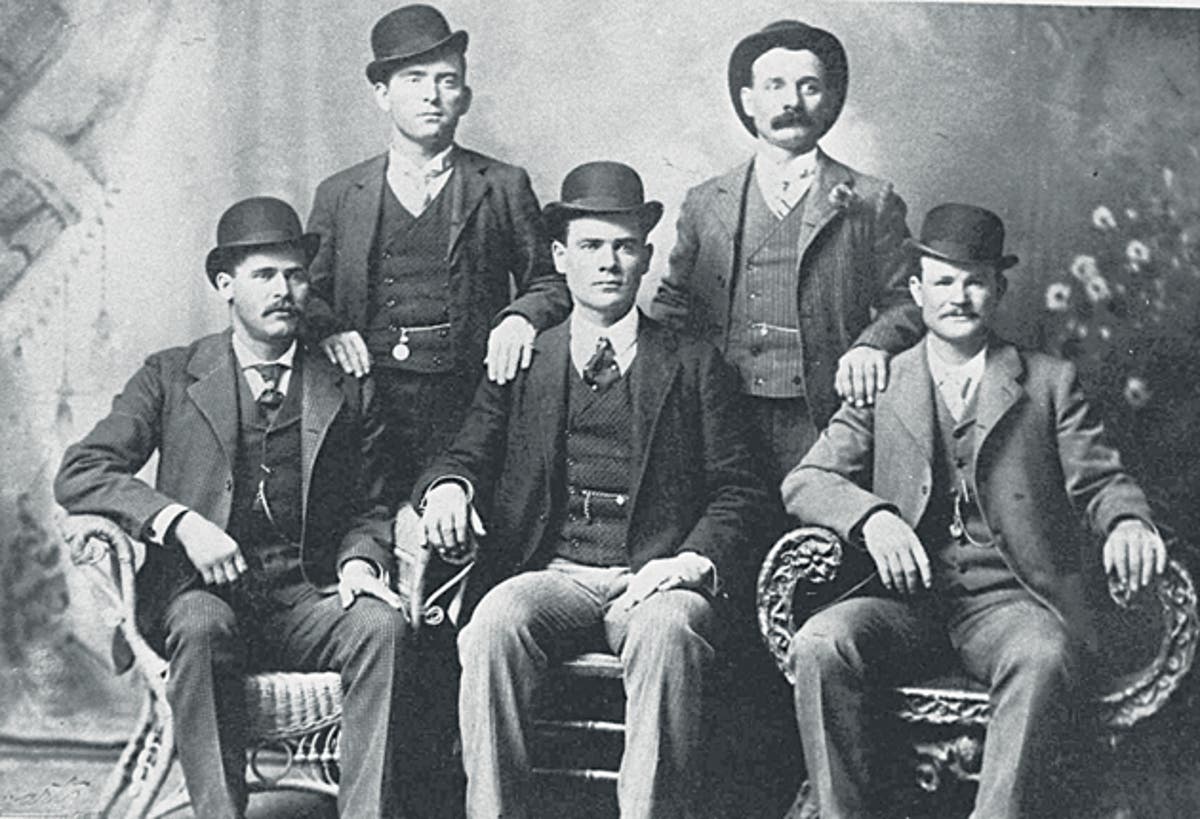
The 1899 "Fort Worth Five" photo.
Top row, left to right: William Carver and Harvey Logan.
Bottom row, left to right: Harry Longabaugh (the Sundance Kid),
Ben Kilpatrick, and Robert Parker (Butch Cassidy).

November 7, 1908: In San Vicente, Bolivia, soldiers engage in a shootout with 2 men who had robbed the payroll of a silver mine. The robbers were found dead: Apparently, with both men wounded, one shot the other to put him out of his misery, and then used his last bullet on himself.
The local authorities confirmed that these men were the robbers, but they did not know the men's names. The widely-accepted story is that the men were Robert Leroy Parker and Harry Alonzo Longabaugh -- a.k.a. the American outlaws known as Butch Cassidy and the Sundance Kid, respectively.
Butch and Sundance were the last of the major Wild West outlaws. From 1889 to 1901, with their Wild Bunch gang, they robbed banks and trains throughout the Rocky Mountain States, especially Parker's native Utah (which gained Statehood in 1896). In 1901, along with Longabaugh's girlfriend Etta Place, they escaped to New York, and then took a ship to South America: First to Argentina, then to Chile, and finally to Bolivia, in the hopes of becoming respectable ranchers.
But they couldn't make an honest living, so they turned back to robbery, which is why they had to leave Argentina and then Chile. Finally, in 1906, Place got tired of living on the run, and went back to America. History loses track of her after that.
Attempts to determine whether Butch and Sundance actually were the men killed in the San Vicente shootout have thus far failed. It has been alleged, including by Cassidy's sister, that Butch left Bolivia and was still alive as late as 1937. (He would have been 72.) A suggestion that Sundance was still alive as late as 1936 has been proven by DNA testing to be false, but, so far, that's as close as DNA testing has come to proving anything. Among the stories, it has been suggested that Etta may have been alive as late as 1966.
For all we know, the old Utah and Wyoming bank and train robbers of the 1890s may well have had a good laugh about it all for a long time thereafter.
Among the depictions of Butch and Sundance: The 1951 film The Texas Rangers (played by John Doucette and Ian MacDonald, respectively), the 1956 film The Three Outlaws (Neville Brand and Alan Hale Jr.), a 1958 episode of Tales of Wells Fargo (only Butch appears, played by a young Charles Bronson), the 1969 film Butch Cassidy and the Sundance Kid (Paul Newman and Robert Redford, with Katharine Ross as Etta), the 1979 film Butch and Sundance: The Early Days (Tom Berenger and William Katt), the 1994 TV-movie The Gambler V: Playing for Keeps (Scott Paulin and Brett Cullen, with Mariska Hargitay as Etta), and the 2004 TV-movie The Legend of Butch & Sundance (David Clayton Rogers and Ryan Browning, with Rachelle Lefevre as Etta).
*
November 7, 1908 was a Saturday. Baseball was out of season. Basketball and hockey were not yet professional. But there was college football to be played. Among the games:
* The Polo Grounds in New York hosted a crowd of 10,000, as undefeated Dartmouth (5-0-1) beat previously undefeated Princeton (5-0-3), 10-6.
* Harvard and the Carlisle Indian School (with Jim Thorpe not yet playing) were both 6-0-1 when facing each other in Cambridge, Massachusetts, and Harvard won, 17-0.
* Yale, undefeated, blew a 10-0 lead at home in New Haven, Connecticut, and escaped with a 10-10 with Brown.
* The University of Pennsylvania beat Lafayette, 34-4 at the original Franklin Field (built in 1895, replaced in 1922) in Philadelphia. They finished 11-0-1, and were recognized as the National Champions. A 6-6 tie with Carlisle was the only blemish on their record, though it should be noted that they didn't play either Harvard, Yale or Princeton. They did go on to beat Michigan, though.
* The University of Pittsburgh undefeated, stayed that way, beating the school that would become their arch-rivals, West Virginia, 11-0 at Exposition Park, home of baseball's Pirates. In their 1st 7 games, Pitt had outscored their opponents 128-4. But they lost 3 of their last 4 games, all at home.
* Army beat Springfield, 6-5 at West Point, New York.
* Navy beat Villanova, 30-6 at Annapolis, Maryland.
* Michigan beat Kentucky, 62-0 at Ann Arbor, Michigan.
* Notre Dame beat Indiana, 11-0 at Washington Park in Indianapolis.
* New York University lost to Rensselaer Polytechnic Institute. RPI beat NYU, 11-0 in Troy, New York.
* And Rutgers could only manage a 6-6 tie with Delaware.

Saturday, November 5, 2022

November 6, 1869: The 1st American Football Game

The First Game, painted in 1968 by Arnold Friberg,
commissioned for the 1969 College Football Centennial

November 6, 1869: What is generally recognized as the 1st college football game -- and the 1st game of what is usually, outside the United States, called "American football" -- is played. Rutgers College plays the College of New Jersey, on Rutgers' campus in New Brunswick.

Legend has it that the impetus for the game was Rutgers wanting to redeem its honor after losing the 1st-ever baseball game between the schools, on May 2, 1866, 42-0 on CNJ's campus in Princeton, 18 miles down the road that would become the Lincoln Highway and then New Jersey Route 27 -- known as Albany Street, French Street and Somerset Street in New Brunswick, and Nassau Street in Princeton.

The game is essentially a very large soccer game, with a round leather ball, and 25 men on a side. As agreed upon before the game, by Captains William Leggett of Rutgers and William Gummere of CNJ, there was no clock, and the 1st team to 6 goals would win.

The Rutgers men, finding the color inexpensive to obtain, wrap scarlet red cloth around their heads like turbans, so that they can tell each other apart on the field. Thus did they invent school colors and, in a way, the football helmet.

The men of Old Queens must have had less trouble telling team from team than did the men of Old Nassau, as Rutgers won, 6-4 -- that's 6 goals to 4, or 42-28 under today's scoring system.

The next week, the CNJ men returned the favor in Princeton. As before, the home team set the rules, with 8 goals to win. They also wanted "fair catches," which Rutgers had denied them the week before. This played to the Nassau men's strength, and they won, 8-0. There was supposed to be a 3rd game, but the colleges' presidents got together,  and decided that too much emphasis was being placed on athletics, and forbade it.

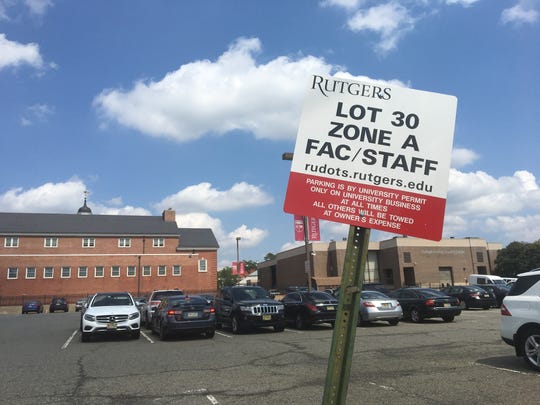
The field where "the first football game" was played is now the parking lot for Rutgers' College Avenue Gym. Rutgers played at College Field until 1891, then opened Neilson Field across the street, playing there until 1938, when Rutgers Stadium opened across the River in Piscataway. The Alexander Library, the school's main library, was built on the site of Neilson Field in 1953. Rutgers Stadium was replaced on the same site by what's now named SHI Stadium in 1994, while they played their 1993 home games, and many others from 1976 to 2009, at Giants Stadium.
The site of College Field today. In the background,
College Avenue Gym (left) and the Rutgers Student Center.

George Large of Rutgers was the last surviving player from this game, living until August 15, 1939, age 88. The native of Readington, Hunterdon County played on the Rutgers side, and in 1888 served as President of the State Senate, making him the Acting Governor on a few occasions.
Plaque inside the Gym

In 1874, Harvard University would accept a challenge from McGill University in Montreal, and discover on the McGill men's arrival that by "football," McGill meant "rugby," not "soccer." Adjustments were made, Harvard liked the results, and convinced the other "football"-playing schools to join them in this adaptation of "football." In 1906, the forward pass was legalized and hashmarks prevented dangerous scrimmages close to the sideline. "Football" as America knows it now was on its way.

In 1896, the College of New Jersey changed its name to Princeton University, while a nearby school would later be founded as Trenton State College, and change its name to The College of New Jersey. Rutgers College would become, and remains, the centerpiece of the larger system of Rutgers, The State University of New Jersey.

Princeton's nickname, the Tigers, would inspire 2 professional team names: Baseball's Detroit Tigers and the Canadian Rugby Union's Hamilton Tigers, now the Canadian Football League's Hamilton Tiger-Cats.

Rutgers was known as "The Queensmen" until 1925, when they became the Chanticleers, after a fighting rooster. The school's literary magazine was already called The Chanticleer. But this carried the connotation of "chicken" -- and, as the University of South Carolina has found out with their similarly-named Gamecocks, they can be called "Cocks." In 1955, head coach Harvey Harman recommended the change to the Scarlet Knights, and such they have been ever since.
The West Stand of what's now named SHI Stadium

Rutgers continues to bill itself as "The Birthplace of College Football," or simply "The Birthplace." You know the joke: Rutgers invented football in 1869, and they haven't done a damn thing since. It's not completely true -- they had undefeated seasons in 1961 and 1976, won 6 bowl games between 2006 and 2014, and shared the Big East Conference Championship in 2012 -- but it sure feels like it at times.
Statue outside the stadium's North End

After that 1st game, Rutgers did not beat Princeton again until the dedication game for the original Rutgers Stadium in Piscataway, in 1938, going 0-33 in between. But, starting in 1958, Rutgers won 4 straight, before Princeton then won 6 straight.

Rutgers began to dominate the rivalry in 1968. They wanted "bigger-time football" in the 1970s, and started recruiting better, to the point where Princeton, wanting to stay in the Ivy League, couldn't keep up. Rutgers won the last 5 games before Princeton decided to stop playing them, including the finale, on September 27, 1980, a 44-13 win in Piscataway. Nevertheless, Princeton still leads the all-time rivalry, 53-17-1, despite Rutgers going 9-3-1 from 1968 onward.

The rivalry remains intense in other sports, including basketball.

*

November 6, 1869 was a Saturday. You might think that there were no other scores on this historic day. But you'd be wrong. The 1st openly professional baseball team wrapped up its season that day: The Cincinnati Red Stockings beat the Mutual Base Ball Club of New York, 17-8 at the Union Grounds in the Williamsburg section of Brooklyn.   

November 5, 1938: Rutgers Stadium Opens

Program from the dedication game

November 5, 1938: Rutgers Stadium opens in Piscataway, Middlesex County, New Jersey, across the Raritan River from the New Brunswick campus of Rutgers College, now called Rutgers University.

For the 1st time since they played each other in the 1st college football game in 1869 -- 69 years minus 1 day earlier -- Rutgers beat Princeton, 20-18.

Rutgers had begun the season playing home games in New Brunswick, at Neilson Field, where they had been playing since 1892. They finished the 1938 season 7-1, their only loss coming at Neilson Field, to New York University (NYU), 25-6.

Before 1892, including that 1869 game, they had played at College Field. In 1931, the College Avenue Gym and its parking lot were built on the site.

In 1953, the Alexander Library, the hub of RU's University Library system, was built on the site of Neilson Field. As far as I know, Rutgers is the only school that tore down a football stadium and built a library on the site. Can you imagine that happening at another school that's now in the Big Ten? Or in the South?
The 1938 Rutgers Stadium, late in its tenure

RU would continue to play home games in football, and sometimes soccer and lacrosse, at the 23,000-seat Rutgers Stadium until 1992. By the time of their undefeated season in 1976, when they committed to playing what they called "bigger time" football, the stadium was hopelessly outdated, and they had begun playing games at Giants Stadium at the Meadowlands.

It was far larger, but well off campus, and visiting teams sometimes drew in bigger crowds, making it seem like a home game. Example: Army's Michie Stadium is 82 miles from Piscataway, but only 48 miles from the Meadowlands.

While RU played their 1993 home games at Giants Stadium, the old stadium was demolished, and replaced with a 41,000-seat modern Rutgers Stadium that opened in 1994. It was renamed High Point Solutions Stadium in 2011, HighPoint.com Stadium in 2017, and SHI Stadium in 2019. It now seats 52,454.
The current Rutgers stadium

*

November 5, 1938 was a Saturday. These other notable college football games were played:

* The University of Pittsburgh, then ranked Number 1, were by their neighbors, Number 19 Carnegie Tech, 20-10 at Pitt Stadium. This ended a 22-game unbeaten streak for the Panthers (20-0-2). Both teams used Pitt Stadium as their home field, and Carnegie Tech became Carnegie Mellon University in 1967.

* The Number 3 team in the country also lost: California lost to Number 13 USC, 13-7 at the Los Angeles Coliseum.

* The Number 2 team, Texas Christian University, a.k.a. TCU of Fort Worth, beat the University of Tulsa, 21-0 at Skelly Field in Tulsa. TCU jumped to Number 1, won the Southwest Conference title, and beat Carnegie Tech, then ranked Number 6, in the Sugar Bowl to finish 11-0. Their quarterback, a lefthander named Davey O'Brien, was awarded the Heisman Trophy.

* Number 4 Notre Dame beat Navy, 15-0, in a game moved from the Naval Academy in Annapolis, Maryland to Municipal Stadium in Baltimore, to take advantage of the much higher seating capacity. Memorial Stadium would be built on the site in 1954. Notre Dame would blow its shot at the National Championship by losing to USC.

* Number 6 Tennessee beat the University of Chattanooga, 45-0 at Shields-Watkins Field in Knoxville, Tennessee. (It was later renamed for Tennessee's head coach, Bob Neyland.) Tennessee rose to Number 2, and then beat Number 4 Oklahoma in the Orange Bowl to finish 11-0. The polls split the National Championship between TCU and Tennessee.

* Number 12 Minnesota beat Iowa, 28-0 at Memorial Stadium in Minneapolis. They went on to win the Big Ten.

And 2 games were played in the NHL. The Chicago Black Hawks beat the Montreal Canadiens, 3-2 at the Montreal Forum; and the Boston Bruins beat the Detroit Red Wings, 4-1 at the Olympia Stadium in Detroit. 

Also, Arsenal lost to Leeds United, 3-2 at Highbury in North London.

And César Luis Menotti, who managed Argentina to win the 1978 World Cup on home soil, was born on this day.

Tuesday, November 1, 2022

November 2, 1880: James Garfield Wins the Closest Presidential Election

November 2, 1880: James Abram Garfield is elected the 20th President of the United States, in one of the narrowest races ever. In fact, in terms of total popular vote, it remains the closest ever.

The Republican nominee, Garfield, 46, had been elected to Congress from Ohio in 1862, was commissioned a General in the Union Army for the American Civil War without losing his seat. In 1880, the Ohio legislature elected him to a seat in the U.S. Senate. But he never took it, because the Republican Convention nominated him for President.

The Democratic nominee was Winfield Scott Hancock, a 56-year-old native of a small town outside Philadelphia, named for the losing Whig Party candidate of 1852, who had already been a war hero since the War of 1812, 40 years before that. Known as Hancock the Superb, and as The Thunderbolt of the Army of the Potomac for his heroism at the Battle of Gettysburg in 1863, had never previously held political office.
Winfield Scott Hancock

Hancock received 4,444,260 votes, losing by a margin of 1,898 votes, to Garfield's 4,446,158. But it's Electoral Votes that matter, although that was also close: Garfield won 214 to Hancock's 155. Each man won 19 States. Whether the Republicans stole the votes of any State, as they had for Rutherford B. Hayes 4 years earlier, has never been seriously suggested, or proven.

No one State would have helped Hancock. Garfield won the 21 Electoral Votes of New York, then the largest State, by 21,033 votes. Had Hancock won the State, that would still have left the Electoral Vote at a 193-176 Garfield victory.

Garfield was inaugurated on March 4, 1881. On July 2, he was shot. He could have survived, but his doctors' incompetence led to an inability to find the bullet, and a subsequent infection that killed him on September 19. Only William Henry Harrison died earlier upon his Inauguration than Garfield's 200 days.

Hancock didn't fare a whole lot better. He developed diabetes, chose not to run again in 1884, and died in 1886.

Chester Arthur, Garfield's Vice President and successor, also got sick, with kidney disease, did not run for a term of his own in 1884, and died in 1886. Samuel Tilden, cheated out of the Presidency in 1876, did not run in 1880 or 1884, and he, too, died in 1886. None of them lived to see what would have been the end of the Garfield-Arthur ticket's 2nd term -- or, had they won, that of Hancock and his running mate, former Congressman William H. English of Indiana. He lived until 1896.

*

November 2, 1880 was a Tuesday. This was before Saturday was standardized as the day for college football. On this day, the College of New Jersey defeated their arch-rivals, Rutgers, 8-0 in Princeton, New Jersey. The College would rename itself for its town in 1896: Princeton University.

Also on the day, Stevens Institute of Technology beat City College of New York, 6-0 at Stevens' field in Hoboken, New Jersey. CCNY would drop football entirely, while Stevens Tech became an NCAA Division III school.

And Harvard, having hosted Montreal's McGill University in 1875, in a game that changed the course of football in North America, traveled to Montreal, and, on this date, played the Montreal Football Club to a 0-0 tie.

Thursday, October 27, 2022

October 28, 1922: The Rose Bowl Stadium Opens

October 28, 1922: The Rose Bowl stadium opens in the Los Angeles suburb of Pasadena, California. And the matchup for the opener couldn't have been better: A battle of unbeatens.

The University of California, from the system's main campus in Berkeley, outside San Francisco, was 4-0, and took on the 5-0 team from the University of Southern California, based in Los Angeles. A safety gave Cal a 2-0 lead at halftime, and the Golden Bears held on 2 goal-line stands, before adding a touchdown and a field goal to beat USC, 12-0.

On January 1, 1923, the Rose Bowl game, previously played at the 40,000-seat Tournament Park, was played there for the 1st time. This time, USC won, beating Penn State 14-3. The Rose Bowl has been played there annually since, except for 1942, when concerns over the bombing of Pearl Harbor led it to be moved to Durham, North Carolina, where host Duke lost to Oregon State; and 2021, when it was moved to Arlington, Texas due to COVID restrictions.

Originally a horseshoe, an expansion in 1928 made it the largest stadium in the country. Attendance peaked at 106,869, for the 1973 Rose Bowl, in which USC beat Ohio State 42-17. A renovation in 2013, with wider seats, dropped seating capacity to 92,542.

It was the home field for Caltech from 1923 to 1976, California State University at Los Angeles from 1957 to 1969, the North American Soccer League's the Los Angeles Wolves in 1968 and Los Angeles Aztecs in 1978 and '79, and MLS' Los Angeles Galaxy from 1996 to 2002. UCLA have played home games there sine 1982.

It has also hosted the 1983 Army-Navy Game (Navy won, 42-13), 8 games of the 1994 World Cup (including the U.S.' win over Colombia and loss to Romania, and Brazil's win over Italy in the Final), 4 games of the 1999 Women's World Cup (including the U.S.' win over China in the Final), cycling at the 1932 Olympics, and soccer at the 1984 Olympics.

And it has hosted 5 Super Bowls: XI, 1977, the Oakland Raiders beating the Minnesota Vikings 32-14; XIV, 1980, the Pittsburgh Steelers beating the Los Angeles Rams 31-19; XVII, 1983, the Washington Redskins beating the Miami Dolphins 27-17; XXI, 1987, the New York Giants beating the Denver Broncos 39-20; and XXVII, 1993, the Dallas Cowboys beating the Buffalo Bills 52-17.

*

October 28, 1922 was a Saturday. There was another major college football milestone: For the 1st time, a football game is broadcast on live nationwide radio. The year before, the University of Chicago had become one of the first colleges to send its football team to play a team outside its home region, beating Princeton University 9-0 at Palmer Stadium in Princeton, New Jersey. Now, they would have a rematch at Stagg Field on the South Side of Chicago.

The Princeton Tigers entered the game 4-0, the Chicago Maroons 3-0. After 3 quarters, thanks to 3 touchdowns by John Thomas, Chicago led 18-7. Then came the kind of collapse people would still be talking about nearly a century later if it had happened on TV and the footage had been preserved. The Maroons fumbled, the Tigers recovered, and took it in for a 40-yard touchdown. Harry Crum scored for Princeton in the closing minutes, and, since Princeton made their PATs, and Chicago didn't make theirs, the Tigers emerged victorious, 21-18.

On the basis of the win over Chicago, Eastern and Midwestern sportswriters proclaimed Princeton to be the National Champions after the season. Western writers gave the title to Cal. No playoff in those days. Bowl games? Cal had won the Rose Bowl in 1920 and tied it in 1921, but in 1922 and 1923, they didn't go. From September 25, 1920 to October 3, 1925, under coach Andy Smith, the Golden Bears had a 50-game unbeaten streak, still the longest in college football history: Played 50, won 46, tied 4, lost exactly none.

Coaching took a severe toll on Smith, who went just 6-3 with Cal in 1925. On a visit to Philadelphia, where he had coached the University of Pennsylvania from 1909 to 1912, he was hospitalized with pneumonia, and died on January 8, 1926, only 49 years old. His career coaching record was 116-32-13, including 74-16-7 at Cal.

This was also the day that Benito Mussolini's Fascists marched on Rome. I have a separate entry for that event. And on the opposite end of the political spectrum, if not quite on the opposite end of the Eurasian continent, the Communists finally completed their conquest of Russia, as the Red Army conquered the Siberian port city of Vladivostok. The Reds would be in power in Russia for the next 69 years, the Fascists in Italy for 21 years.

Also on this day, basketball coach Butch van Breda Kolff and French soccer star Ernest Vaast were born.

The Major League Baseball season had ended earlier in the month, with the New York Giants winning the World Series over the New York Yankees. There was, as yet, no major professional basketball league. The National Hockey League's new season was still a few weeks away. The nascent National Football League did play games that weekend, but all the next day, Sunday.

But, being a Saturday, there were college football games. In addition to Cal vs. USC and Princeton vs. Chicago, including the following:

In New York City, New York University played Rhode Island State at Ohio Field in The Bronx, and won 23-7. Fordham University played Westminster College of Pennsylvania at Fordham Field, also in The Bronx, and won 12-0. Columbia University wasn't so lucky: They played Williams College of Massachusetts, at South Field, just south of their famed Low Library in the Morningside Heights section of Manhattan, and lost 13-10.

And, aside from Princeton the main team in New Jersey, Rutgers University went to Morgantown and lost to West Virginia University 28-0.

Also, in English soccer, Arsenal lost to Newcastle United, 2-1 at the Arsenal Stadium, a.k.a. Highbury, in North London.

October 28, 1922: The March On Rome

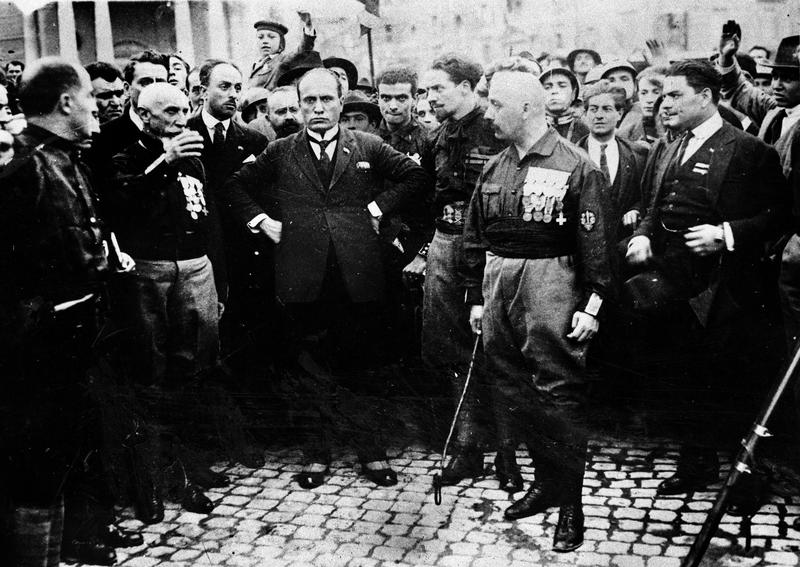
October 28, 1922: The March on Rome takes place. It was an organized mass demonstration by 25,000 right-wing Blackshirt paramilitary men, representing the National Fascist Party, led by Benito Mussolini, seeking to rescue Italy from the economic and social chaos of the post-World War I world.

Prime Minister Luigi Facta told King Victor Emmanuel III that he wanted to declare a state of siege, but the King, conservative like most European monarchs tended to be then, and sympathetic to the Fascists, overruled him. The next day, the King dismissed Facta, and gave the job to Mussolini.

For the next 21 years, Mussolini ruled Italy with an iron fist, having opponents killed, including Socialist Party leader Giacomo Matteotti in 1924; aiding the Fascist movement in Spain during that country's Civil War of 1936 to 1939; and expanding Italy's influence into Africa, taking over Libya and Ethiopia, in an attempt to establish a new Roman Empire with himself as Caesar.

Mussolini considered Fascism to be the direct opposite of liberalism’s opposite. In article in the 1932 edition of the Enciclopedia Italiana, he wrote, “Fascism should more appropriately be called Corporatism because it is a merger of state and corporate power.” As the 1930s proved, Fascism also includes militarism and nationalism, which, inevitably, includes bigotry -- if not at first, then, eventually, lurching toward it and eventually carrying it out on a governmental level.

The American journalist George Seldes, whom Mussolini had befriended on the way up in the hopes of gaining American patrons, turned on him after gaining power. Seldes then wrote a biography of Mussolini, titled Sawdust Caesar. 

And in aiding the Fascists in Spain, led by Generalissimo Francisco Franco, Mussolini sent troops, which became known as Franco's Italian Army. That name would later be adopted by a family that owned an Italian restaurant in Pittsburgh, to honor Pittsburgh Steelers running back Franco Harris, whose mother grew up in Italy under Mussolini -- but whose father was an African-American soldier who participated in the liberation of Italy from Fascism, and married her and took her to America.

While Harris always showed appreciation to the restaurateurs and the other Steeler fans, it is not known if it made him uncomfortable to know what Francisco Franco did in Spain and Benito Mussolini did in Ethiopia, before that country was liberated.

Mussolini was deposed in 1943, and executed in 1945. And that old saying, "At least he made the trains run on time"? It was a myth: On the average, the trains in Italy ran no better than they did before he took over.

At heart, Italy is a conservative country. But, since World War II, more of its governments have been left of center rather than right. When one government falls, it is usually replaced by another leftward one. An exception was Silvio Berlusconi, the broadcast executive whose Forza Italia party is economically and socially conservative. He served as Prime Minister in 1994 and '95, from 2001 to 2006, and 2008 to 2011.

But on September 25, 2022, a right-wing party named Fratelli d'Italia, meaning "Brothers of Italy," won the most seats, and built a coalition that made its Leader -- ironically, given the name of the party, a woman, Giorgia Meloni -- the new Prime Minister. She will be Italy's furthest-right head of government since Mussolini, noticeably further to the right than Berlusconi.

*

October 28, 1922 was a Saturday. The Major League Baseball season had ended earlier in the month, with the New York Giants winning the World Series over the New York Yankees. There was, as yet, no major professional basketball league. The National Hockey League's new season was still a few weeks away. The nascent National Football League did play games that weekend, but all the next day, Sunday.

But, being a Saturday, there were college football games. One was the 1st football game ever broadcast on live nationwide radio. The year before, the University of Chicago had become one of the first colleges to send its football team to play a team outside its home region, beating Princeton University 9-0 at Palmer Stadium. Now, they would have a rematch at Stagg Field on the South Side of Chicago.

The Princeton Tigers entered the game 4-0, the Chicago Maroons 3-0. After 3 quarters, thanks to 3 touchdowns by John Thomas, Chicago led 18-7. Then came the kind of collapse people would still be talking about nearly a century later if it had happened on TV and the footage preserved. The Maroons fumbled, the Tigers recovered, and took it in for a 40-yard touchdown. Harry Crum scored for Princeton in the closing minutes, and, since Princeton made their PATs and Chicago didn't, the Tigers emerged victorious, 21-18. 

Another battle of unbeatens took place at the new Rose Bowl stadium in the Los Angeles suburb of Pasadena. The University of California, from the system's main campus in Berkeley, outside San Francisco, was 4-0, and took on the 5-0 team from the University of Southern California, based in Los Angeles. A safety gave Cal a 2-0 lead at halftime, and the Golden Bears held on 2 goal-line stands, before adding a touchdown and a field goal to win 12-0. I have a separate entry for this event.

On the basis of the win over Chicago, Eastern and Midwestern sportswriters proclaimed Princeton to be the National Champions after the season. Western writers gave the title to Cal. No playoff in those days. Bowl games? Cal had won the Rose Bowl in 1920 and tied it in 1921, but in 1922 and 1923, they didn't go. From September 25, 1920 to October 3, 1925, under coach Andy Smith, the Golden Bears had a 50-game unbeaten streak, still the longest in college football history: Played 50, won 46, tied 4, lost exactly none.

Coaching took a severe toll on Smith, who went just 6-3 with Cal in 1925. On a visit to Philadelphia, where he had coached the University of Pennsylvania from 1909 to 1912, he was hospitalized with pneumonia, and died on January 8, 1926, only 49 years old. His career coaching record was 116-32-13, including 74-16-7 at Cal.

In New York City, New York University played Rhode Island State at Ohio Field in The Bronx, and won 23-7. Fordham University played Westminster College of Pennsylvania at Fordham Field, also in The Bronx, and won 12-0. Columbia University wasn't so lucky: They played Williams College of Massachusetts, at South Field, just south of their famed Low Library in the Morningside Heights section of Manhattan, and lost 13-10.

And, aside from Princeton the main team in New Jersey, Rutgers University went to Morgantown and lost to West Virginia University 28-0.

Also, Arsenal FC lost to Newcastle United, 2-1 at the Arsenal Stadium, a.k.a. Highbury, in North London. 

Monday, October 24, 2022

October 24, 1914: Palmer Stadium Opens In Princeton

October 24, 1914: Palmer Stadium opens, on the southern edge of the campus of Princeton University in Princeton, Mercer County, New Jersey. Princeton defeats Dartmouth College, 16-12.

Prior to Palmer Stadium, Princeton played at University Field, also known as Osborne Field, about 3 blocks to the north of the Palmer site. It seated 20,000, and they continued to play baseball at the site until 1960, when the Engineering Quadrangle began to be built on the site.

The building was named for Stephen S. Palmer, a trustee of the university, by his son, Edgar Palmer III. It was a horseshoe with the open end at the south, facing Lake Carnegie, with a full-sized track around the football field. (In 1936, Edgar Palmer III also funded the building of the centerpiece of the Borough of Princeton, Palmer Square.)

While playing at Palmer Stadium, Princeton won 5 National Championships: 1920, 1922, 1933, 1935 and 1950. The Ivy League was founded in 1954, and in 2021, Princeton won its 12th Ivy League title.

Briefly, in the early 1970s, when the New York Giants needed a temporary home between the October 1973 closing of the original Yankee Stadium and the October 1976 opening of Giants Stadium. Palmer Stadium was considered, due to its relative proximity and its 45,750-seat capacity -- larger than Michie Stadium at West Point, and twice the capacity of Rutgers Stadium.

Traffic and parking would have been a nightmare, but the real reason it was voted down was that the NFL now had a rule that games had to be played in stadiums of at least 50,000 capacity. That rule was bent for the Tennessee Oilers (1998) and the Los Angeles Chargers (2017-19), but not for the Giants in the 1970s.

On October 10, 1987, I was at Palmer Stadium to see Princeton play Columbia. Dean Cain, later to play Superman on television, intercepted a pass and returned it for a touchdown, and Princeton won, 38-8. It was Columbia's 35th consecutive loss, setting a new record for the longest in NCAA Division I history. Oddly, the next season, they ended that streak by beating Princeton at home, at 44 games. Prairie View A&M put that record out of reach, losing 80 straight from 1989 to 1998.
Palmer Stadium as I knew it,
with Jadwin Gym in the background

By the time of that 1987 Princeton-Columbia game Palmer Stadium was already in bad shape. It remained the Princeton Tigers' home until 1996, when, finally bowing to the reality that age had rendered it unsafe, the University agreed to tear it down and build a new home field on the site.

As with the 1st game, the last game was against Dartmouth, on November 23, 1996, and Princeton lost, 24-0. (To be fair, Dartmouth was then ranked Number 18 in the nation, and finished the season undefeated.) Only 16,461 fans came out to say goodbye. The days of Princeton football really mattering were long gone.

Princeton played all their 1997 games on the road while Powers Field at Princeton University Stadium was built on the site. Amazingly, they went 6-4. They did play 2 games in New Jersey. They beat Fordham before 4,050 fans at Lions Field in Ewing, home of the school formerly known as Trenton State College, but which, in 1996, had just taken on the name that Princeton University, itself, had until 1896: "The College of New Jersey." And they beat Yale at Giants Stadium (roughly halfway between the schools), in front of 7,731.

Don't be shocked by those low attendances: Ivy League football is no longer a big draw, and when their game against Penn at Franklin Field got 15,847, it became Princeton's only game all season with more than 8,542. (Penn didn't do much better: With a poor season, it was their only crowd above 13,000 at the 60,000-seat stadium.)

What is usually called simply "Princeton Stadium," with a capacity of 27,773 seats, opened on September 19, 1998. Princeton beat Cornell University, 6-0, before a full house. They had 4 more home games, each with at least 19,000 fans.
Jadwin Gym had opened in front of Palmer Stadium's open south end in 1969. Weaver Track & Field Stadium was built in between Princeton Stadium and Jadwin Gym, giving Princeton a top-class track facility and enabling them to build the stands at their new football stadium close to the field, without a track around it.

In 2007, in honor of a $10 million donation for a new artificial turf field the year before, by William C. Powers, managing director at Pacific Investment Management, and a former Princeton defensive back and punter, the playing surface was renamed Powers Field. The stadium retained the name Princeton Stadium.

*

October 24, 1914 was a Saturday. These other notable college football games were played that day:

* Army beat Holy Cross, 14-0 on The Plain in West Point, New York. Army went 9-0 that season.

* Navy beat Western Reserve, 48-0 at Worden Field in Annapolis, Maryland.

* The University of Chicago beat Purdue, 21-0 at Stagg Field in Chicago.

* Nebraska beat Michigan State, 24-0 at Nebraska Field in Lincoln. Nebraska finished 7-0-1 and won the Missouri Valley Conference title.

* Tennessee beat Alabama, 17-7 at Waite Field in Knoxville, Tennessee. They went 9-0, and won the Southern Intercollegiate Athletic Association title.

* Illinois beat Northwestern, 33-0 at Northwestern Field in the Chicago suburb of Evanston, Illinois. At the time, Northwestern considered Illinois their arch-rivals, but Illinois considered theirs to be Chicago. Illinois went 7-0, and won the title of the Western Conference, which later became the Big Ten.

* Texas beat arch-rival Oklahoma, 32-7 at Fair Park Stadium in Dallas. Texas went 8-0 that season, and won the 1st-ever Southwest Conference title.

* In what would become a major rivalry, Minnesota beat Iowa, 7-0 at Iowa Field in Iowa City.

* Syracuse beat Michigan, 20-6 at Archbold Stadium in Syracuse, New York.

* Penn State stunned Harvard, playing them to a 13-13 tie at Harvard Stadium in Boston.

* Notre Dame, coming off its major upset of Army the season before, beat South Dakota, 33-0 at Sioux Falls, South Dakota.

* In New York City, the Polo Grounds hosted a neutral-site game in which Cornell beat Brown, 28-7; Fordham beat Rhode Island State (known since 1951 at the University of Rhode Island), 28-0 at Fordham Field in The Bronx; and New York University beat Rensselaer Polytechnic Institute: NYU 17, RPI 6, at Ohio Field in The Bronx.

* And New Jersey's other school -- it would be a long time before they could turn Princeton into the Garden State's "other school" -- Rutgers beat Tufts, 16-7 at Neilson Field in New Brunswick.

The baseball season had ended the day before, with the Boston Braves completing a "miracle" 4-game sweep of the Philadelphia Athletics in the World Series. Professional basketball barely existed. It was too early for hockey season to start.

In English soccer, North London team Arsenal went to the East Midlands, and lost to Derby County, 4-0 at The Baseball Ground. Derbyshire was one of the few places in England where baseball caught on, and it wasn't for long, yet the "Baseball Ground" name held until the stadium was replaced in 1997.

Wednesday, October 19, 2022

October 19, 1946: The Rutgers-Princeton "Cannon War"

"Big Cannon," with Nassau Hall behind it

October 19, 1946: Princeton beats Rutgers 14-7 at Rutgers Stadium. An attempt to steal the cannon proves even more embarrassing for RU.

Rutgers University is in New Brunswick, in Middlesex County, New Jersey. (The stadium is across the Raritan River, in Piscataway.) Princeton University is in the town of the same name, in Mercer County. They are separated by 17 miles of State Route 27. In 1869, Rutgers beat Princeton in "the first college football game," in New Brunswick, hence Rutgers calls itself "the Birthplace of College Football."

Two cannons were left on the Princeton campus after the War of the American Revolution, although neither of them were used in the Battle of Princeton of January 3, 1777, as is often claimed. "Big Cannon" is located behind Nassau Hall in the center of the quadrangle there, called "Cannon Green," and "Little Cannon" is situated between Whig and Clio Halls.

For the War of 1812, Big Cannon was transported to New Brunswick to help defend the city against potential attack by the British, remaining on the Rutgers campus, where it was used for training during and after the American Civil War of 1861-65 by Rutgers cadets, until it was taken back to Princeton in 1875 by the "Princeton Blues," a local militia.

On the night of April 25, 1875, 10 members of the Rutgers Class of 1877 set out to take Big Cannon from Princeton. However, they were unable to move it, so instead they returned to New Brunswick with Little Cannon. Princeton responded with a raid on Rutgers, stealing some muskets, and the presidents of the colleges exchanged polite but demanding correspondence. Eventually, a joint committee settled the matter, and Little Cannon was returned to Princeton, escorted by the New Brunswick Police Chief. In other words, Rutgers was forced to cave.

On October 19, 1946, a contingent of Rutgers men slipped onto the Princeton campus, and again tried to steal the famed Big Cannon. This attempt was even more disastrous than the first. They attached one end of a heavy chain to the cannon and the other to their car, a Ford. Surprised by Princeton students and the police, they gunned the engine of the car so hard that the car, weighted down by the cannon, was torn in half. The Rutgers students managed to escape, but with neither the car nor the cannon.

On the eve of the annual Rutgers-Princeton game of 1971, Big Cannon was apparently "stolen" again. A 5-foot-deep hole was found where the cannon sat. Campus police were baffled that the cannon had been taken, given its extreme weight. After crime photos were taken, it appears that a hole had simply been dug next to Big Cannon and the dirt from the hole used to bury it. Reports appeared in the Rutgers newspaper, the Daily Targum, as well as nearby papers such as the New Brunswick-based Daily Home News, the Princeton Packet and The Times of Trenton. (Rutgers won the game, 33-18.)

With Rutgers having committed to "big-time" (sometimes written as "bigger time") football, and Princeton having committed to the smaller-time Ivy League, the schools haven't played each other in football since 1980, a 44-13 Rutgers win in Piscataway, although they still play each other in other sports.
Big Cannon at Princeton is routinely painted red by Rutgers students, particularly in the week leading to Rutgers commencement, as well as on other notable Rutgers dates. In November 2011, a group of Rutgers students who went to paint the cannon in Princeton brought a video camera with them and made a documentary about the tradition.
The footage became part of a larger project about the history of the Cannon War and its perception in the minds of current students today. The film, Knights, Tigers, and Cannons. Oh My!, by Zack Morrison, premiered at the New Jersey Film Festival in September 2012, and won the award for Best Student Film.
*
October 19, 1946 was a Saturday. In other notable college football games:
* Number 1 Army beat Number 11 Columbia, 48-14 at Michie Stadium in West Point, New York.
* Number 2 Notre Dame were idle that week. Notre Dame would play Army in a de facto National Championship game at Yankee Stadium 3 weeks later, but it ended in a 0-0 tie. Notre Dame, naturally, were awarded the National Championship.
* Number 3 Texas beat Number 14 Arkansas, 20-0 at Memorial Stadium in Austin, Texas. Arkansas won the Southwest Conference title, anyway.
* Number 4 UCLA beat the University of California, 13-6 at Memorial Stadium in Berkeley, California. UCLA won the Pacific Coast Conference title.
* Number 5 Michigan and Number 10 Northwestern played to a tie, 10-10 at Michigan Stadium in Ann Arbor.
* Number 6 University of Pennsylvania beat the University of Virginia, 40-0 at Franklin Field in Philadelphia.
* Number 7 Alabama were upset by Number 9 Tennessee, 12-0 at Shields-Watkins Field (later Neyland Stadium) in Knoxville, Tennessee.
* Number 8 Georgia beat Oklahoma A&M (later Oklahoma State), 33-13 at Sanford Stadium in Athens, Georgia.
* Number 12 Louisiana State University were upset by Georgia Tech, 26-7 at Tiger Stadium in Baton Rouge, Louisiana.
* Number 15 North Carolina beat Navy, 21-14 at Municipal Stadium in Baltimore.
* Number 16 Rice beat Southern Methodist University (SMU), 21-7 at Rice Field in Houston. Rice shared the SWC title with Arkansas, but lost the head-to-head tiebreaker. Nevertheless, they were invited to the Orange Bowl, where they beat Tennessee. Rice went to the Cotton Bowl, where they played LSU to a tie.
* Illinois, then unranked, beat Number 20 Wisconsin, 27-21 at Memorial Stadium in Champaign, Illinois. Illinois went on to play UCLA in the Rose Bowl. That was the 1st time that the Champions of the leagues that would come to be known as the Big Ten and the Pac-12 were locked into playing each other in the Rose Bowl. Illinois won, 45-14.
* New York University beat the University of Rochester, 6-0 at River Campus Stadium in Rochester, New York.

* Fordham University lost to St. Mary's of the San Francisco Bay Area, 33-2 at the Polo Grounds.

There were 2 games in the All-America Football Conference. The New York Yankees beat the Brooklyn Dodgers, 21-10 at Yankee Stadium. Yes, that's in football. And the Buffalo Bisons beat the San Francisco 49ers, 17-14 at Civic Stadium (later renamed War Memorial Stadium) in Buffalo.

Baseball season ended 4 days earlier, with the St. Louis Cardinals beating the Boston Red Sox in Game 7 of the World Series. The league that would become the NBA played its 1st game on November 1. The NFL scheduled no games for this day, but the nascent All-America Football Conference played 2. The New York Yankees beat the Brooklyn Dodgers, 21-10 at Yankee Stadium. Yes, there were football teams with those names. And the Buffalo Bisons beat the San Francisco 49eres, 17-14 at Civic Stadium (later War Memorial Stadium) in Buffalo.
And there were 2 NHL games on this day. The Boston Bruins and the Montreal Canadiens played to a tie, 1-1 at the Montreal Forum. And the Toronto Maple Leafs beat the Detroit Red Wings, 6-3 at Maple Leaf Gardens in Toronto. The New York Rangers and the Chicago Black Hawks were not scheduled,
Also on this day, Arsenal defeated Staffordshire team Stoke City 1-0 at Highbury. Kevin O'Flanagan scored the goal. Soccer was not his best sport: He was renowned as a rugby player for Ireland, and excelled in sprint races and the long jump. He was also a noted amateur golfer and tennis player, and played Gaelic football as a boy.
But he's not the most notable player in this game. That would be Albert Sigurður Guðmundsson. Although this is the 1st of only 2 League matches he plays for Arsenal, it makes him the 1st native of Iceland ever to play professional soccer. He later served his country as Minister of Finance.

December 31, 1999 & January 1, 2000: The Millennium

December 31, 1999:  The Millennium arrives. The people of planet Earth survived. At a terrible cost. But we hadn't destroyed ourselves. ...