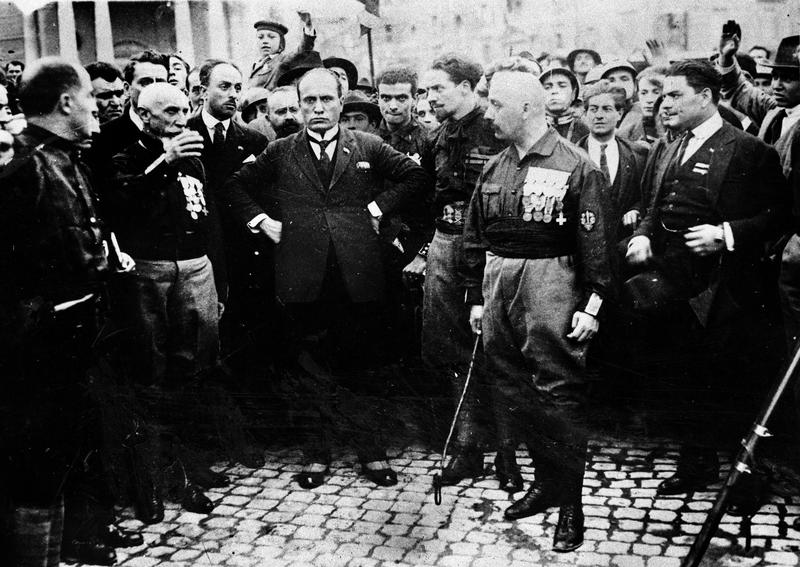
October 28, 1922: The March on Rome takes place. It was an organized mass demonstration by 25,000 right-wing Blackshirt paramilitary men, representing the National Fascist Party, led by Benito Mussolini, seeking to rescue Italy from the economic and social chaos of the post-World War I world.
Prime Minister Luigi Facta told King Victor Emmanuel III that he wanted to declare a state of siege, but the King, conservative like most European monarchs tended to be then, and sympathetic to the Fascists, overruled him. The next day, the King dismissed Facta, and gave the job to Mussolini.
For the next 21 years, Mussolini ruled Italy with an iron fist, having opponents killed, including Socialist Party leader Giacomo Matteotti in 1924; aiding the Fascist movement in Spain during that country's Civil War of 1936 to 1939; and expanding Italy's influence into Africa, taking over Libya and Ethiopia, in an attempt to establish a new Roman Empire with himself as Caesar.
Mussolini considered Fascism to be the direct opposite of liberalism. In article in the 1932 edition of the Enciclopedia Italiana, he wrote, "Fascism should more appropriately be called Corporatism because it is a merger of state and corporate power." As the 1930s proved, Fascism also includes militarism and nationalism, which, inevitably, includes bigotry -- if not at first, then, eventually, lurching toward it and eventually carrying it out on a governmental level.
He also launched what would later be called a "cult of personality," in which the leader and the nation became inseparable, much as King Louis XIV of France once proclaimed, "I am the state."
The American journalist George Seldes, whom Mussolini had befriended on the way up in the hopes of gaining American patrons, turned on him after gaining power. Seldes then wrote a biography of Mussolini, titled Sawdust Caesar.
And in aiding the Fascists in Spain, led by Generalissimo Francisco Franco, Mussolini sent troops, which became known as Franco's Italian Army. That name would later be adopted by a family that owned an Italian restaurant in Pittsburgh, to honor Pittsburgh Steelers running back Franco Harris, whose mother grew up in Italy under Mussolini -- but whose father was an African-American soldier who participated in the liberation of Italy from Fascism, and married her and took her to America.
While Harris always showed appreciation to the restaurateurs and the other Steeler fans, it is not known if it made him uncomfortable to know what Francisco Franco did in Spain and Benito Mussolini did in Ethiopia, before that country was liberated.
Mussolini was deposed in 1943, and executed in 1945. And that old saying, "At least he made the trains run on time"? It was a myth: On the average, the trains in Italy ran no better than they did before he took over.
At heart, Italy is a conservative country. But, since World War II, more of its governments have been left of center rather than right. When one government falls, it is usually replaced by another leftward one. An exception was Silvio Berlusconi, the broadcast executive whose Forza Italia party is economically and socially conservative. He served as Prime Minister in 1994 and '95, from 2001 to 2006, and 2008 to 2011.
But on September 25, 2022, a right-wing party named Fratelli d'Italia, meaning "Brothers of Italy," won the most seats, and built a coalition that made its Leader -- ironically, given the name of the party, a woman, Giorgia Meloni -- the new Prime Minister. She will be Italy's furthest-right head of government since Mussolini, noticeably further to the right than Berlusconi.
*
October 28, 1922 was a Saturday. The Major League Baseball season had ended earlier in the month, with the New York Giants winning the World Series over the New York Yankees. There was, as yet, no major professional basketball league. The National Hockey League's new season was still a few weeks away. The nascent National Football League did play games that weekend, but all the next day, Sunday.
But, being a Saturday, there were college football games. One was the 1st football game ever broadcast on live nationwide radio. The year before, the University of Chicago had become one of the first colleges to send its football team to play a team outside its home region, beating Princeton University 9-0 at Palmer Stadium. Now, they would have a rematch at Stagg Field on the South Side of Chicago.
The Princeton Tigers entered the game 4-0, the Chicago Maroons 3-0. After 3 quarters, thanks to 3 touchdowns by John Thomas, Chicago led 18-7. Then came the kind of collapse people would still be talking about nearly a century later if it had happened on TV and the footage preserved. The Maroons fumbled, the Tigers recovered, and took it in for a 40-yard touchdown. Harry Crum scored for Princeton in the closing minutes, and, since Princeton made their PATs and Chicago didn't, the Tigers emerged victorious, 21-18.
Another battle of unbeatens took place at the new Rose Bowl stadium in the Los Angeles suburb of Pasadena. The University of California, from the system's main campus in Berkeley, outside San Francisco, was 4-0, and took on the 5-0 team from the University of Southern California, based in Los Angeles. A safety gave Cal a 2-0 lead at halftime, and the Golden Bears held on 2 goal-line stands, before adding a touchdown and a field goal to win 12-0. I have a separate entry for this event.
On the basis of the win over Chicago, Eastern and Midwestern sportswriters proclaimed Princeton to be the National Champions after the season. Western writers gave the title to Cal. No playoff in those days. Bowl games? Cal had won the Rose Bowl in 1920 and tied it in 1921, but in 1922 and 1923, they didn't go. From September 25, 1920 to October 3, 1925, under coach Andy Smith, the Golden Bears had a 50-game unbeaten streak, still the longest in college football history: Played 50, won 46, tied 4, lost exactly none.
Coaching took a severe toll on Smith, who went just 6-3 with Cal in 1925. On a visit to Philadelphia, where he had coached the University of Pennsylvania from 1909 to 1912, he was hospitalized with pneumonia, and died on January 8, 1926, only 49 years old. His career coaching record was 116-32-13, including 74-16-7 at Cal.
In New York City, New York University played Rhode Island State at Ohio Field in The Bronx, and won 23-7. Fordham University played Westminster College of Pennsylvania at Fordham Field, also in The Bronx, and won 12-0. Columbia University wasn't so lucky: They played Williams College of Massachusetts, at South Field, just south of their famed Low Library in the Morningside Heights section of Manhattan, and lost 13-10.
And, aside from Princeton the main team in New Jersey, Rutgers University went to Morgantown and lost to West Virginia University 28-0.
Also, Arsenal FC lost to Newcastle United, 2-1 at the Arsenal Stadium, a.k.a. Highbury, in North London.


No comments:
Post a Comment