Showing posts with label franz beckenbauer. Show all posts

Friday, July 8, 2022

July 8, 1990: The 1990 World Cup Final

Manager Franz Beckenbauer, Lothar Matthäus and Andreas Brehme

July 8, 1990: What has often been called the best World Cup ever staged reaches its Final. But that Final turns out to be -- for everybody but fans of the winning team -- a tremendous letdown.

Most of the major stadiums in Italy either received major renovations, or were torn down and completely replaced, in preparation for this World Cup. Two years later, Camden Yards opened in Baltimore, changing stadium and arena architecture forever. Instantly, Italian soccer had 12 major stadiums that went from great to obsolete almost overnight. Today, those stadiums range from merely outdated to in serious need of repair. One of them, a Semifinal host, didn't even last 20 years.

The U.S. team, in the World Cup for the 1st time in 40 years, did not make the Final. They didn't even come close to reaching the knockout stage. In their 1st game, on June 10, they lost, 5-1 to Czechoslovakia, at the Stadio Comunale in Florence. The only U.S. goal was scored by Paul Caliguiri, then playing his club soccer in Germany's lower divisions. (Czech captain Ivan Hašek was not related to later hockey goaltending legend Dominik.)

It could have been much worse. It was already 3-0 to the Czechs when Eric Wynalda, now one of the worst soccer pundits on Earth, was rightly sent off in the 52nd minute. Tony Meola, creator of the Kearny Mullet, was lucky not to be lit up for 10. The U.S. team was like a dog that chased cars, until one day he caught one... and then the car started, and backed up.

After that, the last thing the U.S. team needed in their 2nd World Cup match was to play the host country at their national stadium. Nevertheless, Italy at the Stadio Olimpico in Rome on June 14 it was. Italy fielded some serious legends: Franco Baresi, Giuseppe Bergomi, Paolo Maldini, Roberto Donadoni, Gianluca Vialli and Salvatore Schillaci. (Roberto Baggio was an unused substitute.) And we were going to face them, with our best players being the Kearny Army -- Tony Meola, John Harkes and Tab Ramos? Plus Rutgers University's Peter Vermes of Delran?
Left to right: Tab Ramos, John Harkes, Tony Meola

Giuseppe Giannini scored in the 11th minute, and the worst fears of U.S. fans seemed to be realized. But the U.S. defense held on long enough to give their attack a chance to tie it up. But it just wasn't going to happen. Now, even with a win in their last Group Stage game against Austria, it was unlikely the U.S. would advance to the knockout stage.

On June 19, the campaign ended not with a bang, but with a whimper. Back in Florence, we lost 2-1 to Austria. Bruce Murray, a D.C.-area native who later played in England for London club Millwall and retired as the U.S. team's all-time leading scorer, scored in the 85th minute to make a game of it. But that was it, despite Austria being down to 10 men for 2/3 of the match. (Both their goals came after Peter Artner was sent off with a straight red card.)

The U.S. would qualify for the 1994 World Cup -- as hosts. At least we made more out of that opportunity than with the one we actually earned for 1990.

*

Cameroon was a story, led by Roger Milla. Like baseball pitcher Leroy "Satchel" Paige and boxing champion Archie Moore, Milla seemed more myth than man, partly because he'd been operating for so long on a level that white people hadn't seen, and partly because there was great speculation as to how old he was. Officially, the forward had just turned 38, but some people thought he was older than that.

He had led Léopards Douala to his country's top league's title in 1972, '73 and '74. He had led Tonnerre Yaoundé, in his country's capital city, to the 1975 African Cup Winners' Cup. He went to France's top league, and won the Coupe de France with AS Monaco in 1980 and Corsican team SC Bastia in 1981. And he had led Cameroon to the African Cup of Nations in 1984 and '88.

In the Group Stage, he captained Cameroon to an opening victory over defending Champions Argentina at the San Siro in Milan, and a win over Romania in Bari, guaranteeing advancement, before a bad but meaningless loss to the Soviet Union in Bari.
Roger Milla

The Republic of Ireland was a story: While Northern Ireland had made the World Cup twice before, this was the 1st time the Republic had made it. And their 1st game was to be against arch-rivals England, on June 11, at Stadio Sant'Elia in Cagliari on the island of Sardinia. Gary Lineker of Tottenham Hotspur scored for England in the 9th minute, but Kevin Sheedy of Everton equalized in the 73rd, and the Boys In Green escaped with a 1-1 draw.
Kevin Sheedy

They went to Palermo, on the island of Sicily, and got a 0-0 draw with Egypt. Their last Group Stage game was against the Netherlands, the winners of Euro 88. They needed at least a draw to advance. They followed the same script as against England: They gave up an early goal, to Ruud Gullit in the 11th, and got a late equalizer, from Arsenal's Niall Quinn in the 71st. It ended 1-1, and they moved on.

Then came the knockout stage. Cameroon were put up against Colombia, at Stadio San Paolo in Naples. It was 0-0 after regulation. On to extra time, and Milla scored in the 106th and the 108th minute. They let in a goal in the 115th, but hung on for a 2-1 win.

It was the 1st time any African nation had qualified for the Quarterfinals. Algeria had qualified in 1934, but no African team was admitted again until FIFA began allowing a single qualifier in 1970, which turned out to be Morocco. Zaire was the only team in 1974, making them the 1st team from sub-Saharan Africa to qualify. Tunisia was the 1978 qualifier. They got 2 qualifiers for 1982, '86 and '90; and would get 3 in 1994, expanding to 5 for 1998. South Africa hosting in 2010 meant a 6th qualifier. (UPDATE: In 2022, Morocco became the 1st African team to reach the Semifinals. The expansion of the tournament to 48 teams for 2026 meant 10 African nations qualified.)

As for Ireland, the consensus was, "Okay, lads: You've had your fun, now it's time for some serious football. You're about to be eliminated by a real football nation, Romania." The Boys In Green either didn't get the message, or rejected it: At the Stadio Luigi Ferraris in Genoa, home to Genoa and Sampdoria, they held Romania scoreless through normal time and extra time, and went to penalties. And while Glasgow Celtic goalkeeper Patrick "Packie" Bonner came through on Romania's last spot-kick, Arsenal's ageless defender David O'Leary made Ireland's last, and they were through to the Quarterfinals.

They gave it all they had against Italy in Rome. But Salvatore Schillaci of Juventus scored in the 38th, and Italy won, 1-0. Cameroon had a little more to give, leading England 2-1 after 65 minutes in Naples. But England were awarded 2 penalties, an equalizer in the 83rd, and in extra time, in the 105th. Lineker converted both, and England won, 3-2.

*

Both Semifinals became legendary, much more so than the Final. On July 3, one Semifinal was held in Naples. Hosts Italy played defending champions Argentina, featuring Diego Maradona, the hero (and villain) of the 1986 World Cup. He had just led the venue's main tenant, SSC Napoli, to their 2nd national title in 4 seasons.
Diego Maradona

Maradona had asked the people of Naples to root for Argentina, against Italy. No chance: During the game, a banner was hung, reading, "Maradona, we love you, but Italy is our home." The game was 1-1 after normal time, it went to penalties, and Argentina won. They would play the winner of the next day's Semifinal.

That game was played on July 4, but there was nothing American about it. It was played in the rain at Stadio Delle Alpi in Turin, home to Juventus FC and Torino FC from 1990 until 2009. It was another showdown between England and (West) Germany.

England were managed by Bobby Robson, who had been a forward on their World Cup teams of 1958 and 1962, and was famed for leading Ipswich Town to the 1978 FA Cup and the 1981 UEFA Cup. West Germany were managed by Franz Beckenbauer, who captained their 1974 World Cup winners while starring for Bayern Munich.

Andreas Brehme, familiar with the stadium because he played his "club football" for Internazionale Milano, opened the scoring at the hour mark. Gary Lineker of North London team Tottenham Hotspur tied it up in the 80th minute, and the game went to extra time.

Lineker's Tottenham teammate, Paul Gascoigne, had been one of the heroes of the tournament. This Newcastle-area native with the great skills, but also the great self-destructive streak, had thrilled TV audiences, and "Gazzamania" was born. For the first generation of English people not old enough to remember their country's win in 1966, the 1990 edition remains their favorite World Cup.

But in extra time, in the 99th minute, Gazza fouled Thomas Berthold, another German player in the Italian league, playing for A.S. Roma. Gazza could remain in this game, but, due to yellow card accumulation, he would be suspended for the Final if England won this game. The sight of Gazza wiping both tears and rain out of his eyes became an iconic image, and summed up what happened to England in this tournament:

Lineker told Robson to substitute Gazza off, because his head was no longer in the game: Using a classic English expression, Lineker told Robson, "He's lost the plot!" Robson left him Gazza, but he was useless for the game's last 20 minutes. So much passion, so much promise, but, in the end...
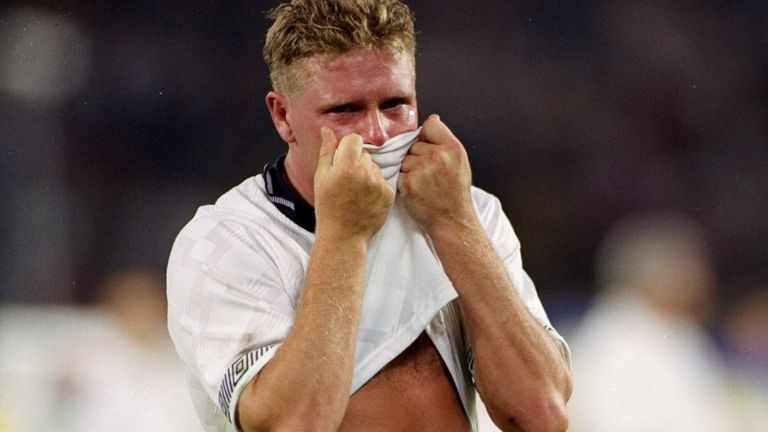
Paul Gascoigne

In the end, Bodo Illgner, goalkeeper for F.C. Köln of Cologne, held off the penalty of Stuart Pearce, and Chris Waddle -- a former teammate of Gazza at Newcastle, and of both Gazza and Lineker at Spurs, now with French club Olympique de Marseille -- blasted his shot over the bar, and the Germans advanced to the Final. They'd lost the last 2 Finals, to Italy in 1982 and to Argentina in 1986. Now, they would play Argentina again.

But after 2 great Semifinals, the Final, on July 8 at the Stadio Olimpico, was an anticlimax. TNT, Turner Network Television, broadcast it live in the U.S. The Germans had a few chances in the 1st half, but could not capitalize on them. Argentina played its usual dirty game, and were getting away with it. Twice, the Germans appealed for penalties, on a handball in the box by Oscar Ruggeri in the 13th minute, and a dirty tackle in the box by Simón on Rudi Völler in the 18th. Referee Edgardo Codesal, born in Uruguay but a citizen of Mexico, refused to grant either. Argentina had just one chance in the half, late, but Maradona sent a kick over the crossbar.

In the 58th minute, Argentine goalkeeper Sergio Goycochea took Klaus Augenthaler down inside the penalty area. Again, Codesal refused to award a penalty. Finally, in the 65th minute, Pedro Monzón of Independiente became the 1st player ever sent off in a World Cup Final, with Codesal showing him a straight red card for a reckless studs-up challenge on Jürgen Klinsmann. Still, despite Argentina being down to 10 men, West Germany couldn't score.

Finally, in the 83rd minute, Roberto Sensini brought Völler down in the box, and Codesal awarded a penalty. Brehme took it, and it was 1-0 to West Germany.

Gustavo Dezotti had already been cautioned in the 5th minute. In the 87th, he received a straight red card when he hauled Jürgen Kohler down with what The New York Times described as a "neck tackle right out of professional wrestling." After dismissing Dezotti, Codesal was surrounded and jostled by the rest of the Argentinian team, with Maradona receiving a yellow card for dissent.

Argentina were down to 9 men, and they were lucky to end the game with that many. West Germany hung on for the 1-0 win, as their opponents now had over half of their intended squad unavailable due to injury or suspension.

Beckenbauer joined Brazil's Mário Zagallo as only the 2nd man to both play on and manage a World Cup winner. He has been followed by France's Didier Deschamps.

UPDATE: An article for ESPN.com, published after the 2026 World Cup, ranking all 23 tournaments, rated this one 16th, citing the amount of dull games seeming to cancel out the large amount of star power.

*

July 8, 1990 was a Sunday. These Major League Baseball games were played:

* The New York Yankees lost to the Minnesota Twins, 6-3 at Yankee Stadium. David West outpitched Tim Leary. Mike Blowers hit a home run, but it was a rotten season for the Yankees, who finished last for only the 4th time in their history -- and, through the 2021 season, the last.

* The New York Mets beat the Atlanta Braves, 2-1 at Atlanta-Fulton County Stadium. Frank Viola was the winning pitcher.

* The Houston Astros beat the Montreal Expos, 5-3 at the Olympic Stadium in Montreal.

* The Philadelphia Phillies beat the Cincinnati Reds, 4-3 at Veterans Stadium in Philadelphia.

* The Seattle Mariners beat the Toronto Blue Jays, 6-3 at the SkyDome (now the Rogers Centre) in Toronto. Ken Griffey Jr. went 2-for-4 with a walk.

* The Oakland Athletics beat the Cleveland Indians, 8-3 at Cleveland Municipal Stadium. Rickey Henderson went 1-for-3 with 2 walks, a stolen base and an RBI.

* The Detroit Tigers beat the Kansas City Royals, 10-4 at Tiger Stadium in Detroit. George Brett went 1-for-3 with 2 walks and an RBI.

* The Baltimore Orioles beat the Chicago White Sox, 8-6 at Comiskey Park in Chicago. Mike Devereaux doubled home 2 runs in the top of the 11th inning. Cal Ripken went 1-for-5.

* The Milwaukee Brewers beat the California Angels, 20-7 at Milwaukee County Stadium. The Brewers scored 6 runs in the 4th inning, and 13 in the 5th inning.

* The Texas Rangers beat the Boston Red Sox, 4-3 at Arlington Stadium in the Dallas suburb of Arlington, Virginia. Gary Pettis hit a ground ball that Boston shortstop Luis Rivera bobbled, allowing Jack Daugherty to score the winning run in the bottom of the 11th.

* The St. Louis Cardinals beat the San Diego Padres, 4-1 at Jack Murphy Stadium in San Diego. Tony Gwynn did not play.

* The Pittsburgh Pirates beat the Los Angeles Dodgers, 7-2 at Dodger Stadium in Los Angeles. Barry Bonds went 2-for-4 with a walk and 3 RBIs.

* And the San Francisco Giants swept a doubleheader from the Chicago Cubs, 5-3 and 10-4 at Candlestick Park in San Francisco.

Thursday, July 7, 2022

July 7, 1974: The Netherlands' Lost Final

Johan Cruyff and Franz Beckenbauer in the Final.
The fact that the Dutch wore a bright color
and the Germans wore black and white
seemed symbolic of each country's soccer style.

July 7, 1974: Rarely is a sports competition remembered less for the team that won than for the team, or one of the teams, that lost. The 1974 World Cup was one of them.

The tournament was being held in West Germany, and the Dutch team seemed to have the best of all Dutch worlds:

From AFC Ajax, of Amsterdam (currently or formerly), came forwards Johan Cruyff and Piet Kiezer, midfielder Johan Neeskens, right wing Johnny Rep centerback Arie Haan, right back Wim Suurbier, and left back Ruud Krol.

(Note: Since his name was usually written as "Cruyff" for the English-speaking world, that's how I'm going to spell it in this post, even though it was always written as "Cruijff" in his homeland.)

* From Feyenoord, of Rotterdam, who formed the country's greatest rivalry with Ajax, came goalkeeper Eddy Treijtel; defenders Wim Rijsbergen, Wim Jansen, Rinus Israel and Harry Vos; and midfielders Willem van Hanegem and Theo de Jong.

* From PSV Eindhoven came defender Pleun Strik and twin brother midfielders René and Willy van de Kerkhof.

* From Twente Enschede came goalkeeper Piet Schrijvers and defender Kees van Ierssel.

* From FC Amsterdam came starting goalkeeper Jan Jongbloed.

* From Belgian club Anderlecht came forward Rob Rensenbrink.

* And from Anderlecht's arch-rivals, Club Brugge, came midfielder Ruud Giels. While Belgium is mostly divided among ethnic French (Wallonia) and ethnic Dutch (Flanders), both Anderlecht and Brugge are on the Dutch side of the country.

(And to clear something up: The names "Holland" and "the Netherlands" are not interchangeable. While Holland includes the country's 3 largest and most important cities -- Amsterdam, Rotterdam and The Hague -- it has about 1/3rd of the country's population, and about 1/6th of its area. Telling someone from Eindhoven, in North Brabant, that he lives in "Holland" is less dangerous than telling someone from Glasgow that he lives in "England," but it's still an insult.)

The Netherlands defeated Uruguay 2-0, drew 0-0 with Sweden, and demolished Bulgaria 4-1 to advance to the 2nd Group Stage. There, they beat Argentina 4-0, East Germany 2-0, and defending champions Brazil 2-0. The match with Sweden featured Cruyff faking out Jan Olsson with a move that became known as "The Cruyff Turn," and it became his signature play. Two things, though: He wasn't the first to do it -- no one knows for sure who was, although Pelé is known to have done it in 1960 -- and it didn't result in a shot, let alone a goal.

It was beginning to look easy. They had played 6 games, and had an aggregate advantage of 14-1. With their flowing football, flowing hair and bright orange uniforms, they had captivated the entire world -- especially since this was, for many countries, still the early days of color television. But not in America: No matches were broadcast live. CBS broadcast the Final a few days later.

On July 7, 1974, at the Olympiastadion in Munich, the dream seemed to be coming true. The Dutch lined up for the Final against a West Germany side dominated by players from Bundesliga winners Bayern Munich, including defender Franz Beckenbauer, goalie Sepp Meier and forward Gerd Müller. In only the 1st minute of the game, Crujiff advanced into the penalty area, and Bayern's Uli Hoeness brought him down. A penalty was rightly awarded, the 1st ever awarded in a World Cup Final, and Neeskens converted to give the Dutch a lead before 2 minutes had passed.
The Olympiastadion in Munich

But the Dutch may have scored too soon, and rested on their laurels. The Germans fought back, and got a legitimate penalty of their own in the 25th minute. Müller scored in the 43rd to give West Germany the lead. The half soon came, and Cruyff argued with the referee, Englishman Jack Taylor, and was booked for this.

The Dutch came a little unglued, and although they fell no further behind, neither did they get any closer. West Germany won, 2-1. It was not a home soil victory: Indeed, in the 2nd half, they had a goal waved off for offside, and were denied what looked like another legitimate penalty.

Playwright Johan Timmers wrote, "The defeat of 1974 is the biggest trauma that happened to Holland in the 20th Century, apart from the floods of 1953 and World War II." Historian Bastiaan Bommeljé wrote, "It should have been the epiphany of the sixties. Instead it turned out to be its requiem. The team was a product of an age that had put all its money on youth and the promise of youth and the idea that good times will be here when a new generation takes over."

In his book Brilliant Orange: The Neurotic Genius of Dutch Soccer, David Winner wrote, "The most talented group of footballers their country -- almost any country -- ever produced blew it. How? Why? It's a riddle wrapped in a mystery inside an enigma." He cited a 20th Anniversary survey that showed that nearly everyone old enough to watch remembered exactly where they were, and, on that basis, he compared it to the assassination of President John F. Kennedy in 1963.

Despite the defeat in the Final, Cruyff, since 1973 playing his "club football" for FC Barcelona in Spain, was awarded the Ballon d'Or (Golden Ball), as World Player of the Year, for the 3rd time in the last 4 years. There was no doubt that he was now the best player in the world, even if he couldn't quite get his country to the greatest prize of all.

In 1977, Cruyff announced his retirement from international soccer, refusing to play in the 1978 World Cup in Argentina. For 30 years, it was believed that he was protesting the military dictatorship that took over Argentina in 1976, after the country was awarded the tournament. But in 2008, he revealed the truth: There was a threat against his family, and it got into his head, and he didn't think he would be at his best for the tournament.

Again, the Netherlands reached the Final, even without Cruyff. This time, it was a home soil victory, as the Argentines' mere qualification for the Final under the system then in place was dubious, and they scored 2 dubious goals in extra time to win 3-1. There were some Dutch players who were quoted as saying they didn't know if they would leave the stadium alive if they won.

Cruyff has been called the greatest player that Europe has ever produced. However, the lack of a World Cup sticks out on his resume, as it does for players like Puskás, Argentina's Di Stéfano and (so far) Lionel Messi, France's Raymond Kopa, Wales' John Charles, Northern Ireland's George Best, Italy's Paolo Maldini, and Portugal's Eusébio and (so far) Cristiano Ronaldo. (UPDATE: In 2022, Argentina, with Messi, won the World Cup.)

For some of those players (particularly Charles and Best), it's because their countrymen were not up to their level. For Maldini, it was down to luck: He was considered too young to make the national side in 1982, and too old in 2006, despite his 25 years of top-flight football.

But the Netherlands has had so much talent, yet their only major tournament win has been Euro 88. They would lose the World Cup Final again in 2010, to Spain. No other country that's been in at least 3 Finals has failed to win at least 1.

One more note: The Olympiastadion in Munich is 1 of 3 stadiums to have hosted an Olympic Games, a World Cup Final and a UEFA European Cup/Champions League Final. The others are the Olympiastadion in Berlin and the old Wembley Stadium in London. In 2024, the Stade de France outside Paris will make it 4.

UPDATE: An article for ESPN.com, published after the 2026 World Cup, ranking all 23 tournaments, rated this one 4th.

*

July 7, 1974 was a Sunday. These baseball games were played that day:

* The New York Yankees lost to the Texas Rangers, 3-2 at Arlington Stadium in the Dallas suburb of Arlington, Texas. Steve Hargan outpitched Pat Dobson. Chris Chambliss went 3-for-4 with an RBI in defeat.

* The New York Mets beat the San Francisco Giants, 6-0 at Shea Stadium. Ted Martinez went 3-for-4 with 4 RBIs. Tom Seaver had to leave the game after 5 innings, allowing 2 hits. Bob Apodaca went the rest of the way, for a 3-hit shutout.

* The Los Angeles Dodgers swept a doubleheader from the Montreal Expos, 4-1 and 5-3 at Jarry Park in Montreal.

* A doubleheader was split at Fenway Park in Boston. The Kansas City Royals won the 1st game, 11-9. Hal McRae singled home the winning run in the top of the 10th inning. Rick Miller went 5-for-5 with an RBI in defeat. The Boston Red Sox won the 2nd game, 5-3. After going 0-for-4 in the 1st game, Carl Yastrzemski went 3-for-3 with a walk in the 2nd game. George Brett was nursing an injury: He didn't play in the 1st game, and was removed from the 2nd after going 1-for-2.

* The Philadelphia Phillies beat the San Diego Padres, 9-3 at Veterans Stadium in Philadelphia. Mike Schmidt went 2-for-4 with a walk and an RBI. Willie McCovey, then with the Padres, went 2-for-4 with an RBI. Dave Winfield did not play.

* The Cincinnati Reds swept a doubleheader from the St. Louis Cardinals, 2-1 and 11-2 at Riverfront Stadium in Cincinnati. Pete Rose went 1-for-5 with 4 walks in the doubleheader. Johnny Bench went 1-for-9. Joe Morgan went 0-for-4 in the 1st game, and didn't play in the 2nd game. Lou Brock went 0-for-4 in the 1st game, and didn't play in the 2nd game. Joe Torre didn't play in the 1st game, but went 1-for-4 in the 2nd game.

* The Chicago White Sox beat the Detroit Tigers, 3-1 at Tiger Stadium in Detroit. Al Kaline, in his last season, did not play.

* The Chicago Cubs beat the Atlanta Braves, 4-3 at Wrigley Field in Chicago. Hank Aaron went 2-for-4, including his 725th career home run.

* A doubleheader was split at Milwaukee County Stadium. The Milwaukee Brewers won the 1st game, 8-5. The Minnesota Twins won the 2nd game, 5-3. Steve Brye doubled home the winning run in the top of the 11th inning. He and Bobby Darwin each went 4-for-5, and Darwin had a home run and 4 RBIs. Harmon Killebrew only appeared as a pinch-hitter in each game, getting a hit in the 2nd game. Rod Carew went 3-for-9 with a walk.

* The Pittsburgh Pirates beat the Houston Astros, 6-4 at the Astrodome in Houston. Richie Zisk hit 2 home runs, and Willie Stargell went 1-for-2 with 3 walks and an RBI.

* The Cleveland Indians beat the California Angels, 6-2 at Anaheim Stadium (now Angel Stadium of Anaheim). Frank Robinson was then with the Angels, did not play in this game, was traded to the Indians later in the year, and was named their manager, the 1st black manager in the major leagues, at the end of the season.

* The Baltimore Orioles beat the Oakland Athletics, 4-1 at the Oakland Coliseum. Dave McNally outpitched Ken Holtzman. Reggie Jackson drove in the only run for the A's.

Saturday, January 1, 2022

January 1, 1973: Britain Joins the Common Market, Goes Metric

Edward Heath

January 1, 1973: The United Kingdom, Ireland and Denmark official enter the European Economic Community -- the EEC, a.k.a. "the Common Market", a predecessor to the European Union.

As a result, the United Kingdom -- England, Wales, Scotland and Northern Ireland -- also, to make economic matters easier, switches over from "the imperial system" to the metric system. Weights go from being measured in ounces and pounds to grams and kilograms; lengths from inches, feet and miles to meters and kilometers; volume from ounces to liters (except in pubs, where the pint remains the classic measurement to this day); and so on.

When I started public school in America in September 1975, all of our math textbooks were published in 1972, and they all included metric references, predicting that America would switch over to the metric system by 1985. As of January 1, 2022, it hasn't happened.

Britain's Prime Minister, Edward Heath, Leader of the Conservative Party, favored the entry into the Common Market. So did the Leader of the Opposition, the Leader of the the Labour Party, the once and future Prime Minister, Harold Wilson.

But there was significant opposition in the Kingdom, especially in England. In the 1980s, under Prime Minister Margaret Thatcher, the Conservative Party would resist efforts at closer ties. In the 2010s, the "Tories" would lead Britain's exit, or "Brexit," from the EU. This would lead to David Cameron being replaced as Leader and Prime Minister by Theresa May, and she by the pro-Brexit Boris Johnson.

Two days after the switchover, on January 3 -- the day that the consortium led by George Steinbrenner bought the New York Yankees -- a soccer game was held at the original Wembley Stadium in London, to commemorate the entry of the three new nations.

Players from those nations were put together as "The Three," managed by England manager Alf Ramsey, against a team of players from "The Six," managed by West Germany manager Helmut SchönWest Germany (which had won the previous year's European Championship), Italy (losing Finalists from the 1970 World Cup), the Netherlands (whose Ajax Amsterdam had won the last 2 European Cups), Belgium, Luxembourg and France.

Franz Beckenbauer, Captain of West Germany and Bayern Munich, chose to play. Johan Cruijff, Captain of the Netherlands and Ajax, chose not to. That may have made a difference. Only 36,500 people saw "The Three" win, 2-0. The low turnout was attributed to its staging on a Wednesday, and to the English people's ambivalence about joining the Common Market.

The goals were scored by Henning Jensen, a forward from Denmark and German team Borussia Mönchengladbach; and Colin Stein, a Scottish forward who had starred for Rangers in Glagsow, but was now playing for English team Coventry City.

The players' reactions to the expansion of the Common Market varied. "I'm really not interested in the whole thing," said Pat Jennings, goalkeeper for Northern Ireland and Tottenham Hotspur. Alan Ball, a holdover from England's 1966 World Cup win and now playing for Arsenal, was a substitute on the evening. He said, "The only thing that interests me about joining the Common Market is whether or not it will make my family's Summer holidays cheaper."

In contrast to Jennings' disinterest and Ball's humor, Johnny Giles of Leeds United, by this point both playing for the Republic of Ireland team (joining at the same time as the United Kingdom, and thus considered part of "The Three") but also managing it, showed far more acumen: "A small country like Ireland need close business and trade links with other European nations, so I'm certainly in favor."

Of the players on The Six team, Beckenbauer was the most Euro-friendly: "The Common Market is vital to us, as it encourages us to work more closely together, and that will hopefully mean that Europe will remain peaceful." Beckenbauer had been born 4 months after V-E Day in a Munich occupied by American troops, and he did not want another Europe-wide war.

The match was part of a week-long "Fanfare For Europe," a cultural festival that would allow Britain to share what Prime Minister Heath called his "heart full of joy" at the prospect of their country forging closer ties with Western Europe.

The cultural exchange didn't quite go as planned. Heath’s plan to borrow the Bayeux Tapestry, depicting the Battle of Hastings in 1066 and its leadup, and display it in Westminster Hall was dropped after critics pointed out that images of Saxons being butchered by Normans was hardly a symbol of European co-operation.

As the British Museum had recently refused France the loan of the Rosetta Stone, the Mona Lisa never appeared in a proposed exhibition at the Victoria & Albert Museum, either. But there was a display of European sweets, food festivals, concerts at Covent Garden and European art exhibitions at various London hotels.

*

January 1, 1973 was a Monday. In college football's bowl games:

* The University of Southern California, Champions of the Pacific-8 Conference and ranked Number 1, beat Ohio State University, Champions of the Big 10 Conference and ranked Number 3, 42-17 in the Rose Bowl, in the stadium of the same name in the Los Angeles suburb of Pasadena, California. This clinched the National Championship for USC and head coach John McKay, over Woody Hayes' Buckeyes.

Lynn Swann, later a Hall of Fame receiver for the Pittsburgh Steelers, opened the scoring for the Trojans by catching a touchdown pass. Later, Sam Cunningham scored 4 touchdowns. Anthony Davis, who had run wild against Notre Dame a few weeks earlier, and would do so again 2 years later, also scored a touchdown.

* The University of Texas, Champions of the Southwest Conference and ranked Number 5, beat the University of Alabama, Champions of the Southeastern Conference and ranked Number 4, 17-13 in the Cotton Bowl, in the stadium of the same name in Dallas. Alan Lowry scored 2 touchdowns in the 2nd half, including a 34-yard run with 3:20 to go, to give Darryl Royal's Longhorns the victory over Paul "Bear" Bryant's Crimson Tide.

Each team came in having lost only once, and, oddly, each to its arch-rival: Texas to Oklahoma, and Alabama to Auburn.

* The University of Nebraska, ranked Number 9, beat the University of Notre Dame, 40-6 in the Orange Bowl, in the stadium of the same name in Miami. This would be Bob Devaney's last game as Nebraska's head coach, as he turned the reins over to his assistant Tom Osborne. Devaney had led the Cornhuskers to the National Championship in the 1970 and '71 seasons, while Osborne would struggle to reach that level, but eventually achieve it.

* The night before, on New Year's Eve, the Sugar Bowl was played at Tulane Stadium in New Orleans. The University of Oklahoma, Champions of the Big 8 Conference and ranked Number 2, beat Pennsylvania State University, ranked Number 8, 14-0. Oklahoma had beaten both of its major rivals, Nebraska (in the Big 8) and Texas (not), but had lost to Colorado in midseason. That loss cost them at least a share of the National Championship: Having won, they then had to hope that Number 3 Ohio State beat Number 1 USC, but not too convincingly. And, since USC won, they got the National Championship.

In contrast, Penn State was once again the top team in the Northeast (if you can call rural Central Pennsylvania "the Northeast"), but had lost their season opener to Tennessee, which would finish 10-2 and ranked Number 8. As usual, Joe Paterno and his Nittany Lions thought the media wasn't giving them enough respect. But, after losing to Tennessee, they played only 1 other ranked team in the regular season, beating Number 18 West Virginia away, and were not convincing. Barry Switzer's Sooners had little trouble with them in the Sugar Bowl.

Baseball was out of season. There were no games in the American Basketball Association. In the NBA, there were 2 games. The Baltimore Bullets beat the Milwaukee Bcks, 88-87 at the Milwaukee Exposition and Convention Center Arena, a.k.a. The MECCA (now the UW-Milwaukee Panther Arena). And the Los Angeles Lakers beat the Seattle SuperSonics, 108-103 at the Seattle Center Coliseum. Gail Goodrich scored 36 points. Wilt Chamberlain, in his final season as a player, had only 6 points, but grabbed 20 rebounds and blocked 5 shots.

There was 1 game in the NHL: The Boston Bruins beat the Vancouver Canucks, 8-2 at the Pacific Coliseum in Vancouver. Phil Esposito scored a hat trick, 3 goals. Bobby Orr had no goals, but assisted on 6.

There were 3 games in the World Hockey Association, then in its 1st season:

* The New York Raiders lost to the Philadelphia Blazers, 3-0 at Madison Square Garden.

* The Minnesota Fighting Saints and the Houston Aeros played to a tie, 4-4 at the St. Paul Civic Center. Playing in St. Paul, rather than sharing the Metropolitan Sports Center in nearby Bloomington with the Minnesota North Stars, led to the "Fighting Saints" name.

* And the Alberta Oilers beat the Winnipeg Jets, 7-3 at the Edmonton Gardens. The hosts changed their name to the Edmonton Oilers the next season.

December 31, 1999 & January 1, 2000: The Millennium

December 31, 1999:  The Millennium arrives. The people of planet Earth survived. At a terrible cost. But we hadn't destroyed ourselves. ...