Showing posts with label toledo. Show all posts

Saturday, October 29, 2022

October 29, 1960: The Cal Poly Plane Crash & Ali's Pro Debut

October 29, 1960: A C-46 plane crashes during takeoff near Toledo, Ohio, killing 22 people, including 16 players for the football team at California Polytechnic State University of San Luis Obispo. The school popularly known as "Cal Poly" should not be confused with the California Institute of Technology, a.k.a. "Caltech," in Pasadena.

They had just lost 50-6 to a Bowling Green team that featured future actor Bernie Casey. An investigation revealed that the plane was overloaded, weighing over 2,000 pounds more than it should have. Fog was also a factor: It was so bad that the City of Toledo suspended taxi service for the night.

Amazingly, 26 people on board survived, including quarterback Ted Tollner, who went on to coach USC from 1983 to 1986. "I was the cutoff for who lived and died," Tollner said in a 2006 interview. "Everyone in front of me died. Everyone behind me survived." Of the 26 survivors, 13 attended a 50th Anniversary memorial service in 2010.
Cal Poly, then an NCAA Division II school, was 1-5, and it canceled the rest of its season. The Mustangs would bounce back in 1961, going 5-3. As recently as 1957 and '58, they had gone 17-2, with a team that included an offensive tackle who would make his mark in pro football, not as a player, but as a coach, broadcaster and video game impresario: John Madden.
The school won the Division II National Championship in 1980, and is now in the Football Championship Subdivision (FCS), formerly known as Division I-AA, having most recently made the Playoffs in 2016.
*
October 29, 1960 was a Saturday. The next-biggest sporting event occurring that day would not be thought of as such for a few more years. Cassius Clay, coming off his Olympic Gold Medal in Rome, has his 1st professional fight, in his hometown of Louisville, Kentucky. He fights Tunney Hunsaker, the fight goes the maximum 6 rounds, and Clay wins a unanimous decision. He later admitted that he wasn't prepared to face a professional fighter, and that Hunsaker gave him one of the hardest body blows he would ever receive.
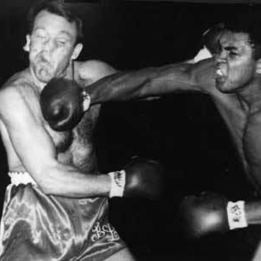
Not an especially interesting beginning for the man who will become Muhammad Ali, one of the most interesting people who has ever lived. Hunsaker, a U.S. Air Force veteran, returned to his native West Virginia, and was named a police chief at age 27, serving for 38 years. He and Ali stayed in touch and became friends. Hunsaker disagreed with Ali's decision to refuse being drafted, but he respected Ali's dedication to principle. Hunsaker died in 2005.
Among the other college football games played that day:
* Number 1 Iowa beat Number 19 Kansas, 21-7 at Iowa Stadium (renamed Kinnick Stadium in 1972).
* Number 2 Mississippi (Ole Miss) and Louisiana State (LSU) played to a tie, 6-6 at Hemingway Stadium (renamed Vaught-Hemingway Stadium in 1982) in Oxford, Mississippi.
* Number 3 Syracuse were upset by the University of Pittsburgh, 10-0 at Archbold Stadium in Syracuse, New York.
* Number 4 Navy beat Notre Dame, 14-7 at Philadelphia Municipal Stadium (renamed John F. Kennedy Stadium in 1964). Also among the service academies, Army beat Miami University of Ohio, 30-7 at Michie Stadium in West Point, New York; and Air Force lost to George Washington University, 20-6 at Falcon Stadium in Colorado Springs, Colorado. 
* Number 5 Missouri beat Nebraska, 28-0 at Memorial Stadium in Lincoln, Nebraska.
* Number 6 Minnesota beat Kansas State, 48-7 at Memorial Stadium in Minneapolis.
* Number 7 Baylor were upset by Texas Christian University (TCU), 14-6 at Amon G. Carter Stadium in Fort Worth, Texas.
* Number 8 Ohio State beat Number 10 Michigan State, 21-10 at Spartan Stadium in East Lansing, Michigan.
* Number 9 Washington beat Oregon, 7-6 at Husky Stadium in Seattle.
* In a crosstown rivalry that no longer plays football, but is still a nasty one in basketball, Xavier beat the University of Cincinnati, 5-0 at Nippert Stadium in Cincinnati.
* And in New Jersey, Princeton beat Brown, 54-21 at Palmer Stadium in Princeton; and Rutgers lost to Villanova, 14-12 at Rutgers Stadium in Piscataway.
There were 4 NBA games played that day:
* The New York Knicks lost to the Detroit Pistons, 115-110 at the Olympia Stadium in Detroit.
* The Philadelphia Warriors beat the Boston Celtics, 1341-103 at the Boston Garden.
* The Syracuse Nationals beat the Los Angeles Lakers, 125-118 at the Onondaga County War Memorial (now the Upstate Medical University Arena) in Syracuse, New York.
* And the St. Louis Hawks beat the Cincinnati Royals, 113-97 at the Kiel Auditorium in St. Louis.
Two games were played in the NHL. The Montreal Canadiens beat the Boston Bruins, 3-2 at the Montreal Forum. And the Toronto Maple Leafs beat the Chicago Black Hawks, 8-4 at Maple Leaf Gardens in Toronto. The New York Rangers and the Detroit Red Wings were not scheduled.
And Michael Carter was born that day, becoming a defensive tackle who won 3 Super Bowls with the San Francisco 49ers.

Thursday, July 14, 2022

July 14, 1887: Baseball Draws the Color Line

Moses Fleetwood Walker

July 14, 1887: Professional baseball commits its greatest crime: Drawing "the color line." It was something that was already in the works for a while.

On August 10, 1883, the Chicago White Stockings (the team now known as the Cubs) were scheduled to play an exhibition game against the Toledo Blue Stockings, then running away with the Pennant in the Northwestern League. The Chicago 1st baseman and manager was Adrian Constantine Anson, known as "Cap," short for "Captain." He was the best player in baseball, and the most popular.

He was also the most openly racist. And the Blue Stockings' catcher was Moses Fleetwood Walker. "Fleet" Walker was black. While Bill White, who played 1 game at 1st base for the Providence Grays in 1879, was black, he passed as white, making Walker the 1st player known to be black on any previously all-white team. Anson refused to play the game.

Blue Stockings manager Charlie Morton told Anson that if they refused to play, they would forfeit the gate receipts. Anson decided that the color green was more important than the color white, and the game was played. But he used the N-word throughout the game, and declared he would never play another game against a black man.

(It wasn't just black people that Anson hated. He eventually wrote a memoir in which he told of growing up in Iowa, and saying rotten things about Native Americans living nearby.)

Moses Walker was born on October 7, 1856, in Mount Pleasant, on the Ohio side of the Ohio River, across from West Virginia, and not far from the Pennsylvania line and Pittsburgh. The family moved to nearby Steubenville, Ohio, where his brother, Weldy Wilberforce Walker, was born on July 27, 1860. Both graduated from Steubenville High School.

Moses had been an athlete as Oberlin College, in Oberlin, Ohio, the 1st racially integrated college in America; and at the University of Michigan, where he became the 1st black athlete to earn a varsity letter. Weldy also played baseball at Oberlin and Michigan. In 1883, both brothers signed with the Blue Stockings.

Having won the Northwestern League Pennant in 1883, the Blue Stockings were invited to join the American Association, then a major league, for the 1884 season. That season, they scheduled another exhibition game where they were supposed to host the White Stockings, for July 25. But a showdown was avoided, because Moses Walker had an injured hand, and was unable to play.

Not wanting to deal with it anymore, the Blue Stockings caved in to the bigots. Weldy last played for them on August 6, and Moses on September 4. Both were released after the season. Moses had batted .263 in 42 games, with his RBIs not recorded. Weldy batted .222 in 5 games, with 2 RBIs. Not surprisingly, given the era, neither hit a home run.

Which brings us back to July 14, 1887. Again, it was the Chicago White Stockings and Cap Anson involved. The White Stockings were in Newark, New Jersey, to play an exhibition game against the Newark Little Giants of the International League, then as now one of the top minor leagues. This team included both Moses Walker and George Stovey, a 21-year-old pitcher and outfielder from Williamsport, Pennsylvania. This made Walker and Stovey the 1st all-black "battery" (pitcher & catcher combination) in otherwise-white baseball history.
The best picture of Stovey I could find

Going in, Anson was not aware that Walker was on this team. But he read the Newark News, and saw that Stovey was the scheduled Newark starting pitcher, and the article mentioned that Stovey was black. Anson objected, and Stovey did not pitch. Walker did not play, either. The Little Giants beat the White Stockings, anyway.

The News' evening edition -- my parents both grew up in Newark, and were ardent readers of the Newark Evening News until it went out of business in 1972 -- wrote, "Stovey was to have pitched for Newark, but he complained of sickness, and so (Mickey) Hughes was substituted."

On July 17, the Newark Sunday Call said, "Stovey was expected to pitch in the Chicago game. It was announced on the ground that he was sulking, but it has since been given out that Anson objected to a colored man playing. If this be true, and the crowd had known it, Mr. Anson would have received hisses instead of the applause that was given him when he first stepped to the bat." The New York Telegram published this, word-for-word, the next day.

Also on July 14, the IL team owners had a meeting in Buffalo, and voted 6-to-4 to exclude African-American players from future contracts. Despite going 34-14 with a 2.46 ERA, Stovey never played in what would eventually be called "organized ball" ever again, although he continued to play in black leagues. Nor did either of the Walker brothers play any more pro ball.

In the years to come, baseball team executives tried to sneak black players onto their roster by claiming they were Native Americans or, if they were light-skinned enough, either Cuban or possibly even white. It never worked: The only way they could even try to get away with it would have been in Spring Training, and any black baseball fans in town would give the player away, by cheering especially hard when he came to bat or made a play in the field.

Moses Walker died on May 11, 1924, at 67; Weldy on November 23, 1937, at 77. Both brothers had been involved in various businesses in the interim, including together. Stovey died on March 23, 1936, at 69. And Bill White died on March 29, 1937, at 76. (As far as I can tell, he had no connection, other than race and profession, to later star 1st baseman, broadcaster and National League President Bill White.)

In 1942, Brooklyn Dodger manager Leo Durocher charged that there was a "grapevine understanding" keeping black players out of baseball. He was summoned to the Chicago office of the Commissioner of Baseball, Kenesaw Mountain Landis. Afterward, each man addressed the press. Durocher said that he had been misquoted -- not the biggest lie he would ever tell, but neither was it one he enjoyed telling. Landis went next: 

Negroes are not barred from organized baseball by the Commissioner, and never have been in the 21 years I have served. There is no rule in organized baseball prohibiting their participation, and never has been to my knowledge. If Durocher, or if any other manager, or all of them, want to sign one, or 25, Negro players, it is all right with me. That is the business of the managers and the club owners. The business of the Commissioner is to interpret the rules of baseball, and to enforce them.

Officially, Landis was telling the truth: Aside from the 1887 International League vote, there had never been a rule keeping any player out of the major leagues, or the minor leagues, because of his race. Unofficially, it was a bald-faced lie. Landis' word was law in baseball, and there was never going to be a black player in the professional ranks as long as he lived.

Landis died on November 25, 1944. On October 23, 1945, 331 days later, Branch Rickey, president of the Brooklyn Dodgers, having looked over existing reports, sent out his scouts, read their reports, and deciding that he had found his man, signed Jackie Robinson to a contract. On April 15, 1947, Robinson made his major league debut.

It had been 63 years since a black man had played in the major leagues. Cap Anson had been dead for 25 years, Moses Walker for 23, George Stovey for 11, Bill White and Weldy Walker for 10, and Judge Landis for 2 1/2.

*

July 14, 1887 was a Thursday. There was 1 game were played in the National League that day: The Detroit Wolverines beat the Boston Beaneaters, 7-4 at the South End Grounds in Boston. The Wolverines won the Pennant, but that led to their players demanding higher salaries for 1888. Owner Frederick K. Stearns couldn't keep up, and the team folded at the end of the season.

The Beaneaters went through a few name changes until in 1912, when they took on the name they have since carried to Milwaukee and Atlanta: The Braves.

These games were played in the American Association:

* The New York Metropolitans beat the Louisville Colonels, 18-9 at Eclipse Park in Louisville. The "original New York Mets" went out of business after this season. The Colonels joined the NL in 1892, after the AA folded, and but were contracted out of it after the 1899 season.

* The Brooklyn Grays lost to the St. Louis Browns, 6-4 at Sportsman's Park in St. Louis. This was not the first ballpark in St. Louis to bear that name, nor would it be the last. The Grays joined the NL in 1890, the Browns in 1892. The Grays would go through a few name changes, before becoming the Dodgers in 1911. The Browns became the Cardinals in 1900.

* The Washington Nationals beat the Pittsburgh Alleghenys, 5-3 at Swampoodle Grounds in Washington. Swampoodle was the name of a neighborhood in Washington, and also of a neighborhood in Philadelphia. These Nationals went out of business in 1889, and bear no connection to the current NL team of the same name. The Alleghenys joined the NL in 1890, and a move they made a year later was described by another team as "piratical," they became known as the Pittsburgh Pirates.

* The Baltimore Orioles beat the Cleveland Blues, 5-2 at National League Park in Cleveland. The Blues became the Spiders in 1889, and moved to the 1st League Park in 1891. They and the Orioles both joined the NL in 1892, and both were contracted out of it after the 1899 season.

* The Cincinnati Red Stockings beat the Philadelphia Athletics, 3-2 at League Park in Cincinnati. This was the 1st of 4 ballparks on land on which the team now known as the Cincinnati Reds would play from 1884 to 1970, the last being built in 1912 and known for most of its existence as Crosley Field. The Reds joined the NL in 1892, but this version of the Athletics folded with the AA after the 1891 season.

Monday, July 4, 2022

July 4, 1919: Jack Dempsey Says Hello

July 4, 1919: The Heavyweight Championship of the World changes hands in the most devastating fashion in its history.

The Champion was Jess Willard, from Kansas. At 6 feet, 6½ inches at 245 pounds, he was known as the "Pottawatamie Giant." He had won the title 4 years earlier, knocking out Jack Johnson, the 1st black Heavyweight Champion. He successfully defended his title against Frank Moran in 1916, before World War I prevented him from making another defense.

The war over, he was set to defend it at Bayfront Park in Toledo, Ohio, on the 4th of July. He took a 21-3-1 record into the fight. But he was 37 years old, and it was going to be hot. And his opponent...

William Harrison Dempsey was 24, stood 6-foot-1 and weighed 187, and was 56-4-9. That's right: 13 years younger, and had won more than twice as many fights as Willard had fought.

He was called Jack because of an earlier fighter, former Middleweight Champion Jack "Nonpareil" Dempsey (real name John Edward Kelly, held the title from 1884 to 1891). He was from Mansassa, Colorado, and was known as the Manassa Mauler. And, because this was the 1910s, and he was a white man who nonetheless had a very dark complexion, he was called "Kid Blackie."

His last 6 fights before his title shot all ended in knockouts, all of them in the 1st round. Or, as boxing historian Bert Sugar put it, "In his last two fights before the Willard fight, Dempsey knocked his opponents out in 19 and 27 seconds. Not rounds."

But he had learned to box in hobo camps and saloons, places barely removed from the "Wild West." He hadn't fought serious contenders. Surely, a seasoned professional and a gigantic man, like Willard, would be able to handle him easily. But Lightweight Champion Benny Leonard wrote a newspaper column predicting that Dempsey would win, because, despite being smaller, he was stronger.

Leonard was right: The fight was a massacre. Dempsey knocked Willard down 7 times in the 1st round. At the time, the rules allowed the standing fighter to remain standing over the one knocked down, to wait for him to get up, and then go after him again. Dempsey took advantage of this rule.

Had current rules been in place, Willard still wouldn't have lasted much longer: Dempsey would have had to go to a neutral corner (a new rule that he forgot about in 1927, in what became known as the Long Count Fight), Willard would have been given a standing 8-count, and with the 3rd knockdown of the round, the fight would have been declared over.

Somehow, Willard got up for the 2nd and 3rd rounds, but not the 4th. Dempsey was the new Heavyweight Champion of the World, and became one of the sports icons of the 1920s. For a while, he was both loved and hated in equal measure: Loved, even more than Babe Ruth for a time, for his success and his personality; hated, because some accused him of not properly serving his country in World War I, calling him a "slacker." Out of the ring, Dempsey was a considerably more mild-mannered man, but the "slacker" tag bothered him.
Go ahead. Call him a slacker. I dare you.

Reports on Willard's injuries were conflicted. The New York Times reported "severe swelling" on one side of his face, but mentioned no broken bones. Other reports suggested broken facial bones, several broken teeth, a broken jaw, and broken ribs.

Willard would accuse Dempsey of cheating. Many others agreed: How could Dempsey have injured Willard's face so badly, without injuring his own hands?

Eventually, Dempsey would have a falling-out with his manager, Jack Kearns. In 1964, with both fighters also still alive, Kearns gave an interview to Sports Illustrated, claiming he applied plaster of Paris to the wrappings on Dempsey's hands.

Also still alive at that point was Nat Fleischer, founder and editor of The Ring magazine, known as "the Bible of Boxing." He said he was present when Dempsey's hands were wrapped:

Jack Dempsey had no loaded gloves, and no plaster of Paris over his bandages. I watched the proceedings and the only person who had anything to do with the taping of Jack's hands was Deforest. Kearns had nothing to do with it, so his plaster of Paris story is simply not true.

And boxing historian J.J. Johnston said, "the films show Willard upon entering the ring walking over to Dempsey and examining his hands." That, along with an experiment conducted by a boxing magazine designed to re-enact the fight, have been noted as proof that Kearns' story was a lie.

Willard fought only twice more. In the 1st prizefight ever held at the original Yankee Stadium, on May 12, 1923, he knocked Floyd Johnson out in the 11th round. Two months later, at Boyle's Thirty Acres in Jersey City, New Jersey, he got knocked out in the 8th round by Luis Angel Firpo. That was it for Willard, who died in 1968.

Willard's last fight was Firpo's warmup for a fight with Dempsey at the Polo Grounds, one of the greatest fights in Heavyweight Title history. It was to be Dempsey's last title defense, as he then didn't fight for 3 years, losing the title to Gene Tunney in 1926. He lived until 1983, one of the last surviving sports stars of "The Roaring Twenties," a.k.a. "The Golden Age of Sports."

*

July 4, 1919 was a Friday. Football, basketball and hockey were out of season. But baseball was in midseason, and the 4th of July was often a day for doubleheaders:

* The New York Yankees swept the Washington Senators at the Polo Grounds, 8-2 and 6-5. Bob Shawkey was supported in the opener by 2 home runs from former Athletics slugger Frank "Home Run" Baker. Former Red Sox star Duffy Lewis won the nightcap with a double in the bottom of the 9th.

* The New York Giants swept the Philadelphia Phillies at Baker Bowl, 3-1 and 8-3.

* A doubleheader was split at Ebbets Field in Brooklyn. The Brooklyn Robins (as the Dodgers were known from 1914 to 1931) won the 1st game, 7-3. The Boston Braves won the 2nd game, 5-2.

* The Boston Red Sox swept the Philadelphia Athletics at Fenway Park in Boston, 9-2 and 9-6. In the 2 games, Babe Ruth went 3-for-4 with an RBI double.

* The Chicago Cubs swept the Pittsburgh Pirates at Forbes Field in Pittsburgh, 7-3 and 4-1.

* The Cleveland Indians swept the St. Louis Browns at League Park in Cleveland, 9-4 and 11-1. Tris Speaker went 3-for-8, while George Sisler went 3-for-5.

* The Cincinnati Reds swept the St. Louis Cardinals at Redland Field in Cincinnati (it was renamed Crosley Field in 1934), 4-3 in 12 innings, and 4-2.

* And the Chicago White Sox swept the Detroit Tigers at Comiskey Park in Chicago, 8-1 and 2-1. Ty Cobb only appeared as a pinch-hitter in the 1st game, unsuccessfully, before going 1-for-4 in the 2nd game. Shoeless Joe Jackson went 3-for-7 with an RBI.

Sunday, June 26, 2022

June 26, 1959: The St. Lawrence Seaway Opens

June 26, 1959: The St. Lawrence Seaway opens, aiding international trade for the United States; Canada, its neighbor and co-owner of the Seaway; and their allies.

It had actually opened on April 25, but June 26 was the dedication ceremony. Attending was each country's head of state: The 68-year-old President Dwight D. Eisenhower and the 33-year-old Queen Elizabeth II of the British Commonwealth, to which Canada still belonged (and still does).

The year before, the Republican nominee for U.S. Senator from Massachusetts, opposing Democratic incumbent John F. Kennedy, was noted Boston attorney Vincent J. Celeste. One of his campaign statements was, "Of course my opponent voted for the St. Lawrence Seaway. It ends at the Merchandise Mart in Chicago, which is owned by old Joe Kennedy." The suggestion was that JFK voted for it not because it was good policy -- and even most Republicans seemed to agree that it was -- but because of family corruption. This didn't work at all -- and not just because, while the Merch Mart is effectively on the Seaway, it is not the Seaway's terminal -- and JFK rose from 51 percent of the vote in his 1952 election to 73 percent.

The Seaway is a system of locks, canals and channels that connects the Great Lakes with the St. Lawrence River, and eventually the Atlantic Ocean. Officially, it runs 370 miles from Port Colborne to Montreal. Unofficially, it accesses such port cities as Duluth, Minnesota; Green Bay and Milwaukee, Wisconsin; Chicago, Illinois; Detroit, Michigan; Toledo and Cleveland, Ohio; Erie, Pennsylvania; Thunder Bay, Sault Ste. Marie, Sarnia, Port Colborne, Hamilton, Toronto and Oshawa, Ontario; Buffalo, Niagara Falls and Ogdensburg, New York; and Montreal, Trois-Rivières, Québec City, Baie-Comeau and Sept-ÃŽles, Quebec, into the Atlantic Ocean.

The locks on the U.S. side are managed by the St. Lawrence Seaway Development Corporation. The ones on the Canadian side are managed by the St. Lawrence Seaway Management Corporation. Over 3,000 ships use the Seaway every year. From Duluth to Sept-ÃŽles, it takes about 8 1/2 days.

*

June 26, 1959 was a Friday. Canadian Comedian Mark McKinney, known for his work on The Kids in the Hall from 1989 to 1995, and on Saturday Night Live from 1995 to 1997, was born on this day. This was also the day that Ingemar Johansson knocked Floyd Patterson out to become the Heavyweight Champion of the World.

And these baseball games were played:

* The New York Yankees beat the Chicago White Sox, 8-4 at Comiskey Park in Chicago. Mickey Mantle went 3-for-4 with a walk. Art Ditmar outpitched Billy Pierce.

* The Cleveland Indians beat the Boston Red Sox, 11-5 at Cleveland Municipal Stadium. Ted Williams went 1-for-3 with a walk.

* The Cincinnati Reds beat the St. Louis Cardinals, 7-6 at Crosley Field in Cincinnati. Johnny Temple doubled Eddie Kasko home with the winning run in the bottom of the 10th inning. Frank Robinson only appeared as a pinch-runner, and never came to bat or took the field. Stan Musial hit 2 home runs.

* The Baltimore Orioles swept a doubleheader from the Detroit Tigers, 12-7 and 4-1 at Briggs Stadium (later Tiger Stadium) in Detroit. Over the 2 games, Al Kaline went 2-for-9 with a home run and 2 RBIs. Brooks Robinson did not play in either game.

* The Milwaukee Braves beat the Chicago Cubs, 11-1 at Milwaukee County Stadium. Warren Spahn went the distance for the win, and helped his own cause with a home run. Hank Aaron went 2-for-4 with an RBI. Ernie Banks went 1-for-4 with an RBI.

* The Washington Senators beat the Kansas City Athletics, 8-4 at Kansas City Municipal Stadium. Harmon Killebrew hit a home run for the Senators. Roger Maris went 0-for-5 for the A's.

* The Los Angeles Dodgers beat the Pittsburgh Pirates, 6-5 at the Los Angeles Memorial Coliseum. Duke Snider, John Roseboro and Charlie Neal hit home runs for the Dodgers. Harry Bright, Don Hoak and Dick Stuart hit home runs for the Pirates. Roberto Clemente did not play.

* And the San Francisco Giants beat the Philadelphia Phillies, 8-0 at Seals Stadium in San Francisco. Mike McCormick pitched a 3-hit shutout. Willie Mays and Jackie Brandt hit home runs for the Giants.

December 31, 1999 & January 1, 2000: The Millennium

December 31, 1999:  The Millennium arrives. The people of planet Earth survived. At a terrible cost. But we hadn't destroyed ourselves. ...