Showing posts with label pittsburgh steelers. Show all posts

Tuesday, December 27, 2022

December 27, 1975: The Pittsburgh Steelers Introduce the Terrible Towel

December 27, 1975: The Pittsburgh Steelers, the defending NFL Champions, host the Baltimore Colts in an AFC Divisional Playoff at Three Rivers Stadium. In the stands, fans wave yellow dish towels, which became known as "The Terrible Towel."

At the time, the flagship of the Steelers' radio network was WTAE, 1250 on the AM dial. Two weeks before this game, Ted Atkins, the station's general manager, and Larry Garrett, the station's president of sales, went to Myron Cope, the Steelers' main broadcaster, who also had a sports-talk show on the station. They suggested that a "gimmick" -- an unusual device or idea that seems to have little value, but would attract an increased amount of attention -- which would attract sponsors to Cope's show.

Cope, a Pittsburgh native born Myron Sidney Kopelman, was then 46 years old, and had already won awards for writing for Sports Illustrated. He began his talk show on WTAE in 1968, and became the Steelers' main announcer when Three Rivers opened in 1970. At first, he didn't want to do a gimmick, saying, "I'm not a gimmick guy."

It wasn't true: Like other broadcasters in town, including the Pirates' Bob Prince and the Penguins' Mike Lange, he was known for catchphrases. Being Jewish, something good made him yell the Yiddish word, "Yoi!" Sometimes it would be good enough to be a "Double Yoi!" which became the title of his memoir. If something bad happened, he would use the Yiddish word, "Feh!" Instead of, "Okey dokey," he would say, "Okel dokel."

He gave some Steelers nicknames: Hard-hitting linebacker Jack Lambert was "Jack Splat." In the next generation of Steeler players, the big fullback Jerome Bettis became "The Bus," and Kordell Stewart -- said to be a quarterback/running back/receiver -- became "Slash." And he mocked opposing teams: The Cleveland Browns were the Brownies, the Cincinnati Bengals were the Bungles, the Dallas Cowboys were the Cryboys, and so on.

So he wasn't being fully honest when he said, "I'm not a gimmick guy." But Garrett told him that, if the gimmick worked, it would be good leverage when his contract came up for renewal. Hearing, this, Cope said, "I'm a gimmick guy!"
Pictured: A gimmick guy

So Cope, Atkins and Garrett started thinking about what kind of gimmick. Cope said it should be something "lightweight and portable, and already owned by just about every fan." Garrett thought of a small towel. Cope gave it the alliterative name, "The Terrible Towel." It would be in Steeler colors: While black with gold lettering was experimented with, it was correctly decided that gold with black lettering would show up better.

Garrett was enthusiastic. Atkins was not: He thought that, if the Steelers lost the game, the Towel would be seen as the reason why, a jinx. So Cope asked the players what they thought. Linebacker Jack Ham said, "I think your idea stinks." Older linebacker Andy Russell, paralleling what Cope had already said, said, "We're not a gimmick team. We've never been a gimmick team."

But that wasn't true, either. Three years earlier, a group of employees at an Italian restaurant in Pittsburgh quickly took to Franco Harris, the team's half-black, half-Italian rookie running back, wearing Army-style helmets, and sitting behind a banner reading, "FRANCO'S ITALIAN ARMY." Similar groups copied them. A group of Polish fans honored Ham with "JACK HAM DOBRE SHUNKA FAN CLUB." "Dobre shunka" is Polish for "Good ham." Running back John "Frenchy" Fuqua had Frenchy's Foreign Legion. Lambert had Lambert's Lunatics. Kicker Roy Gerela had Gerela's Gorillas.

Knowing this, Cope went to the most visible player on the team, quarterback Terry Bradshaw, and asked him, "How do you feel about the Terrible Towel?" According to Cope, Bradshaw said, "Huh?" And Cope later said, "I check him off as a 'Yes.'... I reported back to Ted Atkins that the Steelers overwhelmingly approved of the Towel." A little white lie -- or a little black and gold lie.

As the Steelers took the field for their Playoff game against the Colts, the fans whipped out their Towels and waved them around. Cope thought there were 30,000 of them, in a stadium that then seated a little over 50,000.

In the 1st quarter, Ham intercepted a pass from the Colts' Marty Domres. This set up a 34-yard pass from Bradshaw to Frank Lewis, which set up an 8-yard run by Harris, giving the Steelers a 7-0 lead. But the Colts led 10-7 at the half. Early in the 3rd quarter, Mel Blount intercepted a Domres pass, and took it to the Colts' 7-yard line. Rocky Bleier ran it in on the next play, giving the Steelers a lead they would not relinquish.

In the 4th quarter, Colt coach Ted Marchibroda, himself an unsuccessful Steeler quarterback in the 1950s, replaced Domres with Bert Jones. He did no better: He got to the Steelers' 7-yard line, but was hit by Ham, and fumbled. Of all people to pick it up, it was "not-gimmick-guy" Russell, who ran 93 yards, for the longest fumble return in NFL Playoff history. Sports Illustrated called it "the longest, slowest touchdown ever witnessed." It put the cap on a 28-10 Steeler win.

(UPDATE: Russell's record stood until 2023, when Cincinnati Bengals defensive end returned one 98 yards against the Baltimore Ravens. The Bengals won.)

Steeler fan Lisa Benz wrote a poem about the game and the Towels, and sent it to Cope, who read it on the air. It concluded:

He ran ninety-three like a bat out of hell,
And no one could see how he rambled so well.
"It was easy", said Andy, and he flashed a crooked smile:
"I was snapped on the fanny by the Terrible Towel!"

So the gimmick worked. The next week, Gimbel's department stores all over Western Pennsylvania sold out of yellow and gold dish towels. Cope got rich off the idea. In 1996, he gave the rights to The Terrible Towel to the Allegheny Valley School in nearby Coraopolis, which cares for people with intellectual and physical disabilities. Cope's son Danny was autistic, and had attended the school. Proceeds from Towel sales have raised over $6 million for the school.

Having won Super Bowl IX the season before, the Steelers went on to win Super Bowl X. After 2 years of near-misses, they won Super Bowl XIII and Super Bowl XIV. The 2005 season, in which they went on to win Super Bowl XL, was Cope's retirement season. They won Super Bowl XLIII as well. They've also lost Super Bowl XXX and Super Bowl XLV.

*

A standard Terrible Towel, now bearing Cope's name, is 16-by-23-inches. It was the original sports-team gimmick, preceding the Cleveland Indians' "Hate the Yankees Hanky" by nearly 2 years, the Minnesota Twins' "Homer Hanky" by nearly 12 years, and the Atlanta Braves' foam Tomahawk by almost 16 years.

Because of their 1970s success, when they were frequently on television, the Steelers gained lots of fans in big cities whose teams weren't doing well at the time, like New York, Philadelphia, Boston and Chicago. (This is also true of the decade's other successful teams: The Dallas Cowboys, the Miami Dolphins, and the then-Oakland Raiders.) As a result, Steeler fans are everywhere.

And as a result of that, Steeler fans have taken their Towels everywhere: The Vatican in Rome, the Western Wall in Jerusalem, the Great Wall of China, Mount Everest on the China-Nepal border, the South Pole in Antarctica. Soldiers have taken them to war zones, including Lebanon, Iraq, Bosnia and Afghanistan. Pittsburgh-born rapper Wiz Khalifa put one in a video. Pittsburgh-born astronaut Mike Fincke took one to the International Space Station in 2009.
Making it the most "far out" piece of sports memorabilia ever.
Don't tell me Alan Shepard swung a golf club on the Moon:
He did, but golf is not a sport.

Although the Rooney family, owners of the Steelers since their founding in 1933, is Republican, team president Dan Rooney gave a Towel to Democratic Presidential candidate Hillary Clinton when she campaigned in the 2008 Pennsylvania Primary. She won it, though she lost the nomination to Barack Obama.

In the general election, Rooney gave Obama one, and Rooney's ticket-splitting support may have made the difference in Obama winning the State. Obama rewarded him by appointing him U.S. Ambassador to Ireland, a post into which he was sworn in by Obama's Secretary of State -- Hillary Clinton. He served for 3 years.

*

But do not mock the Terrible Towel, nor misuse it. There is a Curse of the Terrible Towel. No, I'm not kidding. During player introductions for the Steelers' 1994 Playoff game against the arch-rival Browns, Brentson Buckner came out waving one, and dropped it. The Browns' Earnest Byner stepped on it, saying, "We don't care about your towel! We're going to beat you this time!" They did not, and less than a year later, the original version of the Browns was moved, becoming the Baltimore Ravens.

You would think that opponents would have learned from this, but some didn't. In 2005, T.J. Houshmandzadeh of the Bengals celebrated a touchdown by wiping his feet on one. The Bengals won, but the Steelers went on to beat them in the Playoffs, and the Bengals didn't win another Playoff game for 16 years. They didn't even make the Playoffs again until 4 years later -- after Houshmandzadeh had left the team.

Cope died on February 27, 2008. On September 29, Derrick Mason of the Ravens stepped on a Towel. The Steelers swept their Divisional games against the Ravens, and then beat them in the AFC Championship Game. On October 5, Jacksonville Jaguars mascot Jaxson de Ville celebrated a Jags touchdown against the Steelers by taking a Towel and scratching his armpits with it. The Steelers came from behind to win, and the Jags lost 8 of their last 11 games.

On December 21, the Tennessee Titans beat the Steelers, and LenDale White and Keith Bulluck celebrated by stomping on a Towel, and they ended up as the top seed in the AFC Playoffs, but lost at home to the Ravens, who then lost to the Steelers.

The Titans ended up losing 8 straight games, including their 2009 season opener against the Steelers and a 59-0 loss to the New England Patriots. NFL teams simply don't lose games by 59 points, but the Titans did. Head coach Jeff Fisher publicly apologized for the desecration of the Towel, bought a new one, had his players autograph it, and donated it to the Allegheny Valley School. Did that generous gesture remove the Curse? Apparently: The Titans won their next 5 games.

And to close the 2008 season, as the Arizona Cardinals prepared to play the Steelers in Super Bowl XLIII on February 1, 2009, Mayor Phil Gordon of Phoenix hosted a pep rally at City Hall, invited Cards mascot Big Red to the stage, and handed him a Towel. Big Red proceeded to use the Towel to scratch his armpits and blow his nose (beak). The Steelers won.

After 4 such incidents in 1 season alone, you'd think people would've learned. Alas, in the closing minutes of a 2009 game in Detroit, the Steelers led by 8 points, but the Lions were marching down the field in the hope of a tying touchdown. Lions mascot Roary found a Towel, stepped on it, and ripped it apart with his teeth. Result: 3 straight sacks of Lion quarterback Daunte Culpepper, and a Steeler win. That same season, the Indianapolis Colts tried to pay tribute, issuing blue and white "Terrific Towels." It almost worked: They did reach Super Bowl XLIV, but lost to the New Orleans Saints. I guess the Saints had too much good karma stored up since Hurricane Katrina.

In 2014, Jaxson de Ville struck again. During a game with the Steelers in Jacksonville, he held up a Towel with one hand and a sign reading "Towels Carry Ebola" with the other. Not only did the Steelers win the game, but the Jags lost 13 of their next 17. In 2016, as the Steelers opened the season against the Washington Redskins, Washington punter Tress Way tweeted a video of his mother burning a Terrible Towel in a voodoo cemetery. The Steelers won.

Even other sports are not immune to the Curse. On February 7, 2016, the Penguins were visiting the Florida Panthers, and trailed 2-0 with about 6 minutes left in regulation. Florida's mascot, Stanley C. Panther, blew his nose into a Terrible Towel. The Pens tied the game and won it in overtime. So, if you don't want horrible things to happen to you, leave the Terrible Towel alone.

Terrible Towels usually cost $10. I once attended a sports memorabilia show at the Wildwoods Convention Center on the Jersey Shore, and saw them for sale. I bought 2, keeping 1, and sending the other to a friend who's a big Steeler fan.

In 2011, some scenes for the Batman film The Dark Knight Rises were filmed in Pittsburgh. Three Rivers' replacement, then named Heinz Field and now named Acrisure Stadium, stood in for Gotham City's football stadium; and the fictional Gotham Rogues wore black and gold uniforms like the Steelers. Several real-life Steelers appeared, and the fans were given yellow towels with black lettering, labeled as "Rogue Rags."

The character of Bane (played by Tom Hardy) proceeded to destroy the stadium's field, and blow up the owner's luxury box, killing the Mayor (Nestor Carbonell). Granted, this was fiction, and it seemed more like the Rag was a tribute to the Towel rather than a parody, but it's still suspicious.

UPDATE: The Jacksonville Jaguars are so dumb! (How dumb are they?) They're so dumb, they are a three-time loser when it comes to messing with the Terrible Towel. On October 29, 2023, they beat the Steelers, 20-10. During the game, several Jacksonville players took fans' Terrible Towels, mockingly waved them around, and dropped them. The team proceeded to finish the season 3-6, which included a loss in their final game against the Tennessee Titans, 28-20. This not only eliminated the Jaguars from playoff contention, but gave the Steelers the final AFC Playoff spot.

*

December 27, 1975 was a Saturday. There was 1 other NFL Playoff game that day: The Los Angeles Rams beat the football version of the St. Louis Cardinals, 35-23 at the Los Angeles Memorial Coliseum.

There was 1 college football game played: Number 9 Texas beat Number 10 Colorado, 38-21 at the Astrodome in Houston, in the Bluebonnet Bowl.

There were 7 games played in the NBA:

* The New York Knicks beat the New Orleans Jazz, 108-101 at Madison Square Garden.

* The Cleveland Cavaliers beat the Washington Bullets, 106-100 at the Capital Centre in the Washington suburb of Landover, Maryland.

* The Atlanta Hawks beat the Milwaukee Bucks, 87-82 at The Omni in Atlanta.

* The Buffalo Braves beat the Philadelphia 76ers, 130-105 at the Buffalo Memorial Auditorium.

* The Chicago Bulls beat the Detroit Pistons, 112-99 at the Chicago Stadium.

* The Houston Rockets beat the Golden State Warriors, 113-110 at the Oakland Coliseum Arena. Rudy Tomjanovich, later to coach the Rockets to back-to-back NBA Championships, led all scorers on the day with 32 points.

* And the Los Angeles Lakers beat the Seattle SuperSonics, 109-100 at the Seattle Center Coliseum.

There were 2 games played in the ABA. The New York Nets lost to the Denver Nuggets, 130-113 at the McNichols Arena in Denver. And the Indiana Pacers beat the Virginia Squires, 97-94 at The Scope in Norfolk.

There were 5 games played in the NHL:

* The Montreal Canadiens beat the Minnesota North Stars, 2-1 at the Montreal Forum.

* The Chicago Black Hawks beat the Toronto Maple Leafs, 4-1 at Maple Leaf Gardens in Toronto.

* The Pittsburgh Penguins beat the Atlanta Flames, 3-2 at the Civic Arena in Pittsburgh.

* The St. Louis Blues beat the Vancouver Canucks, 4-2 at the St. Louis Arena.

* And the Los Angeles Kings beat the Kansas City Scouts, 9-4 at The Forum outside Los Angeles in Inglewood, California.

And there were 5 games played in the World Hockey Association:

* The Quebec Nordiques beat the Edmonton Oilers, 6-3 at the Colisée de Québec.

* The Cleveland Crusaders beat the Toronto Toros, 5-0 at The Coliseum in the Cleveland suburb of Richfield, Ohio.

* The Indianapolis Racers beat the Cincinnati Stingers, 2-1 at the Market Square Arena in Indianapolis.

* The Houston Aeros beat the Minnesota Fighting Saints, 5-0 at The Summit in Houston. (The arena has since been converted into the Central Campus of the Lakewood Church, Dr. Joel Osteen's "megachurch.")

* And the Phoenix Roadrunners beat the Denver Spurs, 10-0 at the Arizona Veterans Memorial Coliseum.

And in English soccer, Arsenal beat West London team Queens Park Rangers, 2-0 at Highbury in North London.

Also on this day, child actress Heather O'Rourke was born. A congenital back problem led to the death of the star of the Poltergeist trilogy, at the age of 12.

Friday, December 23, 2022

December 23, 1972: The Immaculate Reception

December 23, 1972: The Pittsburgh Steelers play their 1st Playoff game, in their 40th season. And for most of the game, it wasn't looking good.

They began play in 1933, with Art Rooney having founded them. But Art's love of football far exceeded his knowledge of it. In 1947, they finished in a 1st place tie in the NFL Eastern Division with the Philadelphia Eagles, and lost a playoff. To this day, the NFL does not recognize this as an official Playoff game.

Finally, after a 1-13 season in 1969, Art's sons, Dan and Art Jr., told dear old Dad to let them run the team from now on. And in just 3 seasons, they had built the team into AFC Central Division Champions.

The 1972 season wasn't just the one in which the Steelers came of age competitively. It was also the year they became a cultural phenomenon in Western Pennsylvania. A group of employees at an Italian restaurant in Pittsburgh quickly took to Franco Harris, the team's half-black, half-Italian rookie running back out of Penn State and the Philadelphia suburb of Mount Holly, New Jersey. They went into the stands at Three Rivers Stadium in Pittsburgh, wearing Army-style helmets, and sitting behind a banner reading, "FRANCO'S ITALIAN ARMY."

Similar groups copied them. A group of Polish fans honored linebacker Jack Ham with "JACK HAM DOBRE SHUNKA FAN CLUB." "Dobre shunka" is Polish for "Good ham." Running back John "Frenchy" Fuqua had Frenchy's Foreign Legion. Kicker Roy Gerela had Gerela's Gorillas. Drafted in 1974, linebacker Jack Lambert, one of the most intense players of the era, had Lambert's Lunatics.

Al Davis ran the Oakland Raiders, and had built them into AFL Champions in 1967. But they lost Super Bowl II, then lost the 1968 AFC Championship Game to the New York Jets. By 1972, they were dominating the AFC Western Division, but hadn't won a Super Bowl yet.

And so, on Saturday afternoon, December 23, 1972, Davis' Silver and Black marched into Three Rivers Stadium in Pittsburgh to face the Rooneys' Black and Gold. For a game with such an epic ending, it was not good theater most of the way. The 1st half ended scoreless. Roy Gerela kicked a field goal early in the 2nd half, but it remained 3-0 at the end of the 3rd quarter. Gerela kicked another field goal early in the 4th quarter, but the Steelers couldn't put the ball in the end zone, so it remained 6-0 as the clock wound down.

Daryle Lamonica, known as the Mad Bomber, struggled in the 1st half, and coach John Madden replaced him with Ken Stabler, the Alabama lefthander known as the Snake. With 1:17 to go, Stabler ran for 30 yards to get into the end zone. George Blanda, the Raiders' ageless backup quarterback and regular kicker, nailed the extra point, and the Raiders had a 7-6 lead.

The Steelers did not yet have a reputation as the kind of team that could win this kind of game. And Pittsburgh fans, who had seen the Pirates win the World Series the year before, were not used to glory from their football team. The 50,327 fans inside Three Rivers figured the game was lost.

Among them was Art Rooney. "The Chief" left his suite and got into an elevator, to go down to the locker room to congratulate the Raiders and console his team. So he never saw the play that changed the course of his team's history.

Quarterback Terry Bradshaw, who had been the top pick in the 1970 NFL Draft, had a difficult relationship, not just with head coach Chuck Noll, but with the Pittsburgh fans. He hadn't yet lived up to their hopes. Now, he had gotten the Steelers to their own 40 yard line. But it was 4th and 10, and there were only 22 seconds left, and the Steelers had no time-outs left.

Noll's intended play was "66 Circle Option," intended for Barry Pearson, a rookie who had been on the Steelers' bench all season long without being sent into a game. Now, he was -- his 1st professional play.

But just as no battle plan survives the first shot, Noll's play didn't last. Raiders Tony Cline and Horace Jones bore down on Bradshaw, and "the Blonde Bomber" from Louisiana had to scramble. He just got a throw off before getting clobbered by Cline and knocked to Three Rivers' artificial turf.

The ball got to the Raiders' 33-yard line, and it looked like Steeler running back John "Frenchy" Fuqua was going to catch it. But Raider safety Jack Tatum did what he so often did to potential receivers: He leveled Fuqua.

Big mistake: As with so many dirty soccer players, Tatum should have gone for the ball, not the opposing player. He could have intercepted it. Instead, the ball bounced off him, and went backwards to the Raider 43. And it almost hit the ground.

And for 50 years, the Raiders and their fans have insisted that the ball hit Fuqua first, which, under the rules of the time, would have made every Pittsburgh player an ineligible receiver after that. And they have insisted that the ball did hit the ground.

It didn't. Harris saved it, and took off down the left sideline, and scored. It was 3:29 PM -- don't bet any Steeler fan old enough to remember.

Steeler radio announcer Jack Fleming said, with only slight exaggeration, "From out of nowhere came Franco Harris, riding a white stallion, heading up Franco's Italian Army, galloping into the sunset!"

Like Rooney, Bradshaw didn't see the play. He remembered being down on the ground, and hearing a tremendous roar going up: "I knew that this was a good sound. This was the sound of something good happening."

Fans came pouring onto the field, and had to be cleared, because there was still an extra point to kick, which Gerela did, and 5 seconds to play. The Raiders could do nothing with the ensuing kickoff, and the Steelers had won, 13-7.

The surviving '72 Raiders still insist they were robbed. It would take until the 1976 season for them to win a Super Bowl. But the Steelers didn't win immediately, either: This was the season in which the Miami Dolphins went undefeated. Eight days later, they came into Three Rivers -- at the time, home-field advantage for Conference Championships was on a rotating basis, not decided by record -- and beat the Steelers, on their way to winning Super Bowl VII.

But the Steelers would win Super Bowls IX, X, XIII and XIV. Harris was named the Most Valuable Player for IX, receiver Lynn Swann for X, and Bradshaw for XIII and XIV. The Raiders would win Super Bowls XI, XV and, during their Los Angeles sojourn, XVIII. (Their MVPs, respectively: Fred Biletnikoff, Jim Plunkett and Marcus Allen.)

The catch became known as "The Immaculate Reception." What Art Rooney, a devout Irish Catholic, thought about that, only he knew. Others, noting that it was 2 days to Christmas, called it a Christmas Miracle.

But, along with Alan Ameche's overtime plunge to win the 1958 NFL Championship Game for the Baltimore Colts, Bart Starr's quarterback sneak to win the 1967 Championship Game (the Ice Bowl), and Dwight Clark's "The Catch" from Joe Montana to win the 1981 NFC Championship Game, it ranks as perhaps the greatest play in NFL history.

Franco Harris died on December 21, 2022, at the age of 72, 2 days before the 50th Anniversary of the play. On December 24, he was scheduled to be honored at halftime of the Steelers' Sunday night home game against the now-Las Vegas Raiders, with the retirement of his Number 32. At least he knew it was going to be retired.

In 2019, a poll ranked this game 13th on a list of the 100 Greatest Games of the NFL's 1st 100 years.

*

December 23, 1972 was a Saturday. This was also the day of the earthquake in Managua, Nicaragua, for which Roberto Clemente's doomed flight 8 days later was intended to help provide relief. I have a separate entry for that event.

Another NFL Playoff game was played that day, with the Dallas Cowboys beating the San Francisco 49ers in another classic, 30-28 at Candlestick Park in San Francisco.

The next day, Christmas Eve, the Washington Redskins beat the Green Bay Packers, 16-3 at Robert F. Kennedy Stadium in Washington. And the Miami Dolphins beat the Cleveland Browns, 20-14 at the Orange Bowl in Miami. The following week, New Year's Eve, saw the Conference Championships: Dolphins 21, Steelers 17 at Three Rivers; and Redskins 26, Cowboys 3 at RFK Stadium. On January 14, 1973, at the Los Angeles Memorial Coliseum, the Dolphins completed their undefeated season, beating the Redskins, 14-7 in Super Bowl VII.

There were 4 games played in the NBA on December 23, 1972:

* The Baltimore Bullets beat the Detroit Pistons, 104-97 at the Baltimore Civic Center. While the arena still stands, now known as the CFG Bank Arena, this would be the Bullets' last season in Baltimore, as they moved to the Washington area, and are now named the Washington Wizards.

* The Atlanta Hawks beat the Philadelphia 76ers, 124-112 at The Omni in Atlanta. Pistol Pete Maravich scored 42 points, Super Lou Hudson scored 31, and Bob Christian scored 13 and had 25 rebounds.

* The Milwaukee Bucks beat the Boston Celtics, 104-98 at the Milwaukee Arena. In 1974, it was renamed the Milwaukee Exposition, Convention Center and Arena, or "The MECCA." Since 2014, it has been named the UW-Panther Arena.

* And the Golden State Warriors beat the Chicago Bulls, 127-109 at the Oakland Coliseum Arena.

There were 4 games played in the American Basketball Association:

* The New York Nets lost to the Memphis Tams, 105-103 at the Mid-South Coliseum in Memphis.

* The Virginia Squires beat the Dallas Chaparrals, 112-107 at The Scope in Norfolk. Julius "Dr. J" Erving scored 41 points.

* The Carolina Cougars beat the Utah Stars, 123-117 at the Greensboro Coliseum. Billy Cunningham scored 34 points and grabbed 15 rebounds.

* And the Kentucky Colonels beat the San Diego Conquistadors, 116-105 at Freedom Hall in Louisville.

These games were played in the NHL:

* The expansion New York Islanders beat the Minnesota North Stars, 4-2 at the Nassau Coliseum.

* The Montreal Canadiens beat the Pittsburgh Penguins, 6-3 at the Montreal Forum.

* The Boston Bruins beat the expansion Atlanta Flames, 3-1 at the Boston Garden.

* The Detroit Red Wings beat the Vancouver Canucks, 5-1 at the Olympia Stadium in Detroit.

* The Toronto Maple Leafs beat the Chicago Black Hawks, 5-3 at Maple Leaf Gardens in Toronto.

* The St. Louis Blues beat the Philadelphia Flyers, 6-1 at the St. Louis Arena.

* The Los Angeles Kings beat the Buffalo Sabres, 2-0 at The Forum outside Los Angeles in Inglewood, California.

* The New York Rangers and the California Golden Seals were not scheduled.

And these games were played in the inaugural-season World Hockey Association:

* The Quebec Nordiques beat the Los Angeles Sharks, 2-1 at the Colisee de Quebec.

* The Cleveland Crusaders beat the Minnesota Fighting Saints, 3-1 at the Cleveland Arena.

* The Chicago Cougars beat the Alberta Oilers (as the Edmonton Oilers were named in that inaugural season alone), 3-2 at the International Amphitheatre in Chicago.

* And the Houston Aeros beat the Philadelphia Blazers, 7-3 at the Sam Houston Coliseum in Houston.

Also: Arsenal played Birmingham City to a 1-1 draw at St. Andrews Stadium in Birmingham.

Wednesday, December 21, 2022

December 21, 1947: A Pennsylvania Playoff in the NFL

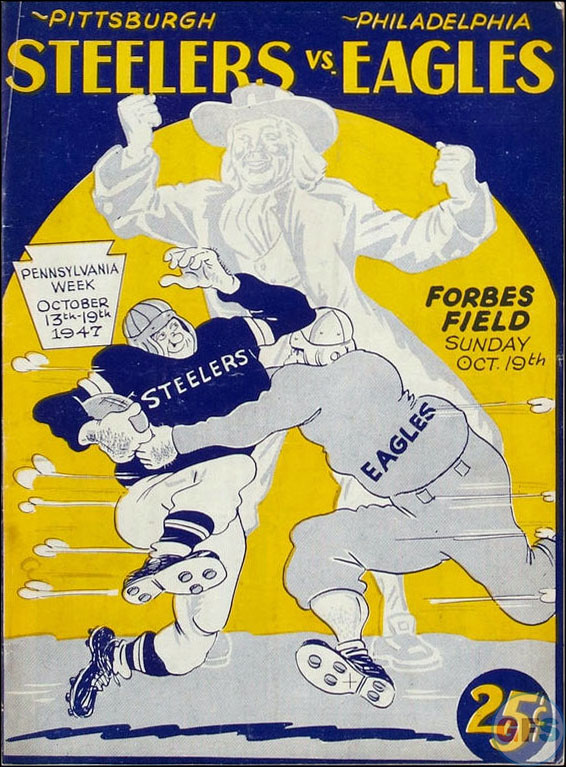
Program from a game between the teams,
earlier in the season

December 21, 1947: For the 1st time, an NFL team from Philadelphia plays a Playoff game. For the 1st time, an NFL team from Pittsburgh plays a Playoff game. And they play it against each other.

Both the Philadelphia Eagles and the Pittsburgh Steelers had been founded in 1933, in anticipation of the Pennsylvania legislature legalizing the playing of professional sports on Sunday within the State. It did so, making both teams viable. (The Philadelphia-based Frankford Yellow Jackets, forced to compete with high school and college teams for Saturday viewing, folded in 1931.)

In 1947, the Eagles and the Steelers both finished at 8-4, to tie for 1st place in the NFL Eastern Division. There was no tiebreaker: If either team had swept the other in the regular season, this Playoff game would still have to be played. For the record, though: On October 19, at Forbes Field in Pittsburgh, the Steelers won, 35-24; then, on November 30, at Shibe Park in Philadelphia, the Eagles won, 21-0. Point spread, or "aggregate" as they would say in English soccer, didn't matter, either, so the fact that the Eagles would have won overall, 45-35, was meaningless.

The Playoff was played at Forbes Field. Having the home-field advantage did the Steelers no good: The Eagles won, 21-0, scoring a touchdown in each of the 1st 3 quarters. Tommy Thompson threw a 15-yard touchdown pass to Steve Van Buren, then he threw a 28-yard pass to Jack Ferrante (Number 83 in the photo above), and finally Bosh Pritchard returned a punt 79 yards for a touchdown.

Winning the game didn't do the Eagles much good: In their 1st NFL Championship game, a week later, coach Earle "Greasy" Neale's team lost to the Chicago Cardinals, 28-21. They reversed that result in 1948, and won another title in 1949.

The Steelers were coached by a dying man: Dr. John "Jock" Sutherland, a dentist, had a brain tumor, and died the following April. The team never recovered. It would be 1972 before they made the Playoffs again. By that point, realignment had put them in the AFC Central Division, and now the AFC North; while the Eagles were put in the NFC East, where they remain. They have never faced each other in the postseason again, and can only do so in the Super Bowl. Although they have been to 12 Super Bowls between them, they have never played each other in one.

So while Penn State vs. the University of Pittsburgh remains a big rivalry in college football, Philadelphia vs. Pittsburgh is big in the NHL, less so in baseball, and barely even exists in the NFL.

*

December 21, 1947 was a Sunday. No other football games were played. Baseball was out of season. No NHL games were scheduled. There was 1 game played in the league that would become the NBA: The Chicago Stags beat the Baltimore Bullets, 93-83 at the Chicago Stadium.

Monday, December 19, 2022

December 19, 1976: A Plane Crash at an NFL Playoff Game

December 19, 1976: An AFC Divisional Playoff is played at Memorial Stadium in Baltimore. The Baltimore Colts hosted the Pittsburgh Steelers, winners of the last 2 Super Bowls, eliminating the Colts on the way to winning the previous season.

The game is no contest. Terry Bradshaw completed 14 of 18 passes for 267 yards and 3 touchdowns. Don't ask me how the NFL's "passer rating" system works, because I have no idea, and I certainly don't know why a rating of 158.3 is considered a "perfect score." But Bradshaw had the 1st such rating since the system's debut. And Franco Harris ran for 132 yards, and caught 3 passes for 24 yards, despite leaving the game with an injury early in the 2nd half.

The game ended with the Steelers winning, 40-14, and many fans had left early. It's a good thing they did: Less that 10 minutes after the game ended, a small propeller-driven airplane, a Piper PA-28 Cherokee, crashed into the mostly-empty upper deck in the south end zone, what would be behind home plate in the stadium's baseball configuration. Had there still been fans there, it could have been catastrophic.

The plane was wrecked, but there wasn't much damage to the stadium. The crash happened about halfway up the upper deck, where the seats gave way to aluminum benches. About 30 seats were wrecked, but that was it. Given that it was the last home game of the season (the Colts would have traveled to Oakland for the AFC Championship Game had they won this one), and the seats wouldn't be necessary again until early April of the next year, it wasn't hard to get them replaced in time.

The pilot was Donald Kroner, 33, and he sustained cuts and bruises, but only spent 1 night in a hospital. He spent more time in jail. He had previously spent 4 years grounded for psychiatric reasons, and had been arrested just 5 days before the game, on charges of reckless flying, littering, and making a bomb threat against the Iron Horse Restaurant owned by former Colt linebacker, Bill Pellington. He had recently been thrown out of it for being abusive.

Kroner was not that bad of a pilot: He managed to fly his plane between the light towers of the north end zone (center field in the baseball configuration). Fans who witnessed the crash said that it looked like he was trying to make an emergency landing on the field. He was only 10 feet off the ground at the 50-yard line, but he suddenly accelerated and climbed, the engine stalling just before smashing into the upper deck. The stall may have prevented a fuel explosion that could have injured people and caused additional damage to the stadium.

Kroner, of German descent, liked to call himself the Blue Max, after a military decoration given to German soldiers up until World War I. Indeed, his plane was white with blue trim, which, of course, were also the Colts' colors.

Kroner was sentenced to 2 years in prison, for "malicious destruction of property" and "violation of aviation ordinances." He ended up serving only 3 months. He was jailed again in 1980, for stealing 2 Greyhound buses from Dulles International Airport in the Virginia suburbs of Washington.

He died in 2013, at age 70, 37 years after the crash, 29 years after the Colts were moved to Indianapolis, 17 years after they were replaced by the Baltimore Ravens, 15 years after the opening of the new M&T Bank Stadium, and 11 years after Memorial Stadium was demolished -- without his "help." He is a footnote in the history of the team that could, legitimately, be called football's answer to baseball's Brooklyn Dodgers, a team once celebrated as heroes of the working class who brought glory to their place, and were then heartlessly moved, before being replaced.

In 1972, flying a Piper Cherokee in a competition, Prince William of Gloucester, a 1st cousin of Queen Elizabeth II of Britain, was killed in a crash.

*

December 19, 1976 was a Sunday. There was 1 other Playoff game in the NFL that day: The Los Angeles Rams beat the Dallas Cowboys, 14-12 at Texas Stadium in the Dallas suburb of Irving, Texas.

The college bowl games were underway, but none were played on this day. There were 6 games in the NBA:

* The New York Knicks lost to the Boston Celtics, 94-87 at Madison Square Garden.

* The Detroit Pistons beat the New Orleans Jazz, 125-110 at the Superdome in New Orleans. Bob Lanier had 34 points and 15 rebounds.

* The Cleveland Cavaliers beat the San Antonio Spurs, 106-105 at The Coliseum in the Cleveland suburb of Richfield, Ohio.

* The Milwaukee Bucks beat the Atlanta Hawks, 126-109 at the Milwaukee Exposition, Convention Center and Arena, or "The MECCA." Since 2014, it has been named the UW-Panther Arena. Swen Nater had 30 points and 33 rebounds.

* The Los Angeles Lakers beat the Kansas City Kings, 103-92 at The Forum outside Los Angeles in Inglewood, California.

* And the Buffalo Braves beat the Seattle SuperSonics, 99-98 at the Seattle Center Coliseum.

There were 5 games in the NHL:

* The New York Rangers beat the Cleveland Barons, 3-2 at Madison Square Garden.

* The Boston Bruins beat the Pittsburgh Penguins, 6-3 at the Boston Garden.

* The Philadelphia Flyers beat the Colorado Rockies, 4-3 at The Spectrum in Philadelphia.

* The Buffalo Sabres beat the Detroit Red Wings, 6-1 at the Buffalo Memorial Auditorium.

* And the St. Louis Blues beat their arch-rivals, the Chicago Black Hawks, 6-4 at the Chicago Stadium.

And there were 4 games in the World Hockey Association:

* The Indianapolis Racers beat the Birmingham Bulls, 3-2 in overtime at the Market Square Arena in Indianapolis.

* The Edmonton Oilers beat the Cincinnati Stingers, 4-2 at the Northlands Coliseum in Edmonton.

* The Houston Aeros beat the Phoenix Roadrunners, 6-4 at the Arizona Veterans Memorial Coliseum in Phoenix.

* And the San Diego Mariners beat the Quebec Nordiques, 5-3 at the San Diego Sports Arena (now the Pechanga Arena).

Saturday, December 10, 2022

December 10, 1983: Farewell to Bradshaw, and to the NFL In New York City

December 10, 1983: For the last time, so far, a National Football League game is played within the Five Boroughs of the City of New York. It does not go well for the home team.

The New York Jets had been playing home games at Shea Stadium in Flushing Meadow-Corona Park in Queens since it opened in 1964. But the City's Department of Parks, which owned it (and also owned Yankee Stadium in the South Bronx), gave scheduling priority in September, the month when the NFL regular season begins, to the Major League Baseball team for whom it was really built, the New York Mets.
Shea Stadium, football configuration

As a result, the Jets often had too many away games at the start of the season. Not only did this mean they often got off to bad starts, but it meant more home games later in the season. This was not as much of an advantage as you think: Shea was a wind tunnel, and could get very cold.

What's more, once the baseball season ended, the City tended to cut down on maintenance, leaving things messier, and various things to break down more often and stay broken down longer. Worst of all, from the Jets organization's point of view, lease at Shea was bad.

Team owner Leon Hess was an oil company boss, and could afford it. But that wasn't the point: The lease terms the Mets and the Yankees had with the City; the terms the New York Giants, the New Jersey Nets and the New Jersey Devils had with the State of New Jersey at the Meadowlands Sports Complex; and the terms the New York Islanders had with the County of Nassau at the Nassau Coliseum were all better. Throw in the fact that the Madison Square Garden Corporation owned the New York Knicks and the New York Rangers, so those teams had no lease at all at The Garden, and the Jets had easily the worst lease in the New York Tri-State Area.

So Hess made a deal with the New Jersey Sports and Exposition Authority, operator of the Meadowlands Complex. Starting in 1984, the Jets would play home games at Giants Stadium. This led to other problems, but it was still better than at Shea, not least because Giants Stadium then had 16,000 more seats than Shea did in its football configuration.

In this last game at Shea, the Jets hosted the Pittsburgh Steelers. Most of the stars of the Steeler teams that won 4 Super Bowls in 6 seasons from 1974 to 1979 had retired, or were now too far along in their careers, or too injured, to be significant contributors.

One such player was their quarterback, Terry Bradshaw. He had missed the 1st 14 weeks of the season with a bad elbow. But he said he was ready to come back for the season's last 2 games, and hopefully one more Playoff run.

The weather wasn't especially bad: 45 degrees at kickoff, with the wind at 12 miles per hour. A crowd of 53,996, about 6,000 short of a sellout, came out to watch the end of 2 eras, even though they only knew for sure about 1. At one point, the scoreboard operator had some fun, turning "N.Y. JETS" into "N.J. JETS."

At first, it looked like Bradshaw had turned back the clock. In the 1st quarter, he threw a 17-yard touchdown pass to Gregg Garrity. In the 2nd quarter, he threw a 10-yard touchdown pass to Calvin Sweeney. That made it 14-0 Steelers.

But on that pass to Sweeney, he felt something pop in his elbow. He had reaggravated the injury. He walked off the field, and never played another down.

Cliff Stoudt took over at quarterback, and put together 2 drives that ended in field goals by Gary Anderson, making it 20-0 Steelers at the half. He threw a touchdown pass to Bennie Cunningham in the 3rd quarter, and it was 27-0.

Finally, late in the 3rd quarter, Pat Ryan threw a 27-yard touchdown pass to Johnny "Lam" Jones, and the Jets were on the board. But in the 4th quarter, Stoudt threw to Sweeney, and it was another touchdown. Final score: Steelers 34, Jets 7.

Thousands of fans stormed the field, tore down the goalposts, ripped up the field, and took other souvenirs. The grounds crew had 4 months to get the field ready for the Mets.

The win clinched the AFC Central Division title and a Playoff berth for the Steelers, who went on to lose to the Los Angeles Raiders in the Divisional Round. The Jets finished 7-9, 5th and last in the AFC Eastern Division, out of the Playoffs.

In 2004, a stadium was proposed for the West Side of Manhattan, between Pennsylvania Plaza (including Penn Station and Madison Square Garden) and the Hudson River. It was to seat 85,000, and be a new home for the Yankees and the Jets, bringing the NFL back to New York City proper, the NFL back to Manhattan for the 1st time since the Giants left the Polo Grounds in 1955 (the Jets had played at the Polo Grounds from 1960 to 1963, in the AFL), and the Yankees back to Manhattan for the 1st time since they left the Polo Grounds in 1922.

It would have a retractable roof, allowing it to host Super Bowls, a college football bowl game called the Big Apple Bowl, and the NCAA Final Four. What's more, it would be the centerpiece of New York's bid to host the 2012 Olympics.

City officials, especially Mayor Mike Bloomberg, wanted it badly. Nobody else seemed to want it. The Yankees turned it down, preferring to build a new Yankee Stadium across 161st Street from the old one. The Mets didn't want it, either, preferring to build Citi Field next-door to Shea Stadium. The baseball teams seemed to want to keep their respective identities in The Bronx and Queens, respectively.

The real killer for the stadium was the realization of Woody Johnson, the pharmaceutical executive who had bought the Jets from Leon Hess' heirs, that the Jets would still be second-class citizens in this stadium. So he negotiated a deal with the Giants and the New Jersey Sports & Exposition Authority to build what became MetLife Stadium, next-door to Giants Stadium.

It would be owned 50-50 by the 2 New York NFL teams, and they would share the maintenance costs, and, not having to worry about whether a baseball team in the same stadium might make the Playoffs and mess up the schedule, would agree on open dates before each season started.

On June 6, 2005, the New York State Public Authorities Control Board voted West Side Stadium down. A month later, the International Olympic Committee voted on a site for the 2012 Olympics. New York finished 4th, behind London, Paris and Madrid, but ahead of Moscow. London ended up hosting the games, with the stadium eventually hosting soccer team West Ham United, and Major League Baseball's London Series, starting in 2019, with the Yankees playing the Boston Red Sox.

In 2010, the New Meadowlands Stadium, later renamed MetLife Stadium, opened. It pretty much guaranteed that no NFL game would be played within the City of New York for the majority of the 21st Century.

*

December 10, 1983 was a Saturday. One other NFL game was played that day, before all of the rest, except the Monday night game, were played the next day: The Miami Dolphins beat the Atlanta Falcons, 31-24 at the Orange Bowl in Miami.

It was a little early for college football bowl games, but one was played: The Independence Bowl, at Independence Stadium in Shreveport, Louisiana. The U.S. Air Force Academy, ranked Number 16 in the nation, beat the University of Mississippi, a.k.a. Ole Miss, 9-3.

There were 7 games played in the NBA:

* The Boston Celtics beat the Atlanta Hawks, 104-87 at The Omni in Atlanta.

* The Cleveland Cavaliers beat the Chicago Bulls, 101-95 at the Chicago Stadium.

* The Kansas City Kings beat the Indiana Pacers, 119-103 at the Kemper Arena (now the Hy-Vee Arena) in Kansas City.

* The Utah Jazz beat the Houston Rockets, 128-121 at The Summit in Houston. (The arena has since been converted into the Central Campus of the Lakewood Church, Dr. Joel Osteen's "megachurch.")

* The San Antonio Spurs beat the Washington Bullets, 125-120 at the HemisFair Arena in San Antonio.

* The Phoenix Suns beat the San Diego Clippers, 109-93 at the Arizona Veterans Memorial Coliseum in Phoenix.

* And the Dallas Mavericks beat the Golden State Warriors, 126-123 in overtime at the Oakland Coliseum Arena. Mark Aguirre scored 40 points for the Mavs.

And there were 9 games played in the NHL that day:

* The New Jersey Devils lost to the Philadelphia Flyers, 8-2 at the Brendan Byrne Arena.

* The New York Islanders beat the Minnesota North Stars, 4-2 at the Metropolitan Sports Center in the Minneapolis suburb of Bloomington, Minnesota.

* The Buffalo Sabres beat the Boston Bruins, 4-2 at the Boston Garden.

* The Hartford Whalers played the Winnipeg Jets to a tie, 5-5 at the Hartford Civic Center (now the PeoplesBank Arena).

* The Washington Capitals beat the Montreal Canadiens, 2-0 at the Capital Centre in the Washington suburb of Landover, Maryland.

* The Toronto Maple Leafs played the Calgary Flames to a tie, 3-3 at Maple Leaf Gardens in Toronto.

* The St. Louis Blues beat the Detroit Red Wings, 8-3 at the St. Louis Arena.

* The Quebec Nordiques beat the Los Angeles Kings, 6-4 at The Forum outside Los Angeles in Inglewood, California.

* And the Vancouver Canucks beat the Edmonton Oilers, 3-2 at the Pacific Coliseum in Vancouver. 

Saturday, December 3, 2022

December 3, 1973: The 1st Close-Up Pictures of the Planet Jupiter

December 3, 1973: The probe Pioneer 10 sends photographs of Jupiter, the largest planet in the solar system, back to Earth. These were the first close-up pictures of any of the system's 4 outer "gas giants."

Pioneer 10 was launched from Cape Canaveral, Florida on March 2, 1972, and was intended for a flyby only of Jupiter, no other planets. It was followed a year later by Pioneer 11, which was designed for flybys (flybies? flysby?) of both Jupiter and Saturn, becoming the 1st probe to take close-up photos of the latter.

On the suggestion of astronomer Carl Sagan, each of them carried a 6-by-9-inch gold-anodized aluminum plaque, in case either of them is ever found by intelligent life-forms from another planetary system. The plaques feature the nude figures of a human male and female, along with several symbols that are designed to provide information about the origin of the spacecraft. The plaque is attached to the antenna support struts, where it would be shielded from interstellar dust.
On June 13, 1983, Pioneer 10 crossed the orbit of Neptune, making it the 1st human-made object to leave the Solar System. On April 27, 2002, NASA had its last successful reception of telemetry from Pioneer 10, from a distance of 80.22 AU -- an "astronomical unit" being the distance between the Earth and the Sun, about 93 million miles, so 80.22 AU is about 1.16 billion miles from Earth. A last signal, too weak to learn anything from it, was received on January 23, 2003.

*

December 3, 1973 was a Monday. Actress Holly Marie Combs was born.

Baseball was out of season. There were no games scheduled in the NBA, the ABA, the NHL or the WHA. There was one score on this historic day: On ABC Monday Night Football, the Miami Dolphins beat the Pittsburgh Steelers, 30-26 at the Orange Bowl in Miami.

Sunday, November 27, 2022

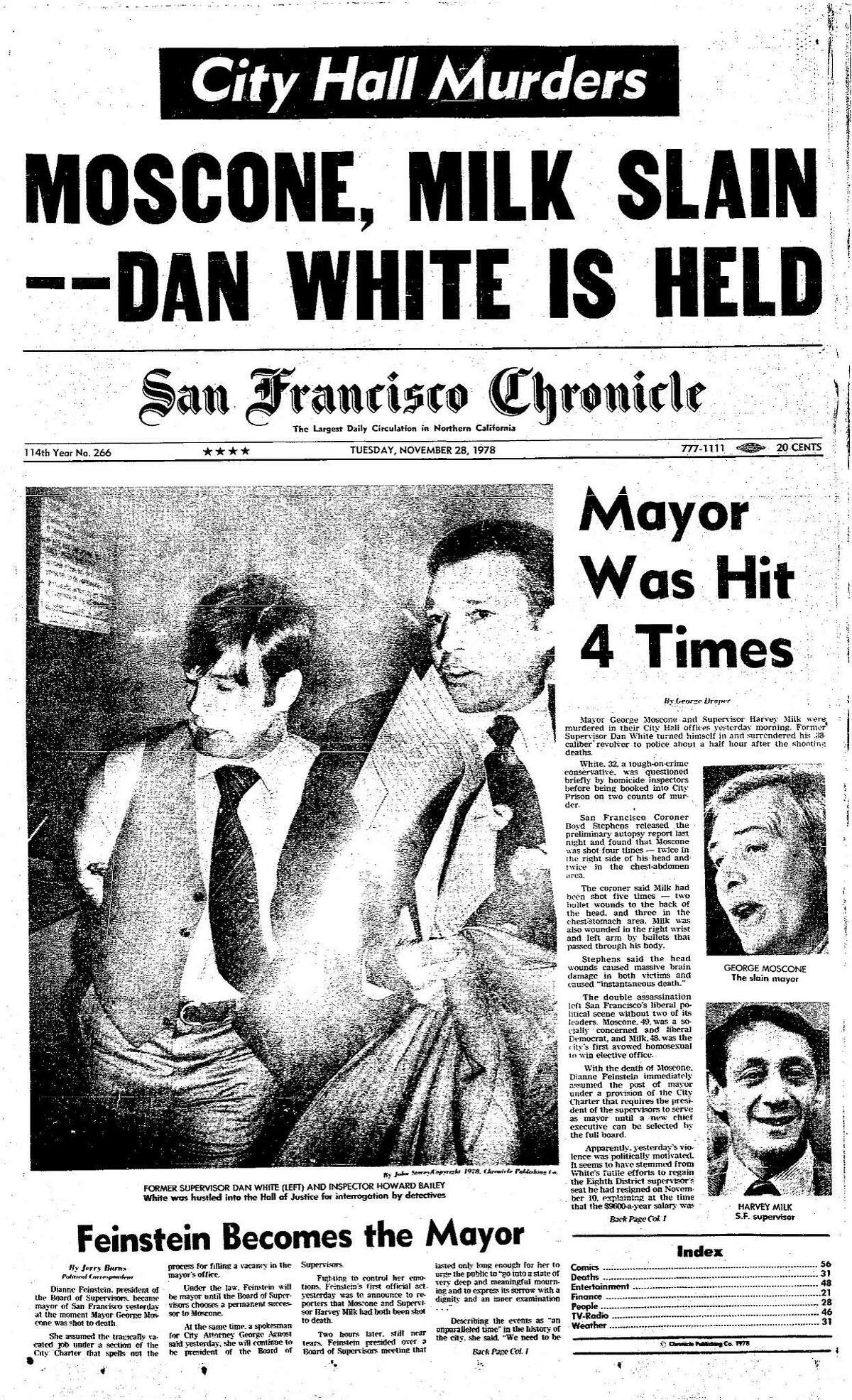
November 27, 1978: The Moscone-Milk Assassination

Harvey Milk (left) and George Moscone

November 27, 1978: A city still reeling from losing hundreds of its citizens in a cult suicide the week before suffers a shocking double assassination.

On November 18, nearly 1,000 people, most of them from the San Francisco Bay Area, died in a mass suicide ordered by the Rev. Jim Jones in the South American nation of Guyana. By the 27th, there were still funerals to conduct, when the next awful thing happened.

Before his descent into paranoia, Jones had been active in city politics, and had been helpful in the election of George Moscone as Mayor in 1975, and that of Harvey Milk to the Board of Supervisors, San Francisco's version of a City Council, in 1977.

Moscone served in the U.S. Navy in the Korean War, became a lawyer, and an ally of the Burton family's Democratic political machine in San Francisco. He was elected to the Board of Supervisors in 1962, and to the State Senate in 1966, rising to the rank of Majority Leader.

He was known for his support of poor people, minorities, small business owners, and, before most politicians dared, gay rights. He also helped block construction of a freeway that would have cut the city in half and destroyed Golden Gate Park and some neighborhoods. He sponsored bills creating a State school lunch program and legalizing abortion in the State. And both of these bills were signed into law by Governor Ronald Reagan.

He wanted to run for Governor of California in 1974, but was talked out of it, in favor of Jerry Brown, who won. (Jerry's father, Pat Brown, had been elected in 1958, and had beaten Richard Nixon in 1962, but had lost to Reagan in 1966.) Moscone was rewarded for this by being elected Mayor in 1975. Within weeks of taking office, he was instrumental in preventing the San Francisco Giants from moving to Toronto.

He also led the move away from the Board of Supervisors having all at-large seats to having neighborhood seats. This led to the 1977 election of Milk, the 1st openly gay elected official in America; Gordon Lau, the 1st Asian-American elected official in San Francisco; and Dan White, a cop-turned-fireman.

Milk was Jewish, and a native of Bay Shore, Long Island, outside New York City. Like Moscone, he served in the Navy during the Korean War. Unlike Moscone, he was gay, and this was discovered, so had to accept an "other than honorable" discharge. He returned to Long Island and taught in high school, then worked as an insurance actuary in Manhattan.

In 1970, he left New York, and arrived in San Francisco. In 1973, he opened a camera shop on Castro Street, the center of the Castro District, the city's premier gay neighborhood. In 1973, he ran for the Board of Supervisors, but finished 10th among 32 candidates for the at-large seats. In 1975, he ran again, and finished 7th. Under the old system, he had to finish at least 6th.

But with the new system in place in 1977, he only had to finish 1st in his own District, and he did. Part of it was leading the fight against singer Anita Bryant's move to ban gay people from teaching in Florida's public schools. This meant a boycott of the product for which Bryant was a spokeswoman: Florida oranges.

In 1978, Milk was among the leaders of the fight to stop a similar move in California, Proposition 6. He began to get death threats. He made a public statement: "If a bullet should enter my brain, let that bullet destroy every closet door."

Milk had clashed with White on a few issues. White got more and more frustrated in his job, and, on November 10, he resigned, saying a salary of $9,600 -- $43,000 in 2022 money -- was not enough to support his family.

But on November 15, he changed his mind, and asked Moscone to reinstate him. At first, Moscone was willing. But the other Supervisors, including Milk and the Board's President (and thus next in line to be Mayor), Dianne Feinstein, talked him out of it.

The Peoples Temple suicide happened on November 18, and word reached San Francisco on November 19. White told his aides, "One day, I'm on the front page; and the next, I'm swept right off."

Moscone announced a press conference for November 27, at which he would announce his appointment to serve as an interim holder of White's seat, until a special election could be held. White went to City Hall, with its dome making it look more like a State Capitol, and got in through a basement window, avoiding metal detectors. Because he had a gun, his former police issue revolver.
San Francisco City Hall

He went to Moscone's office. People nearby heard shouting, then gunshots. White shot Moscone in the shoulder, then the chest, and then finished him off with 2 shots to the head. White then walked over to his former office, and reloaded his gun. He walked into the corridor, and came face to face with Milk. From her office, Feinstein heard gunshots, and called the police. She went into the corridor, and found Milk down, shot 5 times -- like Moscone, twice in the head.
Moscone had just turned 49 years old. Milk was 48. Feinstein was 45. White was 33.

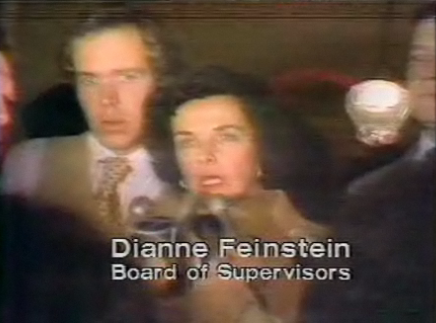
Now the Acting Mayor, the 1st woman and the 1st Jewish person to hold that post, Feinstein was forced to call a press conference to announce the assassinations, and say that White the suspect. White turned himself in after about an hour.
Flowers were left on the steps of City Hall, and when darkness fell, 40,000 people marched in a candlelight vigil from Castro Street to City Hall. The next day, both men lay in state in City Hall's rotunda.

White's trial was fixed. There were no gay people on the jury, nor any ethnic minorities, nor poor people. It was all white middle-class people, most of them Catholic. White's attorney blamed the dual assassination on his mistreatment by his colleagues, and also on a junk-food binge that messed with his blood sugar. Although Hostess' Twinkies were never mentioned, this became known as "the Twinkie defense." (This dovetailed with the Jonestown Massacre: The tainted drink was Flavor Aid, but everybody remembers it as Kool-Aid.)

On May 21, 1979, White was found not guilty on both counts of first degree murder, and found guilty on two counts of voluntary manslaughter. He was sentenced to 7 years in prison. Seven years for murdering two men -- and the Mayor and another major politician of his hometown, no less.

The sadness of the gay community 6 months earlier turned to rage. People began throwing rocks at the front doors of City Hall. Allies of Milk tried to reason with them, but there was no listening. Several downtown buildings were damaged, and a police car was set on fire. It became known as the White Night Riot. When a reporter asked a rioter why they were "destroying parts of the city," the rioter said, "Just tell people that we ate too many Twinkies."

San Francisco-based punk rocker Eric Boucher, taking the stage name Jello Biafra and fronting a band named for assassinated politicians, the Dead Kennedys, ran for Mayor in the 1979 election. A part of his platform was for a statue to be erected to Dan White, and to supply eggs, tomatoes and stones nearby, to give people something to throw at it. Apparently, despite being only 21 years old, he was serious about his campaign.

Appearing on the ballot with both his real name and his stage name, as "Eric 'Jello Biafra' Boucher," he actually finished 4th, with 6,591 votes, a little less than 4 percent of the vote, ahead of 6 other people who were on the ballot. Feinstein barely won, with 46.6 percent of the vote to the 44.7 of Supervisor Quentin Kopp, a margin of 3,331 votes. Kopp was later elected to the State Senate.

Things would get worse. The 1980s would bring the AIDS epidemic. It would take pretty much the entire decade for the disease to be stripped of its stigma as "gay cancer," or as "God's punishment for homosexuals." Per capita, San Francisco was hit harder by the disease than even the much larger cities of New York and Los Angeles.

In 1981, a Convention Center for which Moscone had lobbied was finished. It was named for him, and it hosted the 1984 Democratic National Convention. It remains the last building smaller than a professional sports arena to host a Democratic Convention.
The George R. Moscone Convention Center

Also in 1984, White was released from prison, having served a little over 5 years -- for murdering 2 men. On October 21, 1985, having won his case, but having lost pretty much everything else, including his wife to divorce, he committed suicide. He was 39 years old.

Feinstein was re-elected in 1983. Leaving office at the beginning of 1988, she ran for Governor in 1990, losing to Senator Pete Wilson. In 1992, she was elected to an unexpired term in the U.S. Senate, and was re-elected in 1994, 2000, 2006, 2012 and 2018. She is still alive, 89 years old, and still fighting for the rights of all Americans. It is not yet known if she will run for re-election in 2024, and people who hate her -- being female, Jewish, liberal, and outspoken, she pushes a lot of buttons -- claim that she has dementia. There is no reliable evidence of this. (UPDATE: She died in office in 2023.)

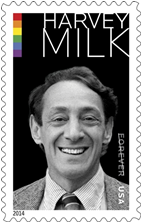
Milk has gone down in history as a pioneer of gay rights, a "Martin Luther Queen." In 2014, the U.S. Postal Service made him the 1st openly gay American politician to be honored with a postage stamp.
In 1980, Representative Robert Bauman, Republican of Maryland, was outed, making him the 1st member of Congress known to be gay. What's more, he was caught soliciting a teenage male prostitute. He was the 1st Republican politician, but by no means the last, to blame his indiscretion on alcoholism. He apologized for said indiscretion, but lost his bid for re-election. As of November 27, 2022, he is still alive.

In 1983, Representative Gerry Studds, Democrat of Massachusetts, was outed, and had his relationship with a 17-year-old Congressional page exposed. He was censured, but won re-election in 1984, making him the 1st openly gay person to win an election for Congress. He continued to serve his District -- which includes Cape Cod, which includes Provincetown, one of the most gay-friendly places in America -- until retiring in 1996, and died in 2006.

In 1998, Tammy Baldwin of Wisconsin was elected to Congress, the 1st openly gay non-incumbent to be elected, and the 1st openly gay woman to serve. In 2012, she became the 1st openly gay person elected to the U.S. Senate.

In 2004, Governor Jim McGreevey, Democrat of New Jersey, exposed as having appointed an unqualified lover to public office, came out, and resigned. He has never run for public office again. In 2018, Jared Polis, Democrat of Colorado, having previously been elected to Congress, was the 1st openly gay person elected Governor of any State. (UPDATE: In 2023, McGreevey announced that he was running for Mayor of his birthplace, Jersey City, in the 2025 election.)

In 2020, Mayor Pete Buttigieg of South Bend, Indiana became the 1st openly gay person to win delegates for a Presidential nomination. When Joe Biden was elected President, he appointed Buttigieg to be Secretary of Transportation, making him the 1st openly gay member of a President's Cabinet. And a few transgender politicians have been elected to local and State offices, though not yet to Congress or Governorships.

One last thing. I was 8 years old, almost 9, in November 1978. I remember seeing the Jonestown story on the news, dominating coverage for a few days, leading into Thanksgiving weekend, November 23 to 26. But I have no memory of seeing the national news cover the assassinations of Moscone and Milk on the 27th. I knew Moscone's name from having watched the 1984 Democratic Convention. But I don't recall hearing Milk's name until I was already out of high school. And I have no idea why that is.

*

November 27, 1978 was a Monday. The White Shadow, perhaps the best sports-themed TV show of all time, premiered on this night.

Baseball was out of season, although there was a notable event in the sport that day: Jimmy Rollins, Captain of the Philadelphia Phillies' 2007-11 quasi-dynasty, including the 2008 World Series win, was born, in Oakland, California, and grew up in neighboring Alameda.

There were no games scheduled that day for the NBA, the NHL, or the World Hockey Association. But Monday Night Football aired on ABC. And in the "You can't make this stuff up" department, the game that night happened to be set for Candlestick Park, between the San Francisco 49ers and the Pittsburgh Steelers.

Pete Rozelle, Commissioner of the NFL, and a former publicity director for the University of San Francisco, had been through this before. In 1963, President John F. Kennedy had been assassinated about 48 hours before NFL games were to kick off. Knowing that some teams scheduled to play on the road were already at their respective airports, and may even have been in the air, he decided to let the games go ahead as scheduled. He later called that his biggest mistake of his career.

This time, with only a few hours to make a decision, he decided to let the game be played, but ordered a moment of silence in memory of Moscone and Milk, to be held right before the National Anthem. But right between them, a truck backed into a wooden flagpole near the south end zone. The sound the pole made when it hit the ground unnerved many people who had been on edge, some for a few hours, some for a few days. At any rate, the Steelers, on their way to winning Super Bowl XIII, won the game, 24-7.

Saturday, November 26, 2022

November 26, 1998: A Turkey of an Overtime Coin Flip

November 26, 1998: The Detroit Lions' annual tradition of hosting a game on Thanksgiving Day turns into a delicious result for them, because of a turkey of a turn of events.

The Lions were hosting the Pittsburgh Steelers at the Silverdome in the Detroit suburb of Pontiac, Michigan, in a game televised nationally on CBS. With Barry Sanders in the backfield, the Lions came into the game 4-7. With an offense with quarterback Kordell Stewart (known as "Slash" because he was a quarterback/runner/receiver) and running back Jerome Betts (known as "The Bus" because he was as big as one), the Steelers came in 7-4, and were leading the AFC Central Division.

The 1st quarter was scoreless. Norm Johnson kicked 2 field goals for the Steelers in the 2nd quarter, and Jason Hanson kicked 1 for the Lions, so it was 6-3 Pittsburgh at halftime. Stewart threw a touchdown pass to Will Blackwell to put the Steelers up 13-3. Hanson kicked another field goal, and it was 13-6 after 3 quarters.

In the 4th quarter, Charlie Batch threw a touchdown pass to Herman Moore, to tie the game. Hanson kicked a field goal to give the Lions their 1st lead of the game. But with 4 seconds left in regulation, Johnson kicked a 25-yard field goal, sending the game to overtime, 16-16.

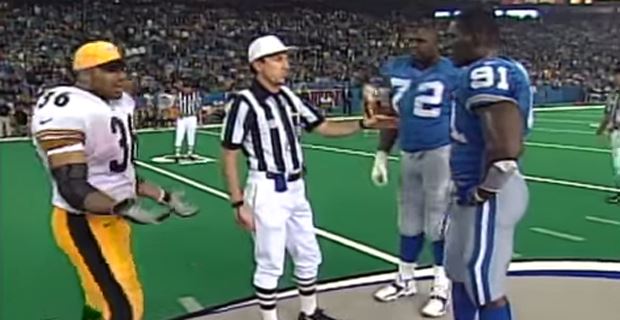
Referee Phil Luckett called the team Captain to midfield for the overtime coin toss. As the visiting team, the Steelers had the right to call the toss, as they did at the beginning of the game. Luckett told Bettis to call the coin in the air.

Bettis had started to say, "Heads," but changed his mind in mid-syllable: "He -- Tails!" But Luckett went with the first syllable he said he heard, and ruled that Bettis had said, "Heads," which he hadn't. The coin landed tails, meaning the Steelers should have had the ball. Instead, Luckett ruled that the Lions had won the toss, and gave them the ball.

Batch took the Lions down the field, and, just 2 minutes and 52 seconds into overtime, with the Steelers never even getting the ball, Hanson kicked a 42-yard field goal to win it, 19-16.

The Steelers cried foul, but there was nothing they could do. The NFL was never going to order the overtime replayed. And while the win didn't affect the Lions much, as they lost the last 4 games of the season, to finish 5-11, the loss ruined the Steelers' season: It started a season-ending 5-game losing streak. They finished 7-9, and missed the Playoffs completely.

This play inspired 2 rule changes. First, the player making the call now does so while the ref is still holding the coin, and the ref repeats the call before flipping, with his microphone being piped into both the stadium public-address system and the television microphones. This way, no one, inside the stadium or outside, has any doubt as to what the Captain's call is.

That change took effect the next season. But it would be many more years before the NFL changed its rule so that the team winning the toss must score a touchdown to automatically win; if they only kick a field goal, the opposing team then gets the ball and a chance to win.

Luckett was also the referee 10 days later at the Meadowlands, when Vinny Testaverde of the New York Jets appeared to score a touchdown against the Seattle Seahawks, but the replay showed that the ball did not cross the plane of the goal line. Head linesman Earnie Frantz ruled it a touchdown, and Luckett, the man in charge, let it stand. The following season, the NFL instituted instant replay.

That didn't stop Luckett from being involved in a controversial play again the next season -- and this time, it was in the Playoffs. Luckett ruled that Frank Wychek's pass to Kevin Dyson, leading to Dyson's touchdown run that won the game for the Tennessee Titans against the Buffalo Bills was a lateral, and thus legal, and the play stood. This was the right call to make: It was a lateral.

Since 2012, Luckett has been a supervising official, in charge of instant replay.

*

November 26, 1998, like all Thanksgiving Days, was a Thursday. In the NFL's other game that day, the Minnesota Vikings beat the Dallas Cowboys, 46-36 at Texas Stadium in the Dallas suburb of Irving, Texas.

There were 2 college football games played that day, both of them intrastate matchups. Tulane, so rarely ranked since the 1st half of the 20th Century, were ranked Number 11, and beat Louisiana Tech, 63-30 at the Superdome in New Orleans. And Mississippi State, ranked Number 25, beat Mississippi, a.k.a. Ole Miss, 28-6 at Vaught-Hemingway Stadium in Oxford, Mississippi.

Baseball was in the off-season. Traditionally, the NBA and the NHL avoid scheduling games on Thanksgiving Day, so as not to compete with football for TV ratings. This time, however, the NHL scheduled 2 games, and a New York Tri-State Area team was in both. And both lost. The New York Islanders lost to the Ottawa Senators, 4-1 at the Corel Centre in the Ottawa suburb of Kanata, Ontario. (It's now the Canadian Tire Centre. The town was absorbed into Ottawa proper in 2001.) And the New Jersey Devils lost to the Phoenix Coyotes, 3-2 at the America West Arena (now the Footprint Center) in Phoenix.

Thursday, November 24, 2022

November 24, 1983: "Sesame Street" Says Goodbye to Mr. Hooper

November 24, 1983: Sesame Street airs its best-remembered episode, perhaps its most important, and certainly its saddest.

William Lee (no middle name) was born on August 6, 1908 in Brooklyn. He was a member of the Group Theatre and then the Federal Theatre in New York in the 1930s, and was later blacklisted as a result of being an unfriendly witness before the House Un-American Activities Committee. He recovered from this, and in 1956, began appearing on the soap opera As the World Turns, as Grandpa Hughes -- already playing a grandfather at the age of 48.

He taught at the American Theatre Wing, and then, in 1969, at the age of 61, he got the part of Mr. Hooper on Sesame Street. Show co-creator Joan Ganz Cooney said, "He gave millions of children the message that the old and the young have a lot to say to each other." He said of the role:

I was delighted to take the role of Mr. Hooper, the gruff grocer with the warm heart. It's a big part, and it allows a lot of latitude. But the show has something extra, that sense you sometimes get from great theater, the feeling that its influence never stops.

Mr. Hooper operated Hooper's Store, across from 123 Sesame, the signature building on the show's set. In a 1974 episode, "Mr. Hooper" (everybody called him that, except Big Bird -- more on that in a moment) was, like his portrayer, canonically revealed to be Jewish, when his phone rang, and he began speaking Yiddish. In a 1977 episode, he told Big Bird, "I grew up in a neighborhood where that was the only language a lot of people spoke."

In the 1978 special Christmas Eve On Sesame StreetMr. Hooper came through to provide a happy ending. Muppet roommates Bert and Ernie unwittingly recreated the O. Henry story The Gift of the Magi: Neither one of them had enough money to buy the other a Christmas present, so Ernie traded his beloved rubber duckie to Mr. Hooper for a cigar box, so Bert would have a good place to store his beloved paper clip collection; and Bert traded that collection to Mr. Hooper for a soap dish, so the rubber duckie wouldn't keep slipping off the edge and into the bathtub.

In one of the rare appearances by one of the show's human characters in Bert and Ernie's apartment, Mr. Hooper gave Ernie a present. He unwrapped it, and it was his rubber duckie. And he gave Bert a present. He unwrapped it, and it was a box containing his paper clip collection. The boys realized what had happened. Then they felt guilty that they hadn't gotten Mr. Hooper anything. He said, "I got the best Christmas present ever: I got to see that everybody got exactly what they wanted!"

A quirk in Big Bird's character was that he always mispronounced Mr. Hooper's name, usually coming out "Mister Looper." I remember a "Mr. Dooper" and a "Mr. Stooper" -- that last one really annoyed Mr. Hooper. When Mr. Hooper got his GED, we finally learned his first name, when he was introduced at the ceremony -- by a grownup -- as "Harold Cooper."

On November 24, 1982, at the age of 74, Will Lee taped an episode of Sesame Street -- as it turned out, for the last time. He didn't feel well that day, and barely spoke to the cast. The next day, he appeared live on national television as part of Sesame Street's float in the Macy's Thanksgiving Day Parade. There was no indication at that time that he was ill. But, just 12 days later, on December 7, 1982, he died of a heart attack. 

The Children's Television Workshop, producers of Sesame Streethad a dilemma. They based their whole show on the fact that kids were smart enough to learn things. So they knew that kids would notice if Mr. Hooper were played by a different actor, or if he stopped appearing altogether, and would need an explanation. They considered saying that the character had retired and moved away. In the end, they decided to tell the truth -- or, rather, to write the actor's truth into the character's story.

On November 24, 1983, one year to the day after his last taping -- Thanksgiving Day, a day when families were together, to help explain anything that the show might not have properly covered to the kids watching -- it was revealed that Mr. Hooper had died some time earlier (no cause was given), but that Big Bird still didn't grasp what this meant. He had to be told that it means, "Mr. Hooper's not coming back."

Bob McGrath, who played music teacher Bob Johnson, said of the human cast, "We barely got through that show." Carroll Spinney, who both wore the Big Bird costume and operated the Oscar the Grouch Muppet, said, "The best episode we ever did was Mr. Hooper's death. Those were real tears. Will was the sweetest man."
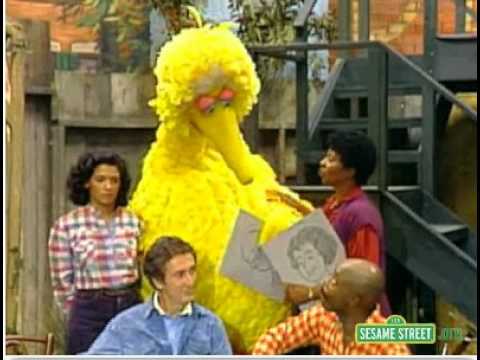
Big Bird, played by Carroll Spinney, surrounded by, left to right:
Maria (Sonia Manzano), Bob (Bob McGrath),
Susan (Loretta Long) and Gordon (Roscoe Orman)

For a few years by that point, Northern Calloway had played David (his last name was never mentioned), a young black man who had been Mr. Hooper's assistant. David inherited Hooper's Store. After that, David hired Gina Jefferson, a teenage girl played by Alison Bartlett-O'Reilly. But Calloway fell victim to mental illness, left the show in 1989, and died a year later.

The store was then bought by Mr. Handford, a black retired firefighter played by Leonard Jackson for one season, then by David L. Smyrl. Jackson played Mr. Handford as a grumpy old man, while Smyrl found the same balance between grumpy old man and kindly old gentleman that Lee had. (David's disappearance was explained as the character simply moving away, while the change in actor for Mr. Handford was less drastic, since the character wasn't original and beloved, as Mr. Hooper and, to a lesser extent, David were.)

In 1998, Smyrl left the show, and it was explained that Mr. Handford had sold the store to Alan (whose last name has never been revealed). Alan is played by Japanese-American actor Alan Muraoka, and has run the store ever since -- his 24 years in charge nearly twice as long as the 13 years we saw Mr. Hooper run it, although we have no way of knowing how long it was open before 1969.

But, to this day, the drawing of Mr. Hooper that Big Bird made, and showed in the farewell episode, rests adjacent to Big Bird's nest, as a reminder of Mr. Hooper, and of Will Lee.
Carroll Spinney, in his 80s, began to pull back, allowing Eric Jacobson to take over as Oscar in 2015, and Matt Vogel to replace him as Big Bird 2018. Spinney died the following year. But, like Oscar, Bert and Ernie, Grover, Cookie Monster, The Count, and all the rest, Big Bird lives. Which means he'll never see Mr. Hooper again -- barring the invention of a Star Trek-style holodeck or the intervention of an artificial intelligence setup that can simulate the character. 

*

November 24, 1983 was Thanksgiving Day, a Thursday. The NFL's usual suspects for the day both won. In the opener, on NBC, the Detroit Lions beat the Pittsburgh Steelers, 45-3 at the Silverdome in the Detroit suburb of Pontiac, Michigan. In the nightcap, on CBS, the Dallas Cowboys beat the football version of the St. Louis Cardinals, 35-17 at Texas Stadium in the Dallas suburb of Irving, Texas.

There was 1 college football game: Memphis State University (now the University of Memphis) beat the University of Louisville, 45-7 at Cardinal Stadium in Louisville.

At the time, I was in the 9th grade at Hammarskjold Junior High School in East Brunswick, Middlesex County, New Jersey. In East Brunswick, the High School is limited to 10th, 11th and 12th grades. EBHS played that day, away to Colonia High School in Woodbridge, the school's longest regular roadtrip, so I couldn't have gone even if I'd been aware of it at the time. EBHS won it, 21-7.

As usual, the NBA did not play on Thanksgiving. But the NHL did. The Quebec Nordiques beat the Boston Bruins, 6-3 at the Boston Garden. And the Winnipeg Jets and the Calgary Flames played to a 4-4 tie at the Saddledome in Calgary.

This was a little unusual, since 3 of the 4 teams that played on the day were in Canada. Canada does celebrate a Thanksgiving Day, on the 2nd Monday in October, when America celebrates Columbus Day.

And they do celebrate it with football: A nationally-televised doubleheader known as the Thanksgiving Day Classic. There's a game in the East, usually hosted by the Montreal Alouettes; and a game in the West, where the host varies. This year, the Alouettes beat the Ottawa Redblacks, 20-16 at Molson Stadium in Montreal; and, while Ontario is not exactly in Western Canada, the Toronto Argonauts beat the Hamilton Tiger-Cats, 24-23 at Tim Hortons Field in Hamilton.

December 31, 1999 & January 1, 2000: The Millennium

December 31, 1999:  The Millennium arrives. The people of planet Earth survived. At a terrible cost. But we hadn't destroyed ourselves. ...