Showing posts with label minneapolis auditorium. Show all posts

Tuesday, November 22, 2022

November 22, 1950: Pistons 19, Lakers 18

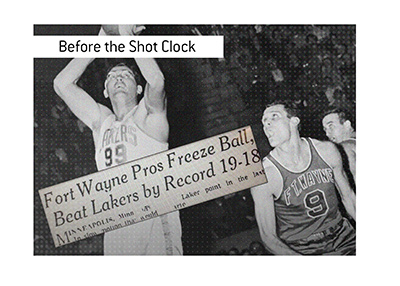
99: George Mikan. 9: Bob Harris.

November 22, 1950: The worst game in NBA history is played. There were games that were sloppier, and games that had ugly brawls. But as far as quality of play is concerned, nothing will ever top this one -- or "bottom" it, if you prefer.

The Minneapolis Lakers were hosting the Fort Wayne Pistons at the Minneapolis Auditorium. The Lakers were representing Minnesota, the State known as "the Land of 10,000 Lakes," while the Pistons were owned by Fred Zollner, whose Fort Wayne, Indiana-based Zollner Corporation ran a foundry that manufactured pistons, primarily for car, truck and locomotive engines.

Both teams began play in the Midwest-based National Basketball League before entering the NBA. The Pistons won the NBL Championship in 1944 and 1945. The Lakers won it in 1948, then joined the NBA, and won their title in 1949 and 1950.

Coached by John Kundla, a Minneapolis native and University of Minnesota basketball star who wasn't much older than his players, the Lakers were led by George Mikan, at 6-foot-10 the professional game's 1st great big man. Before coming to the Lakers, he had helped Chicago's DePaul University win the NIT (then considered a more important competition than the NCAA Tournament) in 1944 and 1945. Earlier in 1950, despite being just 26 years old, the Associated Press named Mikan the greatest basketball player of the 1st half of the 20th Century.

(The AP's other honorees: Babe Ruth for baseball, Howie Morenz for hockey, Jack Dempsey for boxing, Bill Tilden -- despite his recent scandal -- for men's tennis, Suzanne Lenglen for women's tennis, Man o' War as the greatest racehorse; and Jim Thorpe for football and track and field, and as greatest athlete overall.)

Mikan wasn't fast or graceful: In 1969, longtime New York sportscaster Bill Mazer wrote, "He was more like a stampeding elephant"; while Boston Globe columnist Bob Ryan said on a 1996 ESPN panel, "Great player in his time. Deserved every accolade he ever got. But, today? He's Greg Kite with a hook shot."

The Lakers had other players who would make the Hall of Fame: Jim Pollard jumped around the court so much, he had the nickname "the Kangaroo Kid" years before Billy Cunningham of the Philadelphia 76ers did; while Slater Martin and Vern Mikkelsen were also among the best players in the game. Kundla would also eventually be elected to the Hall, and lived to be 100, outliving each of these players.

The Lakers' game was simple: Find an outside shot, and, if you can't, get the ball to Mikan and let him shoot over everybody. So, Pistons coach Murray Mendenhall decided that the only way to win the game was to make sure that Mikan doesn't get the ball. And the way to do that was to hold onto possession for as long as possible. In other words, or other word: Stall.

A crowd of 7,021 saw this: The Pistons leading 8-7 at the end of the 1st quarter, the Lakers leading 13-11 at the half, and the Lakers leading 17-14 at the end of the 3rd quarter. The crowd, hoping to see Mikan do his stuff, knew what the Pistons are trying, and they booed vociferously.

The Lakers scored only 1 point in the 4th quarter, but were still leading 18-17 with 6 seconds left in regulation, with Mikan having scored 15 of their points, including all of their field goals, 4 in 11 attempts. The rest came from 3 free throws: The other Lakers shot 0-for-6 from the field.

On the game's final play, unable to stall any longer, Pistons rookie Larry Foust took an inbounds pass, and laid it up over Mikan's outstretched arms. Mikan couldn't stop the shot, and it went in. Final score: Pistons 19, Lakers 18.

Point totals: Pistons: John Oldham 4, Curly Armstrong 4, Foust 3, Fred Schaus 3, John Hargis 2, Jack Kerris 2, Bob Harris 0, Ralph Johnson 0; Lakers: Mikan 15, Bob Harrison 2, Pollard 1, and none for Martin, Mikkelsen, Arnie Ferrin, Joe Hutton, and Bud Grant. Yes, football fans, the same Bud Grant who made the Pro Football Hall of Fame for leading the Minnesota Vikings into 4 Super Bowls (but losing them all).

Kundla told the sportswriters, "Play like that will kill professional basketball." But teams found the Lakers' weakness: Hold on to possession, and you can beat them. The 1950-51 NBA Championship was won by the Rochester Royals.

Kundla got his team to bounce back, winning the NBA Championship in 1952, 1953 and 1954. Then Mikan retired, and they didn't win another title until 1972 -- and not in Minneapolis.

Mikan's timing may have been absolutely right: For the 1954-55 season, the NBA adopted the 24-second shot clock. Stalling was no longer possible. Other teams, by necessity, needed faster players to copy the Lakers' now-useless fast break. For that reason, the aforementioned Bob Ryan said that 1954 is the demarcation line: When comparing great players and great teams in NBA history, you shouldn't put pre-1954 entries into the discussion, because they weren't really playing the same game.

The 19-18 game didn't kill pro hoops, but winning it didn't help the Pistons much. Although they reached the NBA Finals in 1955 and 1956, they didn't win either time. In 1957, accepting that Fort Wayne was too small a market in which to compete, Zollner moved the team to Detroit, the Motor City, where the Pistons name still made sense.

Murray Mendenhall lived until 1972, Fred Zollner until 1982, Larry Foust until 1984, and George Mikan until 2005.

Built in 1927, the Minneapolis Auditorium seated 10,545 people, and was home to the Lakers from 1947 to 1959. They played the 1959-60 season at the Minneapolis Armory, which still stands. After that season, they moved to Los Angeles, where the Lakers name didn't make sense. But they became L.A.'s most popular sports team, and remain so.

Since 1980, they have won 11 NBA Championships, the most of any team over that stretch. In total, in Minneapolis and Los Angeles combined, they have won 17, tied with the Boston Celtics for the most. One of those titles came in 2002, when a questionable imbalance of fouls gave them the Western Conference title over the Sacramento Kings. That remains the closest the Kings franchise has come to the NBA Finals since... 1951, when they were the Rochester Royals, the team that briefly interrupted the Lakers' Minneapolis dynasty. (UPDATE: The Celtics won an 18th title in 2024.)

Since their respective moves, the Lakers and the Pistons have played each other in 3 NBA Finals. The Lakers won in 1988, the Pistons in 1989, and the Pistons in one of the great NBA Finals upsets in 2004.

Made obsolete by the construction of the Metropolitan Sports Center in suburban Bloomington in 1967, and more so by the plan to build the Target Center downtown (it opened in 1990), the Auditorium was demolished in 1988, and the Minneapolis Convention Center was built on the site. The Minnesota Timberwolves began play in 1989, playing their 1st season in the Metrodome before the Target Center was ready. They have not been a success: Only once, in 2004, have they made the NBA Western Conference Finals, and they lost it -- to the Lakers. (UPDATE: They made it that far again in 2024, losing to the Dallas Mavericks.)

*

November 22, 1950 was a Wednesday, the day before Thanksgiving. Steven Van Zandt, who played guitar for Bruce Springsteen's E Street Band, and played consigliere Silvio Dante on The Sopranos, was born on this day.

There were 2 other games played in the NBA that night. The New York Knicks beat the Baltimore Bullets, 87-73 at the Baltimore Coliseum. And the Washington Capitols beat the Tri-Cities Blackhawks, 65-60 at the Uline Arena (now the Washington Coliseum).

Baseball was in the off-season. Football was in midweek. There were 2 NHL games played that night. The New York Rangers beat the Montreal Canadiens, 3-2 at the old Madison Square Garden. And the Toronto Maple Leafs beat the Chicago Black Hawks, 5-2 at Maple Leaf Gardens in Toronto. The Boston Bruins and the Detroit Red Wings were not scheduled.

In spite of the next day being Thanksgiving, a day on which the NBA generally doesn't play today, 5 games were played: New York 109, Washington 78; Philadelphia 89, Rochester 71; Boston 94, Tri-Cities 78; Indianapolis 92, Syracuse 85; and, in a rematch in Fort Wayne, Pistons 73, Lakers 63. So the 19-18 game was an aberration: The Pistons proved they could win while playing what then passed for normal basketball.

In the NHL on Thanksgiving 1950: Toronto 2, Detroit 1 in Detroit; and host Chicago 4, Boston 1. In the modern era, the NBA and the NHL avoid playing on Thanksgiving Day, so as not to compete with college and pro football, although there are usually some college basketball games on the day.

Among the college football games on T-Day '50: Number 12 Wyoming 42, the University of Denver 12 in Denver; Number 19 Washington & Lee 67, Richmond 7 in Richmond; Columbia 33, Brown 0 in Providence; Virginia Military Institute 27, Virginia Tech 0 in Roanoke; Missouri 20, Kansas 6 in Columbia; and Utah 46, Utah State 0 in Salt Lake City.

And in the NFL on T-Day '50: Detroit Lions 49, New York Yanks 14 at Briggs Stadium (Tiger Stadium) in Detroit; and Pittsburgh Steelers 28, Chicago Cardinals 17 at Comiskey Park in Chicago.

Wednesday, April 27, 2022

April 27, 1960: The Minneapolis Lakers Are Moved to Los Angeles

April 27, 1960: Bob Short, owner of the NBA's Minneapolis Lakers, announces he is moving the team to Los Angeles. For the 1st time, the NBA will be a coast-to-coast league. The NFL had already become one in 1946; Major League Baseball, in 1958.

The Lakers won the National Basketball League title in 1948, entered the NBA, and won the title in 1949, 1950, 1952, 1953 and 1954. They featured future Basketball Hall-of-Famers: George Mikan, Vern Mikkelsen, Jim Pollard, Slater Martin, Clyde Lovellette, and head coach John Kundla. They had another Hall-of-Famer: Pro Football Hall of Fame coach Bud Grant played for them.
Left to right: Arnie Ferrin, Vern Mikkelsen,
George Mikan, Jim Pollard, Slater Martin.

The institution of the 24-second shot clock for the 1954-55 season changed everything, making the NBA a faster, higher-scoring game. By the end of the 1955-56 season, Mikan, despite being only 32 years old, saw the writing on the wall, and retired. His era, the Lakers' era of dominance, was over.

By 1959, the team had completely turned over, and reached the NBA Finals with rookie sensation Elgin Baylor, but lost the Finals to the Boston Celtics. And then, after the 1959-60 season, in which they lost the Western Conference Finals to the St. Louis Hawks, team owner Bob Short moved them across the country to Los Angeles.

How could Short move a team that had been to 7 league finals, winning 6 of them, in just 12 seasons? Especially since he was a Minneapolis native, and having Baylor, and being able to draft Jerry West, meant that they had 2 great drawing cards to fill the arena? It didn't make any sense. Talk about "Short-sighted."

Maybe not. There was the arena situation to consider. The Minneapolis Auditorium opened in 1927, and seated 10,000 people, but it was not designed with sports in mind. Nor was the Minneapolis Armory, which opened in 1936 and was the Lakers' home in their final Minneapolis season, 1959-60. The Auditorium was demolished in 1989, while the Armory still stands.

In contrast, the Los Angeles Memorial Sports Arena opened in 1959, seated over 16,000 for basketball, and had no tenant. The Dodgers had recently arrived to an overwhelming response, the Rams were successful, and both USC and UCLA attracted good basketball crowds. Short realized that the NBA could work there.

The Lakers reached the NBA Finals in 1962, 1963 and 1965, before Short sold them to Jack Kent Cooke. He built The Forum in Inglewood for them in 1967. They won the NBA Championship in 1972. In 1979, Cooke sold the Lakers to Jerry Buss, in whose family the team remains today.

In 1968, Short bought MLB's Washington Senators, and after the 1971 season, moved them as well, to the Dallas area, where they became the Texas Rangers. So he not only moved 2 different major league sports teams, he did it in 2 different sports, involving 4 different metropolitan areas. He died in 1982.

The Lakers are Los Angeles' most successful team, having won 12 NBA Championships. The rest of the city? The Clippers haven't yet reached the NBA Finals, but the Sparks have won 3 WNBA titles; the Dodgers have won 5 World Series (not counting 1955 in Brooklyn), while the Angels have won 1; the Rams have won 2 NFL Championships (counting 1 Super Bowl, but not counting the 1 they won in their sojourn in St. Louis), while the Raiders, who weren't there long, won 1; the Kings have won 2 Stanley Cups, the Anaheim Ducks 1; the Galaxy have won 5 MLS Cups, Los Angeles F.C. 1, and the Aztecs won an NASL title. And that doesn't count the 11 National Championships each won by the UCLA basketball team and the USC football team.

But it's more than just the success: There's "sizzle" to go with the "steak." With Elgin Baylor and Jerry West in the 1960s, West and Wilt Chamberlain in the early 1970s, Kareem Abdul-Jabbar and Magic Johnson leading "Showtime" in the 1980s, Shaquille O'Neal and Kobe Bryant in the early 2000s, and Kobe and Pau Gasol the last few years, their flashy image has been a perfect match for L.A.

And what about Minneapolis? They didn't miss the Lakers. Once Mikan retired, the Lakers' attendance was terrible. In 1961, right after the move, baseball's Twins and the NFL's Vikings arrived. By 1962, the Twins were contenders; by 1967, so were the Vikings. Also, at the time, the University of Minnesota's football team was a championship contender. So the Twin Cities weren't starved for sports entertainment.

True, the Twins lost the 1965 World Series -- to the Dodgers, no less. But they were still having more fun watching the Twins and the Vikings throughout the 1960s than they had watching the Lakers in the late 1950s.

In contrast, when the NBA finally expanded in 1989 to include the Minnesota Timberwolves, the response was underwhelming. The T-Wolves have never been a success on the court -- they've only reached the Western Conference Finals once in their 1st 33 seasons -- and they're not making the turnstiles spin, either.

The Twin Cities might not be big enough of a region to support teams in each of the Big Four sports, plus Major League Soccer. And, with the Twins, the Vikings, MLS' Minnesota United and UM football all having gotten new stadiums since 2009, the State of Minnesota being hockey-crazy, and the NHL not wanting to piss them off a 2nd time, if any team has to go, it's going to be the T-Wolves.

UPDATE: The T-Wolves made the Western Conference Finals in 2024, but lost.

The Timberwolves have retired 2 numbers: 2, for forward Malik Sealy, after his death in a car crash in 2000; and 21, for forward Kevin Garnett. Sealy had previously wore 21 throughout his career, but switched to 2 out of respect for Garnett. The T-Wolves have also honored the late coach Philip Saunders with a banner with his nickname, "FLIP."

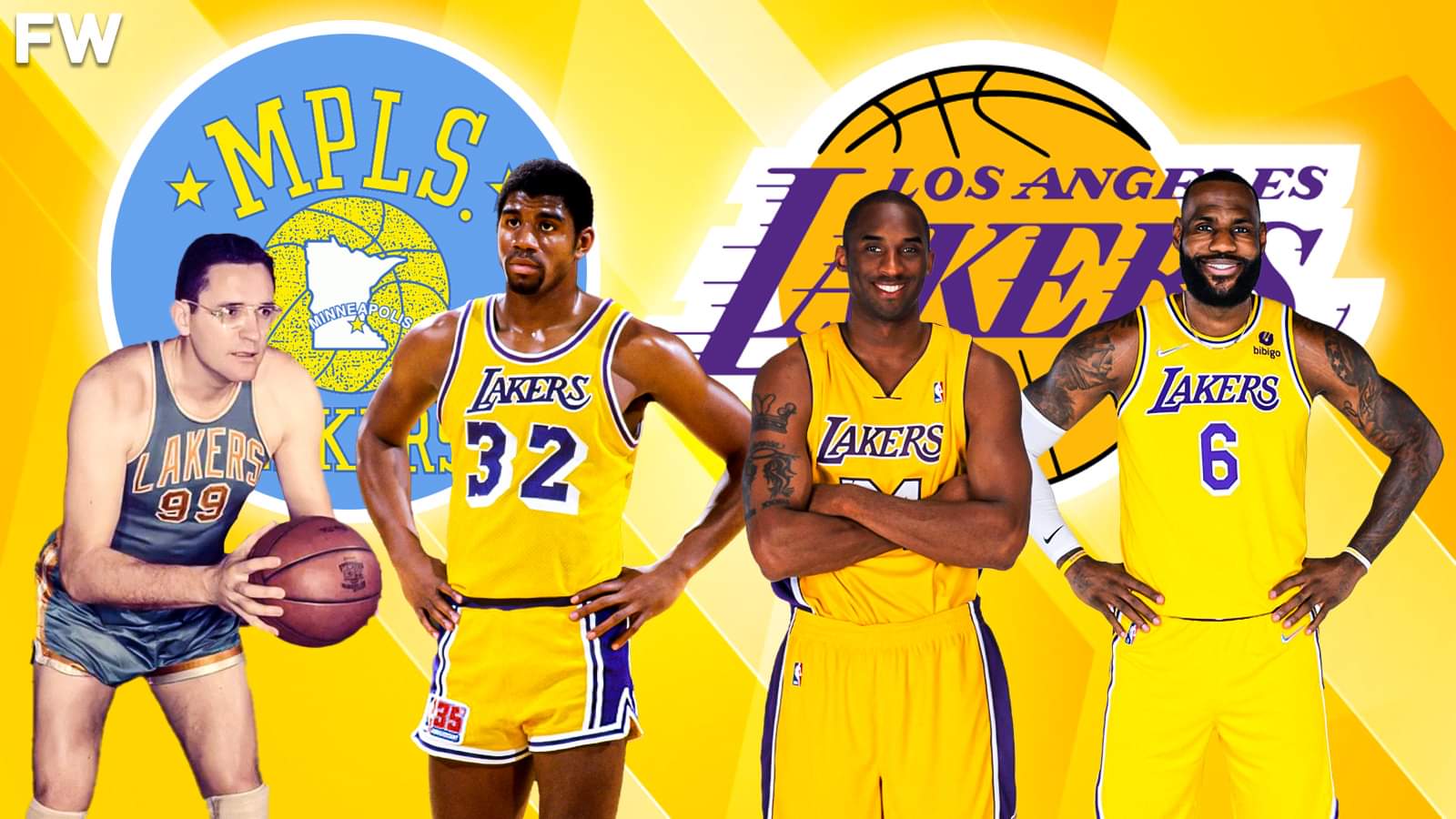
In 2002, the Los Angeles Lakers hung a banner at the Staples Center (now the Crypto.com Arena), honoring their Minneapolis past. A single banner honors Hall of Fame coach John Kundla, and the 5 Hall of Fame players: Center George Mikan, Number 99; forwards Jim Polland, Number 17, and Clyde Lovellette, Number 34; and guard Slater Martin, Number 22.

The Lakers do not have a team Hall of Fame. But they have honored 13 players with the retirement of their uniform numbers:

* From their Minneapolis era, 1947 to 1960: 99, for Mikan. It was just as well: It was unlikely to ever be worn again, anyway.

* From the 1960s, but not their 1972 title: 22, for forward Elgin Baylor.

* From their 1972 NBA Championship: 13, for center Wilt Chamberlain; 25, for guard Gail Goodrich; and 44, for guard Jerry West. While Pat Riley, later to coach them to 4 NBA Championships, played as a guard on this team, his Number 12 has not yet been retired.

* From their 1980, 1982, 1985, 1987, and 1988 NBA Championships: 33, for center Kareem Abdul-Jabbar; 52, for forward Jamaal Wilkes (left after 1985); 21, for guard Michael Cooper; 32, for guard Earvin "Magic" Johnson; and 42, for forward James Worthy (arrived after 1982).

* From their 2000, 2001 and 2002 NBA Championships 34, for center Shaquille O'Neal; and 8, for guard Kobe Bryant.

* From their 2009 and 2010 NBA Championships: 24, to which Bryant had switched, making him the only athlete in the "Big Four" North American sports to have one team retire two different numbers for him; and 16, for forward Pau Gasol.

* As of the 2025-26 season, no player on their 2020 NBA Championship has had his number retired.

* And Francis "Chick" Hearn, who broadcast for the Lakers from 1961 to 2002, was honored with a banner with a microphone in place of a number.

*

April 27, 1960 was a Sunday. Hockey player Mike Krushelnyski was born.

Football was out of season. The NBA season had ended on April 9, with the Boston Celtics beating the St. Louis Hawks for the title. The hockey season had ended on April 14, with the Montreal Canadiens beating the Toronto Maple Leafs for their 5th straight Stanley Cup.

And these Major League Baseball games were played:

* The New York Yankees lost to the Washington Senators, 5-4 at Yankee Stadium. Jim Kaat, a 21-year-old rookie lefthander, outpitched Whitey Ford. Don Mincher and Jim Lemon hit home runs for the Senators. For the Yankees, Bill "Moose" Skowron hit a home run. Mickey Mantle went 1-for-4. Yogi Berra went 0-for-3 with a walk. Roger Maris and the Senators' Harmon Killebrew did not play.

* The Pittsburgh Pirates beat the Philadelphia Phillies, 3-2 at Connie Mack Stadium in Philadelphia. Roberto Clemente went 2-for-4 with a walk.

* The Baltimore Orioles beat the Boston Red Sox, 8-3 at Memorial Stadium in Baltimore. Brooks Robinson went 1-for-4 with a walk and an RBI. Ted Williams appeared only as a pinch-hitter, and did not reach base.

* The Milwaukee Braves beat the Cincinnati Reds, 8-5 at Crosley Field in Cincinnati. Hank Aaron went 4-for-6 with a home run. Frank Robinson went 1-for-4 with a home run.

* The Los Angeles Dodgers beat the Chicago Cubs, 9-4 at Wrigley Field in Chicago. Gil Hodges hit a home run. Ernie Banks went 0-for-4, but had an RBI on a groundout.

* The Kansas City Athletics beat the Detroit Tigers, 3-1 at Kansas City Municipal Stadium. Al Kaline went 0-for-3 with a walk.

* And the Chicago White Sox, the Cleveland Indians, the St. Louis Cardinals and the San Francisco Giants were not scheduled.

Wednesday, April 13, 2022

April 13, 1949: Mikan the Conqueror

George Mikan. "MPLS" means "Minneapolis."

April 13, 1949: The Minneapolis Lakers win the Championship of the Basketball Association of America, in their 1st season in the league. The following season, following a merger with the NBA, the National Basketball League, it will be renamed the NBA: The National Basketball Association.
 
The Lakers were coached by John Kundla, and led on the court by center George Mikan. At 6-foot-10, he might not have been the tallest man in basketball, but he was the biggest in terms of impact. He dominated the game so much in the NBA's 1st 10 years of play that the marquee at the old Madison Square Garden, advertising his upcoming game there, didn't read, "KNICKS V/S LAKERS," it read, "GEO MIKAN V/S KNICKS."
No, I'm not making that up:
Big George got top billing over the home team.
 
The native of Joliet, Illinois had led DePaul University of Chicago to the 1945 NIT Championship, and the Lakers to the NBL title in 1948. They joined the BAA immediately, and, in the 1949 Finals, beat the Washington Capitols, 4 games to 2. The last game was at home, at the Minneapolis Auditorium, and the Lakers won it, 77-56.
 
The Capitols' coach left in the off-season, in a dispute with team owner Mike Uline. That dispute changed the history of the sport. The former Washington boss was hired by another NBA team, and never lost another Finals to the Lakers as a head coach, winning 5 of them. It would be 8-0 before he lost one as a general manager. His name was Arnold "Red" Auerbach. 

The Capitols played 2 more seasons, and went out of business. The city didn't win an NBA Championship until the Bullets in 1978. Indeed, the city didn't even make the Finals in any sport again for 23 years, until the Redskins won the 1972 NFC Championship Game before losing Super Bowl VII.

The Lakers also had forwards Jim Pollard and Arnie Ferrin. Later, they would have forward Vern Mikkelsen and Clyde Lovellette, and guard Slater Martin. All except Ferrin (unfairly so), along with Kundla, have been elected to the Basketball Hall of Fame. They won titles in 1950, 1952, 1953 and 1954 – 6 league titles in 7 years, 5 in 6 if you only count the NBA.

*

April 13, 1949 was a Wednesday. Baseball season started 5 days later. Football was out of season. Game 3 of the Stanley Cup Finals was played at Maple Leaf Gardens in Toronto, and the Toronto Maple Leafs beat the Detroit Red Wings, 3-1. The Leafs completed the sweep 3 days later.

Saturday, March 12, 2022

March 12, 1957: Dr. Seuss Publishes "The Cat In the Hat"

March 12, 1957: Dr. Seuss publishes The Cat in the Hat. It becomes a classic of children's literature.

Theodor Seuss Geisel was born on March 2, 1904 in Springfield, Massachusetts. He became an illustrator and cartoonist for magazines like Vanity Fair. He married twice, but never had children, and admitted that he didn't like children. But he became famous for writing and illustrating children's books, starting in 1937 with And to Think That I Saw It on Mulberry Street.

After writing propaganda cartoons for the U.S. Army during World War II, he went back to children's writing. In 1955, he publishes Horton Hears a Who! He gave varying accounts of how he created The Cat in the Hat, but in the version he told most often, he was so frustrated with the word list from which he could choose words to write his story that he decided to scan the list and create a story based on the first two rhyming words he found. The words he found were cat and hat.

The story centers on a tall anthropomorphic cat, who wears a red and white-striped top hat and a red bow tie. The Cat shows up at the house of Sally and her brother one rainy day when their mother is away. Despite the repeated objections of the children's fish, the Cat shows the children a few of his tricks in an attempt to entertain them. In the process, he and his companions, Thing One and Thing Two, wreck the house. As the children and the fish become more alarmed, the Cat produces a machine that he uses to clean everything up and disappears just before the children's mother comes home.

The book was met with immediate critical and commercial success. Reviewers praised it as an exciting alternative to traditional primers. Three years after its debut, the book had already sold over a million copies, and in 2001, Publishers Weekly listed the book at number nine on its list of best-selling children's books of all time. In 1983, Geisel said, "It is the book I'm proudest of because it had something to do with the death of the Dick and Jane primers." 

It was followed by, among others, How the Grinch Stole Christmas! in 1957, Green Eggs and Ham in 1960, The Sneetches and Other Stories in 1961, and The Lorax in 1971. Many of his stories were animated for television. In 1971, The Cat in the Hat became an animated TV special, with comedian Allan Sherman voicing the Cat.

Geisel died on September 24, 1991, at the age of 87. In 2003, a live-action version of The Cat in the Hat was produced, starring Mike Myers. The film tanked, and Audrey Geisel, Seuss' widow, decided not to allow any further live-action adaptations of his work.

In a 2011 episode of the YouTube series Epic Rap Battles of History, guest performer Mickey Meyer played Dr. Seuss, "Nice" Peter Shukoff played the Cat in the Hat, and "Epic" Lloyd Ahlquist played Thing 1 and Thing 2, against guest performer George Watsky as William Shakespeare. This was the 1st time the series had 2 guest stars opposing each other, although Meyer as Seuss did not speak.

*

March 12, 1957 was a Tuesday. Baseball was in Spring Training. Football was out of season. There was 1 game played in the NBA: The Minneapolis Lakers beat the Philadelphia Warriors, 100-94 at the Minneapolis Auditorium. And there was 1 game played in the NL: The Detroit Red Wings beat the Chicago Black Hawks, 4-3 at the Chicago Stadium.

Marlon Jackson, of the singing Jackson siblings, was born on this day. So was Val Demings, who served as a Democratic Congresswoman from Florida.

December 31, 1999 & January 1, 2000: The Millennium

December 31, 1999:  The Millennium arrives. The people of planet Earth survived. At a terrible cost. But we hadn't destroyed ourselves. ...