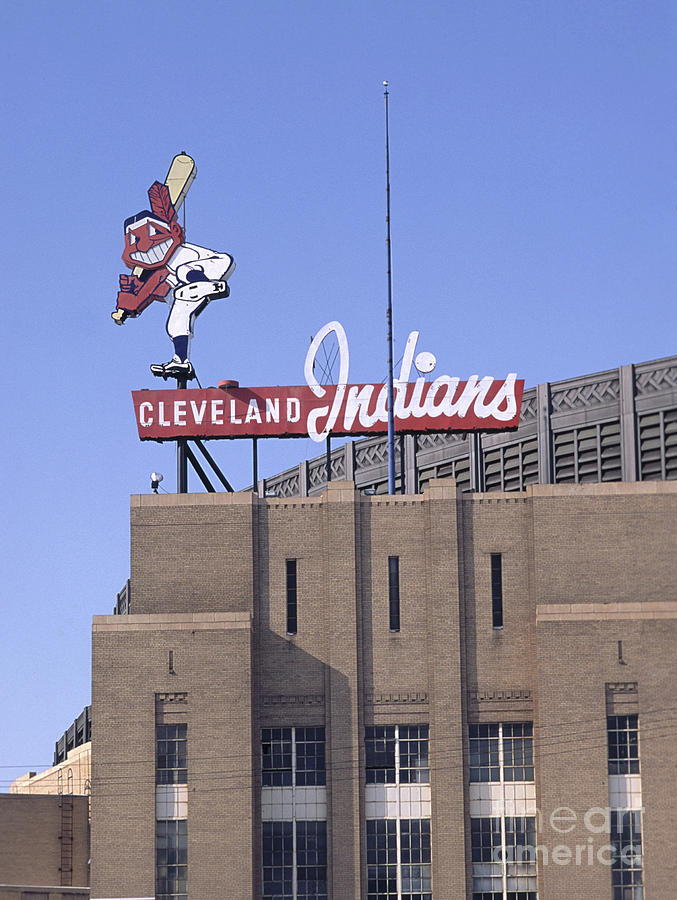
Showing posts with label cleveland naps. Show all posts

Sunday, October 9, 2022

October 9, 1910: The Controversial End to the "Chalmers Race"

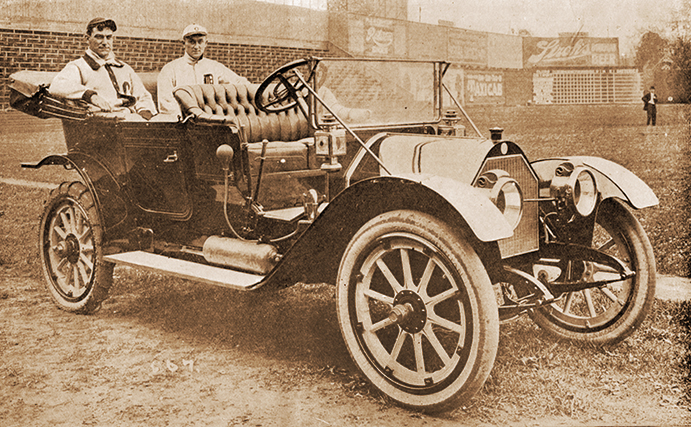
Nap Lajoie (left) and Ty Cobb, in the back seat
of the model of car to be awarded, a 1911 Chalmers 30.

October 9, 1910: The battle for the American League batting title is decided on the final day of the regular season‚ when Ty Cobb of the Detroit Tigers edges Nap Lajoie of the Cleveland… Naps. (Seriously, the team was named after their star 2nd baseman and manager. They would be renamed the Indians in 1915.) Cobb's final average is .385, Lajoie's is .384. Or, more precisely, Cobb's was .385069, and Lajoie's was .384095.

Cobb‚ rather than risk his average‚ sits out the last 2 games‚ the Tigers beating the Chicago White Sox in today's finale‚ 2-1 at the new Comiskey Park in Chicago.

Meanwhile, in a doubleheader with the St. Louis Browns‚ at Sportsman's Park in St. Louis, Lajoie goes 8-for-8, accepting 6 gift hits on bunt singles, on which Browns rookie 3rd baseman Red Corriden is apparently purposely stationed at the edge of the outfield grass.

The prejudiced St. Louis scorer also credits the popular Nap with a "hit" on shortstop Bobby Wallace's wild throw to 1st. In Lajoie's last at-bat‚ he is safe at 1st on an error call‚ but is credited with a sacrifice bunt since a man was on, and thus is not charged with an at-bat.

The St. Louis Post is just one of the papers to be openly critical of the move against Cobb, then the best, but also the most unpopular, player in baseball: "All St. Louis is up in arms over the deplorable spectacle‚ conceived in stupidity and executed in jealousy." The Browns win the opener‚ 5-4‚ and Cleveland takes the nightcap‚ 3-0, with both managers‚ Jack O'Connor and Jim Maguire, catching in the otherwise meaningless game. O'Connor is behind the plate for just an inning‚ but Maguire goes all the way.

AL President Byron Bancroft "Ban" Johnson investigates, and clears everyone concerned‚ enabling Cobb to win the 3rd of 9 straight batting crowns. 
Ty didn't exactly cover himself with glory by sitting it out -- after all, 31 years later, Ted Williams insisted on playing both games of a last-day doubleheader that he went into at .39955, and went 6-for-8 on the day to finish at .406 -- but neither he nor Nap did anything illegal.

The embarrassed Chalmers Auto Company, which had promised a brand-new car to the winner of the batting title, awards cars to both Ty and Nap. Cobb didn't care that Lajoie also got one, as he admired Lajoie: He went on record as saying he badly wanted the car, for the sake of the award, as a measure of respect.

In 1978, baseball historian Pete Palmer uncovered an mistake, which had credited a 2-for-3 game to Cobb twice, that‚ if corrected‚ would have given the batting title, and the "Chalmers Race," to Lajoie, .384 to .383. But the Commissioner's office voted unanimously to leave the stats changed, but not the title. In 1989, The Sporting News looked at the records again, and confirmed Palmer's analysis that one of Cobb's games had been counted twice. In 1991, among other rulings -- including giving Roger Maris full possession of the single-season home run record, and redefining a "no-hitter," the Commissioner's office ruled Cobb's revised totals to be correct.

This reduced Cobb's career hit total from 4,191 to 4,189 (thus meaning that Pete Rose broke the record 3 days before we thought he did, although it was still celebrated when he reached 4,192, due to the number 4,191 being so ingrained in the public memory), and his lifetime batting average from .367 to .366 (although that's still easily a record). Lajoie finished with 3,243 hits, and his lifetime average was .339.

In case you're wondering, in that 1910 season, Cobb had a better on-base percentage than Lajoie, .456 to .445; the higher slugging percentage, .551 to .514; the higher OPS, 1.008 to .960; and the higher OPS+, 206 to 199.

Neither Detroit nor Cleveland seriously challenged the Philadelphia Athletics for the Pennant. The A's finished 14 1/2 games ahead of the 2nd-place New York Highlanders (1 of only 3 times the team that became the Yankees in 1913 finished as high as 2nd before their 1st Pennant in 1921), 18 ahead of the 3rd-place Tigers, and 32 ahead of the 5th-place Naps.

So the Tigers were 14 games ahead of the Naps, meaning that, both stats-wise and standings-wise, Cobb unquestionably had a better season than Lajoie. Lajoie lived until 1959, age 84; Cobb, until 1961, at 74.

The NL Pennant race had no drama in 1910, either, as the Chicago Cubs won their 4th flag in the last 5 years, beating the Giants by 13 games. The Brooklyn Superbas, forerunners of the Dodgers, finished 6th, a whopping 40 games back. So it was A's vs. Cubs in the World Series, and the A's won it in 5 games.

*

October 9, 1910 was a Sunday. Professional football was still minor-league at this point. Professional hockey, and basketball in any form, were still in their infancy. There were 2 other games were played that day in what would eventually be called Major League Baseball. The Cincinnati Reds beat the Pittsburgh Pirates, 7-1 at the Palace of the Fans in Cincinnati. And the Chicago Cubs beat the St. Louis Cardinals, 4-3 at West Side Park in Chicago.

Saturday, October 1, 2022

October 2, 1908: Ed Walsh vs. Addie Joss

Addie Joss (left) and Ed Walsh

October 2, 1908:  In a wild 3-team American League race, every bit as tight as the 3-team race going on in the National League at the same time, the AL has perhaps its greatest pitching duel ever, between 2 future Hall-of-Famers, at League Park in Cleveland.

Big Ed Walsh of the White Sox strikes on 15 batters, setting a new AL record that stood for 30 years. It was his 40th win of the season. But it's not enough, as Addie Joss, a.k.a. the Human Hairpin for his slender build and his tight pitching motion, pitches a perfect game for the Cleveland Naps, who win, 1-0. Joss advanced to 24-11. Walsh "fell" to 39-15.

Napoleon Lajoie, one of the greatest all-around players of the era, a member of the 3,000 Hits Club and a great fielder, too, was the Cleveland team's 2nd baseman and manager. They were renamed the Naps in his honor in 1903, after being named the Blues. He left after the 1914 season, and they were renamed the Indians, which they would remain until becoming the Cleveland Guardians in 2022.

So the ChiSox and the Naps had played the greatest game in the American League's 8-year history, with both really needing it to win the Pennant. And yet, neither team does. The Detroit Tigers do, the Naps finishing half a game behind, the White Sox 1 1/2 behind: Detroit 90-63, Cleveland 90-64, Chicago 88-64.

Why wasn't the Tigers' missing 154th game made up? I don't know: Neither The Unforgettable Season by G.H. Fleming nor Crazy '08 by Cait Murphy explains why.

It's the 2nd of 3 straight Pennants for the Tigers. The ChiSox had won in 1901 and 1906. The Naps/Indians will not get this close to a Pennant again until they win it all in 1920.

Joss died of meningitis on April 14, 1911, the eve of what would have been his 10th in the major leagues. He was only 31. In 1978, the Baseball Hall of Fame gave him a special waiver on the rule that says players must have played at least 1 game in at least 10 different seasons to qualify for election, since he would have pitched in 1 such game had he been stricken just 1 week later. He was soon elected. It was deserved: He was 160-97, his WHIP of 0.968 is the lowest ever, and his ERA of 1.89 is the 2nd-lowest.

The lowest? Walsh, at 1.82. And his WHIP, exactly 1.000, is 2nd all-time to Joss. He would pitch a no-hitter of his own in 1911. He went 192-126 for his career. And, unlike Joss, he played on a Pennant winner, as the White Sox won the 1906 World Series. He died on May 26, 1959, the day Harvey Haddix pitched a perfect game for 12 innings for the Pittsburgh Pirates, but lost the game to the Milwaukee Braves in the 13th inning.

*

October 2, 1908 was a Friday, the start of the last weekend of one of baseball's greatest regular seasons. Both Leagues had 3-way races.

* The Detroit Tigers beat the St. Louis Browns, 7-6 at Bennett Park in Detroit. Ty Cobb went 1-for-3 with 2 walks and 2 RBIs.

* The New York Highlanders lost to the Washington Senators, 12-2 at Hilltop Park in Manhattan. The proto-Yankees went 51-103 that season, and it remains the most games they've ever lost in a season.

* The Boston Red Sox lost to the Philadelphia Athletics, 8-1 at Columbia Park in Philadelphia.

* In the National League, the New York Giants beat the Philadelphia Phillies, 7-2 at Baker Bowl in Philadelphia.

* The Chicago Cubs beat the Cincinnati Reds, 5-0 at the Palace of the Fans in Cincinnati. Mordecai "Three-Finger" Brown pitched a 4-hit shutout.

* The Pittsburgh Pirates swept a doubleheader from the St. Louis Cardinals at Robison Field in St. Louis, 7-4 and 2-1. Over the 2 games, Honus Wagner went 3-for-8 with an RBI.

* And the Brooklyn Superbas (Dodgers) beat the Boston Doves (Braves), 3-2 at Washington Park in Brooklyn.

Friday, July 29, 2022

July 30, 1910: The Philadelphia Athletics Trade Shoeless Joe Jackson

July 30, 1910: The Philadelphia Athletics beat the Washington Senators, 7-5 at Shibe Park in Philadelphia. It is a battle between future Hall of Fame pitchers, although neither has his best stuff. Walter Johnson goes the distance for the Senators. Charles Albert "Chief" Bender takes a 7-0 lead into the 9th inning, then stumbles. Manager Connie Mack is forced to bring in another future Hall-of-Famer, Eddie Plank, and he isn't much better. Before Plank can secure the final out of the game, the Senators have scored 5 runs, and nearly completed an amazing comeback.

Not a factor in this game is left fielder Joe Jackson. On this day, Mack, also the team's treasurer, under owner Ben Shibe, sends Jackson to the Cleveland Naps. as the player to be named later, along with infielder Morris "Morrie" Rath, for left fielder Bristol "Bris" Lord, who had previously played with the A's on their 1905 American League Pennant winners.

The Naps, named for their manager, 2nd baseman and best hitter, Napoleon "Nap" Lajoie, beat the St. Louis Browns on this day, 2-1 at League Park in Cleveland. Cy Young, 43 years old, notched the 502nd win of his career.

Joseph Jefferson Jackson had become known as "Shoeless Joe" because of an incident in a minor league game. The shoes he'd been given were too tight, so he took them off in the outfield. He was a farmboy from the Appalachian western region of South Carolina, and had never learned how to read. He knew he had to learn how to sign his name, to give kids autographs, but he got around his illiteracy by having his wife order for him in restaurants.

And, up to this point, he hadn't yet shown that he could "read" pitchers, either. Just past his 23rd birthday, he had played 10 games for the A's, none this season. Although batting .354 for the New Orleans Pelicans of the Southern Association, he had gone 6-for-40 at the major league level, or .150. Reports disagree as to why he hadn't made it in Philadelphia: Either he didn't get along with his teammates, or he didn't get along with Mack, or he simply couldn't handle the big city.

Cleveland was then the 6th-largest city in America, but not as bad as Philadelphia. And Jackson now had Nap Lajoie to learn from. They got along much better. It's no coincidence that the Indians traded him to the Chicago White Sox in 1915, after Lajoie had fallen out with team management and been traded.

Babe Ruth supposedly modeled his lefthanded swing after Jackson's. At the close of the 1920 season, just 33 years old, he had a .356 lifetime batting average (still the 3rd-highest ever), a whopping 170 OPS+, and 1,772 hits, including 307 doubles, 168 triples and 54 home runs. What would later be known as the 3,000 Hit Club was within reach for him.

He was also a good baserunner, having stolen 202 bases. How good a fielder was he? Ty Cobb called him the greatest left fielder he'd ever seen, and his glove "the place where triples go to die." There was no Baseball Hall of Fame yet, but Shoeless Joe seemed to be on his way.

Jackson never played again after 1920: He and 7 White Sox teammates were permanently banned for their apparent roles in throwing the 1919 World Series to the Cincinnati Reds. In a weird twist, the sign to the gamblers that the fix was still on was that the 1st Reds batter in Game 1 was to be hit with a pitch. That turned out to be Morrie Rath. (He was not injured.)

How did the A's do without Jackson? Pretty well, winning 4 of the next 5 AL Pennants, including 3 World Series. That dynasty was broken up in the 1914-15 off-season, as Mack needed money during the fight between the AL and the National League on one side, and the Federal League on the other. If he and Jackson had worked out their differences, and Jackson had become a star with the A's, he probably would have been sold off as part of this process, anyway.

*

July 30, 1910 was a Saturday. These other baseball games were played that day:

* The New York Highlanders lost to the Boston Red Sox, 5-4 in 10 innings at the Huntington Avenue Grounds. The Highlanders became the Yankees in 1913.

* The New York Giants swept a doubleheader from the Boston Doves, 4-1 and 4-0 at the Polo Grounds. Red Ames pitched a 4-0 shutout in the 2nd game. The Doves became the Boston Braves in 1912.

* The Brooklyn Superbas lost to the Philadelphia Phillies, 2-1 in 14 innings at Washington Park in Brooklyn. The game was scoreless for the 1st 13 innings. The Superbas became the Dodgers the next season.

* The Cincinnati Reds beat the Pittsburgh Pirates, 4-2 at Forbes Field in Pittsburgh. Honus Wagner went 0-for-4 with a walk.

* The Detroit Tigers beat the Chicago White Sox, 4-2 at Comiskey Park in Chicago. Ty Cobb went 2-for-4 with a stolen base and an RBI.

* And the Chicago Cubs beat the St. Louis Cardinals, 4-1 at Sportsman's Park in St. Louis.

Sunday, July 24, 2022

July 24, 1911: The Addie Joss Benefit Game

July 24, 1911: A benefit game is played at League Park in Cleveland, for the family of Addie Joss.

Adrian Joss was born on April 12, 1880 outside Milwaukee in Woodland, Wisconsin. Known as the Human Hairpin for his slender build and his tight pitching motion, he pitched for the Cleveland Naps from 1902 to 1910, going 160-97.

The Cleveland Whats? Napoleon Lajoie, one of the greatest all-around players of the era, a member of the 3,000 Hits Club and a great fielder, too, was the Cleveland team's 2nd baseman and manager. Starting as the Cleveland Blues in 1901, and the Cleveland Bronchos in 1902, they were renamed the Cleveland Naps in his honor in 1903. He left after the 1914 season, and they were renamed the Indians, which they would remain until becoming the Cleveland Guardians in 2022.

Addie Joss' career WHIP -- walks plus his, divided by innings pitches -- of 0.968 is the lowest ever, and his ERA of 1.89 is the 2nd-lowest. The lowest ERA belongs to Ed Walsh of the Chicago White Sox, at 1.82. And his WHIP, exactly 1.000, is 2nd all-time to Joss. In the 1900s (the 1900-09 decade), Joss and Walsh were the 2 best pitchers in the American League.

On October 2, 1908, they opposed each other as their teams and the Detroit Tigers all went down to the wire for the AL Pennant. Walsh struck out 15 batters, and AL record that stood for 30 years. But Joss pitched a perfect game, and the Naps won, 1-0. It remains the greatest pitching duel in AL history, but it ended up not mattering, as the Tigers won the Pennant, by half a game over the Naps and one and a half over the ChiSox.

Joss led the major leagues in wins in 1907, and led the major leagues in ERA in 1904 and 1908. On April 20, 1910, he pitched a no-hitter against the White Sox, making him the 1st pitcher to pitch no-hitters against the same team twice. Only one pitcher since has matched that: Tim Lincecum of the San Francisco Giants, against the San Diego Padres in 2013 and 2014.
Addie Joss

Joss died of meningitis on April 14, 1911, the eve of what would have been his 10th in the major leagues. He was only 31. Upon hearing of his death, the Cleveland Press newspaper wrote "every train brings flowers" and "floral tributes by the wagonload are hourly arriving at the Joss home from all sections of the country." Billy Sunday, then America's foremost evangelist, had been a major league pitcher from 1883 to 1890, mostly with the team now known as the Chicago Cubs, and accepted the Joss' family's request to preside over Addie's funeral.

A benefit "all-star" game for Joss's family was scheduled by the Naps for July 24, 1911. They invited players from the other 7 AL teams to play against them. Jimmy McAleer would manage the All-Stars against Lajoie. At the time, he was the manager of the Washington Senators. He had been the Cleveland team's 1st manager in 1901, and had played for their previous National League team, the Cleveland Spiders. He said, "The memory of Addie Joss is sacred to everyone with whom he ever came in contact. The man never wore a uniform who was a greater credit to the sport than he."

Cy Young, who had also played for the Spiders, was in his last season in the major leagues, and started for the Naps, pitching the 1st 3 innings. (He would be traded later in the season, to the Boston team that became known as the Braves, and end his career there.) Lajoie played in the game, but went 0-for-2. "Shoeless" Joe Jackson, in his 1st big season in the majors, also went 0-for-2. From the other 7 teams:

* From the Boston Red Sox: Pitcher "Smoky" Joe Wood (who started, and pitched the 1st 2 innings), center fielder Tris Speaker (who would be traded to Cleveland in 1916 and lead them to the 1920 World Series).

* From the Detroit Tigers: Right fielder Ty Cobb (who forgot his Tigers uniform, so he wore a Cleveland road uniform during the game), and left fielder Sam Crawford.

* From the New York Highlanders: 1st baseman Hal Chase, and pitcher Russ Ford, who pitched the last 4 innings.

* From the Philadelphia Athletics: 2nd baseman Eddie Collins, 3rd baseman Frank Baker (who would become known as "Home Run Baker" for his heroics in that year's World Series), and catcher Patrick "Paddy" Livingston.

* From the St. Louis Browns: Shortstop Bobby Wallace.

* From the Washington Senators: Pitcher Walter Johnson (who told the press, "I'll do anything they want for Addie Joss' family"), and pitched the 3rd, 4th and 5th innings; catcher Gabby Street and center field Clyde Milan.

* Only the Chicago White Sox did not send a representative. Ed Walsh had volunteered to play, but the team's travel schedule simply didn't allow it.

The game was attended by approximately 15,270 fans, and raised nearly $13,000 (about $40,000 in 2022 money) to help Joss' family members pay remaining medical bills. The All-Stars beat the Naps, 5–3. No home runs were hit.

Baseball would not have an official All-Star Game until 1933, when a team of AL stars beat a team of NL stars at Comiskey Park in Chicago, making the All-Star Game an annual event. Oddly, in 1920, when Ray Chapman, shortstop for the team by then known as the Cleveland Indians, became the only player ever to die as a result of an in-game incident, there was no benefit game for his family.

In 1978, the Baseball Hall of Fame gave Joss a special waiver on the rule that says players must have played at least 1 game in at least 10 different seasons to qualify for election, since he would have pitched in 1 such game had he been stricken just 1 week later. He was soon elected. It was deserved.

*

July 24, 1911 was a Monday. One reason why this date was chosen for the game is that only 3 games were scheduled. All were in the National League:

* The New York Giants beat the Cincinnati Reds, 8-3 at the Palace of the Fans in Cincinnati. Rube Marquard went the distance for the win.

* The Brooklyn Dodgers lost to the Pittsburgh Pirates, 8-2 at Forbes Field in Pittsburgh. Honus Wagner went 0-for-3, but did draw a walk.

* And the St. Louis Cardinals beat the Philadelphia Phillies, 10-2 at Baker Bowl in Philadelphia.  

Saturday, July 23, 2022

July 23, 2021: The Cleveland Indians Become the Cleveland Guardians

July 23, 2021: The Cleveland Indians announce that, after 107 seasons, they are changing their name to the Cleveland Guardians.

The franchise began in the American League in 1901, as the Cleveland Blues. They became the Cleveland Bronchos -- pronounced like "Broncos" -- in 1902. That season, they acquired Napoleon Lajoie, one of the greatest all-around players of the era, eventually a member of the 3,000 Hits Club, and a great fielder, too, to be their 2nd baseman and manager. They were renamed the Cleveland Naps in his honor in 1903. He left after the 1914 season, and they were renamed the Indians.

Legend had it that they were named the Indians in honor of Louis Sockalexis, the 1st major league player to identify as a Native American, who had played for the National League's Cleveland Spiders from 1897 to 1899. Another story said they were named the Indians in honor of the Native tribes that lived on the shore of Lake Erie before the white man came.

Neither story was true. Terry Pluto, the longtime Cleveland newspaper columnist who's written several books about the team and its history, and knows more about them than anyone, decisively determined that Lajoie's departure coincided with the Boston Braves winning the World Series, and so, trying to match the Braves' luck, the Cleveland team renamed itself the Indians.

Some "luck": Between them, these 2 teams won only 6 Pennants between 1915 and 1990. And 2 of those 6 were against each other, in 1948. By that point, the Indians had adopted a character known as Chief Wahoo as their mascot. Pluto would later describe the Chief as a "grinning idiot."  
The Chief at Cleveland Municipal Stadium

For years, fans were divided between those who clung to the Chief as a symbol of team "heritage" -- much like people who say that about the Confederate flag -- and those who thought it was disgustingly racist. The Indians moved from Municipal Stadium to Jacobs Field in 1994 (it was renamed Progessive Field in 2007), and won Pennants in 1995, 1997 and 2016, and were more often than not Playoff contenders since the stadium switch.

Nevertheless, after the 2019 season, the Indians removed all references to the Chief, including from their caps, replacing him with a block letter C for Cleveland. In 2020, the NFL's Washington Redskins finally did what they said they would never do, and dropped their Native American name. They played 2 years as "The Washington Football Team" while they selected a new name. On February 2, 2022, they became the Washington Commanders.

With that in mind, Indians management decided it was time to consider alternatives. On July 23, 2021, they announced that, starting with the 2022 season, they would be the Cleveland Guardians. It was exactly 1 year to the day after the Washington Football Team dropped "Redskins."

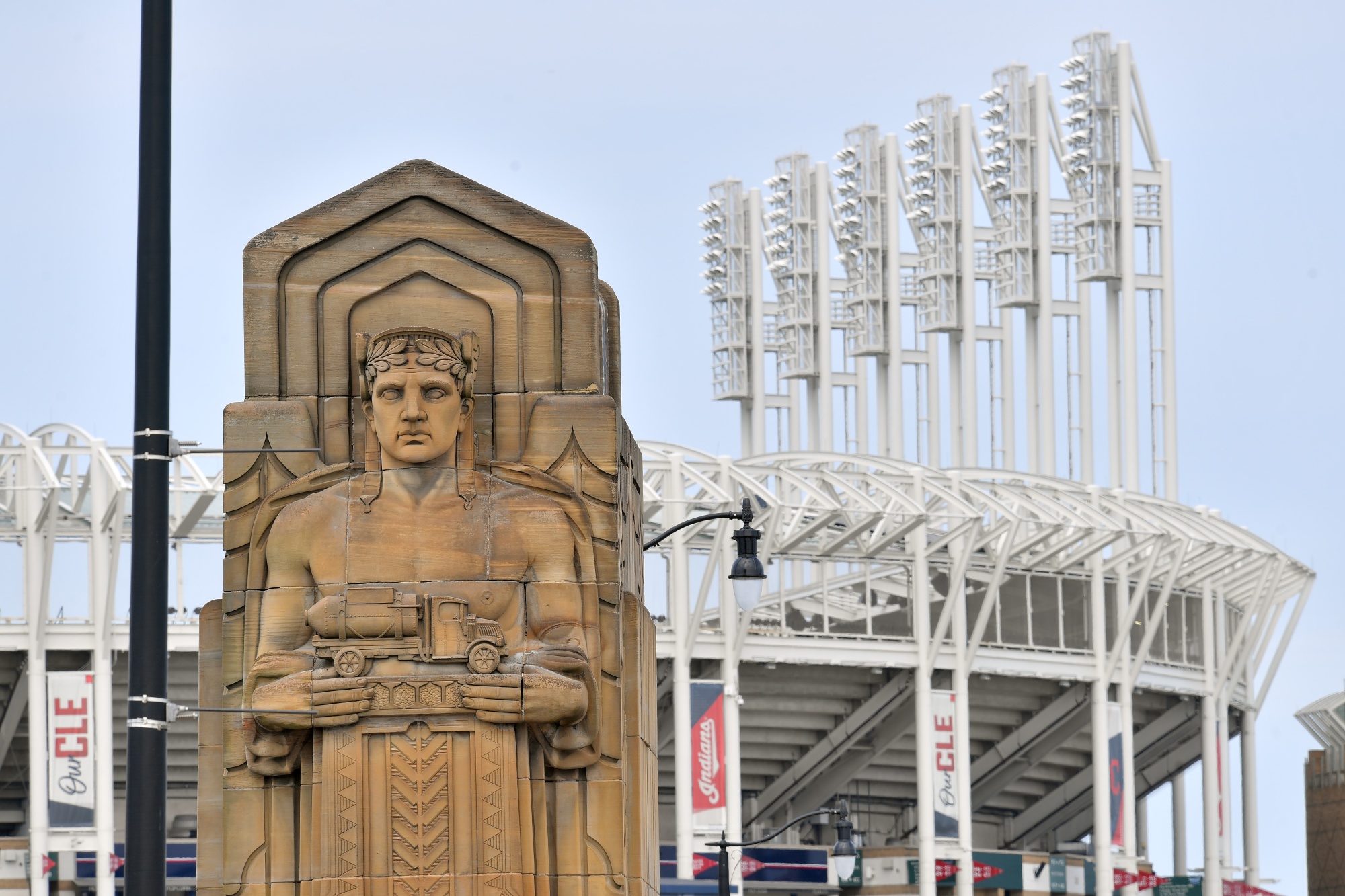
The team's name references "the Guardians of Traffic," 8 monolithic 1932 Art Deco sculptures by Henry Hering on the city's Hope Memorial Bridge, which is adjacent to Progressive Field.
One of the Guardians of Traffic,
with Progressive Field in the background

A minority of fans was furious, throwing out stupid labels like "politics" and "woke." The truth is, not only was the change long overdue, but changing from "Indians" to "Guardians" really didn't even change half the name: It still ended in "-dians."

The 1st game under the name "Cleveland Indians" was on April 14, 1915, a 5-1 win over the Detroit Tigers at Navin Field (eventually named Tiger Stadium) in Detroit. The last game under the name was on October 3, 2021, a 6-0 win over the Texas Rangers at Globe Life Field in Arlington, Texas. And the 1st game under the name "Cleveland Guardians" was on April 7, 2022, a 3-1 loss to the Kansas City Royals at Kauffman Stadium in Kansas City.

For those still upset over the change: "Indians" wasn't the team's original name, either. In fact, of the 16 teams that Major League Baseball had prior to 1961, only the Detroit Tigers are still using their original name. Only 7 of the 30 current teams are using their original names: The Tigers, the Royals, the New York Mets, the San Diego Padres, the Toronto Blue Jays, the Seattle Mariners and the Arizona Diamondbacks.

*

July 23, 2021 was a Friday. These Major League Baseball games were played:

* The name change didn't help the Cleveland franchise that day: They lost to the Tampa Bay Rays, 10-5 at Progressive Field. Since they are the team in question, I have deviated from my usual path of starting with the New York teams, and then going from North to South, East to West, which I now resume:

* The New York Yankees lost to the Boston Red Sox, 6-2 at Fenway Park in Boston. The Red Sox used an "opener game," and were able to defeat Yankee ace Gerrit Cole. Rafael Devers hit 2 home runs.

* The New York Mets beat the Toronto Blue Jays, 3-0 at Citi Field. How many Met pitchers does it take to pitch a 3-hit shutout? This time, 4: Tylor Megill (6 innings, 2 hits, 1 walk, winning pitcher), Seth Lugo (7th inning, 1 hit), Trevor May (a perfect 8th inning) and Edwin Díaz (a perfect 9th, save).

* The Philadelphia Phillies beat the Atlanta Braves, 5-1 at Citizens Bank Park in Philadelphia.

* The Baltimore Orioles beat their neighbors, the Washington Nationals, 6-1 at Oriole Park at Camden Yards in Baltimore.

* The San Diego Padres beat the Miami Marlins, 5-2 at LoanDepot Park in Miami.

* The Houston Astros beat their cross-State rivals, the Texas Rangers, 7-3 at Minute Maid Park (now Daikin Park) in Houston.

* The Cincinnati Reds beat the St. Louis Cardinals, 6-5 at Great American Ball Park in Cincinnati.

* The Chicago Cubs beat the Arizona Diamondbacks, 8-3 at Wrigley Field in Chicago.

* The Milwaukee Brewers beat the Chicago White Sox, 7-1 at American Family Field in Milwaukee.

* The Minnesota Twins beat the Los Angeles Angels, 5-4 in Minneapolis.

* The Kansas City Royals beat the Detroit Tigers, 5-3 in Kauffman Stadium in Kansas City.

* The Colorado Rockies beat the Los Angeles Dodgers, 9-6 at Dodger Stadium in Los Angeles. The Rockies scored 3 runs in the top of the 10th inning, including a home run by Charlie Blackmon.

* The Pittsburgh Pirates beat the San Francisco Giants, 6-4 at Oracle Park in San Francisco.

* And the Seattle Mariners beat the Oakland Athletics, 4-3 at T-Mobile Park in Seattle.

Monday, July 11, 2022

July 11, 1914: Babe Ruth's 1st Major League Game

July 11, 1914: The Boston Red Sox beat the Cleveland Naps, 4-3 at Fenway Park in Boston. The winning pitcher is a 19-year-old lefthander from Baltimore, making his major league debut. His name is George Herman Ruth Jr.

He had been purchased from the Baltimore Orioles of the International League, run by former major league pitcher Jack Dunn. When he got to Boston, the immature kid was known as "Jack Dunn's Baby." This was shortened to "Baby," and then to "Babe." Although some friends continued to call him "George," or the slangy "Jidge," he was pretty much "Babe Ruth" from then on.

He pitched 7 innings, allowing 3 runs, 2 of them earned, on 8 hits. He only struck out 1 batter, but he didn't walk any. Dutch Leonard pitched the last 2 innings, picking up the save.

The Naps got their name from their manager and 2nd baseman, Napoleon "Nap" Lajoie, who collected his 3,000th career hit later in the season. It would be his last with them. The following season, they became known as the Cleveland Indians. In 2022, they became the Cleveland Guardians.

Lajoie went 0-for-4 against Ruth in this game, but Shoeless Joe Jackson went 2-for-4 with an RBI. Also going 2-for-4 was left fielder Jack Graney, who went on to become the 1st former player to broadcast a Major League Baseball game. Going 1-for-4 was shortstop Ray Chapman. Chapman was there for Ruth's 1st major league game. Six years later, Ruth would be there for Chapman's last. as he became the only MLB player ever to die as the result of an on-field incident.

Ruth himself, showing no sign of what was to come, went 0-for-2 at the plate. In the bottom of the 2nd inning, in his 1st at-bat as a major leaguer, he struck out against Cleveland pitcher Willie Mitchell. In the bottom of the 4th, he hit the ball to right field, where it was caught by Jackson, who would later be better known as a left fielder. Duffy Lewis pinch-hit for Ruth in the bottom of the 7th, as he'd allowed 2 runs in the top half to make it 4-3 Boston, but Leonard made that score hold up.

Tris Speaker went 1-for-4 with an RBI. Larry Gardner went 3-for-4 with an RBI.

It was a successful day for the Red Sox, and Ruth was 1-0 for his career. It would be another 10 months before he hit his 1st major league home run. From 1915 to 1918, Ruth became the best lefthanded pitcher in baseball, going 78-32. Overall, his pitching record would be 94-46 with a 2.28 ERA and a 1.159 WHIP. Had he continued as a pitcher, without concerning himself with hitting, he could well have been a Hall-of-Famer anyway.

As we now know, that was not the case. After 4 seasons of being a lefthanded pitcher as good as Randy Johnson, he then spent 16 years as a lefthanded hitter better than Ted Williams or even a steroided-up Barry Bonds. Babe Ruth was the greatest hitter, and the greatest player, that baseball has ever known.

But anybody guessing on July 11, 1914 that such a thing would happen would have been considered crazy. At the time, he was a promising rookie, but nobody, not even Ruth himself, knew how far that promise could go -- or in what direction.

*

July 11, 1914 was a Saturday. These other games were played. In the American League:

* The New York Yankees beat the Chicago White Sox, 9-4 at the Polo Grounds. Center fielder William "Birdie" Cree went 3-for-4 with an RBI in support of Leonard "King" Cole, who relieved Carroll "Boardwalk" Brown, after Brown allowed 4 runs in the top of the 1st inning. (It was a good time for baseball nicknames.)

* A doubleheader was split at Shibe Park in Philadelphia. The St. Louis Browns won the opener, 4-3 in 12 innings. The Philadelphia Athletics won the nightcap, 6-4.

* And the Washington Senators beat the Detroit Tigers, 4-2 at American League Park (later Griffith Stadium) in Washington. Ty Cobb did not play for the Tigers.

In the National League:

* The New York Giants beat the St. Louis Cardinals, 13-9 at Robison Field in St. Louis.

* The Brooklyn Robins lost to the Cincinnati Reds, 6-5 at Redland Field (later Crosley Field) in Cincinnati. The Dodgers were in their 1st season with Wilbert Robinson as manager, and were called the Robins until he was fired in 1931.

* The Pittsburgh Pirates beat the Philadelphia Phillies, 3-1 at Forbes Field in Pittsburgh. Honus Wagner went 1-for-3.

* And the Boston Braves beat the Chicago Cubs, 5-2 at West Side Park in Chicago.

In the Federal League:

* The Brooklyn Tip-Tops swept a doubleheader from the Pittsburgh Rebels at Washington Park in Brooklyn. The Tip-Tops won the 1st game, 1-0, and the 2nd game, 8-2.

* A doubleheader was played at Terrapin Park in Baltimore. The Baltimore Terrapins won the 1st game, 2-1. The 2nd game was tied, 3-3 after 13 innings, when it was called due to darkness.

* The Indianapolis Hoosiers beat the Chicago Whales, 3-2 at Weeghman Park in Chicago. It was renamed Cubs Park in 1920 and Wrigley Field in 1926.

* And the St. Louis Terriers beat the Kansas City Packers, 6-3 at Handlan's Park in St. Louis.

Friday, June 3, 2022

June 4, 1902: The Cleveland Naps

June 4, 1902: The case of Napoleon Lajoie is settled. He plays his 1st game for Cleveland.

Napoléon Lajoie (that's pronounced "LAH-zhoh-ay," and he had no middle name) was born on September 5, 1874, in Woonsocket, Rhode Island. He would be the 1st of 2 natives of that town to be elected to the Baseball Hall of Fame, followed by 1930s Chicago Cubs catcher Charles "Gabby" Hartnett.

A son of French-Canadian immigrants, Napoléon dropped out of school to work in a textile mill, a major industry in late 19th Century New England. He joined a semi-professional baseball team, where a teammate, unable to pronounce his last name, started calling him "Larry." Others began calling him "Nap" for short.

He was playing for a team in nearby Fall River, Massachusetts when he was signed by the Philadelphia Phillies of the National League. They put him at 1st base, and he roomed with their biggest star, the hard-hitting Ed Delahanty. In 1897, he batted .363, had 127 RBIs, and led the NL in total bases and slugging percentage. In 1898, he was moved to 2nd base, again had 127 RBIs (which would remain a career high), and led the NL with 43 doubles.

Despite injuries that cost him significant playing time in 1899 and 1900, in the latter year, Ned Hanlon, manager of the Brooklyn Superbas, offered the Phillies $10,000 for Lajoie. At the time, it would have matched the record purchase for a ballplayer. Phillies owner John Rogers turned him down.

Rogers should have taken it. He had promised Lajoie the same salary as Delahanty, $2,600. When Lajoie found out that Delahanty was actually making $3,000, they both believed Rogers was untrustworthy. As the American League was ready to start play and raid NL rosters in 1901, Lajoie said, "Because I felt I had been cheated, I was determined to listen to any reasonable American League offer."

(Eventually, so was Delahanty: He stayed with the Phillies for 1901, but "jumped" to the Washington Senators in 1902. He was still with them in 1903, when he died under mysterious circumstances.)

Former Phillies part-owner Ben Shibe founded the AL's Philadelphia Athletics, borrowing the name from at least 2 previous professional teams. He hired Connie Mack, former Washington Senators (NL) and Pittsburgh Pirates catcher, and former Pirates manager, to be his team's manager and treasurer. Lajoie made $2,800 in 1900. He was offered $24,000, about 8 1/2 times what he was making. He said, "You can bet I signed in a hurry," adding, "The Phillies opened their season, and drew 6,000 fans. A week later, when we opened, there were 16,000 in the stands. The American League was here to stay."

Lajoie won the AL's 1st batting title, although his average was in dispute for many years. Until 1954, it was listed at .405. A transcription error was discovered, and it was revised to .422, making it the highest in AL history to this day. Later on, another error was found, and it was discovered that his average was actually .426, making it the 2nd-highest in major league history, trailing only the .440 of Hugh Duffy with the 1894 Boston Beaneaters.

That season, Lajoie also hit 14 home runs and had 125 RBIs. These also led the League, giving him the Triple Crown. He also led the AL with 232 hits, 48 doubles (which, through the 2021 season, remains an A's franchise record, in any city), 350 total bases, 145 runs, a .463 on-base percentage, a .643 slugging percentage, a 1.106 OPS, and a 198 OPS+. (He also had 14 triples, a fine total in any era, but it did not lead the League.)

Over the next 120 years, the American League would have multi-category-leading seasons produced by Ty Cobb, Babe Ruth, Lou Gehrig, Jimmie Foxx, Hank Greenberg, Joe DiMaggio, Ted Williams, Mickey Mantle, Frank Robinson, Carl Yastrzemski, Rod Carew, Reggie Jackson, George Brett, Ken Griffey Jr., Miguel Cabrera, Mike Trout and Shohei Ohtani. Lajoie's performance in the AL's 1st season stands alongside the best of these.

Mack said of Lajoie, "He plays so naturally and so easily, it looks like lack of effort." Ed Walsh, Hall of Fame pitcher for the Chicago White Sox, once said, "Did you ever see Larry Lajoie bat? No. Then you missed something. I want to tell you that there was one of the greatest hitters, and fielders, too, ever in baseball. There's no telling the records he'd have made if he'd hit against the lively ball."

But the next season, the Phillies sought an injunction to prevent Lajoie from playing in the American League. On April 21, 1902, the Supreme Court of Pennsylvania upheld the reserve clause in contracts between players and NL teams -- but also said that the injunction was only enforceable in Pennsylvania. That is, he could only play in the Keystone State if it was for the Phillies. This meant that he could play for the A's in away games.

Since he could only play away games -- and there was no health risk as there would be over a century later, as with Kyrie Irving and the Brooklyn Nets -- the A's let him go. To return the favor of Charles Somers, owner of the Cleveland Bronchos (the H was silent), lending the A's money to help them get started, on May 31, Mack traded Lajoie and pitcher Bill Bernhard, who had also jumped from the Phillies to the A's and to whom the injunction also applied, to the Bronchos.

Lajoie made his debut with the Bronchos on June 4. They beat the Boston Americans, 4-3 at League Park in Cleveland. Lajoie went 1-for-3 with an RBI. He completed the 1902 season with a .378 batting average, leading the AL again.

In 1903, Somers made Lajoie his manager, and even changed the name of the team to the Cleveland Naps, to capitalize on his popularity. He batted .344 in 1903 and .376 in 1904. The American League had been in business for 4 years, and only 1 man had ever led it in batting average: Nap Lajoie.

In the middle of the 1905 season, Lajoie contracted sepsis from an untreated spike injury. Dye from his stockings entered his bloodstream, and led to blood poisoning. As a result, a rule was put into place requiring white socks to be worn underneath a player's colored socks. Doctors considered amputating the leg, but he recovered. The Naps were 52-29 on July 24 when he was hurt, but only went 24-47 the rest of the way. Lajoie's Cleveland teammate, right fielder Elmer Flick, who had been their best player before Lajoie arrived, won the batting title.

Lajoie bounced back in 1906, batting .355 (which did not lead the League), and collecting 214 hits including 48 doubles (both of which did). That same year, he married Myrtle Smith, but they never had children. He tailed off a bit in 1907, and did not have a great season in 1908, but the team did, finishing just half a game behind the Detroit Tigers, led by Ty Cobb. That would be his best performance as a manager. He had another good by not great season in 1909.

In 1910, the Chalmers auto company promised a new car to the AL's batting champion. Lajoie, turning 36 late in the season, and Cobb, just 23, both wanted it. With 3 games left in the season, Cobb was batting .383, and stayed out of the lineup to preserve that average. On the last day, Lajoie went 8-for-8 in a doubleheader in which the St. Louis Browns, hating Cobb for his seemingly dirty play, played their infield back. Of Lajoie's 8 hits, 6 were bunt singles. Lajoie finished at .384, but few thought that was legitimate. Chalmers settled it by giving each man a car.

Lajoie batted .365 in 1911, .368 in 1912, and .335 in 1913. But with Cobb at his peak, Lajoie never won another batting title. He dropped to .258 in 1914, although he collected his 3,000th career hit. With the injunction long gone, he returned to the A's for the 1915 and 1916 seasons, and retired with a lifetime batting average of .338; 3,243 hits (at the time, 2nd all-time behind Honus Wagner) including 657 doubles, 153 triples and 82 home runs; 380 stolen bases; and an OPS+ of 150.

Had the Phillies paid Lajoie what he was worth, who knows? Most likely, they wouldn't have won a Pennant, either, as one man could only have done so much.

In 1917, he was player-manager for the Toronto Maple Leafs of the International League, for whom the hockey team would later be named. At age 43, he batted .380, won the IL batting title, and managed them to the Pennant. He played for the American Association's Indianapolis Indians in the war-shortened 1918 season, and then retired.

In 1937, he was among the 2nd class of players elected to the Baseball Hall of Fame. In 1939, he attended the Hall's opening ceremony. In 1958, living in Daytona Beach, Florida, he had a fall and broke his arm. He never recovered, and died on February 7, 1959, at the age of 84.

In 1949, Ogden Nash, my grandmother's favorite poet, wrote "Line-Up for Yesterday" for Sport magazine, an alphabetical list of star players. For the letter L, he wrote: 

L is for Lajoie
Whom Clevelanders love,
Napoleon himself,
With glue in his glove.

In 1999, despite his not having played in a major league game in 83 years, The Sporting News ranked him 29th on their list of the 100 Greatest Baseball Players, 3rd among 2nd basemen behind Rogers Hornsby and Eddie Collins. In 2022, ESPN ranked him 48th, 4th among 2nd basemen behind Hornsby, Joe Morgan and Jackie Robinson. (Hornsby fell from 9th to 20th, Collins all the way from 24th to 82nd.)

The Cleveland team kept the name Naps until he left them after the 1914 season. They then became the Indians, and the Guardians in 2022. (The Boston Americans became the Red Sox in 1908.)

*

June 4, 1902 was a Wednesday. These baseball games were played:

* The New York Giants beat the Chicago Orphans, 4-3 in 10 innings at the Polo Grounds. The Chicago team, formerly known as the White Stockings and, for their youth, as the Colts, had long been led by 1st baseman and manager Adrian Constantine Anson. He was known as "Cap," for "Captain," until he got older, and became known as "Pop." He retired after the 1897 season, and the team became known as the "Orphans," because "they missed their Pop." They were renamed the Chicago Cubs in 1903.

* The Brooklyn Superbas beat the Cincinnati Reds, 5-2 at Washington Park in Brooklyn. The Superbas became the Dodgers in 1911.

* The Boston Beaneaters beat the St. Louis Cardinals, 7-3 at the South End Grounds in Boston. The Beaneaters went through some name changes, and became the Braves in 1912.

* The Chicago White Sox beat the Philadelphia Athletics, 3-0 at South Side Park in Chicago. Roy Patterson pitched a 4-hit shutout.

* The St. Louis Browns beat the Baltimore Orioles, 6-2 at Oriole Park in Baltimore. The Orioles would fold at the end of the season, and a new franchise would take their place, eventually becoming the New York Yankees.

* The Pittsburgh Pirates beat the Philadelphia Phillies, 7-4 at National League Park (later renamed Baker Bowl) in Philadelphia. Honus Wagner went 1-for-3 with 2 walks and 2 RBIs.

* And the Washington Senators beat the Detroit Tigers, 13-6 at Boundary Field in Washington.
December 31, 1999 & January 1, 2000: The Millennium

December 31, 1999:  The Millennium arrives. The people of planet Earth survived. At a terrible cost. But we hadn't destroyed ourselves. ...