Showing posts with label south africa. Show all posts

Saturday, December 3, 2022

December 3, 1967: The 1st Heart Transplant

December 3, 1967: The world's 1st heart transplant surgery is completed. Was it a success? Well, not exactly.

Christiaan Barnard was a 49-year-old heart surgeon from Cape Town, South Africa, who, since 1958, had been the head of the Department of Experimental Surgery at Groote Schuur Hospital, named for the original "Great Barn" estate laid out by Dutch settlers in Cape Town in the 17th Century.

The 1st kidney transplant had been done in 1953, and the 1st lung transplant and the 1st liver transplant were both performed in 1963. This led to the hope that a heart transplant was possible. In 1964, the 1st serious attempt at one was tried, putting the heart of a chimpanzee into a human body. But it worked for only an hour or so, and the patient died without ever regaining consciousness. 

Ironically, it was in Jackson, Mississippi, a State which, like the nation of South Africa, then practiced strict racial segregation. Hamilton Naki was a black doctor who worked with Barnard, who admitted he "had better technical skills than I did." But there was no way he would be allowed to perform the 1st heart transplant in South Africa. As it turned out, he wasn't even allowed in the room when it happened.

Barnard had long experimented on dogs, getting his start with intestinal surgery on them. On 48 occasions, he performed heart transplants on dogs, but it never kept a dog alive for more than 10 days. However, Adrian Kantrowitz at Maimonides Medical Center in New York and Norman Shumway at Stanford University outside San Francisco had kept dogs alive for more than a year with heart transplants, so there was hope.

Louis Washkansky was a 54-year-old grocer, whose family had taken him out of Lithuania in the anti-Semitic Russian Empire as a boy, to South Africa. He had diabetes and incurable heart disease. When Barnard explained the possibility of transplant to him at Groote Schuur in November 1967, the idea was still so new that Washkansky's wife Ann thought that her husband might adopt personality traits of the heart's previous owner. But Louis, knowing that he would die soon without the transplant, became a willing recipient. Now, all that was needed was a suitable donor.

Once again, apartheid reared its ugly head. A young black man, whose identity has never been revealed, had died in an accident. There was some question as to whether the hospital would allow the heart of a black person to be transplanted into a white person. But the question became moot when it was found that the heart was damaged and unusable.

Denise Darvall and her mother Myrtle were killed in a car accident on December 2, 1967. Denise was only 25 years old, was taken to Groote Schuur, and hung on until 9:00 that night. Her father gave permission for her heart to be used. At 1:00 AM local time on December 3 (about 6:00 PM on December 2, U.S. Eastern Time), Louis Washkansky was anesthetized, and Dr. Christiaan Barnard led a team of 30 people, including his brother, Dr. Marius Barnard, in the surgery.

The procedure took about 6 hours. When it was over, Washkansky was alive. He regained consciousness, and even ate. On the 5th day, there were signs that his body was beginning to reject the heart. Barnard discussed it with his team, and it was agreed to give Washkansky immunosuppressants. Ultimately, the "cure" was worse than the condition: When he developed pneumonia, his immune system couldn't handle it. He died on December 21, 18 days after the surgery.

Barnard still considered the surgery a success, because the new heart was "not being stimulated by an electrical machine." On January 2, 1968, Barnard tried again, and this time, he defied his country and put the heart of a black man in the chest of a white man -- and got more grief in the country's black press than in its white press. The patient lived for 19 months.

In 1968, throughout the world, about 100 heart transplants were performed, but only about one-third of them lived longer than 3 months, which led to many hospitals that had performed them refusing to continue. Barnard would eventually attempt 59 heart transplants, with a survival rate after 5 years of 36 percent. One patient lived 23 years after the surgery, and another made it 13 years. Eventually, better immunosuppressants increased the lifespan of transplant patients, regardless of organ.

In 1982, the 1st successful artificial heart surgery was performed. As with heart transplants, this is now common, and patients live longer than ever.

Barnard developed rheumatoid arthritis in his hands, and had to stop practicing surgery in 1983. He died in 2001, of a severe asthma attack.

*

December 3, 1967 was a Sunday. These games were played in the NFL:

* The New York Giants lost to the Cleveland Browns, 24-14 at Cleveland Municipal Stadium.

* The Philadelphia Eagles and the Washington Redskins played to a tie, 35-35 at District of Columbia Stadium. (It was renamed Robert F. Kennedy Stadium 2 years later.)

* The Baltimore Colts beat the Dallas Cowboys, 23-17 at Memorial Stadium in Baltimore.

* The Pittsburgh Steelers beat the Detroit Lions, 24-14 at Tiger Stadium in Detroit.

* The Green Bay Packers beat the Minnesota Twins, 30-27 at Metropolitan Stadium in the Minneapolis suburb of Bloomington, Minnesota.

* The football version of the St. Louis Cardinals beat the expansion New Orleans Saints, 31-20 at Busch Memorial Stadium in St. Louis.

* The Los Angeles Rams beat the Atlanta Falcons, 20-3 at the Los Angeles Memorial Coliseum.

* And the Chicago Bears beat the San Francisco 49ers, 28-14 at Kezar Stadium in San Francisco.

In the AFL:

* The New York Jets beat the Boston Patriots, 29-24 at Fenway Park in Boston. The Patriots moved to suburban Foxborough, Massachusetts in 1971, and took on the New England Patriots name.

* The Denver Broncos beat the Buffalo Bills, 21-20 at War Memorial Stadium in Buffalo.

* The San Diego Chargers beat the Kansas City Chiefs, 17-16 at Kansas City Municipal Stadium.

* The Oakland Raiders beat the Miami Dolphins, 31-17 at the Oakland-Alameda County Coliseum.

* And the Houston Oilers had a bye.

There was 1 game played in the NBA that day. The St. Louis Hawks beat the Seattle SuperSonics, 123-109 at the Seattle Center Coliseum. It was the Sonics' 1st season in the NBA, and the Hawks' last season in St. Louis. They moved to Atlanta a year later.

There were 4 games played in the American Basketball Association, which was in its 1 season:

* The Pittsburgh Pipers beat the Indiana Pacers, 103-100 at the Civic Arena in Pittsburgh, with Connie Hawkins delivering 29 points and 22 rebounds for the eventual inaugural ABA Champions.

* The New Orleans Buccaneers beat the Kentucky Colonels, 102-94 at Freedom Hall in Louisville.

* The Houston Mavericks beat the Minnesota Muskies, 113-100 at the Sam Houston Coliseum in Houston. Arthur Becker scored 37 points.

* And the Denver Rockets beat the Anaheim Amigos, 100-87 at the Auditorium Arena in Denver.

There were 5 games in the newly-expanded NHL:

* The New York Rangers beat the Los Angeles Kings, 4-2 at the old Madison Square Garden, which would be replaced 2 months later.

* The Boston Bruins beat the Montreal Canadiens, 5-3 at the Boston Garden.

* The Philadelphia Flyers beat the St. Louis Blues, 4-2 at The Spectrum in Philadelphia.

* The Detroit Red Wings beat the Pittsburgh Penguins, 6-1 at the Olympia Stadium in Detroit.

* The Minnesota North Stars beat the Chicago Black Hawks, 4-3 at the Chicago Stadium.

* And the Toronto Maple Leafs and the Oakland Seals were not scheduled. 

Monday, September 12, 2022

September 12, 1977: The Assassination of Stephen Biko

September 12, 1977: Anti-apartheid activist Stephen Biko is arrested and beaten to death by policemen in Pretoria, South Africa.

Bantu Stephen Biko was born on December 18, 1946 in Tarkastad, Eastern Cape Province, South Africa. He believed that well-intentioned white liberals failed to comprehend the black experience and often acted in a paternalistic manner. He developed the view that to avoid white domination, black people had to organize independently.

To this end, he became a leading figure in the creation of the South African Students' Organisation (SASO) in 1968. Membership was open only to "blacks," a term that Biko used in reference not just to Bantu-speaking Africans, but also to "Coloureds" and Indians. He was careful to keep his movement independent of white liberals, but opposed anti-white hatred and had white friends. The white-minority National Party government were initially supportive, seeing SASO's creation as a victory for apartheid's ethos of racial separatism.

Influenced by America's Black Power movement, Biko and his compatriots developed Black Consciousness as SASO's official ideology. The movement campaigned for an end to apartheid and the transition of South Africa toward universal suffrage and a Socialist economy. It organized Black Community Programmes (BCPs), and focused on the psychological empowerment of black people. Biko believed that black people needed to rid themselves of any sense of racial inferiority, an idea he expressed by popularizing the slogan "Black is beautiful."

In 1972, he was involved in founding the Black People's Convention (BPC) to promote Black Consciousness ideas among the wider population. The government came to see Biko as a subversive threat and placed him under a banning order in 1973, severely restricting his activities. He remained politically active, and was detained by state security services on several occasions. Following his arrest on August 18, 1977, Biko was beaten to death by state security officers. Over 20,000 people attended his funeral.

Biko's fame spread posthumously. He became the subject of numerous songs and works of art, while a 1978 biography by his friend Donald Woods formed the basis for the 1987 film Cry Freedom, starring Denzel Washington. Biko became one of the earliest icons of the movement against apartheid, and is regarded as a political martyr and the "Father of Black Consciousness."

It would take another 16 years before the national government to admit that it had to end apartheid.

*

September 12, 1977 was a Monday. Tauheed K. Epps, the rapper known as 2 Chainz, was born. And these Major League Baseball games were played:

* The New York Mets beat the Montreal Expos, 4-3 at the Olympic Stadium in Montreal.

* The Philadelphia Phillies beat the Pittsburgh Pirates, 6-2 at Veterans Stadium in Philadelphia. Mike Schmidt went 2-for-4. Willie Stargell did not play.

* The Baltimore Orioles beat the Toronto Blue Jays, 6-3 at Exhibition Stadium in Toronto. Eddie Murray, soon to be named American League Rookie of the Year, went 1-for-4.

* The Cleveland Indians beat the Detroit Tigers, 8-1 at Cleveland Municipal Stadium.

* The Houston Astros beat the Cincinnati Reds, 7-2 at Riverfront Stadium in Cincinnati. J.R. Richard outpitched Mario Soto. José Cruz and César Cedeño each hit 2 home runs, and Bob Watson hit 1. Pete Rose went 2-for-3 with 2 walks. Johnny Bench did not play.

* The Chicago White Sox beat the Minnesota Twins, 7-2 at Comiskey Park in Chicago. Rod Carew went 2-for-5 with an RBI, raising his batting average to .376. He would finish at .388.

* The St. Louis Cardinals beat their arch-rivals, the Chicago Cubs, 11-9 at Busch Memorial Stadium.

* The Texas Rangers beat the California Angels, 3-2 at Arlington Stadium in the Dallas suburb of Arlington, Texas. Dock Ellis outpitched Nolan Ryan.

* The Los Angeles Dodgers beat the San Diego Padres, 7-6 at Dodger Stadium in Los Angeles. The Padres trailed 5-2 after 7 innings, but scored 2 runs in the 8th and 1 in the 9th to send the game to extra innings, and took a 6-5 lead in the top of the 10th. But Ron Cey hit a 2-run home run in the bottom of the 10th to win it.

* The Atlanta Braves beat the San Francisco Giants, 3-1 at Candlestick Park in San Francisco.

* The Kansas City Royals and the former Kansas City team, the Oakland Athletics, were rained out at Royals Stadium (now Kauffman Stadium) in Seattle. They were rained out the next day, too, so they had to play twi-night doubleheaders on Wednesday (including a makeup of this game) and Thursday. The Royals, on their way to the 2nd of 3 straight AL West titles, and 6 in a span of 10 seasons, swept all 4 games from the A's, who had won 5 straight Division titles from 1971 to 1975, but were now hopeless.

In particular, the Royals won the makeup game, 5-2. Al Cowens hit a home run, and George Brett went 2-for-4.

* And the New York Yankees, the Boston Red Sox, the Milwaukee Brewers and the Seattle Mariners were not scheduled.

Monday, July 11, 2022

July 11, 2010: The Battle of Soccer City

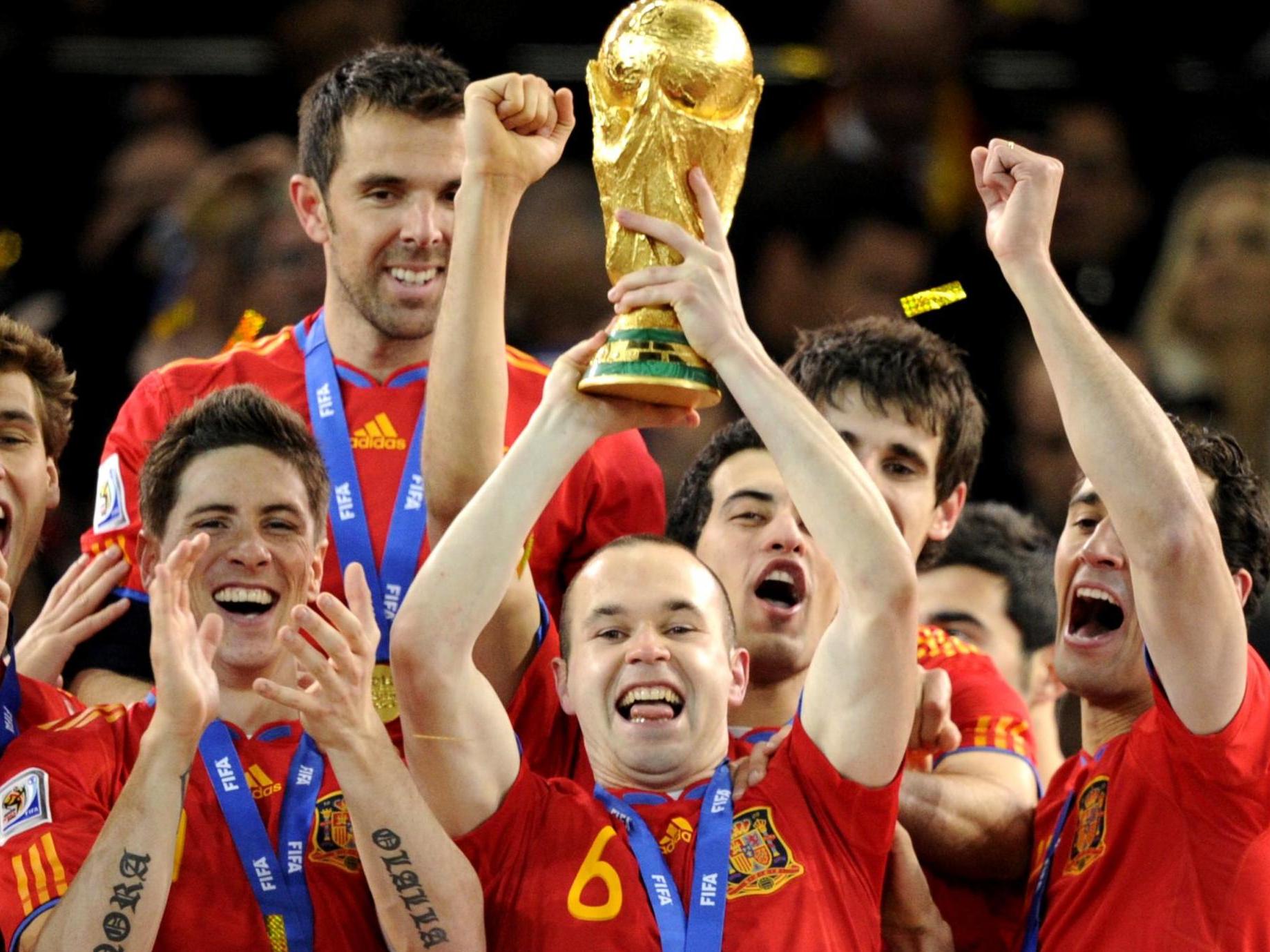
Andrés Iniesta with the World Cup

July 11, 2010: The World Cup Final is held at Soccer City in Johannesburg, South Africa. For sponsorship reasons, it is known as First National Bank Stadium, or FNB Stadium. But since the World Cup prohibits corporate names on stadiums, it was referred to as "Soccer City." It was built in 1989, on the edge of the Soweto township, a key location in black South Africans' struggle for equality. It is also the home of one of the country's top soccer teams, Kaizer Chiefs.

ABC broadcast it in America, including the constant annoyance of the fans with their native musical instrument, the vuvuzela. Given the countries competing in the game, it should have been a beautiful Final for the world championship of what Pelé called "The Beautiful Game": Spain vs. the Netherlands.

It wasn't. It was the ugliest Final in World Cup history, even more so than the tainted Final of 1978 in which Argentina, on Fascist-controlled home soil, beat the Netherlands.

The Spain side was managed by former Real Madrid boss Vicente del Bosque, and was dominated by 2 of the most-cheating teams in soccer, brought together for a common purpose: Real Madrid and FC Barcelona. From Real Madrid came goalkeeper Iker Casillas (Captain of club and country), defenders Sergio Ramos (maybe the dirtiest player in the sport at the time), Raúl Albiol and Álvaro Arbeloa; and midfielder Xabi Alonso.

From "Barça" came defenders Carles Puyol (their Captain), a dirty tackler, and Gerard Piqué, a notorious diver; midfielders Andrés Iniesta, Xavi Hernández (known by just his first name) and Sergio Busquets (another diver); forward Pedro Rodríguez (also known by his first name); and backup goalkeeper Victor Valdés.

From Valencia CF came forward David Villa; midfielders Juan Mata (yet another diver) and David Silva; and defender Carlos Marchena. From Villareal CF came defender Joan Capdevila. From Sevilla FC came midfielder Jesús Navas. From Athletic Bilbao came forward Fernando Llorente and midfielder Javi Martínez. And 3 players came from England's Premier League. From Liverpool FC were forward Fernando Torres and goalkeeper Pepe Reina. And from North London team Arsenal FC was former Barcelona midfielder Cesc Fàbregas.

And the Dutch? This was not your father's Oraanje. No Total Football, no brilliant passing, no stylish goalscoring. They were more like a sledgehammer. They were managed by Bert van Marwijk, who once managed Rotterdam side Feyenoord. As usual, the Dutch team was dominated by players who had come from the Netherlands' "Big Three" Feyenoord, Amsterdam team Ajax, and Eindhoven team PSV. But, as the Dutch top league, the Eredivisie, doesn't pay as well as the leagues of neighboring countries like England, Spain, France and Germany, not all of them had stayed with those teams:

From Ajax: Goalkeeper Maarten Stekelenburg; defenders Gregory van der Wiel, John Heitinga (then with Liverpool team Everton FC); midfielders Demy de Zeeuw, Nigel de Jong (then with Manchester City), Wesley Sneijder (who had played with Real Madrid, but was then with Internazionale Milano) and Rafael van der Vaart (then, ironically, with Real Madrid); and forward Ryan Babel (then with Liverpool).

From Feyenoord: Defender Giovanni van Bronckhorst (Captain); and forwards Dirk Kuyt (then with Liverpool) and Robin van Persie (then with Arsenal).

From PSV: Defender André Ooijer; midfielders Ibrahim Afellay, Mark van Bommel (who had played for Barcelona, but was then with Bayern Munich); and forwards Arjen Robben (who had played with Real Madrid, but was then with Bayern) and Klaas-Jan Huntelaar (who had also played for Ajax and Real Madrid, but was then with AC Milan).

From AZ Alkmaar: Defender Joris Mathijsen (then with Hamburger SV); midfielder Stijn Schaars.

From Enschede side FC Twente: Backup goalkeeper Sander Boschker; defender Edson Braafheid (then with Glasgow, Scotland team Celtic); and forward Eljero Elia (then with Hamburger).

From RKC Waalwijk: Defender Khalid Boulahrouz (then with VfB Stuttgart).

From FC Utretcht: Backup goalkeeper Michael Vorm, who led to the soccer-themed pun: "Vorm is temporary, class is permanent."

The Netherlands slogged through their Group, winning all 3 games, but not particularly distinguishing themselves in any of them, beating Denmark 2-0, Japan 1-0, and Cameroon 2-1. Spain opened their run by getting upset 1-0 by Switzerland, but rebounded to beat former colonies Honduras 2-0 and Chile 2-1.

In the Round of 16, the Netherlands beat Slovakia, 2-1 in Durban; while Spain beat neighboring Portugal, 1-0 in Cape Town. In the Quarterfinals, 2 goals by Sneijder turned an early 1-0 Brazil lead into a 2-1 Dutch win in Port Elizabeth; while Spain left it late, with Villa scoring in the 83rd minute, to beat Paraguay, 1-0 in Johannesburg. In the Semifinals, the Netherlands hung on to beat Uruguay, 3-2 in Cape Town; while Spain got a goal from Captain Puyol in the 73rd to beat Germany, 1-0 in Durban.

The referee for the Final was Howard Webb, the English former police officer infamous for his bald head and his apparent favoritism for Manchester United. To be assigned as the top official for a World Cup Final should be the greatest honor any sports official can ever receive, but Webb did not live up to the distinction. To say that he lost control of the match would suggest that he even tried to exert any control. The 14 yellow cards he gave out -- 9 to the Netherlands, 5 to Spain -- were more than double the previous record.
Howard Webb

Spain had the 1st serious chance of the game just 5 minutes in, when Stekelenburg made a diving save of a Ramos header. Shortly thereafter, the Dutch had their 1st chance, but Casillas saved from Kuyt. Heitinga deflected a Ramos shot over the crossbar in the 11th. Casillas stopped a screamer of a free kick from Sneijder.

In the 28th minute, with Webb having already given each side 2 yellow cards, de Jong kicked Alonso in the chest. For this, Webb should have shown him a straight red card and sent him off, but he only gave de Jong a yellow. As if the match wasn't rough enough, Casillas did Spain no favors by colliding with Puyol and injuring him in the 33rd. Puyol was able to carry on. Just before halftime, Casillas saved a shot by Robben, and it remained 0-0.

In the 50th minute, Spain did what Barcelona usually do when they think they should be awarded a penalty, and surrounded the ref in an attempt to intimidate him. Webb, used to such behavior from Premier League teams Man United and Chelsea, refused to give in. Two minutes later, Casillas saved a van Persie shot.

Heitinga was booked for a foul on Villa in the 56th. In the 62nd, Robben had a one-on-one with Casillas, but shot too low, and Casillas deflected it. In the 70th, Villa had an equally good chance, and an equally bad shot, deflected by Stekelenburg. Ramos had a great chance in the 77th, but fired over the crossbar. Casillas made a brilliant stop on Robben in the 83rd. Regulation play ended with the game still scoreless.

On to extra time. In the 92nd, Xavi went down a little too easy after a collision with Heitinga, and, again, the Spaniards demanded a penalty. Again, they didn't get it. Apparently, their reputation preceded them. Fàbregas had come on as a substitute for Alonso, and had a shot in the 95th, saved by Stekelenburg. In the 101st, Navas fired a shot that had the stadium roaring, thinking it was a goal, but it only hit the side netting. In the 104th, Fàbregas just missed, slightly wide of the goalpost. Still 0-0 as the match headed into the 2nd half of extra time.

In the 109th, Xavi was brought down by Heitinga. This earned him a 2nd yellow, equivalent to a red. Neither of his yellow card offenses was especially bad, but there were 2 of them, and, given the rules, he, rather than the much rougher de Jong -- or any of the Spanish players -- was off, and the Dutch were down to 10 men.

In the 115th minute, Webb made a call that may have changed the outcome of the game. He rightly awarded the Netherlands a free kick, which Sneijder took, and Casillas tipped it behind the goal. That should have resulted in a corner for the Netherlands. Instead, Webb awarded Spain a goal kick.

Torres took the kick, took the ball up the pitch, and passed it to Fàbregas, who passed it to Iniesta, who scored. His goal in the 116th minute remains the latest ever scored in a World Cup Final. The Dutch complained to Webb about his decisions, both the awarding of the goal kick and his failure to call a foul on Elia. Mathijsen slammed the ball on the grass in anger, and Webb booked him instead. But Spain held on for the 1-0 win.

Two days later, on July 13, Spain held its World Cup celebration in the capital of Madrid. Barcelona players pull an FC Barcelona shirt over the head of Fàbregas, calling him "The future of Barcelona, the future of Spain," as if he were only on loan to Arsenal, and that he had to be sent back to his boyhood club.

He did not immediately remove the shirt and tell his national team mates to respect his contract. A year later, he proved that he didn't respect his contract, either: He went on strike and faked an injury. Soon, he was sold back to Barcelona.

Had I been the manager of Arsenal, I would have sold Fàbregas to Real Madrid, Barcelona’s arch-rivals, the next day. For one pound. It would have sent multiple messages. To Fàbregas: You are a traitor, and are being punished for it. To Barcelona: Do not mess with The Arsenal. To the Arsenal players: No one is irreplaceable. And to the Arsenal fans: I know you love him, and that I didn't get any money for him, but there are things more important than money. Alas, the manager of Arsenal was Arsène Wenger, and he had too much class to do this.

Howard Webb retired from refereeing in 2014. In 2022, he was named the head of the Professional Game Match Officials Limited (PGMOL) is the body responsible for refereeing games in English soccer. He replaced Mike Riley, who had also been known for calls favoring Manchester United, both as a referee himself and in upholding the calls and cards of the referees he governed.

An article for ESPN.com, published after the 2026 World Cup, ranking all 23 tournaments, rated this one 17th, citing the rough play, the cheating, and those damn vuvuzelas.

*

July 11, 2010 was a Sunday. These Major League Baseball games were played:

* The New York Yankees beat the Seattle Mariners, 8-2 at Safeco Field (now T-Mobile Park) in Seattle. CC Sabathia was the winning pitcher. Marcus Thames hit a home run. Mark Teixeira went 4-for-5 with an RBI. Derek Jeter went 1-for-5 with 2 RBIs. Alex Rodriguez went 0-for-5.

* The New York Mets beat the Atlanta Braves, 3-0 at Citi Field. Johan Santana allowed 5 hits over 7 innings, and Bobby Parnell and Francisco Rodríguez completed the 5-hit shutout.

* The Philadelphia Phillies beat the Cincinnati Reds, 1-0 at Citizens Bank Park in Philadelphia. Cole Hamels allowed 6 hits over 7 2/3rds innings, and José Contreras, J.C. Romero and Brad Lidge finished the 6-hit shutout. The only run came in the 3rd inning, when Jimmy Rollins singled Carlos Ruiz home.

* The San Francisco Giants beat the Washington Nationals, 6-2 at Nationals Park in Washington.

* The Boston Red Sox beat the Toronto Blue Jays, 3-2 at the Rogers Centre in Toronto. David Ortiz * and Darnell McDonald hit home runs.

* The Tampa Bay Rays beat the Cleveland Indians, 6-5 at Tropicana Field in St. Petersburg, Florida. Jason Bartlett singled Carl Crawford home with the winning run in the bottom of the 10th inning.

* The Minnesota Twins beat the Detroit Tigers, 6-3 at Comerica Park in Detroit.

* The Chicago White Sox beat the Kansas City Royals, 15-5 at U.S. Cellular Field (now Rate Field) in Chicago.

* The Milwaukee Brewers beat the Pittsburgh Pirates, 6-5 at Miller Park (now American Family Field) in Milwaukee.

* The Baltimore Orioles beat the Texas Rangers, 4-1 at Rangers Ballpark (now Choctaw Stadium) in the Dallas suburb of Arlington, Texas.

* The St. Louis Cardinals beat the Houston Astros, 4-2 at Minute Maid Park (now Daikin Park) in Houston.

* The San Diego Padres beat the Colorado Rockies, 9-7 at Coors Field in Denver.

* The Florida Marlins beat the Arizona Diamondbacks, 2-0 at Chase Field in Phoenix. How many Marlin pitchers does it take to pitch an 8-hit shutout? This time, 6: Alex Sanabia allowed 5 hits over 3 1/3rd innings, Burke Badenhop none in 2/3rds of an inning and credited as the winning pitcher, Brian Sanches none over 2, José Veras none in 1, Clay Hensley 2 in 1, and Juan Carlos Oviedo 1 in 1.

* The Los Angeles Dodgers beat the Chicago Cubs, 7-0 at Dodger Stadium in Los Angeles. Vicente Padilla allowed 2 hits over 8 innings, and Hung-Chih Kuo completed the 4-hit shutout.

* And the Oakland Athletics beat the Los Angeles Angels, 5-2 at the Oakland Coliseum.

Friday, July 8, 2022

July 8, 2010: "The Decision" Airs On ESPN

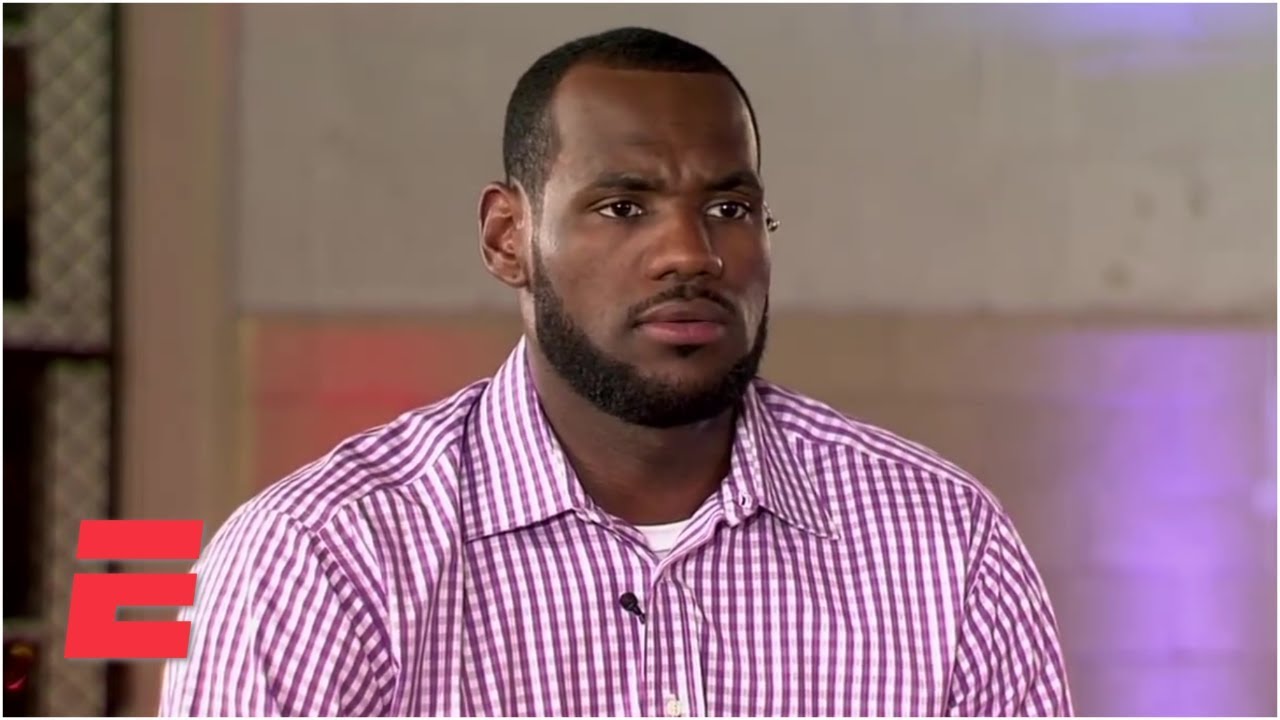
July 8, 2010: The Decision airs on ESPN. LeBron James had played out his contract with the Cleveland Cavaliers. Where would he go? The New York Knicks? The Chicago Bulls? The Los Angeles Lakers? Surely, it would be one of the big-market teams.

(The idea that he would go to one of the "little brother franchises," the soon-to-be Brooklyn Nets or the Los Angeles Clippers, was ludicrous. Thanks to Kyrie Irving with the former and Kawhi Leonard with the latter, it is not ludicrous anymore.)

But there was also talk that he would join Dwyane Wade of the Miami Heat to form a "superteam." And, yes, Miami is a big market, if not as big as New York, Los Angeles or Chicago.

ESPN reporter Jim Gray pitched the idea of a show covering James' choice to the network. Interviewing James himself, it was essentially the pregame show for the next phase of James' career. He said, "In this Fall, I'm going to take my talents to South Beach, and join the Miami Heat."

Heat fans -- the ones who supported the team before this, and soon found themselves outnumbered by people who were merely LeBron fans -- were ecstatic. Everybody else felt betrayed:

* Knick fans couldn't figure out why he wouldn't want to play in New York, "The Greatest City in the World," in Madison Square Garden, "The World's Most Famous Arena." (James Dolan was running the Knicks, that's why.)

* Bulls fans couldn't figure out why he wouldn't want to play on the team of Michael Jordan. (Jordan's shadow, maybe? After all, everything LeBron had done, and has gone on to do, has been measured against Jordan's career and life. Or maybe the Ohio native was just tired of the cold Midwestern weather.)

* Laker fans couldn't figure out why he didn't want to play for, if not the historically most successful (2nd only to the Boston Celtics), then certainly the most glamorous franchise in the NBA.

Did it work? Sort of: LeBron was with the Heat for 4 seasons, and reached the NBA Finals all 4 times -- but only won 2 of them. Then he finished that contract, and went back to the Cavs, and led them to the Finals 4 straight times, all against the Golden State Warriors, but only won 1 of them -- but it was still the title they had waited the team's entire existence for. Then he finished that contract, and went to the Lakers, leading them to a title in 2020, but that was in a COVID-interrupted season and an entire Playoffs in a "bubble," so Laker haters tend to put an asterisk on it. Otherwise, with the Lakers, he has fallen short.

The Decision showed that, unlike every other league, the NBA was now player-driven, not coach-driven, owner-driven, or even TV-driven. LeBron was driving TV. He had become the most influential figure in the league, more so than Commissioner David Stern and his eventual replacement, Adam Silver. The NBA was now The LeBron Show, with hundreds of supporting characters.

*

July 8, 2010 was a Thursday. These Major League Baseball games were played that day:

* The New York Yankees beat the Seattle Mariners, 3-1 at Safeco Field (now T-Mobile Park) in Seattle. The Yankees trailed 1-0 going into the 8th inning, but tied it, and won it in the 9th on a 2-run single by Alex Rodriguez against the team with whom he came up. This made a winning pitcher out of Andy Pettitte.

* The Philadelphia Phillies beat the Cincinnati Reds, 4-3 at Citizens Bank Park in Philadelphia. Brian Schneider won it with a home run in the bottom of the 12th.

* The San Diego Padres beat the Washington Nationals, 9-1 at Nationals Park in Washington.

* The Tampa Bay Rays beat the Cleveland Indians, 5-2 at Tropicana Field in St. Petersburg.

* The Toronto Blue Jays beat the Minnesota Twins, 8-1 at the Rogers Centre in Toronto.

* The Baltimore Orioles beat the Texas Rangers, 6-4 at Rangers Ballpark (now Choctaw Stadium) in the Dallas suburb of Arlington, Texas.

* The Houston Astros beat the Pittsburgh Pirates, 2-0 at Minute Maid Park (now Daikin Park) in Houston. Roy Oswalt allowed a single to Neil Walker in the 1st inning, and no more hits the rest of the way, although he walked 2 batters and hit another. Lance Berkman provided all the scoring with 2 solo home runs for the Astros.

* The Chicago White Sox beat the Los Angeles Angels of Anaheim, 1-0 at U.S. Cellular Field (now Guaranteed Rate Field) in Chicago. The only run of the game came on a sacrifice fly by Paul Konerko in the bottom of the 1st inning. John Danks pitched a 2-hit shutout.

* The San Francisco Giants beat the Milwaukee Brewers, 9-3 at Miller Park (now American Family Field) in Milwaukee.

* The Colorado Rockies beat the St. Louis Cardinals, 4-2 at Coors Field in Denver.

* The Arizona Diamondbacks beat the Florida Marlins, 10-4 at Chase Field in Phoenix.

* The Los Angeles Dodgers beat the Chicago Cubs, 3-2 at Dodger Stadium in Los Angeles.

* And the New York Mets, the Atlanta Braves, the Boston Red Sox, the Detroit Tigers, the Kansas City Royals and the Oakland Athletics were not scheduled to play.

The 2010 World Cup was also nearing its conclusion in South Africa. The Semifinals had been held: On July 6 in Cape Town, the Netherlands beat Uruguay, 3-2; and on July 7 in Durban, Spain beat Germany, 1-0. In the Final on July 11, Spain beat the Netherlands, 1-0 in extra time in Johannesburg.

Friday, June 24, 2022

June 24, 1995: The Rugby Match That United a Nation

Nelson Mandela and Francois Pienaar

June 24, 1995: A nation in search of reconciliation finds a moment to rally around -- as its President knew it could.

During the years of apartheid in South Africa, soccer was seen as the sport of the nation's black people, while cricket and rugby were the sports of its white people. Cricket appealed to the white people of British descent, while rugby appealed to both them and the people of Dutch descent, the Afrikaners whose Afrikaans language was a derivation of Dutch.

But Nelson Mandela, elected President in the country's 1st all-races election in 1994, saw that he was going to host the Rugby World Cup the following year. He knew that sport had the power to bring people together. In some cases -- soccer in Germany in 1954 and England in 1966, hockey in Canada in 1972 and America in 1980 -- it could bring an entire country together, or even the entire world.
So he wanted South Africa's famed rugby team, the green-and-gold-clad "Springboks" (a springbok is an antelope native to southern and western Africa), to bring the country together, by becoming racially integrated for the 1st time in its history, and face the other world powers of rugby, all integrated, and beat them on home soil.

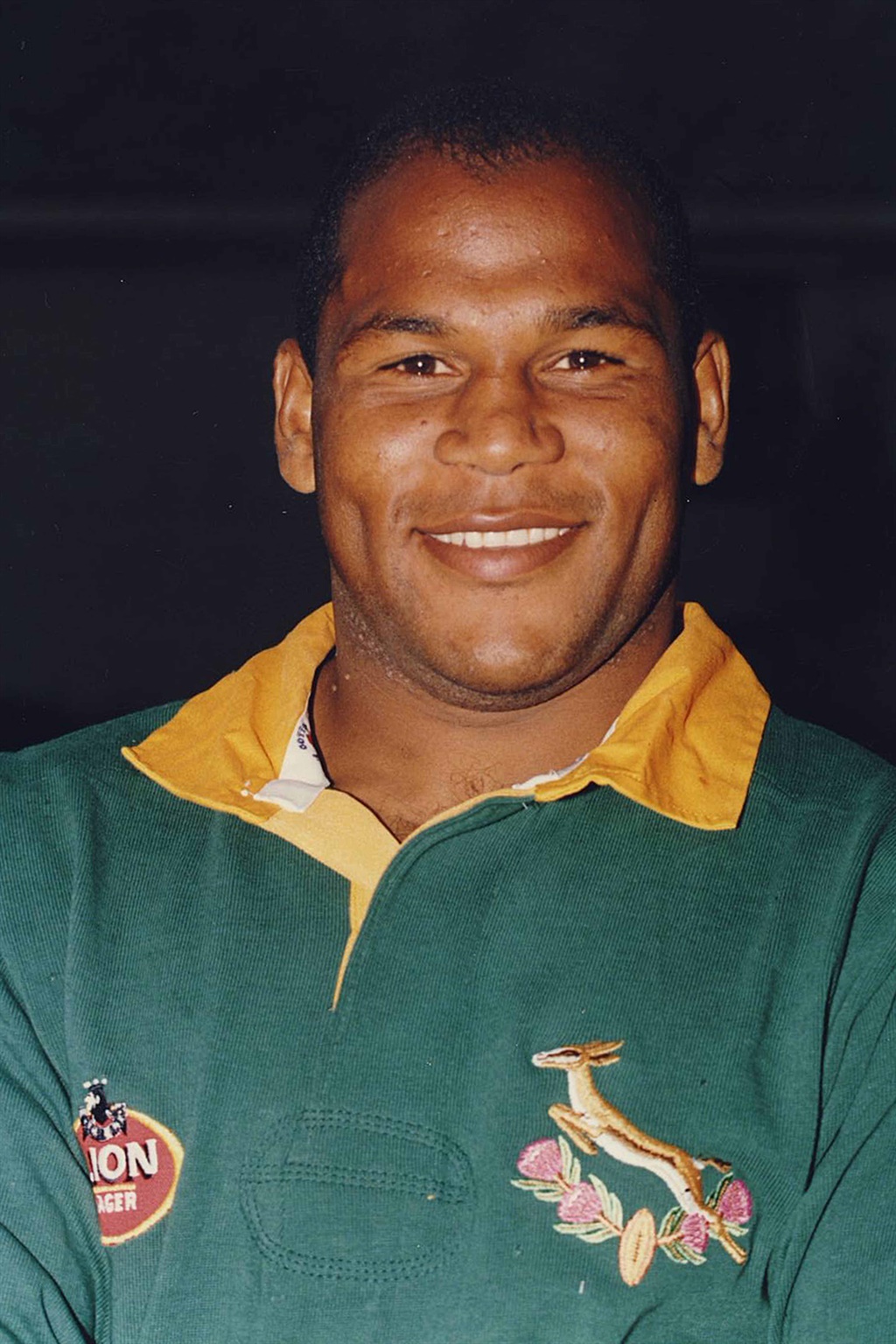
Chester Williams, a 24-year-old left wing from Cape Town, was the 1st black Springbok. In club matches, some opponents had made racist remarks about him. That was not the case when those opponents joined him on the national side: "When we were together as a team, the team-spirit was good. We partied together, we had fun together, we stuck by one another. Those other things happened while we were playing against one another in the Currie Cup, or domestic competitions. But that's in the past now. We have all moved on, and everybody's happy." Mandela could be seen in the stands wearing Williams' Number 11 shirt.
Chester Williams

South Africa were put in a group with Australia, Romania and Canada, but beat them all. They beat Western Samoa in the Quarterfinal, 42-14; and a tough France team in the Semifinal, 19-15. They would host the Final on June 24, at Ellis Park in Johannesburg, the home of South African rugby.

But they would have to play New Zealand. They are known as the All Blacks, referring to their uniforms, as they are multicultural, with players of Samoan descent often leading them in a fierce-looking pregame haka dance. (The New Zealand soccer team is the All Whites, again for their uniforms, not their racial makeup.)

The All Blacks had won the 1st Rugby World Cup, in 1987; and finished 3rd in 1991. They came into this edition as the favorites, mainly because they had the man then regarded as the best player in the world: Jonah Lomu. Scotland player Kenny Logan put it this way: "You could talk about Lionel Messi or Cristiano Ronaldo, that's what Jonah was, someone who could change games if you gave him the ball, wherever he was."

A New Zealander of Tongan ancestry, Lomu had been an all-around track and field star as well. At 6-foot-5 and 262 pounds of solid muscle, Lomu was so effective, his playing style attracted attention from NFL scouts and suggested that he might be able to make the transition to American football. He never tried it, though.
Jonah Lomu

(While a few NFL players had played rugby at a scholastic or collegiate level, only 1 professional rugby player has ever played in the NFL: Hayden Smith, an Australian who played 8 seasons for Saracens in London, and 5 games as a tight end for the New York Jets in 2012. Most of those who've tried out have been cut, or only made the practice squad, never getting into a game.)

New Zealand beat Ireland, Wales and Japan in the Group Stage, their win over Japan being a shocking 145-17. They beat Scotland in the Quarterfinal, and England in the Semifinal. So they had beaten all 4 of the United Kingdom's "Home Nations," given that the Ireland team was a combination of players from the Republic of Ireland and British-controlled Northern Ireland. The Semifinal win over England was 45-29, and that 16-point margin was the closest anyone had come to beating them. Lomu scored 4 tries (touchdowns) in that game. He and teammate Mark Ellis had each scored 7 over the course of the tournament.

(For the sake of perspective: In the Spring tournament then known as the Five Nations Championship, England went 4-0, Scotland 3-1, France 2-2, Ireland 3-1, and Wales 0-4. In 2000, Italy were admitted to the competition, giving it the current name: The Six Nations Championship.)

Essentially, it looked like a battle of a great offense against a great defense: New Zealand had outscored their opponents, 315-104; while South Africa had outscored theirs, 129-55. Average that out, and you get New Zealand 180, South Africa 116. Of course, sports usually doesn't work out anywhere near that way, but enough people thought it would that, despite the Springboks being the hosts, the All Blacks were the worldwide betting favorites. The match kicked off at 1:30 PM local time -- 11:30 AM in London, 6:30 AM on the U.S. East Coast, and 11:30 PM in New Zealand.

South Africa played their own game, relying on their defense. This led to Ruben Kruger, Mark Andrews and Joost van der Westhuizen preventing much progress. Nevertheless, Andrew Mehrtens scored a penalty just 6 minutes in, giving New Zealand a 3-0. In the 11th minute, Joel Stransky tied the game. Each of these men added another penalty to make it 6-6, and in the 32nd minute, Stransky added another, allowing South Africa to take a 9-6 lead into halftime. The policy of "bend, but don't break" seemed to be working.

In the 55th minute, Mehrtens scored another drop goal, to tie it at 9-9. He just missed another late in regular time, but it was still tied at full time, putting the game into extra time. According to the rules, if extra time finished with scores still level, with no side having scored more tries than the other, then the team with the better overall disciplinary record during the tournament would win. That tiebreaker belonged to New Zealand. So South Africa had to score.

But early in the first half, the Springboks were penalized for chasing a Stransky kick from an offside position. From just inside the half-way line, Mehrtens kicked truly to give New Zealand a 12–9 lead. As half-time approached, Stransky put a high kick for his teammates to chase, and from the resultant play, referee Morrison penalized the All Blacks for diving to the ground near the tackle. Right on the stroke of half-time of extra time, Stransky levelled the scores at 12–12.
Joel Stransky

With 7 minutes remaining, Stransky scored a drop goal from 30 meters out (about 33 yards, in U.S. football terms). No tries were scored in the entire match, but South Africa had won, 15-12. They had held a team that had averaged 63 points a match thus far to 1/5th of that.

After the match, Mandela, wearing a Springbok jersey and cap, as head of state for the host nation, presented the Webb Ellis Cup to Captain Pienaar, to the delight of the diverse crowd of 59,870 people.

The story was depicted in the book Playing the Enemy: Mandela and the Game that Made a Nation, by British journalist John Carlin. A screenplay based on that book was filmed as Invictus in 2009, with Clint Eastwood directing. Morgan Freeman as Mandela, Matt Damon as Pienaar, McNeill Hendricks (who had played 2 matches for the Springboks) as Williams, Eastwood's son Scott Eastwood as Stransky; and Isaac Fe'aunati (credited as Zak Fe'aunati), who made 13 appearances for the Samoa national team, as Lomu.

A surprising number of players from that Final have died young: Ruben Kruger from cancer in 2010, at 39; Joost van der Westhuizen from ALS (known in British Commonwealth countries as "motor neurone disease" and in America as "Lou Gehrig's disease) in 2017, at 45; both James Small and Chester Williams from heart attacks in 2019, at 50 and 49, respectively. South Africa's manager, George "Kitch" Christie, died in 1998, from leukemia, at 58. Mandela died in 2015, at 95.

New Zealand star Jonah Lomu married a white South African woman, but it didn't last. Despite all his fame, and an ability to speak 7 languages, he suffered from kidney disease and lost all his money trying to treat it. He died in 2015, only 40 years old.

*

June 24, 1995 was a Saturday. On this same day, the New Jersey Devils beat the Detroit Red Wings, 5-2, at the Brendan Byrne Arena at the Meadowlands in East Rutherford, New Jersey. This completed a 4-game sweep, and gave the Devils their 1st Stanley Cup. I have a separate entry for this event.

And these Major League Baseball games were played:

* The New York Yankees beat those pesky Toronto Blue Jays, 10-2 at Yankee Stadium. The only home run in the game was hit by the Jays' Joe Carter. But, for the Bronx Bombers, Luis Polonia, Wade Boggs and Dion James each got 2 hits. Boggs got 3 RBIs, and James and Paul O'Neill each got 2. This was in support of Melido Perez.

* The New York Mets, as they so often did in those days, lost to the Atlanta Braves, 5-4 at Atlanta-Fulton County Stadium.

* The Montreal Expos beat the Pittsburgh Pirates, 5-0 at the Olympic Stadium in Montreal. Carlos Perez, brother of Melido and Pascual, pitched a 6-hit shutout.

* The Boston Red Sox beat the Baltimore Orioles, 6-5 at Camden yards in Baltimore.

* The Cincinnati Reds beat the Florida Marlins, 5-2 at Riverfront Stadium in Cincinnati.

* The Detroit Tigers beat the Milwaukee Brewers, 7-2 at Tiger Stadium in Detroit.

* The Chicago White Sox beat the Cleveland Indians, 8-3 at the new Comiskey Park (now Rate Field) in Chicago.

* The Philadelphia Phillies beat the St. Louis Cardinals, 10-9 at Busch Memorial Stadium.

* The Minnesota Twins beat the Kansas City Royals, 6-5 at Kauffman Stadium in Kansas City.

* The Texas Rangers beat the Oakland Athletics, 6-5 at The Ballpark (now Choctaw Stadium) in the Dallas suburb of Arlington, Texas.

* The Chicago Cubs beat the Houston Astros, 5-2 at the Astrodome in Houston.

* The San Diego Padres beat the Colorado Rockies, 2-0 at Jack Murphy Stadium in San Diego. Joey Hamilton pitched a 4-hit shutout.

* The Los Angeles Dodgers beat their arch-rivals, the San Francisco Giants, 7-0 at Dodger Stadium in Los Angeles. Hideo Nomo had the night's best pitching performance, pitching a 2-hit shutout and striking out 13.

* And the Seattle Mariners beat the California Angels, 3-2 at the Kingdome in Seattle.

Thursday, June 23, 2022

June 23, 2010: The Landon Donovan Goal

June 23, 2010: Landon Donovan scores the most famous goal in the history of American soccer.

* More famous than Joe Gaetjens' goal to allow the U.S. national team to beat England in the 1950 World Cup, because nobody was watching on television.

* More famous than any goal ever scored in the North American Soccer League, during its run of 1967 to 1984.

* More famous than any goal ever scored in Major League Soccer since its debut in 1996.

* And more famous than the goals scored by Brian McBride and Donovan himself in the 2002 World Cup "Dos a Cero" win over arch-rival Mexico.

On that occasion, Donovan was 20 years old, and already the winner of an MLS Cup with the San Jose Earthquakes. He would win another with them, and then win one for the Los Angeles Galaxy. And he would help the U.S. team win 3 CONCACAF Gold Cups. He would also play for the U.S. in the 2006 World Cup, a disappointment for the team. And he had played in Germany's Bundesliga for Bayer Leverkusen and Bayern Munich.

The 2010 World Cup was held in South Africa. The U.S. team, led by Donovan and Clint Dempsey, was placed in a Group with England, Slovenia and Algeria, and it was expected that the 1st 2 games would be lost, and the U.S. would fail to qualify for the Knockout Stage.

But goalkeeper Rob Green's mishandling of a Dempsey shot gave the U.S. a 1-1 draw with England in Rustenberg. And they dominated Slovenia in Johannesburg, and should have won, but a goal, a Maurice Edu volley off of a Donovan pass, was wrongly disallowed, leaving a 2-2 draw, with Donovan and Marcus Bradley scoring the goals.

So the game against Algeria, at the Loftus Versfeld Stadium in Pretoria -- named for the founder of organized sports in that city, and home of the historically black soccer team Mamelodi Sundowns and the traditionally white rugby team Blue Bulls -- was huge. A win would send the U.S. to the knockout stage. A draw might, depending on who won between England and Slovenia, and by how much. A loss, and we were definitely out.
Loftus Versfeld Stadium

Oddly, only 35,827 fans paid to see the game. Loftus Versfeld Stadium, built in 1923 and substantially renovated in 2008, has a capacity of 51,752. But ticket prices for this World Cup were very high, pricing poor black South Africans out, and there weren't enough people from other countries willing to pay.

After an early Algerian shot hit the crossbar, the American defense settled down. Jozy Altidore missed a sitter. Dempsey scored, but it was disallowed for offside. The joke went around the world: Now, the U.S. is a true footballing nation, because they've gotten screwed twice at one World Cup.

At the end of 90 minutes, it was still 0-0. But the final had come in: England had beaten Slovenia 1-0. England were in. If the U.S. could not score in stoppage time, they would finish 3rd in the Group to Slovenia's 2nd, and would be out.

Three minutes were added on. Goalkeeper Tim Howard, of North Brunswick, Middlesex County, New Jersey, threw an outlet pass to Donovan. He dribbled a bit, then passed to Altidore, who crossed to Dempsey. Raïs M'Bolhi, born in Paris but playing his national soccer for Algeria and his club soccer, at the time, for Slavia Sofia in Bulgaria, moved forward, and blocked Dempsey's shot.

But he only blocked it, unable to stop it. Donovan was moving forward, the ball came right to him, and he put it in the net. The social media reaction was delayed because fans all over America were pretty much still celebrating when the referee, Frank De Bleeckere of Belgium, blew his final whistle during the 94th minute. One-nil to the Stars & Stripes.

Those of us who are both Americans and Arsenal fans thought of the Michael Thomas goal that won Arsenal the 1989 Football League title against Liverpool, partly because that goal was also started by a goalkeeper's long throw, and was in the 92nd minute instead of the 91st.

Unfortunately, all the Donovan goal won was a World Cup Group. It didn't guarantee anything other than a place in the Round of 16. Although the U.S. held Ghana to 1-1 after regulation, with Donovan converting a penalty, they ran us ragged in extra time, and we lost, 2-1. Spain went on to win the World Cup, defeating Netherlands in extra time in the Final in Johannesburg.

Still, Donovan's goal, the win it secured, and the advancement that the win secured, was a huge moment for American soccer. The "Miracle On Grass" in 1950 was an anomaly: We didn't qualify for the Knockout Stage, and we didn't qualify for the World Cup again for 40 years. "Dos a Cero" in 2002 was a great moment, and we did advance to the Quarterfinal, but it had more of an effect on our reputation within the CONCACAF region (the Confederation of North, Central America and Caribbean Association Football) than in the world at large. Europe, Asia, Africa, Oceania, and even South America didn't particularly care that we embarrassed Mexico.

But 1950 was the dawn of the television era. It might have been different if the game had been covered on TV, but it wasn't. And 2002, while in the Internet era, wasn't in the social media era. In contrast, Donovan's goal was shared almost immediately. Almost: We did celebrate a bit before we tweeted about it. 

After the 2010 World Cup, Donovan won 2 more MLS Cups with the Galaxy, and 1 more CONCACAF Gold Cup. He also played in England for Liverpool-based Everton, and, with some irony, in Mexico with Club León. In 2020, the minor-league team San Diego Loyal was founded, and Donovan has been their manager ever since.

*

June 23, 2010 was a Wednesday. As I said, the other World Cup Group C game played that day was England's 1-0 win over Slovenia at Nelson Mandela Bay Stadium in Port Elizabeth.

In Group D, Germany beat Ghana 1-0 at FNB Stadium, a.k.a. Soccer City, in Johannesburg; and Australia beat Serbia 2-1 at Mbombela Stadium in Nelsprit.

American football was out of season. The basketball season had ended 6 days earlier, when the Los Angeles Lakers won the NBA Championship by beating the Boston Celtics. The hockey season had ended 14 days earlier, when the Chicago Blackhawks won the Stanley Cup by beating the Philadelphia Flyers.

These Major League Baseball games were played that day:

* The New York Yankees beat the Arizona Diamondbacks, 6-5 at Chase Field in Phoenix. Curtis Granderson won it with a home run in the top of the 10th inning, making Mariano Rivera a winner in relief of Javier Vazquez.

* The New York Mets beat the Detroit Tigers, 5-0 at Citi Field. José Reyes hit a home run, and knuckleballer R.A. Dickey pitched a 4-hit shutout.

* The Philadelphia Phillies beat the Cleveland Indians, 7-6 at Citizens Bank Park in Philadelphia. The Tribe scored a run in the top of the 9th. But, Cliché Alert: Walks can kill you, especially the leadoff variety. Brian Schneider drew a leadoff walk for the Phils, and Jimmy Rollins hit a home run.

* The Florida Marlins beat the Baltimore Orioles, 7-5 at Oriole Park at Camden Yards in Baltimore.

* The Kansas City Royals beat the Washington Nationals, 1-0 at Nationals Park in Washington. Brian Bannister and 2 relievers pitched a 6-hit shutout.

* The San Diego Padres beat the Tampa Bay Rays, 5-4 at Tropicana Field in St. Petersburg.

* The St. Louis Cardinals beat the Toronto Blue Jays, 1-0 at the Rogers Centre in Toronto. Matt Holliday singled home the only run of the game in the top of the 9th, making a winner of Chris Carpenter, who had pitched 8 innings of a 3-hit shutout, with Ryan Franklin allowing a 4th hit but keeping the shutout.

* The Chicago White Sox beat the Atlanta Braves, 4-2 at U.S. Cellular Field (now Rate Field) in Chicago. Mark Buerhle outpitched Tim Hudson.

* The Milwaukee Brewers beat the Minnesota Twins, 5-3 at Miller Park (now American Family Field) in Milwaukee.

* The Texas Rangers beat the Pittsburgh Pirates, 13-3 at Rangers Ballpark (now Choctaw Stadium) in the Dallas suburb of Arlington, Texas.

* The Houston Astros beat the San Francisco Giants, 6-3 at Minute Maid Park (now Daikin Park) in Houston.

* The Colorado Rockies beat the Boston Red Sox, 8-6 at Coors Field in Denver. Ian Stewart and former Yankee Jason Giambi (with Clint Barnes on base) hit home runs of Jonathan Papelbon in the bottom of the 9th to win it.

* The Los Angeles Angels beat their regional rivals, the Los Angeles Dodgers, 2-1 at Angel Stadium of Anaheim. Both of the Halos' runs were scored in part due to errors.

* The Cincinnati Reds beat the Oakland Athletics, 3-0 at the Oakland Coliseum. Johnny Cueto and 2 relievers pitched a 7-hit shutout.

* And the Seattle Mariners beat the Chicago Cubs, 8-1 at Safeco Field (now T-Mobile Park) in Seattle.

Sunday, June 12, 2022

June 12, 2010: USA vs. England and the "Hand of Clod"

You've heard of "Harvard Beats Yale, 29-29"? Well…

June 12, 2010: Soccer's World Cup continues in South Africa. The U.S. team plays England at Royal Bafokeng Stadium in Rustenburg. The teams had played each other in a few games of low meaning, but hadn't played in a game that truly mattered since 1950, when the U.S. shocked England in the World Cup in Brazil.

This time, the U.S. is better than it was in 1950, but this is England's "Golden Generation": Steven Gerrard, Jamie Carragher and Glen Johnson of Liverpool; Frank Lampard, John Terry and Ashley Cole of Chelsea; Wayne Rooney of Manchester United; Ledley King, Aaron Lennon and Peter Crouch of Tottenham Hotspur; and former Liverpool star Emile Heskey and future Liverpool star James Milner, both of Aston Villa.

The U.S. have no chance. An English paper, The Sun, had described Group C as "EASY: England, Algeria, Slovenia, Yanks." (Hardly the 1st thing that rag got wrong.) On ABC, former Liverpool legend Steve McManaman says England will win 3-1.

Sure enough, Gerrard gives England an early 1-0 lead. But shortly before halftime, goalkeeper Robert Green of West Ham United mishandles a shot by Clint Dempsey, and the ball goes into the net, stunning everyone.

During halftime, Mike Tirico tells the audience that he'd just explained to McManaman who Bill Buckner was, referencing the most famous error in baseball history, in the 1986 World Series. The game ends "USA Beats England, 1-1."

Two different English newspapers, the Daily Mirror and the News of the World, did a takeoff on Diego Maradona's "Hand of God" cheat for Argentina against England in the 1986 World Cup: They called Green's howler the "Hand of Clod."

If, as the only saying from American football goes, "A tie is like kissing your sister," then, for the Americans, this tie was like kissing your sister's really nice-looking best friend; while, for England, this tie (they would say, "draw") was like kissing your sister's other best friend -- you know, the one with the "great personality."

Elsewhere that day, Argentina beat Nigeria 1-0 at Johannesburg, and South Korea beat Greece 2-0 at Port Elizabeth.

The U.S. and England both advanced to the Knockout Stage, and both lost in the Round of 16.

UPDATE: They would play each other again in the 2022 World Cup, in Qatar, with England again favored. That would also be a draw, 0-0.

*

June 12, 2010 was a Saturday. American-style football was out of season. Hockey season had ended 3 days earlier, when the Chicago Blackhawks beat the Philadelphia Flyers in Game 6 of the Finals to win the Stanley Cup. The NBA Finals were between Games 4 and 5, and the Los Angeles Lakers went on to beat the Boston Celtics in 7 games.

And these games, mostly Interleague, were played in Major League Baseball:

* The New York Yankees beat the Houston Astros, 9-3 at Yankee Stadium. Javier Vázquez was the winning pitcher. Derek Jeter hit 2 home runs, and Jorge Posada also hit a homer.

* The New York Mets beat the Baltimore Orioles, 3-1 at Camden Yards in Baltimore.

* The Boston Red Sox beat the Philadelphia Phillies, 10-2 at Fenway Park in Boston.

* The Tampa Bay Rays beat the Florida Marlins, 6-5 at Tropicana Field in St. Petersburg, Florida.

* The Cleveland Indians beat the Washington Nationals, 7-1 at Progressive Field in Cleveland.

* The Cincinnati Reds beat the Kansas City Royals, 11-5 at Great American Ball Park in Cincinnati.

* The Detroit Tigers beat the Pittsburgh Pirates, 4-3 at Comerica Park in Detroit. Carlos Guillén win it with a home run in the bottom of the 10th inning.

* The Chicago White Sox beat the Chicago Cubs, 2-1 at Wrigley Field in Chicago.

* The Texas Rangers beat the Milwaukee Brewers, 4-3 at Miller Park (now American Family Field) in Milwaukee.

* The Atlanta Braves beat the Minnesota Twins, 3-2 at Target Field in Minneapolis.

* The Colorado Rockies beat the Toronto Blue Jays, 1-0 at Coors Field in Denver. Jason Hammel pitched 8 innings of 3-hit shutout ball, and Manny Corpas finished the 4-hit shutout.

* The Arizona Diamondbacks beat the St. Louis Cardinals, 7-2 at Chase Field in Phoenix.

* The San Diego Padres beat the Seattle Mariners, 7-1 at Petco Park in San Diego.

* The Los Angeles Angels beat the Los Angeles Dodgers, 4-2 at Dodger Stadium in Los Angeles.

* And the San Francisco Giants beat the Oakland Athletics, 5-4 at AT&T Park (now Oracle Park) in San Francisco.

December 31, 1999 & January 1, 2000: The Millennium

December 31, 1999:  The Millennium arrives. The people of planet Earth survived. At a terrible cost. But we hadn't destroyed ourselves. ...