Showing posts with label paris. Show all posts

Sunday, December 18, 2022

December 18, 1963: “The Pink Panther” Premieres

December 18, 1963: The film The Pink Panther premieres, directed by Blake Edwards. The cartoon character of the same name debuted in the film's opening sequence, with the classic theme song composed and conducted by Henry Mancini. You know the joke: What did the Pink Panther say when he stepped on an ant? "Dead ant, dead ant... "

But, within the film, the Pink Panther is not a character. Rather, it is the thing everyone is chasing, what film director Alfred Hitchcock called a "MacGuffin": A large pink diamond with a "flaw" in the shape of a leaping panther. It is owned by Princess Dala (played by the Tunisian-born Italian actress Claudia Cardinale, with her voice dubbed by Canadian singer Gale Garnett), an exiled royal whose country's new dictatorship wants it back, and the United Nations' World Court has sided with them, and they've offered a big reward for it.

And Inspector Jacques Clouseau (played by Peter Sellers), the incompetent, clumsy, accident-prone Paris police official who was, clearly, named for oceanographer Jacques Cousteau, isn't the hero of the movie. The hero is actually a criminal, a "gentleman thief" named Sir Charles Lytton, a.k.a. The Phantom (David Niven).
Cardinale, Niven and the Panther

To make matters worse, Clouseau's wife, Simone (the French actress Germaine Hélène Irène Lefebvre, a.k.a. Capucine) is having an affair with The Phantom. He shouldn't be the hero, but he has been treated as such, because, while he often played less-than-moral characters, the handsome, incredibly charming Niven was beloved, as if he were an earlier, English version of Paul Newman. Even my mother, a senior in high school when the film came out, adored Niven. She also liked Robert Wagner, who played Lytton's American-based and even less-moral nephew, George.

The film was successful enough to lead to a series, with A Shot in the Dark premiering the following June, and Inspector Clouseau in 1968. The film also inspired the TV show Get Smart: NBC told the producers to combine Inspector Clouseau and James Bond, because they were the two biggest cultural phenomena in the world at the time. I guess they forgot about the Beatles.

The series resumed a few years later: The Return of the Pink Panther was released in 1975, The Pink Panther Strikes Again in 1976, and The Revenge of the Pink Panther in 1978. Sellers died in 1980. By that point, Niven was suffering from ALS, known in America as Lou Gehrig's disease. That didn't stop Blake Edwards: In 1982, he made The Trail of the Pink Panther, using a brief cameo from Niven and previously unused footage of Sellers, with Clouseau spending most of the film in a body-cast. And in 1983, all kinds of tricks, including the briefest of cameos from a dying Niven, were used for Curse of the Pink Panther.

In a way, in 1983, things came full circle: The cartoon Inspector Gadget premiered, with Don Adams, star of Get Smart, voicing the title role, a well-meaning but incompetent robot cop who dressed much like Inspector Clouseau, with a tan trenchcoat and a trilby hat, the kind also favored by another famous fictional cop, Telly Savalas on Kojak.

In 1993, Edwards tried again, with Son of the Pink Panther, with Italian actor Roberto Benigni as the title character, Gendarme Jacques Gambrelli. As it turns out, he is half of the result of a one-night stand between Clouseau and a different character played by Cardinale, the other being his twin sister, Jacqueline Gambrelli (Nicoletta Braschi).

The one constant through all these films was Czech-British actor Herbert Lom as the original Clouseau's beleaguered boss, Chief Inspector Charles Dreyfus.

Capucine died in 1990, Edwards in 2010, Lom in 2012. As of December 18, 2022, Cardinale and Wagner are still alive. (UPDATE: Cardinale died in 2025.)

In 2006, Steve Martin starred in a reboot, with The Pink Panther 2 released in 2009.

*

December 18, 1963 was a Wednesday. Basketball star Charles Oakley and actor Brad Pitt were born.

Baseball was out of season. Football was in midweek. There were 4 games in the NBA:

* The New York Knicks lost to the Boston Celtics, 133-111 at the Boston Garden.

* The Baltimore Bullets beat the Detroit Pistons, 124-107 at Cobo Hall (now Huntington Place) in Detroit. For the Bullets, Gus Johnson scored 38 points, and Walt Bellamy scored 36. 

* The Los Angeles Lakers beat the Philadelphia 76ers, 116-96 at the Los Angeles Sports Arena. Jerry West scored 30 points and grabbed 14 rebounds.

* And the San Francisco Warriors beat the St. Louis Hawks, 104-96 at, sort of, a neutral site: The gymnasium at Sacramento High School, 88 miles northeast of downtown San Francisco. It was just another day at the office for Wilt Chamberlain: He scored 27 points, grabbed 27 rebounds, and had 11 assists. For the Hawks, Bob Pettit scored 29 points. Pettit was the NBA's all-time leading scorer.

And the NHL's entire "Original Six" were in action:

* The New York Rangers and the Detroit Red Wings played to a tie, 1-1 at the old Madison Square Garden.

* The Montreal Canadiens beat the Toronto Maple Leafs, 7-1 at the Montreal Forum.

* And the Boston Bruins beat the Chicago Black Hawks, 2-1 at the Chicago Stadium.

Thursday, December 15, 2022

December 15, 1944: Glenn Miller Disappears

December 15, 1944: Glenn Miller, the biggest name of the "Big Band" era of music, disappears.

Miller was a trombonist, and led The Glenn Miller Orchestra. In 1939, they had hits with "Moonlight Serenade" and "In the Mood." In 1940, he would record "Tuxedo Junction" and "PEnnsylvania 6-5000." In 1941 came "Chattanooga Choo Choo." In 1 day, May 20, 1942, he recorded "At Last" (now better known for the 1961 version by Etta James) and "(I've Got a Gal in) Kalamazoo."

So in a span of a little over 3 years, he recorded 7 iconic songs, which led to his band being featured in some movies. They became the biggest band of the World War II years (I'm talking about popularity, not just in number of members) -- bigger than Benny Goodman's, bigger than either Tommy Dorsey's or Jimmy Dorsey's, and (no doubt helped by the fact that he and his band were white) bigger than Duke Ellington's and Count Basie's.

Miller's career came to what was expected to be a temporary interruption when he joined the war effort. He was ready to give up a civilian income of $20,000 per week -- about $339,000 in 2022 money, or around $17 million a year, so it was comparable to today's biggest stars -- to put on a uniform and serve his country.

At 38, he was too old to be drafted by the U.S. Army. So he volunteered for the U.S. Navy. They told him they didn't need him. So he wrote to an Army General, suggesting that he "be placed in charge of a modernized Army band."

This was done, as he was assigned to the U.S. Army Air Forces, the precursor to the U.S. Air Force. This allowed his band members -- not the same ones he had in his Orchestra -- to fly to various U.S. installations and perform for their fellow troops.

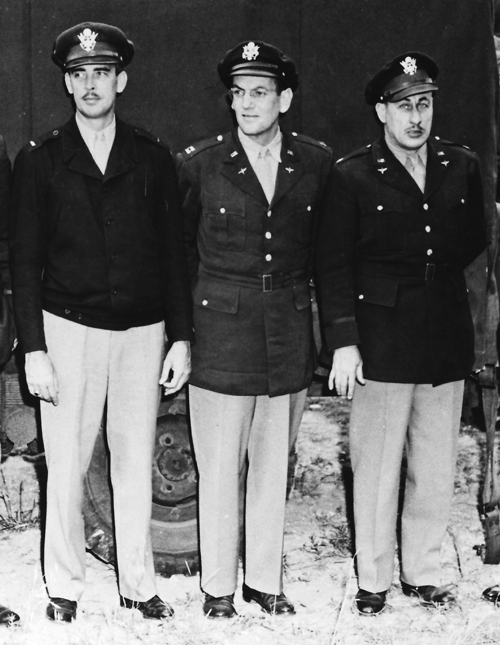
On December 15, 1944, Major Glenn Miller boarded a single-engine UC-64 Norseman at Clapham, England, heading for recently-liberated Paris, where he would establish the headquarters his band intended to have for the duration of the War. With him were 2 other officers: Lieutenant Colonel Norman Baessell, who would supervise the construction of the HQ; and the pilot, Flight Officer John Morgan.
Left to right: Morgan, Miller, Baessell

The weather was bad the day before, leading to all planes being grounded. Miller was expected to be in Paris on the 16th, but on the 15th, Baessell made a guess that there would be enough of a break in the weather to fly. So the plane took off at 1:55 PM Greenwich Mean Time (8:55 AM on the U.S. East Coast).

No one was expecting the plane to arrive in Paris that afternoon, and so, when it didn't show up, no one thought to look for it. It was only when the rest of the band arrived at Paris' Orly Airport on December 18, and Miller wasn't there to meet them, that anybody realized that anything was wrong. The intended hotel was called, and Miller hadn't checked in.

It was only on December 24, Christmas Eve, that it was announced by the Army that Miller's plane was missing and presumed lost. No trace of it has ever been found. The band's deputy leader, Technical Sergeant Jerry Gray, led the band in that evening's performance in Miller's place.

Investigations turned up nothing solid, but the most common theory is that, given the weather, the plane's carburetor iced up, causing a crash that would have killed everybody on impact with the water. Suggestions of the Nazis shooting the plane down, or a horrible mistake of "friendly fire," or Miller having made it to Paris, dying in a brothel, and having the Army cover it up were dismissed as impossible.

Miller was 39, and left behind a wife and 2 children. His wife, Helen, was given a Bronze Star awarded to him 3 months later.

Today, as with some of the other bands I mentioned, a "legacy band," authorized by the Miller estate, performs the Miller catalog. Trumpeter Ray Anthony was the last surviving member of the original Glenn Miller Orchestra. On January 20, 2022, he celebrated his 100th birthday.

*

December 15, 1944 was also the day the Battle of the Bulge began in the Ardennes Forest of France, Belgium and Luxembourg, Nazi Germany's last stand on the Western Front. On December 22, the Nazis sent an officer to deliver a surrender demand to the U.S. Army's 101st Airborne Division, then stationed in Bastogne, Belgium, and virtually surrounded. General Anthony McAuliffe, in command, sent him away with a one-word reply: "Nuts!"

The Nazis held the upper hand through Christmas, but the day after, the 4th Armored Division arrived with reinforcements, and turned the tide of the battle. Once that happened, the Nazis were doomed, both on the Western Front and overall.

It was also the day the first five-star Generals were promoted. I have a separate entry for that.

And it was the day the film Hollywood Canteen opened. I have a separate entry for that, too.

December 15, 1944 was a Friday. Baseball was in the off-season. The NFL Championship Game was played 2 days later, with the Green Bay Packers beating the New York Giants, 14-7 at the Polo Grounds in New York. The NBA hadn't been founded yet. And, while the NHL was in-season, no games were scheduled for that day. So there are no scores on this historic day.

December 15, 1925: The Death of Battling Siki

December 15, 1925: The 1st fight card is held at the brand-new version of Madison Square Garden -- which will eventually become known as "The Old Garden," "The Mecca of Basketball," and "The Mecca of Boxing." This Garden would be replaced in 1968.

Battling Siki would never get to fight at this Garden. The same night, he was found shot and killed on 42nd Street, where the Port Authority Bus Terminal would later be built. He was 28, and may have been shot by a policeman for drunk and disorderly conduct.

He was born as Louis Mbarick Fall on September 16, 1897 in Saint-Louis, in Senegal, the West African land that had been a French colony since 1677, during the reign of King Louis XIV. He began boxing at the age of 14. When World War I broke out in 1914, he joined the French Army, serving in the 8th Colonial Infantry Regiment. He was decorated for bravery in battle with the Croix de Guerre and the Médaille Militaire.

After the war, he moved to Amsterdam, the Netherlands, and resumed his boxing career, under the name Battling Siki. He was romantically involved with a Dutch woman, Lijntje van Appelteer, who became his common-law wife, and, in 1921, the mother of his son, Louis Fall Jr.

From 1919 to 1922, he was 43 out of 46 fights, with 1 loss and 2 draws. He earned a fight against the Light Heavyweight Champion of the World, a white Frenchman named Georges Carpentier, a war hero who had famously lost a bout for the Heavyweight Championship to Jack Dempsey in 1921.

The fight was set for September 24, 1922, at the Stade Buffalo in Paris. The venue, normally a cycling track or "velodrome," was named for Buffalo Bill Cody, who had brought his Wild West Show to the site many years before. Ernest Hemingway, not yet world-famous but already known to the Paris literati, was in attendance.

Siki claimed that he had agreed to take a dive, but when Carpentier knocked him down, he was outraged: Although he had agreed to throw the fight, he did not intend to get beat up doing so. In the 6th round, Siki hit Carpentier with a powerful right uppercut that appeared to put him down and out for the count.

The referee, however, claimed Siki had tripped Carpentier, and awarded the bout to the unconscious champion on a foul. Fearing a riot from the aroused crowd, the three ringside judges overruled the referee, and Siki was declared the champion.

Like many boxers before and after, Siki let his newfound fame go to his head. He would walk down the Avenue des Champs-Élysées in Paris, wearing a tuxedo and top hat, and walking a pet lion. His carousing in postwar Paris knew no bounds, and his appetites for champagne and white women seemed endless. Had he acted like that in America, as had the 1st black Heavyweight Champion, Jack Johnson, his end might have come sooner.

He refused offers to come to America and fight boxers such as Dempsey and Harry Greb. He stayed in Europe, and lost his 1st title defense, to Mike McTigue, in Dublin, Ireland on March 17, 1923. He had been the champ for less than 6 months.

Later that year, he came to America, fighting at the soon-to-be-replaced Madison Square Garden at 26th Street and Madison Avenue, and also in Philadelphia, Buffalo, Memphis, New Orleans, Minneapolis, Rochester, Columbus, Syracuse and Baltimore. His partying had badly caught up with him: In 25 fights in America, he went 9-15-1.

He also married Lillian Werner, a white artist from Memphis who was 7 years older. His friends were under the impression that he was still married to Lijntje. With America under Prohibition, he would go into speakeasies, refuse to pay his tab, and fight his way out.

On December 15, 1925, a policeman saw him drunkenly staggering down 42nd Street. He told the cop he was on his way home, and walked off. That was the cop's story. Later that night, Siki was found dead, shot twice in the back at close range. No one was ever arrested for the crime.

He was buried in Flushing Cemetery in Queens. In 1993, his remains were repatriated to Senegal, which gained its independence from France in 1960.

*

December 15, 1925 was a Tuesday. Baseball was out of season. The NBA hadn't been founded yet. The NFL season ended 3 days earlier, with the Chicago Cardinals claiming the title amid controversy.

There were 2 games in the NHL. A few hours before the new, later "Old," Madison Square Garden held its 1st boxing card, it hosted a matinee of a brand-new hockey team, the New York Americans. In their 5th game, they lost to the Montreal Canadiens, 3-1. I have a separate entry for that event. And the Ottawa Senators beat the Boston Bruins, 2-1 at the Boston Arena, now named the Matthews Arena.

And Hockey Hall of Fame executive Sam Pollock was born.

Saturday, December 10, 2022

December 10, 1948: The Universal Declaration of Human Rights

Mrs. Roosevelt with the Declaration

December 10, 1948: The United Nations General Assembly, meeting at the Palais de Chaillot in Paris, France, adopts the Universal Declaration of Human Rights. Of the 58 members of the UN at the time, 48 voted Yes, none voted No, 8 abstained, and 2 did not vote.

A foundational text in the history of human and civil rights, the Declaration consists of 30 articles detailing an individual's "basic rights and fundamental freedoms," and affirming their universal character as inherent, inalienable, and applicable to all human beings. Adopted as a "common standard of achievement for all peoples and all nations," the UDHR commits nations to recognize all humans as being "born free and equal in dignity and rights," regardless of "nationality, place of residence, sex, national or ethnic origin, colour, religion, language, or any other status."

John Peters Humphrey of Canada, the newly appointed Director of the Division of Human Rights within the United Nations Secretariat, was called upon by the UN Secretary-General, Trygve Lie, to work on the project, becoming the Declaration's principal drafter. Humphrey is credited with devising the "blueprint" for the Declaration, while René Cassin, the representative from France, composed the first draft. The American representative, former First Lady Eleanor Roosevelt, was key in lobby several nations, including her own, to accept it.

Although not legally binding, the contents of the UDHR have been elaborated and incorporated into subsequent international treaties, regional human rights instruments, and national constitutions and legal codes.

*

December 10, 1948 was a Wednesday. Baseball was out of season. Football was in midweek. And there were no games scheduled in the NHL.

There were 3 games in the Basketball Association of America, the league that would become the NBA a year later. The Minneapolis Lakers beat the Rochester Royals, 96-75 at the Edgerton Park Arena in Rochester, New York. George Mikan scored 31 points. And there was a doubleheader at the Chicago Stadium. In the 1st game, the St. Louis Bombers beat the Washington Capitols, 88-83 in overtime. In the 2nd game, the Chicago Stags beat the Fort Wayne Pistons, 78-70.

Friday, November 18, 2022

November 18, 1922: Marcel Proust Loses Time

November 18, 1922: Author Marcel Proust, long in ill health, dies of a pulmonary abscess in Paris. He was only 51 years old.

Since 1909, he had begun working on a multi-part novel that he called À la recherche du temps perdu. Translating from French to English, this becomes In Search of Lost Time. When the 1st English edition was released, shortly before his death, and comprising the 1st 4 volumes, it carried the English title Remembrance of Things Past. It would not be until 1992 that an English edition with the correctly translated title appeared.

Proust died before he was able to complete his revision of the drafts and proofs of the final volumes, the last three of which were published posthumously and edited by his brother, Robert. In chronological order -- by publication, if not by content:

1. Swann's Way, 1913
2. In the Shadow of Young Girls in Flower, 1919
3. The Guermantes Way, 1921
4. Sodom and Gomorrah, 1922
5. The Prisoner, 1923
6. The Fugitive, 1925
7. Time Regained, 1927 (originally mistranslated as Finding Time Again, later as The Past Recaptured)

All told, it was around 3,200 pages, with more than 2,000 characters. When people want to joke about reading, or writing, something incredibly long, they usually compare it to War and Peace by Leo Tolstoy. At 1,225 pages, it's about 38 percent as long as the entirety of In Search of Lost Time.

The short version: The narrator (who, in all those page, never once mentions his own name) tells of his childhood and experiences into adulthood in the high-society France of the late 19th and early 20th Centuries, and thinks about the loss of time and the lack of meaning in the world.

In 1922, while it was still in the process of being published, and Proust was still alive, English author Virginia Woolf wrote, "Oh if I could write like that!" In 1965, Russian-American author Vladimir Nabokov said that the greatest prose works of the 20th Century, in this order, were "Joyce's Ulysses, Kafka's The Metamorphosis, Bely's Petersburg, and the first half of Proust's fairy tale In Search of Lost Time."

English author Graham Greene called Proust "the greatest novelist of the 20th Century." Another English author, W. Somerset Maugham, called In Search of Lost Time "the greatest fiction to date." American literary critic Harold Bloom said it "is now widely recognized as the major novel of the twentieth century." In 2013, American author Edmund White called it "the most respected novel of the twentieth century." In 2014, American author Michael Chabon called it his favorite book.

On the other hand, in 1948, English author Evelyn Waugh wrote, "I am reading Proust for the first time... and am surprised to find him a mental defective." In 2015, Japanese writer Kazuo Ishiguro said, "To be absolutely honest, apart from the opening volume of Proust, I find him crushingly dull."

And in 1999, as a guest on the last episode of The McLaughlin Group in the 20th Century, host John McLaughlin asked his panelists to name various bests and worsts of the Century, including the "most original thinker" and the "most stagnant thinker." Tony Blankley, a political operative who had worked for President Ronald Reagan and House Speaker Newt Gingrich, named Proust his most stagnant thinker, "for wasting his considerable intellect on the remembrance of things past."

Disclaimer: I have never read the novel. Nor do I intend to. If you have, you are entitled to your own opinion of it.

Because of the sheer volume, no one has seriously tried to film the whole thing, even as a series. In 1982, Italian director Fabio Carpi filmed Basileus Quartet, with parts of the 4th and 7th volumes. In 1984, German director Volker Schlöndorff -- who looks like Bryan Cranston as Walter White, and whose name sounds like that of a male porn star -- filmed Swann in Love, with Jeremy Irons and Ornella Muti.

In 1999, Chilean director Raúl Ruiz filmed Time Regained, encompassing the 7th volume, with Catherine Deneuve, Emmanuelle Béart and John Malkovich. And in 2000, Belgian director Chantal Akerman filmed La Captive, about the 5th volume. In 2011, French director Nina Companeez helmed a 4-hour, 2-part miniseries for TV network France 2, and even this one drops the 1st volume, somewhat condensing the last 6.

*

November 18, 1922 was a Saturday. Baseball was in the off-season. There was hardly any professional basketball. The NHL season didn't begin for another month.

But there was college football. Among those games:

* Army beat Bates College of Maine, 39-0 on The Plain at West Point, New York.

* The University of Pennsylvania beat Penn State, 7-6 at the new Franklin Field in Philadelphia.

* North Carolina beat Davidson, 29-6 at Wearn Field in Charlotte. UNC won the Southern Conference, a precursor to both the Southeastern (SEC) and Atlantic Coast (ACC) Conferences.

* The University of Chicago beat the University of Illinois, 9-0 at Stagg Field in Chicago.

* Iowa beat Ohio State, 12-9 at the new Ohio Stadium in Columbus. Iowa won the Big Ten.

* Notre Dame beat Butler, 31-3 at Irwin Field in Indianapolis.

* Nebraska beat Kansas State, 21-0 at Nebraska Field in Lincoln. They went on to win the Missouri Valley Conference (a forerunner of the Big 8/12).

* Baylor beat Oklahoma A&M, 10-0 at Lewis Field in Stillwater, Oklahoma. Baylor went on to win the Southwest Conference. Oklahoma A&M is now Oklahoma State, and Lewis Field, still standing, is named Boone Pickens Stadium.

* Texas beat Oklahoma, 32-7 at Boyd Field in Norman, Oklahoma. "The Red River Showdown" would be held in Austin the next season, but, every time since then, it has been held in Dallas (with the exception of the 2018 Big 12 Championship Game, which was held near Dallas at the Cowboys' AT&T Stadium in Arlington.)

* The University of California beat the University of Nevada, 61-13 at California Field in Berkeley. They won the Pacific Coast Conference (a forerunner of the Pac-12), went on to go 9-0, and were retroactively awarded the National Championship.

* The University of Southern California beat Idaho, 14-0 at the new Rose Bowl stadium outside Los Angeles in Pasadena, California. They went on to beat Penn State in the Rose Bowl game.

* Oregon beat Oregon State, 10-0 at Bell Field in Corvallis, Oregon State's home field at the time.

* In New York City, Columbia University -- despite having a sophomore fullback named Lou Gehrig -- lost to Dartmouth, 28-7 at South Field. City College of New York (CCNY) lost to Catholic University, 21-0 at Lewisohn Stadium. Fordham lost to Holy Cross, 28-0 at Fitton Field in Worcester, Massachusetts, so that's a New England team embarrassing a team from The Bronx.

* In New Jersey, Princeton beat Yale, 3-0 at Palmer Stadium in Princeton. And, on neutral ground at Ashland Stadium in East Orange, Rutgers beat New York University (NYU), 37-0.

And in English soccer, North London team Arsenal traveled to Sunderland in the North-East, and played Sunderland to a 3-3 draw at Roker Park.

Tuesday, November 15, 2022

November 15, 1925: "The Phantom of the Opera" Premieres

November 15, 1925: A film version of Gaston Leroux's 1910 novel The Phantom of the Opera premieres, director by Rupert Julian. Lon Chaney, already known as "The Man of a Thousand Faces," having starred in The Hunchback of Notre Dame 2 years earlier, stars as Erik, a hideously deformed escapee from the French prison on Devil's Island, who uses fear to dictate what happens at the Palais Garnier, the Paris opera house.

Chaney died of lung cancer in 1930, only 47 years old. His son, Creighton Tull Chaney, billed as Lon Chaney Jr., also became an actor specializing in monsters: Just from 1941 to 1944, he starred in the title role in The Wolf Man, reprising it in Frankenstein Meets the Wolf Man and House of Frankenstein, as the mummy Kharis in The Mummy's Tomb, The Mummy's Ghost and The Mummy's Curse; as the Monster in The Ghost of Frankenstein, and Count Dracula in Son of Dracula.

Mary Philbin played his intended star, Christine Daaé. She was later cast opposite Conrad Veidt as the similarly disfigured, but much more sympathetic, protagonist of The Man Who Laughs, rendering her typecast. She never made the adjustment to talking pictures, and became a recluse. One of her rare public appearances was at the Los Angeles premiere of the 1986 Andrew Lloyd Webber musical version of The Phantom of the Opera. She died in 1993.

There have been many adaptations. The 1st sound, and the 1st color, version was in 1943, with Claude Rains. The 1962 version starred Herbert Lom, and is the version that has permanently linked Johann Sebastian Bach's Toccata and Fugue in D minor with the character of the Phantom. (Although both Chaney and Rains were shown playing the organ, neither played that piece.)

In 1974, Brian De Palma directed a rock musical version, Phantom of the Paradise, starring William Finley. Maximilian Schell starred in a 1983 NBC TV version. Robert Englund, famed as Freddy Krueger in the Nightmare On Elm Street films, starred in a 1989 version. Charles Dance, later Twyin Lannister on Game of Thrones, starred in another NBC version, in 1990. 

A musical version, by Andrew Lloyd Webber, opened at Broadway's Majestic Theatre on January 26, 1988, with Michael Crawford as Erik and Sarah Brightman, then married Lloyd Webber, as Christine. It is the longest-running show in Broadway history, and is scheduled to close on February 18, 2023. Having debuted in London's West End in 1986, it is their 3rd-longest-running show, and their 2nd-longest-running musical. A film version was made in 2004, with Gerard Butler and Emmy Rossum.

*

November 15, 1925 was a Sunday. The only North American sport in operation that day was pro football:

* The New York Giants, in their 1st season of play, beat the Providence Steam Roller, 13-12 at the Polo Grounds.

* The Pottsville Maroons beat the Rochester Jeffersons, 14-6 at Minersville Park in Pottsville, Pennsylvania.

* The Chicago Cardinals beat the Buffalo Bisons, 23-6 at Comiskey Park in Chicago.

* The Chicago Bears beat the Detroit Panthers, 14-0 at Cubs Park in Chicago. It was renamed Wrigley Field the next year.

* The Green Bay Packers beat the Dayton Triangles, 7-0 at Green Bay City Stadium, which had just opened. A new City Stadium was built next-door in 1957, and was renamed Lambeau Field in 1965, after team founder Earl "Curly" Lambeau died.

* The Rock Island Independents beat the Kansas City Cowboys, 35-12 at Douglas Park in Rock Island, Illinois.

* The Frankford Yellow Jackets were forbidden by Pennsylvania law from playing on Sundays. So they played the day before, beating the Maroons, 20-0 at Frankford Stadium in Northeast Philadelphia. And yet, the Maroons played the next day. I can't find an explanation for why they got away with it. They were fools to schedule games on back-to-back days, possibly resting their better players on the Saturday. But since they controversially finished 2nd, 10-2 to the Cardinals' 11-2-1, this bit of scheduling may have cost them the NFL Championship. Had they only played 1 game that weekend, they might have finished 10-1, and the controversy that followed, giving the Cardinals the title, might not have happened.

* The Akron Pros, the Canton Bulldogs, the Cleveland Bulldogs, the Columbus Tigers, the Hammond Pros and the Milwaukee Badgers had a bye week.

* And the Duluth Kelleys had dropped out of the league after just 3 games. They would be replaced the next season by the Duluth Eskimos.

Friday, November 11, 2022

November 11, 1930: The Arsenal-Racing Armistice Day Game

Racing in the stripes, Arsenal in the all-red shirts.
The famed red shirts with white sleeves did not debut until 1933.

November 11, 1930: It is Armistice Day, the anniversary of the end of "The Great War," sometimes called "The World War" -- though not yet "World War I." To symbolize the alliance between Great Britain and France, a benefit football match (soccer game) is played between the largest teams in each country's capital.

Arsenal F.C., of North London, had just won the FA Cup for the 1st time, and were about to begin a stretch of winning the Football League 5 times in 8 seasons. Racing Club de France, of Paris, so named because they were formed by members of a bicycle-racing club, had won some minor trophies, but had only won the title in France's national league in 1907. Nevertheless, they were the most popular team in Paris.

So the managers of the teams, Herbert Chapman of Arsenal and Jean Bernard Levy of Racing, set up the "friendly" as a benefit for war veterans, on the anniversary, at Racing's home, Stade Olympique Yves-du-Manoir, which had been the main stadium for the 1924 Olympic Games.

In the game, Jack Lambert -- no relation to the later American football linebacker of the same name -- scored 4 goals, as Arsenal won, 7-2. Seeking revenge, Racing invited Arsenal back one year later, and this time, Arsenal again won, but only 3-2.

The matches brought Arsenal international fame, and its first very close link with France. There are stories of the French press giving Arsenal players nicknames such as Le Feu d’Artifice (The Firework) for Cliff Bastin, and La Miracle for Alex James.

The games continued, alternating between the Yves-du-Manoir and the Arsenal Stadium, known as Highbury for its neighborhood, until 1962. In 1935, Racing avoided defeat for the 1st time, drawing with Arsenal, 2-2. It took until 1952 for Racing to emerge victorious, 2-0. In the meantime, Racing won Ligue 1 in 1936, and the Coupe de France in 1936, 1939, 1940, 1945 and 1949.

In the 1960s, French football went through a major financial crisis. At Racing, the creation of a "team of stars" -- what Spanish team Real Madrid would later call "Galactico" -- fell apart in a way that such grand rescue schemes have a habit of doing whenever they turn up in football. Racing tumbled down the divisions of the French league, and by 1970, a new team became the biggest one in the national capital, named Paris Saint-Germain.

Today, having gone through several name changes, the old club is named Racing Club de France Football. They still play at the Stade Olympique Yves-du-Manoir, and are in the Championnat National 2, France's 4th division.

On November 11, 2011, in commemoration of Armistice Day/Veterans Day here, the U.S. and France national teams played a friendly at the Stade de France in Saint-Denis, outside Paris. Unfortunately, and with some irony, it was ruined by a German. Jürgen Klinsmann, once one of the great strikers, was then the manager of the U.S. team, but could not pick a lineup. France won, 1-0. 

*

November 11, 1930 was a Tuesday. Baseball was out of season. Football was in midweek. The NBA hadn't been founded yet.

There were 3 games in the NHL that night. The New York Rangers beat the Philadelphia Quakers, 3-0 at the Philadelphia Arena. This was the 1st NHL game played in Philadelphia, and it was a harbinger of things to come, as the Quakers had the worst season in NHL history, and then folded due to the Great Depression. I have a separate entry for this event.

The New York Americans lost to the Boston Bruins, 1-0 at the Boston Garden. And the Ottawa Senators beat the Montreal Maroons, 2-0 at the Ottawa Auditorium. 

Saturday, October 22, 2022

October 22, 1926: "The Sun Also Rises" Is Published

October 22, 1926: The Sun Also Rises, written by Ernest Hemingway, is published by Charles Scribner's Sons. Although Hemingway had previously been a journalist, and had published short stories, this was his 1st novel, and it set the tone for a writing style that would change literature.

The novel is a roman à clefThe characters are based on real people in Hemingway's social circle, and the action is based on real events, particularly Hemingway's life in Paris in the 1920s, and a trip to Spain in 1925 for the "running of the bulls" festival in Pamplona and fishing in the Pyrenees.

Hemingway, then 27 years old, presented his notion that what was already being called the "Lost Generation," considered to have been decadent, dissolute, and irretrievably damaged by their experiences in World War I, which had ended just 8 years earlier, was, instead, resilient and strong. Hemingway investigated the themes of love and death, the revivifying power of nature, and the concept of masculinity.

However, in his treatment of women, art imitated life: The character of Lady Brett Ashley is promiscuous and untrustworthy. Hemingway married 4 times, and it's been suggested that he mistreated all 4 wives, but got a great novel out of each: The Sun Also Rises, A Farewell to Arms (a version of his experience in World War I, published in 1929), For Whom the Bell Tolls (a version of his experience in the Spanish Civil War, published in 1940), and The Old Man and the Sea (based on stories he heard from fishermen in Cuba, published in 1952).

Along with The Great Gatsby, by his friend F. Scott Fitzgerald, and Main Street by Sinclair Lewis, The Sun Also Rises is 1 of 3 definitive novels of the "Roaring Twenties" and the "Lost Generation." But it has not really stood the test of time: Not only does Lady Brett look bad in an era of feminism, but the character of Robert Cohn is treated badly, leading to the charge the Hemingway was anti-Semitic; and bullfighting, which Hemingway celebrated in this book and in several short stories, has come to be seen by the wider world as barbaric.

Hemingway himself, though an incredibly talented writer, was a barbaric man, who never met a human being, man or woman, that he didn't want to hit; never met a woman that he didn't want to have sex with; and never met an animal he didn't want to shoot. On July 2, 1961, he shot and killed the most dangerous animal he ever faced: Himself. He was his own worst enemy, and he was just short of turning 63.

*

October 22, 1926 was a Friday. This was also the day that Harry Greb, a former Light Heavyweight Champion of the World, died. I have a separate entry for that event.

The baseball season had just ended, with the St. Louis Cardinals beating the Yankees in the World Series. Football was in midweek. The NBA hadn't yet been founded. And the NHL season wouldn't begin until November 16. So there were no scores on this historic day.

Friday, October 21, 2022

October 22, 1895: The Montparnasse Derailment

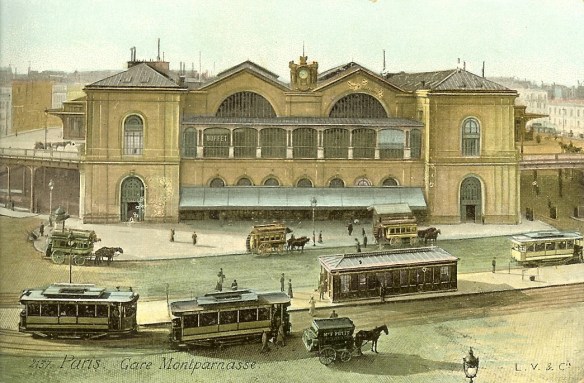
October 22, 1895: At 4:00 PM local time -- 10:00 AM on the American East Coast -- the Granville-to-Paris Express train overruns the buffer stop at Gare Montparnasse, a rail terminal in the 15th Arrondissement of Paris. Its driver is trying to make up for lost time, and he comes in too fast, and his air brake fails. The train crosses the station concourse, and crashes through the 2-foot-thick station wall, falling onto the Place de Rennes below.
At least 4 photographs of the Montparnasse Derailment are known to exist, and have become legendary, for the improbability of a locomotive crashing out of a building onto a street.

Incredibly, only 1 person died as a result of the accident, a woman on the street below, named Marie-Augustine Aguilard, and not from the train itself, but from masonry falling from the station's facade. The driver, whose name was not publicly revealed, did not go to prison, or even lose his job. His only punishment was a fine of 50 francs.
The old Gare Montparnasse

The station opened in 1840, was rebuilt in 1852, and relocated in 1969 to a new station just south of the original location, where subsequently the prominent Montparnasse Tower was constructed. Completed in 1973, at 689 feet it was the tallest building in France -- as opposed to the 1,063-foot Eiffel Tower, the country's tallest structure -- until 2011, when the Tour First reached 758 feet.

The new Gare Montparnasse.
If you're getting a vibe like New York's Penn Station,
from the old one to the new, I don't blame you.

The station serves intercity TGV trains to the west and southwest of France, including Tours, Bordeaux, Rennes and Nantes, and suburban and regional services on the Transilien Paris-Montparnasse routes.

*

October 22, 1895 was a Tuesday. The baseball season was over. Saturday had been standardized as the day for football. And basketball and hockey were not yet professional. So there were no scores on this historic day.

Monday, October 10, 2022

October 10, 1963: Édith Piaf Dies

October 10, 1963: Édith Piaf dies in Paris at age 47, after years of alcoholism and prescription drug abuse stemming from a car accident years earlier.

She was born as Édith Giovanna Gassion in Paris, on December 19, 1915, a week after Frank Sinatra. She began touring with her father at age 14. She had an affair, and at age 17, gave birth to a daughter, Marcelle, who died from meningitis 2 years later. Marcelle would be her only child.

In 1935, she was hired by nightclub owner Louis Leplée, who gave her her stage name, La Môme Piaf. There is a dispute as to the translation: Either "The Bonnet Kid" or "The Sparrow Kid." He also gave Édith her signature look, a black dress. He was murdered by gangsters in 1936, and since she knew them, she was questioned as an accomplice by the police, but cleared.

Her image was in tatters, but her next boyfriend, songwriter Raymond Asso, built her back up. He changed her name to Édith Piaf, kept the undesirables away, and, in addition to the songs he wrote for her, brought Marguerite Monnot in to write songs for her, many of them reflecting her life as a poor kid in Paris.

In 1940, she starred in Le Bel Indifférent, a play by Jean Cocteau, then one of France's greatest living writers, and a lifelong friend thereafter. Despite the Nazi occupation, her fame grew, and she became a symbol of French Resistance. She performed at Paris' legendary Moulin Rouge nightclub, and began an affair with actor Yves Montand.

By 1947, 2 songs that she wrote had become famous all over the world: Her own recording of "La Vie en Rose" (The Life In Pink), and "What Can I Do?" recorded by Montand, Montand became as popular as she was, and she couldn't take it, and she broke up with him. She soon began an affair with Marcel Cerdan, who had been Middleweight Champion of the World. That affair ended when Cerdan died in a plane crash in 1949.

"France's national chanteuse" became popular in America. She appeared on The Ed Sullivan Show 8 times, including live in 1950 and 1956 during her tours, the other times with clips filmed in Paris.

In 1952, Piaf married her 1st husband, singer Jacques Pills. They divorced 5 years later. In 1960, in a successful effort to save the Paris Olympia music hall from bankruptcy, she recorded Charles Dumont's song "Non, je ne regrette rien" ("No, I do not regret anything"), and performed several concerts at the Olympia. In 1962, she married Théo Sarapo, a Parisian-born singer of Greek descent who was 20 years younger. 

But she was in a bad car crash in 1951, and, on top of her alcoholism, she became addicted to the painkiller morphine. She was in 2 more car crashes, and her drug dependency deepened. Her liver was hopelessly damaged, she developed cancer in it, and died on October 10, 1963, at her country home in Plascassier. Sarapo drove her body back to Paris, so her fans would believe she died there.

Her death was announced the next day. Cocteau gave a tearful public statement about it, and died later that day. But he already, literally, had a broken heart: He had suffered a heart attack the previous April. And he was not young, 74.

Sarapo also died young, in 1970, at 34, in a car crash, in Limoges, France.

In the film Bull Durham, Annie Savoy (Susan Sarandon) played a record of her singing "Non, je ne regrette rien" as a prelude to romance.

Marion Cotillard played Piaf in the 2007 film La Vie en Rose, winning the Academy Award for Best Actress, the 1st time an Oscar had ever been given for a French-language role. Although the facial resemblance was undeniable, Piaf was 5 feet even and Cotillard is 5-foot-10, and so some special effects were necessary.

*

October 10, 1963 was a Thursday. The baseball season ended 4 days earlier, when the Los Angeles Dodgers completed a 4-game sweep of the New York Yankees. Football was in midweek. The NBA season started 6 days later.

There was 1 score on this historic day, and it was in the NHL: The Detroit Red Wings beat the Chicago Black Hawks, 5-3 at the Olympia Stadium in Detroit. Gordie Howe scored 2 goals for the Wings. The Hawks got a goal from Bobby Hull and another from Stan Mikita, but it wasn't enough.

Sunday, October 2, 2022

October 2, 1927: Josephine Baker: Siren of Paris

October 2, 1927: The silent film Siren of the Tropics premieres in Paris. It will take 2 more years for it to be released in America, despite the fact that its star is an American.

You don't need to know about the film's plot. You only need to know about its star, the 1st black woman to star in a major motion picture, anywhere in the world: Josephine Baker.

She was born as Freda Josephine McDonald on June 3, 1906 in St. Louis. She grew up in what would once have been quaintly called "a broken home," and by the age of 13, she was homeless, making money by dancing on street corners. By 15, she had been married and divorced. At 15, she married William Baker, and began using the stage name Josephine Baker. In 1925, she got a job with a New York vaudeville troupe, and divorced William.

Like a few black American entertainers before her, and many after her -- some specifically because of her example -- she went to France to take the stage in Paris. She became a feature of a famed nightclub, the Folies Bergère. Her performance in its 1927 revue Un vent de folie (A Wind of Madness) caused a sensation in the city: Her costume consisted only of a short skirt of artificial bananas and a beaded necklace. She became known as the Black Venus, the Bronze Venus, the Black Pearl and the Creole Goddess. Film of her doing the decade's defining dance, the Charleston, has made her an icon of "The Roaring Twenties."

She renounced her U.S. citizenship and became a French national after her marriage to French industrialist Jean Lion in 1937. Following the example of dancer Isadora Duncan, and presaging the later actress (of French descent) Angelina Jolie, she adopted 12 children of various nationalities, which she referred to as the Rainbow Tribe, and raised them in France.

During World War II, Baker aided the French Resistance, and worked with the U.S. Secret Service and the British Secret Intelligence Service. After the war, President Charles de Gaulle named her a Chevalier of the Legion of Honor, and the French Army awarded her its highest honor, the Croix de Guerre (Cross of War).
She did occasionally return to America, but refused to perform for segregated audiences in the United States. In 1951, Grace Kelly walked out of New York's famed Stork Club, hand-in-hand with Baker, vowing never to return, since it would let her perform there, but not dine there. (She broke the vow only once, because her eventual husband, Prince Rainier III of Monaco, wanted to visit.) In 1963, she was one of the speakers at the Lincoln Memorial during the March On Washington for Jobs and Freedom.

When, despite being an international star in the 1920s, a heroine of the French Resistance in the 1940s, and a major figure in the Civil Rights Movement in the 1960s, she lost her French castle due to unpaid debts. Rainier and Grace took her in.
On April 8, 1975, she had a triumphal concert in Monte Carlo, attended by Rainier and Grace, Jacqueline Kennedy Onassis, Sophia Loren, Mick Jagger, Shirley Bassey, Diana Ross, and Liza Minnelli. Four days later, at the age of 68, she died of a cerebral hemorrhage in Paris. She was 68. The Monaco royals paid for her funeral and burial in Monte Carlo.

Ross often emulated her onstage, and wanted to make a movie about her life, but couldn't get the funding. Eventually, in 1991, The Josephine Baker Story aired on HBO, starring Lynn Whitfield. The film closes with her finale in Monte Carlo, with Whitfield singing Bob Dylan's "The Times, They Are a-Changin'."

A country not interested in honoring her during her lifetime did so afterward. Her hometown inducted her into its St. Louis Walk of Fame, and the U.S. Postal Service issued a stamp with her image. Despite having married and divorced 4 men, and being known to have had an affair with the fame Swiss architect Le Corbusier, she has also been rumored to have had affairs with women, including French writer Colette and Mexican painter Frida Kahlo, and gay-rights displays in Chicago and San Francisco have honored her.

*

October 2, 1927 was a Sunday. Baseball was between the regular season and the World Series. The NBA hadn't been founded yet. The NHL started its season a few weeks later. But these games were played in the NFL:

* The New York Giants and the Cleveland Bulldogs played to a tie, 0-0 at Luna Park in Cleveland.

* There was a team named the New York Yankees playing in the NFL, and, on this day, 2 days after the baseball Yankees' Babe Ruth hit his 60th home run of the season, the football Yankees beat the Dayton Triangles, 6-3 at Triangle Park in Dayton, Ohio.

* The Chicago Cardinals beat the Pottsville Maroons, 19-7 at Normal Park on the South Side of Chicago. The "Roaring Twenties" were the football version of baseball's "Dead Ball Era," and the Cards scored 36 percent of the points in the League that day, all by themselves.

* The Providence Steam Roller (no S on the end) beat the Buffalo Bisons, 5-0 at the Cycledrome in Providence, Rhode Island.

* And the Chicago Bears beat the Green Bay Packers, 7-6 at City Stadium in Green Bay, Wisconsin. With the Cardinals still being in Chicago, it would take many years before the Bears and their fans began to consider the Packers their arch-rivals.

Wednesday, September 28, 2022

September 29, 1902: The Death of Émile Zola

September 29, 1902: Émile Zola dies in Paris. He was 62 years old.

He may have been murdered. Given the political role he'd taken over the preceding 5 years, the correct term may be "assassinated."

Émile Édouard Charles Antoine Zola was born on April 2, 1840, also in Paris. From childhood, he was a friend of the painter Paul Cézanne. Zola's mother wanted him to be a lawyer, but he failed the law school entrance exam. He went into journalism, opposing the dictatorial regime of Emperor Napoleon III.

And he became a novelist. More than half of Zola's novels were part of the 20-volume Les Rougon-Macquart cycle, which details the history of a single family under the reign of Napoléon III. Set in the context of Baron Georges-Eugène Haussmann's reconstruction of Paris, which gave rise to the term "Second Empire Architecture," the series traces the environmental and hereditary influences of violence, alcohol, and prostitution which became more prevalent during the second wave of the Industrial Revolution. The series examines two branches of the family: The respectable (that is, legitimate) Rougons and the disreputable (illegitimate) Macquarts, over 5 generations.

By 1877, at age 37, 7 years after the fall of Napoleon III following defeat in the Franco-Prussian War, Zola was paid more as a writer than was Victor Hugo, author of Les Misérables.

In 1894, Captain Alfred Dreyfus, an artillery officer, both Jewish and Alsatian, was accused of having recently communicated French military secrets to the German Embassy in Paris. He was convicted, and sentenced to the notorious prison on Devil's Island, in the South African colony of French Guiana.

In 1896, new evidence came to light, showing that the guilty party was, instead, Major Ferdinand Esterhazy. Not wanting to look foolish after having already "gotten their man," a military court acquitted Esterhazy in a trial that lasted only 2 days.

The Dreyfus Affair had polarized France, its alleged ideals of "Liberté, égalité, fraternité  (liberty, equality, brotherhood) dragged through the mud of elitism (many of the officers involved in framing Dreyfus were monarchists, still loyal to the idea of the fallen Napoleon III and other royal pretenders) and bigotry (France, by this point, had no official religion, but was still largely Catholic).

On January 13, 1898, L'Aurore (The Dawn), a national newspaper with a liberal stance, published an open letter from Émile Zola to the President of France, Félix Faure. Having already written extensively about how French society fell apart due to the Franco-Prussian War, Zola seemed to have credibility with both sides. He had already received France's highest civilian honor, "Officer of the Legion of Honor."

So his letter in L'Aurore caught everyone's attention. How could it not? In a big, bold headline, the paper blasted: "J'Accuse! Lettre au Président de La République par Émile Zola." (I accuse! Letter to the President of the Republic from Émile Zola.)

Zola wrote, "The conviction of Alfred Dreyfus was based on false accusations of espionage and was a misrepresentation of justice." He accused Major Armand du Paty de Clam of framing Dreyfus. He pointed out that the evidence clearly showed that the incriminating document came from an infantry officer, not an artillery officer. 

Zola accused many influential men in his letter, including Major Esterhazy. And he wrote, "The evidence of Drefyus's character, his affluence, the lack of motive and his continued affirmation of innocence combine to show that he is the victim of the lurid imagination of Major du Paty de Clam, the religious circles surrounding him, and the 'dirty Jew' obsession that is the scourge of our time."

As with the Marquess of Queensberry's accusation 3 years earlier, that Oscar Wilde was having a (then-illegal) gay affair with the Marquess' son, Zola's purpose was to get sued for libel, so that the truth would come out, and those he accused would be exposed and ruined. Unlike the Marquess, however, Zola's move didn't work. He was brought to trial for libel, and was convicted, sentenced to jail, and removed from the Legion of Honor.

When the Marquess first accused Wilde, and again after Wilde was convicted, Wilde's friends told him to flee to France. He refused. To avoid jail time, Zola fled to England.

In 1899, the pressure on the French government could no longer be ignored. Faure died in office that year -- from a stroke while receiving, ahem, assistance from his mistress -- and Émile Loubet became President. He ordered Dreyfus returned to France for another trial. But he was convicted again, and sentenced to 10 years in prison. Loubet pardoned him, and he was released. That freed him, but it did not restore his honor.

Zola returned to France. On September 29, 1902, he died in his house in Paris, from carbon monoxide poisoning, caused by an improperly ventilated chimney. Accusations of murder were launched, but no suspect was arrested. His funeral was attended by thousands, including, having gotten permission from Zola's widow, Alexandrine.

In 1906, Dreyfus was officially exonerated, and his rank of Major and his previous decorations were restored. He served through the entirety of World War I, and retired with the rank of Lieutenant Colonel. He died in 1935. Ferdinand Esterhazy, who committed the crime of which Dreyfus was accused, fled to England in 1899, and died there in 1923.

In 1937, the film The Life of Emile Zola was released. It won the Academy Award for Best Picture. Paul Muni played Zola, and was nominated for Best Actor. He didn't win, but Joseph Schildkraut won Best Supporting Actor for playing Dreyfus.

In 1953, the newspaper Libération published the deathbed confession of Henri Buronfosse, a chimney-sweep: "Zola was asphyxiated voluntarily. I'm the one who blocked the chimney in his apartment."

*

September 29, 1902 was a Monday. There were 3 baseball games played that day:

* The Brooklyn Superbas beat their arch-rivals, the New York Giants, 5-2 at the 1891 version of the Polo Grounds. Frank Kitson outpitched Christy Mathewson. The Superbas became the Dodgers in 1911.

* The Philadelphia Phillies beat the Boston Beaneaters, 5-4 at National League Park (later Baker Bowl) in Philadelphia. The Beaneaters went through some name changes, and finally became the Boston Braves in 1912.

* And the Boston Americans beat the Baltimore Orioles, 9-5 at Oriole Park in Baltimore. After the season, the Orioles were folded by the American League, and a new franchise was established for 1903, the New York Highlanders. In 1908, the Americans became the Boston Red Sox. In 1913, the Highlanders became the New York Yankees.

December 31, 1999 & January 1, 2000: The Millennium

December 31, 1999:  The Millennium arrives. The people of planet Earth survived. At a terrible cost. But we hadn't destroyed ourselves. ...