
October 17, 1911: John Franklin Baker of the Philadelphia Athletics becomes the only man in baseball history to receive "Home Run" as a nickname.
The A's had played the New York Giants in the 1905 World Series, and lost. Now, they were playing each other again, alternating home field: The Polo Grounds in New York, rebuilt in the Spring after a fire, for the odd-numbered games; and Shibe Park in Philadelphia, later to be renamed Connie Mack Stadium for the A's manager, for the even-numbered games.
Remembering that the Giants had beaten the A's in 5 games in 1905 while wearing all-black uniforms, Giant manager John McGraw chose to wear them again, hoping it would be good luck. The smartest, most scientific manager of the era -- mainly because he was one of the few scientific managers the game had yet seen -- was not generally superstitious, but he was also not one to take any chances.
The Giants won Game 1 at home, 2-1, with the Giants' ace, Christy Mathewson, who went 26-13 that season, outpitching the A's Albert "Chief" Bender, 17-5. This was the height of immigration to America, and when opposing fans would make "Indian war whoops" at Bender, he, a Native American from the Chippewa tribe, would yell, "You lousy foreigners! Go back where you came from!"

The Polo Grounds, in its 1911-22 configuration
The A's won Game 2, 3-1. It was another battle of future Hall-of-Famers, as Eddie Plank, who went 23-8 that season, beat Richard "Rube" Marquard, who went 24-7. In the next day's paper, in a nationally-syndicated column "ghost-written" for him by an unknown sportswriter, Mathewson criticized Marquard's pitching, especially to Frank Baker, the A's 3rd baseman, who hit a home run in the game.
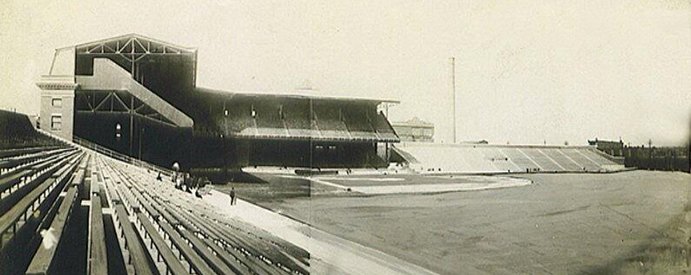
Shibe Park, in its 1909-24 configuration
Was such criticism really Mathewson's intention? He probably shouldn't have arranged for the column in the first place, but it's understandable that he did it, given how much baseball team owners paid their players before free agency. Even Mathewson, the most popular player in the game and the best pitcher the sport had yet seen, was underpaid.
Mathewson took the mound for Game 3, against Jack Coombs, who went 28-12 that season. Matty took a 1-0 lead into the top of the 9th. With 1 out‚ he faced Baker. One of the earliest pitchers to throw the screwball, or the "fadeaway" as he called it, he threw it to Baker. Baker lined it over the right field fence to tie the game. This was the Dead Ball Era, so hitting home runs in back-to-back World Series games -- especially against a pair of pitchers like Marquard, then Mathewson, was a very big deal.
The game goes to extra innings. Errors by Giant 3rd baseman Buck Herzog and shortstop Art Fletcher give the A's 2 unearned runs in the top of the 11th. New York scores once‚ but the A's win 3-2.
And in the next day's paper, in "his own" column, Marquard chided Mathewson for the way he pitched to Baker. Quickly, Frank receives the nickname "Home Run" Baker.
Like I said, it was the Dead Ball Era. He only hit 96 home runs in his entire 13-season career, although he did have a .307 lifetime batting average and a very strong 135 OPS+, is regarded as one of the best 3rd basemen of the 1st half of the 20th Century, and is in the Hall of Fame. He, shortstop Jack Barry, 2nd baseman Eddie Collins (who would also make the Hall of Fame) and 1st baseman John "Stuffy" McInnis became known as the $100,000 Infield.
But the World Series, already later in the calendar year than any had yet been played (at least, in the current version that began in 1903), was not over -- and wouldn't be for a while. The Northeast got drenched by day after day of rain. It would not resume until October 24, in Philly. The A's won, 4-2, with Bender beating Mathewson.
Game 5 in New York had a controversial ending. It was 3-3 in the bottom of the 10th when Larry Doyle scored on a sacrifice fly. Or did he? Home plate umpire Bill Klem later said that Doyle didn't touch home plate when he slid in. But the A's did not appeal the play, and so Klem had to let the run, and the Giants' 4-3 win, stand.
The A's won Game 6, 13-2, to take the Series. They got 4 runs in the 4th inning, and 7 in the 7th, more than enough support for Bender. It was the 2nd straight World Championship for the A's. It turned out to be the 1st of 3 straight World Series losses for the Giants.
Baker would help the A's win the Series again in 1913, but they would lose it in 1914. Mack and team owners Tom and Jack Shibe began to break the team up, due to the salary war with the Federal League. Refusing to take a pay cut, Baker sat out the entire 1915 season, and the A's crashed to last place. (So an A's fire sale was not an Oakland invention of Billy Beane -- or Charlie Finley.)
Mack sold him to the New York Yankees, as Jacob Ruppert began to build a dynasty. He sat out the entire 1920 season, as his wife and his twin daughters died from scarlet fever. Grief and mental health were an issue back then as well. He returned, helped the Yankees win their 1st 2 Pennants in 1921 and 1922, and retired to the farm on which he was born in Trappe, on Maryland's Eastern Shore.
He remarried, but had no other children. In 1924, in nearby Easton, he intervened to save a black man from being lynched. He later ran Trappe's bank and served on its town council, was elected to the Hall of Fame in 1955, and appeared at Old-Timers' Day at Yankee Stadium that year, as part of a celebration of Hall-of-Famers. He died in 1963, at the age of 77.
In 1978, the Philadelphia Phillies founded the Philadelphia Baseball Wall of Fame. Each year until 2003, they elected one Athletics figure, starting with Connie Mack. Also elected from their 1910-14 dynasty were Baker, 2nd baseman Eddie Collins, outfielder Rube Oldring; and pitchers Eddie Plank, Chief Bender and Jack Coombs. Mack, Baker, Plank, Bender, Eddie Collins and Herb Pennock have also been elected to the Philadelphia Sports Hall of Fame.
*
October 17, 1911 was a Tuesday. Football was in midweek, and basketball and hockey barely existed at the professional level. So there were no other scores on this historic day.


