Showing posts with label norman mailer. Show all posts

Monday, November 28, 2022

November 28, 1966: Truman Capote's Black and White Ball

November 28, 1966: Author Truman Capote hosts "The Black and White Ball" at the Plaza Hotel, off Grand Army Plaza, at the southeastern corner of Central Park, at 59th Street and 5th Avenue in Manhattan, New York City.

Supposedly, it was meant to honor Katharine Graham, publisher of The Washington Post. Historian Deborah Davis, who wrote a biography of Graham, also wrote a book about the ball, titling it Party of the Century.

Truman Streckfus Persons was born on September 30, 1924 in New Orleans. After his parents divorced, his mother took him to her hometown of Monroeville, Alabama, where one of his childhood friends was another author-to-be, Harper Lee. In To Kill a Mockingbird, Lee named the character based on herself Jean Louise Finch, nicknamed Scout; and the one based on Capote "Dill."

When he was 8, his mother remarried, to a Cuban-born bookkeeper living in New York, named José García Capote (pronounced "Kah-POH-tay"), who adopted him as his son, and renamed him Truman García Capote. They lived on Park Avenue, so his stepfather was doing well. Too well, as it turned out: He was convicted of embezzlement.

By 11, the boy was writing. At 15, the family moved to nearby Greenwich, Connecticut. At 18, he got a job as a copyboy at The New Yorker magazine. Two years later, he was fired for having angered Robert Frost, America's greatest living poet. That was the 1st time he willingly annoyed a better writer than himself. It would not be the last: Speaking of Jack Kerouac in 1959, he said, "That's not writing, that's typing."

He published Other Voices, Other Rooms in 1948, The Grass Harp in 1951, and Breakfast at Tiffany's in 1958. In 1959, he went to Kansas to write about the murder of the Clutter family. In 1965, he published his "nonfiction novel" about the case, In Cold Blood. It gained him the greatest acclaim of his career.

And that's what he was after: Like many people who make it big, he was less interested in being good at what he did than he was in being a star. He was a relentless self-promoter. Had he been buried rather than cremated, his epitaph could well have been his self-description: "I'm an alcoholic. I'm a drug addict. I'm a homosexual. I'm a genius."

Yes, Truman Capote was openly gay -- not just in the 1960s, but in the hyper-repressive 1950s. He may have been the reason why "flamboyant" became a stereotype of gay men. His clothes, his mannerisms, his lisping voice... Even if he hadn't come out of the closet, people would have guessed.

According to a friend, writer Leo Lerman, as far back as 1942, he said that when (not if) he became rich and famous, he would throw a party for his rich and famous friends. In June 1966, he felt secure enough to start setting it up. He was inspired by another author, Dominick Dunne, who had given a black and white ball in 1964, for his 10th wedding anniversary. Capote was a guest. Another inspiration was that year's film version of the musical My Fair Lady: In the scene at Ascot Racecourse, the women all wore black and white dresses.

There had to be a guest of honor. And even Capote didn't have the chutzpah to make himself that. He decided that "Kay" Graham needed cheering up. She disagreed, but knew she couldn't stop him from giving the party: "I was sort of baffled... I felt a little bit like Truman was going to give the ball anyway, and that I was part of the props."
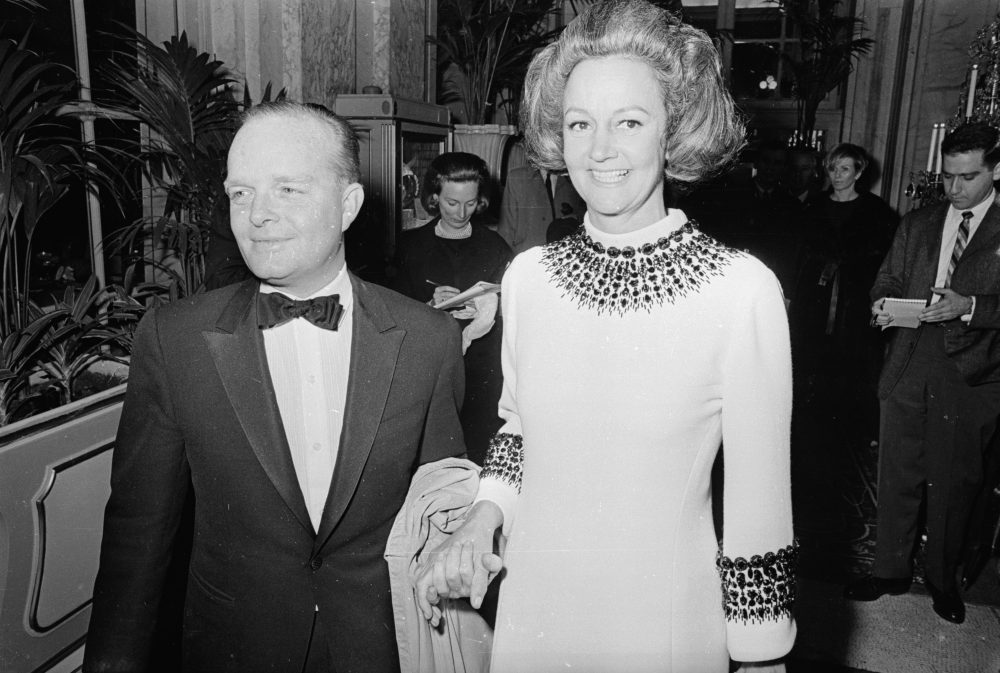
"Tru" and "Kay" at the Ball

While Other Voices, Other Rooms was his 1st published novel, the 1st he'd written was titled Summer Crossing, and its 1st scene was in a dining room at the Plaza Hotel. So he hired the Grand Ballroom of the Plaza. Red tablecloths, with gold candelabra as centerpieces. The menu, served at midnight: Scrambled eggs, sausages, biscuits (Breakfast at midnight?), pastries, spaghetti and meatballs, and, a specialty of the Plaza and one of Capote's favorite dishes, chicken hash. And 450 bottles of Taittinger champagne. How much did Capote spend on this thing? $16,000 -- about $147,000 in 2022 money.

Capote's 540 guests, asked to wear black and white, and masks, included luminaries from New York, Washington, Hollywood and New Orleans. They included the aforementioned Graham and Lerman; CBS chairman William S. Paley and his wife, the former Barbara Cushing, now known as Babe Paley; Scottish businessman Kenneth Keith, Baron Keith of Castleacre, and his wife, the former Mary Gross, now known as Slim Keith; polo champion Winston Guest and his wife, the former Lucy Cochrane, now known as C.Z. Guest; and Prince Stanisław "StashRadziwiłł, and his wife, the former Caroline Bouvier, now known as Lee Radzill, sister of former First Lady Jacqueline Kennedy -- but the invited guests did not include Jackie herself.

Babe, Slim, C.Z. and Lee were the leading members of a group of fabulously wealthy and stylish women who glommed onto Capote as a "safe" gay man that they could talk to while their husbands were off making deals and having affairs. He glommed onto them, too, calling them "my swans." He turned out not to be trustworthy, and exposed them in a very nasty article for Esquire magazine in 1975.

Also among the guests: First Lady Claudia "Lady Bird" Johnson (but not President Lyndon Johnson), the Duke and Duchess of Windsor (formerly King Edward VIII of Britain and Wallis Simpson); Ford Motor Company chairman Henry Ford II, journalist Walter Lippmann, economist John Kenneth Galbraith, National Security Adviser McGeorge Bundy, writers Lillian Hellman, Norman Mailer, John Knowles and George Plimpton; Random House publisher and What's My Line? panelist Bennett Cerf, his wife, and his children; San Francisco Chronicle columnist Herb Caen, historian Arthur Schlesinger Jr., editor Norman Podhoretz, Frank Sinatra and his then-wife Mia Farrow, fashion designer Oscar de la Renta and his wife, Vogue magazine editor Françoise de Langlade; heiress and fashion designer Gloria Vanderbilt, philanthropist Brooke Astor, Harper's Bazaar editor Gloria Guinness, poet Marianne Moore, painter Andy Warhol, Broadway producer Hal Prince, Broadway choreographer Jerome Robbins, photographer Gordon Parks, singer Harry Belafonte, actors Douglas Fairbanks Jr. and Henry Fonda, then-married actors Lauren Bacall and Jason Robards, actress Tallulah Bankhead, and actress Candice Bergen.
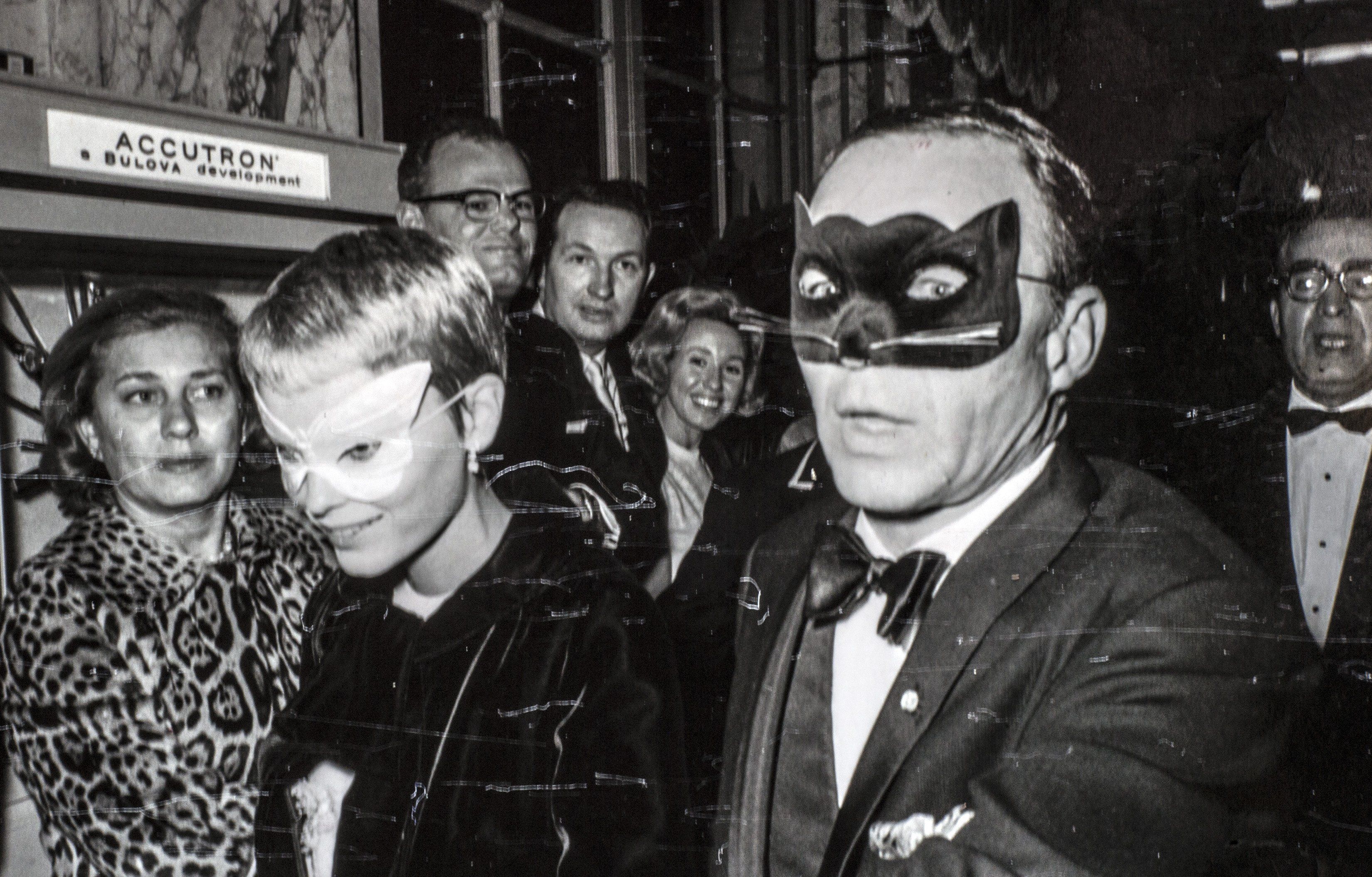
Mia looks comfortable attending. Frank does not.

Oddly, he didn't invite Dunne. Carson McCullers, a woman who, like Capote, was a novelist, a Southerner, and gay, and was allegedly a friend of his, was snubbed as well. Gore Vidal, also an openly gay writer, was not invited, but that wasn't a surprise: They were in a feud that lasted for the rest of Capote's life. Writer William Styron and his wife Rose were invited; he didn't want to go, and didn't, while she did want to go, and did.

Mailer and Bundy nearly got into a fight over the way the Administration was conducting the Vietnam War. Bergen -- only 20 years old at the time -- had misgivings involving the war as well:

I remember the guilt I felt, or actually the guilt that other people thought I should feel. I was 19, I think. Reporters accosted me. "Wasn't it inappropriate to have a ball for five hundred people, when a war was going on?"

Someone said -- could it have been Douglas Fairbanks, in his executioner's hood? -- "The question's inappropriate." Somebody else, who was wearing a mouse mask with little ears, said, "The war's inappropriate."

Nowadays, I don't see how anyone can rationalize a gesture like a ball.
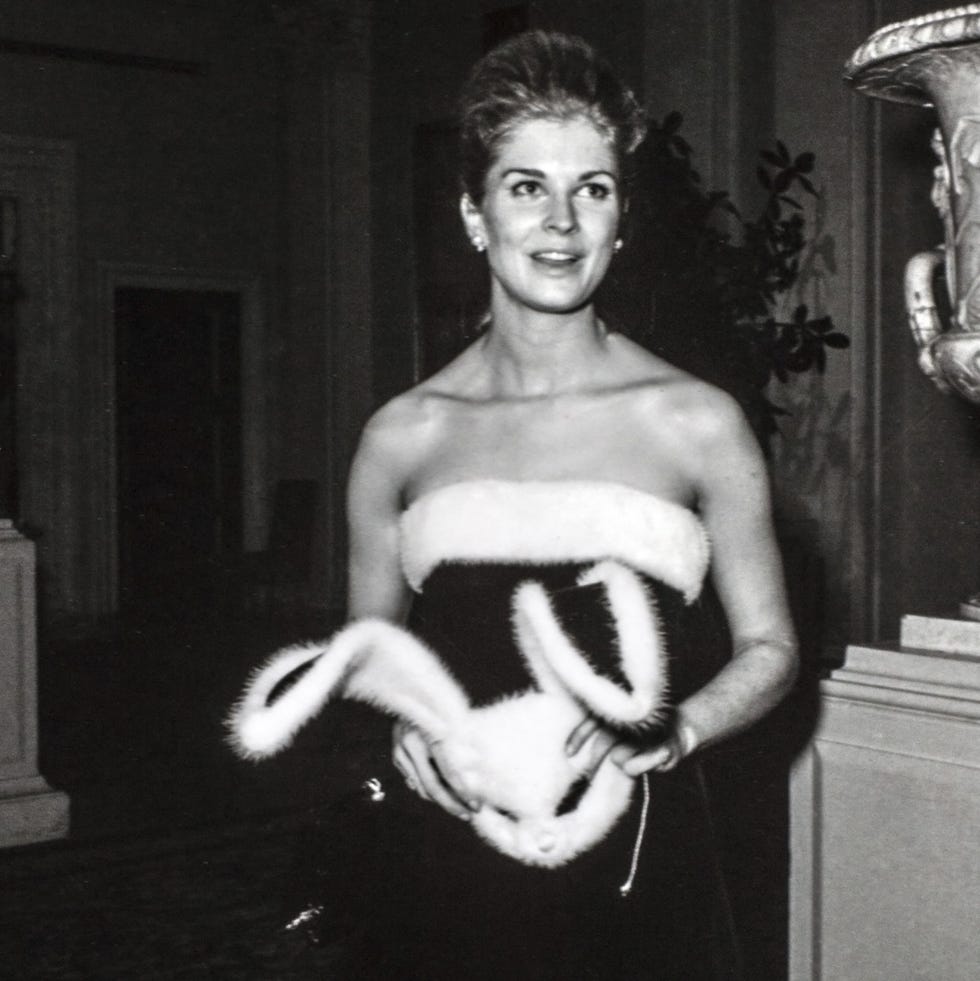
Candice Bergen, 22 years before becoming Murphy Brown

Sinatra did not have a good time. Just before midnight, when the food would be served, he turned to Caen, and said, "Hey, let's get out of here." They and their wives tried to sneak out. Capote tried in vain to stop them. Caen later said of Capote, "I think he was hurt. It was one of those great parties that never got off the ground."

R. Couri Hay, eventually a gossip columnist for Warhol's magazine Interview, but then only 17 years old, once wrote, "Truman always claimed that he invited five hundred of his friends, and made fifteen thousand enemies."

But Mailer, who infamously stabbed his wife at a party he'd hosted at his New York apartment 6 years earlier, said, "It was one of the best parties I ever went to. There was so much action… so many people whom you'd never met before... Everybody there felt anointed that night. I think that's Truman's greatest coup. To me, that party's greater than any of his books."

As Deborah Davis wrote in her book about the Ball:

There was no question that the party triggered an insatiable thirst in readers for the very, "who-wore-it-better" coverage that is so popular today. But the distinction is that, at that moment in time, you had to earn your place on the red carpet. And celebrity had a different definition, it wasn't the "15 minutes of fame."

The thing about the black and white ball was that it was a private party that we were given an insider peek at, and it did create a monster, and it also marked Capote's demise in a sense, because, before the ball, he had always said that gregariousness is the enemy of art. When he was writing a book, he would go off into seclusion and he would never be interrupted by any element of social life. After the ball, he became the world's best guest. And he just went from one event to another, and he lost his hold on his art. And that was very sad. The culture changed, and Capote changed as well.

Capote did a little acting, including in the 1976 murder-mystery comedy Murder By Death, where he played a party host who ended up killed; and became a regular on the talk-show circuit, including making several appearances on The Tonight Show Starring Johnny Carson. He hadn't invited Carson to the Ball, but he did become close friends with Carson and his 2nd wife Joanne.

But he never wrote another novel after the Ball. In fact, if you don't count In Cold Blood -- which could count as a novel, since he was accused of making a lot of things up in it -- he published Breakfast at Tiffany's at the age of 34, and then didn't write another novel for the rest of his life. He died on August 25, 1984, from the effects of drinking, drugs and phlebitis, at Joanne Carson's Los Angeles home, where he'd been staying. He was a few weeks short of turning 60. Vidal got the last word in their feud, calling his death "a good career move."

In 1990, Robert Morse won a Tony Award for playing Capote in the play Tru, and an Emmy Award for reprising the role on PBS 2 years later. Philip Seymour Hoffman -- who, sadly, died from drugs even younger, at age 46 -- won an Oscar for starring in the 2005 film Capote, which was about the making of In Cold Blood.

Capote has also been played by Paul Williams in Oliver Stone's 1991 film The Doors, Louis Negin in 54 (about the discotheque Studio 54) in 1998, Sam Street in the Jacqueline Susann biopic Isn't She Great in 2000, and Toby Jones in Infamous in 2006. Michael J. Burg has played him 3 times: In The Audrey Hepburn Story in 2000, in The Hoax in 2006, and in the 1973-set 2009 TV series Life on Mars. (UPDATE: He was played by Tom Hollander in the 2024 FX miniseries Feud: Capote vs. The Swans.)

*

November 28, 1966 was a Monday. Baseball was out of season. Football was in midweek: There would be no Monday Night Football for another 4 years. And no games were scheduled in the NBA or the NHL. So there were no scores on this historic day. Unless you want to count: "Guests 500, Capote 0."

Sunday, November 20, 2022

November 20, 1960: Norman Mailer Stabs His Wife

November 20, 1960: Novelist Norman Mailer stabs his wife at a party they were hosting -- and, for all intents and purposes, he gets away with it.

Born in 1923 in Long Branch, Monmouth County, New Jersey, he was, for want of a better choice of words, raised in Crown Heights, Brooklyn, and graduated from Harvard University. He served in the Pacific Theater of World War II, as a typist at a regimental headquarters, then a wire lineman, then volunteered for a reconnaissance platoon, seeing combat, and finally as a cook. He was discharged with the rank of Sergeant, and said that being in the U.S. Army was "the worst experience of my life, and also the most important."

It led to the publication of his 1st novel in 1948, The Naked and the Dead. It sold over 1 million copies in its 1st year, and has been called the 1st great novel about World War II. (Not the greatest, but, chronologically, the first one that could be called "great.") He was 25 years old, and already a literary superstar.

His subsequent novels did not sell as well, nor were received as well. While still writing fiction, he turned to journalism, becoming one of the co-founders of The Village Voice, New York City's "alternative weekly" newspaper, in 1955.

In 1957, the magazine Dissent published his essay The White Negro: Superficial Reflections on the Hipster, connecting what Mailer called the "psychic havoc" wrought by the Holocaust and the Cold War to the aftermath of slavery in America, in the figuration of the Hipster. The essay was a call to abandon the numbing culture of conformity during the Administration of President Dwight D. Eisenhower.

It wasn't Mailer (I've been unable to find out who it was) who labeled it "the Ike Age," as a "cold" period like an "ice age," but that is the kind of thing Mailer would have thought of. Instead, much like the "Beat Generation" writers like Jack Kerouac (whose novel On the Road came out that year) and Allen Ginsberg (whose poem Howl, published the year before, was even more in-your-face about it), Mailer wanted Americans to rebel, to seek out new forms of entertainment, and to be more sexually liberated, things he associated with black American culture.

The essay's reviews were mixed: While black activist Eldridge Cleaver liked it, it was ripped by black authors James Baldwin and Ralph Ellison, and even the white and Jewish Ginsberg himself, whom, due to his open defiance of just about every Judeo-Christian ethic there was, Mailer had previously called "the most courageous man in America."

In 1960, Mailer covered the Democratic National Convention for Esquire magazine, writing a very complimentary story about John F. Kennedy, titled Superman Goes to the Supermarket. Along with the works of Tom Wolfe, it is considered one of the foundations of what became known as the New Journalism.

Mailer married 6 times, having 8 children. His 1st marriage, to Beatrice Silverman, ended in 1952 because he was having an affair with painter and actress Adele Morales, a New York native with a Spanish mother and a Peruvian father. Norman and Adele married in 1954, and had 2 daughters, Danielle and Elizabeth.

Inspired by Kennedy's recent election as President, Mailer decided to run for Mayor of New York in the next year's election. On November 19, 1960, he hosted a party at the Upper West Side apartment he shared with Adele and their daughters. Mailer had enlisted his well-connected friend, journalist George Plimpton, to attract figures from the city's "power structure." The idea was to use this party to unite these people with what he saw as his base, the "disenfranchised" people of the City -- most of whom couldn't have given a damn about who the Mayor was.

David Rockefeller, America's leading banker, and the brother of Governor Nelson Rockefeller of New York, declined his invitation. But Ginsberg showed up. So did several people described by an account years later as "derelicts, cut-throats and bohemians." A friend of Mailer's who was there, publisher Barney Rosset, called it "the most dangerous evening I've ever spent in my life."

Fights broke out. This pleased the increasingly drunk Mailer, who fancied himself both a "man's man" and a "ladies' man," enjoyed drinking copiously, and also enjoyed challenging people to get into a boxing ring and fight him. These were all traits he shared with his literary (including journalistic) idol, Ernest Hemingway, still alive at that point. Adele later said that he left the apartment, "almost incoherent." She said, "He was down in the street, punching people," and, "He didn't know what his name was. He was so out of it."

At 4:30 AM, November 20, he came back into the apartment. Only 6 guests remained, and Adele was getting ready for bed. Adele mocked his, as we would say today, "toxic masculinity." She also made a reference to his mistress, who may or may not have actually existed. His rage peaking, he took out a rusty 2 1/2-inch penknife, and stabbed Adele through the breast, narrowly missing her heart; then stabbed her in the back. He walked out of the room, and told the remaining guests, "Don't touch her. Let the bitch die."

She was taken to University Hospital, underwent emergency surgery, and made a quick recovery. The next day, with the story not yet having hit the newspapers, Mailer appeared, as previously scheduled, for an interview on The Mike Wallace Show. He advertised his mayoral bid, and spoke of a knife as "a symbol of manhood." Wallace, one of the finest journalists in CBS history, did not yet know what Mailer had done.

At first, Adele said that she was wounded by falling on some broken glass. Two days after the stabbing, she admitted that Mailer had done it. Mailer was at the hospital, and the police arrested him. Based on her account of his state of mind at the time of the stabbing, he was involuntarily committed to Bellevue Hospital, home of the most famous (or infamous, if you prefer) psychiatric ward in America. He was released after 17 days.

Mailer cut a deal, pleading guilty to a reduced charge of assault, saying, "I feel I did a lousy, dirty, cowardly thing." He was sentenced to 3 years' probation, but no prison time, unless you count the 17 days at Bellevue. He had tried to kill his wife, and, essentially, he got away with it.

Mailer did not officially run for Mayor of New York in 1961. That year, his hero, Hemingway, committed suicide. Mailer was never going to do that -- at least, not intentionally. His ego prevented that. Adele divorced him in 1962. In 1967, he covered the antiwar demonstration at the Pentagon, publishing The Armies of the Night, one of his most-lauded works. His stabbing of his then-wife seemed to have been forgotten.

In 1969, he finally ran for Mayor, with a platform of making New York City the 51st State -- which would have cut Long Island off from the rest of the State of New York, and would have forced either the old State or the new one to change its name -- and banning private cars from Manhattan Island. He came up with bold campaign slogans: "No more bullshit!" and "The other guys are the joke." As his running mate, for the office of President of the City Council, he enlisted a real journalist, New York Daily News columnist Jimmy Breslin.

In the Democratic Primary on June 17, the Mailer-Breslin ticket got 41,288 votes, good for 5 percent of the popular vote, finishing 4th out of 5 tickets. It actually got 10 percent of the vote in Manhattan, but no more than 4 percent in any other Borough. Since Mailer's candidacy wasn't taken seriously by anybody, his stabbing of his wife never became an issue. City Comptroller Mario Procaccino won the nomination, and lost the general election to the incumbent Mayor, John Lindsay. Neither Mailer nor Breslin ever ran for office again.

Mailer continued writing controversial books, and became the target of the wrath of feminists. I wanted to say, "If a writer of similar profile today..." but realized that I couldn't finish that sentence. No writer today has a similar profile to Norman Mailer. Or the aforementioned James Baldwin and Tom Wolfe, or Truman Capote, or Gore Vidal, whom Mailer once head-butted backstage when they were both guests on The Dick Cavett Show in 1971. All of those men blurred the line between novel-writing and journalism in the 1960s. Nobody has done that in the 21st Century.

Writers simply aren't the kind of celebrities in the age of mass media, including social media, that they were in 1960, or even in 1970. Case in point: In 1980, Johnny Carson cut The Tonight Show from 90 to 60 minutes. Before, he had frequently had writers on the show. Afterward, because he couldn't do a 15-to-20-minute in-depth interview, broken up by a commercial or two, authors' appearances on his show became considerably rarer. Mailer appeared on the show in 1969, 1972 and 1974, but only once after the shift to 60 minutes, in 1985.

(Carson had Capote on 19 times, the last in 1976. Capote's substance abuse issues got worse, and he died in 1984. Vidal was luckier: Carson had him on 25 times, 7 after the shift. Wolfe appeared twice, both in 1980, right before the shift. Baldwin, Kerouac and Ginsberg never appeared on The Tonight Show.)

However, having seen what happened with football star-turned-actor O.J. Simpson in 1994, if a person, in any field, having a similar level of fame, tried to kill his wife now, he would be instantly "canceled," well before he went to trial.

In 1997, Adele Morales published The Last Party, detailing the near-fatal night in 1960. In a 2000 interview, Mailer called stabbing Adele "the one act I can look back on and regret for the rest of my life." It was his only public expression of remorse for the act. He died in 2007, at age 84. In their headline for his obituary, The New York Times called him a "Towering Writer with Ego to Match." He was actually just 5-foot-8, but his effect on writing was huge, as was his ego.
Adele died in 2015, at age 90. With considerable irony, she was, as far as I can determine, the last living person who was at that party. (Had he accepted his invitation, it could have been David Rockefeller, who lived until 2017, age 101.) Of her daughters with Norman, Danielle, a.k.a. Dandy, is a painter; and Elizabeth, a.k.a. Betsy, is a writer.
Left to right: Adele Morales, Betsy Mailer, Dandy Mailer, in 2011

Perhaps Mailer's real idol should have been King Henry VIII of England. After all, he married 6 women, and mistreated all of them. However, while Henry had 2 of his wives killed, 1 more than Norman tried, Henry never had the guts, or the insanity, to do it himself, while Norman did. But Norman was rightly committed for it, something that only happened to one King of England, and it was George III, not Henry VIII.

From his 1st marriage, Norman had a daughter, Susan, who is, perhaps with more irony, a psychoanalyst. She wrote a book about her relationship with her father. From his 3rd marriage, Norman had a daughter, Kate, an actress. From his 4th marriage, Norman had 2 sons, producer Michael and actor Stephen. From his 5th marriage, Norman had a daughter, Maggie, a painter. And from his 6th and last marriage, he had a son, John Buffalo Mailer, a writer and actor.

*

November 20, 1960 was a Sunday. Baseball season was over. These games were played in the NFL:

* The New York Giants lost to the Philadelphia Eagles, 17-10 at Yankee Stadium. This was the game where the Eagles' Chuck Bednarik knocked the Giants' Frank Gifford out of the game with perhaps the most famous hit in football history, a key event in the Eagles' run to the NFL Championship that year. I have a separate entry for that event.

* The football version of the St. Louis Cardinals, who had been in Chicago until this season, beat the Washington Redskins, 26-14 at Griffith Stadium in Washington.

* The Pittsburgh Steelers beat their arch-rivals, the Cleveland Browns, 14-10 at Forbes Field in Pittsburgh.

* The Chicago Bears beat the Detroit Lions, 28-7 at Wrigley Field in Chicago.

* The Los Angeles Rams beat the Green Bay Packers, 33-31 at Milwaukee County Stadium.

* The San Francisco 49ers beat the Dallas Cowboys, 26-14 at the Cotton Bowl in Dallas. The Cowboys, a 1st-year expansion team, went 0-11-1 that 1st season. Their only non-loss was a tie against the Giants at Yankee Stadium.

* Since there were now 13 teams in the NFL, one team had to have a bye week every week. This week, it was the Baltimore Colts.

This was the 1st season of the American Football League. These were their games on the day:

* The Houston Oilers beat the Denver Broncos, 20-10 at Jeppesen Stadium in Houston.

* The Buffalo Bills beat the Los Angeles Chargers, 32-3 at the Los Angeles Memorial Coliseum.

* The Boston Patriots, the Dallas Texans, the New York Titans and the Oakland Raiders -- the teams now known as the New England Patriots, the Kansas City Chiefs, the New York Jets and the Las Vegas Raiders -- had irregular schedules, and did not play on November 20.

There were 2 games in the NBA. The Boston Celtics beat the Cincinnati Royals, 120-103 at the Cincinnati Gardens. And the Los Angeles Lakers beat the Detroit Pistons, 135-131 at the Olympia Stadium in Detroit. Elgin Baylor scored 52 points for the Lakers.

And the entire NHL, the "Original Six," was in action. The New York Rangers lost to the Detroit Red Wings, 4-3 at the old Madison Square Garden. The Toronto Maple Leafs beat the Boston Bruins, 3-2 at the Boston Garden. And the Montreal Canadiens and the Chicago Black Hawks played to a tie, 1-1 at the Chicago Stadium.

Friday, October 21, 2022

October 21, 1967: Flower Power at the Pentagon

October 21, 1967: An antiwar protest hits Washington, D.C. The marchers head across the Potomac River to the Pentagon, and, to this day, some marchers claim they actually "levitated" the building. Uh-huh.

This was the day of the famous Pulitzer Prize-winning "Flower Power" photograph, taken by Bernie Boston of The Washington Star, of the long-haired (but not Hippie-length-haired) kid in the turtleneck sweater sticking a carnation in the barrel of a rifle held by a soldier "protecting" the Pentagon from the demonstrators.

The kid is usually identified as George Harris, then an 18-year-old actor from New York. He later took the stage name Hibiscus, and formed a drag troupe in San Francisco, and died in the 1st wave of the AIDS epidemic in 1982. Bernie Boston lived until 2008.

Novelist Norman Mailer, though already 44 years old and thus old enough to be the father of many of the demonstrators, covered the demonstration for Harper's Magazine, titling his article The Armies of the Night. Perhaps inspired by the publication the previous year of Truman Capote's In Cold Blood, he took the idea of "Journalism is the first draft of history" seriously. It was published in book form the next year, and won Mailer the Pulitzer Prize for Nonfiction and the National Book Award for Arts and Letters.

Although there was not a demonstration at the Lincoln Memorial that day, it's been suggested that this was the day of the demonstration shown in the film Forrest Gump, which Forrest (Tom Hanks) wanders into after leaving the White House, where he'd just been awarded the Congressional Medal of Honor by President Lyndon B. Johnson. A cop pulled the microphone cable out to prevent people far away from hearing Forrest as he spoke. So filmgoers never heard it.

The script has Forrest saying, "Sometimes, when people go to Vietnam, they go home to their mamas without any legs. Sometimes, they don't go home at all. That's a bad thing." That's when the cable gets plugged back in, and Forrest concludes, "That's all I have to say about that." And an activist, obviously meant to make the viewer think he's Abbie Hoffman (Richard D'Alessandro, making Abbie the only historical figure in the film portrayed by an actor rather than being digitally inserted in), says, "That's okay, man: You said it all."

At the start of the scene, a woman can be heard yelling the name, "Hillary!" Obviously, this is meant to suggest that Hillary Clinton, the First Lady at the time the film was released, was at the demonstration. However, while Hoffman was definitely at the Pentagon that day, and has been suggested as the source of the "levitate the Pentagon" idea, there is no indication that Hillary Rodham, then a 20-year-old junior at Wellesley College in the Boston suburb of Wellesley, Massachusetts, was there.

*

October 21, 1967 was a Saturday. There were college football games played on this day:

* Number 1-ranked USC beat the University of Washington, 23-6 at Husky Stadium in Seattle. Their Los Angeles arch-rivals, Number 3 UCLA, beat Stanford, 21-16 at the old Stanford Stadium in the San Francisco suburb of Palo Alto. They were on a collision course, and would play one of those periodic "Games of the Century."

It was the 3rd Saturday in October, and by this point, Alabama was used to beating Tennessee on the day. This time, though, Number 7 Tennessee beat Number 6 'Bama, 24-13 at Legion Field in Birmingham.

Notre Dame beat Illinois, 47-7 at Memorial Stadium in Champaign, Illinois. Ohio State beat Northwestern, 6-2 at Dyche Stadium in the Chicago suburb of Evanston, Illinois. Indiana upset Michigan, 27-20 at Michigan Stadium in Ann Arbor.

Penn State beat West Virginia, 21-14 at Beaver Stadium in State College, Pennsylvania. Rutgers lost to Army, 14-3 at Michie Stadium in West Point, New York. And Princeton beat Colgate, 28-0 at Palmer Stadium in Princeton, New Jersey.

The baseball season had ended 9 days earlier, when the St. Louis Cardinals ended the "Impossible Dream" of the Boston Red Sox in Game 7 of the World Series. There were 6 games played in the NBA that day:

* The New York Knicks lost to the Los Angeles Lakers, 114-106 at the old Madison Square Garden. The new Garden opened 4 months later. Willis Reed scored 30 for the Knickerbockers, but Elgin Baylor and Archie Clark each scored 25 for the Lakers.

* The Philadelphia 76ers, defending NBA Champions, beat the Detroit Pistons, 116-111 at the new South Philadelphia arena, The Spectrum. Wilt Chamberlain only scored 17 points, but Hal Greer scored 41 for the Sixers.

* The Boston Celtics beat the Baltimore Bullets, 125-109 at the Baltimore Civic Center. (The building still stands, and is named the CFG Bank Arena.) Sam Jones scored 31 for the C's.

* The Cincinnati Royals beat the Chicago Bulls, 109-107 at the Cincinnati Gardens. For the Royals, Happy Hairston scored 30, and Oscar Robertson scored 28.

* The St. Louis Hawks beat the San Francisco Warriors, 115-110 at the Kiel Auditorium in St. Louis. This would be the Hawks' last season in St. Louis. For 1968-69, they moved to Atlanta.

* And in a battle between 2 expansion teams, the Seattle SuperSonics beat the San Diego Rockets, 117-110 in overtime, at the San Diego Sports Arena. The Rockets moved to Houston in 1971. Of course, the Sonics moved to become the Oklahoma City Thunder in 2008.

* And one game was played in the brand-new American Basketball Association: The Indiana Pacers beat the New Orleans Buccaneers, 114-111 at the New Orleans Municipal Auditorium. Jimmy Jones scored 35 in defeat for the Bucs.

There were 5 games played in the newly-expanded NHL:

* The New York Rangers beat the Toronto Maple Leafs, 5-3 at Maple Leaf Gardens. Vic Hadfield scored 2 goals for the Broadway Blueshirts against the Leafs, then defending Stanley Cup Champions, which they have never been since the 1967-68 season.

* The Montreal Canadiens beat the Boston Bruins, 4-2 at the Montreal Forum.

* The Pittsburgh Penguins beat the Chicago Black Hawks, 4-2 at the Civic Arena in Pittsburgh.

* The Minnesota North Stars beat the Oakland Seals, 3-1 at the Metropolitan Sports Center in the Minneapolis suburb of Bloomington, Minnesota.

* And the Los Angeles Kings played the St. Louis Blues to a tie, 3-3 at the St. Louis Arena.

* The only NHL teams that didn't play were the Detroit Red Wings and the Philadelphia Flyers.

Also, my high school, East Brunswick in Middlesex County, New Jersey, beat Perth Amboy, 18-13 at what would become known as Jay Doyle Field in East Brunswick.

Arsenal, for some reason, did not play. Their next game was 2 days later, and they lost to Wolverhampton Wanderers, 3-2 at Molineux Stadium in Wolverhampton, outside Birmingham, in England's West Midlands. 

December 31, 1999 & January 1, 2000: The Millennium

December 31, 1999:  The Millennium arrives. The people of planet Earth survived. At a terrible cost. But we hadn't destroyed ourselves. ...