Showing posts with label george steinbrenner. Show all posts

Saturday, December 31, 2022

December 31, 1974: The Yankees Hook a Catfish

December 31, 1974: The era of baseball free agency begins, as the Yankees "hook a Catfish."

James Augustus Hunter was signed out of Perquimans High School in North Carolina by the Kansas City Athletics on June 8, 1964. Team owner Charles O. Finley thought "Jim Hunter" was too ordinary a name, and that he needed a nickname. Charlie asked "Jimmy" (as he was always known to his family) what he liked to do. Jim said he liked to hunt and fish, a common pair of passions for baseball players from rural areas in those days.

So Finley made up a story about how, when he was a boy, Jimmy caught a whole bunch of catfish, and that he had been nicknamed "Catfish Hunter" -- or, sometimes, just "Cat" -- from then on. Of course, no one had ever called him "Catfish" -- or "Cat" -- until June 8, 1964.

Hunter made his debut with the A's in 1965. In 1966, he made the 1st of what turned out to be 8 All-Star Games. The A's moved to Oakland in 1968. That season, Catfish pitched a perfect game. He helped them win the American League Western Division in 1971, and the World Series in 1972, 1973 and 1974. He won the AL Cy Young Award in 1974, leading in both wins (he went 25-12) and ERA. That year, despite Tom Seaver, Steve Carlton, Jim Palmer and Nolan Ryan all being in their prime, he was the best pitcher in baseball.

Charlie Finley was so cheap! (How cheap was he?) He was so cheap, he let the best pitcher in baseball get away because he refused to fulfill a part of the man's contract. The contract that Catfish signed for 1974 was for 2 years -- unusual under the still-holding reserve clause -- for $200,000, or $100,000 per year, which, while no longer a record, was still a benchmark for ballplayers.

But not all of that was salary: The contract stipulated that, in 1974 and again in 1975, Finley would make a $50,000 payment to a life insurance annuity. Since Finley had become rich selling insurance, he should have not only understood this, but respected this.

But after the 1974 season, Finley found out he had to pay $25,000 in taxes, due immediately. (Worth about $148,000 in 2022 money.) So he refused to pay the annuity. Catfish, who had been trying to secure his family's post-baseball future, was normally a very even-tempered man, which helped him a lot while pitching. Over this, though, he hit the roof, and appealed to Peter Seitz, Major League Baseball's arbitrator for contract disputes.

On December 16, 1974, foreshadowing the decision he would make a year later, killing the reserve clause, Seitz ruled in Catfish's favor: He was now a free agent, and the 24 teams then in Major League Baseball were all permitted to bid for his services for 1975 and beyond.

Suddenly, the small town of Hertford, in the Inner Banks of North Carolina, a small town of about 2,000 people, 60 miles south of the Class AAA city of Norfolk, Virginia, became the center of the baseball world. Every team, except the San Francisco Giants, bid for Catfish.

The winning bid came from the New York Yankees. Although team owner George Steinbrenner was suspended from operating the team until the 1976 season, general manager Gabe Paul had his permission to offer Catfish $3.35 million over 5 years -- $670,000 per season, a record at the time. (In today's money, about $3.98 million per year. How quaint that now sounds.)

Catfish actually refused 2 higher bids: From the San Diego Padres, because he was tired of being on the opposite coast from home; and from the Kansas City Royals, because he wanted to play on real grass, and Royals Stadium had artificial turf. (In 1993, that stadium was given both real grass and a new name, Kauffman Stadium, both of which it still has.)

To put the figure in perspective: The player who was paid the most for the 1974 season was Hank Aaron, MLB's new all-time home run leader: $240,000. (About $1.42 million in 2022 money.) Catfish's contract had broken the barriers of $250,000 (a quarter of a million), $300,000, $400,000, $500,000 (half a million) and $600,000.

Catfish struggled at first in 1975, losing his 1st 3 games. In fact, his debut, on April 8, 1975, was also Frank Robinson's 1st game as baseball's 1st black manager, and he hit a home run off Catfish to give the Cleveland Indians the win. But Catfish settled down, and went 23-12. It was his 5th straight season of at least 21 wins.

But all that pitching began to wear on his arm. He went just 17-15 in 1976, still helping the Yankees win the Pennant. He was injured for much of the 1977 and 1978 seasons, but a procedure on his shoulder allowed him to win 6 straight games down the stretch in 1978. After being hit hard in Game 2 of the 1977 World Series, but the Yankees won the Series anyway, Catfish won the clinching Game 6 of the 1978 World Series.

After the 1979 season, the 5th and last year of his contract, Catfish retired. He had always intended to, but his bad shoulder took the decision out of his hands. His final record was 224-166. After that season, the Houston Astros signed Ryan to the 1st contract to break the $1 million-per-season barrier.

Jim "Catfish" Hunter was elected to the Baseball Hall of Fame in 1987. Charlie Finley has never been elected. Then again, neither have George Steinbrenner, Gabe Paul and Peter Seitz.

Catfish died in 1999, like Lou Gehrig from amyotrophic lateral sclerosis, the disease now named for Gehrig.

For the 2023 season, the New York Mets will pay Max Scherzer and Justin Verlander, 2 pitchers whose statistics will make them sure Hall-of-Famers if they don't do anything stupid like Pete Rose did, record salaries of $43,333,333 each. In 1974, that would have been $7.1 million, or 10.6 times Catfish Hunter's former record salary.

*

December 31, 1974 was a Tuesday. Baseball was out of season. The NFL was in midweek. No college football bowl games were played that day. No NBA games were played. One game was played in the American Basketball Association: The San Antonio Spurs beat the Indiana Pacers, 140-105 at the HemisFair Arena in San Antonio. Despite that high score, the leading scorer for the Spurs was George Gervin: "The Iceman" scored 27.

Two games were played in the NHL. The Detroit Red Wings beat the California Golden Seals, 4-3 at the Olympia Stadium in Detroit. And the Los Angeles Kings beat the Chicago Black Hawks, 3-1 at the Chicago Stadium.

And 2 games were played in the World Hockey Association. The Chicago Cougars beat the Cleveland Crusaders, 4-3 at The Coliseum in the Cleveland suburb of Richfield, Ohio. And a 1-1 tie was played between the Phoenix Roadrunners and the Michigan Stags, at Cobo Hall in Detroit.

December 31, 1962: The Failure of the American Basketball League

December 31, 1962: The American Basketball League folds, early in its 2nd season.

Since the Basketball Association of America took on some teams of the National Basketball League in 1949, and took on the name of the National Basketball Association, the NBA had been the only major league in the sport. But when Abe Saperstein, founder and owner of the all-black Harlem Globetrotters, was denied a Los Angeles-based expansion team, and Minneapolis Lakers owner Bob Short was allowed to move his team to Los Angeles for the 1960-61 season, Saperstein acted.

Saperstein contacted George Steinbrenner, the Cleveland shipbuilding executive who owned the Cleveland Pipers, champions of the Amateur Athletic Union, and Paul Cohen, who owned the Tuck Tapers of the National Alliance of Basketball Leagues, and they formed the ABL.

Saperstein hired Bill Sharman, a former star for USC and the Boston Celtics, to coach the Los Angeles Jets. Their star player would be Los Angeles native George Yardley, who had starred with the Fort Wayne and Detroit Pistons.

Steinbrenner, only 31 years old when the league began play for the 1961-62 season, was already a man of big ideas and big ambition. He hired John McLendon, formerly the coach at historically-black Tennessee State University, as his head coach. If the ABL was to be considered a "major league," then this made him the 1st black head coach or manager in major league sports. (Unless one wanted to count the NFL in its very 1st season, which was a little premature, and Fritz Pollard coached the 1920 Akron Pros.)

Just as he would later be the 1st team owner in Major League Baseball to embrace free agency, Steinbrenner made a big splash with his 1st big signing for the Pipers: Jerry Lucas, who had led Ohio State to 3 straight NCAA Finals, including the 1960 National Championship. Because he was still in college, Lucas couldn't play for the Pipers in 1961-62. For legal reasons, he wouldn't be able to play in 1962-63, either. But Steinbrenner figured, with Lucas on his team from 1963-64 onward, he could rule the ABL.

The original 8 teams were the Jets, the Pipers, the Washington Tapers, the Pittsburgh Rens (short for "Renaissance"), the Chicago Majors, the Kansas City Steers, the San Francisco Saints, and the Hawaii Chiefs.

Among the players who had already been NBA stars were Yardley in Los Angeles, Connie Dierking in Cleveland, Gene Conley in Washington, and Ken Sears in San Francisco. Bill Spivey had starred at the University of Kentucky, but was caught up in the 1951 college basketball point-shaving scandal. Although acquitted, he was still banned from the NBA, and had played on semipro teams ever since, finishing his career with the Jets.

Among the players who would eventually become NBA stars were Lucas, Dick Barnett and Larry Siegfried in Cleveland; and Connie Hawkins in Pittsburgh. Hawkins had been a star on the playgrounds of New York City and at the University of Iowa, but had been banned from the NBA for his connection to a gambler. He would star in the American Basketball Association, before his NBA ban was finally lifted.

The Pipers won the 1962 ABL title, beating the Steers, 3 games to 2. George Steinbrenner had his 1st sports championship. Cleveland would not win another title in pro basketball for 54 years.

Various moves, in both leagues, doomed the ABL. Saperstein's founding franchise, the Los Angeles Jets, folded before the 1st season even ended. The Philadelphia Warriors moved to San Francisco, so the Saints moved across the Bay, taking on the name of a defunct minor-league baseball team, the Oakland Oaks. The Tapers moved to Philadelphia, to fill this void. Traveling to Hawaii was cost-prohibitive for most teams, so the Chiefs took the Jets' place in the L.A. market, becoming the Long Beach Chiefs.

But even as a 6-team league, the ABL couldn't compete. The Chiefs still had to compete for attention with the Los Angeles Lakers, and the Lakers won. The Oaks still had to compete for attention with the San Francisco Warriors, and the Warriors won.

And the Majors had to compete for attention with the NBA's Chicago Zephyrs, and both ended losing: The Majors folded, and the Zephyrs moved for the 1963-64 season, becoming the Baltimore Bullets. They became the Washington Bullets in 1973, and the Washington Wizards in 1997.

Finally, a rumor spread that the NBA's Syracuse Nationals were going to move to Philadelphia for the 1963-64 season. The rumor was true: They became the Philadelphia 76ers. So the Tapers were doomed.

And so, with no team in the New York market, and their teams in the other big markets failing, the ABL folded on New Year's Eve 1962. The Kansas City Steers were in 1st place at the time, and were declared league Champions. Kansas City has never won another pro basketball title.

After the folding, it came out that Steinbrenner had a secret deal with NBA Commissioner Maurice Podoloff: The Cleveland Pipers would merge with the Kansas City Steers and join the NBA, with Lucas staying in Ohio, in Cleveland, and boosting the NBA's attendance. A schedule was printed for the 1963–64 NBA season with the Pipers playing the New York Knicks in the 1rst game.

The gambit worked, but the ABL sued to block the move, and as a result, Steinbrenner had a team, but no league to put it in. Instead of returning to the ABL, Steinbrenner folded the team. This was the 1st move of his as a sports team owner that backfired. It wouldn't be the last.

The ABL did have a legacy, though. It was the 1st basketball league to have a three-point field goal. The ABA would use it for its entire existence, 1967 to 1976, and the NBA adopted it in 1979. It also had a 30-second shot clock, compared to the NBA's 24-second clock; and a free throw lane of 18 feet, compared to the 12 feet then used in the NBA.

Jerry Lucas would stay in Ohio, but with the Cincinnati Royals, where he would play alongside fellow future Hall-of-Famers Oscar Robertson and Jack Twyman. Dick Barnett would help the New York Knicks win the 1970 and 1973 NBA Championships. In 1973, those Knicks would also have Lucas, and beat a Lakers team coached by Bill Sharman, which won the title the year before. Connie Hawkins would lead the Pittsburgh Pipers to the 1st ABA title in 1968, then star in the NBA with the Phoenix Suns and the Lakers.

Saperstein, Sharman, Lucas and Hawkins would all be elected to the Basketball Hall of Fame -- albeit, in each case, for reasons other than what they did in the ABL.

*

December 31, 1962 was a Monday. Baseball was out of season. No NBA games were scheduled. The NFL Championship Game was played the day before, and the Green Bay Packers beat the New York Giants, 16-7 at Yankee Stadium. There was 1 NHL game played: The New York Rangers and the Detroit Red Wings played to a tie, 1-1 at the Olympia Stadium in Detroit.

There was also a college football bowl game played: West Texas State beat Ohio University, 15-14 in the Sun Bowl, in the stadium of the same name in El Paso, Texas.

Tuesday, November 29, 2022

November 29, 1976: Reggie Jackson Brings His Star to New York

Left to right: Thurman Munson,
Reggie Jackson, Roy White

November 29, 1976: The New York Yankees sign the biggest available free agent, Reggie Jackson. The contract is for $2,960,000 over 5 years – $592,000 a year, or about $3.04 million in today's money.

This was the 1st off-season in which free agency was widespread. Charlie Finley, Reggie's boss with the Kansas City and Oakland Athletics from his 1966 signing (including his 1967 major league debut) until the previous April, was not going to sign him to a big contract. Finley wasn't going to sign anybody, because, as Reggie himself said in his memoir, "Lord, but the man was cheap."

Just before the start of the 1976 regular season, Finley had traded Reggie to the Baltimore Orioles. But their owner, Jerry Hoffberger, wasn't going to sing him, either.

Three team owners were willing to sign Reggie: Shipbuilding tycoon George Steinbrenner of the Yankees, McDonald's head honcho Ray Kroc of the San Diego Padres, and Seagram's whiskey baron Charles Bronfman of the Montreal Expos. Reggie thought about it, and decided that he didn't want to deal with the Canadian exchange rate -- or to learn French, and narrowed it down to the Yanks and Padres.

"George Steinbrenner hustled me," Reggie said at the press conference for his signing. He told George that Kroc was offering him more money to go to San Diego. George revealed that, whatever Kroc intended, the promise of more money was a half-truth: "Kroc is offering you more salary to go to San Diego." George reminded Reggie that New York was the media capital of the world, including the advertising capital of the world. Between salary, endorsements, and the glory that would come with winning with the New York Yankees, Reggie could get a lot more from George Steinbrenner than he ever could from Ray Kroc.

The press conference was held at the Versailles Terrace at the Americana Hotel. Reggie posed for pictures with George, with coaches Yogi Berra and Elston Howard, and with new teammates Thurman Munson and Roy White. One notable Yankee not there was manager Billy Martin. He didn't want Reggie, for reasons both professional (if misguided) and personal.

A 1974 Sports Illustrated cover had called Reggie, then the reigning Most Valuable Player of the American League and the World Series, a "Superduperstar." So he wasn't kidding when he told the New York media, "I didn't come to New York to be a star. I'm bringing my star with me."

A lot of people didn't like that. Munson was one of them: George had promised him he would be the highest-paid Yankee as long as he was on the team. George had already broken that promise once, 2 years earlier, when the chance to sign the best pitcher in baseball at the time, Reggie's former Oakland teammate Jim "Catfish" Hunter, came up. Thurman understood then. But breaking the promise again?

And a SPORT magazine article printed early in the 1977 season, with quotes -- or perhaps misquotes, or perhaps simply made-up quotes -- from Reggie about himself, and about Thurman, further drove a wedge between them. Things got ugly.

Two million, nine hundred and sixty thousand dollars? In Jerry Ford dollars? Bargain. Reggie defined an era in baseball, earning the nickname Mr. October. In 5 seasons, he got the Yankees to 4 postseasons, winning 3 Pennants and 2 World Series, and making them the biggest show in baseball.

Finley's other stars that he cheaply let get away?

* Kroc signed relief pitcher Rollie Fingers and 1st baseman Gene Tenace. He got no Playoff berths as a result, as the Dodgers were too strong. But at least he tried.

* Gene Autry, the entertainment legend who owned the team then known as the California Angels, signed A's left fielder Joe Rudi and designated hitter Don Baylor, along with former Oriole 2nd baseman Bobby Grich. He got 2 Division titles, but no Pennants.

* Allan "Bud" Selig, the used car dealer who owned the Milwaukee Brewers, signed 3rd baseman Sal Bando, and would later acquire Fingers in a trade. He won a Pennant, but no World Series.

* Brad Corbett, the oil executive who owned the Texas Rangers, signed shortstop Bert Campaneris, and made some other notable acquisitions. He got no Playoff berths as a result.

* And real estate tycoon Bob Lurie, who owned the San Francisco Giants, was the final landing spot for pitcher Vida Blue, after Finley had previously tried to sell Blue to the Yankees and trade him to the Cincinnati Reds. Both of those teams did better without the increasingly drug-addled Blue than the Giants did: They didn't make the Playoffs again until 1987.

Minnesota Twins owner Calvin Griffith, was not only nearly as cheap as Finley, but also blatantly racist. He refused to lift a finger to re-sign pitcher Bill Campbell. He went to the free-spending Boston Red Sox, who thought that having a lockdown reliever would have made the difference in the 1975 World Series against the Reds and the 1977 AL Eastern Division race against the Yankees. But the Yankees had also improved.

And pitcher Wayne Garland, who went 20-7 for the Orioles in 1976, was signed by the Cleveland Indians for $2.3 million over 10 years. But he wrecked his shoulder in Spring Training, and went 13-19 in 1977. He had won 40 games in the major leagues before his 27th birthday. He won 15 games after it.

*

November 29, 1976 was a Monday. Actors Chadwick Boseman and Anna Faris were born on this day.

Baseball was out of season. No games were played in the NBA, the NHL or the WHA. On ABC Monday Night Football, the San Francisco 49ers beat the Minnesota Vikings, 20-16 at Metropolitan Stadium in the Minneapolis suburb of Bloomington, Minnesota.

Sunday, November 27, 2022

November 27, 1972: The Yankees Acquire Graig Nettles

November 27, 1972: The New York Yankees traded catcher John Ellis, 3rd baseman Jerry Kenney, right fielder Charlie Spikes and outfielder Rusty Torres to the Cleveland Indians for 3rd baseman Graig Nettles and catcher Jerry Moses.

Nettles was the key. He was the best defensive 3rd baseman the Yankees have ever had, and his lefthanded swing was ideal for Yankee Stadium. He led the American League in home runs in 1976, and helped the Yankees win 4 Pennants and 2 World Series. His fielding in Game 3 turned the 1978 World Series around, making what looked like a Los Angeles Dodger sweep into a Yankee win in 6 games.

Some people have alleged that the fix was in: Indians general manager Gabe Paul knew he was going to be named GM of the Yankees when Cleveland native George Steinbrenner, denied the chance to buy the Indians, finalized a deal to buy the Yankees.

When that deal was announced on January 3, 1973, there were 4 men on the Yankee roster who were still there when the Yankees won the World Series again, 5 years later: Roy White, Thurman Munson, Sparky Lyle and Graig Nettles.

*

November 27, 1972 was a Monday. Baseball was out of season. On ABC Monday Night Football, the Miami Dolphins beat the football version of the St. Louis Cardinals, 31-10 at the Orange Bowl in Miami.

There were no games played in the NBA, the NHL, or the American Basketball Association. There was 1 game in the brand-new World Hockey Association: The New England Whalers beat the Cleveland Crusaders, 3-0 at the Boston Garden.

Friday, October 28, 2022

October 28, 1981: The Last Night of My Yankee Dynasty

October 28, 1981: A dark day in my life. One might even say a blue day... Dodger Blue.

No two franchises have played each other in the World Series as often as the New York Yankees and the Dodgers. They played each other in 1941, 1947, 1949, 1952, 1953, 1955 and 1956, when the Dodgers were in Brooklyn. The Dodgers won in 1955, but the Yankees won all the rest.

After the 1957 season, the Dodgers moved to Los Angeles. They beat the Yankees in 1963. They didn't play each other again until 1977, and the Yankees won. The Yankees beat them again in 1978.

By this point, I was old enough to watch baseball on television, and these were the Yankees of Reggie Jackson, Thurman Munson, Catfish Hunter, Ron Guidry, Graig Nettles and Goose Gossage. And these were the Dodgers of Steve Garvey and Don Sutton, with a young Dusty Baker in left field. And while the Yankees had replaced their managers periodically -- Billy Martin managed the 1977 title, Bob Lemon the one in 1978 -- Tommy Lasorda had been their manager since late in 1976.

This Dodger team had also won the National League Pennant in 1974, while still managed by the man who'd led them since 1954, Walter Alston. They lost that World Series to the Oakland Athletics, then including Jackson, Hunter, and Ken Holtzman, who would also pitch for the Yankees in 1977, but was traded in 1978. The Yankees had also won the American League Pennant in 1976, losing the World Series to the Cincinnati Reds.

Pretty much everybody outside each team's market hated both teams. The Yankees were seen as New York gangsters, rough and nasty, ready to run over your grandmother if she got in their way; the Dodgers as L.A. nice guys, All-American Boys, a little too clean, too good to be true (which turned out to be the case). No longer the beloved underdogs, a.k.a. "Dem Bums," as they were in Brooklyn, the Los Angeles Dodgers were popular from the Pacific Ocean to Las Vegas, but not east of there.

But when they played each other in the World Series, even people who hated the Dodgers rooted for them, because they hated the Yankees more.

In 1978, the Dodgers had won the 1st 2 games of the Series in Los Angeles. Then the Yankees took the next 4, 3 at Yankee Stadium and Game 6 at Dodger Stadium, to win the title.

Both teams had done a little retooling. In 1979, neither made the Playoffs, and Munson, the Yankees' catcher and Captain, was killed in a plane crash. Hunter retired due to a shoulder injury. Roy White also retired. Sparky Lyle (a season earlier), Ed Figueroa, Mickey Rivers and Chris Chambliss were traded. Lemon, Oscar Gamble and Rudy May had left, and returned. Bobby Murcer, the popular center fielder traded after the 1974 season, had also returned. The Yankees signed pitcher Tommy John away from the Dodgers, and brought in Bob Watson, Jerry Mumphrey and Rick Cerone.

In 1980, the Yankees won the AL Eastern Division again, but lost the AL Championship Series to the Kansas City Royals, whom they had beaten in the ALCS in 1976, '77 and '78. The Dodgers finished in a tie with the Houston Astros for the NL Western Division title, but lost a Playoff game to the Astros.

The Dodgers traded Sutton, but benefited from the arrival in 1981 of Fernando Valenzuela, a chubby Mexican lefthander with a sensational screwball that allowed him to win his 1st 8 decisions. Even people who didn't like the Dodgers were gripped by "Fernandomania," and, for the first time, the huge Mexican-American community in Southern California found a reason to root for the Dodgers instead of a team from Mexico. Valenzuela finished 13-7, and was named the NL's Rookie of the Year, just as their reliever Steve Howe had been in 1980, and their starting pitcher Rick Sutcliffe in 1979.

The Yankees signed San Diego Padres star Dave Winfield to their 1st contract worth more than $1 million a year. Remembering how he wasn't exactly welcomed as the big free agent signing 4 years earlier, Reggie showed Dave the courtesy he'd wanted.

The strike that interrupted the 1981 season meant that a team had to finish 1st in either half of the season to qualify for the Playoffs. The Yankees won the AL East in the 1st half; beat the 2nd-half winners, the Milwaukee Brewers; and finally the A's for the Pennant. The Dodgers won the NL West in the 1st half, beat the Astros, and then beat the Montreal Expos for the Pennant.

*

October 20, 1981: Game 1 of the World Series at Yankee Stadium. A banner is hung from the upper deck: "DON'T THE DODGERS EVER LEARN"?
Not yet, they don't, as Watson's 1st-inning homer and the pitching of Guidry and Gossage shut the Bums down, 5-3.
October 21, 1981: The Yankees take a 2-0 lead, as John and Gossage combine on a 3-0 shutout. Watson has 2 hits and an RBI.
The Yankees are 2 wins away from their 23rd World Championship. No one can imagine it now, but the team will not win another competitive game until April 12, 1982 (the next season opened later than it should have, due to a late snowstorm postponing a week's worth of games), and it will take them 15 more years to get that 23rd title.
The Yankees also make a trade on this day, sending 22-year-old outfielder Willie McGee to the St. Louis Cardinals for pitcher Bob Sykes. It will be one of the worst trades in Yankee history, as Sykes, a native of nearby Neptune, New Jersey, is already damaged goods, and never appears in another big-league game, finished at 27. McGee helps the Cards win the next year’s World Series and 3 of the next 6 NL Pennants.
October 23, 1981Despite an uncharacteristically poor performance (9 hits‚ 7 walks), Valenzuela goes the distance in the Dodgers' 5-4 come-from-behind win in Game 3. The deciding run scores on a double play.
Yankee starter Dave Righetti lasts just 2 innings‚ walking 2 and allowing 5 hits‚ but it is reliever George Frazier who takes the loss. Ron Cey hits a 3-run homer for the Dodgers. Starters Valenzuela and Righetti are the 1st 2 Rookies of the Year, of any position, to oppose each other in the World Series since Willie Mays and Gil McDougald in 1951.
October 24, 1981: The Dodgers tie the World Series up at 2 games apiece, 8-7, thanks to some poor Yankee fielding. Jackson and Willie Randolph hit home runs for the Bronx Bombers -- Reggie's last in a Yankee uniform, as it turned out -- but Jay Johnstone, who'd helped the Yankees beat the Dodgers in the 1978 World Series, returns the favor for the Dodgers.

Johnstone would later write, in his memoir Temporary Insanity (a title based on his quirky personality), that George Steinbrenner stormed into the locker room and demanded that Ron Davis (Yankee reliever and future Met player Ike's father) tell him why he threw Johnstone a fastball.

October 25, 1981: The Dodgers win Game 5, as back-to-back homers by Pedro Guerrero and Steve Yeager off Guidry give the Dodgers their 3rd consecutive win, 2-1. Winfield singled in the 5th, but that turned out to be his only hit in the Series. Even then, he didn't score, as he was eliminated when Reggie grounded into a double play.
After this game, George said he'd scuffled with 2 Dodger fans in a hotel elevator, and that explained his fat lip and his broken hand.
*
October 28, 1981: Game 6 of the World Series is played at Yankee Stadium, having been postponed a day due to rain. John started for the Yankees, Burt Hooton for the Dodgers, and both of them got through the 2nd inning without allowing a run.

The Yankees, needing to win to force a Game 7, got on the board first: With 2 out in the bottom of the 3rd, Randolph hit a home run. They got 2 more men on, and that brought up Mr. October. But Reggie flied to left. The Dodgers tied it in the top of the 4th, on singles by Baker, Rick Monday and Yeager.

With 1 out in the bottom of the 4th, Nettles doubled, and Cerone struck out. Lasorda ordered the weak-hitting shortstop, Larry Milbourne, walked intentionally, to bring the pitcher's spot in the order up. Lemon gambled, and sent Bobby Murcer up to pinch-hit for a pitcher who'd allowed only 1 run in 4 innings. Having made his major league debut 16 years earlier, this was the biggest plate appearance that Murcer would ever have. He nearly hit it out to right field, but not quite long enough.

Lemon, himself a Hall of Fame pitcher and a pitching coach before becoming a manager, might have been justified in pinch-hitting for John. But he couldn't get the pitching right afterward. He sent Frazier out for the 5th, and he had nothing, allowing an RBI single by Cey and an RBI triple by Guerrero, giving the Dodgers a 4-1 lead.

It got worse in the 6th, as Davis walked Hooton, walked Davey Lopes, and allowed an RBI single to Bill Russell. Lemon replaced him with Rick Reuschel. When Lopes and Russell advanced on a double steal, Lemon ordered Garvey walked to set up the double play. It didn't work: Derrel Thomas hit a grounder to 3rd that got Lopes home. Baker reached on an error, and Guerrero singled home 2 runs. It was 8-1 Los Angeles.

Lou Piniella singled home a run in the bottom of the 6th, but that would be it for the Bronx Bombers, no further bombing. In the top of the 8th, Guerrero hit a home run. In the bottom of the 9th, Howe walked Randolph, struck Mumphrey out, and got Winfield to fly to left.

Mr. October came to bat as a Yankee one more time, and grounded to Lopes at 2nd. Lopes had driven the Yankees crazy in all 3 World Series. This time, he bobbled the ball, and Reggie reached base in Pinstripes one last time. It made no difference, as Watson made the last out, flying to Lee Lacy in center.

Dodgers 9, Yankees 2. The L.A. Bums had finally beaten the Yankees in the World Series. For the 1st time, the Series' Most Valuable Player award was split, awarded to 3 players: Guerrero, Cey and Yeager.

Winfield was just 1-for-21‚ while Frazier tied a Series record by losing 3 games. The record was set by the White Sox' Lefty Williams in 1919‚ but Williams‚ one of the 8 "Black Sox‚" was losing on purpose. Frazier was trying to win, and didn't.

The long-term effects on the Yankees were as follows:

* This was the last time that Reggie Jackson suited up as a player for the Yankees, and George Steinbrenner refused to exercise the option for a 6th year on his contract. Reggie happily accepted an offer from Gene Autry to return to the West Coast and play for the California Angels.

* Winfield's performance contrasted so much with Reggie's Mr. October persona that George eventually nicknamed him Mr. May, never gave him the respect he deserved, and ended up chasing Dave out of town – coincidentally, also to the Angels, although Reggie was retired by that point – and getting himself in trouble with how he did it.

While George gave Dave a "Day" after he was elected to the Hall of Fame, to this day, Dave's Number 31 has not been retired, along with those of his Yankee teammates Jackson (44), Ron Guidry (49) and, later, Don Mattingly (23), and his occasional manager Billy Martin (1). Nor has he gotten a Plaque in Monument Park like those 4, and also like teammates Randolph and Gossage.

* George went through various experiments in managers and styles of play (booming bats one year, speed the next, and so on) to get the Yankees back on top, but they wouldn't reach the World Series again for 15 years, giving the new ownership of the Mets the chance to become from 1984 to 1992 what they have not been since '92, New York's first team. (Despite their 2015 Pennant, they still aren't.)

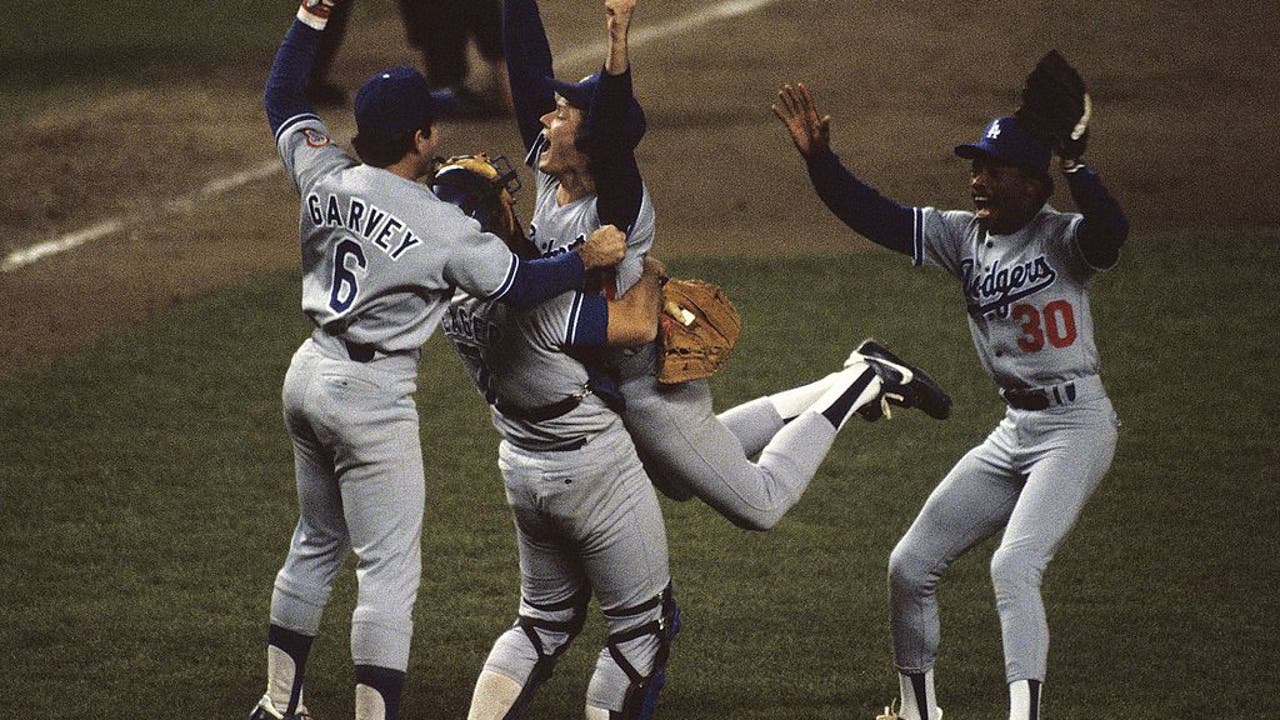
Blowing that lead, to the evil O'Malley Bums and their fat hypocritical slob of a manager, Tommy Lasorda, losing the Series at home, and when I was just 11 going on 12...

More than any other Yankee defeat, this one sticks in my craw. As bad as the 2001 and 2003 World Series losses were (I don't really remember the 1976 sweep loss); or the 1980 and 2012 ALCS sweeps; or the 2010, 2017, 2019 and 2022 ALCS folds; or the ALDS losses of 1995, 1997, 2006, 2011, 2018 and 2020; or the 1985 and 1988 regular-season near-misses; or the complete bottle-jobs in the Wild Card Games of 2015 and 2021. Even the 2004 ALCS collapse doesn't bother me as much as the 1981 World Series.

And, unlike with the 2004 Red Sox and the 2017, '19 and '22 Astros, I can't even rationalize it away by saying the Dodgers cheated! That I know of. There are some people who have alleged that the mound at Dodger Stadium was actually less than 60 feet 6 inches from home plate in the Lasorda era, but I don't think this was ever seriously challenged.

In 1998, the Yankees celebrated the 20th Anniversary of the '77 and '78 World Champions by inviting the Dodgers of that period to Old-Timers' Day. The Old-Timers' Game usually goes 3 innings, but since it was tied, it went to a 4th inning, and Willie Randolph hit a home run off Tommy John to win it for the Yankees. So not only did John pitch on the losing side in all 3 of these Yankee-Dodger World Series, but he lost this Old-Timers' Game as well.

Among the interviews done on WPIX-Channel 11, Bobby Murcer, by then a broadcaster, and wearing a special hookup on his belt so he could announce a game he was playing in, talked to Lasorda. The man who liked to say, "I bleed Dodger Blue," and referred to God as "the Big Dodger in the Sky," talked about the '77 and '78 Series, but brought up '81, Murcer's only World Series in 17 seasons in the major leagues, 13 of them with the Yankees, and said, "We brought that World Championship trophy back to Los Angeles where it belongs!"

The fat bigoted slob forgot: Los Angeles isn't even where the Dodgers belong. Brooklyn is.

Buster Olney titled his book about the 2001 Yankees, with a focus on their loss to the Arizona Diamondbacks in Game 7 of the World Series, The Last Night of the Yankee Dynasty. Peter Golenbock, in Dynasty: The New York Yankees, 1949-1964; David Halberstam, in October 1964; and Philip Bashe, in Dog Days: The New York Yankees' Fall from Grace and Return to Glory, 1964-1976 have all written about how the Yankees' loss to the St. Louis Cardinals in Game 7 of the 1964 World Series was the last day of the old Yankee Dynasty.

October 28, 1981 was the last day of my Yankee Dynasty. That wasn't apparent at the time. But the team's collapse in 1982 made it clear.

The Yankees were now 8-3 in World Series against the Dodgers, 2-2 in their Los Angeles period. In the 41 years since, the teams have never played each other in another World Series. In Interleague Play, yes; in the World Series, no.

They've both made the Playoffs in 1995, 1996, 2004, 2006, 2009, 2015, 2017, 2018, 2019, 2020, 2021 and 2022. They've both reached their respective League Championship Series in 2009, 2017 and 2019. But, since 1981, they've never again met in the World Series.

And at the rate Brian Cashman is going, it looks like it won't happen again for years to come, through no fault of the Dodgers and their management.

UPDATE: They did face each other in the 2024 World Series. The Dodgers won in 5 games.

*

October 28, 1981 was a Wednesday. The baseball season was over. It was midweek for football. The NBA season started 2 days later. There were 7 games played that night in the NHL:

* The New York Rangers lost to the Edmonton Oilers, 5-3 at Madison Square Garden. The Broadway Blueshirts blew leads of 2-0 and 3-1, as Wayne Gretzky had 2 goals and 2 assists.

* The Buffalo Sabres beat the St. Louis Blues, 6-2 at the Buffalo Memorial Auditorium.

* The Toronto Maple Leafs beat the Pittsburgh Penguins, 5-3 at the Civic Arena in Pittsburgh.

* The Chicago Black Hawks beat the Winnipeg Jets, 7-6 at the Chicago Stadium.

* The Minnesota North Stars beat the Calgary Flames, 6-1 at the Metropolitan Sports Center in the Minneapolis suburb of Bloomington, Minnesota.

* The Quebec Nordiques beat the Colorado Rockies, 3-1 at the McNichols Arena in Denver. The Rockies became the New Jersey Devils the next season.
* And the Vancouver Canucks beat the Washington Capitals, 3-0 at the Pacific Coliseum in Vancouver.

Also, Milan BaroÅ¡, a Czech soccer player who helped Liverpool FC win the 2005 UEFA Champions League, was born on this day. 

Saturday, October 22, 2022

October 22, 1974: The Murcer-Bonds Trade

October 22, 1974: The Yankees and the San Francisco Giants swap popular star outfielders: Bobby Bonds goes to New York, and Bobby Murcer heads to San Francisco. Bonds hit 32 home runs and stole 32 bases in 1975‚ becoming only the 2nd member of "the 30-30 Club" for any of The City's baseball teams. (The 1st was Willie Mays of the 1956 Giants.)

Bonds got off to a rough start, before adjusting to the different style of pitching in the American League. He went on a tear in May. But a knee injury in Chicago on June 7 wrecked his season. He later admitted that he should have gotten surgery, missed the rest of the season, and come back stronger in 1976.

Instead, he played on, and never quite adapted to New York. After just the 1 season, he was traded to the California Angels for outfielder Mickey Rivers and pitcher Ed Figueroa. They turned out to be 2 major figures in the Yankees' revival, so Bonds' greatest value to the Yankees was as trade bait.
Today, Bonds is known 3rd for his amazing combination of power and speed, 2nd for being traded so many times, and 1st for being the father of Barry Bonds. That really isn't fair, as Bobby was a fantastic player, one of the best of the 1970s.

As for Murcer, he felt betrayed. Team owner George Steinbrenner had promised him he would be "a Yankee for life." But Steinbrenner had been suspended from operation of the team, and wasn't reinstated until 1976. So general manager Gabe Paul made the call.

Murcer loved the city of San Francisco, but hated playing in cold, windy Candlestick Park, both as a batter and as an outfielder. He was traded to the Chicago Cubs in 1977, and he enjoyed Wrigley Field a lot more. (Sure, Wrigley also has wind issues, but it is also much more of a hitter's park.)

Still, Murcer was heartbroken to be traded by the Yankees, to whom he had given as much as anybody could in those dark years between 1964 and 1976, and swore he would never forgive them for trading him. But in 1979, Steinbrenner traded to get him back, and Bobby jumped at the chance, and he remained a part of the Yankee family, as a player until 1983, and then as a broadcaster until his death in 2008. He titled his autobiography Yankee For Life. It made sense, because, as much as he could, Steinbrenner kept his word.

*

October 22, 1974 was a Tuesday. The baseball season had ended 5 days before, with the Oakland Athletics beat the Los Angeles Dodgers in the World Series. Football was in midweek. There were 6 games played in the NBA that day:

* The New York Knicks beat the Houston Rockets, 110-100 at Madison Square Garden. Bill Bradley led the Knicks with 22 points.

* The Atlanta Hawks beat the Philadelphia 76ers, 125-92. John Drew scored 42 for the Hawks.

* The Buffalo Braves beat the New Orleans Jazz, 134-118 at the Buffalo Memorial Auditorium. Bob McAdoo had 33 points and 22 rebounds. The Braves became the San Diego Clippers in 1978, and the Los Angeles Clippers in 1984. The Jazz moved to Salt Lake City in 1979, becoming the Utah Jazz.

* The Milwaukee Bucks beat the Chicago Bulls, 92-90 at the Milwaukee Exposition, Convention Center and Arena, or "The MECCA." Since 2014, it has been named the UW-Panther Arena.

* The Washington Bullets beat the Kansas City-Omaha Kings, 123-121 at the Kemper Arena in Kansas City. (It's now named the Hy-Vee Arena.) Elvin Hayes scored 35 points for the Bullets, who became the Washington Wizards in 1997.

The Kings stopped playing the occasional game in Omaha after this season, and became just the Kansas City Kings, then the Sacramento Kings in 1985.

* And the Portland Trail Blazers beat the Golden State Warriors, 107-106 at the Oakland Coliseum Arena.

There were 2 games played in the American Basketball Association:

* The San Diego Conquistadors beat the Memphis Sounds, 109-106 at the Mid-South Coliseum in Memphis. Travis Grant scored 41 for the visiting "Q's."

* And the Virginia Squires beat the Spirts of St. Louis, 118-112 at the St. Louis Arena, known from 1973 to 1981 as the Checkerdome.

There were 4 games played in the National Hockey League:

* The New York Islanders beat the Atlanta Flames, 2-1 at the Nassau Coliseum. Bob Bourne scored the winner with just 43 seconds left in regulation.

* The Detroit Red Wings beat the Washington Capitals, 3-0 at the Capital Centre in the Washington suburb of Landover, Maryland. This was the down period in which the Detroit team was known as the Dead Things, but the expansion Caps put together the worst season, winning-percentage-wise, in NHL history. Famously, they didn't win a game on the road until their last try, and skated around the ice with a trash can, in imitation of having won the Stanley Cup.

* The Philadelphia Flyers beat the Los Angeles Kings, 4-2 at The Forum in the Los Angeles suburb of Inglewood, California. The Flyers had won the Cup the season before, and would again this season -- but haven't won it since.

* And the Minnesota North Stars beat the Vancouver Canucks, 3-2 at the Pacific Coliseum in Vancouver.

And there were games played in the World Hockey Association:

* The Quebec Nordiques beat the Houston Aeros, 7-2 at the Colisee de Quebec. In spite of this loss, the Aeros, led by a line of ageless Gordie Howe and his sons Mark and Marty, would repeat as WHA Champions.

* The Toronto Toros beat the Minnesota Fighting Saints, 11-2 at Maple Leaf Gardens in Toronto.

* And the San Diego Mariners beat the Cleveland Crusaders, 5-2 at the San Diego Sports Arena. 

Friday, September 30, 2022

September 30, 1973: The Last Game at the Pre-Renovation Yankee Stadium

September 30, 1973: The last game is played at Yankee Stadium before its renovation. The Yankees lose 8-5 to the Detroit Tigers.

The renovation was necessary, not because the Mets were talking about how much better Shea Stadium was, but because there were actual structural issues. The institution of Bat Day led to kids sitting in the upper deck, banging their bats on the floor, weakening the stadium structure.

So Mayor John Lindsay negotiated a deal in which the Department of Parks of the City of New York, which already owned Shea, bought both Yankee Stadium and the land on which it sat -- previously owned by separate entities -- and would renovate it, to reopen in time for the 1976 season. The Yankees would play the 1974 and '75 seasons at Shea.

This also forced the football Giants out of Yankee Stadium after 2 games, a 34-14 win over the Houston Oilers on September 16, and a 23-23 tie with the Philadelphia Eagles on September 23. The rest of their home schedule for 1973, and all of it for 1974, would be played 70 miles to the northeast, at the Yale Bowl in New Haven, Connecticut.

Lindsay, angry that the Giants had already negotiated a deal to build a stadium in the Meadowlands of New Jersey, in time for the 1976 season, denied them the use of Shea, so they had to look elsewhere. So they made the deal to play '73 and '74 at the Yale Bowl. Lindsay's successor, Abe Beame, had no such grudge, and allowed the Giants to play the 1975 season at Shea -- meaning that it was hosting both of New York's MLB teams and both of its NFL teams at the same time.

(In other words: In 1975, the New York Tri-State Area had 8 teams playing in 3 buildings: Shea Stadium had the Yankees, the Mets, the Giants and the Jets; Madison Square Garden had the Knicks and the Rangers; and the Nassau Coliseum had the Nets and the Islanders. In 2022, with the Devils making it 9 teams, they are playing in 7 separate buildings.)

In order to avoid the kind of damage that fans had done to other ballparks in their recent closures, the Monuments were removed from center field, and the Plaques from the wall, before the game.

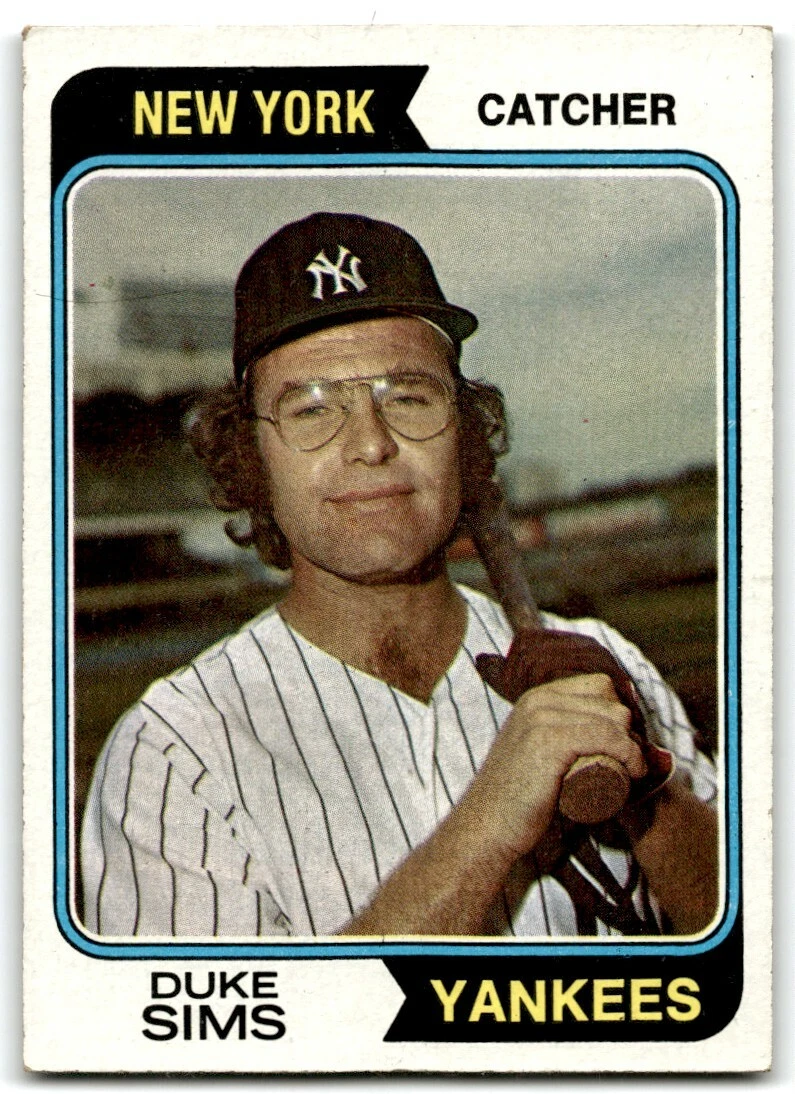
Duane "Duke" Sims, catching in the last game at the pre-renovation Stadium instead of Thurman Munson, hits the last home run, off Fred Holdsworth in the 7th inning. But Lindy McDaniel, in relief of Fritz Peterson, implodes in the 8th inning, allowing 6 runs, making a winning pitcher of John Hiller.
Sims' 1974 Topps card. Topps tended to take
players' card pictures in New York,
going back to the Polo Grounds.

The last play is 1st baseman Mike Hegan hitting a fly ball to, appropriately, center field, once patrolled by Joe DiMaggio and Mickey Mantle. This one is caught by the Tigers' Mickey Stanley.

Attendance: 32,238, in a Stadium whose capacity was then listed as 65,010.

For all the greats who had played in Yankee Stadium, the only future Hall-of-Famer who played in this game was the Tigers' Al Kaline.

After the game, Yankee manager Ralph Houk resigned, tired of the meddling of the team's 1st-year owner, George Steinbrenner. George found finding a replacement difficult, as he tried to hire Dick Williams, who, after the subsequent World Series despite winning it, had quit as manager of the Oakland Athletics. A's owner Charlie Finley contended that Williams couldn't manage anywhere else as long as his contract with him was running. So George hired former Pittsburgh Pirate manager Bill Virdon. Houk was signed to manage the Tigers.

The day after the last game, the renovation began. Claire Ruth, the Babe's widow, was given home plate. Eleanor Gehrig, Lou's widow, was given the 1st base that was used in the last game.

The 1923-73 version of Yankee Stadium saw the home team win 27 American League Pennants and 20 World Series in 51 seasons. (The 1st 2 Yankee Pennants, 1921 and '22, came at the Polo Grounds.) It also hosted 3 NFL Championship Games in the pre-Super Bowl era: 1956, when the Giants beat the Chicago Bears; 1958, when the Giants lost to the Baltimore Colts in an overtime classic that has been called "The Greatest Game Ever Played"; and 1962, when the Giants lost to the Green Bay Packers.

It also hosted the Army-Navy Game in 1930 and '31; and 22 Army-Notre Dame games, including 1928, when Knute Rockne told his team to "Win one for the Gipper," and they did; and 1946, when both teams came in undefeated, and left that way, a "Game of the Century" that didn't live up to the hype, ending 0-0. And it hosted a long run of boxing champions, from Jack Dempsey to Floyd Patterson, including Joe Louis' 1938 knockout of Max Schmeling.

Remaining with the team until 1980, shortstop Fred Stanley was the last Yankee who had played a home game at the pre-renovation Stadium, although center fielder Bobby Murcer would be traded away and reacquired, playing his last game on June 11, 1983, nearly 10 years later.

*

September 30, 1973 was a Sunday. Other Major League Baseball games played on this day:

* The New York Mets split a doubleheader with the Chicago Cubs at Wrigley Field. The Cubs won the opener 1-0, with Rick Reuschel and Bob Locker combining for an 8-hit shutout. In the nightcap, Jerry Koosman was backed by 3 hits from Rusty Staub, 2 each by Wayne Garrett and Felix Millan, and a home run by Cleon Jones, as the Mets won 9-2.

The regular season should have been over, but the National League Eastern Division race was a wild one that no one seemed to want to win. The Mets ended the day 1 game ahead of the St. Louis Cardinals, a game and a half ahead of the Pittsburgh Pirates, 3 ahead of the Montreal Expos, and 4 ahead of the Cubs -- who finished closer to the Mets this time than they had in their in famous 1969 "September Swoon."

But because of rainouts, the race still wasn't decided. The Cards had completed their schedule, but the Mets had 2 games left to play, the Pirates 1. It was still possible for any of the 3 to win the Division.

* Because the Cardinals had beaten the Philadelphia Phillies, 3-1 at Busch Memorial Stadium in St. Louis.

* And the Pirates had beaten the Expos, 10-2 at Three Rivers Stadium in Pittsburgh. The next day, the Pirates would play a rainout makeup against the San Diego Padres at home, while the Mets would stay at Wrigley and play another doubleheader with the Cubs.

The Mets won the opener, 6-4, and clinched the Division. Until the 1986 Pennant, this would remain their only clincher on the road. (The 1969 and 1986 Division titles, the 1969 and 1973 Pennants, and the 1969 World Series win would all occur at Shea.) They beat the Cubs, and barely beat the rain, which canceled the nightcap, which was now unnecessary. It was made more so when the Pirates lost 4-3 to the Padres.

* Elsewhere on September 30, the Houston Astros beat the Atlanta Braves, 5-3 at Atlanta Stadium. (It was renamed Atlanta-Fulton County Stadium in 1975.) This was the 3,739th and last regular-season game managed by Leo Durocher, who was soon fired. He first managed with the 1939 Brooklyn Dodgers, while he was still an active player.

Hank Aaron got 3 hits, but none of them was a home run, so he finished the season with 713 career home runs. It would be a long off-season before he got the chance to break the career record then held by Babe Ruth. He hit Number 714 on April 4, 1974 in Cincinnati, and then Number 715 on April 8 at home to Los Angeles.

* The Boston Red Sox beat the Milwaukee Brewers, 3-2 at Fenway Park in Boston.

* The San Francisco Giants beat the Cincinnati Reds, 4-3 at Riverfront Stadium in Cincinnati.

* The California Angels beat the Minnesota Twins, 3-0 at Anaheim Stadium (now Angel Stadium). Frank Tanana pitched a 2-hit shutout, outdueling Bert Blyleven.

* The Texas Rangers beat the Kansas City Royals, 3-0 at Arlington Stadium in the Dallas suburb of Arlington, Texas. Pete Broberg allowed 7 hits, but kept the shutout.

* And the Chicago White Sox beat the Oakland Athletics, 1-0 at the Oakland Coliseum. The ChiSox won it in the top of the 10th, on a bases-loaded walk drawn by shortstop Russell "Bucky" Dent, who would later write his name in Yankee history. Speaking of which: Reggie Jackson did not play for the A's, but Catfish Hunter started, and did not get the decision. The A's would go on to beat the Mets in the World Series.

And there were NFL games played on the day:

* The New York Giants lost to the Cleveland Browns, 13-10 at Cleveland Municipal Stadium.

* The New York Jets lost to the Buffalo Bills, 9-7. It was the Bills' 1st game at their new stadium, south of the city, in suburban Orchard Park, New York. Originally known as Rich Stadium, for the Rich family of meat-product producers, O.J. Simpson and his teammates beat the Jets, 9-7.

The stadium was renamed Ralph Wilson Stadium for the team's founding owner in 1998, and, in 2015, was renamed New Era Field, as naming rights were bought by the New Era sports cap company. But New Era asked to be let out of the agreement in 2020. It was renamed Highmark Stadium. In 2026, it was torn down, and replaced by a new facility, also named Highmark Stadium.

* The Washington Redskins beat the Philadelphia Eagles, 28-7 at Veterans Stadium in Philadelphia.

* The Baltimore Colts beat the New Orleans Saints, 13-10 at Memorial Stadium in Baltimore.

* The Miami Dolphins beat the New England Patriots, 44-23 at the Orange Bowl in Miami.

* The Pittsburgh Steelers beat the Houston Oilers, 36-7 at the Astrodome in Houston.

* The Dallas Cowboys beat the football version of the St. Louis Cardinals, 45-10 at Texas Stadium in the Dallas suburb of Irving, Texas.

* The Minnesota Vikings beat the Green Bay Packers, 11-3 at Metropolitan Stadium in the Minneapolis suburb of Bloomington, Minnesota.

* The Kansas City Chiefs beat the Oakland Raiders, 16-3 at Arrowhead Stadium in Kansas City.

* The Chicago Bears beat the Denver Broncos, 33-14 at Mile High Stadium in Denver.

* The Cincinnati Bengals beat the San Diego Chargers, 20-13 at San Diego Stadium.

* The Los Angeles Rams beat the San Francisco 49ers, 40-20 at Candlestick Park in San Francisco.

* The next day, on Monday Night Football, the Detroit Lions beat the Atlanta Falcons, 31-6 at Tiger Stadium in Detroit. 

Saturday, August 6, 2022

August 6, 1979: The Munson Memorial Game

Bobby Murcer, hugged by Ron Guidry (left) and Lou Piniella

August 6, 1979: The New York Yankees return from Canton, Ohio, where they attended the funeral of Thurman Munson, their catcher and team Captain, who had been killed in a plane crash there 4 days earlier.

There was a question of whether they would get back in time to play that night’s nationally televised game against the Baltimore Orioles. Team owner George Steinbrenner, a man who liked to say, "To me, winning is second to breathing," said going to the funeral was more important: "If we don't make it back, we'll forfeit."

They got back in time. On ABC Monday Night Baseball, Howard Cosell, a man so often seemingly like he was born without tact, remembered that he was a professional journalist, and handled the situation superbly. He spoke well of Munson, and broadcast an interview he had done with Munson on a recent broadcast, in which Munson spoke of possibly retiring to spend more time with his family. Instead, at the age of 32, he had no future.

Keith Jackson, better known for college football, was the play-by-play announcer. Ron Guidry started for New York, Dennis Martinez for Baltimore. Munson's death had left the Yankees with only 1 catcher on their major league roster: Jerry Narron, who had played exactly 29 major league games, batting .188. The Yankees activated their bullpen catcher, Brad Gulden, who had played in 3, all the previous season, with the Los Angeles Dodgers.

The Orioles led 4-0 at the 7th Inning Stretch, including home runs by Lee May and Ken Singleton, who later became a Yankee broadcaster. But with 2 outs in the bottom of the 7th, Bucky Dent drew a walk, and Willie Randolph doubled. Bobby Murcer, a Yankee star who had been traded away and recently reacquired, Munson's best friend and, along with Lou Piniella, one of the eulogists at Munson's funeral, hit a home run to bring the Yankees to within 4-3.
Murcer and Munson in 1973.
Note the Yankee Stadium 50th Anniversary sleeve patches.

Felix "Tippy" Martinez replaced Dennis. (They were not related: Tippy was from Colorado and of Mexican descent, while Dennis was from Nicaragua.) The game remained 4-3 going into the bottom of the 9th. Dent led off with another walk. Randolph tried to bunt him over, but Eddie Murray, the Orioles' best all-around player, dropped the throw at 1st base, putting Dent on 3rd base and Randolph on 2nd. And Murcer hit a drive into the left-field corner, scoring Dent with the tying run, and Randolph with the winning run: Yankees 5, Orioles 4.

The Yankees mobbed Murcer, most of them in tears. A crowd of 36,314 was crying along with them. This game has been called the only time the home fans left Yankee Stadium crying after a win.

But losing Munson was the latest and worst in a series of events that had troubled the Yankees all season long. They never got going, and finished 4th, 13 1/2 games behind the Orioles, who went on to end the Yankees' 3-year run atop the American League Eastern Division, and then win the AL Pennant.

*

August 6, 1979 was, as I said, a Monday. These other 5 games were played in Major League Baseball:

* The Kansas City Royals beat the Toronto Blue Jays, 16-12 at Exhibition Stadium in Toronto. Yes, that's a baseball game, not football. The Royals scored 11 runs in the 7th inning. George Brett went 2-for-4 with a walk and 4 RBIs. Pete LaCock went 4-for-6 with 2 RBIs. Freddie Patek went 3-for-4 with a walk and 5 RBIs. Despite all of that, they hit no home runs. For the Jays, former Royal John Mayberry and Rico Carty hit home runs, and Rick Cerone, who would become the Yankees' catcher the next season, went 3-for-4 with 5 RBIs.

* The Cincinnati Reds beat the Atlanta Braves, 3-1 at Riverfront Stadium in Cincinnati. Johnny Bench went 2-for-3 with a walk.

* The San Francisco Giants beat their arch-rivals, the Los Angeles Dodgers, 7-1 at Dodger Stadium in Los Angeles.

* The California Angels beat the Oakland Athletics, 5-2 at the Oakland Coliseum. Bobby Grich hit a home run. Rod Carew went 2-for-5. Rookie Rickey Henderson went 0-for-3 with a walk, but had an RBI on a groundout.

* And the Seattle Mariners beat the Minnesota Twins, 7-4 at the Kingdome in Seattle.

Tuesday, August 2, 2022

August 2, 1975: "Billy, You're Hired!"

August 2, 1975: Bill Virdon is fired as manager of the New York Yankees. His replacement: Former Yankee 2nd baseman Billy Martin.

George Steinbrenner bought the Yankees in 1973, while Ralph Houk was the manager. After that season, tired of George's meddling, Houk resigned. George tried to hire Dick Williams, who had just quit as manager of the Oakland Athletics, despite leading them to back-to-back World Series wins, because he was tired of the meddling of his team's owner, Charlie Finley.

But Williams was still under contract to Finley, who wouldn't let him go. At least, not to George. In the middle of the 1974 season, when Gene Autry, the former country singer who owned the California Angels, fired his manager, Bobby Winkles, Finley gave him permission to hire Williams.

George hired Virdon, a former outfielder with the Pittsburgh Pirates, who had managed them to the National League Eastern Division title in 1972, and had nearly done so again in 1973. He nearly led the Yankees to the American League Eastern Division title in 1974, but the team was struggling in 1975, and Virdon had "lost the locker room." George fired him, but he was soon hired by the Houston Astros, whom he led to the NL West title in 1980.

Alfred Manuel Martin Jr. was born on May 16, 1928, in Berkeley, California, across the Bay from San Francisco. But it was not the tony Berkeley of the University of California where he grew up. Instead, it was the hardscrabble neighborhood of West Berkeley, home to immigrants, like his mother, who was from Italy; and his father's parents, who were from Portugal.

Al Martin and Juvan "Jenny" Salvini may never have gotten married. Al left when Alfred Jr. was a baby, and for the rest of her life, Jenny called Al "the Jackass." Her mother called Alfred Jr. "Bello," meaning "beautiful," in spite of a large nose that would later get him picked on, and which he would have surgically fixed. "Bella" became "Billy."

When Billy went off to school, and his teacher read off all the names of the students, he didn't hear his name. When he spoke up, and said his name was "Billy Martin," the teacher repeated the name of "Alfred Manuel Martin." That's how Billy found out his real name. When he went home, and asked his mother why she'd never told him his real name, she said, "I didn't want you to know you were named after the Jackass."

Unfortunately, Billy inherited the worst traits of both parents: The combativeness of his mother, and, by the time he grew up, it was clear that he had inherited the womanizing and drinking ways of his father. He had a talent for baseball, though, and starred at Berkeley High School.

His mother had been married before, and had an older son, Frank, a.k.a. "Tudo." Tudo was friends with a local baseball star, Augie Galan, who made 3 All-Star Games with the Chicago Cubs. Galan told the manager of the Pacific Coast League's Oakland Oaks about Billy, and the manager had Billy signed to a contract with an Oaks farm team in 1946. That manager was Casey Stengel.

In 1947, wearing uniform Number 1 for the 1st time, and liking it, Billy played for the Phoenix Senators of the Class C Arizona-Texas League (roughly equivalent to today's Class A), and had the highest batting average in all of "organized baseball," .393, plus 173 RBIs. He was named the league's Most Valuable Player. In 1948, Billy was one of the few young players on an Oaks team that included local hero and former Cincinnati Reds batting champion Ernie Lombardi, that was nicknamed "The Nine Old Men." Casey led them to the PCL Pennant.

Casey was hired to manage the Yankees, and told Billy that if he had the chance to bring him to New York, he would. He kept that promise, and Billy played his 1st major league game on April 18, 1950, at Fenway Park in Boston. Taking over for starting 2nd baseman Jerry Coleman in the 6th inning, he had no fielding chances, but he hit a single and an RBI double off Boston Red Sox ace Mel Parnell, and the Yankees beat the Red Sox, 15-10.

Billy wore Number 12 in that call-up, but spent most of the 1950 and 1951 seasons with the Yankees' top farm team, the Kansas City Blues. When Coleman went back into the Marines for the Korean War, Billy was called back up, and got Number 1 like he wanted.

In 1952, he made a key catch late in Game 7 of the 1952 World Series. In the 1953 Series, Billy tied what was then the Series record with 12 hits, the last of them a single driving Hank Bauer home in the bottom of the 9th inning of Game 6, to clinch the Yankees' 5th straight World Championship. Both victories, '52 and '53, were against the Brooklyn Dodgers.

Despite the Korean War ending, the U.S. Army still had a draft, and Billy missed the entire 1954 season and most of 1955 while serving. Interestingly, 1954 was the only season between 1948 and 1959 that the Yankees didn't win the American League Pennant. The Yankees lost the World Series to the Dodgers in 1955, but won it in 1956.

But Billy had not just a chip on his shoulder, he had an entire bag of chips on it. And he and pitcher Whitey Ford, a native of Queens, were leading the team's biggest star, Oklahoma country boy Mickey Mantle, astray, with late nights of drinking and womanizing.

Furthermore, Billy was always getting into fights, on and off the field. He brawled with St. Louis Browns catcher Clint Courtney in 1952, and again in 1953, having previously fought with him in the minor leagues. In 1956, with the Dodgers having given up on pitcher Tommy Lasorda, sending him to the Kansas City Athletics, Billy and Tommy got into a fight. Oddly, they would end up as opposing managers in the 1977 World Series, and, before pregame introductions, shook hands in mutual respect as fellow little Italians who'd made good.

On May 16, 1957, his 29th birthday, some of his teammates, seeing that he was feeling down after his divorce, decided to take him out for a night on the town. This included a visit to the famous Copacabana Club. Sammy Davis Jr. was performing, and a racist heckler got on his case. One thing led to another, and the heckler got knocked out, though all 6 Yankees involved, including Billy, said not only had none of them done it, but none of them had even seen it.

Thus far, Casey had been protecting Billy: General manager George Weiss had long wanted to get rid of him, but Casey would go over Weiss' head to team owners Dan Topping and Del Webb, and Billy stayed. This time, given the bad press over the fight, and the fact that he was batting only .241, and Topping, Webb and Weiss were high on rookie 2nd baseman Bobby Richardson, Billy figured Casey wouldn't be able to protect him. On trading deadline day, June 15, Billy hid in the bullpen, telling Mickey, "If they can't find me, they can't trade me." It didn't work that way, and he was traded to the A's. (By this point, they had also given up on Lasorda.) Richardson not only got Billy's job, he got Billy's number: 1. (He had been wearing 29.)

Billy played in Kansas City the rest of 1957, was traded to the Detroit Tigers in 1958, traded to the Cleveland Indians in 1959, traded to the Cincinnati Reds in 1960, traded to the Milwaukee Braves in 1961, and traded again in 1961, to the Minnesota Twins. At 33, his playing career was over.

But he had observed Casey Stengel's managing. He knew he could be a big-league manager. Twins owner Calvin Griffith made him a scout for the 1962 season. Billy urged Griffith to sign pitcher Jim Palmer, but Palmer wanted a $50,000 signing bonus, and Griffith, a notorious cheapskate, refused. Palmer would win 268 games for the Baltimore Orioles. Through the 2025 All-Star Break, the winningest pitcher in Twins history is Jim Kaat, with 189.

Billy became the Twins' 3rd base coach in 1965, and they won the Pennant. He worked with Zoilo Versalles, and he was named the AL's Most Valuable Player in 1965. He worked with Rod Carew, and he became one of the most aggressive young hitters and runners in baseball, winning the AL's Rookie of the Year in 1967, and winning the 1st of 7 batting titles in 1969. That season, Billy was named the Twins' manager, and led them to the AL Western Division title. However, a series of incidents, some of them affected by Billy's drinking, led Griffith to fire him after the season.

The Detroit Tigers hired him for 1971, and in 1972, he led them to the AL East title. But things fell apart in 1973, and he was fired. He was immediately picked up by the Texas Rangers, whom he managed to a surprise 2nd-place finish in 1974. He developed his "Cowboy Billy" persona during this time, and, despite his Bay Area roots, spoke with something of a Southern drawl for the rest of his life, something that irked some of his black players. But the pattern repeated: He and his team couldn't hold the prosperity, and he drank threw it, and there were incidents. He was fired on July 20, 1975.

Thirteen days later, George Steinbrenner hired him. Casey Stengel, now 85 and suffering from cancer, called him to congratulate him. The two men hadn't spoken for 18 years. It was just in time: Casey died 58 days later.

Billy's 1st game as manager of the Yankees -- uniform Number 1 being available after the trade of Bobby Murcer the preceding October -- was a 5-3 win over Cleveland at Shea Stadium, where the Yankees were playing home games while Yankee Stadium was being renovated. The Yankees trailed 3-0 going into the bottom of the 6th inning, but came from behind, including a home run by Roy White over former Yankee Fritz Peterson, making Sparky Lyle a winning pitcher in relief of Pat Dobson.

Over the next 14 years, George would hire and fire Billy 5 times. Some people think there would have been a 6th time if Billy hadn't died. It was one of the strangest relationships in the history of North American sports: They drove each other crazy, but they always managed to patch things up. They couldn't live with each other, and they couldn't live without each other.

*

August 2, 1975 was a Saturday. These other Major League Baseball games were played that day:

* The New York Mets beat the Pittsburgh Pirates, 6-0 at Three Rivers Stadium in Pittsburgh. Jon Matlack pitched a 5-hit shutout. Willie Stargell did not play for the Pirates.

* The Montreal Expos beat the Philadelphia Phillies, 4-3 at Jarry Park in Montreal. Nate Colbert won it for the Expos with a 3-run home run in the bottom of the 9th inning. For the Phillies, Greg Luzinski hit a home run. Mike Schmidt went 0-for-2 with 2 walks.

* The Boston Red Sox beat the Detroit Tigers, 7-2 at Fenway Park in Boston. Carl Yastrzemski went 2-for-4 with a walk and 2 RBIs.

* The Baltimore Orioles beat the Milwaukee Brewers, 6-1 at Memorial Stadium in Baltimore. Brooks Robinson went 1-for-4. Doug DeCinces, his eventual successor at 3rd base, but playing 2nd base today, hit a home run. So did Don Baylor. Hank Aaron, playing out the string with the Brewers, went 0-for-4.

* The St. Louis Cardinals beat their arch-rivals, the Chicago Cubs, 4-0 at Wrigley Field in Chicago. Bob Forsch pitched a 4-hit shutout, and helped his own cause by sacrifice-bunting a run home.

* The Minnesota Twins swept a doubleheader from the Chicago White Sox, 4-1 and 8-3 at Metropolitan Stadium in the Minneapolis suburb of Bloomington, Minnesota. Over the 2 games, Rod Carew went 3-for-6 with 2 walks and 3 RBIs.

* The Oakland Athletics beat the Kansas City Royals, 6-5 at Royals Stadium (now Kauffman Stadium) in Kansas City. Reggie Jackson and former Chicago Cub star Billy Williams hit home runs for the A's. Harmon Killebrew, playing out the string with the Royals, went 0-for-4. George Brett went 3-for-4 with 2 RBIs.

* The Texas Rangers beat the California Angels, 8-2 at Arlington Stadium in the Dallas suburb of Arlington, Texas.

* The Atlanta Braves beat the San Diego Padres, 8-6 at San Diego Stadium (later Jack Murphy Stadium and Qualcomm Stadium). Darrell Evans hit a home run in the top of the 15th inning.

* The Cincinnati Reds beat the Los Angeles Dodgers, 1-0 at Dodger Stadium in Los Angeles. Tom Carroll allowed 7 hits and 3 walks, but no runs, over 6 1/3rd innings. Clay Carroll, no relation, was perfect the rest of the way, preserving the shutout, and outpitching Andy Messersmith (8 innings) and Mike Marshall. Pete Rose went 0-for-4. Johnny Bench went 0-for-1 with 3 walks.

* And the San Francisco Giants beat the Houston Astros, 8-7 at Candlestick Park in San Francisco. With Bobby Murcer at bat in the bottom of the 10th inning, Jim Crawford threw a wild pitch, allowing Mike Sadek to score the winning run.

December 31, 1999 & January 1, 2000: The Millennium

December 31, 1999:  The Millennium arrives. The people of planet Earth survived. At a terrible cost. But we hadn't destroyed ourselves. ...