Showing posts with label red barber. Show all posts

Wednesday, October 5, 2022

October 5, 1947: The Al Gionfriddo Game


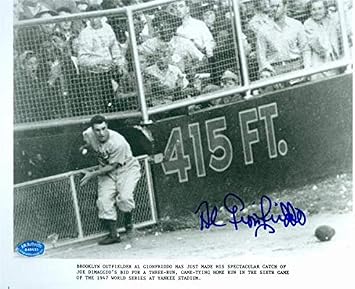
October 5, 1947: Game 6 of the World Series. The New York Yankees trail the Brooklyn Dodgers, 8-5 in the bottom of the 6th inning, but have 2 men on. Joe Hatten pitches to Joe DiMaggio, and the Yankee Clipper rips the ball deep to left-center field.
But, in Yankee Stadium, that's "Death Valley." Dodger left fielder Al Gionfriddo makes a leaping catch near the bullpen gate. Red Barber had the call on the Dodgers' radio station, WMGM, AM 1050:
Here's the pitch. Swung on, belted, it's a long one! Back goes Gionfriddo, back, back, back, back, back, back, he makes a one-handed catch against the bullpen! Oh, Doctor!
In a rare show of emotion, DiMaggio kicked the infield dirt, caught by at least 2 newsreel cameras.
The Yankees closed to within 8-6, but that was as close as they would get. Ralph Branca, winner of 21 regular-season games this year at age 21, but to whom baseball history would get considerably less kind, was the winning pitcher. Hugh Casey, to whom baseball history was nasty in 1941 but had already been the winning pitcher in Game 4, got the save in Game 6.
Game 7 was played the next day, and the Yankees won it, 5-2. The Dodgers won the 2 best-remembered games of the Series, but the Yankees won the Series itself. It was similar to 1975, when the Boston Red Sox won the memorable Game 6, but the Cincinnati Reds won Game 7.
Gionfriddo became a hero, but, like Game 4 heroes Bill Bevens and Cookie Lavagetto, he never plays another major league game after the next day's Game 7. He played in the minors until 1953, managed in the minors until 1959, and died in 2003.
This was also the day that the 1st televised speech by a President from the White House was delivered, by Harry Truman. I have a separate entry for this event.
*
October 5, 1947 was a Sunday. This was the only baseball game played that day. And it was too early for the NBA or the NHL to start there seasons. But there were professional football games played. In the NFL:
* The New York Giants lost to the Philadelphia Eagles, 23-0 at Shibe Park in Philadelphia.
* The Detroit Lions beat the Boston Yanks, 21-7 at Fenway Park in Boston. Yes, there was a football team named the Boston Yanks, who existed from 1944 to 1948. Yes, these Yanks played at Fenway. No, they did not wear Pinstripes, choosing instead the kelly green and gold of Notre Dame.
* The Washington Redskins beat the Pittsburgh Steelers, 27-26 at Griffith Stadium in Washington.
* The Chicago Cardinals beat their cross-town rivals, the Chicago Bears, 31-7 at Comiskey Park in Chicago. The Cardinals would win the NFL Championship in 1947. In the three-quarters of a century since, including moves to St. Louis in 1960 and Phoenix in 1988, including 2 Super Bowl defeats as the Arizona Cardinals, they have never won another.
* And the Green Bay Packers beat the Los Angeles Rams, 17-14 at the Dairy Bowl in the Milwaukee suburb of West Allis, Wisconsin. The Dairy Bowl was a football stadium built in the infield of a speedway, now known as the Milwaukee Mile, at the Wisconsin State Fair Park.

In the All-America Football Conference, which challenged the NFL from 1946 to 1949, and produced 3 teams that would join it in 1950:
* The Cleveland Browns beat the New York Yankees, 26-17 at Cleveland Municipal Stadium. These football Yankees played their home games at Yankee Stadium, were owned solely by Yankee half-owner Dan Topping, and had former NFL Giants star Ray Flaherty as head coach. They lost the AAFC Championship Game to the Browns in 1946 and 1947, and were not welcomed into the NFL, as the Browns were.
* The Baltimore Colts and the San Francisco 49ers, the other 2 AAFC teams that would be absorbed into the NFL, played to a 28-28 tie at Baltimore Municipal Stadium. In 1954, this facility was converted into Memorial Stadium.
* And the Buffalo Bills beat the Los Angeles Dons, 27-25 at the Los Angeles Memorial Coliseum. In Spanish-era California, "Don" was a term meaning "Lord," and was given to the landowners. The term was also used in Italy, and the term "Don" for a Mafia boss comes from this.
The Bills reached the 1949 AAFC Championship Game, losing to the Browns, but were not invited into the NFL. This quickly became known as "The Screwing of Buffalo."
In 1959, Ralph Wilson, a former part-owner of the Lions, was offered a team in the American Football League by founder Lamar Hunt. He wanted Miami, but was turned down. When the first choice for a Buffalo team's owner backed out, Wilson told Hunt, "Count me in with Buffalo." And he named the team after the AAFC team, the Buffalo Bills, who were named after Wild West showman William F. "Buffalo Bill" Cody.
Also on this day, Brian Johnson, who was hired to replace the late Bon Scott as lead singer of rock band AC/DC, was born.

Monday, October 3, 2022

October 3, 1947: The Cookie Game

October 3, 1947: The New York Yankees' Floyd "Bill" Bevens takes a no-hitter into the bottom of the 9th inning against the Brooklyn Dodgers in Game 4 of the World Series. He gets to within 1 out of the 1st World Series (and thus the 1st postseason) no-hitter ever. But 10 walks put him in danger, including putting the tying and winning runs on base -- Al Gionfriddo and Eddie Miksis, respectively.

Dodger manager Burt Shotton send Harry "Cookie" Lavagetto up to pinch-hit for Eddie Stanky. Lavagetto hits a double-off the right-field wall at Ebbets Field, which the Yankees' Tommy Henrich can't catch, and the Dodgers win, 3-2.

Red Barber, calling the game for the Dodgers' radio station, WMGM, AM 1050, watched the hit, and the play, and the pounding on the back Lavagetto got from his teammates, and said this, concluding with one of his Southern expressions:

Gionfriddo walks off second, Miksis off first. They're both ready to go on anything. Two men out, last of the ninth. The pitch, swung on, there's a drive hit out toward the right field corner. Henrich is going back. He can't get it! It's off the wall for a base hit! Here comes the tying run, and here comes the winning run! Friends, they're killin' Lavagetto, his own teammates, they're beatin' him to pieces, and it's taking a police escort to get Lavagetto away from the Dodgers! Well, I'll be a suck-egg mule!

Hugh Casey, the Dodgers' closer throughout the 1940s, and the losing pitcher in The Mickey Owen Game in 1941, is the winning pitcher this time.

Instead of the Yankees being up 3 games to 1, the Series is now tied. This becomes known as The Cookie Game.

Two days later, Al Gionfriddo will rob Joe DiMaggio with an amazing catch to preserve the Dodgers’ lead in Game 6, but the Yankees win the Series in Game 7. By a weird twist of fate, neither Bevens, nor Lavagetto, nor Gionfriddo will ever play again.

Floyd Clifford Bevens (1916-1991) was called "Bill" because, in a minor-league game, he caught a popup after it bounced off the bill of his cap. He said, "I'm lucky it didn't bounce off my nose!"
Harry Arthur Lavagetto (1912-1990) was called "Cookie" because he was signed by Victor Devincenzi, the owner of the Pacific Coast League's Oakland Oaks, whose nickname was Cookie. The Oaks played from 1903 to 1955, winning Pennants in 1912, 1926, 1948 (managed by Casey Stengel, and with Hall of Fame catcher Ernie Lombardi, and 2nd baseman and future manager Billy Martin) and 1954.

A 3rd baseman, Cookie was a fan favorite in Brooklyn, especially in the Pennant season of 1941. A Dodger fan and commercial artist known as Fierce Jack Pierce would buy tickets for 2 seats, one for himself, and one for a helium tank. With the tank, he would blow up balloons with "COOKIE" written on them every time Lavagetto came to the plate, chanting, "Coooo-kie! Coooo-kie!" He was probably not the inspiration for the Sesame Street character Cookie Monster.

October 3, 1947 was a Friday. Elsewhere in Brooklyn, Fred DeLuca, who went on to found the Subway fast-food franchise, was born.

It was too soon for the NBA and the NHL. And the NFL played no games. But there was a game in the All-America Football Conference, which challenged the NFL from 1946 to 1949. The Brooklyn Dodgers beat the Chicago Rockets 35-31 at Soldier Field in Chicago.

Mickey Colmer scored 3 touchdowns for the football version of "Dem Bums," who were coached by former Washington Redskin Hall-of-Fame running back Cliff Battles. The Rockets were coached by Jim Crowley, one of "The Four Horsemen of Notre Dame" in 1924. But their best player, receiver Elroy Hirsch, had suffered a fractured skull earlier in the season, and was out for the season. This gave "Crazy Legs" another nickname, "The Highest-Paid Waterboy In Football." He would later become a Hall-of-Famer for the Los Angeles Rams.

Sunday, September 25, 2022

September 25, 1941: The Brooklyn Dodgers' Wild Ride

September 25, 1941: The Dodgers can clinch their 1st Pennant in 21 years today, if they beat the Boston Braves at Braves Field in Boston. If not, there are 2 games left, both at home to the woeful Philadelphia Phillies.

They had opened the season on April 15, with a lot of hope. They hadn't won a National League Pennant since 1920, and hadn't been in a Pennant race since 1924. But they had been rebuilt, under the auspices of team president Larry MacPhail. He had renovated Ebbets Field, hired Walter "Red" Barber as radio broadcaster, traded for shortstop Leo Durocher, made Durocher the manager, and made other key transactions, including trading for Durocher's replacement as shortstop, Harold "Pee Wee" Reese.

After going 62-91 in the last pre-MacPhail season, 1937, the Dodgers improved to 69-80 in 1938. In 1939, they improved to 84-69, 3rd place, but still 12 1/2 games behind the Pennant-winning Cincinnati Reds. In 1940, they were 88-65, 2nd place, but still 12 games behind the Pennant-winning Reds.

Still, hopes were high for 1941. But their opening series, at home to their arch-rivals, the New York Giants, was a flop: They were swept 3 straight, 6-4, 3-1 and 7-5. It wasn't that surprising: The Giants still had some of the players that had won Pennants in 1933 (also winning the World Series that year), 1936 and 1937. Then the Dodgers went up to Boston and turned it around, sweeping a 3-game series from the Braves.

The same teams started a new series on April 20. It was the Giants' home opener at the Polo Grounds, with a full house of 56,314 on hand. Remembering that Joe Medwick, the former St. Louis Cardinal slugger had been beaned shortly after MacPhail had traded for him, the Dodgers came to bat with metal inserts inside their caps. This was the 1st step toward baseball teams wearing batting helmets. The Dodgers won the game, 10-9, and ended up taking 2 out of 3 in the series.

From April 18 to 30, the Dodgers went 13-1. They ended the month in 1st place by 1 game. From May 6 to 14, they rattled off a 7-game winning streak. Then, through May 22, they lost 6 straight. Then, through June 1, they won 9 straight. They were tied for 1st with the Cardinals, with the next-closest team, the Giants, being 8 games behind.

But after June 1, they went downhill again. From June 2 to 18, they went 6-8. Then they got going again, winning 15 out of 19 decisions (plus a game that was called due to rain while tied) through July 11. They were 3 1/2 games ahead of the Cardinals. After losing 2, they won another 4, to go 4 games up.

This streaky team then took another downturn, going 2-10, including going 0-4 against the Cards, plus a game that was called due to darkness after 12 innings, as the Cards' Sportsman's Park didn't yet have lights. At the close of business on July 30, the Dodgers trailed the Cards by 3 games. They were playing like "Dem Bums" of old.

But they closed July by taking the finale of their series in St. Louis, 9-5. That started another hot streak, going 9-1 through August 11. But the Cards stayed hot, too, so, by that date, the teams were tied for 1st. The Dodgers won 5 straight: A doubleheader in Boston on August 17, a single game at home to the Pittsburgh Pirates on August 18, and a doubleheader against the Pirates on August 19. But no matter what the Dodgers did, they couldn't shake the Cards: As late as September 3, the teams were tied for 1st.

The Dodgers got hot one more time, going 13-6 from September 6 to 24. This run included a 10-inning win at home to the Giants on the 7th, an 11-inning win away to the Cards on the 11th, and 4 runs in the top of the 17th to beat the defending World Champion Reds.

On September 25, they played the Boston Braves at Braves Field. They need not have worried. Their ace, Whitlow Wyatt, pitched a shutout for his 22nd win of the season, and was backed by a home run by Pete Reiser. The Dodgers won, 6-0.

Listening on the radio back at Ebbets Field, MacPhail called the New York Central Railroad office at Grand Central Terminal. He wanted the Dodgers' train back from Boston's Back Bay Station stopped at 125th Street, the last stop before Grand Central, so he can get on, and then get off with them to enjoy the party on arrival.

On the train, already a party every bit as chaotic as the plane flight that the New York Mets would have back from Houston 45 years later, Durocher is told this, and he tells the conductor to forget the order, and plow right on through to Grand Central. Why should their fans wait any longer to celebrate, just because MacPhail's massive ego wanted some validation? And so, the train barreled right on through 125th Street, leaving MacPhail fuming on the platform.

The next day, MacPhail called Durocher into his office, and fired him on the spot. Durocher appealed to the team's various owners, including the young lawyer operating the Brooklyn Trust bank's 1/4 share of the team, Walter O'Malley. MacPhail was overruled.

It was a difficult time for the world. World War II was on, and Nazi Germany was still pounding Great Britain with bombs, but the Royal Air Force rendered them unable to make a crossing of the English Channel for a land invasion. Every country in Western Europe had been either conquered by the Nazis or, as in the case with the already-fascist-ruled nations of Italy, Spain and Portugal, and the neutral nations of Switzerland and Sweden, taken into their diplomatic orbit. And they had invaded the Soviet Union, and were besieging Leningrad, and were knocking on the door of Moscow itself. The Red Army was digging in.

And in the Pacific region, the Empire of Japan was truly a rising Sun, having effectively taken over Korea, Japan, and the Dutch East Indies (the eventual Indonesia). They were threatening British and French interests in Southeast Asia, and even Australia. As would soon be seen, even American possessions in the Pacific Ocean were not safe.

But baseball had been America's distraction from the threat of being dragging into this horrible war. The Dodgers had that great Pennant race. The Yankees ran away with the American League Pennant, due largely to the 56-game hitting streak that Joe DiMaggio had from May 15 to July 16. And Ted Williams of the Boston Red Sox had batted .406, clinching the .400 batting average on the season's last day, September 28.

The Dodgers and their fans were feeling particularly potent at this moment. They were convinced that they would beat the New York Yankees in the World Series, and take over New York.

It didn't happen. How was a stunning story. The Dodgers would have a near-miss for the Pennant in 1942, fall short during World War II, had another near-miss in 1946, and won the Pennant in 1947. That year and 1948 were transition seasons, and in 1949, they began a run of success with a new group of players, some of whom had debuted in 1947, including Jackie Robinson and Duke Snider. Included in that was, finally, a World Series win.

Then came something much worse for their fans than losing a World Series: They lost their team.

*

September 25, 1941 was a Thursday. There were 3 other bas* eball games were played that day:

* The New York Giants beat the Philadelphia Phillies, 3-2 at Shibe Park in Philadelphia. Mel Ott went 0-for-3 with a walk. Bob Carpenter went the distance to win the game for the Giants. Two years later, a different Bob Carpenter would buy the Phillies, and restore them to glory.

* The Pittsburgh Pirates beat the St. Louis Cardinals, 3-1 at Forbes Field in Pittsburgh. Rookie Stan Musial, who'd made his major league debut just 8 days earlier, went 2-for-4.

* And the Cincinnati Reds beat the Chicago Cubs, 6-0 at Crosley Field in Cincinnati.

Thursday, September 22, 2022

September 22, 1966: Red Barber Gets Himself Fired

September 22, 1966: The New York Yankees lose to the Chicago White Sox, 4-1 at Yankee Stadium. Mickey Mantle does not play.

It is a Thursday afternoon, when many people who might have gone to the game are at work, and it was rescheduled from the game that was rained out the preceding Tuesday night. Many fans hadn't heard of the rescheduling. This was, after all, the age before social media, and even before 24-hour sports TV would be able to let people know that the game would be played, and when. And the weather still wasn't great: It was cloudy throughout the game, and rain drizzled during it.

Also, the game was available on television, on WPIX, New York's Channel 11. As you can see by the photo, the station was then owned by the New York Daily News, which advertised itself as "New York's Picture Newspaper." Hence, the call letters, WPIX. Although the newspaper has since moved to new locations, the station still broadcasts out of the Daily News Building on East 42nd Street, as it has since it first went on the air in 1948.

And the Yankees were wrapping up an awful season: They would finish 70-89, in 10th place, last in the American League. It was their fewest wins in 41 years, and their lowest winning percentage and their 1st last-place finish in 54 years.

Put it all together, and the attendance was predictably low. But no one could have predicted how low: 413. That is not a typographical error: Only four hundred and thirteen fans paid to attend this Major League Baseball game. Aside from the games played behind closed doors during the COVID-19 epidemic in 2020, this is the smallest crowd in Yankee history, home or away.

Walter "Red" Barber had broadcast for the Cincinnati Reds from 1934 to 1938, the Brooklyn Dodgers from 1939 to 1953, and the Yankees from 1954 onward. He had also done national broadcasts, first on radio and then on television, for both NBC and CBS.

But, on this day, Barber asked the TV cameras to pan the empty stands, as he commented on the low attendance. WPIX refused to do so, on orders from the Yankees' head of media relations. Undeterred, Barber said, "I don't know what the paid attendance is today, but whatever it is, it is the smallest crowd in the history of Yankee Stadium, and this crowd is the story, not the game."

A week later, Barber was invited to breakfast with Yankees team president Mike Burke, who told him that his contract would not be renewed at the end of the season. In his memoir, Rhubarb in the Catbird Seat, Barber admitted that he was tired of broadcasting the Yankees, and, with Mel Allen having been fired after the 1964, he did not like his new broadcast partner, Joe Garagiola. He admitted that he did it on purpose, so that he would be fired. Essentially, the greatest broadcaster in baseball history "committed suicide by cop."

Barber wrote a few books, occasionally participated in radio broadcasts, and sat for an interview for Ken Burns' documentary Baseball. He died in 1992, before the documentary could be finished and broadcast.

*

September 22, 1966, as I said, was a Thursday. There were 5 other baseball games played that day, including a doubleheader:

* The Atlanta Braves beat the Pittsburgh Pirates, 14-1 at Atlanta Stadium. (It was renamed Atlanta-Fulton County Stadium in 1975.) Hank Aaron, Gene Oliver and Mack Jones hit home runs. Roberto Clemente went 1-for-4.

* A doubleheader was split at Tiger Stadium in Detroit. The California Angels beat the Detroit Tigers in the opener, 5-3. Al Kaline went 2-for-4, then sat out the nightcap. The Tigers won it, 7-0. Johnny Podres, hero of the Brooklyn Dodgers' 1955 World Series Game 7, pitched a 5-hit shutout.

* The Chicago Cubs beat the Cincinnati Reds, 7-2 at Wrigley Field in Chicago. Ernie Banks went 1-for-4 with an RBI. Pete Rose went 1-for-4.

* And the Baltimore Orioles beat the Kansas City Athletics, 6-1 at Kansas City Municipal Stadium. This game clinched the American League Pennant for the Orioles. It was the 1st Pennant for a major league team from Baltimore since the National League version of the Orioles in 1896 -- 70 years. Brooks Robinson went 1-for-5 with 2 RBIs. Frank Robinson went 3-for-5 with 2 RBIs.

Friday, August 26, 2022

August 26, 1939: The 1st Baseball Game On Television

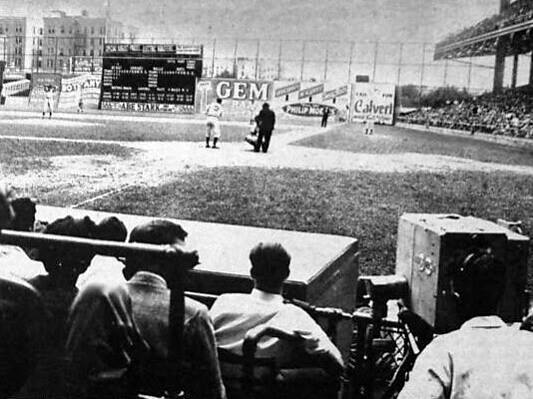
August 26, 1939: The Brooklyn Dodgers host a doubleheader against the Cincinnati Reds at Ebbets Field. The 2nd game is the 1st Major League Baseball game ever broadcast on television.

In 1935, Larry MacPhail was the general manager of the Reds. He made them the 1st MLB team ever to play under lights. He also put their games on regular radio for the first time, and his broadcaster was Walter "Red" Barber, a rural Floridian who adjusted well to a big city.

In 1938, these two redheads adjusted to a much larger city, New York, when MacPhail was named general manager of the Dodgers, and brought Barber with him, breaking the "gentlemen's agreement" that none of the City's teams would broadcast their games on radio.

MacPhail also made Ebbets Field the 1st of the City's 3 ballparks to put up lights. It may not have been a coincidence that the 1st night game there was against the Reds. Fortunately for baseball history, but unfortunately for the Dodgers, this game, on June 15, 1938, was the game in which the Reds' Johnny Vander Meer became the only man, to this date, to pitch back-to-back no-hitters in the major leagues.

On April 30, 1939, the New York World's Fair got underway in Flushing Meadow-Corona Park in Queens, across Roosevelt Avenue from where Shea Stadium and Citi Field would later be constructed. The opening, with a dedication by President Franklin D. Roosevelt, himself a New Yorker, was the 1st broadcast of W2XBS, New York's 1st television station.

Run by RCA, the Radio Corporation of America, W2XBS was going to be the centerpiece of a new TV network, to go along with the radio network they had established in 1926, the National Broadcasting Company, NBC. Now, it was going to broadcast baseball, and Red Barber was going to call the action.

But only for the 2nd game. The 1st game was won by the Reds, 5-2. This was not surprising: The Dodgers were a team on the rise, and would finish 3rd in the National League that season; but the Reds went on to win the next 2 NL Pennants.

Bucky Walters, the Reds' ace, won his 21st game of the season, outpitching Luke Hamlin. Walters would finish the season 27-11. If there had been a Cy Young Award back then, he surely would have won the NL's edition that season. Hamlin didn't pitch badly, but was undone by 2 errors by his teammates.

Between games, the telecast began. Barber gave a recap of the opener, and conducted interviews, including with Dodger manager and shortstop Leo Durocher. It was the beginning of a long and productive relationship between Barber and television -- and one between Durocher and television, as "Leo the Lip" used the medium, as he had already used print and radio, for his own cynical ends.

The 2nd game was the rescheduling of a game originally set for June 12, postponed not due to weather, but because it was the Opening Day of the Baseball Hall of Fame. Hugh Casey, better known as a reliever, started for Brooklyn, and Johnny Niggeling did so for Cincinnati. As the home team's starting pitcher, Casey thus became the 1st Major League Baseball player to play on television.

The Dodgers got on the board in the bottom of the 2nd inning. Art Parks led off with a single, and Dolph Camilli hit a home run. They broke the game open in the 3rd: Pete Coscarart led off with a single, and Cookie Lavagetto doubled him home. Dixie Walker grounded out, but Parks singled again, and Camilli doubled him home. Al Todd drew a walk, and Ernie Koy singled home Parks and Camilli. The Dodgers led 6-0.

The Reds reached Casey for a run in the 8th, but that was it: The Dodgers won 6-1, and the few hundred people capable of watching this game outside Ebbets Field (where a full house of 33,535 paid to watch) got their money's worth.

Sadly, it appears that no record of this game survives: Not the original TV broadcast, not a radio recording, not a film. The photograph at the top of the page is allegedly from that game.

Later in 1939, W2XBS would also become the 1st TV station in the world to broadcast college football and the 1st to broadcast pro football. In 1940, it became the 1st American TV station to broadcast a National Hockey League game (a British station had telecast a hockey game in London in 1938), the 1st to broadcast a religious service (Easter Mass from St. Patrick's Cathedral, a short walk from the RCA Building at Rockefeller Center), and the 1st to broadcast a political convention (the Republican Convention in Philadelphia, nominating Wendell Willkie to run against FDR, unsuccessfully as it turned out).

On July 1, 1941, the Federal Communications Commission (FCC) gave licenses to W2XBS and W2XAB, which was owned by the Columbia Broadcasting Service, CBS. Doing so on the same day meant that neither could claim to be the 1st. W2XBS became WNBT, broadcasting on Channel 4. They changed their call letters to WRCA in 1954, and to WNBC in 1960. W2XAB broadcast on Channel 2, and became WCBW, and then WCBS in 1946.

The other New York VHF TV stations:

* Channel 5 went on the air on May 2, 1944, on the DuMont Network, with its call letters being WABD, for its founder, Allen B. DuMont, went independent when DuMont folded in 1956, became WNEW in 1958, and WNYW when it became a Fox station in 1956.

* Channel 13 went on the air on May 13, 1948, as an independent station, WATV. It became WNTA in 1958, and WNDT in 1962. That year, it joined National Educational Television (NET), America's 1st "public television" network. In 1970, NET became the Public Broadcasting Service, PBS, and the station's call letters were changed to WNET. Why not WPBS? Those call letters were not already being used, but were subsequently given to a PBS station in Watertown, New York, on the St. Lawrence River, Channel 16.

* Channel 11 went on the air on June 15, 1948, as WPIX, the call letters referring to its ownership by the New York Daily News, "New York's Picture Newspaper." This was not unusual: Many radio TV stations were founded by newspapers. WPIX continues to use the Daily News Building on East 42nd Street as its headquarters, even though the paper has moved its offices elsewhere. The station joined Warner Brothers in 1995, becoming part of The WB. When The WB and UPN merged in 2006 to form The CW, WPIX went along with it.

* Channel 7 went on the air on August 10, 1948, as WJZ, an ABC station, becoming WABC in 1953.

* Channel 9 went on the air on October 11, 1949, as WOR, an independent station, becoming WWOR when bought by MCA in 1987, moved to United Paramount Network (UPN) in 1995, and to MyNetwork in 2006, following the WB/UPN merger.

*

August 26, 1939 was a Saturday. It was the off-season for the NFL and the NHL, and the NBA hadn't been founded yet. Here are the other MLB games that were played that day:

* The New York Yankees beat the St. Louis Browns, 6-1 at Sportsman's Park in St. Louis. Irving "Bump" Hadley went the distance. The Yankees hit no home runs, but got 2 hits each from Joe DiMaggio, Red Rolfe, Joe Gordon and Babe Dahlgren, who had replaced Lou Gehrig at 1st base.

* The New York Giants swept a doubleheader from the Pittsburgh Pirates at the Polo Grounds. The Jints won the opener 6-2, and the nightcap 8-0, as Cliff Melton pitched a 3-hit shutout.

* The St. Louis Cardinals swept a doubleheader from the Philadelphia Phillies at Shibe Park in Philadelphia. The Cards won the 1st game 5-0, as Curt Davis allowed 10 hits, but kept the shutout. The Cards won the 2nd game 11-4.

* The Chicago Cubs swept a doubleheader from the Boston Bees at Braves Field in Boston. This was during the stretch when the Braves, trying to change their identity after a horrible 1935 season, changed their name, with their ballpark being nicknamed "The Bee Hive." It didn't take, and they went back to being named the Braves in 1941. Both games in this doubleheader ended 8-1 in the Cubs' favor.

* It was also Chicago beating Boston in the American League, as the Chicago White Sox beat the Boston Red Sox, 5-4 at Comiskey Park in Chicago.

* The Cleveland Indians beat the Philadelphia Athletics, 7-5 at League Park in Cleveland.

* And the Detroit Tigers beat the Washington Senators, 6-3 at Briggs Stadium in Detroit. That ballpark would be renamed Tiger Stadium in 1961.

Also, Arsenal opened what turned out to be their shortest Football League season by drawing with Wolverhampton Wanderers, 2-2 at Molineux Stadium in Wolverhampton, outside Birmingham in England's West Midlands. Two weeks later, the League would suspend play due to the start of World War II. 

December 31, 1999 & January 1, 2000: The Millennium

December 31, 1999:  The Millennium arrives. The people of planet Earth survived. At a terrible cost. But we hadn't destroyed ourselves. ...