Showing posts with label larry bird. Show all posts

Wednesday, October 12, 2022

October 12, 1979: Magic, Larry & the 3-Pointer Debut

October 12, 1979: The much-hyped opponents from the previous March's collegiate National Championship game make their NBA debuts. Earvin "Magic" Johnson scores 26 points, and veteran Kareem Abdul-Jabbar scores 29, and the Los Angeles Lakers need them all to defeat the San Diego Clippers, 103-102 at the San Diego Sports Arena. (That building still stands, under the name Pechanga Arena.) The Lakers needed all those points because Lloyd Free, later to rename himself World B. Free, scores 46 for the Clippers.

Larry Bird has a quieter debut, scoring 14 points, but the Boston Celtics have an easier game, overcoming 31 points from Moses Malone and defeating the Houston Rockets 114-106 at the Boston Garden.

This is also the day the 3-point field goal finally enters regular-season NBA play, after having previously been used in the American Basketball League (1961-63) and the American Basketball Association (1967-76). The Celtics' Chris Ford is the 1st player to attempt one, and the 1st player to make one. Larry goes on to make the trey a major part of his arsenal, while Magic doesn't, proving that he didn't really need it.

Another debut on this day is that of the Utah Jazz, after 5 seasons without making the Playoffs as the far more sensibly-named New Orleans Jazz. They get pounded 101-85, by the Portland Trail Blazers at the Veterans Memorial Coliseum in Portland.

Coach Frank Layden will eventually right the ship in Salt Lake City, and make them a consistent Playoff team and a model franchise, though they've never won a title. 

He would also remark that the team, and the Minneapolis Lakers, had names that made sense in their original cities, but not anymore. He suggested that they switch names, as "Los Angeles Jazz" and "Utah Lakers" both made much more sense.

The arrivals of Magic and Larry are said to have "saved the NBA." This is nonsense. The league already had Kareem, and Julius "Dr. J" Erving, and Bill Walton, and plenty of other great players.

Times change. Today's kids only know Magic, and Michael Jordan, as team owners. They know Larry, and Jerry West, as team executives. They know Dr. J, and Walton, and Shaquille O'Neal, and Charles Barkley, and Walt Frazier as broadcasters. They know Patrick Ewing and Isiah Thomas as coaches. They know Kareem as something of a curmudgeon. And they have no idea that Wilt Chamberlain would have eaten LeBron James.
*

October 12, 1979 was a Friday. There were 6 other games in the NBA on this tipoff night:

* The New York Knicks lost to the Atlanta Hawks, 121-1014 at The Omni in Atlanta.

* The New Jersey Nets beat the Cleveland Cavaliers, 102-95 at the Rutgers Athletic Center (now the Jersey Mike's Arena) in Piscataway, New Jersey.

* The Philadelphia 76ers beat the Washington Bullets, 93-92 at the Capital Centre in the Washington suburb of Landover, Maryland.

* The Detroit Pistons beat the Indiana Pacers, 114-105 at the Silverdome in the Detroit suburb of Pontiac, Michigan.

* The Kansas City Kings beat the Milwaukee Bucks, 105-103 at the Kemper Arena (now the Hy-Vee Arena) in Kansas City.

* And the Phoenix Suns beat the Golden State Warriors, 97-89 at the Arizona Veterans Memorial Coliseum in Phoenix.

The NHL was also early in its season, but only had 1 game on this night: The Vancouver Canucks beat the Detroit Red Wings, 3-1 at the Pacific Coliseum in Vancouver.

And Game 3 of the World Series was played at Three Rivers Stadium in Pittsburgh. The Baltimore Orioles came from 3-0 down to beat the Pittsburgh Pirates, 8-4. Scott McGregor outpitched John Candelaria, and Benny Ayala hit a home run. But the Pirates would win the Series in 7 games.

Saturday, March 26, 2022

March 26, 1979: Magic & Larry Make March Go Mad

March 26, 1979: The Camp David Accords are signed at the White House, by President Jimmy Carter, President Anwar Sadat of Egypt, and Prime Minister Yitzhak Rabin of Israel.

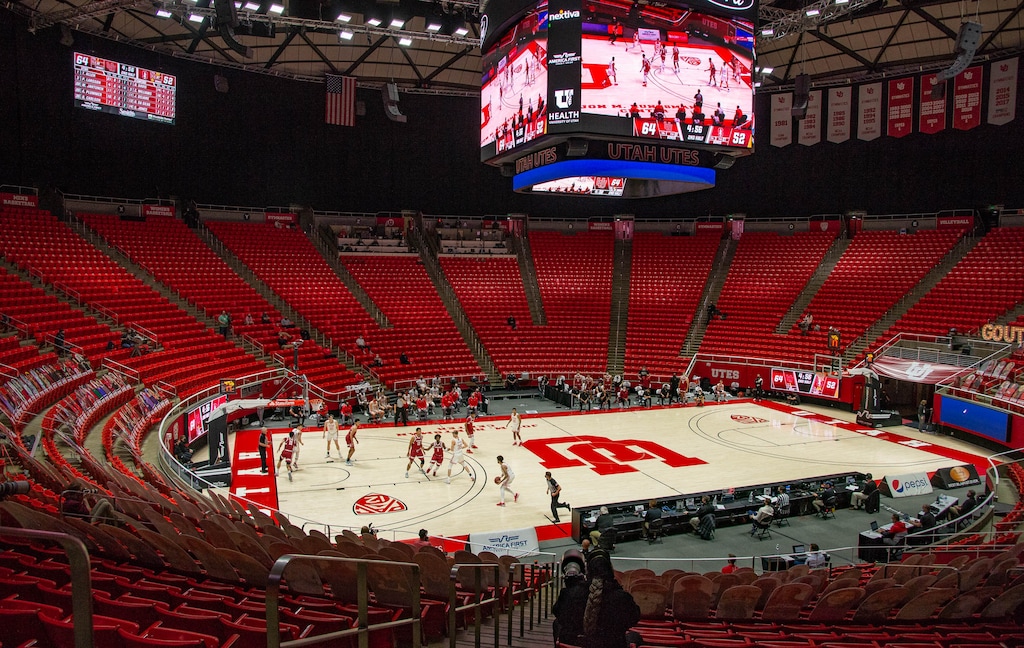
It is a momentous day for another reason, although hardly anybody knew it at the time. The NCAA held the Final of its Division I Basketball Tournament, at the Special Events Center at the University of Utah, in Salt Lake City.

As CBS college basketball analyst Seth Davis put it in the title of a book he wrote, it was When March Went Mad.
Built in 1969, the building is still used by the Utah Runnin' Utes, and has since been renamed the Jon M. Huntsman Center, in honor of the chemical magnate whose son, also named Jon Huntsman, would later serve as Governor of Utah and U.S. Ambassador to Russia.
Indiana State University, of Terre Haute, coached by Bill Hodges, undefeated at 33-0, Champions of the Missouri Valley Conference in both its regular season and its tournament, and in its 1st-ever Final Four (the term had officially been adopted the year before), took on Michigan State University, of East Lansing, coached by George "Jud" Heathcote, 25-6, Co-Champions of the Big Ten Conference (which then had no tournament), and in its 2nd Final Four, the 1st coming in 1957.

A crowd of 15,410 saw it live. About 40 million saw it on NBC, making it the most-watched basketball game ever to that point, college or pro -- and probably the best thing to happen to the Peacock Network all year. The announcers Dick Enberg, Billy Packer, and Al McGuire, who had won this game 2 years earlier in his final game as head coach at Milwaukee's Marquette University.

Why such a huge audience? Because of each team's respective stars. ISU, the Sycamores, had senior forward Larry Bird. Portland Trail Blazers star Bill Walton was so frequently hurt. Ernie DiGregorio had flamed out. And John Havlicek, Dave Cowens, Rick Barry and Pete Maravich were winding down their careers. So white basketball fans wanted to believe in a "Great White Hope." "The Hick from French Lick" seemed to be it.

But MSU, the Spartans, had Earvin Johnson, a sophomore guard nicknamed "Magic." Like Michael Jackson, he had a million-dollar smile -- at a time when the phrase "million-dollar" still meant something. Like Julius "Dr. J" Erving of the Philadelphia 76ers, he had amazing moves and a fabulous nickname. Unlike the moody Los Angeles Lakers star Kareem Abdul-Jabbar, he had a winning personality, and a name that was easy to spell and pronounce.

Both men wore Number 33. When Magic was drafted by the Lakers, Kareem had 33, so Magic switched to 32. Bird was able to keep 33 with the Boston Celtics.

The game was close for a little while, with Michigan State leading 9-8. But the Spartans were able to cover Bird tightly, enabling them to go on a 9-0 run, and led 37-28 at the half. In the 2nd half, they jumped out to a 50-34 lead. 

But Bird got the Sycamores on a good run, and with 10 minutes left (college basketball uses halves but not quarters, but this would have been the end of the 3rd quarter), Indiana State had climbed to within 52-46. The game was far from over.

There was no shot clock in college basketball at the time. For the last 5 minutes, Michigan State held onto the ball as much as they could, eating the clock, stalling. At one point, Johnson tried to inbound the ball, and Bird stole it -- presaging a famous play he would make for the Celtics against the Detroit Pistons in the 1987 NBA Playoffs. But since this was not done for the Celtics in the Boston Garden, the referee applied the rule book, and called Bird for a technical foul.

That was Indiana State's last real gasp. Michigan State won, 75-64. It was Indiana State's only loss of the season. Bird scored 19 points, but only made 7 of his 21 field goal (2-point) attempts. Johnson scored 24, shooting 8 of 15. Following his 29-point performance in the Semifinal win over Bob Weinhauer's University of Pennsylvania (still the last Ivy League team to reach the Final Four), Magic was named the Tournament's Most Outstanding Player.

Many observers credit this game with "saving basketball." This was ridiculous. As I said, the NBA already had Kareem, Dr. J and Walton. It also had Elvin Hayes and Moses Malone. It was not wanting for stars. Just for white stars.

Bird graduated, and the Celtics had traded up to acquire his draft rights, and he signed with them between the end of his eligibility and the deadline for the draft -- which would soon be banned by what became known as "The Larry Bird Rule." Johnson forewent his last 2 years of college eligibility, and made himself eligible for the 1979 NBA Draft. He was the top pick, as the Lakers had acquired the pick from the Utah Jazz.

Johnson would be key to the Lakers winning the NBA Championship in 1980 and 1982; Bird would be key to the Celtics doing so in 1981. They would face each other in 3 out of 4 NBA Finals: The Celtics won in 1984, the Lakers won in 1985 and 1987.

The Celtics also won in 1986, over the Houston Rockets; while the Lakers won in 1988 over the Detroit Pistons, and also lost Finals to the 76ers (with Erving and Malone) in 1983, the Pistons in 1989, and the Chicago Bulls (with Michael Jordan) in 1991, before the Magic Era came to a stunning end, with 3 letters none of us knew in 1979: HIV. Bird played on until 1992. Both of them, and Jordan, played on the U.S. "Dream Team" that won the Gold Medal at the 1992 Olympics in Barcelona, Spain.

The term "March Madness" had been used in high school basketball before 1979. But it began to be applied to the NCAA Tournament as well. The NCAA now owns the trademark.

As of March 26, 2022, the 1979 NCAA Tournament Final remains the most-watched college basketball game of all time, although its 40 million viewership has been surpassed by a few NBA games.

*

March 26, 1979 was a Monday. Baseball was in Spring Training. Football was out of season. No NBA games were scheduled. Nor were any games scheduled in the World Hockey Association.

Only 1 game was played in the NHL: The Buffalo Sabres beat the St. Louis Blues, 4-2 at the Checkerdome in St. Louis. At the time, St. Louis-based Ralston Purina owned the Blues, and they renamed the St. Louis Arena after their "Checkerboard Square" logo. The Arena regained its old name in 1980.

December 31, 1999 & January 1, 2000: The Millennium

December 31, 1999:  The Millennium arrives. The people of planet Earth survived. At a terrible cost. But we hadn't destroyed ourselves. ...