Showing posts with label notre dame fighting irish. Show all posts

Thursday, December 29, 2022

December 29, 1934: The 1st Madison Square Garden Doubleheader

December 29, 1934: Madison Square Garden in Midtown Manhattan hosts its 1st college basketball doubleheader. It was set up by Edward S. "Ned" Irish, then head of promotions for The Garden.

Irish, then 29 years old and a native of Brooklyn, had covered Manhattan College basketball games for the New York World-Telegram, and saw that their games, especially against other teams in New York City, had more demand than the seats had supply. So he quit his job to become promotions director for The Garden, whose current version, built in 1925, was between 49th and 50th Streets, and 8th and 9th Avenues.
Ned Irish

For the 1st doubleheader, each game featured a New York City-based team vs. one from outside the city. In the 1st game, New York University, of Manhattan, beat the University of Notre Dame, of South Bend, Indiana, 25-18. NYU would finish the 1934-35 season 19-1, and were recognized as National Champions. In the 2nd game, St. John's University, of Queens, lost to Westminster College, of New Wilmington, Pennsylvania, 37-33.

If those scores seem low to you, consider the state of the sport at the time: It was almost all slow, skinny white guys; there was no shot clock; and, until 1938, there was a center jump after every basket. In other words, what would become known as the fast break was not only difficult, it was completely impractical.

A crowd of 16,138 attended, then the largest crowd ever to pay to see a basketball game, at any level, marking the experiment as a success. Another doubleheader was set up for a week later, on January 5, 1935. NYU beat Kentucky, 23-22, before a new record high, 16,539.

Though defeated, Kentucky coach Adolph Rupp liked the idea so much that he suggested that there should be a national college basketball tournament. That was such a good idea that, by the end of the decade, there were 2: The National Invitation Tournament (NIT) started in 1938, the 1st one won by Temple University of Philadelphia; and the NCAA Tournament started in 1939, the 1st one won by the University of Oregon.

After the 1934-35 season, being invited to play in a "Garden doubleheader" was a sign that a school had made the big time. Already known as "The Mecca of Boxing," The Garden became known as "The Mecca of Basketball."
But the point-shaving scandal of 1951 crippled New York City basketball, with only St. John's among the City's schools emerging unscathed. After that, the pro game became more popular, with Ned Irish becoming the founding owner of the New York Knicks. The event that opened the new Garden in 1968 was a doubleheader. Dave DeBusschere scored the new Garden's 1st basket -- not for the Knicks, but for the Detroit Pistons in the 1st game of the doubleheader.

In 1959, Irish sold the Knicks to Irving Felt, but remained team president. He was elected to the Basketball Hall of Fame in 1964. In 1968, he and Felt moved the Knicks into the current Madison Square Garden, between 31st and 33rd Streets, and 7th and 8th Avenues. He retired as team president in 1974, and died in 1982.

The event that opened the new Garden in 1968 was a doubleheader. Dave DeBusschere scored the new Garden's 1st basket -- not for the Knicks, but for the Detroit Pistons, in the 1st game of the doubleheader.

*

December 29, 1934 was a Saturday. ABC News reporter Tom Jarriel was born on this day.

The NBA hadn't been founded yet. Baseball was in the off-season. No college football games were played that day, as there were, as yet very few bowl games. The NFL season had ended 20 days earlier, with the New York Giants beating the Chicago Bears in the Championship Game.

There were 2 games played in the NHL: The New York Americans beat the Montreal Canadiens, 3-1 at the Montreal Forum. and the Montreal Maroons beat the Toronto Maple Leafs, 4-2 at Maple Leaf Gardens in Toronto.

And in English soccer, Arsenal and Hampshire team Portsmouth played to a 1-1 draw at Highbury in North London.

Wednesday, December 14, 2022

December 14, 1920: George Gipp Dies

December 14, 1920: George Gipp dies of pneumonia, possibly related to a streptococcus infection, at St. Joseph's Hospital in South Bend, Indiana, seat of the University of Notre Dame, where he was a student. He was 25 years old.

He was born on February 18, 1895, 13 days after Babe Ruth, and 16 days after George Halas, in Laurium, on the Upper Peninsula of Michigan. He went to Notre Dame hoping to play baseball. But their head coach, Knute Rockne, thought he would be a good back, both offensive and defensive, in football. Gipp had never played the sport before, but tried it anyway.

Rockne proved to be right: Gipp was named an All-American for the 1920 football season, as Notre Dame went undefeated, 9-0:

* October 2: Beat Kalamazoo College at home, 39-0. (They are now in NCAA Division III.)
* October 9: Beat Western State at home, 42-0. (Also based in Kalamazoo, they are now named Western Michigan University.)
* October 16: Beat Nebraska in Lincoln, 16-7.
* October 23: Beat Valparaiso at home, 28-3. (Valparaiso is based in the Indiana town of the same name.)
* October 30: Beat Army at West Point, 27-17.
* November 6: Beat Purdue at home, 28-0.
* November 13: Beat Indiana at Washington Park in Indianapolis, 13-10.
* November 20: Beat Northwestern in Evanston, 33-7.
* November 25, Thanksgiving Day: Beat Michigan Agricultural in East Lansing, 25-0. (Now known as Michigan State.)

Notre Dame outscored its opponents 251-44, for an average of 29-5. And Gipp was a major reason why, on both sides of the ball. There were no official National Championships in those days, but, retroactively, some sources have listed Notre Dame as such. (Other sources awarded it to Harvard or the University of California.) 

So how did he get sick? Most likely, he was giving punting lessons in cold weather. Being in northeastern Indiana, the cold weather is the reason that the Notre Dame-USC game is played in October when it's the Fighting Irish's turn to host it, and on Thanksgiving Saturday when it's USC's turn to host in Los Angeles.

The more popular version, but the less likely one, is that Gipp, a known carouser, returned to campus after curfew one night, and found his residence hall locked. He went to Washington Hall, the campus' theatre building, because he knew the back door was often unlocked, and spent many post-curfew nights in the hall. This time, the door was locked, so he slept outside, and that's how he got pneumonia.

This story is believable because Gipp was a carouser. He was a gambler, a womanizer, and a drunkard. He was a cardplayer and a pool hustler. He would bet on anything. He even bet on his own team, just like Pete Rose would decades later. He also tended to not show up for classes (mandatory) or Mass (equally mandatory for a Catholic school in those days).

And the University, including Rockne himself, covered up for him. Under modern NCAA rules, Gipp might have singlehandedly gotten Notre Dame put on probation.

At any rate, there were no antibiotics available then. Had there been, he could have recovered quickly, spent a nice Christmas at home on the U.P., and played in the early National Football League and become a star, making bundles of money. He, rather than Red Grange of Illinois and the Chicago Bears a few years later, could have become the NFL's 1st real star. (Or maybe its 2nd, after Jim Thorpe, who was already playing for the Canton Bulldogs.) Alas, in those pre-antibiotic days, you really could die from something as simple as "strep throat."

He was buried in Lake View Cemetery, outside Calumet, Michigan. Laurium put up a monument to him.

On November 10, 1928, Notre Dame played Army at Yankee Stadium. A crowd of 78,188 saw the Cadets lead the Fighting Irish 6-0 at halftime. It wasn't that surprising: Army was undefeated, 6-0, while Notre Dame was only 4-2.

In his halftime pep talk, instead of discussing strategy, Rockne told his players, who would have been in junior high school in 1920, about George Gipp. As Rockne told it, he went to see Gipp on his deathbed, and Gipp told him: 

I've got to go, Rock. It's all right. I'm not afraid. Some time, Rock, when the team is up against it, when things are wrong, and the breaks are beating the boys, ask them to go in there with all they've got, and win just one for the Gipper. I don't know where I'll be then, Rock. But I'll know about it, and I'll be happy.

Having told the 1928 players that story, Rockne concluded by saying, "Gentlemen, this is that game." And the players left the locker room in tears, and came from behind, and beat Army 12-6.

That's the story. But it makes no sense. First of all, why choose this game? Because it was in New York? Because it was against Army? Certainly, Rockne didn't need to be afraid of losing his job: He was already an icon in South Bend.

Second of all, they were only down by 6 points. Maybe if they needed a much bigger effort, to overcome a 2-touchdown deficit, such a speech might be warranted.

Third of all, like I said, those players were just kids when Gipp died. They never saw him play. It's not like there was television back then. The newsreels probably never showed Gipp. For all they knew, Rockne could have been lying, and Gipp could have walked into the room at that moment, and they wouldn't have recognized him. (Another coach, Edward "Slip" Madigan of St. Mary's in the San Francisco Bay Area, allegedly once tearfully told his players about his sick son, and said to win the game for him, when the son walked in, just fine.) Gipp's legend shouldn't have had any effect on the 1928 Fighting Irish.

And fourth of all, if the locker room speech did happen, Rockne probably made it up. As one sportswriter put it, decades later, If Gipp said anything to Rockne as he was dying on December 14, 1920, it was probably more along the lines of, "Put a hundred bucks on the 4 horse in tomorrow's 7th race at Arlington for me."

Rockne was killed in a plane crash near Bazaar, Kansas on March 31, 1931. So, whatever the truth of the final meeting between Gipp and Rockne was, it died with Rockne.

On October 4, 1940, the film Knute Rockne, All-American premiered. Pat O'Brien played the coach. Ronald Reagan, who had played guard at Eureka College in Illinois, now an NCAA Division III school, played Gipp, and played the speech scene straight.
Reagan as Gipp

As Reagan went into politics in the 1960s, and was elected President in 1980, he often played up his connection to Notre Dame. At the 1988 Republican Convention, at the Superdome in New Orleans, knowing he couldn't run for a 3rd term, he told the new nominee, his Vice President, George H.W. Bush (who played baseball at Yale), "Go out there, and win one for the Gipper!" Meaning himself. Bush did win the election.

As Reagan fell victim to Alzheimer's disease, and could no longer make public appearances, campaign signs reading, "WIN ONE FOR THE GIPPER" appeared at rallies for Bob Dole in 1996 and George W. Bush in 2000. Reagan died in 2004, and during Bush's re-election campaign, there were more "Gipper" signs than ever before. They still come up, every 4 years: For John McCain in 2008, for Mitt Romney in 2012, and for Donald Trump in 2016 and 2020.

Reagan's political career was built on many, many lies. The "Win one for the Gipper" story was the first. If the truth about Gipp had been widely known in 1966, when Reagan was making his 1st run for public office, for Governor of California, he might never have won an election. After all, the other movie people tended to remember him for was Bedtime for Bonzo, where he worked with a chimpanzee.

George Gipp was a real person, and he really was a great football player. But the thing everybody remembers about him almost certainly isn't true. But, like Reagan's campaign promises, Rockne's Gipper speech was a fraud -- or, as the actual Irish would say, it was blarney -- that worked very well.

*

December 14, 1920 was a Tuesday. There were no scores on this historic day: The college football season was over except for the Rose Bowl, baseball was out of season, the NBA hadn't been founded yet, and while the NHL season was underway, no games were scheduled.

But there was one notable sporting event that day. Jack Dempsey defended the Heavyweight Championship of the World, knocking Bill Brennan out in the 12th round, at the 2nd Madison Square Garden, the one that stood off the actual Madison Square, at 26th Street and 5th Avenue, from 1890 to 1925. It was his only fight at any building with the name Madison Square Garden.

Wednesday, December 7, 2022

December 14, 1930: The New York Giants Beat the Notre Dame All-Stars

December 14, 1930: A football game was played at the Polo Grounds in Upper Manhattan. The home team was not the one cheered by most of the fans. Most of them left stunned at the result.

America was a year into the Great Depression, and Jimmy Walker, the flamboyant, corrupt Mayor of New York City, had a private unemployment relief fund. He contacted his friend, Charles Stoneham, owner of the New York Giants baseball team and its home, the Polo Grounds; and another friend, Tim Mara, owner of the New York Giants football team, which leased the Polo Grounds from Stoneham. He asked if Stoneham would host, and Mara would play, a benefit game for the relief fund. Both agreed.

But who would be the opponent? There was a football team called the Brooklyn Dodgers, and another called the Staten Island Stapletons, but neither had a following that would fill the Polo Grounds' 56,000 seats. Nor did the Giants: Only once all season did they have a home crowd over 25,000, and that was on November 23, when 37,000 saw them beat the Green Bay Packers, 13-6. That would be the Packers' only loss of the season, as they won the Championship by 1 game over the Giants.

The most popular football team among New Yorkers was a college team, 700 miles west: The University of Notre Dame, in South Bend, Indiana. Although there is a school in Washington, D.C. named "The Catholic University of America," the high profile of Notre Dame's football team had made their school America's most familiar Catholic school.

This was due to the success of their head coach, the charismatic Norwegian immigrant Knute Rockne. Coaching players like the ill-fated George Gipp on his National Championship teams of 1919 and 1920, and the four-man backfield known as "The Four Horsemen" on his National Championship team of 1924, Rockne had made himself and his school legend. Catholics in cities like New York, Philadelphia, Boston and Chicago, who couldn't afford to go to college, or even to finish high school, read of Notre Dame's exploits in the newspapers, and became fans, known as "Subway Alumni."

The game in which the great Southern, but nationally-syndicated, sportswriter Grantland Rice had named quarterback Harry Stuhldreher, halfback Don Miller and Jim Crowley, and Elmer Layden "The Four Horsemen," after the Apocalypse figures in the Bible's book of Revelation, had been at the Polo Grounds, a win over the U.S. Military Academy, a.k.a. "Army." The 1928 game in which Rockne had told his players of the dying wish of Gipp, suffering from an infection in those pre-antibiotic days, to "win just one for the Gipper," had also been against Army, at Yankee Stadium.

And Notre Dame had won the National Championship again in 1929 and 1930. In the current season alone, they had gone 10-0, and brought 66,000 fans to Pitt Stadium for their win over the University of Pittsburgh, 75,000 to Franklin Field in Philadelphia for their win over the University of Pennsylvania, 110,000 to Soldier Field in Chicago for their win over Army, and 74,000 to the Los Angeles Memorial Coliseum for their win over the University of Southern California.

So they were the ideal opponent. And it's not as though teams in the NFL's early days hadn't played college teams before. So the Giants asked Rockne if he would bring his "Fighting Irish" east to play the Giants.

He wouldn't do it. Not because he objected to playing professionals -- or because the game would be on a Sunday. (The State of New York had only legalized professional sports on Sundays in 1919.) It was because the game had been set for December 14, only 8 days after their win over USC, and, having needed 3 days to get back to South Bend by train, and needing another day to get to New York by train, Rockne thought his players would be too tired to play.

So a team of "Notre Dame All-Stars" was set up: A few of the current players, who felt they could do it, came east. And the Four Horsemen, none of whom had made the trip to Los Angeles, were reunited.

But Stuhldreher was now the head coach at Villanova University in Philadelphia, Crowley the head coach at Michigan State, Layden the head coach at the University of Pittsburgh, and Miller the backfield coach at Ohio State. None of them had played beyond the 1926 season, and they were now 29 (Stuhldreher), 28 (Miller and Crowley) and 27 (Layden) years old -- not old if they had still been playing all along, but old enough to not be able to fully resume their playing careers if they had wanted.

Nevertheless, the American media had put into the heads of the American football-watching public that college football was superior to professional football, that pro football was a way for boys who hadn't grown up to make money playing the game they loved, on top of, or maybe instead of, getting a "real job." The consensus was that the Giants would be no match for the 24 men who assembled to represent the great Notre Dame.

But the Giants had quarterback Benny Friedman, who has been called the NFL's 1st great passer. They had end Red Badgro. They had tackle Steve Owen, who was also their head coach. All 3 would one day make the Pro Football Hall of Fame. They had backs Dale Burnett and Chris Caple. There were reasons why the Giants nearly won the NFL Championship.

Instead, the Giants sacked Stuhldreher in the end zone for a safety just 2 minutes into the game, and led 2-0. The Giants' big linemen overwhelmed the Notre Dame line, including some of the "Seven Mules" who had blocked for the Four Horsemen. It did no good: The Irish gained only 34 yards -- the entire game. Their passing attack was 0-for-9, with 2 interceptions.

In the New York Daily News, Marshall Hunt wrote of the crowd that came to see Notre Dame and ended up seeing the Giants, "More than 50,000 cheered every futile thrust of Knute Rockne's improvised squadron of former Notre Dame football players against the super line of Tim Mara's team."

In the 2nd quarter, Friedman drove the Giants down the field, and scored on a 4-yard touchdown run. Close to halftime, the Giants' line opened a hole for him, and he ran in from 22 yards. Giants 15, Fighting Irish 0.
Rockne lost the plot, as would be said in English soccer. This was not something he did often. He found Giants team president Harry March, and tore into him for allowing the Giants to embarrass his squad in a purported charity game. He told March to call off the dogs in the second half.

March must have gotten the message to Owen, because he sent in the reserves. And still, in the 3rd quarter, Francis "Hap" Moran threw a touchdown pass to Glenn Campbell (no relation to Glen Campbell the later singer). The Giants won, 22-0.

As sports historian Clayton Trutor wrote for Notre Dame Magazine in 2021:

The 22-0 final score headlined all newspapers in the city, earning the hometown team a grudging respect from writers who had previously discounted the professional game. Nevertheless, they were treated like sparring partners by many of the New York papers, who instead focused their coverage on the plucky performance of a Notre Dame alumni team that had assembled just a few days earlier.

It wasn't the catalyst for the NFL to take over from the pros in the minds of the public, but it was part of a gradual process that began, also with the Giants at the Polo Grounds, when Red Grange and the Chicago Bears beat them in front of 75,000.

Rockne died in a plane crash the next year, and many of the other great old football coaches, some of whom had spoken ill of the professional game -- passed from the scene, either through death or retirement.

In 1933, Jim Crowley became the head coach at Fordham University in The Bronx, and coached a line known as "The Seven Blocks of Granite," including future Packer coach Vince Lombardi. That team played their bigger games at the Polo Grounds, and had a famous 0-0 tie with Pittsburgh there, with both teams going in undefeated.

*

December 14, 1930 was a Sunday. There was 1 regular-season game in the NFL that day: The Green Bay Packers, their Championship already assured, played the Portsmouth Spartans to a tie, 6-6 at Universal Stadium (now Spartan Memorial Stadium) in Portsmouth, Ohio.

Baseball was out of season. The NBA hadn't been founded yet. There were 2 games in the NHL. The New York Rangers beat the Detroit Falcons, 3-0 at the old (but then-new) Madison Square Garden. And the Montreal Maroons beat the Chicago Black Hawks, 2-0 at the Chicago Stadium. The Falcons became the Red Wings in 1932, and the Maroons folded in 1938.

Wednesday, November 30, 2022

November 30, 1974: The Anthony Davis Game

November 30, 1974: The University of Southern California hosts the University of Notre Dame in football at the Los Angeles Memorial Coliseum.

USC vs. Notre Dame is the biggest inter-sectional rivalry in American college football, and has been since it was established in 1926. No other pair of traditional rivals has as many National Championships, or as many Heisman Trophy winners. Notre Dame has had more 1st-round picks in the NFL Draft than any other school, and USC is 2nd in that regard. And both teams' fans are regarded as insufferable by pretty much everyone who hasn't bought into the schools' respective myths.

In odd-numbered years, the game is played at Notre Dame Stadium in South Bend, Indiana, in mid-to-late October, when the leaves are changing. In even-numbered years, the game is played at the Los Angeles Memorial Coliseum, on the Saturday of Thanksgiving weekend, when it would be too cold to play it in the Midwest.

It had been 10 years since USC had upset Notre Dame to end their National Championship hopes. Since then, Ara Parseghian had led Notre Dame to the National Championship in 1966 and 1973, and John McKay had led USC to it in 1967 and 1972, and were both still in charge.

Notre Dame went into the game at 9-1. Their only loss had been at home to Purdue. Their only ranked opponent was Number 17 University of Pittsburgh, whom they beat at home. Nevertheless, being Notre Dame, they were still the media darlings, and were ranked Number 5.

USC came in at 8-1-1. They lost their opener away to Number 20 Arkansas. But they beat Pitt, who were then ranked Number 8, away. They were held to a tie by the University of California at home. The week before, they beat UCLA to clinch the Pacific-Eight Conference title, and were ranked Number 8 coming in. As usual, ABC broadcast the game nationally.

Notre Dame took a 24-0 lead in the 2nd quarter. In 2021, for a USC-themed website, Trojan linebacker Kevin Bruce wrote:

The entire game was the typical uber-physical and nasty play on the field. Lots of punching, poking, grabbing and chippy-yacking after most plays. It was only the vague deep-down stirring of playing disciplined football just in case we could claw our way back into this game that prevented a fullout bar fight on the field in the first, as had happened several times in the last few years.

USC scored a touchdown before the end of the half, but the extra point was blocked: 24-6. McKay told his team at intermission that they still had a very good chance to win if they just calmed down, focused on scoring on their opening drive of the 2nd half, and executed better on defense.

(McKay liked to use the word "execution." In 1976, he left USC to become the 1st coach of an NFL expansion team, the Tampa Bay Buccaneers. He went from 3 National Championships to an 0-26 start. When asked what he thought of his team's "execution," he said, "I'm for it.")

Bruce again:

I'm delighted to be able to tell you as an eyewitness and active participant what really happened on that magical day in November 1974. This was the day that Sports Illustrated called "17 minutes that shook LA." This was an earthquake that was very selective. Only Notre Dame was damaged by it, which I for one, think is a best practice. The only thing missing was Traveler stomping on that annoying little green leprechaun. 

In the 1961 Rose Parade in Pasadena, a USC events director saw Richard Saukko riding his white horse, Traveler. Saukko was talked into riding his horse around the Coliseum track at USC football games. The tradition has continued. The rider is often called Tommy Trojan, like the famous on-campus statue, but the character does not have an official name. The rider continues to ride a horse named Traveler around the field before every game, after every win, and following every touchdown, although the Coliseum's 1995 renovation has removed the track.

Notre Dame kicked off to start the 2nd half, and Anthony Davis returned the ball 102 yards for a touchdown. He scored twice more, as USC put up 49 points in 16 minutes and 31 seconds of game time, to win going away, 55-24.

Davis later said that, on his last run into the end zone, he saw a nun waving a crucifix at him, saying, "You must be the Devil! Nobody does that to Notre Dame!" Well, Anthony Davis did that to Notre Dame.
John McKay and Anthony Davis

Joe Jares, the Sports Illustrated writer quoted above by Bruce, said that the loss was "the worst disaster for the Irish since the potato famine." This was the final regular season game for Notre Dame's Hall of Fame head coach Ara Parseghian, who announced his retirement after the year. Parseghian was sick over what transpired and reportedly said "he was damn tired" of seeing Traveler running around the track every time USC scored.

USC fans call it "The Comeback." Notre Dame fans call it "That Game," or worse. USC had already clinched the title in the league then known as the Pacific-Eight Conference the week before, beating intra-city rival UCLA.

Davis finished 2nd in the Heisman Trophy voting, to Ohio State running back Archie Griffin. He played in 4 different professional football leagues: The World Football League (WFL), with the Southern California Sun in 1975; the Canadian Football League (CFL), with the Toronto Argonauts in 1976; the NFL, with McKay's Tampa Bay Buccaneers in 1977, the Houston Oilers in 1978, and the Los Angeles Rams, back at the Coliseum and again with Haden as quarterback, later in 1978; and the United States Football League (USFL), with the Los Angeles Express, again at the Coliseum, in 1983.

He later became a successful real estate developer, but, like so many other football players, his head-on collisions led to CTE and brain impairment. As of November 30, 2022, he is still alive.

*

November 30, 1974 was a Saturday. These other notable college football games were played that day:

* Rivalry: Number 1 Oklahoma beat Oklahoma State, 44-13 at Owen Field in Norman. The Sooners won the Big Eight Conference title, and were undefeated at 11-0. However, they were on probation, due to recruiting violations, and were not eligible for the UPI coaches' poll National Championship, or a bowl game appearance, or even a television appearance. Nevertheless, the AP sportswriters' poll awarded them their National Championship.

* Number 16 Baylor beat Rice, 24-3 at Baylor Stadium (later Floyd Casey Stadium) in Waco, Texas. Baylor clinched the Southwest Conference title.

* Rivalry: Navy beat Army, 19-0 at John F. Kennedy Stadium in Philadelphia.

* Rivalry: Boston College beat Holy Cross, 38-6 at Alumni Stadium outside Boston in Chestnut Hill, Massachusetts.

* Rivalry: Georgia Tech beat Georgia, 34-14 at Sanford Stadium in Athens.

* Rivalry: Florida beat Miami, 31-7 at Florida Field in Gainesville.

* Rivalry: Heavily favored Tennessee were held to a tie by Vanderbilt, 21-21 at Dudley Field (now FirstBank Stadium) in Nashville.

* Mississippi (Ole Miss) beat Tulane, 26-10 at Tulane Stadium in New Orleans. This was Tulane's last game at their old stadium. The following season, they moved into the Superdome.

* Louisiana State (LSU) beat Utah, 35-10 at Tiger Stadium in Baton Rouge, Louisiana. I have no idea why this one was set up: It sounds more like a bowl game.

* Rivalry: Arizona beat Arizona State, 10-0 at Arizona Stadium in Tucson.

* And Rutgers lost to Hawaii, 28-16 at Honolulu Stadium. Hawaii played 1 more game there, losing to Arizona State the next week, and opened the new Aloha Stadium the next season.

* The day before, Number 2 Alabama beat Number 7 Auburn, 17-13 at Legion Field in Birmingham. 'Bama won the Southeastern Conference title.

* Also the day before, Number 17 Texas upset Number 8 Texas A&M, 32-3 at Memorial Stadium in Austin.

* And the day before that, Thanksgiving, Number 10 Penn State beat Number 18 Pittsburgh, 31-10 at Three Rivers Stadium in Pittsburgh. Penn State went on to beat Baylor in the Cotton Bowl.

* Number 8 Nebraska were idle, having lost a game, and the Big 8 title, to Oklahoma the week before. They beat Florida in the Sugar Bowl.

* Number 3 Ohio State were idle, having beaten then-Number 2 Michigan for the Big Ten Conference title. USC, with Davis, went on to beat Ohio State, with Griffin, in the Rose Bowl. With Number 1 Oklahoma (through their own fault) and Number 5 Michigan (through a dumb Big 10 rule) both ineligible for a bowl, and Number 2 Alabama and Number 3 Ohio State both losing their bowl games, the latter to Number 5 Ohio State, UPI named USC its National Champion.

Notre Dame went on to beat Alabama in the Orange Bowl. It was Parseghian's last game: He retired, and joined ABC's broadcast crew. Dan Devine succeeded him as head coach. A year after that, McKay left for Tampa Bay, and was succeeded by John Robinson.

Baseball was out of season. There were 6 games in the NBA:

* The New York Knicks beat the Buffalo Braves, 118-111 at Madison Square Garden. Bob McAdoo scored 36 points and grabbed 18 rebounds in defeat for the Braves.

* The Washington Bullets beat the Seattle SuperSonics, 122-90 at the Capital Centre in the Washington suburb of Landover, Maryland.

* The Milwaukee Bucks beat their arch-rivals, the Chicago Bulls, 101-99 in double overtime at the Milwaukee Exposition, Convention Center and Arena, or "The MECCA." Since 2014, it has been named the UW-Panther Arena.

* The Phoenix Suns beat the Houston Rockets, 112-100 at the Arizona Veterans Memorial Coliseum in Phoenix.

* The Golden State Warriors beat their arch-rivals, the Los Angeles Lakers, 128-118 at the Oakland Coliseum Arena. Rick Barry scored 43 points.

* And the Portland Trail Blazers beat the New Orleans Jazz, 117-85 at the Portland Memorial Coliseum.

There were 4 games in the American Basketball Association:

* The Virginia Squires beat the Indiana Pacers, 121-120 at the Hampton Coliseum outside Norfolk in Hampton, Virginia. George McGinnis scored 38 in defeat for the Pacers.

* The Kentucky Colonels beat the San Diego Conquistadors, 109-100 at Freedom Hall in Louisville, Kentucky.

* The Utah Stars beat the San Antonio Spurs, 110-103 at the HemisFair Arena in San Antonio.

* And the Denver Nuggets beat the Spirits of St. Louis, 128-109 at the Denver Auditorium Arena.

There were 7 games in the NHL:

* The New York Islanders lost to the Vancouver Canucks, 3-0 at the Pacific Coliseum in Vancouver.

* The Montreal Canadiens beat the St. Louis Blues, 7-1 at the Montreal Forum.

* The Toronto Maple Leafs beat the Washington Capitals, 7-1 at Maple Leaf Gardens in Toronto.

* The Buffalo Sabres and the Pittsburgh Penguins played to a tie, 5-5 at the Civic Arena in Pittsburgh.

* The Minnesota North Stars beat the Chicago Black Hawks, 5-3 at the Metropolitan Sports Center in the Minneapolis suburb of Bloomington, Minnesota.

* The Detroit Red Wings beat the Kansas City Scouts, 1-0 at the Kemper Arena (now the Hy-Vee Arena) in Kansas City.

* The Los Angeles Kings beat the Boston Bruins, 2-0 at The Forum outside Los Angeles in Inglewood, California.

* And the New York Rangers, the Philadelphia Flyers, the California Golden Seals and the Atlanta Flames were not scheduled.

There were 2 games in the World Hockey Association. The Chicago Cougars beat the Minnesota Fighting Saints, 7-5 at the St. Paul Civic Center in St. Paul, Minnesota. And the Cleveland Crusaders beat the Houston Aeros, 5-4 at the Sam Houston Coliseum in Houston.

And in English soccer, Arsenal beat Yorkshire team Middlesbrough, 2-0 at the Arsenal Stadium, a.k.a. Highbury, in North London.

Monday, November 28, 2022

November 28, 1964: USC Upsets Notre Dame

November 28, 1964: As occasionally happens, the game between the University of Southern California and the University of Notre Dame becomes one of the most important games of the college football season.

USC vs. Notre Dame is the biggest inter-sectional rivalry in American college football, and has been since it was established in 1926. No other pair of traditional rivals has as many National Championships, or as many Heisman Trophy winners. Notre Dame has had more 1st-round picks in the NFL Draft than any other school, and USC is 2nd in that regard. And both teams' fans are regarded as insufferable by pretty much everyone who hasn't bought into the schools' respective myths.

In odd-numbered years, the game is played at Notre Dame Stadium in South Bend, Indiana, in mid-to-late October, when the leaves are changing. In even-numbered years, the game is played at the Los Angeles Memorial Coliseum, on the Saturday of Thanksgiving weekend, when it would be too cold to play it in the Midwest.

In 1964, the Fighting Irish had a new head coach, Ara Parseghian. He had played for Woody Hayes at Miami University of Ohio and Paul Brown with the Cleveland Browns; coached under Hayes at Miami; succeeded him at that job when Hayes was hired at Ohio State, then coached at Northwestern.

In that 1st season, he had quarterback John Huarte, who would win the Heisman Trophy; defensive tackle Alan Page, who would be elected to the Pro Football Hall of Fame; and linebacker Jim Lynch, whose Kansas City Chiefs would beat Page's Minnesota Vikings in Super Bowl IV, 5 years later.

They won their 1st 9 games, most of them easily, although one of them should have been an omen, a visit to the University of Pittsburgh where they came away with only a 17-15 win. And none of their opponents had been nationally ranked. Still, they went into the season finale at USC ranked Number 1.

John McKay was in his 5th season at USC, and had already won a National Championship in 1962. Despite having the next season's Heisman winner, running back Mike Garrett, the Trojans did not have a good season. While Notre Dame had beaten Michigan State, 34-7 at home, USC lost to them, 17-7 away. They also lost to Ohio State in Columbus and the University of Washington at home. That dropped them to 4-3.

Their next game was away to Stanford, whom Notre Dame had beaten at home, 28-6. But the Trojans got on their horses and beat Stanford, 15-10. After a week off, they played arch-rival UCLA, and won, 34-13. It may not have been clear that they were ready to face the Number 1 team in the country. Nevertheless, 83,840 fans plowed into the Los Angeles Memorial Coliseum to watch it.

Sure enough, Notre Dame led 17-0 at the half. But in the 3rd quarter, USC drove down the field, and Garrett scored on a 1-yard run to get on the board. With 4:45 left, Craig Fertig threw a 23-yard touchdown pass to Fred Hill, but the extra point was missed.

But their defense held the Irish, and, with 1:35 to go, Fertig threw a 15-yard pass to Rod Sherman, and USC led, 20-17. Their defense held again, and one of the biggest upsets in recent college football was complete.

Neither team went to a bowl game. Notre Dame bounced back, and won the National Championship in 1966; USC, the year after. McKay would lead USC to another in 1972, while Parseghian led Notre Dame to one the following year. Then came 1974, and another epic game between the teams.

*

November 28, 1964 was a Saturday. This was also the day that "Leader of the Pack" by The Shangri-Las hit Number 1. I have a separate entry for that event.

These other notable college football games were played:

* Rivalry: Army beat Navy, 11-8 at John F. Kennedy Stadium in Philadelphia.

* Rivalry: Boston College beat Holy Cross, 10-8 at Alumni Stadium outside Boston in Chestnut Hill, Massachusetts.

* Rivalry: Georgia beat Georgia Tech, 7-0 at Sanford Stadium in Athens, Georgia.

* Rivalry: Florida beat Miami, 12-10 at Florida Field (now Ben Hill Griffin Stadium) in Gainesville, Florida.

* Rivalry: Vanderbilt beat Tennessee, 7-0 at Dudley Field (now FirstBank Stadium) in Nashville.

* Rivalry: Oklahoma beat Oklahoma State, 21-16 at Lewis Field (now Pickens Stadium) in Stillwater, Oklahoma.

* Rivalry: Texas Christian University (TCU) beat Southern Methodist University (SMU), 17-6 at the Cotton Bowl in Dallas.

* Rivalry: Arizona beat Arizona State, 30-6 at Arizona Stadium in Tucson.

Two days earlier, on Thanksgiving Day:

* Rivalry: Number 2 Alabama beat Auburn, 21-14 at Legion Field in Birmingham, Alabama. 'Bama won the Southeastern Conference title. 

* Rivalry: Number 5 Texas beat Texas A&M, 26-7 at Memorial Stadium in Austin, Texas.

* Idle: Number 3 Arkansas, who had beaten Texas, and won the Southwest Conference title; Number 6 Michigan, who had won the Big Ten Conference title; Number 7 Nebraska, who, despite losing the week before to arch-rival Oklahoma, had won the Big Eight Conference title; Number 8 Louisiana State University (LSU); Number 9 Oregon State, who had won the title in the Athletic Association of Western Universities (AAWU), the league that became the Pacific-Eight (or Pac-8) the next year; Number 10 Ohio State, which had blown the Big 10 title by losing their finale to Michigan; and New Jersey teams Rutgers and Princeton.

And so, at a time when the National Championship was awarded by the Associated Press' sportswriters' poll after the regular season, with Notre Dame's loss, Alabama, coached by Bear Bryant and quarterbacked by Joe Namath, rose to Number 1.

But Texas beat Alabama in the Orange Bowl, and Arkansas beat Nebraska in the Cotton Bowl, to earn a share of the National Championship with Alabama. Michigan beat Oregon State in the Rose Bowl, and LSU beat Syracuse in the Sugar Bowl.

Both the NFL and the AFL played the next day, plus games 2 days earlier, on Thanksgiving. The CFL played its championship game, the Grey Cup, and the BC Lions beat the Hamilton Tiger-Cats, 34-24 at Exhibition Stadium in Toronto. It was the 1st Grey Cup for the Vancouver-based team. I have a separate entry for this event.

Baseball was out of season. There were 4 games in the NBA:

* The New York Knicks beat the St. Louis Hawks, 106-91 at the old Madison Square Garden.

* The Boston Celtics beat the Cincinnati Royals, 129-98 at the Boston Garden.

* The Philadelphia76ers beat the Detroit Pistons, 101-93 at Cobo Hall (now Huntington Place) in Detroit.

* And the San Francisco Warriors beat their arch-rivals, the Los Angeles Lakers, 109-106 at the Civic Auditorium in San Francisco. Just another day at the office for Wilt Chamberlain: 40 points and 30 rebounds.

There were 2 games played in the NHL. The New York Rangers beat the Toronto Maple Leafs, 4-1 at Maple Leaf Gardens in Toronto. The Montreal Canadiens beat the Boston Bruins, 2-1 at the Montreal Forum. The Detroit Red Wings and the Chicago Black Hawks were not scheduled.

And in English soccer, Manchester United beat Arsenal, 3-2 at the Arsenal Stadium, a.k.a. Highbury, in North London.

Saturday, November 19, 2022

November 19, 1966: Michigan State vs. Notre Dame: "The Game of the Century"

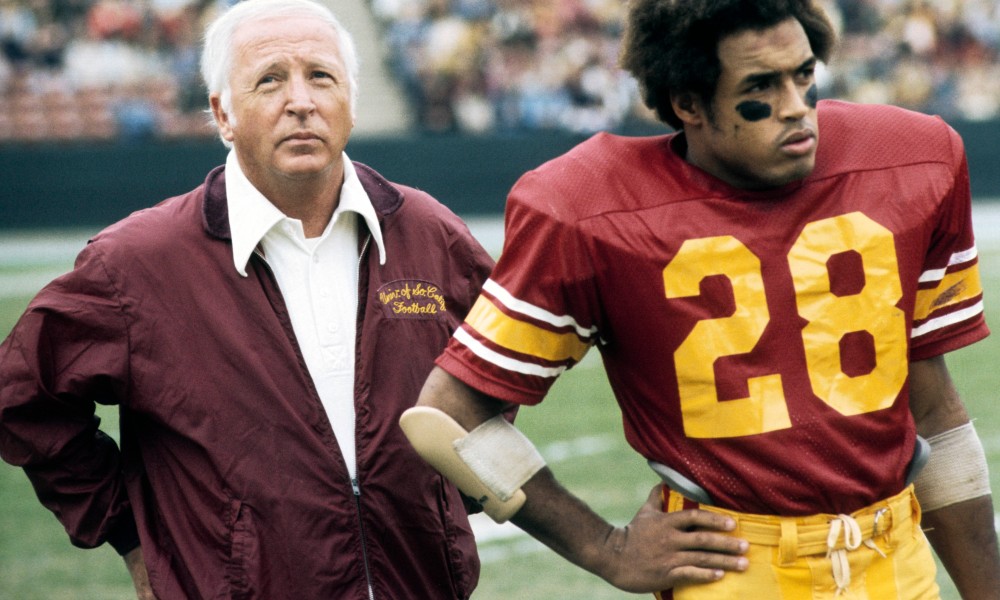
Ara Parseghian (left) and Duffy Daugherty

November 19, 1966: One of college football's occasional "Games of the Century" is played, at Spartan Stadium in East Lansing, Michigan.

Michigan State University, coached by Hugh "Duffy" Daugherty and known as "Duffy's Toughies," defending National Champions and now back-to-back Big Ten Champions, were undefeated, and ranked Number 1 in one of the major polls in use at the time and Number 2 in the other.

The University of Notre Dame, based in South Bend, Indiana, coached by Ara Parseghian, was also undefeated, and ranked 1st in one poll and 2nd in the other.

ABC televised the game nationally, albeit on a tape delay, with Chris Schenkel and former Oklahoma coach Bud Wilkinson calling it. This was the 1st time, except for New Year's Day bowl games, that a single college football game went coast-to-coast over national television -- and in color, no less.

This was a time when the words "in color" and "coast-to-coast" still had a special meaning, because neither of them, as yet, was a given. The 1965-66 TV season was when most American TV series, if they had not already done so, switched from black & white to color. But that still wasn't a given for unscripted shows like sports broadcasts.

As for "coast-to-coast": Even today, ABC/ESPN and CBS split some of their games regionally: While the East Coast and the Midwest might see, for example, Ohio State vs. Penn State, the South and the West Coast might see, say, Southern California vs. Texas. But each network usually staggers its schedule so that, on any given Saturday, there's at least one game that most of the country, unless their own team is otherwise occupied, will want to see. In 1966, such a thing was still a novelty.

These two teams weren't even supposed to play each other, let alone on this day. Notre Dame had usually played the University of Iowa on the 3rd Saturday in November from 1945 onward. But after 1964, Iowa opted out of that arrangement. Since Michigan State only had 9 regular-season games scheduled, and it was a relatively short trip -- 149 miles, or 2 1/2 hours by road -- the game was set up, and as luck would have it, they both came in undefeated, Number 1 vs. Number 2.

The teams had first played each other in 1897, before either one was a major football power. At this point, they had played each other every year since 1948, with 1966 having started out as an exception.

Michigan State had gone to the Rose Bowl the year before. At the time, the Big Ten Conference had 2 unbelievably stupid rules: No team could go to the Rose Bowl in back-to-back years, and only the Conference Champion -- or, if disqualified by the preceding stupid rule, the 2nd-place team -- could go to any bowl game. This meant that, regardless of the result of their game against Notre Dame, MSU were not going to play in a bowl game. (Purdue, quarterbacked by future Miami Dolphin Super Bowl winner Bob Griese, finished 2nd, and went on to their 1st-ever Rose Bowl, and won it for what remains the only time in their history.)

Notre Dame had a policy against bowl games, and hadn't been to one since Knute Rockne's legendary "Four Horsemen" (Harry Stuhldreher, Jim Crowley, Don Miller & Elmer Layden) beat Ernie Nevers' Stanford in the Rose Bowl on New Year's Day 1925. They wouldn't stop turning down bowl invitations until the 1970 season. So for both the Spartans and the Fighting Irish, this was it.
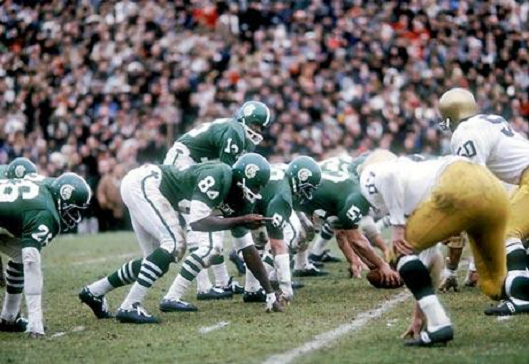
Michigan State in the home green.
Notre Dame in the road white.

At first, it didn't go too well for Notre Dame: Their leading rusher, Nick Eddy, did not play due to a shoulder injury. Quarterback Terry Hanratty got sacked by the massive (for the time, anyway) Spartan defensive lineman (and future actor) Charles "Bubba" Smith, and had to leave the game with an injury. Center George Goeddeke hurt his ankle while blocking for a punt.

Early in the 2nd quarter, the Spartans took a 7-0 lead on a Regis Cavender touchdown. God only knows what Regis Philbin, at age 32 already a known entertainer, and a Notre Dame graduate, so much of a fan that his request to be buried in the school's Cedar Grove Cemetery was granted, thought of a man named Regis scoring against his beloved Irish.

Dick Kenney, a barefooted kicker, added a field goal to make it 10-0 Michigan State. Barefoot kickers are now illegal in high school in every State except Massachusetts and Texas. They're still legal in college and in the NFL, but have been very rare since the 1980s.

Notre Dame came back. Backup quarterback Coley O'Brien threw a touchdown pass to Bob Gladieux, and it was 10-7 Spartans at the half. On the 1st play of the 4th quarter, Joe Azzaro kicked a field goal to tie it. There was still plenty of time left for either team to win the game.

A Spartan pass play gave both teams a good chance to score: Quarterback Jimmy Raye -- a black quarterback, not the first at Michigan State but rare on national television at that point -- attempted to pass to Gene Washington  but Washington outran the pass, doubled back, and Tom Schoen intercepted it. That gave the Irish a chance, but Azzaro just missed what could have been a game-winning field goal.

(This Gene Washington went on to play for the Minnesota Vikings and Denver Broncos, and should not be confused with the man of the same name who went on to All-Pro honors with the San Francisco 49ers and then became an executive in the NFL's main office.)

The last series of the game began with 1 minute and 10 seconds left on the clock, and Notre Dame had the ball on its own 30-yard line. Gaining 40 yards in 70 seconds would have put them in position for Azzaro to try again to win it with a field goal.

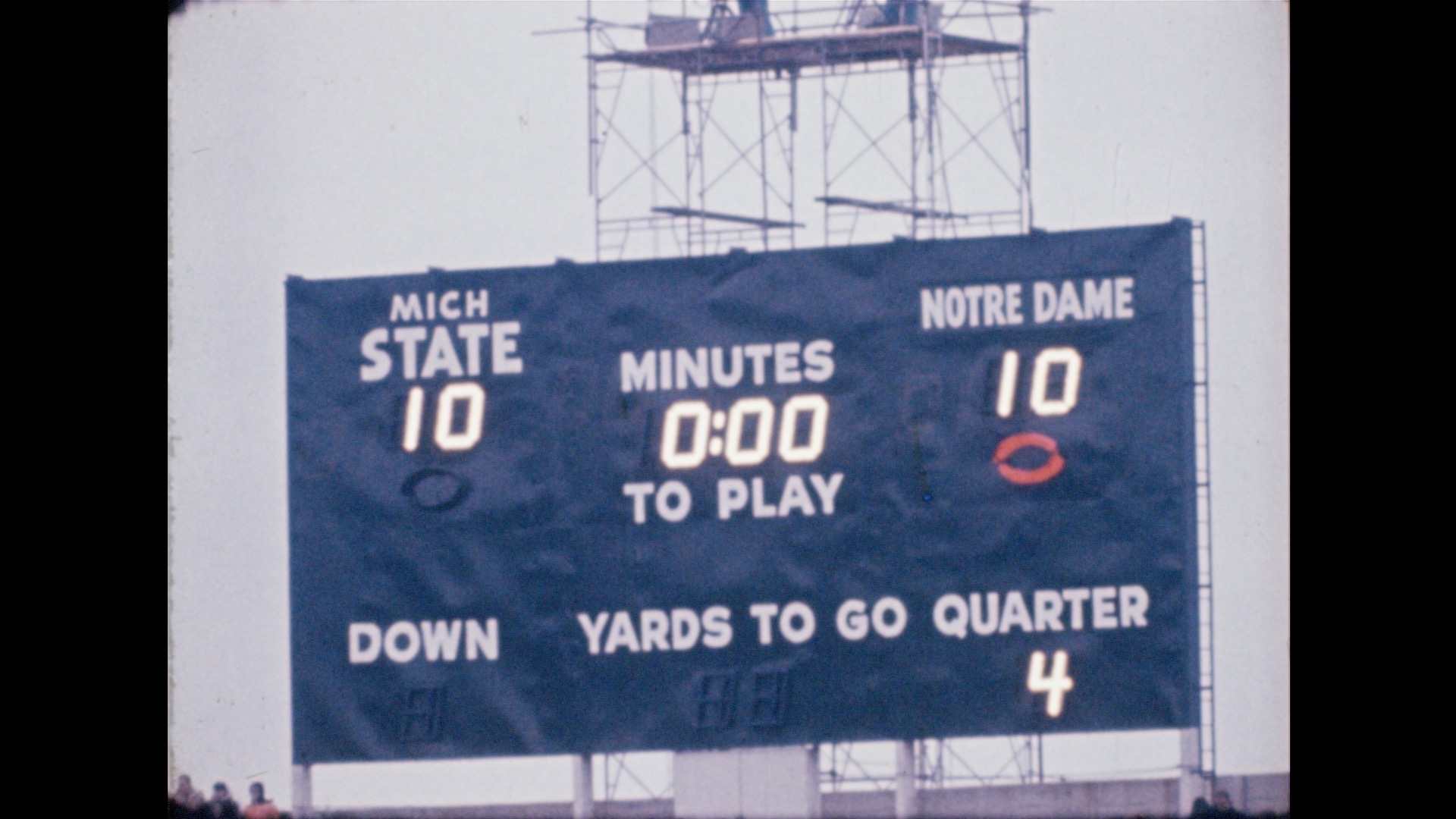
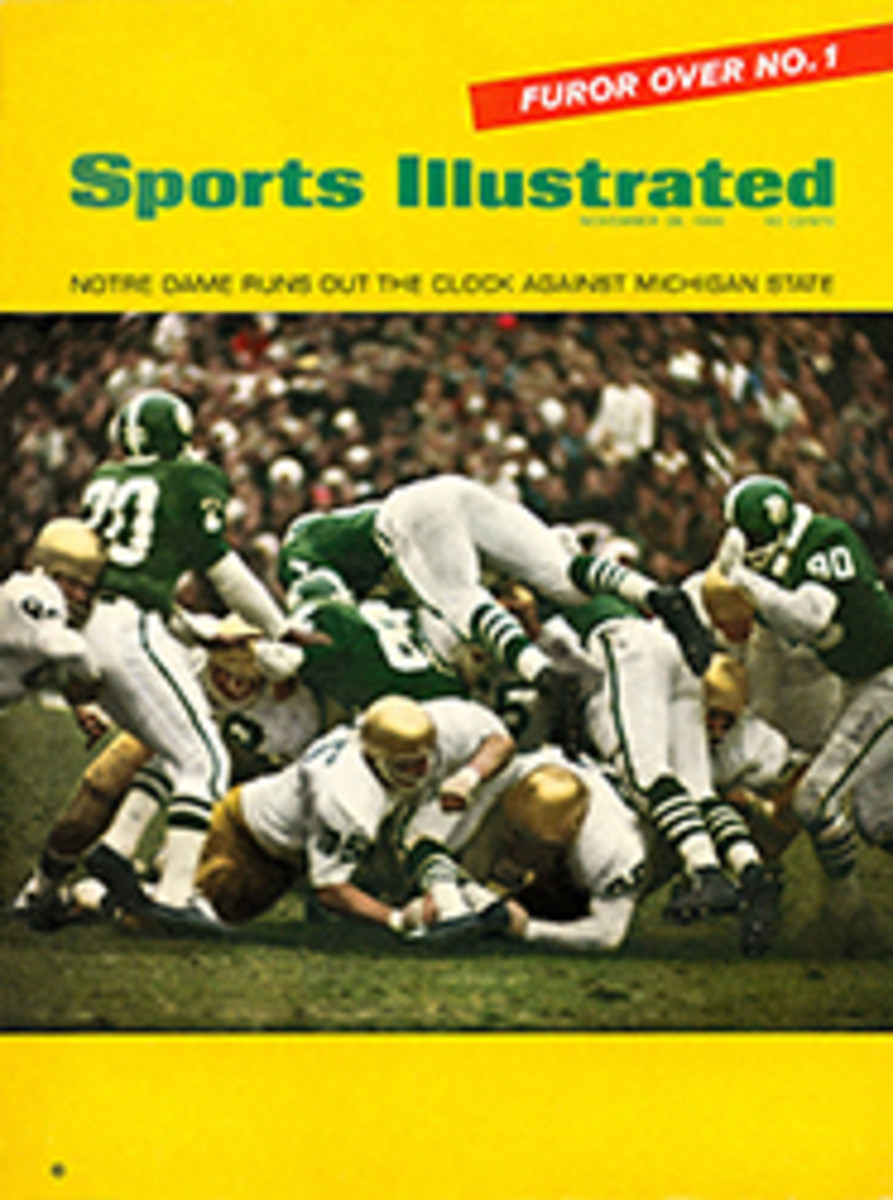
But Parseghian chose to run out the clock. He called 4 running plays, one of which gained a 1st down, then O'Brien was sacked by Bubba Smith, and then O'Brien ran up the middle on the final play. None of these plays got the ball across midfield, let alone within field goal range. Final score, Michigan State 10, Notre Dame 10. The home crowd booed the final play-call.
I've seen ESPN Classic's broadcast of the game's surviving footage, which is all but the 1st quarter. The video is clear, the color is bright, and both teams, while looking small compared to the college teams of today, fought hard, and both seemed worthy of the National Championship -- until the last 70 seconds, of course.

Normally, the national media gives Notre Dame the benefit of the doubt, since they are so swept up in the myth of the Golden Dome -- Knute Rockne, George Gipp and Rockne's "Win One for the Gipper" speech, the Four Horsemen, Frank Leahy and "Leahy's Lads," and Paul Hornung... and this was well before Rudy Ruettiger and his movie, Joe Montana, and Lou Holtz's tenure.

Not this time. In Sports Illustrated's writeup of the game, Dan Jenkins, until his death in 2019 perhaps the greatest living writer on the subject of college football, titled his article "Tying One for the Gipper." Jenkins quoted one observer as saying, "Parseghian had no guts."
Was that fair? Here was Ara's explanation: "We'd fought hard to come back and tie it up. After all that, I didn't want to risk giving it to them cheap. They get reckless and it could cost them the game. I wasn't going to do a jackass thing like that at this point."

Both teams ended the season 9-0-1. And the polls? Both the Associated Press (the college football writers) and United Press International (the coaches), still issuing their final polls before the bowl games, ranked Notre Dame Number 1 in their last poll, Michigan State Number 2, and undefeated Alabama Number 3.

Alabama, led by Paul "Bear" Bryant and actually having a bowl game to win, did so, beating Number 6 Nebraska in the Sugar Bowl, and finishing 11-0. They should have thus gotten their 3rd straight National Championship, having split the 1965 polls with Michigan State.

Both Notre Dame and Alabama claim to be 1966 National Champions, but Notre Dame still gets the official recognition. Keith Dunnavant came out with a book about the '66 Crimson Tide squad and how they were screwed by the polls, titling it The Missing Ring.

Ara Parseghian won another National Championship at Notre Dame in 1973, this time beating Alabama in a Number 1 vs. Number 2 matchup in the Sugar Bowl. That year, Ohio State and Michigan played to a 10-10 tie, thus tying for the Big Ten title, and the Conference sent Ohio State to the Rose Bowl. Despite this, Ohio State coach Woody Hayes joined with Bo Schembechler, once his player and assistant coach but now the Michigan coach, in his outrage, and together they got the only-the-Rose-Bowl rule changed for the 1975 season.

Duffy Daugherty remained Michigan State's coach until 1972, and lived until 1987, seeing the 20th Anniversary of this game. Parseghian retired after the 1974 season, and became a broadcaster in the sport. He died in 2017, at the age of 94. living long enough to see the 50th Anniversary of this game. He never took his good health for granted, and continued to raise money for research into diseases that have hit his family. Until the Kardashians became famous, he was easily the most famous American of Armenian descent. A statue of him stands outside Notre Dame Stadium. Yet, even in death, he still gets dogged by charges of cowardice for 1966.

I'm not a Notre Dame fan. Indeed, I once did a blog post of "The Top 10 Reasons to Hate Notre Dame." Ara's successor, Dan Devine, who led them to the 1977 National Championship with Joe Montana at quarterback, once said, "There's Notre Dame fans, and then there's Notre Dame haters, and, frankly, they're both a pain in the ass."

But I think we can let Ara off the hook. Like Schembechler, Ara both played for Hayes and coached under him at Miami University of Ohio before becoming a great head coach himself. Woody's philosophy was simple: Run the football. Or, as it became known, "Three yards and a cloud of dust." I'm not sure if Woody came up with those words himself, but words that have been attributed to him are, "There are three things that can happen when you throw the football, and two of them are bad." In other words, an incomplete pass and an interception.

When Ara had 70 seconds of play remaining, and 70 yards to go for a touchdown, and at least 40 yards to go for a field goal, no doubt he heard Woody's wisdom in his mind. After all, at the time, the man was still, along with Bear Bryant at Alabama, recognized as one of the top 2 coaches in college football, well ahead of some men who would soon be adding to their records: Parseghian himself, Darrell Royal at Texas, John McKay at USC, Bob Devaney at Nebraska, and Joe Paterno, then in his 1st season at Penn State.

At the time, Woody and the Bear were it. Ara wanted to be "it," and, to do that, he couldn't lose this game. So he chose to not risk losing on an interception that might put Michigan State in position to win with a last-second field goal. It worked, and, as times changed, Ara became part of that top tier of great college football coaches.

In 1946, Army was undefeated and ranked Number 1, and Notre Dame was undefeated and ranked Number 2, and they finished the regular season against each other, at the original Yankee Stadium, in the 1st college football game to get the "Game of the Century" tag from the national media.

That game did not live up to the hype, ending in a 0-0 tie. As they would say in that other kind of football, soccer, it was "a turgid nil-nil draw." The word "turgid" so perfectly suits 0-0 draws, regardless of what game you call "football."

Frank Leahy, Notre Dame's coach at the time, had "tied one for the Gipper" 20 years before Ara. Yet he never got the derision that Ara got. Probably because it wasn't on television: In order to see this game in its entirety, you had to be inside The Stadium. Newsreel highlights in movie theaters wouldn't have shown you all you needed to see. Nobody's ever said, "Leahy had no guts." Essentially, he played for a tie, and got away with it.

Duffy Daugherty didn't exactly go for the win, either. And it really did cost his team the National Championship. But nobody mocked him for it, and nobody, in Michigan or elsewhere, holds it against him now.

Also, the odds were against the Fighting Irish. Michigan State had the home field. They were the defending National Champions. They were favored to win. And Notre Dame went into the game with a major injury (their top rusher) and got more of them as the game went on (their starting quarterback and center). And still, they held Michigan State to just 10 points at home and avoided a loss. That's a pretty good achievement.

Finally, a win wasn't necessary. The polls proved it, giving Notre Dame the National Championship anyway. Ara knew that a loss would kill their national title dreams, just as they had against USC 2 years earlier. But a tie would still leave them undefeated.

And, at that point, as they nearly always do (except where this one game was concerned), the national media gave Notre Dame the benefit of the doubt, and crowned them National Champions, even though Alabama, undefeated and untied in 11 games as opposed to undefeated but tied in 10 games, was a more deserving National Champion.

Sounds like Ara Parseghian had more guts than the media: Not only were they gutless in claiming him to be a coward, but they ended up rolling over for the Irish anyway. If not for Ara himself.

Notre Dame and Michigan State last played each other on September 23, 2017, a few weeks after Parseghian's death. Notre Dame won, 38-18, raising their lead in the rivalry to 47-29-1. It should be 49-29-1, but due to the discovery of their use of ineligible players, the NCAA vacated all of their wins, including their wins over Michigan State, in the 2012 and 2013 seasons.

The schools have signed a contract to resume the rivalry, beginning in 2026, in South Bend.

*

November 19, 1966 was, of course a Saturday. Other notable college football games played that day:

* In the 2nd half of ABC's nationally-telecast doubleheader, Number 8 UCLA beat Number 7 USC, 14-7 at the Los Angeles Coliseum. This game forced a tie for the Championship in the Athletic Association of Western Universities (AAWU), and, head-to-head, UCLA should have had the tiebreaker. The next week, Notre Dame went into the Coliseum, and walloped USC, 51-0.

But USC still got the Rose Bowl bid, and lost to Purdue. UCLA, hampered by a rule in the league now known as the Pac-12 similar to the Big Ten's, couldn't go to a bowl, despite finishing the regular season 9-1. Wow, if ever a 20th Century college football season needed a playoff, this was it. The next season, USC and UCLA would play a "Game of the Century."

* Number 3 Alabama and Number 4 Nebraska both had the week off. The following week, Nebraska lost to arch-rival Oklahoma. But they still won the Big Eight Conference title. Alabama beat Southern Mississippi and then arch-rival Auburn, and beat Nebraska in the Sugar Bowl.

* Number 10 Purdue crushed arch-rival Indiana, 51-0 at Ross-Ade Stadium in West Lafayette, Indiana.

* Michigan beat Ohio State, 17-3 at Ohio Stadium in Columbus.

* Wisconsin beat Minnesota, 7-6 at Camp Randall Stadium in Madison, Wisconsin.

* Southern Methodist beat Baylor, 24-22 at the Cotton Bowl in Dallas, clinching the Southwest Conference title. But they lost the Cotton Bowl to Georgia, who were off this week, and ranked Number 7.

* Harvard beat Yale, 17-0 at Harvard Stadium in Boston.

* Penn State beat Pittsburgh, 48-24 at Pitt Stadium.

* Army and Navy both had the week off. The following week, Army beat Navy, 20-7 at John F. Kennedy Stadium in Philadelphia.

* In New York City, Columbia beat Brown, 40-38 at Baker Field.

* In New Jersey, Princeton beat Cornell, 7-0 at Palmer Stadium in Princeton.

* And Rutgers lost to Colgate, 26-7 at Rutgers Stadium in Piscataway.

One more football score I want to mention, but not in college, nor in the pros. The school that would one day become my high school, East Brunswick in Middlesex County, New Jersey, beat Sayreville 33-0. This enabled them to win both the Greater Jersey Group IV Conference, Central Division II Championship, and, due to their record, winning a share of their 1st Central Jersey Group IV Championship. Our first "State Championship." I have a separate entry for this event.

There were 5 games played in the NBA that day:

* The New York Knicks beat the expansion Chicago Bulls, 116-104 at the old Madison Square Garden.

* The Philadelphia 76ers beat the Cincinnati Royals, 134-110 at the Philadelphia Civic Center.

* The Boston Celtics beat the Baltimore Bullets, 147-125 at the Baltimore Civic Center. (The building still stands, under the name of the CFG Bank Arena.)

* The St. Louis Hawks beat the Detroit Pistons, 105-87 at the Kiel Auditorium in St. Louis.

* And the San Francisco Warriors beat the Los Angeles Lakers, 144-109 at the Los Angeles Memorial Sports Arena. For the Warriors, Rick Barry scored 45, and Nate Thurmond had 24 points and 27 rebounds.

And the entire NHL -- all of the "Original Six" teams -- were in action:

* The New York Rangers played the Boston Bruins to a tie, 3-3 at the Boston Garden.

* The Toronto Maple Leafs beat the Montreal Canadiens, 5-1 at Maple Leaf Gardens in Toronto.

* And the Chicago Black Hawks beat the Detroit Pistons, 7-2 at the Chicago Stadium.

Also on this day, Gail Devers, an American sprinter who won Olympic Gold Medals, was born. So was celebrity chef Rocco DiSpirito. So was actor and martial artist Jason Scott Lee. Although not related to Bruce Lee, he played Bruce in a film biography.

Wednesday, November 16, 2022

November 16, 1957: Notre Dame Ends Oklahoma's 47-Game Winning Streak

November 16, 1957: The University of Oklahoma football team takes a 47-game winning streak into a home game with the University of Notre Dame, the last team to have beaten them.

Notre Dame had beaten Oklahoma on September 26, 1953, at Oklahoma Memorial Stadium (a.k.a. Owen Field, now Gaylord Family Memorial Stadium) in Norman, Oklahoma, en route to a National Championship. The following week, Oklahoma were held to a tie by the University of Pittsburgh. The week after that, they beat arch-rival Texas, and it was off to the races from there. Coach Charles "Bud" Wilkinson's Sooners ran the table, finishing 9-1-1.

They won all 10 games in 1954, but finished behind both Ohio State and UCLA in the last national poll. They won all 11 games in 1955, and this time, they were rewarded with the National Championship. They won all 10 games in 1956, and were again awarded the National Championship. Running back Tommy McDonald was the star of these teams, before going on to a Hall of Fame career as a flanker with the Philadelphia Eagles. In 1956, McDonald finished 2nd to Paul Hornung of the Notre Dame for the Heisman Trophy, and, in a rare height for an offensive lineman, Oklahoma center Jerry Tubbs finished 3rd.

The Sooners kept going in 1957, winning away to Number 8 Pitt, then beating Iowa State at home, Texas in the Cotton Bowl, Kansas and Colorado at home, then Kansas State and Number 19 Missouri on the road. That made them 7-0, with a 47-game winning streak, and a 48-game unbeaten streak, both all-time records in college football.

Notre Dame began the 1957 season by winning their 1st 4 games, over Purdue, Indiana, then-Number 10 Army and Pittsburgh. But they lost their next 2, home to Number 16 Navy and away to Number 2 Michigan State. They entered the game unranked, but perhaps harshly so.

Still, Oklahoma were a 19-point favorite and the Number 2-ranked team in the nation going in, so anyone predicting that Notre Dame would beat Oklahoma was just guessing. Sports Illustrated, founded 3 years earlier, was not guessing: They put the Sooners on the cover, with the headline, "WHY OKLAHOMA IS UNBEATABLE."

Notre Dame didn't get the memo. Their defense proved every bit as tough as Oklahoma's. Midway through the 4th quarter, the game was still scoreless. The Fighting Irish launched an 80-yard drive, and, on the drive's 20th play, on 4th and goal from the 3-yard-line, quarterback Bob Williams pitched the ball to running back Dick Lynch, later an All-Pro for the New York Giants, and put Notre Dame on top, 7-0.

Oklahoma had one last chance, but, with less than 1 minute left, Williams intercepted a pass, and the 7-0 score held to the final gun, and most people in the crowd of 63,170 were stunned.

Oklahoma shook the loss off, beating Nebraska and Oklahoma State, winning the Big Seven Conference title, and they beat Duke in the Orange Bowl. They finished the season ranked Number 4. Notre Dame weren't as lucky: The win over Oklahoma raised them to Number 9, but they lost their next game, home to Iowa. They beat USC at home, and then beat SMU in the Cotton Bowl (the stadium, not the game), and finished Number 9.

In a weird twist of events, the longest winning streak in the history of men's college basketball is 88 games, set by UCLA from 1971 to 1974. The last team to beat them before the streak began, and the team that beat them to end it? In each case, it was Notre Dame. Unlike Oklahoma football, however, both UCLA losses to Notre Dame were on the Notre Dame campus in South Bend, Indiana.

*

November 16, 1957 was a Saturday. Among the other college football games played that day were these:

* Oklahoma may have had the most shocking defeat of the day, or even of the decade, but they weren't even the highest-ranked team to lose that day. Texas A&M went in ranked Number 1, but were upset by Number 20 Rice, 7-6 at Rice Stadium in Houston. Rice went on to win the Southwest Conference title.

* Number 3 Auburn beat Georgia, 6-0 at Memorial Stadium in Columbus, Georgia.

* Number 4 Michigan State beat Minnesota, 42-13 at Spartan Stadium in East Lansing, Michigan.

* Number 5 Iowa were slightly upset by Number 6 Ohio State, 17-13 at Ohio Stadium in Columbus. Ohio State won the Big Ten Conference title.

* Number 7 Tennessee were slightly upset by Number 8 Mississippi, 14-7 at Crump Stadium in Memphis. "Ole Miss" went on to win the Southeastern Conference title, and beat Texas in the Sugar Bowl.

* Number 9 Navy beat George Washington University, 52-0 at Memorial Stadium in Baltimore. Navy beat Rice in the Cotton Bowl, in large part due to running back Pete Dawkins, who won the Heisman Trophy the next season.

* Number 10 Army beat Tulane, 20-14 at Michie Stadium in West Point, New York.

* Number 11 Duke beat Number 14 Clemson, 7-6 at Duke Stadium (now Wallace Wade Stadium) in Durham, North Carolina.

* Number 15 Illinois were upset by Wisconsin, 24-13 at Camp Randall Stadium in Madison, Wisconsin.

* Number 16 Oregon beat Southern California (USC), 16-7 at the Los Angeles Memorial Coliseum. Oregon won the Pacific Coast Conference title. But the Ohio State beat Oregon in the Rose Bowl, and were awarded the National Championship by UPI.

* In New York City, Columbia lost to the University of Pennsylvania, 28-6 at Baker Field in Manhattan.

* And in New Jersey, Rutgers lost to William & Mary, 38-7 at Cary Field in Williamsburg, Virginia; and Princeton lost to Yale, 20-13 at Palmer Stadium in Princeton.

There were 3 games played in the NBA:

* The New York Knicks lost to the Detroit Pistons, 109-105 at the old Madison Square Garden.

* The Boston Celtics beat the Philadelphia Warriors, 111-89 at the Boston Garden. Bill Russell scored 28 points and set a new NBA record with 49 rebounds. Three years later, with the Warriors, Wilt Chamberlain said a record which has never seriously been approached, against Russell and the Celtics, with 55 rebounds. But the Celtics won the game.

* And the St. Louis Hawks beat the Syracuse Nationals, 118-101 at the Kiel Auditorium in St. Louis.

And the NHL's entire "Original Six" were in action:

* The New York Rangers beat the Montreal Canadiens, 4-2 at the Montreal Forum.

* The Boston Bruins beat the Toronto Maple Leafs, 4-2 at Maple Leaf Gardens in Toronto.

* And the Detroit Red Wings beat the Chicago Black Hawks, 1-0 at the Chicago Stadium.

And in English soccer, Arsenal beat Hampshire team Portsmouth, 3-2 at Highbury in North London.

Sunday, November 13, 2022

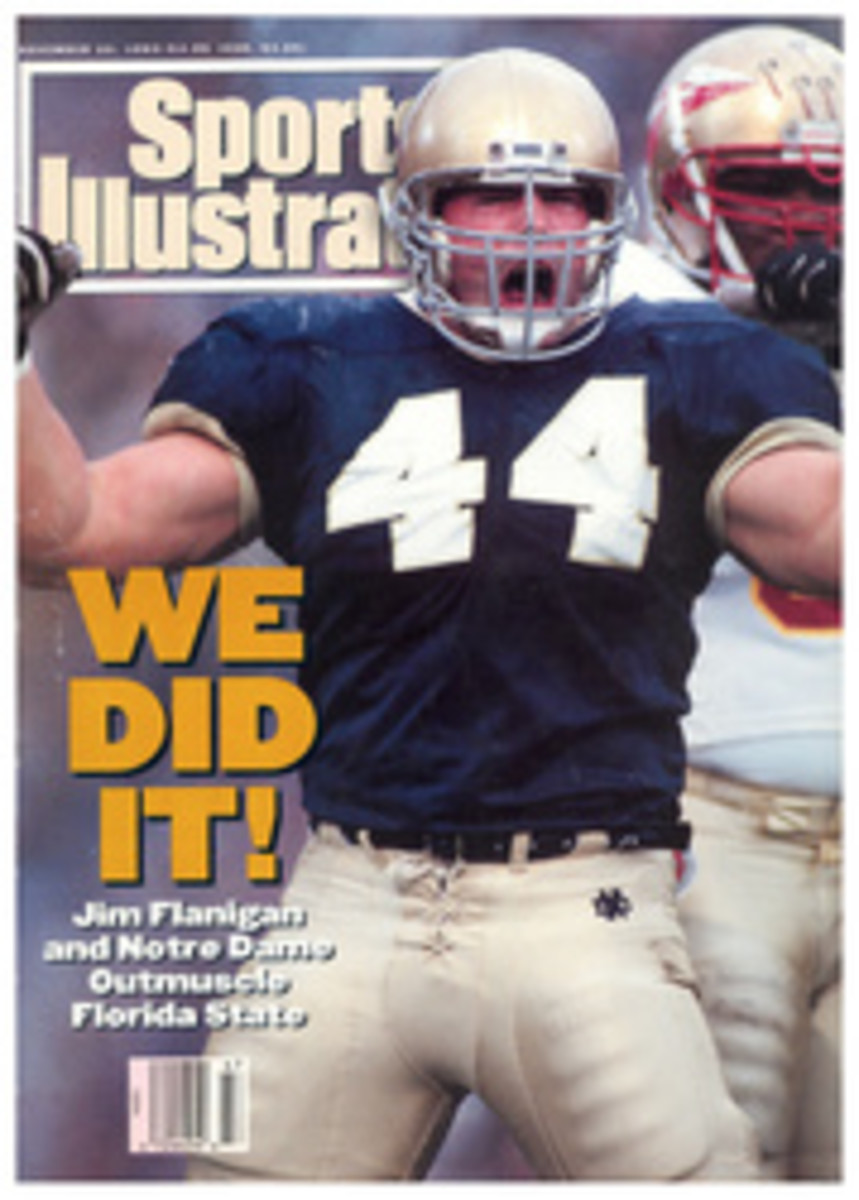
November 13, 1993: Florida State vs. Notre Dame, "The Game of the Century"

November 13, 1993: Not every college football game billed as "The Game of the Century" lives up to the billing. This one did.

Florida State University, coached by Bobby Bowden, and quarterbacked by eventual Heisman Trophy winner Charlie Ward, had gone through several near-misses for the National Championship. In 1993, they looked ready to go all the way. They won their 1st 5 games: 42-0 over Kansas in the Kickoff Classic at the Meadowlands, 45-7 away to Duke, 57-0 home to Number 17 Clemson, 33-7 away to Number 13 North Carolina, and 51-0 home to Georgia Tech.

The 2 previous years, they had lost to one of their rivals, the University of Miami, on missed last-play field goals. This time, with Miami coming into Doak Campbell Stadium in Tallahassee with the Number 3 ranking, the Seminoles left no doubt, winning 28-10. No last-play, or even last-minute, heroics necessary. They followed this with a 40-14 win home to Number 15 Virginia, a 54-0 home win over Clemson, and a 49-20 win away to Maryland.

That set up a meeting with the University of Notre Dame. The Fighting Irish played about as tough a schedule as could be played without being part of a major conference, including 4 Big 10 schools. They opened the season by beating Northwestern at home, 27-12. The beat then-Number 3 Michigan away, 27-23; Michigan State at home, 36-14; Purdue away, 17-0; Stanford away, 48-20; the University of Pittsburgh at home, 44-0; Brigham Young University (BYU) award, 45-20; the University of Southern California (USC) at home, 31-13; and Navy at Veterans Stadium in Philadelphia, 58-27.

The Irish were also undefeated, and looked every bit as unstoppable as the Seminoles. With NBC having the contract to broadcast Notre Dame home games, they could hype this Number 1 vs. Number 2 matchup as "The Game of the Century."

Notre Dame outplayed Florida State the entire game, to the tune of a 31–17 lead in the 4th quarter. The offense had hung its shoulders around their junior running back Lee Becton, who had yet another 100+ yard afternoon.

With 1:39 left, Ward drove Florida State down the field, and hit Kez McCorvey on 4th-and-20 for a touchdown. The pass bounced off of Notre Dame safety Brian McGee and into McCorvey's hands.

Notre Dame then went three-and-out on their next possession, giving Florida State one last shot. In just 3 plays, Ward led Florida State to the Notre Dame 14 with 3 seconds to play. On the last play of the game, Ward rolled out, and had his final pass attempt batted down by Notre Dame cornerback Shawn Wooden, clinching the final score as Notre Dame 31, Florida State 24.

There was pandemonium in South Bend. Meanwhile, all of Florida, people were crushed. It looked like Florida State's best chance ever to win the National Championship had been lost. Not exactly "blown," as it was with the missed field goals of the preceding 2 years, but definitively taken away from them by a team which, if not necessarily better, was certainly good enough and had the home-field advantage.

Afterward, all Notre Dame had to do was beat Boston College at home the following Saturday, and theyvwould be able to play Nebraska for the National Championship in the Orange Bowl on New Year’s Day. That was all.

They didn't. BC were ranked Number 17, and David Gordon kicked a 41-yard field goal on the last play of the game, to give them a 41-39 win. It was BC's biggest win since Doug Flutie led them past Miami in 1984, and their biggest without Flutie since clinching a share of the National Championship in the 1941 Sugar Bowl.

Had there been a Bowl Championship Series or a National Championship Playoff at the time, Notre Dame would still have gotten into it. Instead, they dropped from Number 1 to Number 4. They ended up beating Number 7 Texas A&M in the Cotton Bowl.

In contrast, losing away to Notre Dame by 7 points only dropped Florida State to Number 2. They beat North Carolina State, 62-3 at home, to clinch the Atlantic Coast Conference title, to retake the Number 1 spot. Then they beat Number 7 and arch-rival Florida away, 33-21, to set up a National Championship matchup with Number 2 Nebraska in the Orange Bowl. Florida State won, 18-16.

In the final polls, both the Associated Pres (AP, the sportswriters) and United Press International (UPI, the head coaches) had Florida State at Number 1, and Notre Dame at Number 2.

*

November 13, 1993 was a Saturday. These other major college football games were played that day:

* Number 3 Miami beat Rutgers, 31-17 at the Orange Bowl in Miami.

* Number 4 Nebraska beat Iowa State, 49-17 at Memorial Stadium in Lincoln, Nebraska.

* Number 5 Ohio State beat Number 19 Indiana, 23-17 at Ohio Stadium in Columbus.

* Number 7 Auburn beat Georgia, 42-28 at Sanford Stadium in Athens, Georgia.

* Number 8 Florida beat South Carolina, 37-26 at Williams-Brice Stadium in Columbia, South Carolina.

* Number 9 West Virginia beat Temple, 49-7 at Veterans Stadium in Philadelphia.

* Number 10 UCLA were upset by Arizona State, 9-3 at the Rose Bowl in the Los Angeles suburb of Pasadena, California.

* Number 11 Texas A&M beat Number 20 University of Louisville, 42-7 at Kyle Field in College Station, Texas.

* Number 12 Alabama beat Mississippi State, 36-25 at Bryant-Denny Stadium in Tuscaloosa, Alabama.

* Number 13 Arizona were upset by the University of California, 24-20 at California Memorial Stadium in Berkeley, California.

* Number 18 Virginia were upset by Clemson, 23-14 at Memorial Stadium in Clemson, South Carolina.

* Number 23 Wyoming were upset by New Mexico, 10-7 at University Stadium in Albuquerque, New Mexico.

* Number 25 University of Washington were upset by the University of Southern California (USC), 22-17 at Husky Stadium in Seattle.

* In the "Little Brown Jug," Michigan beat Minnesota, 58-7 at the Metrodome in Minneapolis.

* Army beat Lafayette, 35-12 at Michie Stadium in West Point, New York.

* Navy lost to Vanderbilt, 41-7 at Vanderbilt Stadium (now FirstBank Stadium) in Nashville.

In New Jersey high school football, my Alma Mater, East Brunswick, lost to Woodbridge, 29-23 at Jay Doyle Field in East Brunswick.

Baseball was out of season. There were 8 games played in the NBA:

* The New York Knicks beat the Milwaukee Bucks, 99-86 at Madison Square Garden. John Starks scored 35 points.

* The New Jersey Nets lost to the Philadelphia 76ers, 98-97 at the Brendan Byrne Arena in the Meadowlands.

* The Boston Celtics beat the Chicago Bulls, 98-97 at the Chicago Stadium.

* The Utah Jazz beat the Dallas Mavericks, 101-100 at the Reunion Arena in Dallas.

* The Houston Rockets beat the Phoenix Suns, 99-95 at The Summit in Houston. (The arena has since been converted into the Central Campus of the Lakewood Church, Dr. Joel Osteen's "megachurch.")

* The Golden State Warriors beat the Denver Nuggets, 106-98 at the McNichols Arena in Denver.

* The Los Angeles Clippers beat the San Antonio Spurs, 92-90 at the Los Angeles Memorial Sports Arena.

* And the Seattle SuperSonics beat the Atlanta Hawks, 97-89 in overtime at the Seattle Center Coliseum.

And there were 12 games played in the NHL, with every team in action except the 2 new expansion teams, the Florida Panthers and the Mighty Ducks of Anaheim:

* The New York Rangers beat the Washington Capitals, 2-0 at the USAirways Arena (formerly the Capital Centre) in the Washington suburb of Landover, Maryland.

* The New York Islanders lost to the Boston Bruins, 5-2 at the Nassau Coliseum.

* The New Jersey Devils lost to the San Jose Sharks, 4-2 at the Brendan Byrne Arena at the Meadowlands.

* The Buffalo Sabres beat the Philadelphia Flyers, 7-2 at The Spectrum in Philadelphia.

* The Ottawa Senators beat the Montreal Canadiens, 3-2 at the Montreal Forum. Dave McLlwain scored the winning goal with 1:38 left in overtime. 

* The Edmonton Oilers and the Hartford Whalers played to a tie, 4-4 at the Hartford Civic Center (now the PeoplesBank Arena).

* The Tampa Bay Lightning beat the Quebec Nordiques, 4-3 at the ThunderDome (now Tropicana Field) in St. Petersburg, Florida.

* In an "Original Six" matchup, the Chicago Blackhawks beat the Toronto Maple Leafs, 3-2 at Maple Leaf Gardens in Toronto.

* The Detroit Red Wings beat the Pittsburgh Penguins, 7-3 at the Civic Arena in Pittsburgh.

* The Dallas Stars beat the Winnipeg Jets, 3-2 at the Winnipeg Arena.

* The Calgary Flames beat the Vancouver Canucks, 4-3 at the Saddledome in Calgary.

* The Los Angeles Kings beat the St. Louis Blues, 6-3 at The Forum outside Los Angeles in Inglewood, California.


December 31, 1999 & January 1, 2000: The Millennium

December 31, 1999:  The Millennium arrives. The people of planet Earth survived. At a terrible cost. But we hadn't destroyed ourselves. ...