Showing posts with label golden age of sports. Show all posts

Tuesday, December 6, 2022

December 6, 1925: Red Grange Saves the NFL

December 6, 1925: The New York Giants football team, in its 1st season of play, is in deep financial trouble, in spite of a 10-3 record to this point -- 8-2 against NFL teams. Too few fans have come out to the Polo Grounds that team owners Tim and Jack Mara are afraid that their team will financially fail. And if the NFL's New York team fails, so will the League.

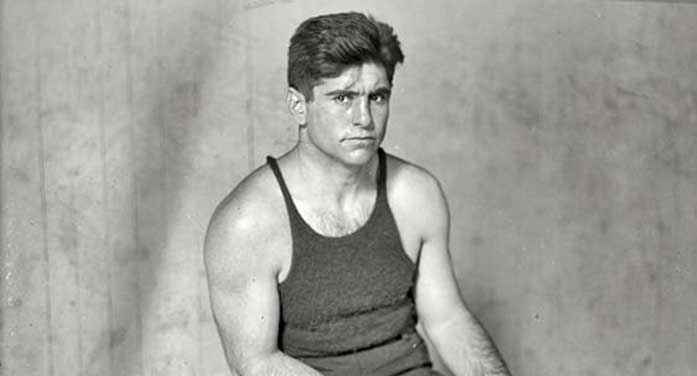
Red Grange to the rescue. Harold Edward Grange, "the Galloping Ghost" out of the University of Illinois, the most famous (or, at least, the most-hyped) player in the history of college football, comes in with his new teammates, the Chicago Bears.

A crowd of 68,000 people pays to get into the Polo Grounds, more than the Giants' last 3 home games combined. It's believed that another 8,000 crashed the gate, making the 74,000 crowd the biggest in the NFL's 6-season history to that point.

The Ghost lives up to the hype: He scores a touchdown on a 35-yard interception return, runs for 53 yards on 11 carries, catches a 23-yard pass, and completes 2 of 3 passes for 32 yards. And he is part of a defense that recorded a shutout. He could do everything except kick.

The Bears win, 19-0, but that's beside the point: The gate receipts from all the people coming out to see Grange mean that the Giants will be able to play the 1926 season. In 1927, they finish 1st, taking the 1st of what is now 8 NFL Championships, including 4 Super Bowls.

The Bears? They were a good team throughout the 1st decade of NFL play, winning the title in 1921, but won't win another title until 1932. By that point, Grange will be joined by Bronislau "Bronko" Nagurski, and they will win the title in 1933 as well.

Grange was the template for every speedy scatback who followed him: Steve Van Buren, Doak Walker, Frank Gifford, Lenny Moore, Paul Hornung, Gale Sayers, O.J. Simpson, Tony Dorsett, Marcus Allen, Walter Payton, Terrell Davis, Marshall Faulk, Chris Johnson, Joe Mixon.

Nagurski is the model for every big bruising fullback to come: Clarke Hinkle, Marion Motley, Tank Younger, Jim Taylor, Jim Brown, Larry Csonka, Franco Harris, John Riggins, Roger Craig, Emmitt Smith, Terrell Davis, Jerome Bettis, Adrian Peterson.

This -- not the 1958 NFL Championship Game that the Giants lost to the Baltimore Colts at Yankee Stadium -- is not only the biggest football game ever played in New York City; it is the most important game in the history of American professional football. If Grange had, for whatever reason, been unable to play in it, the Giants would have folded, and the NFL would probably have gone down the tubes during the Great Depression.

This might have opened the door for soccer, with its working-class roots and its ethnic appeal (most U.S. soccer teams at that point were ethnically based), to become America's Fall and Winter sport, possibly also hurting basketball and hockey. If you want to know why "football" made it in America, and "futbol" didn't until the 1970s, this, as much as America's natural distrust for "foreign" things, is the moment.

Even at the time, the 1920s, "The Roaring Twenties," was called "The Golden Age of Sports." It was Babe Ruth in baseball, Howie Morenz in hockey, Jack Dempsey in boxing, Paavo Nurmi in track, Bill Tilden in tennis, Bobby Jones in golf, and Man o' War in horse racing. In football, it was the Galloping Ghost, Red Grange.

Grange played until 1934, and became a broadcaster. He lived until 1991. He was ranked 80th on The Sporting News' 100 Greatest Football Players in 1999, named the greatest player in college football history by ESPN in 2008, had a statue of him dedicated outside Illinois' Memorial Stadium in 2009, was named to the NFL's 100 Greatest Players by the NFL Network in 2010 (ranked 48th, actually gaining 32 places in the intervening 11 years), and was named the Big Ten Conference's greatest sports icon by the Big Ten Network in 2011.

Keep in mind, most of those honoring him had never seen him play, as he played his last NFL game in 1934, and there is precious little surviving footage of him.


*

December 6, 1925 was a Sunday. These other NFL games were played that day:

* The Pottsville Maroons beat the Chicago Cardinals, 21-7 at Comiskey Park in Chicago. This led to the most controversial awarding of the NFL Championship in the League's history. 

* The Green Bay Packers beat the Providence Steam Rollers, 13-10 at the Cycledrome in Providence. The Steam Rollers debuted in 1916, joined the NFL for the 1925 season, won its Championship in 1928, and folded due to the Depression in 1933.

* The Cleveland Bulldogs beat the Canton Bulldogs, 6-0 at Dunn Field in Cleveland. (League Park used that name from 1921 to 1927.) Despite being just 60 miles apart, the cities' respective Bulldogs were separate teams.

* While baseball was in the off-season, and the NBA wasn't founded yet, there was also 1 NHL game played on this day. The Pittsburgh Pirates beat the Toronto St. Patricks, 6-3 at the Duquesne Gardens in Pittsburgh.

While the St. Patricks became the Toronto Maple Leafs in 1927, the Pirates -- as the NFL's Steelers were from their 1933 debut through 1939, named after the baseball team in town -- are not the forerunners of the Pittsburgh Penguins. In 1930, they moved across Pennsylvania, and became the Philadelphia Quakers. After one of the worst seasons in NHL history, both on the ice and at the Depression-addled box office, they folded.

Saturday, November 26, 2022

November 26, 1925: Red Grange Makes His Professional Debut

November 26, 1925: Red Grange, just 5 days past his last game for the University of Illinois, plays his first professional football game. (That was within the rules at the time, as there was no NFL Draft, let alone restrictions connected to it.)

I don't think I can underestimate how big an event this was considered to be. This was "The Golden Age of Sports," and, what Babe Ruth was to baseball, Jack Dempsey to boxing, Man o' War to horse racing, Howie Morenz to hockey, Paavo Nurmi to track, Bill Tilden to tennis, and Bobby Jones to golf, Red Grange was to football. He had Peyton Manning and Tom Brady levels of hype at a time when the only real form of mass media was newspapers. Radio broadcasting was in its infancy, television was still in the experimental stage, and newsreels weren't much yet.

It is the annual Thanksgiving Day tussle between Chicago's NFL teams, the Bears and the Cardinals, and Cubs Park -- which was renamed Wrigley Field the next season -- is packed to the gills, 39,000 people, to watch the Galloping Ghost put on his Number 77 jersey for the Bears -- in the same colors as UI, dark blue and orange, and the first truly famous uniform number in North American sports. The game ends in a scoreless tie.

(The NHL already had uniform numbers, but was still not thought of as an American game, so Howie Morenz's 7 was not yet famous outside Canada. And Major League Baseball wouldn't adopt numbers until 1929, so Babe Ruth hadn't yet begun wearing 3.)

Both Chicago teams finished 9-2, but the Cardinals had only 1 tie, while the Bears had 3. Under the rules then in effect, the standings were decided by winning percentage, with a tie counting as half a win, and not every team played the same number of games against in-league opponents. So the Cardinals had a winning percentage of .846, and the Bears .643. And that wasn't even the most controversial part. The Pottsville Maroons went 10-2, with no ties, so their percentage was .833. I described how the title was settled in the Cardinals' favor in a separate post.

The uneven scheduling was a big reason why the NFL was not exactly "major league" yet, and also a big reason why it needed a big name like Grange. Even having Jim Thorpe didn't help. The Philadelphia-based Frankford Yellow Jackets played 17 games. The Bears played 14. The Green Bay Packers played 13. The Cardinals, the Maroons, the Cleveland Bulldogs played 12. The New York Giants, the Detroit Panthers, the Rock Island Independents played 11. The Providence Steam Roller played 10. The Buffalo Bisons and the Columbus Tigers played 9. The Kansas City Cowboys, the Dayton Triangles, and the Canton Bulldogs -- not to be confused with nearby Cleveland -- played 8. The Rochester Jeffersons played 7. And struggling teams that soon went out of business played fewer: The Milwaukee Badgers 5, the Indiana-based Hammond Pros 4, and the Minnesota-based Duluth Kelleys 3.

Grange is one of the greatest all-around players in football history, a sensational running back and one of the best defensive backs of his era. He is also, by far, the most important player in the history of the NFL: If he had failed, the NFL might never have become bigger than it was in 1925, and likely would have gone out of business during the Great Depression, and another sport would have had to fill the gap between the end of the World Series in October and Opening Day in April. Maybe it would have been that other "football."

But Grange did succeed, and, along with his coach George Halas and his contemporary Jim Thorpe, he was one of the first 3 men elected to the Pro Football Hall of Fame.

*

November 26, 1925, as are all Thanksgiving Days, was a Thursday. Also on this day, the New York Giants, an NFL team in its 1st season, won 7-0 over the Staten Island Stapletons, a non-NFL team founded in 1915, and played in the Stapleton neighborhood of Staten Island. The game was played at the Stapes' home, Thompson Stadium, which stood from 1924 to 1933, and the attendance is listed as 10,000, which might be a sellout.

The Stapes did not join the NFL until the 1929 season, and the Great Depression knocked them out in 1932. Berta A. Dreyfus Intermediate School is now on the site of Thompson Stadium, at 101 Warren Street.

The Kansas City Cowboys and the Cleveland Bulldogs, neither of them drawing very well (which would shock later fans in those cities), played at Clarkin Field in Hartford, Connecticut. The Cowboys won, 17-0. Since New England was then, and remains now, a big region for high school football on Thanksgiving, the attendance for this game was listed as only 1,000. The Cowboys played 1 more season before folding, the Bulldogs 1 more after that.

The Pottsville Maroons beat the Green Bay Packers, 31-0 at Minersville Park in Pottsville. The Maroons lasted until 1929.

And the Rock Island Independents beat the Detroit Panthers, 6-3 at Navin Field (later renamed Briggs Stadium and Tiger Stadium) in Detroit. Both teams lasted 1 more year.

Among the major college rivalry games played that day:

* Virginia and North Carolina played to a tie, 3-3 at Emerson Field in Chapel Hill, North Carolina.

* Alabama beat Georgia, 27-0 at Rickwood Field in Birmingham, Alabama.

* Kentucky beat Tennessee, 23-20 at Stoll Field in Lexington, Kentucky.

* Texas A&M 28 beat Texas, 28-0 at Kyle Field in College Station.

* Colorado A&M (which became Colorado State) beat Wyoming, 40-0 at Colorado Field in Fort Collins.

* And Utah State beat Utah, 10-6 at Cummings Field in Salt Lake City.

Not rivalries, but also (in my opinion) noteworthy:

* Syracuse beat Columbia, 16-5 at Baker Field in Upper Manhattan.

* The University of Pennsylvania beat Cornell, 7-0 at Franklin Field in Philadelphia.

* The University of Pittsburgh beat Penn State, 23-7 at Pitt Stadium in Pittsburgh. (It had opened 2 months earlier, on September 26, with a 28-0 win over Washington & Lee University.

* Nebraska beat Notre Dame, 17-0 at Memorial Stadium in Lincoln, Nebraska.

* Oklahoma beat Oklahoma State, 35-0 at Memorial Stadium in Norman.

Wednesday, November 23, 2022

November 23, 1946: The Disgrace of Bill Tilden

November 23, 1946: Two Beverly Hills police officers pull over a car that had been moving erratically. The driver appeared to be a teenage boy. An older man had his arm around him. When the officers pulled the car over, the man hurriedly changed places with the boy. The boy's fly was open. The police arrested the older man.

His name was Bill Tilden. At the time, he was 53 years old, and considered the greatest tennis player who ever lived.

William Tatem Tilden Jr. was born on February 10, 1893, to a wealthy family in the Germantown section of Philadelphia. By the time he was 22, both of his parents and 3 older siblings had all died. For the rest of his life, as one of his biographers, Sports Illustrated writer Frank Deford, explained, he spent his adult life trying to create father-son relationships with tennis students and ball boys.

He had taken up tennis at the age of 6, after seeming to already be depressed over the loss of one of the siblings.

He never competed in the Australian Open -- given the distance, many of the best American and European players didn't make the trip -- and was 0-2 in French Open Finals. But, from 1920 to 1930, he won the U.S. Open 7 times and Wimbledon 3 times. From 1920 to 1926, he helped the U.S. team win 7 straight Davis Cups.

As the "Roaring Twenties" were considered "the Golden Age of Sports," sportswriters put him on a pedestal with baseball's Babe Ruth, boxing's Jack Dempsey, football's Red Grange, hockey's Howie Morenz, track's Paavo Nurmi, golf's Bobby Jones, and racehorse Man o' War. (Basketball, as yet, was not considered big enough for its best player, whoever that would have been deemed to be, to be an equivalent to those men.)

In 1930, he won his last major, Wimbledon. He was 37 years old. But those tournaments, until 1968, were all-amateur. And he had blown through his family fortune. So he turned professional, and was rated the Number 1 professional player in the world in each of the next 3 years, making money through the depth of the Great Depression.

But age caught up with him, and by the late 1930s, he was living in Los Angeles, making money by giving tennis lessons to film actors, including Charlie Chaplin, who became a close friend, and other wealthy people.

Then came his arrest in 1946. He was numb from shock, and, not having his glasses with him, signed a confession without even looking at it. When he recovered, he asked for a lawyer. He wanted Jerry Giesler, who had achieved fame by defending Chaplin and Errol Flynn in suits resulting from their sexual escapades. Giesler wanted no part of him, since he defended only heterosexual predators.

Tilden finally engaged Richard Maddox, a young former prosecutor. Maddox had a hard time convincing Tilden that he was in serious trouble. Maddox pointed out that the scandal sheets and rumor-mongers would have a field day, imagining tennis parties at the Chaplin estate, thinking there were orgies with Chaplin, a known Communist, and "In Like" Flynn seducing the little girls, while Queer Bill seduced the little boys.

The state's case was weak, the lawyer said. If Tilden repudiated his statement, the only evidence would be the boy's statement. The boy, a precociously dissolute 14-year-old, had been expelled from several schools because of his sexual activities and general delinquency. If Tilden pleaded not guilty, Maddox said, the boy's parents would not want him to testify. And they had said they didn't want Tilden to go to jail.

But Tilden refused to plead not guilty. He said he must accept responsibility. "He was hung up on the sportsman thing," Maddox said later.

Tilden was still convinced that, with his celebrity and his famous friends, he would get no more than a tongue-lashing and a fine. Dr. J. Paul De River, a psychiatrist who examined Tilden, told the court he was "impulsively weak... passive autistic with egocentric traits... in need of special psychiatric care." He said, "Any jail sentence would of necessity be limited and would not tend to work as a curative measure, and would probably bring... more harm." He concluded, "He is... in some ways quite juvenile... This man should be regarded as someone who is mentally ill."

De River believed Tilden suffered from "an endocrine dysfunction so often seen during the evolutionary stage of life when the sex curve is on the decline." Even the prosecutor, Deputy District Attorney William Ritzi, said, years later, "The poor man was a sick individual. We realized it then, and we realize it now. It's just that society treats it differently today than in those days."

At the sentencing hearing, Tilden compounded his trouble by lying to the judge, A.A. Scott. He said he had never been involved in a situation like this before. Scott, like almost everybody in Beverly Hills, knew better. He sentenced Tilden to one year in jail. Tilden was so stunned at this, Maddox had to lift him to his feet.

De River was right: Jail was no cure. Tilden was released after serving 7 1/2 months. Both the tennis world and Hollywood wanted nothing to do with him. It was one thing if a person being gay, or a woman being a "homewrecker" or having a child out of wedlock, or if a person being a Communist was "a well-kept secret" -- that is, if everybody in Hollywood knew, but the general public did not. But once said secret was exposed, they wanted nothing to do with the person. Tilden had embarrassed them, and that was the greatest sin of all.

And so, invitation to play at a pro tournament at the Beverly Wilshire Hotel was withdrawn at the last moment. He was unable to give lessons at most clubs. Even on public courts, he had fewer clients. At first, Chaplin stood by him, allowing him to use his private court for lessons.

But he couldn't help himself, and he was arrested again in January 1949, for groping a 16-year-old hitchhiker. He was sentenced to another year, but he got out after about 10 months. Shortly before he was released, the Associated Press' poll of American sportswriters voted him the greatest men's tennis player of the 1st half of the 20th Century.

The AP's other honorees: Babe Ruth for baseball, George Mikan for basketball, Howie Morenz for hockey, Jack Dempsey for boxing, Suzanne Lenglen for women's tennis, Man o' War as the greatest racehorse; and Jim Thorpe for football and track and field, and as greatest athlete overall.

Few others honored him. Chaplin may have wanted to, but he couldn't: He had gone home to England, and, with the Red Scare having significantly ramped up in 1950, he was barred from returning to America. Almost all of Tilden's other acquaintances avoided him. Mentally, he was rapidly disintegrating. He stopped bathing and changing his clothes. When he visited Maddox, the lawyer's secretary complained that his odor was unbearable.

According to George Lott, a player and later tennis coach at DePaul University, who spoke to Deford, Tilden never made advances to players, whether other adults or his pupils. Art Anderson of Burbank, who took lessons from Tilden from the age of 11, and remained a lifelong loyal friend, reported that Tilden never made advances toward him.

Tilden would not concede that he was finished. In 1953, at the age of 60, sick and out of shape, he persuaded a former pupil to give him money for the trip to Cleveland for the U.S. Professional Tennis Championships. On June 5, 1953, preparing to leave for the tournament, he dropped dead of a heart attack at his apartment in Hollywood Dell.

The International Tennis Hall of Fame was established in Newport, Rhode Island, America's 1st great tennis center, and inducted its 1st class in 1955. It was still too soon: People remembered Tilden's fall too easily. He was inducted in 1959.

*

November 23, 1946 was a Saturday. Bobby Rush, a Black Panther who was later elected to Congress as a Democrat from Illinois, was born on this day.

Baseball was out of season. No games were played in either the NFL or the insurgent All-America Football Conference. But it was a big day in college football, including some major rivalries:

* The night before, Number 9 Louisiana State (LSU) beat Fordham, 40-0 at Tiger Stadium in Baton Rouge, Louisiana.

* Number 1 Army had the week off. They were preparing to play Navy the next week, at Municipal Stadium (later John F. Kennedy Stadium) in Philadelphia. In a near-upset, Army hung on to win, 21-18.

* Number 2 Notre Dame beat Tulane, 41-0 at Tulane Stadium in New Orleans.

* Number 3 Georgia beat the University of Chattanooga (now the University of Tennessee at Chattanooga), 48-27 at Chamberlain Field in Chattanooga, Tennessee. Georgia won the Southeastern Conference title.

* Rivalry: Number 4 UCLA (University of California at Los Angeles) beat Number 10 USC (University of Southern California), 13-6 at the Los Angeles Memorial Coliseum. UCLA won the title in the Pacific Coast Conference, a forerunner of the league now known as the Pac-12.

* Rivalry: Number 5 Illinois beat Northwestern, 20-0 at Dyche Stadium (now Ryan Field) outside Chicago in Evanston, Illinois. Illinois won the title of the Big Nine Conference (as the Big Ten was known between the University of Chicago canceling its program in 1940 and the admission of Michigan State in 1953). They went to the Rose Bowl, and beat UCLA.

* Number 6 Georgia Tech beat Furman, 41-7 at Grant Field in Atlanta.

* Rivalry: Number 7 Tennessee beat Kentucky, 7-0 at Shields-Watkins Field (now Neyland Stadium) in Knoxville, Tennessee.

* Rivalry: Number 8 Michigan beat Ohio State, 58-6 at Ohio Stadium in Columbus.

* Number 11 Arkansas were not scheduled. They played LSU to a tie in the Cotton Bowl.

* Number 13 Rice beat Texas A&M, 27-10 at Kyle Field in College Station, Texas. Rice won the Southwest Conference title, then beat Tennessee in the Orange Bowl.

* Rivalry: Number 14 North Carolina beat Duke, 22-7 at Kenan Stadium in Chapel Hill, North Carolina. Carolina won the Southern Conference title (not to be confused with the SEC or the SWC), and went to the Sugar Bowl. There, they lost to Georgia, who were then awarded a share of the National Championship.

* Rivalry: Number 15 Yale beat Harvard, 27-14 at Harvard Stadium in Boston.

* Rivalry: Number 18 Oklahoma beat Nebraska, 27-6 at Owen Field in Norman, Oklahoma.

* Rivalry: Lafayette beat Lehigh, 13-0 at Fisher Field in Easton, Pennsylvania.

* Rivalry: The University of Pittsburgh beat Penn State, 14-7 at Pitt Stadium.

* Rivalry: Virginia beat West Virginia, 21-0 at Scott Stadium in Charlottesville.

* Rivalry: Indiana beat Purdue, 34-20 at Ross-Ade Stadium in West Lafayette, Indiana.

* Rivalry: Minnesota beat Wisconsin, 6-0 at Camp Randall Stadium in Madison, Wisconsin.

* Rivalry: Mississippi State beat Mississippi (Ole Miss), 20-0 at Hemingway Stadium (now Vaught-Hemingway Stadium) in Oxford, Mississippi.

* Rivalry: Stanford beat the University of California, 25-6 at California Memorial Stadium in Berkeley.

* Rivalry: Oregon State beat Oregon, 13-0 at Bell Field in Corvallis, Oregon.

* In New York City, Columbia beat Syracuse, 59-21 at Baker Field in Manhattan. The next day, New York University (NYU) lost to Georgetown, 19-12 at Yankee Stadium in The Bronx.

* And in New Jersey, Rutgers beat Bucknell, 25-0 at Rutgers Stadium in Piscataway; and Princeton lost to Dartmouth, 20-13 at Palmer Stadium in Princeton.

There were 4 games played in the Basketball Association of America, which was in its 1st season. It became the NBA in 1949.

* The New York Knicks beat the Cleveland Rebels, 82-76 at the old Madison Square Garden.

* The St. Louis Bombers beat the Providence Steam Rollers, 65-59 at the Rhode Island Arena in Providence.

* The Washington Capitols beat the Toronto Huskies, 74-50 at the Uline Arena (now the Washington Coliseum) in Washington.

* And the Detroit Falcons beat the Boston Celtics, 54-46 at the Olympia Stadium in Detroit.

Although Cleveland, Washington, Toronto and Detroit currently have teams in the NBA, and St. Louis would get a new one before losing it to Atlanta, of those 8 teams, only 2 still exist: The Knicks and the Celtics.

And there were 2 games in the NHL. The New York Rangers beat the Montreal Canadiens, 3-2 at the Montreal Forum. And the Detroit Red Wings beat the Toronto Maple Leafs, 4-2 at Maple Leaf Gardens in Toronto. The Boston Bruins and the Chicago Black Hawks were not scheduled.

Friday, September 30, 2022

September 30, 1927: Babe Ruth Hits His 60th Home Run

September 30, 1927: George Herman "Babe" Ruth hits a drive down the right field line at Yankee Stadium, off Tom Zachary of the Washington Senators. It is his 60th home run of the season, breaking the record of 59 that he set in 1921. The Yankees win the game 4-2. Herb Pennock is the winning pitcher, in relief of George Pipgras.

If you've ever seen film footage purporting to be from this game, it's not: There were no film cameras present, not even the newsreels. (Which does seem to be odd, given the potential, and realized, historic nature of the game.) If you've ever heard an alleged radio broadcast of it, that's also fake, a recreation: The Yankees didn't broadcast their games on radio until 1939.

When the Sultan of Swat gets back to the dugout, he says, "Sixty! Count 'em, sixty! Let's see some other son of a bitch match that!" That was one of the true roars from the guy who, more than anybody else made "The Roaring Twenties" roar.

Not until 1961 would another player match it. Roger Maris, also a lefthanded-hitting right fielder for the Yankees, did, and surpassed it, 34 years and 1 day later. Much is made of the small crowd when Maris hit Number 61, but when Ruth hit Number 60, only 8,000 showed up on a Saturday afternoon. It should be noted though that, in each case, the Yankees had already wrapped up the American League Pennant.

This game is notable for another reason: It was the last major league playing appearance for Walter Johnson, the Senators pitcher who would, like Ruth, Ty Cobb, Honus Wagner and Christy Mathewson, be 1 of the 1st 5 players elected to the Baseball Hall of Fame. Oddly, he did not appear as a pitcher, although he could have, had the Senators tied it and sent it to the bottom of the 9th: The Big Train pinch-hit for Zachary. He flied out, with some appropriateness, to Ruth, and it was the final out of the game.
Babe Ruth, baseball's greatest player;
and Walter Johnson, perhaps baseball's greatest pitcher.

No, I don't know why the Great Bambino and the Big Train are holding roosters in that photo. But they seemed to be friends. That was not the case between Ruth and Cobb, although they came around later. Cobb and Johnson were great admirers of one another.

I once saw a photo of Cobb, in street clothes, talking with Mathewson in the Giants' dugout in the 1911 World Series. Later, they served in the same Army unit in World War I. Despite a professional rivalry, Cobb and Wagner were friends. At least one photograph of Ruth and Wagner exists. Wagner and Mathewson admired each other. I know nothing of the relationship, if any, between Ruth and Mathewson, but at least one baseball autographed by both of them exists, and was also autographed by Lou Gehrig.

I do know that, when the 1st Hall of Fame induction ceremony was held in 1939, Mathewson was already dead, and Cobb was delayed and didn't make it to the ceremony on time, but Ruth, Johnson and Wagner had no issue with posing together, or with anyone else, in the group photo.

Even at the time, the 1920s was called "The Golden Age of Sports." It was Red Grange in football, Howie Morenz in hockey, Jack Dempsey in boxing, Paavo Nurmi in track, Bill Tilden in tennis, Bobby Jones in golf, and Man o' War in horse racing. In baseball, of course, it was the Sultan of Swat, Babe Ruth.

Ruth hit 714 home runs, 708 of them in the American League, 659 of them with the Yankees, 467 of them in the 1920s, which remains a single-decade record; and, of course, 60 in 1927.

In a 2013 episode of the YouTube series Epic Rap Battles of History, "Nice" Peter Shukoff played Lance Armstrong, while "Epic" Lloyd Ahlquist played Babe Ruth.
*

September 30, 1927 was a Friday. There were no football games played on the day, hockey was out of season, and the NBA wasn't founded yet. There were other Major League Baseball games played:

* The Brooklyn Dodgers (or the Robins, as they were known from 1914 to 1931, in honor of manager Wilbert Robinson) beat the New York Giants, 10-5 at Ebbets Field.

* The Boston Braves beat the Philadelphia Phillies, 12-2 at Braves Field in Boston.

* The Cincinnati Reds beat the Pittsburgh Pirates, 2-1 at Redland Field in Cincinnati. (It was renamed Crosley Field in 1934.) The Pirates had already clinched the National League Pennant, and would face the Yankees in the World Series.

* The Chicago White Sox sweep a doubleheader from the Detroit Tigers at Comiskey Park. They win the opener, 5-4 in 13 innings. They win the nightcap, 4-1.

* A doubleheader is split at Sportsman's Park in St. Louis. The Cleveland Indians win the 1st game, 5-4. The St. Louis Browns win the 2nd game, 9-4.

* The Boston Red Sox and the Philadelphia Athletics were supposed to play at Shibe Park in Philadelphia. According to Baseball-Reference.com, it was "Postponed by agreement." No reason is given there. The next day, October 1, they played a doubleheader. The A's swept, 10-2 and 3-2.

* The Chicago Cubs and the St. Louis Cardinals also didn't play on the day, possibly because, while the Cardinals were the more successful team -- in this season, they were the defending World Champions -- they were the tenants at Sportsman's Park, and the Browns were the landlords and had first choice of scheduling.

Since the Browns did play there that day, the Cards' absence from the day's results was not due to rain. Nor did they play on September 28 or 29, or on October 1. They closed out their schedule against the Cubs on October 2, at Sportsman's Park, and lost 6-4.

Tuesday, September 27, 2022

September 27, 1930: Bobby Jones Wins the Grand Slam

September 27, 1930: Bobby Jones completes what was then considered the Grand Slam of golf.

NOTE: For a long time, with this project, I resisted putting in references to golf, because of the kind of people who tend to play it. I finally caved in, although I haven't included as many references as I would if it were a real sport, which it is not.

Robert Tyre Jones Jr. was born on March 17, 1902 in Atlanta, the son of a prominent lawyer, and he became a lawyer himself. He battled health issues as a boy, and golf was recommended as a way of getting out into the open and breathing fresh air. He won his 1st tournament at the age of 14.

In the amateur age of golf, he won the U.S. Open in 1923, 1924, 1925, 1927 and 1928; the U.S. Amateur in 1924, 1925, 1927 and 1928; and The Open Championship, more commonly called the British Open, in 1926 and 1927.

Even at the time, the 1920s was called "The Golden Age of Sports." It was Babe Ruth in baseball, Red Grange in football, Howie Morenz in hockey, Jack Dempsey in boxing, Paavo Nurmi in track, Bill Tilden in tennis, and Man o' War in horse racing. In golf, it was Bobby Jones.

But Jones' best year would be after the Twenties stopped, Roaring and otherwise. In the Spring of 1930, while the world was falling into the Great Depression, he took a cruise to Britain. On May 31, at the place where golf is said to have been invented, the Old Course at St. Andrews, Fife, Scotland, he won The Amateur Championship, a.k.a. the British Amateur. He stayed, and, on June 20, he won The Open Championship, a.k.a. the British Open, at the Royal Liverpool Golf Club.

He came home to America, and, facing amateurs and professionals, without having given up his amateur status -- it must have been nice having a rich father -- he won the U.S. Open at Interlachen Country Club in the Minneapolis suburb of Edina, Minnesota on July 12. On September 27, at Merion Golf Club in the Philadelphia suburb of Haverford, Pennsylvania, he won the U.S. Amateur. At this point, this was considered "The Grand Slam" of golf.

Jones then retired, without ever having turned professional. Which means he never entered the PGA Championship, because PGA stands for "Professional Golfers' Association." In 1932, in Augusta, Georgia, he and investment banker Clifford Roberts founded Augusta National Golf Club on the site of a former plantation. Jones and Alister MacKenzie, a Scot who had designed courses all over the world, designed the golf course at the Club.

In 1934, Jones founded the Masters Tournament there. Still effectively an amateur, he entered the 1st edition of his own tournament... and finished in a tie for 13th. Horton Smith won it. By retiring from golf at the age of 28, the game's fans were spared from seeing the decline of Bobby Jones.

In 1953, Ben Hogan won the Masters and the U.S. and British Opens, becoming the 1st to win 3 of what became known as the 4 majors in a single year. However, the schedules for the British Open and the PGA Championship overlapped, making the winning of all 4 in 1 year impossible.

In 1960, Arnold Palmer won the Masters in April and the U.S. Open in June. According to his autobiography, A Golfer's Life, he and his friend Bob Drum of the Pittsburgh Press, while on the trans-Atlantic flight to the British Open at St. Andrews, came up with the idea that adding it and the PGA titles that July would constitute a modern "Grand Slam." Drum spread the notion among the gathered media and it caught on. Palmer couldn't hold up his end of the bargain, finishing 2nd at the British Open, to Kel Nagle.

Jack Nicklaus won the Masters and the U.S. Open in 1972, but, like Hogan, finished 2nd in the British, to Lee Trevino. In 2000, Tiger Woods did not win the Masters, but won the next 4 majors: The 2000 U.S. Open, the 2000 British Open, the 2000 PGA Championship, and the 2001 Masters. Winning all 4 in a row became known as "The Tiger Slam."

But that's not the Grand Slam, because it wasn't all done in the same year. Indeed, while someone wins each of the majors in every year, winning all 4 is tough: Hogan, Nicklaus, Woods, Gene Sarazen and Gary Player are the only 5 golfers ever to have won "The Career Grand Slam." Famously, Sam Snead won 3 Masters, 3 PGA titles, and the 1946 British Open, but never won the U.S. Open, finishing 2nd 4 times. Phil Mickleson has had even more trouble at the U.S. Open, finishing 2nd 6 times, despite winning the Masters 3 times, the PGA twice and the British once. Trevino won the U.S., the British and the PGA twice each, but his best performance at the Masters was 10th place.

Bobby Jones died on December 18, 1971. He was not related to Robert Trent Jones and his son Robert Trent Jones Jr., also designers of golf courses.

*

September 27, 1930 was a Saturday. These baseball games were played that day:

* The New York Yankees beat the Philadelphia Athletics, 10-8 at Shibe Park in Philadelphia. Roy Sheird outpitched George Earnshaw. Babe Ruth had 2 home runs and 5 RBIs, while Lou Gehrig went 2-for-3 with 2 walks and an RBI. For the A's, Jimmie Foxx went 3-for-4 with a walk and an RBI.

Despite this Yankee win, the A's had already wrapped up the American League Pennant. Indeed, from 1926 to 1932, either the Yanks or the A's had won the Pennant every year.

* The New York Giants beat the Philadelphia Phillies, 5-3 at the Polo Grounds. Bill Terry went 1-for-4 with an RBI. Mel Ott went 2-for-4.

* A doubleheader was split at Ebbets Field. The Brooklyn Robins (as the Dodgers were known when Wilbert Robinson managed them from 1914 to 1931) won the opener, 8-2. The Boston Braves won the nightcap, 7-1.

* The Washington Senators beat the Boston Red Sox, 8-3 at Fenway Park in Boston.

* The Cleveland Indians beat the St. Louis Browns, 9-7 at League Park in Cleveland.

* A doubleheader was split at Navin Field (later Briggs Stadium and Tiger Stadium) in Detroit. The Detroit Tigers won the 1st game, 6-5. The Chicago White Sox won the 2nd game, 10-5.

* The Chicago Cubs beat the Cincinnati Reds, 13-8 at Wrigley Field in Chicago.

* And the Pittsburgh Pirates beat the St. Louis Cardinals, 11-8 at Sportsman's Park in St. Louis. Paul Waner went 2-for-5 with a walk and an RBI. Lloyd Waner did not play.

Among the college football games played that day were these:

* Alabama beat Howard College, 43-0 at Denny Stadium in Tuscaloosa, Alabama. Alabama went on to win the Southern Conference. The Southeastern Conference wasn't founded until 1933. Denny Stadium was renamed Bryant-Denny Stadium in 1975. Definitely not to be confused with the historically black Howard University in Washington, D.C., the then-all-white Howard College became Samford University in 1965.

* Michigan beat Michigan State Normal, 7-0 at Michigan Stadium in Ann Arbor. Not to be confused with Michigan State, Michigan State Normal became Eastern Michigan University in 1956.

* Washington State beat Albertson, 47-12 at Rogers Field in Pullman, Washington. "Wazzu" went on to win the Pacific Coast Conference. Albertson became the College of Idaho.

* In what will eventually be recognized as a major rivalry, the University of Southern California, USC, beat the University of California at Los Angeles, UCLA, 52-0 at at the Los Angeles Memorial Coliseum. Both teams played home games there, but, officially, this was a home game for UCLA.

* Army beat Boston University, 39-0 at Michie Stadium in West Point, New York.

* Among New York City teams, Columbia beat Middlebury, 48-0 at Baker Field in Upper Manhattan. Fordham beat the University of Baltimore, 73-0 at Fordham Field in The Bronx. New York University beat Hobart College, 35-0 at Ohio Field in Upper Manhattan. City College of New York beat Long Island University, 44-0 at Lewisohn Stadium in Upper Manhattan. Manhattan College lost to Rider College (now Rider University) of Lawrenceville, New Jersey, 14-7 at Innisfall Park in The Bronx. And St. John's University opened their season the next week.

* In addition to Rider beating Manhattan, one other New Jersey team was in action: Rutgers lost to Providence College, 12-6 at Neilson Field in New Brunswick. Princeton and Seton Hall opened their season the next week. Seton Hall dropped football after the 1932 season, due to the Great Depression. Providence dropped football after 1941, due to World War II.

* Texas played the next day, beating Texas Mines, the school now known as Texas-El Paso or UTEP, 28-0 at Memorial Stadium in Austin. Texas went on to win the Southwest Conference title.

* Notre Dame, who would go on to be awarded the National Championship, opened their season the following week. So did Kansas, who would go on to win the Big Six Conference title. Navy also opened the next week.

And in English soccer, North London team Arsenal went to St. Andrews Stadium, and beat Birmingham City, 4-2.

Wednesday, September 14, 2022

September 14, 1923: Jack Dempsey vs. Luis Firpo

September 14, 1923: A fight for the Heavyweight Championship of the World is held at the Polo Grounds in New York. It is one of the most spectacular prizefights in American history.

Jack Dempsey had been Heavyweight Champion since July 4, 1919. He was enormously popular with many people, but hated by others, for the accusation that he was a "slacker" in World War I. But he was still the most devastating puncher that boxing had ever seen.

He was one of the people who made the 1920s "the Roaring Twenties." Even at the time, the 1920s was called "The Golden Age of Sports." It was Babe Ruth in baseball, Red Grange in football, Howie Morenz in hockey, Paavo Nurmi in track, Bill Tilden in tennis, Bobby Jones in golf, and Man o' War in horse racing. In boxing, it was the Manassa Mauler, Jack Dempsey. (Manassa was his hometown, in Colorado.)
Luis Ángel Firpo was the heavyweight champion of South America, and the 1st native of that continent, and the 1st fighter of Spanish descent, to get a shot at the title. Known as the Wild Bull of the Pampas, the Argentine had already faced contenders Edward "Gunboat" Smith and Bill Brennan, and had ended the career of the man from whom Dempsey brutally took the title, Jess Willard. He seemed like the obvious next opponent for Dempsey.
And it would be held in New York City. Boxing had just been legalized in the State of New York, and both the Polo Grounds, newly-expanded to 56,000 seats, and the brand-new Yankee Stadium, with 67,000, had already hosted professional prizefights. For this fight, the crowd, including in seats on the field, was 80,000. In terms of pre-fight hype, this would be the biggest fight ever held in the Empire State, and would remain so even after the old Madison Square Garden was built in 1925, and after the new Garden was built in 1968, possibly until the 1st fight between Muhammad Ali and Joe Frazier in 1971.
The 1923-64 edition of the Polo Grounds

Firpo came in with a record of 25-2, with 2 no-contests. Dempsey was 61-4, with 9 draws. (Don't be shocked by that last statistic: In those days, some States' athletic commissions had rules that any fight that didn't end with a knockout was classified as a draw.) It was one of the earliest prizefights to be broadcast nationwide on radio.

And the bell had barely rung to begin the fight when Dempsey lunged at Firpo, and left himself undefended, and Firpo threw a right hand that knocked him down. Dempsey was one of those fighters with whom the worst thing you could do was make him mad. With no knockdown rule, and no neutral-corner rule, Dempsey was able to pound away at Firpo, knocking him down 7 times. That's not a typographical error: Dempsey knocked Firpo down seven times in one round.

But the round still wasn't over. Firpo came back, trapped Dempsey against the ropes, and slammed a right into Dempsey's chin. It knocked Dempsey out of the ring. As he fell, he hit the back of his head against a sportswriter's typewriter. He could have been knocked unconscious, but wasn't.

According to the rules, when a fighter is knocked out of the ring, he gets 20 seconds to get back in, instead of the 10 he gets if he's merely knocked down inside the ring. It took Dempsey 14 seconds to get back in. There were those who believed that the writers had given Dempsey help in getting back in, which should have disqualified him. But he was not disqualified, and survived the round.

In the 2nd round, Dempsey knocked Firpo down twice more, and Firpo was counted out at the 57-second mark of the round. It was 4 minutes unlike any that boxing had ever seen, or has since. Bert Sugar, a sportswriter who was boxing's foremost historian, called it the greatest fight in the history of the sport. Did I mention that it wasn't even 4 minutes? Seriously: Roger Bannister's mile run that was the 1st in less than 4 minutes took 2 seconds longer than this fight.

George Bellows, one of the leading American painters of that generation, produced Dempsey and Firpo, one of the most famous paintings ever made of a sporting event. Showing Dempsey falling out of the ring, copies of it seem to appear in every saloon in America.
Firpo never fought for the title again, but remained popular, both in America and in Latin America. At the time of the fight, the Washington Senators had a pitcher named Fred Marberry. Due to a perceived facial resemblance, he was nicknamed Firpo Marberry.

Firpo retired with a career record of 31-4-2, his last fight in 1936, a defeat by another South American who would challenge for the Heavyweight Championship: Arturo Godoy of Chile, who twice fought Joe Louis, losing both times.

Firpo invested his boxing winnings in a ranch in Argentina, becoming one of the most successful ranchers in the country. He managed Abel Cestac, who became South America's Heavyweight Champion, and later fought Archie Moore for the Light Heavyweight Championship, but lost. Firpo lived until 1960.

Dempsey didn't fight again for 3 years, and when he did, he lost to Gene Tunney. He fought Tunney again, losing the "Long Count Fight." He became more popular in defeat than he ever had in victory. He ran a restaurant at the northern end of Times Square, a block from the old Madison Square Garden, from 1934 to 1974, and died in 1983.

*

September 14, 1923 was a Friday. Football was in midweek. Basketball and hockey were out of season. These baseball games were played that day:

* The New York Yankees lost to the Chicago White Sox, 7-4 at the brand-new original Yankee Stadium. Babe Ruth went 1-for-4, but Eddie Collins hit a home run off Bob Shawkey.

* The New York Giants lost to the Chicago Cubs, 7-1 at Cubs Park in Chicago. (It was renamed Wrigley Field in 1926.)

* The Boston Red Sox beat the Cleveland Indians, 4-3 at Fenway Park. Tris Speaker went 2-for-6, but Ira Flagstead singled home the winning run in the bottom of the 12th inning.

* The Detroit Tigers beat the Washington Senators, 8-3 at Griffith Stadium in Washington. Ty Cobb went 1-for-3.

* The Brooklyn Robins -- as the Dodgers were known under the managing of Wilbert Robinson, from 1914 to 1931 -- and the Pittsburgh Pirates were supposed to play each other at Forbes Field in Pittsburgh. The game was postponed -- due not to rain, but to cold. The game was played the next day, as part of a doubleheader. The Pirates won the 1st game, 4-1; and the Robins won the 2nd game, 13-2.

* The Philadelphia Athletics and the St. Louis Browns were supposed to play each other at Shibe Park in Philadelphia. This game was also postponed due to cold. The game was played the next day, as part of a doubleheader. The A's won the opener, 8-1; and the Browns won the nightcap, 3-2.

* A doubleheader was played at Redland Field in Philadelphia. (It was renamed Crosley Field in 1934.) The Cincinnati Reds won the 1st game, 9-1. The Boston Braves won the 2nd game, 4-0. Jesse Barnes allowed 11 hits, but only 1 walk, and pitched a shutout.

* And the St. Louis Cardinals beat the Philadelphia Phillies, 3-2 at Sportsman's Park in St. Louis.

Tuesday, March 8, 2022

March 8, 1937: The Death of Howie Morenz

March 8, 1937: Howie Morenz, perhaps the greatest player the game of hockey had yet seen, dies while, technically, still an active player, sending shock waves through the sport.

He was born on September 21, 1902 in Mitchell, Ontario. At age 15, he was moved with his family to Stratford, Ontario. He played his 1st organized hockey game at age 8, as a goaltender. He allowed 21 goals. The coach switched him to rover, a position soon phased out of hockey, basically a player who switched from offense to defense as the flow of the game required. At 14, he was switched to center because of his speed. That speed, and his hometowns, would lead to nicknames: The Mitchell Meteor and the Stratford Streak.

Morenz worked for the Canadian National Railway (the CN in Toronto's CN Tower), and played on their semi-pro team. The referee told a friend, Montreal Canadiens owner Léo Dandurand, how good Morenz was. He had already led a junior league and a senior league in scoring, and the Toronto St. Patricks (who became the Maple Leafs in 1927) were already looking at him. Dandurand wanted Morenz signed at any cost, and got him.

He debuted on December 26, 1923, and scored, although the Canadiens lost in overtime to the Ottawa Senators, 3-2 at the Ottawa Auditorium. But, as a rookie, he helped the Canadiens win the Stanley Cup. He also led the team to the Stanley Cup in 1930 and 1931.

Even at the time, the 1920s was called "The Golden Age of Sports." It was Babe Ruth in baseball, Red Grange in football, Jack Dempsey in boxing, Paavo Nurmi in track, Bill Tilden in tennis, Bobby Jones in golf, and Man o' War in horse racing. In hockey, it was Howie Morenz.

He led the NHL in scoring in 1928 and 1931, before the founding of the Art Ross Trophy for the leading scorer. In both of those seasons, and again in 1932, he won the Hart Memorial Trophy as the League's Most Valuable Player. In addition to his geographical nicknames, the Francophone fans of the Canadiens nicknamed him L'Homme Eclair: The Lightning Man.

In 1934, he and his Canadiens linemate, Aurèle Joliat, were named to the NHL All-Star Team that faced the Toronto Maple Leafs in the Ace Bailey Benefit Game. But he was barely able to play in it, as he hurt his ankle, and just returned in time. He was never the same player: His production dropped off, and, right before the next season, he was traded to the Chicago Black Hawks.

A little more than a year later, he was traded to the New York Rangers. Before the 1936-37 season, he was reacquired by the Canadiens. It seemed to reinvigorate him, as his scoring and assisting output increased.

But on January 28, 1937, the Canadiens played the Black Hawks at the Montreal Forum. The Canadiens won, 6-5, but few cared. In the 1st period, Morenz and the Hawks' Earl Seibert went after the puck. Morenz lost his balance, crashed into the boards, and caught his left skate in the wooden siding. Seibert was unable to stop, and fell on Morenz. The sound of Morenz' leg breaking could be heard all through the Forum.

At Hôpital Saint-Luc, Morenz' leg was X-rayed, and found to be broken in 4 places. He was out for the season, and his career was now in jeopardy. He received so many visitors, from his own team and the teams visiting the Canadiens, that a teammate said, "The whisky was on the dresser, and the beer was under the bed."

But once visiting hours were over, there was nothing to do, except read the newspapers, which told of how badly the Canadiens were doing without him. This, and the thought that he might never play again, sent him spiraling into depression. The team doctor examined him, and said that he'd suffered a nervous breakdown, and banned all visitors except for family and team officials.

On March 8, 1937, 39 days after his injury, he got up to use the bathroom, and collapsed on the floor. A blood clot from his broken leg led to a coronary embolism. Howie Morenz was dead at age 34.

His death cast a pall over the Province of Quebec, and over hockey as a whole. The Canadiens were scheduled to play their fellow tenants of the Forum, the Montreal Maroons, the next night, and asked his widow, the former Mary McKay, if the game should be canceled. She said he would want them to play. The teams took to the ice wearing black armbands, and observed two minutes' silence in his memory before beginning play. The Maroons won, 4-1.

At the old Madison Square Garden, another intra-building rivalry was set to take place, and a moment of silence was held there as well. The New York Rangers beat the New York Americans, 7-5. One other game was played that night: The Boston Bruins beat the Detroit Red Wings, 6-1 at the Boston Garden.

On March 11, Morenz' funeral was held at the Forum. A rotating guard of honor of 4 Canadiens players stood around his coffin. Joliat had contributed a floral arrangement that included a Number 7. The service was broadcast on radio.

He was buried in Mount Royal Cemetery in Montreal, which is also the final resting place of 3 other members of the Hockey Hall Fame: NHL founder Frank Calder, executive Sir Montagu Allan, and former Canadiens owner Hartland Molson. And also of 1890s Prime Minister John Abbott, author Mordecai Richler, and Anna Leonowens, the "I" of The King and I.

On November 2, 1937, a benefit game was held at the Forum for the Morenz family. A combined team of Canadiens and Maroons played a team from the rest of the NHL, which won, 6-5. Morenz' Number 7 was also retired by the Canadiens that night. A total of $26,595 was raised for the Morenz family. This would work out to $490,984 in 2021 money, or $387,297 in U.S. dollars.

The money went to his wife and 3 children: Son Howie Jr., son Donald, and daughter Marlene. Marlene married a later Canadiens legend, Bernie "Boom-Boom" Geoffrion. Their son Dan Geoffrion played briefly in the NHL and the WHA, including the 1979-80 season with the Canadiens.

Dan's son, Blake Geoffrion, won the Hobey Baker Award, hockey's version of the Heisman Trophy, with the University of Wisconsin in 2010. He played only 3 seasons in the NHL, but that included 13 games in 2012 with the Canadiens. So that's 4 straight generations of one family (and 3 of another) playing for the Canadiens.

At the time of his death, Morenz had 270 goals and an NHL career record 472 points. He was a charter inductee into the Hockey Hall of Fame in 1945. In 1950, the Canadian Press (Canada's version of the Associated Press) named him the greatest hockey player of the 1st half of the 20th Century. In 1998, The Hockey News ranked him 15th on its list of the 100 Greatest Hockey Players. In 2017, he was named to the NHL's 100th Anniversary 100 Greatest Players.

The AP's other 1950 honorees: Ruth for baseball, Dempsey for boxing, Tilden -- despite his recent scandal -- for men's tennis, George Mikan for basketball, Suzanne Lenglen for women's tennis, Man o' War as the greatest racehorse; and Jim Thorpe for football and track and field, and as greatest athlete overall.

*

March 8, 1937 was a Monday. There were no NHL games scheduled for that day. The NBA hadn't been founded yet. Baseball was in Spring Training. And the NFL was out of season. So there were no scores on this historic day. 

December 31, 1999 & January 1, 2000: The Millennium

December 31, 1999:  The Millennium arrives. The people of planet Earth survived. At a terrible cost. But we hadn't destroyed ourselves. ...