Showing posts with label margaret thatcher. Show all posts

Wednesday, November 30, 2022

November 30, 1979: Pink Floyd Release "The Wall"

Left to right: Roger Waters, Nick Mason
David Gilmour and Rick Wright

November 30, 1979: British "progressive rock" band Pink Floyd release their concept album The Wall. It exceeds their 1973 album Dark Side of the Moon, a concept album about mental illness and greed, as their signature work.

(Alecia Moore, the singer known as Pink, was born a few weeks before The Wall was released. Although she has written some deeply emotional songs, she has never suggested that Pink Floyd has been an influence on her work.)

Given that it was released in the year when an election put a Conservative Party government led by right-wing icon Margaret Thatcher into power in the band's home country of Great Britain, a fan hearing this album for the first time could be excused for thinking it's about Thatcher's policies and the effects they were already having. In fact, the source of the album's themes of alienation and hopelessness predated that election by 2 years.

In 1977, touring for their album In the Flesh, bass guitarist and singer-songwriter Roger Waters began to feel that the audience was not listening. The band was now big enough to play multipurpose sports stadiums, where some fans were sitting so far away, Waters though they couldn't see the band. This was before rock concerts began to use giant video screens. He said, "It became a social event rather than a more controlled and ordinary relationship between musicians and an audience." In July 1977, on the tour's final date, at the Olympic Stadium in Montreal, a group of noisy and excited fans near the stage irritated Waters so much that he spat on one of them. Rock fans expected that from punk groups like the Sex PIstols, but not from Pink Floyd.

The Wall is a rock opera that explores abandonment and isolation, symbolized by a wall. The songs create an approximate storyline of events in the life of the protagonist, Pink, a character based on a combination of Waters himself and original band member Syd Barrett, who had to be phased out in 1968 due to his advancing mental illness. 

Waters' father was killed while fighting in World War II, so that was written into the protagonist's story, so that it was where he starts to build a metaphorical wall around himself, resulting in the song "Another Brick in the Wall, Part 1." His teachers are physically and verbally abusive, and that inspires the most famous lines in the entire Floyd canon, from "Another Brick in the Wall, Part 2," which hit Number 1 in America in March 1980:

We don't need no education.We don't need no thought control.No dark sarcasm in the classroom.Teacher, leave them kids alone.
Hey! Teacher! Leave them kids alone!All in all, it's just another brick in the wall!All in all, you're just another brick in the wall!
He grows up to become a rock star, and gets married, but, while he's on the road, he cheats on his wife, and she cheats on him. With "Another Brick in the Wall, Part 3," his wall is complete: No feelings reach him, and no people reach him. He quickly realizes that this was a mistake, leading to the song "Hey You." He becomes catatonic, and his handlers have to give him a drug to make him stageworthy. This leads to the song "Comfortably Numb," is based on Waters' taking an injection of a muscle relaxant to fight the effects of hepatitis during the aforementioned tour.

But the drug makes him hallucinate that he's a fascist dictator, telling ethnic minorities to "Run Like Hell." He puts himself on trial, and his "inner judge" orders him to tear down the wall, where he finally rejoins the outside world.

Backing vocalists included Bruce Johnston of The Beach Boys and Toni Tennille of The Captain & Tennille. Jazz drummer Joe Porcaro played instead of Nick Mason on "Bring the Boys Back Home," and his son Jeff Porcaro, one of rock's top session drummers in the 1970s, played them on "Mother." The kids singing on "Another Brick in the Wall, Part 2" were the Chorus of Islington Green School in North London, now named City of London Academy Islington.

The album was a huge success, and launched a new tour. On that tour, as the band played, a wall was gradually built between them and the audience, until it reached a height of 40 feet. The tour was not a big success, losing £400,000 -- almost $1 million then, and about $3.37 million in 2022 money. The bandmembers were getting sick of each other: Waters and lead guitarist David Gilmour were barely on speaking terms, and keyboardist Rick Wright left afterward. Waters left for a solo career in 1985.

Pink Floyd occasionally reunited until Wright died in 2008. Those reunions never included Barrett, who became a recluse, gaining income by selling paintings, and died in 2006. As of November 30, 2022, Waters is 79, Mason is 78, and Gilmour is 76.

I can't stand Pink Floyd. In the 1980s, I had a girlfriend who was the youngest of 3 sisters, and the middle sister played The Wall over and over again. I found it depressing as hell, and I was already pretty depressed. What I didn't know at the time was that the sisters (there were 3 of them) were watching their parents' marriage dissolve, and the middle sister took it the hardest. All 3 eventually recovered, but, unlike some other bands I didn't like at that age, including AC/DC and Judas Priest, I never came around to liking Pink Floyd.

A little more than a year after the album came out, Ronald Reagan was elected President, and cut spending on education so much that it seemed like he really did believe we didn't "need no education." And Thatcher governed like she agreed. The result was a generation that, in both countries, bought the conservative movement's lies. Gee, thanks, Roger Waters.

UPDATE: It took me until 2024 to think of this, but the 1970s were Schrödinger's Decade. There was too much overwrought music, and, at the same time, not enough of it.

*

November 30, 1979 was a Friday. Baseball was out of season.  Football was in midweek. There were 9 games played in the NBA:

* The New York Knicks lost to the Boston Celtics, 100-97 at the Boston Garden.

* The New Jersey Nets beat the Denver Nuggets, 127-118 at the Rutgers Athletic Center (now the Jersey Mike's Arena) in Piscataway, New Jersey. Mike Newlin scored 39 points for the Nets.

* The Philadelphia 76ers beat the San Diego Clippers, 104-101 at The Spectrum in Philadelphia.

* The Indiana Pacers beat the Washington Bullets, 99-91 at the Capital Centre in the Washington suburb of Landover, Maryland.

* The Houston Rockets beat the Atlanta Hawks, 106-95 at The Summit in Houston. (The arena has since been converted into the Central Campus of the Lakewood Church, Dr. Joel Osteen's "megachurch.")

* The San Antonio Spurs beat the Portland Trail Blazers, 107-100 at the HemisFair Arena in San Antonio.

* The Seattle SuperSonics beat the Kansas City Kings, 107-102 in overtime at the Kemper Arena (now the Hy-Vee Arena) in Kansas City. Gus Williams scored 37 for the defending NBA Champion Sonics.

* The Chicago Bulls beat the Los Angeles Lakers, 107-100 at The Forum outside Los Angeles in Inglewood, California.

* The Utah Jazz beat the Golden State Warriors, 112-104 at the Oakland Coliseum Arena. Adrian Dantley scored 39 points.

And there were 3 games in the NHL:

* The Hartford Whalers beat the Pittsburgh Penguins, 7-5 at the Springfield Civic Center (now the MassMutual Center) in Springfield, Massachusetts, 26 miles north of their usual home, the Hartford Civic Center (now the XL Center) in Hartford, Connecticut, which was being rebuilt after snow caved in the roof in 1978.

Mark Howe scored 2 goals, the 214th and 215th of his major league career (if you count the World Hockey Association, from whence the Whalers came, as a major league; and his father, 51-year-old Gordie Howe, scored 1, the 969th of his career, his 795th in NHL play.

* The Edmonton Oilers beat the New York Islanders, 5-3 at the Northlands Coliseum in Edmonton. Wayne Gretzky scored "only" 1 goal for the Oilers, while Duane Sutter scored 2 for the Isles.

* And the Chicago Black Hawks and the Vancouver Canucks played to a tie, 1-1 at the Pacific Coliseum in Vancouver.

Tuesday, November 22, 2022

November 22, 1990: Margaret Thatcher Is Fired By Her Own Party

November 22, 1990: Margaret Thatcher, Prime Minister of Great Britain, and Leader of its Conservative Party, is forced out of power by that Party. It was a stunning development, and a very personal one directed at the country's 1st female head of government, and its longest-serving Prime Minister of the modern era.

She had led the Conservatives, a.k.a. the "Tories," to victory in the general elections of 1979, 1983 and 1987, each time with a solid mandate. She introduced a series of economic policies intended to reverse high inflation and Britain's economic struggles. And she led the country to victory over Argentina in the Falkland Islands War in 1982.

But she divided the country over her  reducing the power and influence of trade unions, and her seeming indifference to the suffering of Catholics in Northern Ireland. She eventually fell to 40 percent, the 2nd-lowest average approval rating of any post-war Prime Minister. A self-described conviction politician, "The Iron Lady" always insisted that she did not care about her poll ratings, and pointed instead to her unbeaten election record.

In December 1989, Thatcher was challenged for the leadership of the Conservative Party by the little-known backbench MP Sir Anthony Meyer. She won it easily. But opinion polls in September 1990 reported that the Opposition Labour Party had established a 14 percent lead over the Conservatives.

On November 13, 1990, Geoffrey Howe, her former Foreign Secretary, and by then the last remaining member of Thatcher's original 1979 cabinet, resigned as Deputy Prime Minister. On November 14, Michael Heseltine, Secretary of State for Defence from 1983 to 1986, mounted a challenge for the leadership of the Conservative Party. Opinion polls had indicated that he would give the Conservatives a national lead over Labour.

Although Thatcher led on the first ballot with the votes of 204 Conservative MPs to 152 for Heseltine, with 16 abstentions, she was four votes short of the required 15 percent majority. A second ballot was therefore necessary. Thatcher initially declared her intention to "fight on and fight to win" the second ballot, but consultation with her cabinet persuaded her to withdraw.

After holding an audience with the nation's head of state, Queen Elizabeth II, calling other world leaders, and making one final Commons speech, she announced her resignation on November 22. She officially left 10 Downing Street in tears on November 28. She reportedly regarded her ousting as a betrayal.

John Major, Thatcher's Chancellor of the Exchequer (equivalent to the Secretary of the Treasury in the U.S.), replaced Thatcher as head of government and party leader, whose lead over Heseltine in the second ballot was sufficient for Heseltine to drop out. Major oversaw an upturn in Conservative support in the 17 months leading to the 1992 general election, and led the party to a 4th successive victory.

Thatcher remained in the House of Commons until 1992, was created Baroness Thatcher of Kesteven, and served in the House of Lords until her death.

America and Britain are different. In 2004, when Thatcher's great international partner, former President Ronald Reagan, died, America's liberals held their tongues for a week, until the funeral, not talking about the damage Reagan had done. On April 8, 2013, when Thatcher died, half of Britain was deeply saddened, and the other half cheered.

*

November 22, 1990 was a Thursday. In America, it was Thanksgiving Day. Britain does not celebrate that holiday, although many people throughout the United Kingdom were thankful that Thatcher was out.

The NFL had its usual 2 games. The Detroit Lions beat the Denver Broncos, 40-27 at the Silverdome in the Detroit suburb of Pontiac, Michigan. And the Dallas Cowboys beat their arch-rivals, the Washington Redskins, 27-17 at Texas Stadium in the Dallas suburb of Irving, Texas.

There was 1 game in college football, and it wasn't a traditional rivalry: South Carolina beat West Virginia, 29-10 at Williams-Brice Stadium in Columbia, South Carolina.

Baseball was out of season. No games were scheduled in the NBA. There were 2 games in the NHL. The New York Islanders beat the Winnipeg Jets, 3-1 at the Nassau Coliseum. And the Calgary Flames beat the Los Angeles Kings, 6-3 at the Saddledome in Calgary.

Wednesday, October 12, 2022

October 12, 1984: The Brighton Hotel Bombing

October 12, 1984: At 2:54 AM, a bomb planted by the Provisional Irish Republican Army explodes in Room 629 of the Grand Hotel in Brighton, Sussex, on England's South Coast. There was a Conservative Party meeting there, and 5 people were killed. But the main target, Prime Minister Margaret Thatcher, escaped serious injury.

The victims were Anthony Berry, a Member of Parliament; Donald Maclean, the President of the Scottish Conservative and Unionist Party; his wife, Muriel; Lady Jeanne Shattock, the wife of the Western Area chairman of the Conservative Party, Sir Gordon Shattock, who was injured but survived; and Roberta Wakeham, wife of John Wakeham, then the Government Chief Whip in the House of Commons, who has since been created a Baron.

(Both Shattock and Wakeham would remarry. In the latter's case, he married his secretary, Alison Ward -- who had previously served as Thatcher's secretary.)

The explosion caused several floors a wing of the hotel to collapse. Norman Tebbit, then Secretary of State for Trade and Industry, recalled:

The ceiling came crashing down on us and then, in a hail of debris, the floor collapsed, catapulting us down under an avalanche of bricks, timber and plaster. The force of the impact was indescribable, blow after blow as the debris smashed on to my left side. Something tore into my abdomen with a terrible blow, and I heard my very guts sloshing inside me. There was a colossal impact tearing a great hole in my side, then I stopped falling, with no idea where, nor even which way up I was, as the debris cascaded down.

But he survived. His wife, Margaret, fell through 4 floors, and was wheelchair-bound for the rest of her life. Thatcher's room was below the Tebbits'. Her bathroom was badly damaged but she, her husband Denis, and Robin Butler, her personal private secretary, were all uninjured.

According to Rory Carroll, then 12 years old and living in Dublin, but later the Ireland correspondent for English newspaper The Guardian and the author of a book on the bombing, the bomb "did not even scratch her. But it came very, very close." He theorized that if she had still been in the bathroom, "she would have been cut to ribbons, perhaps fatally."

The Provisional IRA released this statement: "Mrs. Thatcher will now realise that Britain cannot occupy our country and torture our prisoners and shoot our people in their own streets and get away with it. Today we were unlucky, but remember we only have to be lucky once. You will have to be lucky always. Give Ireland peace and there will be no more war."

Thatcher responded with her usual bluntness: "That is the scale of the outrage in which we have all shared, and the fact that we are gathered here now -- shocked, but composed and determined -- is a sign not only that this attack has failed, but that all attempts to destroy democracy by terrorism will fail."

The man who planted the bomb was Patrick Magee, then a 33-year-old Provisional IRA member who had previously served 2 years in prison. He was sentenced to 8 life terms, but was released in 1999 as part of the Good Friday Accord. As of October 12, 2022, he is still alive, and has written a book about his experiences.

If the Provisional IRA thought this bombing would rally people to their cause, they were wrong. Support for Thatcher only grew, as she achieved the rare distinction of being both strong leader and victim at the same time.

Thatcher had led the Conservative Party to victory in the national elections of 1979 and 1983, and would do so again in 1987. But an intraparty squabble forced her out in 1990. Tebbit was among those considering running to support her, but, still needing to look after his wife, he retired from the Commons instead, and John Major became Prime Minister. Like Wakeham, Tebbit was later created a Baron, and sat in the House of Lords.

Thatcher was loved by conservatives for her toughness and her belligerence, but hated by the poor, labor unions, and especially the Irish, for being bigoted and openly harmful to them. She was renowned for her alliance with Ronald Reagan, whose entire Presidency was during her Premiership. When Reagan died, the half of America that hated him held its tongue out of respect; when Thatcher died, the half of Britain that hated her rejoiced.

*

October 12, 1984 was a Friday. Game 3 of the World Series was played at Tiger Stadium in Detroit. The Detroit Tigers beat the San Diego Padres, 5-3. Milt Wilcox outpitched Tim Lollar. Marty Castillo hit a home run for the Tigers, who would win the Series in 5 games.

Football was in midweek. The NBA season hadn't started yet, but there were 2 games played in the NHL. The New Jersey Devils beat the New York Islanders, 7-2 at the Brendan Byrne Arena at the Meadowlands. And the Edmonton Oilers beat the St. Louis Blues, 5-1 at the Northlands Coliseum in Edmonton.  

Thursday, June 9, 2022

June 9, 1983: "The Longest Suicide Note In History"

June 9, 1983: Britain's Conservative Party wins a 2nd consecutive term, gaining 58 seats in the House of Commons, and increasing the majority of its Leader, the country's 1st female, and most conservative, Prime Minister ever, Margaret Thatcher.

The Labour Party, led by Michael Foot, lost 60 seats. The defeat, the largest for a left-of-center party in Britain since 1924, is attributed to their warmup publication: The New Hope for Britain: Labour's Manifesto 1983. One of their own Members of Parliament -- Gerald Kaufman, once Prime Minister Harold Wilson's press officer -- called the manifesto "the longest suicide note in history."

Born in 1913 in Plymouth, Devon, Foot was first elected to Britain's House of Commons in the postwar election of 1945. In 1980, he was elected Leader of the Labour Party, and thus Leader of the Opposition. He maintained Labour's status as a party further left than America's Democrats and Canada's Liberals, and was beloved by the trade unions. He became the face of socialism for the Western world.
But when he went into the election of 1983, he approved the party's manifesto, which advocated unilateral nuclear disarmament, higher personal taxation, a return to a more interventionist industrial policy, the abolition of the House of Lords, the nationalization of the banks, and – oddly, given Labour's more recent stance – immediate withdrawal from what was then called the European Economic Community.

The Conservatives gained a net 59 seats, and Foot had to resign as Leader. He was a principled leader, but a poor campaigner. In American terms, he was a George McGovern, rather than a Bernie Sanders.

When he died in 2010, at the age of 96, he was admired (if not liked) by pretty much everyone. When Thatcher died, 3 years later, half the country deeply mourned, and the other half said, "Good riddance!"

Contrary to legend, The Times of London never actually ran a headline about his leadership of a nuclear disarmament committee reading "Foot Heads Arms Body." Someone came forward to admit that he had written the headline, but it was not approved for the paper.

*

June 9, 1983 was a Thursday. These Major League Baseball games were played:

* The New York Mets beat the Chicago Cubs, 6-4 at Wrigley Field in Chicago. Bob Bailor doubled 2 runs home in the top of the 11th inning.

* The Pittsburgh Pirates beat the Montreal Expos, 6-3 at the Olympic Stadium in Montreal.

* The Detroit Tigers beat the Boston Red Sox, 8-2 at Fenway Park in Boston. Carl Yastrzemski, in his final season as a player, went 1-for-4 with 2 RBIs.

* The Philadelphia Phillies beat the St. Louis Cardinals, 6-5 at Veterans Stadium in Philadelphia. Bob Dernier singled Pete Rose home in the bottom of the 11th inning to win it. Rose had entered the game as a pinch-hitter, and went 2-for-3. Mike Schmidt went 1-for-4 with a walk. Joe Morgan hit 2 home runs.

* The Baltimore Orioles beat the Milwaukee Brewers, 10-7 at Memorial Stadium in Baltimore. Eddie Murray went 1-for-4 with a walk and an RBI. Cal Ripken went 2-for-4 with a walk. Robin Yount went 1-for-5 with an RBI. Paul Molitor went 0-for-5.

* The Los Angeles Dodgers beat the Atlanta Braves, 4-2 at Atlanta-Fulton County Stadium.

* The Cincinnati Reds beat the San Diego Padres, 8-1 at Riverfront Stadium in Cincinnati. Each team had the greatest player in their history available for this game, but neither entered: 35-year-old Johnny Bench for the Reds, in his final season as a player, and 23-year-old Tony Gwynn for the Padres, in his 2nd full season.

* The Kansas City Royals beat the Minnesota Twins, 6-5 at Royals Stadium (now Kauffman Stadium) in Kansas City. George Brett did not play.

* The California Angels beat the Chicago White Sox, 3-2 at Anaheim Stadium (now Angel Stadium of Anaheim). Tommy John went the distance for the win. Neither Reggie Jackson nor Rod Carew entered the game for the Angels.

* The Houston Astros beat the San Francisco Giants, 3-0 at the Astrodome in Houston. Bob Knepper pitched a 2-hit shutout, and got 2 hits himself, including an RBI triple.

* The Oakland Athletics beat the Toronto Blue Jays, 3-1 at the Oakland Coliseum. Rickey Henderson went 0-for-2 before leaving the game due to an injury.

* The Seattle Mariners beat the Texas Rangers, 3-2 at the Kingdome in Seattle. Todd Cruz singled Dave Henderson home in the bottom of the 11th to win it.

* And the New York Yankees and the Cleveland Indians were not scheduled.

Thursday, May 26, 2022

May 26, 1989: The Anfield Finale

How can I explain this story to people who, like me until 2008, had never heard it before?

Think of Liverpool Football Club as the 2001 New York Yankees: A storied past, a great present, but going into the finale having had an unbearable tragedy that still haunts the city to this day.

And think of Arsenal Football Club as the 1951 Brooklyn Dodgers, looking for that elusive championship, and it looks like it's finally going to happen, and then the collapse.

Now imagine that Bobby Thomson plays for the Dodgers, and you've got Michael Thomas.

May 26, 1989: Arsenal clinch the title in England's Football League, beating Liverpool, 2-0 at Liverpool's ground, Anfield. The way the tiebreakers worked, Arsenal had to beat Liverpool by 2 goals, and they get the 2nd from Michael Thomas in the last minute of the last game of the season.

Both soccer teams are among England's most historic. Liverpool had dominated the League in the 1980s, and were the defending Champions, having also reach the Final of the previous season's FA Cup. Arsenal were on the rise, having won the 1987 League Cup.

Liverpool were managed by Kenny Dalglish, who had played on those late 1970s to mid-1980s trophy winners, and had still not officially retired as a player, although he hadn't played in the 1988-89 season. He might have been the best player Scotland has ever produced, and the best player ever to suit up for Liverpool.

Arsenal were managed by George Graham, a key midfielder on their 1970-71 team that won both the League and the FA Cup, "The Double." (Dalglish had led Liverpool to The Double in 1986, as player and manager, a "double" of his own.) 

Graham was a good player, but was considered a bit lazy. His nickname was "Stroller," because he didn't seem to be running much, particularly in comparison to more athletic teammates like Charlie George, Ray Kennedy and George Armstrong. As a manager, he was so discipline-oriented that, like Herb Brooks of the 1980 Gold Medal-winning U.S. Olympic hockey team, his players nicknamed him "The Ayatollah." He freely admitted, "The player I was could never have played for the manager I am."

Dalglish was from Milton, on the North Side of Glasgow; Graham, from Bargeddie, east of Glasgow, about 9 miles from Milton.

There was history between the teams: Arsenal had beaten Liverpool in the FA Cup Final in 1950, and again in 1971 to win The Double. Liverpool edged Arsenal out for the League title in 1973. The teams had played an epic FA Cup Semifinal against each other in 1980, requiring 3 replays before Arsenal finally won it (and then lost the Final). And Arsenal had beaten Liverpool in the Final to win the aforementioned 1987 League Cup.

On New Year's Eve, December 31, 1988, Arsenal beat Aston Villa of Birmingham to take 1st place, while Liverpool lost to Manchester United on New Year's Day, leaving them 9 points adrift.

Arsenal remained on top at the end of January. At the end of February, Arsenal were still top, with Liverpool in 8th, 19 points back -- but with 4 games in hand, meaning, if they won all 4, they'd be only 7 points back. They did go on a tear: At the end of March, they were only 5 points behind League-leading Arsenal, with a game in hand.

Arsenal were still top on April 15, beating Newcastle United 1-0 in a League match, while the FA Cup Semifinals were scheduled for neutral sites. Both Merseyside teams had gotten that far. Everton beat Norfolk team Norwich City 1-0 at Aston Villa's Villa Park. And Liverpool were set to play East Midlands team Nottingham Forest at Hillsborough Stadium in Yorkshire, home of Sheffield Wednesday.

But just 6 minutes in, the game was abandoned, as fans came onto the field. This was not a hooligans' invasion: It was a disaster. A combination of too many fans let into the wrong section by the police, and perimeter fencing, designed to prevent a pitch invasion, led to people being crushed. Over 700 were hospitalized, and 94 died that day. Another died 3 days later. Another was in a coma for 4 years before finally passing away, bringing the death toll to the sad and now-familiar 96.

Games were postponed for the next 2 weeks, including Arsenal's visit to Anfield, which was set for the following Saturday. Games were resumed on May 1, a Bank Holiday Monday. Wins that day, at home at the Arsenal Stadium, a.k.a. Highbury, to Norwich, and on the following Saturday, away to North Yorkshire team Middlesbrough, meant that Arsenal only had to win their 2 remaining home games, and they would be League Champions no matter what Liverpool did.

Those 2 home games would be against East Midlands team Derby County in the originally-intended League finale on May 13, and against South London team Wimbledon in a rescheduled game on May 17. Win those, and they would have won the League, regardless of what happened at Anfield on May 26. But Arsenal didn't win either game: Derby beat them 2-1; and Wimbledon, winners of the previous year's FA Cup in a stunning Final upset of Liverpool, forged a 2-2 draw.

Meanwhile, Liverpool kept winning, with the city rallying around the team and the survivors of the victims. They went to Glasgow for a fundraiser for the victims on April 30, and beat Celtic 4-0. Both teams had adopted the Liverpool-based band Gerry & the Pacemakers' 1963 recording of "You'll Never Walk Alone," from the 1945 Rodgers & Hammerstein musical Carousel, as a theme song. In the wake of the Hillsborough Disaster, it came to mean more than ever.

They played the rescheduled Semifinal against Forest on May 7, and won 3-1. They beat Wimbledon on May 13, avenging their Cup Final defeat of the year before. And on May 16, they beat West London team Queens Park Rangers. This, combined with the points Arsenal dropped the next night against Wimbledon and the Saturday before against Derby, moved Liverpool top of the League.

And, on May 20, Liverpool beat Everton 3-2 in extra time, in an All-Merseyside FA Cup Final. Liverpool's season of tragedy included a major trophy. On May 23, they beat East London team West Ham United.

With only the Arsenal match 3 days later to play, Liverpool led the League by 3 points, and had the 1st tiebreaker, superior goal difference. So even if Arsenal, who once led them by 19 points, beat them at Anfield, something they hadn't done in 15 years, it might not be enough: A 1-goal win by Arsenal would give Liverpool the title, and The Double. Arsenal had to win by 2. There seemed to be nobody who thought they could do it.

British TV had the same idea with soccer that American TV had once had with baseball: Why give the product away? So few games were broadcast live. Instead, they would be filmed, and later videotaped, on the Saturday afternoon, and then shown in a package on Sunday afternoon, on the BBC's Match of the Day and ITV's The Big Match.

Only the biggest of matches -- such as the FA Cup Final, or the European Cup Final, whether an English team was in it or not -- was shown live. Well, this was the biggest of matches: At the time, the 2 biggest teams in the country, going at it for the League title. ITV broadcast it, live in prime time.

A crowd of 41,783 people shoehorned themselves into Anfield. Judging by how many Arsenal fans have said they were there, one could sarcastically infer that the attendance may have been 10 times that.

Graham made a serious gamble, having Arsenal line up in a 5-4-1, defense-oriented formation. This led to what was, in the days when uniform numbers were assigned to positions rather than to players, the rare occurrence a centreback, in this case Steve Bould, wearing Number 10, usually a forward or an attacking midfielder. It almost paid off very quickly: Arsenal's first shot on goal was a header from Bould.

Despite needing 2 goals, Graham told his players to focus on defending in the 1st half, and that, if that ended 0-0, he was confident they could get the 2 goals they needed in the 2nd half. As Graham put it in an interview years later, "If it works, you're a hero. And if it doesn't work, you're a villain." Having blown the League lead, he may have been putting his job on the line with this strategy.

Sure enough, Graham's prediction came true: There were no goals in the 1st half. In the 53rd minute, Liverpool Captain Ronnie Whelan committed a foul just outside the penalty area, narrowly avoiding a major gaffe. It's a lot harder to score from a free kick, which is what referee David Hutchinson correctly awarded Arsenal, than from a penalty.

Nigle Winterburn took it. Arsenal Captain Tony Adams looked like he was trying to head it in -- ITV announcer Brian Moore said, "Adams has made a darting little run in there" -- but he stumbled. But Alan Smith, who had already clinched the League scoring title, was right behind him, and headed it into the net. As the later song would say, "One-nil to The Arsenal."

In a tactic as old as the sport itself, the Liverpool players surrounded the referee, demanding that the goal be disallowed. Hutchinson saw no foul on the play. He called the linesman over. The linesman confirmed: There was no offside, there was no interference, and Smith had actually touched the ball. With all his questions answered, Hutchinson awarded the goal. Later, Liverpool's John Aldridge took a pass from John Barnes, and put it in the net, but it was correctly disallowed for offside.

As the 90th and last minute of regular time wound down, Steve McMahon could be seen holding up one finger, as if to let his Liverpool teammates known that there would be only one minute of stoppage time (or "injury time") added, and yelling, "Hey, come on!"

In fact, Hutchison awarded two minutes of stoppage time. Arsenal's Kevin Richardson had enough left in his tank to deny a drive by Barnes, and to get the ball to goalkeeper John Lukic, who threw the ball halfway up his own half, to Lee Dixon. Dixon sent a long through ball to Smith. Smith found Michael Thomas, who was followed by Steve Nicol. Seeing Nicol practically stepping on Thomas' heels, Smith remembered yelling at Thomas, "Mickey, you've got to shoot, you've got to shoot!"

At 91 minutes and 23 seconds of the match, Thomas shot. The ball seemed to glance off his right foot, to the left of Liverpool goalie Bruce Grobbelaar. Grobbelaar dove to stop it, but couldn't. Moore had the call:

Arsenal come streaming forward now, in what will surely be their last attack. A good ball by Dixon, finding Smith, to Thomas, charging through the midfield! Thomas! It's up for grabs now! Thomas!

Right at the end! An unbelievable climax to the League season! Well into injury time!

The Liverpool players are down, absolutely abject! Aldridge is down, Barnes is down, Dalglish just stands there, Nicol's on his knees, McMahon's on his knees!

It wasn't quite Russ Hodges' 1951 "The Giants win the Pennant!" Because the match wasn't over yet. The celebration meant that there would be a 93rd minute. And Liverpool did make one last go at it, but couldn't get close.

Moore saw Graham, 45 years old, in his dark suit, and 11 years removed from his last game, with the Anaheim-based California Surf of the North American Soccer League; and Dalglish, 38 and not yet officially retired, but not having selected himself for availability in the game, in his bright red Adidas jacket; and mentioned that they would both like to get out there and see if they can make a difference in that final minute.

Finally, at 92 minutes and 49 seconds, Hutchinson blew his whistle. Arsenal were the Champions. For Liverpool fans, after all they'd gone through, it was a crushing defeat, and it's almost as if the FA Cup they'd won was an afterthought.

As TV show host and Arsenal fan Dermot O'Leary (no relation to David) put it while hosting Arsenal: 501 Goals, "For many Arsenal fans, the greatest night of their lives. And, if you have to ask why, you're either too young, or you've bought the wrong tape."

Having guided Arsenal to the League Cup in 1987, and a lost Final in that tournament in 1988, Graham had given Arsenal its 1st League title in 18 years, one whose drama would stand alongside that 1971 title-clincher, and the last one before that, in 1953. He would lead Arsenal to another League title in 1991, the 1st-ever sweep of England's domestic Cups, the FA Cup and the League Cup, in 1993; and the European Cup Winners' Cup in 1994. A financial scandal, more than declining League form, forced his firing in 1995.

After managing Leeds United, and then Arsenal's arch-rivals, Tottenham Hotspur, including the 1999 League Cup, he got back into Arsenal fans' good graces -- the fact that "Spurs" fans had never fully trusted him, being an Arsenal man, helped -- and remains a beloved figure in Arsenal fandom.

David Rocastle, perhaps the most-skilled of his 1989 Arsenal players, died of lymphoma in 2001. All of the other Arsenal players from the Anfield finale, and Graham himself, are still alive as of May 26, 2022.

*

May 26, 1989 was a Friday. The NFL was in its off-season. The NBA's Conference Finals were underway. In the East, the Chicago Bulls and Detroit Pistons were on an off-day, tied 1-1. The Pistons would win the series in 6 games. In the West, the Los Angeles Lakers beat the Phoenix Suns, 110-107 at the Arizona Veterans Memorial Coliseum. This gave the Lakers a 3-0 lead, and they would clinch 2 days later. However, in the NBA Finals, the Pistons would sweep them in 4 straight, to win their 1st title.

In the NHL, the Stanley Cup had been clinched the night before. The Calgary Flames beat the Montreal Canadiens, 4-2 in Game 6, to win their 1st Cup. (It's still their only one.) It was the 1st time a team had clinched the Cup against the Canadiens at the Montreal Forum. (In 1928, the New York Rangers had clinched the Cup at the Forum, but that was against the Montreal Maroons.)

There was a full slate of Major League Baseball games that night:

* The Yankees lost to the Oakland Athletics, 4-0 at Yankee Stadium. Three A's pitchers -- Todd Burns, Rick Honeycutt (who got the last out in the 7th inning) and Eric Plunk (who pitched the 8th and the 9th) -- combined to allow just 1 hit, an infield single by Rickey Henderson in the 4th. Soon, the Yankees would trade Henderson back to the A's, who would win the World Series.

* The New York Mets beat the Los Angeles Dodgers, 8-2 at Dodger Stadium in Los Angeles.

* The California Angels beat the Boston Red Sox, 5-0 at Fenway Park in Boston. Chuck Finley pitched a 1-hit shutout to beat Roger Clemens. The only hit was a 2-out single by Jody Reed in the 8th, so Finley came within 4 outs of a no-hitter.

* The Toronto Blue Jays beat the Chicago White Sox, 11-3 at Exhibition Stadium in Toronto. Two days later, on May 28, the Jays beat the ChiSox 7-5 in the last game at that stadium, before moving into the SkyDome (now the Rogers Centre).

* The Houston Astros beat the Pittsburgh Pirates, 4-2 at Three Rivers Stadium in Pittsburgh.

* The Baltimore Orioles beat the Cleveland Indians, 5-2 at Cleveland Municipal Stadium.

* The Cincinnati Reds beat the Chicago Cubs, 10-8. Rolando Roomes won the game in the 12th inning, with a home run, 1 of just 9 he would hit in a brief career.

* The Seattle Mariners beat the Milwaukee Brewers, 7-2 at Milwaukee County Stadium.

* The Texas Rangers beat the Minnesota Twins, 5-3 at the Metrodome in Minneapolis.

* The St. Louis Cardinals beat the Atlanta Braves, 3-0 at Busch Memorial Stadium. Scott Terry allowed just 2 hits over the 1st 7 innings. Ken Dayley allowed 3, and had to be bailed out for the last out by former Kansas City closer Dan Quisenberry.

* The Kansas City Royals beat the Detroit Tigers, 6-3 at Royals (now Kauffman) Stadium in Kansas City.

* The Montreal Expos beat the San Diego Padres, 5-0 at Jack Murphy Stadium in San Diego. Bryn Smith pitched a 6-hit shutout.

* And the San Francisco Giants beat the Philadelphia Phillies, 6-1 at Candlestick Park in San Francisco.

Thursday, May 5, 2022

May 5, 1981: The Death of Bobby Sands

May 5, 1981: Bobby Sands, Member of Parliament for Fermanagh and South Tyrone, dies at Her Majesty's Prison Maze in County Down, Northern Ireland, 66 days after starting a hunger strike there. He was 27 years old.

He was 15 when the Northern Irish civil war known as "The Troubles" began in 1969, and, as a Catholic, he discovered that Protestant kids who once considered him a friend would no longer even talk to him. He dropped out of school, and took a job building buses. Members of a Loyalist "Tartan gang" found him on the job, held him at gunpoint, and told him never to come back if he valued his life.

In 1971, he joined the Provisional Irish Republican Army. He served 3 years in prison on a gun charge. He and a colleague planned the bombing of the Balmoral Furniture Company in Dunmurry in 1976. A gun battle ensued, and Sands was among those arrested trying to escape. He and 3 other men were sentenced to 14 years in prison -- not for the bombing, but for possession of the gun used in the ensuing shootout. It was as if they were giving him the bombing's punishment for the much smaller charge.

Conditions at Maze were brutal. Guards frequently took prisoners, including Sands, and stripped them naked and beat them. This was in response to the end of "Special Category Status," as they began to be treated like any other criminal, and not like a political prisoner, and thus forced to wear prison uniforms.

A committee of prisoners, led by Sands, presented a list of demands, including the right not to wear a prison uniform, and more blankets for the Winter months. These demands were flat-out refused. On March 1, 1981, Sands began his strike, saying he and the other prisoners would not eat until the demands were met.

Four days later, Frank Maguire, Member of Parliament for the district of Fermanagh and South Tyrone, died of a heart attack, forcing a by-election for his seat on April 9. In solidarity, some potential candidates withdrew, and threw their support to Sands, who was unable to campaign, and was in no position to even intend to. He won, 30,493 votes to 29,046 for a Loyalist candidate, a 1,447-vote margin of victory, 51.2 percent of the vote.

But he would never be able to take that seat. He remained in prison, and his strike went on and on. Because of the large Irish presence in America, the national news here covered this story day after day, counting up the days just as they did with the recently-ended Iran Hostage Crisis.

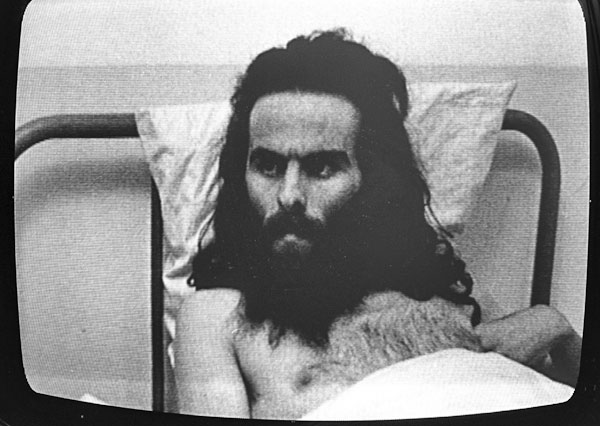
On Day 55 of the strike, ABC World News Tonight showed the photograph above, showing what Sands looked like before his conviction, and then, not having access to a current photograph, showed an artist's depiction of what he looked like at this point. I can't find that drawing on the Internet, but he looked like images I'd seen of newly-freed prisoners from the Nazi Holocaust. The only photograph I've seen shows him with a long beard that obscures how skinny he'd gotten, and it isn't clear how close to the end he was.
People from all over the world, including Pope John Paul II, head of the Roman Catholic Church, contacted British Prime Minister Margaret Thatcher, begging her to give in to the demands, rather than let a duly-elected Member of Parliament die. A Protestant and a hard-right-wing Conservative, she flat-out refused.

On Day 66, May 5, Sands died. Thatcher's official response, while addressing Parliament: "Mr. Sands was a convicted criminal. He chose to take his own life. It was a choice that his organization did not allow to many of its victims."

Over 100,000 people lined the route of Sands' funeral, and he was buried not far from his parents' home, in Milltown Cemetery in West Belfast.

The 1981 British Home Championships were canceled, because the "national" soccer teams of England and Wales refused to play away to Northern Ireland, not because they opposed Sands (not officially, anyway), but because they were afraid they would be attacked by the home fans.

In New York, the International Longshoremen's Association announced a 24-hour boycott of providing service to British ships; and the Archbishop, Terence Cardinal Cooke, offered a Mass of Reconciliation. Perhaps the greatest tribute was an agreement of the City's Irish bars: For 2 hours, they closed.

In New Jersey, the General Assembly, the lower house of the State legislature, voted 34-29 for a resolution honoring Sands' "courage and commitment." Just 28 miles away, in East Brunswick -- and with towns named Milltown and Old Bridge, also the names of towns in Northern Ireland, on either side -- the 11-year-old version of me couldn't understand why Thatcher let it happen.

President Ronald Reagan, an American of Irish descent, but a Protestant one, survived an assassination attempt during the hunger strike (although that had nothing to do with it), and made no public statement about Sands' cause, and made no statement on the occasion of Sands' death.

Another 9 hunger strikers would die, before the remaining strikers gave up. What did they gain? Publicity and sympathy, but nothing else.

On July 2, Parliament passed the Representation of the People Act 1981, automatically disqualifying anyone from election if they were serving more than one full year in prison. On August 20, a by-election for Sands' seat was held, and Owen Carron, a Sands ally, won with 49.1 percent of the vote, but with a larger margin of victory than Sands. Although never officially connected with terrorism, he lost his bid for re-election in 1983.

On October 5, James Prior, newly installed as the British government's Northern Ireland Secretary, agreed to Sands' original demands for the remaining political prisoners.

Thatcher remained Prime Minister until 1990. The Good Friday Agreement, not even remotely possible as long as she remained in office, ended The Troubles in 1998. HM Prison Maze was closed in 2000, and demolition began in 2006. Had the British government shown some humanity, and accepted his reasonable demands, Bobby Sands would have been 52 years old.

In 2013, Thatcher died, and while half of Great Britain, including the Protestant sectors of Northern Ireland, went into deep mourning, the other half, including the Catholic sectors of Northern Ireland, cheered. There was no holding of tongues by her opponents, as happened in America in 2004 upon Reagan's death.

Also in 2013, the Maze site was redeveloped into Balmoral Park, a showgrounds. With some irony, the main tenant is the Balmoral Show, an agriculture exhibition.

*

May 5, 1981 was a Tuesday. Actress Danielle Fishel was born. She played Topanga Lawrence on the sitcom Boy Meets World, and later, having married the earlier show's protagonist, Topanga Matthews on the sequel sitcom Girl Meets World.

These games were played in Major League Baseball:

* The New York Yankees lost to the California Angels, 6-2 at Anaheim Stadium (now Angel Stadium of Anaheim). Barry Foote hit a home run, but Reggie Jackson went 0-for-4, and Tom Underwood was removed when he couldn't get an out in the 4th inning. Brian Downing later hit a home run for the Halos.

* The New York Mets lost to the San Francisco Giants, 9-7 at Shea Stadium.

* The Montreal Expos beat the San Diego Padres, 4-3 at the Olympic Stadium in Montreal.

* The Philadelphia Phillies beat the Los Angeles Dodgers, 8-7 at Veterans Stadium in Philadelphia. Manny Trillo homered, and Mike Schmidt and Pete Rose each had a 2-RBI double.

* The Baltimore Orioles beat the Minnesota Twins, 3-2 at Memorial Stadium in Baltimore.

* The Houston Astros beat the Chicago Cubs, 4-3 at Wrigley Field in Chicago.

* The St. Louis Cardinals beat the Atlanta Braves, 4-1 at Busch Memorial Stadium in St. Louis.

* The Kansas City Royals beat the Boston Red Sox, 2-1 at Royals Stadium (now Kauffman Stadium) in Kansas City. George Brett went 1-for-4 for the Royals, while Carl Yastrzemski did not play for the Red Sox.

* The Texas Rangers beat the Chicago White Sox, 6-1 at Arlington Stadium in the Dallas suburb of Arlington, Texas.

* The Oakland Athletics beat the Detroit Tigers, 6-2 at the Oakland Coliseum.

* The Milwaukee Brewers beat the Seattle Mariners, 4-1 at the Kingdome.

* The Cincinnati Reds and the Pittsburgh Pirates were supposed to play each other at Three Rivers Stadium in Pittsburgh, but were rained out. The game was made up as part of a doubleheader on May 7, and the Pirates won both games, 3-1 and 7-1.

* The Cleveland Indians and the Toronto Blue Jays were supposed to play each other at Exhibition Stadium in Toronto. This game was never made up, due to the Strike of '81.

Football was out of season. The NBA Playoffs were in the Conference Finals. In the East, the Boston Celtics beat the Washington Bullets, 131-126 in double overtime at the Boston Garden, to move on to the Conference Finals. And the Milwaukee Bucks beat the Philadelphia 76ers, 110-98 at The Spectrum in Philadelphia. But, 2 nights later, the Sixers beat the Bucks to advance to face the Celtics.

In the West, the San Antonio Spurs eliminated the Seattle SuperSonics, 109-103 at the Kingdome in Seattle, setting them up to play the Los Angeles Lakers, who had already wrapped up their Conference Final berth. (Yes, the Kingdome hosted baseball and basketball on the same day.) In the NBA Finals, the Lakers beat the 76ers.

The Stanley Cup Playoffs were approaching their climax. The day before Sands' death, the New York Islanders had wrapped up their 3rd straight Finals bid, completing a 4-game sweep of the Quebec Nordiques. The day after his death, the Vancouver Canucks clinched their 1st Finals appearance, beating the Chicago Black Hawks in 5 games.

Tuesday, May 3, 2022

May 3, 1979: The Thatcher Revolution

May 3, 1979: The Conservative Party wins Great Britain's national election, gaining 62 seats and a majority in the House of Commons. This makes the Conservatives' Leader, Margaret Thatcher, Britain's 1st female Prime Minister.

The Conservative Party, a.k.a. the Tories, have long been known in Britain as "the natural party of government." That, of course, is elitism. But, after 5 years of Labour Party government, and Britain sinking deeper into an economic abyss -- one that had lasted pretty much since the previous Tory takeover, in 1970, leading to the last Labour win, in 1974 -- things weren't getting any better.

The Tories, backed by many of the country's leading national newspapers, ran a populist campaign, convincing the working people of the country that the party of the rich could help the poor, while the party that proclaimed Socialism was to blame for all their problems. The people bought it: Except for staunch Labour areas like North London, Liverpool, Manchester and Newcastle in England; Cardiff and Swansea in Wales; and Edinburgh and Glasgow in Scotland, the Tories pretty much swept the country. Labour's leader, James Callaghan, was out, and Thatcher was in.

She talked as tough as any male politician, and became known as the Iron Lady. She cracked down on the country's labor unions, and sent more troops into Northern Ireland to strike back at the Irish Republican Army -- as if the IRA weren't already playing defense against paramilitary groups funded by the Labour leaders of the previous British government.

In 1982, when Argentina took back the nearby Falkland Islands, a British colony, Thatcher sent the Royal Navy and the Royal Air Force to take them back. They did so in only 71 days. This wild success, with "only" 255 deaths, made her even more popular.

And, like Ronald Reagan, elected President of the United States in 1980, she cut taxes for the rich, and the economy built a "paper prosperity," in which the country once again seemed to be doing well on the surface. But cultural depictions of 1980s Britain since she left office -- including films like Billy Elliott, TV shows like Ashes to Ashes and In the Long Run, and the This Is England film and TV series -- revealed that, for people who weren't well off, things hadn't changed all that much. As The Who said a decade earlier, "Meet the new boss: Same as the old boss."

But the toughness that "Maggie" showed (including surviving an assassination attempt in Brighton in 1984), and the veneer of prosperity she brought, made her enormously popular with British conservatives. But anybody to the left of center despised her.

She built a strong rapport with Reagan, and, together, they dominated the world stage in the 1980s, until Reagan left office due to the two-term limit in 1989, and Thatcher was forced out by an intraparty squabble in 1990, having won 3 general elections, and becoming the longest-lasting Prime Minister in over 150 years. (Others had served longer than her 11 1/2 years, but not consecutively.)

But America and Britain are different. In 2004, when Reagan died, America's liberals held their tongues for a week, until the funeral, not talking about the damage Reagan had done. In 2013, when Thatcher died, half of Britain was deeply saddened, and the other half cheered.

As I said, many national newspapers are conservative, especially the tabloids, including The Sun, the Daily Express, the Telegraph (a.k.a. the Torygraph), and the Daily Mail (known as the Daily Fail for its poor journalism and the Daily Heil for its politics). Britain's biggest leftist newspaper, the Daily Mirror, did not mince words with its front page, nor did it lie.
Oddly, the leading portrayals of her, through 2002, have been by Americans: Meryl Streep in the 2011 film The Iron Lady, and Gillian Anderson in the 2020 season of the Netflix TV series The Crown.

*

May 3, 1979 was a Thursday. There were 6 Major League Baseball games were played that day:

* The New York Mets lost to the San Francisco Giants, 7-5 at Candlestick Park in San Francisco.

* The Milwaukee Brewers beat the Toronto Blue Jays, 5-4 at Milwaukee County Stadium.

* The Minnesota Twins beat the Detroit Tigers, 7-6 at Metropolitan Stadium in the Minneapolis suburb of Bloomington, Minnesota.

* The Houston Astros beat the St. Louis Cardinals, 4-1 at Busch Memorial Stadium in St. Louis.

* The San Diego Padres beat the Montreal Expos, 10-2 at San Diego Stadium (later Jack Murphy Stadium and Qualcomm Stadium). Dave Winfield went 1-for-4 with a home run.

* And the Los Angeles Dodgers beat the Philadelphia Phillies, 5-2 at Dodger Stadium in Los Angeles. Mike Schmidt hit a solo home run, and Pete Rose went 2-for-3 with an RBI. But that was all the runs the Phils got off eventual National League Rookie of the Year Rick Sutcliffe, who outpitched Steve Carlton.

Football was out of season. The NBA and the World Hockey Association were each between rounds of the Playoffs. The NHL was in its Stanley Cup Semifinals. Both series were in Game 4, and both games went to overtime. The New York Islanders beat the New York Rangers, 3-2 at Madison Square Garden. Bobby Nystrom scored the winning goal, 3:40 into overtime. But the Rangers would win the next 2 games to take the series.

In the other series, the Boston Bruins beat the Montreal Canadiens, 4-3 at the Boston Garden. Jean Ratelle scored the winner, 3:46 into overtime. But the Canadiens would win the series in overtime of Game 7, and then beat the Rangers for the Cup in 5 games.

Friday, April 15, 2022

April 15, 1989: The Hillsborough Disaster

April 15, 1989: A terrible mistake in opening the wrong gate leads to the deaths of 97 people, and injuries to hundreds of others, at Hillsborough Stadium in Sheffield, England, at the start of an FA Cup Semifinal, on neutral ground, between soccer teams Liverpool and Nottingham Forest. Most of those hurt were Liverpool fans.

The game was abandoned 6 minutes in, at 3:06 PM -- 10:06 AM U.S. Eastern Time, hence the time of this post.

All English football matches were postponed for 2 weeks. On May 1, a "Bank Holiday Monday," games were resumed. Every player across the country wore black armbands for matches, and a minute's silence was held before every kickoff.

The other Semifinal featured "the Blue Club in Liverpool," Everton, playing Norfolk team Norwich City at Villa Park, home of Aston Villa, in Birmingham in the West Midlands. Everton won, 1-0 on a goal by Pat Nevin.

On that tragic Saturday, there were 6 games played in the Football League's Division One:

* Arsenal defeated Newcastle United, 1-0 at the Arsenal Stadium, a.k.a. Highbury, in North London. Brian Marwood scored the goal for Arsenal, but recalls that the crowd was subdued, as some fans in the stands had transistor radios, and were getting reports that something had happened at Hillsborough, and the death toll was going up, and up, and up.

* The other North London team, Tottenham Hotspur, went to South London, and beat Wimbledon 2-1 at Plough Lane.

* Southampton beat West Ham United, 2-1 at the Boleyn Ground in East London.

* Derby County beat Manchester United, 2-0 at Old Trafford. This was not as big an upset as it looks now. At the time, it wasn't an upset at all: Derby would finish 5th in the League, Man U 11th.

* Luton Town and Coventry City played to a 2-2 draw at Kenilworth Road in Luton, Bedfordshire.

* And Queens Park Rangers and Middlesbrough played to a 0-0 draw at Loftus Road in West London.

The Hillsborough Semifinal was replayed on May 7, at Old Trafford, home of Manchester United. Liverpool won, 3-1, with John Aldridge scoring twice.

The Final was played as scheduled on May 20, at the old Wembley Stadium in West London. As in 1986, it was an All-Merseyside Final. As in 1986, it was still possible for Liverpool to win both the Football League and the FA Cup, also known as "doing The Double." Aldridge scored 4 minutes into the game, and it looked like Liverpool's "Double" was on. But Stuart McCall scored for Everton in the 89th minute, and the game went to extra time.

McCall scored again, but Ian Rush scored twice, and Liverpool won, 3-2. They had a glorious consolation for their misery.

The Liverpool-Arsenal match, scheduled for Liverpool's home of Anfield on April 22, was postponed to Friday night, May 26 -- and it turned out to be the League title-decider. When the Arsenal players came onto the pitch, they were holding bouquets of flowers, and each player in the starting XI ran toward the stands and gave his bouquet to a fan.

With the tiebreakers requiring Arsenal to win by 2 goals, at a stadium where they hadn't won at all in 15 years, to win the League title (and deny Liverpool the Double), they did just that, with Michael Thomas' goal in the 2nd minute of 2nd-half stoppage time giving Arsenal the most dramatic title in League history.

True, Liverpool fans did have the FA Cup, so they didn't exit the season empty-handed. But after all the death and destruction, and the lies and humiliation from the media and their own government, this defeat was another blow to their collective psyche.

The disaster happened 6 months before the Loma Prieta Earthquake interrupted the 1989 World Series in San Francisco. The much-maligned Candlestick Park held, protecting 60,000 people, although 63 people died around the San Francisco Bay Area.

*

In North American sports on April 15, 1989:

* The New York Yankees were supposed to play the Minnesota Twins at the original Yankee Stadium, but the game was rained out. It was rescheduled as the opener of a twi-night doubleheader (those were a thing, once) on August 2 -- the 10th Anniversary of another tragedy, the death of Thurman Munson -- and the Yankees won, 7-6. Bob Geren hit a home run, and Lance McCullers, whose son Lance Jr. would later drive the Yankees crazy as a pitcher for the Houston Astros, was the winning pitcher, in relief of Dave LaPoint.

* The New York Mets lost to the St. Louis Cardinals, 3-2 in 10 innings at Busch Memorial Stadium in St. Louis. Pedro Guerrero hit a walkoff single against Don Aase.

* The Philadelphia Phillies were supposed to host the Chicago Cubs at Veterans Stadium. Like Yankees vs. Twins, this was rained out, and rescheduled as the opener of a twi-night doubleheader. On July 31, the Cubs won, 10-2.

* The Baltimore Orioles beat the Boston Red Sox, 12-4 at Fenway Park in Boston.

* The Kansas City Royals beat the Toronto Blue Jays, 10-5 at Exhibition Stadium in Toronto.

* The Pittsburgh Pirates beat the Montreal Expos, 6-4 at Three Rivers Stadium in Pittsburgh.

* The Texas Rangers beat the Detroit Tigers, 4-1 at Tiger Stadium in Detroit.

* The Chicago White Sox beat the Oakland Athletics, 7-4 at Comiskey Park in Chicago.

* The Milwaukee Brewers beat the Cleveland Indians, 5-1 at Milwaukee County Stadium. Eight days earlier, the film Major League premiered, featuring a fictionalized version of the Indians, with County Stadium serving as a stand-up for Cleveland Municipal Stadium. Hence, real-life Brewers broadcaster Bob Uecker played fictional Indians broadcaster Harry Doyle.

* The Cincinnati Reds beat the San Diego Padres, 6-3 in 10 innings, at Jack Murphy Stadium in San Diego.

* The Los Angeles Dodgers beat the Houston Astros, 3-1 at Dodger Stadium in Los Angeles.

* The San Francisco Giants beat the Atlanta Braves, 1-0 at Candlestick Park in San Francisco.

* And the California Angels beat the Seattle Mariners, 9-2 at the Kingdome in Seattle.

*

There were 2 Stanley Cup Playoff series that were decided in a Game 7 on this day. An overtime goal by Joel Otto gave the Calgary Flames a 4-3 win over the Vancouver Canucks at the Saddledome in Calgary.

And Wayne Gretzky led his new team, the Los Angeles Kings, to a 6-3 win over his former team, the defending Stanley Cup Champions, the Edmonton Oilers, at what was then known as the Great Western Forum, in the Los Angeles suburb of Inglewood, California.

There were 7 games, all regular-season, played in the NBA that day:

* The Atlanta Hawks beat the Milwaukee Bucks, 125-100 at The Omni in Atlanta.

* The Indiana Pacers beat the Charlotte Hornets, 115-105 at the Market Square Arena in Indianapolis. Chuck Person scored 37 points for the Pacers.

* The Sacramento Kings beat the Golden State Warriors, 114-110 at the Oakland Coliseum Arena.

* The Phoenix Suns beat the San Antonio Spurs, 137-91 at the Arizona Veterans Memorial Coliseum in Phoenix. Tom Chambers led all NBA scorers for the night, with 38 for the Suns.

* The Los Angeles Clippers beat the Los Angeles Lakers, 119-107, at the Clippers' home, the Los Angeles Memorial Sports Arena, which had been the Lakers' home before the Forum opened.

* The Utah Jazz beat the Portland Trail Blazers, 99-95 at the Portland Memorial Coliseum.

* And the Seattle SuperSonics beat the Denver Nuggets, 125-92 at the Seattle Center Coliseum. Dale Ellis scored 32 for the Sonics. 

December 31, 1999 & January 1, 2000: The Millennium

December 31, 1999:  The Millennium arrives. The people of planet Earth survived. At a terrible cost. But we hadn't destroyed ourselves. ...