Showing posts with label newsy lalonde. Show all posts

Tuesday, April 5, 2022

April 5, 1919: Joe Hall Dies, Stanley Cup Finals Canceled

Joe Hall

April 5, 1919: For the 1st time, the Stanley Cup Finals are canceled. There was little choice, and it had nothing to do with the greed of the hockey teams' owners.

In 1917, the Seattle Metropolitans, Champions of the Pacific Coast Hockey Association, became the 1st American-based team to win the Stanley Cup, beating the Montreal Canadiens, defending Champions, and again Champions of the National Hockey Association. At age 29, Pete Muldoon became the youngest head coach ever to win the Cup, and remains so.

The National Hockey League was then formed, and the Canadiens joined it. In 1919, the Canadiens won the NHL title again, with stars like Joe Malone, Edouard Lalonde, Didier Pitre, Joe Hall, Odie Cleghorn and Georges Vézina.

They were skillful: "Cannonball" Pitre was the fastest skater in the League, "Phantom" Joe Malone its leading scorer, and player-head coach "Newsy" Lalonde perhaps its best all-around player. And Georges Vézina was the best goaltender, the man for whom the award for the NHL's top goaltender would eventually be named.

But they were also tough: Odie Cleghorn was dirty, "Bad" Joe Hall was perhaps the dirtiest player in the game, and Billy Coutu would actually go on to get banned for life because of an attack on a referee. (The ban was lifted after 2 years. Odie's brother, Sprague Cleghorn, then with the Ottawa Senators but a future Canadien, was dirtier than Odie, but not dirtier than Hall.)

With future Hall-of-Famers Frank Foyston, Jack Walker and goaltender Harry "Hap" Holmes as holdovers from the 1917 Champions, the Metropolitans won the PCHA title, setting up a rematch with "Les Habitantes."

But the Metros would be going into the Finals without their leading scorer. Not because he was stricken with what became known as "The Spanish Flu," an epidemic raging throughout the world since the previous August. Nor was it because he was serving in World War I. It was because he wasn't serving: Just before Game 1 of the PCHA Finals against the Vancouver Millionaires, Bernie Morris was arrested for draft evasion.

He was a Canadian citizen, and thus a subject of the British Empire. But because he was working in America, even though it was in professional sports, a treaty between the Empire and the United States meant that he was supposed to register for the draft. Once he did that, he would have been allowed to claim an exemption. But he did not appear on his induction date, and became "the first foreign national on the West Coast convicted of draft evasion."

After being sent to the U.S. military prison on Alcatraz Island in San Francisco Bay -- later to be turned into the most famous of all American civilian prisons -- he was transferred to a U.S. Army unit. In March 1920, he was granted an honorable discharge, and was permitted to rejoin the Metropolitans for the Stanley Cup Finals. Which did them, and him, no good in 1919. (Where was Clarence Darrow when Morris needed him?)

As with 1917, the Canadiens and the Metropolitans reached an agreement: Because of the distance between Montreal and Seattle, all the games would be played at the Seattle Ice Arena, but they would alternate with each league's rules: PCHA rules would be used for Games 1 and 3, and, if necessary, 5; while NHL rules would be used for Game 2 and, if necessary Game 4.

As could easily be guessed, the team whose league rules were used won each of the 1st 3 games. Foyston scored a hat trick in Game 1, part of a 7-0 Metropolitans win. But the Canadiens won Game 2, with Lalonde scoring all 4 of Montreal's goals, before Seattle came back with 2. Perhaps Foyston took that personally, as he scored 4 goals in Game 3, and the Metropolitans won, 7-2.
Frank Foyston

Game 4 was a purist's delight, as regulation, an overtime, and a 2nd overtime all ended 0-0, with both Holmes and Vézina stopping every shot. As the clock was winding down in the 2nd overtime, Louis Berlingette of the Canadiens appeared to have a clear shot, but just missed. Lalonde and Muldoon met, and agreed to halt the game, leaving Seattle up 2 games to 1, with 1 tie. The Ice Arena could only hold 4,000 people, but they all gave both teams a standing ovation.
Newsy Lalonde

But the next day, the agreement between the teams began to break down. Lalonde argued that, since Game 4 did not reach a conclusion, Game 5 should be a replay of it, and so NHL rules should be used. Muldoon insisted that the original agreement, that Game 5 would use PCHA rules, hold. In the end, Lalonde let the original agreement stand, but got a concession that, if the Canadiens won Game 5, tying the series, then Game 6 would be under NHL rules. Since alternating was what had been done, Muldoon agreed.
Pete Muldoon

A deal was also reached between the officials of each league, and the Cup's trustees: No more ties. No matter how long it took -- and, in the 1930s, there would be 2 Playoff games going to 6 overtimes -- the teams would play until somebody scored a winning goal.

On March 29, Game 5 was played. After 2 periods, the Metropolitans led, 2-0. But they faltered, the Canadiens took advantage, and at the end of regulation, it was 3-3. After 15:51 of overtime, Jack McDonald scored to give the Canadiens the 4-3 win. The series was tied, 2-2-1.

After the game, some players were taken to a hospital. Some of the Seattle players were carried home. At first, it was suspected that they were exhausted and dehydrated, from playing 9 periods of hockey in a span of 4 days. But the hospitalized players were diagnosed with the Spanish Flu.

Most countries downplayed the epidemic, which may have reduced the chances of protecting oneself against it, and increased the chance of death. (As with COVID-19, over a century later, people tended to wear masks in public, and, for many people, this worked.) It was feared that, if the solders learned how many people, in their ranks and back at home, had the flu, and how many were dying from it, it would ruin morale.

But Spain was neutral, not fighting in the war. Their newspapers reported on how the flu ravaged their country. Even King Alfonso XIII was infected, although he survived. So the disease became known as "The Spanish Flu," even though it was an All-American thing.

The 1st wave of the flu hit the U.S. in February 1918, and peaked in April. A 2nd wave began in August, and, with U.S. troops having arrived in France, it spread throughout the Allied ranks. British and French soldiers took it to their colonies in Africa and Asia. This 2nd wave peaked in late October 1918, with Philadelphia reporting 4,600 deaths in one week. That's a "9/11" and a half, at a time when our country had about 1/3rd the population it has now.

There was a 3rd wave that began in late February 1919, after the Armistice, and it was still going on April 1, the day Game 6 was supposed to be played. We may never know how many people this epidemic killed: Estimates range from 50 to 100 million, possibly as much as 5 percent of the world's population. That's right: This disease may have killed 1 out of every 20 people in the world at the time. And the war was one of the causes. And not everybody died: About 500 million got sick from it, which could be 1 out of every 4 people. One out of four people on the planet.

There were 70 million people serving in the armed forces of one country or another in World War I. About 10 million people died in service, and at least that many civilians' deaths can be attributed it -- not counting the flu epidemic. So, about 20 million people died as a result of the war. The flu killed at least 3 times as many.

Lalonde -- remember, their head coach as well as their best player -- Hall, Coutu, Berlinguette and McDonald were all in a hospital, across the continent from their homes, and not even in their home country. Their fevers were between 101 and 105 degrees Fahrenheit. Game 6 was postponed indefinitely.

George Kennedy, the former professional wrestling champion of Canada who had become Montreal's top sports promoter, and owned the Canadiens, asked for emergency conditions: He wanted to use players from the next-closest PCHA team, the Victoria Cougars. But PCHA president Frank Patrick (Lester's brother) refused. With this in mind, Kennedy was willing to forfeit the series, and claim the Stanley Cup and the title of World Champions. But Muldoon was sporting enough to refuse this: He did not want to accept the Cup on the basis of his opponents' catastrophic illness.

Four days later, on April 5, Joe Hall died. He had won the Stanley Cup in 1907 with the Kenora Thistles, and in 1912 and 1913 with the Quebec Bulldogs. But now, he was dead at the age of 37. "Bad Joe" was one of the dirtiest players of his time, but was mourned as if he was already beloved.

Kennedy would also be hospitalized. Although the flu didn't kill him, it permanently compromised his health. On October 19, 1921, a few weeks short of his 40th birthday, he died.

With Hall's death, Game 6 was canceled outright. It is the only time the Stanley Cup Playoffs have been played without reaching a conclusion, and, aside from the canceled season of 2004-05, the only time since the Cup's establishment for the 1893 season that it hasn't been awarded.

At first, the tradition of engraving the winning team's name, and those of its players and officials, onto the Cup was not observed, because there was no winning team. In 1948, when the Cup was given its current "barrel" shape, an engraving was made, reading:

1919
Montreal Canadiens
Seattle Metropolitans
Series Not Completed

The Metropolitans reached the Finals again in 1920, losing to the Ottawa Senators, despite the return of Bernie Morris. In 1921, '22 and '24, they lost the PCHA Final to the Vancouver Millionaires. After the 1923-24 season, they were evicted by the new owners of the Seattle Ice Arena, and folded.

Despite the growth of the NHL, and the existence of the World Hockey Association from 1972 to 1979, Seattle wouldn't get another major league hockey team until 2021. On October 26, 2021, the Seattle Kraken raised a banner honoring the 1917 Stanley Cup win, but not a banner representing their 1919 PCHA title and Stanley Cup Finals appearance. The opponent that night, fittingly, was the Montreal Canadiens. Seattle won, 5-1.

*

April 5, 1919 was a Saturday. There were no other hockey games. Professional basketball barely existed. Football was out of season. And baseball was still in Spring Training.

There were, however, other sports that day. The 1918-19 season would be the last in English soccer with the Football League suspended, as the war ended too late to start a full new season. So this would be the last season of "The London Combination" and other small regional leagues. Among the games played that day: Arsenal defeated Chelsea, 2-1 at the Arsenal Stadium, known as Highbury for its North London neighborhood.

Wednesday, March 30, 2022

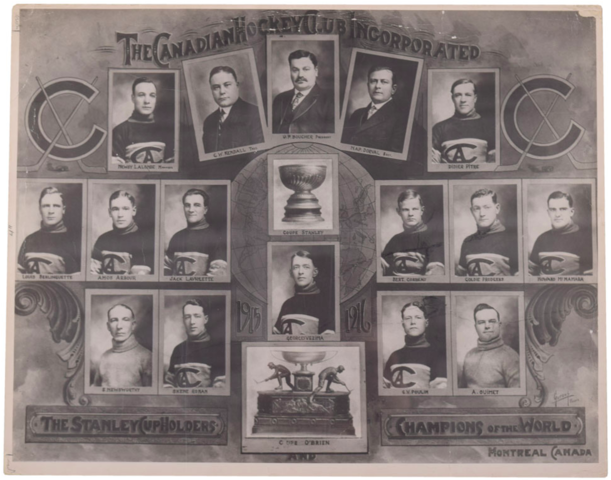
March 30, 1916: The 1st Canadien Cup

The 1916 Canadiens. Note the "CA" logo instead of "CH,"
the much smaller Stanley Cup, and the O'Brien Trophy.

Every great sporting institution had to start its greatness at some point. For hockey's greatest franchise, this was it.

March 30, 1916: The Montreal Canadiens win the Stanley Cup for the 1st time. They defeat the Portland Rosebuds, the 1st American-based team to compete for the Cup.

The team was founded in 1909, as Club Athlétique Canadien -- Canadian Athletic Club. The original logo was a Gothic C inside a maple leaf. Later, it became a "CA," for "Canadian Athletic." In the 1st NHL season of 1917-18, it became "Club de Hockey Canadien," and the logo became a "CH."

George "Tex" Rickard, the boxing promoter who built the 3rd Madison Square Garden and founded the Rangers, was once asked what the H in the Canadiens' "CH" logo stood for, and he said, "Habitantes," a reference to the early French settlers of Québec, especially farmers. This got shortened to "Habs," leading to the English chant, "Go, Habs, go!"

But at their founding, they quickly became the team of Montreal's French speakers, or "Francophones." The Montreal Wanderers, "the Little Men of Iron," Stanley Cup winners of 1906, 1908, 1909 and 1910, remained the team of the English speakers, of "Anglophones."

The Canadiens reached the Playoffs for the 1st time in 1914, and in 1916, won the Championship of the National Hockey Association, the O'Brien Cup, which was named after their founder, J. Ambrose O'Brien. This, effectively, made them the hockey champions of Eastern Canada, and entitled them to play the champions of Western Canada, the champions of the Pacific Coast Hockey Association. Only this time, it was the Portland Rosebuds, of Portland, Oregon, who won the PCHA title, becoming the 1st American team to play for the Cup.

The format was a best-3-out-of-5, and, because of the distance required for train travel in that pre-jet plane era, all the games were played at the Montreal Arena, so the Rosebuds would never have home-ice advantage. To make up for this, Games 2 and 4 would be played under Western rules, with 7 men on a side, including the "rover" position that the NHA had already eliminated, in favor of 6-a-side: Goaltender, 2 defensemen, left wing, center, right wing.

The Arena, also known as the Westmount Arena, because it was built just west over the city line, in the City of Westmount. It opened in 1898, as the 1st arena ever built specifically for ice hockey, with rounded corners, a style copied by hockey arenas ever since.

Despite playing under Eastern rules, the Rosebuds won Game 1, 2-0, holding the Canadiens to 6 shots. The Habs' Captain and best defender, Jean-Baptiste "Jack" Laviolette, got his jaw broken. And their head coach and best all-around player, Édouard Cyrille "Newsy" Lalonde, developed a bad cold, and would also miss Game 2, which would be played under Western rules. It looked like a major upset was in the making.

But the Canadiens won Game 2, anyway, 2-1, with a much tighter-checking defense. Laviolette and Lalonde both returned for Game 3. Lalonde got into a fight with Rosebuds star Ernie "Moose" Johnson, remembered by Montreal fans for his time with the Wanderers. The police had to come onto the ice to break up the fight, and Lalonde and Laviolette were both ejected from the game. Despite this, Didier "Cannonball" Pitre scored three goals -- the term "hat trick" didn't come into wide use until the 1950s -- and the Canadiens won, 6-3.

In Game 4, the Rosebuds blew a 3-0 lead, then the Canadiens blew a 4-3 lead, and the Rosebuds won, 6-5, to send the series to the distance. In Game 5, the Rosebuds took a 1-0 lead, but the Canadiens tied it, and George "Goldie" Prodgers won it for Montreal, 2-1.

It was the 26th time (counting the Cup's tenure as a "challenge cup") in 24 seasons that a Montreal team had won the Stanley Cup. But it was the first time for the Montreal Canadiens. Through the 2020-21 season, they have won 24. The only team in all of North American major league sports with more World Championships is the New York Yankees, with 27. From their 22nd Cup in 1979 until the Yankees' 24th World Series win in 1999, the Canadiens were actually in, or at least tied with the Yankees for, 1st place overall.

Hail the Champions: Goaltender, Number 1, Georges Vézina; defensemen, 2, Bert Corbeau; 3, Howard McNamara; and 8, Goldie Prodgers; centers, 4, Newsy Lalonde; 5, Didier Pitre; 6, George "Skinner" Poulin; and 12, Erskine "Skene" Ronan; and wingers, 7, Jack Laviolette; 9, Louis Berlinguette; 10, Albert John "Jack" Fournier; and 11, Amos Arbour. (Amos was a cousin of later New York Islanders coach Al Arbour.) Vézina, Lalonde, Pitre, Laviolette and O'Brien would be elected to the Hockey Hall of Fame.

The Canadiens won the NHL Championship again in 1917, but lost the Stanley Cup Finals to the Seattle Metropolitans, who thus became the 1st American team to win the Stanley Cup. They lost the 1st NHL Finals in 1918, to the team now known as the Toronto Maple Leafs. They faced the Metropolitans again in the 1919 Stanley Cup Finals, but they were called off due to the Spanish Flu epidemic hitting both teams, killing Canadien defenseman Joe Hall (who was with the Quebec Bulldogs in 1916). The Canadiens didn't win the Cup again until 1924.

The Montreal/Westmount Arena burned down in 1918, dooming the Wanderers franchise. Condominums are on the site today. The Montreal Forum was built a block away, on the other side of the Montreal City Line, in 1924. Place Alexis Nihon, a shopping mall, was built between the sites, on the Westmount side.

From the opening of the Forum in 1924 until 1938, the Montreal Maroons played there, taking the Wanderers' place as the team of Anglophone Montrealers. But despite winning the Cup in 1926 and 1935, the Great Depression did them in. The Canadiens united the city for the next 40 years.

In 1979, the NHL took on the World Hockey Association's Quebec Nordiques, and the dynamic was reversed: In the Province of Quebec, the Canadiens began to be seen as the team of Quebec's Anglophones and Canadian nationalists/federalists, while the Nords were seen as the team of Francophones and Quebec nationalists/separatists. And the rivalry got very nasty, including "the Good Friday Massacre" in the 1985 Playoffs. But in 1995, unable to get a new arena, the Nordiques' owners moved them to Denver, making them the Colorado Avalanche.

After the founding of the NHL, the O'Brien Trophy was given to the NHL Champion (even if they didn't beat the Western Champions for the Stanley Cup) until 1927, then the winners of the NHL Canadian Division until 1938, and then to the team that lost the Stanley Cup Final until the trophy was retired in 1950. In my opinion, it should be brought back, and given to the last Canadian team standing in the Stanley Cup Playoffs.

*

March 30, 1916 was a Thursday. There were no other scores on this historic day: Baseball was in Spring Training, and professional football and basketball only existed on a minor-league level. 

Thursday, March 3, 2022

March 3, 1920: The NHL's Biggest Blowout

Édouard "Newsy" Lalonde

March 3, 1920: The biggest blowout in the history of the National Hockey League occurs. It was only the League's 3rd season, but in over 100 seasons since, it hasn't been topped.

The game was played at the Quebec Arena, in Quebec City. It was built in 1913, on the heels of back-to-back Stanley Cup wins by the Quebec Bulldogs. But World War I and the 1917 move from the National Hockey Association to the NHL hurt the team.

Although Joe Malone had scored 7 goals in a game, just 32 days earlier, in an 11-3 Bulldogs win over the Montreal Canadiens, that was only the 2nd game the Bulldogs had won in the 1919-20 season, and they'd only won 1 since. Meanwhile, the Canadiens had bounced back, and were challenging for the League title.

This game would be an embarrassment for the Provincial capital club. Didier Pitre had a hat trick, 3 goals, before the 1st period was out. Odie Cleghorn added another, and the period ended 4-0 to Montreal. Édouard "Newsy" Lalonde, the Canadiens' player-coach, and Harry Cameron made it 6-0, before Thomas McCarthy finally got the Bulldogs on the board, at the 9:25 mark of the 2nd period.

Les Habitantes were unfazed. Just 40 seconds later, Lalonde got his 2nd of the game. A minute and a half later, Cleghorn got his. Amos Arbour (apparently, no relation to later New York Islanders coach Al) scored, then Lalonde got his 3rd of the game, and Cameron got his 2nd. The period ended 11-1 Montreal.

Lalonde scored a 4th goal 2 minutes into the 3rd, before Harry Mummery pulled one back for the Bulldogs, making it 12-2. But Cameron scored a 3rd goal, so did Cleghorn, and Arbour got a 2nd. Malone finally got on the board, before Cameron scored a 4 with 27 seconds left.

Final score: Montreal 16, Quebec 3. Goals for the Canadiens: Lalonde 4, Cameron 4, Pitre 3, Cleghorn 3, Arbour 2. Four different Canadiens scored hat tricks. It's enough to ask whether Bulldog goalie Frank Brophy was hurt. Had to say: Although his goals-against average for the season was 7.11, he was the winning goalie in 3 of the team's 4 wins that season.

The season was split into 2 halves. Since the Ottawa Senators won each half -- the 1st by 2 over the Canadiens, and the 2nd by 6 over the Toronto St. Patricks (forerunners of the Maple Leafs) -- they were declared NHL Champions, without a playoff being necessary. They went on to beat the Seattle Metropolitans, Champions of the Pacific Coast Hockey Association, for the Stanley Cup, starting a dynasty where they won 4 Cups in 7 seasons.

The Canadiens would be back. The Bulldogs wouldn't: Before the start of the 1920-21 season, they moved to Hamilton, Ontario, and became the Hamilton Tigers. After the 1925 season, that team was dissolved, and replaced with the New York Americans. Quebec City wouldn't get another NHL team until 1979, when the NHL took on the WHA's Quebec Nordiques. They moved in 1995, becoming the Colorado Avalanche, and since then, the capital of the Province of Quebec has been without an NHL team again.

*

March 3, 1920 was a Wednesday. Elsewhere in Canada, in Vancouver, James Doohan was born. The Irish-Canadian was a hero of D-Day, and later played Chief Engineer Montgomery Scott in the Star Trek franchise.

Baseball was in Spring Training. Football was out of season. And professional basketball barely existed. There was 1 other NHL game played that day: The Senators beat the St. Patricks, 7-4 at the Ottawa Arena. Cy Denneny scored 2 goals, so did Eddie Gerard, and Cleghorn's brother Sprague Cleghorn scored 1.

Monday, January 10, 2022

January 10, 1920: The NHL's Highest-Scoring Game

Newsy Lalonde

January 10, 1920: The highest-scoring game in National Hockey League history is played.

Later in the month, on January 31, Joe Malone of the Quebec Bulldogs would set an NHL record that still stands, with 7 goals in 1 game. But he and his Bulldog teammates were not involved in this game.

Instead, it was the Montreal Canadiens, playing the Toronto St. Patricks at the Mount Royal Arena in Montreal. It took 4 minutes for the Canadiens to get on the scoreboard, but, after that, they just couldn't stop. Didier "Cannonball" Pitre had 3 goals, a "hat trick"; and player-coach Édouard "Newsy" Lalonde 2 goals, all before 9 minutes of hockey had been played.

Billy Coutu and Odie Cleghorn followed with goals. With 4 minutes left in the 1st period, the score was Montreal 7, Toronto 0. Yes, that's in hockey, not football. Mickey Roach scored to make it 7-1 by the end of the 1st period.

In the 2nd period, Cleghorn got his 2nd of the game, while Lalonde got his 3rd, his 4th, and his 5th. Reg Noble scored for Toronto, and Corb Denneny scored twice. With 9 minutes left in the 2nd, it was 11-4 Montreal. Amazingly, there were no more goals in the period.

Just 30 seconds into the 3rd period, Cully Wilson scored for the St. Patricks. But within 2 minutes of each other, Bert Corbeau and the 6th goal of the game for Lalonde put an end to Toronto hopes, making it 13-5. Noble got his hat trick, but so did Cleghorn.

In a game with no goals in its 1st 4 minutes, and none in its last 5, the Canadiens won by a score of 14-7. That's 21 goals in a single NHL game. It has never happened again. Indeed, it was 21 goals in a span of 51 minutes, a goal every 2 minutes and 25 seconds.

Neither of these teams went on to win the Stanley Cup. Nor did Malone's Bulldogs. It would be the other team in what was then a 4-team League, the Ottawa Senators, who won the Cup. The St. Patricks did win it in 1922. In 1927, they changed their name to the Toronto Maple Leafs, ditching their green uniforms -- along with the St. Patricks name, designed to appeal to Toronto's Irish community -- for the blue uniforms they wear to this day.

The Canadiens had won the Cup in 1916, and would do so again in 1924. After the folding of the Montreal Maroons, who lasted from 1924 to 1938, the Leafs became the Canadiens' greatest rivals. From 1942 to 1979, either the Canadiens or the Leafs won the Stanley Cup in 18 of the 38 seasons.

*

January 10, 1920 was a Saturday. Baseball and football were out of season. Professional basketball barely existed. And there was only 1 other NHL game that day: The Ottawa Senators beat the Quebec Bulldogs, 7-1.

Also, in England's FA Cup, Arsenal defeated Rochdale AFC, 4-2 at the Arsenal Stadium, a.k.a. Highbury, in North London, in the 1st Round Proper.

December 31, 1999 & January 1, 2000: The Millennium

December 31, 1999:  The Millennium arrives. The people of planet Earth survived. At a terrible cost. But we hadn't destroyed ourselves. ...