Showing posts with label 1933. Show all posts

Thursday, December 29, 2022

December 29, 1933: Laurel & Hardy Star In "Sons of the Desert"

December 29, 1933: Sons of the Desert premieres, starring Stan Laurel and Oliver Hardy. The film's title became the name of the comedy duo's international appreciation society.

Arthur Stanley Jefferson was born on June 16, 1890 in Ulverston, Cumbria, in the North-West of England. Taking on the name Stan Laurel, he starred in English music halls (their version of vaudeville), developing the persona of a well-meaning bumbler in a bowler hat. In 1910, he came to America on the same sea voyage as Charlie Chaplin, and made his 1st film appearance in 1917.

Norvell Hardy was born on January 18, 1892 in Harlem, Georgia. Taking his father's name of Oliver, he developed an early interest in music, and played football at the University of Georgia. He made his 1st film appearance in 1914, in what was then the filmmaking capital of the South, Jacksonville, Florida. He moved to Los Angeles in 1917, and in 1921, he appeared in The Lucky Dog, as did Laurel: Hardy's character was a robber who tried to hold Laurel's character up. But they would not appear together again until 1927, as Hardy developed a persona of a fat man who became the film's "fall guy."

That year, they both appeared in Slipping Wives and Duck Soup (not to be confused with the later Marx Brothers film of the same title), both for Hal Roach Studios. Roach director Leo McCarey noticed that they worked well together, and teamed them up. Together, they would appear in 107 films, many of them comedy shorts, with 23 full-length features. Hardy also began wearing a bowler hat, which became identified with the duo long after going out of fashion.

My grandmother was a huge fan of theirs. Their theme song was "The Cuckoo Song," with a similarity to "The Worm Crawls In." Their slapstick humor carried through films like The Music Box, Way Out West, and Babes in Toyland, which became a Christmas-season classic.

But Laurel & Hardy is another entertainment institution with a famous catchphrase that was never actually used. Stan's bumbling would inevitably lead to "Ollie" saying, "This is another fine mess you've gotten us into, Stanley." Instead, it was, "Well, here's another nice mess you've gotten me into!" Stan's reply was usually to start crying and say, "Well, I couldn't help it!" Nevertheless, one of their films was titled Another Fine Mess.

When their contract ran out in 1944, they switched to a stage show, sometimes entertaining the troops in World War II. After the war, both men, only in their early 50s, had serious health issues, and they made only 1 more film together, a French film titled Atoll K., in 1951. On December 1, 1954, they appeared on This Is Your Life, and it was their only television appearance.

Hardy died from the last of a series of strokes on August 7, 1957, at the age of 65. Laurel refused to perform without him, and turned down a role in the 1963 cast-of-thousands comedy It's a Mad, Mad, Mad, Mad World. He died on February 23, 1965, at 75.

That same year, John McCabe, who'd written a book about them, founded The Sons of the Desert, not a "fan club," but an "appreciation society." Among the original members were actors Orson Bean and Chuck McCann, who occasionally appeared in character as the duo.

Larry Harmon, the most famous portrayer of Bozo the Clown, bought the legal rights to the Laurel & Hardy franchise, and produced new cartoons based on them, including a 1972 pairing with Scooby-Doo and Mystery, Inc.

In 1999, he produced a live-action film, The All New Adventures of Laurel & Hardy in For Love or Mummy. Bronson Pinchot, best known as Balki on the sitcom Perfect Strangers -- with Mark Linn-Baker's Larry being something of a Hardy to Pinchot's Laurel -- played Stan; while Gailard Sartain, known for playing fat Southerners like Hardy, played Hardy. It went direct to video, and was not a hit.
Maybe Matthew Broderick and Nathan Lane could do it better.

*

December 29, 1933 was a Friday. This was also the day the film Flying Down to Rio premiered, marking the 1st film pairing of Fred Astaire and Ginger Rogers. I have a separate entry for that event.

Baseball and football were in the off-season. The NBA hadn't been founded yet. And while the NHL season was in progress, no games were scheduled. So there were no scores on this historic day. 

December 29, 1933: The Debut of Fred Astaire & Ginger Rogers

December 29, 1933: The film Flying Down to Rio premieres. It is the 2nd film for Fred Astaire, the 22nd film of Ginger Rogers, and their 1st film together.

Frederick Austerlitz was born on May 10, 1899 in Omaha, Nebraska. Sidney Zion, a columnist for the New York Daily News, listed him as one of "The Century Seven," 7 people born in 1899, the last year of the 19th Century, whose work guided American popular culture through much of the 20th Century. They were: Duke Ellington, born on April 29; Fred Astaire, May 10; James Cagney, July 17; Alfred Hitchcock, August 13; Hoagy Carmichael, November 22; Noël Coward, December 16; and Humphrey Bogart, December 25.

He started dancing professionally with his sister, Adele. Their mother suggested a change of surname to "Astaire," after an uncle's nickname. In 1914, Fred met the brothers George and Ira Gershwin, and they worked together for the rest of George's life.

Virginia Katherine McMath was born on June 16, 1911 in Independence, Missouri, outside Kansas City. Independence became famous as her hometown before it became known as the hometown of President Harry S Truman: He was 27 years older, but she became nationally famous first.

A cousin had trouble saying, "Virginia," and it came out "Ginger." When her parents split up, and her mother remarried, Ginger took her stepfather's surname, Rogers. She was discovered in 1925 by vaudeville legend Eddie Foy.

In 1930, the Gershwins' musical Girl Crazy debuted on Broadway. Rogers appeared in it, and Astaire helped with the choreography. They met then, but they didn't star together until Flying Down to Rio. Despite being 12 years younger, Rogers actually become a film star first, earlier in the year, with Gold Diggers of 1933, with its signature song, "We're In the Money."

Fred & Ginger made 10 films together. Flying Down to Rio in 1933; The Gay Divorcee, featuring the song "Night and Day," in 1934; Roberta, featuring "I Won't Dance (Don't Ask Me)" and "Smoke Gets In Your Eyes," and Top Hat, featuring the title song and "Cheek to Cheek," in 1935; Follow the Fleet and Swing Time, the latter featuring "The Way You Look Tonight," in 1936; Shall We Dance, featuring "Let's Call the Whole Thing Off" and "They Can't Take That Away From Me," in 1937; Carefree in 1938; The Story of Vernon and Irene Castle, featuring "By the Light of the Silvery Moon," in 1939; and The Barkleys of Broadway in 1949.

Despite playing real-life couples in the last 2, they were never romantically involved with each other. With the rise of feminism in the 1970s, a joke developed: "Ginger Rogers did everything Fred Astaire did, but backwards and in high heels."

Rogers retired from acting in 1965, and ran a ranch in Oregon. Astaire continued to dance into the 1970s, and acted as late as 1981. Rogers married and divorced 5 times, and had no children. Astaire married, was widowed, and, many years later, married the much younger female horse-racing jockey Robyn Smith. Fred Astaire Jr. became a pilot and (interestingly, like Rogers but not his father) a rancher. Ava Astaire maintains her father's commercial legacy.

Astaire died on June 22, 1987, at the age of 88, the last survivor of the men that Sidney Zion called "The Century Seven." Rogers died on April 25, 1995, at 83. As of December 29, 2022, both Astaire children are still alive.

*

December 29, 1933 was a Friday. This was also the day the Laurel & Hardy film Sons of the Desert premiered. I have a separate entry for that event.

Baseball and football were in the off-season. The NBA hadn't been founded yet. And while the NHL season was in progress, no games were scheduled. So there were no scores on this historic day.

Saturday, December 17, 2022

December 17, 1933: The 1st NFL Championship Game

Hewitt's lateral to Karr

December 17, 1933: The 1st official NFL Championship Game is played. Appropriately, it's between the League's founding team, the Chicago Bears; and its team in the biggest market, the New York Giants.

There had been controversies for the League title in 1921 and 1925, so having a definitive title game would have helped. In 1932, the Bears and the Portsmouth Spartans (who became the Detroit Lions in 1934) finished tied for first: The Bears were 6-1-6, the Spartans 6-1-4. (At the time, ties were not counted in winning percentage.) So a playoff game was set, and the Bears won it, 9-0.

So, for the 1933 season, the NFL was divided into Eastern and Western Divisions, and the winners were to meet in a Championship Game. The Giants won the East, going 11-3. The Bears won the West, 10-2-1. So the decider was set for Wrigley Field. (Until the Super Bowl began, regardless of which team had the better record, the West winners would host the game in odd-numbered years, and the East winners would do so in even-numbered years.

Coached by Steve Owen, the Giants had some fantastic players: Quarterback Harry Newman, running back Ken Strong, end Ray Flaherty, and the man regarded for decades to come as the best center in NFL history, Mel Hein.

George Halas, one of the co-founders of the NFL, coached the Bears. They had 2 of the defining players of NFL history, speedy halfback Harold "Red" Grange and bruising fullback Bronislau "Bronko" Nagurski. They also had center George Trafton, tackles Link Lyman and George Musso, and end Bill Hewitt, who famously played without a helmet, at a time when that was still allowed, even though everybody knew it was a bad idea. All of them are in the Pro Football Hall of Fame.

Another difference in this new season was a liberalization of the passing rules. The Bears, the 1st NFL team to use the T formation, took advantage of this. The Giants had not done so as much. Nevertheless, when meeting with the officials before the game, Newman told them the Giants would be trying some trick plays, checking to ensure they would be legal.
Wrigley Field in its football configuration

The game kicked off at 1:45 PM Central Time (2:45 Eastern). It was broadcast on Chicago radio station WGN and a few other stations, but not on a national network. Nor was it broadcast on radio in New York.

Early in the game, the Giants' offensive line shifted, so that Hein was now on the end, and thus an eligible receiver. Hein snapped the ball to Newman, who handed it right back to him, then ran out to fake a run. While the Bears keyed on Newman, Hein took off. By the time the Bears caught on and caught up with him, he had gotten to the Bears' 15-yard line. But Chicago managed to, as their later fight song said "Bear Down," and hold the Giants to a field goal attempt, which the normally reliable Strong missed.

Jack Manders, so reliable he was known as "Automatic Jack," kicked field goals in each of the 1st 2 quarters, and the Bears led 6-0. But just before the half, Newman threw a 29-yard touchdown pass to Badgro, and the Giants went into the locker room up 7-6.

Manders kicked another field goal in the 3rd quarter, but a Giant drive resulted in Max Krause scoring from the 1-yard line, making it 14-9 New York. Finally, late in the quarter, Nagurski, not known as a passer, or as a jumper -- his style was to take the ball, crash into the line, and let the defenders fall where they may -- threw a jump pass to Bill Karr, who ran it in 8 yards for a touchdown, and the Bears led, 16-14.

The Giants had another trick play in them, early in the 4th quarter. Newman took off on a 30-yard run, then lateraled to Strong, who finished the touchdown, and then kicked the extra point. It was 21-16 Giants.

The minutes ticked away, and another Manders field goal would have done the Bears no good. Quarterback Carl Brumbaugh drove them to the Giants' 36 with less than 2 minutes left. He passed to Hewitt, and the Giant defense was ready to tackle him. But pulled the "hook and ladder play": He spun and lateraled to Karr, who took it in for a touchdown. The Bears led, 23-21.

The Giants got the ball back, and there was still time for them to get within Strong's field goal range. They got to their own 40, and again set Hein up as an eligible receiver. Running back Dale Burnett tried an option pass, and Hein was wide open on the Bear 30. But the pass was a bad one, and fell well short.

There was time for one more play. Newman passed to Badgro, who was ready to copy the earlier Hewitt-to-Karr hook and ladder. But this was the era of two-platoon football, where, no matter how big a star you were, you had to play both offense and defense. And there was no bigger star in football than Grange. He immediately figured out what was about to happen, and ran to Badgro, and wrapped his arms around Badgro's arms. Any lateral Badgro made wouldn't go very far. The clock ran out. Halas, eventually the grand old man of football, would later call it the greatest defensive play he ever saw.

The Bears were NFL Champions for the 3rd time, having won it in controversial fashion in 1921, and then definitively in 1932. The Giants had won in 1927, and would get revenge over the Bears in 1934, in the Polo Grounds, in a frigid contest known as The Sneaker Game.

These 2 teams would also meet in the NFL Championship Game in 1941, 1946, 1956 and 1963, with the Giants winning only in 1956. They've since met in the NFC Playoffs in the seasons of 1985, with the Bears winning; and 1990, with the Giants winning; and, each time, it was a good omen, as the winner went on to win the Super Bowl.

In 1981, John Thorn left his comfort zone, baseball, and published Pro Football's 10 Greatest Games. He included this game as the earliest of them.

In 2019, in connection with their 100th Season (not their 100th Anniversary, which was the next year), the Bears did fan balloting for their 100 Greatest Players. From the 1932 and 1933 NFL Champions, they chose running backs Red Grange and Bronislau "Bronko" Nagurski, guards Joe Kopcha and George Musso, tackle William "Link" Lyman, and ends Luke Johnsos and Bill Hewitt. From the 1934 team that didn't quite do it, they named halfback Beattie Feathers.

*

December 17, 1933 was a Sunday. It was the only football game played that day. Baseball was out of season. There was no NBA yet. There were 3 games played in the NHL:

* The New York Rangers and the Boston Bruins played to a tie, 2-2 at the old Madison Square Garden.

* The New York Americans and the Detroit Red Wings played to a tie, 4-4 at the Olympia Stadium in Detroit.

* And the Chicago Black Hawks beat the Montreal Canadiens, 4-1 at the Chicago Stadium. 

Monday, December 12, 2022

December 12, 1933: Eddie Shore vs. Ace Bailey

A colorized photo of Ace Bailey, included in a composite photo
of a Maple Leafs' Centennial Team, 2016

December 12, 1933: Perhaps the ugliest game in National Hockey League history is played. But it led to one of the game's greatest moments.

The Boston Bruins were hosting the Toronto Maple Leafs at the Boston Garden. The Bruins still had most of the players who had led them to the 1929 Stanley Cup, including 2 of the greatest defensemen the game has ever known, Eddie Shore and Aubrey "Dit" Clapper. The Leafs, winners of the Cup in 1932, had another, Francis "King" Clancy.

This game, which the Leafs would win 4-1, was in the 2nd period. The Leafs had taken 2 quick penalties, and sent Clancy, defenseman George "Red" Horner, and right wing Irvine Wallace "Ace" Bailey out to defend the 5-on-3 Bruin power play.

Shore, who helped the Bruins win the Stanley Cup in 1929, rushed up the ice. Clancy, charitably listed at 5-foot-7 and 155 pounds, and a winner of the Cup with the Ottawa Senators in 1922, '23 and '27, and with the Leafs in '32, followed him, and checked him into the boards.

Shore got up, and, in his daze, he figured the closest Leaf player to him must have been the one who did it. He guessed wrong: The closest Leaf player to him was Bailey. Shore hit him from the side, and he landed head-first on the ice.
Horner skated over, knowing full well that it wasn't Bailey who had checked Shore, and yelled, "What did you do that for, Eddie?" Shore, not realizing the enormity of what he had done, gave Horner a big grin. What happened next is in dispute: The first source I saw on the story said that Horner hit Shore over the head with the blade of his stick. Another source said that Horner punched Shore, knocking him out in an instant.

Whatever the truth was, Shore was also out cold. The Boston crowd booed the hell out of Horner, who was already known as one of the dirtiest players in the game. But so was Shore, who, with his attitude, his receding hairline, and the fact that he was admired but not especially liked, was practically the Ty Cobb of hockey.

But it quickly became apparent that Bailey was hurt worse. Both men regained consciousness, and were carried off the ice together. Shore apologized. Bailey seemed to forgive him, saying, "It's all part of the game," and then passed out again.

Bailey was taken to Boston City Hospital. He was diagnosed with a fractured skull and an extradural clot on the brain. His father, listening to the game on the radio in Toronto, packed a gun, and immediately boarded a train for Boston, intending to kill Shore.

Leafs owner Conn Smythe found out about this, and talked to his general manager, Frank Selke. Selke had a friend working with the Boston Police, who met Bailey's father at the hotel, and talked him out of the murder plot.

Nevertheless, the BPD said they would charge Shore with manslaughter if Bailey died. Within 24 hours, he underwent 2 spinal taps to relieve intracranial pressure. There was at least one news report that Bailey had died. But, through several procedures, he came out of his coma after 10 days. He hung on, through Christmas and New Year's. In mid-January 1934, he was released from the hospital.

NHL President Frank Calder suspended Horner for 6 games, and Shore indefinitely. Once he was confident that Bailey was going to live, Calder set Shore's suspension at 16 games, or 1/3rd of the season at the time (48 games). Bailey never played again.

Walter Gilhooly, sports editor of the Ottawa Journal, recommended that a benefit game be played, to offset Bailey's loss of income. Calder agreed. The Leafs would host the game, and put their team out against a team made up of players from the rest of the League, 2 from each of the other 8 teams then in it.

The game was played at Maple Leaf Gardens on February 14, 1934. Here were the lineups:

* From the Toronto Maple Leafs, coached by Dick Irvin, once a great player, and the father of eventual Hall of Fame broadcaster Dick Irvin Jr.: Number 1, goaltender George Hainsworth, formerly a star with the Montreal Canadiens; 2, defenseman Red Horner; 3, defenseman Alex Levinsky; 4, defenseman Clarence "Hap" Day; 5, center Andy Blair; 7, defenseman King Clancy; 8, left wing Harold "Baldy" Cotton; 9, right wing Charlie "the Bomber" Conacher; 10, center Joe Primeau; 11, left wing Harvey "Busher" Jackson; 12, left wing Hector "Hec" Kilrea; 14, center Bill Thoms; 15, right wing Ken Doraty; 16, right wing Charlie Sands; 17, left wing Frank "Buzz" Boll.

NHL All-Stars, coached by Lester Patrick of the New York Rangers, also once a great player:

* From the Chicago Black Hawks: 1, goaltender Charlie Gardiner; and 7, defenseman Lionel Conacher, brother of Charlie.

* From the Boston Bruins: 2, defenseman Eddie Shore; and 9, center Nelson "Nels" Stewart, better known as a Montreal Maroon.

* From the Ottawa Senators: 3, right wing Frank Finnigan; and 17, defenseman Al Shields.

* From the Montreal Canadiens: 4, left wing Aurele Joliat; and 16, center Howie Morenz. Morenz, known as "the Babe Ruth of Hockey" -- like Ruth, he had several nicknames -- normally wore 7, but Lionel Conacher was considered the greatest all-around athlete in Canada, and had priority.

* From the Detroit Red Wings: 5, left wing Herbie Lewis; and 14, right wing Larry Aurie.

* From the New York Rangers: 6, defenseman Ivan "Ching" Johnson; and 15, right wing Bill Cook. Somebody decided that the Irish-Canadian Johnson looked Chinese, and nicknamed him Ching. He had seniority over Aurie, who also wore 6; but Lewis had seniority over Cook, who wore 5 with the Rangers.

* From the Montreal Maroons: 10, center Reginald "Hooley" Smith; and 18, right wing Jimmy Ward.

* From the New York Americans: 11, center Norman Himes; and 12, defenseman Norman "Red" Dutton.

Before the game, the other teams' players posed at center ice in their regular sweaters. Then they were given white jerseys with "NHL" on them. And the Leafs had special jerseys, too, with "ACE" on them.
The selection of Shore was controversial. When he skated up to receive his Number 2 jersey, the crowd of 14,074 was silent. Then he skated over to the Leafs bench, where Bailey was sitting in a suit, long coat and fedora. Shore offered his hand, and Bailey shook it. The crowd roared, and the players tapped their sticks on the ice, in what was already a long-established hockey salute.
The ceremony concluded with Smythe giving Bailey his Number 6 jersey, and announced that it would be retired.

Bailey dropped a puck for a ceremonial faceoff, and the game began. Charlie Conacher already had an injured knee, and left the game early. Other than that, there wasn't much hitting, and no penalties were called. Cotton and Jackson scored to put the Leafs up 2-0, before Stewart scored to make it 2-1 Leafs at the end of the 1st period.

Jackson scored again early in the 2nd period. Morenz and Finnigan scored to tie it up. But it was all Leafs the rest of the way: Day scored halfway through the 2nd, and Kilrea, Doraty and Blair scored in the 3rd. The Leafs won, beating the entire rest of the NHL, 7-3.

The game raised $20,909 for Bailey's family, about $426,000 in 2022 money. Bailey applied to the NHL to be a referee, but was turned down. Smythe hired him to work in the team's front office. He worked there, in one capacity or another, until a later owner, Harold Ballard, already perhaps the most hated man in the history of Canadian sports, fired him in 1986. Bailey lived until 1992.

A later player, Garnet Bailey, no relation, played in the NHL from 1969 to 1978, and was known as Ace Bailey. He was working as a scout for the Los Angeles Kings when he died in the destruction of United Airlines Flight 175 at the South Tower of the World Trade Center on September 11, 2001.

Shore continued to play with the Bruins through their 1939 Stanley Cup win. In 1940, he bought the minor-league Springfield Indians of Massachusetts, and remained their owner until his death in 1986. Both he and Bailey were elected to the Hockey Hall of Fame.

Bailey wanted the benefit game to become an annual event, for injured players. That didn't happen. But additional benefit games were held for the families of Morenz, who died of heart trouble in 1937, and the Canadiens' Albert "Babe" Siebert, who drowned in 1939. Both of those games were played at the Montreal Forum: The former was a combined Montreal team, Canadiens and Maroons, against the rest of the NHL. The Maroons folded in 1938, so it was just the Canadiens against the rest of the NHL in Siebert's benefit. Both times, the NHL All-Stars won. In 1947, the NHL finally established an annual All-Star Game.

*

December 12, 1933 was a Tuesday. Baseball was out of season, although this was also the day of what would now be called a "fire sale" by the Philadelphia Athletics. I have a separate entry for that event.

The NBA hadn't been founded yet. The NFL was going to play its 1st official Championship Game the following Sunday, and the Chicago Bears won it, 23-21 over the New York Giants.

There were 3 other games played in the NHL that night:

* The New York Americans beat the New York Rangers, 3-0 at the old Madison Square Garden, which was still fairly new at the time. The company that ran the Garden owned the Rangers, and the Amerks were tenants, so any win the tenants had over the landlords was considered big.

* The Detroit Red Wings beat the Chicago Black Hawks, 4-1 at the Olympia Stadium in Detroit.

* And the Montreal Canadiens and the Ottawa Senators played to a 1-1 tie at the Ottawa Auditorium.

December 12, 1933: The 2nd Athletics Fire Sale

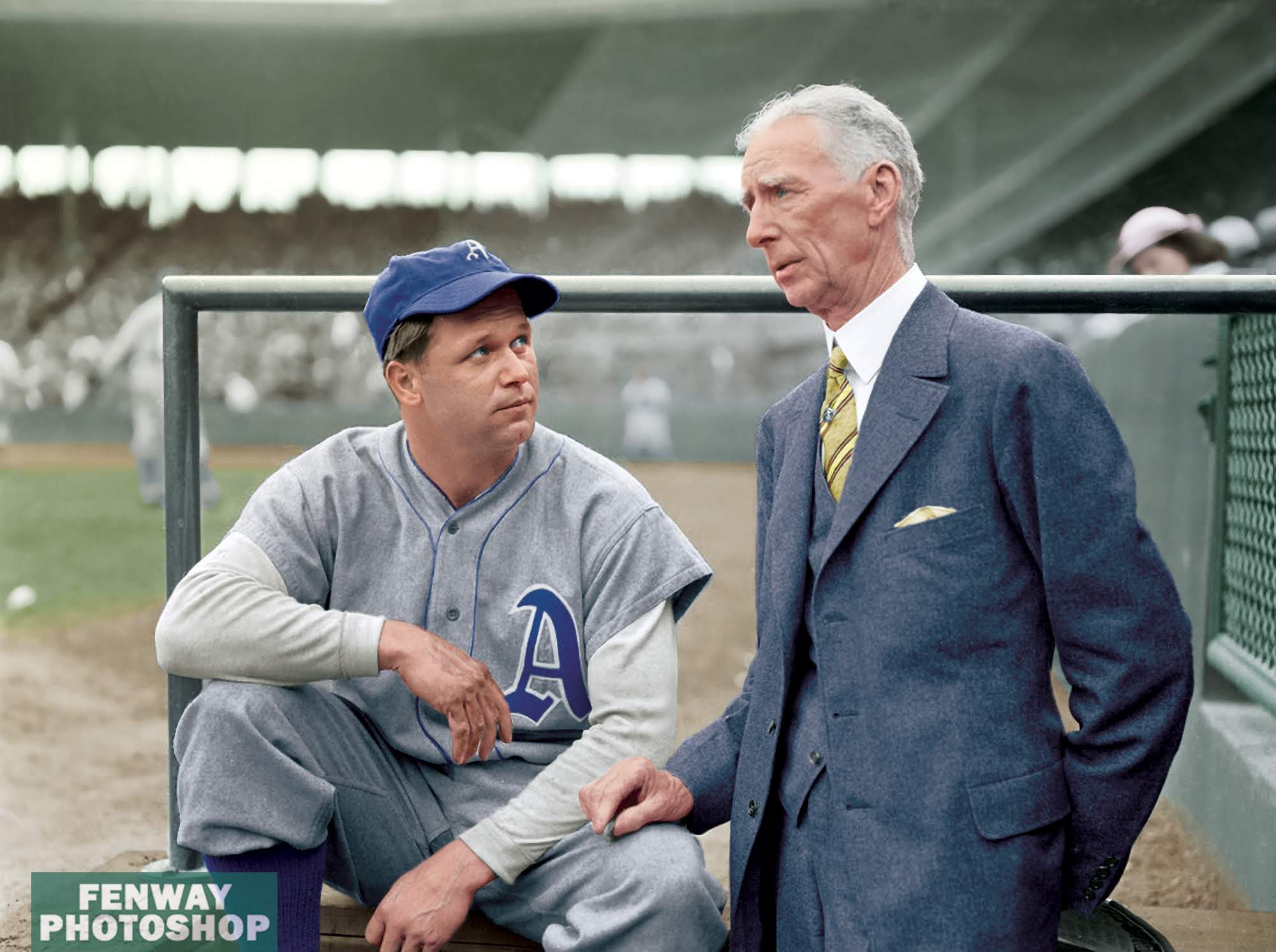
Jimmie Foxx (left) and Connie Mack

September 28, 1932: Connie Mack begins the breakup his of his Philadelphia Athletics. The 1st time he'd done so, in 1914-15, it was because he couldn't keep up with the salaries being offered by the Federal League teams. This time, it was personal.

In 1925, the A's went 88-64, and were only 8 1/2 games behind the 1st-place Washington Senators. But the rise of the "Murderers' Row" Yankees delayed Philadelphia's return to greatness. In 1929, they began a run of 3 seasons in which they won 313 games, and game within a Game 7 loss in 1931 of winning 3 straight World Series.

But Mack lost all of his non-baseball holdings in the stock market Crash of 1929. He couldn't fund the A's with any other income. So, after the 1932 season, despite a strong 94-60 record (but 13 games behind the Pennant-winning Yankees), he began to sell of his 2nd generation of stars.

On September 28, 1932, he sent left fielder Al Simmons, 3rd baseman Jimmy Dykes, and center fielder Mule Haas are all sold to the Chicago White Sox, for $100,000. Simmons would be elected to the Baseball Hall of Fame, and Dykes and Haas would have been perennial All-Stars had the All-Star Game been founded before 1933.

But the big day was...

December 12, 1933: When Mack made 3 separate moves:

* Pitchers Lefty Grove and Rube Walberg, and 2nd baseman Max Bishop, are traded to the Boston Red Sox for Bob Kline and Rabbit Warstler and $125,000. Along with Carl Hubbell, Grove was 1 of the 2 best lefthanded pitchers in the game, and would go to the Hall of Fame. Walberg was the 3rd starter on the A's, behind Grove and George Earnshaw, but would have been the ace on many teams.

Key to this deal was the fact that Tom Yawkey had recently turned 30 and come into his inheritance, and had bought the Red Sox, and could afford to spend whatever he wanted to build a championship team. He did try, but the Yankees' dynasty that was restarted in 1936 thwarted his early efforts.

Grove's 199 wins during the 1930s made him the winningest pitcher of the decade.

* Catcher Mickey Cochrane was traded to the Detroit Tigers for Johnny Pasek and $100,000. The Tigers subsequently named Cochrane player-manager, and won the next 2 American League Pennants.

* Finally, before the ink was dry on the previous 2 trades, Mack traded Pasek and Earnshaw to the White Sox for Charlie Berry and $100,000. So, in 1 day, Mack sold off his 3 best pitchers.

On December 10, 1935, 1st baseman Jimmie Foxx and pitcher Johnny Marcum were traded to the Red Sox for Gordon Rhodes, George Savino and $150,000. Foxx was the best righthanded slugger in the game, and would go to the Hall of Fame. Marcum was the Mackmen's best pitcher following the '33 fire sale, and Mack dumped him, anyway.

The A's went from 94-60 in 1932 to 79-72 in 1933, to 68-82 in 1934, to 58-91 in 1935, and to 53-100 in 1936. To make matters worse, Tom Shibe died in 1936, and Jack Shibe the next year. The deaths of these sons of Ben Shibe, with whom Mack founded the A's in 1901, pretty much left Mack, 74 years old at the time, in full control of the A's, and his control of his mental faculties began to diminish.

The A's never recovered. In 1950, Mack's sons, who seemed to agree on nothing else, ganged up in the senile 87-year-old man, and finally removed him from control, if not ownership, and the manager's job after his 50th season in charge. The Mack family ended up selling the team in 1954, to a buyer who moved them to Kansas City.

They failed there as well, and Charlie Finley bought them in 1960, moving them to Oakland in 1968. After 5 straight AL Western Division titles, 1971-75, including 3 straight World Series wins, 1972-74, he broke them up, and the team crashed. New owner Walter Haas rebuilt them in the early 1980s, but the pitching collapsed, preventing a new dynasty. The A's rebuilt again, and won 3 straight Pennants, 1988-90, but after another Division title in 1992, were broken up again.

The pattern held: By 2000, the "Moneyball" regime built a team that reached the Playoffs 5 times in 7 years, but won no Pennants. They sold off, rebuilt, and made 3 straight Playoffs, 2012-14. They couldn't afford to keep it going, sold off, rebuilt, and made 3 straight Playoffs, 2018-20. They couldn't afford to keep it going, and sold off. In 2022, the A's lost 102 games, their most since the Finley fire sale bottomed out at 108 in 1979.

Rumors of the A's moving again have been renewed, since they haven't been able to get a deal to replace the Oakland Coliseum. If they do move, how long will it be before they win again? And, if so, how long before they have a 9th fire sale?

One thing is for sure: The A's are not moving back to Philadelphia, where the Phillies, having won the 2022 NL Pennant, are overwhelmingly popular. The Delaware Valley is certainly big enough to support one winning Major League Baseball team, but not two MLB teams, regardless of performance. But, wherever they go, or if they stay, at some point, the A's will go back to their Philadelphia roots, by breaking it all down and starting all over again.

In 1949, Ogden Nash, my grandmother's favorite poet, wrote "Line-Up for Yesterday" for Sport magazine, an alphabetical list of star players. For the letter Q, Nash had to cheat a little, and wrote:

Q is for Don Quixote
Cornelius Mack;
Neither Yankees nor years
Can halt his attack.

He also had to cheat a little for the letter X:

X is the first
of two x's in Foxx
Who was right behind Ruth
with his powerful soxx.

But even that poem is now so far back in history that it hasn't raised their profiles. The Athletics' moves have left their Philadelphia era virtually forgotten, even though Foxx hit 534 home runs, Grove and Eddie Plank each won at least 300 games, and Eddie Collins collected over 3,000 hits and Al Simmons nearly did. Foxx hit 415 home runs during the 1930s, making him the decade's leader. And, unlike their Bay Area neighbors, the San Francisco Giants, the Oakland version of the A's doesn't really pay tribute to that era.

They have notations for Philadelphia's 1910, 1911, 1913, 1929 and 1930 World Series wins at the Oakland Coliseum, but, unlike the Giants with the top players from their New York era, they have not retired any uniform numbers from their time in Philly: The 2 of Mickey Cochrane, the 3 of Jimmie Foxx, the 7 of Al Simmons and the 10 of Lefty Grove remain in circulation. Earlier players like Plank and Collins did not have numbers that could be retired, though Collins later wore 32 as a coach. And, of course, wearing suits instead of uniforms, Connie Mack also never had a number to retire.

And it took until 2018 for them to establish a team Hall of Fame, and 2021 for them to honor any figures from the Philadelphia era: Mack, Plank, Collins, Cochrane, Foxx, Simmons, Grove, George "Rube" Waddell, Charles "Chief" Bender, Frank "Home Run" Baker, Bob Johnson and Eddie Joost.

*

December 12, 1933 was a Tuesday. Baseball was out of season. The NBA hadn't been founded yet. The NFL was going to play its 1st official Championship Game the following Sunday, and the Chicago Bears won it, 23-21 over the New York Giants.

There were 4 games played in the NHL that night:

* The Toronto Maple Leafs beat the Boston Bruins, 4-1 at the Boston Garden. This was the game in which Eddie Shore hit Ace Bailey over the head with his stick, ending his career. I have a separate entry for that event.

* The New York Americans beat the New York Rangers, 3-0 at the old Madison Square Garden, which was still fairly new at the time. The company that ran the Garden owned the Rangers, and the Amerks were tenants, so any win the tenants had over the landlords was considered big.

* The Detroit Red Wings beat the Chicago Black Hawks, 4-1 at the Olympia Stadium in Detroit.

* And the Montreal Canadiens and the Ottawa Senators played to a 1-1 tie at the Ottawa Auditorium.

Monday, December 5, 2022

December 5, 1933: Prohibition Ends

December 5, 1933: The 21st Amendment to the Constitution of the United States is ratified, repealing the 18th Amendment, which had prohibited the production, sale, purchase, transport, and possession of alcoholic beverages in America. After 14 years, Prohibition has ended. 

America's self-appointed moral arbiters had gotten Prohibition ratified in the first place, in 1919 to take effect on January 16, 1920, because they saw alcohol as evil, but also because they saw it as something that those other people enjoy. You know, the immigrants. The foreigners. The Catholics.

As it turned out, Banning liquor and drinking was the worst thing they could have done. There was already organized crime in America, but Prohibition launched it headlong into American life, as Mob bosses like Al Capone were happy to supply the people with the drinks they craved.

With the Great Depression underway by late 1929, people needed a drink more than ever. And so, the desire to keep Prohibition began to fade away. Being "Dry" was a winning stance in the Presidential election of 1920 for Warren Harding, 1924 for Calvin Coolidge, and 1928 for Herbert Hoover.

In 1929 and 1930, the Philadelphia Athletics won the World Series. Both times, Hoover made the short train trip from Washington to Shibe Park in North Philadelphia, and threw out the ceremonial first ball before one of the games. In October 1929, he was cheered. In October 1930, he heard boos and chants of "We want beer! We want beer! We want beer!"

In 1932, the Depression meant that Hoover was going to lose to Franklin Delano Roosevelt, anyway, but being "Dry" hurt Hoover on top of that. FDR was "Wet," and that made him all the more popular.

Did making booze legal again stop organized crime? Far from it. The Mob, figuring that this day would eventually come, was prepared, and had already moved on to other things, like gambling, and illegal drugs.

By 1933, the 18th Amendment was so unpopular, that it became the first Amendment to the Constitution to be repealed. It remains the only one.

This historic day was in December, so there were no games in Major League Baseball. It was a Tuesday, so there were no games in the National Football League. And it was before 1946, so there was, as yet, no National Basketball Association.

Even in the National Hockey League, there was not a full schedule. The New York Rangers and the Chicago Blackhawks were not scheduled to play. These games were:

* The New York Americans lost to the Toronto Maple Leafs, 9-1 at what would later be called "the old Madison Square Garden."

* The Boston Bruins beat the Montreal Canadiens, 5-2 at the Boston Garden.

* And the Montreal Maroons and the Detroit Red Wings played to a 1-1 tie at the Montreal Forum.

Thursday, November 17, 2022

November 17, 1933: The Marx Brothers' "Duck Soup" Premieres

Left to right: Chico, Zeppo, Groucho, Harpo

November 17, 1933: Duck Soup premieres, starring the Marx Brothers. It is considered their greatest and funniest film.

The Marx Brothers, sons of an Alsatian father and an East Frisian mother, both parents Jewish, and all 5 brothers born and raised in Yorkville on the Upper East Side of Manhattan, were:

* Leonard Joseph Marx, born March 22, 1887. There was one brother born before him, Manfred, but he died in infancy. His younger brothers noticed his early womanizing, and while the British term "bird" for a young woman remains popular, the long-ago American variant "chicken" does not. But he was called a "chicken chaser." This was shortened to "Chicko." At some point, somebody mistakenly dropped the K, and he was "Chico" from then on. Not knowing the origin, most people pronounced it "CHEEK-oh," but the brothers all pronounced it "CHICK-oh" to the end.

* Adolph Marx, later Arthur Marx, born November 23, 1888. He was called "Harpo" because he was an excellent harp player. He could also play the piano (and Groucho would later write a song titled "I Love a Piano," but Chico was the only one who made piano-playing part of his persona.

* Julius Henry Marx, born October 2, 1890. He gave 2 different stories about how he got "Groucho." There was a comic strip, Knocko the Monk, which had a supporting character, Groucho the Monk. But, in one of his last interviews, he said that comedian Art Fisher gave him the nickname because he was grouchy.

* Milton Marx, born October 23, 1892. His nickname, "Gummo," came from either his tendency to chew gum, or from wearing gum-soled shoes.

* Herbert Manfred Marx, born February 25, 1901. He later claimed he was called "Zeppo" because "Zep" was Italian-American slang for "baby," and he was the "baby brother," so this became "Zeppo." Harpo gave another version, in his memoir Harpo Speaks!: He said that "Herbie" liked to do chin-ups, as did a popular trained chimpanzee named Mr. Zippo. So they called him "Zippo" until he objected to the comparison, and they changed it to "Zeppo." But Groucho said it was short for "Zeppelin," and his ex-wife Barbara backed this explanation up.

The brothers tried their hand at vaudeville. Gummo had a stammer, which made appearing in a stage act difficult. He was the only one who didn't have his heart in show business. When he was drafted into the U.S. Army for World War I in 1918, he went in, and never returned to the act. Zeppo stepped into his place. Gummo survived the war, and became a successful businessman.

The other four succeeded at vaudeville, where W.C. Fields was beginning to make a name for himself. (Good thing he did: His birth name was William Claude Dunkenfeld.) He said that The Marx Brothers were the only act he couldn't follow on the live stage.

He is known to have appeared on the same bill with them only once, during an engagement at Keith's Orpheum Theatre in Columbus, Ohio, in January 1915. Fields later wrote, "They sang, danced, played harp and kidded in zany style. Never saw so much nepotism or such hilarious laughter in one act in my life. The only act I could never follow."

This success led to Broadway, and finally, in 1929, sound films. They made The Cocoanuts, followed by Animal Crackers in 1930, based on their 1928 musical. Groucho stars as Captain Jeffrey T. Spaulding -- his characters usually had a middle initial -- a famous explorer and hunter in Africa. He delivered a line that has lasted through the age: "One morning, I shot an elephant in my pajamas. How he got in my pajamas, I don't know."

That film made the brothers national stars, and it led to them going out to California for Hollywood. It was followed in 1931 by The House That Shadows Built and Monkey Business, and in 1932 by Horse Feathers.

Their personas had been set. Groucho, who wore glasses, smoked cigars, and used greasepaint to simulate a large mustache and large eyebrows, was the prominent wiseguy, who wasn't really worth the hype, but his wit allowed him to bluff his way through tough situations, often involving a woman played by Margaret Dumont (1882-1965), whose character loved his, but he wanted nothing to do with, until he found out how much money she had. Chico was a stereotypical Italian, with the thick accent, and a con artist, but with a talent for playing piano. Harpo, with his hobo's clothes, including a top hat and a long coat with deep pockets, was silent, communicating in pantomime and with a horn he would honk at opportune moments.

Zeppo's persona was less defined: As critic Percy Hammond put it, "One of the handicaps to the thorough enjoyment of the Marx Brothers in their merry escapades is the plight of poor Zeppo Marx. While Groucho, Harpo, and Chico are hogging the show, as the phrase has it, their brother hides in an insignificant role, peeping out now and then to listen to plaudits in which he has no share."

There had been a silent film titled Duck Soup in 1927, starring the comedy team of Stan Laurel and Oliver Hardy, as petty criminals hiding from forest rangers. It was remade with sound in 1930, as Another Fine Mess. (This was based on the line Ollie frequently gave Stan: "This is another fine mess you've gotten us into, Stanley!")

Leo McCarey worked on the 1927 film, which was considered lost until a copy was found in 2020. McCarey directed the Marx Brothers' film, and used the same title for the follow-up to Horse Feathers.

Duck Soup takes place in the fictional European nation of Freedonia, which is small and struggling, and threatened by its warlike neighbors. It is basically kept afloat by the money of Mrs. Gloria Teasdale (played by Dumont). This wealthy widow has become convinced that the only man who can properly lead the nation is Rufus T. Firefly (Groucho).

Firefly likes the idea of having the power, but he doesn't like the idea of having the responsibility. He also doesn't like Mrs. Teasdale: "You'd better beat it. I hear they're going to tear you down and put up an office building where you're standing. You can leave in a taxi. If you can't get a taxi, you can leave in a huff. If that's too soon, you can leave in a minute and a huff. You know, you haven't stopped talking since I came here? You must've been vaccinated with a phonograph needle." But he finds out how rich she is, and starts courting her.

One of those warlike neighboring nations is Sylvania. Their ambassador, Trentino (Louis Calhern, 1895-1956), also wants Mrs. Teasdale for her money, and he wants control of Freedonia. He sends 2 spies into the country to get dirt on Firefly: Chicolini (Chico) and Pinky (Harpo). As part of his cover, Chicolini sells peanuts outside Firefly's window. Firefly takes a liking to him, and appoints him Secretary of War.

Bob Roland (Zeppo), Firefly's secretary, suspects Trentino's treachery, and tells Firefly to get rid of him by insulting him. The idea is that Trentino will be goaded into slapping Firefly, and will thus be forced to leave the country. The plan backfires: Firefly slaps Trentino instead. Leading to the Groucho line, "Of course, you realize, this means war!"

(Mel Blanc would base the cartoon character Bugs Bunny on Groucho, with a New York accent, and a carrot in place of the cigar. On a few occasions, Blanc as Bugs reacted to an insulting situation by saying, "Dis means war!")

Thanks to vampish spy Vera Marcal (Raquel Torres, 1908-1987), Trentino learns that Freedonia's war plans are in Mrs. Teasdale's safe, and Chicolini and Pinky break into her mansion to steal the plans. This leads to the famous "mirror scene" between Groucho and Chico (which Harpo and Lucille Ball would, over 20 years later, parody on I Love Lucy), which leads to Chicolini getting caught. During his trial, war is officially declared, and Freedonia... breaks out into song and dance.

But Chicolini knows too much about Trentino, and offers his services to Freedonia in exchange for clemency. Pinky joins, too, and all four brothers' characters fight together. Just as it looks like Freedonia will lose the one-battle war, Trentino gets caught in a makeshift pillory. The brothers throw fruit at him until he surrenders, and Freedonia have won the war. The film ends with Mrs. Teasdale happily singing the Freedonian national anthem. And the brothers throw their remaining fruit at her.

Duck Soup would be Zeppo's last film. He left the act, and became an engineer and a theatrical agent. He married Barbara Blakeley, who later divorced him, and became the 4th and final Mrs. Frank Sinatra.

The three remaining brothers are how people tend to remember the Marx Brothers: Groucho, Harpo and Chico. They made A Night at the Opera in 1935, A Day at the Races in 1937, Room Service in 1938, At the Circus in 1939, Go West in 1940, and The Big Store in 1941. World War II ended the era of "screwball comedies" that were popular during the Great Depression, and killed, along with 75 million people, the Marx Brothers' momentum. They made only 2 more movies together, and in 1957, all 3 appeared, but no 2 in the same scene, in The Story of Mankind.

Harpo and Chico didn't really adjust to TV, but they were able to sit on the money they made from earlier films, and the residuals they got from those films being shown on TV. They made only 1 TV appearance together, in 1957, on Tonight! America After Dark, a late-night show hosted by Jack Lescoulie. It was a version of NBC's The Tonight Show, between hosts Steve Allen and Jack Paar.

From 1950 to 1961, NBC aired You Bet Your Life, a game show with Groucho as host. By this time, his familiar curly hair had receded, and he had actually grown a mustache. But he was still, essentially, playing himself, giving out insults that may, or may not, have been good-natured. Before Don Rickles and Robert Smigel's puppet Triumph the Insult Comic Dog, Groucho was the original "insult comic." But the show introduced a new generation to Groucho, and they sought out his films with his brothers on TV.

In 1960, Billy Wilder, then the biggest comedy director in Hollywood, wanted to make A Day at the U.N., a comedy about international intrigue set at the United Nations complex in New York. Groucho and Chico were willing to do it, but Harpo was too ill to try. On October 11, 1961, when it looked like Harpo might recover enough, Chico died, the first of the brothers to go. The project was canceled. Harpo died on September 28, 1964.

On October 1, 1962, Johnny Carson hosted The Tonight Show for the 1st time, and Groucho was one of his guests that night. He came on a few more times, and was also an occasional guest on The Dick Cavett Show.

In the 1970s, Groucho impersonations became common. Richard Dawson did them as a member of the cast of Rowan & Martin's Laugh-In, and then as a panelist on Match Game, even after Groucho died during that show's run. On M*A*S*H, Hawkeye (Alan Alda) did Groucho impressions a few times, and once did a full-makeup parody, with Trapper (Wayne Rogers), already having blonde curly hair, playing Harpo. And on All in the Family, the Stivics went to a costume party as Groucho (Rob Reiner as Mike) and Harpo (the curly blonde Sally Struthers as Gloria).

Gummo died on April 21, 1977. By this point, Groucho was ill, and no longer with it. He was never told that his brother had died, for fear it would shock him into a fatal heart attack. Groucho died on August 19, 1977, 3 days after Elvis Presley, so his death was barely noticed. Zeppo was the last survivor, living until November 30, 1979.

The last surviving actor from Duck Soup was Leonid Kinskey, who played one of Trentino's "agitators." He became a drinking buddy of actor Humphrey Bogart and, as a result was cast as one of the European exiles in Casablanca, as Sascha, the Russian bartender at Rick's Cafe Americain. He lived until 1998.

*

November 17, 1933 was a Friday. Baseball season was over. The NBA hadn't been founded yet. No games were scheduled in the NHL. And the NFL had to wait until the following Sunday.

There were 2 college football games played on the day. The University of Tulsa beat George Washington University, 13-6 at Griffith Stadium in Washington. And Texas Tech beat Baylor, 13-0 at Tech Field in Lubbock, Texas.

Friday, November 11, 2022

November 11, 1933: The Beginning of the Dust Bowl

November 11, 1933: As if the Great Depression wasn't already bad, and hitting farm country harder than the cities, on came the Dust Bowl. For those of you who are sports fans: No, this was not a college football game.

On this day, a very strong dust storm stripped topsoil from desiccated South Dakota farmlands in one of a series of severe dust storms that year.

Such storms had been periodic since 1931, but this was when the Dust Bowl kicked into high gear. Beginning on May 9, 1934, a strong, two-day dust storm removed massive amounts of Great Plains topsoil. The dust clouds blew all the way to Chicago. Two days later, the same storm reached cities to the east, such as Cleveland, Buffalo, Boston, New York and Washington, Over the Winter of 1934-35, red snow fell on New England.

On April 14, 1935, known as "Black Sunday," 20 of the worst "black blizzards" occurred across the entire sweep of the Great Plains, from Canada south to Texas. The dust storms caused extensive damage and appeared to turn the day to night. Witnesses reported that they could not see 5 feet in front of them at certain points.

Denver-based Associated Press reporter Robert E. Geiger was in Boise City, Oklahoma that day. His story about Black Sunday marked the first appearance of the term "Dust Bowl," coined by Edward Stanley, Kansas City news editor of the AP.

Dust Bowl conditions fomented an exodus of the displaced from the Texas Panhandle, the adjoining Oklahoma Panhandle, and the surrounding Great Plains to adjacent regions. More than 500,000 Americans were left homeless. More than 350 houses had to be torn down after one storm alone. The severe drought and dust storms had left many homeless; others had their mortgages foreclosed by banks, or felt they had no choice but to abandon their farms in search of work.

Many Americans migrated west looking for work. Parents packed up "jalopies" with their families and a few personal belongings, and headed west in search of work. In particular, residents of Oklahoma and Arkansas -- "Okies" and "Arkies" -- headed west on U.S. Route 66, which became known as "The Mother Road," for California, "the land of milk and honey," hearing of jobs available picking fruits and vegetables. These jobs proved to be worse than farming, as they were no longer their own bosses, and the bosses were brutal until the labor unions came in.

The Plains States lost about 3.5 million people in the 1930s. More migrants arrived in California in 1936 than in any other year, including the Gold Rush year of 1849. Many of them brought their Southern mindsets with them, and were every bit as biased against the black and Hispanic people of California as they were against the black people of their home States. Ray Manzarek, keyboard player for rock band The Doors, said that, in the 1960s, a big chunk of the Los Angeles Police Department was the sons of Southerners who had come from the Dust Bowl, and they enjoyed practicing police brutality on minorities and hippies.

What did the federal government do about the Dust Bowl? President Franklin D. Roosevelt quickly set the New Deal to work on the problem. The Soil Conservation Service, forerunner of the Natural Resources Conservation Service, was founded. He also created the Civilian Conservation Corps (CCC), which created the Great Plains Shelterbelt: A line of 200 million trees from Canada to Abilene, Texas, to block the wind and cut the giant dust storms off.

In 1939, John Steinbeck published The Grapes of Wrath, about a family that escaped the Dust Bowl, only to find life in California just as hard as life in Oklahoma. The following year, it was made into a film. That same year, Woody Guthrie recorded one of the earliest "concept albums," Dust Bowl Ballads, making himself a legend of folksinging.

*

November 11, 1933 was a Saturday. Actor James Boyd, who played J. Arthur Crank and Paul the Gorilla on the 1970s PBS kids show The Electric Company, was born on this day.

Among the college football games played that day were these:

* Alabama beat Virginia Tech, 27-0 at Denny Stadium (now Bryant-Denny Stadium) in Tuscaloosa, Alabama. This was the 1st season of the Southeastern Conference, and Alabama won the title.

* Duke beat Maryland, 38-7 at Byrd Stadium in the Washington suburb of College Park, Maryland. Duke won the Championship of the Southern Conference, which, 20 years later, would sort-of evolve into the Atlanta Coast Conference.

* Michigan beat Iowa, 10-6 at Michigan Stadium in Ann Arbor. Michigan won the Big Ten Conference.

* Nebraska beat Kansas, 12-0 at Memorial Stadium in Lincoln, Nebraska. Nebraska won the Big Six Conference, the league that would become the Big Eight, and, later, the Big Twelve.

* Rice beat Arkansas, 7-6 at Rice Field in Houston. Nevertheless, Arkansas went on to win the title in the Southwest Conference.

* Purdue beat Notre Dame, 19-0 at Notre Dame Stadium in South Bend, Indiana.

* Among the service academies, Army beat Harvard, 27-0 at Harvard Stadium in Boston; and Navy lost to Columbia, 14-7 at Baker Field in Manhattan.

* In the other major game played in New York City that day, Fordham beat New York University (NYU), 20-12 at Yankee Stadium.

* And among New Jersey's teams, Princeton beat Dartmouth, 7-0 at Palmer Stadium in Princeton; and Rutgers beat Lafayette, 20-13 at Fisher Field in Easton, Pennsylvania.

* Stanford beat the University of Southern California (USC), 13-7 at the Los Angeles Memorial Coliseum. Stanford won the Pacific Coast Conference, the league that would become the AAWU, the Pac-8, the Pac-10 and the Pac-12.

Baseball was out of season. The NBA hadn't yet been founded. There were 3 games played in the NHL:

* The Montreal Maroons beat the Boston Bruins, 3-2 at the Montreal Forum.

* The Ottawa Senators beat the Montreal Canadiens, 2-0 at the Ottawa Auditorium.

* The Toronto Maple Leafs beat the New York Rangers, 4-3 at Maple Leaf Gardens in Toronto.

* And the New York Americans, the Detroit Red Wings and the Chicago Black Hawks were not scheduled.

And in English soccer, defending Champions Arsenal, of North London, beat Wolverhampton Wanderers, a.k.a. Wolves, 1-0 at Molineux Stadium in Wolverhampton, outside Birmingham.

Monday, November 7, 2022

November 7, 1933: Pennsylvania Legalizes Sunday Sports

November 7, 1933: The Pennsylvania legislature votes to repeal the law banning the playing of professional sports on Sunday. Governor Gifford Pinchot signs the bill into law.

Pinchot was a Republican. He was elected in 1922, but the State Constitution then forbid Governors from serving consecutive terms, so he couldn't run again in 1926. He ran again in 1930, and won, but couldn't run again in 1934. A new Constitution, in 1968, made Governors eligible for 2 consecutive terms, but not 3. It's possible that Pinchot would have lost in the Democratic landslide of 1934, anyway.

For centuries, Christians followed the Commandment of "Remember the Sabbath Day, and keep it holy," defining it as 12:00 AM to 11:59 PM on Sunday, and not doing any work on the day. Of course, there would always be people who tried to get around this. But when professional sports became viable, some people of faith fought to get laws passed banning it on Sundays. They also tried to get laws passed banning other things on Sundays, like shopping. They called themselves "Sabbatarians."

Baseball was the first sport in America to really go professional. And when the National League was founded in 1876, the team owners chose not to challenge the laws: They refused to schedule games on Sundays. But this meant that that, since most people worked a six-day week, and permanent lights at a ballpark were not yet practical, thus making night games any day of the week possible, there would be no day on which the average working man could go to a baseball game.

In 1882, the American Association was founded, and they chose to play on Sunday -- where it was legal. Some teams got around this by playing games outside the city limits, or in neighboring States. A Boston team might play in neighboring Providence, Rhode Island; a Pittsburgh team might play in Wheeling, West Virginia: and a Detroit team might play in Toledo, Ohio.

The AA folded in 1891, but the American League, founded in 1901, adopted this "play on Sunday where and when you can" philosophy. The 1903 National Agreement between the NL and the AL allowed the NL to play on Sunday, where and when legal.

By that point, Saturday had become a non-mandatory workday for many people, allowing big crowds on the day; and professional football had become viable. The National Football League was founded in 1920, and began playing on Sunday because they didn't want to compete with college football, which played on Saturday.

It took until 1929 for Massachusetts to legalize Sunday sports. Right on time: The Great Depression came, and the Boston Red Sox, the Boston Braves, and anyone thinking of funding an NFL team in Boston needed those big crowds badly. (Of course, the big crowds still didn't come for George Preston Marshall's Boston Redskins, so he moved them to Washington in 1937.) Even so, for the 1929 season, the Red Sox made a deal with the Braves to play Sunday home games at Braves Field, because Fenway Park was "too close to a church." People really thought about such ridiculous things at the time.

In 1931, the NFL's Philadelphia team, the Frankford Yellow Jackets, folded. Their Frankford Stadium in Northeast Philadelphia had burned down, and they had trouble securing a new home field, since they couldn't play on Sunday, and most football stadiums of any size in the city had a college team playing there on Saturday afternoons.

In 1933, the rights to a Philly NFL team were bought by Bert Bell (later to be the Commissioner of the NFL) and Lud Wray, and they founded the Philadelphia Eagles. The same year, Art Rooney founded a football team named the Pittsburgh Pirates, which he would rename the Pittsburgh Steelers in 1940. Together, Bell and Rooney lobbied the Pennsylvania legislature to make Sunday sports legal, and they succeeded, making the long-term success of their teams possible.

The Pirates/Steelers debuted on September 20, at home at Forbes Field, and lost to the New York Giants, 23-2. The Eagles debuted on October 15, also against the Giants, and they were nearly strangled in their crib, losing 56-0 at the Polo Grounds. Three days later, playing their 1st home game, at Baker Bowl, home of the Phillies in North Philadelphia, they lost 25-0 to the Portsmouth Spartans, the team that would become the Detroit Lions the next season. 

Angelo Cataldi of Philadelphia sports-talk radio station WIP says of the city, "This place is wired for football." That's a little misleading: Philadelphia is a basketball city, but Pennsylvania is a football State. As political consultant James Carville, a graduate of Louisiana State University, said after getting Bob Casey Sr. elected Governor in 1986, "Pennsylvania is Philadelphia and Pittsburgh, with Alabama in between." He wasn't kidding: In neighboring New Jersey, we call the rural portions of the State "Pennsyltucky." The State is absolutely nuts about football.

In hindsight, legalizing Sunday sports was inevitable. Now, it is impossible to imagine an Autumn Sunday without a big percentage of the State's people in Eagles green and white, and another in Steelers black and gold.

*

November 7, 1933 was a Tuesday. Baseball season was over. Football was in midweek. The NBA hadn't been founded yet. And the NHL season started 2 days later. So there were no scores on this historic day, despite it being a day that made some scores possible.

Friday, October 28, 2022

October 28, 1933: "The Kennel Murder Case" Premieres

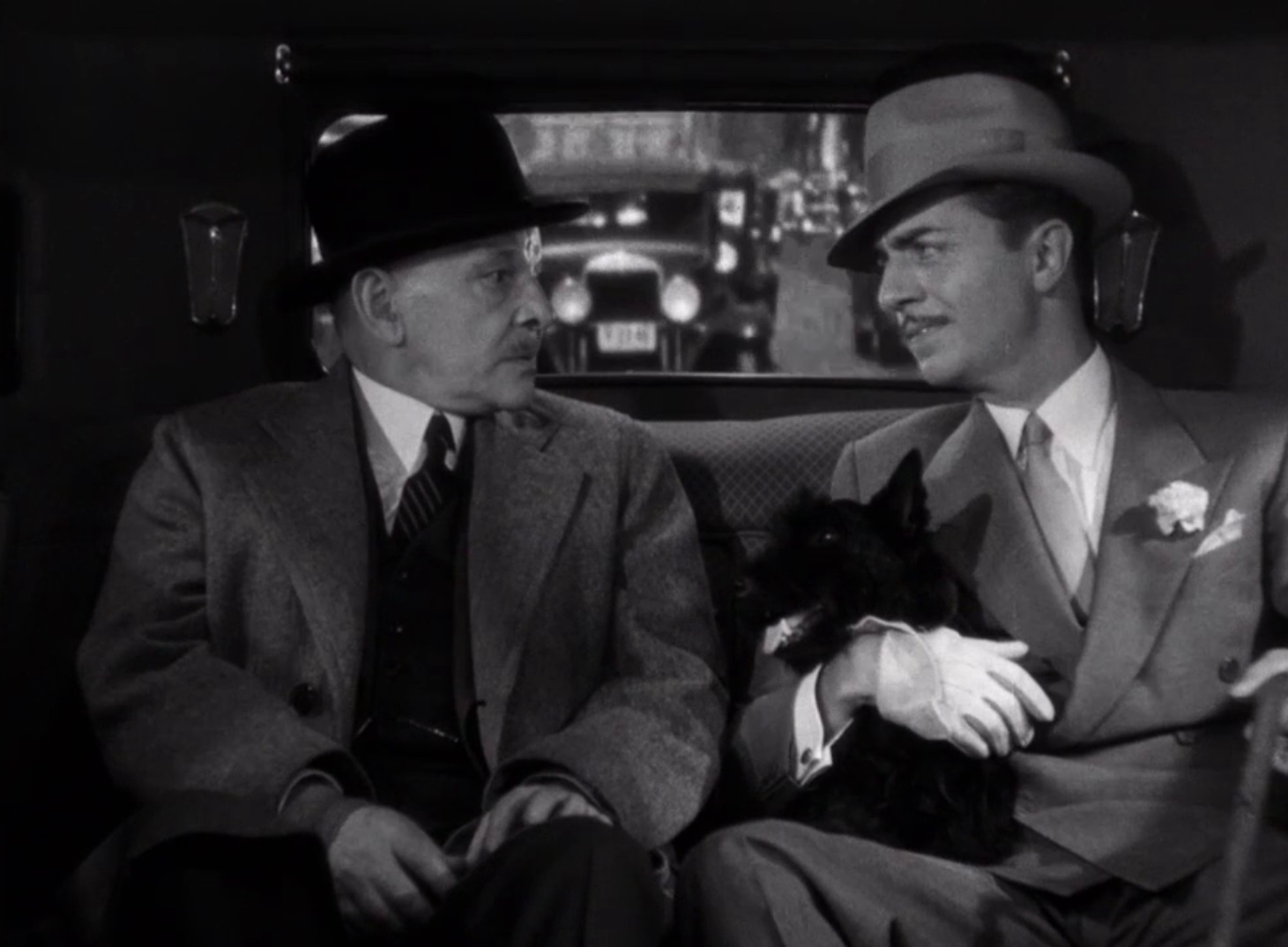
Etienne Girardot (left) and William Powell

October 28, 1933: The Kennel Murder Case premieres. Michael Curtiz directed, and would later direct James Cagney in Angels with Dirty Faces and Yankee Doodle Dandy, Errol Flynn in The Adventures of Robin Hood and The Sea Hawk, Humphrey Bogart and Ingrid Bergman in Casablanca, and Joan Crawford in Mildred Pierce.

William Powell, in what could be seen as a warmup to playing Nick Charles in the Thin Man movies, plays Philo Vance, a private detective created by art critic Willard Huntington Wright, who, to protect his reputation with his main job, wrote mystery novels under the name S.S. Van Dine.

Mary Astor also stars, perhaps as a warmup for playing Brigid O'Shaughnessy in the 1941 version of Dashiell Hammett's The Maltese Falcon opposite Humphrey Bogart's Sam Spade.

French actor Etienne Girardot plays the coroner, Dr. Doremus. In this film, he says, "I'm a doctor, not a detective." A moment later, he says, "I'm a doctor, not a magician." This predates DeForest Kelley using, "I'm a doctor, not a... " on Star Trek by 33 years, although there's no hint that any Trek writer ever used this movie as inspiration.

*

October 28, 1933 was a Saturday. The only team sport then in season in North America was football. Among the notable college games played were these:

* Army beat Yale, 21-0 at the Yale Bowl in New Haven, Connecticut. Army went undefeated until their last game, on December 2, losing to Notre Dame, 13-12 in front of 73,594 fans at Yankee Stadium.

* Navy beat the University of Pennsylvania, 13-0 at Franklin Field in Philadelphia.

* Notre Dame may have gone on to beat Army, but they had a bad season, 3-5-1, including a loss on this day, to the University of Pittsburgh, 14-0 at Notre Dame Stadium in South Bend, Indiana.

* Michigan beat the University of Chicago, 28-0 at Stagg Field in Chicago. Michigan won the Big Ten Conference title, and went undefeated, the only blemish on their record a 0-0 draw at home to Minnesota.

* Stanford lost to the University of Washington, 6-0 at Husky Stadium in Seattle. In spite of this, Stanford won the Pacific Coast Conference title, and go to the Rose Bowl.

* In what would eventually become a major rivalry, Nebraska beat Oklahoma, 16-7 at Memorial Stadium in Lincoln, Nebraska. Nebraska went on to win the Big Six Conference title. (Forerunner of the Big Eight and the Big 12.)

* Among New York City teams: Columbia beat Penn State, 33-0 at Baker Field in Upper Manhattan; Fordham beat Alabama, 2-0 in front of 60,000 fans at the Polo Grounds; New York University (NYU) lost to Georgia, 25-0 at Sanford Stadium in Athens, Georgia.

Columbia's only loss of the season was dealt by Princeton. Columbia went on to beat Stanford in the Rose Bowl.

* Rivalry: Kansas State beat Kansas, 6-0 at Memorial Stadium in Lawrence, Kansas.

* And among New Jersey's teams, Princeton beat Washington & Lee, 6-0 at Palmer Stadium in Princeton; while Rutgers beat Lehigh, 27-0 at Neilson Field in New Brunswick.

Saturday, October 22, 2022

October 22, 1933: Ethel Waters Records "Stormy Weather"

October 22, 1933: Ethel Waters records "Stormy Weather," with the Dorsey Brothers Orchestra. The song was written by Harold Arlen (1905-1986) and Ted Koehler (1894-1973), and she had sung it at Harlem's famed Cotton Club, at 142nd Street & Lenox Avenue. (Arlen should not be confused with a contemporary, radio announcer Harold Arlin.)

She was born on October 31, 1896, outside Philadelphia in Chester, Pennsylvania. She became one of the top jazz singers of all time. In 1950, ABC made her the 1st black actress to star in a TV series, Beulah. She quit after one season, finding the scripts degrading. For a 1961 guest appearance on Route 66, she became the 1st black person of either gender to be nominated for an Emmy Award in a dramatic role, and the 1st black woman to be nominated for any Emmy. She lived until September 1, 1977.

In 1943, "Stormy Weather" was featured in a film of the same title, sung by Lena Horne, who had first recorded it in 1941. With some irony, also in 1943, Waters and Horne both starred in another mostly-black-cast film, Cabin in the Sky, with Waters playing the honest wife of a troubled man, and Horne playing the femme fatale who tempts him.

Other notable versions have been Billie Holiday in 1955, a doo-wop version by The Spaniels in 1958, and the Red Garland Trio's instrumental version in 1959, familiar to listeners of American Public Media's Marketplace radio show, which plays Garland's version as background accompaniment whenever news of a drop in the Dow Jones Industrial Average occurs.

*

October 22, 1933 was a Sunday. Baseball season was over, the NHL season hadn't started yet, and the NBA hadn't been founded yet.

This was the year that Pennsylvania finally legalized professional sports on Sundays, making the newly-formed NFL teams, the Philadelphia Eagles and the Pittsburgh Pirates (who would become the Steelers in 1940), a good long-term proposition. These games were played that day:

* The football version of the New York Giants beat the football version of the Brooklyn Dodgers, 21-7 at the Polo Grounds. The football Dodgers went out of business in 1945.

* The Boston Redskins beat the Chicago Cardinals, 10-0 at Fenway Park in Boston. These teams are known today as the Washington Commanders and the Arizona Cardinals, respectively.

* The football versions of the Pittsburgh Pirates and the Cincinnati Reds played to a tie, 0-0 at Redland Field in Cincinnati. The following year, the ballpark was renamed Crosley Field, and these Reds went out of business. These Pirates became the Pittsburgh Steelers in 1940.

* And the Chicago Bears beat the Green Bay Packers, 10-7 at Wrigley Field in Chicago.

December 31, 1999 & January 1, 2000: The Millennium

December 31, 1999:  The Millennium arrives. The people of planet Earth survived. At a terrible cost. But we hadn't destroyed ourselves. ...