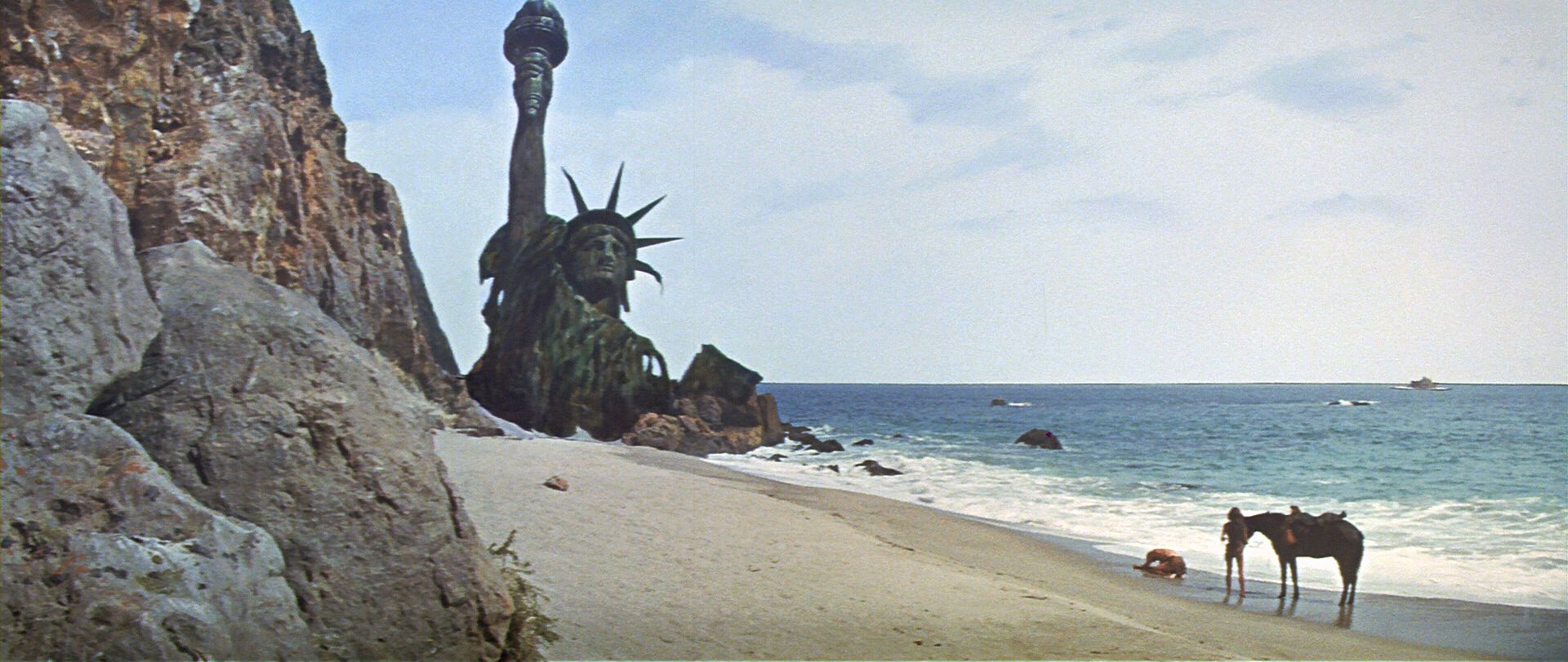
October 2, 1957: The film The Bridge On the River Kwai premieres, directed by David Lean, and based on the 1952 novel by Pierre Boulle. Boulle went on to write Planet of the Apes in 1963.
The film is set in 1943, at a Japanese prison camp in Thailand. William Holden plays one of the prisoners, U.S. Navy Commander Shears. (No first names are used in the film.) A group of British prisoners arrive, commanded by Lieutenant Colonel Nicholson, played by Alec Guinness. They arrive whistling "The Colonel Bogey March," a British song from World War I. The song, previously unfamiliar in America, because legendary because of this scene.
The camp is commanded by Colonel Saito, played by Sessue Hayakawa, who had been the 1st actor of Asian ancestry to make it big in Hollywood. Saito tells the prisoners that they -- including the officers -- will work to build a railway bridge over the River Kwai, to connect Bangkok, the capital of Thailand, with Rangoon, the capital of Burma. (The country's name is now Myanmar, and the city's name is now Yangon.)
Nicholson reminds Saito that the Geneva Convention exempts officers from manual labor. After the enlisted men are marched to the bridge site, Saito threatens to have the officers shot, until Major Clipton, the British medical officer, warns Saito there are too many witnesses for him to get away with murder. Saito leaves the officers standing all day in the intense heat. That evening, the officers are placed in a punishment hut, while Nicholson is beaten and locked in an iron box. Shears escapes, eventually reaching the British colony of Ceylon (now the nation of Sri Lanka).
Work on the bridge proceeds badly, due to both the faulty Japanese engineering plans and the prisoners' slow pace and deliberate sabotage. Saito is expected to commit ritual suicide if he fails to meet the rapidly approaching deadline. Desperate, he uses the anniversary of Japan's 1905 victory in the Russo-Japanese War as an excuse to save face: He announces a general amnesty, releasing Nicholson and his officers, and exempting them from manual labor.
Nicholson is shocked by the poor job being done by his men, and orders the building of a proper bridge, intending it to stand as a tribute to the British Army's ingenuity for centuries to come. Clipton objects, believing this to be collaboration with the enemy. Nicholson's obsession with the bridge eventually drives him to allow his officers to volunteer to engage in manual labor.
Shears is enjoying his hospital stay in Ceylon, unwittingly within a commando school of Britain's Special Operations Executive (SOE). Major Warden (played by Jack Hawkins) of SOE invites him to join a commando mission to destroy the bridge just as it is completed.
Warden, Shears, and two other commandos, Chapman and Joyce, parachute into Thailand. Chapman dies after falling into a tree, and Warden is wounded in an encounter with a Japanese patrol and must be carried on a litter. Under cover of darkness, Shears and Joyce plant explosives on the bridge towers. A train carrying important dignitaries and soldiers is scheduled to be the first to cross the bridge the following day, and Warden wants to destroy both.
By dawn, however, the river level has dropped, exposing part of the wire connecting the explosives to the detonator. Nicholson spots the wire, and brings it to Saito's attention. As the train approaches, they hurry down to the riverbank to investigate. Joyce, manning the detonator, breaks cover and stabs Saito to death. Nicholson yells for help, while attempting to stop Joyce from reaching the detonator. Japanese gunfire wounds Joyce. Shears swims across the river, but is himself shot. Recognizing Shears, Nicholson exclaims, "What have I done?"
Warden fires a mortar, killing Shears and Joyce and fatally wounding Nicholson. Dying, Nicholson stumbles toward the detonator and falls on the plunger, blowing up the bridge. The explosion sends the train hurtling into the river.
This was not the first film "based on a true story" to be full of baloney. While the Japanese did force prisoners of war to build a railroad bridge to connect Bangkok and Rangoon, the conditions under which it was built were too harsh to be allowed onscreen by American film's Hays Code.
Julie Summers, in her book The Colonel of Tamarkan, writes that Boulle, who had been a prisoner of war in Thailand, created the fictional Nicholson character as an amalgam of his memories of collaborating French officers. And on the BBC show Timewatch, a former prisoner at the camp states that it is unlikely that a man like the fictional Nicholson could have risen to the rank of Lieutenant Colonel; and, if he had, due to his collaboration, he would have been "quietly eliminated" by the other prisoners.
As for the real bridge, it was bombed by Allied planes, and rebuilt after the war. It is still in use, 79 miles west of Bangkok, and 467 miles southeast of Yangon. Thailand now calls the river the Khwae Yai.

The Bridge On the River Kwai was the highest-grossing film released in 1957, a year that also included Peyton Place, Old Yeller, Pal Joey, Gunfight at the O.K. Corral, and 2 Elvis Presley films, Loving You and Jailhouse Rock. It was nominated for 8 Academy Awards, winning 7, including Best Picture, Best Director for Lean, and Best Actor for Guinness.
Hayakawa and Hawkins died in 1973, Holden in 1981, Lean in 1991, Boulle in 1994, and Guinness in 2000.
*
October 2, 1957 was a Wednesday. There was only one score on this historic day, and it came in Game 1 of the World Series. The New York Yankees beat the Milwaukee Braves, 3-1 at Yankee Stadium. A pair of future Hall-of-Fame lefthanders started the game, and Whitey Ford outpitched Warren Spahn. Mickey Mantle went 2-for-4.
Hank Aaron, the Braves' star young right fielder, went 1-for-4. Years later, he said the Braves weren't intimidated by the Yankees, the defending World Champions, who were seeking their 18th World Series win; it was Yankee Stadium that intimidated them. Well, they must have overcame it: They ended up beating the Yankees in the Series, clinching 5-0 in Game 7 at Yankee Stadium.