Showing posts with label american revolution. Show all posts

Wednesday, April 13, 2022

April 13, 1943: The Jefferson Memorial Is Dedicated

April 13, 1943: The Jefferson Memorial is dedicated in the Tidal Basin in Washington, D.C., on the 200th Anniversary of the birth of Thomas Jefferson.

The native of Shadwell, outside Charlottesville, Virginia, served in the House of Burgesses of Britain's Virginia Colony from 1769 to 1775. That House became the House of Representatives of the Commonwealth of Virginia, and is the oldest continuously operating deliberative body in North America. (Like Massachusetts, Pennsylvania and Kentucky, Virginia officially calls itself a "Commonwealth," but, like the other 46 States, those "Commonwealths" are recognized by the federal government as "States.")

As a Burgess, Jefferson responded to the "Intolerable Acts" of 1774 by writing A Summary View of the Rights of British America, which made him a natural to be elected to the Continental Congress in Philadelphia. While there, he was selected to write the Declaration of Independence, ratified on July 4, 1776. He served as Governor of Virginia from 1779 to 1781, including writing the Virginia Statute for Religious Freedom.

He then moved into the diplomatic sphere, serving as Minister Plenipotentiary for Negotiating Treaties of Amity and Commerce. From 1785 to 1789, he served as U.S. Minister to France. (Today, we would say, "Ambassador.") He returned to America to become the 1st U.S. Secretary of State, under the 1st President, George Washington. He finished 2nd to John Adams in the Presidential election of 1796, making him, under the wording of the Constitution of that time (changed in 1804 by the 12th Amendment), the 2nd Vice President. In 1800, he defeated Adams to become the 3rd President.

As President, he presided over a vast expansion of the country with the Louisiana Purchase of 1803, and an early military victory in the conflict with the Barbary Pirates of North Africa from 1801 to 1805. His 2nd term was beset by economic issues, and his solution, the Embargo Act of 1807, was terribly counterproductive. Someone noticed that "embargo" spelled backwards was "o-grab-me," and that's what it felt like for what passed for big business in America at the time.

At the conclusion of his 2nd term in 1809, he left the Presidency, and founded the University of Virginia, the 1st university in the world not affiliated with any religious establishment.

To put it politely, his record on slavery was mixed. He had slaves, and never freed them, and, after the 1782 death of his wife Martha, with whom he had 6 children, but only 2 daughters survived to adulthood, he is alleged to have fathered up to 6 children with one of his slaves, Sally Hemings. But he criticized King George III for his role in the slave trade, a passage the Congress removed from the Declaration of Independence, for fear that the Southern colonies would reject it. And he signed a law prohibiting the importation of slaves into America starting in 1808.

He died on July 4, 1826, the 50th Anniversary of the approval of the Declaration of Independence. He had wanted to live to see it, and, every few hours on July 3, he awoke to ask, "Is this the 4th?" After being told, "No," a few times, the truth finally became, "Yes." He smiled, and went back to sleep, lasting until 12:50 PM on the 4th.

He had reconciled with Adams by mail, though they had never again seen each other in person. That same day, not knowing that Jefferson had already died, Adams passed away at 6:20, saying, "Thomas Jefferson lives. Independence forever."

John Russell Pope designed the Jefferson Memorial, but died in 1937 before construction could begin. Rudulph Evans sculpted the 18-foot statue at the center, which, due to wartime priorities for metal, was not finished until 1947, with a plaster version standing in for it until then.
As with the statue of Abraham Lincoln at his Memorial nearby, panels of Jefferson's memorial are inscribed with words of his. On one panel are selections from the Declaration of Independence, with a slight alteration: While he had written that, "We hold these truths to be self-evident: That all men are created equal; that they are endowed by their creator with certain unalienable rights," the inscription on the memorial reads, "with certain inalienable rights," which has led to a great deal of confusion.

In a letter to another Signer of the Declaration, Dr. Benjamin Rush, dated September 23, 1800, Jefferson wrote, "For I have sworn upon the altar of god eternal hostility against every form of tyranny over the mind of man." Those words are inscribed on his Memorial.

And he hated despots to the end. In a letter to John Langdon, a Signer of the Constitution and 3 times Governor of New Hampshire, on March 5, 1810, he wrote, of, respectively, King Louis XVI of France (1774-1792), King Charles IV of Spain (1788-1808, overthrown by Napoleon), the man who ruled Naples as King Ferdinand IV and Sicily as King Ferdinand III (1759 to 1825), King Victor Amadeus III of Sardinia (1773-1796), Queen Maria I of Portugal (known as Maria the Mad, 1777-1816), King Christian VII of Denmark (1766-1806), King Frederick William II of Prussia (1786-1797), King Gustav III of Sweden (1771-1792, assassinated), Emperor Joseph II (reigned over the Holy Roman Empire starting in 1765 and the Austrian Empire starting in 1780, until his death in 1790), King George III of Great Britain (1760-1820, mentally incompetent from 1811 onward with his son, later King George IV, in charge), Empress Catherine II of Russia (a.k.a. Catherine the Great, 1762-1796), and Czar Alexander I of Russia (1801-1825):

While in Europe, I often amused myself with contemplating the characters of the then reigning sovereigns of Europe. Louis the XVI was a fool, of my own knowledge, and in despite of the answers made for him at his trial. The King of Spain was a fool, and of Naples the same. They passed their lives in hunting, and despatched two couriers a week, one thousand miles, to let each other know what game they had killed the preceding days. The King of Sardinia was a fool. All these were Bourbons.

The Queen of Portugal, a Braganza, was an idiot by nature. And so was the King of Denmark. Their sons, as regents, exercised the powers of government. The King of Prussia, successor to the great Frederick, was a mere hog in body as well as in mind. Gustavus of Sweden, and Joseph of Austria, were really crazy, and George of England, you know, was in a strait-waistcoat. There remained, then, none but old Catharine, who had been too lately picked up to have lost her common sense.

In this state Bonaparte found Europe; and it was this state of its rulers which lost it with scarce a struggle. These animals had become without mind and powerless; and so will every hereditary monarch be after a few generations. Alexander, the grandson of Catharine, is as yet an exception. He is able to hold his own. But he is only of the third generation. His race is not yet worn out. And so endeth the book of Kings, from all of whom the Lord deliver us, and have you, my friend, and all such good men and true, in His holy keeping.

And, despite Napoleon Bonaparte, first as dictator of France (1799-1804) and then as Emperor (1804-1814, with a brief return in 1815), selling him the Louisiana Territory, keeping Britain occupied in such a way as to be unable to win the War of 1812, and being one of the greatest military minds of all time, Jefferson hated his guts, too. On his first fall, Jefferson wrote to John Adams on July 5, 1814:

The Attila of the age dethroned, the ruthless destroyer of ten millions of the human race, whose thirst for blood appeared unquenchable, the great oppressor of the rights and liberties of the world...

Bonaparte was a lion in the field only. In civil life, a cold-blooded, calculating, unprincipled usurper, without a virtue; no statesman, knowing nothing of commerce, political economy, or civil government, and supplying ignorance by bold presumption.

And to Count Antonio Dugnani, who had been Pope Pius VI's "papal nuncio" to France while Jefferson was America's Minister there, he wrote on February 14, 1818, on the subject of Napoleon: "Having been, like him, intrusted with the happiness of my country, I feel the blessing of resembling him in no other point."

There are now 5 Presidents who have memorials on the National Mall in Washington. In chronological order of their service, they are: George Washington, Thomas Jefferson, Abraham Lincoln, Franklin D. Roosevelt and Dwight D. Eisenhower. Several other Presidents have official memorials, or at least statues, elsewhere in the District of Columbia.

Jefferson would appreciate institutions of learning being named after him, including Thomas Jefferson High School in Brooklyn. On the TV show Happy Days, the fictional Jefferson High was named for him. Also named for him are Thomas Jefferson University, a health-care-themed school, in Philadelphia; Jefferson College of Health Sciences, in Roanoke, Virginia; Washington & Jefferson College, in Washington; Pennsylvania; Thomas Jefferson School of Law, in San Diego; Jefferson Colleges in Washington, Mississippi and Hillsboro, Missouri; and community colleges in Watertown, New York; Louisville, Kentucky; and Birmingham, Alabama. And the Library of Congress' main building, which includes some donations from him, is named the Thomas Jefferson Building.
There are 15 States with cities or towns named for him, including Jefferson City, the capital of Missouri. The Counties that include Denver and Birmingham, Alabama are Jefferson County. There have been 3 ships named the USS Thomas Jefferson: A brig from 1814 to 1825, an attack transport from 1942 to 1955, and a U.S. Navy submarine in service from 1963 to 1985. 

Since 1938, Jefferson has appeared on the nickel, America's 5-cent coin, replacing the "Buffalo Nickel," the one with the "Indian head" on the front and the buffalo on the back. From 1929 to 1966, he was on the $2 bill, which was phased out, and temporarily brought back in 1976 as part of America's Bicentennial celebration.

The last surviving member of Jefferson's Cabinet was Albert Gallatin, who served as Secretary of the Treasury. He lived until 1849.

Among the actors who have played Jefferson: Charlton Heston in The Patriots in 1963, Hugh O'Brian in Swing Out, Sweet Land in 1970, Ken Howard in 1776 in 1972, Jeffrey Jones in George Washington: The Forging of a Nation in 1986, Scott Wilkinson in A More Perfect Union in 1989, Nick Nolte in Jefferson In Paris in 1995, Sam Neill in Sally Hemings: An American Scandal in 2000, Ronald McAdams in National Treasure in 2004, and Stephen Dillane in John Adams in 2008.

In a 2016 episode of the YouTube series Epic Rap Battles of History, "Nice" Peter Shukoff played Jefferson, while actor J.B. Smoove played Frederick Douglass, who challenged him on slavery, including perhaps the baddest zinger in the show's history: "You got a self-evident truth of your own: You let freedom ring, but never picked up the phone!"

*

April 13, 1943 was a Tuesday. Baseball season started 7 days later. Football was out of season. The NBA hadn't been founded yet. And hockey season had ended 5 days earlier, when the Detroit Red Wings clinched the Stanley Cup over the Boston Bruins. So there were no scores on this historic day.

Tuesday, April 5, 2022

April 5, 1976: The Soiling of Old Glory

April 5, 1976: A disgusting act of racism at City Hall in Boston, birthplace of the American Revolution, casts a shadow over the nation's Bicentennial celebrations.

The act occurs within a 2-minute walk of the Old State House, site of the Boston Massacre of 1770, which is generally considered to be the beginning of the Revolution, and a 3-minute walk of Faneuil Hall, another landmark of the Revolution. Within a 5-minute walk is the Old South Meeting House, where the Boston Tea Party got started in 1773. The Old City Hall, built in 1865, is also within a 5-minute walk.

Boston's new City Hall was built in 1969, and it has severely divided public opinion. Some people think it's wonderful. Others think it is so ugly. How ugly is it? In 2013, Paul McMorrow, a columnist for The Boston Globe, wrote:

City Hall is so ugly that its insane upside-down wedding-cake columns and windswept plaza distract from the building's true offense. Its great crime isn't being ugly; it's being anti-urban. The building and its plaza keep a crowded city at arm's length.

I have to agree. While the David D. Dinkins Municipal Building, the Beaux-Arts skyscraper a block away that serves as Manhattan's Borough Hall as well as space for various City offices, New York's City Hall, built in 1812, is short and easily accessible from street level. Philadelphia's, opening in 1901, has a clock tower that made it, for a few years, the tallest building in the world; but its ground level provides excellent access, and it even hosts the city's skating rink and Christmas market.

In contrast, to get to Boston's New City Hall, you have to climb steps, or use a handicap-accessible elevator. And there's a reason that style of architecture was, at the time, labeled "Brutalist."

But it will never be as ugly as the most famous event ever to happen there -- and I don't mean the "Yankees suck!" chant that goes up there every time a celebration is held for a Boston team winning its sport's World Championship, even if it's not the Red Sox.

In the years after the Revolution, Boston was the center of the American movement for the abolition of slavery. William Lloyd Garrison published his newspaper The Liberator at 21 Cornhill Street, espousing the cause of the abolition of slavery from 1831 until it happened in 1865. With some irony, the site of the building was wiped out to build New City Hall.

One of the most famous all-black units of the American Civil War was the 54th Massachusetts Infantry Regiment, whose memorial is across Beacon Street from the "new" State House. As recently as 1955, Boston had a role to play in the Civil Rights Movement: Martin Luther King Jr. earned his doctorate of divinity at Boston University.

But times changed. In the 1960s, fans jammed the Boston Garden to see the all-white Boston Bruins, no matter how bad they were; while the building was half-empty for the integrated Boston Celtics, until the Playoffs. Then, the Boston fans became front-runners as the Celtics won 11 NBA Championships in 13 years. Celtics star Bill Russell publicly described Boston as a "racist city."

The Boston Red Sox were the last Major League Baseball team to integrate, with Elijiah "Pumpsie" Green in 1959. The Bruins actually had a black player first, Willie O'Ree, in 1958. But the Red Sox also had Earl Wilson, the 1st black pitcher to pitch a no-hitter in the American League, in 1962; and Russell was named head coach in 1966, making him the 1st black head coach in major league sports (unless you count Fritz Pollard in the fledgling NFL in 1920). So the record is mixed.

On June 21, 1974, in the case of Morgan v. Hennigan, federal Judge W. Arthur Garrity Jr. ruled that Boston's public schools had to be desegregated. When the buses with black students arrived at previously all-white South Boston High School on September 12, white parents -- not kids, parents -- threw rocks at the buses.

The black kids were harassed both inside and outside the school. Finally, the black parents called on the one man they thought might have been able to reach the white people of "Southie": Senator Ted Kennedy, brother of a President and a Presidential candidate, both martyred, now the standard-bearer of Boston's, and America's, most famous Irish Catholic family.

But when he pleaded with them to leave the black students alone, they threw rocks at him. One woman yelled out, "You're a disgrace to the Irish!" Ted, for all his faults, had too much class to yell back, "You're a disgrace to the Americans!" The harassment continued into the 1975-76 schoolyear.

On April 5, 1976, Ted Landsmark, a 29-year-old civil rights attorney, born in Kansas City and raised in New York's famous black neighborhood of Harlem, went to City Hall to assist minority contractors in getting opportunities in the construction industry. He later said, "I had difficulty finding a parking space in downtown Boston, and I was running a few minutes late for the meeting in City Hall. So I was in a hurry and perhaps not paying as much attention as I might have as I approached a corner, where the young demonstrators were coming in the other direction. I did not see them until both they and I were at that corner."

There was a protest against the busing going on, and two of the white protestors saw Landsmark, knocked him down, and broke his nose.

However, what the picture seemed to show was not what was actually happening. One of the anti-busing protestors, James M. Kelly, a South Boston High School graduate, looked like he was holding Landsmark's arms to make him an easier target. In fact, he was helping Landsmark up.

The other major figure in the photo was Joseph Rakes. Looking more like a 1960s San Francisco hippie than a 1970s Boston racist, he had brought an American flag to the protest, and he was waving it. But the photo made it look like he was trying to stab Landsmark with the pointed end of the flag's pole.

Rakes later claimed he was simply waving the flag at Landsmark, and there is no video to either back up or dispute his claim. But even if this were true, it seemed to be sending a message: "This is my flag, and represents me and my people, not you and your people."

In 1824, a merchant seaman named William Driver commanded a ship on which he raised an American flag, telling his crew, "Behold, Old Glory." The flag has carried "Old Glory" as a nickname ever since, along with "The Stars & Stripes" and "The Star-Spangled Banner."

Stanley Forman of the Boston Herald American took the photograph that appeared to show Rakes trying to stab Landsmark, and it made the next day's front page. It became known as "The Soiling of Old Glory," and it took the sails out of the busing protests. These white Bostonians, so proud of their patriotism, began to see that they were taking it too far.
Stanley Forman, 2013

The image of the hippie-looking white kid appearing to assault the well-dressed black man with a flag was similar to a collegiate psychology experiment, in which a white guy with greasy hair, stubble, a T-shirt, jeans and a knife was shown holding that knife up to a black man in a nice suit, and then, at the end of the class, the professor asked the class whether the white man or the black man was holding the knife, and got a split answer.

Rakes was convicted of assault with a deadly weapon, and sentenced to two years' imprisonment and two years' probation. The jail sentence was suspended. In 1983, Rakes assaulted his sister's boyfriend, who later died from the injuries sustained in the attack. He fled prosecution, but returned in 1988 after the murder charge was dropped. Rakes carried the stigma of being known as "the flag kid," but eventually married and had children while laboring as a construction worker and later in hazardous waste.

James M. Kelly was not stigmatized by his presence in the photo. He was elected to the City Council in 1984, and was continually re-elected until his death in 2007.

Landsmark parlayed the attention to increase awareness on the racial unrest in Boston. He was later hired by Mayor Raymond Flynn -- another graduate of South Boston High -- to improve youth and workforce development in the city. He taught at Harvard University, the Massachusetts Institute of Technology (MIT), the Boston campus of the University of Massachusetts, and the Massachusetts College of Art. From 1997 to 2014, he was president of Boston Architectural College. He left that post when another Mayor, Marty Walsh, named him to the board of directors for the Boston Planning and Development Agency.
Ted Landsmark, 2020

As of April 5, 2022, Landsmark, Rakes and Forman are still alive. In a 2016 interview, Landsmark said that he and Rakes had never met again after the incident, the way some such meetings have been conducted, as with the Little Rock Nine and their tormentors after 1957 Arkansas, or the descendants of Homer Plessy and Judge John Ferguson to commemorate their court case.

*

April 5, 1976 was a Monday. Actor Sterling K. Brown was born.

Football was out of season. The Major League Baseball season began 3 days later. And this was the day between the last day of the NHL's regular season and the start of the Stanley Cup Playoffs. There were no games scheduled for the World Hockey Association, either.

But there were 3 games played in the NBA that day:

* The Philadelphia 76ers beat the Houston Rockets, 130-129 in overtime at The Spectrum in Philadelphia. Calvin Murphy scored 36 points for the Rockets, and Rudy Tomjanovich added 25. But for the Sixers, Steve Mix scored 33, George McGinnis 28 and Fred Carter 24.

* The Washington Bullets beat the Atlanta Hawks, 133-105 at The Omni in Atlanta.

* And the Milwaukee Bucks beat the Chicago Bulls, 102-97 at the Chicago Stadium.

And there was 1 game played in the American Basketball Association: The New York Nets beat the San Antonio Spurs, 104-102 at the HemisFair Arena in San Antonio.

April 5, 1939: The Library of Congress Opens the John Adams Building

April 5, 1939: The Library of Congress opens an annex. It is across 2nd Street SE from the main Library, the Thomas Jefferson Building, and is also bounded by East Capitol Street, 3rd Street SE and Independence Avenue. On June 13, 1980, it was renamed the John Adams Building.

NOTE: My cutoff date for this project is 1869, the year of the completion of the Transcontinental Railroad, the 1st openly professional baseball team, and the 1st American football game. I had managed to work in references to most pre-1869 Presidents. This was the only way I could think of to do it for both Adamses.

The building is 5 stories in height above ground. It contains 180 miles of shelving, compared to 104 miles in the Jefferson Building, and can hold 10 million volumes. There are 12 tiers of stacks, extending from the cellar to the 4th floor. Each tier provides about 13 acres of shelf space.

John Adams was a Signer of the Declaration of Independence, and the member of the Continental Congress who recommended to that body that George Washington be named commander of the Continental Army. He served as U.S. Minister of France, and to Britain. He was elected the 1st Vice President of the United States, under Washington, in 1789 and 1792, and the 2nd President in 1796, defeating Jefferson.
He lost to Jefferson in 1800, the men's friendship having been torn apart by the politics of the time. With the prodding of his wife Abigail, Adams began writing to Jefferson, and, although they never met in person again, their correspondence restored their friendship. Adams died at 6:20 PM on July 4, 1826, the 50th Anniversary of the approval of the Declaration of Independence, at Peacefield, his home in Quincy, Massachusetts, outside Boston. His last words were, "Thomas Jefferson still lives. Independence forever."

What he didn't know, due to the means of transmitting information available at the time -- it was 28 years before the invention of the telegraph, 50 years before that of the telephone, and 94 years before the start of radio broadcasting -- was that Jefferson had died earlier in the day. The night before, drifting in and out of consciousness, and determined to make it to the great anniversary, he kept asking, "Is this the fourth?" Late at night on the 3rd, not sure that he would make it to midnight, those around him told him, "Yes." He did not regain consciousness, but lived until 12:50 PM on the 4th.

At the time, the President of the United States was Adams' son, John Quincy Adams, who called the coincidence of their deaths on the nation's anniversary "visible and palpable remarks of Divine Favor."

John Quincy had been America's finest diplomat, having been appointed as U.S. Minister to the Netherlands (at age 27!), Prussia (most of modern Germany), Russia and Britain. He also served Massachusetts in the U.S. Senate, before being appointed Secretary of State by President James Monroe. It was Adams who actually wrote the policy that became known as the Monroe Doctrine.
He was also the earliest President to be photographed,
although it was many years after he left office.

A controversial election in 1824 led to Adams becoming President, but his time in office was one of the most frustrating that any President ever had, and he was overwhelmingly defeated by Andrew Jackson in 1828. In 1830, he was elected to the U.S. House of Representatives, and remains the only former President so honored. He became one of the nation's foremost anti-slavery activists, until his death in 1848. He and his wife Louisa, an English native and the only foreign-born First Lady until Melania Trump, are entombed at the same church in Quincy as his parents, John and Abigail.

John Quincy's son, Charles Francis Adams, served a term in Congress, and was U.S. Envoy to Britain during the American Civil War, keeping the British from allying with the Confederate States of America. There was an effort by Republicans unhappy with the corruption in the Administration of Ulysses S. Grant to nominate Charles Francis for President in 1872, but it didn't happen.

His sons included John Quincy Adams II, who served in the Massachusetts House of Representatives; Charles Francis Adams Jr., who never served in public office but whose legal work reformed America's railroad industry, and served as President of the Union Pacific Railroad; and historians Henry Adams and Brooks Adams.

Although the founding owner of the National Hockey League's Boston Bruins was named Charles Francis Adams, he was not a member of this Adams family.

John Marshall served as John Adams' Secretary of State from June 13, 1800 to March 4, 1801. One of Adams' last decisions was to appoint him Chief Justice of the Supreme Court of the United States, in which he served until his death in 1835, leaving him the last surviving member of the Adams Cabinet.

John McLean was the last surviving member of John Quincy Adams's cabinet. He served as Postmaster General throughout Adams' Presidency, and later as an Associate Justice of the Supreme Court. He died in 1861.

In 1870, the Stone Library was built on the grounds of Peacefield. It is considered the Presidential Library for both Adamses.

In 2001, Congress authorized the Adams Memorial Foundation, to provide for the construction in the District of Columbia of a memorial for the Adams family and its accomplishments. As of April 5, 2022, the money necessary for such a memorial had not yet been raised, nor had a site been selected.

There are 6 Counties named for John Adams, and there is Adams County in Iowa, which is officially unsure if it was named for the father or the son. There are John Adams High Schools in Queens, New York City (my grandmother went there, but did not graduate); Cleveland; the Detroit suburb of Rochester Hills, Michigan; South Bend, Indiana; Hasting, Nebraska; and Portland, Oregon.
John Adams statue, Quincy, Massachusetts

On the TV show Boy Meets World, the character of Cory Matthews, played by Ben Savage, attends a school named for John Adams, in the suburbs of Philadelphia. For the sequel series Girl Meets World, a now-grown Cory teaches at a New York City school named for John Quincy Adams, attended by his daughter, Riley, played by Rowan Blanchard.
John Quincy Adams statue, Quincy

On Boy Meets World, Cory's teacher, George Feeney, was played by William Daniels. Daniels had played John Adams in the 1969 Broadway musical 1776, and reprised the role in the 1972 film. Adams was also played by Robert Ayres in the 1959 film John Paul Jones, Hal Holbrook in the 1984 CBS TV-movie George Washington, Ivan Crosland in A More Perfect Union in 1989, and Paul Giamatti in the 2008 HBO miniseries John Adams.

Grant Mitchell played John Quincy Adams in the film The Monroe Doctrine in 1939, Anthony Hopkins played him in Amistad in 1997, and Ebon Moss-Bachrach played him in the 2008 John Adams miniseries.

The USS Adams was a frigate launched in 1799, served in the Quasi-War with France, the First Barbary War, and the War of 1812, before it ran ground in Maine and was scuttled in 1814. A separate frigate, the USS John Adams, was also launched in 1799, and remained in service until 1865. Another USS John Adams, officially named for both men, was a submarine in service from 1963 to 1989.

John Adams was the 1st President born in Massachusetts, although whether he remains the greatest one depends on how you feel about John F. Kennedy.

*

April 5, 1939 was a Wednesday. This was also the day that Kate Smith's recording of "God Bless America" was released. I have a separate entry for that event.

Baseball was in Spring Training. Football was out of season. The NBA hadn't been founded yet. And the Stanley Cup Finals were between Games 1 and 2. The Boston Bruins would beat the Toronto Maple Leafs, 4 games to 1. So there were no scores on this historic day.

Thursday, February 24, 2022

February 24, 1934: Colonial Williamsburg Opens

The Governor's Palace. Original Building, 1710-1781.
Reconstruction: 1931.

February 24, 1934: Colonial Williamsburg opens. Although there are other "living history museums" in America, including Plimouth Plantation in Massachusetts (set at the start of America's colonial era) and Greenfield Village at the Henry Ford Museum in Michigan (set in various periods from the colonial era to the 1920s), Williamsburg is the most famous.

Jamestown was the 1st capital of England's colony in Virginia. The statehouse burned down in 1698. The capital was moved 6 miles inland, to Williamsburg, home of the College of William and Mary, only the 2nd college ever established in America, after Harvard in Massachusetts.

Williamsburg served as the capital of Virginia until 1780, when it was moved 50 miles northwest to Richmond. The next year, the Governor's Palace burned down, about 2 months after the British surrendered at nearby Yorktown, the decisive battle of the War of the American Revolution.

Williamsburg remained a college town, and figured in the other defining conflict of American history: The Battle of Williamsburg was fought as part of the Peninsular Campaign of the American Civil War, on May 5, 1862 -- the same day as the Battle of Puebla during the French Intervention in Mexico, inspiring the holiday Cinco de Mayo.

As the 20th Century dawned, Williamsburg was in decline, but it was the only colonial capital that could, theoretically, have been restored as a historic park. The others were either pretty much abandoned or, as in the case of Boston and Philadelphia, had already become too modernized. The Rev. Dr. William Archer Rutherford Goodwin, a community leader, convinced John D. Rockefeller Jr., of the nation's richest family, to fund the colonial area's rebuilding and restoration. This was done at the depth of the Great Depression, at the same time as "Junior" was funding the building of the Rockefeller Center complex in Midtown Manhattan. That's how much money he had from being the country's top banker, above and beyond even his billionaire oil baron father's fortune.

Today, the Colonial Williamsburg Foundation has over 7,300 employees on 301 acres. Some of the buildings are restored originals, some are constructions based on photographs or paintings. Costumed employees are thoroughly versed in the customs of the era, including records of how people spoke: While they have not attempted to copy the accents of the time (to which, sound recording not having been invented for another 100 years, they could only guess), they do try to match the grammar and the diction that was common at the time.

And they must stay not only in character, but in time. The last time I visited, a town crier was giving the news of the Battle of Saratoga, in October 1777, and he wanted the visitors to join him in three cheers (three shouts of, "Hip, hip, huzzah!") for the winning general of that battle. Benedict Arnold. He had to act as though he didn't know how Arnold's story ended, so, when he saw some people laughing at the mention of the General's name, he said of Arnold, "I know, he's from New England, and they're a little strange up there... " (Arnold was from Norwich, Connecticut. Among the people laughing at that line was a man wearing a Boston Red Sox T-shirt.)

About an hour later, at the restored courthouse, there was a demonstration of the British capture of Williamsburg, and an actor playing Arnold -- who is not known to have ever visited the city, but did cause a lot of damage through his turncoated actions in Virginia -- told the crowd from atop his horse that they should have stayed loyal to the Crown, that they lived better under British rule. He was roundly booed by the early 21st Century tourists. The actor stayed in character, and didn't look bothered by it. An hour later, I looked back at the courthouse, and the Union Jack had once again been replaced by a 13-star American Flag.

Part of the problem of portraying the time is the recognition that much of the American economy, particularly in Virginia, the largest Southern State, involved slavery. The Foundation has chosen to tell the truth about it, though in such a way that it would not upset the children among the tourists.

*

February 24, 1934 was a Saturday. Baseball and football were out of season. The NBA hadn't been founded yet. But there were 3 games played in the NHL:

* The New York Rangers lost to the Toronto Maple Leafs, 8-3 at Maple Leaf Gardens in Toronto. Frank "Buzz" Boll, Harvey "Busher" Jackson and Frank "King" Clancy -- a defenseman -- each had 2 goals for the Leafs. Jackson, Joe Primeau and Charlie Conacher, "the Kid Line," combined for 4 goals and 3 assists.

* The Montreal Canadiens beat the Chicago Black Hawks, 3-2 at the Montreal Forum. Pit Lepine scored all of the Canadiens' goals, including the winner, with 2:40 left in overtime.

* And the Ottawa Senators beat the Boston Bruins, 9-4 at the Ottawa Auditorium. Earl Roche, Gerry Shannon and Nick Wasnie each scored 2 goals. This would be the last season for the Senators, hurt by the Great Depression: They moved, playing the 1934-35 season as the St. Louis Eagles, and then folded. The World Hockey Association had the Ottawa Nationals for the 1972-73 season and the Ottawa Civics for 6 games in 1976, but the NHL would not return to its founding country's capital until the new Ottawa Senators began play in 1992.

And in English soccer, North London team Arsenal, in the process of successfully defending their Football League title in spite of the death of manager Herbert Chapman (Joe Shaw was now leading them), beat Newcastle United, 1-0 at St. James Park in Newcastle-on-Tyne in the North-East.

Sunday, February 20, 2022

February 21, 1885: The Washington Monument Is Dedicated

February 21, 1885: The Washington Monument is dedicated, on what will become known as the National Mall in Washington, the District of Columbia. It had been a long time in coming.

George Washington was been Commander of the Continental Army from 1775 to 1783, winning the War of the American Revolution. He was President of the Constitutional Convention of 1787. And he was the 1st President of the United States, serving from April 30, 1789 to March 4, 1797. He died in 1799, at the age of 67.

(His term was supposed to begin on March 4, 1789, but, due to the transportation links of the time, the 1st Congress had trouble getting together. Once they counted the Electoral Votes, Washington had to get from his home, Mount Vernon, in Alexandria, Virginia, to what was then the national capital, New York.)

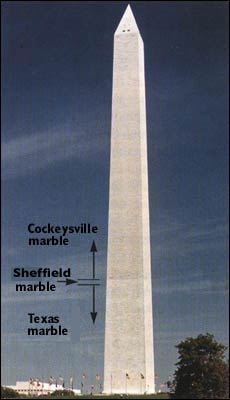
Construction of the national memorial to him, in the new capital city that bore his name, across the Potomac River from Alexandria, began in 1848. But in 1854, the committee tasked with building it ran out of money, and it just sat there, about one-third finished, for years. To this day, a close look reveals where construction started again, in 1877, as shown in the photo at the top. 
The Monument is both the world's tallest predominantly stone structure and the world's tallest obelisk. Upon its completion, the National Park Service measured it at 555 feet, 5 1/8th inches high. In 2014, the U.S. National Geodetic Survey measured it at 554 feet 7 11/32 inches, meaning that, probably due to the ground settling, it lost over 9 inches. At the time of its completion in late 1884, it surpassed the Cologne Cathedral in Germany as the tallest structure in the world, and held that title until 1889, when it was surpassed by the Eiffel Tower in Paris.

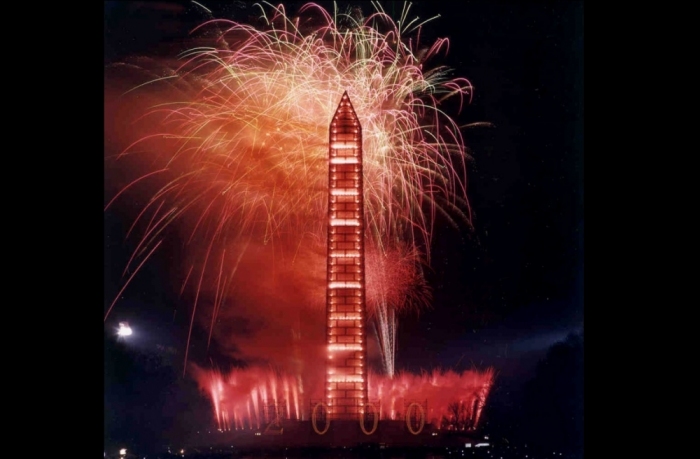
Fifty American flags, one for each State, fly on a large circle of poles centered on the Monument. In 1999 and 2000, it was renovated, and, with its steel scaffold, was the the centerpiece of D.C.'s Millennium Day celebrations. A 2011 earthquake slightly damaged the monument, and it was closed for repairs until 2014.
January 1, 2000, 12:01 AM

On August 21, 1908, helping journalist Preston Gibson win a $500 bet (about $15,700 in 2022 money), Washington Senators catcher Charles "Gabby" Street caught a ball dropped 555 feet from the top of the Monument.

Since its opening, the Washington Monument has been joined by official memorials to Presidents Thomas Jefferson, Abraham Lincoln, Theodore and Franklin Roosevelt, and Dwight D. Eisenhower; and memorials to those lost in World War II and the Korean and Vietnam Wars. A World War I memorial is now under construction.
There are also Washington Monuments in Baltimore (a column completed in 1829, before construction on the D.C. one was even planned), Philadelphia (an equestrian statue in front of the Museum of Art), Richmond (equestrian), Milwaukee (a standing statue), and at the U.S. Military Academy in West Point, New York (another equestrian statue).

Newark, New Jersey has 2 prominent statues of Washington, one of him standing next to his horse, in Washington Park, in front of the city's main Public Library and the Newark Museum; and one of him at the head of a massive Wars of America statue in Military Park, downtown.
Washington Park, Newark, New Jersey

On September 27, 2013, 214 years after his death, a Presidential Library for him opened on the grounds of Mount Vernon. He's the only President with a State named after him. Among the other things named for him are 31 Counties or County equivalents, 43 townships in Ohio alone, 5 of them in New Jersey; Mount Washington, in New Hampshire, the highest peak in the Eastern U.S.; Lake Washington, on which the biggest city in the State of Washington, Seattle, sits.

Since 1928, Washington's portrait has appeared on America's $1 bill. Since 1932, the 200th Anniversary of his birth, his left profile has appeared on the quarter, the 25-cent coin.

Also, George Washington University in D.C.; Washington and Jefferson College in Washington, Pennsylvania, Washington and Lee University, also named after Robert E. Lee, in Lexington, Virginia; and Washington University in St. Louis. Also, the George Washington Bridge, connecting the Washington Heights neighborhood of Manhattan, which includes George Washington High School, with Fort Lee, New Jersey, named for one of his generals who was a relative of Robert E.; and the George Washington Memorial Parkway, connecting D.C. with Mount Vernon.

And 4 ships have been named the USS George Washington: A frigate that sailed from 1798 to 1802, a World War I transport, a submarine in service from 1959 to 1985, and a nuclear-powered aircraft carrier, CVN-73, a.k.a. "The Spirit of Freedom," that has been in service since 1992.

Washington was, of course, the 1st President, and thus the 1st President from Virginia. He is usually listed as 1 of the 3 greatest Presidents, along with Abraham Lincoln and Franklin Delano Roosevelt, so he is still the greatest politician from Virginia.

The last surviving member of George Washington's Cabinet was Oliver Wolcott Jr., who served as his Secretary of the Treasury from 1795 to 1797. He lived until 1833.

Among the actors who've played Washington: Will Geer on a 1970 episode of Bewitched, Peter Graves in The Rebels in 1979, Barry Bostwick in 2 CBS TV-movies in the 1980s, Michael McGuire in A More Perfect Union in 1989, Jeff Daniels in The Crossing in 2000, Kelsey Grammer in Benedict Arnold: A Question of Honor in 2003, David Morse in John Adams in 2008, Ian Kahn in Turn: Washington's Spies from 2014 to 2017, Damian O'Hare in Timeless in 2016, and Randall Batinkoff in DC's Legends of Tomorrow in 2017.

In a 2014 episode of the YouTube series Epic Rap Battles of History, Washington was played by "Nice" Peter Shukoff, against "Epic" Lloyd Ahlquist, playing Scottish hero William Wallace, a.k.a. Braveheart.

*

February 21, 1885 was a Saturday. Baseball and football were out of season. Hockey was all-amateur. And basketball hadn't yet been invented. So there were no scores on this historic day.
Not in this country, anyway. In England, 3 of the 4 Quarterfinals of the FA Cup were played. (The Football League wouldn't be founded for another 3 years.) Nottingham Forest beat Old Etonians, 2-0 at the Pococks Lane ground, Eton, Berkshire. Notts County and Queen's Park, of Glasgow, Scotland (at the time, permitted to play in England's premier "football" competition) played to a 2-2 draw at Meadow Lane in Nottingham. And Blackburn Rovers beat West Bromwich Albion, 2-0 at the Four Acres Cricket Ground in West Bromwich, outside Birmingham.

On April 4, at the Kennington Oval in Southeast London, Blackburn would beat Queen's Park in the Final, 2-0.

Saturday, January 1, 2022

January 1, 1934: The Franklin Institute Opens In Philadelphia

January 1, 1934: The current building of the Franklin Institute opens in Philadelphia, at 222 North 20th Street, at the northwestern edge of Center City, and along the Benjamin Franklin Parkway. The Philadelphia Museum of Art, the Rodin Museum and The Academy of Natural Sciences are also along the Parkway.

Dr. Franklin (born January 17, 1706 in Boston; died April 17, 1790 in Philadelphia) was the most famous American before independence in 1776, and arguably the most important figure in the American Revolution, ahead of even George Washington. Even before the Revolution, he was America's leading printer, its first postmaster, its first fire marshal, the founder of the University of Pennsylvania (who have played at a stadium named Franklin Field since 1895), and its greatest scientist.

The story that he "discovered electricity" in 1752 by flying a kite in a storm is ridiculous. Electricity was already known. What he did was suggest that flying a kite in a storm could prove that lightning was electricity, but whether he actually carried the experiment out is unclear. Of course, Ben knew the value of a good story, even if it wasn't true, and did nothing to discourage its telling.

Franklin was one of five men assigned by the Continental Congress to compose The Declaration of Independence in 1776, along with John Adams, Roger Sherman, Robert R. Livingston, and the man who did the actual writing, Thomas Jefferson. The other four edited Jefferson's words, some to his objections. During the debate over independence, Franklin, already known for his wisdom and witticisms, told the delegates, "We must all hang together, or, surely, we shall all hang separately."

He then went to France, to enlist their aid against their common enemy, Britain. America would not have won that war without France. He represented America at the signing of the peace treaty, the Treaty of Paris, in 1783.

Six men signed both The Declaration and, in 1787, the Constitution of the United States, both at what is now named Independence Hall in Philadelphia: From Pennsylvania, Franklin, Robert Morris, George Clymer and James Wilson; from Connecticut, Sherman; and from Delaware, George Read.

Washington had been chosen as President of the Constitutional Convention. His chair had the image of half a Sun on it. After the Constitution was approved, Franklin said, "Now, I know: It is a rising, and not a setting, Sun." But when he left the Hall, someone asked him what kind of government was approved. He said, "A republic, if you can keep it."
From 1948 to 1963, Franklin's right profile appeared on the half-dollar, the 50-cent coin. Since 1914, his portrait has appeared on the $100 bill. Since the Roman numeral for 100 is the letter C, $100 bills have been nicknamed C-notes. However, due to Franklin's picture, they have also been called Big Bens, and hip-hop culture has led to them being called Benjamins.

Towns all over America have been named for Franklin, including in Somerset County and Sussex County, New Jersey. There are high schools named for him in East Harlem, Manhattan's East Harlem, New Orleans, and, as you might guess, Philadelphia, on North Broad Street, about a mile from the Institute.

He has been played by Walter Walker in the 1938 film Marie Antoinette, Orson Welles in the 1954 film Affairs at Versailles, Welles again in the 1961 film La Fayette, Howard da Silva in the 1972 film version of the musical 1776, Robert Symonds in the 1976 PBS miniseries The Adams Chronicles, Fredd Wayne in the 1987 film A More Perfect Union, Philip Bosco in the 1997 PBS miniseries Liberty! The American Revolution, Richard Easton in the 2002 PBS miniseries Benjamin Franklin, Tom Wilkinson in the 2008 HBO miniseries John Adams, and Dean Norris in the 2015 History Channel series Sons of Liberty. In another PBS documentary titled Benjamin Franklin, directed by Ken Burns in 2022, he was voiced by Mandy Patinkin. Oddly, while he is mentioned in Lin-Manuel Miranda's 2015 Broadway musical Hamilton, he does not appear onstage as a character.

Given Franklin's penchants for both science humor, it's not surprising that he has featured in time-travel stories and comedies. The TV shows Bewitched, Saturday Night Live and MADtv have all brought him forward in time to comment on what were then current events. John Sumner played him in a 2001 episode of the syndicated TV series Jack of All Trades, showing his proposed submarine as a successful invention, even though the show takes place in 1801, well after his death. "Epic" Lloyd Ahlquist played him on a 2011 episode of the YouTube series Epic Rap Battles of History, in which he is portrayed as a salesman, fully aware of events since his death, against the late TV commercial pitchman Billy Mays.

Franklin's life and career were key to the plot of the 2004 film National Treasure, which filmed on location at both the Franklin Institute and Independence Hall. The lead character, played by Nicolas Cage, is named Benjamin Franklin Gates. Other notable fictional characters named for him include Lieutenant Benjamin Franklin Pinkerton in the 1904 opera Madama Butterfly, Dr. Benjamin Franklin "Hawkeye" Pierce (Alan Alda), on M*A*S*H, baseball star Benjamin Franklin "Benny the Jet" Rodriguez (Mike Vitar) in The Sandlot, and teacher Benjamin Franklin Chang (Ken Jeong) in Community. And the mascot for the NBA's Philadelphia 76ers is a dog named Franklin.

*

On February 5, 1824, Samuel Vaughan Merrick and William H. Keating founded The Franklin Institute of the State of Pennsylvania for the Promotion of the Mechanic Arts. Within 3 years of its founding, that promotion had already taken place through public lectures, a high school, a library, public exhibitions, and a research journal. Many of these endeavors remain core activities of The Franklin Institute (TFI) to this day.

Since then, The Franklin Institute has played a central, yet constantly evolving, role in meeting America's educational needs in the fields of science and technology. For the organization's 1st century, classes were offered in mechanics, drafting, and engineering, and promoted science and invention.

In 1930, despite the Great Depression, The Franklin Institute and the Poor Richard Club began to seek funds to build a new science museum and memorial hall. In just 12 days, the community contributed $5.1 million, and in 1932, the cornerstone of the new Franklin Institute was laid at 20th Street and the Benjamin Franklin Parkway.

The Franklin Institute Science Museum opened to the public on January 1, 1934, titling itself a "Wonderland of Science," and was one of the first museums in the nation to offer a hands-on approach to learning about the physical world. Three major capital campaigns (1990, 2003, and 2012) enabled physical and programmatic expansion, resulting in the existing facility, which contains more than 400,000 square feet of exhibit space and two auditoriums.

TFI also operates the Fels Planetarium, the second oldest planetarium in the Western Hemisphere. The museum is home to the Benjamin Franklin National Memorial, which was fully restored in 2010 and is open free to the public. It is one of just a handful of national memorials in the custody of a private institution.

In 2014, the museum opened the 53,000-square-foot Nicholas and Athena Karabots Pavilion, which houses a STEM education and conference center, a climate-controlled traveling exhibition gallery, the award-winning exhibit Your Brain, in which visitors can explore neuroscience and their own senses.

Today, TFI offers three floors of permanent exhibits that provide hands-on learning experiences that introduce and reinforce key science concepts in creative and engaging ways. The museum also hosts renowned traveling exhibits that draw local, national and international visitors to the museum, such as King Tut, the most visited museum exhibit in the world in 2007; and Body Worlds in 2010.

As an American Association of Museums-accredited organization, the museum holds curatorial collections, particularly those related to Franklin and the Wright Brothers, that are considered national treasures.

*

January 1, 1934 was a Monday. This was also the date that Columbia University beat Stanford University in a big upset in the Rose Bowl. I have a separate entry for that event.

It would take until the next year for the Orange Bowl and the Sugar Bowl to be first played, and 2 more years for the Cotton Bowl. The NFL season had ended on December 17, with the Chicago Bears beating the New York Giants in the Championship Game. Baseball was in the off-season. And the NBA wouldn't be founded until 1946. There was 1 NHL game played that day: The Toronto Maple Leafs beat the Chicago Black Hawks, 2-1 at the Chicago Stadium.

And it was the date on which Alan Berg, the Denver radio show host who was the subject of Eric Bogosian's play and movie Talk Radio, murdered in 1984 for his political views, was born in Chicago.

December 31, 1999 & January 1, 2000: The Millennium

December 31, 1999:  The Millennium arrives. The people of planet Earth survived. At a terrible cost. But we hadn't destroyed ourselves. ...