Showing posts with label tom seaver. Show all posts

Saturday, October 8, 2022

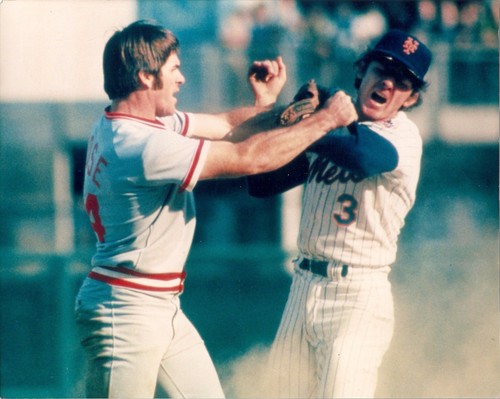
October 8, 1973: Pete Rose vs. Bud Harrelson

October 8, 1973: A year to the day after the Lerrin LaGrow-Bert Campaneris incident, there's another Playoff brawl, this time in the National League Championship Series.

The New York Mets beat the Cincinnati Reds, 9-2 in Game 3 at Shea Stadium, in a game that should have been remembered for Rusty Staub hitting home runs in the 1st and 2nd innings.

Instead, it is remembered for 5-foot-11, 200-pound Pete Rose breaking up a double play by crashing into 5-foot-11, 140-pound Bud Harrelson, and then starting a fight with the much thinner man.

With the fight broken up, Rose returns to his position in left field, where Met fans (understandably angry, but they were hardly justified in their actions) start throwing things at him. Reds manager Sparky Anderson takes his team off the field, fearing for their safety.

The umpires get a message to Loren Matthews, the Shea public address announcer, who announces that if the throwing doesn't stop, the game will be forfeited. Remember, the series is tied 1-1 and the Mets, barring a total (or even, dare I say it, Metlike) collapse, have this game won, and need only 1 more win for the Pennant. Lose it, even by forfeit, and it will be the Reds who are just 1 game from the Pennant.

Desperate, Met manager Yogi Berra takes Tom Seaver and Willie Mays out there, and the 3 of them plead for peace. Listening to the 3 New York baseball legends, the fans stop, and the Mets finish off the win.

The next day, with a banner hanging from Shea's upper deck reading, "A ROSE BY ANY OTHER NAME STILL STINKS" -- I guess they weren't willing to say "Sucks" in public in 1973 -- Rose will make his point by winning the game and tying up the series with an extra-inning home run. But the Mets will win Game 5 and the Pennant.

*

October 8, 1973 was a Monday. The American League Championship Series was on a travel day, with the Oakland Athletics and the Baltimore Orioles tied at 1 game apiece. The A's would beat the O's in 5 games, and then beat the Mets in the World Series.

The NBA season started the next day; the NHL and American Basketball Association seasons, the day after that. The World Hockey Association season had already begun, but it scheduled no games for this date.

And on ABC Monday Night Football, the Washington Redskins beat the Dallas Cowboys, 14-7 at Robert F. Kennedy Memorial Stadium.

If you've watched the superhero film X-Men: Days of Future Passed, you saw the villain Magneto (played as a younger man by Michael Fassbinder) rip RFK Stadium off its foundation in 1973, and move its circular form around the White House to block it off. As he begins this, the field is being lined for a baseball game. This means that, in the Marvel Cinematic Universe, the Washington Senators did not move to become the Texas Rangers after the 1971 season; or D.C. got yet another new team to replace the "New Senators" after the "Old Senators" became the Minnesota Twins after the 1960 season.

Wednesday, September 28, 2022

September 28, 2008: The Last Game at Shea Stadium

September 28, 2008: An emotional day for both New York baseball teams. The New York Yankees, having closed the old Yankee Stadium a week earlier with a 7-3 win over the Baltimore Orioles, and a star-laden pregame ceremony and a postgame lap of honor, but eliminated from postseason eligibility for the 1st time in 15 years in their next game, beat the American League Eastern Division Champion Boston Red Sox 6-2 at Fenway Park.
Xavier Nady hit a home run off Daisuke Matsuzaka, who came into the game 18-2. But the big story was Mike Mussina, who had announced his retirement, and this was his last game. He won his 20th game of the season, the only time he ever did that. It was the 270th win of Moose's career.
It was the opener of a doubleheader. The Red Sox won the nightcap, 4-3, when Jonathan Van Every singled home Alex Cora in the bottom of the 10th inning. Alex Rodriguez got the 2nd game off, and Derek Jeter got both games off.
But at Shea Stadium, the Mets endured "Groundhog Day." Having blown a September Division lead and lost to the Florida Marlins at home on the last day of the season to miss the Playoffs completely last season, it happened again. They lost the last scheduled game at Shea, 6-2 to the Marlins.
Carlos Beltrán hit the last home run by a Met at Shea Stadium. In the 8th inning, Wes Helms and Dan Uggla hit back-to-back jacks, and that left Uggla as having hit the stadium's last home run. (Willie Stargell hit Shea's 1st home run in 1964, Ron Hunt hit its 1st Met home run, Jody Gerut hit the 1st home run at Citi Field, and David Wright hit the 1st Met home run there.)
The Philadelphia Phillies didn't wait until the last day to clinch the National League East this time, although they did beat the Washington Nationals, 8-3 at Citizens Bank Park in Philadelphia. And when the Milwaukee Brewers beat the Chicago Cubs, 3-1 at Miller Park (now American Family Field) in Milwaukee, they clinched the NL Wild Card, eliminating the Mets. There would be no more games at Shea, with Citi Field nearing completion beyond center field.
A postgame ceremony was held, with Mets going back to the first team in 1962, prior to Shea's opening in 1964, coming onto the field, including most of the 1969 and 1986 World Champions. Despite his Yankee connections, 1973 Pennant-winner manager Yogi Berra got a nice hand. So did Dave Kingman, a slugger known for his long home runs, but also for his strikeouts, bad fielding and moodiness. So did Willie Mays, even though he wasn't a Met for very long.
The close had the greatest of all Mets, Tom Seaver, take the mound, and throw a last pitch to Mike Piazza. But it was a bad pitch, bouncing in front of the plate. (Seaver threw a strike to Piazza for the ceremonial first pitch at Citi Field the following April.) Then, to the tune of "In My Life," not one of the songs the Beatles played in their 1965 and 1966 concerts at Shea, Seaver and Piazza walked across the field, gave one last wave to the fans at the center field gate, and walked out. The gate closed behind them, to close the book on the stadium.
Seaver was understandable. But why Piazza? Why not representatives of both World Series teams, who were both already in the Hall of Fame? Why not Seaver and Gary Carter, who was then still alive and well? If they wanted representatives of all the Mets' Pennant-winners, why not Seaver (1969 and 1973), Piazza (2000) and Carter (1986)? If they wanted representatives of all the Mets' Playoff teams, why not Seaver (1969 and 1973), Piazza (1999 and 2000), David Wright (2006) and Carter (1986 and 1988) -- making a "Met Mount Rushmore"? The organization had little control over the game, but they had absolute control over the closing ceremonies. Yet another error on the Mets.

*

September 28, 2008 was a Sunday. In addition to those previously mentioned, these Major League Baseball games were played that day:

* The Toronto Blue Jays beat the Baltimore Orioles, 10-1 at Camden Yards in Baltimore.

* The Tampa Bay Rays beat the Detroit Tigers, 8-7 at Comerica Park in Detroit. Ben Zobrist won it with a home run in the top of the 11th inning.

* The Chicago White Sox beat the Cleveland Indians, 5-1 at U.S. Cellular Field (now Rate Field) in Chicago.

* The Minnesota Twins beat the Kansas City Royals, 6-0 at the Metrodome in Minneapolis. Scott Baker (7 innings) and 2 relievers combined for a 5-hit shutout.

* The St. Louis Cardinals beat the Cincinnati Reds, 11-4 at Busch Stadium in St. Louis.

* The Houston Astros beat the Atlanta Braves, 3-1 at Minute Maid Park (now Daikin Park) in Houston.

* The Arizona Diamondbacks beat the Colorado Rockies, 2-1 at Chase Field in Phoenix.

* The Pittsburgh Pirates beat the San Diego Padres, 6-1 at Petco Park in San Diego.

* The Los Angeles Angels beat the Texas Rangers, 7-0 at Angel Stadium of Anaheim. Joe Saunders (6 innings) and 3 relievers combined for a 3-hit shutout.

* The San Francisco Giants beat their arch-rivals, the Los Angeles Dodgers, 3-1 at AT&T Park (now Oracle Park) in San Francisco.

* And the Seattle Mariners beat the Oakland Athletics, 4-3 at Safeco Field (now T-Mobile Park) in Seattle.

It was also an NFL Sunday. These games were played:

* The New York Jets beat the Arizona Cardinals, 56-35 at Giants Stadium at the Meadowlands.

* The Carolina Panthers beat the Atlanta Falcons, 24-9 at Bank of America Stadium in Charlotte.

* The Jacksonville Jaguars beat the Houston Texans, 30-27 at Jacksonville Municipal Stadium (now EverBank Stadium). Josh Scobee kicked a 37-yard field goal with 11:05 left in overtime.

* The Tampa Bay Buccaneers beat the Green Bay Packers, 30-21 at Raymond James Stadium in Tampa.

* The Tennessee Titans beat the Minnesota Vikings, 30-17 at LP Field (now Nissan Stadium) in Nashville.

* The New Orleans Saints beat the San Francisco 49ers, 31-17 at the Superdome in New Orleans.

* The Washington Redskins beat their arch-rivals, the Dallas Cowboys, 26-24 at Texas Stadium in the Dallas suburb of Irving, Texas.

* The Cleveland Browns beat the Cincinnati Bengals, 20-12 at Paul Brown Stadium (now Paycor Stadium) in Cincinnati.

* The Chicago Bears beat the Philadelphia Eagles, 24-20 at the new Soldier Field.

* The Buffalo Bills beat the St. Louis Rams, 31-14 at the Edward Jones Dome (now The Dome at America's Center) in St. Louis.

* The Kansas City Chiefs beat the Denver Broncos, 33-19 at Arrowhead Stadium in Kansas City.

* The San Diego Chargers beat the Oakland Athletics, 28-18 at the Oakland Coliseum.

* The next night, on Monday Night Football, the Pittsburgh Steelers beat the Baltimore Ravens, 23-20 at Heinz Field (now Acrisure Stadium) in Pittsburgh. Jeff Reed kicked a 46-yard field goal with 8:55 left in overtime.

* And the New York Giants, the Detroit Lions, the Indianapolis Colts, the Miami Dolphins, the New England Patriots and the Seattle Seahawks each had a bye week.

Thursday, August 4, 2022

August 4, 1985: Rizzuto, Seaver & Carew

August 4, 1985: It is a special day in baseball. Three legends of the game receive proper honor. But only one of them was actually scheduled.

The New York Yankees were scheduled to play the Chicago White Sox on a Sunday afternoon at the original Yankee Stadium. It was Phil Rizzuto Day, and Rizzuto, known as "the Scooter," the beloved Yankee shortstop (1941-56) and broadcaster (since 1957, eventually retiring after 1996), was going to have his Number 10 retired, and a Plaque dedicated in his honor for Monument Park.

I was 15 years old, and, with my parents' permission (they, along with my grandmother, would be going with me), I called Ticketmaster the preceding Tuesday, and ordered the tickets, neither knowing nor caring who would be the day's opposing starting pitchers.

The next day, Wednesday, the starters for the Sunday game were announced: Joe Cowley for the Yankees, and Tom Seaver for the White Sox.

At that point, Cowley had 19 career wins, a total that would eventually rise to 33. Seaver had 299 career wins, a total that would eventually rise to 311.

In other words, the man that New York Met fans (for whom he won 199 of his 311) called "Tom Terrific" and "The Franchise" would be going for his 300th win, and I would be there.

Interestingly, while Seaver had made the uniform Number 41 iconic in baseball, Cowley was also wearing it for the Yankees at the time.

The ceremony for Rizzuto was great. Several of his Yankee teammates showed up, including Mickey Mantle and Whitey Ford. This was the first time I'd ever seen either of them in person.

Ex-teammate Yogi Berra was not there, having recently been fired as manager by team executive Clyde King on behalf of team owner George Steinbrenner, and having begun was turned out to be a 14-year boycott of the Yankee organization.

Ex-teammate Joe DiMaggio wasn't there, either. I don't know why. Considering the kind of praise he frequently had for Rizzuto, the only reason I can think of is his egotistical insistence on always being the last man introduced, which wouldn't have happened on another figure's Day.
In reference to two of the Scooter's favorite expressions, one of his gifts was a cow with a papier-mache halo, a "Holy Cow," named "Huckleberry."

That cow, paying no heed to the halo or to Rizzuto being just 5-foot-5 and 150 pounds, or 67 years old for that matter, stepped on his foot, causing him to fall backwards. There was a lot of gasping in The House That Ruth Built. Fortunately, Rizzuto was all right.

And he gave a speech in which he said, "This means more to me than the Hall of Fame ever could." This elicited a big cheer from the Bronx faithful, since he had not yet been elected to the Hall.

But it was a lie, and he knew it. In 1994, 9 years later, he found out just how big a lie it was, as he was finally, rightfully elected, and Yankee Fans everywhere rejoiced that he'd gotten his due while he was still alive.

It was a gorgeous Summer Sunday afternoon: Not too hot, no discernable wind. The field at the old Yankee Stadium was immaculate. Cliché Alert: It was a beautiful day for baseball.

From our box seats in Section 35 in right field -- right around the spot where Roger Maris' 61st home run of 1961 landed (although it was Section 33 in the pre-renovation configuration), we had a decent view. And we were surrounded by other Yankee Fans. This would turn out to be very helpful.

In the bottom of the 3rd inning, with the game scoreless, Mike Pagliarulo led off with a single to right. Bobby Meacham flew to center. Rickey Henderson grounded to 2nd, but Bryan Little couldn't make the double play, and threw Henderson out at 1st, allowing Pags to advance to 2nd. Ken Griffey Sr., not nearly as good as his son. but still a very good player at this stage of his career, singled to right, scoring Pags. Yankees 1, White Sox 0.

The Yankees still led 1-0 after 5 innings. But the White Sox struck back in the top of the 6th. Cliché Alert: Walks can kill you, especially the leadoff variety. Yankee starter Joe Cowley issued a leadoff walk to, somewhat appropriately, Greg Walker. Longtime Yankee nemesis Carlton Fisk grounded into a force play, getting to 1st as Walker was eliminated by Willie Randolph. But Oscar Gamble singled Fisk over to 3rd.

Billy Martin, in his 4th term as Yankee manager, dismissed Cowley, and brought in Brian Fisher. The Pale Hose hadn't yet scored. Now, they would. Tim Hulett tied the game with a double, bringing home Fisk. Ozzie Guillén, who would later manage the White Sox to a World Series win, gave the South Siders the lead by singling home Gamble. Luis Salazar grounded to short, enabling Andre Robertson to eliminate Guillén, but that left 1st and 3rd with 2 outs. Vance Law drew a walk to load the bases. Little singled home Hulett and Salazar. Harold Baines singled to left, but Dan Pasqua threw Law out at the plate.

As the Scooter would have said, "But the damage is done. I tell ya, Bill White, this is unbelievable." In the space of less than 10 minutes, the Yankees had gone from 1-0 up to 4-1 down, and were very nearly 5-1 down.

Seaver set the Yankees down in order in both the 6th and the 7th. In the 8th, he began to tire, allowing singles to Bobby Meacham and Don Mattingly, but worked out of it. Tony La Russa, noted bullpen tinkerer, was the White Sox manager at the time, but he trusted the veteran from Fresno, California to finish the job he began, and to still be on the mound to accept congratulations on Number 300 after the final out.

If Seaver's milestone had been the whole story, that would be enough of a memory. But it wasn't.

For the out-of-town scoreboard told another story -- and led to another, very shocking story. New York was playing Chicago in the National League as well, the Mets vs. the Chicago Cubs at Wrigley Field. By a wacky turn of events, this one also ended 4-1, in favor of the Mets, who were closer to 1st place at that point in the season than at any time since 1969. (When they won the Pennant in 1973, they were in last place on August 4, before going on a tear.)

And Dwight Gooden, the most heralded Met pitcher since Seaver (the most heralded, and probably even more hyped), went the distance. For some reason, I remembered him striking out 16 Cubs that day. He struck out "only" 6. He did have a 16-strikeout game that season, on August 20, a 3-0 home win over the San Francisco Giants.

The crowd at Yankee Stadium that day sure looked like it was about evenly split between Yankee Fans hoping for a win, and Met fans hoping to see Seaver win his 300th.

This was 1985. It was the peak year of soccer hooliganism in England, including the Millwall-Luton riot in an FA Cup Quarterfinal on March 13, and the Heysel Stadium disaster at the European Cup Final between Liverpool and Italy's Juventus in Brussels, Belgium on May 29, which resulted in English clubs being banned from European play for 5 seasons. (In each case, click on the 1st link for details, and the 2nd link for video.)

When the Mets-Cubs score went up on the out-of-town scoreboard, a "Let's Go Mets" chant went up from the visiting Met fans. After about 10 seconds of shock from the home fans, this blasphemous utterance was followed by a "Mets suck" chant. This was followed by a fight, and I couldn't tell which side started it: The Yankee Fans (indicating an overreaction) or the Met fans (indicating that their blue and orange skins were very thin). Whoever started the fight, it started small, then got bigger. Much bigger.

I've seen Yankees-Red Sox at the old Stadium, the new Stadium, and at Fenway Park. I've been to hockey games at Madison Square Garden, the old Boston Garden and the new Philadelphia arena. But I've never seen as much fighting at a sporting event as I saw that day. There were hundreds of people throwing punches. Most of it, including easily the worst of it (but not all of it), was in the Bleachers, and the proto-Bleacher Creatures were taking no shit from the infiltrating 7 Line Army.

There must have been about 50 people ejected by the Burns security officers. At the time, an English "football" crowd would have called that "just another matchday." An American baseball fan would call it "disgraceful." The game went on, and I have no idea if any of the players involved knew about the fighting.

The Yankees did threaten in the bottom of the 9th. Pasqua led off with a single. Seaver reared back, and, in that familiar overhand throw with his right knee brushing the mound, struck Ron Hassey out. He got Randolph to fly to right. But he walked Pagliarulo.

That brought the tying run to the plate, but it was the pathetic Meacham, then batting an inept .232. Billy knew that he needed baserunners. Surely, he was remembering the play 2 nights earlier, when Meacham got caught between 2nd and 3rd, not knowing if a Henderson fly ball would drop for a hit, which it did, and then stumbling, resulting in himself and Yogi's son Dale Berra both running through 3rd base coach Gene Michael's stop sign, and both being tagged out at the plate by Fisk. So Billy went for broke, sending up Don Baylor to pinch-hit.

Baylor was 36, and wasn't hitting much better, .239, but his OPS was .796, .188 higher than Meacham's. And he did end up with 24 doubles, 23 home runs and 91 RBIs that season. So, on paper, it was a good move. (Cliché Alert: The game isn't played on paper, it's played on grass. Had the game gone to extra innings, Billy probably would have sent Andre Robertson out to play shortstop.)

Seaver was 40, had gone the distance, was in his 2nd straight struggling inning, and had to be gassed at this point. But he reared back, reached into his bag of tricks -- one of the greatest arrays of "stuff" any pitcher has ever had -- fired, and his pitch reached the inside corner, a perfect strike.

But Baylor swung, and connected. In almost any other ballpark -- even the White Sox' home of Comiskey Park, a notoriously poor one for hitters as opposed to its windy, ivy-walled North Side NL counterpart -- this might have been a game-tying home run. But in the old Yankee Stadium, with its left-center "Death Valley," it was just a long fly. Reid Nichols, who had replaced Law in left field for Chicago, caught it. Ballgame over. White Sox win.

All 54,032 in attendance rose as one to applaud Seaver off the field, just as La Russa had intended. Yes, at age 40, he pitched a complete game. Tom Terrific had allowed just 1 run, 6 hits, and just 1 walk. He had notched 7 strikeouts, 1 more than Gooden did that day, and the much-hyped "Doctor K" was, literally, half his age. Truly, we had seen a master of his craft at work.

From Section 35, the last section of box seats in right field, I had a great view of the Bleachers (and the fighting), and, although in the outfield, I had a good view of Seaver and the strike zone. Though I hate to lose and I hate the Mets, all I could do was stand and tip my cap to Seaver. It was the only time I ever saw him pitch live.

As my man Reggie Jackson, who struggled against him in All-Star Games and late in their careers when both were in the AL, but hit an RBI double off him in Game 6 of the 1973 World Series, once said of Tom Seaver, "Blind people come to the park, just to listen to him pitch."

The entire broadcast of the game is available on YouTube, if you're so inclined. Here's the last out.

Speaking of Reggie Jackson, he was present for another big milestone on the same day. He was with the California Angels (now named the Los Angeles Angels of Anaheim), as was another future Hall-of-Famer, Rod Carew. They were playing Carew's former team, the Minnesota Twins, at Anaheim Stadium (now named Angel Stadium of Anaheim).

In the bottom of the 3rd, Carew batted against Frank Viola, and singled. It was his 3,000th career hit. It was his only hit of the day, going 1-for-5.

He was batting just .264 at the time, and retired at the end of the season. It was a far cry from his multiple batting titles in the 1970s, including a run at .400 in 1977, when he ended up at .388, with 14 homers, tying a career high, his only 100-RBI season, a Gold Glove, and the AL Most Valuable Player award, despite the Twins finishing nowhere near the Playoffs.
Carew was a legend, not fully appreciated by Calvin Griffith, the racist cheapskate who inherited the original Washington Senators from his uncle Clark, moved them to Minnesota, and then pissed off fans and players alike. Like Reggie, Rod was welcomed with open arms by "Singing Cowboy" turned media mogul and Angels owner Gene Autry.

When the news of Carew's 3,000th hit went up on the scoreboard at Yankee Stadium, everybody cheered: Yankee Fans, Met fans, and the few White Sox fans in attendance, even though Carew never played for any of them.

Managed by Gene Mauch, The Angels won, 6-5, despite Kirby Puckett's 3 RBIs for Minnesota. Reggie pinch-hit for Dick Schofield in the 8th, and grounded to 1st, resulting in a force play. He was stranded on 1st. Attendance: 41,630 -- far from a sellout, as this was the era (1980 to 1996) when The Big A had a capacity of 65,000, enabling the Los Angeles Rams to play home games there -- but, considering that Carew was on 2,999 hits, and any at-bat could be Number 3,000, a decent crowd.

There was no distraction up Interstate 5: Tommy Lasorda's Los Angeles Dodgers were in Cincinnati, where they lost to Pete Rose's Reds 5-4. Rose, MLB's last player-manager, did not put himself into the game. He had 4,168 hits in his career. At the time, the record was considered to be 4,191, by Ty Cobb. On September 11, 1985, Rose collected his 4,192nd hit. With a duplicate game found in Cobb's record, his total was officially reduced to 4,189, meaning Rose actually broke the record on September 8.

*

August 4, 1985 was a Sunday. These other Major League Baseball games were played that day.

* The Texas Rangers beat the Toronto Blue Jays, 8-4 at Exhibition Stadium in Toronto. The Yankees had a chance to pick up a game on the 1st-place Jays, but didn't do it.

* The Atlanta Braves beat the San Francisco Giants, 5-4 in 10 innings at Atlanta-Fulton County Stadium.

* The Pittsburgh Pirates beat the Montreal Expos, 4-3 at Three Rivers Stadium in Pittsburgh.

* The Baltimore Orioles beat the Cleveland Indians, 5-4 at Cleveland Municipal Stadium. Eddie Murray went 2-for-3 with walks and an RBI. Cal Ripken went 1-for-5 with an RBI.

* A doubleheader was split at Tiger Stadium. The Detroit Tigers won the 1st game, 7-4. The Milwaukee Brewers won the 2nd game, 14-4. Over the 2 games, Robin Yount went 2-for-8 with 2 walks and 2 RBIs, and Paul Molitor went 2-for-9 with a walk and an RBI.

* The Philadelphia Phillies beat the St. Louis Cardinals, 6-0 at Busch Memorial Stadium in St. Louis. Mike Schimdt went 0-for-3 with a walk. Kevin Gross pitched a 4-hit shutout.

* The Boston Red Sox beat the Kansas City Royals, 6-5 in 5 innings at Royals (now Kauffman) Stadium. Wade Boggs went 4-for-6, and Bill Buckner went 3-for-6 with 3 RBIs.

* The Houston Astros beat the San Diego Padres, 2-1 at the Astrodome. Tony Gwynn went 1-for-4.

* And the Oakland Athletics beat the Seattle Mariners, 5-3 at the Oakland Coliseum.

Also on this day, soccer players Robbie Findley and Antonio Valencia, and singer Crystal Bowersox, were born.

*

The Yankees finished the 1985 season 97-64, 2 games behind the Blue Jays in the American League Eastern Division. The Mets finished it 98-64, 3 games behind the St. Louis Cardinals in the National League East.

The Chicago teams? The Cubs, defending NL East Champions, had been slammed by the injury bug, and went from 96 wins to 77, a 19-game drop -- or from 6 1/2 games ahead of the 2nd-place Mets in '84 to 23 1/2 games behind the Cards, their arch-rivals, in '85, by that measure a whopping 30-game slide. The White Sox finished 6 games behind the Royals in the AL West.

There was no Central Division in either League in those days, meaning you had to finish ahead of 6 teams (in the AL) or 5 teams (in the NL) to make the Playoffs, instead of the 3, 4 or 5 you have to top now; and no Wild Card, meaning that, despite 97 wins -- 5 more than they won in their 1996 title season and 10 more than in their 2000 title season -- the Yankees were out of luck. So were the Mets,

If the current setup were in place then, the Yankees would have won the AL Wild Card; while the Cards would have won the NL Central, enabling the Mets to win the NL East.

In the Playoffs, the Royals came from 3 games to 1 down to beat the Jays, the Cards beat the NL West Champion Dodgers, and the Royals came back from 3 games to 2 down to beat the Cards and win an all-Missouri World Series, thanks to a controversial umpiring decision in Game 6 and a Cardinal mental meltdown in Game 7.

1985. A strange year. And nobody was bowling for soup.

Note to fans of that band: George Michael was still in Wham! and hadn't gone into his "Faith" phase yet. And when wasn't Ozzy Osbourne an actor?)

*

One final note. On September 19, 1986, a little more than a year later, the White Sox beat the Angels 7-1 in Anaheim. The ChiSox' pitcher that day pitched a no-hitter, despite walking 7 batters, and allowing a run in the 6th inning, on 3 straight walks and a sacrifice fly by Reggie. The Sox pitcher? None other than Joe Cowley, the man Tom Seaver outpitched to win Number 300.

In the preceding winter, the Yankees had traded Cowley and Hassey to the White Sox for 2 guys who never reached the majors, and Britt Burns, a solid lefty who was supposed to be the 2nd left in the rotation (along with Ron Guidry) that the Yankees so desperately needed, but had a degenerative condition in his hip, and never pitched in the majors again. That was the kind of trade that George Steinbrenner and "my baseball people" made in the 1980s.

And in a fascinating irony, that same day, although no one knew it for sure at the time, Seaver made his last major league appearance. (Appropriately, his age was 41.) The previous June, the White Sox had traded him to the Boston Red Sox, even-up, for outfielder Steve Lyons. That's right: The man today's kids know as baseball pundit "Psycho."

In his last game, Seaver started for the Red Sox against the Blue Jays at Exhibition Stadium. He only went 4 innings, and lost to the Jays, 6-4. Dave Stieb was the winning pitcher. The last batter he ever faced? Tony Fernandez, who flew out to right.

The first batter he ever faced? It was on April 13, 1967, at Shea Stadium, against the Pittsburgh Pirates, and his 1st batter was the dangerous defending NL batting champion, Matty Alou, who doubled to right. But the 22-year-old Seaver stranded him, and the Mets won, 3-2 on an 8th inning single by Chuck Hiller. The opposing pitcher was 1960 Cy Young Award winner Vernon Law.

Attendance: 5,005. It was the 3rd game of the 1967 season, the Mets were still horrible, and while Seaver had been highly-touted, many a highly-touted rookie has failed to pan out. At the time, who knew? Seaver did, however, pan out, and then some.

Moving back to 1986: The Red Sox did not include him on their roster for either the American League Championship Series or the World Series, so the September 19 loss in Toronto was his last major league appearance. But with his Boston teammates, he was introduced at Shea Stadium before Game 1 of the World Series, and appropriately got a thunderous ovation.

And you know what? After September 19, 1986, Cowley, like Seaver, never won another game. He was traded by the White Sox to the Philadelphia Phillies during spring training in 1987, went 0-4 in 5 starts, got send down in early May, went 3-9 in Triple-A, got released, and before turning 29 had thrown his last professional pitch.

Cowley is forgotten today. Seaver is remembered. So is Carew. And so is Rizzuto, who even had Seaver as a WPIX-Channel 11 broadcast partner in his last few years on the air.
Holy Cow.

"Rizzuto, Seaver and Carew." Sounds like a re-write of Terry Cashman's "Talkin' Baseball (Willie, Mickey and the Duke)."

Tuesday, July 19, 2022

July 19, 1977: An All-Star Game for a Troubled New York

July 19, 1977: The Major League Baseball All-Star Game is held at Yankee Stadium, the only one held in New York City between 1964 and 2008.

Three days earlier, the New York Mets had held Old-Timers' Day at Shea Stadium, and they honored the 4 great living center fielders of New York baseball: Joe DiMaggio and Mickey Mantle of the Yankees, Willie Mays of the Giants (who, due to his last 2 seasons, was wearing a Mets uniform), and Edwin "Duke" Snider of the Dodgers.

DiMaggio had been elected to the Baseball Hall of Fame in 1955; Mantle, in 1974; and Mays would become eligible in 1979, and everyone presumed that he would be elected that year, and he was. Snider was eligible, but not yet in. In 1980, he was finally elected, leading songwriter Terry Cashman to write and record "Talkin' Baseball (Willie, Mickey and the Duke)."
Left to right: Snider, DiMaggio, Mays, Mantle

Holding the All-Star Game in New York seemed problematic. True, the Yankees had won the American League Pennant the year before, and were contenders again. And the Stadium had just been renovated, making it capable of hosting a major event again.

But the City was in trouble. Crime seemed to be out of control. The serial killer known as the Son of Sam was on the loose. Just 6 days earlier, there had been a City-wide blackout that led to terrible looting and multiple fires. There was already a lot of burned-out, and otherwise substandard, housing and commercial property in The Bronx, the Yankees' home Borough; Harlem, former home of the Giants; and Brooklyn, former home of the Dodgers. And there seemed little that the City government could do about it, because it was still recovering from its near-bankruptcy of 2 years earlier. The incumbent Mayor, Abe Beame, wasn't even going to make the runoff for the Primary in his own Democratic Party.

But, for this night, as it so often does, sport, especially baseball, provided a distraction from it all.

DiMaggio was named Honorary Captain for the AL, and Mays was so named for the National League. (Mantle had been so honored at the 1975 All-Star Game, along with Stan Musial.) Rachel Robinson threw out the ceremonial first ball, as a nod to the 30th Anniversary of her husband, Jackie Robinson, re-integrating the sport. (Jackie had died in 1972.)

Yankees selected to play at home were Reggie Jackson, Thurman Munson, Sparky Lyle, Graig Nettles, Willie Randolph, and, as manager of the defending Pennant winners, Billy Martin. The only current Met selected was John Stearns. Former Mets Tom Seaver, Nolan Ryan and Ken Singleton were also selected. (Seaver and Singleton both became broadcasters for the Yankees.)

The game featured a lot of players who would later play in New York: For the Yankees: Rich "Goose" Gossage, Dave Winfield, Ruppert Jones, Rick Reuschel, Dave LaRoche, Butch Wynegar, Jason Thompson, Bert Campaneris and Ken Griffey Sr. For the Mets: Willie Montanez, Jerry Morales and Ellis Valentine. For both: Frank Tanana and John Candelaria.

This was also an expansion year, with the American League adding 2 teams. The 1st All-Star for the Seattle Mariners was center fielder Ruppert Jones. The 1st All-Star for the Toronto Blue Jays was 1st baseman Ron Fairly, a former Los Angeles Dodgers star, who had been an All-Star for the Montreal Expos. He was the only player to be an All-Star for both Canadian-based teams before the Expos moved to Washington after the 2004 season.

Jim Palmer of the Baltimore Orioles started for the AL. Usually, he pitched well against the Yankees. This time, pitching in Yankee Stadium did him no favors. He gave up a leadoff home run to Joe Morgan of the Cincinnati Reds. He struck out Steve Garvey of the Los Angeles Dodgers. Then he gave up a single to Dave Parker of the Pittsburgh Pirates. Then he gave up an RBI double to George Foster of the Reds, who ended up leading the NL with 52 home runs and winning the NL's MVP. Then Palmer gave up a home run to Greg Luzinski of the Philadelphia Phillies.

It was 4-0 NL, the AL's starting pitcher had gotten 1 out, and the game was essentially already over. Or, as Warner Wolf, then the sports anchor for Eyewitness News on New York's WABC-Channel 7, would have said, "Turn your sets off right there!"

In contrast, the NL's starter, Don Sutton of the Los Angeles Dodgers, pitched 3 strong innings, allowing no runs, 1 hit and 1 walk. This was a foreshadowing of that season's World Series -- and the next season's -- when the Yankees faced the Dodgers. So was Garvey hitting a home run in the 3rd, to make it 5-0.

Seaver got a standing ovation when he came out to pitch the bottom of the 6th, wearing his gray Reds road uniform. But he didn't pitch well, allowing a leadoff single to Rod Crew of the Minnesota Twins, who flirted with a .400 average for much of the season, ending at .388, and winning the AL MVP; a walk to Fred Lynn of the Boston Red Sox; and a double by Richie Zisk of the Chicago White Sox, making the score 5-2.

Rarely getting the chance to face Yankees, in the 7th, Seaver faced Nettles, who reached on an error, allowing Butch Wynegar of the Twins to get into scoring position; and then Randolph singled Wynegar home, to make it 5-3.

The NL got 2 more runs in the 8th, while in the bottom of the 9th, George Scott of the Red Sox homered off Rich "Goose" Gossage of the Pirates to get the AL within 7-5. But Gossage, apparently auditioning for the Yankees, impressed team owner George Steinbrenner by getting Randolph to short and striking Munson out to end the game.

The National League won, 7-5. This is the only game in the YES Network series Yankees Classics in which current Yankees are shown to lose.

*

July 19, 1977 was a Tuesday. Since no other major league sport was then in season, this was the only score on this historic day. 

Saturday, July 9, 2022

July 9, 1969: Tom Seaver's Imperfect Game

July 9, 1969: The New York Mets host the Chicago Cubs at Shea Stadium. The Mets had ranged from absolutely dreadful to merely mediocre over their 1st 7 seasons. But here, in their 8th season, and the 1st season of Divisional Play in Major League Baseball, came into the game just 4 1/2 games behind the Cubs in the National League Eastern Division. The day before, the Mets had beat the Cubs, 4-3.

The starting pitchers were Tom Seaver for New York, 13-3; and Ken Holtzman for Chicago, 10-4. Seaver, 24 years old, the 1967 NL Rookie of the Year and just named an All-Star for the 3rd time in as many seasons, breezed through the top of the 1st inning. Tommie Agee greeted Holtzman with a leadoff triple, and Bobby Pfeil doubled him home.

Holtzman got the 1st out in the bottom of the 2nd, but errors by 3rd baseman Ron Santo and shortstop Don Kessinger created RBI situations. Seaver, who had struck out the side in the top of the 2nd, helped his own cause by singling home Jerry Grote. And Agee doubled home Al Weis. It was 3-0 Mets. Cleon Jones hit a home run in the 7th, to make it 4-0.

That would be the final score, as Seaver kept sending the Cubs down. While he didn't have an overwhelming fastball, he had an array of pitches that all seemed to find the strike zone. As he got closer and closer to the achievement of not just a no-hitter, but a perfect game, the crowd of 50,709 got wilder and wilder.

In the 8th, Seaver got Santo to fly out, and struck out Ernie Banks and Al Spangler. They were his 10th and 11th strikeouts of the game.

The 9th inning began, and Shea Stadium hadn't been so loud since The Beatles played there. Three outs to go. Randy Hundley grounded back to Seaver. Two outs to go.

The batter was Jim Qualls. A 22-year-old rookie center fielder from Exeter, California -- 54 miles southeast of Seaver's hometown of Fresno -- was considerably less likely to break up the gem than were future Hall-of-Famers Banks, Santo and Billy Williams. But that's what he did, sending a looping single into short left-center field for a clean base hit.

Willie Smith was sent up to pinch-hit for pitcher Ted Abernathy, and Seaver induced a popup to 1st base. He then got Kessinger to fly to left to end it. Seaver had come very close to a perfect game, but had to settle for a 1-hit shutout.

This was the game that cemented Seaver as "The Franchise" to Met fans, and the game that served notice that the Mets' good start was not a fluke. They were not going to go away. A "Miracle" was in progress.

If there was a fluke, it was Qualls. It was the 12th hit of his major league career. There would be only 19 more.

*

July 9, 1969 was a Wednesday. These other games were played in Major League Baseball that day:

* The New York Yankees lost to the Baltimore Orioles, 6-5 at Memorial Stadium in Baltimore. Stan Bahnsen started for the Yanks, Dave McNally for the O's. In the bottom of the 10th inning, Boog Powell singled off Ken Johnson, and Brooks Robinson singled him home. Earlier, Powell and Frank Robinson had hit home runs. Jerry Kenney, Ron Woods, Gene Michael (yes, the Stick) and Bobby Cox (yes, the future Braves manager) each got 2 hits for the Yankees, to no avail.

* The Detroit Tigers beat the Boston Red Sox, 6-5 at Fenway Park in Boston. Carl Yastrzemski hit a home run for the Red Sox. Al Kaline did not play for the Tigers.

* A doubleheader was split at at Connie Mack Stadium in Philadelphia. The Philadelphia Phillies won the opener, 7-1. The St. Louis Cardinals won the nightcap, 5-3. Over the 2 games, Lou Brock went 4-for-9 with 2 RBIs, and Joe Torre went 4-for-8 with an RBI. Each of them homered in the nightcap.

* The Washington Senators beat the Cleveland Indians, 3-0 at Robert F. Kennedy Memorial Stadium in Washington. Joe Coleman Jr. pitched a 4-hit shutout. His father, Joe Coleman Sr., was also a major league pitcher, going 52-76 from 1942 to 1955, including as an original Baltimore Oriole in 1954. Joe Jr. went 142-135 from 1965 to 1979, helped the Detroit Tigers win the 1972 American League Eastern Division title, and was a World Champion in his last season, with the Pittsburgh Pirates. His son, Casey Coleman, was also a major league pitcher, going 8-13 from 2010 to 2014, including with the 2014 AL Champion Kansas City Royals.

* The Pittsburgh Pirates swept a doubleheader from the Montreal Expos at Forbes Field in Pittsburgh, 4-3 and 3-2. Jose Martinez won the 1st game with an RBI single in the bottom of the 10th inning. Roberto Clemente went 1-for-6 with a walk. Willie Stargell went 4-for-5 with 2 RBIs.

* The Chicago White Sox beat the Oakland Athletics, 5-3 at Comiskey Park in Chicago. Reggie Jackson went 1-for-4 with a walk and an RBI.

* The Kansas City Royals beat the Minnesota Twins, 4-3 at Metropolitan Stadium in the Minneapolis suburb of Bloomington, Minnesota. Harmon Killebrew hit a home run, and Rod Carew went 1-for-4, but it wasn't enough.

* The Cincinnati Reds beat the San Diego Padres, 4-3 at San Diego Stadium (later renamed Jack Murphy Stadium and Qualcomm Stadium). Pete Rose went 2-for-5, and Johnny Bench went 1-for-4.

* The Los Angeles Dodgers beat the Atlanta Braves, 3-1 at Dodger Stadium in Los Angeles. Hank Aaron went 2-for-4, including a single that drove in the Braves' only run.

* And the San Francisco Giants beat the Houston Astros, 10-3 at Candlestick Park in San Francisco. Willie Mays went 2-for-4 with 2 RBIs.

* And a doubleheader was split at Sick's Stadium in Seattle. The Seattle Pilots -- a poorly-run franchise that went bankrupt, and were moved to become the Milwaukee Brewers during the following year's Spring Training, and were memorialized in Jim Bouton's 1970 book Ball Four -- won the 1st game, beating the California Angels, 8-0. Fred Talbot pitched a 3-hit shutout, and hit a grand slam home run. As Pilot manager Joe Schultz might have said, he zitzed 'em. As former Pilot pitcher Gary Bell might have said, he smoked 'em inside.

The Pilots had a promotion titled "Home Run for the Money": If a radio listener had his name drawn, he was assigned a certain hitter. If that hitter hit a home run in a certain inning, the listener won the jackpot. If the hitter in question hit a grand slam, there was a $25,000 bonus. Talbot's grand slam won $27,500 -- about $220,000 in 2022 money -- for Donald Dubois of Gladstone, Oregon.

Bouton and the other Pilot relievers decided to play a practical joke on Talbot. Talbot received a telegram, allegedly from Dubois, thanking him for helping him win the money, and saying that a check for $5,000 was in the mail. Since Talbot was making only $17,000 for the entire season, this was a big deal. It took 3 days without Talbot getting a check before Bouton slipped up and revealed to Talbot that he was behind the joke.

The Angels won the 2nd game, 5-0. George Brunet, soon to be traded to the Pilots (and, Bouton discovered, a man who never wore underwear), pitched a 5-hit shutout. John Gelnar was the losing pitcher. Bouton pitched 2 innings of relief, allowing 2 hits, but no runs and no walks, and struck out 3.

Wednesday, June 15, 2022

June 15, 1977: The Tom Seaver Trade

The face is Tom's. The ballpark is Shea.
But the uniform never looked right on him.

June 15, 1977: The New York Yankees trade Mike Fischlin, Randy Niemann and a player to be named later (who, after the season, turns out to be Dave Bergman) to the Houston Astros for Cliff Johnson.

This is easily the best trade made by a New York baseball team on the day, as Johnson becomes Thurman Munson's backup catcher and a key righthanded bat off the bench for the Yankee teams that win the 1977 and '78 World Series. But it is not the trade that anyone ends up talking about that week.

In June 1977, the New York Mets were, for the moment, still the most popular team in New York City, riding their rather incomplete successes of the 1969 World Series win and the 1973 National League Pennant (but losing the World Series). They remained the most popular team despite not really following up, and despite the Yankees having won the 1976 American League Pennant.

M. Donald Grant was a friend of Joan Payson, the founding owner of the Mets. She hired him to be the team's 1st chairman of the board. After the 1969 season, the Mets owned New York, even more than the Jets did. After the 1973 season, when they'd won another Pennant, they were so far ahead of the Yankees it wasn't funny -- though you can be sure Met fans were cackling with glee.

The Mets, or rather Grant, frittered away so much of that goodwill, to the point where a few Met fans -- not many, but a few, including a Brooklyn-born-and-raised college student and aspiring filmmaker, Shelton "Spike" Lee -- switched to the Yankees after they returned to the top, a rise coinciding with the Mets' collapse.

In 1970, shortly after the World Series win, Johnny Murphy, the former Yankee reliever who was the Mets' general manager, died. Their player development director expected to be promoted into the job, but Grant wouldn't do it, because he knew the guy wouldn't let him tell him what to do.

When manager Gil Hodges died in 1972, Grant passed the guy over for that job as well, giving it to coach Yogi Berra -- who, to be fair, had won a Pennant as manager of the Yankees in 1964, and would do so for the Mets in 1973.

The passed-over guy had enough: He went to the Kansas City Royals, and built a winner there, before crossing Missouri and doing the same thing with the St. Louis Cardinals, causing problems first for the Yankees in the 1970s and then for the Mets in the 1980s. He was Dorrel Norman Elvert "Whitey" Herzog.

Grant hired Bob Scheffing to be the GM, and he did as he was told -- including trading away Nolan Ryan in 1971, allowing Ryan to become one of the best pitchers of his generation. On Grant's orders, Scheffing traded away Tommie Agee after the 1972 season, and Tug McGraw after 1974. In 1975, Grant fired Scheffing, and replaced him with Joe McDonald, who traded away Cleon Jones and Rusty Staub after that season.

Then Mrs. Payson died. Her daughter, Lorinda de Roulet, inherited the team, and she knew that she knew nothing about baseball, so she trusted Grant even more than her mother did. After the 1976 season, in which the Mets finished 15 games out of 1st place, but were nonetheless 86-76 for a very respectable 3rd, Grant/McDonald traded away Jerry Grote. Hardly anybody from the '73, let alone '69, Pennant winners was left.

But there was still Tom Seaver, the greatest player the Met franchise had ever known. (And he still is). Along with Steve Carlton of the Philadelphia Phillies and Don Sutton of the Los Angeles Dodgers, he was still 1 of the 3 best pitchers in the NL; along with Ryan of the California Angels, Jim Palmer of the Baltimore Orioles,and Jim "Catfish" Hunter of the Yankees, 1 of the top 6 in the majors. But he was also expensive: Going into the 1977 season, he was in the middle of a 3-year contract worth $675,000, or $225,000 a year.

Like most MLB team owners were cheap back then, M. Donald Grant -- he really hated it when people referred to him that way -- was cheap. Not because the Mets weren't making money. And even if they weren't, it wasn't his money: Mrs. de Roulet was a de Roulet by marriage, and both a Payson and a Whitney by blood. She was richer than George Steinbrenner. She could afford to spend whatever she wanted.

But she trusted Grant, and he thought baseball players were beneath him. He had what Marvin Miller, director of the players' union, called "a plantation mentality." When Seaver, who lived in Stamford, Connecticut during the season (and his native Fresno, California in the off-season), joined the nearby Greenwich Country Club, Grant was furious: "Who do you think you are, joining the Greenwich Country Club?"

M. Donald Grant wasn't so much dumb as he was out of touch. How out of touch was he? I once saw a Met-themed blog whose author wrote that Grant tried to explain what he was doing with Seaver in terms of "bluffing and playing tricks in a hand of bridge." How many average baseball fans know how to play the card game bridge, a.k.a. contract bridge? I consider myself a fairly smart person. I can play poker and gin rummy. I've never even seen bridge being played. It's usually considered a rich person's game. Well, M. Donald Grant was a rich person.

Seaver thought that, even at $225,000 a year, he was underpaid. He knew that, across town, Catfish was making $640,000; as the 1st free agent of the modern era, his salary was well-publicized. Also well-publicized was the $230,000 that the Cleveland Indians were paying free agent pitcher Wayne Garland, whose career would be cut short by that season's injury.

Seaver may not have known that Steve Carlton of the Philadelphia Phillies was making less than he was, $160,000. Or that Jim Palmer of the Baltimore Orioles was making more than he was: $250,000. Or that Don Sutton of the Los Angeles Dodgers was also making $250,000. (Dodger owner Walter O'Malley often reluctantly paid stars big, but average players very little.)

Noting 2 other pitchers whose names will shortly come up: He may not have known that Luis Tiant of the Boston Red Sox was making $185,000, or that Nolan Ryan's California Angels teammate Frank Tanana was making $225,000.

But he did know that his teammate, Jerry Koosman, who had, in 1976, become the 2nd Met, after Seaver, to win 20 games in a season was making $150,000. And he knew that Ryan was making $200,000. And how did he know this? Because their wives, Nancy Seaver and Ruth Ryan, remained close friends after Nolan was traded. Women talk.

Seaver thought he was underpaid. Given that he was the Mets' biggest drawing card, he was right: In the 8 home games that he started, the Mets got an average per-game attendance of 23,257; the 17 home games he didn't start, they averaged 11,913, about half as much.

Seaver wanted to remain a Met for the rest of his career, but wanted more money and over a longer period of time, guaranteed. He decided to go over Grant's head, and asked Mrs. de Roulet for a contract extension. She agreed to it. No problem, right?

Wrong: Grant acted as though he was the true owner of the Mets, and took this as a grave personal insult. (Well, maybe it was, but he deserved it.) Apparently, he was okay for him to call a wartime U.S. Marine veteran who was the greatest player his team had ever had "a Communist," but it wasn't okay for said player to go over his head to his boss. (He probably also didn't like that his boss was a woman. After all, unlike Mrs. Payson, Mrs. de Roulet was not an old friend. He probably thought of her as "the kid.")

Grant went to Dick Young, longtime baseball columnist for the Daily News. Once a liberal crusader who stood up for Jackie Robinson, Young was now 59 years old. Years of hard drinking had lined his face and turned his hair stark white. He had become embittered and conservative, as he saw what he called "my America" fading away. He was tight with Grant, who asked him to write a column smearing Seaver. Young didn't need much convincing. He probably traded it for a drink. He was probably happy to do it.

In the column, Young called Seaver "very greedy," and "jealous of those who had the guts to play out their option or used the threat of playing it out as leverage for a big raise." Young also lied about the various salaries. And he brought Seaver's wife into the discussion. And Ryan's wife, too.

Young wrote over Seaver, "He talks of being treated like a man. A man lives up to his contract." A man may disagree with another man, but a man does not bring the other man's family into it. That is a line that a man does not cross. Ever. You got a problem with someone? Fine. But leave the family out of it. By playing Major League Baseball, Tom Seaver had made himself a public figure. Nancy Seaver was not a public figure until Dick Young made her one, and for what? Selling a few newspapers, and doing his pal M. Donald Grant a big fat favor.

"That Young column was the straw that broke the back," Seaver told the Daily News in 2007, on the 30th Anniversary. "Bringing your family into it, with no truth whatsoever to what he wrote. I could not abide by that. I had to go."

Sometimes, you get to a point where no other circumstance matters, and you can no longer work for your boss. The well had been poisoned -- by Grant and Young, not by Seaver.

According to the Young column, Grant had told Seaver that the Cincinnati Reds had made the best trade offer for him. Seaver took Grant at his word one last time, and accepted a trade to Cincinnati. In exchange for the legend, 32 years old but still one of the game's top pitchers, the Mets got:

* Steve Henderson, 24, stuck behind George Foster in Cincinnati.

* Doug Flynn, 26, stuck behind Joe Morgan in Cincinnati.

* Pat Zachry, 25, a pitcher who had finished in a 1st place tie in the vote for the previous year's NL Rookie of the Year, with pitcher Butch Metzger of the San Diego Padres -- but, stricken by injury, would himself be traded to the Mets in 1978, ending his career with them that season. 

* And Dan Norman, 22, a right fielder who made his major league debut that September, and never amounted to much; essentially, a throw-in, to make it look like the Mets had actually gotten 4 serviceable major leaguers for Seaver.

And yet, by Opening Day 1981, Henderson and Norman would be gone; by Opening Day 1982, so would Flynn; by Opening Day 1983, so would Zachry. By the time Seaver pitched his last major league game, Henderson was the only 1 of the 4 still playing in the majors.

True, the Mets didn't exactly get nothing for Seaver. That would happen when, after the new regime brought him back in 1983, a clerical mistake caused them to lose him as a free-agent compensation pick to the Chicago White Sox after the season. They got some value for him in 1977.

They still didn't get as much value for Seaver as Seaver gave the Reds from June 18, 1977 to August 15, 1982 (a season cut short by injury), including 2 more All-Star seasons in 1978 and 1981, pitching the only no-hitter of his career in 1978, leading the NL in shutouts and getting them to its Championship Series in 1979, leading it in wins and winning percentage in 1981, nearly winning a 4th Cy Young Award that year, and, also that year, notching his 3,000th career strikeout, against the St. Louis Cardinals, the victim being future Met legend Keith Hernandez.

And it wasn't the only Met trade of the night: They also sent Dave Kingman, the surly slugger who would go on to hit 442 home runs but, strikeout-prone, would have a lifetime batting average of .236, to the Padres. What did they get from San Diego for "Kong"? Paul Siebert, a nothing pitcher who would throw his last major league pitch for the Mets in 1978, only 25. And a once-greatly-heralded prospect, now a 27-year-old banged-up utility player who could no longer hit, and would play his last major league game just 2 years later. He would, however, later write his name into Met history. His name was Bobby Valentine.

Interestingly, when the Mets got Kingman back in 1981, from the Chicago Cubs, where he'd thrived, the player they sent to get him was Steve Henderson.

With Watergate and its "Saturday Night Massacre" -- which happened mere hours after Seaver was the losing pitcher when the Mets lost Game 6 of the 1973 World Series -- still fresh in the memory, and the Yankees having made a trade in 1974 that was known as "the Friday Night Massacre," these 2 Met trades became known as "the Midnight Massacre."

The effect on attendance was staggering. The following Saturday, June 18, was Banner Day, and the Mets drew 52,784, nearly a sellout. On August 21, not just a Sunday but also Seaver's 1st game back with the Reds, the Mets drew 46,265. Minus those 2 games, their average attendance from June 16 to September 23, 1977 (their last home date of the season) was 13,243 -- only a little more than they were getting without Seaver before the trade, and 10,000 per game less than they got when he pitched.

Aside from the Dodgers and Giants getting moved out of town, this is the most hated transaction in the history of New York sports. Surely, it can't be justified.

Well, maybe not justified. But it can be understood. Zachry was a good pitcher. He would be an All-Star in 1978, going 10-6 for a bad Met team. He went 46-47 for the Mets, 69-67 for his career. Flynn became one of the best-fielding 2nd basemen in baseball in Flushing Meadow, winning a Gold Glove in 1980, although never making an All-Star Team and never batted above .255 as a Met. He did have 61 RBIs in 1979, pretty good for a 2nd baseman at that time.

Henderson made his major league debut for the Mets the day after the trade, and became a decent hitter and a good left fielder. He finished the year batting .297, with 12 home runs and 65 RBI -- and that was in less than 400 plate appearances. He finished 2nd in the NL Rookie of the Year voting, behind Andre Dawson of the Montreal Expos, a future Hall-of-Famer.

In 1978, his batting average dipped to .266, but he still hit 10 home runs had 65 RBIs. He batted .306 in 1979, and .290 in 1980, with 23 stolen bases that year. Trading him for Kingman after that was a mistake: He batted .289 or higher 4 more times, and had 54 RBIs in 1983. There was nothing wrong with wanting a healthy Steve Henderson on your team. He simply wasn't healthy often enough.

But even if he had been, or even if Seaver had still been there, it wouldn't have mattered. Having Seaver, even if the Mets had those other 4 players as well, would have made no difference: The Mets were nowhere near Playoff contention from 1977 to 1982, when he was in Cincinnati, and his pitching wouldn't have won enough games to get them into contention.

Indeed, here comes the elephant in the room: There is a theory that suggests that losing Seaver may have been for the best, since the Mets would have been a little better, and wouldn't have accumulated the draft picks that helped build The Dynasty That Never Was, including the 1986 World Championship.

The Mets took Darryl Strawberry with the 1st pick in the 1980 Draft. If they'd kept Seaver, Straw would have fallen to the next team, the Toronto Blue Jays. In 1982, the Mets had the 5th pick, which they used on Dwight Gooden. Had they been better in 1981, they wouldn't have had that pick. No Straw, no Doc.

In other words, had Tom Seaver stayed, the Mets would not have won the World Series since 1969 -- not once in my entire lifetime -- and we would now be talking about the Curse of Amos Otis, instead of the Curse of Kevin Mitchell.

In hindsight, it had to be done. Either Seaver or Grant had to go, and Grant had the power, so he wasn't going anywhere. And the Mets were better off in the long run.

But in the short term, from a public relations standpoint, the deal was a nightmare. It made the Mets organization look petty, bush-league, like profits were more important than Playoffs, and obedience more important than performance. It made them look, as Wayne Gretzky would say of the New Jersey Devils in 1983, like "a Mickey Mouse organization."

The world of baseball had changed, to the point where players now had the freedom to get paid based on performance, and to play where they wanted; and M. Donald Grant was saying, essentially, "No, the world has not changed, not on my watch!"

Throw in the fact that the Yankees were titleholders in the American League, had a renovated Yankee Stadium that was better than Shea, had the defending AL Most Valuable Player in Thurman Munson, had the game's best relief pitcher in Sparky Lyle, and had recently acquired the game's most charismatic slugger in Reggie Jackson, and any pretensions the Mets had to being the most popular, and the most respected, baseball team in New York were gone. Until 1984, anyway.

For Met fans, this was, to borrow Don McLean's phrase about the 1959 plane crash that killed Buddy Holly, "The Day the Music Died." They treated it as if their childhood was over. They reacted to it the way their parents (or big brothers) did when the Dodgers (or Giants) left in 1957. They cried over this as if Seaver had died. As if Seaver had been assassinated by M. Donald Grant, and their youth had died with him.

Babe Ruth left the Yankees in 1935. Joe DiMaggio retired in 1951. Mickey Mantle retired in 1969. Reggie Jackson was not re-signed in 1981. Mariano Rivera retired in 2013, and Derek Jeter retired in 2014. On none of those occasions did Yankee Fans react like a child who had been told his dog was "taken to a farm upstate."

There were 2 times when Yankee Fans did react like that. The 1st was for Lou Gehrig in 1939. Except he actually was going to die. The 2nd was for Thurman Munson in 1979. And he actually
did die.

Great players leave. Great players come to take their places. It was time for Met fans to grow up.

*

June 15, 1977 was a Wednesday. These games were played in Major League Baseball that day:

* The Mets actually won, beating the Atlanta Braves, 6-5 at Atlanta-Fulton County Stadium. Bob Apodaca got the win, in relief of Jon Matlack, supported by Lenny Randle going 3-for-5, John Milner going 2-for-4 with 3 RBIs, and Bruce Boisclair hitting a home run.

* The Milwaukee Brewers beat the Baltimore Orioles, 6-2 at Memorial Stadium in Baltimore. Don Money hit a home run, and Robin Yount went 2-for-4 with an RBI. For the Orioles: One Hall-of-Famer going out, Brooks Robinson, did not play; one coming in, Eddie Murray, went 0-for-3 with a walk; and Ken Singleton hit a home run.

* The Texas Rangers beat the Cleveland Indians, 6-0 at Cleveland Municipal Stadium. Mike Marshall pitched 7 shutout innings, and 2 relievers completed the 4-hit shutout.

* The Cincinnati Reds beat the Philadelphia Phillies, 8-7 at Riverfront Stadium in Cincinnati. Pete Rose singled home the winning run in the bottom of the 10th inning, going 3-for-6 on the night. George Foster and starting pitcher Tom Hume hit home runs. Johnny Bench went 1-for-4. Ken Griffey Sr. went 4-for-5. The Phillies got homers from Mike Schmidt, Greg Luzinski and Richie Hebner, to no avail.

* The Detroit Tigers beat the Toronto Blue Jays, 9-0 at Tiger Stadium in Detroit. Fernando Arroyo pitched a 5-hit shutout.

* The Minnesota Twins beat the California Angels, 3-2 at Metropolitan Stadium in the Minneapolis suburb of Bloomington, Minnesota. Rod Carew went 2-for-3 with an RBI, and scored the winning run in the 7th, on Craig Kusick's sacrifice fly.

* The Montreal Expos beat the Houston Astros, 2-0 at the Astrodome in Houston. Jackie Brown pitched a 4-hit shutout, to outdo J.R. Richard.

* The Chicago Cubs beat the San Diego Padres, 2-0 at San Diego Stadium. (It was renamed Jack Murphy Stadium in 1980, and Qualcomm Stadium in 1997.) Rick Reuschel pitched a shutout, allowing just 4 hits, 1 of them a single by Dave Winfield.

* The Los Angeles Dodgers beat the Pittsburgh Pirates, 10-1 at Dodger Stadium in Los Angeles.

* The St. Louis Cardinals beat the San Francisco Giants, 9-6 at Candlestick Park in San Francisco.

* The Seattle Mariners beat the Oakland Athletics, 6-5 at the Kingdome in Seattle. Each team scored a run in the 10th inning, the M's getting theirs on a homer by Carlos Lopez. The A's scored 1 in the top of the 11th. But in the bottom of the 11th, the M's got a game-tying single by Larry Milbourne and a game-winning single by Juan Bernhardt. The winning pitcher was Mike Kekich, he of the family-swap with then-Yankee teammate Fritz Peterson in 1973. He only won 1 more game.

* The New York Yankees were supposed to play the Kansas City Royals at Yankee Stadium, but got rained out. The game was played the next night, and the Yankees won, 7-0. Rookie Ron Guidry pitched a 3-hit shutout. Mickey Rivers got 3 hits, including a home run.

* And the Boston Red Sox were supposed to play the Chicago White Sox at Fenway Park in Boston, but got rained out. The game was played the next night, and the White Sox won, 7-3. Oscar Gamble hit a home run off Luis Tiant, in support of Steve Stone. George Scott and Jim Rice hit homers for the BoSox, and Carl Yastrzemski went 2-for-4, but it wasn't enough.
Friday, April 22, 2022

April 22, 1970: Tom Seaver Strikes Out 10 Straight Batters

April 22, 1970: Tom Seaver, perhaps the greatest New York-based pitcher of baseball's post-1920 Lively Ball Era, has perhaps his greatest performance. Yes, better than the near-miss of a perfect game he'd done the season before.

The New York Mets were hosting the San Diego Padres at Shea Stadium, a 2:05 PM start on a Wednesday afternoon. Only 14,197 people paid to see this game, and if everyone who's said they were there actually were, it probably would have sold the Flushing Meadow facility out.

Tom Seaver, whose pitching had led the Mets to a "Miracle" World Series win the season before, started against Mike Corkins. Corkins pitched pretty well himself, going 7 innings, allowing 2 runs on 4 hits, but 5 walks, and 5 strikeouts.

In the bottom of the 1st inning, Bud Harrelson singled, and Ken Boswell doubled him home. In the top of the 2nd, Al Ferrara hit a home run off Seaver, to tie the game. But Tommie Agee led off the bottom of the 3rd with a single, and Harrelson tripled him home. That made it 2-1 Mets, and that would be the final score.

But that would not be the big story. "Tom Terrific" went the distance, allowing only 4 baserunners: The home run to Ferrara, a walk to Bob Barton in the 3rd, and a walk to Ferrara and a single to Dave Campbell in the 4th. He got out of that jam by striking out Jerry Morales, and ended up retiring the game's last 16 batters.

And he struck out the last 10: In the 6th, Ferrara; in the 7th, Nate Colbert, Campbell and Morales; in the 8th, Barton, Ramon Webster and Ivan Murrell; and, in the 9th, Van Kelly, Cito Gaston and Ferrara.

This gave Seaver a total of 19 strikeouts. That tied the major league record for a 9-inning game, set by another future Hall-of-Famer, Steve Carlton, then with the St. Louis Cardinals, set the previous September 15 -- against the Mets, at Busch Memorial Stadium, and Carlton lost the game, 4-3, due to giving up 2 home runs to Ron Swoboda.

Since then, 19 strikeouts in 9 innings has been done by Nolan Ryan in 1974, David Cone in 1991, and Randy Johnson twice in 1997. It has been topped with 20 in 9 innings by Roger Clemens in 1986 and again in 1996, Kerry Wood in 1998, Johnson in 2001, and Max Scherzer in 2016.

The MLB record for strikeouts in a game is 21, by Tom Cheney of the Washington Senators against the Baltimore Orioles, at Memorial Stadium in Baltimore, on September 12, 1962. But he needed 16 innings to do it. He got 12 in the 1st 9 innings, and ended up walking 4 batters. Today, the 16 innings pitched would seem his most amazing feat of the day. Luis Tiant needed 10 innings to get 19 in a 1968 game.

Before this performance by "The Franchise," the record for most consecutive strikeouts was 9, and it was achieved by a pitcher for a New York team in the National League. But it was a long time ago, when the distance from the pitcher's mound to home plate was only 50 feet, not 60 feet, 6 inches; there wasn't a raised mound, just a flat box; and most pitching actually was "pitching," as in throwing underhanded.

On August 28, 1884, Mickey Welch of the New York Gothams -- they didn't become the "Giants" until 1886 -- struck out 9 straight members of the Cleveland Blues, at the original version of the Polo Grounds. He fanned 14 Blues in a 2-1 Gothams victory. Between 1884 and 1970, a few pitchers struck out 8 straight, but never 9. Seaver made it 10.

That feat would not be matched until the 2021 season, the year after Seaver's death -- when, out of the blue, 2 All-Star pitchers did it within 43 days:

* Aaron Nola of the Philadelphia Phillies did it to the Mets at Citi Field on June 25, finishing with 12 strikeouts and 1 walk -- having pitched to only 22 batters. You see, the Phillies' manager is Joe Girardi, and he tends to panic when a pitcher throws too many pitches, and Nola hadn't yet gotten out of the 6th inning, but had already thrown 99 pitches. The next Phils pitcher blew the lead, and the next one was the losing pitcher, as the Mets won, 2-1.

* And Corbin Burnes of the Milwaukee Brewers did it to the Chicago Cubs at Wrigley Field on August 12, finishing with 15 strikeouts and no walks. It was overkill, as the Brewers won the game 10-0. Burnes began the season with a record 58 strikeouts before issuing his 1st walk, and ended it in the National League Division Series and with the NL's Cy Young Award.

*

April 22, 1970 was a Wednesday. There were 10 other Major League Baseball games played that day:

* The New York Yankees lost to the Washington Senators, 2-1 at Robert F. Kennedy Stadium in Washington. It was one of the longest games in Yankee history. Bobby Murcer hit a home run in the 9th inning to send the game to extra innings, but the Yanks wasted a runner on 1st after Murcer's homer in the 9th, a man on 2nd and nobody out in the 10th, a man on 2nd with 1 out in the 11th, 1st and 3rd and nobody out in the 12th, a man on 1st with 2 out in the 13th, 1st and 3rd with 2 out in the 14th, 1st and 2nd with 1 out in the 15th, and a man on 1st with 2 out in the 16th. Cliché Alert: Walks can kill you, especially the leadoff variety.

Finally, Ed Stroud led off the bottom of the 18th with a walk off Ron Klimkowski. Hank Allen (Dick's brother) singled him over to 3rd. John Cumberland was brought in to pitch, but he gave up a sacrifice fly to Mike Epstein, and that got Stroud home with the winning run for the Senators.

* The Philadelphia Phillies beat the San Francisco Giants, 6-1 at Connie Mack Stadium in Philadelphia. Willie Mays went 0-for-4 for the Giants.

* The Los Angeles Dodgers beat the Montreal Expos, 9-2 at Jarry Park in Montreal.

* The Boston Red Sox beat the Baltimore Orioles, 5-2 at Fenway Park in Boston. Carl Yastrzemski went 1-for-4 with an RBI. Frank Robinson went 3-for-4, but Brooks Robinson went 0-for-4.

* The Pittsburgh Pirates beat the Houston Astros, 6-1 at Forbes Field in Pittsburgh. Roberto Clemente went 3-for-5, Willie Stargell went 1-for-3, and each had an RBI. Despite a lineup with such renowned hitters as Tommy Davis, Joe Pepitone, Jimmy Wynn, John Mayberry and Joe Morgan, Steve Blass limited Houston to a run on 3 hits and 3 walks. It doesn't exactly make a fellow proud to be an Astro. (At least they didn't cheat.)

* The Detroit Tigers beat the Cleveland Indians, 5-0 at Cleveland Municipal Stadium. Jim Northrup hit a home run, and Al Kaline went 1-for-4 with an RBI, in support of Mickey Lolich, who pitched a 5-hit shutout, striking out 7 and walking none.

* The Chicago Cubs beat the St. Louis Cardinals, 7-5 at Wrigley Field in Chicago. For the Cards, Joe Torre and Leron Lee hit home runs, and Lou Brock went 2-for-5. But for the Cubs, Don Kessinger homered, Johnny Callison went 4-for-5, Billy Williams went 2-for-5 with 3 RBIs. Ernie Banks went 0-for-3.

* The Minnesota Twins beat the Chicago White Sox, 3-1 at Metropolitan Stadium in the Minneapolis suburb of Bloomington, Minnesota. This game was shortened to 5 innings by rain.

* The California Angels beat the Milwaukee Brewers, 3-1 at Anaheim Stadium. (It was renamed Edison International Field in 1997, and Angel Stadium of Anaheim in 2004.)

* The Oakland Athletics beat the Kansas City Royals, the team that replaced them in Kansas City, 2-1 at the Oakland Coliseum. Reggie Jackson went 0-for-3.

* And the Atlanta Braves and the Cincinnati Reds were not scheduled to play.

Football was out of season. It was an off-day in the Stanley Cup Playoffs, which would be won by the Boston Bruins over the St. Louis Blues, 18 days later. And the NBA Playoffs were between the Conference Finals and the Finals, with the New York Knicks beating the Los Angeles Lakers in 7 games, 16 days later.

There were 4 games played in the American Basketball Association's Playoffs:

* The New York Nets lost to the Kentucky Colonels, 128-101 at the Island Garden in in West Hempstead, Long Island, New York.

* The Washington Capitols beat the Denver Rockets, 131-114 at the Washington Coliseum. The Capitols do not survive, but the Rockets do, having changed their name to the Denver Nuggets in 1974.

* The Indiana Pacers beat the Carolina Cougars, 115-106 at the Charlotte Coliseum.

* And the Los Angeles Stars beat the Dallas Chaparrals, 144-138 at the Anaheim Convention Center.

The Pacers would go on to beat the Stars for the ABA Championship.

December 31, 1999 & January 1, 2000: The Millennium

December 31, 1999:  The Millennium arrives. The people of planet Earth survived. At a terrible cost. But we hadn't destroyed ourselves. ...