Showing posts with label preakness stakes. Show all posts

Monday, October 31, 2022

October 31, 2015: Horse Racing's 1st "Grand Slam"

October 31, 2015: American Pharoah wins the Breeders' Cup Classic, the highlight of the annual Breeders' Cup meet, held this year at Keeneland Race Course in Lexington, Kentucky.

On May 2, 2015, at Churchill Downs in Louisville, Kentucky, at 3-1 odds, American Pharoah won the Kentucky Derby, in 2 minutes, 3.02 seconds, by 1 length over Firing Line. Two weeks later, on May 16, at Pimlico Race Course in Baltimore, at 9-10 odds, he won the Preakness Stakes, in 1 minute, 58.46 seconds, by 7 lengths over Tale of Verve.

Since Affirmed won the Triple Crown in 1978, there had been several near-misses, horses winning the Derby and the Preakness, but not the Belmont Stakes, the mile-and-a-half "True Test of Champions." Spectacular Bid had failed in 1979, Pleasant Colony in 1981, Alysheba in 1987, Sunday Silence in 1989, Silver Charm by 3/4 of a length in 1997, Real Quiet in a photo finish in 1998, Charismatic due to an in-race injury in 1999, War Emblem in 2002, Funny Cide in 2003, Smarty Jones by 1 length in 2004, Big Brown due to an in-race injury in 2008, I'll Have Another scratched from the Belmont due to an injury in 2012, and California Chrome due to an in-race injury in 2014. Racing fans were wondering if they would ever see another winner.

On June 6, American Pharoah was loaded into the paddock at Belmont Park in Elmont, Long Island, New York, just over the City Line from Queens, at odds of 3-4. There was no injury, no fade, and not even any drama: He won by 5 1/2 lengths over Frosted, in a time of 2 minutes, 26.65 seconds.

The idea for the Breeders' Cup was proposed at the 1982 awards luncheon for the Kentucky Derby Festival by pet food heir John R. Gaines, a leading Thoroughbred owner and breeder who wanted to clean up the sport's image.

The event was created as a year-end championship for North American thoroughbred racing, and also attracts top horses from other parts of the world, especially Europe. The Cup was initially faced with much skepticism in the racing community, but with the vocal support of legendary trainer John Nerud and others, the event was carried out for the 1st time in 1984, and subsequently experienced tremendous popularity domestically and abroad.

The feature race is the Breeders' Cup Classic, a mile and a quarter like the Kentucky Derby. Usually, it is won by a horse that has won at least 1 of the Triple Crown races, although the 1st winner, Wild Again, didn't even enter any of those races, but held off 1983 Three-Year-Old Male Champion Slew o' Gold and 1984 Preakness winner Gate Dancer at Hollywood Park outside Los Angeles.

American Pharoah was the 1st Triple Crown winner to whom the Classic was available. On Halloween, October 31, 2015, at Keeneland in Lexington, Kentucky -- practically home soil -- he won by 5 1/2 lengths, in 2 minutes, 0.07 seconds, by 6 1/2 lengths over Effinex. Thus, he became the 1st winner of an American thoroughbred racing "Grand Slam." Through the 2021 Classic, he remains the only one.

It was his last race. Unlike many 3-year-old champions, he did not have a money-making 4-year-old season, and was immediately retired to stud. As of October 31, 2022, American Pharoah stands at Ashford Stud farm in Kentucky. Most of his descendants who have gone on to race have done so outside the United States, winning races in Britain, Europe and Australia.

*

October 31, 2015 was a Saturday. This was also the day that the University of Miami's football team beat Duke University, then ranked Number 22 in the country, 30-27 at Wallace Wade Stadium in Durham, North Carolina, on a controversial final play. It became known as "The Debacle at Durham." I have a separate entry for that vent.

Among the other college football games played that day:

* Number 1 Ohio State had the week off. They blew the Big Ten and National Championships by losing to Michigan State.

* Number 2 Louisiana State also had the week off. LSU blew the Southeastern Conference and National Championships by losing their next 3 games, to Alabama, Arkansas and Mississippi.

* Number 3 Clemson beat North Carolina State, 56-41 at Carter-Finley Stadium in Raleigh, North Carolina. Clemson went on to win the Atlantic Coast Conference title.

* Number 4 Alabama had the week off. They won the SEC West Division title, and moved on to the SEC Championship Game.

* Number 5 Texas Christian had played 2 nights before. TCU beat West Virginia, 40-10 at Amon G. Carter Stadium in Fort Worth, Texas. Losses to Oklahoma and Oklahoma State cost them shots at the Big Twelve and National Championships. They did win the Alamo Bowl in San Antonio.

* Number 7 Michigan State had the week off. The won the Big Ten title, but lost the Cotton Bowl to Alabama.

* Number 8 Stanford beat Washington State, 30-28 at Martin Stadium in Pullman, Washington. Stanford won the Pacific-Twelve title.

* Number 9 Notre Dame beat Number 21 Temple, 24-20 at Lincoln Financial Field in Philadelphia. Notre Dame went on to beat Ohio State in the Fiesta Bowl.

* Number 10 Iowa beat Maryland, 31-15 at Kinnick Stadium in Iowa City. Iowa finished 2nd in the Big Ten, but since Champions Michigan State qualified for the National Championship Playoff, Iowa got the league's Rose Bowl bid, losing "The Granddaddy of Them All" to Stanford.

* In the rivalry known as "The World's Largest Outdoor Cocktail Party," Number 11 Florida beat Georgia, 27-3 at EverBank Field (now TIAA Bank Field) in Jacksonville. Florida won the SEC East Division, but lost the SEC Championship Game to Alabama.

* Number 12 Oklahoma State beat Texas Tech in a wild one, 70-53 at Jones Stadium in Lubbock, Texas. Yes, that's a football game, not a basketball game. Losses to Oklahoma and Baylor cost TCU shots at the Big Twelve and National Championships. They went on to beat Mississippi in the Sugar Bowl. Texas Tech went to the Texas Bowl in Houston, but lost to LSU.

* Number 14 Oklahoma beat Kansas, 62-7 at Memorial Stadium in Lawrence, Kansas. Oklahoma won the Big Twelve Conference title, but lost to Clemson in the Orange Bowl. Clemson then lost the National Championship Playoff to Alabama.

* In a rivalry for the Little Brown Jug, Number 15 Michigan beat Minnesota, 29-26 at TCF Bank Stadium (now Huntington Bank Stadium) in Minneapolis.

* Among the service academies, Navy beat South Florida, 29-17 at Navy-Marine Corps Memorial Stadium in Annapolis, Maryland; Air Force beat Hawaii, 58-7 at Aloha Stadium in Honolulu; and Army had the week off.

* In a rivalry for the Old Bourbon Barrel, Tennessee beat Kentucky, 52-21 at Kroger Field in Lexington, Kentucky.

* And Rutgers lost to Wisconsin, 48-10 at Camp Randall Stadium in Madison. Who's the money-grubber -- or the masochist -- who thought that RU joining the Big Ten was a good idea?

Game 4 of the World Series was played at Citi Field in Queens. Tim McGraw, country music superstar and son of New York Mets (and Philadelphia Phillies) legend Tug McGraw, both sang the National Anthem and threw out the ceremonial first ball. As far as I know, no other person has ever been given both honors at a major league game.

Michael Conforto's home run gave the Mets a 2-0 lead in the 3rd inning, and another Conforto homer in the 5th made it 3-1. He is the only Met ever to hit 2 home runs in a World Series game. As late as the top of the 8th, they led the Kansas City Royals 3-2.


But for the 4th straight game -- actually, the 5th, since they did it in Game 5 back in 2000 -- the Mets blew a lead in a World Series game. Tyler Clippard walked the 1st 2 Royals in the 8th. With Jeurys Familia brought in to pitch, Daniel Murphy, the Mets' biggest postseason hero thus far, made a key error that allowed the tying run to score. Mike Moustakas singled home the go-ahead run, and the Royals tacked on another. Yoenis Céspedes, the other big Met hero of the season, got doubled off 1st base following a soft line drive to end it, in a 5-3 Royals win.


The Mets had thrilled the baseball world the last 3 months. Now, they were clowning their way to an ignominious defeat.

There were 6 games played in the NBA:

* The New York Knicks beat the Washington Wizards, 117-110 at the Capital One Arena in Washington. Carmelo Anthony scored 37 points for the Knickerbockers, and that wasn't even close to making him tops in the league for the night.

* The Brooklyn Nets lost to the Memphis Grizzlies, 101-91 at the FedEx Forum in Memphis.

* The Golden State Warriors beat the New Orleans Pelicans, 134-120 at the Smoothie King Center in New Orleans. Steph Curry scored 53 points for the Dubs.

* The Utah Jazz beat the Indiana Pacers, 97-76 at the Bankers Life Fieldhouse (now the Gainbridge Fieldhouse) in Indianapolis.

* The Los Angeles Clippers beat the Sacramento Kings, 114-109 at the Staples Center (now the Crypto.com Arena) in Los Angeles. Blake Griffin scored 37 for the Clips.

* And the Phoenix Suns beat the Portland Trail Blazers, 101-90 at the Moda Center in Portland.

And there were 10 games in the NHL: 

* The New Jersey Devils beat the New York Islanders, 3-2 in a shootout at the Prudential Center.

* The Boston Bruins beat the Tampa Bay Lightning, 3-1 at the Amalie Arena (now the Benchmark International Arena) in Tampa.

* The Washington Capitals beat the Florida Panthers, 2-1 at the BB&T Center (now the FLA Live Arena) in the Miami suburb of Sunrise, Florida. Evgeny Kuznetsov scored the winning goal with 1:16 left in overtime.

* The Detroit Red Wings beat the Ottawa Senators, 5-3 at the Canadian Tire Centre in Ottawa.

* The Pittsburgh Penguins beat the Toronto Maple Leafs, 4-0 at the Air Canada Centre (now the Scotiabank Arena) in Toronto.

* The Winnipeg Jets beat the Columbus Blue Jackets, 3-2 at the Nationwide Arena in Columbus.

* The St. Louis Blues beat the Minnesota Wild, 3-2 at the Scottrade Center (now the Enterprise Center) in St. Louis. David Backes scored the winning goal with 34 seconds left in overtime.

* The Dallas Stars beat the San Jose Sharks, 5-3 at the American Airlines Center in Dallas.

* In the Battle of Alberta, the Calgary Flames beat their arch-rivals, the Edmonton Oilers, 5-4 at Rexall Place (as the Northlands Coliseum was then known) in Edmonton.

* And the Los Angeles Kings beat the Nashville Predators, 4-3 at the Staples Center (now the Crypto.com Arena, which hosted the Clippers later that night). Jeff Carter scored the winning goal with 18 seconds left in overtime.

And in England's Premier League, North London team Arsenal went to Wales, and beat Swansea City, 3-0 at the Liberty Stadium (now Swansea.com Stadium).

Wednesday, October 12, 2022

October 12, 1920: Man o' War vs. Sir Barton

Man o' War, with Johnny Loftus aboard

October 12, 1920: The 2 greatest racehorses of their era face each other, although it is not a match race. The same jockey had ridden each of them to their greatest achievements. The horse he chose for this race won.

Man o' War was foaled in 1917 near Lexington, Kentucky, on a farm owned by August Belmont Jr., financier, supplier of the money to build Belmont Park and the first part of the New York Subway system, and the son of the newspaper publisher who founded the Belmont Stakes. Foreshadowing? The foal's father, Fair Play, was a stakes winner who finished 2nd in the 1908 Belmont. His mother, Mahubah, was the daughter of Rock Sand, who won the English Triple Crown.

Shortly after the colt was foaled, August Belmont Jr., despite being 65 years old, volunteered for service in the U.S. Army in World War I. (He served as a quartermaster, playing to his strength. He survived the war, and lived until 1924.) So his wife, the English former stage actress Eleanor Robson, named the colt in honor of her husband: "Man o' War." (She was his much-younger 2nd wife, and lived until 1979, just short of her 100th birthday.) The Belmonts liquidated many of their assets due to the war, and sold Man o' War to Samuel D. Riddle, who had a stable in the Philadelphia suburbs.

Man o' War was tall, strong, and, like a later contender for the title of the greatest racehorse of the 20th Century, Secretariat, had a reddish coat that led to the nickname "Big Red." Trained by Louis Feustel, and ridden by Johnny Loftus, he first raced as a 2-year-old on June 6, 1919. He raced again on June 9, again on June 21, again on June 23, and again on July 5. That's 5 races in 29 days. He won all of them.

Traditionally, in New York State, Belmont Park and Aqueduct Race Course close for the Summer, and everybody goes Upstate to Saratoga Race Course. On August 13, he ran in the Sanford Memorial Stakes, at Saratoga. He got off to a bad start, and lost, by only a neck, to a horse carrying 15 fewer pounds.

The horse's name was Upset, and in the years to come, many people would come to believe that this race was the reason that an expected winner being defeated is called an "upset." In fact, the term had been used in horse racing as far back as 1877. A term that did result from this race is that Saratoga became known as The Graveyard of Champions.

Upset's jockey was Willie Knapp. He had done this before: In 1918, he won the Kentucky Derby aboard Exterminator, who was a 30-1 shot.

In all, Man o' War raced 9 times as a 2-year-old, winning 8 of them. That year, 1919, Sir Barton became the 1st horse to win the Triple Crown: Winning the Kentucky Derby, the Preakness Stakes and the Belmont Stakes. Loftus had ridden Sir Barton, too, but called Man o' War the best horse he ever rode. The Triple Crown would not become a big deal until the 1930s.

Man o' War did not win the Triple Crown, because he did not even enter the Kentucky Derby. Riddle looked at the schedule, saw the Derby being raced on May 8 and the Preakness on May 18. He looked at the map, and saw that the Derby was in Louisville, and the Preakness was in much closer Baltimore. So he decided to save his horse for the Preakness. Man o' War did not race as a 3-year-old until that May 18, and won the Preakness. Just 11 days later, he won the Belmont Stakes.

He ran 2 races at Saratoga that Summer, the Miller Stakes and the Travers Stakes, and won both, with Upset among the defeated horses in the latter (but not entered in the former). His last race was on October 12, 1920, at Kenilworth Park in Windsor, Ontario, Canada, across the Detroit River from Detroit. Running against Sir Barton, with Loftus aboard Man o' War, this could have been a match race instead of in the Kenilworth Park Gold Cup. Instead, there were other horses in the race, and Man o' War beat the Triple Champion by 7 lengths.

He finished his career with 21 races, winning 20. Of those 20 wins, 4 included Upset among the defeated horses. He was retired to stud at Lexington, Kentucky. The Jockey Club credits him with 62 stakes winners from 381 named foals, including 1925 Belmont winner American Flag, 1929 Kentucky Derby winner Clyde Van Dusen, and 1937 Triple Crown winner War Admiral. Seabiscuit, the 1938 Horse of the Year, was a grandson of Man o' War, so when he won his famous match race against War Admiral, he was beating his more successful nephew.

Also among Man o' War's descendants: 5-time Horse of the Year Kelso (also a descendant of 1943 Triple Crown winner Count Fleet), 1966 Horse of the Year Buckpasser, 1968 Horse of the Year Dr. Fager, 1977 Triple Crown winner Seattle Slew, and 2015 Triple Crown winner American Pharoah.

Man o' War died in 1947, at the age of 31, which was then considered to be old for a retired thoroughbred horse. Samuel Riddle died in 1951, Louis Feustel in 1970, and Johnny Loftus in 1976.

In 1950, the Associated Press named Man o' War the greatest racehorse of the 1st half of the 20th Century. Their other honorees: Babe Ruth for baseball, George Mikan for basketball, Howie Morenz for hockey, Jack Dempsey for boxing, Bill Tilden -- despite his recent scandal -- for men's tennis, Suzanne Lenglen for women's tennis; and Jim Thorpe for football and track and field, and as greatest athlete overall.

*

October 12, 1920 was a Tuesday. There was only one score on this historic day. The Cleveland Indians beat the Brooklyn Robins, 3-0 at League Park in Cleveland. This was Game 7 of the World Series, which was a best-5-out-of-9 event from 1919 to 1921. The Indians thus won the Series.

Both starting pitchers would be elected to the Hall of Fame, and both would, after the season, be among the 17 pitchers "grandfathered in" with the ban on the spitball. Stan Coveleski pitched a 5-hit shutout, defeating Burleigh Grimes, who ended up as the last active spitballer, retiring in 1934. The Indians got their runs on a Grimes throwing error in the 5th inning, their player-manager Tris Speaker hitting an RBI triple in the 5th, and Charlie Jamieson's RBI double in the 7th.

It was the 1st World Championship for the Indians, or any Cleveland-based baseball team. The team now known as the Cleveland Guardians have won it only once since, in 1948.

The Brooklyn team was named the Robins after their manager from 1914 to 1931, Wilbert Robinson. After he was fired, they went back to the name they'd used from 1911 to 1913, and had been nicknamed before that: The Brooklyn Dodgers.

Wednesday, August 31, 2022

August 31, 1955: Nashua vs. Swaps

August 31, 1955: A rare match race between horse racing champions is held at Washington Park in Chicago.

Swaps, a horse known as the California Comet, won the 1955 Kentucky Derby in 2 minutes, 1 and 4/5ths seconds, just 2/5ths shy of the race record, since broken by Secretariat in 1973. He was ridden by Willie Shoemaker, who retired as the jockey with the most races won in a career. But an injured hoof prevented Swaps from running in the last 2 legs of the Triple Crown, the Preakness Stakes and the Belmont Stakes.

Nashua was bred and trained in Maryland, and ridden by the other great jockey of the 1950s, Eddie Arcaro. The leading 2-year-old racer the year before, Nashua was the favorite to win the Kentucky Derby, but finished 2nd to Swaps. Nashua won the Preakness Stakes, by only 1 length, but in a track record, also broken by Secretariat 18 years later. Nashua won the Belmont Stakes by 9 lengths, and certainly looked like the best thoroughbred horse in the country.

But some racing observers still thought Swaps was the better horse. He recovered from his injury to set several track records on the West Coast. So a deal was reached for a match race. The prize money: $110,000, winner-take-all. (About $1.21 million in 2022 money.)

The day before the race, Swaps was in a practice run on the track, which was wet, and he re-injured his foot. As a result, Nashua, having broken fast from the gate, led wire to wire. Having won the match race, Nashua was awarded the Eclipse Award for horse of the year.

Swaps was rested for the remainder of the year -- which is probably what should have happened before the match race. It should have been called off as soon as his handlers knew he was hurt. But the money was too good. I guess we'll never know for sure.

The rest he did get did him a lot of good. He won several races in 1956, and was named Horse of the Year. But an even worse injury near the end of the racing season nearly led to his death, and forced his retirement. He sired Chateaugay, who won the Kentucky Derby and the Belmont Stakes in 1963. He died in 1972.

Nashua also retired after the 1956 racing season, having become only the 2nd horse ever to earn $1 million. (The 1st was 1948 Triple Crown winner Citation.) At stud, his daughters were more successful than his sons. His descendants include 1997 Kentucky Derby winner Fusaichi Pegasus. He died in 1982.

Both horses were named to the United States Racing Hall of Fame. In 1999, The Blood-Horse magazine named its Top 100 Racehorses of the 20th Century, and ranked Swaps 20th and Nashua 24th -- in spite of Nashua's win in their match race.

*

August 31, 1955 was a Wednesday. Olympic Gold Medalist hurdler Edwin Moses was born on this day.

These baseball games were played:

* The New York Yankees beat the Kansas City Athletics, 11-6 at Kansas City Municipal Stadium. Mickey Mantle, Gil McDougald and Irv Noren hit home runs in support of Tommy Byrne.

* The New York Giants beat the Cincinnati Redlegs, 5-0 at the Polo Grounds. (The Reds were known as the Redlegs from 1954 to 1958, because of stupid McCarthyism.) Ruben Gomez pitched a 7-hit shutout. Willie Mays went 1-for-4.

* The Brooklyn Dodgers lost to the Milwaukee Braves, 13-8 at Ebbets Field. The Braves knocked Carl Erskine out of the box in the 5th inning, including a single by Hank Aaron and a home run by George Crowe. A 19-year-old rookie from Brooklyn named Sandy Koufax pitched the 6th inning, and allowed 4 runs.

Jackie Robinson did not appear in this game. Don Newcombe did, but as a pinch-hitter, not a pitcher. He ended that season with 20 wins against 5 losses, 7 home runs, and a World Series ring. (Take note, Shohei Ohtani.) But, on this occasion, he struck out. Sandy Amoros hit a home run, and Pee Wee Reese and Duke Snider each had 3 hits, but Dem Bums still lost.

* The Philadelphia Phillies beat the Pittsburgh Pirates, 13-2 at Connie Mack Stadium, in Philadelphia. The Phils got home runs from Stan Lopata and Jim Greengrass; and 3 RBIs each from Greengrass, Granny Hamner and Willie "Puddin' Head" Jones, in support of Murry Dickson. Richie Ashburn went 2-for-3 with 2 walks. Ernie Banks went 0-for-4.

* The Pittsburgh Pirates beat the St. Louis Cardinals, 4-3 at Forbes Field in Pittsburgh. Stan Musial was in the starting lineup, batting 5th and playing right field, but did not get into the game: Pete Whisenant was sent to pinch-hit for him in the 1st inning, and played right field the rest of the way. I can find no explanation, as Baseball-Reference.com shows that Musial played in every single game that season. (I guess being listed in the starting lineup counts with them, even if the player was replaced before coming to bat or taking the field.)

Pirate rookie Roberto Clemente did not enter this game, either. Johnny O'Brien, along with his brother Eddie 1 of 10 sets of twins to have played in the major leagues, did play, and he singled home the winning run in the bottom of the 10th inning.

(In 2022, there is 1 set of twins in the major leagues, identical, and both pitchers: Taylor Rogers of the Milwaukee Brewers, and Tyler Rogers of the San Francisco Giants. Oddly, Taylor throws lefthanded, and Tyler is righthanded.)

* The Cleveland Indians beat the Baltimore Orioles, 5-1 at Cleveland Municipal Stadium. Herb Score, soon to be named the American League Rookie of the Year, went the distance, striking out 13 -- but also walking 7, and allowing 3 hits. Brooks Robinson would make his major league debut for the Orioles on September 17.

* The Detroit Tigers beat the Washington Senators, 7-4 at Briggs Stadium in Detroit. (It was renamed Tiger Stadium in 1961.) Al Kaline, on his way to becoming the youngest batting champion in AL history (breaking the record of an earlier Tiger, Ty Cobb), went 0-for-3, but had an RBI on a sacrifice fly.

* The Chicago White Sox beat the Boston Red Sox, 4-2 at Comiskey Park in Chicago. Ted Williams went 0-for-4.

Sunday, June 12, 2022

June 12, 1948: Citation Wins the Triple Crown

June 12, 1948: The Belmont Stakes is held at Belmont Park, in Elmont, New York, on the Long Island side of the New York City Line.

Everyone is expecting the horse that won the Kentucky Derby and the Preakness Stakes to win it, and seal the Triple Crown. That was Citation. Bred, foaled and trained at Calumet Farm outside Lexington, Kentucky.

He won 8 of his 9 races as a 2-year-old. His 1st 2 races as a 3-year-old saw him not only win, but defeat the 1947 Horse of the Year, Armed, who was ridden by Eddie Arcaro, who had won the Triple Crown aboard Whirlaway in 1941.

After winning the Flamingo Stakes at Hialeah Park outside Miami, tragedy struck on March 5, 1948, when his jockey, Albert Snider, was lost at sea when his fishing boat was lost in a storm off the Florida Keys. He was only 26 years old. Arcaro was signed to ride Citation. Together, they lost to Saggy in the Chesapeake Trial Stakes at Havre de Grace Racetrack in Maryland. But in the actual Chesapeake Stakes, Arcaro and Citation reversed this defeat, starting a 16-race winning streak.

On May 1, 1948, on a sloppy track at Churchill Downs in Louisville, Kentucky, Citiation won the Kentucky Derby by 3 1/2 lengths. Arcaro gave a share of his winners' purse to Snider's widow. On May 15, Citation won the Preakness by 5 1/2 lengths. Instead of the usual 3-week gap between the Preakness and the Belmont, there was a 4-week gap, and trainer Ben A. Jones decided on a warmup race for Citation. He won the Jersey Stakes by 11 lengths.

So he was more than ready to run the mile and a half of the Belmont, "the True Test of Champions." He won it by 8 lengths, with a time of 2 minutes, 28 and 1/5ths seconds, tying the course record set in 1943, by Triple Crown winner Count Fleet.

Arcaro became the 1st jockey to win the Triple Crown on 2 different horses. He remains the only one. Citation was the 8th horse to win the Triple Crown of American thoroughbred racing, the 4th in the last 8 years. There would not be another for 25 years, until Secretariat, who broke the Belmont Stakes time record shared by Citation and Count Fleet.

Over the rest of 1948, Citation won the Jockey Club Gold Cup, and the Pimilico Special in a walkover, as no other horse was willing to challenge him. An injury prevented him from racing in 1949, but he won his 1st race of 1950, as a 5-year-old.

That gave him 16 straight wins. It was a record eventually matched by Cigar in 1996, and not surpassed until the filly Peppers Pride won 19 straight in 2008, matched by another filly, Zenyatta, in 2010. However, none of those horses ever even entered one of the Triple Crown races -- although Cigar and Zenyatta each won the Breeders' Cup Classic, a race not available until 1984, and thus not to Citation (or Secretariat, for that matter). Only American Pharoah, in 2015, has won the Triple Crown and added the BCC for a "Grand Slam."

In 1951, at age 6, considered young for most horses but "old" for a thoroughbred, Citation won the Hollywood Gold Cup. This made him the 1st horse to win $1 million in prize money. He was then retired to stud at Calumet, and died in 1970, at 25.

In 1999, Blood-Horse magazine ranked the Top 100 U.S. Thoroughbred Champions of the 20th Century. Citation was ranked 3rd, behind Man o' War and Secretariat. In 2020, as part of a fundraiser for emergency relief efforts due to the COVID-19 pandemic, a "virtual Kentucky Derby" was held, wherein the field included all 13 Triple Crown winners. Citation finished 2nd to Secretariat.

*

June 12, 1948 was a Saturday. These baseball games were played that day:

* The New York Yankees were swept in a doubleheader by the Cleveland Indians, 7-5 and 9-4 before a crowd of 68,586 at Cleveland Municipal Stadium. Joe DiMaggio went 1-for-9 over the 2 games.

* The Chicago White Sox beat the Boston Red Sox, 5-3 at Fenway Park in Boston. Ted Williams went 2-for-4. In a way, this day decided the American League Pennant: The Indians and the Red Sox finished in a tie for 1st place, with the Yankees 1 game back; and the Indians then won a 1-game Playoff, beating the Red Sox.

* The Philadelphia Athletics beat the St. Louis Browns, 3-2 at Shibe Park in Philadelphia.

* The Detroit Tigers beat the Washington Senators, 4-1 at Griffith Stadium in Washington.

* The New York Giants beat the St. Louis Browns, 7-5 at Sportsman's Park in St. Louis. Stan Musial went 2-for-5.

* The Cincinnati Reds swept a doubleheader from the Boston Braves, 3-2 and 11-9 at Crosley Field in Cincinnati. In spite of this, the Braves won the National League Pennant, before losing to the Indians in the World Series.

* The Philadelphia Phillies and the Pittsburgh Pirates were rained out at Forbes Field in Pittsburgh. The game was made up as part of a doubleheader on July 22. The Pirates won the opener, 5-3. The nightcap was tied, 1-1 in the 5th inning, when it was rained out again. Since 5 innings had been completed, the game was declared official, and was never replayed. The Pirates had a whopping 16 games postponed due to rain, and another 5 shortened by it.

* And the Brooklyn Dodgers and the Chicago Cubs were rained out at Wrigley Field in Chicago. The game was made up as part of a doubleheader on August 31. The Cubs swept, 3-0 and 7-2. In the opener, Hank Borowy allowed only 1 baserunner, a single by Gene Hermanski in the 2nd inning. Jackie Robinson went 0-for-7 on the day.

Friday, June 10, 2022

June 11, 1919: The 1st Thoroughbred Triple Crown

June 11, 1919: For the 1st time, a horse wins American thoroughbred racing's "Triple Crown." Except it barely gets noticed at the time.

It used to be that the 3 biggest sports in America were baseball, boxing, and horse racing, "the Sport of Kings." And its 3 biggest races became known as the "Triple Crown." Those races are the Kentucky Derby, traditionally run on the 1st Saturday in May at Churchill Downs, in Louisville, Kentucky, a mile and one-quarter; the Preakness Stakes, usually run 2 Saturdays later at Pimlico Race Course, in Baltimore, a mile and three-sixteenths; and the Belmont Stakes, usually run on the 1st Saturday in June at Belmont Park, just outside the New York City Line in Elmont, Long Island, New York, a race known due to its distance, a mile and a half, as "the true test of champions."

The Belmont was founded in 1867, the Preakness in 1873, and the Kentucky Derby in 1875, so it's been since 1875 that the achievement has been possible. Winning 2 of the 3 had happened 5 times:

* In 1877, Cloverbrook won the Preakness and the Belmont, but Baden-Baden won the Derby.

* In 1878, Duke of Magenta won the Preakness and the Belmont, but Day Star won the Derby.

* In 1880, Grenada won the Preakness and the Belmont, but Fonso won the Derby.

* In 1881, Saunterer won the Preakness and the Belmont, but Hindoo won the Derby.

* In 1895, Belmar won the Preakness and the Belmont, but Halma won the Derby.

Sir Barton was a chestnut colt, foaled on April 26, 1916 in Kentucky. One of his grandfathers was Isinglass, which, in 1893, had won the English version of the Triple Crown: The 2,000 Guineas Stakes, 1 mile, at Newmarket Racecourse in Newmarket, Suffolk, East Anglia; The Derby, a.k.a. the Epsom Derby, 1 mile 4 furlongs and 10 yards, at Epsom Downs Racecourse in Epsom, Surrey; and the St Leger Stakes, 1 mile 6 furlongs and 132 yards, at Town Moor in Doncaster, Yorkshire.

Sir Barton ran only 5 races as a 2-year-old, and didn't win any of them, although he finished 2nd in his last. His 1st race as a 3-year-old was the Kentucky Derby, on May 10, 1919, with Johnny Loftus, a 24-year-old Chicagoan, aboard. He led the race from start to finish, and won by 5 lengths. The Preakness Stakes would be only 4 days later, on May 14, rather than the modern 2-week difference. (This may have been a reason why no horse had ever won both in the same year -- until now.) Again, he led the whole way, and won by 4 lengths.

In the modern era, letting a horse race in the 2 weeks between the Derby and the Preakness, or in the 3 weeks between the Preakness and the Belmont, would be considered lunacy, too great a risk to the horse. But Sir Barton was run in the Withers Stakes, a 1-mile race at Aqueduct Racetrack in Queens, and he won it. (The Withers is still run at Aqueduct, but has been lengthened to a mile and 1/16th.)

The Belmont was on June 11. At the time, it was shorter than now: 1 and 3/8ths miles. He still managed to win it. That was 4 wins, including all 3 Triple Crown races, in 32 days. That has never been matched.

It took a while for the Triple Crown to become a big deal: Man o' War, considered the greatest racehorse of all time when he ran in 1920, and while he won both the Preakness and the Belmont, his owner thought it was too soon too risk running him in the Derby. (Man o' War ran 21 races, and won 20. The horse that beat him was named Upset, but the term "upset" for an unexpected win in sport was already in common use, so it wasn't named after the horse.)

The Triple Crown was won again by Gallant Fox in 1930, Omaha in 1935, War Admiral in 1937, Whirlaway in 1941, Count Fleet in 1943, Assault in 1946, and Citation in 1948. Citation, in particular, had been so dominant, that when racing fans were asked to name the greatest thoroughbred of all time, he was the 1st one to seriously challenge Man o' War for the title.

From 1949 to 1972, there were 7 horses that won the Kentucky Derby and the Preakness, but not the Belmont: Tim Tam in 1958, Carry Back in 1961, Northern Dancer in 1964, Kauai King in 1966, Forward Pass in 1968, Majestic Prince in 1969, and Cañonero II in 1971. But the 1970s saw 3 horses take all 3: Secretariat in 1973, Seattle Slew in 1977, and Affirmed in 1978. There was another long drought, before American Pharoah won the Triple Crown in 2015, and Justify did it in 2018.

In 1920, Sir Barton ran 12 races, winning 5. On October 12, a match race was set between him and Man o' War at Kenilworth Park in Windsor, Ontario, Canada, across the river from Detroit. Kenilworth had a hard surface, harder than Sir Barton was used to, and Man o' War beat him by 7 lengths.

Sir Barton was retired to stud at a farm in Berryville, Virginia, and lived until October 30, 1937, at age 20. Loftus lived until 1976, age 80.

*

June 11, 1919 was a Wednesday. This would seem odd to modern readers, who are used to the Triple Crown races being held on Saturdays. These baseball games were played on that day:

* The New York Yankees beat the Detroit Tigers, 7-0 at the Polo Grounds. Jack Quinn pitched a 5-hit shutout. He would still be with the Yankees to help them win their 1st American League Pennant in 1921, although he was traded after the season. He would finally pitch on a World Series winner in 1929 -- at the age of 46. And he threw his last major league pitch on July 7, 1933, 6 days after his 50th birthday. He went 247-218 over his career.

* The New York Giants lost to the Cincinnati Reds, 2-1 at Redland Field (later Crosley Field) in Cincinnati.

* The Brooklyn Robins (as the Dodgers were known while they were managed by Wilbert Robinson from 1914 to 1931) lost to the Pittsburgh Pirates, 3-2 at Forbes Field in Pittsburgh.

* The Chicago White Sox beat the Boston Red Sox, 3-0 at Fenway Park in Boston. Shoeless Joe Jackson went 2-for-4 with an RBI. Claude "Lefty" Williams pitched a 6-hit shutout, beating Carl Mays. By the end of September 1920, each of those men's reputations would be ruined. Babe Ruth did not appear in the game. His reputation would be just fine.

* The St. Louis Browns beat the Philadelphia Athletics, 4-3 at Shibe Park in Philadelphia. George Sisler went 2-for-4 with a solo home run.

* The Washington Senators beat the Cleveland Indians, 6-3 at American League Park (later Griffith Stadium) in Washington. Tris Speaker went 0-for-4.

* The Chicago Cubs beat the Philadelphia Phillies, 7-2 at Weeghman Park (later Wrigley Field) in Chicago.

* And the Boston Braves beat the St. Louis Cardinals, 6-4 at Robison Field in St. Louis.

Thursday, June 9, 2022

June 9, 1973: Secretariat Wins the Triple Crown

June 9, 1973: The Belmont Stakes is held at Belmont Park, just over the New York City line in Elmont, Nassau County, New York. The big story: Secretariat is going for the Triple Crown.

Secretariat was born on March 30, 1970, at Meadow Stud in Caroline County, Virginia, the son of Something Royal and Bold Ruler, winner of the 1957 Preakness Stakes. (Being a son of Bold Ruler also made Secretariat an uncle of Kentucky Derby winners Dust Commander, Cannonade, Foolish Pleasure, Bold Forbes, Seattle Slew and Spectacular Bid; and of Ruffian, the leading filly of the 1970s.) He was born with a "star" with a narrow stripe on his nose, and 3 of his 4 legs had "white socks."

Meadow Stud's owner, Penny Chenery, asked her secretary, Elizabeth Ham, for suggestions for a name. Mrs. Ham was an old lady who had worked at the Secretariat of the League of Nations -- the failed attempt at a peacekeeping organization after World War I, which led to the United Nations being founded after World War II, and it has its own Secretariat -- and she suggested "Secretariat." So that's what was chosen.

But Secretariat grew to be a big horse, with a gorgeous dark brown coat that looked red from a distance. So "Big Red" was an obvious nickname.

He made his 1st race on July 4, 1972 at Aqueduct Racetrack in Queens, New York City, and finished 4th. But 11 days later, he ran at Aqueduct again, and won. After 2 races with Paul Feliciano aboard, he was given a new jockey, a 31-year-old French-Canadian named Ron Turcotte. He wore the colors of Meadow Stud: Blue and white checks on the body, blue and white stripes down the sleeves.

Secretariat ran 7 more races as a 2-year-old, winning all but 1, missing that 1 by just 2 lengths. He entered 1973 as the leading 3-year-old horse in the country, a favorite to win the "Triple Crown" races.

Those races are the Kentucky Derby, traditionally run on the 1st Saturday in May at Churchill Downs, in Louisville, Kentucky, a mile and one-quarter; the Preakness Stakes, usually run 2 Saturdays later at Pimlico Race Course, in Baltimore, a mile and three-sixteenths; and the Belmont Stakes, usually run on the 1st Saturday in June at Belmont Park, known due to its distance, a mile and a half, as "the true test of champions."

In 1919, Sir Barton became the 1st horse to win all 3 in a single year, and it became known as "the Triple Crown of American thoroughbred racing." For fillies, each of those tracks hosts a race the day before, known as the Triple Tiara: The Kentucky Oaks, the Black-Eyed Susan Stakes, and the Acorn Stakes.

Secretariat began his 3-year-old season at Aqueduct, winning the Bay Shore Stakes on March 17 and the Gotham Stakes on April 7, but only finished 3rd, 4 lengths back, at the Wood Memorial on April 21. Along with the Florida Derby at Gulfstream Park outside Miami, and the Santa Anita Derby at Santa Anita Park outside Los Angeles, the Wood is considered one of the major warmups for the Triple Crown races. Each of the 3 is a mile and one-eighth, a little shorter than the Kentucky Derby, but slightly longer than the Preakness. And Secretariat hadn't won it.

So, on May 5, 1973, he went into the paddock at Churchill Downs, wearing Number 1A, as a joint entry with another Meadow Stud horse, Angle Light, as the favorite with odds of 3-2 (or one and a half to one). He won the race in 1 minute, 59 and 2/5ths seconds. Each quarter-mile was faster than the last: Secretariat was running faster at the end. Runner-up Sham was 2 1/2 lengths back.

It wasn't just a record: It was the 1st time the Kentucky Derby, the most famous American horse race, billing itself as "The Most Exciting Two Minutes In Sports," had been run in under 2 minutes since its mile-and-a-quarter length was set. It would take until 2001 before another horse ran the Derby in under 2 minutes, Monarchos. Secretariat's record still stands.

On May 19, Secretariat went into the Preakness as a 3-10 favorite, wearing Number 3. He won it in 1:53, a new record. Again, Sham was 2 1/2 lengths behind, and also broke the previous record.

Horse racing had been in a bit of a slump. It used to be that the 3 biggest sports in America were baseball, boxing, and horse racing, "the Sport of Kings." It helped that there had been 6 Triple Crown winners in 19 years between 1930 and 1948. But there hadn't been any since.

It took a while for the Triple Crown to become a big deal: Man o' War was considered the greatest racehorse of all time when he ran in 1920, and while he won both the Preakness and the Belmont, his owner thought it was too soon too risk running him in the Derby. (Man o' War ran 21 races, and won 20. The horse that beat him was named Upset, but the term "upset" for an unexpected win in sport was already in common use, so it wasn't named after the horse.)

The Triple Crown was won again by Gallant Fox in 1930, Omaha in 1935, War Admiral in 1937, Whirlaway in 1941, Count Fleet in 1943, Assault in 1946, and Citation in 1948. Citation, in particular, had been so dominant, that when racing fans were asked to name the greatest thoroughbred of all time, he was the 1st one to seriously challenge Man o' War for the title.

From 1949 to 1972, there were 7 horses that won the Kentucky Derby and the Preakness, but not the Belmont: Tim Tam in 1958, Carry Back in 1961, Northern Dancer in 1964, Kauai King in 1966, Forward Pass in 1968, Majestic Prince in 1969, and Cañonero II in 1971.

It had been 25 years since Citation did it. Could it be done again? Secretariat was big, and he was fast, and he loved to run. But he had never run a mile and a half before. (Then again, most Derby and Preakness contenders, let alone winners, don't run that far until they get to the Belmont. And somebody has to win the mile-and-a-half race.) The story got huge, made bigger by the fact that Belmont Park is just outside New York City, so the New York media got involved.

The national media got involved: Secretariat's bid for the Triple Crown became a nice distraction from the growing national scandal of Watergate, and the unsatisfying end to the Vietnam War. An emotionally weary nation had found a hero who wasn't even human. But could he finish the job?

On June 9, 1973, wearing Number 2 -- an omen that he would finish 2nd, not 1st? -- Ron Turcotte mounted Secretariat, and guided him into the paddock at Belmont. There were only 5 horses in the field. The odds were 1-10: Secretariat was considered so likely to win the race, a 10-dollar bet would win you only 1 dollar.

A crowd of 69,138 packed into the stands. Millions more watched on CBS. The weather was warm, but not hot. The Sun was out. The track was fast. The conditions could not have been better for a good race.

The gates were opened, and, as expected, Secretariat and Sham were the fastest, Secretariat on the inside. The 1st quarter-mile was run in 23 and 3/5th seconds; the 2nd, in 22 and 3/5ths. Together, they were 10 lengths ahead of the other horses.

In the 3rd quarter-mile, Sham began to lag, and would finish last. Secretariat, on the other hand, picked up speed. Charles "Chic" Anderson, describing the race for CBS, delivered the most famous commentary in the history of any race, be it man, animal or automobile:

They're on the turn, and Secretariat is blazing along! The first three-quarters of a mile are 1:09 and 4/5ths! Secretariat is widening now! He is moving like a tremendous machine! Secretariat by 12! Secretariat by 14 lengths on the turn!

Secretariat broke the Belmont Stakes 1st-mile record set by his father, Bold Ruler, in 1957: 1 minute, 34 and 1/5th second. Except Bold Ruler ran out of gas, and finished 3rd. Secretariat did not: Anderson yelled, "Secretariat is all alone! He's out there, almost a sixteenth of a mile away from the other horses!"

Looking at the footage now, from a 21st Century perspective, following some racing tragedies, including that of Barbaro in the 2004 Preakness -- and having seen enough TV shows and movies featuring time travel -- even though I knew it was settled history, it was easy to think, "Don't break down. You're doing this magnificent thing, don't ruin it by breaking down. Please, God, don't let him break down."

But, as Doctor Who would say, it was a fixed point in time. Secretariat did not break down. He kept going and going. When he crossed the finish line, Anderson said he'd won by 25 lengths. That would have matched the record set by Triple Crown winner Count Fleet in 1943. In fact, it was 31 lengths. The time was 2 minutes, 24 seconds even. That's an average speed of 37.5 miles per hour. The greatest race any horse has ever run.

The performance was so spectacular, the fact that he'd just won the 1st Triple Crown in a quarter of a century became secondary. It's like asking someone who remembers the 1956 World Series, "Who won it?" and being told about Don Larsen's perfect game in Game 5, before being told the Yankees won it in 7.

Did I say, "perfect"? That night, Jack Whitaker, part of CBS' broadcast team, received a phone call from Jack Nicklaus, who was preparing to defend his title at golf's U.S. Open the following weekend, at Oakmont Country Club outside Pittsburgh. (Johnny Miller ended up winning it.)

Nicklaus: "Jack, I gotta tell you, when I saw Secretariat running, I had tears in my eyes."
Whitaker: "That's because you've been pursuing perfection your whole life, and you finally saw it."

How can you follow up something like that? You couldn't. Not then: There would be no Breeders' Cup until 1984. Secretariat ran 6 more races, before retiring at the end of that season. He won 4 of them: The Arlington Invitational outside Chicago, the Marlboro Cup and the Man o' War Stakes back at Belmont, and the Canadian International at Woodbine in Toronto. His career record: 21 races, 1st in 16, 2nd in 3, 3rd in 1, 4th in 1. Earnings: $1,316,808 -- about $8.6 million in 2022 money.

The Triple Crown was subsequently won by Seattle Slew in 1977 and Affirmed in 1978. Another long drought with several near-misses (horses winning the Derby and the Preakness, but not the Belmont) followed, until the Triple Crown was again won, by American Pharoah in 2015 and Justify in 2018.

Unlike his father, Bold Ruler, Secretariat did not have many champion descendants. His grandson, A.P. Indy, won the Belmont Stakes and the Breeders' Cup Classic in 1992; Indy's son Rags to Riches won the Belmont in 2007; and Indy's great-grandson California Chrome won the Kentucky Derby and the Preakness in 2014.

Secretariat had been retired to stud at Claiborne Farm, outside Paris, Kentucky. He developed a hoof infection called laminitis, and did not respond to a month's worth of treatment. He was euthanized on October 4, 1989, at the age of 17. He was buried at Claiborne.

(Barring such infections, an average lifespan for a racehorse is between 25 and 28. Silver Charm, winner of the Kentucky Derby and the Preakness in 1997, is the oldest living winner of either of those races, at 28. The oldest living winner of any of the 3 is Editor's Note, 29, winner of the 1996 Belmont.)

In 2005, ESPN ranked the Top 20 greatest individual sports performances ever. Secretariat's Belmont win came in 2nd, behind Wilt Chamberlain's 100-point game in 1962. ESPN also estimates that Secretariat has had more streets in the United States named after him than any other athlete: 263. (There are probably more streets named Ruth, but most of them are not named for Babe Ruth. Many real estate developers name streets after their children.)

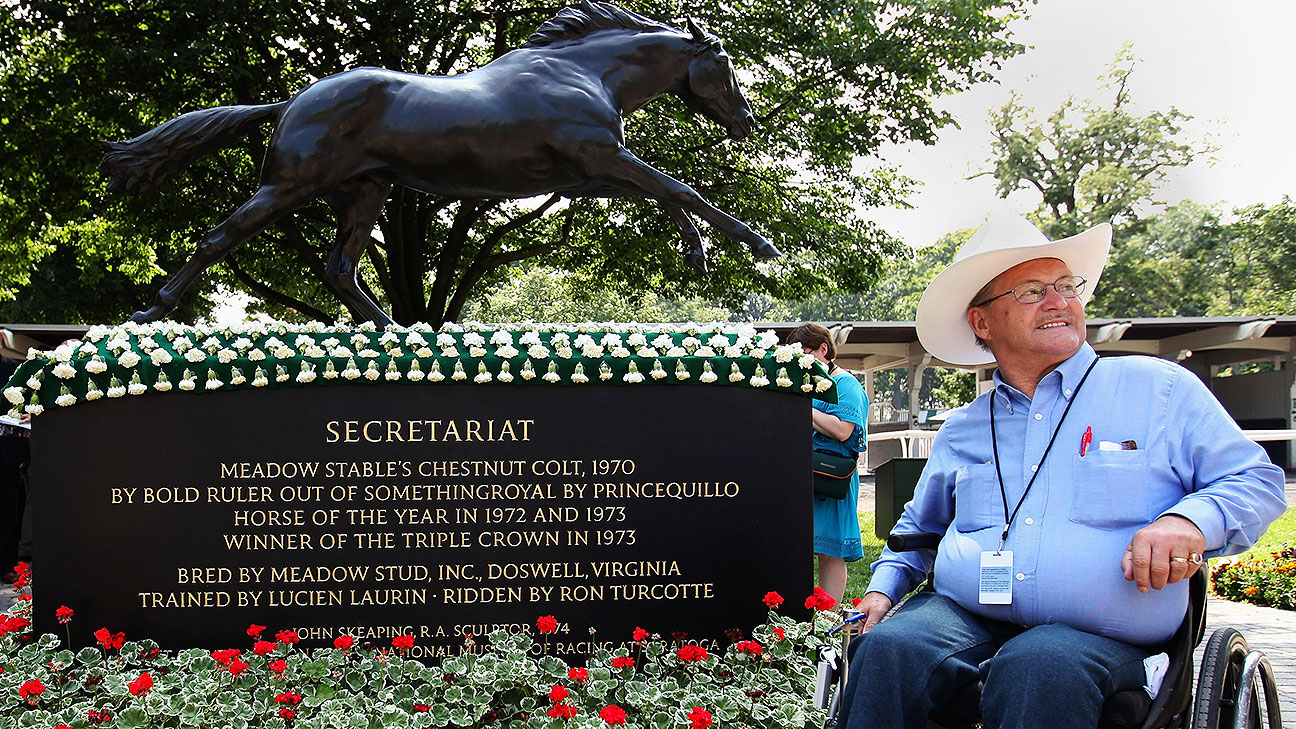
Statues of Secretariat now stand outside the National Museum of Racing and Hall of Fame at Saratoga Race Course in Saratoga, New York; the Kentucky Horse Park and Keeneland Race Course, both in Lexington, Kentucky; and, with Turcotte aboard, in Turcotte's hometown of Grand Falls, New Brunswick, Canada.

Unfortunately, Turcotte himself had a grand fall: During a 1978 race at Belmont, he fell from his mount, and was paralyzed. As of June 9, 2022, he is 80 years old, still lives in Grand Falls, and is an advocate for disability research.
Turcotte at Secretariat's statue at the Kentucky Horse Park

In 1975, Sports Illustrated horse racing writer William Nack, who covered every race "Big Red" ever ran, published Secretariat: The Making of a Champion. In 2010, it served as the basis for the film Secretariat. Diane Lane starred as Penny Chenery, real-life jockey Otto Thorwarth played Turcotte, Kevin Connolly played Nack, and the horse that played Secretariat was not identified.

*

June 9, 1973 was a Saturday. Football was out of season. Both the NBA and the NHL awarded their titles a month earlier. These Major League Baseball games were played that day:

* The New York Yankees beat the Kansas City Royals, 6-4 at the new Royals Stadium in Kansas City. (It was renamed Kauffman Stadium in 1993.) The Yankees scored 5 runs in the top of the 9th to win it.

Cliché Alert: Walks can kill you, especially the leadoff variety. The inning began with Roy White drawing a walk. Matty Alou grounded to 1st, advancing White. Bobby Murcer drew a walk. Ron Blomberg singled White home. Jim Ray Hart drew a walk to load the bases. Graig Nettles drew the 4th walk of the inning, forcing Murcer home. Thurman Munson grounded to 3rd, and Blomberg was out at home, but the bases were still loaded. A 5th walk was drawn by Gene Michael, forcing home Alou. And Horace Clarke singled home Nettles and Munson. Pat Dobson was the winning pitcher, in relief of Fred Beene.

* The New York Mets beat the Los Angeles Dodgers, 4-2 at Shea Stadium. Jon Matlack outpitched Al Downing. Willie Mays hit the 655th home run of his career.

* The Montreal Expos beat the San Francisco Giants, 9-6 at Jarry Park in Montreal.

* The Philadelphia Phillies beat the San Diego Padres, 4-1 at Veterans Stadium in Philadelphia. Ken Brett was the winning pitcher, and hit a home run.

* The Baltimore Orioles beat the Minnesota Twins, 7-4 at Memorial Stadium in Baltimore. Brooks Robinson went 1-for-4. So did Harmon Killebrew. Rod Carew went 2-for-5.

* The Atlanta Braves beat the St. Louis Cardinals, 8-2 at Atlanta Stadium. (It was renamed Atlanta-Fulton County Stadium in 1975.) Hank Aaron hit the 687th and 688th home runs of his career. Joe Torre went 3-for-4 with an RBI. Lou Brock went 0-for-3, but did draw a walk. The Cards couldn't win despite having players named Mike Tyson (a white shortstop) and Spinks (Scipio Spinks, a black pitcher from Chicago, no relation to Leon and Michael, who were from St. Louis.)

* The Chicago White Sox beat the Cleveland Indians, 6-3 at Cleveland Municipal Stadium.

* The Cincinnati Reds beat the Chicago Cubs, 8-4 at Wrigley Field in Chicago. Tony Pérez hit a home run. Pete Rose went 0-for-5, but did have an RBI on a groundout. Joe Morgan went 1-for-4. Johnny Bench went 2-for-4 with an RBI.

* The Boston Red Sox beat the Texas Rangers, 12-1 at Arlington Stadium in the Dallas suburb of Arlington, Texas. Carl Yastrzemski went 1-for-4 with an RBI. He did not hit a home run for the Red Sox, but Carlton Fisk, Tommy Harper and Orlando Cepeda did.

* The Pittsburgh Pirates beat the Houston Astros, 4-1. Willie Stargell went 1-for-2 with 2 walks and 2 RBIs.

* The Milwaukee Brewers beat the California Angels, 1-0 at Anaheim Stadium. (It was renamed Edison International Field in 1997, and Angel Stadium of Anaheim in 2004.) Jim Colborn and Frank Linzy combined on a 4-hit shutout. Rudy May allowed only 2 hits, but lost because 1 of them was a home run by Ollie Brown. Frank Robinson went 0-for-2 with a walk for the Angels.

* And the Oakland Athletics beat the Detroit Tigers, 4-0 at the Oakland Coliseum. Ken Holtzman pitched a 2-hit shutout. Reggie Jackson went 1-for-4 with 3 RBIs. Al Kaline went 0-for-3.

And Tedy Bruschi, a linebacker who would win 3 Super Bowls with the New England Patriots, was born on this day. So was Keesha Sharp, who played Monica Charles Brooks on the sitcom Girlfriends.

Wednesday, June 8, 2022

June 8, 1935: Omaha Wins the Triple Crown

June 8, 1935: Omaha becomes the 3rd horse to win American thoroughbred racing's Triple Crown. The 2nd was his father, Gallant Fox. They remain the only father and son to win the Triple Crown.

Foaled at Claiborne Farm in Paris, Kentucky, Omaha was trained by "Sunny Jim" Fitzsimmons, just as Gallant Fox was. He was ridden by William "Smokey" Saunders, who would become the 1st Canadian jockey to win the Triple Crown. (Ron Turcotte, aboard Secretariat in 1973, would become the 2nd.) He won only 1 race as a 2-year-old, but finished 2nd in a few, suggesting hope for his 3-year-old season.

Despite a weak finish in the Wood Memorial, and a sloppy track at Churchill Downs, Omaha won the Kentucky Derby by a length and a half over Roman Soldier. The Preakness Stakes was run only 1 week later, and Omaha won it by 6 lengths over Firehorn. Famously, Omaha wouldn't stay still for the victory photo.

Between the Preakness and the Belmont, Omaha was run in the Withers Stakes, at Aqueduct in Queens, and lost to Rosemont by a length and a half. The Belmont was 12 days later, 7 miles to the east. Rosemont and Firethorn were both entered. But it rained, and the track was muddy, just like in the Derby, just the way Omaha liked it. He started slow, but put on a stretch run, and beat Firethorn by a length and a half, with Rosemont further back. The Triple Crown was won.

In 1936, as a 4-year-old, he was put on a ship to England, and, running on grass for the 1st time, and running clockwise for the 1st time, won his 1st 2 races, and finished 2nd in the next 2, after which he was retired to stud.

His sons never won any major races, but his later descendants have included 3 Kentucky Derby winners -- which, of course, are also counted among the descendants of Gallant Fox. Omaha died in 1959, Fitzsimmons in 1966, and Saunders in 1986.

*

June 8, 1935 was a Saturday. These baseball games were played:

* A doubleheader was split at Fenway Park in Boston. The New York Yankees won the opener, 12-6. The Boston Red Sox won the nightcap, 4-2. Over the 2 games, Lou Gehrig went 4-for-5 with a home run, 3 walks and 5 RBIs.

* The Brooklyn Dodgers were leading the Philadelphia Phillies, 3-2 after 5 innings at Baker Bowl in Philadelphia, when the game was called due to rain.

* The Philadelphia Athletics beat the Washington Senators, 4-3 at Griffith Stadium in Washington. Jimmie Foxx went 1-for-3 with 2 walks.

* The Pittsburgh Pirates beat the Cincinnati Reds, 14-8 at Forbes Field in Pittsburgh.

* The Cleveland Indians beat the St. Louis Browns, 3-2 at League Park in Cleveland.

* The Chicago White Sox beat the Detroit Tigers, 3-2 at Comiskey Park in Chicago. Hank Greenberg hit a home run, and the Tigers went on to win the World Series, anyway.

* The St. Louis Cardinals swept a doubleheader from their arch-rivals, the Chicago Cubs, 5-4 and 6-5 at Sportsman's Park in St. Louis. In the bottom of the 9th of the 1st game, Jack Rothrock singled, and Johnny "Pepper" Martin scored on a subsequent error. James "Ripper" Collins won the 2nd game with a home run in the bottom of the 11th inning.

Jay "Dizzy" Dean did not pitch in either game. His brother, Paul Dean, who hated being called "Daffy," started the 1st game, was relieved, didn't get to be the winning pitcher, then got to be the winning pitcher in relief in the 2nd game.

* And the New York Giants and the Boston Braves were supposed to play at the Polo Grounds, but got rained out. It was made up as part of a doubleheader on August 4. The Giants swept, 9-2 and 3-1. Hal Schumacher won the opener, Carl Hubbell the nightcap. Over the 2 games, Giant player-manager Bill Terry went 2-for-8 with 2 RBIs, and Mel Ott went 2-for-7 with 2 walks. Travis Jackson went 3-for-5 with a home run and 4 RBIs in the 1st game, before Terry gave him the 2nd game off.

Tuesday, June 7, 2022

June 7, 1941: Whirlaway Wins the Triple Crown

June 7, 1941: The Belmont Stakes is run at Belmont Stakes in Elmont, Long Island, New York. The Triple Crown is on the line.

Whirlaway was one of many champion thoroughbred racehorses bred at Calumet Farm, outside Lexington, Kentucky. His sire was Blenheim, who won the 1930 Epsom Derby in England. Trained by Ben A. Jones, and ridden by Eddie Arcaro, he won 4 stakes races as a 2-year-old, and was named the American Champion Two-Year-Old Colt.

On May 3, 1941, he entered the Kentucky Derby at Churchill Downs in Louisville, Kentucky, and won it in 2 minutes, 1 and 2/5ths seconds, a record at the time. He won the race by 8 lengths, tying a record which still stands. Two weeks later, on May 17, he won the Preakness Stakes at Pimlico Race Course in Baltimore.

He was considered such a favorite in the Belmont that only 3 other horses entered: Robert Morris, Yankee Chance, and Itabo. At post time, the odds on "Mr. Longtail" (his tail was exceptionally long for a thoroughbred) were 1-4. That's not a typographical error: One to four. He won in 2 minutes and 31 seconds, by 2 1/2 lengths over Robert Morris.

He had become the 5th horse to win the Triple Crown. Then, he did something not done before or since: He went up to Saratoga Race Course in Upstate New York, and won the Travers Stakes. No other horse has won all 4 races, although the feat was called "The Superfecta" rather than "The Grand Slam" like in tennis or golf.

Arcaro was suspended for the 1942 racing season, for racing infractions. George Woolf, who had previously stepped in for the injured Red Pollard to ride Seabiscuit to some big wins, became Whirlaway's rider.

Alsab was also a Kentucky-bred horse. He was the 2-year-old champion in 1941, and in 1942, ridden by Basil James, he won the Preakness, finishing 2nd Shut Out in both the Kentucky Derby and the Belmont.

It might have made sense, in an era when match races, races between 2 major thoroughbred horses, were occasionally done, to match up Whirlaway and Shut Out, winners of 5 of the last 6 Triple Crown races. Instead, one was set up for September 19, 1942, at Narragansett Park in Pawtucket, Rhode Island -- 6 miles northeast of downtown Providence, and 41 miles southwest of Boston -- between Whirlaway and Alsab, who, despite being only 2, finished 2nd to Whirlaway for Turf and Sport Digest magazine's Horse of the Year award the year before. Alsab won in a photo finish.

Nevertheless, the horses opposed each other in one more race before the year was out, and Whirlaway won. It may have made a difference, as Whirlaway, having won 12 races on the year to Alsab's 9, was named Horse of the Year again. Whirlaway lived until 1953, Alsab until 1963.

In 1948, Eddie Arcaro rode Citation, making him the only jockey ever to ride 2 Triple Crown winners. He lived until 1997.

*

June 7, 1941 was a Saturday. These baseball games were played that day:

* The New York Yankees beat the St. Louis Browns, 11-7 at Sportsman's Park in St. Louis. The Yankees led 6-4 going to the bottom of the 8th inning, but the Browns scored 3 runs off Spud Chandler, in relief of Lefty Gomez, to take a 7-6 lead. Then the Yankees scored 5 in the top of the 9th. Charley Stanceu was the winning pitcher. The losing pitcher was former Yankee Johnny Allen.

Charlie Keller went 3-for-4 with a home run, a walk and 4 RBIs. Joe DiMaggio went 3-for-5 with an RBI. This was the 22nd game of his hitting streak, and people were beginning to notice. It would reach a record 56.

* The New York Giants lost to the St. Louis Cardinals, 11-3 at the Polo Grounds. Mel Ott went 0-for-3 with a walk.

* The Brooklyn Dodgers lost to the Cincinnati Reds, 8-3 at Ebbets Field. Pete Reiser hit a home run.

* The Chicago Cubs beat the Boston Braves, 5-1 at Braves Field in Boston.

* The Philadelphia Phillies beat the Pittsburgh Pirates, 2-0 at Shibe Park in Philadelphia. Cy Blanton allowed 8 hits, but kept the shutout.

* The Cleveland Indians beat the Philadelphia Athletics, 6-2 at League Park in Cleveland.

* The Detroit Tigers beat the Washington Senators, 10-6 at Briggs Stadium (later Tiger Stadium) in Detroit. The Tigers' Hank Greenberg had recently become the 1st big star in baseball to enlist in the U.S. armed forces.

* The Chicago White Sox beat the Boston Red Sox, 5-4 at Comiskey Park in Chicago. Ted Williams went 1-for-4 with a walk. He was batting .431. Then he went into a slump, finishing at .406.

June 7, 1930: Gallant Fox Wins the Triple Crown

June 7, 1930: Gallant Fox becomes the 2nd horse to win American thoroughbred racing's Triple Crown.

Foaled at Claiborne Farm in Paris, Kentucky, Gallant Fox was trained by "Sunny Jim" Fitzsimmons, and ridden by Earl Sande. He won 2 races as a 2-year-old, and won the Wood Memorial as a warmup to the Triple Crown races.

In 1930, the Preakness Stakes was run first, and Gallant Fox won it by 3/4ers of a length over Crack Brigade. Two weeks later, the Kentucky Derby was held in a driving rain, and Gallant Fox won it by 2 lengths over Gallant Knight, his half-brother. (Both were sons of Sir Galahad III, whose wins did not include any Triple Crown races, but he became the leading sire of champion racehorses in his time.) It was Sande's 3rd Derby win, having won aboard Zev in 1923 and Flying Ebony in 1925.

Three weeks later, at Belmont Park, Gallant Fox was actually not the favorite at the Belmont, despite having won the Wood Memorial at nearby Jamaica Race Course. (It was moved to Aqueduct, also in Queens, in 1960.) The favorite was Whichone, the Champion Two-Year-Old Colt of the year before. Injured and unable to compete at Pimlico and Churchill Downs, he had won the Withers Stakes at Belmont, and so was considered to have the "home-field advantage." Gallant Fox won the race by 3 lengths.

In July, Gallant Fox raced against Gallant Knight again, in the Arlington Classic at Arlington Park outside Chicago, and won by a neck. He was beaten by Jim Dandy by 8 lengths in the Travers Stakes at Saratoga in August, but won his last 3 races of the year, the last being the Jockey Club Gold Cup at Belmont.

He was retired thereafter, and in 1935, his son, Omaha, won the Triple Crown. They remain the only father and son to do so. Gallant Fox died in 1954, Fitzsimmons in 1966, and Sande in 1968.

*

June 7, 1930 was a Saturday. These baseball games were played:

* The New York Yankees beat the St. Louis Browns, 12-5 at Sportsman's Park in St. Louis. The Yankees scored 7 runs in the 1st inning, and never looked back. Ed Wells went the distance for the win. Babe Ruth and Lou Gehrig both hit home runs.

* The New York Giants beat the St. Louis Cardinals, 9-7 at the Polo Grounds. Mel Ott had 2 home runs and 6 RBIs. Bill Terry went 1-for-5.

* The Brooklyn Robins beat the Chicago Cubs, 12-9 at Ebbets Field. (The Dodgers were known as the Robins when Wilbert Robinson managed them from 1914 to 1931.)

* The Boston Braves beat the Pittsburgh Pirates, 6-4 at Braves Field in Detroit. Paul Waner went 1-for-3 with a walk, and Lloyd Waner did not play.

* The Detroit Tigers beat the Boston Red Sox, 6-0 at Navin Field (later Briggs Stadium and Tiger Stadium) in Detroit. George Uhle pitched a 3-hit shutout.

* The Chicago White Sox beat the Philadelphia Athletics, 6-5 at Comiskey Park in Chicago. Jimmie Foxx went 1-for-3 with 2 walks and 2 RBIs. Mickey Cochrane went 0-for-2 with 3 walks.

* The Philadelphia Phillies and the Cincinnati Reds were rained out at Baker Bowl in Philadelphia. The game was made up as part of a doubleheader on July 12. The Reds swept, 9-5 and 6-1.

* And the Cleveland Indians and the Washington Senators were rained out at League Park in Cleveland. The game was made up as part of a doubleheader on July 16. The Senators won the 1st game, 10-4. The Indians won the 2nd game, 13-6.

Monday, June 6, 2022

June 6, 2015: American Pharoah Ends the Triple Crown Drought

June 6, 2015: For the 1st time in 37 years, a horse wins American thoroughbred racing's "Triple Crown." With some appropriateness, he has a royal name: American Pharoah.

Bred in Kentucky, his father was a Pioneerof the Nile, who finished 2nd in the 2009 Kentucky Derby. Trained by Bob Baffert, and ridden by Mexican jockey Victor Espinoza, he ran 3 races as a 2-yer-old, winning the last 2. As a 3-year-old, he ran 2 warmups for the Kentucky Derby, both in Arkansas, and won both: The Rebel Stakes and the Arkansas Derby.

On May 2, 2015, at Churchill Downs in Louisville, Kentucky, at 3-1 odds, American Pharoah won the Kentucky Derby, in 2 minutes, 3.02 seconds, by 1 length over Firing Line. Two weeks later, on May 16, at Pimlico Race Course in Baltimore, at 9-10 odds, he won the Preakness Stakes, in 1 minute, 58.46 seconds, by 7 lengths over Tale of Verve.

Since Affirmed won the Triple Crown in 1978, there had been several near-misses, horses winning the Derby and the Preakness, but not the Belmont Stakes, the mile-and-a-half "True Test of Champions." Spectacular Bid had failed in 1979, Pleasant Colony in 1981, Alysheba in 1987, Sunday Silence in 1989, Silver Charm by 3/4 of a length in 1997, Real Quiet in a photo finish in 1998, Charismatic due to an in-race injury in 1999, War Emblem in 2002, Funny Cide in 2003, Smarty Jones by 1 length in 2004, Big Brown due to an in-race injury in 2008, I'll Have Another scratched from the Belmont due to an injury in 2012, and California Chrome due to an in-race injury in 2014. Racing fans were wondering if they would ever see another winner.

On June 6, American Pharoah was loaded into the paddock at Belmont Park in Elmont, Long Island, New York, just over the City Line from Queens, at odds of 3-4. There was no injury, no fade, and not even any drama: He won by 5 1/2 lengths over Frosted, in a time of 2 minutes, 26.65 seconds.

The Triple Crown had been achieved. Baffert said, "This little horse deserves it. There's something about this horse that he just brought it every time. He's a joy to be around."

The Breeders' Cup meet had been founded in 1984. The feature race is the Breeders' Cup Classic, a mile and a quarter like the Kentucky Derby. Usually, it is won by a horse that has won at least 1 of the Triple Crown races. American Pharoah was the 1st Triple Crown winner to whom it was available. On Halloween, October 31, 2015, at Keeneland in Lexington, Kentucky -- practically home soil -- he won by 5 1/2 lengths, in 2 minutes, 0.07 seconds, by 6 1/2 lengths over Effinex. Thus, he became the 1st winner of an American thoroughbred racing "Grand Slam." Through the 2021 event, he remains the only one.

It was his last race. Unlike many 3-year-old champions, he did not have a money-making 4-year-old season, and was immediately retired to stud. As of June 6, 2022, American Pharoah stands at Ashford Stud farm in Kentucky. Most of his descendants who have gone on to race have done so outside the United States, winning races in Britain, Europe and Australia.

*

June 6, 2015, like all "Triple Crown" race days, was a Saturday. Game 2 of the Stanley Cup Finals was played at Amalie Arena (now the Benchmark International Arena) in Tampa. The Tampa Bay Lightning beat the Chicago Blackhawks, 4-3. However, the Hawks went on to win the Cup in 6 games.

The NBA Finals were also underway, although this was an off-day. The Golden State Warriors went on to beat the Cleveland Cavaliers in 6 games.

Football was in midweek. And these Major League Baseball games were played:

* The New York Yankees beat the Los Angeles Angels, 8-2 at Yankee Stadium. Adam Warren was the starting and winning pitcher -- both halves of which, in hindsight, are a little hard to believe. The Yankees scored 6 runs in the bottom of the 1st inning, and coasted from there. Brian McCann hit a home run. Alex Rodriguez went 0-for-1 with 3 walks. For the Angels, Mike Trout hit a home run, and Albert Pujols went 1-for-3 with a walk.

* The New York Mets lost to the Arizona Diamondbacks, 2-1 at Chase Field in Phoenix.

* The Boston Red Sox beat the Oakland Athletics, 4-2 at Fenway Park in Boston.

* The San Francisco Giants beat the Philadelphia Phillies, 7-5 at Citizens Bank Park in Philadelphia.

* The Chicago Cubs beat the Washington Nationals, 4-2 at Nationals Park in Washington.

* The Atlanta Braves beat the Pittsburgh Pirates, 5-4 at Turner Field (now Center Parc Stadium) in Atlanta.

* The Toronto Blue Jays beat the Houston Astros, 7-2 at the Rogers Centre in Toronto.

* The Cleveland Indians beat the Baltimore Orioles, 2-1 t Progressive Field in Cleveland.

* The San Diego Padres beat the Cincinnati Reds, 9-7 at Great American Ball Park in Cincinnati.

* The Detroit Tigers beat the Chicago White Sox, 7-1 at U.S. Cellular Field (now Rate Field) in Chicago.

* The Milwaukee Brewers beat their former arch-rivals, the Minnesota Twins, 4-2 at Target Field in Minneapolis.

* The Texas Rangers beat the Kansas City Royals, 4-2 at Kauffman Stadium in Kansas City.

* The Colorado Rockies beat the Miami Marlins, 10-5 at Coors Field in Denver.

* The Los Angeles Dodgers beat the St. Louis Cardinals, 2-0 at Dodger Stadium in Los Angeles. Clayton Kershaw allowed just 1 hit and 2 walks over 8 innings, and still had Kenley Jansen pitch a perfect 9th in relief to finish the shutout.

* And the Seattle Mariners beat the Tampa Bay Rays, 2-1 at Safeco Field (now T-Mobile Park) in Seattle.

Sunday, June 5, 2022

June 5, 1943: Count Fleet Wins the Triple Crown

June 5, 1943: The Belmont Stakes is held at Belmont Park, just outside New York City in Elmont, Long Island. A horse named Count Fleet is going for the Triple Crown.

The son of Reigh Count, who won the Kentucky Derby and the Jockey Club Gold Cup in 1928, Count Fleet was foaled at Stoner Creek Stud Farm in Paris, Kentucky. He was owned by Fannie Hertz, whose husband, John D. Hertz, founded the rental car company that bears his name.

Count Fleet was not a particularly attractive horse, called "narrow, light-waisted, and flat-muscled" by one expert and too leggy and light boned by others. He also had an unruly temperament. John Hertz initially did not think much of Count Fleet, and thought of selling him, until jockey Johnny Longden talked him out of it. Don Cameron became the horse's trainer.

He started slowly as a 2-year-old, but began winning races as the year wound down. As a 3-year-old, he won the Wood Memorial at Aqueduct in Queens, but was cut in the process. On May 1, he won the Kentucky Derby by 3 lengths. On May 8, only 3 horses opposed him in the Preakness Stakes, and he was a 3-20 favorite. He won by 8 lengths. He was taken to Belmont Park, and squeezed in a win over 2 other horses to win the Withers Stakes on May 22.

On June 5, his performance in the Belmont Stakes would have been considerably more memorable had it happened on television. But with only radio, and with a big chunk of the listening audience in military service, the number of people who cared was a lot smaller than it would have been. Nevertheless, with only 2 other opponents, he won in 2 minutes, 28 and 1/5ths seconds, a record until Gallant Man broke it in 1957. And he won by 25 lengths, a record until Secretariat broke it in 1973.

But in this spectacular performance, he injured himself yet again, and it was his last race. In 1951, his son, Count Turf, won the Kentucky Derby, producing the 1st three-straight-generations winners of the Derby, ever. It's only been done once since: Pensive in 1944, his son Ponder in 1949, and Ponder's son Needles in 1956.

Count Fleet's son Counterpoint won the Belmont in 1951, and another son, One Count, won it in 1952. Other descendants include 5-time Horse of the Year Kelso, 1965 Kentucky Derby winner Lucky Debonair, 1971 Epsom Derby winner Mill Reef, and 2015 Triple Crown winner American Pharoah. Count Fleet died in 1973, at the age of 33, and remains the longest-lived Kentucky Derby winner.

Longden, born in 1907 in Yorkshire, England, grew up in Alberta, Canada, and went on to become the winningest jockey ever, with 6,032 wins, a record since broken. He became a trainer, and trained Majestic Prince, who won the Kentucky Derby and the Preakness in 1969. But the horse was injured, and his owner overruled Longden, and had him run in the Belmont. The injury may have cost Longden the chance to become the only man to win the Triple Crown as a hockey and a trainer, as Majestic Prince finished 2nd, 5 1/2 lengths behind Arts and Letters. Longden lived until 2003.

*

June 5, 1943 was a Saturday. These baseball games were played that day:

* The New York Yankees lost to the St. Louis Browns, 3-2 at Yankee Stadium. Chet Laabs singled Milt Byrnes home with the winning run in the top of the 10th inning. Johnny Niggeling outpitched Charles "Butch" Wensloff. Charlie Keller hit a home run.

* The New York Giants beat the Pittsburgh Pirates, 5-1 at Forbes Field in Pittsburgh. Mel Ott, now also the Giants' manager, went 2-for-4 with a walk.

* The Brooklyn Dodgers lost to the Chicago Cubs, 3-2 at Wrigley Field in Chicago.

* The Chicago White Sox beat the Boston Red Sox, 4-1 at Fenway Park in Boston.

* The Philadelphia Athletics beat the Cleveland Indians, 6-5 at Shibe Park in Philadelphia.

* The Washington Senators beat the Detroit Tigers, 6-3 at Griffith Stadium in Washington.

* The Boston Braves beat the Cincinnati Reds, 7-5 at Crosley Field in Cincinnati.

* And the Philadelphia Phillies played the St. Louis Cardinals at Sportsman's Park in St. Louis. With the Cards leading, 1-0 in the bottom of the 8th, the Phils lodged a protest. The Cards hung on to win, but the Phils' protest was upheld. The game was resumed from the point of the protest on July 29, and Jimmy Wasdell hit a home run in the top of the 9th, and the Phillies won, 2-1.

December 31, 1999 & January 1, 2000: The Millennium

December 31, 1999:  The Millennium arrives. The people of planet Earth survived. At a terrible cost. But we hadn't destroyed ourselves. ...