Showing posts with label stanley matthews. Show all posts

Monday, November 21, 2022

November 21, 1945: Dynamo Moscow Kicks Off Sports' Cold War

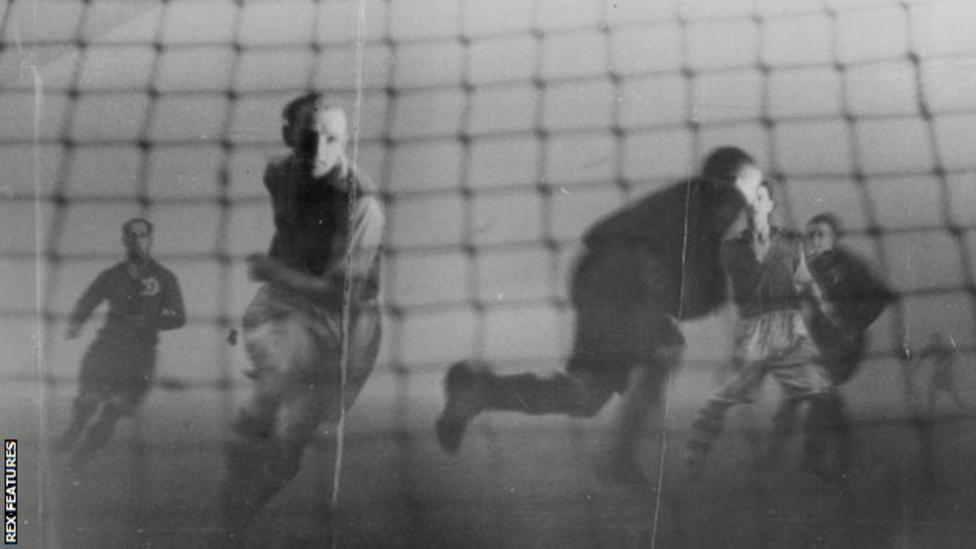
Yes, the fog was that thick.

November 21, 1945: The most-hyped game of the 1st visit of a Soviet soccer team to England, the sport's traditional birthplace, takes place. In hindsight, it can be called the event that kicked of the sports division of the Cold War.

In Communist countries, sports clubs, and the teams they fielded, were sponsored by state-owned industries. The countries' armies sponsored teams named "Central Club of the Army," or "CSKA" in Slavic languages. The national railroads sponsored teams named "Lokomotiv." The auto industry sponsored teams named "Torpedo." The teams most hated by the citizens, but with the most funding from the government and the most favorable decisions from government-appointed officials, were named "Dynamo."

Football Club Dynamo Moscow won the Soviet Top League in 1936, 1937, 1940 and 1945; and were regarded, along with Spartak Moscow, as the best team in the Soviet Union. So when World War II came to an end, Dynamo wanted to test themselves against what was seen as the best competition in the world: The British.

This was the age of radio. Television existed, but it hadn't yet done much to cover sports. Most of what people knew about sports was what they read in newspapers. So there was very little information on Dynamo for the British teams they would be facing, and their fans -- and vice versa: Dynamo knew very little about their opponents.

Interviewed for a 2001 documentary, Dynamo forward Konstantin Beskov said, "Until those games, we only knew that England was the motherland of football, that English football was the best in the world." One of Britain's national newspapers, The Evening Standard, wrote, "Don't expect much from Dynamo. They are only beginners, blue-collars, amateurs." They would regret that dismissive derision.

On Tuesday, November 13, Dynamo visited Chelsea Football Club, at Chelsea's West London stadium, Stamford Bridge. Officially, the crowd was 75,000 people. It was probably much more than that, given English "footie" fans' propensity to jam themselves into those vast "standing terraces." It's a wonder there weren't more disasters like Ibrox in 1971 and Hillsborough in 1989.

Chelsea, prior to the 1960s rarely even a good team, much less a challenge for Dynamo, took a 2-0 lead. Just before the half, Dynamo were awarded a penalty. Leonid Solovyov hit the post with his shot, and the Soviet side went into the locker room embarrassed. Whatever was said to them in the locker room, it worked: They came back to tie the game, 2-2, fell behind 3-2, and then tied it again near the end of the game, to end it 3-3.

Tommy Lawton, the former star of Liverpool team Everton FC who had recently been signed by Chelsea, said, "Dynamo were one of the fastest teams I have ever seen in my life. They flash the ball from man to man in bewildering fashion, often while standing still." Chelsea Captain John Harris said, "At least two of Lawton's kicks were of such a type that no goalkeeper would catch, but Khomich jumped like a tiger and caught them." The Soviet goalie was known as Tiger Khomich from then on.

On Saturday, November 17, Dynamo visited Cardiff City Football Club. England's Football Association, of which City were then 1 of 3 Welsh members, refused to rearrange their schedule to accommodate Dynamo, so City were the only team available, and they were in Division Three, equivalent to Class AA in modern baseball.

Wales, full of coal mines, steel mills and dockworkers, was openly sympathetic to socialism, and welcomed the Soviet team with open arms. But City were completely overwhelmed, as Dynamo beat them, 10-1.

The team with which Dynamo were most familiar, and the team they truly wanted to test themselves against, was Arsenal Football Club, winners of the Football League in 1931, '33, '34, '35 and '38. Dynamo badly wanted to play Arsenal at their North London home, the Arsenal Stadium, nicknamed Highbury for its neighborhood.

Having made trips to the Continent, including an annual home-and-home series on Armistice Day, November 11, with Racing Club de France in London and Paris, Arsenal were happy to make themselves available for this soccer "summit." But they could not do the same for Highbury: It had been commandeered by the British government at the outset of World War II, as an Air Raid Precaution Centre, and had not yet been returned to the club's control. Since 1939, Arsenal had been playing home games at White Hart Lane, the home of their arch-rivals, Tottenham Hotspur, a.k.a. Spurs, 4.7 miles to the north.

A dirty little secret had gotten out: Dynamo had "drafted" 4 star players from other Soviet teams, including Spartak Moscow and CSKA Moscow. So the FA made arrangements for teams to "loan" some players to Arsenal, including Stanley Matthews of Staffordshire team Stoke City, a winger known as "The Wizard of Dribble," and possibly England's best player at the time. Another loanee was Stan Mortensen of Lancashire team Blackpool. With massive hypocrisy, the Soviets complained.

(In 1953, Blackpool, having acquired Matthews, won the FA Cup Final, with Mortensen scoring the only hat trick in the history of the Final, but Matthews had put on such a show that it's still remembered as "The Matthews Final.")

The game was set for Wednesday, November 21, but, as so often happened in those days before environmental regulations were passed, leading to outsiders nicknaming London "The Smoke," a thick fog settled over White Hart Lane. Still, the place was sold out, 54,000 strong, and the FA didn't want to issue refunds, so the game went on. The Soviet officials insisted on a Soviet referee, Nikolay Latyshev, who had accompanied the team. The FA agreed.

Writer George Orwell, who had recently published Animal Farm (Nineteen Eighty-Four was yet to come), was in attendance, and called the match "War minus the shooting." The Soviet players, knowing Matthews was the best player on either side of the pitch, targeted him for rough treatment.

Both goalies, Khomich and Arsenal's Wyn Griffiths, took more physical assaults than shots with the ball. Griffiths sustained a concussion, and had to be replaced for the 2nd half. Harry Brown, goalkeeper for West London team Queens Park Rangers, was in attendance, and, since the Soviets had negotiated for the right to a substitution, something the FA wouldn't allow in League and cup ties until 1966, they allowed Brown to step in for Griffiths.

Dynamo scored first, but Ronnie Rooke equalized shortly thereafter. Shortly before the half, there were 3 goals within a span of 4 minutes: Mortensen put Arsenal up 2-1, then he took another Matthews feed to make it 3-1, and then Beskov put the ball past Griffiths to make it 3-2.

The 2nd half was a travesty. Solovyov scored to tie it up, but multiple witnesses claimed he was blatantly offside. Latyshev let the goal stand. A little later, Arsenal thought they should have been awarded a penalty, but Latyshev denied it. Shortly after that, he sent Arsenal midfielder George Drury off for throwing a punch. No one else claimed to see the punch.

Vsevolod Bobrov, who became one of the Soviet Union's first great hockey players as well, received a Solovyov pass while offside, and scored. The goal was allowed to stand. Rooke was nearly brought down by a rugby-style tackle by Dynamo Captain Mikhail Semichastniy, opening a cut on his forehead, but elbowed him out of the way, giving him a black eye, and driving a 25-yard shot that beat Khomich. But instead of rightly allowing the goal and sending Semichastniy off, Latyshev waved off the goal and called Rooke for a foul.

So instead of what it should have been, 4-2 to The Arsenal, with Arsenal having 11 players on the pitch and Dynamo having 10 at most, it was 4-3 to Dynamo, with Arsenal down to 10 and Dynamo fielding... no one was sure how many. Dynamo took advantage of the fog to put more players on, with some accounts saying it was now 15 against 10.

The match ended 4-3 to Dynamo. The Daily Mail wrote, "It was one of the most exciting games 54,000 people never saw." Unusually for the paper known in modern times as the Daily Fail, it was the truth.

The controversy threatened to cancel the 4th and final game on the tour. But the FA were making too much money to bow to the wishes of the fans, and the finale went on. On Wednesday, November 28, Dynamo were hosted by Rangers Football Club, Scotland's most successful team, at Ibrox Stadium in Glasgow. Despite Bobrov scoring what The Daily Telegraph called "as perfect a goal as has ever been scored at Ibrox," Rangers held on for a 2-2 draw.

Dynamo had finished the tour with 2 wins, 2 draws, and no losses. But all the goodwill they had generated in their games against Chelsea and Cardiff City was thrown away by their actions against Arsenal. The game with Rangers did them no good in the eyes of the British, or European, sporting public.

Dynamo would win the Soviet Top League again in 1949, 1954, 1955, 1957, 1959, 1963 and 1976. But they never won it again. Nor have they won its replacement, the Russian Premier League. They have long since been surpassed as Moscow's top team by Spartak and CSKA, and St. Petersburg team Zenit have also surpassed them among Russia's teams.

Nikolay Latyshev, the referee for the Arsenal-Dynamo match, went on to officiate at the 1962 World Cup Final, which featured a team from what was then a Communist nation, Czechoslovakia. But none of his calls in the game were considered controversial, and Brazil defeated the Czechs.

*

November 21, 1945 was a Wednesday. Actress Goldie Hawn was born on this day.

Baseball was out of season. Football was in midweek. The NBA hadn't been founded yet. Only 1 game was played in the NHL: The Boston Bruins beat the Montreal Canadiens, 3-0 at the Boston Garden.

Monday, November 14, 2022

November 14, 1934: The Battle of Highbury

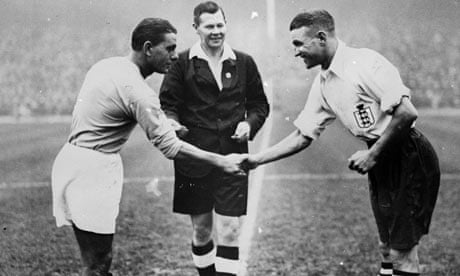
Left to right: Italy Captain Attilio Ferraris,
referee Otto Olsson, England Captain Eddie Hapgood

November 14, 1934: The most-hyped soccer game ever to that point is played. And, while the competition lived up to the hype, everything else was horrible.

In 1928, a dispute with the governing body of world soccer, the Fédération internationale de Football Association (FIFA), England left their jurisdiction. The other "home nations" of the United Kingdom of Great Britain and Northern Ireland -- Wales, Scotland and Northern Ireland -- followed suit. (To this day, I don't know why they compete as a single united kingdom in the Olympics Games, but, for every other event, the home nations each have their own separate teams.)

This made the home nations ineligible to play in FIFA's signature tournament, the World Cup, which began in 1930, with Uruguay winning on home soil. The 1934 tournament would be the 1st held in Europe, in Italy, then ruled by fascist dictator Benito Mussolini. With a team dominated by players from Juventus FC of Turin and FC Internazionale Milano of Milan, Italy won it.

But England, which "invented football" (at the least, it did so in an organized way), still thought it had the best team in the world. So they challenged Italy in a game to decide "the real world championship." Italy accepted. The game would be in England, so Mussolini couldn't use his authority to cheat. But he did offer an incentive: If they won, each player would receive a new Alfa Romeo car and a cash prize which, converted into 2022 U.S. money, was about $7,000, a pretty good figure during the Great Depression..

Italy manager Vittorio Pozzo sent out this lineup (with neither side wearing uniform numbers):

* Goalkeeper: Carlo Ceresoli of Inter. This was a change from the World Cup, where his keeper, and his Captain, was Gianpiero Combi of Juventus.
* Right Back: Eraldo Monzeglio of Bologna FC.
* Left Back: Luigi Allemandi of Inter.
* Right Half: Attilio Ferraris of SS Lazio of Rome, Italy's Captain for this game.
* Center Half: Luis Monti of Juventus.
* Left Half: Luigi Bertolini of Juventus.
* Outside Right: Enrique Guaita of AS Roma of Rome.
* Inside Right: Pietro Serantoni of Juventus.
* Center Forward: Giuseppe Meazza of Inter. He had been the inside right in the World Cup, but was moved to center forward for this game, replacing Angelo Schiavio of Bologna. The Milan stadium used by both Inter and AC Milan, known worldwide as the San Siro for its neighborhood, is officially named for Meazza, as he was the greatest Italian player of his generation.
* Inside Left: Giovanni Ferrari of Juventus.
* Outside Left: Raimundo Orsi of Juventus.

At the time, England did not have a "manager" as we now understand that term. Essentially, the team Captain was the head coach. Rather, a board of directors selected the starting eleven:

* Goalkeeper: Frank Moss of Arsenal FC. Arsenal, of North London, were the dominant team in England in the 1930s, winning 5 Football League titles and 2 FA Cups.
* Right Back: George Male of Arsenal.
* Left Back: Eddie Hapgood of Arsenal. So respected by his peers was Hapgood that he was named Captain of his country before he was named Captain of his club: Arsenal's Captain at the time was the great Scottish forward Alex James.
* Right Half: Cliff Britton of Everton FC, based in Liverpool.
* Center Half: Jack Barker of Derby County FC, in the East Midlands.
* Left Half: Wilf Copping of Arsenal. A purely defensive player, he never scored a goal for Arsenal. But he was the most feared player in the league. Not that he was dirty: Not once was he ever booked for a foul. (This was before Mike Riley, a known Arsenal hater, was in charge of English referees.)
* Outside Right: Stanley Matthews of Stoke City FC. At 19, he was the youngest player on the team. He would eventually become the grand old man of English football, playing for Stoke in Division One at age 50. In between tenures at Stoke, he would play for Lancashire side Blackpool FC. Playing his career for struggling teams, "The Wizard of Dribble" only won 1 trophy in his career, the 1953 FA Cup. In that game, his teammate Stan Mortensen became the 1st, and remains the only, player to score 3 goals in an FA Cup Final. And yet, the game is still called "The Matthews Final," such was his dominance of the game.
* Inside Right: Ray Bowden of Arsenal.
* Center Forward: Ted Drake of Arsenal. Recently acquired from Hampshire team Southampton FC, he became the top scorer in the country. The following year, he would tie the League record by scoring 7 goals against Birmingham team Aston Villa.
* Inside Left: Cliff Bastin of Arsenal. Normally an outside left, he would score 178 goals for "The Gunners," a team record that would last until surpassed by Ian Wright in 1997. He finished with 185, which was surpassed by Thierry Henry with 228.
* Outside Left: Eric Brook of Manchester City FC.

Seven players from Arsenal. It remains the only time 1 team has had 7 players in the England starting XI. So the match was set for Arsenal's home, Arsenal Stadium, known for its neighborhood as "Highbury." Although having little experience at the international level, these players were battle-tested in the toughest league in the world.

The referee was Otto Olsson, of Sweden. The crowd was given as 56,044 people. England wore white shirts and navy blue shorts, while Italy wore sky blue shirts and white shorts.

But when the game began at 3:00 on that Wednesday afternoon -- 10:00 in the morning, U.S. Eastern Time -- it was pouring rain, and the rain continued throughout the game. And the Italians were dirty from the outset. In only the 1st minute of the game, Drake had a one-on-one with Ceresoli, who crashed into him. Olsson awarded a penalty, but it was taken by Brook, who missed it.

Just a minute later, Monti tackled Drake, and broke his own foot in the process. A minute later, Brook headed in a cross from Matthews, and it was one-nil to England. Shortly thereafter, Hapgood took an elbow to the face, breaking his nose. In the 10th minute, Brook fired a free kick that Matthews said was "like a thunderbolt." It was 2-0 England. Just 2 minutes later, Drake made it 3-0. It looked like a wipeout.

By the 15-minute mark, both Monti and Hapgood had to leave the pitch. Both sides were down to 10 men. Pozzo changed tactics, and the Italian defense got tighter. And dirtier: Drake was punched, Brook's arm was broken, and Bowden got his ankle hurt. Olsson booked none of these offenses.

The Italians kept their tactics up in the 2nd half, and the tide of the game turned. Meazza scored twice within 4 minutes on either side of the hour mark. He fought hard for an equalizer, denied by saves from Moss and once hitting the post. When Olsson blew his whistle for full-time, it was still England 3, Italy 2.

England claimed to be the true world champions, their "gentlemen" having defeated the World Cup winners at their dirtiest, in a match that Matthews, whose length and greatness of career can be compared to American baseball pitcher Nolan Ryan and Canadian hockey player Gordie Howe, called it the most violent match in which he had ever played.

But Italy received its players as heroes. Recognizing that they had played under completely unfavorable conditions, they were hailed as "The Lions of Highbury." Mussolini, not bound by his promise because of the defeat, followed through anyway, giving the players the cash prizes and the cars.

Ceresoli lived until 1995, making him the last surviving Italian player from this game. Matthews was the game's last survivor, living until February 23, 2000.

Italy would repeat as World Cup winners in 1938. World War II canceled the World Cup of 1942, and the inability to set up qualifying matches because the European phase of the war didn't come until 1945 forced the cancellation of the 1946 edition. FIFA and the British home nations settled their differences, and England entered the 1950 World Cup, but failed until hosting the tournament in 1966. That remains the only international tournament that England have ever won. Italy have won the World Cup again in 1982 and 2006; and the UEFA European Championships of 1968 and 2020.

*

November 14, 1934 was a Wednesday. Baseball season was over. Football was in midweek. The NBA hadn't been founded yet. And no games were scheduled for the NHL. So there were no other scores on this historic day.

Monday, May 2, 2022

May 2, 1953: The Matthews Final

Stanley Matthews

May 2, 1953: The Football Association Cup Final is held at the old Wembley Stadium in West London. It remains the only FA Cup Final in which a single player scored 3 goals. And yet, it is better remembered for another player.

Stanley Matthews was a native of Stoke-on-Trent, in Staffordshire, in the West Midlands of England. He played outside right, or right wing as the position would be known today, thus wearing uniform Number 7. He debuted with hometown team Stoke City in 1932, at age 19.

In 1934, he had already impressed the FA enough to have them select him for the England side that would play World Cup winners Italy at Highbury, the North London home of Arsenal Football Club, for an unofficial world championship. England won, 3-2, in pouring rain and in a very rough game that became known as the Battle of Highbury.

Stoke City (or just "Stoke" for short) are one of the oldest teams in world "football," having played since 1863. But they are not a successful team, having won just 1 major trophy in all that time, the 1972 Football League Cup. Their best league finish, in either the old Football League Division One (1888-1992) or the Premier League (the 1992-93 season onward) is 4th, in 1936, with Matthews leading the way.

He served in the British Army during World War II, and played in benefit games. He was in the Stoke lineup for the 1946 FA Cup Quarterfinal against Manchester area team Bolton Wanderers when Bolton's stadium, Burnden Park, caught fire, resulting in 33 deaths. English footballers didn't make much money in those days, but he gave £30 to the Burnden Park disaster fund. (That's about £1,452 in 2022 money. With the current U.K.-U.S. exchange rate, about $1,748.)

In 1947, the man already known as "The Wizard of Dribble" accepted a transfer to Lancashire team Blackpool FC. There, he became a teammate of Stan Mortensen. A native of South Shields, across the River Tyne from Newcastle, he was already one of the top forwards in the game.

All 4 British "Home Nations" had been in a dispute with FIFA, the governing body for world soccer, before World War II, and so none of them made themselves eligible for the World Cup until the qualifying for the one in 1950. Both Stans were selected for England, and Mortensen became both the 1st player for England to score in a World Cup qualifier and the 1st to do so in a World Cup game. But England were shocked by the U.S. in a Group Stage game in Belo Horizonte, Brazil. Mortensen was selected for that game; oddly, Matthews was not.

The window for glory was closing, or so it seemed. Going into the 1952-53 season, Matthews was 37 years old, Mortensen 31, and neither had ever won a major trophy, or had international success. (Founded in 1887, Blackpool have traditionally been in England's 2nd and 3rd divisions. Their best top-flight finish ever to that point was 3rd, in 1951. That year, they reached the FA Cup Final, but lost to Newcastle United. They had reached 1 other Final, also with the two Stans, in 1948, losing to Manchester United.)

But in 1952-53, it seemed to come together. Their League finish wasn't great, except perhaps by their standards: 7th. But in the FA Cup, they beat Yorkshire team Sheffield Wednesday in the 3rd Round (like all 1st division teams, they got a bye into the 3rd Round); another Yorkshire team, Huddersfield Town, in the 4th Round; drew with Hampshire team Southampton in the 5th Round, then beating them in a replay; eliminated Arsenal in the Quarterfinal, and eliminated the other North London team, Tottenham Hotspur, in the Semifinal.

This earned them a Final berth against Bolton Wanderers, with their own star looking for his 1st trophy, forward Nat Lofthouse. It was May 2, 1953, 1 month before the Coronation of Queen Elizabeth II, and many people in struggling postwar Britain had bought television sets just to watch the Coronation festivities. This made this Final the 1st major British sporting event to be widely seen on TV. 

The day before, Arsenal had beaten Lancashire team Burnley, to clinch the Football League title, beating another Lancashire team, Preston North End, in the closest finish in League history: Level on points, and, in the tiebreaker in use at the time, ahead on goal average by 0.099 per game.

In the Final, Lofthouse got Bolton on the board in only the 2nd minute. Morton scored an equalizer in the 35th minute. Just 4 minutes later, Bolton took the lead on a goal by Willie Moir. In the 55th minute, Eric Bell made it 3-1 Bolton. It looked like Lofthouse, rather than Matthews and Mortensen, would be the hero finally getting his long-awaited major trophy.

But in the 68th minute, a Matthews cross found Mortensen, who scored, to make it 3-2. Bolton held onto their lead until the 89th minute, when Mortensen scored again, tying the game. He thus became the 1st player ever to score a "hat trick" in an FA Cup Final.

Extra time loomed, but in the 2nd minute of stoppage time, Matthews came down the right wing, and sent one more cross in toward Mortensen. But it went behind Mortensen. Instead, it was retrieved by Blackpool's Bill Perry, who fired home for the winner. Blackpool 4, Bolton 3. Even Lofthouse had to applaud the turnaround.

Mortensen remains the only player ever to score 3 goals in a Final. And yet, because of his skill in setting everything up, the game was immediately, and is still, known as "The Matthews Final." It was Matthews -- not Mortensen, and not team Captain Harry Johnston -- that the Blackpool players carried off on their shoulders at the end.

Matthews, Mortensen and Lofthouse were all members of an England team that subsequently toured the Western Hemisphere, including beating the U.S. team, 6-3 at Yankee Stadium in New York on June 13.

Blackpool finished 2nd in the League in 1956. It remains their greatest finish ever. Since 1971, they have spent only 1 season in the top flight, 2010-11, and were immediately relegated.

Lofthouse finally got his trophy in 1958, captaining Bolton and scoring both of their goals in a 2-0 win over Manchester United in the FA Cup Final. He managed Bolton from 1968 to 1971, and again briefly as "caretaker manager" in 1985. He died in 2011. Two years later, a statue of him was dedicated at Bolton's new stadium, now named the University of Bolton Stadium.

Mortensen remained with Blackpool until 1955, continued playing until 1962, managed Blackpool in the 1967-68 and 1968-69 seasons, and died in 1991, at the age of 69. In 2005, a statue of him was dedicated outside Blackpool's stadium, Bloomfield Road.

Matthews kept going and going, staying at a high level far beyond what would be expected, becoming English soccer's equivalent to baseball's Nolan Ryan, hockey's Gordie Howe, or boxing's Archie Moore. In 1961, he left Blackpool, and returned to Stoke City, playing his last game in 1965. On New Year's Day, January 1, 1965, he became the 1st player ever to be knighted while still playing.

In the film version of Nick Hornby's memoir Fever Pitch, the characters of Paul (played by Colin Firth) and Steve (Mark Strong) are musing about Steve's brother, having given up a tryout with a lower-division London team to open his own business, now making a fortune and playing for a "non-league" side:

Paul: Gets to have it both ways, doesn't he? Makes fifty thousand quid a year, and plays at a place with floodlights.

Steve: Floodlights and a tea bar. I'd love to play at a place with a tea bar.

Paul: Bit late now, though, huh?

Steve: Don't know. Stanley Matthews was playing first division football 'til he was 50.

Paul: I'll bet you any money you like, you're not playing first division football when you're 50.

Steve: Well, it's the smoking.

Paul: It's not the smoking, Steve. It's the crapness.

Clearly, "Sir Stan" wasn't smoking. In the 1967-68 season, he managed Port Vale, the other, even less successful team in Stoke-on-Trent -- the team he had grown up supporting. He did so to save them from bankruptcy. That would be his only season as a manager, anywhere, after 33 seasons as as player: The experience "left a sour taste" in his mouth, and was enough to convince him never to try his hand as management in English football again.

He gave up his Summers every year between 1953 and 1978 to coach poor children in South Africa, Nigeria, Ghana, Uganda and Tanzania, all former British colonies. In South Africa in 1975, he ignored apartheid to form a team of black schoolboys in the township of Soweto called "Stan's Men." "Men," not "Boys."

The members of his team told him that it was their dream to play in Brazil, so Matthews organized a trip there, becoming the 1st black sports team from South Africa ever to tour outside of it. He did not have the money to fund the trip himself, though used his connections (for the only time other than when he used them to save Port Vale in 1968) to arrange sponsorship from Coca-Cola and a newspaper, the Johannesburg Sunday Times.

He played his final football game for an England Veterans XI against a Brazil Veterans XI, in a charity match in Brazil in 1985, at the age of 70. Brazil won, 6-1. Matthews hurt his knee during the match. In his autobiography, he said, "a promising career cut tragically short."

He died in 2000, at the age of 85. He was cremated, and his ashes were buried under the center circle of Stoke City's new home, currently named the Bet365 Stadium. As with Lofthouse and Mortensen, there is a statue of him outside the stadium, and another in Hanley, the neighborhood in Stoke where he grew up.

*

May 2, 1953 was a Saturday. Basketball Hall-of-Famer Jamaal Wilkes was born on this day.

Football was out of season. The NBA and NHL seasons had ended a few days earlier, won by the Minneapolis Lakers and the Montreal Canadiens, respectively.

The Kentucky Derby was run, and Dark Star beat Northern Dancer. It was the only loss of Northern Dancer's career: I have a separate entry for this event.

These baseball games were played that day:

* The New York Yankees lost to the Chicago White Sox, 8-7 at Comiskey Park in Chicago. Mickey Mantle went 2-for-4, but Eddie Lopat did not have a good start, and 3 Yankee pitchers blew a 7-4 lead in the bottom of the 9th, including allowing a home run by Ferris Fain to tie the game, and a sacrifice fly by Jim Rivera to win it.

* The Pittsburgh Pirates beat the Cincinnati Reds, 12-4 at Forbes Field in Pittsburgh. Ralph Kiner and Danny O'Connell hit home runs for the Bucs.

* The Boston Red Sox beat the Cleveland Indians, 5-1 at Cleveland Municipal Stadium. Hal Brown outpitched Bob Feller, despite Ted Williams being unavailable, due to serving in the Korean War.

* The Philadelphia Athletics beat the Detroit Tigers, 4-1 at Briggs Stadium (later renamed Tiger Stadium) in Detroit.

* The Washington Senators beat the St. Louis Browns, 5-4 at Sportsman's Park in St. Louis.

* The Brooklyn Dodgers and the Chicago Cubs were rained out at Ebbets Field. The game was made up as part of a doubleheader on June 14. The Dodgers won the opener, 6-3. Billy Loes was the winning pitcher. By this point, the Pirates had traded Ralph Kiner to the Cubs, and he went 1-for-3 with a walk for them.

The nightcap was called due to rain, with the teams tied 6-6 after 9 innings. Kiner tied it with a grand slam off Carl Erskine in the top of the 9th. Over the 2 games, Jackie Robinson went 4-for-8 with a walk and 2 RBIs.

* The New York Giants and the St. Louis Cardinals were rained out at the Polo Grounds. The game was made up on June 15. The Giants won, 3-2, despite Willie Mays not being available, due to serving in the Korean War. Alvin Dark went 3-for-4 with an RBI, in support of Jim Hearn. Stan Musial went 1-for-2 with 2 walks.

* And the Milwaukee Braves and the Philadelphia Phillies were rained out at Connie Mack Stadium in Philadelphia. The game was made up as part of a doubleheader on July 21. The Phillies won the 1st game, 10-0. The Braves won the 2nd game, 7-3.

Thursday, April 28, 2022

April 28, 1951: The Milburn Final

April 28, 1951: The FA Cup Final is held at the old Wembley Stadium in London. It features two of the most popular players in the country, but neither has yet won a major trophy: Jackie Milburn of North-East side Newcastle United, in their black-and-white-striped shirts that got them nicknamed the Magpies; and Stanley Matthews, "the Wizard of Dribble," for Lancashire team Blackpool, whose fans like to say of their main color, “It’s not orange, it’s tangerine.”

The game was scoreless until early in the 2nd half, when Milburn, a local lad known as "Wor Jackie" -- "Our Jackie" in the Geordie dialect of English, and a cousin of later stars Bobby and Jack Charlton -- scored twice in a span of 5 minutes, giving Newcastle a 2-0 win. Captain Joe Harvey received the Cup from King George VI – who will be dead in less than a year.

Milburn would lead Newcastle to victory in the Cup again in 1952, and again in 1955, scoring 45 seconds, not minutes, into the game. But Football League success eluded them: Since their last title in 1927, they had been relegated from the First Division to the Second Division in 1934, promoted again in 1948, but never finished higher than 4th in the First Division in Milburn's tenure with them, 1943 to 1957, doing so in 1949 and 1951.

Along with later stars Kevin Keegan and Alan Shearer, Milburn remains one of the most popular players in Newcastle history, with a statue on Strawberry Place, across from their stadium, St. James' Park.

Charlie Crowe was the last surviving player from the 1951 Newcastle team, living until 2010.

Matthews would lead Blackpool to the FA Cup in 1953, defeating Bolton Wanderers, including another longtime English star who had never won a trophy, Nat Lofthouse. He finally led Bolton to the Cup in 1958.

*

April 28, 1951 was, like all FA Cup Final days, a Saturday. This baseball games were played:

* The New York Yankees beat the Washington Senators, 6-4 at Yankee Stadium. Tom Morgan outpitched Al Sima. Joe DiMaggio, in his last season, went 3-for-5 with a home run and 3 RBIs. Mickey Mantle, in his 1st season, went 2-for-4. Yogi Berra, in his prime, went 2-for-4 with an RBI.

* The Brooklyn Dodgers beat their arch-rivals, the New York Giants, 8-4 at Ebbets Field. Preacher Roe outpitched Roger Bowman. Jackie Robinson and Carl Furillo hit home runs. Alvin Dark and Eddie Stanky hit them for the Dodgers.

On August 11, the Dodgers would be 13 1/2 games ahead of the Giants. In the end, things were different.

* The Boston Braves beat the Philadelphia Phillies, 3-0 at Braves Field in Boston. Max Surkont allowed 8 hits, but kept the shutout, outpitching Russ Meyer.

* The Boston Red Sox beat the Philadelphia Athletics, 4-2 at Shibe Park in Philadelphia. Dom DiMaggio (Joe's brother) and Lou Boudreau hit home runs. Ted Williams went 1-for-4.

* The Cincinnati Reds beat the Pittsburgh Pirates, 4-2 at Forbes Field in Pittsburgh. Ralph Kiner went 0-for-4 with a walk.

* The Detroit Tigers beat the Chicago White Sox, 7-4 at Briggs Stadium (later Tiger Stadium).

* The Chicago Cubs beat their arch-rivals, the St. Louis Cardinals, 8-2 at Wrigley Field in Chicago. Hank Sauer and Andy Pafko hit home runs. Stan Musial went 3-for-4 with an RBI.

* And the Cleveland Indians beat the St. Louis Browns, 12-4 at Sportsman's Park in St. Louis.

December 31, 1999 & January 1, 2000: The Millennium

December 31, 1999:  The Millennium arrives. The people of planet Earth survived. At a terrible cost. But we hadn't destroyed ourselves. ...