Showing posts with label nikita khrushchev. Show all posts

Friday, October 28, 2022

October 28, 1962: The Cuban Missile Crisis Is Resolved

Herbert Block (Herblock) cartoon in The Washington Post,
November 1, 1962: JFK says, "Let's get a lock for this thing."

October 28, 1962: The Cuban Missile Crisis is resolved, as Soviet leader Nikita Khrushchev
announces that he has ordered the removal of Soviet missile bases in Cuba, as demanded by President John F. Kennedy.

In a secret deal between them, JFK agrees to the withdrawal of U.S. missiles from Turkey. The fact that the Turkey part of the deal is not made public makes it look like the Soviets have backed down, rather than that the deal was a true compromise.

On October 25, Adlai Stevenson, the former 2-time Democratic nominee for President who was now the U.S. Ambassador to the United Nations, attended an emergency session of the U.N.'s Security Council. The Soviet Ambassador, Valerian Zorin, said, "Falsity is what the United States has in its hands, false evidence."

Except it wasn't false. Unlike Colin Powell, addressing the threat of Iraq in the same room 40 years later, Stevenson actually had proof that America's would-be opponent had weapons of mass destruction, only 90 miles from the coast of Florida.

He forcefully asked Zorin if his country was installing missiles in Cuba. Like every delegate, he was wearing a headset, into which someone who spoke both his language and that of the speaker was translating. But Stevenson knew that Zorin spoke English, and demanded an answer, his voice rising:

All right, sir, let me ask you one simple question: Do you, Ambassador Zorin, deny that the U.S.S.R. has placed, and is placing, medium- and intermediate-range missiles and sites in Cuba? Yes or no? Don’t wait for the translation! Yes or no?

Zorin refused to answer. Stevenson said, "I am prepared to wait for my answer until Hell freezes over, if that's your decision. And I am also prepared to present the evidence in this room." Zorin remained silent. Stevenson passed the photos around -- taken by a U-2 "spy plane." It had been nearly 2 1/2 years since the Soviets had shot one down over their territory, casting a pall over the last year in office of President Dwight D. Eisenhower. But "Ike" and JFK had both kept the U-2s flying, and it's a good thing they did.

Everyone was on edge. My mother was a junior in high school, and on the Friday, October 26, one of her teachers gave homework, and said that if you didn't want to do it, that's okay, because we might not have school on Monday -- or ever again. 

There were at least 3 false alarms at U.S. military bases, including a bear that had wandered on and touched a fence, setting off an intruder alert.

Much of the world thought that this was it, that World War III was assured, that the NFL and AFL games of this day might be the last sporting events that they'd ever see, or even that they would be prevented. They weren't, because Kennedy and Khrushchev both understood that nobody "wins" a nuclear war, they settled the Crisis on terms acceptable to both countries, and the world moved on.

One event the world moved on to was the Nuclear Test Ban Treaty, signed on July 26, 1963 by JFK, Khrushchev, and British Prime Minister Harold Macmillan, banning nuclear testing in the atmosphere -- including above the Arctic Circle.

Another was the establishment of the Hot Line, a direct connection between the White House and the Kremlin, to make for quicker diplomacy, in the hope that something like the Cuban Missile Crisis would never happen again. The Hot Line has been used a few times since, and nothing like the Cuban Missile Crisis has.

*

October 28, 1962 was a Sunday. The baseball season ended on October 16, as the New York Yankees beat the San Francisco Giants 1-0 in Game 7 of the World Series, the 1st Series to be between a team on the Atlantic Coast and a team on the Pacific Coast. (The Dodgers had already been in a World Series since their move from Brooklyn to Los Angeles, in 1959, but their opponent was the Chicago White Sox, not a coastal team. The Dodgers won it.)

There was 1 NBA game played that day. The Cincinnati Royals beat the San Francisco Warriors, 131-130 at the Cincinnati Gardens. The Warriors were in their 1st season on the Coast, after playing in Philadelphia. They changed their name to the Golden State Warriors in 1971.

Wilt Chamberlain scored 53 points and grabbed 27 rebounds. Just another day at the office for the greatest basketball player who ever lived. But Oscar Robertson, himself a serious contender for that title, scored 36 to lead the team now named the Sacramento Kings to victory.

For the NHL, this was the "Original Six" era, and 4 of the 6 played. The New York Rangers lost to the Chicago Black Hawks, 5-3 at the old Madison Square Garden. And the Detroit Red Wings beat the Toronto Maple Leafs, 2-0 at the Olympia Stadium in Detroit. The Montreal Canadiens and the Boston Bruins did not play.

And there was football. In the NFL, at the original Yankee Stadium. Y.A. Tittle tied an NFL record with 7 touchdown passes, and the New York Giants beat the Washington Redskins 49-34.

Tittle is 1 of 8 NFL quarterbacks to have thrown 7 touchdown passes in a single game. Sid Luckman of the Chicago Bears did it against the Giants in 1943. Adrian Burk of the Philadelphia Eagles did it against the Redskins in 1954. Although it was in the AFL, the NFL counts George Blanda of the Houston Oilers doing it against the New York Titans (the Jets) in 1961. Joe Kapp of the Minnesota Vikings did it against the Baltimore Colts in 1969.

It was done twice in 2013, by Peyton Manning of the Denver Broncos against the Baltimore Ravens, and by Nick Foles of the Philadelphia Eagles against the Oakland Raiders. In 2015, the Giants were victimized again, by Drew Brees of the New Orleans Saints.

Also on October 28, 1962:

* The Green Bay Packers beat the Baltimore Colts, 17-6 at Memorial Stadium in Baltimore. Johnny Unitas was the greatest quarterback of the era, but Vince Lombardi was the best coach and the best general manager, and had built the best team. From September 24, 1961 to September 13, 1964, the Packers went 38-5-1, including winning the 1961 and 1962 NFL Championship Games.

* The Cleveland Browns beat their arch-rivals, the Pittsburgh Steelers, 41-14 at Forbes Field in Pittsburgh.

* The St. Louis Cardinals beat the Dallas Cowboys, 28-24 at the Cotton Bowl in Dallas.

* The Detroit Lions beat the Chicago Bears, 11-3 at Tiger Stadium in Detroit.

* The Philadelphia Eagles beat the Minnesota Vikings, 31-21 at Metropolitan Stadium in the Minneapolis suburb of Bloomington, Minnesota.

* And the Los Angeles Rams beat their arch-rivals, the San Francisco 49ers, 28-14 at Kezar Stadium in San Francisco.

In the upstart American Football League:

* The New York Titans beat the San Diego Chargers, 23-3 at the Polo Grounds in New York. The Titans changed their name to the New York Jets the next year.

* The Boston Patriots beat the Oakland Raiders, 26-16 at Boston University Field. The stadium would be renamed Nickerson Field in 1964, and the team would be renamed the New England Patriots upon their move to suburban Foxborough, Massachusetts in 1971.

* The Dallas Texans beat the Houston Oilers, 31-7 at Jeppesen Stadium in Houston. The teams would meet again in the AFL Championship Game, and the Texans won. The next year, though, tired of trying to compete for attention with the NFL's Cowboys, they moved, becoming the Kansas City Chiefs.

* The Buffalo Bills beat the Denver Broncos, 45-38 at Bears Field in Denver. Bears Field would be expanded and turned into the original Mile High Stadium.

And actress Daphne Zuniga was born.

Saturday, October 22, 2022

October 22, 1962: "The First Family" Is Recorded Amid the Cuban Missile Crisis

October 22, 1962: Eight days after finding out that the Soviet Union has set up missiles in Cuba, which could reach the United States, and debating what to do about it, President John F. Kennedy addresses the nation from the Oval Office at the White House.

Obviously, JFK couldn't simply do nothing, and let the missiles stay there. It would have been nuclear extortion on America and its allies. He also knew that standard diplomacy, trying to get the Soviets to remove the missiles that way, or to convince Castro to refuse them, wouldn't work.

Most of the President's military advisors had recommended a first strike on Cuba -- not nuclear, but with conventional weapons, meaning planes and bombs. This would be followed by a land invasion.

JFK knew that this would be considered an act of war, not just on Cuba, but on Cuba's ally, the Soviet Union, and might lead to that country launching its missiles on the West, including any missiles that the hypothetical bombing raid failed to take out. If ever there was a President who, as Donald Trump once suggested he did, "knew more than the Generals do," it was Kennedy.

Secretary of Defense Robert McNamara suggested a naval blockade, preventing any more Soviet supplies from arriving in Cuba by sea -- including aircraft carriers whose planes could enforce the blockade by air.

But this, too, was problematic: According to international law, a blockade is an act of war. Admiral George Anderson, Chief of Naval Operations, told JFK to, instead, call it a "quarantine." JFK's Attorney General, his brother, Robert F. Kennedy, told him that this would provide legal justification, under the Rio Treaty, effectively establishing the Organization of American States (OAS) as a NATO for the Western Hemisphere, and also backing up the Monroe Doctrine, prohibiting European interference in the Hemisphere. And so, JFK announced the "quarantine."

For the next week, the world was terrified that this is it: World War III is coming, and, as JFK had said before, "The living would envy the dead."

And while this speech was being broadcast, among the few people not seeing it were in Fine Recording Studio in Manhattan, watching the recording of the comedy album The First Family, a parody of the Kennedy family. Presidents had been portrayed before, and comedians had made jokes about incumbent Presidents. But comedian Vaughn Meader, a fellow New Englander (from Waterville, Maine) had already made a name for himself impersonating JFK, including the accent, the phrasing and the gestures.
Unlike some later Presidential parodies, this was mostly in good fun, riffing on various facets of Kennedy life: JFK's comparative youth and inexperience, his reliance on his brother Bobby's counsel and their father Joe's money, his bad back and the rocking chair he used instead of a stiffer chair, his affinity for cigars, Jackie's redecoration of the White House, the raising of daughter Caroline and baby John Jr., and the family's love of sports, including football and water-skiing.

Naomi Brossart played Jackie. She was a model, and this album was her recording debut. Canadian actress Norma McMillan, an experienced cartoon voice actress, and older than either Meader or Brossart, ironically provided the voices of both Caroline and "John-John."

Also among the cast were Earle Doud and Bob Booker, who co-produced the album; and Chuck McCann, a comedian known for his commercials ("Hi, guy!" for Right Guard antiperspirant, and he was the voice of Sonny the Cuckoo Bird who went "cuckoo for Cocoa Puffs" cereal). McCann also starred in a kids' science-fiction comedy, Far Out Space Nuts, with a post-Gilligan's Island John Denver. That show, too, was produced by Earle Doud, for the Krofft Superstars, as was another McCann vehicle, Magic Mongo. Also for Sid & Marty Krofft, Doud created and produced Wonderbug.

Meader later said, "A lot of people don't know this, but we recorded The First Family on the night of October 22, 1962, the same night as John F. Kennedy's Cuban Missile Crisis Speech. The audience was in the studio and had no idea of the drama that was taking place. But the cast had heard the speech and our throats almost dropped to our toes, because if the audience had heard the Cuban Missile Speech, we would not have received the reaction we did."

"Mr. President, we recently learned that you sent an agent into Cuba.
Did he return with any useful information?"
"Well, I didn't send him for information. I sent him for cigars!"

Cadence Records almost cancelled the distribution of the record, assuming America would be going to war. But the crisis was resolved on October 28, so the album was released a few days later. It rode JFK's post-crisis popularity to became the fastest-selling record in American history, until The Beatles came along a year later, and in 1963 it won the Grammy Award for Album of the Year. Since the music business is a copycat's business, Jewish comedians Buck Henry, Joan Rivers and George Segal recorded The Other Family, imagining the Khrushchevs at home.


On November 22, 1963, JFK was assassinated. The night before, Meader had done a show in character in Milwaukee. Right after the news of the assassination hit the media, he hailed a taxi to take him to the airport. The driver recognized him, and said, "Did you hear about Kennedy in Dallas?" Since Meader hadn't heard, he presumed this was the setup for a joke, and said, "No, how does it go?" The driver told him, and turned on the radio so Meader could hear.


That night, a far more controversial comedian, Lenny Bruce, was due to go onstage at a nightclub in New York's Greenwich Village. He wondered if it were possible to be funny that night. He wondered if anybody would even show up. He decided to go out, and there were 12 people in the audience. He sat on a stool for a moment, and then, his usual bad taste kicked in, and he said, "Boy, is Vaughn Meader fucked!" And the 12 people laughed like crazy. Bruce walked offstage, knowing it wouldn't get any better than that, and collected his pay from a satisfied club owner.


Sadly, Bruce was right: Nobody wanted to hear from Meader anymore. He couldn't do JFK material anymore, but anything else he tried reminded people of the sadness of those 4 days in November. He went back to Maine, and ran a bar.


Earle Doud, who produced the original album, tried again, with Welcome to the LBJ Ranch and Lyndon Johnson's Lonely Hearts Club Band. But instead of impressionists, they did it as a "cut-in" album, in the style of Dickie Goodman's "Flying Saucer" records: They would ask a question, and then use a recording of LBJ, a figure in his Administration, or another politician, the result intending to be funny. It didn't work.


David Frye was an amazing impressionist, who managed to not only sound like, but use his facial expressions to even look like, not just LBJ, but also Robert Kennedy, Richard Nixon, Nelson Rockefeller, and even William F. Buckley. Sometimes, he would play talk show host David Susskind, interviewing each of them. He recorded the albums I Am the President and Radio Free Nixon.


Of course, once Nixon's own recordings were released, the paradigm was changed: Since the world had heard just how mean a President of the United States could be, it was okay to really skewer him in comedy routines.


Meader had a brief revival in 1981, with The First Family Rides Again! But Doud made him just a supporting player on that album: Rich Little provided the voice of Ronald Reagan. Meader died in 2004, at the age of 68. Norma MacMillan died in 2001, Chuck McCann in 2018. As of October 22, 2022, Earle Doud, Bob Booker and Naomi Brossart are still alive.


*


October 22, 1962 was a Monday. Actor Bob Odenkirk was born.

The baseball season ended 6 days earlier, with the New York Yankees winning Game 7 of the World Series over the San Francisco Giants. Football was in midweek: There wouldn't be Monday Night Football until 1970. The NBA and NHL seasons were underway, but no games were scheduled for either. So there were no scores on this historic day.

Friday, October 14, 2022

October 14, 1964: The Fall of Walter Jenkins -- and of Nikita Khrushchev

October 14, 1964: Walter Jenkins, unofficially the White House Chief of Staff (officially, the office was vacant) to President Lyndon B. Johnson, resigns his post under pressure, following an arrest on what would once have been quaintly called a "morals charge."
He began working for Johnson, then a Congressman from Texas, in 1939, and remained with him through serving in the House of Representatives, the Senate (including LBJ's tenures as Minority Leader and Majority Leader), the Vice Presidency, and finally the Presidency.
He became a close friend to both Johnson and his wife, Claudia "Lady Bird" Johnson. Another LBJ aide from Texas, Bill Moyers, said, "If Lyndon Johnson owed everything to one human being other than Lady Bird, he owed it to Walter Jenkins."
But on October 7, Jenkins and another man are arrested in the men's room of a YMCA in Washington, for what was officially labeled "disorderly conduct." In spite of Jenkins being a married Catholic with 6 children, this was code for saying that he had been caught in a homosexual act.
It was difficult to keep the story quiet, especially when reporters found out he had previously been arrested on such a charge in 1959. That made it much harder to explain away as the result of overwork or, as one journalist wrote, "combat fatigue."
On October 14, The Washington Star called the White House for comment. His hand forced, LBJ told White House Press Secretary George Reedy to make a statement that the Administration was coming clean about the story -- 20 days before the Presidential election.
Jenkins had to resign, and the Republican Party wanted to make hay out of this. They knew LBJ was soundly beating their nominee for President, Senator Barry Goldwater of Arizona, at the polls. Goldwater, unofficially the leader of the Party, refused to go along with it, and told them to back off. In his memoir, he said, "It was a sad time for Jenkins' wife and children, and I was not about to add to their private sorrow."
Indeed, it was a bad month for Presidents of the United States. The incumbent, Johnson, had lost his most trusted advisor. The day before, former President Harry S Truman, 80 years old, had tripped and fallen at his home in Independence, Missouri, and had to be hospitalized. Those who knew him said that, physically, he never really recovered, although he lived another 8 years.
On October 20, former President Herbert Hoover died at the age of 90. And on October 22, the other living former President, Dwight D. Eisenhower, was hospitalized in Washington for acute tracheobronchitis.
*
Walter Jenkins had bad luck. But, as a President running what amounted to a re-election campaign, Lyndon Johnson had good luck: The same day that Jenkins' resignation was announced, Nikita Khrushchev was ousted as Soviet leader. Apparently, he had become too liberalizing for the Supreme Soviet. They allowed him to live at his dacha (vacation home) outside Moscow, and he was able to get his memoir smuggled out of the country. But he died in 1971, officially disgraced by the country that, 10 years earlier, he had raised to its greatest height.
He once said, "If you feed the people with slogans, they will be with you today, and they will be with you tomorrow, and they may be with you the day after tomorrow. But the next day, they will say, 'To Hell with you.'"
The day after the Jenkins resignation and the Khrushchev ouster, Britain had a previously-scheduled national election. It changed the party of government: The Labour Party beat the Conservative Party, so Alec Douglas-Home was out as Prime Minister, and Harold Wilson was in. That same day, Game 7 of the World Series was played, which also helped take attention away from the Jenkins scandal.
The next day, October 16, China announced it had The Bomb. Two days after that, Johnson gave a televised Oval Office speech, addressing the world situation; and comedian Jackie Mason appeared on The Ed Sullivan Show, fell flat (under the circumstances, "bombed" would be a bad analogy), and was banned from the show by Sullivan, who accused Mason of giving him the middle finger onstage. That became a big story.
And, as I said, two days after that, on October 20, Hoover died, and both Johnson and Goldwater suspended their campaigns until after his funeral, on October 25 -- which both Truman and Eisenhower had wanted to attend, but couldn't due to their infirmities, but Johnson and Goldwater did.
Between the media's reluctance to divulge details of a sex scandal, particularly what would later be called a gay sex scandal, and the preponderance of other news over the next few days, the Jenkins story couldn't gain any traction. Indeed, many people never even knew it had happened. On November 3, LBJ won 44 States.
Jenkins returned to his hometown of Austin, Texas, and worked as an accountant until his death in 1985. Moyers got Jenkins' job, but proved to be less skillful at it, and some historians believe that not having Jenkins to talk to may have hurt LBJ in his full term in office. Indeed, a lack of continuity hurt Johnson. Moyers only filled the job until July 8, 1965, before succeeding Reedy as White House Press Secretary, and, like many other former White House officials, later became a prominent journalist.
Both a fellow Texan, pleasing Johnson, and a Harvard man, which Johnson usually distrusted, Jack Valenti, the White House Appointments Secretary, became the de facto Chief of Staff, but only held the post until June 1, 1966, leaving to accept the Chairmanship of the Motion Picture Association of America, which he held for 38 years, including the implementation of the new movie rating system that replaced the Hays Code in 1968.
Having succeeded Valenti as Appointments Secretary, Marvin Watson, yet another Texan, also succeeded him as Chief of Staff, until April 26, 1968, and served as U.S. Postmaster General for the remainder of the Johnson Administration. And against the Appointments Secretary became the Chief of Staff, James R. Jones, serving until LBJ left office. Jones was later elected to Congress from a District in Oklahoma, and President Bill Clinton appointed him U.S. Ambassador to Mexico.
Valenti died in 2007, Watson in 2017. As of October 14, 2022, Moyers and Jones are still alive. (UPDATE: Moyers died in 2025.)
Times have changed: If something like the Jenkins scandal had stricken a Presidential Administration in an election year from the 1980s onward, the American media would have led every broadcast with it, no matter what other news was going on, at home or abroad.
*
October 14, 1964 was a Wednesday. Joe Girardi was born. He was a good catcher, who reached the postseason with the 1989 Cubs and the 1995 Colorado Rockies, and 4 times with the New York Yankees. In 1996, he caught Dwight Gooden's no-hitter, and his triple off Greg Maddux got the Yankees on the scoreboard in Game 6 of the World Series. He mentored Jorge Posada, and while Posada caught David Wells' perfect game in 1998, Girardi caught David Cone's perfect game in 1999.

Joe was named National League Manager of the Year with the 2006 Florida Marlins, but was fired after just 1 year anyway. After a year in the YES Network broadcast studio, the Yankees named him manager. As a Yankee player, he wore Number 25; as manager, he switched to 27, a sign that he was determined to win the Yankees their 27th World Championship. In 2009, he did, joining Billy Martin and Ralph Houk as the only men to win World Series with the Yankees as both player and manager.

He then switched to 28, but he wasn't able to get that 28th World Championship, and, his contract running out after the 2017 season, he was not rehired.
Also on this day, English soccer star Paul Stewart was born. The Manchester native scored in the 1991 FA Cup Final for Tottenham Hotspur -- the last major trophy that "Spurs" have won. He also played for Manchester City, Liverpool and Sunderland, making him one of the few players to play in a Manchester Derby (City vs. United), a North London Derby (Arsenal vs. Tottenham), a Merseyside Derby (Liverpool vs. Everton) and a North-East Derby (Newcastle United vs. Sunderland).

Game 6 of the World Series was played at Busch Stadium (formerly Sportsman's Park) in St. Louis. Roger Maris and Mickey Mantle hit home runs on back-to-back pitches from Curt Simmons‚ and Joe Pepitone belted Gordie Richardson for a grand slam. The Yankees won, 8-3, and sent the World Series to a deciding Game 7. With all the home runs that Mickey and Roger hit, this is the only time they hit back-to-back homers in a postseason game.

Football was in midweek. The NBA season began 2 days later. One game was played in the NHL: The Chicago Black Hawks beat the Boston Bruins, 3-0 at the Chicago Stadium.

Wednesday, October 12, 2022

October 12, 1960: Nikita Khrushchev at the United Nations

October 12, 1960: The United Nations General Assembly is meeting at the UN Building on the East River at 42nd Street in Manhattan. Lorenzo Sumulong, Ambassador to the UN from the Philippines, claims that the Soviet Union is conducting "colonial policy" in Eastern Europe.

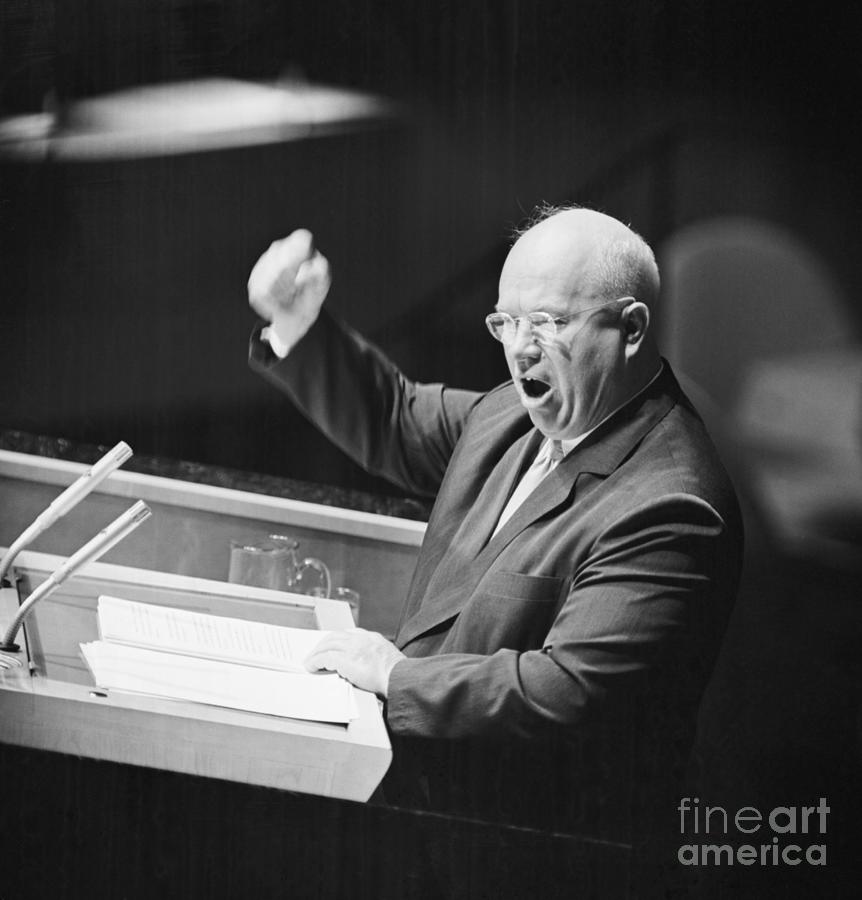
Soviet Premier Nikita Khrushchev, visiting America, represents his own country. He calls Sumulong names, which, when translated into English, come out as a "jerk," a "stooge," a "lackey," and a "toady of American imperialism."

Sumulong resumes his speech, and Khrushchev starts pounding his fist on the table. This is captured on film. Supposedly, Khrushchev removes his shoe, and starts banging that on the table as well. That was not captured on film, and a photograph supposedly showing it was found to be doctored, and from an earlier incident.

In his memoir, published after his ouster in 1964, Khrushchev claimed he'd done it to protest something done by the fascist regime in Spain, run by Francisco Franco. But that speech was in Moscow on October 1. And his shoes were not mentioned in the Soviet media at the time, for either the October 1 speech or the October 12 speech.

His son Sergei wrote a biography of him, and said he couldn't find any visual evidence of the shoe-banging. Both NBC and Canada's CBC broadcast the speech live, but, in each case, their representatives now say they have no footage of Khrushchev banging his shoe on any table. Italy's RAI say they do, but they haven't produced it.

This wasn't the 1st time Khrushchev had been misunderstood by the West. On November 18, 1956, he held a reception for Western ambassadors at the Polish Embassy in Moscow. He said, "About the capitalist states, it doesn't depend on you whether or not we exist. If you don't like us, don't accept our invitations, and don't invite us to come to see you. Whether you like it or not, history is on our side."

This was a statement similar to the one that Fidel Castro, eventually to be dictator of Cuba, had already said of himself: "History will absolve me." (Spoiler Alert: History wasn't on the Soviets' side, and it hasn't absolved Castro, either.)

Right after saying, "History is on our side," Khrushchev said, "My vas pokhoronim!" His personal interpreter, Viktor Sukhodrev (who managed to stay in the good graces of Soviet leaders all the way to Mikhail Gorbachev), translated this as, "We will bury you!"

It sure sounded like a threat, from a man who had access to nuclear weapons. But Khrushchev had risen from peasant status, a farmer-turned-leader, much like his American contemporaries, Presidents Harry Truman and Lyndon Johnson. His remark was actually a rather common saying in Russia, and its implication isn't, "We will kill you," but, "We will attend your funeral." It can also mean, "You are digging your own grave."

Like Joseph Stalin, Nikita Khrushchev wasn't much of a sports fan. Unlike Stalin, Khrushchev did accept that sports could be used as propaganda. This incident was a few weeks after the Olympics in Rome, one of those occasional East vs. West sports encounters; 5 months after Khrushchev embarrassed President Dwight D. Eisenhower over the shot-down U-2 spy plane piloted by Gary Powers; and during the debates to succeed Ike, between his Vice President, Richard Nixon, and Senator John F. Kennedy, one of which was to be held the following night.

A year earlier, Khrushchev visited America, and was cheered in San Francisco. "This is the damnedest city," said Frank Conniff of the arch-conservative Hearst newspaper chain, including their flagship, the San Francisco Examiner, and the New York Journal-American. "They cheer Khrushchev and boo Willie Mays."

*

October 12, 1960 was a Wednesday. It was also the day the film The Magnificent Seven premiered. I have a separate entry for that.

It was the day of Game 6 of the World Series. Whitey Ford pitches a 7-hit shutout, and singles home the 1st run of a 12-0 New York Yankees rout of the Pittsburgh Pirates at Forbes Field. There will be a Game 7 tomorrow, also in Pittsburgh.

The Yankees had won their 3 games 16-3, 10-0 and 12-0. The Pirates wins had been by scores of 6-4, 3-2 and 5-2. It seems as though a high-scoring game favors the Yankees. And the Yankees will score 9 runs in Game 7, while the Pirates hadn't yet scored more than 5. Sounds like a Yankee title. Except...

Football was in midweek. The NBA season didn't begin until November 1. There was 1 NHL game that day: The Chicago Black Hawks beat the Toronto Maple Leafs, 3-0 at the Chicago Stadium.

Thursday, September 15, 2022

September 15, 1959: Khrushchev Comes to America

September 15, 1959: Soviet Premier Nikita Khrushchev arrives in the U.S., the 1st visit to America by a Russian or Soviet leader, ever. He brought his wife Nina and their adult children, including his lookalike son Sergei – who, in defiance of his father’s previous proclamation, "We will bury you," became an American citizen and a professor at Brown University in Providence, Rhode Island.

"Mr. K" visited New York, Los Angeles, San Francisco, a farm in Iowa, Pittsburgh and Washington, including meeting with President Dwight D. Eisenhower for a summit at Camp David (named for Ike's grandson). His New York visit included a meeting with Eleanor Roosevelt at Hyde Park.

On his visit to Los Angeles, he wanted to visit Disneyland, but it was canceled due to security concerns. He didn't like that. So he asked to see the filming of a real Hollywood movie. The one he watched was Can-Can, based on the play by Abe Burrows, music by Cole Porter, and starring Frank Sinatra and Shirley MacLaine. When he got back to Moscow, he called the film "depraved" and "pornographic."

San Francisco Examiner columnist Frank Conniff wrote of his hometown, syndicated throughout the country via the conservative Hearst media company, "This is the damndest city: They cheer Khrushchev and boo Willie Mays!"

Time magazine had named Khruschchev its Man of the Year for 1957. For 1959, it gave the award to Eisenhower.

*

September 15, 1959 was a Tuesday. These baseball games were played:

* The New York Yankees lost to the Chicago White Sox, 4-3 at Yankee Stadium. The South Siders scored 2 runs in the 8th and 1 in the 9th to come from behind, while the Yankees could only muster 1 run in the bottom of the 9th. Billy Pierce was the winning pitcher, while Whitey Ford blew a save in relief of Ralph Terry. Nellie Fox, soon to be named the American League's Most Valuable Player, went 3-for-4 with a walk. Mickey Mantle hit 2 home runs, but it wasn't enough.

One week later, the White Sox would clinch the American League Pennant. Only 2 AL Pennants between 1949 and 1964 were won by teams other than the Yankees: This one, and in 1954, by the Cleveland Indians. Both the '54 Indians and the '59 ChiSox had Al Lopez as their manager.

* The Boston Red Sox beat the Cleveland Indians, 1-0 at Fenway Park in Boston. Tom Brewer pitched a 6-hit shutout. Ted Williams singled as a pinch-hitter.

* The Baltimore Orioles beat the Detroit Tigers, 2-1 at Memorial Stadium in Baltimore. An error by Tiger catcher Lou Berberet on a grounder by his opposite number, Gus Triandos, let the winning run score in the bottom of the 11th inning. Brooks Robinson went 1-for-4. Al Kaline went 2-for-4 with a walk and an RBI.

* A doubleheader was split at Griffith Stadium in Washington. The Washington Senators won the opener, 1-0. Camilo Pascual pitched a 3-hit shutout. The Kansas City Athletics won the nightcap, 6-2. Over the 2 games, Roger Maris went 2-for-7 with a walk and an RBI for the A's. Harmon Killebrew went 1-for-7 with a walk for the Senators.

* The St. Louis Cardinals beat the Philadelphia Phillies, 6-4 at the 1st Busch Stadium (formerly the last Sportsman's Park) in St. Louis. Stan Musial did not play.

* The Los Angeles Dodgers beat the Milwaukee Braves, 8-7 at the Los Angeles Memorial Coliseum. The Braves scored a run in the top of the 10th inning, but in the bottom half, the Dodgers tied it, and then Don McMahon walked Joe Pignatano with the bases loaded to give the former Brooklyn team the win.

Duke Snider left the game with an injury after going 0-for-1, but his replacement in center field, Ron Fairly, went 2-for-4 with a walk and an RBI. Hank Aaron went 4-for-6 with 3 RBIs, but this did not include any of his 755 home runs.

* The San Francisco Giants beat the Cincinnati Reds, 13-6 at Seals Stadium in San Francisco. Khrushchev did not attend. Willie Mays, who was not booed, went 2-for-3 with 2 walks and an RBI. Willie McCovey, about to be named the National League Rookie of the Year, went 3-for-5 with a home run and 2 RBIs. Frank Robinson went 0-for-1 before leaving the game with an injury.

* And the game between the Chicago Cubs and the Pittsburgh Pirates at Wrigley Field in Chicago was postponed -- not due to rain, but due to cold weather. It was made up as part of a doubleheader the next day. The Pirates won the 1st game, 3-2. The Cubs won the 2nd game, 4-2. They scored a run in the 8th and 2 in the 9th, on a home run by Sammy Taylor, to come from behind.

Over the 2 games, Ernie Banks, soon to be named the NL's Most Valuable Player, went 4-for-8 with 2 RBIs, and Roberto Clemente went 5-for-8 with an RBI.

Tuesday, August 30, 2022

August 30, 1963: The Moscow-Washington Hot Line

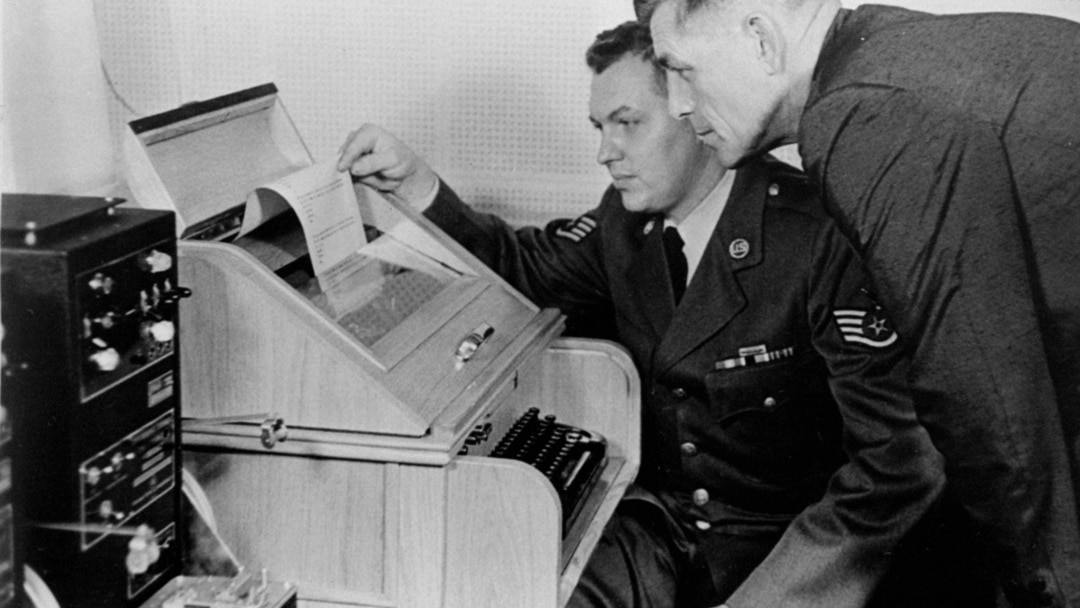
August 30, 1963: The Moscow-Washington Hot Line goes into operation. It was put in place in the wake of the Cuban Missile Crisis the previous year, to make for quicker diplomacy.

In American popular culture, the Hot Line usually appears as a red telephone on the desk of the President of the United States. It has never been a phone, it has never been in the White House, and it doesn't link the 2 countries' respective heads of state.

Rather, it was originally a Teletype machine, became a fax machine in 1986, and a secure computer link in 2008; and its Washington end is actually across the Potomac River in Arlington, Virginia, at the Pentagon, the headquarters of the U.S. Department of Defense, while the Russian end is in the General Staff Building, home of the Russian Federation's Ministry of Defense. Of course, the respective Presidents do have secure phone lines that they can use to talk directly to each other, through translators.

Through August 30, 2022, it has been used 11 times:

* In 1963, following the assassination of President John F. Kennedy.
* 1967, during the Arab-Israeli Six-Day War.
* 1971, during the India-Pakistan War.
* 1973, during another Arab-Israeli conflict, the Yom Kippur War.
* 1974, during the Turkish invasion of Cyprus.
* 1979, after the Soviet invasion of Afghanistan.
* 1981, when the Soviets were threatening to invade Poland.
* 1982, during the Israeli invasion of Lebanon.
* 1991, during the Persian Gulf War.
* 2003, during the Iraq War.
* And, most recently, on October 31, 2016, when Barack Obama told Vladimir Putin he'd better not interfere in the Presidential election that was happening 8 days later. Putin interfered anyway.

*

August 30, 1963 was a Friday. This was also the day that the modern audio cassette tape, and the tape recorder that used it, were both introduced to the public by the Philips Company. I have a separate entry for that event. Actor Michael Chiklis was born that day.

And these baseball games were played:

* The New York Yankees beat the Baltimore Orioles, 4-1 at Memorial Stadium in Baltimore. Al Downing outpitched Steve Barber. Barber's arm probably wasn't sore, just a little stiff. (Ball Four reference.) Mickey Mantle, Roger Maris and Yogi Berra were all held out of this game. Brooks Robinson went 0-for-4.

* The New York Mets lost to the Milwaukee Braves, 3-1 at the Polo Grounds. Hank Aaron went 0-for-4. Duke Snider appeared as a pinch-hitter for the Mets, but did not reach base.

* The St. Louis Cardinals beat the Philadelphia Phillies, 11-6 at Connie Mack Stadium in Philadelphia. In his final season, Stan Musial got the day off.

* The Washington Senators beat the Boston Red Sox, 7-0 at Fenway Park in Boston. Claude Osteen pitched a 5-hit shutout. Carl Yastrzemski did not play for the Sox.

* The Cincinnati Reds beat the Pittsburgh Pirates, 2-1 at Forbes Field in Pittsburgh. Frank Robinson went 1-for-4. So did Pete Rose, soon to be named National League Rookie of the Year. So did Roberto Clemente, who also had an RBI.

* The Cleveland Indians beat the Detroit Tigers, 5-4 at Cleveland Municipal Stadium. Al Kaline went 0-for-4.

* The Houston Colt .45s beat the Chicago Cubs, 5-1 at Wrigley Field in Chicago. Ernie Banks did not play. The Colts became the Houston Astros in 1965.

* The Minnesota Twins beat the Chicago White Sox, 5-3 at Metropolitan Stadium in the Minneapolis suburb of Bloomington, Minnesota. Harmon Killebrew and Bob Allison hit home runs.

* The Los Angeles Angels beat the Kansas City Athletics, 6-2 at Kansas City Municipal Stadium.

* And the Los Angeles Dodgers beat their arch-rivals, the San Francisco Giants, 3-1 at Dodger Stadium in Los Angeles. Don Drysdale outpitched Juan Marichal. Willie Mays went 2-for-4, and drove in the Giants' only run.

Saturday, August 13, 2022

August 13, 1961: The Berlin Wall Goes Up

August 13, 1961: The German Democratic Republic -- better known as East Germany, since it was not democratic and not a republic -- closes the border between the Eastern and Western Sectors of Berlin, to thwart its inhabitants' attempts to escape to the West. Construction of the Berlin Wall -- Der Berliner Mauer -- is started. The day is known as Stacheldraht-Sonntag -- Barbed Wire Sunday.

After the defeat of the Nazis in 1945, the German capital of Berlin was divided into 4 Sectors, 1 for each of the main victorious Allies: American in the southwest, British in the central west, French in the northwest, and Soviet in the east. In 1948, the Soviet Union sealed the border, trying to starve West Berlin (American, British and French) into submission. In response, President Harry S Truman started the Berlin Airlift, and the Soviets couldn't stop it, and gave up.

Now, in 1961, tensions had been again been rising between America and the Soviet Union over the status of Berlin. In June, President John F. Kennedy and Soviet Premier Nikita Khrushchev met for a summit in Vienna, Austria. It was the only time they would meet face-to-face.

The 67-year-old Khrushchev, already a hardened veteran of World War I by the time JFK was born in 1917, thought he could intimidate the youngest man ever elected President of the United States. He was right: The 44-year-old Kennedy was out of his league -- for the moment. By July, he was calling up U.S. Army Reserve units to send to West Berlin, because Khrushchev was doing the same with his country's Red Army.

The Warsaw Pact, dominated by the Soviets with East Germany as its 2nd-ranking partner, called the Wall "the Antifascist Protection Rampart." The idea was that it was supposed to keep America and its NATO allies, including Britain and France, out. This was a cover: So many people were fleeing from East Berlin to West Berlin that the Pact was willing to put the Wall up, heavily guarded by sniper towers, to stop them.

In his speech accepting the 1964 Republican nomination for President, Senator Barry Goldwater of Arizona called it "the wall of shame in Berlin." But, at the time, Kennedy was relieved: Better a wall than a war. Time magazine named Kennedy its Man of the Year for 1961.

The Cold War had nearly gotten hot, but had cooled off again. It nearly became World War III in October 1962, with the Cuban Missile Crisis. But Kennedy and Khrushchev, communicating by translator-aided phone, avoided it. In June 1963, Kennedy proposed a Nuclear Test Ban Treaty, and Khrushchev accepted it.

Later that month, Kennedy visited West Berlin. At City Hall, not far from the Wall, he gave a speech remembered for its metaphor-launching close: "All free men, wherever they may live, are citizens of Berlin. Therefore, as a free man, I take pride in the words, 'Ich bin ein Berliner.'" More important were these words, earlier in the speech: "Freedom has many difficulties, and democracy is not perfect. But we have never needed to put a wall up to keep our people in."

Goldwater thought he could use "the wall of shame" to beat Kennedy in 1964. But when Kennedy died a year before the election, from an assassin's bullet, Goldwater knew his chance of winning had also died. The Cold War was supposed to be his issue, not the Democrats', and the new President, Lyndon Johnson, clobbered him with it (among other issues).

In 1987, another President, Ronald Reagan, spoke in front of the Brandenburg Gate, which turned out to be a convenient landmark between East and West, with the Wall blocking access to it, and challenged the current Soviet leader, Mikhail Gorbachev: "Mr. Gorbachev, tear down this wall!"

He didn't. It would be another 2 1/2 years, after Reagan left office, before the East German government removed travel restrictions, rendering the Wall meaningless. It was the people of Berlin, East and West, who began tearing it down, after 28 years.

No one is sure how many people tried to escape through openings in the Wall, or climbing over it, or tunneling under it, during those 28 years. A fair estimate was 5,000 succeeding, and about 200 being shot and killed in attempts.

*

August 13, 1961 was a Sunday. Actress Dawnn Lewis was born.

This was the off-season for the NFL, the AFL, the NBA and the NHL. But it was still the era of Sunday doubleheader, so a full slate of Major League Baseball games was played, and then some:

* The New York Yankees split a doubleheader with the Washington Senators at Griffith Stadium in Washington. 

The Senators won the opener, 12-2. Bud Daley got shelled, and then so did Hal Reniff. The only Yankee runs came on a pair of solo home runs -- Roger Maris' 44th of the season, and Mickey Mantle’s 45th.

The Yankees won the nightcap, 9-4. Jim Coates went the distance for the win. Maris hit his 45th homer, and Clete Boyer hit his... 8th. Mantle didn't get a hit in this game.

* The Baltimore Orioles beat the Boston Red Sox, 6-5 at Memorial Stadium in Baltimore. The Sox scored in the 1st inning, and led 1-0 in the 4th, 3-1 in the 5th, and scored in their half of the 10th and the 11th, and still blew it. They blew 4 separate leads.

Arnold Earley pitched to 1 batter in the game, Russ Snyder, who bunted on him, and Earley threw the ball away, allowing the winning run to score in the bottom of the 11th inning.

* The Pittsburgh Pirates beat the Philadelphia Phillies, 13-4 at Forbes Field in Pittsburgh. This was the 16th game in a string of 23 consecutive losses for the Phils, still the longest in MLB since 1899.

* The Los Angeles Angels beat the Cleveland Indians, 8-7 at Cleveland Municipal Stadium. 

* The Chicago White Sox beat the Kansas City Athletics, 9-3 at Comiskey Park in Chicago.

* The Milwaukee Braves beat the Chicago Cubs, 8-3 at Milwaukee County Stadium. Hank Aaron got 2 hits, neither of them a home run. Eddie Mathews hit one.

* The Minnesota Twins beat the Detroit Tigers, 13-5 at Metropolitan Stadium in the Minneapolis suburb of Bloomington, Minnesota.

* The Los Angeles Dodgers beat the St. Louis Cardinals, 8-0 at the Los Angeles Memorial Coliseum. Despite allowing 8 hits, Stan Williams pitched a shutout.

* And the Cincinnati Reds beat the San Francisco Giants, 8-1 at Candlestick Park in San Francisco. Willie Mays went 1-for-4 in a losing cause.

Sunday, July 24, 2022

July 24, 1959: The Nixon-Khrushchev "Kitchen Debate"

July 24, 1959: Vice President Richard Nixon, accepting an invitation on behalf of the unavailable President Dwight D. Eisenhower, attends the opening of the American National Exhibition, at Sokolniki Park in Moscow.

It was the 2nd half of a cultural exchange that was supposed to bring the United States and the Soviet Union closer together in peaceful competition. The 1st half was held in New York in June, and was considered a success by both sides, so there was hope for a continuation.

On display in Moscow was an exhibition of American art, fashion, cars, and model homes, including what was then described in the American media as "futuristic kitchens." The press agent was William Safire, who thus began a professional relationship with Nixon that lasted for the rest of Nixon's life, first as a campaign advisor, then as a speechwriter, and finally, starting in 1973, as a Nixon-friendly columnist for the otherwise-Nixon-unfriendly New York Times. That column ran until 2005, well after Nixon's death.

Khrushchev, already 65 years old, was dismissive of the American technology in front of Nixon, 46 but nearing the end of his 2nd term as Eisenhower's Vice President. Having previously told the West in general, "We will bury you" in a 1956 speech -- it was later suggested that he meant not, "We will kill you," but, "We will attend your funeral," or, "You are digging your own grave" -- Khrushchev asked Nixon, "This is what America is capable of, and how long has she existed? 300 years? 150 years of independence? And this is her level. We haven't quite reached 42 years, and, in another 7 years, we'll be at the level of America, and, after that, we'll go farther."

And yet, he also maintained that the technology -- things like electric juicers and can openers -- were harder to use than the traditional hand-driven methods, and, remembering a scene from Charlie Chaplin's 1936 film Modern Times, mockingly asked Nixon, "Don't you have a machine that puts food into the mouth and pushes it down?" Nixon responded that at least their competition was technological, rather than military.

Nixon pointed out that there were areas where each side was ahead of the other. He cited the Soviets being ahead in rocket power, and the Americans ahead in color television. Khrushchev said, "Nyet," and wagged his finger at Nixon, not to deny that the Americans were ahead in color TV, but dismissing the idea that being ahead on that subject mattered much.

The American reaction to all this was mixed. Conservative media said that it showed that Nixon, who soon had to make the decision of whether to run for President in 1960, as Eisenhower was the 1st President ever to be limited to the 2 terms of the 22nd Amendment, had gone toe-to-toe, face-to-face with the leader of America's greatest enemy, the much older, far more experienced bald (albeit short) bully Khrushchev, and had held his own, so he was ready to lead the nation as "Ike" retired.

More liberal observers thought that the "Kitchen Debate" was just a publicity stunt, and that it wouldn't matter when Nixon faced the Democratic nominee for President in 1960, whoever that turned out to be.

It turned out to be Senator John F. Kennedy of Massachusetts. And when they held their 1st debate, the argument for Nixon in '59 became the argument against him in '60: Kennedy, though just 4 years younger, had outdebated the more strictly experienced man.

After losing to Kennedy, Nixon set about writing a book about his political experience thus far. He titled it Six Crises, and listed the Kitchen Debate was one of them, along with the Alger Hiss hearings, what became known as the Checkers Speech, President Eisenhower's 1955 heart attack, his troubled 1958 tour of South America, and his defeat to Kennedy.

*

July 24, 1959 was a Friday. These baseball games were played that day:

* The New York Yankees lost to the Detroit Tigers, 4-2 at Briggs Stadium in Detroit. (It was renamed Tiger Stadium in 1959.) Don Mossi went the distance for the Tigers, and Don Larsen only lasted 1 inning, helping pave the way for his inclusion, after the season, in the trade that brought Roger Maris to The Bronx. Eddie Yost hit a home run for the Tigers, and Al Kaline went 1-for-3 with a walk. Mickey Mantle went 0-for-4, and Elston Howard hit a home run in the 9th to give the Yankees a little hope.

* The Cleveland Indians beat the Washington Senators, 5-2 at Cleveland Municipal Stadium.

* The Philadelphia Phillies beat the Cincinnati Reds, 2-1 at Crosley Field in Cincinnati. Frank Robinson went 2-for-4. The game was scoreless going to the bottom of the 8th, when Eddie Kasko hit a home run for the Reds. But in the top of the 9th, Carl Sawatski hit a 2-run homer to win it for the Phils.

* The Chicago White Sox beat the Baltimore Orioles, 2-1 at Comiskey Park in Chicago. Brooks Robinson went 2-for-4.

* The Milwaukee Braves beat the Pittsburgh Pirates, 8-0 at Milwaukee County Stadium. Juan Pizarro pitched a 4-hit shutout. Joe Adcock hit a home run. Hank Aaron went 2-for-4 with a walk and 2 RBIs. Roberto Clemente went 1-for-4.

* The Kansas City Athletics beat the Boston Red Sox, 3-1 at Kansas City Municipal Stadium. Yankee-to-be Roger Maris went 2-for-4 with an RBI, and manager-to-be (but not for the Yankees) Dick Williams hit a home run. For the Red Sox, Ted Williams appeared only as a pinch-hitter, and did not reach base.

* The St. Louis Cardinals beat the Los Angeles Dodgers, 2-1 at the Los Angeles Memorial Coliseum. Stan Musial did not play.

* And the San Francisco Giants beat the Chicago Cubs, 6-5 at Seals Stadium in San Francisco. Jim Davenport singled home the winning run in the bottom of the 10th inning. Willie Mays appeared as a pinch-hitter and then took over in center field, with a single and a walk. Ernie Banks went 0-for-1 and then left the game due to injury.

Wednesday, July 6, 2022

July 6, 1959: The Harlem Globetrotters In Moscow

July 6, 1959: As part of a cultural exchange program, which ends up including the "Kitchen Debate" between Vice President Richard Nixon and Soviet Premier Nikita Khrushchev, basketball's Harlem Globetrotters play a game in Moscow, the capital of the Soviet Union.

Since 1927, the all-black Globies -- or the Trotters, if you prefer -- had been entertaining crowds all over the world with trick plays when they could, and with great basketball skill when they had to. They would play anybody, anywhere. In the late 1940s and early 1950s, they played a few games against the top team in the still-all-white pro leagues, the Minneapolis Lakers, and won the 1st 2 times before the Lakers managed to adjust.

Vasily Gricorevich, the director of Lenin Central Statium (later renamed the Luzhniki Stadium), extended an invitation to the Globetrotters. They played 9 games there, outdoors, in front of crowds in excess of 60,000, starting on July 6.

Among the Globetrotter players who made the trip were 3 whose uniform numbers would later be retired by the team: Charles "Tex" Harrison, Number 34; Meadowlark Lemon, Number 36; and Wilt Chamberlain, Number 13.

(They've honored 8 players in total. The others: Reece "Goose" Tatum, Number 50, from the 1940s and early '50s; Marques Haynes, Humber 20, from the same era, and returned as an elder statesman in the 1970s; Hubert "Geese Ausbie, Number 35, and Fred "Curly" Neal, Number 22, who played from the early 1960s to the mid-1980s; and Sweet Lou Dunbar, Number 41, who played in the 1970s and '80s, and now coaches the team.)

Chamberlain had starred at the University of Kansas, and wanted to turn pro, but the NBA wouldn't let him play until his college class had graduated in the Spring of 1959. So he played the 1958-59 season with the Globetrotters, and made more money with them in that one year, and certainly traveled to more places, and more interesting ones, than he did in each of his first few years in the NBA, with his hometown Philadelphia Warriors.
The previous season, 1957-58, Bob Gibson, who had starred on the court for Omaha's Creighton University before a Hall of Fame career pitching for baseball's St. Louis Cardinals, played for the Globetrotters. An urban legend said that Gibson quit because he couldn't stand the clowning, but it was really the constant traveling that made him give baseball a full go. Chamberlain later admitted that he loved the stunts.

In his writeup of the 1st game for Pravda, the official newspaper of the Communist Party, Gregor Belevich was not kind:

This is not basketball; it is too full of tricks. The Harlem Globetrotters from New York City played tonight against Basketball Club Dynamo of Moscow in what was presented to be a virtuous competition of basketball but was in fact nothing of the sort. These Americans are men big of the body, but made small by their deeds...

By relying on hoax and chicanery, these Globetrotters have surely become beholden to deception at the expense of their competitive spirit and industriousness (a more apt team of representatives from America this reporter cannot think of…). While the final score was 98–42 in favor of the Globetrotters, it is better to go to bed supperless than to rise in debt.

Dynamo was then known for its great soccer team, but also had the best basketball team in the U.S.S.R. at the time. It should also be noted that, while Harlem is in New York City, it was chosen as an identifier to indicate that the team was all-black. The team was actually based in Chicago, hometown of their founder, owner and manager, Abe Saperstein. Later ownership groups would move the team's organization to Los Angeles, and now to Phoenix.

But the fans did not agree with Belevich, and loved what they saw. Khrushchev met with them, and awarded them the Order of Lenin. While this medal could be given to Soviet citizens for various forms of service, it was also the highest award the country could give to a foreigner, usually to "Those who promoted friendship and cooperation between people and in strengthening peace."

The 2 leading newspapers in the Soviet Union were Pravda, meaning "Truth"; and Izvestia, meaning "News." This led to a joke: "There is no news in the Truth, and there is no truth in the News."

On this same trip, the Globetrotters played in Germany, Italy, Switzerland, and -- no doubt due to some very delicate negotiations, as that nation was still largely closed to the West -- the People's Republic of China. Chamberlain was with them the whole way, before departing for the Warriors.

Interviewing him for his radio show in 1986, Philadelphia basketball historian Sonny Hill, told his listeners, "In the Fifties, they knew about Wilt Chamberlain in China! That's how big of a man he was, and is!" And, in this case, "big" did not refer to the man's physical size, but his impact.

*

July 6, 1959 was a Monday. There were no scores on this historic day: Baseball was in its All-Star Break, and no other sports were in season.

December 31, 1999 & January 1, 2000: The Millennium

December 31, 1999:  The Millennium arrives. The people of planet Earth survived. At a terrible cost. But we hadn't destroyed ourselves. ...