Showing posts with label we will bury you. Show all posts

Wednesday, October 12, 2022

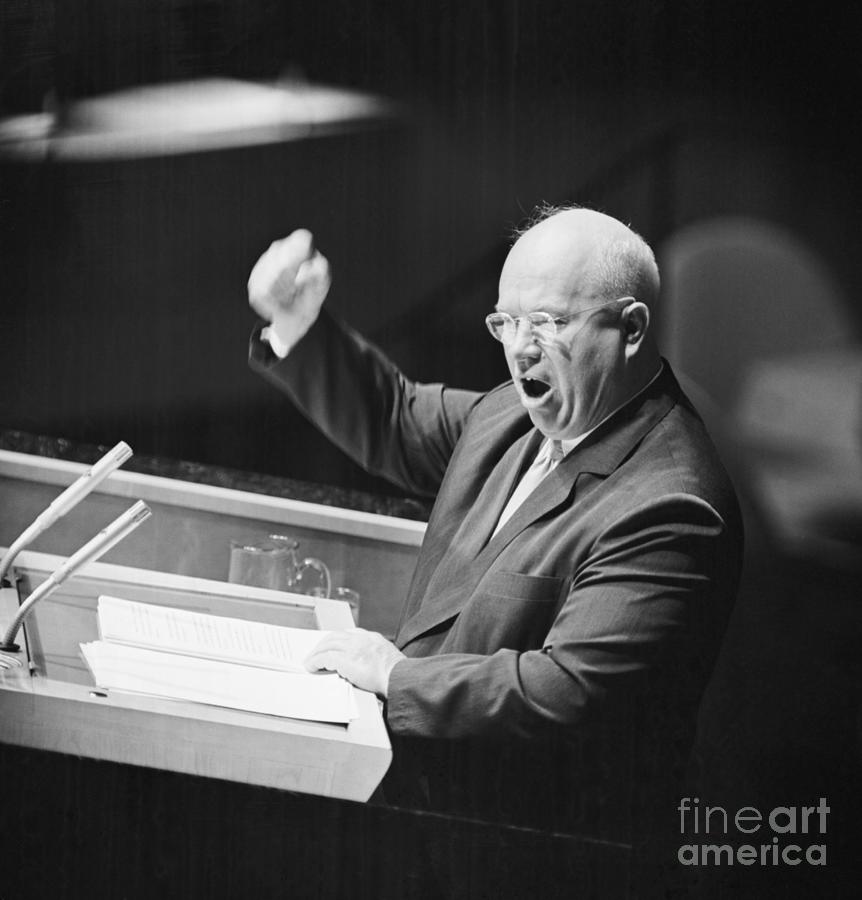
October 12, 1960: Nikita Khrushchev at the United Nations

October 12, 1960: The United Nations General Assembly is meeting at the UN Building on the East River at 42nd Street in Manhattan. Lorenzo Sumulong, Ambassador to the UN from the Philippines, claims that the Soviet Union is conducting "colonial policy" in Eastern Europe.

Soviet Premier Nikita Khrushchev, visiting America, represents his own country. He calls Sumulong names, which, when translated into English, come out as a "jerk," a "stooge," a "lackey," and a "toady of American imperialism."

Sumulong resumes his speech, and Khrushchev starts pounding his fist on the table. This is captured on film. Supposedly, Khrushchev removes his shoe, and starts banging that on the table as well. That was not captured on film, and a photograph supposedly showing it was found to be doctored, and from an earlier incident.

In his memoir, published after his ouster in 1964, Khrushchev claimed he'd done it to protest something done by the fascist regime in Spain, run by Francisco Franco. But that speech was in Moscow on October 1. And his shoes were not mentioned in the Soviet media at the time, for either the October 1 speech or the October 12 speech.

His son Sergei wrote a biography of him, and said he couldn't find any visual evidence of the shoe-banging. Both NBC and Canada's CBC broadcast the speech live, but, in each case, their representatives now say they have no footage of Khrushchev banging his shoe on any table. Italy's RAI say they do, but they haven't produced it.

This wasn't the 1st time Khrushchev had been misunderstood by the West. On November 18, 1956, he held a reception for Western ambassadors at the Polish Embassy in Moscow. He said, "About the capitalist states, it doesn't depend on you whether or not we exist. If you don't like us, don't accept our invitations, and don't invite us to come to see you. Whether you like it or not, history is on our side."

This was a statement similar to the one that Fidel Castro, eventually to be dictator of Cuba, had already said of himself: "History will absolve me." (Spoiler Alert: History wasn't on the Soviets' side, and it hasn't absolved Castro, either.)

Right after saying, "History is on our side," Khrushchev said, "My vas pokhoronim!" His personal interpreter, Viktor Sukhodrev (who managed to stay in the good graces of Soviet leaders all the way to Mikhail Gorbachev), translated this as, "We will bury you!"

It sure sounded like a threat, from a man who had access to nuclear weapons. But Khrushchev had risen from peasant status, a farmer-turned-leader, much like his American contemporaries, Presidents Harry Truman and Lyndon Johnson. His remark was actually a rather common saying in Russia, and its implication isn't, "We will kill you," but, "We will attend your funeral." It can also mean, "You are digging your own grave."

Like Joseph Stalin, Nikita Khrushchev wasn't much of a sports fan. Unlike Stalin, Khrushchev did accept that sports could be used as propaganda. This incident was a few weeks after the Olympics in Rome, one of those occasional East vs. West sports encounters; 5 months after Khrushchev embarrassed President Dwight D. Eisenhower over the shot-down U-2 spy plane piloted by Gary Powers; and during the debates to succeed Ike, between his Vice President, Richard Nixon, and Senator John F. Kennedy, one of which was to be held the following night.

A year earlier, Khrushchev visited America, and was cheered in San Francisco. "This is the damnedest city," said Frank Conniff of the arch-conservative Hearst newspaper chain, including their flagship, the San Francisco Examiner, and the New York Journal-American. "They cheer Khrushchev and boo Willie Mays."

*

October 12, 1960 was a Wednesday. It was also the day the film The Magnificent Seven premiered. I have a separate entry for that.

It was the day of Game 6 of the World Series. Whitey Ford pitches a 7-hit shutout, and singles home the 1st run of a 12-0 New York Yankees rout of the Pittsburgh Pirates at Forbes Field. There will be a Game 7 tomorrow, also in Pittsburgh.

The Yankees had won their 3 games 16-3, 10-0 and 12-0. The Pirates wins had been by scores of 6-4, 3-2 and 5-2. It seems as though a high-scoring game favors the Yankees. And the Yankees will score 9 runs in Game 7, while the Pirates hadn't yet scored more than 5. Sounds like a Yankee title. Except...

Football was in midweek. The NBA season didn't begin until November 1. There was 1 NHL game that day: The Chicago Black Hawks beat the Toronto Maple Leafs, 3-0 at the Chicago Stadium.

Sunday, July 24, 2022

July 24, 1959: The Nixon-Khrushchev "Kitchen Debate"

July 24, 1959: Vice President Richard Nixon, accepting an invitation on behalf of the unavailable President Dwight D. Eisenhower, attends the opening of the American National Exhibition, at Sokolniki Park in Moscow.

It was the 2nd half of a cultural exchange that was supposed to bring the United States and the Soviet Union closer together in peaceful competition. The 1st half was held in New York in June, and was considered a success by both sides, so there was hope for a continuation.

On display in Moscow was an exhibition of American art, fashion, cars, and model homes, including what was then described in the American media as "futuristic kitchens." The press agent was William Safire, who thus began a professional relationship with Nixon that lasted for the rest of Nixon's life, first as a campaign advisor, then as a speechwriter, and finally, starting in 1973, as a Nixon-friendly columnist for the otherwise-Nixon-unfriendly New York Times. That column ran until 2005, well after Nixon's death.

Khrushchev, already 65 years old, was dismissive of the American technology in front of Nixon, 46 but nearing the end of his 2nd term as Eisenhower's Vice President. Having previously told the West in general, "We will bury you" in a 1956 speech -- it was later suggested that he meant not, "We will kill you," but, "We will attend your funeral," or, "You are digging your own grave" -- Khrushchev asked Nixon, "This is what America is capable of, and how long has she existed? 300 years? 150 years of independence? And this is her level. We haven't quite reached 42 years, and, in another 7 years, we'll be at the level of America, and, after that, we'll go farther."

And yet, he also maintained that the technology -- things like electric juicers and can openers -- were harder to use than the traditional hand-driven methods, and, remembering a scene from Charlie Chaplin's 1936 film Modern Times, mockingly asked Nixon, "Don't you have a machine that puts food into the mouth and pushes it down?" Nixon responded that at least their competition was technological, rather than military.

Nixon pointed out that there were areas where each side was ahead of the other. He cited the Soviets being ahead in rocket power, and the Americans ahead in color television. Khrushchev said, "Nyet," and wagged his finger at Nixon, not to deny that the Americans were ahead in color TV, but dismissing the idea that being ahead on that subject mattered much.

The American reaction to all this was mixed. Conservative media said that it showed that Nixon, who soon had to make the decision of whether to run for President in 1960, as Eisenhower was the 1st President ever to be limited to the 2 terms of the 22nd Amendment, had gone toe-to-toe, face-to-face with the leader of America's greatest enemy, the much older, far more experienced bald (albeit short) bully Khrushchev, and had held his own, so he was ready to lead the nation as "Ike" retired.

More liberal observers thought that the "Kitchen Debate" was just a publicity stunt, and that it wouldn't matter when Nixon faced the Democratic nominee for President in 1960, whoever that turned out to be.

It turned out to be Senator John F. Kennedy of Massachusetts. And when they held their 1st debate, the argument for Nixon in '59 became the argument against him in '60: Kennedy, though just 4 years younger, had outdebated the more strictly experienced man.

After losing to Kennedy, Nixon set about writing a book about his political experience thus far. He titled it Six Crises, and listed the Kitchen Debate was one of them, along with the Alger Hiss hearings, what became known as the Checkers Speech, President Eisenhower's 1955 heart attack, his troubled 1958 tour of South America, and his defeat to Kennedy.

*

July 24, 1959 was a Friday. These baseball games were played that day:

* The New York Yankees lost to the Detroit Tigers, 4-2 at Briggs Stadium in Detroit. (It was renamed Tiger Stadium in 1959.) Don Mossi went the distance for the Tigers, and Don Larsen only lasted 1 inning, helping pave the way for his inclusion, after the season, in the trade that brought Roger Maris to The Bronx. Eddie Yost hit a home run for the Tigers, and Al Kaline went 1-for-3 with a walk. Mickey Mantle went 0-for-4, and Elston Howard hit a home run in the 9th to give the Yankees a little hope.

* The Cleveland Indians beat the Washington Senators, 5-2 at Cleveland Municipal Stadium.

* The Philadelphia Phillies beat the Cincinnati Reds, 2-1 at Crosley Field in Cincinnati. Frank Robinson went 2-for-4. The game was scoreless going to the bottom of the 8th, when Eddie Kasko hit a home run for the Reds. But in the top of the 9th, Carl Sawatski hit a 2-run homer to win it for the Phils.

* The Chicago White Sox beat the Baltimore Orioles, 2-1 at Comiskey Park in Chicago. Brooks Robinson went 2-for-4.

* The Milwaukee Braves beat the Pittsburgh Pirates, 8-0 at Milwaukee County Stadium. Juan Pizarro pitched a 4-hit shutout. Joe Adcock hit a home run. Hank Aaron went 2-for-4 with a walk and 2 RBIs. Roberto Clemente went 1-for-4.

* The Kansas City Athletics beat the Boston Red Sox, 3-1 at Kansas City Municipal Stadium. Yankee-to-be Roger Maris went 2-for-4 with an RBI, and manager-to-be (but not for the Yankees) Dick Williams hit a home run. For the Red Sox, Ted Williams appeared only as a pinch-hitter, and did not reach base.

* The St. Louis Cardinals beat the Los Angeles Dodgers, 2-1 at the Los Angeles Memorial Coliseum. Stan Musial did not play.

* And the San Francisco Giants beat the Chicago Cubs, 6-5 at Seals Stadium in San Francisco. Jim Davenport singled home the winning run in the bottom of the 10th inning. Willie Mays appeared as a pinch-hitter and then took over in center field, with a single and a walk. Ernie Banks went 0-for-1 and then left the game due to injury.

December 31, 1999 & January 1, 2000: The Millennium

December 31, 1999:  The Millennium arrives. The people of planet Earth survived. At a terrible cost. But we hadn't destroyed ourselves. ...