Showing posts with label rutherford b. hayes. Show all posts

Wednesday, December 21, 2022

December 22, 1877: The American Museum of Natural History Opens

December 22, 1877: The American Museum of Natural History opens in New York, on land bordered by West 81st Street, Central Park West (8th Avenue), West 77th Street and Columbus Avenue (9th Avenue). President Rutherford B. Hayes attends the dedication ceremony.

The Museum is directly across Central Park, 1 mile away, from the Metropolitan Museum of Art. The Museum complex comprises 20 interconnected buildings housing 45 permanent exhibition halls, in addition to the Rose Center for Earth and Space (formerly the Hayden Planetarium) and a library. The museum collections contain about 35 million specimens of plants, animals, fungi, fossils, minerals, rocks, meteorites, human remains, and human cultural artifacts, as well as specialized collections for frozen tissue and genomic and astrophysical data, of which only a small fraction can be displayed at any given time.

The Museum occupies more than 2.5 million square feet, has a full-time scientific staff of 225, sponsors over 120 special field expeditions each year, and averages about 5 million visits annually. It is a private 501(c)(3) organization. Its mission statement is: "To discover, interpret, and disseminate -- through scientific research and education -- knowledge about human cultures, the natural world, and the universe."

The main entrance and lobby, on Central Park West, were built in 1936, as the official New York State Memorial to Theodore Roosevelt. The 26th President of the United States was the 1st President born in New York City -- Donald Trump was the 2nd, but we don't count him -- and the Roosevelt family has been a major benefactor to the museum, dating back to his father, also named Theodore Roosevelt. TR's 1909-10 hunting trip to Africa resulted in hundreds of specimens that he sent back to the Museum.
In 1940, an equestrian statue of TR, sculpted by James Earle Fraser, was placed at the Central Park West entrance. Unfortunately, on either side of the horseborne TR is a Native American man and a sub-Saharan African man. The statue has thus been called racially insensitive. TR's grandson, investment banker Theodore Roosevelt IV, supported the calls for its removal, which was done in 2022.
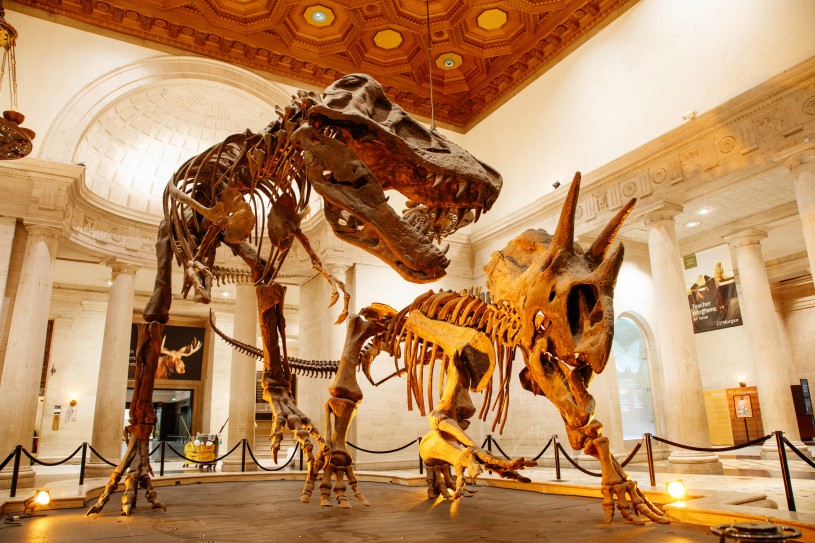
Part of the dinosaur display. TR was a bit old-fashioned,
and he could be intimidating, but he was not a dinosaur.

When I was a kid, the Museum was my favorite place in the whole world. All those stuffed animals, and the dinosaur skeletons, and the Milstein Hall of Ocean Life, opening in 1924, with the giant blue whale suspended from the ceiling. The Planetarium hit my interest in astronomy.
We went there many times between my ages of 4 and 15. I didn't get to go back until my nieces were old enough to go. By that point, my legs were in such bad shape that all that walking on hard floors left me in misery. Fortunately, I've since gotten my hips replaced, and have been to other museums with them without pain.

*

December 22, 1877 was a Saturday. There were no scores on this historic day. 

Sunday, November 20, 2022

November 21, 1877: Thomas Edison Invents the Phonograph

November 21, 1877: Thomas Edison invents the phonograph at his laboratory in the Menlo Park section of Raritan Township, Middlesex County, New Jersey. It is the 1st device capable of recording sound.

It recorded on tinfoil around a grooved cylinder. Into its speaker -- partly because it was the only way it could be done, and partly because he was hard of hearing -- Edison shouted into it, an old nursery rhyme:

Mary had a little lamb!
Its fleece was white as snow!
And everywhere that Mary went
the lamb was sure to go!

Although that recording does not survive, Edison recorded it again for a demonstration years later, and that one does survive.

Edison already had many patents to his name, making him wealthy. But the phonograph was the one that first got him national attention. Over the next few years, other scientists, including telephone inventor Alexander Graham Bell, made improvements that made the recording industry possible.

Edison died in 1931. In 1954, to differentiate itself from the other towns in New Jersey named Raritan, the town that included the neighborhood of Menlo Park changed its name to the Township of Edison. It later erected a monument on the site of Edison's laboratory, a "Light Tower" that referenced his invention of the incandescent lamp, the 1st practical light bulb, in 1879.

*

November 21, 1877 was a Wednesday. Traditionally, this is not a day on which football games are played. But one was: On what was then its home field, Hamilton Park in New Haven, Connecticut, Yale University beat Trinity College of Hartford, 7-0.

Thursday, November 10, 2022

November 11, 1880: The Execution of Ned Kelly

November 11, 1880: Ned Kelly is executed in Melbourne, in the Colony of Victoria, eventually to become the State of Victoria, in the not-yet-independent nation of Australia.

Edward Kelly, like many Edwards nicknamed "Ned" (or "Ted"), was born in Beveridge, in Victoria. The exact date of his birth is not recorded, but anecdotal evidence suggests it was in early December 1854. At the time, despite a civilian civilization being built there, Australia was still a destination for transported convicts, and Kelly's father, John, from County Tipperary, Ireland, was one. He died when Kelly was 12.

Kelly became a "bushranger," essentially the Australian equivalent of a desperado in America's Wild West at the same time. Twice, he was sent to prison. In 1878, along with his younger brother Dan and gang members Joe Byrne and Steve Hart, he shot 3 Victoria policemen, and they were declared outlaws, forcing them into hiding.

Like his contemporary, the American outlaw Jesse James, he was seen as a Robin Hood type, who stood up to the authorities on behalf of the people. This led to assistance from many sympathizers, and he was able to evade the law, until June 26, 1880. He and his men had crafted crude body armor, but it didn't work: In a shootout with the police at Glenrowan, Victoria, he was wounded, and the rest of his gang was killed.

Despite thousands of supporters attending rallies and signing a petition for his reprieve, Kelly was tried, convicted and sentenced to death by hanging, which was carried out at the Old Melbourne Gaol on November 11, 1880. Kelly was a little short of turning 26.

Kelly became a cultural icon, inspiring art and films, and is the subject of more biographies than any other Australian. More so than such American outlaws as James, Butch Cassidy & the Sundance Kid, or Depression-era outlaws such as Bonnie Park & Clyde Barrow, Kelly continues to cause division in his homeland: Some celebrate his Robin Hood-like status, while others regard him as a murderous villain undeserving of his folk hero status.

*

November 11, 1880 was a Thursday. Baseball was out of season. Football was in midweek. Hockey was not yet organized. And basketball had not yet been invented. So there were no scores on this historic day.

Sunday, November 6, 2022

November 7, 1876: Samuel Tilden Is Elected President, But Not Really

November 7, 1876: Samuel Jones Tilden, former Governor of New York, wins the popular vote and the Electoral Vote in the Presidential election, defeating the Governor of Ohio, Rutherford B. Hayes. Tilden got 51 percent of the popular vote, to Hayes' 48; and 204 Electoral Votes, to Hayes' 165.

What's that? You've never heard of Tilden? That's not surprising, unless you're a history buff, or are from Brooklyn where there's a high school named for him, or Nebraska where there's a town named for him (the hometown of Baseball Hall-of-Famer Richie Ashburn). He didn't get to become President, because the Republicans stole the Electoral Votes of Louisiana (8), South Carolina (7) and Florida (4), plus 1 in Oregon.

So the final count, not made official until the Electoral Commission made its ruling on a pure party-line vote of 8-7 on March 2, 1877 -- 2 days before the Inauguration -- was Hayes 185, Tilden 184.

Hayes, nicknamed "Rutherfraud," "His Fraudulency" and "Old 8 to 7," announced he would serve only 1 term, and kept his promise. Tilden was convinced he was robbed, but did not run again in 1880 or 1884, due to ill health, and died in 1886.

But was he robbed? The Democrats, then the nation's conservative party, may have engaged in serious intimidation of newly-enfranchised black voters in Southern States. It's possible they tried every bit as hard to steal those States on Election Day as the Republicans did afterward. We may never know who truly deserved to win. Regardless, there is absolutely no known evidence that either Hayes or Tilden participated in any election fraud on his own behalf.

Hayes' home in Delaware, Ohio, Spiegel Grove, was converted into one of the earliest Presidential Libraries, opening in 1916. Tilden didn't get one, although there is a high school in Brooklyn named after him. Hayes was played by John Dilson in the 1944 film Buffalo Bill. The USS President Hayes, an attack transport, was in service from 1941 to 1949.
Hayes Statue, Delaware, Ohio

The only high school named for Hayes is in his hometown of Delaware. Tilden, being a former Governor of New York, got a high school named for him in the Flatbush section of Brooklyn. Fort Tilden, an Army base, was in service in the Rockaways section of Queens from 1914 to 1978.

Nathan Goff Jr. was the last surviving member of Hayes' Cabinet. He served as Secretary of the Navy for the final 2 months of Hayes' presidency, January 7 to March 4, 1881, and lived until 1920.

*

November 7, 1876 was a Tuesday. No sporting events were played that day.

Tuesday, November 1, 2022

November 2, 1880: James Garfield Wins the Closest Presidential Election

November 2, 1880: James Abram Garfield is elected the 20th President of the United States, in one of the narrowest races ever. In fact, in terms of total popular vote, it remains the closest ever.

The Republican nominee, Garfield, 46, had been elected to Congress from Ohio in 1862, was commissioned a General in the Union Army for the American Civil War without losing his seat. In 1880, the Ohio legislature elected him to a seat in the U.S. Senate. But he never took it, because the Republican Convention nominated him for President.

The Democratic nominee was Winfield Scott Hancock, a 56-year-old native of a small town outside Philadelphia, named for the losing Whig Party candidate of 1852, who had already been a war hero since the War of 1812, 40 years before that. Known as Hancock the Superb, and as The Thunderbolt of the Army of the Potomac for his heroism at the Battle of Gettysburg in 1863, had never previously held political office.
Winfield Scott Hancock

Hancock received 4,444,260 votes, losing by a margin of 1,898 votes, to Garfield's 4,446,158. But it's Electoral Votes that matter, although that was also close: Garfield won 214 to Hancock's 155. Each man won 19 States. Whether the Republicans stole the votes of any State, as they had for Rutherford B. Hayes 4 years earlier, has never been seriously suggested, or proven.

No one State would have helped Hancock. Garfield won the 21 Electoral Votes of New York, then the largest State, by 21,033 votes. Had Hancock won the State, that would still have left the Electoral Vote at a 193-176 Garfield victory.

Garfield was inaugurated on March 4, 1881. On July 2, he was shot. He could have survived, but his doctors' incompetence led to an inability to find the bullet, and a subsequent infection that killed him on September 19. Only William Henry Harrison died earlier upon his Inauguration than Garfield's 200 days.

Hancock didn't fare a whole lot better. He developed diabetes, chose not to run again in 1884, and died in 1886.

Chester Arthur, Garfield's Vice President and successor, also got sick, with kidney disease, did not run for a term of his own in 1884, and died in 1886. Samuel Tilden, cheated out of the Presidency in 1876, did not run in 1880 or 1884, and he, too, died in 1886. None of them lived to see what would have been the end of the Garfield-Arthur ticket's 2nd term -- or, had they won, that of Hancock and his running mate, former Congressman William H. English of Indiana. He lived until 1896.

*

November 2, 1880 was a Tuesday. This was before Saturday was standardized as the day for college football. On this day, the College of New Jersey defeated their arch-rivals, Rutgers, 8-0 in Princeton, New Jersey. The College would rename itself for its town in 1896: Princeton University.

Also on the day, Stevens Institute of Technology beat City College of New York, 6-0 at Stevens' field in Hoboken, New Jersey. CCNY would drop football entirely, while Stevens Tech became an NCAA Division III school.

And Harvard, having hosted Montreal's McGill University in 1875, in a game that changed the course of football in North America, traveled to Montreal, and, on this date, played the Montreal Football Club to a 0-0 tie.

Tuesday, October 25, 2022

October 26, 1877: The Louisville Gambling Scandal

Jim Devlin

October 26, 1877: What we would later call "Major League Baseball" suffers its 1st scandal. Charles Chase, vice president of the Louisville Grays, confronts George Hall‚ the National League home run leader in 1876 with 5‚ and pitcher Jim Devlin with charges that they threw road games in August and September of this past season.

Both admit to throwing non-league games: An exhibition game in Lowell‚ Massachusetts on August 30; and another in Pittsburgh on September 3. They also implicate teammates Al Nichols and Bill Craver. 

Hall implicates Devlin, saying that the 2 helped in losses to the NL's Cincinnati Reds (no connection to the current team of that name) on September 6, and to the minor league Indianapolis Blues on September 24. But Hall argues that, since the Reds were about to be suspended and the games nullified‚ it amounted to an exhibition game.

Devlin had pitched for the Philadelphia White Stockings in 1873, the Chicago White Stockings in 1874 and '75, and the Grays in 1876 and '77. In 1876, he became the NL's 1st strikeouts leader. When banned, he had a career record of 72-76, but an ERA of only 1.90, and a WHIP of 1.087. He was a good pitcher.

The Grays opened a 4-game lead in the NL in mid-August 1877, but lost 7 straight, and the Boston Red Stockings, forerunners of the Braves, won 20 of their last 21 games. Meanwhile, the players who would end up accused were wearing new jewelry and dining at the kind of restaurants that ballplayers usually couldn't afford.

The Louisville Courier-Journal did some investigating, and uncovered telegrams from the gamblers to the players they were paying. NL President William Hulbert, also the owner of the Chicago White Stockings, the team that would become the Cubs, knew that if he didn't come down hard on the players, it would be tantamount to announcing that taking money to throw games was okay. So he permanently banned the accused players from the League. When the American Association was founded in 1882, it banned them as well.

And none of them ever played again. Devlin tried the hardest to get reinstated. He went to Hulbert, got on his knees, and begged him for another chance. Hulbert gave him a $50 bill (about $1,400 in 2022 money), and said, "This is what I think of you personally, Jim. But, damn you, you have thrown a game. You are dishonest, and this National League will not stand for it!"

On February 24, 1878, Devlin wrote a letter to the one man he thought Hulbert might listen to: Harry Wright, the owner and manager of the Boston Red Stockings, who had been the leader of the 1st openly professional team, the 1869 Cincinnati Red Stockings. Devlin apparently had little education, so I've cleaned up the spelling, and summarized:

As I am deprived from playing this year I thought would write to you to see if you could do anything for me in the way of looking after your ground or anything in the way of work. I don't know what I am to do. I have tried hard to get work of any kind, but I cannot get it...

I am living from hand to mouth all winter. I have not got a stitch of clothing or has my wife and child...

I am honest, Harry. You need not be afraid. The Louisville people made me what I am today, a beggar...

I am dumb, Harry. I don't know how to go about it. So I trust you will answer this and do all you can for me.

Harry Wright never answered the letter. It was found among his papers after his death in 1895.

Finally, Devlin was hired as a police officer in his hometown of Philadelphia. But he fell victim to tuberculosis, and died on October 10, 1883. He was only 34 years old, and left behind a wife and a son.

Ironically, Walter Haldeman, owner of the Courier-Journal, the paper whose investigation doomed Devlin and the others, was also the owner of the Grays. He folded the team after the 1877 season. In 1882, the Louisville Eclipse were founded in the AA. They were renamed the Louisville Colonels in 1885, won the AA Pennant in 1890, and joined the NL after the AA folded following the 1891 season. But they didn't do so well in the NL.

In 1900, Barney Dreyfuss, owner of the Pittsburgh Pirates, bought the Colonels, including their 2 best players, Honus Wagner and Fred Clarke. He folded the team, as part of the NL's consolidation from 12 to 8 teams. Although various minor-league teams in the city have won 19 Pennants, Louisville has never returned to the major leagues. Curse of Jim Devlin, anyone?

*

October 26, 1877 was a Friday. The baseball season had ended a few days earlier. No football games were played. Basketball hadn't been invented yet, and hockey barely had. So there were no scores on this historic day.

Sunday, October 23, 2022

October 24, 1877: "The Great Race" at Pimlico

Pimlico's entrance, including the sculpture

October 24, 1877: Pimlico Race Course in Baltimore hosts a 2½-mile match race -- a mile longer than the modern Belmont Stakes, and twice the length of the modern Kentucky Derby -- run by a trio of champions. 

Pimlico, a.k.a. "Old Hilltop," had opened on October 25, 1870, with a race called the Dinner Party Stakes. It was won by a colt named Preakness. In that horse's honor, since 1873, the track has hosted the Preakness Stakes, which went on to become the 2nd leg of American thoroughbred horse racing's "Triple Crown." The current building, seating 98,983, dates to 1967, and another renovation is planned for the 2020s.

A crowd of 20,000 people attends, a huge number for any sporting event in those days. Congress had been adjourned so that members could leave Washington and take the 45-mile train trip up the Baltimore & Ohio Railroad to attend. This was the Gilded Age.

The horses are:

* Ten Broeck, 5 years old, considered the champion of Kentucky, already known as the greatest of thoroughbred horse-producing States.
* Tom Ochiltree -- that's the name of the horse, not the jockey -- also 5, considered the Eastern champion, and winner of the 1875 Preakness Stakes on the same track. And...
* Parole, a 2-year-old gelding considered the champion of New York State, and a brother of Aristides, the 1st horse to win the Kentucky Derby (in 1875), and later to be a brother of Iroquois, who in 1881 became the 1st American-bred horse to win England's Epsom Derby (in 1881).

Parole makes a late run, and wins, 3 lengths ahead of Ten Broeck, and 6 ahead of Tom Ochiltree. The event is depicted in a four-ton stone bas relief, copied from a Currier & Ives print and sculpted in stone by Bernard Zuckerman, hanging over the clubhouse entrance at Pimlico. It is 30 feet long and 10 feet high, and is gilded in 24-karat gold leaf.

Ten Broeck was retired after this race, and lived until 1887. Tom Ochiltree was also retired after this race, and lived until 1897. Parole continued to race, in both America and Europe, until 1884, age 12, and lived until 1903. All 3 have been elected to the National Museum of Racing and Hall of Fame, just down the block from Saratoga Race Course in Saratoga Springs, New York.

*

October 24, 1877 was a Wednesday. The baseball season was already over. And while Saturday hadn't yet been standardized as the day of college football, none of the schools already established as playing it played a game on that day. So there were no scores.

Friday, October 21, 2022

October 22, 1879: Thomas Edison Invents the Light Bulb

October 22, 1879Thomas Alva Edison successfully tests his "incandescent lamp," with a carbon filament that glows for 13 1/2 hours at his lab in the Menlo Park section of Raritan Township, Middlesex County, New Jersey. Raritan would be renamed The Township of Edison in 1954.

Soon, he could make it last 1,500 hours -- over 2 months. So while Edison didn't really "invent the light bulb," he did make the 1st practical one, thus he gets the credit for its invention. (What credit he deserves for other things is debatable, so if anyone posts this on Reddit, let the record show that he did screw over Reddit's secular god, Nikola Tesla.)

This made artificially lit sporting events possible. The 1st night football game will be played in 1892, the 1st night game in the NFL and the 1st night game in professional baseball in 1930, and the 1st night game in Major League Baseball in 1935. This also makes the indoor sports of basketball and hockey possible without windows large enough to let in enough sunlight to get in the players' eyes.

Thomas Edison loved baseball, calling it "the greatest of American games." He lived to see some amazing things, but he never saw a night game. He died in 1931, having looked out his window and spoken his last words: "It's very beautiful over there."

A 2013 episode of the YouTube series Epic Rap Battles of History followed the rivalry between Edison and Nikola Tesla, which had become a running gag on the Internet. "Epic" Lloyd Ahlquist played Edison, and ERB crewmember Dante Cimadamore played Tesla.

*

October 22, 1879 was a Wednesday. There were no sporting events played.

Friday, September 23, 2022

September 24, 1877: The End of the Samurai

Saigō Takamori

September 24, 1877: The Satsuma Rebellion is crushed, ending the age of the samurai in Japan.

Samurai were soldiers who served as retainers to lords in Feudal Japan, starting in the late 12th Century. They were granted kiri-sute gomen: The right to kill anyone of a lower class in certain situations. Some important samurai and other figures in Japanese history wanted others to believe all of them engaged combatants using codes of martial virtues, called bushido, and followed various cultural ideals about how a samurai should act.

The American naval expedition of Commodore Matthew C. Perry in 1853 led to the opening of Japanese trade with the West, and to the modernization of the country under the Meiji Restoration in 1868.

But there was growing dissatisfaction with the direction the country was taking. The modernization of the country meant the abolition of the privileged social status of the samurai class, and had undermined their financial position. The very rapid and massive changes to Japanese culture, language, dress and society appeared to many samurai to be a betrayal of everything they stood for.

The Boshin War, sometimes known as the Japanese Revolution or Japanese Civil War, was fought from January 27, 1868 to June 27, 1869, between forces of the ruling Tokugawa shogunate and a coalition seeking to seize political power in the name of the Imperial Court. The Imperial coalition won, ending the shogunate that had been founded in 1603.

Saigō Takamori, one of the senior Satsuma leaders in the Meiji government, had initially supported the reforms. But he became concerned about growing political corruption: Popular prints depicted the rebel army with banners bearing the words shinsei-kōtoku: "New government, high morality."

Saigō was a strong proponent of war with Korea in 1873. At one point, he offered to visit Korea in person and to provide a casus belli by the likely outcome of his being assassinated by Korean nationalists. He expected both that a war would ultimately be successful for Japan, and also that the initial stages of it would offer a means by which the samurai whose cause he championed could find meaningful and beneficial death.

When the plan was rejected, Saigō resigned from all of his government positions in protest, and returned to his hometown of Kagoshima, as did many other Satsuma ex-samurai in the military and police forces. Support for Saigō was so strong that Satsuma had effectively seceded from the central government by the end of 1876.

Fearing a rebellion, on January 30, 1877, the Meiji government sent a warship to Kagoshima to remove the weapons that were stockpiled at the Kagoshima arsenal. This, accompanied by an elimination of samurai rice stipends, provoked open conflict. Outraged by the government's tactics, 50 students from Saigō's academy attacked the Somuta Arsenal and carried off weapons.

Over the next three days, more than 1,000 students staged raids on the naval yards and other arsenals. Presented with this sudden success, the greatly dismayed Saigō was reluctantly persuaded to come out of his semi-retirement to lead the rebellion against the central government.

It is widely presumed by modern Western culture that samurai, superbly trained in swordsmanship, would never use firearms, considering them to to be dishonorable. This was not the case at all, but they were outgunned by the Meiji forces, and, after some initial success, Saigō and his remaining samurai were pushed back to Kagoshima where, in the Battle of Shiroyama, Imperial Army troops under the command of General Yamagata Aritomo, and marines under the command of Admiral Kawamura Sumiyoshi, outnumbered Saigō 60-to-1.

After Saigō rejected a letter dated September 1 from Yamagata asking him to surrender, Yamagata ordered a full frontal assault on September 24, 1877. By 6:00 AM, only 40 rebels were still alive. Saigō was killed, and one of his followers, Beppu Shinsuke, had his head removed in order to preserve his dignity. Beppu and the last of the "ex-samurai" drew their swords and plunged downhill toward the Imperial positions and to their deaths. With these deaths, the Satsuma rebellion came to an end.

Financially, the cost of suppressing the Satsuma Rebellion forced Japan off the gold standard, and caused the government to print paper currency, and to reduce the land tax from 3 percent to 2.5 percent. The costs of pacifying the former samurai led to the Meiji government becoming virtually bankrupt. The government was forced to sell off state-owned enterprises such as factories and mines to politically-connected merchants and former officials at low prices, leading to the instant formation of large industrial firms.

Meanwhile, the remnants of the militaristic faction that supported Saigō's invasion proposal evolved into Japanese right-wing groups, which would become a problem for China in the 1930s, and the rest of the world in the 1940s.

The rebellion also effectively ended the samurai class, as the new Imperial Japanese Army, built on heimin conscripts, had proven itself in battle. More critically, the defeat of the samurai displayed the power of modern artillery and rifles, against which a banzai charge had no appreciable effect.

On February 22, 1889, Emperor Mutsuhito -- known after his death as Meiji -- pardoned Saigō posthumously. He has been labelled as a tragic hero by the people of Japan, and his actions were considered an honorable example of the samurai code of bushido.

The samurai are seen as a symbol of medieval Japan. Yet they lasted until 1877. Theoretically, a samurai could have made a telephone call to a teenaged Theodore Roosevelt.

*

September 24, 1877 was a Monday. Baseball's National League was the only professional sports league in North America at the time, and only one game was played that day: The Cincinnati Reds beat the St. Louis Brown Stockings, 5-1 at the Avenue Grounds in Cincinnati.

These Reds folded after the 1879 season, and were not the current team with the name, which did not debut until 1882. Nor were these Browns, who folded within days of this game, the team that became the St. Louis Cardinals of the NL, which also started in 1882; or the St. Louis Browns of the American League that started in 1902, and became the Baltimore Orioles in 1954.

Sunday, September 4, 2022

September 5, 1877: The Execution of Crazy Horse

Crazy Horse was never photographed, due to
a Native superstition that photography captured the subject's soul.
A Mormon missionary made this sketch after interviewing
Crazy Horse's sister, and she claimed the depiction was accurate.

September 5, 1877: The Lakota warrior Crazy Horse is executed -- martyred -- at Fort Robinson, Nebraska.

It's not clear how old he was, but, based on the sources available at the time, the likeliest year of his birth was 1840, making him 36 or 37 at the time of his death. He was born to the Lakota branch of the Sioux tribe of Native Americans, near Rapid Creek, in what is now South Dakota. He was born with the name Čháŋ Óhaŋ, meaning ''Among the Trees," indicating that he was "one with nature." Eventually, he was given the same name as his father: Tȟašúŋke Witkó, meaning ''His Horse Is Crazy.'' 

A cousin, Black Elk, described him in the 1932 book Black Elk Speaks: Being the Life Story of a Holy Man of the Oglala Sioux:

He was a queer man and would go about the village without noticing people or saying anything. In his own teepee he would joke, and when he was on the warpath with a small party, he would joke to make his warriors feel good. But around the village, he hardly ever noticed anybody, except little children. All the Lakotas like to dance and sing, but he never joined a dance, and they say nobody ever heard him sing. But everybody liked him, and they would do anything he wanted or go anywhere he said.

(In this case, "queer" meant "strange," not "homosexual." Crazy Horse is known to have married at least once, and fathered at least one child, a daughter. And a story dating to before his marriage reports that a tribesman once caught Crazy Horse with his wife.)

In 1864, after the Third Colorado Cavalry decimated Cheyenne and Arapaho tribesmen in the Sand Creek Massacre, Oglala and Minneconjou bands allied with them against the U.S. military. Crazy Horse was present at the Battle of Platte Bridge (near present-day Casper, Wyoming) and the Battle of Red Buttes (on the North Platte River in Nebraska) in July 1865. Both were Native victories.

On December 21, 1866, he led a group of 10 men who killed 81 men at Fort Phil Kearny, Wyoming, in what became known as the Fetterman Massacre. His reputation grew from there, peaking on June 25, 1876, when his troops crushed the U.S. Army's 7th Cavalry, killing 268 of them, including their commanding officer, Lieutenant Colonel George Custer, at the Battle of the Little Bighorn in Montana.

The U.S. government's reaction was to put an end to the threat by any means necessary. They cut off supply lines, separating the Lakota from the buffalo, their main sources of food and clothing, for the Winter. The idea was to starve and freeze them into surrendering. It worked: Crazy Horse took his men to the Red Cloud Agency, located near Fort Robinson, Nebraska, on May 5, 1877.

On September 5, the Agency received orders that Crazy Horse was to be arrested and taken under the cover of darkness to Division Headquarters. Once there, Crazy Horse struggled with the guard, made up entirely of Natives. He was stabbed with a bayonet by one of the members of the guard. He died that night. His remains were turned over to his elderly parents. His final resting place is not known to the white man.

Historian Ian Frazier wrote of him:

Even the most basic outline of his life shows how great he was, because he remained himself from the moment of his birth to the moment he died; because [though] he may have surrendered... he was never defeated in battle; because, although he was killed, even the Army admitted he was never captured. His dislike of the oncoming civilization was prophetic. Unlike many people all over the world, when he met white men he was not diminished by the encounter.

In response to the carving of Mount Rushmore, near Rapid City, South Dakota, which Natives consider a desecration of one of their holy lands, Korczak Ziolkowski, who had worked on it, designed the Crazy Horse Memorial. He died in 1982, early in the moument's construction. When the head was completed in 1998, it was 87 feet high, compared to the 60-foot-high faces on Rushmore, 17 miles away. 
The Memorial in 2020

When finished, if it ever is, the Memorial will show Crazy Horse on a horse, pointing with his left arm. At last check, the hand, arm, shoulder, hairline, and top of the horse's head were anticipated to be finished by 2037.

*

September 5, 1877 was a  Wednesday. At the time, the only professional sports league in North America was baseball's National League. And no games were played that day.

Sunday, August 7, 2022

August 8, 1877: Mike Dorgan Introduces the Catcher's Mask to the Major Leagues

Mike Dorgan

August 8, 1877: The Louisville Grays beat the St. Louis Brown Stockings, 10-2 at the original Sportsman's Park in St. Louis. It was just one game, in the second season of the National League.

But there was a significant moment: Mike Dorgan, normally an outfielder, became the first catcher in major league history to wear a mask during a regular season game.

Dorgan played in the major leagues from 1877 to 1890, and became a bartender. In 1909, he developed blood poisoning during surgery on the knee he injured during his career. With no antibiotics available at the time, he was dead at the age of 55.

The first known catcher's mask in baseball was developed by Fred Thayer, a Harvard student and 3rd baseman on their 1876 baseball team. In 1888, his brother Ernest would later write baseball's greatest poem, "Casey at the Bat."
Fred Thayer

Inspired by fencing masks, and by the rise (figuratively, and sometimes literally) of the curveball resulting in injuries to catchers, Fred Thayer modified a brass and leather fencing mask to create a protective faceguard for Harvard's catcher, Jim Tyng, who also pitched. The mask was designed to be strong enough to protect against the ball while still allowing Tyng to see the field clearly.
Jim Tyng

Eventually, masks would also be worn by umpires. Today's catcher's masks are more like the helmets worn by hockey goaltenders, complete with team-themed, or personalized, decorations.

Fred Thayer died in 1913. Jim Tyng played several years in the minors, but only briefly in the majors, and died in 1931.

*

August 8, 1877 was a Wednesday. There was only one other major league baseball game played that day: The Boston Red Stockings beat the Hartford Dark Blues, 5-3 at the Blues' home ground -- not in Hartford, Connecticut, but at the Union Grounds, the world's 1st enclosed baseball ground, in the Williamsburg section of what was then the separate city of Brooklyn.

Wednesday, July 13, 2022

July 14, 1877: The Great Railroad Strike

July 14, 1877: The Great Railroad Strike of 1877, sometimes referred to as the Great Upheaval, begins in Martinsburg, West Virginia, after the Baltimore & Ohio Railroad (a.k.a. the B&O) cut wages for the 3rd time in a year.

Because of economic problems and pressure on wages by the railroads, workers in numerous other cities, in New York, Pennsylvania and Maryland, into Illinois and Missouri, also went out on strike. An estimated 100 people were killed in the unrest across the country. In Martinsburg, Pittsburgh, Philadelphia and other cities, workers burned down and destroyed both physical facilities and the rolling stock of the railroads (engines and railroad cars). Local populations feared that workers were rising in revolution such as the Paris Commune of 1871.

At the time, the workers were not represented by trade unions. The city and state governments were aided by unofficial militias, the National Guard, federal troops and private militias organized by the railroads, who all fought against the workers. Disruption was widespread and at its height, the strikes were supported by about 100,000 workers.

With the intervention of federal troops in several locations, most of the strikes were suppressed by early August. Labor continued to work to organize into unions to work for better wages and conditions. Fearing the social disruption, many cities built armories to support the local National Guard units; these defensive buildings still stand as symbols of the effort to suppress the labor unrest of this period.

The strike ended on September 4, 52 days after it began, after it was put down by unofficial militias, the National Guard, and federal troops.

The use of federal troops prompted bipartisan support for the 1878 Posse Comitatus Act, limiting the 
power of the president to use federal troops for domestic law enforcement.

With public attention on workers' wages and conditions, the B&O in 1880 founded an Employee Relief Association to provide death benefits and some health care. In 1884, it established a worker pension plan. Other improvements were implemented later.

*

July 14, 1877 was a Saturday. The only professional sports league in North America at the time was baseball's National League. And only 2 games were played that day. The Hartford Blues beat the Chicago White Stockings, 9-4 at the Union Grounds in Chicago. And the St. Louis Brown Stockings beat the Boston Red Stockings, 10-3 at an early version of Sportsman's Park in St. Louis.

The Blues and the Brown Stockings both went out of business after the season. These St. Louis Brown Stockings bear no connection to the later teams to use the name: The American Association and later NL team that's now the Cardinals, or the American League team that became the Baltimore Orioles.

The Chicago White Stockings went through some name changes before becoming the Cubs in 1903, with an AL team having already assumed the White Stockings, later White Sox, name. And the Boston Red Stockings went through a few name changes as well, before becoming the Braves in 1912, then moving to Milwaukee in 1953 and Atlanta in 1966.

Friday, July 8, 2022

July 9, 1877: The 1st Wimbledon Championships

Spencer Gore

July 9, 1877: The All England Lawn Tennis and Croquet Club holds its 1st tennis tournament. Spencer Gore wins "gentlemen's singles" at what will eventually be called "The Wimbledon Championships," for its neighborhood in South London.

Spencer Gore was born on March 10, 1850 in Wimbledon. The 1877 win was his only title, as he never competed again. He ran a property advisory firm, and died in 1906.

Norman Brookes, of Australia, was the 1st non-British native to win, in 1907. Bill Tilden was the 1st American to win, in 1920. The most wins have been by Roger Federer of Switzerland, 8.

"Ladies' singles" were first competed in 1884. Maud Watson won the 1st title. Born in 1864 in Harrow, North-West London, she won again in 1885, and lost the Final in 1886. She received an OBE for her work as a nurse during World War I, and lived until 1946. In 1976, having been named Sportswoman of the Year by Sports Illustrated magazine, Chris Evert appeared on the cover, in a copy of Watson's 1884 Wimbledon outfit.
Maud Watson

In 1907, American May Sutton became the 1st non-British citizen to win ladies' singles at Wimbledon. Martina Navratilova, the Czech defector to America, has won the tournament the most, 9 times.

The tournament was not held from 1915 to 1918, due to World War I; from 1940 to 1945, due to World War II; and in 2020, due to the COVID-19 epidemic. Other than that, it's been held every year. The main stadium, Centre Court, opened in 1922. Tired of rain delays pushing matches back, the All England Club added a retractable roof in 2009.
Centre Court

*

July 9, 1877 was a Monday. The only professional sports league in North America at that point was baseball's National League. But no games were played that day.

Monday, June 20, 2022

June 21, 1879: MLB's 1st Black Player

June 21, 1879: For the 1st time, a black man plays in Major League Baseball. This was 40 years before the birth of Jackie Robinson, and 5 years before the arrival of Moses and Weldy Walker. What's more, it seems that nobody knew it at the time -- except for the player himself.

William Edward "Bill" White plays 1st base for the Providence Grays. He went 1-for-4 and scored a run, and the Grays beat the Cleveland Blues, 5-3 at the Messer Street Grounds in Providence, Rhode Island.

Joe Start was the Grays' regular 1st baseman, and one of the best all-around players of that era. He was injured on that occasion, and White played in his place.

Little is known about White, including his exact birthdate: He appears to have been born sometime in October 1860, right before the American Civil War, in Milner, Georgia, the son of a white planation owner and a black slave -- which, if true, would make him the only former slave to play in MLB.

Having a white father and, figuratively and literally, a White name, Bill White chose to "pass as white," something the Walker brothers could not do. As a result, there is no recorded objection to his having played: It's possible that no one on either team knew he was black.

Furthermore, it took a lot of searching to determine that White was the 1st black major leaguer: For a long time, it was thought that Moses Walker was. But in 2007, researcher Pete Morris found White and determined his heritage. But since he passed as white, many baseball historians still consider Walker the first black player, because he was the first to, as we would say now, identify as black.

White died on March 29, 1937, in Chicago. He was 76. Jackie Robinson debuted with the Brooklyn Dodgers 10 years and 17 days later.

This Bill White appears to be no relation to the Bill White who would later be a star 1st baseman for the St. Louis Cardinals, become the 1st black broadcaster for a major league team, and become the 1st black President of a major league.

*

June 21, 1879 was a Saturday. There were 2 other games played in the National League that day. The Cincinnati Reds beat the Boston Red Stockings, 15-13 at the South End Grounds in Boston. These Reds folded at the end of the season, and the current team with the name began play in the American Association in 1882. The Red Stockings are the forerunners of the team now known as the Atlanta Braves.

And the Chicago White Stockings beat the Syracuse Stars, 5-3 at Newell Park in Syracuse, New York. The Stars folded after the season, while the White Stockings became known as the Chicago Cubs in 1903.

June 21, 1877: The Execution of the Molly Maguires

June 21, 1877: Ten members of the pro-labor "Molly Maguires" are executed for a group of murders in northeastern Pennsylvania's coal-mining country. It is a setback for both the American labor movement and justice in general.

The Molly Maguires originated in Ireland, where secret societies were common beginning in the 18th century and through most of the 19th century. Agrarian rebellion can be traced to local concerns and grievances relating to land usage, particularly as traditional socioeconomic practices such as small-scale potato cultivation were supplanted by the fencing and pasturing of land.

Agrarian resistance often took the form of fence destruction, night-time ploughing of croplands that had been converted to pasture, and killing, mutilating, or driving off livestock. The Mollies blackened their faces with burnt cork. At a time when there were few people of African descent in the British Isles, there was no reason to consider this to be racist.

The Irish potato famine of the 1840s led to large-scale immigration, not just immediately but for the remainder of the 19th Century, to England, Scotland, and to the New World, including America and Canada. In 2022, there are about 32 million Americans of Irish descent, while there are only about 7.2 million people in Ireland (the Republic and Northern Ireland combined).

Many of the immigrants when to major cities like New York, Philadelphia and Boston; but many were from rural parts of Ireland, and went to rural parts of America, where there was work, including mining, where their Anglo-Saxon bosses treated them no better than they had been treated back home.

Some Mollies came with them, and they are believed to have been present in the anthracite coal fields of Pennsylvania since at least the Panic of 1873, making themselves welcome in the accompanying labor unions.

Members of the Mollies were accused of murder, arson, kidnapping, and other crimes, in part based on allegations by Franklin B. Gowen, president of the Philadelphia and Reading Railroad, whose business depended largely on the transportation of coal from around the Commonwealth of Pennsylvania to the big cities of Philadelphia and Pittsburgh.

They also relied on the testimony of an agent of the Pinkerton Detective Agency, James McParland, a native of County Armagh, in what is now Northern Ireland, and a very anti-Catholic Protestant. Gowen acted as a prosecutor in some of the trials, which wipes out any notion of fairness right off the bat.

The first trials were for the killing of John P. Jones. The 3 defendants, Michael J. Doyle, Jimmy Kerrigan and Edward Kelly, had elected to receive separate trials. Doyle went first, with a conviction for first-degree murder being returned on February 1, 1876. Before the trial was completed, Kerrigan had decided to become a state's witness, and gave details about the murders of Jones and Benjamin Yost. Kelly was convicted on April 6.

On June 21, 1877, at the State Prison in Pottsville, Pennsylvania, 6 men -- Doyle, Kelly, Alexander Campbell, Hugh McGeehan, They were followed by Thomas Munley, James Roarity and "Yellow Jack" Donahue, all still proclaiming their innocence -- were hanged.

On the same day, at the State Prison in Mauch Chunk (a small city that would later rename itself Jim Thorpe, for the right to host the great Native American athlete's tomb), 5 others were hanged for a different murder: Hugh McGeehan, James Carroll, Thomas Duffy, James Boyle and James Roarity.

The Mollies declined, and American mining and railroad management grew more confident in their power. It would take until the 1890s for them to be seriously challenged again.

In 1889, Benjamin Gowen committed suicide. His family, not satisfied with the coroner's determination, hired the Pinkertons to find a killer. Certainly motivated by their past relationship with Gowen, the Agency was more than willing to blame the Mollies. But they could find no connection, and honesty won out: They determined, based on the word of members of the Gowen family, that he had been acting strangely lately, and that there was a history of insanity in the family. No one was ever charged in connection with his death.

*

June 21, 1877 was a Thursday. There were 2 games were played in the National League. The Hartford Dark Blues beat the Chicago White Stockings, 6-0 at the Union Grounds in Brooklyn, where, in spite of their Hartford name, the Dark Blues were playing their home games that season. And the St. Louis Brown Stockings beat the Boston Red Stockings, 13-11 at the South End Grounds in Boston.

December 31, 1999 & January 1, 2000: The Millennium

December 31, 1999:  The Millennium arrives. The people of planet Earth survived. At a terrible cost. But we hadn't destroyed ourselves. ...