Showing posts with label west virginia. Show all posts

Tuesday, December 6, 2022

December 6, 1907: America's Worst Mining Disaster

December 6, 1907: The Fairmont Coal Company's Number 6 and Number 8 mines explode, in Monongah, West Virginia, 25 miles southwest of Morgantown, and about 100 miles south of Pittsburgh. The disaster claimed 362 lives, making it the worst mining accident in American history.

Of the miners who died, 171 were Italian immigrants. There were 4 Italians who managed to escape alive, and 1 Polish miner was successfully rescued. But for most of those who died, it was instantaneous. The rescue attempts were dangerous due to gas buildup, and would have been pointless even if perfectly safe.

Beyond the men who died, 216 women were widowed, and the miners left behind 475 children, with a further 31 born after the disaster.

The public began demanding additional oversight to help regulate the mines. In 1910, Congress created the United States Bureau of Mines, under the control of the U.S. Department of the Interior, with the goal of investigating and inspecting mines, to reduce explosions and to limit the waste of human and natural resources. In addition, the Bureau of Mines set up field officers that would train mine crews, provide rescue services, and investigate disasters.

Housing has been built on the site.

*

December 6, 1907 was a Friday. Baseball was out of season. Football season had just ended. Professional basketball and hockey barely existed. So there were no scores on this historic day.

Friday, September 2, 2022

September 2, 1921: The Battle of Blair Mountain

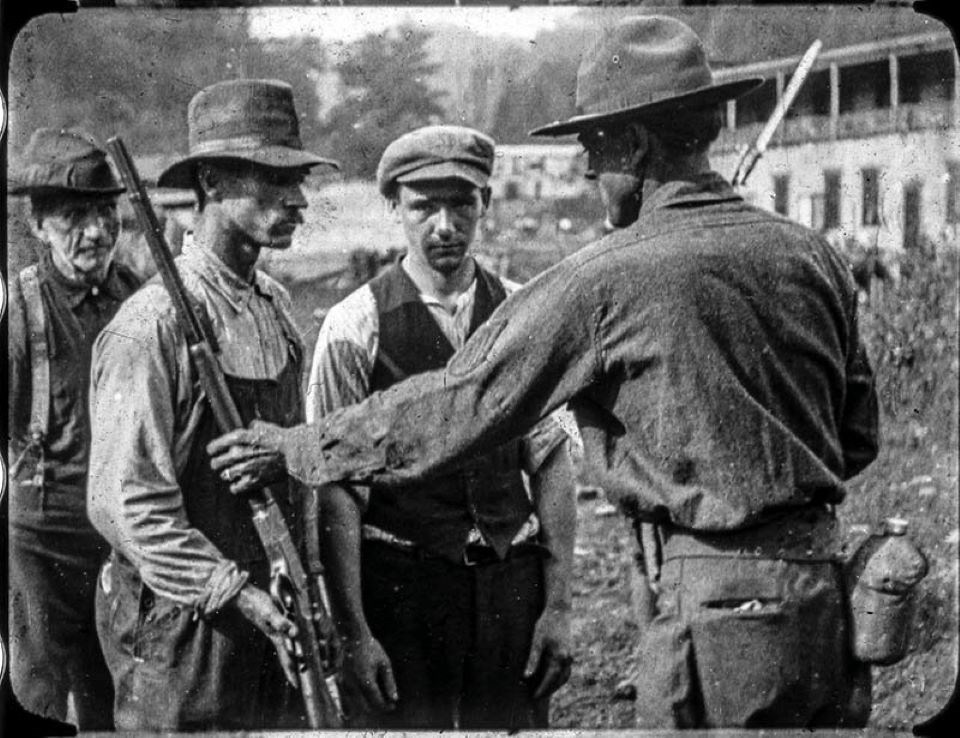
September 2, 1921: The largest labor uprising in American history takes place in Logan County, West Virginia. It becomes known as the Battle of Blair Mountain.

Coal companies had been exploiting their workers for decades. Due to the prosecution of miners' union leaders, things came to a head in the Summer of 1921. The United Mine Workers called for a rally at the State Capitol in Charleston for August 7. The UMW's leaders, including organizer Bill Blizzard, met with Governor Ephraim Morgan, who owed his election to the coal companies, and rejected their demands.

Labor leader Mary "Mother" Jones, for whom a liberal magazine would later be named, feared a bloodbath between the union men and the better-armed Logan County Sheriff's Department, led by Sheriff Don Chafin. So she warned the union men against taking further action.

Nevertheless, on August 24, 13,000 men began marching toward the Logan County mine, to try to force the strikebreakers out of their jobs. The next day, President Warren Harding threatened to send federal troops to protect the mine -- not the miners. A meeting was arranged between Chafin and the union leaders, and a truce was called. It seemed to be over.

It wasn't: Chafin wanted to break the union for once and for all, and assembled a "private army." Rumor got around that this army had shot union sympathizers, and caught families in the crossfire, in Sharples, just north of Blair Mountain. The union men turned back, believing that Chafin had done more than just front up with a private army, and that he had flat-out broken his word.

The Chafin army, now including some State Police officers, was outnumbered, but had the high ground and better weapons. On August 29, private planes dropped homemade bombs on the miners. One did not explode, and that proved crucial. The next day, Governor Morgan called out the West Virginia National Guard. On September 2, federal troops arrived. Many of the miners were World War I veterans, and refused to fire on the U.S. Army. The miners surrendered.

The number of casualties is unclear. The actual Army reported 3 deaths, because one of their planes crashed upon its return. On the Chafin side, the number of deaths has been reported as being between 10 and 30; on the miners' side, anywhere from 50 to 100. After the battle, 985 miners were indicted for murder, conspiracy to commit murder, accessory to murder, and treason -- not against the United States of America, but against the State of West Virginia.

At Blizzard's trial, the unexploded bomb was used as evidence of the government and companies' brutality, and he was acquitted. Though some were acquitted by sympathetic juries, others were imprisoned. The last was paroled in 1925.
Bill Blizzard

The UMW was crippled, and was a spent force throughout the 1920s. The Great Depression enabled them to come back, and they appealed to President Franklin D. Roosevelt in the 1930s. FDR's New Deal programs gave them much of what they wanted.

Mother Jones, already elderly by the time of Blair Mountain, died in 1930. In 1924, Sheriff Chafin was arrested in connection with moonshining, and sentenced to two years in prison. He died in 1954. UMW leader John L. Lewis expelled Blizzard, but the union revolted, and he had to be hired back. The two men were never friendly, and Lewis expelled Blizzard again in 1955. Blizzard died in 1958.

*

September 2, 1921 was a Friday. These baseball games were played that day:

* The New York Yankees beat the Washington Senators, 9-3 at the Polo Grounds. Babe Ruth, Bob Meusel and Roger Peckinpaugh hit home runs for the Yankees. Waite Hoyt was the winning pitcher.

* The Boston Red Sox beat the Philadelphia Athletics, 4-3 at Fenway Park in Boston.

* The St. Louis Cardinals beat the Pittsburgh Pirates, 1-0 at Forbes Field in Pittsburgh. Bill Doak started for the Cardinals, and pitched to 1 batter, giving up a single to Carson Bigbee. Manager Branch Rickey then took him out, and put in Jesse Haines, who went the rest of the way, pitching shutout ball for 9 innings, allowing 6 hits and a walk.

I don't know why Rickey did this. Both Doak and Haines were righthanded pitchers, so it wasn't as if Rickey was trying to trick Pirate manager George Gibson into loading his lineup with lefthanded hitters, with the intention of then switching to a lefthanded pitcher.

Doak does have 2 distinctions worth mentioning. He was 1 of the 17 pitchers who, at the start of the season, was allowed to continue using various pitches that fell under the category of "spitball" until they retired, with the pitches banned for everyone else. Doak may have been the only one who actually did spit on the ball, instead of licking his fingers or putting some other "foreign substance," such as grease or Vaseline, on the ball, earning him the nickname "Spittin' Bill."

And, in 1920, he suggested to sporting goods company Rawlings, maker of all major league baseball gloves, that a "web" should be laced between the index finger and the thumb, saying it would create a natural pocket. This design soon replaced all other baseball gloves, and remains the standard.

* The Chicago Cubs beat the Cincinnati Reds, 7-0 at Redland Field in Cincinnati. (It was renamed Crosley Field in 1934.) Grover Cleveland Alexander pitched a 5-hit shutout.

* The Cleveland Indians beat the Detroit Tigers, 12-1 at Navin Field in Detroit. (It was renamed Briggs Stadium in 1938, and Tiger Stadium in 1961.) Tris Speaker went 2-for-5 with an RBI for Cleveland. Ty Cobb went 1-for-3 for Detroit. Each was, by this point, his team's manager.

* The St. Louis Browns beat the Chicago White Sox, 3-0 at Comiskey Park in Chicago. Urban Shocker pitched a 4-hit shutout. George Sisler went 4-for-5 with 2 RBIs. Eddie Collins went 0-for-3 with a walk for the White Sox.

* Concerned about possible bad weather on September 2, the New York Giants and the Brooklyn Dodgers (or the Brooklyn Robins as they were known from 1914 to 1931, due to their manager being Wilbert Robinson), arch-rivals, moved their game at Ebbets Field back to September 1. Brooklyn won, 5-1. Zack Wheat went 2-for-4, in support of Burleigh Grimes, who turned out to be the last legal spitballer, retiring in 1934.

* As it turned out, there was enough rain to postpone the game in Brooklyn, though not in Upper Manhattan, as the Yankees played. There was also enough rain to postpone the game in Philadelphia, and a doubleheader was set up for Baker Bowl the next day. The Philadelphia Phillies won the opener, 4-1. The Boston Braves won the nightcap, 15-4. So the Phillies scored the same number of runs in both games, winning one comfortably and getting blown out in the other.

Wednesday, July 13, 2022

July 14, 1877: The Great Railroad Strike

July 14, 1877: The Great Railroad Strike of 1877, sometimes referred to as the Great Upheaval, begins in Martinsburg, West Virginia, after the Baltimore & Ohio Railroad (a.k.a. the B&O) cut wages for the 3rd time in a year.

Because of economic problems and pressure on wages by the railroads, workers in numerous other cities, in New York, Pennsylvania and Maryland, into Illinois and Missouri, also went out on strike. An estimated 100 people were killed in the unrest across the country. In Martinsburg, Pittsburgh, Philadelphia and other cities, workers burned down and destroyed both physical facilities and the rolling stock of the railroads (engines and railroad cars). Local populations feared that workers were rising in revolution such as the Paris Commune of 1871.

At the time, the workers were not represented by trade unions. The city and state governments were aided by unofficial militias, the National Guard, federal troops and private militias organized by the railroads, who all fought against the workers. Disruption was widespread and at its height, the strikes were supported by about 100,000 workers.

With the intervention of federal troops in several locations, most of the strikes were suppressed by early August. Labor continued to work to organize into unions to work for better wages and conditions. Fearing the social disruption, many cities built armories to support the local National Guard units; these defensive buildings still stand as symbols of the effort to suppress the labor unrest of this period.

The strike ended on September 4, 52 days after it began, after it was put down by unofficial militias, the National Guard, and federal troops.

The use of federal troops prompted bipartisan support for the 1878 Posse Comitatus Act, limiting the 
power of the president to use federal troops for domestic law enforcement.

With public attention on workers' wages and conditions, the B&O in 1880 founded an Employee Relief Association to provide death benefits and some health care. In 1884, it established a worker pension plan. Other improvements were implemented later.

*

July 14, 1877 was a Saturday. The only professional sports league in North America at the time was baseball's National League. And only 2 games were played that day. The Hartford Blues beat the Chicago White Stockings, 9-4 at the Union Grounds in Chicago. And the St. Louis Brown Stockings beat the Boston Red Stockings, 10-3 at an early version of Sportsman's Park in St. Louis.

The Blues and the Brown Stockings both went out of business after the season. These St. Louis Brown Stockings bear no connection to the later teams to use the name: The American Association and later NL team that's now the Cardinals, or the American League team that became the Baltimore Orioles.

The Chicago White Stockings went through some name changes before becoming the Cubs in 1903, with an AL team having already assumed the White Stockings, later White Sox, name. And the Boston Red Stockings went through a few name changes as well, before becoming the Braves in 1912, then moving to Milwaukee in 1953 and Atlanta in 1966.

Tuesday, May 10, 2022

May 10, 1960: JFK Wins the West Virginia Primary

FDR Jr. (left) and JFK

May 10, 1960: West Virginia holds its Presidential Primary election. The results surprise a lot of people.

Senator John F. Kennedy of Massachusetts knew that only one Roman Catholic before him had a serious shot at the Presidency, and he had lost badly: Governor Alfred E. Smith of New York, the Democratic Party's nominee in 1928. He and the people around him -- including his father, Joseph P. Kennedy -- thought maybe the nation was ready to accept a Catholic President.

"Old Joe" had been U.S. Ambassador to Britain going into the 1940 election, and thought he could be the 1st Catholic President. But President Franklin D. Roosevelt chose to run for a 3rd term, in the face of World War II raging through Europe and representing a threat to America; and Joe's response to that war made him look like a defeatist, and even, in the eyes of many people, favorable to the Nazis.

So Joe knew it wouldn't be him. He turned his attention to his eldest son, Joseph P. Kennedy Jr. Joe Sr. made a deal with FDR: He would resign as Ambassador and give a close-to-Election Day radio speech endorsing FDR, and FDR would support Joe Jr. for the office of Lieutenant Governor of Massachusetts in 1942.

But the attack on Pearl Harbor meant that Joe Jr. would enlist in the U.S. Navy, followed by his brothers John and Robert, and would be unavailable for public office for the duration of The War. Joe Jr. was killed in a plane accident in 1944, and Joe Sr. never forgave FDR for this.

Joe Sr. turned his attention to John, or "Jack." Jack followed the path that Joe Jr. would have followed had he survived: Elected to the U.S. House of Representatives in 1946, then to the U.S. Senate in 1952, then stand as a candidate for Vice President at the 1956 Democratic Convention.

JFK led on the 1st ballot, but didn't have a majority of the Delegates. He knew that if it wasn't going to happen then, it wasn't going to happen later: He would lose support. So he dropped out, and endorsed the 2nd-place candidate, Senator Estes Kefauver of Tennessee, who was nominated along with former Governor Adlai Stevenson of Illinois, who was again clobbered in November by Dwight D. Eisenhower.

JFK told a fundraising dinner that if it had been his brother Joe, he wouldn't have dropped out, he would have been nominated, and Stevenson's loss would have been blamed on Joe's religion. (It wouldn't have been: Stevenson's only chance was for Ike to drop out due to his health, or die, and run against Vice President Richard Nixon.)

But the Kennedys -- Jack as candidate, Bobby as campaign manager, and Old Joe as funder, with Jack telling people to make every cent count, because his father said, "I'll be damned if I'll pay for a landslide!" -- prepared for 1960. As the only New Englander in the race, nobody seriously challenged JFK in New Hampshire on March 8. But on April 5, JFK beat Senator Hubert Humphrey of neighboring Minnesota, 56 percent to 43 percent.

But Wisconsin's Democratic vote was overwhelmingly Catholic: Polish and German, and to a lesser extent Irish and Italian. The next Primary, on April 26, would also be in a heavily Catholic State: Pennsylvania. JFK won that, easily, too.

The true tests would be in 2 overwhelmingly Protestant States on May 10: West Virginia and Nebraska. If Kennedy could do well in those, maybe he would do well in the general election. Fortunately, JFK had a secret weapon: Franklin Delano Roosevelt Jr., the son of a President who, 15 years after his death, was still beloved in that State.

FDR Jr. had served New York's Hudson Valley in Congress from 1949 to 1955. But because he was born at the family’s vacation home at Campobello Island, New Brunswick, Canada, he could not become President of the United States like his father went on to do.

But, despite the rift between their fathers, FDR Jr. had no problem campaigning for JFK in West Virginia. Poor people -- mostly farmers and coal miners -- saw them together, and presumed that the younger Kennedy would govern like the elder Roosevelt.

Not all of them. At one point, in his Harvard accent, JFK asked in a speech, "What wrong with the American farmer?" It came out "fah-mah?" And someone yelled out, "He's stah-ving!" But someone else walked up to JFK, and said, "Somebody told me you've never worked a day in your life. Well, let me tell you something: You ain't missed much!" JFK won 60 percent of the vote, Humphrey just 39 percent.

JFK won the nomination, and the general election. In 1963, he appointed FDR Jr. to be Under Secretary of Commerce. In 1965, the new President Lyndon B. Johnson, appointed FDR Jr. to be the 1st Chairman of the Equal Employment Opportunity Commission. He resigned the next year, to run for Governor of New York. He won the Democratic nomination, but lost to another political scion, incumbent Nelson Rockefeller.

FDR Jr. died in 1988. His son, Franklin Delano Roosevelt III, is a retired economist and a professor at Sarah Lawrence College, and successfully led a drive to get a memorial to Eleanor Roosevelt in Riverside Park, not far from Grant's Tomb. He had 3 children, 1 son, but named him Nicholas rather than Franklin Delano Roosevelt IV. Through his mother, FDR III is also related to the du Pont family.

*

May 10, 1960 was a Tuesday. In Dublin, another famous Irishman was born: Paul David Hewson, later to become Bono, the lead singer of U2.

And these baseball games were played:

* The New York Yankees lost to the Cleveland Indians, 5-1 at Yankee Stadium. Yankee reliever Ryne Duren, knowing for being alternately very effective and very wild with a blazing fastball, was wild in the top of the 10th inning, allowing 4 runs, including a home run by Jimmy Piersall. The Yankee run came on a home run by Elston Howard. Mickey Mantle went 0-for-3 with 2 walks, Yogi Berra went 0-for-4, and Roger Maris went 0-for-3 with 1 walk.

* The Boston Red Sox beat the Chicago White Sox, 9-7 at Fenway Park in Boston. Ted Williams, in his final season, appeared as a pinch-hitter, and drew a walk.

* The Kansas City Athletics beat the Baltimore Orioles, 10-0 at Memorial Stadium in Baltimore. Brooks Robinson went 1-for-3. Dick Hall pitched a 6-hit shutout for the A's. The O's were impressed, and traded for him right before the next season started, and he helped their rise to contention, helping them win the 1966 World Series. 

* The Detroit Tigers beat the Washington Senators, 1-0 at Griffith Stadium in Washington. Don Mossi pitched a 3-hit shutout. Al Kaline went 0-for-4.

* The Pittsburgh Pirates beat the Los Angeles Dodgers, 3-2 at the Los Angeles Memorial Coliseum. Vernon Law outpitched Johnny Podres. Hal Smith and Bill Mazeroski hit home runs, a combination that would prove glorious for the Pirates on October 13. Roberto Clemente went 2-for-4. Duke Snider went 0-for-4.

* The San Francisco Giants beat the Philadelphia Phillies, 4-2 at Candlestick Park in San Francisco. Willie Mays went 0-for-4, but Willie Kirkland went 3-for-4 with an RBI.

* A cold snap and rain forced the Chicago Cubs to postpone an entire week's worth of games. On this day, they were scheduled to play the Cincinnati Reds at Wrigley Field in Chicago. The game was postponed to August 22, and the Cubs won, 6-3. Ernie Banks went 2-for-4. Frank Robinson went 2-for-3 with a solo home run and a walk.

* The Milwaukee Braves also postponed a few games due to rain and cold. But, on this day, they and the St. Louis Cardinals were not scheduled to play.

Wednesday, April 6, 2022

April 6, 1971: John Denver Gives West Virginia a Theme Song

April 6, 1971: John Denver releases his album Poems, Prayers & Promises. It contains covers of the Beatles' "Let It Be" and James Taylor's "Fire and Rain." It also includes his own composition "Sunshine On My Shoulders," and a song written by Bill Danoff and Taffy Nivert, a then-married couple who would join with another, Jon Carroll and Margot Chapman, to form the Starland Vocal Band. In 1976, they went on to have a Number 1 hit with "Afternoon Delight."

Danoff and Nivert were driving down Clopper Road in Maryland to a Nivert family reunion in Gaithersburg. But the melody that got stuck in Danoff's head needed 4 syllables, so he tried Massachusetts, his home State, before remembering West Virginia. Not only was West Virginia nearby, but Danoff remembered listening, from his home in Springfield, Massachusetts, to a radio show that was broadcast from Wheeling, West Virginia: Saturday Night Jamboree.

So West Virginia became the site of the song, titled "Take Me Home, Country Roads." The State government eventually put the words "Almost Heaven" on its license plates. In 2014, the State made it the official State Song.

In 1979, Denver -- by this point, more identified with Colorado, not just because of his stage name (the native of Roswell, New Mexico was born Henry John Deutchendorf Jr.), but because of his 1972 hit "Rocky Mountain High" -- made it up to Maryland. He appeared at a World Series game in Baltimore, singing yet another of his rural-themed hits: "Thank God I'm a Country Boy." To this day, the Orioles play that song after "Take Me Out to the Ball Game" during the 7th Inning Stretch.

As for "Take Me Home, Country Roads," the site of the song's inspiration is no longer "Almost Heaven": The Washington, D.C. metropolitan area has grown like crazy in the last half-century, and swallowed up so much of the countryside with development. Both couples in the Starland Vocal Band split up, although, as of April 6, 2022, all 4 of them are still alive. Denver is not: He was killed in a plane crash in 1997.

*

April 6, 1971 was a Tuesday. It was Opening Day of the Major League Baseball season. Oddly, the team that was closest to the site of the song's inspiration, the Baltimore Orioles, did not play that day: They had their opener the next day, beating the Washington Senators, 3-2 at Memorial Stadium in Baltimore.

Nor did the Chicago White Sox play that day: They also opened the next day, beating the Oakland Athletics, 6-5 at the Oakland Coliseum.

The A's and the Senators opened on April 5, at Robert F. Kennedy Stadium in Washington. Tradition had it that the 1st game of the season in the American League would be in Washington, and that the President of the United States would throw out the ceremonial first ball.

President Richard Nixon had done so in 1969, but he wasn't available in 1970, and Vice President Spiro Agnew got booed when he did it -- not because the fans wanted to see Nixon, but based on his personality. Nixon was again unavailable for Opening Day 1971, so he selected someone absolutely unbooable: Master Sergeant Daniel L. Pitzer, U.S. Army, who had been a prisoner of war in Vietnam.

The Senators won, 8-0. Dick Bosman pitched a 6-hit shutout. As it turned out, this would be the last traditional AL opener in Washington: The following season, the Senators moved to the Dallas area, becoming the Texas Rangers. In 1984, Ronald Reagan began throwing out the Opening Day first ball in Baltimore, as the closest MLB city to Washington, restarting the tradition. In 2005, the Washington Nationals arrived, playing in the National League.

The traditional NL opener was always in Cincinnati, preceded by a downtown parade, in honor of the city's status as the home of the 1st openly professional baseball team. Although the Cincinnati Reds were founded in 1880, and have no corporate connection to the 1869-70 Cincinnati Red Stockings, they (and their chosen opponents) have usually played before every other NL team. And on April 5, they lost to the Atlanta Braves, 7-4 at Riverfront Stadium.

These games were played on April 6:

* The New York Yankees lost to the Boston Red Sox, 3-1 at Fenway Park in Boston. Ray Culp outpitched Stan Bahnsen. Reggie Smith and Duane Josephson each went 3-for-4. Carl Yastrzemski went 2-for-4 with an RBI. Thurmann Munson went 2-for-4, but the rest of the Yankees only got 3 hits and no walks between them, including an RBI single by Horace Clarke.

* The New York Mets were leading the Montreal Expos, 4-2 after 5 innings at Shea Stadium, when the game was called due to rain. Tom Seaver was the winning pitcher.

* The Pittsburgh Pirates beat the Philadelphia Phillies, 4-2 at Three Rivers Stadium in Pittsburgh. Roberto Clemente went 0-for-4, and Willie Stargell went 1-for-4.

* The Detroit Tigers beat the Cleveland Indians, 8-2 at Tiger Stadium in Detroit. Al Kaline went 1-for-4 with a walk.

* The Chicago Cubs beat their arch-rivals, the St. Louis Cardinals, 2-1 at Wrigley Field in Chicago. Billy Williams hit a home run off Bob Gibson in the bottom of the 10th inning to win it, making a winning pitcher out of Ferguson Jenkins. On what turned out to be his last Opening Day as a player, Ernie Banks did not play.

For the Cards, Joe Torre hit a home run, on his way to a season where he would win the batting title with a .363 average, and would be named the NL's Most Valuable Player. Lou Brock went 0-for-4.

* The Milwaukee Brewers beat the Minnesota Twins, 7-2 at Metropolitan Stadium in the Minneapolis suburb of Bloomington, Minnesota. Harmon Killebrew went 2-for-3 with a walk and an RBI. Rod Carew went 0-for-4 with a walk.

* The Los Angeles Dodgers beat the Houston Astros, 2-0 at the Astrodome in Houston. Claude Osteen pitched a 4-hit shutout to outpitch Don Wilson.

* The San Francisco Giants beat the San Diego Padres, 4-0 at San Diego Stadium (later Jack Murphy Stadium and Qualcomm Stadium). Juan Marichal pitched a 5-hit shutout. Willie Mays hit his 629th career home run.

* And the Kansas City Royals beat the California Angels, 4-1 at Anaheim Stadium (now Angel Stadium of Anaheim).

Football was out of season. The NHL was between the end of its regular season and the start of the Stanley Cup Playoffs. There were 2 games played in the NBA Playoffs. The New York Knicks beat the Baltimore Bullets, 112-111 at Madison Square Garden. And the Los Angeles Lakers beat the Chicago Bulls, 109-98 at The Forum outside Los Angeles in Inglewood, California.

There were 3 games in the American Basketball Association Playoffs:

* The New York Nets beat the Virginia Squires, 135-131 at the Hofstra Physical Fitness Center, Hempstead, Long Island, New York. Like many ABA (and later World Hockey Association) teams, the home arenas only booked the "rebel league" teams through the end of their regular season, meaning that some of them had to scramble to find new homes for the Playoffs. In the Nets' case, the gym at Hofstra University was right across the street from the parking lot where their new home, the Nassau Coliseum, was being built. Rick Barry scored 43 points.

* The Miami Floridians beat the Kentucky Colonels, 120-102 at the gymnasium of Miami-Dade Junior College North in Miami.

* And the Utah Stars beat the Texas Chaparrals, 128-107 at the Moody Coliseum in Dallas. For the 1970-71 season only, the Dallas Chaparrals tried the ABA's experiment of regional "home games," and called themselves the Texas Chaparrals. In 1973, they became the San Antonio Spurs.

Wednesday, February 9, 2022

February 9, 1950: Senator Joseph McCarthy's List

February 9, 1950: Senator Joseph R. McCarthy of Wisconsin, facing re-election in 2 years, finds an angle, one that has worked for other Republicans in the last 4 years: Anti-Communism. He decides to use it, regardless of the truth.

For this night, he had been invited to give a Lincoln Day speech to the Republican Women's club of Wheeling, West Virginia. While the Democratic Party had Jefferson-Jackson Day, to honor 2 of their "founding fathers," Thomas Jefferson and Andrew Jackson, usually in February, the Republicans came up with Lincoln Day, on or close to Abraham Lincoln's birthday, February 12.

Why would women in Wheeling, a a small town of about 25,000 people in the Northern Panhandle of West Virginia -- 270 miles northwest of Washington, 60 miles southwest of Pittsburgh, and 140 miles southeast of Cleveland -- in what was then a heavily Democratic area invite a 1st-term Senator from Wisconsin? Probably because, for the moment, he came cheap.

His words in the speech are a matter of some debate, as no audio recording was saved. However, it is generally agreed that he produced a piece of paper that he claimed contained a list of "known Communists" working for the United States Department of State, which runs American foreign policy.

McCarthy is usually quoted to have said, "The State Department is infested with Communists. I have here in my hand a list of two hundred and five, a list of names that were made known to the Secretary of State as being members of the Communist Party, and who nevertheless are still working and shaping policy in the State Department."

There is some dispute with whether or not McCarthy actually gave the number of people on the list as being "205" or "57." In a later telegram to President Harry S Truman, and when entering the speech into the Congressional Recordhe used the number 57.

As for the list itself, it has never been found. You won't find it on display in the National Archives, the Smithsonian Institution, or the Library of Congress. How many names were actually on the list? Some people have suggested it was just a blank piece of paper, or a shopping list, or a laundry list.

The origin of the number 205 can be traced: In later debates on the Senate floor, McCarthy referred to a 1946 letter that then–Secretary of State James F. Byrnes, a conservative Democrat from the Southern State of South Carolina, sent to Congressman Adolph J. Sabath of Illinois. In that letter, Byrnes said State Department security investigations had resulted in "recommendation against permanent employment" for 284 persons, and that 79 of these had been removed from their jobs. If so, this left 205 still on the State Department's payroll.

In fact, by the time of McCarthy's speech, only about 65 of the employees mentioned in the Byrnes letter were still with the State Department, and all of these had undergone further security checks.

This speech of McCarthy's came 19 days after Alger Hiss was convicted of perjury (in connection with his alleged espionage with the Soviet Union, as the statute of limitations on that charge had run out), 221 days after Mao Zedong's Communist takeover of China, and 229 days after President Truman announced that the U.S. Department of Defense could confirm that the Soviets had successfully tested a nuclear bomb. So international Communism was a viable threat at the time. This was a chilly point in the Cold War -- and the start of the Korean War was less than 5 months away, so it was going to get frigid.

So there was a firestorm of interest, and even McCarthy was taken aback by the massive media response to the Wheeling speech. He was accused of continually revising both his charges and figures. A few days later, in Salt Lake City, Utah, he cited a figure of 57. On February 20, on the Senate floor, he claimed 81, presenting a case-by-case analysis of these "loyalty risks" employed at the State Department.

It is widely accepted that most of McCarthy's cases were selected from the so-called "Lee List," a report that had been compiled three years earlier for the House Appropriations Committee. In reciting the information from the Lee List cases, McCarthy consistently exaggerated, representing the hearsay of witnesses as facts and converting phrases such as "inclined towards Communism" to "a Communist."

In the nearly 5 years between the Wheeling speech and his censure by his fellow Senators, Joe McCarthy never exposed one single Communist. Everybody he ever accused was either already exposed as such elsewhere, or was later found to be innocent.

The March 29, 1950 edition of The Washington Post included a cartoon by Herbert Block, a.k.a. Herblock, showing a "tower of tarbuckets," topped by a leaking bucket labeled "McCARTHYISM," with a Republican elephant being pushed by men labeled, and representing Senators Robert Taft of Ohio, Styles Bridges of New Hampshire, and Kenneth Wherry of Nebraska; and the Chairman of the Republican National Committee, Guy Gabrielson, a former Speaker of the New Jersey General Assembly. They want the elephant to get on top of the platform on top of the barrel on top of the 10 tarbuckets.

 
The cartoon made "McCarthyism" the byword for reckless charges of Communism, and made Herblock a national star.

Suffice it to say, this was not the Republican Party of quiet conservative leadership and prosperity. Republican voters who trusted Calvin Coolidge or Theodore Roosevelt no longer recognized their Party. If they wanted to end 20 years of Democratic leadership in the 1952 election, they were going to need a nominee not like McCarthy, or Taft, or the other firebrands. They were going to need a unifying figure.

In the end, they would get that figure, Dwight D. Eisenhower. But even he would be tainted by McCarthyism. Not enough to defeat him, but enough to put a cloud over him that he would have to remove.

*

February 9, 1950 was a Thursday. Baseball and football were out of season. There were 4 games played in the NBA, none by a team still playing in the same city:

* The Baltimore Bullets beat the St. Louis Bombers, 79-67 at the Baltimore Coliseum.

* The Philadelphia Warriors beat the Fort Wayne Pistons, 64-61 at the gym of North Side High School in Fort Wayne, Indiana.

* The Sheboygan Red Skins beat the Tri-Cities Blackhawks, 104-82 at the Sheboygan Municipal Auditorium in Sheboygan, Wisconsin.

* And the Minneapolis Lakers beat the Washington Capitols, 71-59 at Minneapolis Auditorium.

There was 1 game in the NHL: The New York Rangers beat the Chicago Black Hawks, 5-3 at the Chicago Stadium.

December 31, 1999 & January 1, 2000: The Millennium

December 31, 1999:  The Millennium arrives. The people of planet Earth survived. At a terrible cost. But we hadn't destroyed ourselves. ...