Showing posts with label richard j. daley. Show all posts

Tuesday, November 8, 2022

November 8, 1960: John Fitzgerald Kennedy Is Elected President

November 8, 1960: Senator John F. Kennedy of Massachusetts is elected the 35th President of the United States. At 43, he is the youngest man ever elected to the office, although Theodore Roosevelt was 42 when he was first sworn in. He is also the 1st Catholic to achieve the office, and remains the only one.

He beats the Republican nominee, incumbent Vice President Richard Nixon. It is incredibly close: JFK wins 49.72 percent of the popular vote, Nixon 49.55, a margin of 118,000 votes. The Electoral Vote goes 303 to 219 for Kennedy (with 15 votes from Southern electors going elsewhere), making it look like it wasn't so close. The election was so close, comedian Mort Sahl said, "Neither of them is going to win."

Kennedy won Illinois by 8,858 votes. To this day, Republicans say JFK's friend, Mayor Richard J. Daley of Chicago, "stole" the State's vote for him. There's just one problem with this theory: Even if it were true, it wouldn't have mattered. Winning Illinois would've changed the Electoral Vote from 303-219 Kennedy to 276-246 Kennedy, still above the threshold for a majority, which was then 269. Nor would winning Illinois have given Nixon the edge in the popular vote.

In addition, there are stories that the real reason Nixon didn't contest the Illinois vote is that he knew that Southern Illinois had seen vote-tampering in his favor. Indeed, only 1 State had a vote so close that, as with Florida in 2000, a legally-mandated recount kicked in. It was the newest State, Hawaii. And it did switch... from Nixon to Kennedy.

The Republicans actually did better in the Congressional elections, gaining 22 seats in the House, and 2 in the Senate.

The Kennedy campaign has been celebrated in many ways, from Theodore H. White's Pulitzer Prize-winning book The Making of the President 1960 to the various movies about JFK to the extensive exhibit at JFK's Presidential Library, on the waterfront of the Boston campus of the University of Massachusetts.

Indeed, for all of his accomplishments, JFK will forever be remembered best for the way his Presidency began, with a legendary campaign for the office and a spectacular Inaugural Address; and for the way it ended, assassinated in public in broad daylight, with an official solution that remains not fully accepted by the American people.

Needing something to do after leaving the Vice Presidency, and not being President, Nixon wrote a memoir about his political experiences to that point. He titled it Six Crises. In addition to this election, he included the Alger Hiss case, what became known as the Checkers Speech, his role as "Acting President" after Eisenhower's 1955 heart attack, his ill-fated trip to South America in 1958, and his "Kitchen Debate" with Nikita Khrushchev in 1959.

*

November 8, 1960, like all modern U.S. Election Days, was a Tuesday. The baseball season was over. Football was in midweek. The NHL season had begun, but no games were scheduled for the day. But there was 1 NBA game. Somewhat appropriately, given JFK's win, Boston won this as well: The Boston Celtics beat the Cincinnati Royals, 136-120 at the Cincinnati Gardens.

For the Royals, Jack Twyman scored 32, and Oscar Robertson 31. But for the Celtics, Tom Heinsohn scored 33, Bob Cousy 30, and Bill Sharman 26. Bill Russell only scored 2, but had 15 rebounds. 

Friday, September 23, 2022

September 22, 1959: The Go-Go White Sox Win the Pennant

September 22, 1959: The Chicago White Sox beat the Cleveland Indians, 4-2 at Cleveland Municipal Stadium, and clinch the American League Pennant, putting the Indians 4 1/2 games back with 4 games to play. For the White Sox, it is the 1st Pennant in 40 years.

The White Sox had won the World Series in 1917, and lost it in 1919. Late in the 1920 season, it was revealed that 7 members of the White Sox had "thrown" the 1919 World Series for a payoff from gamblers, and an 8th knew about the "fix" but hadn't told anyone. All 8 of them were banned for life, and it wrecked the franchise.

Despite such talents as hard-hitting shortstop Luke Appling and pitcher Ted Lyons, the South Siders didn't even get into another Pennant race until 1957. Finally, in 1959, with the New York Yankees -- who had won 9 of the last 10 Pennants -- having a rare bad year, the title was open for someone else.

The Indians looked good for it, with their right fielder, Rocky Colavito, having a fantastic season. But the White Sox had a former Indian, 39-year-old Early Wynn, as their ace, winning 24 games, with Billy Pierce and Dick Donovan giving them a good rotation. 

And with Comiskey Park not having close fences for a slugger -- although they did pick up former Cincinnati Reds 1st baseman Ted Kluszewski for the stretch drive -- they had a scrappy, running style that reminded people of the 1930s St. Louis Cardinals' "Gashouse Gang."

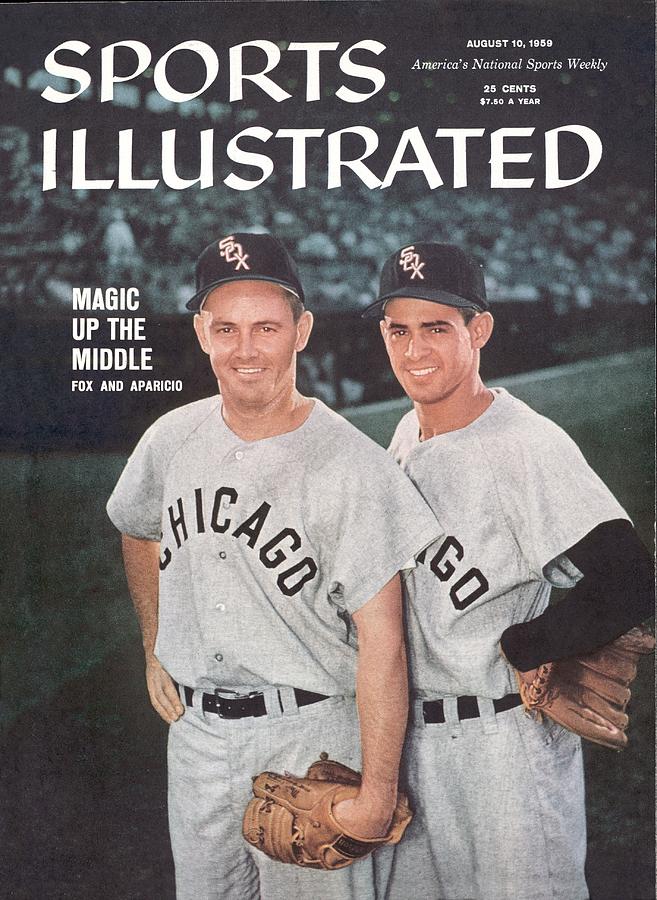
Shortstop Luis Aparicio and 2nd baseman Nellie Fox didn't just form the AL's best double-play combination, known as the Keystone Twins. They formed the nucleus of a team that made fans yell, "Go! Go! Go!" when they were on the bases. They became known as "The Go-Go White Sox," including an outfield of Al Smith, Jim Landis and Jim Rivera.

It led to Al Trace, a songwriter who had played in the White Sox' farm system, and Walter "Li'l Wally" Jagiello, to write a song for the team, recorded by Tom Fouts, a.k.a. Captain Stubby, leader of the band Captain Stubby and the Bucaneers. It remains the team's fight song to this day:

White Sox! White Sox! Go-Go White Sox!
Let’s go, Go-Go White Sox!
We’re with you all the way!
You’re always in there fighting,
and you do your best.
We’re glad to have you out here
in the Middle West.
We’re gonna root-root-root-root White Sox.
and cheer you on to victory.
When we’re in the stands,
we’ll make those rafters ring;
All through the season,
you will hear us sing.
Let’s go, Go-Go White Sox,
Chicago’s proud of you!

The last Pennant not won by the Yankees was in 1954, won by the Indians. Their manager was Al López. Bill Veeck had once owned the Indians (before that, building their 1948 World Champions), and now owned the White Sox, and hired López away. He led them to a record of 94-60.

They clinched in Cleveland, with 3 games to spare. Aparicio and Billy Goodman had RBI doubles in the 3rd inning, and Smith and Rivera hit back-to-back home runs in the 6th, to give the Pale Hose a 4-2 win over the Tribe. Wynn was the winning pitcher, rookie Jim Perry the losing pitcher. The last out was Vic Power grounding into a double play, Aparicio stepping on 2nd to force Jimmy Piersall out, and throwing Power out at 1st base. Thus ended a 40-year Pennant drought: Like the ancient Israelites, they had spent 40 years in the wilderness. 

Mayor Richard J. Daley lived at 3536 South Lowe Avenue, 9 blocks from Comiskey Park, and was a lifelong White Sox fan. He announced that, as soon as he got word that the Sox had clinched, he would order the City's air-raid sirens to go off. It is still widely remembered today.

Two oddities about this White Sox team: Because he was serving in the U.S. Marine Corps during World War II, Jack Brickhouse, long the voice of both Chicago teams but better known for his work with the National League's Cubs, missed the Cubs' 1945 Pennant. As a result, the only Pennant team he broadcast for in a long career was the '59 White Sox.

And Cuban left fielder Orestes "Minnie" Miñoso, who had starred for the ChiSox from 1951 to 1957, and would again in 1960 and 1961, was with the Indians at the time, so one of the most popular players in White Sox history missed out on this Pennant.

Fox was named the AL's Most Valuable Player, and Wynn received the Cy Young Award. The White Sox won Game 1 of the World Series against the Los Angeles Dodgers, and were leading Game 2, but the Dodgers struck back, winning the next 3 games. The White Sox won Game 5, but the Dodgers won Game 6 to take the title. The 1917 World Series was still the last one won by either Chicago team. 

Over the years, the White Sox had some close calls. They missed the Pennant by 1 game in 1964, and 3 games in 1967. They missed the AL Western Division title by 5 1/2 games in 1972, and led the Division as late as August 8 in 1977, before drifting to 12 games back. They won the Division in 1983, but lost the AL Championship Series to the Baltimore Orioles. In 1990, the last season at the old Comiskey Park, they stayed close to the Oakland Athletics most of the season, before 9 back.

In 1993, they won the AL West, but lost the ALCS to the Toronto Blue Jays. In 1994, they led the newly-created AL Central Division when the Strike hit. In 2000, they won the Division, but lost the AL Division Series to the Seattle Mariners.

And so their drought after 1959 turned out to be longer than the one they had from 1919 to 1959. What's more, the crosstown Cubs, who hadn't won a Pennant since 1945 and the World Series since 1908, and the Boston Red Sox, who hadn't won the World Series since 1918 -- one year more recently than the White Sox -- were celebrated for their seemingly "cursed" close calls. The White Sox? They didn't have a litany of bizarre incidents down the years that could seemingly be ascribed to a curse. They just... lost.

And with the Cubs having gotten the WGN Superstation to broadcast their games, and the White Sox not, and the Cubs and the Red Sox both having literati write lots of books about their woe-is-us status, it was as if the baseball world didn't care that the White Sox hadn't won the World Series for longer than the Red Sox. Even when the Red Sox finally won it in 2004, the attention that was on them didn't shift to the White Sox. If anything, the Cubs got even more.

Finally, the White Sox won the Pennant again in 2005, and swept the Houston Astros in the World Series, 4 straight. It was Chicago's 1st title in 88 years. Still, the Cubs had better attendance over the next few years. And when the Cubs finally won it all again in 2016, it was celebrated as a great moment for Chicago and environs, and White Sox fans were all, "Uh, hello? We did it first!"

*

September 22, 1959 was a Tuesday. These other baseball games were played that day:

* The New York Yankees beat the Washington Senators, 8-4 at Griffith Stadium in Washington. Despite having by far the best season of anyone on the Yankees, Mickey Mantle struck out in his 1st at-bat in this game, and then left due to injury, and played in only 1 of the season's last 4 games.

* The Boston Red Sox beat the Baltimore Orioles, 4-3 at Fenway Park in Boston. Ted Williams did not play. Brooks Robinson went 1-for-4.

* The Philadelphia Phillies swept a doubleheader from the Cincinnati Reds, 3-1 and 3-2 at Connie Mack Stadium (formerly Shibe Park) in Philadelphia. Frank Robinson did not play for the Reds in either game.

* The Milwaukee Braves beat the Pittsburgh Pirates, 5-3 at Forbes Field in Pittsburgh. Hank Aaron went 0-for-3, but had an RBI on a sacrifice fly. Roberto Clemente went 0-for-4.

* The Detroit Tigers beat the Kansas City Athletics, 6-4 at Briggs Stadium in Detroit. (That ballpark was renamed Tiger Stadium in 1961.) Al Kaline went 1-for-2 with a walk. For the A's, Roger Maris went 2-for-5. In the off-season, the Yankees traded for Maris.

* The Chicago Cubs beat the San Francisco Giants, 5-4 at Wrigley Field in Chicago. Unlike the White Sox, the North Siders had a losing season, but Ernie Banks was still named the National League's MVP. In this game, he went 2-for-4 with an RBI. Willie Mays went 1-for-4 with a walk. The Cubs led 3-2 after 7 innings, but the Giants scored 2 runs in the 8th. The Cubs won it in the bottom of the 9th, on a 2-run home run by George Altman.

* And the St. Louis Cardinals beat the Los Angeles Dodgers, 11-10 at the 1st Busch Stadium (formerly known as the last Sportsman's Park) in St. Louis. Neither the Dodgers' Sandy Koufax nor the Cardainals' Larry Jackson got out of the 1st inning. Stan Musial went 1-for-3 with a walk.

Sunday, August 28, 2022

August 28, 1968: Riot at the Democratic Convention

August 28, 1968: The Democratic National Convention is in progress, held at the International Amphitheatre, at 4200 South Halsted Street on the South Side of Chicago. Anger over the Party's role in the Vietnam War has led to the incumbent President, Lyndon B. Johnson, dropping out of the race for what would have amounted to a 2nd full term. At this point, LBJ couldn't even attend the Convention -- and a celebration planned for August 27, his 60th birthday, had to be canceled.

Given the way things were set up at the time, with Primaries not yet having the influence they would have -- the 1968 nomination process would lead the Democratic Party to change the process for 1972 and thereafter -- once LBJ dropped out, the nominee was always going to be the Vice President, Hubert Humphrey.

It was not going to be Senator Robert F. Kennedy of New York, brother of John F. Kennedy, the President whose assassination in 1963 led to the rise of LBJ from Vice President to President. RFK had won key Primaries, but Johnson, no longer a candidate but still the leader of the Party, controlled the Delegates. RFK was shot and killed mere minutes after claiming victory in the California Primary, but even if he had lived, the chances of his winning the nomination over Humphrey were not good.

It was not going to be Senator Eugene McCarthy of Wisconsin: He was a single-issue candidate, and once Bobby Kennedy got into the race, he became "the peace candidate," and McCarthy was finished.

With RFK dead, and McCarthy only running half-heartedly thereafter, there was no real challenge to Humphrey. And people who wanted the war over were furious. They demonstrated in Chicago's Grant Park, which the main hotel for Convention Delegates, the Conrad Hilton Hotel (now the Hilton Chicago), overlooked.

And, egged on by agitators Abbie Hoffman and Jerry Rubin -- who were more interested in making trouble than making peace -- the demonstrators challenged the Chicago Police. The Police charged, and there was a riot. It became known as "the New Battle of the Midway" and "the Melee on Michigan Avenue."

The cops wore short-sleeved blue shirts (understandable due to the heat) and blue helmets (understandable due to the need for protection). They swung their nightsticks freely, and even poked demonstrators in the stomach.

Borrowing a line from Bob Dylan's song "When the Ship Comes In," demonstrators chanted, "The whole world is watching! The whole world is watching! The whole world is watching!" And TV cameras were, indeed, getting the whole picture: The police were seen as the aggressors -- although half of the viewing audience thought them justified.

The Number 1 song in America was "People Got to Be Free" by The Rascals. But the people in power didn't seem to be listening.

Mayor Richard J. Daley, the Convention's host and the cops' boss, was as much a part of the Democratic Party establishment as anyone. The year before, he had been elected to a 4th term as Mayor of what was still the nation's 2nd-largest city. (It would be the early 1980s before its "white flight"-led population decline allowed Los Angeles to surpass it.) And, with RFK dead, he was probably now the most famous Irish, and the most famous Catholic, politician in America. He was 66 years old, and looked even older due to his receding hairline, heavy jowls and fat physique.
At a press conference to address the violence, he came up with one of the all-time great malaprops/Freudian slips: "Gentlemen, let's get something straight, for once and for all: The policeman is not there to create disorder. The policeman is there to preserve disorder."

When the nominating speeches were given for the candidates, Senator Abraham Ribicoff of Connecticut, who had previously been Secretary of Health, Education & Welfare under President John F. Kennedy, rose to nominate Senator George McGovern of South Dakota, in the faint hope of uniting RFK and McCarthy supporters behind a peace candidate.

He knew what was happening outside, and he knew that Daley knew what was happening outside. Being Jewish, Ribicoff decided to, as would be said in later years, "go there": He said, "With George McGovern as President, we wouldn't have Gestapo tactics in the streets of Chicago!"

Half the Amphitheatre cheered. The other half booed. A camera was put on Daley, and people who could read lips thought he yelled at Ribicoff: "You Jew fucker!" Congressman Dan Rostenkowski, a Daley ally, told an interviewer in 1998, on the 30th Anniversary, that Daley had actually called him, "You faker," explaining that "faker" was a frequent insult of Daley's.

Whatever Daley said, anti-Semitic or not, Ribicoff did not back down. He stared at Daley, nodded a couple of times, and said, "How hard it is, how hard it is to accept the truth!"
Neither man served in World War II: Daley was the Minority Leader of the Illinois State Senate, while Ribicoff was a judge in Hartford. Regardless, at that moment, Ribicoff was tougher than Daley.

Humphrey won the nomination easily. The next night, he addressed the violence and the anger, inside the hall and out, in his acceptance speech:

This moment, this moment is one of personal pride and gratification. Yet one cannot help but reflect the deep sadness that we feel over the troubles and the violence which have erupted, regrettably and tragically, in the streets of this great city, and for the personal injuries which have occurred.
Surely we have now learned the lesson that violence breeds counterviolence, and it cannot be condoned, whatever the source.
I know that every Delegate to this Convention shares tonight my sorrow and my distress over these incidents. And for just one moment, in sober reflection and serious purpose, may we just quietly and silently, each in our own way, pray for our country.
And may we just share for a moment a few of those immortal words of the prayer of St Francis of Assisi, words which I think may help heal the wounds, ease the pain and lift our hearts. Listen to this immortal saint:
"Where there is hatred, let me know love. Where there is injury, pardon. Where there is doubt, faith. Where there is despair, hope. Where there is darkness, light."
Those are the words of a saint. And may those of us of less purity listen to them well and may America tonight resolve that never, never again shall we see what we have seen.
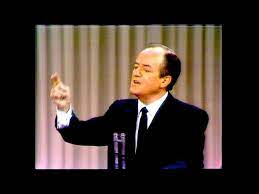
My mother had recently turned 21, and so was voting for President for the first time. My father was voting for the second time. Mom saw this speech, and she told me years later that she thought Humphrey "was on the verge of a nervous breakdown."

In 2008, on the 40th Anniversary, C-SPAN showed the speech in its entirety, and I saw what she meant. "Nervous breakdown" was a bit of a stretch, but Humphrey seemed a beaten man, on the verge of tears, knowing that this nomination, which he had previously tried for halfheartedly at the 1956 Convention and in the 1960 Primaries, was a "poisoned chalice."

At the very least, Humphrey chose a nominee for Vice President who did him no harm, and may even have helped: Senator, and former Governor, Edmund S. Muskie of Maine. Certainly, he looked like a better choice for Vice President that the Republican nominee, Governor Spiro T. Agnew of Maryland.

Other conventions have had Delegates walking out thinking, "We've nominated the wrong guy." There was no right guy available to the Democrats in August 1968.

A week later, former Vice President Richard Nixon, already nominated for President by the Republican Party in Miami Beach on August 8, rode in an open car down Michigan Avenue, and was wildly cheered. Nixon may have been the only person who went to Chicago that Summer and got his reputation enhanced.

Republicans have long blamed Nixon's very close 1960 loss to John F. Kennedy on shenanigans by officials in Chicago. In 1968, events in Chicago made Nixon the 37th President of the United States.

Under Johnson, the U.S. Department of Justice made no effort to prosecute anyone for crimes committed at the Convention. When Nixon took office the following January 20, with his former campaign manager, John Mitchell, as the U.S. Attorney General, such efforts began. On March 20, eight demonstrators were indicted: Abbie Hoffman, Jerry Rubin, David Dellinger, Tom Hayden, Rennie Davis, John Froines, Lee Weiner, and Bobby Seale. Seale, a member of the Black Panther Party, eventually had his case separated, and the "Chicago Eight" became a "Chicago Seven."

On February 18, 1970, all defendants were acquitted on the charge of conspiracy, a charge that left Hoffman incredulous: "Conspiracy? We can't even agree on lunch!" On the charge of traveling across State Lines with intent to incite a riot, Froines and Weiner were acquitted, but the others were convicted. They were sentenced to 5 years in prison, but remained free upon appeal. On November 21, 1972, 2 weeks after Nixon was re-elected, the U.S. Court of Appeals threw out their convictions.

My parents each made lists of reasons to vote for Humphrey and reasons to vote for Nixon, and, for each of them, Nixon came out ahead. They both voted for Nixon. Mom told me she regretted it the instant she stepped out of the voting booth. Dad took a little longer to regret it. When the Democrats nominated McGovern to oppose Nixon in 1972, both parents voted for McGovern, for all the good it did.

As of August 28, 2022, my mother is still alive, and has never voted for a Republican for President again. My father died in 2014, and made one exception, for Ronald Reagan in 1984. He would not have voted for Trump.

*

August 28, 1968 was a Wednesday. Scottish actor Billy Boyd was born.

These Major League Baseball games were played that day:

* The New York Yankees were actually in Chicago that night, a mile and a half to the northeast, at Comiskey Park. They lost to the Chicago White Sox, 3-0. Rookie lefthander Jerry Nyman got his 1st major league victory, outpitching Mel Stottlemyre. The only Yankee hits were singles by Mickey Mantle, Horace Clarke, and 2 by catcher Frank Fernandez. Nyman would make his last big-league appearance just 2 years later, with a career record of 6-7.

* Back in the Big Apple, the New York Mets hosted a doubleheader against the Cincinnati Reds at Shea Stadium, and got swept, losing the 1st game 8-3, and losing the 2nd game 5-2. Pete Rose went 2-for-9 over the 2 games. Johnny Bench didn't play in the opener, and went 1-for-4 in the nightcap.

* The Atlanta Braves swept the Philadelphia Phillies in a doubleheader at Connie Mack Stadium in Philadelphia. The Braves won the 1st game 9-2, and the 2nd game 2-1. Hank Aaron went 5-for-8 with a home run and 2 RBIs on the day.

* The Washington Senators beat the Baltimore Orioles, 3-2 at Memorial Stadium in Baltimore. Frank Howard hit a home run for the Senators. For the Orioles, Frank Robinson went 1-for-4, and Brooks Robinson went 2-for-3 with a walk.

* The Oakland Athletics beat the Boston Red Sox, 5-3 at Fenway Park in Boston. Rookie Reggie Jackson went 1-for-5, and Carl Yastrzemski went 1-for-3 with a 2-run homer.

* The St. Louis Cardinals beat the Pittsburgh Pirates, 8-0 at Forbes Field in Pittsburgh. Bob Gibson pitched a 4-hit shutout, striking out 14. At the conclusion of this game, his ERA for the season was 1.03. Willie Stargell went 0-for-4, and Roberto Clemente did not play.

* The Cleveland Indians beat the Minnesota Twins, 3-2 at Cleveland Municipal Stadium. Rod Carew went 0-for-3, but got an RBI on a groundout. Harmon Killebrew did not play.

* The Detroit Tigers beat the California Angels, 6-1 at Tiger Stadium in Detroit. Denny McLain went the distance, and was now 26-5 with a month to go. His chances of winning 30 games in the season were now very good. Al Kaline did not play.

* In a doubleheader at Dodger Stadium in Los Angeles, the Los Angeles Dodgers lost the 1st game to the Chicago Cubs, 7-4, but won the 2nd game, 8-4. Ernie Banks went 2-for-9 with 2 RBIs.

* And the San Francisco Giants beat the Houston Astros, 4-3 at Candlestick Park in San Francisco. Willie McCovey hit a home run, and Willie Mays went 1-for-3 with an RBI.

Wednesday, January 26, 2022

January 26, 1967: The Chicago Blizzard of '67

January 26, 1967: The Chicago Blizzard of '67 hits. It drops 23 inches of snow on the biggest city in the Midwest: Just short of 2 full feet. It remains the greatest single-storm snowfall in the city's history.

It took people by surprise, because the forecast for this day, on the day before, was for rain or snow, because a cold front was predicted to stall there. Later on the night of the 25th, the forecast was changed to 4 inches of snow. Please, Chicago is a city used to nasty weather, both in Summer and in Winter. Chicagoans? They can handle 4 inches of snow in their sleep.

On the morning of the 26th, a Thursday, the accumulation prediction was revised to 4 to 8 inches. Knowing that, the kids should not have been sent to school. But they were.

Snow fell continuously from 5:02 AM on Thursday until 10:10 AM on Friday. It messed up 2 morning rush hours and 1 evening rush hour. Both major airports, O'Hare and Midway, were closed. People were stranded in schools, offices, 1,100 buses and 20,000 cars. It was estimated that 50,000 cars were, at least temporarily, abandoned. For a 50th Anniversary newspaper feature in 2017, some people recalled their half-hour commutes to get home taking 6 hours. There were 26 deaths reported, mainly from car accidents and heart attacks while shoveling snow.

But the city's sense of community kicked in. People shoveled each other's walks. People not stranded got food and blankets to those who were.

Although Chicago's highest snowfall ever isn't close to New York's -- 30 inches in 1996, topping 26 inches in 1947 -- like an earthquake, it had "aftershocks." The following Wednesday, February 1, another 4 inches fell. The Sunday after that, February 5, they got another 8 1/2. 

But Mayor Richard J. Daley's herculean response to digging the city out, clearing the streets and the elevated railroad tracks, was a welcome sign that the city's slogan, "The City That Works," wasn't just words. He was overwhelmingly elected to a 4th term that Spring. In contrast, his eventual successor, Michael Bilandic, did not sufficiently respond to the blizzard of 1979, and it cost him the election.

*

January 26, 1967, as I said, was a Thursday. Baseball and football were out of season. Only 1 game was played in the NBA, and it did not involve the Chicago Bulls, then playing their 1st season: The Detroit Pistons beat the Cincinnati Royals, 118-110 -- at the Cleveland Arena.

The Royals were trying to broaden their base. Oscar Robertson scored 35 points for them. But Dave Bing scored 32 for the Pistons, and future Knick legend Dave DeBusschere added 27 points and 17 rebounds.

The Chicago Black Hawks did play that night, but not at home. Detroit managed to avoid a major snowfall, and the Olympia Stadium hosted the Hawks' 4-3 win over the Detroit Red Wings. Also that night, the Boston Bruins beat the Montreal Canadiens, 4-1 at the Montreal Forum. The New York Rangers and the Toronto Maple Leafs, the other two of the "Original Six," were not scheduled to play.

December 31, 1999 & January 1, 2000: The Millennium

December 31, 1999:  The Millennium arrives. The people of planet Earth survived. At a terrible cost. But we hadn't destroyed ourselves. ...