Showing posts with label game show. Show all posts

Wednesday, November 2, 2022

November 2, 1959: The Quiz Show Scandal

Charles Van Doren

November 2, 1959: The television "quiz show scandal" reaches its peak, with its biggest beneficiary confessing before Congress.

Television networks have always cared more about money, and therefore ratings, than integrity. So several TV game shows rigged their results in the 1950s, to let viewers see more attractive people win.

Twenty-One, hosted by Jack Barry, and produced by Barry and Dan Enright, premiered on NBC on September 12, 1956. As Enright himself said in an interview in 1991:

In fact, the first show of Twenty-One was not rigged, and the first show of Twenty-One was a dismal failure. It was just plain dull. Neither contestant was able to answer the questions, and the score remained at zero. It lacked all drama, it lacked all suspense.

And next morning, the sponsor called my partner, Jack Barry, and me, and told us in no uncertain terms that he never wanted to see a repeat of what happened the previous night. And from that moment on, we decided to rig Twenty-One.

Herb Stempel, a 29-year-old postal clerk and former U.S. Army intelligence officer from The Bronx, soon appeared as a contestant. Although a brilliant man whose IQ was measured at 170, Enright coached him on some answers, and he won, kept on winning. But Twenty-One wasn't doing as well as NBC's other big game show, The $64,000 Question.

($64,000 in 1956 would be worth about $700,000 in 2022. The show was so popular, rival CBS not only mentioned it twice on The Honeymooners, but parodied it, putting Jackie Gleason's character Ralph Kramden on a show titled The $99,000 Answer. $99,000 then would be worth about $1.08 million now.)

So, with Stempel still winning, they found Charles Van Doren. Then 30 and teaching at New York's Columbia University, he was the son of Mark Van Doren, also a professor at Columbia, and a Pulitzer Prize-winning poet. He was handsome, and Stempel looked like a stereotypical nerd (a word that was only beginning to catch on). He had an interesting job, and Stempel didn't. Stempel was already married, so that wasn't a story; Van Doren was engaged, so that was a story.

On December 5, 1956, after winning $69,500 (about $761,000 in 2022), Stempel, as they said in boxing parlance, took a dive: He was asked what film won the most recent Academy Award for Best Picture. He knew the answer was Marty, because he identified with the main character, played by Ernest Borgnine: Although he wasn't a butcher, he was a homely guy from The Bronx who nonetheless found true love. But, having been given wins he hadn't deserved, he was now told to lose, and he did: He answered with the previous year's Best Picture winner, On the Waterfront. Van Doren had become champion.

After his loss, Stempel overheard one backstage technician say to another, "At least, we finally have a clean-cut intellectual on this program, not a freak with a sponge memory." Van Doren ended up winning $129,000 (about $1.37 million in 2022), which he certainly didn't need, given his family's wealth. He was finally defeated on March 11, 1957, by Vivienne Nearing, a lawyer whose husband had previously been defeated by Van Doren.

Stempel began telling people that the show was rigged, but Enright insisted that Stempel was just jealous of Van Doren's success. It was Stempel's word against those of many others, until the Manhattan District Attorney's office found other contestants, on Twenty-One and other game shows, who said they were coached.

Van Doren was hired as a correspondent on NBC's Today Show. By 1959, enough evidence had been gathered that Frank Hogan, the Manhattan D.A., shared his evidence with Congress. Congress' lead investigator was Richard Goodwin, who later became a speechwriter for Presidents John F. Kennedy and Lyndon Johnson, and later married historian Doris Kearns.

Knowing that they had promoted Van Doren tremendously, and now could only minimize the damage, not prevent it, NBC convinced Van Doren to testify before the House Subcommittee on Legislative Oversight. On November 2, he did so:

I was involved, deeply involved, in a deception. The fact that I, too, was very much deceived cannot keep me from being the principal victim of that deception, because I was its principal symbol. There may be a kind of justice in that.

In his book The Fifties, journalist David Halberstam wrote:

Aware of Van Doren's great popularity, the committee members handled him gently and repeatedly praised him for his candor. Only Congressman Steve Derounian announced that he saw no particular point in praising someone of Van Doren's exceptional talents and intelligence for simply telling the truth. With that, the room suddenly exploded with applause, and Richard N. Goodwin knew at that moment ordinary people would not so easily forgive Van Doren.

Derounian was a Republican who represented a district on New York's Long Island from 1953 to 1965.

Goodwin was right: Van Doren was fired by NBC, and, knowing he would be fired if he didn't, he resigned his post at Columbia. Eventually, after making money by writing books under pen names so as not to prejudice them, he bounced back, and got a job as an editor with The Encyclopedia Britannica.

Stempel got a job with the New York City Department of Transportation. 

Barry and Enright also bounced back, creating new game shows, finally having another hit in 1972 with The Joker's Wild. Barry was still that show's host when he died in 1984. Enright followed in 1992, Derounian in 2007, Goodwin in 2018, Van Doren in 2019, Stempel in 2020.

The 1994 film Quiz Show, directed by Robert Redford (who tended not to appear in the films he directed), starred John Turturro as Stempel, Ralph Fiennes as Van Doren, Christopher McDonald as Barry, David Paymer as Enright, and Rob Morrow as Goodwin.

*

November 2, 1959 was a Monday. Baseball season was over. Football was in midweek: There would be no Monday Night Football for another 11 years. And no games were scheduled for the NBA or the NHL that night. So there were no scores on this historic day.

Sunday, October 2, 2022

October 2, 1961: "Password" and "Ben Casey" Premiere

The Odd Couple/Password crossover. Left to right:
Betty White, Allen Ludden, Jack Klugman and Tony Randall

October 2, 1961: The TV game show Password premieres. In runs on CBS until 1967, then on ABC until 1975. Allen Ludden hosts.
The main part of the game features five words, shown to the audience, whispered by an announcer. Two teams, made up of a celebrity panelist and an ordinary citizen contestant, take turns giving and receiving the clues. The contestants were usually one man and one woman, with a celebrity of the same gender assisting. On occasion, the female celebrity panelist would be Ludden's wife, comic actress Betty White.
The person giving must say a word that is a clue to the "password." If the first team gets it, that's 10 points. If they don't, the other team gets to try, for 9 points; then 8, and so on. The five passwords are a clue to a larger password, which is worth bonus points.
Password figured in the December 1, 1972 episode of The Odd Couple, also on ABC. Allen (playing himself) invited sportswriter Oscar Madison (Jack Klugman) to appear as one of the celebrity guests, and he brings his roommate, commercial photographer Felix Unger (Tony Randall), as a contestant. Even Allen and Betty agree that the results are "ridiculous."
The show would be revived on NBC as Password Plus from 1979 to 1982, but Ludden died of cancer in 1981, and was replaced briefly by Bill Cullen, and then by Tom Kennedy. NBC brought it back as Super Password from 1984 to 1989, hosted by Bert Convy. Unfortunately, Convy also developed cancer, and it was decided to close the show. He died in 1991. In the 2008-09 season, CBS brought it back as Million Dollar Password. In 2022, NBC brought it back, with actress Keke Palmer as host.
(UPDATE: Shortly after she began hosting, Palmer announced that she was pregnant. Given the nature of TV "seasons" in recent years, it was easy to schedule new tapings around her maternity leave. She is probably the 1st pregnant game show host on U.S. network television. Vanna White had been pregnant as the letter-turner on Wheel of Fortune, but that doesn't count as hosting.)
*
Also on October 2, 1961, Ben Casey premieres on ABC. Vince Edwards played Casey, a talented young neurosurgeon. Sam Jaffe played Dr. David Zorba, the chief of neurosurgery at the hospital where Casey worked. Every episode began with a hand drawing the symbols "" on a chalkboard, as Jaffe delivered the meaning behind the symbols: "Man, woman, birth, death, infinity." The series ran for 5 seasons.
Vince Edwards

Jaffe died in 1984, Edwards in 1996. 

Speaking of men named Casey, in this case a real one: Also on this day, coming out of retirement, former Yankee skipper Casey Stengel agrees to manage the Mets, New York's National League expansion team.

At his introductory press conference, he goofed, and said, "I'm very pleased to be managing the New York Knickerbockers." I guess nobody told him the real name of the team -- which, since it hadn't played a game yet, was partly understandable.

That would not be the most embarrassing thing that happened to the franchise during Stengel's involvement. During in their 1st season, 1962, he was quoted as saying, "Come and see my amazing Mets! I been in this game a hundred years, but they've shown me ways to lose that I never knew existed before!" On another occasion, he was quoted as saying, "Can't anybody here play this game?"

*

October 2, 1961 was a Monday. Baseball was between the end of the regular season and the World Series. Football was in midweek: The debut of Monday Night Football was 9 years away. And it was too soon for either the NBA or the NHL season for 1961-62 to begin. So there were no scores on this historic day.

Tuesday, June 7, 2022

June 7, 1955: “The $64,000 Question” Premieres

The famous "isolation booth"

June 7, 1955: The $64,000 Question premieres on CBS. It ran for 4 years, before being caught up in "The Quiz Show Scandals." It was sponsored by Camel cigarettes and Revlon cosmetics.

It was similar to the more recent game show Who Wants to Be a Millionaire?, except that you had to choose one category and stick with it; you got only one lifeline, and you could only use it if you got to the last question: You could bring "an expert."

Host Hal March died of lung cancer in 1970, only 49 years old -- apparently, more loyal to Camel than to Revlon.

In 1955, an as-yet-unknown Dr. Joyce Brothers won the $64,000, her subject being boxing. As a joke, Jack Benny went on the show, and picked violins as the subject. He got the first, $64, question right, and, fulfilling his reputation for cheapness, quit. March gave Benny the money out of his own pocket. In return, Benny brought March onto his own show.

Another CBS show, The Honeymooners, made 2 references to it, then introduced a parody, The $99,000 Answer, in which Jackie Gleason's character, Brooklyn-based bus driver Ralph Kramden, was determined to win the big prize, using popular songs as his category, but, in one of the most-telegraphed punches in TV history, blew the initial question, worth $100.

According to an inflation-calculator website, $64,000 in 1955 is worth $710,000 today. So winning the big prize on Who Wants to Be a Millionaire? is bigger. But $99,000 would be even bigger: That's worth about $1.1 million.

*

June 7, 1955 was a Tuesday. These baseball games were played:

* The New York Yankees lost to the Detroit Tigers, 4-3 at Briggs Stadium (later Tiger Stadium) in Detroit. Fred Hatfield hit a home run off Tom Sturdivant in the bottom of the 12th inning. Al Kaline went 3-for-5. For the Yankees, Eddie Robinson and Joe Collins hit home runs, while Mickey Mantle went 1-for-5.

* The New York Giants lost to the Milwaukee Braves, 13-4 at the Polo Grounds. Hank Aaron went 4-for-5 with 3 RBIs, including his 23rd career home run. there would be more. Willie Mays went 3-for-4 with 2 RBIs.

* The Brooklyn Dodgers beat the Cincinnati Reds, 4-0 at Ebbets Field. Johnny Podres pitched a 5-hit shutout, and went 2-for-3 with an RBI in his own cause. Jackie Robinson went 0-for-3.

* The St. Louis Cardinals beat the Philadelphia Phillies, 5-4 at Connie Mack Stadium in Philadelphia. Stan Musial went 3-for-5 with 3 RBIs.

* The Chicago Cubs beat the Pittsburgh Pirates, 4-3 at Forbes Field in Pittsburgh. Ernie Banks went 0-for-4.

* The Boston Red Sox beat the Cleveland Indians, 9-5 at Cleveland Municipal Stadium. Neither starting pitcher -- Mel Parnell for Boston and rookie Herb Score for Cleveland -- finished the 1st inning. Ted Williams went 1-for-4 with a walk and 2 RBIs.

* The Washington Senators swept a doubleheader from the Kansas City Athletics, 3-2 and 7-3 at Kansas City Municipal Stadium.

* And the Baltimore Orioles and the Chicago White Sox were rained out at Comiskey Park in Chicago. The game was made up as part of a doubleheader on August 23. The ChiSox won the opener, 6-2. The O's won the nightcap, 10-3.

Wednesday, March 30, 2022

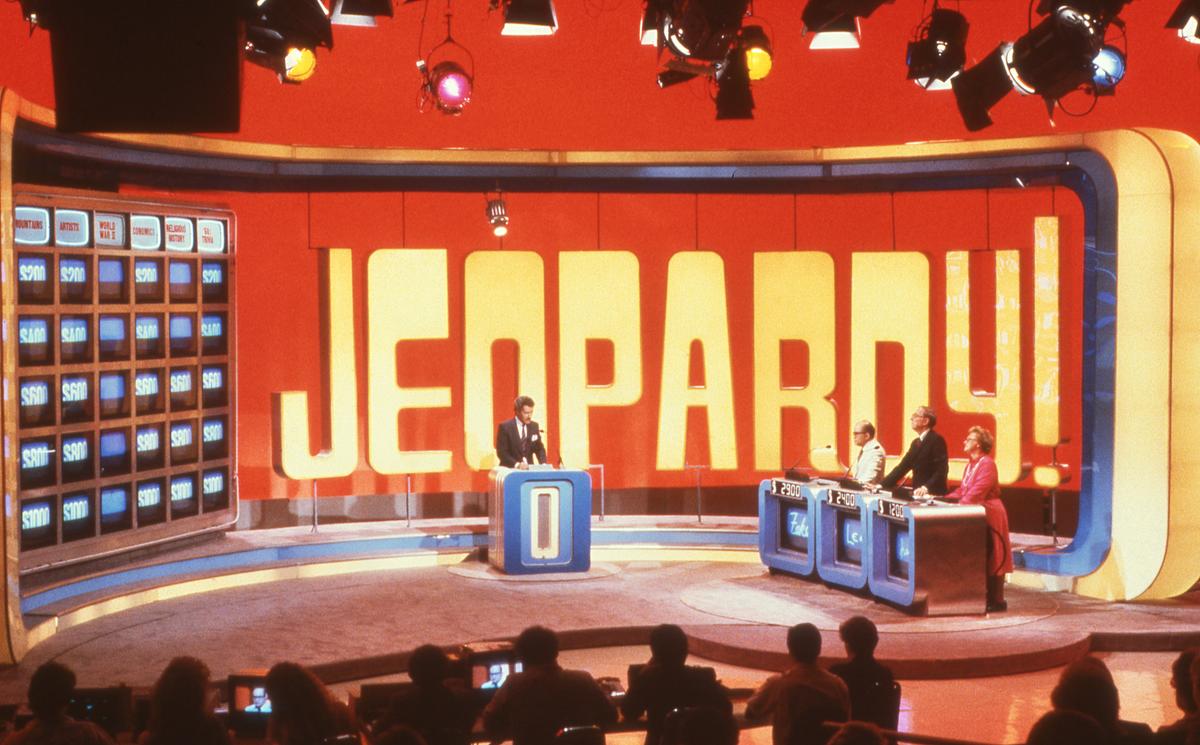
March 30, 1964: "Jeopardy!" Premieres

The original set. Note that the board is on the viewer's right,
instead of the left like the modern version.

March 30, 1964: Jeopardy! premieres on NBC, a daytime game show created by Merv Griffin. Art Fleming hosts it until it is canceled in 1979. A new version began in syndication in 1984, and was hosted by Alex Trebek until his death in 2020. (Fleming died in 1995, Griffin in 2007.)
Art Fleming

Trebek's version became the most popular game show in TV history. Ken Jennings, the highest money-winner in the show's history, and actress Mayim Bialik have alternately hosted since. (UPDATE: In 2023, Bialik was dropped, and Jennings became the permanent host.)
Alex Trebek

Each game features 3 contestants, competing in 3 rounds: Jeopardy!, Double Jeopardy!, and Final Jeopardy! In each round, contestants can choose among 6 categories, and are presented trivia clues phrased as answers, to which they must respond in the form of a question that correctly identifies whatever the clue is describing.

For example, instead of asking, "Who is the only U.S. President to marry in the White House?" and the answer being "Grover Cleveland," the clue is, "He is the only U.S. President to marry in the White House," and the contestant, should he or she know the answer, would respond by asking, "Who is Grover Cleveland?"

And if the contestant goofs, and does not frame the answer in the form of a question, he or she does not get credit. Which sounds as cheap as punishing a spelling bee contestant for not saying, "Capital" to spell a proper noun, but that's the rule.
The 1984 set, with a noticeably younger Trebek

On the original Jeopardy! series, clue values in the first round ranged from $10 to $50 in the Jeopardy! round, and $20 to $100 in Double Jeopardy! The 1984 series' first round originally ranged from $100 to $500 in Jeopardy! and $200 to $1,000 in Double Jeopardy! These ranges were increased to $200–$1,000 and $400–$2,000, respectively, on November 26, 2001.
Ken Jennings

To put this in perspective: In 2022 dollars, that original 1964 $10 to $100 range would be $94 to $940; while the 1984 $100 to $1,000 would be $281 to $2,810; and the 2001 $200 to $2,000 would be $330 to $3,300.

Before 2003, Jeopardy! contestants were limited to 5 consecutive wins. At the beginning of the show's 20th season in 2003, the rules were changed to allow contestants to remain on the show as long as they continued to win. After this rule change, and until Jennings' run, the record winning streak was set by Tom Walsh, who won $186,900 in 8 games in January 2004.

Jennings' run as champion aired from June 2 to November 30, 2004. He won 74 straight games, before losing the 75th, winning $2,522,700 -- $3,908,326 in 2022 money.

*

March 30, 1964 was a Monday. Baseball was in Spring Training. Football was out of season. The Stanley Cup Playoffs were underway, but no games were set for this day. There was 1 game played in the NBA: What was St. Louis Hawks 121, Los Angeles Lakers 108, at the Kiel Auditorium in St. Louis?

Monday, January 24, 2022

January 25, 1949: The 1st Emmy Awards

January 25, 1949: The 1st Emmy Awards ceremony is held at the Hollywood Athletic Club in Los Angeles, under the auspices of the National Academy of Television Arts and Sciences.

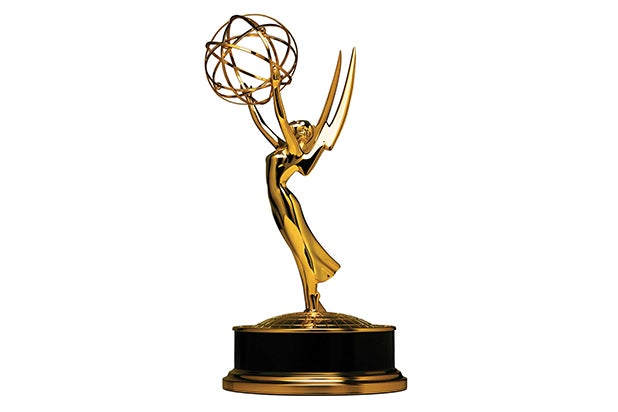
The name "Emmy" is not a derivative of "Emma" or any other feminine name. Nor is the award named after a person, as the Tony Awards were named for Broadway actress and director Antoinette Perry. Rather, it is a corruption of "immy," short for "image orthicon tube," which was common in early TV cameras. So it's a technical term, just as "Grammy" is short for "gramophone," an early term for a record player.

The host was supposed to be Rudy Vallée, already a superstar since the 1920s, but he had to leave town at the last minute, so Walter O'Keefe, host of the NBC game show Double Or Nothing, and the popularizer of the song "The Daring Young Man On the Flying Trapeze," substituted. (He lived until 1983.)

On this occasion, only TV shows produced in Los Angeles County and aired in the Los Angeles metropolitan area were eligible to win. And only 6 awards were given out:

* Most Popular Television Program: Pantomime Quiz, a game show on KTLA-Channel 5, then on the Paramount Television Network, an independent station from 1955 to 1995, on The WB from then until 2006, and on The CW ever since. The show later became Stump the Stars, and lasted from 1947 to 1959, on ABC for most of its run.

* Best Film Made for Television: The Necklace. Unfortunately, there seems to be no surviving footage.

* Most Outstanding Television Personality: Shirley Dinsdale, host of a KTLA show titled Judy Splinters, which was also the name of her ventriloquist's dummy. This made her the 1st woman to win an Emmy. As 2 of the other 4 nominees were Rita LeRoy and Patricia Morison, the chances of a woman winning at the 1st Emmy ceremony were better than you might have thought. By the way: Shirley managed to do this show while attending classes at UCLA.
In 1953, she got married, and, except for a 1958 appearance as a panelist on the game show To Tell the Truth, she retired from show business. In 1970, with her kids now teenagers, she went back to school, and became a pulmonary therapist on Long Island. She lived until 1999.

* Outstanding Overall Performance by a Television Station: KTLA. I'm beginning to notice a pattern.

* Technical Award: Charles Mesak, of Don Lee Television, for his innovation, Phasefader, an improvement for TV cameras.

* And a special award, to the man who designed the Emmy statue, Louis McManus. Instead of his own Emmy, they gave him a plaque. (At least Ed Smith, the NYU football player and male model who modeled for the Heisman Trophy in 1985, eventually got his own copy.)

In 1974, the NATAS (now just "the Academy of Television Arts and Sciences," or ATAS) held the 1st Daytime Emmy Awards. All subsequent broadcasts of the primetime Emmy Awards are called just that: The Primetime Emmy Awards. All previous ceremonies have been retroactively given that name, so that the 1949 ceremony is "The 1st Primetime Emmy Awards." The 2022 edition will be the 74th.

The show with the most Emmy Awards is Saturday Night Live, with 74, but that's understandable, as it's been on the air for 47 years. Number 2 is Game of Thrones, which was on the air for 8 years, and won 59 Emmys.

The actor with the most Emmy wins is Julia Louis-Dreyfus, with 11, in 24 nominations. Angela Lansbury has been nominated 17 times, and has never won. This has attracted far less attention than Susan Lucci got for being nominated for a Daytime Emmy 18 times and never winning, before she finally got hers in 1999. She is now 1-for-21.

The 1st black person to win, in any category (performing or behind the scenes) was Harry Belafonte, in 1960, for his special The Revlon Revue: Tonight With BelafonteThe 1st Hispanic person to win was -- no, not Desi Arnaz for I Love Lucy -- Rita Moreno, in 1977, for Best Supporting Actress for her participation in The Muppet ShowThe 1st Asian person to win was Archie Panjabi, in 2010, for Outstanding Supporting Actress in a Drama Series, for The Good WifeAnd the 1st openly gay person to win was Ellen Degeneres, in 1997, for "The Puppy Episode," the episode of Ellen when her character came out -- but she won for writing it, not for acting in it.

In 1962, songwriter Richard Rodgers won an Emmy, making him not only the 1st person to win one of those and an Oscar, but the first "EGOT": A winner of an Emmy, a Grammy, an Oscar and a Tony.

Venues for the ceremonies:

* 1949: Hollywood Athletic Club

* 1950-51: Ambassador Hotel

* 1952, 1957: Cocoanut Grove

* 1953: Hotel Statler

* 1954, 1962-66, 1968, 1971-72, 1975: Hollywood Palladium

* 1955, 1959, 1961: Moulin Rouge Nightclub

* 1956: Pan-Pacific Auditorium

* 1957, 1960: NBC Studios

* 1967, 1970: Century Plaza Hotel

* 1969: Santa Monica Civic Auditorium

* 1973, 1976, 2001: Shubert Theatre

* 1974: Pantages Theatre

* 1977-97: Pasadena Civic Auditorium

* 1998-2000, 2002-07: Shrine Auditorium

* 2008-19, 2022: Peacock Theater

* 2020: Staples Center (Crypto.com Arena)

* 2021: The Event Deck at L.A. Live


*

January 25, 1949 was a Tuesday. Baseball and football were out of season. There were no games scheduled for the NHL. But there were 3 games scheduled for the Basketball Association of America, the league that was renamed the NBA the next season:

* The Providence Steam Rollers beat the Boston Celtics, 69-54 at the Boston Garden.

* The Indianapolis Jets beat the St. Louis Bombers, 65-53 at the Butler Fieldhouse (now the Hinkle Fieldhouse) at Butler University in Indianapolis.

* And the Philadelphia Warriors beat the Chicago Stags, 86-77 at the Chicago Stadium.

December 31, 1999 & January 1, 2000: The Millennium

December 31, 1999:  The Millennium arrives. The people of planet Earth survived. At a terrible cost. But we hadn't destroyed ourselves. ...