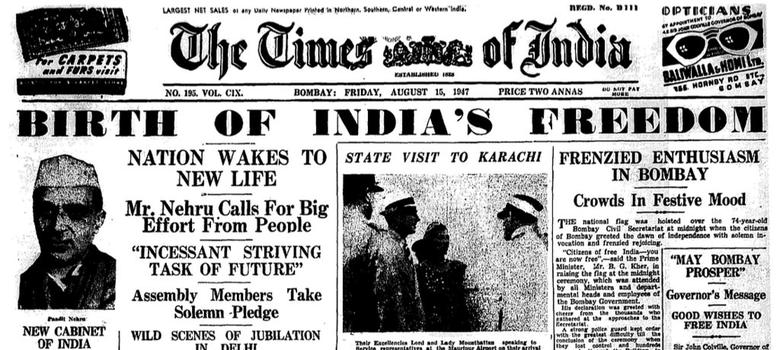
August 15, 1947: The partition of India takes effect, and the nations of India and Pakistan are created out of the former British "Raj."
The independence took effect at midnight, Delhi time. Pakistan is 1 hour behind, so they celebrate their independence on August 14, India theirs on August 15.
Jawaharlal Nehru, India's 1st Prime Minister, tried to echo President Franklin D. Roosevelt's words about how America "had a rendezvous with destiny": Over the network All India Radio, he said that the new country with an ancient civilization "had a tryst with destiny."

Despite a great deal of trouble, he kept winning elections until his death on May 27, 1964. And when he died, for once, the world’s great powers were in agreement. Lyndon Johnson said, "Perhaps more than any other world leader he has given expression to man's yearning for peace. This is the issue of our age. In his fearless pursuit of a world free from war he has served all humanity."
And Nikita Khrushchev said, "Jawaharal Nehru is known as an outstanding statesman of modern times who devoted his entire life to the struggle for strengthening friendship and cooperation among peoples and for the progress of humanity."
His daughter eventually became Prime Minister, lost the office, regained it, and was assassinated while still in it. Indira Gandhi took her husband’s family name, but he was not related to her father’s friend Mohandas Gandhi. A member of the Nehru-Gandhi family was Prime Minister for 37 of the country’s 1st 44 years of independence.
As with India's 1st head of government, Pakistan's had been a lawyer before becoming an activist. Muhammad Ali Jinnah served as the leader of the All-Indian Muslim League from 1913 until 1947, and was a natural choice to lead his new country. But he had long suffered from tuberculosis, and died on September 11, 1948, at 71, only a year into independence.

Pakistan calls Jinnah "The Father of the Nation." But historian Akbar S. Ahmed calls him "the most maligned person in recent Indian history ... In India, many see him as the demon who divided the land." Thus, they hold him responsible for the conflict that followed, which was, for all intents and purposes, a civil war. British actor Christopher Lee starred in the film Jinnah in 1998, and called it the finest performance of his career.
The title "Empress of India" was created by the British Parliament for Queen Victoria in 1877. She held it until her death in 1901. The title "Emperor of India" was subsequently held by her son, King Edward VII, until his death in 1910; by his son, King George V, until his death in 1936; by his son, King Edward VIII, until his abdication later that year; and by his brother, King George VI, who renounced the title on June 22, 1948, 10 months after independence. Officially, he remained head of state as King of India until the country became a republic on January 26, 1950. He remained King of Pakistan until his death in 1952. His daughter, Queen Elizabeth II, was Queen of Pakistan until that country became a republic on March 23, 1956.
India remains a member of the successor organization to the British Empire, the Commonwealth of Nations, informally known as the British Commonwealth. Pakistan left it in 1972, but rejoined in 1989.
One thing that both countries kept from Britain is the love of the sport of cricket, which is baseball's cousin. The similarities are easy to see, but the differences can be very confusing.
To this day, no native of South Asia has ever played in Major League Baseball. Some Indian-born players -- all trained as cricket bowlers, the equivalent of pitchers -- have played in the North American minor leagues, but haven't reached the majors.
One former major leaguer was born in Afghanistan: Jeff Bronkey, born in the capital of Kabul in 1965 to an Afghan father and an American mother, who raised him in Oregon. He pitched, mostly in relief, for the Texas Rangers in 1993, and the Milwaukee Brewers in 1994 and '95, going 2-2 with 2 saves and a 4.04 ERA.
*
The NFL, the NBA and NHL were all in their off-seasons, and did not play on August 15, 1947, a Friday. These Major League Baseball games were played:
* The New York Yankees beat the Boston Red Sox, 10-6 at the old Yankee Stadium. George "Snuffy" Stirnweiss hit a home run for the Bronx Bombers. Joe DiMaggio went 2-for-3 for the Yanks, Ted Williams 4-for-5 for the BoSox. Joe Page was the winning pitcher, in relief of Karl Drews.
* The New York Giants lost to the Boston Braves, 8-7 at Braves Field in Boston.
* The Brooklyn Dodgers beat the Philadelphia Phillies, 8-1 at Shibe Park in Philadelphia.
* The Philadelphia Athletics beat the Washington Senators, 3-0 at Griffith Stadium in Washington.
* The St. Louis Cardinals beat the Pittsburgh Pirates, 7-4 at Forbes Field in Pittsburgh.
* The Chicago Cubs beat the Cincinnati Reds, 6-5 at Crosley Field in Cincinnati.
* The Detroit Tigers beat the Chicago White Sox, 9-2 at Comiskey Park in Chicago.
* And the Cleveland Indians beat the St. Louis Browns, 2-0 at Sportsman's Park in St. Louis.
None of these games went to extra innings.


