Showing posts with label brian epstein. Show all posts

Monday, August 29, 2022

August 29, 1966: The Beatles' Last Official Concert

August 29, 1966: The Beatles conclude their World Tour at Candlestick Park in San Francisco, home of Major League Baseball's San Francisco Giants. It turns out to be the last time all four of them would play together before a paying audience.

The tour had been tough. It had started in June 24, in Munich, West Germany, followed by shows the next night in Essen, then in Hamburg, where they had "grown up as a band" in 1960. They went to the Far East, doing 5 shows in 3 days at Nippon Budokan in Tokyo, which had become a shrine for the sport of sumo wrestling, and it led to objections that they were soiling an ancient art. The art may have been ancient, but the venue was less than 2 years old, having been built for the 1964 Olympics. As it turned out, it has become better-known for its rock concerts.

Then came 2 shows at Rizal Memorial Stadium in Manila on July 4. The night before, exhausted, the band had failed to show up for social engagement held by Imelda Marcos, wife of President Ferdinand Marcos. This led to a backlash from the President's supporters, and the group left the country under a cloud. It would be years before anybody realized how bad both halves of the Marcos couple were.

On July 29, while they were resting up for their upcoming U.S. tour, Datebook magazine published Maureen Cleave's interview with John Lennon, in which he said, "We're more popular than Jesus now." Within a week, as only Americans can do, Americans overreacted: Radio stations from coast to coast, North to South were banning Beatle records, and "Beatle bonfires" were being held.

On August 11, The Beatles arrived in Chicago, and, for the only time in his life, Lennon ate crow, and offered an apology. The tour began: August 12, 2 shows at the International Amphitheatre in Chicago; August 13, 2 shows at the Detroit Red Wings' Olympia Stadium; August 14, Cleveland Municipal Stadium, home of the Indians and the Browns; August 15, District of Columbia Stadium, then the home of the teams named the Washington Senators and the Washington Redskins, a stadium later renamed for Robert F. Kennedy; August 16, John F. Kennedy Stadium in Philadelphia; August 17, 2 shows at Maple Leaf Gardens in Toronto, the only building they played on all 3 of their North American tours; and August 18, Suffolk Downs, a horse-racing track in Boston.

Then came August 19, and 2 shows at the Mid-South Coliseum in Memphis. This was the Bible Belt, and lots of people were still pretty mad. The Ku Klux Klan had nailed a Beatles LP to a wooden cross and burned it. During the evening show, someone threw a firecracker onto the stage. No one was hit, but when it went off, lots of people thought it was a gunshot. All 3 of the others turned to John after the firecracker, to make sure he was all right. He was.

August 20 had been scheduled for Crosley Field, the ballpark of the Cincinnati Reds, but it rained. That gave the Fab Four a little rest, but it forced an unusual doubleheader: Two concerts in two cities in one day. They did an afternoon show at Crosley, then flew to St. Louis to play at the new Busch Memorial Stadium.

So many music historians have ripped Elvis Presley's manager, Tom Parker, for running his man ragged, and praised Beatles manager Brian Epstein for "taking care of" "the boys." With many things, he did. But he was every bit as determined to make as much money from his charges as he could as Parker was, and their 3 North American tours were always inches away from disaster. And, despite the aural damp squib that was their concert at Shea Stadium in New York the year before, people still hadn't yet figured out how to stage a rock concert in a baseball park or a football stadium.

And John kept talking. At a press conference in New York before their return to Shea on August 23, John he said the Vietnam War was "wrong." He was right, but America wasn't ready to hear that yet. The year before, they had filled all 55,000 available seats at the Flushing Meadow stadium. This time, "only" 40,000 showed up, with pickets both for and against them facing off against each other.

It was their most stressful tour ever, and George Harrison said he'd rather leave the band than ever go on another tour. They decided they wouldn't, and would be only a recording band from that point onward. George agreed to stay -- for now.

After Shea, it was off to the West coast. They did 2 shows at the Seattle Center Coliseum on August 25. After 2 days of rest, they played the 1st concert at Dodger Stadium in Los Angeles. The next concerts there wouldn't be until 1975, with 2 by Elton John; and the next ones until 1984, with The Jacksons' Victory Tour.

The last concert on the tour was at Candlestick Park in San Francisco on August 29. They were supported by The Ronettes, The Cyrkle, Bobby Hebb, and The Remains. (The Cyrkle were also managed by Epstein's company.) Attendance: 25,000, meaning about 17,000 empty seats. (In 1971, the NFL's San Francisco 49ers joined baseball's San Francisco Giants there, leading to an expansion to 69,000 seats.)
Candlestick Park in the 1960s

As usual, they roared through their set, unable to hear themselves over the all the screaming, playing 11 songs in 33 minutes:

1. John Lennon singing Chuck Berry's "Rock and Roll Music."
2. Paul McCartney singing his song "She's a Woman."
3. George Harrison singing his song "If I Needed Someone." (Every show would have a George song and a Ringo song, so "the other guys" wouldn't feel left out.)
4. Paul singing his song "Day Tripper."
5. John singing his song "Baby's In Black."
6. John singing his song "I Feel Fine."
7. Paul singing his song "Yesterday."
8. Ringo Starr singing Paul's song "I Wanna Be Your Man."
9. John singing his song "Nowhere Man."
10. Paul singing his song "Paperback Writer."
11. And the last song anybody would ever pay to hear The Beatles sing live, Paul singing Little Richard's song "Long Tall Sally."

Reviews of the concert were not good, with the San Francisco Chronicle headlining "Bedlam at the Ball Park." Ringo was 26 years old, John 25, Paul 24 and George 23, so age wasn't an issue. But they they were physically, mentally and emotionally wiped-out, and the sound system was insufficient, and the overall atmosphere wasn't what it had been, even a year earlier, when it could still be adequately described as "Beatlemania."

They had already released Rubber Soul, and had just released Revolver on August 5. They were weary. They were examining their feelings, and expressing them on their recordings. These were no longer "The Lovable Mop Tops" who had dazzled people on The Ed Sullivan Show: When John sang "Help!" the year before, he wasn't just singing a song as a character in a story, he was being himself.

As I said, they were between 23 and 26 years old. A kid who was 13 when they first arrived at John F. Kennedy International Airport on February 7, 1964 would now be only 15. How many 15-year-olds were going to "get" the content of "Norwegian Wood," "She Said She Said" or "Tomorrow Never Knows"? Or even understand the grownup love stories of "Girl" and "For No One"?

A lot of people couldn't handle what the Liverpudlians were offering in 1966, and that was one reason NBC made the TV show The Monkees, to fill that void.

The gap would grow. The next time anyone saw The Beatles in public, they weren't wearing black suits. They were wearing the wild colors of Swinging London and San Francisco's Haight-Ashbury. They had mustaches. And they had recorded "Penny Lane" and "Strawberry Fields Forever," and released promotional films (what would later be called "music videos") for them, in which they looked... weird. "Tomorrow Never Knows," indeed.

While they'd decided not to tour again, even the four of them did not know that the Candlestick Park show would be their last paying concert together, ever. There would be the concert on the roof of the building where Apple Records was based, on January 30, 1969. And each of them would have notable solo gigs, with Paul and Ringo living and continuing to tour into the 2020s. But The Beatles would never have another official concert.

If, in the Summer of 1966, you had told people that the last official concert by The Beatles would be 11 years before the last one by Elvis Presley, few of them would have believed you. But it turned out to be true.

Built in 1960, Candlestick Park hosted its last event on August 14, 2014. It was a concert by 72-year-old former Beatle Paul McCartney. A crowd of 53,477 attended, and it got great reviews. The stadium's demolition began 3 months later.

*

August 29, 1966 was a Monday. These baseball games were played that day:

* The New York Yankees beat the Kansas City Athletics, 7-2 at Kansas City Municipal Stadium. Future Seattle Pilot Fred Talbot started, but didn't get out of the 3rd inning. The winning pitcher was another future Seattle Pilot, THE Dooley Womack. Lou Clinton hit a home run. Mickey Mantle went 2-for-4. Roger Maris drew a walk as a pinch-hitter, and scored a run.

* The New York Mets beat the Los Angeles Dodgers, 5-3 at Shea Stadium. Bob Shaw went the distance for the win, while Claude Osteen didn't get out of the 2nd inning. Former Cardinals MVP Ken Boyer went 3-for-5 with an RBI.

* The Philadelphia Phillies beat the San Francisco Giants, 5-1 at Connie Mack Stadium in Philadelphia. Jim Bunning went the distance for the win, while Ray Sadecki didn't get out of the 3rd inning. Johnny Callison went 3-for-4 with 2 RBIs. Willie Mays went 1-for-4 with an RBI.

* The Detroit Tigers beat the Baltimore Orioles, 6-3 at Memorial Stadium in Baltimore. Denny McLain outpitched Dave McNally. The Tigers got 2 home runs from Willie Horton, and 1 from Bill Freehan. Horton had 5 RBIs. Al Kaline went 2-for-5. Frank Robinson hit a home run for the O's, and Brooks Robinson went 1-for-5.

* The Chicago Cubs beat the Atlanta Braves, 4-2 at Atlanta Stadium (later renamed Atlanta-Fulton County Stadium). George Altman singled Ron Campbell and Adolfo Phillips home in the top of the 14th inning. Fergie Jenkins pitched into the 9th inning, but the winning pitcher, for the 286th and last time in his career, was Robin Roberts.

* The Houston Astros beat the Pittsburgh Pirates, 2-0 at Forbes Field in Pittsburgh. Mike Cuellar pitched a 5-hit shutout, striking out 12, to outpitch Bob Veale. Roberto Clemente went 0-for-4. Willie Stargell did not play.

* The Cincinnati Reds beat the St. Louis Cardinals, 2-0 at Crosley Field in Cincinnati. Deron Johnson hit 2 home runs. Pete Rose went 1-for-4.

* The Chicago White Sox beat the Cleveland Indians, 2-0 at Comiskey Park in Chicago. Tommy John pitched a 5-hit shutout. The Pale Hose's runs came on a home run by Tommie Agee. Neither John nor Agee would be remembered as White Sox, however.

* The Minnesota Twins beat the Washington Senators, 6-1 at Metropolitan Stadium in the Minneapolis suburb of Bloomington, Minnesota. Harmon Killebrew went 1-for-4.

* The Boston Red Sox beat the California Angels, 4-3 at Anaheim Stadium (now Angel Stadium of Anaheim). Carl Yastrzemski drew a walk as a pinch-hitter.

For the record, 11 stadiums that hosted Major League Baseball also hosted Beatle concerts:

1. Kansas City Municipal Stadium, home of the Athletics, later home of the Royals, September 17, 1964.
2. Shea Stadium, New York, home of the Mets, August 15, 1965 and August 23, 1966.
3. Atlanta-Fulton County Stadium, home of the Braves, August 18, 1965.
4. Comiskey Park, Chicago, home of the White Sox, August 20, 1965.
5. Metropolitan Stadium, Bloomington, home of the Minnesota Twins, August 21, 1965.
6. Cleveland Municipal Stadium, home of the Indians, August 14, 1966.
7. District of Columbia/Robert F. Kennedy Stadium, home of the Washington Senators, later home of the Washington Nationals, August 15, 1966.
8. Crosley Field, Cincinnati, home of the Reds, August 21, 1966.
9. Busch Memorial Stadium, St. Louis, home of the Cardinals, August 21, 1966.
10. Dodger Stadium, Los Angeles,  home of the Dodgers, August 28, 1966.
11. Candlestick Park, San Francisco, home of the Giants, August 29, 1966.

UPDATE: As of August 19, 2025, Paul McCartney was still alive, and had performed at least one concert, either as a Beatle or solo, at at least one home field of 26 out of the 30 current MLB teams. On October 11, he is scheduled to play Coors Field in Denver, home of the Colorado Rockies. If that concert goes off as planned, that will leave 3 teams: The Pittsburgh Pirates, the Arizona Diamondbacks, and the Tampa Bay Rays. Given the Rays' stadium situation, and Paul's current age of 83, the odds are against him getting all 30 done.

Sunday, August 28, 2022

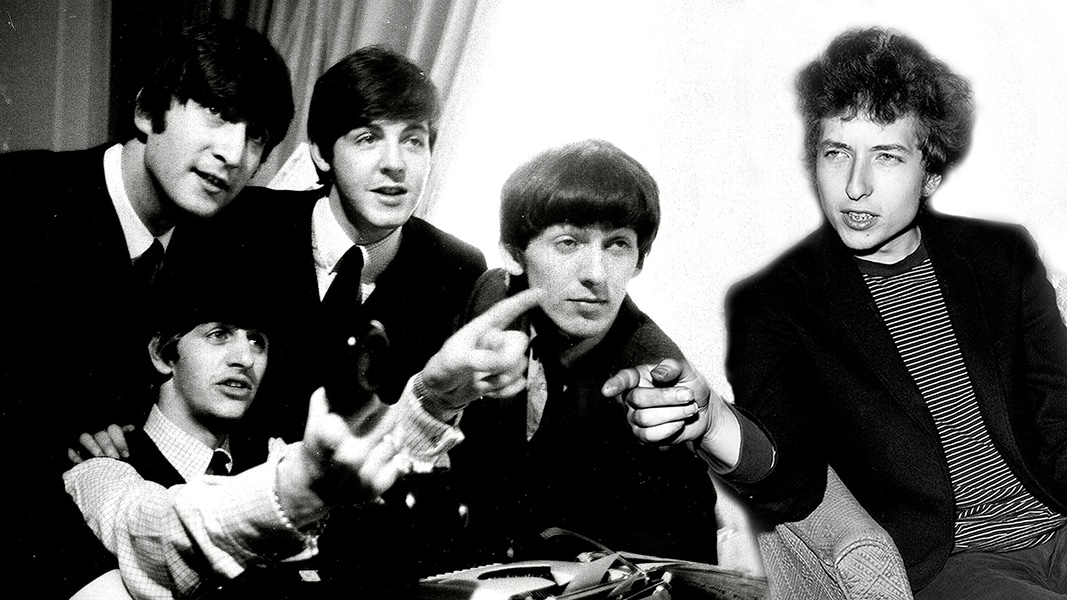
August 28, 1964: Bob Dylan Meets The Beatles

A simulation. There were no photographers at the meeting.

August 28, 1964: The 1st of the 2 great summits of rock and roll occurs: Bob Dylan meets The Beatles.

Dylan released his 3rd album, The Times They Are a-Changin', on February 10, 1964, the day after The Beatles made their 1st American TV appearance, on The Ed Sullivan Show. Among the songs they played was "I Want to Hold Your Hand," then the Number 1 song in America. The bridge goes as follows:

And when I touch you
I feel happy inside.
It's such a feeling that
my love, I can't hide, I can't hide, I can't hide!

But between the music and their Liverpudlian accents, Dylan thought they were singing, "I get high, I get high, I get high!" Dylan, a marijuana smoker, assumed that The Beatles were potheads, too.

In fact, the Fab Four did get high, many times -- but on amphetamines, pep pills. They used them to stay up all night when they were cutting their teeth in the clubs of the Reeperbahn in Hamburg, Germany before they made it big in their homeland. They had never smoked weed yet. It wasn't popular in Britain yet.

When The Beatles returned to America for their Summer 1964 tour, a meeting was set up between them and the leader of American music's protest movement. The band was staying in a 6th floor suite at the Hotel Delmonico, at 502 Park Avenue at 59th Street. Al Aronowitz, covering the tour for The Saturday Evening Post, was friendly with both the band and Dylan, and brought Dylan in.

Dylan brought joints in with him. He first offered one to Ringo Starr. According to one account, the drummer, "ignorant of dope etiquette, chugged through that first joint like a stevedore attacking his first Woodbine of the morning and collapsed in a giggling mess." Next was their manager, Brian Epstein, who was affected very quickly, saying, "I'm so high, I'm up on the ceiling."

Paul McCartney believed he'd attained true mental clarity for the first time in his life, and instructed Beatles roadie and major-domo Mal Evans to write down everything he said henceforth. Whatever John Lennon and George Harrison said or felt, it appears not to have been recorded.

At one point, the phone rang, and Dylan answered, "This is Beatlemania here!" They drank some wine, and got along great.

The 2nd great summit happened exactly 365 days later, on August 27, 1965: Elvis Presley met The Beatles. It didn't go nearly as well.

The effect that marijuana had on the music of Dylan, and on that of The Beatles, is debatable. The effect that the meeting had on each is undeniable. Dylan "went electric," and, within 2 years, produced 3 albums that are regarded as absolute classics: Bringing It All Back Home, Highway 61 Revisited (including "Like a Rolling Stone"), and Blonde On Blonde.

As for The Beatles, most of the effects of the meeting with Dylan were, by his own admission, on John. Without Dylan, he almost certainly would not have written "I'm a Loser," "I Don't Want to Spoil the Party," "Help!", "You've Got to Hide Your Love Away," "Nowhere Man," "Norwegian Wood," "She Said She Said" and "Tomorrow Never Knows" -- to say nothing of what he did from Sgt. Pepper onward.

In 1988, each in their 1st year of eligibility, Dylan and The Beatles were elected to the Rock and Roll Hall of Fame. That same year, George invited Bob to be in his "supergroup," The Traveling Wilburys, along with Roy Orbison, Tom Petty, and Jeff Lynne of Electric Light Orchestra. In 1992, at the Dylan tribute concert at Madison Square Garden, George sang "If Not For You," not one of Bob's better songs; and "Absolutely Sweet Marie," a good one that he probably wouldn't have written without The Beatles' influence.

Al Aronowitz lived until 2005. Built in 1929, the Delmonico was converted into apartments in 1974. In 2018, it was bought by the Trump Organization, and renamed Trump Park Avenue. Disgusting.

*

August 28, 1964 was a Friday. Golfer Lee Janzen was born. This was also the day the North Philadelphia race riot broke out. I have a separate entry for that event.

It was the off-season for the NFL, the AFL, the NBA and the NHL, but games were played in Major League Baseball:

* The New York Yankees lost to the Boston Red Sox, 5-3 at Yankee Stadium. Felix Mantilla, the former Milwaukee Brave and original Met, and Dick Stuart, the powerful slugger but awful-fielding 1st baseman known as "Dr. Strangeglove," both hit home runs off Al Downing. Joe Pepitone hit one for the Yankees, but Mickey Mantle went 0-for-4.

* The New York Mets beat the Chicago Cubs, 12-10 at Wrigley Field in Chicago.

* A doubleheader was split at Memorial Stadium in Baltimore. The Chicago White Sox won the 1st game, 2-1. The Baltimore Orioles won the 2nd game, 8-3.

* The Pittsburgh Pirates beat the Philadelphia Phillies, 4-2 at Forbes Field in Pittsburgh. The Phillies took a 2-0 lead in the top of the 8th, but blew it in the bottom of the 9th, thanks to Smoky Burgess' home run.

* The San Francisco Giants beat the Milwaukee Braves, 3-2 at Milwaukee County Stadium. Willie Mays went 1-for-2 with a 2-run home run, and Hank Aaron went 1-for-2 with 2 walks. Joe Torre hit a home run for the Braves.

* The Washington Senators beat the Minnesota Twins, 3-1 at Metropolitan Stadium in the Minneapolis suburb of Bloomington, Minnesota.

* The St. Louis Cardinals beat the Los Angeles Dodgers, 5-3 at the original Busch Stadium (formerly Sportsman's Park).

* The Cleveland Indians beat the Kansas City Athletics, 4-1 at Kansas City Municipal Stadium.

* The Detroit Tigers swept a doubleheader from the Los Angeles Angels at Dodger Stadium in Los Angeles, where the Angels played from 1962 to 1965 while waiting for their stadium in Anaheim to be built. The Tigers won the opener, 12-1; and the nightcap, 8-7.

* The Cincinnati Reds were supposed to host the Houston Colt .45s at Crosley Field in Cincinnati, but the game was rained out. They played a doubleheader the next day, and the Reds swept it. They won the 1st game, 2-1, on a walkoff single by Steve Boros in the 11th inning. They won the 2nd game, 8-7. The Colt .45s changed their name to the Astros the next season.  

Saturday, August 6, 2022

August 6, 1966: The Beatles "Get Canceled" by America's Religious Right

The Beatles -- left to right: Ringo, Paul, John and George --
on their 1966 World Tour,
looking uneasy, maybe even shellshocked.
Which would have been understandable.

August 6, 1966: What would later be called "cancel culture" hits the biggest act in world entertainment at the time: The Beatles.

On March 4, 1966, The Evening Standard, a London-based newspaper but, like many, serving Great Britain nationally, published an article titled "How Does a Beatle Live?" written by Maureen Cleave. She had interviewed all 4 group members regularly, and accompanied them on their 1st visit to America in February 1964. She is widely believed to have had an affair with John, and to have been the subject of his song "Norwegian Wood (This Bird Has Flown)."
In her latest interview with John Lennon, she portrayed him as restless and searching for meaning in his life. The year before, he had written the song "Help!" While most American teenagers thought it was just a great rock and roll song, it was more than that: John was physically and mentally exhausted from 2 years of nonstop Beatlemania, and all the money he'd made hadn't reduced his stress. So he really was looking for help and meaning.

He and bandmate George Harrison had been reading about religion. Unlike George, who found a connection with Eastern, especially Indian, faiths, John found no comfort in it, or in any other religion. Cleave quoted him as saying:

Christianity will go. It will vanish and shrink. I needn't argue about that; I'm right and I'll be proved right. We're more popular than Jesus now; I don't know which will go first – rock 'n' roll or Christianity. Jesus was all right but his disciples were thick and ordinary. It's them twisting it that ruins it for me.

People in Britain barely noticed: The article provoked no controversy there. Church attendance there was in decline, and Christian churches were attempting to transform their image, to make themselves more "relevant to modern times."

At first, that was also the case in America. Later in March, Newsweek printed the quote. In May, Detroit magazine printed the interview. On July 3, The New York Times Magazine printed it. Still, there was no reaction worth mentioning.

On July 29, Datebook magazine published the interview, and also Cleave's most recent interview with Paul McCartney, in its September 1966 "Shout-Out" issue, which was dedicated to controversial youth-orientated themes, including recreational drugs, sex, long hair, and the Vietnam War.

Although only Paul was shown on the cover, Art Unger, the magazine's editor, put a quote from Lennon's interview on the cover: "I don't know which will go first – rock 'n' roll or Christianity!" In author Robert Rodriguez's description, the editor had chosen what he thought would be Lennon's "most damning comment" for maximum effect.

Except, while it probably should have been, that wasn't the quote that upset people: It was the line, "We're more popular than Jesus now."

And he was right. Granted, 2,000 years from now, if human civilization survives, there will likely be more Bibles sold than Beatle albums. But, at the time, kids were more interested in 4 young men from current Liverpool than in 1 young man from ancient Israel and his 12 disciples.

The people that freaked out over John's remarks shouldn't have asked, "How dare he say that?" They should have asked, "What can we do to make Jesus, once again, more popular than The Beatles?" (Disclaimer: I don't have an answer now, and I probably wouldn't have had an answer had I been around then.)

In Birmingham, Alabama, WAQY disc jockey Tommy Charles said, on the air, "That does it for me. I am not going to play The Beatles anymore." He destroyed their records on the air. Local UPI reporter Al Benn filed a news report in New York City, culminating in a major story in The New York Times on August 5. Radio stations all over the country, including in supposedly liberal cities like New York and Boston, announced that they would no longer play Beatle songs.
On August 6 came the kind of event that one would have expected in Nazi Germany: In Reno, Nevada, station KCBN announced a public bonfire for that night, where the band's albums would be burned.
Many stations in Southern cities followed. Paul compared it to what the Nazis did with books they didn't like, and called it "hysterical low-grade American thinking."
Brian Epstein, the group's manager, who was Jewish, shrugged it off at first. saying, "If they burn Beatles records, they've got to buy them first." But then the press office at the Vatican -- though not Pope Paul VI himself -- weighed in, issuing this statement: "Some subjects must not be dealt with profanely, not even in the world of beatniks." Now, it wasn't just a bunch of ignorant, bigoted, archconservative Southern Baptists that were angry at the Fab Four: It was, officially, the Roman Catholic Church.
What's more, there were death threats. Now, John was scared: He had put his bandmates, and even their loved ones -- by this point, all but Paul were married, John and Ringo Starr each had one son, and George had a sister and her children living in St. Louis -- at physical risk.
And so, for what turned out to be the only time in his public life, John Lennon ate crow, and apologized for something he'd said or done.
On August 11, the Beatles flew from London to Chicago, where the North American leg of their World Tour was to begin. That night, at the Astor Tower Hotel, at a press conference in front of TV cameras, John said, "I suppose if I had said television was more popular than Jesus, I would have got away with it. I'm sorry I opened my mouth. I'm not anti-God, anti-Christ, or anti-religion. I was not knocking it. I was not saying we are greater or better."
He stressed that he had been remarking on how other people viewed and popularized the band. He described his own view of God by quoting the Bishop of Woolwich, "not as an old man in the sky. I believe that what people call God is something in all of us."
He was adamant that he was not comparing himself with Christ, but attempting to explain the decline of Christianity in the UK. He closed with what could be considered a halfhearted apology: "If you want me to apologize, if that will make you happy, then, okay, I'm sorry." (Shades of more recent "I'm sorry if I offended anyone" statements.)
Most American journalists accepted this. A New York Times editorial said that the matter was over. Even the Vatican's newspaper, L'Osservatore Romano (The Roman Observer), decided that the apology was sufficient.
But it wasn't over. On August 13, in South Carolina, the Ku Klux Klan "crucified" a Beatles record on a large wooden cross, which they burned. On the same night, radio station KLUE in Longview, Texas held a Beatles bonfire. The next day, a lightning bolt struck its transmission tower, briefly knocking it off the air. Maybe this was God confirming that He had accepted John's apology as well.
It still wasn't over. On August 15, The Beatles played District of Columbia Stadium (later renamed Robert F. Kennedy Stadium), in Washington, which was still considered a semi-Southern city at that point, and the KKK picketed the concert. On August 19, The Beatles played their only scheduled concert in the South, at the Mid-South Coliseum in Memphis. The Klan picketed this show, too. During the concert, a spectator threw a firecracker onstage, and all 4 members later said that they thought someone had fired a gun.
(Memphis was, of course, the hometown of Elvis Presley. If anyone asked Elvis for his thoughts on the matter, they've never been made public.) 
To make matters worse, John couldn't keep his mouth shut. On August 17, before their concert at Maple Leaf Gardens in Toronto, he gave his approval to Americans fleeing to Canada to avoid the military draft. At a press conference in New York before their concert at Shea Stadium on August 22, John said the Vietnam War was "wrong." The year before, they had filled all 55,000 available seats at the Flushing Meadow stadium. This time, "only" 40,000 showed up, with pickets both for and against them facing off against each other. (There was no fight between these factions.)
It was their most stressful tour ever, and George said he'd rather leave the band than ever go on another tour. They decided they wouldn't, and would be only a recording band from that point onward, although they did not publicly announce it yet. George agreed to stay -- for now.
The last concert on the tour was at Candlestick Park in San Francisco on August 29. They were supported by The Ronettes, The Cyrkle, Bobby Hebb, and The Remains. (The Cyrkle were also managed by Epstein's company.) Attendance: 25,000, meaning about 17,000 empty seats. (In 1971, the NFL's San Francisco 49ers joined baseball's San Francisco Giants there, leading to an expansion to 69,000 seats.)
As usual, they roared through their set, playing 11 songs in 33 minutes, unable to hear themselves over all the screaming, partly due to the fact that, in spite of having a year pass since their first round of stadium concerts, no one had yet figured out how to stage a rock concert in a ballpark. (By the 1970s, that problem would be solved.) The last song they played was a cover of Little Richard's "Long Tall Sally," sung by Paul.
While they'd decided not to tour again, even the four of them did not know that this would be their last paying concert together, ever. There would be the concert on the roof of the building where Apple Records was based, on January 30, 1969. And each of them would have notable solo gigs, with Paul and Ringo living and continuing to tour into the 2020s. But The Beatles would never have another official concert.
In 1970, for his solo album John Lennon/Plastic Ono Band, John recorded a song titled "God," in which he rattled off things and people he didn't believe in: Magic, the I-Ching, the Bible, tarot cards, Adolf Hitler, Jesus, John F. Kennedy, Buddha, mantras, Gita, yoga, kings, Elvis, Zimmerman (meaning Bob Dylan), and, finally, The Beatles. He said, "I just believe in me. Yoko and me. And that's reality." In 1971, for his album Imagine, he recorded a song of the same title, asking people to imagine there's no Heaven or Hell, "and no religion, too."
In contrast, in 1970, for his solo album All Things Must Pass, George recorded "My Sweet Lord," in which he seemed to want to get to know God better -- but the background singers, after chanting, "Hallelujah," began chanting, "Hare Krishna," and moved on to chanting the names of the Hindu gods Brahma, Vishnu and Shiva.
Maureen Cleave, who wrote the original article, died in 2021, at the age of 87.
*

August 6, 1966 was a Saturday. Back in Britain, a preseason exhibition game, or "friendly," was played between two of the most popular soccer teams in the country. Arsenal Football Club of North London traveled to Ibrox Stadium in Glasgow, Scotland, home of Rangers Football Club.

Arsenal were in a transition, having just survived relegation the season before, and had hired a new manager, Bertie Mee. He would build them into England's greatest team once again. But that would take 5 seasons. In contrast, Rangers were, as usual, one of the better teams in Scotland, and had won the Scottish Cup the last season. Rangers won this match, 2-0.

And these baseball games were played:

* The New York Yankees beat the Cleveland Indians, 5-4 at Cleveland Municipal Stadium. Jim Bouton and Sam McDowell started, but, in relief, it was Whitey Ford who was the winning pitcher, and Luis Tiant the losing pitcher. Clete Boyer and Horace Clarke hit home runs. Neither Mickey Mantle nor Roger Maris played.

* The New York Mets lost to the St. Louis Cardinals, 10-8 at Shea Stadium. The Cardinals led 5-0 after 3 innings, then the Mets led 8-4 after 4, but the Cards won. Lou Brock went 2-for-4 with a walk, a stolen base and an RBI. Ken Boyer hit a home run for the Mets over the team he had captained to a World Championship, and won a Most Valuable Player award for, just 2 years earlier.

* The Philadelphia Phillies beat the Atlanta Braves, 6-5 at Connie Mack Stadium in Philadelphia. Hank Aaron went 1-for-3 with 2 walks. Joe Torre went 2-for-5.

* The Baltimore Orioles beat the Washington Senators, 4-0 at Memorial Stadium in Baltimore. Dave McNally pitched a 7-hit shutout. Frank Robinson went 3-for-4 with an RBI. Brooks Robinson went 1-for-3 with an RBI.

* The Pittsburgh Pirates beat the Cincinnati Reds, 9-3 at Forbes Field in Pittsburgh. Roberto Clemente went 0-for-4, but had an RBI on a bases-loaded walk. Willie Stargell did not play. Pete Rose went 2-for-4 with 2 RBIs.

* The Boston Red Sox beat the Detroit Tigers, 8-2 at Tiger Stadium in Detroit. Carl Yastrzemski went 0-for-2 with 2 walks. Tony Conigliaro went 1-for-5. Al Kaline went 1-for-4.

* The Chicago Cubs beat the San Francisco Giants, 5-2 at Wrigley Field in Chicago. Ernie Banks went 2-for-4 with a home run and 2 RBIs. Robin Roberts started for the Cubs, but only pitched 3 innings, and made just 5 more major league appearances before retiring. Willie Mays went 2-for-4.

* The Minnesota Twins beat the Kansas City Athletics, 5-0 at Kansas City Municipal Stadium. Jim "Mudcat" Grant pitched a 4-hit shutout. Harmon Killebrew went 1-for-3 with a walk.

* The Los Angeles Dodgers beat the Houston Astros, 4-3 at the Astrodome in Houston. Don Drysdale outpitched Mike Cuellar.

* And the Chicago White Sox beat the California Angels, 7-1 at Anaheim Stadium (now Angel Stadium of Anaheim).

December 31, 1999 & January 1, 2000: The Millennium

December 31, 1999:  The Millennium arrives. The people of planet Earth survived. At a terrible cost. But we hadn't destroyed ourselves. ...