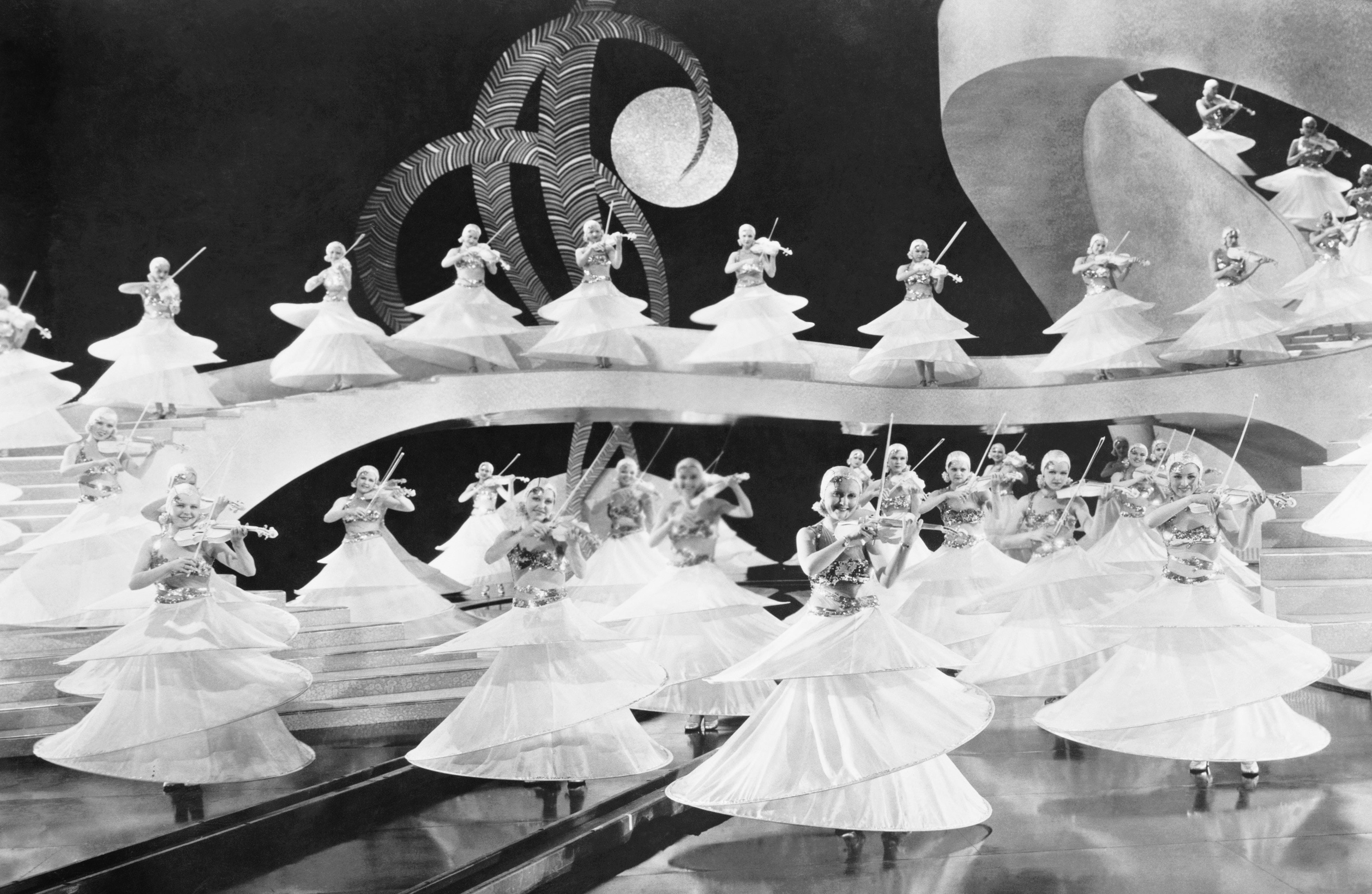
May 27, 1933: Gold Diggers of 1933 premieres. Directed by Mervyn LeRoy, it features music by Harry Warren and lyrics by Al Dubin, including "We're In the Money" and "Remember My Forgotten Man," featuring opposite sides of the ongoing Great Depression.
It is considered the quintessential "Busby Berkeley Musical." Moving from Broadway to Hollywood in 1930, shortly after the move from silent movies to "talking pictures" or "talkies," throughout the 1930s, Berkeley devised elaborate musical production numbers that often involved complex geometric patterns. Berkeley's works used large numbers of showgirls and props as fantasy elements in kaleidoscopic on-screen performances.

According to Sin in Soft Focus: Pre-Code Hollywood by Mark A. Vieira, Gold Diggers of 1933 was one of the first American films made and distributed with alternative footage in order to circumvent State censorship problems. In this way, when a film was edited, the "toned down" reels were labeled according to district. One version could be sent to New York City, another to the South, and another to the United Kingdom.
Berkeley used the lavish production numbers as a showcase of the female anatomy that were both "lyrical and lewd," but had cleaned-up versions. The songs "Pettin' in the Park" and "We're in the Money" are prime examples of this.
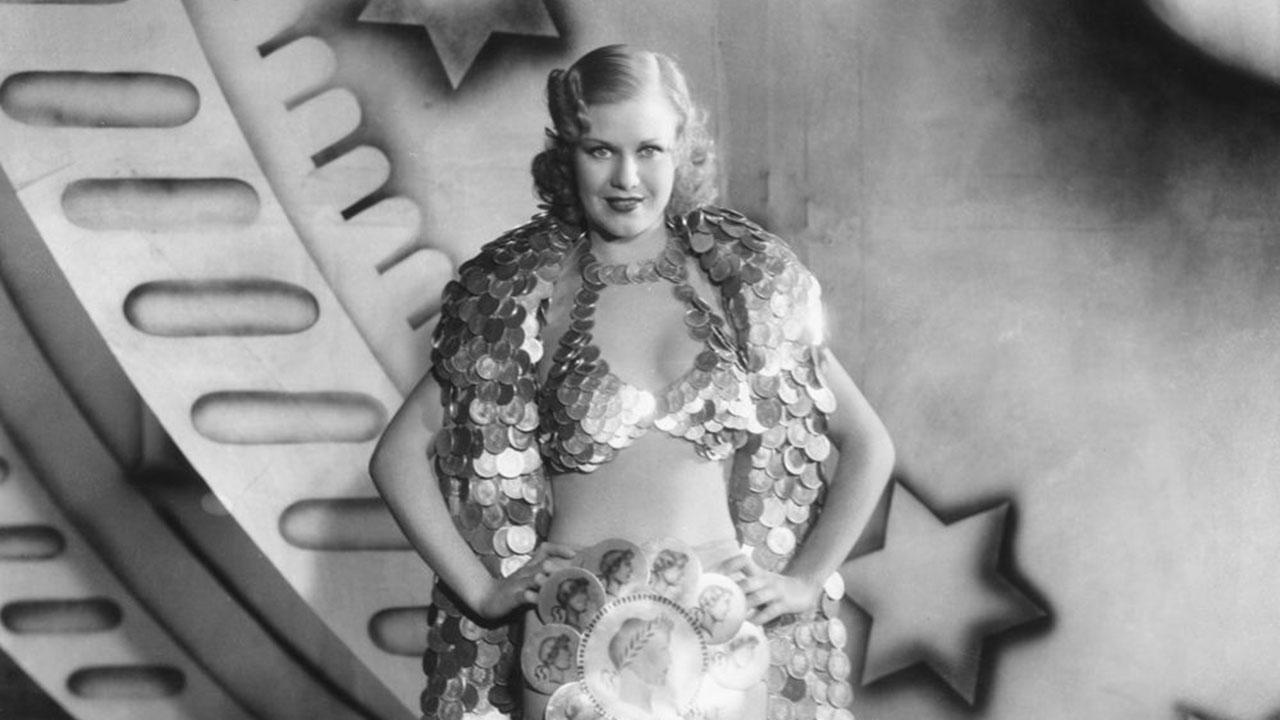
while singing "We're in the Money."
The "gold diggers" in the film are 4 aspiring actresses: Polly Parker (played by Ruby Keeler), an ingenue; Carol King (Joan Blondell), a torch singer; Trixie Lorraine (Aline MacMahon), a comedian; and Fay Fortune (Ginger Rogers, who had not yet made her 1st film with Fred Astaire), a glamour puss.
The film was made in early 1933, at the depth of the Depression, and contains numerous direct references to it. It begins with a rehearsal for a stage show, which is interrupted by the producer's creditors, who close down the show because of unpaid bills.
At the unglamorous apartment shared by 3 of the 4 actresses (Polly, Carol, and Trixie), the producer, Barney Hopkins (Ned Sparks), is in despair because he has everything he needs to put on a show, except money. He hears Brad Roberts (Dick Powell), the girls' neighbor and Polly's boyfriend, playing the piano. Brad is a brilliant songwriter and singer who not only has written the music for a show, but also offers Hopkins $15,000 in cash (about $338,000 in 2022 money) to back the production. Of course, they all think he is kidding, but he insists that he is serious: He offers to back the show, but refuses to perform in it, despite his talent and voice.
Brad comes through with the money, and the show goes into production, but the girls are suspicious that he must be a criminal, since he is cagey about his past and will not appear in the show, even though he is clearly more talented than the aging juvenile lead they have hired (Clarence Nordstrom). It turns out, however, that Brad is in fact a millionaire's son, whose family does not want him associating with the theatre. On opening night, in order to save the show when the juvenile cannot perform (due to his lumbago acting up), Brad is forced to play the lead role.
With the resulting publicity, Brad's brother J. Lawrence Bradford (Warren William) and family lawyer Faneuil H. Peabody Guy Kibbee) discover what he is doing, and go to New York to save him from being seduced by a "gold digger." Lawrence mistakenly identifies Carol as Polly, and his heavy-handed effort to dissuade the "cheap and vulgar" showgirl from marrying Brad by buying her off annoys her so much that Carol plays along, but the two fall in love.
Meanwhile, Trixie targets "Fanny" Peabody, the lawyer, as the perfect rich sap ripe for exploitation. When Lawrence finds out that Brad and the real Polly have wed, he threatens to have the marriage annulled, but relents when Carol refuses to marry him if he does. Trixie marries Faneuil. All the "gold diggers" (except Fay) end up with wealthy men.
In his book, Vieira reported that the film had two different endings: In one, the rocky romance between Bradford and Carol – whom he calls "cheap and vulgar" – is resolved backstage after the "Forgotten Man" number. In an alternative ending, this scene never takes place, and the film ends with the number.
William died in 1948 (from myeloma, only 53 years old), Kibbee in 1956, Sparks in 1957, Powell in 1963, Nordstrom in 1968, Berkeley in 1976, Blondell in 1979, LeRoy in 1987, MacMahon in 1991, Keeler in 1993, and Rogers in 1995.
*
May 27, 1933 was a Thursday. Also opening that day was Walt Disney's animated film version of The Three Little Pigs. I've never seen it. In 1994, a CBS documentary on the 50th Anniversary of World War II mentioned that Adolf Hitler, less than 4 months into his post as Chancellor of Germany when the film was released, really liked the film. It was many more years before I found out why: There's a scene where the Big Bad Wolf disguises himself as a Jewish peddler, complete with an oversized fake nose and an oversized fake beard.
This was also the day that the Century of Progress World's Fair opened in Chicago. I have a separate entry for that event.
These baseball games were played that day:
* The New York Yankees beat the Chicago White Sox, 15-11 at Yankee Stadium. Yes, that's a baseball score, not a football score. Pitcher Ted Lyons went 3-for-4 for the White Sox, but got knocked out of the box in the 8th inning, when the Yankees came back from 11-3 down to score 12 runs. Lou Gehrig and Bill Dickey hit home runs. Babe Ruth did not, but did go 1-for-4 with a walk and 2 RBIs.
* The Brooklyn Dodgers lost to the Cincinnati Reds, 4-3 at Redland Field in Cincinnati. The ballpark was renamed Crosley Field the next season.
* The Cleveland Indians beat the Boston Red Sox, 6-0 at Fenway Park in Boston. Wes Ferrell allowed 9 hits, but kept the shutout.
* The Philadelphia Athletics beat the Detroit Tigers, 5-2 at Shibe Park in Philadelphia. Mickey Cochrane hit 2 home runs, and Lefty Grove pitched 3 innings of scoreless relief to get the save for Tony Freitas. Jimmie Foxx did not play in this game. A year later, due to owner-manager Connie Mack's Depression-forced fire sale, Cochrane would be managing and playing for the Tigers, and Grove would be pitching for the Red Sox. Two years after that, Foxx would be with the Red Sox.
* The St. Louis Cardinals beat the Philadelphia Phillies, 10-1 at Sportsman's Park in St. Louis. Frankie Frisch, Joe Medwick, Ripper Collins and Jimmie Wilson each had 3 hits for the Cards, while Ethan Allen went 2-for-5 with 3 RBIs.
* The Boston Braves and the Chicago Cubs were rained out at Wrigley Field in Chicago. The game was made up as part of a doubleheader the next day. The Cubs swept, 5-1 and 3-2.
* The Washington Senators and the St. Louis Browns were rained out at Griffith Stadium in Washington. The game was made up as part of a doubleheader on July 15. The Senators swept, 1-0 and 2-0. Lefty Stewart pitched a 9-hit shutout in the opener, and Bobby Burke a 5-hit shutout in the nightcap.
* And the New York Giants and the Pittsburgh Pirates were rained out at Forbes Field in Pittsburgh. The game was made up as part of a doubleheader on July 22. The Giants won the 1st game, 1-0. Carl Hubbell pitched a 6-hit shutout. The Pirates won the 2nd game, 7-2. Over the 2 games, Giants 1st baseman-manager Bill Terry went 3-for-7 with a walk, Mel Ott went 2-for-7 with a walk and an RBI, Pie Traynor went 0-for-7 with an RBI, Paul Waner went 2-for-7 with an RBI, and Lloyd Waner went 2-for-8 with a walk.


