Showing posts with label beatrice arthur. Show all posts

Monday, November 21, 2022

November 21, 1972: CBS' Big Gamble With "Maude"

November 21, 1972: CBS takes a big risk – a few weeks before the Supreme Court’s decision was announced in Roe v. Wade – and airs the "abortion episode" of Maude, the 2nd half of a two-part episode.

The character of Maude Findlay, played by Beatrice Arthur, debuted on December 11, 1971, on an episode of All in the Family. Based largely on Frances Lear, then married to the show's creator, Norman Lear, Maude was a cousin of Edith Bunker (Jean Stapleton), and was as hard to the political left as her husband Archie (Carroll O'Connor) was to the right. The episode was well-received, and a pilot was ordered for a spinoff based on Maude. It debuted on September 12, 1972.

She lived in Tuckahoe, Westchester County, 16 miles north of Midtown Manhattan, with her 4th husband, Walter Findlay (Bill Macy -- not to be confused with later actor William H. Macy); and her grown daughter from a previous marriage, Carol Traynor (Adrienne Barbeau) and her son, Phillip (Brian Morrison).

Maude wasn't quite a parody of a liberal feminist, as much as Archie was a parody of a conservative bigot, but her big mouth did occasionally get her in trouble. Their next-door neighbors were Dr. Arthur Harmon (Conrad Bain), a Republican who had been Walter's best friend since they served together in World War II; and his wife Vivian (Rue McClanahan), a nice but not very bright lady who had been Maude's best friend since college. Arthur had introduced Walter and Maude, and, turning the tables, Maude introduced Arthur and Vivian after the former was widowed and the latter divorced.

For the show's 1st 2 years, Maude had a black housekeeper, Florida Evans (Esther Rolle). That character proved so popular that, for the 1st time ever, CBS created a spinoff of a spinoff, based around the character and her family: Good Times.

On November 14, 1972, CBS broadcast the 1st part of a 2-part episode, "Maude's Dilemma." Maude discovers that she is pregnant. Ordinarily, this would not have been a big deal. After all, she and Walter were happily married. But Maude was 47, so this was probably a record for a pregnant woman on American TV at the time. And she was already a grandmother. (For comparison's sake: The most famous pregnancy in sitcom history after this was on Murphy Brown, and the title character was 43 at the time.)

Carol pointed out to Maude that abortion was now legal in the State of New York. The State legislature had passed a bill legalizing in on April 10, 1970, and Governor Nelson Rockefeller signed it into law the next day. In the 2nd part, airing on November 21, Maude discussed it with Walter, who had no children of his own. He said he would support her decision, no matter what.

She decided that, given their ages (Walter was even older, 49), raising a baby at their stage of life was not what they should be doing. The episode ended with the decision being made: She was not shown going to the doctor, or at the doctor's office, or coming back from it. If she ever had any qualms about her decision, they were never shown onscreen.

Two CBS affiliates in Illinois, WCIA-Channel 3 in Champaign and WMBD-Channel 31 in Peoria, refused to air the episode. It was the 1st time any CBS station had ever refused to run an episode of a continuing series. Roe v. Wade was decided on January 22, 1973, 2 months after the episode. The episode was run again that August and, with abortion legalized throughout the country, 25 affiliates refused to air it.

The shown ran for 6 seasons. At the end, Carol and Phillip moved to Colorado, Arthur and Vivian moved to Idaho, and Maude ran for Congress, to fill a seat vacated by the death of her friend, the incumbent, and won, leading to she and Walter moving to Washington, D.C.

Ironically, after having son Cody Carpenter with her 1st husband, film director John Carpenter, in 1984, at age 39, Barbeau would marry actor Billy Van Zandt, brother of Bruce Springsteen's guitarist Little Steven, and gave birth to twin boys at the age of 51, 4 years older than the character of Maude was when she decided to have the abortion, and the same age at which the character lamented, "I'm old!" But, just as fictional Maude made her choice, real-life Adrienne made her choice, saying, "I was the only one on the maternity ward who was also a member of AARP."

In 1985, TV producer Tony Thomas -- son of Danny and brother of Marlo -- created the sitcom The Golden Girls. He got Betty White, formerly the man-hungry Sue Ann Nivens on The Mary Tyler Moore Show, to play the lovable but dimwitted Rose Nylund; and got McClanahan to play the man-hungry Blanche Devereaux. Thomas asked McClanahan to talk Arthur into playing the wisecracking feminist Dorothy Zbornack.

When Rue approached Bea with the idea, Bea said she didn't want Rue playing "another Vivian." "Oh, but you don't understand," Rue said. "This time, Betty's playing Vivian, and I'm playing Sue Ann!" Bea immediately got the reference, and said, "Interesting!" And so my generation, not old enough to really remember Maude or The MTM Show, will forever remember Bea as Dorothy, Rue as Blanche, and Betty as Rose -- instead of as Maude, Vivian and Sue Ann, respectively.

In that show's 2nd season premiere, Blanche, then age 48, 1 year older than Maude was at the time, thought that she was pregnant, and didn't know what she would do. As it turned out, instead of being pregnant, she was going through menopause, something that had been touched on in an early episode of All in the Family. That Golden Girls episode was written by one of the show's co-creators, Susan Harris, who, 14 years earlier, had written "Maude's Dilemma."

*

November 21, 1972 was a Tuesday. Baseball was out of season. Football was in midweek. There were 7 games played in the NBA:

* The New York Knicks beat the Portland Trail Blazers, 108-80 at Madison Square Garden.

* The Baltimore Bullets beat the Buffalo Braves, 124-88 at the Buffalo Memorial Auditorium.

* The Cleveland Cavaliers beat the Seattle SuperSonics, 98-88 at the Cleveland Arena.

* The Detroit Pistons beat the Atlanta Hawks, 113-110 in overtime at Cobo Hall (now Huntington Place) in Detroit.

* The Chicago Bulls beat the Houston Rockets, 113-105 at the Chicago Stadium.

* The Boston Celtics beat the Milwaukee Bucks, 116-102 at the Milwaukee Exposition and Convention Center Arena. Kareem Abdul-Jabbar scored 33 points for the Bucks. He had recently announced his conversion to Islam and his change of name from Lew Alcindor. He has never publicly stated his feelings about his home court being known by its initials, "The MECCA" -- of those about his hometown's arena, Madison Square Garden, being known as "The Mecca of Basketball."

* And the Kansas City-Omaha Kings beat the Phoenix Suns, 101-96 at the Kansas City Municipal Auditorium. Nate "Tiny" Archibald scored 37 points for the Kings.

There were 3 games in the American Basketball Association:

* The Indiana Pacers beat the Memphis Tams, 121-120 at the Mid-South Coliseum in Memphis. George McGinnis of the Pacers led all scorers on the night with 42 points.

* The Denver Rockets beat the Utah Stars, 106-100 at the Denver Auditorium Arena.

* And the San Diego Conquistadors beat the Dallas Chaparrals, 105-101 at the San Diego Sports Arena (now the Pechanga Arena).

There were 3 games in the NHL:

* The New York Rangers beat the Atlanta Flames, 3-1 at The Omni in Atlanta.

* The New York Islanders beat the California Golden Seals, 4-2 at the Nassau Coliseum.

* And the St. Louis Blues beat the Vancouver Canucks, 4-2 at the St. Louis Arena.

And there were 3 games in the brand-new World Hockey Association:

* The Minnesota Fighting Saints beat the Alberta Oilers, 4-3 at the St. Paul Civic Center in St. Paul, Minnesota. The Oilers were renamed the Edmonton Oilers the next season.

* The Winnipeg Jets beat the Houston Aeros, 4-2 at the Sam Houston Coliseum in Houston.

* And the Cleveland Crusaders beat the Los Angeles Sharks, 5-2 at the Los Angeles Memorial Sports Arena.

Thursday, November 17, 2022

November 17, 1978: "The Star Wars Holiday Special" Premieres

November 17, 1978: The Star Wars Holiday Special airs. It almost kills the franchise. Like a period-specific hairstyle in a high school yearbook photo, it looks worse every year.

Calling it a "Holiday Special" makes it sound like they're trying to tie the events of Star Wars: Episode IV -- A New Hope -- of course, then known simply as Star Wars -- which take place, as the tagline goes, "A long time ago in a galaxy far, far away... " to the Earth holiday of Christmas.

Indeed, in 1980, Domenico Monardo, a.k.a. Meco, who had a Number 1 hit in the Summer of 1977 with a disco version of John Williams' orchestral theme, produced a record album: Christmas in the Stars, starring Anthony Daniels as C-3PO, with special effects making it sound like R2-D2 and Chewbacca were also involved. Other Star Wars characters were mentioned, but none of their portrayers showed up for the recording session. Too expensive, I suppose. It included a song, sung by a droid, titled "What Do You Get a Wookiee for Christmas When He Already Owns a Comb?" (As it turns out, a brush.)

That was bizarre. The Star Wars Holiday Special was so bizarre (How bizarre was it?), it made Christmas in the Stars look like an installment of The Lawrence Welk Show by comparison.

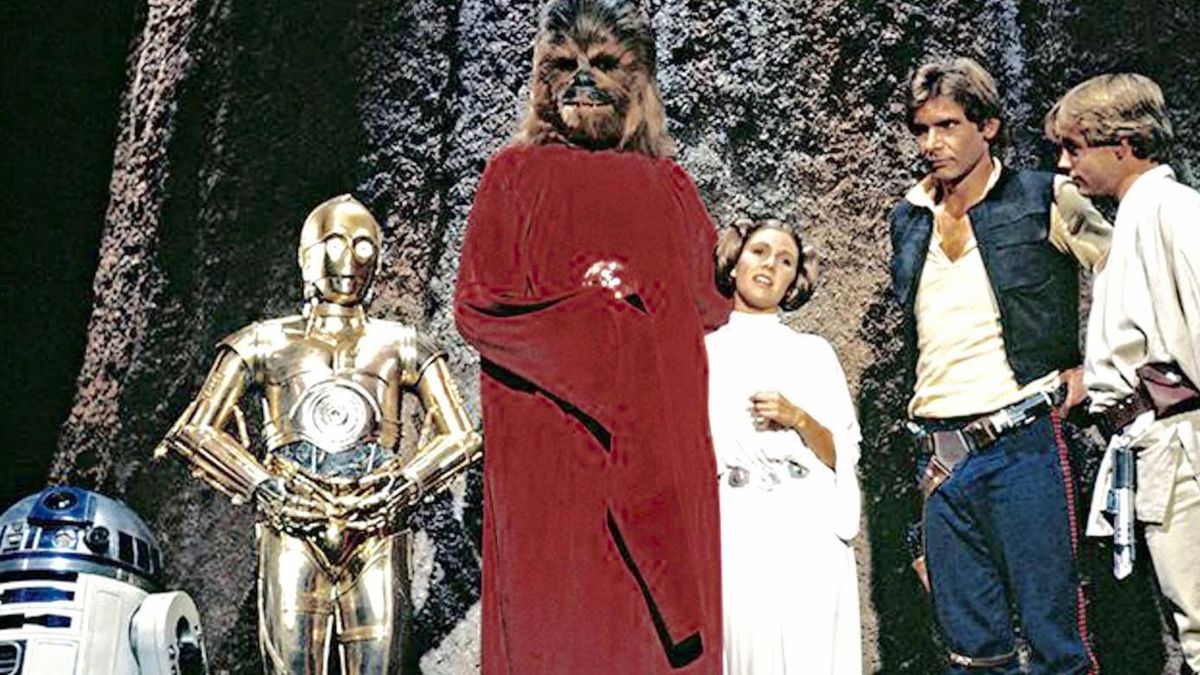
The "holiday" in question is Life Day, on the home planet of Chewbacca's people, the Wookiees, a planet whose name is canonically mentioned for the first time: Kashyyyk. (Yes, 3 straight Y's.) We are introduced to Chewie's wife, Mallatobuck; their son, Lumpawarrump;  and Chewie's father, Attichitcuk, the Chief of their tribe.

They are the focus of the episode: Three characters we hadn't seen before, and who didn't speak English. There weren't even subtitles for their language. Meanwhile, Chewie and Han Solo are trying to get to Kashyyyk for the holiday, aboard the Millennium Falcon, with Darth Vader chasing them. They make it, and Luke Skywalker, Leia Organa, C-3PO and R2-D2 are already there, and the celebration begins.

There is one non-Star Wars human star: Beatrice Arthur, having recently wrapped up her series Maude, but not yet having begun The Golden Girls, plays Ackmena, the operator of the Mos Eiseley cantina. She sings. Yes, Bea Arthur sings. And there's a mid-special cartoon, with most of the major actors' voices, that introduces the character of Boba Fett, one of the few things about this special that people remembered fondly.

The Special was, in TV parlance, a bomb. A bomb big enough to blow up the Death Star. George Lucas later ruled that Life Day, and all the members of Chewbacca's family who were shown or mentioned, are part of the current Star Wars canon, but the special itself is not.

Paramount Pictures figured audiences would eat anything up while waiting for Episode V -- the Empire Strikes Back to be released. They did, but were sick to their stomach. It was a worse next step than Star Trek: The Motion Picture turned out to be, a year later.

The Star Wars Holiday Special completed a trifecta of the film version of Sgt. Pepper's Lonely Hearts Club Band -- with Peter Frampton and The Bee Gees pathetically standing in for The Beatles -- on July 21, and Kiss Meets the Phantom of the Park on October 28, that marked 1978 as a year when Hollywood executives must have gotten together over big bowls of cocaine and thought, "How can we squeeze the utmost profits out of popular culture, without spending as much money as we did on the cocaine before us?"

One more thing to consider: Like Elvis Presley's posthumous last special, the year before, The Star Wars Holiday Special has only aired once, and has never had an official release on any form of home video -- not VHS videotape, not laserdisc, not DVD, not Blu-Ray. Come to think of it, Elvis In Concert was also on CBS.

And CBS still had a better late 1970s than did NBC. Sure, they aired Elvis In Concert and The Star Wars Holiday Special, but they didn't air Hello, Larry, or Pink Lady and Jeff, or Supertrain.

*

November 17, 1978 was a Friday. Football star Reggie Wayne was born. So were actors Tom Ellis and Rachel McAdams.

Baseball was in the off-season. Football was in midweek. There were 6 games in the NBA:

* The New Jersey Nets lost to the Washington Bullets, 143-94 at the Rutgers Athletic Center (now the Jersey Mike's Arena) in Piscataway, New Jersey. The sale of Julius Erving 2 years earlier meant that the Nets went from the best team in the ABA to the worst team in the NBA.

They had gotten better, but they lost this one to the defending World Champions, at home, by 49 points. Despite the big team score, the leading scorer, Elvin Hayes, had just 30 points. But 9 players scored at least 10. Eddie Jordan, who starred for Rutgers at their previous home, the College Avenue Gym, led the Nets with 19. The Nets did recover enough to make the Playoffs, though.

* The Boston Celtics beat the Denver Nuggets, 120-118 at the Boston Garden.

* The Philadelphia 76ers beat the Phoenix Suns, 95-94 at The Spectrum in Philadelphia.

* The Los Angele Lakers beat the New Orleans Jazz, 121-109 at The Forum, outside Los Angeles in Inglewood, California.

* The Chicago Bulls beat the Golden State Warriors, 100-89 at the Oakland Coliseum Arena.

* And the Seattle SuperSonics beat the Indiana Pacers, 126-115 at the Kingdome in Seattle.

There were 2 games played in the NHL. The New York Islanders beat the Washington Capitals, 4-2 at the Capital Centre in the Washington suburb of Landover, Maryland. And the Boston Bruins beat the Atlanta Flames, 6-2 at The Omni in Atlanta.

And there were 3 games played in the World Hockey Association:

* The Birmingham Bulls beat the New England Whalers, 7-1 at the Birmingham-Jefferson Civic Center.

* The Winnipeg Jets beat the Cincinnati Stingers, 10-6 at the Winnipeg Arena.

* And the Edmonton Oilers beat the Indianapolis Racers, 6-1 at the Northlands Coliseum in Edmonton. I guess it was a bad night for defensive hockey.

Thursday, September 22, 2022

September 22, 1964: "Fiddler On the Roof" Premieres

September 22, 1964: Fiddler On the Roof premieres at the Imperial Theatre in New York. It becomes the longest-running musical in Broadway history, a record long since broken.

Jerry Bock wrote the music, and Sheldon Harnick wrote the lyrics. They had previously collaborated on the 1959 musical Fiorello! about former New York Mayor Fiorello La Guardia. Joseph Stein wrote the "book," based on Tevye and His Daughters, a 1905 collection of short stories by Ukrainian-born Jewish writer Solomon Naumovich Rabinovich, who wrote under the pen name Sholem Aleichem.

The story takes place in Anatevka, a shtetl (a Yiddish word for a small town made up mostly of Jews) in the Russian Empire in 1905, a year of a failed revolution. The narrator is Tevye, a middle-aged milkman with a wife and 5 daughters, but no sons. This is key, because, traditionally -- and not just in Judaism -- it is the father of the bride who pays for a wedding. And, as Tevye says, "I realize, of course, that it's no shame to be poor. But it's no great honor, either."

(In Rabinovich's original story, the character's full name is Tevye ben Shneur Zalman. "Tevye" is a Yiddish form of "Tuyva," meaning "God is good." In Greek, "Tuvya" becames "Tobias"; in the English-speaking world, it is often shortened to "Toby." Neither Rabinovich nor Alex Haley -- who allegedly had an ancestor named Kunta Kinte, forced to accept the slave name Toby Waller, or Toby Reynolds in the TV version of Roots -- ever commented publicly on that.)

He begins the play with talk of tradition, and a song titled "Tradition," and says that, for the people there, in their poverty, where they have little freedom due to the impressive regime of Czar Nicholas II, their lives are as precarious as the perch of a fiddler on a roof. Someone asks the local rabbi if there is a blessing for the Czar. He says, "May the Lord bless and keep the Czar... far away from us!"

Like everyone else in Anatevka, Teyve is poor. How poor is he? He has to deliver milk himself, since he can't afford to replace his lame horse. He begins the song "If I Were a Rich Man" in a good mood, imagining what it would be like, but ends it in sadness, asking God if it would "spoil some vast eternal plan." (The song was based on Rabinovich's monologue in his book, "If I Were a Rothschild," with the Rothschilds, a banking family, being a byword for rich Jews to this day.)

One of his daughters is supposed to marry the richest man in town ("rich" being relative there), a butcher who is even older than Tevye. But she loves a tailor instead, and the tailor talks Tevye into allowing their marriage. But another daughter loves a Christian boy who had protected her from an attack by his people, and Tevye refuses to cross the line of allowing his daughter an interfaith marriage, so they run off and elope. Tevye laments the passage of time, singing of his children, "I don't recall growing older. When did they?"

Finally, a constable arrives, and tells the town that it must be abandoned in 3 days, so that native Russians can take it over. Tevye decides to take his wife and remaining daughters to America, while the married ones and their husbands go to Poland, then also still under Russian (and, partly, German) control. The fiddler plays one last song, and then leaves the stage as well.

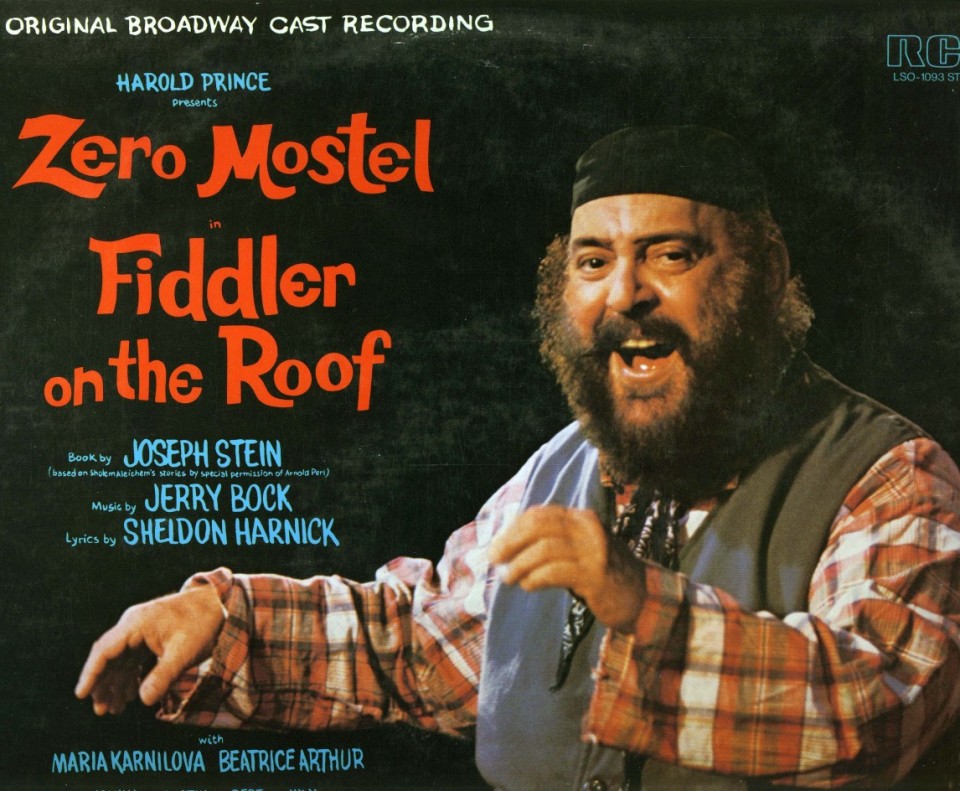
In the original production, Tevye was played by Brooklyn-born Jewish comedian Samuel Joel "Zero" Mostel, a triumph for him after having been blacklisted during the Red Scare of the 1950s. Calling his former film studio "18th Century Fox," he said, "What did they think I was going to do, sell acting secrets to the Russians?" Maria Karnilova played Tevye's wife Goldie. Beatrice Arthur and future game show host Bert Convy were also in the original cast.

Mostel also played Tevye in a 1976 Broadway revival. In 1969, folksinger Theodore Bikel, founder of the Newport Folk Festival, succeeded Mostel in the role. He had previously starred in a nonmusical version, Tevye the Milkman, and ended up playing the part more nights than any other actor, even Mostel.

When the musical first played in the West End, London's version of Broadway, in 1967, Tevye was played by Israel-born actor Chaim Topol. He would also star in the 1971 film version, revivals in the West End in 1983 and 1994, and a Broadway revival in 1990. Herschel Bernardi starred in a 1981 Broadway revival. The most recent Broadway revival, in 2015, starred Danny Burstein.

Norman Jewison, the perhaps aptly-named director of the 1971 film, chose Topol because he though Mostel's version relied too heavily on comedy, and he wanted to lean on the serious side of the story. He had previously told the story of a black hero in a white racist place in directing In the Heat of the Night, and later directed Moonstruck, about Italian-Americans.

In 2004, Gwen Stefani adapted a 1993 rewrite of "If I Were a Rich Man," "Rich Girl," and hit Number 1 with it. That same year, a Broadway revival starred Alfred Molina, who would play Tevye by night, and, by day, still in New York, would film scenes as the villainous Dr. Otto Octavius, a.k.a. Doctor Octopus, a.k.a. Doc Ock, for the film Spider-Man 2. He even filmed a scene of himself in costume as Doc Ock, singing "If I Were a Rich Man," resulting in the character's mechanical arms dancing along with him.

Molina was succeeded the following year by Harvey Fierstein, better known as a playwright. He told an interviewer that someone asked him how, as one of America's most prominent openly gay men, he could play the role of a husband and father. His response was that, when he was cast as Edna Turnblad in the musical version of Hairspray, he had never been, or played, a woman before. In contrast, Tevye was a Jewish man, and he had been a Jewish man his whole life. Of course, his famously gravelly voice wasn't made for singing on Broadway. But it worked just fine for the scatting in "If I Were a Rich Man."

Mostel died in 1977, Bernardi in 1986, Karnilova in 2001, Bock and Stein in 2010. As of September 22, 2022, Harnick, Topol, Jewison, Molina, Feirstein and Burstein are still alive. (UPDATE: Topol died on March 8, 2023. Harnick died on June 23, 2023, 10 months short of what would have been his 100th birthday. Jewison died on January 20, 2024.)

The Imperial Theatre is still in operation, at 249 West 45th Street, between 8th Avenue and Broadway. Among the other shows that have premiered there are Babes in Toyland in 1930, On Your Toes in 1936, Annie Get Your Gun in 1946, Call Me Madam in 1950, The Most Happy Fella in 1956, Oliver! in 1963, Pippin in 1972, They're Playing Our Song in 1979, and Dreamgirls in 1981.

One day, when I was about 12 or so, the film version of Fiddler On the Roof was on TV, and my parents told me, "This is your heritage." I had grown up with the idea that my father's ancestors were Polish and from a city like Warsaw, while my mother's ancestors were Jewish and from a little shtetl in the Russian Empire, like Anatevka.

It was many years before I found out that the truth was the other way around: My mother's ancestors came from a good-sized city, Vilnius, the capital of Lithuania (although also controlled by Russia at the time), while my father's ancestors came from Borki Wielkie, in a part of northeastern Poland that was then part of East Prussia in the German Empire, and barely more than a village.

Oh well. As Tevye might have said, It's no shame to be wrong, but it's no great honor, either.

*

September 22, 1964 was a Tuesday. The TV show The Man from U.N.C.L.E. premiered on this day. I have a separate entry for this event.

These baseball games were played that day:

* The New York Yankees swept a doubleheader from the Cleveland Indians, 5-3 and 8-1 at Cleveland Municipal Stadium. Mel Stottlemyre won the opener, Whitey Ford the nightcap. Home runs were hit by Mickey Mantle, Roger Maris, Joe Pepitone and Phil Linz.

* The New York Mets lost to the St. Louis Cardinals, 2-1 at Shea Stadium. Curt Simmons outpitched Tracey Stallard.

* The Cincinnati Reds beat the Philadelphia Phillies, 9-2 at Connie Mack Stadium in Philadelphia. This was the 2nd game of the 10-game "Phillie Phlop" that cost Philadelphia the National League Pennant. Frank Robinson went 2-for-4 with a home run, a walk, and 2 RBIs. Pete Rose also went 2-for-4 with a walk.

* The Boston Red Sox beat the Washington Senators, 3-0 at District of Columbia Stadium in Washington. (It was renamed Robert F. Kennedy Memorial Stadium in 1969.) Bill Monboquette pitched a 5-hit shutout, and Carl Yastrzemski went 1-for-3 with a walk.

* The Milwaukee Braves beat the Pittsburgh Pirates, 2-0 at Forbes Field in Pittsburgh. Bob Veale pitched a 7-hit shutout. Roberto Clemente went 3-for-4. Hank Aaron went 1-for-4.

* The Detroit Tigers beat the Baltimore Orioles, 2-1 at Tiger Stadium in Detroit. Al Kaline went 2-for-4 with a home run and 2 RBIs. Brooks Robinson went 0-for-4 with a walk.

* The Chicago Cubs beat the Los Angeles Dodgers, 1-0 at Wrigley Field in Chicago. Lew Burdette pitched a perfect 1st inning for the Cubs, then had to leave the game due to an injury. Cal Koonce pitched a 7-hit shutout the rest of the way, outpitching Don Drysdale. Ernie Banks went 0-for-3.

* The Kansas City Athletics beat the Minnesota Twins, 10-9 at Kansas City Municipal Stadium. Harmon Killebrew went 1-for-4 with a walk.

* The San Francisco Giants beat the Houston Colt .45s, 7-1 at Colt Stadium in Houston. Willie Mays went 1-for-4 with a walk and an RBI. The Colts became the Houston Astros the next season.

* And The Los Angeles Angels beat the Chicago White Sox, 1-0 at Dodger Stadium in Los Angeles, where the Angels were groundsharing while waiting for their stadium in suburban Anaheim to be ready. Fred Newman pitched a 5-hit shutout.

Wednesday, September 14, 2022

September 14, 1985: "The Golden Girls" Premieres

Left to right: Estelle Getty, Beatrice Arthur,
Rue McClanahan and Betty White

September 14, 1985: The Golden Girls premieres on NBC. The Miami-set sitcom lasts 7 seasons, and becomes an all-time favorite.

Beatrice Arthur was already a legend for playing the title character, an outspoken feminist, on the 1972-78 CBS sitcom Maude. One of her co-stars was Rue McClanahan, who played Maude's best friend, the nice but dumb Vivian Harmon. Betty White was already a long-standing TV star, including appearing on another iconic CBS sitcom, The Mary Tyler Moore Show, as the smart-mouthed, maneating Sue Ann Nivens.

TV producer Tony Thomas, son of comedian Danny and brother of actress Marlo, wanted to produce a sitcom about older women in Miami, a city known for having a lot of older people, showing that they could have just as much fun as younger people. He created the series with Paul Junger Witt and his then-wife, Susan Harris, with whom Thomas had previously created the sitcoms Soap and its spinoff Benson.

Thomas wanted Bea Arthur, thinking the show needed a Maude type. So he went back-channel, first getting McClanahan and White -- but reversing their former roles. So when Rue approached Bea with the idea, Bea said she didn't want Rue playing "another Vivian." "Oh, but you don't understand," Rue said. "This time, Betty's playing Vivian, and I'm playing Sue Ann!" Bea immediately got the reference, and said, "Interesting!"

So Bea played Dorothy Zbornack, a tough teacher who moved from New York to Miami after splitting with her no-good cheating husband Stan, a recurring character played by Herb Edelman. Betty played Rose Nylund, a nice but dumb lady from St. Olaf, a small town in Minnesota. Her hometown's eccentricities featured in her stories that the other "girls" could never believe. (This may have been a nod to James Noble's Governor Gene Gatling, the good-natured, odd-story-telling, not dumb but in-over-his-head Governor on Benson.) Rose moved to Miami after the death of her husband, Charley, who was never shown.

And Rue played Blanche Devereaux, a Southern belle who had already moved to Miami with her husband, George, but had advertised for roommates after his death in a car crash. How she stayed faithful to him for years wasn't explained, but, both before and after her marriage, she slept around. And around, and around, and around.

In the pilot episode, Dorothy's 82-year-old mother, Sophia Petrillo (Estelle Getty), moved in with them, after her nursing home, Shady Pines, mysteriously burned down. Dorothy frequently threatened to send her back to the rebuilt Shady Pines, but never carried the threat out.

Oddly, Getty was younger than the actress playing her daughter: At the time the show began, Arthur was 63 years old, Getty was 62, McClanahan was 51, and White was also 63.

Being the youngest, McClanahan's character also was, and Blanche's age became a point of contention. In the 2nd season premiere, she feared she might be pregnant, and mentioned her age as being 48. To make matters worse for Blanche was that she didn't know who the prospective father was: According to her "little black book," there were 5 potential candidates! (And there's no way to know if 5 different men in a week is Blanche's "personal best"!)

(Coincidentally, 48 was also the age Maude was when she was pregnant, and got TV's 1st abortion, in 1972, when it was still illegal in most of the country, but legal in the State of New York, where her show was set.)

As it turned out, instead of being pregnant, Blanche was going through menopause, and was afraid this would make her less desirable to men. This also turned out not to be true, and she kept up her wild lifestyle, all the while denying that she was in her 50s. As Dorothy put it: "Blanche, have you heard the latest ad campaigns? 'Join the Navy, see the world, sleep with Blanche Devereaux.' 'Join the Army, be all you can be, and sleep with Blanche Devereaux.' 'The Marines are looking for a few good men who haven't slept with Blanche Devereaux!'"

All 4 women had very sharp wits, and the above just scratches the surface of the digs they got in against each other. Given enough provocation, even Rose could briefly get smart enough to slip in a great insult. In the end, however, they would always reconcile, and split a late-night cheesecake in the kitchen. In other words, Friends was not the white Living Single. Living Single was the young black Golden Girls. And Sex and the City was the young white Golden Girls.

Cindy Fee sang the theme song, "Thank You For Being a Friend," which had been written by Andrew Gold, and was a minor hit for him in 1978.

The Golden Girls was surprisingly progressive by the standards of the Reagan and Daddy Bush years. Blanche had a gay brother, Clayton Hollingsworth (Monte Markham). In his 1st appearance, she had trouble with him coming out to her, but accepted it; in his 2nd, he got married, though it wouldn't be legal in Florida for another 25 years.

The term "a friend of Dorothy" has long been used as a euphemism for a gay person, especially a woman. In a 1986 episode, Jean (Lois Nettleton), a friend of Dorothy's, moved to Miami after the death of her partner, and Dorothy was afraid to tell the others that Jean was a lesbian, until Jean admitted she was falling for Rose. Things were settled tastefully. And Dorothy's brother, Phil Petrillo (never portrayed onscreen), was a cross-dresser, which was difficult for Sophia to handle, until he died, and they had to deal with it.

The show ran 7 seasons, and inspired a spinoff, Empty Nest, starring former Soap star Richard Mulligan as a widowed pediatrician with 3 unmarried daughters. That show spun off another sitcom, Nurses. The shows occasionally crossed over with each other.

In the series finale, Dorothy married Blanche's other brother, Lucas Hollingsworth, played by Leslie Nielsen. Bea Arthur was done with the show, and apparently the jokes about her appearance bothered her more than the jokes about the others and their peculiarities bothered them. After all, Betty wasn't really dumb, Rue wasn't really easy, and Estelle wasn't really mean.

So, just as the 3 actors who wanted M*A*S*H to keep going starred in AfterMASH, which failed, White, McClanahan and Getty starred in The Golden Palace, where Rose, Blanche and Sophia ran a hotel, with help from comedian Cheech Marin as the hotel's chef, and an as-yet-unknown Don Cheadle as its manager. Despite some notable guest stars, including Arthur in a two-parter, the show tanked, and was canceled after 1 season. The conclusion of Empty Nest in 1995, after 7 seasons, ended the franchise.

Herb Edelman died in 1996, Estelle Getty in 2008, Bea Arthur in 2009, Rue McClanahan and Leslie Nielsen in 2010, Andrew Gold in 2011, and Paul Junger Witt in 2018. Betty White became America's favorite old person. She died on New Year's Eve, December 31, 2021, 17 days short of her 100th birthday. This was very upsetting to a lot of people, more so to Golden Girls fans than to fans of her other shows. Many people went online and issued profane remarks about how 2021 wouldn't let us take Betty into the New Year for her Centennial. As of September 14, 2022, Tony Thomas, Susan Harris and Cindy Fee are still alive.

UPDATE: In 2023, as a nod to the show's popularity among gay men, an all-drag version, 4 men playing the characters, began starring in Golden Girls: The Laughs Continue, which depicts the characters in the present day. The play has toured continuously.

In 2024, a rumor got around that there would be a reboot, starring former Saturday Night Live castmembers Tina Fey, Amy Poehler and Maya Rudolph, and former Friends star Lisa Kudrow -- the oldest of them, and, presumably, the one who would have played Sophia. But both Fey and Rudolph publicly denied the rumor. Susan Harris, in particular, has resisted efforts to reboot the show.

*

September 14, 1985 was a Saturday. These Major League Baseball games were played that day:

* The New York Yankees lost to the Toronto Blue Jays, 7-4 at Yankee Stadium. The Jays scored 5 runs in the 6th inning, and that made the difference, as Jimmy Key went the distance for the win. Jesse Barfield hit a home run for them. Rickey Henderson homered for the Yankees, while Don Mattingly went 1-for-4, and Dave Winfield went 0-for-4 with an RBI on a sacrifice fly.

After winning the 1st game of this 4-game series on Thursday night, the Yankees lost the last 3, and that turned out to be the key series of the season, as the Jays ended up winning the American League Eastern Division title by 2 games.

* The New York Mets lost to the Montreal Expos, 5-1 at the Olympic Stadium in Montreal.

* The San Francisco Giants beat the Atlanta Braves, 3-1 at Atlanta-Fulton County Stadium.

* The Pittsburgh Pirates beat the Philadelphia Phillies, 6-3 at Three Rivers Stadium in Pittsburgh. Lee Tunnell outpitched Steve Carlton. Mike Schmidt went 1-for-4 with an RBI.

* A doubleheader was split at Cleveland Municipal Stadium. The Cleveland Indians won the opener, 11-9. The Minnesota Twins won the nightcap, 5-3.

* The Los Angeles Dodgers beat the Cincinnati Reds, 7-0 at Riverfront Stadium in Cincinnati. Bob Welch pitched a 6-hit shutout. Reds player-manager Pete Rose, who had officially broken Ty Cobb's career hits record 3 days earlier, went 1-for-4.

* A doubleheader was split at Tiger Stadium in Detroit. The Detroit Tigers won the 1st game, 10-3. The Baltimore Orioles won the 2nd game, 5-4. Over the 2 games, Eddie Murray went 2-for-7 with 2 walks, and Cal Ripken Jr. went 3-for-9.

* The St. Louis Cardinals beat their arch-rivals, the Chicago Cubs, 5-4 at Wrigley Field in Chicago.

* The Boston Red Sox beat the Milwaukee Brewers, 10-8 at Milwaukee County Stadium. Dwight Evans won the game with a home run in the top of the 11th inning. Wade Boggs went 3-for-6 with an RBI. Paul Molitor went 1-for-5. Robin Yount did not play.

* The Houston Astros beat the San Diego Padres, 4-3 at the Astrodome in Houston. Tony Gwynn went 2-for-4.

* The Texas Rangers beat the California Angels, 8-5 at Anaheim Stadium (now Angel Stadium of Anaheim). The Rangers scored 3 in the 8th and 2 in the 9th to win it. Reggie Jackson went 1-for-3 with a walk and an RBI. Rod Carew, in his last month as an active player, went 1-for-4.

* The Kansas City Royals beat the Oakland Athletics, 2-1 at the Oakland Coliseum. George Brett went 0-for-4.

* And the Seattle Mariners beat the Chicago White Sox, 6-5 at the Kingdome in Seattle.

Among the college football games played that day were these:

* Number 1 Auburn beat Southern Mississippi, 29-18 at Jordan-Hare Stadium in Auburn, Alabama. Auburn running back Vincent "Bo" Jackson would win the Heisman Trophy.

* Number 2 Southern Methodist University (SMU), Number 4 University of Southern California (USC), Number 6 Florida State University (FSU) and Number 7 Louisiana State University (LSU) were idle.

* Number 3 Florida were held to a tie, 28-28, at home at Florida Field, by Rutgers. For the Scarlet Knights, it was a "Harvard Beats Yale, 29-29" situation, even though there was no rivalry between the schools.

Or, to put it another way: If the old saying, which originated in college football, of "A tie is like kissing your sister" is true, then, for Rutgers, this tie was like kissing their sister's really nice-looking best friend. While, for the Gators, this tie was like kissing their sister's other best friend. You know, the one with the "great personality."

* Number 5 Iowa beat Drake, 58-0 at Kinnick Stadium in Iowa City. Drake University is in Des Moines, and, since the 1950s, pretty much the only thing the Bulldogs' football program has had in common with the Hawkeyes' is that they're both in Iowa.

* Number 8 Oklahoma State beat North Texas, 10-9 at Lewis Field (now T. Boone Pickens Stadium) in Stillwater, Oklahoma.

* Number 9 Ohio State beat the University of Pittsburgh, 10-7 at Ohio Stadium in Columbus.

* Number 10 UCLA were held to a tie by Tennessee, 26-26 at Neyland Stadium in Knoxville, Tennessee.

* Number 11 Penn State barely beat Temple, 27-25 at Beaver Stadium in State College, Pennsylvania. Had Temple, from Philadelphia, beaten Penn State, it would have been a bigger deal than the aforementioned Rutgers beating any Top 10 team.

* Number 13 Notre Dame were upset by Michigan, 20-12 at Michigan Stadium in Ann Arbor.

* And, among the service academies, Army beat Western Michigan, 48-6 at Michie Stadium in West Point, New York; Navy lost to Delaware, 16-13 at Delaware Stadium in Newark, Delaware; and Air Force beat Wyoming, 49-7 at War Memorial Stadium in Laramie, Wyoming.

And in English soccer, Arsenal beat Sheffield Wednesday, 1-0 at the Arsenal Stadium, a.k.a. Highbury, in North London.

December 31, 1999 & January 1, 2000: The Millennium

December 31, 1999:  The Millennium arrives. The people of planet Earth survived. At a terrible cost. But we hadn't destroyed ourselves. ...