June 29, 1956: President Dwight D. Eisenhower signs the Federal-Aid Highway Act of 1956, creating the Interstate Highway System.
"Ike" had wanted such a highway system for America since the Summer of 1919, when, as a 28-year-old Lieutenant Colonel, he participated in the U.S. Army's first Transcontinental Motor Convoy across the country. The convoy left the Ellipse south of the White House in Washington on July 7, and went to Gettysburg, Pennsylvania. From there, it got on the Lincoln Highway, and went to the Presidio, the Army base in San Francisco.
But there were mudpatches that vehicles got stuck in, and bad bridges that the Army rebuilt on the spot, on the federal government's dime. The convoy reached San Francisco on September 6 -- 61 days later. Two months to cross the country. Ike thought that was unacceptable.
The Federal Highway System was begun in 1926, with proper paving. But Ike didn't think it was enough: He wanted highways without traffic lights, without having to go through big cities or small towns, rather providing access to local roads leading into them. As a General in World War II, he had seen the Germans' Autobahn system. In a book he wrote after leaving office, he said, "The old convoy had started me thinking about good, two-lane highways, but Germany had made me see the wisdom of broader ribbons across the land."
Ike got his bill, sponsored in the House of Representatives by George Fallon of Maryland, and in the Senate by Albert Gore of Tennessee, both Democrats.
Though Eisenhower is sometimes described as having advocated for the highways for the purpose of national defense, scholarship has shown that he said relatively little about national defense when actually advocating for the plan, instead emphasizing highway fatalities and the importance of transportation for the national economy. In the event of a ground invasion by a foreign power, the U.S. Army would need good highways to be able to transport troops and material across the country efficiently. Following the completion of the highways, the cross-country journey that took the convoy two months in 1919 was cut down to five days.
The 1st time I visited the Baseball Hall of Fame in Cooperstown, New York, in September 1985, the biggest part of the trip was up the New York State Thruway, bannered from The Bronx to Albany as Interstate 87 (and from there on west as Interstate 90), and as I went north, I saw several military vehicles heading south. Being that Ronald Reagan was President, and that this was only a year after he joked, "We begin bombing in five minutes," I thought, "Oh, no, World War III is starting, before I can ever see Cooperstown." But nothing terrible happened that weekend.
The numbered system followed a pattern: North-South highways would be odd-numbered, increasing the further East you went; while East-West highways would be even-numbered, increasing the further North. Thus, my home State of New Jersey has Interstates 76, 78 and 80 going west to east; and 95 going south to north.
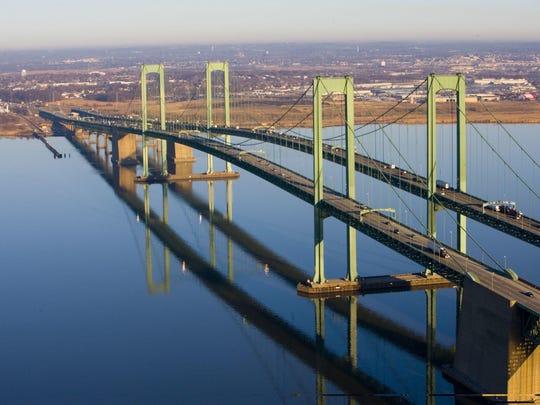
Three-digited highways have a system as well. If starting with an odd number, they are spurs to main highways: Thus, Interstate 195 extends east from I-95, to the Jersey Shore. If starting with an even number, they are "beltways," going around a major city. Thus, Interstate 278 forms the Belt Parkway around Brooklyn and Queens, with an extension into New Jersey; and Interstate 287 loops around New York City within New Jersey, before linking up with I-87; and Interstate 295 loops around Trenton and Philadelphia, before crossing into Delaware over the Delaware Memorial Bridge.
The New Jersey Turnpike is bannered as I-95 from Exit 6 on north. But neither the Garden State Parkway nor the Atlantic City Expressway is part of the Interstate System.
While some older freeways were adopted into the system, most of the routes were completely new. In dense urban areas, the choice of routing destroyed many well-established neighborhoods, often intentionally as part of a program of "urban renewal." In the 20 years following the 1956 Highway Act, the construction of the freeways displaced over 1 million people. This resulted in new forms of racial segregation, as "the wrong side of the tracks" became "the wrong side of the freeway."
The Cross Bronx Expressway cut through Bronx neighborhoods, devastating the Borough. And the New Jersey Turnpike cut sections of Newark and Elizabeth off from the rest of those cities, hurting them badly. Both roads became part of I-95. And I-676, the Vine Street Expressway, seriously messed with Center City Philadelphia.
Many of the Interstates paralleled older Federal highways. Examples: I-95, U.S. Route 1; I-87 in New York, U.S. Route 9; I-90 in New York and the Midwest, U.S. Route 20; I-84 in the Northeast, U.S. Route 6; I-5 in California, U.S. Route 101. The famous U.S. Route 66 was essentially replaced by I-10, I-15 and I-40 in California; I-40 from San Bernardino to Oklahoma City; I-44 from OKC to St. Louis; and I-55 from St. Louis to Chicago.
Many communities on Federal highways like Route 66 got bypassed, and suffered economically as a result, since people waited until the next big city to get off and eat and/or use the bathroom, or get a place to stay the night, instead of the next town coming up. Route 66 in particular had several quirky motels or "motor courts" with Wild West or Native American themes. Route 66 was decommissioned in 1985, although some States rebannered their sections as State Route 66. There is an Interstate 66, but it runs mainly in Washington, D.C. and its Virginia suburbs, and again from Kentucky west to Kansas.
*
June 29, 1956 was a Friday. Dominican baseball All-Star Pedro Guerrero was born. And actress Marilyn Monroe married playwright Arthur Miller. Each would end up married 3 times, and divorced 3 times.
And these baseball games were played:
* The New York Yankees beat the Washington Senators, 3-1 at Yankee Stadium. Bob Grim outpitched Pedro Ramos. Mickey Mantle had an odd batting line: No hits in no official at-bats, but 4 walks. Yogi Berra went 0-for-4. The Senators' only run came on a home run by ex-Yankee Clint Courtney. Harmon Killebrew was a rookie with the Senators, but did not get into this game.
* The New York Giants lost to the Pittsburgh Pirates, 6-3 at Forbes Field in Pittsburgh. Vern Law outpitched Jim Hearn. Roberto Clemente and Lee Walls hit home runs for the Bucs, while Willie Mays went 1-for-4 for the Jints.
* The Brooklyn Dodgers beat the Philadelphia Phillies, 6-5 at Ebbets Field. A rookie named Don Drysdale, in only his 10th appearance, started for the Dodgers. Cliché Alert: Walks can kill you, especially
the leadoff variety. Dem Bums scored 4 runs in the bottom of the 9th to stun the Phils: Jim Gilliam drew a leadoff walk, Pee Wee Reese struck out, and then came 3 straight home runs, by Duke Snider, Randy Jackson and Gil Hodges. This made a winning pitcher out of Clem Labine. Jackie Robinson, in his final season, went 0-for-2 before being lifted for a pinch-hitter.
* The Boston Red Sox beat the Baltimore Orioles, 7-6 at Memorial Stadium in Baltimore. Jackie Jensen went 2-for-4 with a home run, a walk, and 3 RBIs. Ted Williams went 0-for-1, but, like Mantle drew 4 walks. Rookie Brooks Robinson did not get into the game for the O's.
* A doubleheader was split at Cleveland Municipal Stadium. The Cleveland Indians won the opener, 5-2. Herb Score outpitched Jim Wilson. The Chicago White Sox won the nightcap, 13-2. Billy Pierce went the distance for the win, while Bob Lemon didn't get out of the 2nd inning.
* The Chicago Cubs beat the Milwaukee Braves, 8-4 at Wrigley Field in Chicago. Ernie Banks and Pete Whisenant homered for the Cubs. Johnny Logan hit one for the Braves. Hank Aaron went 1-for-4.
* The St. Louis Cardinals beat the Cincinnati Reds, 4-1 at the 1st Busch Stadium (formerly the last Sportsman's Park) in St. Louis. Stan Musial went 1-for-4. Rookie Frank Robinson went 1-for-3 with a walk.
* And the Detroit Tigers beat the Kansas City Athletics, 5-0 at Kansas City Municipal Stadium. Billy Hoeft outpitched Tommy Lasorda, who was appearing in his 24th major league game, and would only pitch in 2 more. He would be back as a coach and a manager. He gave up 2 home runs to Charlie Maxwell, and 1 to Al Kaline.