Showing posts with label syracuse nationals. Show all posts

Wednesday, November 16, 2022

November 16, 1962: "One Day In the Life of Ivan Denisovich" Is Published

November 16, 1962: One Day in the Life of Ivan Denisovich by Aleksandr Solzhenitsyn begins to be serialized in Novy Mir (New World), a Soviet literary magazine. It was assigned to my high school English class, and it took me most of the book before I realized that "Shukhov," the apparent protagonist, and "Ivan Denisovich," as he was addressed by the gulag guard, were the same person. It was even longer -- seeing an interview in which Gorbachev was addressed by the journalist as "Mikhail Sergeyevich" -- before I understood that Russians informally addressed each other by "(First name) (middle name)" instead of "(First name)."

The story is set in a Soviet labor camp in the early 1950s, when Joseph Stalin was still alive and in charge of the Soviet Union. The book's publication was an extraordinary event in Soviet literary history, since never before had an account of Stalinist repressions been openly distributed.

Solzhenitsyn (1918-2008), like his character Shukov, had been a dedicated Communist who was falsely accused of being a spy during World War II, and spent 8 years in a gulag. He was then sent into exile for criticizing Stalin in a private letter. This led him to return to his family's Russian Orthodox Church. He won the Nobel Prize for Literature in 1970.

But his 1973 publication of The Gulag Archipelago made him a chelovek ne privetstvuyetsya -- that's Russian for "persona non grata." He lived in America from 1976 to 1994, having had his Russian citizenship restored, and he moved back to his homeland.

*

November 16, 1962 was a Friday. Baseball season was over. Football was in midweek. And no NHL games were scheduled. But there were 3 NBA games played that day:

* The New York Knicks lost to the San Francisco Warriors, 127-111 at the old Madison Square Garden. Wilt Chamberlain had a good night for the Warriors, scoring 73 points.

* The Syracuse Nationals beat the Boston Celtics, 113-105 at the Onondaga County War Memorial (now the Upstate Medical University Arena) in Syracuse, New York.

* And the Cincinnati Royals beat the St. Louis Hawks, 120-111 at the Cincinnati Gardens.

Monday, October 31, 2022

October 31, 1950: The NBA's 1st Black Player

Earl Lloyd

October 31, 1950: The Rochester Royals defeat the Washington Capitols, 78-70, at the Edgerton Park Arena in Rochester. (It was demolished in the late 1950s.) Arnie Risen scores 20 for the home team, as they begin a season that will bring their 1st NBA Championship.

They had previously won the title in the National Basketball League in 1945. They will become the Cincinnati Royals in 1957, the Kansas City Kings in 1972, and the Sacramento Kings in 1985. Their long-term future in Sacramento is now settled, as they've opened a new arena.


Earl Lloyd, a forward wearing Number 11, scores 2 baskets and 2 free throws for the Capitols, for a total of 6 points. It doesn't sound like much, but his mere presence in the game makes him the NBA's 1st black player.
Chuck Cooper had been the 1st black player drafted, by the Boston Celtics. But, the way the schedule worked out, Earl beat him to the court by 1 day. Chuck should not be confused with another early black star, Charles "Tarzan" Cooper, who played for the New York Renaissance (a.k.a. the Rens) in the 1930s. 
Chuck Cooper
Nat "Sweetwater" Clifton, formerly of the Rens and the Harlem Globetrotters, had been the 1st black player actually signed to a contract, by the New York Knicks, but Earl beat him to the court by 4 days. So, in a way, the NBA had 3 "Jackie Robinsons."
Nat Clifton

Earl Lloyd was born on April 3, 1928 in Alexandria, Virginia, across the Potomac River from Washington, D.C. His hometown team, having fired coach Red Auerbach in 1949, was 10-25 on January 9, 1951, and folded, leaving the nation's capital without an NBA team for the next 22 years. Lloyd was then drafted, and served in the Korean War.

Discharged in 1952, "the Big Cat" (also the nickname of Baseball Hall-of-Famer Johnny Mize, then wrapping up his career with the Yankees) played for the Syracuse Nationals until 1958, and the Detroit Pistons from then until his retirement in 1960. He averaged 8.4 points per game in his 9 NBA seasons. The Pistons then hired him as a scout.
In 1968, they named him the 1st black assistant coach in the NBA. In 1972, they named him the 2nd black head coach, after Bill Russell of the Celtics, and the 1st non-playing black head coach. But the Pistons were awful then, and his career coaching record was just 22-55.
He worked for the Detroit school system, helping students find jobs, then did the same thing for a company run by Pistons Hall-of-Famer Dave Bing. He retired to Tennessee. In 2003, the Basketball Hall of Fame elected him as a "contributor," for his historical prominence.
In 2007, T.C. Williams High School, the integrated Alexandria school into which his former all-black school, Parker-Gray, had been consolidated (a tale told, with considerable dramatic license taken, in the football-themed film Remember the Titans), named their new gym's court after him. He was also elected to the Virginia Sports Hall of Fame, and died on February 26, 2015, a few weeks short of his 87th birthday.

*

October 31, 1950 was a Tuesday. This was the only game played in the NBA on that Halloween Night. Baseball season had ended 24 days earlier, with the New York Yankees sweeping the Philadelphia Phillies in the World Series. Football was in midweek. And no NHL games were scheduled. So there were no other scores on this historic day.

And comedian and actor John Candy was born on this day.

Sunday, October 30, 2022

October 30, 1954: The NBA Begins Using the 24-Second Shot Clock

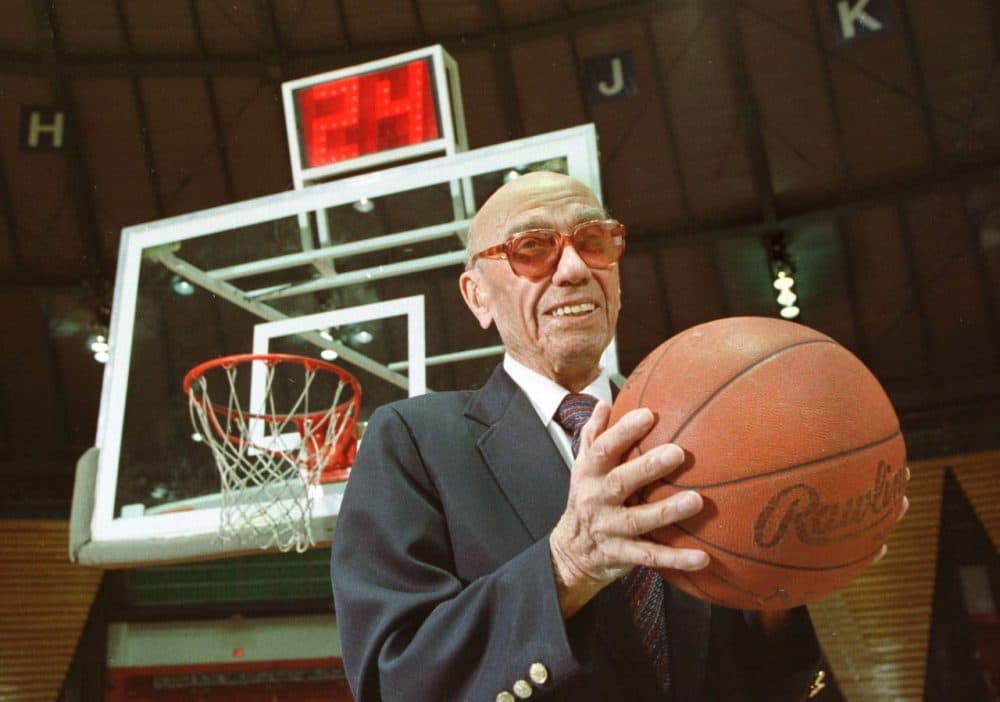
Danny Biasone, 1992

October 30, 1954: The National Basketball Association starts the 1954-55 season, the 1st with the 24-second shot clock. Professional basketball would never be the same.

From their arrival from the rival National Basketball League in 1948 until the retirement of their star center George Mikan in 1954, the NBA was dominated by the Minneapolis Lakers. Although they had others who that would go on to the Basketball Hall of Fame -- forwards Jim Pollard and Vern Mikkelsen, and guard Slater Martin -- their game was mainly to get the ball in to Mikan, at 6-foot-10 the pro game's 1st great "big man," and let him lay it in.

But Mikan was not fast. The New York sportscaster Bill Mazer once said, "He was more like a stampeding elephant." And, unlike some later big men, he was unwilling to foul his way into shooting position, which, for him, wasn't a big area. So the Lakers would keep passing the ball around until Mikan, or somebody else, could get into the lane. This could take several minutes.

The only way to defend against this was to commit fouls, hope that a free throw was missed, and hope that someone could rebound the miss before Mikan could. Or, for the other team to do the same: Hold the ball, pass it around, for as long as possible until someone got inside before Mikan could.

This resulted in scores that even the 1990s New York Knicks version of Pat Riley would think were too low, bottoming out on November 22, 1950: The Fort Wayne Pistons attempted only 13 shots through the entire 48 minutes, and beat the Lakers, 19-18. The 4th quarter saw just 3 points from the Pistons, 1 from the Lakers. A few weeks after that, on January 6, 1951, the Indianapolis Olympians beat the Rochester Royals, 75-73. The final score wasn't the problem. The problem was that game went to 6 overtimes, an NBA record; and, in each overtime, the team that won the jump ball held the ball for nearly the entire 5 minutes before attempting a last-second shot.

The NBA was getting boring. Attendance was dropping. Teams were dropping out. When the NBA was founded as the Basketball Association of America in 1946, it had teams in Washington, Toronto, Chicago, St. Louis, Detroit, Cleveland and Pittsburgh. By the start of the 1951-52 season, all of those teams were gone. Eventually, all of those cities but Pittsburgh would get new teams (although St. Louis eventually lost their replacement, and Chicago lost theirs before a 2nd replacement, the Bulls, succeeded). But big cities were losing teams, because fans didn't want to come out to see the games. Something had to be done.

In 1954, the owner of the Syracuse Nationals, Danny Biasone, had an idea: "I looked at the box scores from the games I enjoyed, games where they didn't screw around and stall. I noticed each team took about 60 shots. That meant 120 shots per game. So I took 2,880 seconds (48 minutes) and divided that by 120 shots. The result was 24 seconds per shot."

Biasone showed his findings to his general manager, Leo Ferris, and his head coach Al Cervi. Cervi ran intrasquad games with a stopwatch, and blew his whistle after 24 seconds without a shot. They agreed that 24 seconds worked well. Ferris talked to the other NBA GMs, and they adopted it for the 1954-55 season, although Biasone has gone down in history as the idea man: He is in the Basketball Hall of Fame, while Ferris is not. (Cervi is in, but was elected for what he did as a player.)
At first, the clock made players nervous. Dolph Schayes, the Nats' best player, said, "We thought we had to take quick shots – a pass and a shot was it – maybe 8–10 seconds... But as the game went on, we saw the inherent genius in Danny's 24 seconds. You could work the ball around for a good shot."

The shot clock, together with some rule changes concerning fouls, revolutionized NBA play. In the last pre-clock season, 1953-54, teams averaged 79 points per game; in the first year with the clock, 1954-55, the average was 93 points, which went up to 107 points by its fourth year in use, 1957-58. The increase in scoring led to an increase in attendance of 40 percent within a few years, to an average of 4,800 per game.

And, wouldn't you know it: The Nationals, the 1st team to work with the shot clock, and thus the team with the most exposure to it, won the 1955 NBA Championship. They got back to the Finals in 1956, but lost to the Philadelphia Warriors. Then Red Auerbach drafted Bill Russell for the Boston Celtics, and they used the shot clock better, and dominated the NBA for the next 13 years.
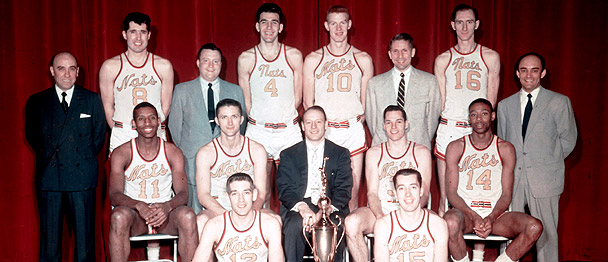
The 1955 NBA Champion Syracuse Nationals.
Biasone is at far left, Farris at far right, Cervi in the middle.
Number 4 is Hall-of-Famer Dolph Schayes.

The Nationals remained a good team, but Syracuse eventually proved to be too small a market for a major league sports team. In 1963, the Nats moved, becoming the Philadelphia 76ers, taking the place of the Warriors, who had moved to San Francisco a year earlier.

The American Basketball league of 1961-63 used a 30-second shot clock. The American Basketball Association started in 1967, and also used a 30-second clock. To get its teams ready for absorption by the NBA (4 of them were: The New York Nets, the Indiana Pacers, the San Antonio Spurs and the Denver Nuggets), they switched to a 24-second clock for 1975-76, which turned out to be the ABA's last season.

The NCAA resisted putting a shot clock in the college game, but allowed conferences to experiment with it, and some did, with enough success that the NCAA put in a 45-second shot clock in 1985. The college game was already growing in popularity, and the institution of the shot clock increased it. The clock was reduced to 35 seconds in 1995, and 30 seconds in 2015.

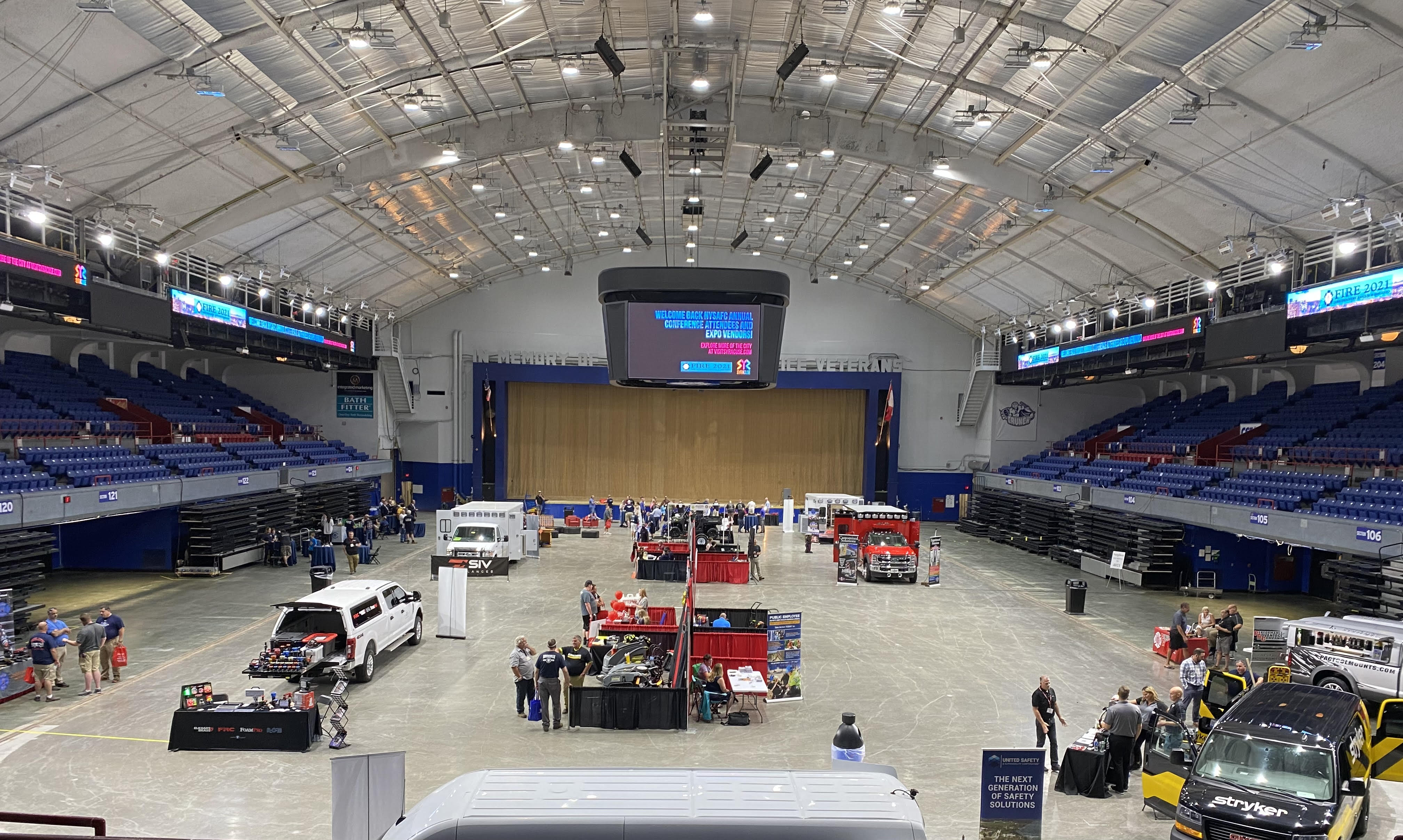
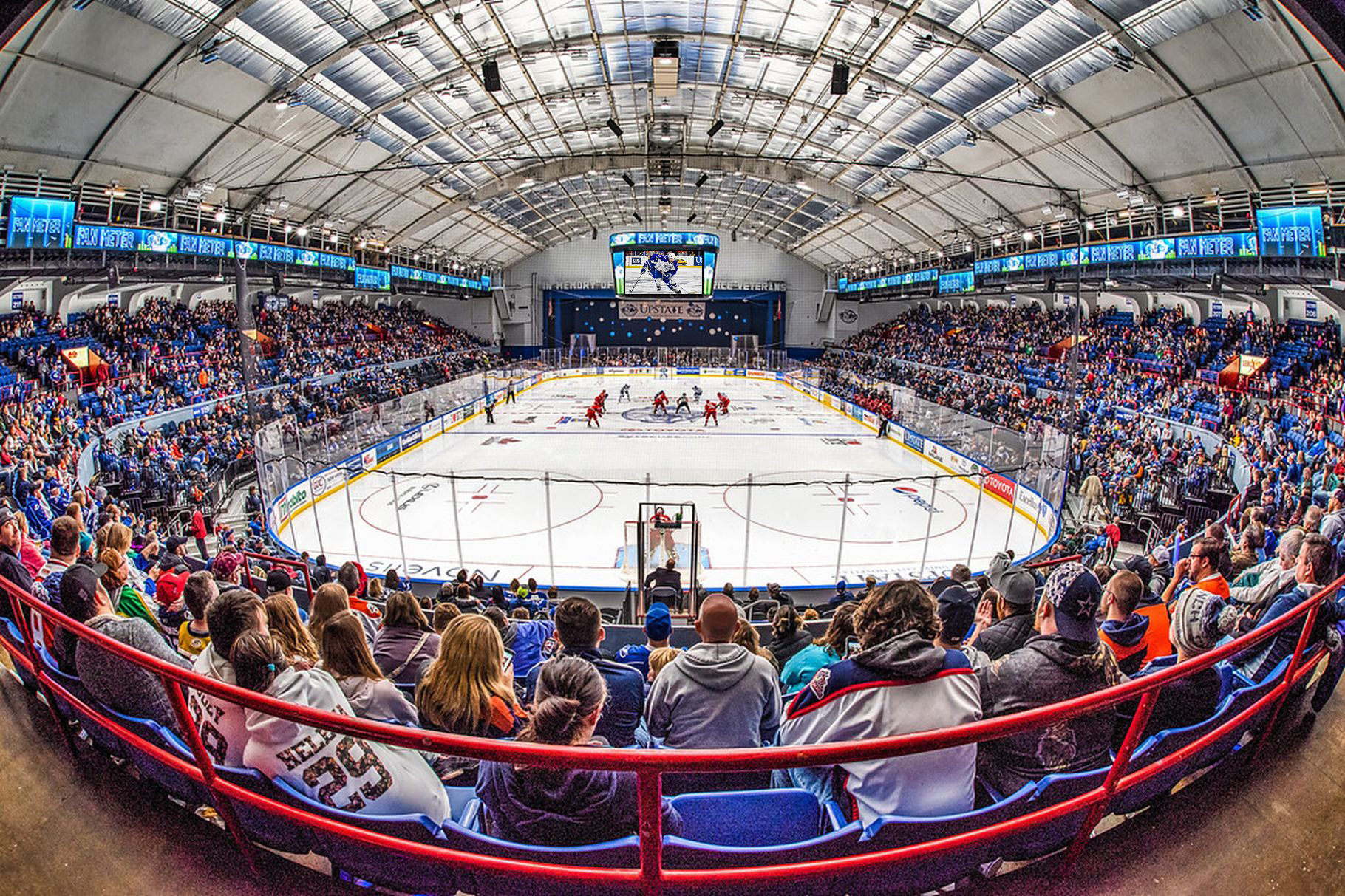
Biasone died in 1992, not long after the photo at the top was taken at the Nats' arena, the Onondaga County War Memorial, built in 1951, and now named the Upstate Medical University Arena. It is home to the Syracuse Crunch of the American Hockey League. Ferris died in 1993, Cervi in 2009.

In 1996, ESPN held a panel discussion on what was the greatest team in NBA history. Bob Ryan of The Boston Globe said that the 1954 institution of the shot clock should be a demarcation line. He cited both Mikan and the NBA's 1st scoring champion, the leader of the Warriors who won the 1st NBA title in 1946-47, as players who would not have excelled under the new system: "I'm not gonna kid you, I don't think Jumpin' Joe Fulks makes it in today's NBA, except maybe as a 12th man. George Mikan? A good backup center. He was great in his time, deserved every accolade he ever got. But, today? He's Greg Kite with a hook shot."

(Ryan decided that the best team in league history was the 1986 Celtics. The other panelists chose teams like the 1967 and 1983 Philadelphia 76ers, and the 1987 Los Angeles Lakers. They also discussed the 1965 Celtics, the 1970 New York Knicks, the 1972 Lakers, the 1977 Portland Trail Blazers, and the Chicago Bulls team that had just gone 72-10 and won the title.)

*

October 30, 1954 was a Saturday. There were 3 games played in the NBA on that Opening Day. It would have made sense for the Syracuse Nationals to be among the teams scheduled, but they weren't. The other appropriate teams would have been the Lakers and the Pistons, the teams that played the 19-18 game. And they did:

* The New York Knicks beat the Minneapolis Lakers, 94-83 at the old Madison Square Garden. Without Mikan, no Laker scored more than the 18 of Clyde Lovellette. Carl Braun -- the man whose saying, "Swish!" whenever he hit a shot that hit nothing but net inspired Knick broadcaster Marty Glickman to use it on the air, and later Warner Wolf to do so in WCBS-Channel 2 recaps -- led all scorers in the game with 26. The Lakers moved to Los Angeles in 1960.

* The Fort Wayne Pistons beat the Milwaukee Hawks, 91-72 at the Milwaukee Arena. In 1974, it was renamed the Milwaukee Exposition, Convention Center and Arena, or "The MECCA." Since 2014, it has been named the UW-Panther Arena. This was the 1st professional game for Bob Pettit, who scored 17 points, and went on to become the greatest player in Hawks history. The Hawks moved to St. Louis the next season, and to Atlanta in 1968. The Pistons moved to Detroit in 1957.

* And the Rochester Royals beat the Boston Celtics, 98-95 at the Rochester War Memorial. Like Syracuse's war memorial arena, former arch-rival Rochester's still stands and hosts minor-league hockey, the Rochester Americans, under the name of the Blue Cross Arena. But it does not host pro basketball: The Royals moved to Cincinnati in 1957, to Kansas City as the Kings in 1972, and to Sacramento in 1985.

All of the NHL's "Original Six" were in action:

* The New York Rangers lost to the Toronto Maple Leafs, 3-1 at Maple Leaf Gardens in Toronto.

* The Montreal Canadiens beat the Chicago Black Hawks, 5-1 at the Montreal Forum.

* And the Detroit Red Wings beat the Boston Bruins, 4-0 at the Olympia Stadium in Detroit.

There were college football games, including the following:

* Number 1 Ohio State beat Northwestern, 14-7 at Dyche Stadium (now Ryan Field) in the Chicago suburb of Evanston, Illinois. Ohio State won the Big Ten Conference title.

* Number 2 Oklahoma beat Colorado, 13-6 at Folsom Field in the Denver suburb of Boulder, Colorado.

* Number 3 University of California at Los Angeles, a.k.a. UCLA, beat the University of California main campus, known as Cal for sports and Berkeley for everything else, 27-6 at California Memorial Stadium in the San Francisco suburb of Berkeley. UCLA won the Pacific Coast Conference title (a forerunner of the Pacific-Twelve), but lost to Ohio State in the Rose Bowl, giving Ohio State the National Championship.

* Number 4 Arkansas beat Texas A&M, 14-7 at Kyle Field in College Station, Texas. Arkansas won the Southwest Conference title.

* Number 5 Army beat Virginia, 21-20 at Michie Stadium in West Point, New York.

* Number 6 Notre Dame beat Number 15 Navy, 6-0 at Thompson Stadium in Annapolis, Maryland.

* Number 7 West Virginia were upset by arch-rival University of Pittsburgh in "the Backyard Brawl," 13-10 at the old Mountaineer Field in Morgantown, West Virginia.

* Number 8 Wisconsin were upset by Iowa, 13-7 at Iowa Stadium (now Kinnick Stadium) in Iowa City.

* Number 9 Purdue beat Illinois, 28-14 at Ross-Ade Stadium in West Lafayette, Indiana.

* The night before, Number 10 Miami beat Fordham, 75-7 at the Orange Bowl. Fordham finished 1-7-1, and the University dropped the program, bringing it back on the Division I-AA (now FCS) level in 1970.

* Number 11 Michigan were upset by Indiana, 13-9 at Michigan Stadium in Ann Arbor.

* Number 12 Mississippi beat Louisiana State, 21-6 at Tiger Stadium in Baton Rouge, Louisiana. Ole Miss won the Southeastern Conference title, but lost the Sugar Bowl to Navy.

* Number 14 Virginia Tech were held to a tie by cross-State William & Mary, 7-7 at Miles Stadium in Blacksburg, Virginia. This was the only blemish on Tech's record, as they finished 8-0-1, but weren't invited to a bowl game.

* Number 16 Duke beat Georgia Tech, 21-20 at Duke Stadium (now Wallace Wade Stadium) in Durham, North Carolina. Tech, then unranked, rebounded, and were invited to the Cotton Bowl, where they upset Arkansas. Duke went on to win the Atlantic Coast Conference title.

* Number 17 Texas Christian were upset by Baylor, 12-7 at Amon G. Carter Stadium in Fort Worth, Texas.

Need: Sugar

* Nebraska, then unranked, beat Missouri, 25-19 at Memorial Stadium in Lincoln, Nebraska. Nebraska went on to upset Oklahoma and win the title in the Big Seven Conference. (Oklahoma State would make it the Big Eight in 1958, and the taking on of half the Southwest Conference made it the Big Twelve in 1996.) But they lost the Orange Bowl to Duke.

* Kansas State beat arch-rival Kansas, 28-6 at World War I Memorial Stadium in Manhattan, Kansas.

* And in New Jersey, Rutgers beat Temple, 25-0 at the old Rutgers Stadium in Piscataway; and Princeton played Colgate to a tie, 6-6 at Palmer Stadium in Princeton.

And in English soccer, Arsenal lost to North-East team Sunderland, 3-1 at Highbury in North London.

Tuesday, October 25, 2022

October 25, 1957: Albert Anastasia Is Killed

October 25, 1957: Albert Anastasia, the founder of what became New York's Gambino crime family, is killed. Murdered. Hit. Rubbed out. Whacked. Taken care of. Whichever expression you want to use.

It may have been revenge for the failed attempt to kill Frank Costello earlier in the year, although it did scare Costello into doing something mobsters rarely did: He retired from "the life." He lived until 1973.

Anastasia was one of the most powerful mob bosses ever, known as Il Capo di Tutti Capi -- The Boss of All Bosses. But, on this day, he entered the barbershop of the Park Sheraton Hotel, at 870 7th Avenue at 56th Street in New York. Organized crime legend Arnold Rothstein had been killed there in 1928. In the hotel's ballroom, Jackie Gleason staged and filmed The Honeymooners. In 1984, the hotel reverted to its original name, the Park Central Hotel.

Anastasia's bodyguard parked the car in an underground garage and then, most conveniently, perhaps with a little financial incentive from one of Anastasia's enemies, decided to take a little stroll.

As Anastasia relaxed in the barber chair, 2 men, with scarves covering their faces, rushed in, shoved the barber out of the way, and fired at Anastasia. After the 1st volley of bullets, Anastasia allegedly attempted to lunge at his killers. However, the stunned Anastasia had actually attacked the gunmen's reflections in the wall mirror of the barber shop. The gunmen resumed firing, and Anastasia fell to the floor, dead. He was 55 years old.
His murder remains officially unsolved, although it's easy to imagine that the NYPD wasn't exactly exerting itself to find the killers. It is widely believed that the contract was given to Joe Profaci, the boss of another of New York's "Five Families," who passed it on to "Crazy Joe" Gallo from Brooklyn, who then performed the hit with one of his brothers. Gallo, himself later the victim of an infamously unsolved rubout (in 1972, on his 43rd birthday, no less), was the subject of Bob Dylan's song "Joey."

Joe Profaci died of cancer in 1962, and Joseph Colombo took over, and the family bears his name today. The other "families" are known as the Gambino, the Genovese, the Bonnano and the Lucchese.

The American Mafia has been governed by "The Commission" since in 1931, when it was established by Charles "Lucky" Luciano, the originator of the family on which Genovese later put his name. The Castellamarese War, the biggest civil war in the history of American organized crime, had just ended, and Luciano figured this was the best way to keep the peace -- a criminal "League of Nations" that turned out to settle interfamily disputes better than the original League did between countries.

The members have always consisted of the boss of New York's Five Families, and the boss of the Chicago Outfit. Like the United Nations has come to do, they have assigned its other seats based on apparent merit, and the bosses of families in Philadelphia and Detroit have often been members. In 1957, Joseph "Joe the Barber" Barbara, the boss of Buffalo crime, was a member.

On November 14, America's organized crime bigwigs met at Barbara's home in Apalachin, New York, near Oswego and Binghamton, to discuss what to do with Anastasia's empire. The meeting was called by Vito Genovese, who now imagined himself as the big boss of it all.

The locals got suspicious when fancy cars with out-of-State license plates arrived in the small town, so they called the police, who raided the meeting, arresting 60 underworld figures.

It was a blow from which the American Mafia has never fully recovered, despite the work of such later bosses as Sam Giancana of Chicago, Nicky Scarfo of Philadelphia and John Gotti of New York's Gambino family.

Budd Schulberg, screenwriter of the 1954 film On the Waterfront, took a big chance in basing the character of Johnny Friendly, played by Lee J. Cobb, on Anastasia. But, today, Anastasia is best known for the way he died.

In a 1975 episode of M*A*S*H, "Soldier of the Month," Hawkeye Pierce (Alan Alda - real name Alphonse D'Abruzzo) sees a sleeping soldier, and says, "Ah, Albert Anastasia's doorman." In a 1976 episode, "Out of Sight, Out of Mind," temporarily blinded, a blindfolded Hawkeye feels around an empty chair by the door and jokingly says, "Ah, Albert Anastasia's bodyguard." Each of these is an anachronistic error, as the Korean War ended in 1953, 4 years before the Anastasia murder.

In a 2002 episode of The West Wing, "Holy Night," the question of when Anastasia was killed comes up, and White House Communications Director Toby Ziegler (Richard Schiff) asks his visiting father, former Murder, Incorporated officer Julius (a.k.a. Julie, Jerry Adler), when it happened. Julie says, "October, 1957." He later tells Toby that he should know things like that, as part of his heritage, and Toby tells him that he does know, that he knows all about Julie's Mob activities back then. Julie's attempt to admonish is ironic, since he gave the year and the month, but not the day.

In an episode of The Sopranos, Uncle Junior (Dominic Chianese) says that he wishes the Mob were like they were in the Fifties, "when it was peaceful." Tony (James Gandolfini) says he remembers seeing the picture of Anastasia in a pool of blood on the barbershop floor. Tony was born in 1959, 2 years after it happened, but he could have seen the photo at any time. I guess even nostalgia ain't what it used to be.
This is probably the photo that Tony saw.

Anastasia's murder came a month after the Brooklyn Dodgers and the New York Giants played their last games before moving to California. That was considered a major change in the life of New York City. But this other kind of "hit" carried with it another major change: For all the harm they caused over the last 50 years, the Mafia protected the neighborhoods they controlled from crime committed by others, in some cases better than the police could. Who was a thug who thought himself a rising tough guy going to be more afraid of? The Police Commissioner? The District Attorney? Or "The Boss of All Bosses"?

So "The Law of Unintended Consequences" kicked in: Without Anastasia, and with the Mob further weakened by Costello's retreat and the Apalachin arrests, that protection weakened. And the mobsters of other ethnicities -- mainly Irish and Jewish -- that the Italians worked with or even controlled found themselves with less support, as the Italians, by necessity, had to be more focused on taking care of their own.

(The Jewish Mob was done for, anyway, and for the best of reasons. In 1999, New York Daily News columnist Sidney Zion wanted to find out what happened, and asked one of the last survivors, long since out of "the life." The ex-gangster pointed out that, unlike the Italians and the Irish, the Jews sent their kids to college. He used a baseball analogy: "We lost our farm system.")

What is now thought of as the crime wave that overtook New York and other cities might have happened anyway, due to the proliferation of drugs, and the way drugs prey on society. But with the loosening of the Mafia's control of the drug trade, things got out of control. It would take the Crime Bill of 1994 before America's cities began to become safe again.

I'm not saying Anastasia was a good person. I am saying that it might have been better to let him live until he came to a natural death.

*

October 25, 1957 was a Friday. So while it was during the NFL season, there were no NFL games. Baseball had wrapped up its season 15 days earlier, when the Milwaukee Braves beat the New York Yankees in Game 7 of the World Series at Yankee Stadium in New York. The NHL season was just underway, but no games were scheduled for this day.

The NBA season was also just underway, but only 1 game was played. At the Onondaga County War Memorial Arena in Syracuse, New York -- now known as the Upstate Medical University Arena -- the Syracuse Nationals beat the Philadelphia Warriors, 103-85. Johnny "Red" Kerr of the Nats and Neil Johnston of the Warriors each scored 22 points, to lead all players.

After the 1961-62 season, the Warriors moved to San Francisco, becoming the San Francisco Warriors, and changing their name to the Golden State Warriors in 1971 when they moved across the Bay to Oakland. Although they returned to the San Francisco side in 2019, they have kept the Golden State name. Just 1 year after their move, Philadelphia got a replacement team, the Nats, who became the Philadelphia 76ers.

Also, actress Nancy Cartwright was born. She provided the voice of Bart Simpson on The Simpsons.

Wednesday, October 19, 2022

October 19, 1963: The Philadelphia 76ers Debut

October 19, 1963: After 14 seasons as the Syracuse Nationals, the NBA's Philadelphia 76ers make their home debut, taking the place of the Philadelphia Warriors, who moved to San Francisco the year before. It doesn't go so well: Despite 31 points from Lee Shaffer and 24 from Chet "the Jet" Walker, they lose to the Detroit Pistons, 124-121 at the Convention Hall of the Philadelphia Civic Center.

After bringing Wilt Chamberlain back from the Warriors in 1965, the 76ers built one of the greatest teams every in 1967, winning the NBA Championship. By 1973, they had collapsed, and finished with the worst record in NBA history, 9-73.

They rebuilt, and reached the NBA Finals in 1977, 1980 and 1982, before winning another title in 1983. But 2 disastrous trades in 1986 doomed them, and they've only reached the NBA Finals once since, in 2001. The last few years, they have asked their fans to "trust the process." Well, they're waiting.

They played at the Convention Hall of the Philadelphia Civic Center through the 1967 title, then moved to The Spectrum in South Philadelphia. In 1996, they moved next-door to the arena currently named the Wells Fargo Center.
The Philadelphia Civic Center's Convention Hall

From their beginnings, the have retired the Number 4 of forward Dolph Schayes, who had starred for them in Syracuse. From their 1967 title team, coached by Alex Hannum with Dr. Jack Ramsay as their general manager, they have retired the 13 of center Wilt Chamberlain, the 15 of guard Hal Greer, and the 32 of forward Billy Cunningham.

From the 1983 title team, coached by Cunningham, with Pat Williams as general manager, they have retired the 2 of center Moses Malone, the 6 of Julius "Dr. J" Erving, the 10 of guard Maurice Cheeks, and the 24 of forward Bobby Jones. From the late 1980s and early 1990s, they have retired the 34 of forward Charles Barkley. From the 2001 Finalists, they have retired the 3 of guard Allen Iverson.

And, in place of a retired number, they have hung a banner with a picture of a microphone, in memory of Dave Zinkoff, the public address announcer for the Warriors from their founding 1946 until their move in 1962, and for the 76ers from their 1963 arrival until his death in 1985.

*

October 19, 1963 was a Saturday. This was also the day that the song "You'll Never Walk Alone" was first played at Anfield, home stadium of Liverpool Football Club, who beat Birmingham-area team West Bromwich Albion, 1-0. I have a separate entry for that event. Also, Arsenal lost to Aston Villa, 2-1 at Villa Park in Birmingham.

There were 3 other games in the NBA that day:

* The New York Knicks lost to the Cincinnati Royals, 121-97 at the Cincinnati Gardens.

* The aforementioned San Francisco Warriors beat the Baltimore Bullets, 103-102 at the Baltimore Civic Center (now named the CFG Bank Arena) Wilt Chamberlain scored only 23 points. Walt Bellamy scored 36 in defeat.

* And the St. Louis Hawks beat the Los Angeles Lakers, 117-108 at the Kiel Auditorium in St. Louis. Jerry West scored 30 for the Lakers, Bob Pettit 32 for the Hawks.

There were 2 games played in the NHL. The Montreal Canadiens beat the Boston Bruins, 2-0 at the Montreal Forum. And the Toronto Maple Leafs beat the Detroit Red Wings, 2-1 at Maple Leaf Gardens in Toronto. The New York Rangers and the Chicago Black Hawks were not scheduled.

And these major college football games were played:

* Number 1 Texas beat Arkansas, 17-13 at Razorback Stadium in Fayetteville, Arkansas. Texas went on to win the Southwest Conference, and won the National Championship by beating Navy in the Cotton Bowl.

* Number 2 Wisconsin beat Iowa, 10-7 at Iowa Stadium (later renamed Kinnick Stadium) in Iowa City. But Wisconsin would lose to Ohio State the next week, knocking them out of the Big 10 and national title pictures.

* Number 3 Pittsburgh beat their arch-rivals, West Virginia, 13-10 at the old Mountaineer Field in Morgantown, West Virginia, in the "Backyard Brawl." Pitt lost their next game, away to Navy, and blew their shot at the National Championship. And, then an independent, it had no conference championship to win. They finished the season 9-1 and ranked Number 4, but didn't even go to a bowl game.

* Number 4 Ohio State were upset by USC, and it was a regular-season game, not the Rose Bowl. It wasn't even close: 32-3 at the Los Angeles Memorial Coliseum. This ruined Ohio State's chances of winning the Big 10 and National Championships. As I said, they took their frustrations out on Wisconsin the next week.

* Number 5 Mississippi beat Tulane, 21-0 at Tulane Stadium in New Orleans. "Ole Miss" went on to win the Southeastern Conference, but lost to Alabama in the Sugar Bowl.

* Number 6 Oklahoma beat Kansas, 21-6 at Oklahoma Memorial Stadium in Norman. A later loss to Nebraska cost them the Big 8 title.

* Number 7 Illinois beat Minnesota, 16-6 at Memorial Stadium in Champaign, Illinois. Illinois won the Big 10, and beat Washington in the Rose Bowl.

* Number 8 Georgia Tech were upset by Auburn, 29-21 at Grant Field in Atlanta.

* Number 9 Alabama beat Tennessee, 35-0 at Legion Field in Birmingham. 

* Number 10 Navy beat Virginia Military Institute, 21-12 at Navy-Marine Corps Memorial Stadium in Annapolis, Maryland. Navy would rise to Number 2, but lost the Cotton Bowl and the National Championship to Texas.

* North Carolina, currently unranked, beat North Carolina State, 31-10 at Kenan Stadium in Chapel Hill, North Carolina. UNC won the Atlantic Coast Conference title, and beat the Air Force Academy in the Gator Bowl.

* Nebraska, currently unranked, beat Kansas State, 28-6 at Memorial Stadium in Manhattan, Kansas. Nebraska would go on to win the Big 8, and beat Auburn in the Orange Bowl.

* Washington, currently unranked, beat Stanford, 19-11 at Husky Stadium in Seattle. Washington went on to win the title in the AAWU (forerunner of the Pac-12), but lost the Rose Bowl to Illinois.

* Army beat Wake Forest, 47-0 at Michie Stadium in West Point, New York.

* Notre Dame beat UCLA, 27-12 at Notre Dame Stadium in South Bend, Indiana.

* Dartmouth beat Holy Cross, 13-8 at Memorial Field in Hanover, New Hampshire. Dartmouth went on to win the Ivy League title.

* And in New Jersey, Rutgers beat Lehigh, 30-6 at Rutgers Stadium in Piscataway. And Princeton beat Colgate, 42-0 at Palmer Stadium in Princeton.

Sunday, April 10, 2022

April 10, 1955: A Title for Syracuse

April 10, 1955: The NBA Championship goes to Syracuse, New York.

Go ahead, clean your glasses. I got it right: Syracuse.

The Salt City has long been a home to Italian immigrants and their descendants. One son of those immigrants was Carmen Basilio, Middlewight Champion of the World in the 1950s. Danny Biasone was an immigrant from Chieti, in central Italy. In 1946, he paid $5,000 for a National Basketball League franchise, and the Syracuse Nationals set up shop at the State Fair Coliseum, a 7,500-seat auditorium built in 1927. It still stands, in the suburb of Geddes, New York, and is known as the Toyota Coliseum.

In their 1st season, 1946-47, the Nats made the Playoffs, but lost to their closest opponents, the Rochester Royals, who had won the NBL title in 1945. Biasone signed former Royals star Al Cervi to coach, and drafted Dolph Schayes as his star player. In 1949, the Nats were among the NBL teams absorbed into the Basketball Association of America, which renamed itself the National Basketball Association.

The Nats had the best record in the NBA in 1949-50, going 51-13. (That's equivalent to 65-17 over a full 82-game season.) They reached the NBA Finals, but lost to George Mikan and the Minneapolis Lakers. The New York Knicks were the Eastern Division Champions the next 3 years.

In 1951, the Onondaga County War Memorial opened, seating 11,000, and the Nats moved in. When the Indianapolis Olympians folded in 1953, the Nats picked up Alex Groza and Ralph Beard (who, unlike some of their 1948 Kentucky and Olympic teammates, had not been barred from the NBA due to the 1951 point-shaving scandal), and reached the 1954 NBA Finals, again losing to the Lakers.
The War Memorial

It was Biasone who recommended the 24-second shot clock to the NBA, and it was instituted for the 1954-55 season. With guards Paul Seymour and George King, forwards Dolph Schayes and Earl Lloyd (who had been the NBA's 1st black player, with the Washington Capitols in 1950), center Ephraim "Red" Rocha, and talented backups like centers Johnny "Red" Kerr (a rookie who went on to become a star) and Connie Simmons, the Nats went 43-29, earning them a 1st-round bye in the Playoffs. They beat the Boston Celtics in the East Finals.

In the NBA Finals, they faced another former NBL team, the Fort Wayne Pistons, featuring Bob Houbregs, Max Zaslofsky, George Yardley and Andy Philip. They were 43-29, and were no pushovers.

As it turned out, home-court advantage meant everything in this series, as no game was a blowout, but the home team won each of the 1st 6. The Nats won Games 1 and 2 at home, 87-82 and 87-84, respectively. Games 3, 4 and 5 were played at the Allen County War Memorial Coliseum in Fort Wayne, Indiana, and the Pistons won them all: 96-89, 109-102, and 74-71. Game 6 was back in Syracuse, and the Nats won, 109-104.

Game 7 was also in Syracuse. The Nats had to keep the pattern going. But the Pistons led 31-21 at the end of the 1st quarter. They started a comeback, and it was 53-47 Fort Wayne at the half. At the end of the 3rd quarter, it was tied, 74-74. With 12 seconds left in regulation, with the game tied, George King was fouled by Frankie Brian. He sank 1 of his free throws, making it 92-91 Syracuse. King then stole an inbounds pass from Andy Philip to seal the title.

Unlike the John Havlicek steal in Boston 10 years later, this one is not preserved on film, which is why, unless you're from the Syracuse area, or King's hometown of Charleston, West Virginia, or really know your NBA history, you've never heard of this steal. Come to think of it, Philip was later traded to the Celtics, and wore Number 17 with them before Havlicek did.

The Pistons returned to the NBA Finals in 1956, losing to the Philadelphia Warriors. In 1957, they moved to Detroit, and, while they have changed home venues 4 times, they have remained in the Detroit metropolitan area.

For those of you who are wondering about the name, knowing that "Pistons" makes sense for a team in "The Motor City," but that they were called that before moving there: They were founded in 1937 by Fred Zollner, whose Zollner Corporation ran a Fort Wayne foundry that manufactured pistons, for the engines of cars, trucks and locomotives. They won the NBL title in 1944 and 1945.

From 1949-50 to 1956-57, the Syracuse Nationals had 8 straight Playoff berths, 3 regular-season NBA Eastern Division titles, 9 Playoff series won, 7 Eastern Division Finals reached, 3 NBA Finals, and the 1955 NBA Championship -- still the last World Championship won by a team in New York State but not in New York City.

(The Rochester Royals had won the NBA title in 1951. The Buffalo Bills went as far as they could go in 1964 and 1965, winning the AFL Championship, but no Buffalo-based team has won a World Championship.)

But it wasn't enough. Syracuse, named for a city in Sicily, has a population of just 150,000. With a metropolitan area of under 700,000, Central New York simply isn't a big enough market to support a major league sports team. In 1963, the Nationals moved to Philadelphia, taking the place of the Warriors, who had moved to San Francisco a year earlier. They became the Philadelphia 76ers, winning the NBA Championship in 1967 and 1983, and losing in the Finals in 1977, 1980, 1982 and 2001.

Syracuse is still home to a Class AAA baseball team, the Chiefs; a hockey team at the same level, the Syracuse Crunch; and Syracuse University, a top-level college sports program. As far as major league sports goes, the Buffalo teams are about 150 miles west;  the Toronto teams are 250 miles west, then northeast; the New York teams are 250 miles southeast; and the Boston teams are a little over 300 miles east.
The War Memorial still stands, under the name of the Upstate Medical University Arena, and is home to the Crunch, concerts, and the occasional college and high school basketball game.
George King coached at West Virginia University, and then led Purdue to the NCAA Final in 1969. He died in 2006. Al Cervi, Dolph Schayes and Earl Lloyd were elected to the Basketball Hall of Fame, and Schayes was named to the NBA's 50th Anniversary 50 Greatest Players and its 75th Anniversary 75 Greatest Players. Cervi died in 2009. Schayes, whose son Danny Schayes had a fine NBA career, died in 2015, as did Lloyd. Jim Tucker was the last survivor of the '55 Nats, living until 2020.

*

April 10, 1955 was a Sunday, Easter Sunday. Football was out of season. Game 5 of the Stanley Cup Finals was played at the Olympia Stadium in Detroit. The Detroit Red Wings beat the Montreal Canadiens, 5-1. Gordie Howe scored a hat trick. Two days later, the Canadiens won Game 6 in Montreal. Two days after that, the Wings won Game 7 in Detroit.

The baseball season began the next day, with the traditional openers (but not always): The National League opener in Cincinnati, reflective of the 1869 Cincinnati Red Stockings being the 1st openly professional team, and the team then known as the Cincinnati Redlegs losing to the Chicago Cubs, 7-5 at Crosley Field; and the American League opener in Washington, so the President of the United States, in this case Dwight D. Eisenhower, could throw out the ceremonial first ball, and the Washington Senators beat their new neighbors, the Baltimore Orioles, 12-5 at Griffith Stadium.

Saturday, March 26, 2022

March 26, 1963: The End of the Syracuse Nationals

March 26, 1963: The Cincinnati Royals defeat the Syracuse Nationals, 131-127, at the Onondaga County War Memorial Auditorium in Syracuse, in Game 5 of an NBA 1st round Playoff series.

The Royals, led by University of Cincinnati stars Oscar Robertson and Jack Twyman, move on to face the defending champion Boston Celtics. Robertson scored 32 points, Twyman 24, while Lee Shaffer scored 45 in defeat for the Nats.

The Nats, led by veteran stars Dolph Schayes and Johnny "Red" Kerr and young sensations Hal Greer and Chet "the Jet" Walker, have played their last game. In the off-season, they will move to fill the void caused by the move of the Philadelphia Warriors to San Francisco. They will be known as the Philadelphia 76ers.

Dante "Danny" Biasone, an Italian immigrant, founded the Nats in the National Basketball League in 1946. In 1949, they were a part of the merger with the Basketball Association of America, which formed the National Basketball Association. They lost the NBA Finals to the Minneapolis Lakers in 1950 and 1954, before winning the title in 1955, beating the Fort Wayne Pistons in the Finals.

Their Hall-of-Famers included guards Greer, Larry Costello and Dick Barnett; forwards Schayes, Walker, Al Cervi and Earl Lloyd; head coach Alex Hannum; and founding owner Danny Biasone, who devised the NBA's 24-second shot clock in 1954.

But, like their neighbors the Rochester Royals, and the Pistons, they found themselves stuck in a market too small to support a major league sports team. Biasone sold the Nats to Irv Kosloff and Ike Richman, who moved them to their hometown of Philadelphia, to fill the void left the year before, when the Philadelphia Warriors moved to San Francisco.

Although it is the seat of a major university, Syracuse is now home to less than 150,000 people, with 660,000 in which can generously be called a "metropolitan area." It might be fairer to say that, like Rochester, it belongs in a single market with Buffalo, 150 miles away.
Built in 1951, the Nationals' arena, the Onondaga County War Memorial, still stands, under the name of the Upstate Medical University Arena. Like its relatively close contemporary, the Blue Cross Arena in Rochester, it is now known for hosting minor-league hockey, the American Hockey League's Syracuse Crunch.
With the Buffalo Bills having gone 0-4 in Super Bowls, the Buffalo Sabres having gone 0-2 in Stanley Cup Finals, and the NBA's Buffalo Braves having lasted only 8 seasons, the 1955 Syracuse Nationals remain the last World Championship team from Western New York.

*

March 26, 1963 was a Tuesday. Baseball was in Spring Training. Football was out of season. There was 1 other game in the NBA Playoffs: The St. Louis Hawks beat the Detroit Pistons, 104-100 at Cobo Hall (now Huntington Place) in Detroit. Bob Pettit scored 35 for the Hawks.

And the Stanley Cup Playoffs got underway. The Toronto Maple Leafs beat the Montreal Canadiens, 3-1 at Maple Leaf Gardens in Toronto. And the Chicago Black Hawks beat the Detroit Red Wings, 5-4 at the Chicago Stadium.

Monday, March 21, 2022

March 21, 1963: Alcatraz Federal Penitentiary Closes

March 21, 1963: The United States Penitentiary, Alcatraz Island, is closed after 28 years of operation.

"Alcatraz" is a Spanish word meaning "the gannet," for the pelican-like birds that the original Spanish settlers found on the island. The Island had been home to a U.S. Army fort since 1859, and had included a military prison since 1912. As a military prison, among those housed there were conscientious objectors from serving in World War I, including Philip Grosser, who called it "America's Devil's Island," after the French island prison off the coast of French Guiana in South America.

Alcatraz opened as a civilian federal prison on August 11, 1934, with the first batch of 137 prisoners arrived at Alcatraz from the U.S. Penitentiary in Leavenworth, Kansas. It was intended for prisoners who continuously caused trouble at other federal prisons. It would be a "last resort prison," to hold "the worst of the worst," who had no hope of rehabilitation. The island became adapted and used as a prison after the buildings were modernized and security increased.

Given this high security and the island's location in the cold waters and strong currents of San Francisco Bay, prison operators believed Alcatraz to be escape-proof and America's strongest prison. An escape attempt on May 2, 1946 resulted in what became known as "The Battle of Alcatraz": Six men attempted to escape, but, seeing the odds against them, three turned back. The other three were killed by U.S. Marines stationed on the island.

No one ever escaped from Alcatraz. The legend that anyone did comes from an attempt on June 11, 1962: Armed robber Frank Morris, and bank-robbing brothers John and Clarence Anglin, made their way through a ventilation shaft, slid down a kitchen vent pipe, then climbed perimeter fences lined with barbed wire, before making their way to an inflated raft. They tried to reach Angel Island, 2 miles to the north.

On June 14, a U.S. Coast Guard cutter found a paddle about 200 yards off Angel Island. Later that day, in the same area, workers on a private boat found a wallet, whose contents suggested it belonged to one of the Anglins. On June 21, shreds of cloth believed to be remnants of the raft were found on a beach near the Golden Gate Bridge. The FBI's report stated, "The individuals' personal effects were the only belongings they had, and the men would have drowned before leaving them behind." The reason people still cling to the belief that the escape was successful is that the bodies were never found. They are likely at the bottom of the Bay.

A 1959 report indicated that the facility was over 3 times more expensive to run than the average American prison. The problem was made worse by the buildings' structural deterioration from exposure to salt spray, which would require $5 million to fix. Major repairs began in 1958, but by 1961, engineers considered the prison a lost cause. Attorney General Robert F. Kennedy submitted plans for a new maximum-security institution at Marion, Illinois. Alcatraz was closed on March 21, 1963, and its prisoners moved to other federal pens.

Alcatraz has been reopened as a public museum. It is one of San Francisco's major tourist attractions, operated by the National Park Service's Golden Gate National Recreation Area, attracting some 1.5 million visitors annually. Visitors arrive by boat and are given a tour of the cellhouse and island, and a slide show and audio narration with anecdotes from former inmates, guards and rangers on Alcatraz.

As of March 21, 2022, there are 2 men still alive who had been prisoners at Alcatraz: Bill Baker, age 88, convicted of check fraud; and Robert Schibline, also 88, bank robbery.

*

March 21, 1963 was a Thursday. Dutch soccer player and manager Ronald Koeman was born.

Baseball was in Spring Training. Football was out of season. One game was played in the NBA: The Cincinnati Royals beat the Syracuse Nationals, 133-115 at the Cincinnati Gardens. Oscar Robertson was a one-man wrecking crew for the Royals, with 41 points, 15 rebounds and 12 assists, what would later be called a "triple-double." The preceding season, he had averaged a triple-double for the entire season, not that anybody kept track of such things at the time. That wouldn't be done again until Russell Westbrook did it in 2017.

And there was 1 game played in the NHL. The New York Rangers and the Boston Bruins played to a tie, 2-2 at the Boston Garden. Johnny Bucyk and Ted Green scored for Boston, Camille Henry and former Bruin Don McKenney for New York. The Bruins' Jean-Guy Gendron, a former Ranger, was given a game misconduct (meaning he was thrown out of the game) at 7:07 of the 1st period, but Hockey-Reference.com doesn't say why.

Thursday, March 17, 2022

March 17, 1963: The Boston Tear Party (We Love Ya, Cooz!)

March 17, 1963: The Boston Celtics hold a retirement ceremony for guard Bob Cousy. It becomes known as the Boston Tear Party.

A New York native, Cousy grew up first on the Upper East Side of Manhattan, and then in the St. Albans neighborhood of Queens. An injury to his right hand forced the guard to dribble with his left, the result being that, when fully healed, he could do pretty much anything with a basketball with either hand. His dribbling skills led to the nickname "The Houdini of the Hardwood."

At a time when freshmen were eligible for varsity play (they would soon not be, until 1972), Cousy helped the College of the Holy Cross win the NCAA Tournament in 1947, and reach what would now be called the Final Four again in 1948. The Boston Celtics took him as a "territorial pick" in the NBA Draft. He led the league in assists 8 times, was named to the league's 1st 15 All-Star Games, and was named the league's Most Valuable Player in 1957, leading the Celtics to their 1st NBA Championship. He also formed the NBA Players' Association, the 1st players' union in any of the "big four" North American sports.

Soon, it would no longer be his team, as center Bill Russell made it his own. Cousy had no problem with this, for the same reason that head coach and general manager Red Auerbach had no problem with it: The Celtics kept on winning. They reached the NBA Finals again in 1958, but lost; then won them in 1959, 1960, 1961 and 1962. In Game 7 of the 1962 Finals against the Los Angeles Lakers, Cousy preserved a 1-point lead in the final seconds by dribbling out the clock.

At age 34, he announced that the 1962-63 season would be his last. On March 17, the Boston Garden was jammed, and repeated standing ovations turned what was intended as a 7-minute ceremony into one lasting 20 minutes. A telegram from President John F. Kennedy, a Boston native, was read aloud: "The game bears an indelible stamp of your rare skills and competitive daring."

Trying to make his speech, Cousy was overwhelmed, and his noticeable speech impediment grew stronger. He struggled to find the right words, until the silence was broken by a fan later identified as Joe Dillion, a water worker from South Boston, yelling, "We love ya, Cooz!" This produced another standing ovation.

There was a game, and the Celtics beat the Syracuse Nationals, 125-116. There was no way that Auerbach -- Cousy was one of the few people to call him by his real name, Arnold, rather than his nickname, Red -- was going to let his team lose this game. Cousy himself only scored 8 points, but had 9 assists. Tom Heinsohn scored 28 points, Russell and rookie John Havlicek each scored 19, Sam Jones 16, Tom "Satch" Sanders 12, Dan Swartz 8, K.C. Jones and Clyde Lovellette 6 each, and Jim Loscutoff 3. For the Nats, who moved the next season to become the Philadelphia 76ers, Hal Greer scored 25.

Cousy helped the Celtics win one more title, again beating the Lakers in the Finals. He was immediately hired to coach at Boston College, and in 6 seasons, got them into 2 NCAA Tournaments and 3 NITs. In 1969, he was hired as head coach of the Cincinnati Royals. Despite having future Hall-of-Famers Oscar Robertson and Jerry Lucas, they struggled, and Cousy came out of retirement to play 7 games, wearing Number 19, because Robertson was wearing 14. It didn't help.

He was still with the Royals when they moved to become the Kansas City Kings in 1972, but was fired in 1974. He later overcame his speech impediment to broadcast for the Celtics. In 1993, he appeared in the film Blue Chips, as the athletic director of the university where Nick Nolte played the coach. A conversation between the two of them shows Cousy trying free throws. He makes 7 in a row, and Nolte says, "Do you ever miss?" By the time the scene ended, he was 10-for-10. He was 67 years old at the time.

He was named to the Basketball Hall of Fame, and to the NBA's 25th, 50th and 75th Anniversary Teams. Holy Cross retired his Number 17, and the Celtics retired his Number 14. He was the last living player from the 1st NBA All-Star Game in 1951, and he and Russell were the last living players of both the Celtics' 1957 NBA Champions and the NBA's 25th Anniversary Team.

*

March 17, 1963 was a Sunday. There were 2 other NBA games played that day. The New York Knicks lost to the Cincinnati Royals, 116-109 at the Cincinnati Gardens. The aforementioned Oscar Robertson had 34 points and 14 rebounds. And the St. Louis Hawks beat the Detroit Pistons, 119-105 at the Kiel Auditorium in St. Louis.

And the NHL's entire "Original Six" was in action that day, including the nightcap of the Boston Garden doubleheader for which Cousy's official farewell was the opener:

* The Boston Bruins and the Montreal Canadiens played to a 2-2 tie. Johnny Bucyk and Doug Mohns gave the Bruins a 2-0 lead, but they blew it, as Dickie Moore and Bobby Rousseau scored for the Habs.

* The Toronto Maple Leafs beat the New York Rangers, 2-1 at the old Madison Square Garden. Bob Nevin and Eddie Shack scored for the Leafs, Andy Bathgate for the Broadway Blues.

* And the Detroit Red Wings beat the Chicago Blackhawks, 4-2 at the Olympia Stadium in Detroit. It was a rough game, with 11 separate penalties called. The Wings got goals from Bruce MacGregor, Vic Stasiuk, Alex Delvecchio and Marcel Pronovost; the Hawks got them from Ron Murphy and Stan Mikita.

Sunday, February 6, 2022

February 6, 1952: King George VI Dies

King George VI, London Airport, January 31, 1952.
His last public appearance, and his last known photo.
He was 56 years old, but looks much older.

February 6, 1952: King George VI of Great Britain dies of a coronary thrombosis at his country home, Sandringham House, in Norfolk, England. He was 56 years old, and had been battling several illnesses, including lung cancer, for years.

Born December 14, 1895 as Albert Arthur Frederick George, the 2nd son of King George V, he was the Duke of York to the public, and "Bertie" to his family. (His grandfather, King Edward VII, had been born Albert Edward, and was also "Bertie" to his family.) When his father died, his brother, the Prince of Wales, became King Edward VIII. But Edward abdicated the throne on December 11, 1936, because the King no longer ruled absolutely, and Parliament was not willing to accept that he wanted to marry Wallis Simpson, a twice-divorced American.

So Bertie became King, and, since Queen Victoria had ruled after the death of her husband, Prince Albert, that no King of England could take the name Albert, Bertie took the regnal name George VI. While he had been trained in royal protocol, and had made many public appearances on behalf of the royal family, he had never expected to become King until the scandal of Edward's affair became public.

He had a serious stammer, which was a lot harder for radio broadcasts and newsreels to hide than was the polio of America's President at the time, Franklin D. Roosevelt. King George went to great lengths to overcome this, as seen in Colin Firth's Oscar-winning role in the film The King's Speech. Those lengths improved his public speaking considerably, but not completely.

Being his country's head of state through World War II took a terrible toll on him. And, like Roosevelt (but not like the continually cigar-smoking Prime Minister, Winston Churchill), the King smoked cigarettes unceasingly. When The War ended, he was not yet 50 years old, but looked 60.

In 1949, he needed surgery to remove an arterial blockage in his right leg. Had it failed, the leg would have had to be amputated. This postponed a tour that he and his wife, Queen Elizabeth, were going to take to Australia and New Zealand. In his place went their daughter, Princess Elizabeth, and her husband, Prince Philip. In September 1951, another trip was postponed, and subsequently undertaken by the Princess and her husband, when the King's cancer had required the removal of his left lung.

Since 1932, when George V finally accepted, 10 years after first being asked, that radio broadcasting was no longer just a means of entertainment, the British monarch has delivered a Christmas broadcast, to the nation and first the British Empire, and later to the British Commonwealth. George VI had faithfully done this since December 25, 1936. But in 1951, he was too ill to sit still for the usual 10 minutes or so. He recorded it piece by piece, and it was edited together. (It would not be done on television until 1957, and it is still recorded beforehand.)

On January 31, 1952, Princess Elizabeth and Prince Philip flew to Kenya, then still a British colony, as a stopover on a tour of Australia. The King saw them off at London Airport (renamed Heathrow Airport in 1966). It was his last public appearance. He and the Queen went to Sandringham, and, 6 days later, at 7:30 AM local time on February 6, it was found that he had passed away in his sleep.

This was not the age of social media, or of 24-hour news. Only a small minority of people on Earth even had television sets. The whole world did not find out at once. Certainly, the British government could not reveal the news to the world before notifying the heir to the throne. And getting word from London to the rural hotel where the heir and her husband were staying was not easy.

Philip was told first. He then asked his wife to take a walk with him. All at once, he had to tell his wife that her father was dead, her King was dead, and that she was now the head of state of the British Commonwealth. And she was only 25 years old. (She turned 26 on April 21.)

She returned at once, setting foot at the same airport, as Queen Elizabeth II. (Like her grandfather, but unlike her father and her great-grandfather, she chose her own name as her regnal name.) Churchill was there to greet her. For her grace in mourning, and for her steadiness in reigning over a grieving nation at such a young age, Time magazine named her its Woman of the Year. This was in place of a "Man of the Year"; the distinction's name wasn't changed to "Person of the Year" until 1999.

A state funeral was held. Edward VIII, now with the title of the Duke of Windsor, marched behind his brother's horse-drawn coffin. It was the only time after his abdication that he set foot in his homeland, as he had been living in France ever since.

King George VI is laid to rest inside St. George's Chapel at Windsor Castle, the family's preferred residence over London's Buckingham Palace, in Windsor, Berkshire, about 30 miles west of London. His widow, re-titled Elizabeth the Queen Mother, lived until 2002, age 101, and was buried alongside him. His 2nd daughter, Princess Margaret, Countess of Snowdon, is also buried there. As are, among others, the great rivals in the War of the Roses, Kings Henry VI and Edward IV; and also Kings Henry VIII, Charles I, George III, George IV, Edward VII and George V. 

Queen Elizabeth II is now 95, and has reigned for 70 years, both records for an English and/or British monarch. She appears to be in good health: She has never smoked, and while she enjoys drinking, she does it in moderation. Nevertheless, plans for her memorials have been made, but it is not publicly known where she will be laid to rest. Somewhere at Windsor Castle is likely, but it could be in a separate mausoleum, as is the case with her great-great-grandmother, Queen Victoria.

He was played by James Wilby in Bertie & Elizabeth in 2002, Bill Champion in Wallis & Edward in 2005,Colin Firth in The King's Speech in 2010, Samuel West in Hyde Park on Hudson in 2012, Rupert Everett in A Royal Night Out in 2015, Jared Harris on The Crown in 2016, and Ben Mendelsohn in Darkest Hour in 2017.

UPDATE: Queen Elizabeth died on September 8, 2022, at 96. She was laid to rest in St. George's Chapel at Windsor Castle, near her parents, her sister, and her husband.

*

February 6, 1952 was a Wednesday. England's Football League then played almost exclusively on Saturdays, but despite the funeral activities taking place over several days, no games were postponed. The great rivals of North London played their Derby on February 9 at White Hart Lane as scheduled, and Arsenal defeated Tottenham Hotspur 2-1.

In America, it was the off-season for MLB and the NFL. It was midseason for the NHL, but no games were played. The NHL was then headquartered in Toronto, and Canada was (and remains) part of the Commonwealth, with the British monarch as head of state. And so, the game scheduled for that night at Maple Leaf Gardens in Toronto, between the Toronto Maple Leafs and the New York Rangers, was postponed. It was rescheduled for February 19, and ended in a 3-3 tie.

There were, however, 2 games played in the NBA:

* The New York Knicks beat the Baltimore Bullets, 73-70 at what my generation would call the old Madison Square Garden. No Knick player scored more than 14 points: Dick McGuire and Max Zaslofsky both scored that many -- but a balanced team effort won the game.

This version of the Bullets would go out of business in 1954, and is not connected to with the new Bullets, who started in 1963, moved to Washington in 1973, and were renamed the Wizards in 1997.

* And the Boston Celtics beat the Syracuse Nationals, 99-88 at the Boston Garden. Bob Cousy scored 33 for the Celts.

Friday, January 28, 2022

January 28, 1958: The Crash of Roy Campanella

Campy at Ebbets Field, the day demolition began,
February 23, 1960

January 28, 1958: Roy Campanella is paralyzed when his 1957 Chevrolet sedan slips on ice and crashes, less than a mile from his home in Glen Cove, Long Island, New York. At age 36, his baseball career should have had at least another couple of years left.

The Brooklyn Dodgers were in the process of moving from Ebbets Field to the Los Angeles Memorial Coliseum, waiting for Dodger Stadium to be built. The close left-field fence at the Coliseum would have been perfect for Campy's swing.

Because of racism at the beginning of his career, and his accident at the end, he only had 10 seasons in the major leagues, 1948 to 1957, hitting 260 home runs. He should have had at least 400; without the crash, at least 300 would have been likely.

He regained some movement in his arms and hands, but he lived the last 35 years of his life in a wheelchair. After his former teammate Jackie Robinson, he became, in 1969, the 2nd black player elected to the Baseball Hall of Fame.

Campanella wrote his autobiography, It's Good to Be Alive, which was published in 1959. Michael Landon directed Paul Winfield in a CBS movie based on it, starring Paul Winfield.

Family legend has it that my grandparents took my mother to Ebbets Field sometime before his crash, and my mother, just a small child, and only having seen the team on black & white TV to that point, said, "Where's Campy?" In 1986, I got to see Campy and his Dodger teammates Duke Snider, Pee Wee Reese and Sandy Koufax at the Baseball Hall of Fame's induction ceremony in Cooperstown, New York. (Robinson and manager Walter Alston were already dead. So was Gil Hodges, who would not be elected until 2021.)

*

January 28, 1958 was a Tuesday. Baseball and football were out of season. And no games were scheduled in the NHL.

There were 2 games in the NBA, and there were played as a doubleheader at the old Madison Square Garden. In the opener, the St. Louis Hawks beat the Philadelphia Warriors, 123-109. In the nightcap, the New York Knicks lost to the Syracuse Nationals, 110-102.

December 31, 1999 & January 1, 2000: The Millennium

December 31, 1999:  The Millennium arrives. The people of planet Earth survived. At a terrible cost. But we hadn't destroyed ourselves. ...