Showing posts with label carl mays. Show all posts

Friday, September 30, 2022

October 1, 1921: The 1st Yankee Pennant

October 1, 1921: The New York Yankees go into this date with 4 games left in the regular season, and were 2 games ahead of the Cleveland Indians in the race for the American League Pennant.

The season before, the Yankees had finished in 3rd place, 3 games behind the Indians, with the Chicago White Sox 2 games behind. This season, with 7 White Sox players banned for life for their role in the fixing of the 1919 World Series (actually 8, but 1 had already retired), it's between the Indians, who went on to win the 1920 World Series, and the Yankees.

The Yankees had begun play in 1903, with the name "New York Highlanders" until 1912. And had never won a Pennant. In 1904, their 2nd season, they lost the Pennant to the team that would become the Boston Red Sox (and, eventually, their arch-rivals) on the last day of the season. In 1906, they finished 2nd, 3 games behind the White Sox. In 1910, they finished 2nd, but 14 1/2 games behind the Philadelphia Athletics.

They didn't get close again under their original owners, Frank Farrell and Bill Devery. In 1915, Jacob Ruppert bought the team, and began rebuilding. By 1919, they were 3rd, 7 1/2 games behind the White Sox. Then Ruppert purchased Babe Ruth from the Yankees, and the course of baseball history was changed. But it didn't quite result in a Pennant.

More pitching was needed, and with the addition of Waite Hoyt, and the record-breaking 59 home runs of Ruth, the Yankees -- wearing white caps for the last time in their history -- were now in line for a Pennant. They could win the Pennant on October 1, with a doubleheader sweep of the Philadelphia Athletics, or an Indians loss to the White Sox.

Here was the Yankee lineup for the opening game of their doubleheader with the Philadelphia Athletics at the Polo Grounds, at 155th Street and 8th Avenue in Upper Manhattan:

CF Elmer Miller
SS Roger Peckinpaugh
RF Babe Ruth
LF Bob Meusel
1B Wally Pipp
2B Aaron Ward
3B Mike McNally
C Wally Schang
P Carl Mays

Remember: No uniform numbers back then.

Oddly, it would be the pitcher, Mays, that started the Yankees scoring, with a single in the bottom of the 3rd inning. Miller hit a triple to left field, to bring Mays around. But in the top of the 4th, Mays allowed a triple to Whitey Witt, an RBI double to Jimmy Dykes, an RBI single to Tillie Walker, a groundout by Cy Perkins, a triple by Frank Welch, and an RBI single by Chick Galloway. It was 3-1 A's.

With 2 outs in the bottom of the 6th, Pipp singled, and tried to steal 2nd. Perkins, the A's catcher, threw the ball away, and Pipp made it to 3rd. Welch, the center fielder, threw the ball back, and it was a bad throw. This allowed Pipp, then better known for being one of the few home-run hitters before Ruth, to score. That make it 3-2 A's. (Pipp would later be best remembered for being replaced by Lou Gehrig.)

Even in the 1920s, walks, especially the leadoff variety, could kill you. McNally led off the bottom of the 7th with a walk. Schang singled, and, again, Welch made an error, allowing McNally to score the tying run. Mays bunted Schang over to 3rd. Miller singled Schang home.

Meanwhile, at Comiskey Park in Chicago, the White Sox beat the Indians, 8-5. Ray Schalk, one of the White Sox players who had no role in the Black Sox Scandal, did something no catcher had ever done before, nor has since: He makes a putout at every base at least once in a game.

Mays sent the Tribe down 1-2-3 in the 9th. Yankees 5, Athletics 3. For the 1st time, the New York Yankees were Champions of the American League. The win advanced Mays to a 27-9 record on the season.

The Yankees would also win the 2nd game, 7-6 in 11 innings. Elmer Miller hit a home run, Johnny Mitchell singled home the winning run, and the Babe himself was the winning pitcher.

But they would lose their 1st appearance in the World Series to their Polo Grounds landlords, the New York Giants. They would also lose to the Giants in the 1922 Series. But in 1923, in their 1st Series in the original Yankee Stadium, they would beat the Giants.

Meusel and Peckinpaugh lived until 1977, with Meusel living 11 days longer, making him the last survivor of the 1921 Yankees.

Other games played on this Saturday:

* A doubleheader was split at Baker Bowl in Philadelphia. The Philadelphia Phillies won the opener, 10-9. The New York Giants won the nightcap, 3-0. Red Causey and Claude Jonnard combined on an 8-hit shutout.

* The Brooklyn Robins beat the Boston Braves, 7-6 at Ebbets Field. The Dodgers were known as the Robins from 1914 to 1931, in honor of manager Wilbert Robinson.

* The Washington Senators swept a doubleheader from the Boston Red Sox at Fenway Park. The Senators won the 1st game 7-2, and the 2nd game 6-1, and they didn't even need Walter Johnson to pitch either game.

* The Cincinnati Reds beat the Chicago Cubs, 5-3 at Redland Field in Cincinnati. It was renamed Crosley Field in 1934.

* The St. Louis Browns beat the Detroit Tigers, 11-6 at Navin Field in Detroit. The Browns scored 5 runs in the top of the 11th inning. The ballpark was renamed Briggs Stadium in 1938, and Tiger Stadium in 1961.

* And the Pittsburgh Pirates and the St. Louis Cardinals were tied 4-4 after 9 innings at Sportsman's Park in St. Louis, when the game was called due to darkness.

Also, actor James Whitmore was born on this day.

Saturday, September 10, 2022

September 11, 1918: The Early World Series

September 11, 1918: The Boston Red Sox win the World Series. They beat the Chicago Cubs 2-1 in Game 6 at Fenway Park. A 3rd inning error by Max Flack gave the Sox their runs, and Carl Mays pitched very well to gain the win. The Sox won the Series despite the lowest batting average ever for a Series-winning team: .186.

World War I was ongoing. The U.S. Secretary of War, Newton D. Baker, had issued the "work or fight order," meaning that anyone in "non-essential" jobs (like sports) had to either enlist in the armed forces, take a job with some connection to the war effort, by July 1, or be subject to being drafted into the U.S. Army.

As a result, baseball had to be shut down a month early, although the World Series was still allowed to be played. Unlike in the later World War II, there was no Commissioner of Baseball at the time, and thus no letter from the Commissioner to the President of the United States, asking what baseball should do; and thus no "green light letter" from the President, saying that baseball should continue.

September 11 was a date fraught with difficult history in America long before al-Qaeda's destruction of the World Trade Center in 2001:

* The Battle of Brandywine that the Continental Army lost outside Philadelphia in 1777.

* The Sugarloaf Massacre in Pennsylvania in 1780.

* The threat to Fort McHenry in Baltimore, with the battle coming 2 days later.

* The Mountain Meadows Massacre in Utah in 1857.

* The leadup to the Battle of Antietam in Maryland in 1862.

* The Ninth Avenue Elevated derailment in New York in 1905.

* Charles Lindbergh's anti-Semitic speech in Des Moines in 1941.

* Hurricane Edna in New England in 1954.

* Hurricane Carla in Texas in 1961.

* A plane crash in Charlotte, North Carolina in 1974.

* A bomb killing a policeman at Grand Central Terminal in New York in 1976.

* Hurricane Iniki in Hawaii in 1992.

All that before 2001 -- and the Benghazi attack in 2012.

On September 11, 1918, no one knew if there would be a 1919 baseball season, or when baseball would ever start up again. It was not widely known that the war would be over in 2 more months. So many other sports competitions had been canceled for the duration in 1914. England's Football League and FA Cup had been canceled for the duration in 1915. There was no 1916 Olympics.

But the war did end on November 11, 1918. On April 19, 1919, the next season started on time. By the end of that year, most major sports competitions had been resumed, even in war-torn Europe. The 1920 Olympics were granted to hard-hit Belgium, and the 1924 Olympics to France: Summer to Paris, and the 1st Winter Olympics to Chamonix in the Alps.

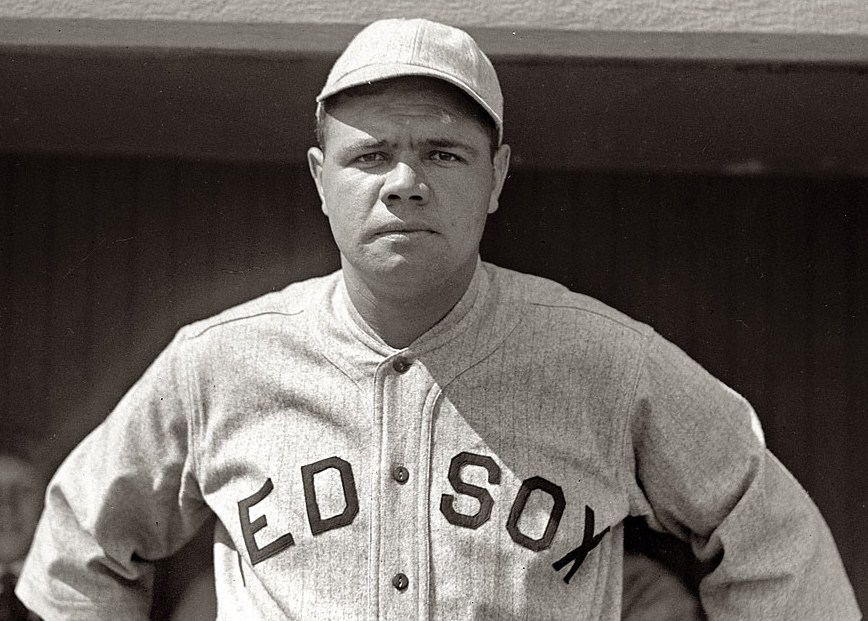
As for the 1918 World Series: George Herman "Babe" Ruth (pictured above, in 1918), who had already helped pitch the Red Sox to win the 1915 and 1916 World Series, and had led the American League in home runs this season with 11, pitched and won Games 1 and 4 for the Sox, although, in Game 4, his streak of consecutive scoreless innings in World Series play ended at 29 2/3rds. That would remain a record until 1961. (It would not be the only record to be set by Ruth and broken that year.)

With this one exception, the earliest that a World Series has ever ended is on October 2. It's happened twice: In 1932, when the New York Yankees (with a Babe Ruth with a very different image) beat the Chicago Cubs; and in 1954, when the New York Giants (with Willie Mays making the most famous defensive play in the history of sports 4 days earlier) beating the Cleveland Indians. Both of those World Series were won in 4-game sweeps.

Let me address the elephant in the room: How did the Babe respond to the work or fight order? Until the World Series was over, he didn't respond to it at all. He kept on playing, exposing himself to the draft -- which he had every legal right to do.

Once it ended, he gained exemption from the war draft by accepting a nominal position with a Pennsylvania steel mill. The end of the war in November set Ruth free to play baseball without such contrivances.

I will leave it to the individual reader to decide whether Ruth's method of avoiding military service, while completely legal, was moral. However, unlike with what Jack Dempsey, who became Heavyweight Champion of the World in 1919, did in 1917 and 1918, and unlike Mickey Mantle, who was exempt from service in the Korean War of the early 1950s because of his osteomyelitis, nobody ever called Ruth a "slacker" or a "coward."

Over the next few years, Sox owner Harry Frazee began to break up his team. He really couldn't keep Ruth, leading to the myth of "The Curse of the Bambino." But the real problem was that he broke up a really good pitching staff.

As a result, the Red Sox did not get into another American League Pennant race until 1938. They didn't win another Pennant until 1946. They lost the ensuing World Series with Game 7 tied in the 8th. They lost a single-game Playoff for the Pennant in 1948. They blew the last 2 games of the 1949 season, only needing to win 1 to win the Pennant.

They lost the 1967 World Series in 7 games. They blew the 1972 AL Eastern Division title in the last week. They blew another Division title in 1974. They lost the 1975 World Series despite leading Game 7 3-0 after 5 innings. They blew another Division title in 1977. They blew a 9-game Division lead in July 1978 (remember, the Yankees were 14 games back, but they weren't the 2nd place team), and lost a 1-game Playoff for the title.

They lost the 1986 World Series despite leading Game 6 5-3 and needing 1 more strike in the 10th inning, and leading Game 7 3-0 going to the bottom of the 6th. They got swept in the AL Championship Series in 1988, and again in 1990. They got swept in the AL Division Series in 1995, and again in 1998. They got to the ALCS in 1999, and clowned their way through another loss. They nearly pulled off a "reverse choke" for the 2000 Division title, but didn't quite make it. They lost the 2003 ALCS despite leading Game 7 5-2 going to the bottom of the 8th.

"The Curse of the Bambino is not, 'The Red Sox can't beat the Yankees.' The Curse of the Bambino is, 'The Red Sox can't win the World Series.'" -- Dan Shaughnessy, Boston Globe. You'll notice that, of those 17 defeats starting in 1946, the Yankees were involved in "only" 6 of them. The problem wasn't the Yankees. If the Sox wanted to know what was wrong, they needed to look in the mirror.

It took one more year to do it. The Boston Red Sox stunned the Yankees in the ALCS, and, on October 27, 2004 -- 86 years, 1 month and 16 days after they last did so -- won the World Series. To do so, they beat the St. Louis Cardinals, who had beaten them in the 1946 and 1967 World Series.

This win, of course, was bogus, as were the World Series they won in 2004 and 2007. And we know why: Performance-enhancing drugs. David "Big Papi" Ortiz and Manny Ramirez, by far their 2 most significant hitters in 2004 and 2007, used PEDs. Ortiz was still there when they won again in 2013.

He used PEDs. He was tested for them. He failed the test. He said he never used them. He lied. He was exposed. Exposed as a cheater and a liar. He still lies about it. For all we know, he still cheated until he retired at the end of the 2016 season.

And yet, he was not only still permitted to play professional baseball, he was allowed to be crowned the Most Valuable Player of the 2013 World Series.

And when the Red Sox won again in 2018, 100 years after their last honest title, that was the year they were caught using something not available for their entire 86-year drought: Apple Watches. So even with these 4 tainted titles, the Red Sox have still not won the World Series without cheating since September 11, 1918.

Which was a Wednesday. And no other major sporting events were played. So Game 6 of the 1918 World Series was the only score on this historic day.

UPDATE: The Red Sox have a team Hall of Fame. From their 1912, 1915, 1916 and 1918 World Champions, they have inducted manager Bill Carrigan, shortstop Everett Scott, 3rd baseman Larry Gardner, left fielder Duffy Lewis, center fielder Tris Speaker, right fielder Harry Hooper, and pitchers Smoky Joe Wood, Dutch Leonard, Herb Pennock and Babe Ruth.

The Cubs also have a team Hall of Fame. Inducted from their 1918 Pennant winners have been pitchers Grover Cleveland Alexander and James "Hippo" Vaughn, team owner William Wrigley Jr., and public address announcer Pat Pieper.

Tuesday, August 16, 2022

August 16 and 17, 1920: The Beaning and Death of Ray Chapman

 
August 16, 1920: The New York Yankees, now in their 1st season with Babe Ruth, are playing the Cleveland Indians at the Polo Grounds in New York. These 2 teams are in a 3-way American League Pennant race with the Chicago White Sox.

Submarine-style hurler Carl Mays hits Indian shortstop Ray Chapman in the head with a pitch. The impact makes such a sound, and the ball comes back to Mays with such force, that Mays thinks Chapman actually hit the ball -- shades of the Roger Clemens-Mike Piazza incident 80 years later -- and throws to 1st base.

This backs up Mays' claim, which he held for the last 51 years of his life, that he did not intentionally hit Chapman, who was known at the time for hanging over the plate.

The audience gasped at the sound -- no batting helmets in those days -- and Chapman got up, and told Yankee catcher Wally Schang, "I'm all right. Tell Mays not to worry." He took some steps, then collapsed, with his left ear bleeding. He never regained consciousness, and died the next day. He was 29 years old.

Aside from the possibility of Mike "Doc" Powers of the 1909 Philadelphia Athletics, whose death may not have been caused by an on-field injury, but was surely worsened by it, Chapman is the only Major League Baseball player to die as the result of an on-field incident.


The Indians won the game, 4-3, and went on to win the World Series in spite of Chapman's death, with rookie Joe Sewell taking his place, and building a Hall of Fame career. They dedicated a monument to him at League Park, but it got lost in the move to Cleveland Municipal Stadium. It was placed in a trunk, and, without anyone still with the team knowing it was in the trunk, it got moved to Jacobs (now Progressive) Field, and was found, and became the centerpiece of the Indians' version of the Yankees' Monument Park, their Heritage Park behind the center field fence.
So the only uniformed person ever to kill another person on a Major League Baseball field, intentionally or otherwise, was a Yankee. Amazingly, this is not often cited by Yankee Haters (Flushing Heathen, Chowdaheads and others) as a reason why they hate the Yankees. It's been 100 years, and pretty much everybody who cared about Chapman and the Indians at the time is gone. But it's still a dark day in Yankee history.

*

August 16, 1920 was a Monday. Writer Charles Bukowski was born. And this was the day of the Miracle of the Vistula, which saved Poland, and allowed it to win the Polish-Soviet War. I have a separate entry for that event.

It was the off-season for the NHL. The NFL was one month away from being founded. The NBA was 26 years away. And, including the contest in which Ray Chapman was mortally injured, there were only 4 games played in what would eventually be called Major League Baseball. Here are the other 3:

* The Boston Red Sox beat the Detroit Tigers, 6-4 at Fenway Park in Boston.

* The Cincinnati Reds beat the Chicago Cubs, 9-1 at Cubs Park in Chicago. It was renamed Wrigley Field in 1926.

* And the Pittsburgh Pirates beat the St. Louis Cardinals, 3-2 at Sportsman's Park in St. Louis.

On August 17, actress Maureen O'Hara was born. Only the Yankees-Indians game was postponed in Chapman's memory. Also not playing were the Chicago White Sox, the Philadelphia Athletics, the Boston Braves and the Brooklyn Dodgers.

Here's everybody else: 

* The Red Sox and the Tigers split a doubleheader. The Red Sox won the opener, 4-3; and the Tigers won the nightcap, 3-1.

* The Reds beat the Cubs again, 3-2.

* The Pirates beat the Cardinals again, 10-6.

* The New York Giants split a doubleheader with the Philadelphia Phillies at Baker Bowl in Philadelphia. The Phils won the 1st game, 3-2; and the Jints won the 2nd game, 8-7 in 10 innings.

* A doubleheader was split at Griffith Stadium in Washington. The St. Louis Browns won the 1st game, 7-2. The Washington Senators won the 2nd game, 10-9 in 11 innings.

Saturday, July 30, 2022

July 30, 1919: The Carl Mays Trade

July 30, 1919: The Boston Red Sox trade pitcher Carl Mays to the New York Yankees for pitchers Bob McGraw and Allen Russell, and $40,000. More than any other trade in the history of the sport, this one changed the history of baseball.

McGraw, Russell and the money don’t matter for this discussion. Mays, a 27-year-old Kentuckian with a righthanded "submarine" delivery -- think 1979 Pittsburgh Pirates World Series hero Kent Tekulve, and 1980s Kansas City Royals closer Dan Quisenberry -- had already helped the Red Sox win the 1915, 1916 and 1918 World Series.

But he was a rotten guy, what we would now call "a clubhouse cancer." One teammate (I can't find a record of which one) said, "He has the disposition of a man with a permanent toothache."

Mays himself couldn't explain it: "I always have wondered why I have encountered this antipathy from so many people, wherever I have been. And I have never been able to explain it, even to myself."

While he was at Spring Training in 1919, his farm house in Missouri burned down. He believed it was arson. He began the 1919 season with a 5-11 record. In a game in Philadelphia, home fans at Shibe Park pounded on the roof of the visitors' dugout, and Mays reacted to this by getting up and throwing a ball into the stands, hitting a fan in the head.

On July 13, against the Chicago White Sox at Comiskey Park, Eddie Collins tried to steal 2nd base. Catcher Wally Schang tried to throw him out, and hit Mays in the head by mistake. When the inning ended, Mays walked off the field, walked into the clubhouse, changed his clothes, went to the train station, and headed back to Boston. He told Burt Whitman, a Boston sportswriter:

I’m convinced that it will be impossible for me to preserve my confidence in myself as a ballplayer and stay with the Red Sox as the team is now handled. The entire team is up in the air and things have gone from bad to worse. The team cannot win with me pitching, so I am getting out…

Maybe there will be a trade or a sale of my services. I do not care where I go.

His teammates had turned against him. Sox management were eager to get rid of him. The Yankees, needing pitching, were happy to make the trade.

But, because he had "jumped the club," Mays had been suspended by Red Sox owner Harry Frazee. And Byron Bancroft "Ban" Johnson, President of the American League, ruled that Mays could not be traded while he was suspended.

"Baseball cannot tolerate such a breach of discipline," Johnson said. "It was up to the owners of the Boston club to suspend Carl Mays for breaking his contract, and when they failed to do so, it is my duty as head of the American League to act."

This move by Johnson split the League. On one side: Johnson, one of its co-founders, and the "Loyal Five": The Philadelphia Athletics, owned by Benjamin Shibe and manager Connie Mack; the Cleveland Indians, owned by James Dunn; the Detroit Tigers, owned by Frank Navin; the St. Louis Browns, owned by Phil Ball; and the Washington Senators, owned by former pitching star Clark Griffith.

On the other side, the "Insurrectos," the other 3 teams: The Red Sox, owned by Frazee; the Yankees, owned by Jacob Ruppert and Tillinghast L'Hommedieu Huston; and the Chicago White Sox, owned by the AL's other co-founder, Charlie Comiskey, once Johnson's best friend, and now a bitter enemy.

The Yankees went to court, and got an injunction against Johnson's ability to prevent the trade. Mays went 9-3 the rest of the way, finishing the season 14-14. He would win 80 games for the Yankees, helping them win their 1st  Pennants and their 1st World Series.

He would also -- unintentionally, he always insisted -- become the only pitcher ever to kill an opposing batter with a pitch: On August 16, 1920, at a time when there were no batting helmets, he hit Cleveland shortstop Ray Chapman in the head. Chapman died the next day.

But the implications of this trade went beyond that. After this, the Loyal Five refused to make any deals with the Insurrectos. Those 3 teams could now only make deals with each other. And Comiskey was famously cheap, which resulted in the Black Sox Scandal. So if Frazee had to make a deal, he had to make it with Ruppert. (Huston more or less stayed out of it.)

And that's why so many of the Red Sox champions of the 1910s went to the Yankees, and helped to make their Dynasty of the 1920s. Mays was the first, and Babe Ruth would be the biggest. Pretty much everybody who has studied this period of baseball history knows that.

What they tend to overlook is what happened to the Loyal Five. Sure, the moves wrecked the Red Sox for a generation. But what did it do to the other teams? The downfall of the White Sox can be traced to the banning for life of the "Eight Men Out" during the Black Sox Scandal.

But from 1921 (after the Indians won the 1920 World Series) through 1964, while the Yankees were winning 29 Pennants in 44 years, how many did the Loyal Five win? The Tigers 4, the Athletics (moving to Kansas City in 1955 and Oakland in 1968) 3, the Senators (becoming the Minnesota Twins in 1961) 3, the Indians 2, the Browns (becoming the Baltimore Orioles in 1954) 1.

And even that wasn't the end of it. The injunction unblocking the Mays trade, combined with the Black Sox Scandal, led to the replacement of the command structure of what we would now call Major League Baseball.

Previously, the game was run by a National Commission, consisting of each League's President and a 3rd man, allegedly impartial (but still doing what the owners wanted.) Afterward, the Office of the Commissioner of Baseball was created. The League Presidents would still have power, particularly in the area of discipline, until Commissioner Bud Selig eliminated their offices in 1999. But they would never be so strong again.

The Carl Mays trade was huge, above and beyond leading to the Babe Ruth sale.

*

July 30, 1919 was a Wednesday. These baseball games were played that day:

* The New York Yankees split a doubleheader with the Chicago White Sox at the Polo Grounds, and both games went to 10 innings. The Yankees won the opener, 6-5, on a suicide squeeze bunt by James "Truck" Hannah that scored Del Pratt. Bob Shawkey went the distance for the win. Wally Pipp hit a home run.

The South Siders won the nightcap, 5-3. Buck Weaver doubled home the winning run. Over the 2 games, "Shoeless" Joe Jackson went 4-for-5 with 3 walks and an RBI, and Eddie Collins went 3-for-10.

* A doubleheader was split at Forbes Field in Pittsburgh. The New York Giants won the 1st game, 9-0. Jesse Barnes pitched a 3-hit shutout. Hal Chase went 4-for-4 with an RBI and a stolen base, unaware that, due to getting caught throwing games, he was in his last 2 months as an active player. The Pittsburgh Pirates won the 2nd game, 6-1.

* The Brooklyn Robins beat the Chicago Cubs, 6-0 at Weeghman Park in Chicago. Jeff Pfeffer allowed 9 hits, but kept the shutout. Zack Wheat went 3-for-4 with a walk and 2 RBIs. (The Dodgers were named the Robins while Wilbert Robinson was their manager, from 1914 to 1931. Weeghman Park was renamed Cubs Park in 1920, and Wrigley Field in 1926.)

* A doubleheader was split at Fenway Park in Boston. The Detroit Tigers won the 1st game, 3-1. The Boston Red Sox won the 2nd game, 3-2. Over the 2 games, Ty Cobb went 4-for-7 with 2 walks and a stolen base, and Babe Ruth went 0-for-6 with 2 walks.

* The Philadelphia Athletics beat the Cleveland Indians, 2-1 at Shibe Park in Philadelphia. Tris Speaker went 0-for-4.

* The Washington Senators beat the St. Louis Browns, 1-0 at Griffith Stadium in Washington. With 1 out in the bottom of the 9th, Sam Rice hit a triple, and Robert "Buzz" Murphy singled him home. Jim Shaw pitched a 4-hit shutout. George Sisler got 1 of those hits.

* The Cincinnati Reds beat the Boston Braves, 7-6 at Redland Field in Cincinnati. (It was renamed Crosley Field in 1934.)

* And the Philadelphia Phillies beat the St. Louis Cardinals, 3-1 at Robison Field in St. Louis. Rogers Hornsby went 0-for-4.

December 31, 1999 & January 1, 2000: The Millennium

December 31, 1999:  The Millennium arrives. The people of planet Earth survived. At a terrible cost. But we hadn't destroyed ourselves. ...