Showing posts with label allen ginsberg. Show all posts

Friday, October 7, 2022

October 7, 1955: Allen Ginsberg Howls

October 7, 1955: Allen Ginsberg gives the 1st public reading of his poem "Howl," at the Six Gallery in the North Beach section of San Francisco.

The poets reading that night were, in order: Philip Lamantia, Michael McClure, Philip Whalen, Ginsberg and Gary Snyder. The organizer was Kenneth Rexroth. They were introduced by Lawrence Ferlinghetti, who also owned the nearby City Lights Bookstore. Both Rexroth and Ferlinghetti were published poets, but neither read his work that night. Jack Kerouac, already a published novelist but 2 years away from his magnum opus On the Road being published, refused to read his own poetry, but cheered the other writers on, and passed a jug of wine around.

"Howl" is best remembered for its opening:

I saw the best minds of my generation destroyed by madness, starving hysterical naked,
dragging themselves through the negro streets at dawn looking for an angry fix,
angelheaded hipsters burning for the ancient heavenly connection to the starry dynamo in the machinery of night,
who poverty and tatters and hollow-eyed and high sat up smoking in the supernatural darkness of cold-water flats floating across the tops of cities contemplating jazz,
who bared their brains to Heaven under the El and saw Mohammedan angels staggering on tenement roofs illuminated,
who passed through universities with radiant cool eyes hallucinating Arkansas and Blake-light tragedy among the scholars of war,
who were expelled from the academies for crazy & publishing obscene odes on the windows of the skull,
who cowered in unshaven rooms in underwear, burning their money in wastebaskets and listening to the Terror through the wall...

And so on. But the part that sticks out to me is Part II, in which Ginsberg compares America's consumer culture to a Canaanite god, usually in the form of a giant bull and demanding the sacrifice of children, mentioned in the Old Testament as Molech (MOLL-ick) or Moloch (MOH-lock):

What sphinx of cement and aluminum bashed open their skulls and ate up their brains and imagination?

Moloch! Solitude! Filth! Ugliness! Ashcans and unobtainable dollars! Children screaming under the stairways! Boys sobbing in armies! Old men weeping in the parks!

Moloch! Moloch! Nightmare of Moloch! Moloch the loveless! Mental Moloch! Moloch the heavy judger of men!
Moloch the incomprehensible prison! Moloch the crossbone soulless jailhouse and Congress of sorrows! Moloch whose buildings are judgment! Moloch the vast stone of war! Moloch the stunned governments!
Moloch whose mind is pure machinery! Moloch whose blood is running money! Moloch whose fingers are ten armies! Moloch whose breast is a cannibal dynamo! Moloch whose ear is a smoking tomb!
Moloch whose eyes are a thousand blind windows! Moloch whose skyscrapers stand in the long streets like endless Jehovahs! Moloch whose factories dream and croak in the fog! Moloch whose smokestacks and antennae crown the cities!
Moloch whose love is endless oil and stone! Moloch whose soul is electricity and banks! Moloch whose poverty is the specter of genius! Moloch whose fate is a cloud of sexless hydrogen!...

Moloch! Moloch! Robot apartments! invisible suburbs! skeleton treasuries! blind capitals! demonic industries! spectral nations! invincible madhouses! granite cocks! monstrous bombs! 
They broke their backs lifting Moloch to Heaven!
Moloch in whom I sit lonely! Moloch in whom I dream angels! Crazy in Moloch!

Moloch had appeared in literature before. In his 1667 Paradise Lost, John Milton described him as a child-eating fallen angel, a "horrid king besmeared with blood / Of human sacrifice, and parents’ tears." Charles Dickens mentioned him in his 1848 novella The Haunted Man. In his 1862 novel Salammbô, set in Carthage during the Mercenary Revolt after the First Punic War in 237 BC, Gustauve Flaubert described Moloch as a god who represents the destructive power of the Sun.

"Howl" became the subject of an obscenity trial, for its profanity and sexual imagery, including the homosexual inferences made by Ginsberg, one of the few openly gay celebrities of the era. It was Ferlinghetti and his store, for selling the book, that were sued, not Ginsberg for writing it. On October 3, 1957, Judge Clayton W. Horn ruled that the poem was not obscene, and could be publicly sold.

As a native of Paterson, New Jersey and a New York resident for most of his life, he certainly had the opportunity to face sports. He was invited to read a poem and throw out a ceremonial first ball before a San Francisco Giants game on June 1, 1994. The Giants lost, 1-0 to the Atlanta Braves, in front of 28,808 fans, the biggest audience one of his readings had ever received. The poem was not well-received, but, 2 days short of his 68th birthday, he threw a strike from the mound.
Ginsberg admitted that day that he had never previously been inside a baseball stadium, except once for a Rolling Stones concert. "I'm just a four-eyed sissy," he remarked that day. In contrast, Kerouac was a star football player and track performer in high school, who washed out at Columbia University.

Certainly, the 1955 edition of Ginsberg wouldn't have been surprised at the move of the Brooklyn Dodgers to Los Angeles just 2 years later; at the corporations buying the naming rights to stadiums and arenas; or at the massive amounts of money that TV networks pay to televise sports, to the point where the NFL teams could lock their stadiums and not admit one single fan to a game, and not collect one single admission fee, and still make a profit.

Kerouac died in 1969, Ginsberg in 1997, Whalen in 2002, Lamantia in 2005, McClure in 2020, and Ferlinghett in 2021, at the age of 101. As of October 7, 2022, Snyder is the only reader from that night still alive.

*

October 7, 1955 was a Friday. Classical cellist Yo-Yo Ma was born.

The baseball season had ended 3 days earlier, with the Brooklyn Dodgers finally winning the World Series, beating the New York Yankees. Football was in midweek. And the NBA season wouldn't start until November 5.

There was 1 game in the NHL: The New York Rangers beat the Chicago Black Hawks, 7-4 at the Chicago Stadium. Ron Murphy scored 3 goals, a hat trick.

And there were 5 games in college football:

* Number 5 Notre Dame beat Number 15 University of Miami, 14-0 at Burdine Stadium (later renamed the Orange Bowl) in Miami. The Fighting Irish lost their next game, to Michigan State.

* Number 7 UCLA beat Oregon State, 38-0 at the Los Angeles Memorial Coliseum. The week before, UCLA had been Number 1, but lost away to then-Number 5 Maryland. UCLA did recover to win the Pacific Coast Conference title, but lost the Rose Bowl to Michigan State, who were awarded the National Championship.

* The Citadel, a military college in Charleston, South Carolina, beat the University of Richmond, 14-12 at City Stadium in Richmond, Virginia. Both schools would eventually be relegated to NCAA Division I-AA, now the Football Championship Subdivision or FCS.

Wednesday, June 1, 2022

June 1, 1969: John Lennon Records “Give Peace a Chance”

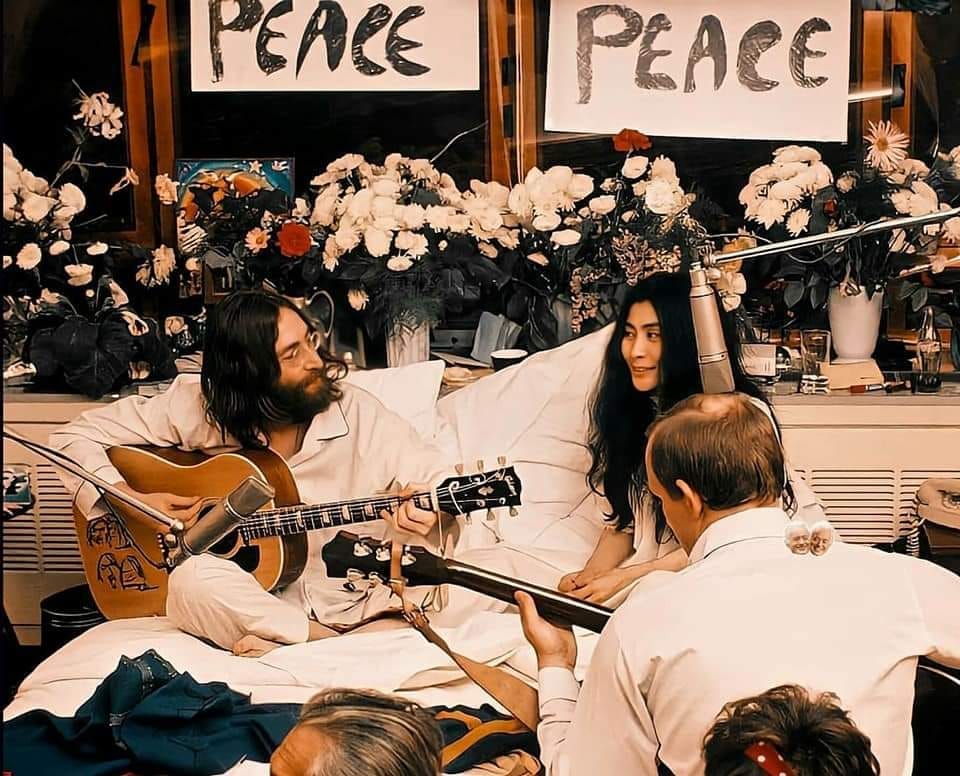
June 1, 1969: John Lennon, Yoko Ono and friends record John's composition "Give Peace a Chance" in Room 1742 at the Queen Elizabeth Hotel in Montreal.

John met Yoko on November 7, 1966, at the Indica Gallery in London, where she was preparing a "conceptual art" exhibit. Having just come off a very hard tour with The Beatles, and feeling cynical about everything, he considered it positive and uplifting. They started corresponding, and in May 1968, they began an affair.

John and his 1st wife, Cynthia Twist, divorced in late 1968. On November 11, he and Yoko released an album they'd recorded together: Unfinished Music No. 1: Two Virgins. The idea behind the title being that this man and this woman, each already with a divorce and a child, had only "lost their virginity" with each other, because only by having sex with each other could they feel as though it was truly "making love." (It doesn't work that way.)

The album wasn't very good. Yoko, infamously, was not a good singer. And John's work was well below what people were used to getting from him. Oh, yes: They were naked on the covers, from the front on the front, and from behind on the back. New outrage. Most record stores only sold it in brown paper wrappers.

John and Yoko married on March 20, 1969, at the registry office in the British colony of Gibraltar. This followed the marriage, 8 days earlier, of Paul McCartney and Linda Eastman. For over a decade, John and Paul needed each other. Now, each had found a new partner that they needed more.

At first, Paul and the other Beatles didn't get it: John insisted on bringing Yoko to the recording sessions for the albums The Beatles (a.k.a. "The White Album") and Let It Be. The acrimony between the four of them during the latter's recording was not caused by Yoko's presence, but it didn't help. The idea that Yoko "broke up The Beatles" was always ridiculous, especially since Paul was getting closer to Linda at exactly the same time; and Paul would go on to publicly refute the suggestion.

Yoko encouraged John in his avant-garde recording, and in his public quest to bring peace to the world, addressing conflicts like the Vietnam War and the civil war in Nigeria, then as now a member of Britain's "Commonwealth of Nations." Honeymooning at the Hilton Hotel in Amsterdam, the Netherlands, they staged not a "sit-in," but a "Bed-In for Peace."

On March 31, still in Amsterdam, they introduced "Bagism," conducting a press conference in a pair of sacks big enough to hold each of them. The idea was that, if you could hear someone without seeing them, you wouldn't judge them by their physical appearance, or their race. This from a professional vocalist with a Liverpudlian accent, and a woman with a Japanese accent.

The media mocked them, and stirred up Beatle fans' feelings of betrayal: John had gone too far, he had lost his mind, she had led him astray. The media didn't get it. He did, saying, "It's part of our policy not to be taken seriously. Our opposition, whoever they may be, in all manifest forms, don't know how to handle humor. And we are humorous."

On April 14, at EMI Records' Abbey Road Studios in Northwest London, where most of The Beatles' recordings had been made, John recorded "The Ballad of John and Yoko." John gave Paul a half-credit for writing it, even though he had nothing to do with it. Paul has always been grateful for this.

They were the only 2 musicians on it: John on lead electric guitar and acoustic guitar; and Paul on bass guitar, drums, piano and maracas, singing backup. George Harrison and Ringo Starr were not there, although they posted for a cover photo with John, Yoko and Paul. At one point in recording, John said, "Play faster, Ringo!" Paul said, "Okay, George."

With his remark 3 years earlier that The Beatles were "more popular than Jesus now" still fresh in people's memories, John caught flak for the song's chorus:

Christ, you know it ain't easy.
You know how hard it can be.
The way things are going
they're gonna crucify me.

On May 26, 1969, the Lennons checked into the Queen Elizabeth Hotel in Montreal, settling in Room 1742, and staged another bed-in. On June 1, they gathered some friends and recorded a new song John had written: "Give Peace a Chance."

Among the friends were Beatles assistant Derek Taylor, singer Petula Clark (who later said she didn't know it was being recorded), comedian Tommy Smothers (that's him in the photo above, with his back to the camera, also playing acoustic guitar, not having brought his brother Dick), comedian Dick Gregory, poet Allen Ginsberg, New York disc jockey Murray "the K" Kaufman, London disc jockey Roger Scott, psychologist and "LSD Guru" Dr. Timothy Leary, his wife Rosemary Woodruff Leary (a model), and Montreal-based Rabbi and peace activist Abraham Feinberg.

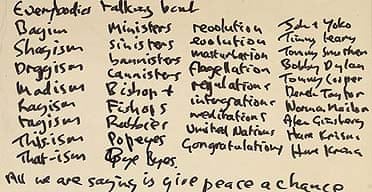
The lyrics mentioned Bagism, used the word "revolution" (possibly a reference to the Beatles song of the same title that he'd written), mentioned the United Nations, included the word "masturbation" (almost certainly the first widely-released single to do so); and name-checked himself, Yoko, Leary, Smothers, Taylor, Ginsberg, "Bobby" Dylan, British comedian Tommy Cooper, author Norman Mailer, and the Hare Krishna movement.
John's handwritten lyrics

It was the 1st recording to be released under the name "Plastic Ono Band," a name Yoko thought up. On the British singles chart, it reached Number 2. On Billboard magazine's Hot 100, the defining American singles chart, it only got to Number 14.

It was recorded exactly 2 years after John, Paul, George Harrison and Ringo Starr had released the album Sgt. Pepper's Lonely Hearts Club Band. The world had already changed a great deal -- and some of the changes were for the worse.

Along with "Imagine," released 2 years later, "Give Peace a Chance" has become better remembered than any song John sang, let alone wrote, with The Beatles.

*

June 1, 1969 was a Sunday. These games were played in Major League Baseball:

* The New York Yankees beat the Kansas City Royals, 8-5 at Kansas City Municipal Stadium. Al Downing relieved Bill Burbach in the 3rd inning, and ended up as the winning pitcher. Joe Pepitone hit a home run. For some reason, Yankee manager Ralph Houk batted the non-slugging Roy White 4th, but it worked: He went 2-for-5 with an RBI. Every Yankee hitter had at least 1 hit, and most had 2.

The left fielder for the expansion Royals went 1-for-3 with a walk and 2 RBIs. He would be named the American League Rookie of the Year. The Yankees would later trade for him. His name was Lou Piniella.

* The New York Mets beat the San Francisco Giants, 5-4 at Shea Stadium. Joe Gibbon walked Ron Swoboda with the bases loaded in the bottom of the 9th, costing the Giants the game. Willie Mays went 1-for-4 with a walk, and Willie McCovey went 3-for-3 with a solo home run and 2 walks.

At the time, the Mets were 22-23, and 9 games behind the Chicago Cubs in the newly-created National League Eastern Division. By their standards, this was a huge improvement. But nobody had any idea of what was to come.

* The San Diego Padres beat the Montreal Expos, 5-2 at Jarry Park in Montreal. These were the NL's 2 new expansion teams, and both ended up even worse than expansion teams usually do: 52-110.\

* The Boston Red Sox beat the Minnesota Twins, 5-2 at Fenway Park in Boston. It was a better game for Italians than for Poles: Carl Yastrzemski went 0-for-4, but the comeback kid Tony Conigliaro and Rico Petrocelli each hit home runs. Harmon Killebrew went 1-for-3 with a walk, and Rod Carew went 0-for-4.

* The Los Angeles Dodgers beat the Philadelphia Phillies, 12-4 at Connie Mack Stadium in Philadelphia. Don Sutton went 7 innings and got the win, while Rick Wise didn't get out of the 2nd inning.

Richie Allen went 2-for-3 with a home run, 2 walks and 2 RBIs. Beloved in Philadelphia not that long ago, his relationships with the city's fans and media, and the team's management, was disintegrating. He hated being called "Richie," thinking it sounded like a 10-year-old boy's name, and that he preferred "Dick," which is what his friends had always called him. He would be traded after the season, but it would be 1972 before he became widely known as "Dick Allen."

* The Washington Senators beat the Chicago White Sox, 9-2 at Robert F. Kennedy Stadium in Washington. The former "District of Columbia Stadium" had been renamed on January 18, but the official dedication ceremony as such didn't happen until June 7.

* The Pittsburgh Pirates beat the Houston Astros, 14-7 at Forbes Field in Pittsburgh. Steve Blass went the distance despite allowing 7 runs on 11 hits and 5 walks, while Don Wilson didn't get out of the 2nd inning. Roberto Clemente went 1-for-4 with a walk and 2 RBIs. Al Oliver went 3-for-5 with 3 RBIs. Richie Hebner went 2-for-4 with 2 walks and 3 RBIs. Matty Alou went 2-for-5. Willie Stargell did not play. For the Astros, Jimmy Wynn and Doug Rader each had 3 hits and 2 RBIs, with Wynn homering.

* The Chicago Cubs beat the Atlanta Braves, 13-4 at Wrigley Field in Chicago. Ernie Banks went 2-for-4 with 2 RBIs. Ron Santo went 4-for-5 with 3 RBIs. Billy Williams, Randy Hundley and Jim Hickman hit home runs. The Cubs already led the Division by 7 1/2 games.

* The St. Louis Cardinals beat the Cincinnati Reds, 11-3 at Busch Memorial Stadium in St. Louis. Lou Brock drew 4 walks, and stole a base. He only had 1 hit, but it was a home run. For the Reds, Johnny Bench and Lee May hit home runs, and Pete Rose went 2-for-4.

* The Baltimore Orioles beat the California Angels, 4-3 at Anaheim Stadium (now Edison International Field of Anaheim). Paul Blair, known for his defense and not his power, led off the top of the 11th inning with a home run. Dave McNally lasted only 2 innings, and Jim Palmer pitched 2 innings of relief for the win. Frank Robinson went 0-for-4 with a walk. Brooks Robinson went 0-for-3 with 2 walks.

* The Oakland Athletics beat the Cleveland Indians, 11-1 at the Oakland Coliseum. Reggie Jackson went 2-for-4 with a home run and 4 RBIs.

* The Seattle Pilots, an expansion team, beat the defending World Champions, the Detroit Tigers, 8-7 at Sick's Stadium in Seattle. Al Kaline, the Tigers' biggest star, did not play. The Pilots got home runs from Don Mincher, Tommy Harper, Steve Whitaker and Wayne Comer. Harper singled Dick Simpson home in the bottom of the 8th inning to win it.

The Pilots used 5 pitchers. Gene Brabender started, but only lasted 2 1/3rd innings. Fred Talbot lasted 3 1/3rd. Jim Bouton pitched to 1 batter, and got the last out in the 6th inning. Diego Seguí pitched the 7th and 8th, and ended up as the winning pitcher. And John O'Donoghue pitched the 9th, and got the save. Earl Wilson started for the Tigers, and Pat Dobson became the losing pitcher.

At the time, the Pilots were 21-24, not bad at all for a 1st-year expansion team -- and only 1 game worse off than the Mets. They were only 4 games behind the Minnesota Twins in the newly-created American League Western Division. But they ended up just 64-98, and were completely incompetent in management, to the point where they went bankrupt, and were moved to become the Milwaukee Brewers before the next season.

Bouton kept a diary of the season, published the next year as Ball Four. For this day, he wrote of manager Joe Schultz's postgame praise: "Attaway to stomp 'em. Stomp the piss out of 'em. Stomp 'em when they're down. Kick 'em and stomp 'em. Attaway to go boys. Pound that ol' Budweiser into you and go get them tomorrow." (Apparently, Schultz, who had been the St. Louis Cardinals' 3rd base coach from 1963 to 1968, forgot he was no longer working for the Cards' owner, beer baron Gussie Busch.)

For this day, Bouton also wrote about a conversation with umpire Jerry Neudecker:

JN: "Why is it that they boo me when I call a foul ball correctly and they applaud the starting pitcher when he gets taken out of the ballgame?"

JB: "Because, Jerry, the fans recognize the pitcher as being a basically good person." (He laughed.)

He also wrote that day of how players take pride in their crudity, including repeating a story that teammate Jim Gosger told -- one that the pre-Yoko John Lennon might have enjoyed, although I'm not sure that John-with-Yoko would have. Gosger watched from a hotel room closet while his road-roommate (the book doesn't give his name) had sex with a woman identified only as "some local talent." She says, "Oh darling, I've never done it that way before." Gosger, not buying it, stuck his head out of the closet, and said, "Yeah, surrre." (Bouton wrote it with 3 R's.) Since Gosger told the story, Bouton said, the expression became a watchword around the club, for when a claim couldn't be taken seriously:

"I only had three beers last night."
"Yeah, surrre."

I could tell you that the man that John Lennon became in 1969 was always in there, and he just needed Yoko Ono to bring it out of him. But if I told you that, you might say, "Yeah, surrre."

Friday, January 14, 2022

January 14, 1967: The Human Be-In

January 14, 1967: An event called "The Human Be-In" is held in Golden Gate Park in San Francisco. It is considered the beginning of the Hippie movement, and makes the adjacent Haight-Ashbury neighborhood the epicenter of what became known as "The Summer of Love."

Of course, this was in the Winter. But as with a lot of other things about the city, the weather in San Francisco is weird. How weird is it? It's the only city I know of that has baseball weather during football season, and football weather during baseball season. And this was football season: The next day, in Los Angeles, what would later be retroactively named Super Bowl I would be played. The Green Bay Packers beat the Kansas City Chiefs, 35-10.

But on January 14, at Golden Gate Park, nobody was thinking about football.

The title was a play on the words "human being," and took its name from the "sit-ins" at racially segregated facilities in the South, and from the subsequent "teach-ins" about racism and the Vietnam War on college campuses.

The event took place 3 months after the State of California banned the psychedelic drug LSD (lysergic acid diethylamide, or "acid"), because of its dangerous effects on the human brain. The speakers included Dr. Timothy Leary, the psychologist who had been the nation's leading advocate for the drug, and popularized the slogan, "Turn on, tune in, drop out." (Popularized, but not originated: He said he got it from media analyst Marshall McLuhan.)

Leary did not illegally provide LSD. Owsley Stanley, known as an "underground chemist," did. Since San Francisco always, not just today, had a serious homelessness problem, food was provided by a group called the Diggers, including future actor Peter Coyote.

Allen Ginsberg, Gary Snyder and Michael McClure read their poetry. In 1955, also in San Francisco, those 3, along with Philip Lamantia and Philip Whalen had read poems at the Six Gallery, with Jack Kerouac and Neal Cassady in the audience but not reading, an event that is said to have founded the Beat Generation of writing. Now, they were effectively passing the torch from the Fifties Beats to the Sixties Hippies.

Dick Gregory, the black comedian, also spoke. And music was provided by bands whose names would soon become household words, if your household had a teenager in it: The Jefferson Airplane, Big Brother and the Holding Company (with Janis Joplin singing lead), the Quicksilver Messenger Service, and The Grateful Dead -- the latter two frequently playing the same shows, to the point where they were nicknamed "The Quick and the Dead."

Over 20,000 people showed up, about as many as had appeared for any rally against the war at that point. And it wasn't all like-minded people, either: Some of them were radicals, wanting an increase in the militancy in the protests of the war; but most of the Hippies were decidedly apolitical, with an attitude of, "Man, just leave us alone, let us take our drugs, listen to our music, dress the way we want, grow our hair the way we want, and make love to each other in peace."

The Hippies were considered "leftist" by mainstream America, but there was something libertarian about it, too. But both groups were united in their hatred of war and bigotry.

With the media making a big deal about this event, San Francisco became a magnet for everybody who wanted to leave their possibly dull, possibly regimented, lives behind, and embrace a culture that was willing to embrace anybody. John Phillips of the vocal group The Mamas & the Papas wrote a song titled "San Francisco," recorded and turned into a big hit by his friend Scott McKenzie:

If you come to San Francisco
be sure to wear some flowers in your hair.
If you're going to San Francisco
you're going to meet some gentle people there.

But it's a small city. I don't mean, "It doesn't have that many people." (It had about 725,000 people then, compared to about 875,000 now.) I mean, "For a city with that many people, it doesn't have nearly enough space." And parks like Golden Gate took up even more space.

San Francisco got overwhelmed with all the new people coming in. Some of them fell victim to con artists, and lost everything. Some of them fell victim to the drugs, LSD and harder drugs like heroin, and lost everything to that. Even by the Summer of 1969, it was not just all over, but dangerously so.

As David Crosby of The Byrds (a Los Angeles-based band) said of the Hippies, "We were right about a lot of things. We were right that peace is better than war. We were right that love is better than hate. We were not right, as it turned out, about drugs."

To this day, San Francisco has the leftist/Hippie image, ignoring the fact that it's a tough, working-class, labor-union, seaport city, with an innate Catholicism (it was founded by Spanish missionaries, after all) that gives its conservatives as strong a voice as its liberals. The city still makes money off tourists coming to enjoy the old image. But the image never quite lived up to the reality. Many tried to make it so. But the world was too big for San Francisco.

The Human Be-In was a success. But the movement it inspired was a beautiful failure.

*

January 14, 1967 was a Saturday. British actress Emily Watson was born that day.

As I said, the football season ended the next day, with Super Bowl I. Baseball was in the middle of the off-season. There were 4 games played in the NBA that day. None were played in San Francisco, although the city's team did play on the road:

* The Boston Celtics beat the Baltimore Bullets, 115-106 at the Baltimore Civic Center (now the CFG Bank Arena).

* The Cincinnati Royals beat the St. Louis Hawks, 116-105 at the Cincinnati Gardens.

* The Chicago Bulls beat the Los Angeles Lakers, 122-121 at the International Amphitheatre in Chicago. Guy Rodgers scored 39 points for the Bulls, in their 1st season of play. For their 2nd season, they moved into Chicago Stadium.

* The San Francisco Warriors beat the Detroit Pistons, 136-121 at Cobo Hall in Detroit (now named Huntington Place). The Warriors' Rick Barry led all scorers on the day with 50 points. The next day, in St. Louis, the Warriors lost to the Hawks, but Barry again led all NBA scorers with 48.

The Warriors moved across San Francisco Bay to Oakland in 1971, and became the Golden State Warriors. Despite moving back to San Francisco in 2019, they have kept the Golden State name.

And, in the last season of "Original Six" play, the entire NHL was in action:

* The New York Rangers lost to the Chicago Blackhawks, 5-3 at the Chicago Stadium.

* The Boston Bruins beat the Montreal Canadiens, 5-4 at the Montreal Forum.

* And the Toronto Maple Leafs beat the Detroit Red Wings, 5-2 at Maple Leaf Gardens in Toronto.

Also, Arsenal beat Manchester City, 1-0 at Highbury in North London. 

December 31, 1999 & January 1, 2000: The Millennium

December 31, 1999:  The Millennium arrives. The people of planet Earth survived. At a terrible cost. But we hadn't destroyed ourselves. ...