Showing posts with label yoko ono. Show all posts

Tuesday, October 11, 2022

October 11, 1971: John Lennon Releases "Imagine"

October 11, 1971: John Lennon releases his song "Imagine." It becomes one of the most beloved songs in the world, and remains the most popular song written by any of the men who were in The Beatles.

It was the title track to an album he released on September 9. The album also included songs he wrote to his wife, Yoko Ono, such as "Jealous Guy" and "Oh Yoko!" It also included a swipe at the previous most important person in his life, former Beatle Paul McCartney, attacking him for what John would later call "silly love songs," and for the business disputes between them: "How Do You Sleep?" And it includes "Gimme Some Truth," which is self-explanatory.

The following year, John released a promotional film based on the album -- they weren't called "music videos" yet -- including a performance of "Imagine," filmed at his home at Tittenhurst Park, near Ascot, Berkshire, England, a town known for its horse-racing track. The film shows Yoko slowly opening the windows of the room as John plays, and letting more light in. John had originally recorded the song there on May 27, 1971. He co-produced the song with Phil Spector, who added an orchestra.

(This was before a Los Angeles recording session at which Spector pulled a gun on Lennon, and Lennon actually dared him to pull the trigger. Not used to people standing up to him, Spector put the gun down.)

People who claim to be Christians have hated John for this song ever since. They haven't listened to the lyrics. He didn't say there is no Heaven, no Hell, no religion; he asked the listener to imagine that there wasn't. It's actually an implication that those things do exist.

Of course, asking people to imagine there's no countries might feel like an attack on people's patriotism. And asking people to imagine there's no possessions seems like an attack on capitalism. And they take those things personally.

In contrast, in 1970, for his solo album John Lennon/Plastic Ono Band, John recorded a song titled "God," in which he rattled off things and people he said he didn't believe in: Magic, the I-Ching, the Bible, tarot cards, Adolf Hitler, Jesus, John F. Kennedy, Buddha, mantras, Gita, yoga, kings, Elvis, Zimmerman (meaning Bob Dylan), and, finally, The Beatles. He said, "I just believe in me. Yoko and me. And that's reality."

Talk about a concurrence of events: The day after Imagine was released, October 12, 1971, the musical Jesus Christ Superstar opened on Broadway.

A few weeks later, on November 24, John and Yoko released "Happy Xmas (War Is Over)," with backing from the Plastic Ono Band and the Harlem Community Choir. They also rented Times Square billboards with the messages "Happy Xmas from John & Yoko" and "War is over (if you want it)."
Eight years later, on November 16, 1979, Paul released "Wonderful Christmastime." How is it that John, who dared to "Imagine there's no heaven... and no religion, too" wrote such a fantastic Christmas song? While his former musical partner, Paul, one of the world's greatest songwriters and one of its greatest sentimentalists, facing that most sentimental of holidays, wrote such a weak one?

*

October 11, 1971 was a Monday. In America, it was Columbus Day.

Game 2 of the World Series, delayed a day by rain, was played at Memorial Stadium in Baltimore. The Baltimore Orioles beat the Pittsburgh Pirates, 11-3. The Pirates would win the Series in 7 games.

The NHL season was underway, but no games were scheduled. The NBA season began the following night. The American Basketball Association's season began the night after that.

On ABC Monday Night Football, The Dallas Cowboys beat the New York Giants, 20-13. It was the last game the Cowboys played at their original home field, the Cotton Bowl. After losing away to the New Orleans Saints the next week, the week after that, they opened their new Texas Stadium in suburban Irving, with a win over the New England Patriots.

Tuesday, September 13, 2022

September 13, 1969: The Toronto Rock 'n' Roll Revival Concert

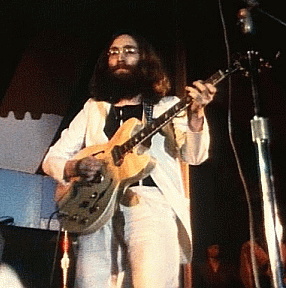
September 13, 1969: The Toronto Rock 'n' Roll Revival Concert is held, at Varsity Stadium on the campus of the University of Toronto. It was one of the earliest examples of a rejection of the awful world of the present, and an embrace of the previous, seemingly simpler and more peaceful era.

The organizers managed to sign several of the founding fathers of rock and roll: Chuck Berry, Little Richard, Fats Domino, Bo Diddley, Jerry Lee Lewis and Gene Vincent. They also signed The Doors, and a young, as-yet-unknown, Alice Cooper.

But they weren't selling tickets. They needed a bigger name. One thing led to another, and John Lennon said yes. With him came his wife, Yoko Ono, and "The Plastic Ono Band": Guitarist Eric Clapton, bass guitarist Klaus Voorman (who had designed the cover of The Beatles' album Revolver), and drummer Alan White.

The concert was an overwhelming success, although, in his 1st concert without any of the other Beatles in 12 years, Lennon was far from at his best. But he found it liberating. Seven months later, Paul McCartney announced that The Beatles had broken up.

Actually, the best-remembered moment from the concert was when someone threw a live chicken onstage at Cooper, and Cooper threw it back, thinking it could fly. It couldn't, it fell into the audience, and they tore it apart. Just as Ozzy Osbourne would later be remembered for biting the head off a bat onstage, Cooper got remembered for killing a chicken onstage -- which he didn't do. But it launched his career as a "shock rocker."

*

September 13, 1969 was a Saturday. Actor, director and playwright Tyler Perry was born. This was also the day of the Toronto Rock and Roll Revival concert. I have a separate entry for that event.

These Major League Baseball games were played that day:

* The New York Yankees lost to the Boston Red Sox, 5-2 at Yankee Stadium. Zoinks! Like, Gary Wagner outpitched Fritz Peterson. Rico Petrocelli hit a home run, Reggie Smith went 3-for-4 with an RBI, Tony Conigliaro went 1-for-3 with an RBI, and Carl Yastrzemski went 0-for-2, but did draw 2 walks. And they got away with it, too, because the Yankees didn't have enough meddling kids. Bobby Murcer went 1-for-3 with a walk and an RBI, but rookie Thurman Munson went 0-for-4.

* The New York Mets beat the Pittsburgh Pirates, 5-2 at Forbes Field in Pittsburgh. Tom Seaver went the distance for the win. Ron Swoboda hit a grand slam. Roberto Clemente went 1-for-4. Willie Stargell went 1-for-5 with an RBI.

* The Montreal Expos beat the Philadelphia Phillies, 7-5 at Connie Mack Stadium in Philadelphia.

* The Baltimore Orioles beat the Cleveland Indians, 10-5 at Memorial Stadium in Baltimore. Brooks Robinson went 1-for-1 with 2 walks and an RBI. Frank Robinson did not play.

* The Washington Senators beat the Detroit Tigers, 11-6 at Robert F. Kennedy Stadium in Washington. Al Kaline entered the game as a pinch-hitter, and went 0-for-2.

* The Atlanta Braves beat the Houston Astros, 3-2 at Atlanta Stadium (later Atlanta-Fulton County Stadium). Phil Niekro pitched 11 shutout innings for the Braves, allowing 6 hits. Larry Dierker pitched 12 shutout innings for the Astros, allowing 4 hits. Jimmy Wynn singled home 2 runs for the Astros in the top of the 13th.

But in the bottom of the 13th, Fred Gladding allowed single, double, walk, single. Jack Billingham got an out, but was immediately replaced by Wade Blasingame, who intentionally walked Hank Aaron, and then unintentionally walked Bob Aspromonte to give the Braves the win.

This game did not make a fellow proud to be an Astro. Maybe manager Harry Walker should have brought in Jim Bouton, whom the Astros had acquired from the Seattle Pilots on August 24. He was in the process of writing his diary of the season, which became the book Ball Four.

* The Oakland Athletics beat the Chicago White Sox, 4-0 at Comiskey Park in Chicago. John "Blue Moon" Odom pitched 8 shutout innings for the A's, before being relieved by Fred Talbot, who had been liberated from the expansion Seattle Pilots 16 days earlier. Paul Edmondson pitched 9 innings of 3-hit shutout ball for the ChiSox, but Wilbur Wood gave up 4 runs in the top of the 10th, including a 3-run home run to Dave Duncan. Reggie Jackson did not enter the game for the A's.

* The Kansas City Royals beat the Minnesota Twins, 1-0 at Metropolitan Stadium in the Minneapolis suburb of Bloomington, Minnesota. Dean Chance went the distance, allowing 4 hits -- and lost for the Twins. The expansion Royals started Roger Nelson, but he only pitched 1 inning before leaving the game with an injury. He didn't pitch again that season, and pitched only 9 major league innings in 1970, and battled injury thereafter, missing all of 1975, and last pitched in 1976, age 32.

Mike Hedlund pitched 6 innings, allowing just 2 hits. Ed Kirkpatrick singled home the only run of the game in the top of the 9th, making a winning pitcher out of Moe Drabowsky, who completed the 2-hit shutout. Shortstop Leo Cárdenas got both Twin hits. Harmon Killebrew went 0-for-3 with a walk, and Rod Carew went 0-for-2 with 2 walks.

* The St. Louis Cardinals beat their arch-rivals, the Chicago Cubs, 7-4 at Busch Memorial Stadium in St. Louis. The Cubs led 4-3 going into the bottom of the 8th, but the Cards scored 4 runs off Fergie Jenkins, Ken Johnson and Phil Regan. Lou Brock went 2-for-4 with a walk. Joe Torre went 3-for-4 with 2 RBIs.

In this 1st season of Divisional play, the Cubs led the National League Eastern Division by as much as 9 games on August 16, but went 17-26 the rest of the way, falling behind the Mets on September 10, a collapse known as the September Swoon.

* The Los Angeles Dodgers beat the San Diego Padres, 7-2 at Dodger Stadium in Los Angeles.

* The Cincinnati Reds beat the San Francisco Giants, 6-4 at Candlestick Park in San Francisco. Pete Rose went 1-for-5. Johnny Bench went 2-for-3 with a walk and an RBI. Willie Mays entered the game as a pinch-hitter, and went 0-for-2.

* And a doubleheader was split at Sick's Stadium in Seattle. The Seattle Pilots won the opener, 6-4. Steve Hovley, Danny Walton and Don Mincher each got 2 hits, to make a winning pitcher of Diego Seguí, in relief of Marty Pattin. The California Angels won the nightcap, 4-2. Eddie Fisher (not the singer) outpitched Miguel Fuentes, the Dooley Womack and John Gelnar.

This was also the opening weekend of the college football season. But only 1 team ranked in the Top 20 played that day: Number 17 UCLA beat Oregon State, 37-0 at the Los Angeles Memorial Coliseum.

And in English soccer, North London team Arsenal traveled to Lancashire, and beat Burnley, 1-0 at Turf Moor. George Graham, later to manage them to success in the late 1980s and early 1990s, scored the game's only goal. 

Wednesday, June 1, 2022

June 1, 1969: John Lennon Records “Give Peace a Chance”

June 1, 1969: John Lennon, Yoko Ono and friends record John's composition "Give Peace a Chance" in Room 1742 at the Queen Elizabeth Hotel in Montreal.

John met Yoko on November 7, 1966, at the Indica Gallery in London, where she was preparing a "conceptual art" exhibit. Having just come off a very hard tour with The Beatles, and feeling cynical about everything, he considered it positive and uplifting. They started corresponding, and in May 1968, they began an affair.

John and his 1st wife, Cynthia Twist, divorced in late 1968. On November 11, he and Yoko released an album they'd recorded together: Unfinished Music No. 1: Two Virgins. The idea behind the title being that this man and this woman, each already with a divorce and a child, had only "lost their virginity" with each other, because only by having sex with each other could they feel as though it was truly "making love." (It doesn't work that way.)

The album wasn't very good. Yoko, infamously, was not a good singer. And John's work was well below what people were used to getting from him. Oh, yes: They were naked on the covers, from the front on the front, and from behind on the back. New outrage. Most record stores only sold it in brown paper wrappers.

John and Yoko married on March 20, 1969, at the registry office in the British colony of Gibraltar. This followed the marriage, 8 days earlier, of Paul McCartney and Linda Eastman. For over a decade, John and Paul needed each other. Now, each had found a new partner that they needed more.

At first, Paul and the other Beatles didn't get it: John insisted on bringing Yoko to the recording sessions for the albums The Beatles (a.k.a. "The White Album") and Let It Be. The acrimony between the four of them during the latter's recording was not caused by Yoko's presence, but it didn't help. The idea that Yoko "broke up The Beatles" was always ridiculous, especially since Paul was getting closer to Linda at exactly the same time; and Paul would go on to publicly refute the suggestion.

Yoko encouraged John in his avant-garde recording, and in his public quest to bring peace to the world, addressing conflicts like the Vietnam War and the civil war in Nigeria, then as now a member of Britain's "Commonwealth of Nations." Honeymooning at the Hilton Hotel in Amsterdam, the Netherlands, they staged not a "sit-in," but a "Bed-In for Peace."

On March 31, still in Amsterdam, they introduced "Bagism," conducting a press conference in a pair of sacks big enough to hold each of them. The idea was that, if you could hear someone without seeing them, you wouldn't judge them by their physical appearance, or their race. This from a professional vocalist with a Liverpudlian accent, and a woman with a Japanese accent.

The media mocked them, and stirred up Beatle fans' feelings of betrayal: John had gone too far, he had lost his mind, she had led him astray. The media didn't get it. He did, saying, "It's part of our policy not to be taken seriously. Our opposition, whoever they may be, in all manifest forms, don't know how to handle humor. And we are humorous."

On April 14, at EMI Records' Abbey Road Studios in Northwest London, where most of The Beatles' recordings had been made, John recorded "The Ballad of John and Yoko." John gave Paul a half-credit for writing it, even though he had nothing to do with it. Paul has always been grateful for this.

They were the only 2 musicians on it: John on lead electric guitar and acoustic guitar; and Paul on bass guitar, drums, piano and maracas, singing backup. George Harrison and Ringo Starr were not there, although they posted for a cover photo with John, Yoko and Paul. At one point in recording, John said, "Play faster, Ringo!" Paul said, "Okay, George."

With his remark 3 years earlier that The Beatles were "more popular than Jesus now" still fresh in people's memories, John caught flak for the song's chorus:

Christ, you know it ain't easy.
You know how hard it can be.
The way things are going
they're gonna crucify me.

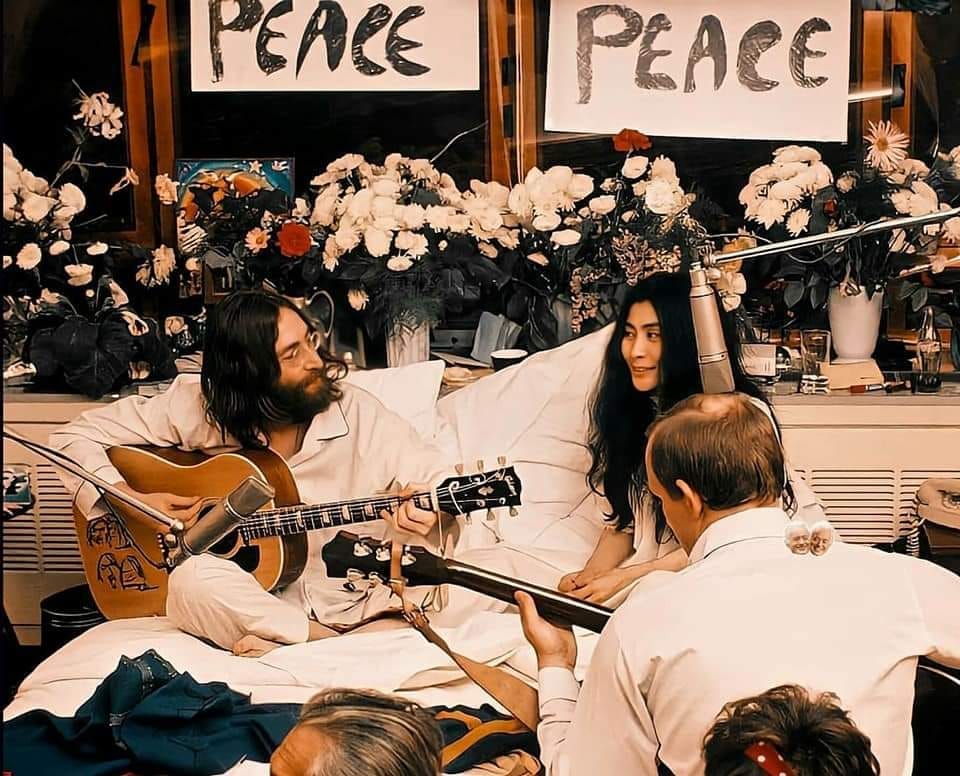
On May 26, 1969, the Lennons checked into the Queen Elizabeth Hotel in Montreal, settling in Room 1742, and staged another bed-in. On June 1, they gathered some friends and recorded a new song John had written: "Give Peace a Chance."

Among the friends were Beatles assistant Derek Taylor, singer Petula Clark (who later said she didn't know it was being recorded), comedian Tommy Smothers (that's him in the photo above, with his back to the camera, also playing acoustic guitar, not having brought his brother Dick), comedian Dick Gregory, poet Allen Ginsberg, New York disc jockey Murray "the K" Kaufman, London disc jockey Roger Scott, psychologist and "LSD Guru" Dr. Timothy Leary, his wife Rosemary Woodruff Leary (a model), and Montreal-based Rabbi and peace activist Abraham Feinberg.

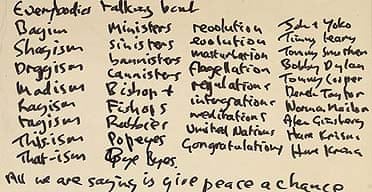
The lyrics mentioned Bagism, used the word "revolution" (possibly a reference to the Beatles song of the same title that he'd written), mentioned the United Nations, included the word "masturbation" (almost certainly the first widely-released single to do so); and name-checked himself, Yoko, Leary, Smothers, Taylor, Ginsberg, "Bobby" Dylan, British comedian Tommy Cooper, author Norman Mailer, and the Hare Krishna movement.
John's handwritten lyrics

It was the 1st recording to be released under the name "Plastic Ono Band," a name Yoko thought up. On the British singles chart, it reached Number 2. On Billboard magazine's Hot 100, the defining American singles chart, it only got to Number 14.

It was recorded exactly 2 years after John, Paul, George Harrison and Ringo Starr had released the album Sgt. Pepper's Lonely Hearts Club Band. The world had already changed a great deal -- and some of the changes were for the worse.

Along with "Imagine," released 2 years later, "Give Peace a Chance" has become better remembered than any song John sang, let alone wrote, with The Beatles.

*

June 1, 1969 was a Sunday. These games were played in Major League Baseball:

* The New York Yankees beat the Kansas City Royals, 8-5 at Kansas City Municipal Stadium. Al Downing relieved Bill Burbach in the 3rd inning, and ended up as the winning pitcher. Joe Pepitone hit a home run. For some reason, Yankee manager Ralph Houk batted the non-slugging Roy White 4th, but it worked: He went 2-for-5 with an RBI. Every Yankee hitter had at least 1 hit, and most had 2.

The left fielder for the expansion Royals went 1-for-3 with a walk and 2 RBIs. He would be named the American League Rookie of the Year. The Yankees would later trade for him. His name was Lou Piniella.

* The New York Mets beat the San Francisco Giants, 5-4 at Shea Stadium. Joe Gibbon walked Ron Swoboda with the bases loaded in the bottom of the 9th, costing the Giants the game. Willie Mays went 1-for-4 with a walk, and Willie McCovey went 3-for-3 with a solo home run and 2 walks.

At the time, the Mets were 22-23, and 9 games behind the Chicago Cubs in the newly-created National League Eastern Division. By their standards, this was a huge improvement. But nobody had any idea of what was to come.

* The San Diego Padres beat the Montreal Expos, 5-2 at Jarry Park in Montreal. These were the NL's 2 new expansion teams, and both ended up even worse than expansion teams usually do: 52-110.\

* The Boston Red Sox beat the Minnesota Twins, 5-2 at Fenway Park in Boston. It was a better game for Italians than for Poles: Carl Yastrzemski went 0-for-4, but the comeback kid Tony Conigliaro and Rico Petrocelli each hit home runs. Harmon Killebrew went 1-for-3 with a walk, and Rod Carew went 0-for-4.

* The Los Angeles Dodgers beat the Philadelphia Phillies, 12-4 at Connie Mack Stadium in Philadelphia. Don Sutton went 7 innings and got the win, while Rick Wise didn't get out of the 2nd inning.

Richie Allen went 2-for-3 with a home run, 2 walks and 2 RBIs. Beloved in Philadelphia not that long ago, his relationships with the city's fans and media, and the team's management, was disintegrating. He hated being called "Richie," thinking it sounded like a 10-year-old boy's name, and that he preferred "Dick," which is what his friends had always called him. He would be traded after the season, but it would be 1972 before he became widely known as "Dick Allen."

* The Washington Senators beat the Chicago White Sox, 9-2 at Robert F. Kennedy Stadium in Washington. The former "District of Columbia Stadium" had been renamed on January 18, but the official dedication ceremony as such didn't happen until June 7.

* The Pittsburgh Pirates beat the Houston Astros, 14-7 at Forbes Field in Pittsburgh. Steve Blass went the distance despite allowing 7 runs on 11 hits and 5 walks, while Don Wilson didn't get out of the 2nd inning. Roberto Clemente went 1-for-4 with a walk and 2 RBIs. Al Oliver went 3-for-5 with 3 RBIs. Richie Hebner went 2-for-4 with 2 walks and 3 RBIs. Matty Alou went 2-for-5. Willie Stargell did not play. For the Astros, Jimmy Wynn and Doug Rader each had 3 hits and 2 RBIs, with Wynn homering.

* The Chicago Cubs beat the Atlanta Braves, 13-4 at Wrigley Field in Chicago. Ernie Banks went 2-for-4 with 2 RBIs. Ron Santo went 4-for-5 with 3 RBIs. Billy Williams, Randy Hundley and Jim Hickman hit home runs. The Cubs already led the Division by 7 1/2 games.

* The St. Louis Cardinals beat the Cincinnati Reds, 11-3 at Busch Memorial Stadium in St. Louis. Lou Brock drew 4 walks, and stole a base. He only had 1 hit, but it was a home run. For the Reds, Johnny Bench and Lee May hit home runs, and Pete Rose went 2-for-4.

* The Baltimore Orioles beat the California Angels, 4-3 at Anaheim Stadium (now Edison International Field of Anaheim). Paul Blair, known for his defense and not his power, led off the top of the 11th inning with a home run. Dave McNally lasted only 2 innings, and Jim Palmer pitched 2 innings of relief for the win. Frank Robinson went 0-for-4 with a walk. Brooks Robinson went 0-for-3 with 2 walks.

* The Oakland Athletics beat the Cleveland Indians, 11-1 at the Oakland Coliseum. Reggie Jackson went 2-for-4 with a home run and 4 RBIs.

* The Seattle Pilots, an expansion team, beat the defending World Champions, the Detroit Tigers, 8-7 at Sick's Stadium in Seattle. Al Kaline, the Tigers' biggest star, did not play. The Pilots got home runs from Don Mincher, Tommy Harper, Steve Whitaker and Wayne Comer. Harper singled Dick Simpson home in the bottom of the 8th inning to win it.

The Pilots used 5 pitchers. Gene Brabender started, but only lasted 2 1/3rd innings. Fred Talbot lasted 3 1/3rd. Jim Bouton pitched to 1 batter, and got the last out in the 6th inning. Diego Seguí pitched the 7th and 8th, and ended up as the winning pitcher. And John O'Donoghue pitched the 9th, and got the save. Earl Wilson started for the Tigers, and Pat Dobson became the losing pitcher.

At the time, the Pilots were 21-24, not bad at all for a 1st-year expansion team -- and only 1 game worse off than the Mets. They were only 4 games behind the Minnesota Twins in the newly-created American League Western Division. But they ended up just 64-98, and were completely incompetent in management, to the point where they went bankrupt, and were moved to become the Milwaukee Brewers before the next season.

Bouton kept a diary of the season, published the next year as Ball Four. For this day, he wrote of manager Joe Schultz's postgame praise: "Attaway to stomp 'em. Stomp the piss out of 'em. Stomp 'em when they're down. Kick 'em and stomp 'em. Attaway to go boys. Pound that ol' Budweiser into you and go get them tomorrow." (Apparently, Schultz, who had been the St. Louis Cardinals' 3rd base coach from 1963 to 1968, forgot he was no longer working for the Cards' owner, beer baron Gussie Busch.)

For this day, Bouton also wrote about a conversation with umpire Jerry Neudecker:

JN: "Why is it that they boo me when I call a foul ball correctly and they applaud the starting pitcher when he gets taken out of the ballgame?"

JB: "Because, Jerry, the fans recognize the pitcher as being a basically good person." (He laughed.)

He also wrote that day of how players take pride in their crudity, including repeating a story that teammate Jim Gosger told -- one that the pre-Yoko John Lennon might have enjoyed, although I'm not sure that John-with-Yoko would have. Gosger watched from a hotel room closet while his road-roommate (the book doesn't give his name) had sex with a woman identified only as "some local talent." She says, "Oh darling, I've never done it that way before." Gosger, not buying it, stuck his head out of the closet, and said, "Yeah, surrre." (Bouton wrote it with 3 R's.) Since Gosger told the story, Bouton said, the expression became a watchword around the club, for when a claim couldn't be taken seriously:

"I only had three beers last night."
"Yeah, surrre."

I could tell you that the man that John Lennon became in 1969 was always in there, and he just needed Yoko Ono to bring it out of him. But if I told you that, you might say, "Yeah, surrre."

December 31, 1999 & January 1, 2000: The Millennium

December 31, 1999:  The Millennium arrives. The people of planet Earth survived. At a terrible cost. But we hadn't destroyed ourselves. ...