Showing posts with label nuclear power. Show all posts

Friday, December 2, 2022

December 2, 1942: The 1st Controlled Nuclear Chain Reaction

December 2, 1942: The world's 1st controlled nuclear chain reaction takes place, at a laboratory at the University of Chicago, as part of the top-secret Manhattan Project.

"Chicago Pile-1" was built inside a squash court under the football stadium, Stagg Field. It was directed by Enrico Fermi, the Italian physicist, who becomes known as "The Architect of the Atomic Age."
Fermi described the reactor as "a crude pile of black bricks and wooden timbers. "Although the project's civilian and military leaders had misgivings about the possibility of a disastrous runaway reaction -- one that might, you know, lead to the destruction of the whole damn world -- they trusted Fermi's safety calculations and decided they could carry out the experiment in a densely populated area.

I have a theory as to why most of the adults in the film Ferris Bueller's Day Off, which takes place in and around Chicago in the Spring of 1985, seem so stupid: It might take place in an alternate reality, in which Fermi's chain reaction wasn't as controlled as everyone thought, and 99 percent of the people living and/or born in the "Chicagoland" area over the next quarter-century or so (leaving 1 percent to be smart, like Ferris and Sloane, Cam not so much), ended up stupid enough to fall for all of Ferris' schemes. Or, something similar happened to produce such widespread stupidity.

But it did work, proving it could be done. The Manhattan Project moved forward. The atomic bomb was built, and nuclear power became widespread by the time Fermi died in 1954, at the age of 53.

*

December 2, 1942 was a Wednesday. Baseball was out of season. Football was in midweek. The NBA hadn't been founded yet. And no games were scheduled for the NHL. So there were no scores on this historic day.


Sunday, November 13, 2022

November 13, 1974: The Death of Karen Silkwood

November 13, 1974: Karen Silkwood is killed in a car crash near Crescent, Oklahoma. She was 28 years old.

A native of Nederland, in southeast Texas, she worked making plutonium pellets at the Cimarron Fuel Fabrication Site, owned by the Kerr-McGee energy company, near Cimarron City, Oklahoma. She became the 1st woman on the negotiating team of the Oil, Chemical & Atomic Workers Union.

The Union said that "the Kerr-McGee plant had manufactured faulty fuel rods, falsified product inspection records, and risked employee safety." On November 5, 1974, after testifying to the Atomic Energy Commission about her concerns, Silkwood was found to have plutonium contamination on her body, about 400 times the legal limit. That contamination was also in her home, as she had unwittingly brought it there.

On November 13, she was driving her Honda Civic to meet with a New York Times reporter and an official of her union's national office. She was founded the next morning, with her car having run off the road and struck a culvert on the east side of State Route 74. The documents she said she was bringing to the meeting were not found in or around the car.

Her family sued Kerr-McGee for the plutonium contamination, and the company settled out of court for $1.38 million, while not admitting liability. No one was ever charged in connection with her crash.

Her story was chronicled in Mike Nichols' 1983 film Silkwood, in which she was played by Meryl Streep.

*

November 13, 1974 was a Wednesday. This was also the day of the "Amityville Horror" murders, and the day of Yassir Arafat's lie-filled speech before the United Nations. I have separate entries for those events.

Baseball was out of season. Football was in midweek. There were 4 games in the NBA:

* The Washington Bullets beat the Kansas City-Omaha Kings, 118-81 at the Capital Centre in the Washington suburb of Landover, Maryland.

* The Detroit Pistons beat the Milwaukee Bucks, 98-91 at Cobo Hall (now Huntington Place) in Detroit. Bob Lanier had 40 points and 24 rebounds.

* The Phoenix Suns beat the Philadelphia 76ers, 105-100 at the Arizona Veterans Memorial Coliseum in Phoenix. Charlie Scott scored 41 for the Suns.

* And the Seattle SuperSonics beat the Los Angeles Lakers, 108-103 at the Seattle Center Coliseum.

There were 4 games played in the American Basketball Association:

* The New York Nets lost to the Kentucky Colonels, 132-129 in double overtime at Freedom Hall in Louisville, Kentucky. Julius "Doctor J" Erving scored 44 points and grabbed 18 rebounds. But it wasn't enough, as Louie Dampier led the Colonels with 32.

* The Spirits of St. Louis beat the Memphis Sounds, 97-92 at the St. Louis Arena. Marvin "Bad News" Barnes scored 31.

* The Utah Stars beat the Indiana Pacers, 114-103 at the Salt Palace in Salt Lake City, Utah.

* And the Denver Nuggets beat the San Diego Conquistadors, 132-108. Travis Grant scored 35 in defeat.

There were 8 games in the NHL:

* The New York Rangers lost to the Philadelphia Flyers, 3-2 at Madison Square Garden.

* The New York Islanders lost to the Pittsburgh Penguins, 8-2 at the Civic Arena in Pittsburgh.

* The Buffalo Sabres beat the Montreal Canadiens, 8-6 at the Montreal Forum. René Robert scored 3 goals and an assist. Guy Lapointe had 3 goals and 2 assists for the Canadiens.

* The Atlanta Flames beat the Washington Capitals, 4-3 at The Omni in Atlanta.

* The Minnesota North Stars beat the Detroit Red Wings, 7-4 at the Metropolitan Sports Center in the Minneapolis suburb of Bloomington, Minnesota.

* The Kansas City Scouts beat the team that was meant to be their arch-rivals, the St. Louis Blues, 5-3 at the Kemper Arena (now the Hy-Vee Arena) in Kansas City. But the Scouts went just 2-8 against the Blues, failed after just 2 seasons, and the Blues' arch-rivals remained the Chicago Black Hawks. The Scouts became the Colorado Rockies in 1976, and the New Jersey Devils in 1982.

* The Los Angeles Kings beat the Toronto Maple Leafs, 4-0 at The Forum outside Los Angeles in Inglewood, California.

* The California Golden Seals beat the Chicago Black Hawks, 2-0 at the Oakland Coliseum Arena.

* And the Boston Bruins and the Vancouver Canucks were not scheduled.

And there were 4 games in the World Hockey Association:

* The Quebec Nordiques beat the Indianapolis Racers, 10-3 at the Colisée de Québec.

* The Houston Aeros beat the Minnesota Fighting Saints, 8-5 at the St. Paul Civic Center in St. Paul, Minnesota.

* The Edmonton Oilers beat the Winnipeg Jets, 5-3 at the Northlands Coliseum in Edmonton. This was only the 2nd game the Oilers played there, following their November 10 opener, a 4-1 win over the Cleveland Crusaders. They had played their 1st 2 seasons, and the start of this, their 3rd, at the Edmonton Gardens.

* And the Toronto Toros beat the Vancouver Blazers, 5-3 at the Pacific Coliseum in Vancouver.

Monday, November 7, 2022

November 7, 1983: Able Archer 83

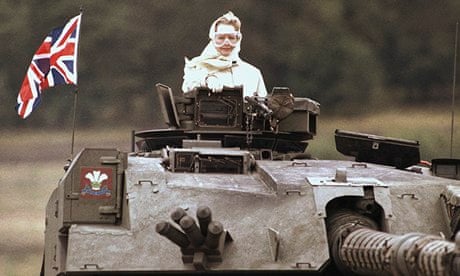
A Welsh tank unit (note the Union Jack and the daffodil logo)
taking part in Able Archer 83

November 7, 1983: Able Archer 83 begins. It is the codename for wargames by the North Atlantic Treaty Organization (NATO), which had been an annual event for a few years. The purpose was to simulate a period of conflict escalation between NATO and the Warsaw Pact, meaning the Soviet Union and their satellite nations in Eastern Europe. It was coordinated from NATO headquarters in Casteau, Belgium.

This came while President Ronald Reagan was placing Pershing II missiles in Western Europe; 8 months after he made a speech declaring the Soviet Union to be "an evil empire"; 67 days after the Soviets shot down Korean Air Lines Flight 007; 42 days after Soviet Lieutenant Colonel Stanislav Petrov figured out that the detection of 2 U.S. nuclear missiles heading for Russia were a false alarm, and refused to give the order to launch a retaliation, thus becoming known (years later, once the world found out) as "The Man Who Saved the World"; and would be followed, 13 days later, with ABC airing the TV-movie The Day After, which imagined a nuclear attack on the U.S.

Able Archer 83 included some steps forward that previous exercises had not. These, on top of everything else that had happened in 1983, led the Soviet government to consider that this was a setup for an actual war. So they placed their military units on the highest possible alert.

Able Archer 83 ended on November 11 -- appropriately enough, the anniversary of the Armistice that ended World War I -- and so the Warsaw Pact forces, seeing that nothing further had happened, were ordered to stand down. This may have been the closest the world came to nuclear war, except for the Cuban Missile Crisis of 1962 and Col. Petrov's moment.

The 1980s -- especially the Autumn of 1983 -- were not "a simpler time." Not even for those of us who were kids at the time.

*

November 7, 1983 was a Monday. Actor Adam DeVine, known for his roles in the Pitch Perfect films and his role as Andy Bailey on the TV show Modern Family, was born on this day. And this was also the day a bomb exploded in the U.S. Senate. Despite the lucky fact that there were no injuries, I have a separate entry for this event.

The baseball season was over. There were no NBA or NHL games scheduled. On ABC Monday Night Football, the Detroit Lions beat the New York Giants, 15-9 at the Silverdome in the Detroit suburb of Pontiac, Michigan.

Tuesday, November 1, 2022

November 1, 1952: The 1st Hydrogen Bomb

November 1, 1952: America successfully detonates the 1st hydrogen bomb, at Eniwetok Atoll in the Marshall Islands in the central Pacific Ocean.
thermonuclear weaponfusion weapon or hydrogen bomb -- H-bomb -- is a second-generation nuclear weapon design. Its greater sophistication affords it vastly greater destructive power than first-generation nuclear bombs (fission bombs), a more compact size, a lower mass, or a combination of these benefits.
Characteristics of nuclear fusion reactions make possible the use of non-fissile depleted uranium as the weapon's main fuel, thus allowing more efficient use of scarce fissile material such as uranium-235 or plutonium-239.

Edward Teller, a Hungarian-born Jewish physicist who won a power struggle with A-bomb pioneer J. Robert Oppenheimer within the American government, is considered "The Father of the Hydrogen Bomb." Late in life, he admitted in an interview, "I think the world has enough nuclear weapons."
He was more than right: The H-bomb was supposed to give the U.S. a leg up on the Soviet Union, but they detonated their 1st H-bomb on August 12, 1953, only 9 months later.

*

November 1, 1952 was a Saturday. Baseball season was over. These were among the college football games played:

* Number 1 Michigan State beat Number 8 Purdue, 14-7 at Ross-Ade Stadium in West Lafayette, Indiana. MSU finished 9-0, but, in this, their last season before joining the Big Ten (which was officially the Big Nine since 1940, when the University of Chicago dropped out), they were not invited to the Rose Bowl, or to any other bowl game. Nonetheless, after the season, they were voted the consensus National Champion.

* Number 2 Maryland beat Boston University, 34-7 at Fenway Park in Boston. Previously undefeated, Maryland lost its last 2 games, and didn't even get invited to a bowl game.

* Number 3 Oklahoma beat Iowa State, 41-0 at Clyde Williams Stadium in Ames, Iowa. Oklahoma won the Big Seven Conference title, but did not go to a bowl game.

* Number 4 Georgia Tech beat Number 5 Duke, 28-7 at Duke Stadium (later Wallace Wade Stadium) in Durham, North Carolina. Tech went on to win the Southeastern Conference title. However, they did not play the University of Mississippi during the regular season, and, despite 2 ties, and despite not even being ranked in the Top 20 until the week after this, "Ole Miss" were also undefeated. So the teams were paired up in the Sugar Bowl, and Tech won, earning National Championship honors from some minor polls.

Duke won the Southern Conference title, but were already on their way out of that league: The next season, they were charter members of the Atlantic Coast Conference (ACC).

* Number 6 USC, the University of Southern California, had the week off. Number 7 UCLA, the University of California at Los Angeles, beat Number 11 Cal, the main campus of the University of California, 28-7 at California Memorial Stadium in Berkeley. Three weeks later, USC beat UCLA for the Pacific Coast Conference title.

* Rivalry: Number 9 Kansas beat Kansas State, 26-6 at Memorial Stadium in Manhattan, Kansas. The Jayhawks lost 2 of their last 3 games, knocking themselves out of league title honors and bowl consideration. Most people there didn't care, as they were still basking in their National Championship in basketball, won in March.

* Number 12 Tennessee beat North Carolina, 41-14 at Shields-Watkins Field (later renamed Neyland Stadium) in Knoxville, Tennessee.

* Number 13 Notre Dame beat Navy, 17-6 at Cleveland Municipal Stadium. This was the end of an 0-2-1 stretch that saw Navy fall out of the Top 20. They were still invited to the Orange Bowl, but declined. Notre Dame declined all bowl invitations between the 1925 and 1969 seasons.

* Number 14 Texas beat Southern Methodist University (SMU), 31-14 at Memorial Stadium in Austin, Texas. Texas won the Southwest Conference title, then beat Tennessee in the Cotton Bowl.

* Number 15 Michigan were upset by Illinois, 22-13 at Michigan Stadium in Ann Arbor.

* Number 16 Virginia were upset by South Carolina, 21-14 at Scott Stadium in Charlottesville, Virginia.

* Number 17 University of Pennsylvania were upset by Pennsylvania State University, a.k.a. Penn State, 14-7 at Franklin Field in Philadelphia. The night before, another of Philadelphia's "Big 5" college basketball schools failed to win in football despite being nationally ranked: Number 10 Villanova were held to a tie by to the Parris Island Marines, 20-20 at Villanova Stadium in the Philadelphia suburb of Villanova, Pennsylvania. The Marines had their ranks swelled by volunteers to fight in the Korean War.

* Number 18 Wisconsin beat Rice University, 21-7 at Rice Stadium in Houston. It sounds like a bowl game, but it was in the regular season. Wisconsin did go on to win the Big Ten Conference title, but USC beat them in the Rose Bowl.

* Number 19 Alabama beat Georgia, 34-19 at Legion Field in Birmingham, Alabama. Losses to Tennessee and Georgia Tech cost 'Bama the SEC title, but they were still invited to the Orange Bowl, where they played Syracuse, who were idle on November 1. Alabama won, 61-6, and those 61 points stood as a record for the most points in a bowl game until 2008.

* Rivalry: Minnesota beat Iowa, 17-7 at Memorial Stadium in Minneapoli.s.

* Rivalry: Montana beat Montana State, 35-12 at Dornblaser Field in Missoula. (Montana State is in Bozeman.)

* Army beat Virginia Military Institute (VMI), 42-14 at Michie Stadium in West Point, New York.

* Among New York City teams, NYU beat Lafayette, 14-7 at Fisher Field in Easton, Pennsylvania. Fordham lost to the University of Detroit, 28-20 at Triborough Stadium (later Downing Stadium) on Randall's Island in the East River. And Columbia lost to Cornell, 21-14 at Baker Field in Upper Manhattan.

* And in New Jersey, Rutgers beat Temple, 40-28 at Rutgers Stadium in Piscataway; while Princeton beat Brown, 39-0 at Palmer Stadium in Princeton.

There were 5 games played in the NBA:

* The New York Knicks beat the Baltimore Bullets, 69-53 at the old Madison Square Garden.

* The Philadelphia Warriors beat the Syracuse Nationals, 86-84 in overtime at the Philadelphia Civic Center.

* The Rochester Royals beat the Fort Wayne Pistons, 94-82 at the Rochester War Memorial Arena (now the Blue Cross Arena) in Rochester, New York.

* The Milwaukee Hawks beat the Indianapolis Olympians, 73-71 at the Milwaukee Arena. In 1974, it was renamed the Milwaukee Exposition, Convention Center and Arena, or "The MECCA." Since 2014, it has been named the UW-Panther Arena.

* And the Minneapolis Lakers beat the Boston Celtics, 94-91 at the Minneapolis Auditorium. Ed Macauley scored 37 in defeat for Boston.

There were 2 games played in the NHL. The New York Rangers lost to the Montreal Canadiens, 4-1 at the Montreal Forum. And the Toronto Maple Leafs beat the Boston Bruins, 3-2 at Maple Leaf Gardens in Toronto. The Detroit Red Wings and the Chicago Black Hawks were not scheduled.

And in English soccer, North London team Arsenal went to the Birmingham area, and lost 2-0 to West Bromwich Albion at The Hawthorns. Arsenal went on to win the Football League title for the 1952-53 season, anyway.

Thursday, September 29, 2022

September 29, 1957: The Kyshtym Disaster

September 29, 1957: A nuclear weapons and nuclear fuel reprocessing plant in Chelyabinsk Russia leaks, exposing 22 villages to radiation. It is rated as the worst nuclear disaster on record, and remains so until the Chernobyl Disaster, 29 years later.

Since the Soviet Union wanted to keep the site secret, it was not marked on any maps. So they named it the Kyshtym Disaster, after the nearest town. The city of Chelyabinsk has been renamed Ozyorsk.

At least 22 villages were exposed to radiation, with a total population of around 10,000 people evacuated. Some were evacuated after a week, but it took almost two years for evacuations to occur at other sites.[5]
The disaster spread hot particles over more than 20,000 square miles, where at least 270,000 people lived. At least 200 people are known to have died from radiation sickness from this event.

Vague reports of a "catastrophic accident" causing "radioactive fallout over the Soviet and many neighboring states" began appearing in the Western press between 13 and 14 April 1958, and the first details emerged in the Austrian newspaper Die Presse on March 17, 1959. Only 1976 did Soviet dissident Zhores Medvedev make the nature and extent of the disaster known to the world, in the magazine New Scientist.

*

September 29, 1957 was a Sunday. On this day, Mark L. Attanasio is born in The Bronx, and grows up just across the Hudson River, in Tenafly, Bergen County, New Jersey. Since 2005, he has been the owner of the Milwaukee Brewers. This was also the day of the Kyshtym Disaster, a nuclear plant explosion and leak in Russia. I have a separate entry for that event.

These baseball games were played:

* The New York Giants played their last game at the Polo Grounds, losing to the Pittsburgh Pirates, 9-1.

* The Brooklyn Dodgers played their last game under that name, losing to the Philadelphia Phillies, 2-1 at Connie Mack Stadium in Philadelphia. Five days earlier, they had beaten the Pirates, 2-0 in the last game at their home park, Ebbets Field. For the 1958 season, the Dodgers moved to Los Angeles, and the Giants moved to San Francisco.

* The New York Yankees lost to the Boston Red Sox, 3-2 at Fenway Park in Boston. Ted Williams went 2-for-2 with an RBI, before being replaced for defensive purposes by Jimmy Piersall. Jerry Coleman hit a home run. Mickey Mantle did not play.

* The Baltimore Orioles beat the Washington Senators, 7-3 at Griffith Stadium in Washington. The Senators' bullpen collapsed in the top of the 10th inning, with the winning run scoring on an RBI double by Brooks Robinson.

* The Detroit Tigers beat the Kansas City Athletics, 7-4 at Briggs Stadium (later Tiger Stadium) in Detroit. Al Kaline went 2-for-5.

* The Cleveland Indians beat the Chicago White Sox, 5-3 at Comiskey Park in Chicago.

* The Milwaukee Braves beat the Cincinnati Redlegs, 4-3 at Milwaukee County Stadium. (The Reds called themselves the Redlegs from 1953 to 1959, because of the Red Scare.) Hank Aaron went 0-for-3. Frank Robinson went 1-for-4.

* The Chicago Cubs beat their arch-rivals, the St. Louis Cardinals, 8-3 at Busch Stadium (formerly Sportsman's Park) in St. Louis. Ernie Banks went 5-for-5 with an RBI. Stan Musial did not play.

These NFL games were played:

* The New York Giants lost to the Cleveland Browns, 6-3 at Cleveland Municipal Stadium. In his NFL debut, Cleveland's Jim Brown ran for 86 yards, and caught a pass for 6 yards.

* The Green Bay Packers open the new City Stadium in Green Bay, Wisconsin, replacing the original, too-small City Stadium. They beat their arch-rivals, the Chicago Bears, 21-17. In 1965, following the death of team founder Earl "Curly" Lambeau, the new City Stadium was renamed Lambeau Field.

* The Baltimore Colts beat the Detroit Lions, 34-14 at Memorial Stadium in Baltimore.

* The Pittsburgh Steelers beat the Washington Redskins, 28-7 at Forbes Field in Pittsburgh.

* The Los Angeles Rams beat the Philadelphia Eagles, 17-13 at the Los Angeles Memorial Coliseum.

* And the Chicago Cardinals beat the San Francisco 49ers, 20-10 at Kezar Stadium in San Francisco.

I have a separate entry that encompasses the baseball Giants' farewell to New York, and the Jim Brown and Lambeau Field debuts.

Monday, August 29, 2022

August 29, 1949: The Red Bomb

August 29, 1949: The Soviet Union successfully test a device they call RDS-1, at the Semipalatinsk Test Site in Kazakhstan. The United States of American is no longer alone in possessing the atomic bomb. The "Reds" have it now, too.

It was similar to the "Fat Man" bomb that the U.S. dropped on Nagasaki, Japan: A plutonium-based implosion type weapon with an explosive yield equivalent to 22 kilotons of TNT. They had received intelligence on Fat Man thanks to Julius Rosenberg, who had been a U.S. Army engineer. He and his wife Ethel had been couriers for the Communist Party, and would be convicted of treason in 1951 and executed for it in 1953.

The Soviets called it "Reaktivnyi Dvigatel Spetsialnyi," or "Special Jet Engine." "RDS" also worked as "Reaktivnyi Dvigatel Stalina," meaning "Stalin's Jet Engine"; or "Rossiya Delayet Sama," meaning "Russia does it herself." (In contrast with Germany and many other countries calling themselves a "Fatherland," Russia has always been known as a "Motherland," or as "Mother Russia.")

Now, the Soviet Union had not just the world's 2nd-biggest military force, it had the bomb. If the Cold War was not yet well and truly on, it was now.

There are those who say that the Soviet Union was a more evil regime than Nazi Germany. The Soviets had the bomb for 42 years before their regime collapsed, and they never used it. If Hitler had the bomb, would he have hesitated to use it on Moscow? On London? If he could have loaded one onto a plane aboard their only aircraft carrier, the Graf Zeppelin, and sent a bomb to New York or Washington, would he have ordered it? It was Hitler. Of course he would have.

But he never got close. Partly because the Allies took action, and partly because Hitler chased his own best scientists into the arms of the Allies.

*

August 29, 1949 was a Monday. These baseball games were played:

* The New York Giants beat the Cincinnati Reds, 3-2 at the Polo Grounds. Hank Thompson, who, earlier in the season, had become the Giants' 1st black player, went 3-for-4 with a home run.

* The Brooklyn Dodgers beat the Pittsburgh Pirates, 5-1 at Ebbets Field. Jackie Robinson and Pee Wee Reese hit home runs, in support of Jack Banta, who went the distance for the win. Ralph Kiner went 0-for-4.

* The St. Louis Cardinals beat the Boston Braves, 8-2 at Braves Field in Boston. Stan Musial went 1-for-3 with 2 walks and 2 RBIs.

* The Philadelphia Phillies beat the Chicago Cubs, 6-5 at Shibe Park in Philadelphia.

* The Cleveland Indians swept a doubleheader from the Boston Red Sox, 5-2 and 5-4 at Cleveland Municipal Stadium. Bob Feller went the distance for the win in the opener. Mike Tresh, father of Yankee star Tom Tresh, won the nightcap by singling home shortstop and manager Lou Boudreau in the bottom of the 12th inning. Over the 2 games, Ted Williams went 3-for-9 with a home run and 3 RBIs.

* The Detroit Tigers beat the Philadelphia Athletics, 4-3 at Briggs Stadium (later Tiger Stadium) in Detroit. Pat Mullin singled Eddie Lake home in the bottom of the 10th inning.

* The St. Louis Browns beat the Washington Senators, 2-1 at Sportsman's Park in St. Louis.

* And the New York Yankees and the Chicago White Sox were not scheduled.

Wednesday, July 6, 2022

July 6, 1942: The Nazis Give Up On the Bomb

Werner Heisenberg

July 6, 1942: Nazi Germany moves its atomic bomb project from the civilian to the military sphere. In so doing, they essentially give up on it. Thus do they give up on what could have been their last chance to win World War II outright, rather than succeed enough to reach a settlement with the Allies that would have allowed themselves to continue.

NOTE: Although I have dated every entry on this blog to 2022, the article I detail here was posted on August 16, 2023. I came upon it by accident, and thought it worth it to write an entry around it.

As Fred Swaller wrote for German broadcaster DW (short for Deutsche Welle, or German Wave):

In 1938, two German chemists, Otto Hahn and Fritz Strassmann, discovered nuclear fission. Fission is the reaction in which the nucleus of an atom splits into two or more smaller nuclei, releasing huge amounts of energy. Harness this power, physicists said, and you could create a bomb so powerful it could flatten entire cities.

Almost immediately, German scientists commenced work on an atomic bomb project. Backed by a strong German industrial base and military interest, the Uranverein (uranium club) employed some of the world's top nuclear experts. Although the project was secret, word got out via scientists fleeing persecution in Nazi Germany. Among them was Albert Einstein, who warned U.S. President Franklin D. Roosevelt in 1939.

Anxiety over the development of a Nazi secret weapon rippled around the world. The US response was The Manhattan Project. Led by J. Robert Oppenheimer, the program began in Summer 1942, researching ways to build a fission bomb using the elements uranium and plutonium.

Fear of the rival Nazi project spurred the U.S. government on. With huge financial backing, it took just 3 years for Oppenheimer and his team to successfully test their first nuclear weapon. The first "live fire" nuclear weapon hit Hiroshima 3 weeks later.

"I don't believe a word of the whole thing," said Werner Heisenberg, then-head of the German nuclear research program, when he heard the news about Hiroshima. At the time, Heisenberg and the 9 other senior nuclear physicists working on the German project were incarcerated in an English estate called Farm Hall. The British secretly recorded the scientists, hoping to discover secrets of the Nazi nuclear projects.

The other German physicists shared his incredulity. Most believed it was a bluff to induce a Japanese surrender. "I didn't think it would be possible for another 20 years," Otto Hahn had said. Heisenberg and Hahn's reactions show just how far the German program was from developing a nuclear weapon.

"The U.S. completely overestimated the German development of the Uranproject. It wasn't until Farm Hall they understood that," Takuma Melber, a historian at Heidelberg University in Germany, told DW.

By the time the The Manhattan Project was up and running, the German nuclear weapons program was already dead. The German researchers knew they would be unable to separate the isotopes necessary for creating an atomic bomb in less than 5 years. They never achieved a successful chain reaction, and had no method of enriching uranium.

The nuclear weapons program was scrapped in July 1942, with the research splitting into nine different institutes around Germany. "Before 1942 it was a military project, but then it became only a civil project," Melber told DW.

From then on, the goal shifted away from a nuclear weapon to building a nuclear reactor that could sustain nuclear fission on a smaller scale. Heisenberg moved his research to a cave laboratory under a castle in Haigerloch, Germany, where he and his team built an experimental nuclear reactor comprised of uranium cubes dangling from wire and submerged in a tank of heavy water.

This experiment was the furthest the German nuclear program progressed, but the reactor never worked: There wasn't enough uranium present in the reactor's core to achieve a chain reaction. But they were close. Scientists now believe that if the reactors had contained 50 percent more uranium, Heisenberg could have created the first nuclear reactor.

With a head start and brilliant scientists working on the project, why did Germany fail to develop its nuclear program? For one, Germany was bleeding scientists. Many Jewish and Polish scientists like Lise Meitner, a Jewish physicist who played an instrumental role in Hahn and Strassmann's discovery of nuclear fission, fled persecution. A number of these refugees fled to the U.K. and U.S., where they worked on the Manhattan Project. Other scientists were drafted into the German army.

Wartime pressure in Germany also rendered scarce some of the resources necessary for the research, like sufficient amounts of enriched uranium, said Melber. Water, which is needed to cool nuclear reactors, was also in short supply. "Heavy water production was underway in Nazi-occupied Norway, but Allied and Norwegian forces attacked these facilities," said Melber.

But ultimately it was the lack of political support that halted progress. "Hitler had difficulties understanding the project" and cut support of it in 1942, Melber said. Without this backing, the nuclear program had very few resources to draw on, especially compared to the Manhattan Project, which employed 500,000 people, about 1 percent of the U.S. workforce, and cost the U.S. government around $2 billion. (Today, around $36 billion.)

By comparison, the Uranverein and subsequent programs involved fewer than a thousand scientists and were budgeted at 8 million reichsmarks, equivalent to about $36 million dollars today.

The Farm Hall tapes also provide another reason for the German failure: The scientists themselves were morally opposed to the atomic bomb and secretly sabotaged the effort. One of the scientists, Carl Friedrich von Weizsaecker, said, "I believe that the reason we didn't do it was because all the physicists didn't want to do it, on principle. If we had all wanted Germany to win the war, we would have succeeded."

Heisenberg himself was opposed to the idea of a nuclear bomb, saying, "At the bottom of my heart, I was really glad it was to be an engine and not a bomb." The German scientists at Farm Hall went on to hope that "History will record… Americans and the English developed this ghastly weapon of war… and that the Germans produced a workable engine."

Eighty years on, the irony is that the modern German state hosts U.S. nuclear weapons, believing them vital for Germany's security, but is vehemently opposed to nuclear power.

*

Heisenberg was released by the Allies early in 1946, returned to scientific research, and died in 1976. Today, when he is remembered at all, it is not for his role in the Nazis' hope to built an atomic bomb, or for his 1927 discovery of the uncertainty principle, which led to the Nobel Prize in Physics in 1932, "for the creation of quantum mechanics." It's for his name being adopted as a street name by high school teacher turned drug dealer Walter White, played by Bryan Cranston, on the TV series Breaking Bad.

American conservatives, eager to portray anything on the right as better than anything on the left, like to remind liberals that Communists have killed more people than Fascists. The response to this is simple. The Soviets had the bomb, and never used it. The Chinese have the bomb, and have never used it. If Hitler had the bomb, there is no doubt that he would have used it -- on Moscow first, on London second, and then, if at all possible, on America.

*

July 6, 1942 was a Monday. There was only one score on this historic day, and it was baseball's All-Star Game, at the Polo Grounds in New York. The American League beat the National League, 3-1. Lou Boudreau of the Cleveland Indians and Rudy York of the Detroit Tigers hit home runs off Mort Cooper of the St. Louis Cardinals in the 1st inning, and that decided it for the AL. Cooper would have the last laugh, though, helping the Cardinals win that season's World Series.

Sunday, June 12, 2022

June 12, 1982: The Central Park Nuclear Disarmament Rally

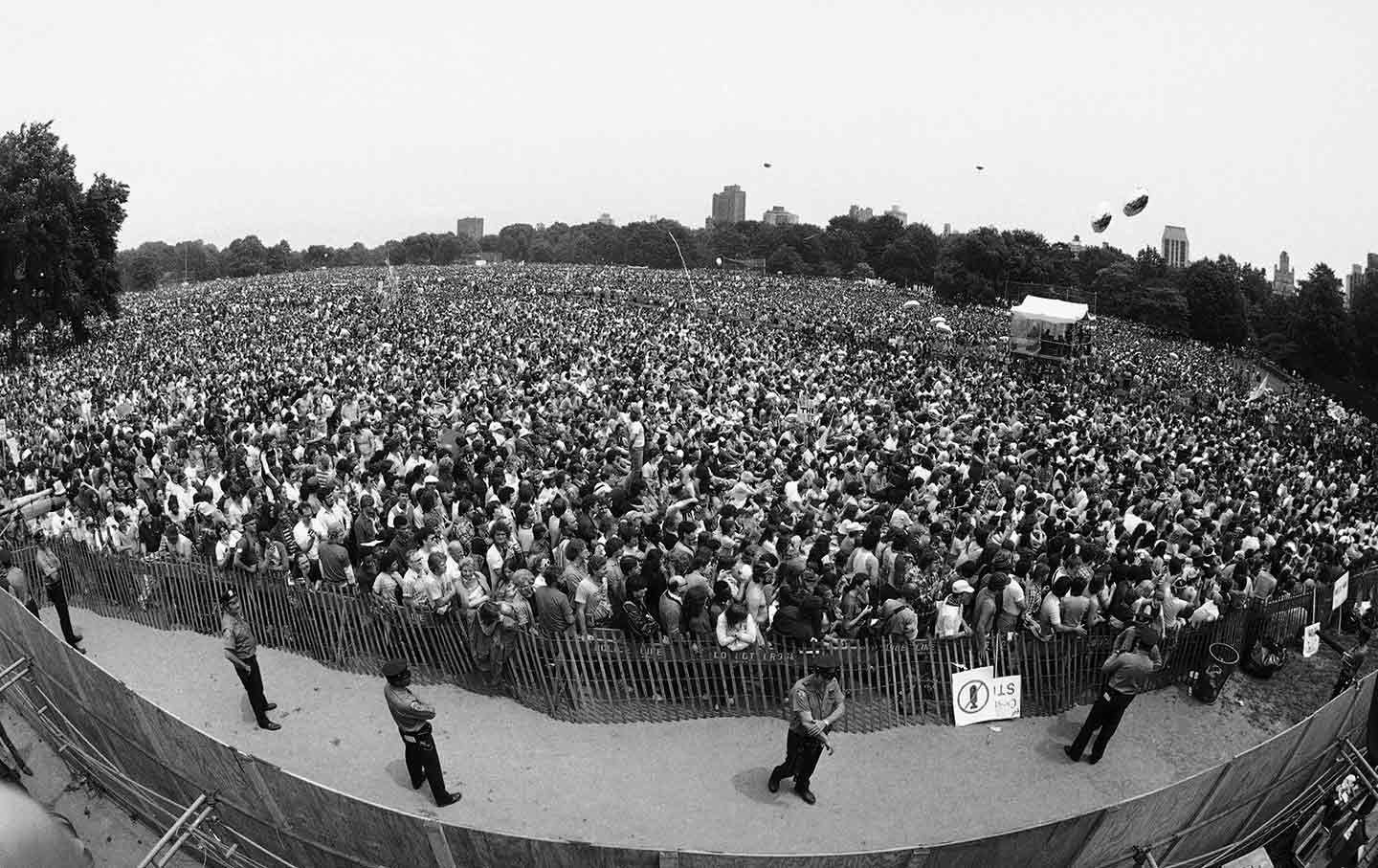
June 12, 1982: A Nuclear Disarmament Rally is held in New York’s Central Park. A crowd of 750,000 turns out. Musical performances are given by Bruce Springsteen, James Taylor, Jackson Browne, and Linda Ronstadt.

These were people desperate to avoid a nuclear confrontation between America and the Soviet Union. They were begging President Ronald Reagan to listen to them.

He didn't: He kept on building up America's nuclear arsenal, even though we already had enough bombs to destroy the Soviet Union many times over.

In 1985, Mikhail Gorbachev became Premier of the Soviet Union. He and Reagan started talking, and the process of winding the Cold War down began.

Reagan did not "win the Cold War" all by himself. He did very little to win it. But since he left office, the people who made the myths about him have written the tremendous opposition to him, including this rally, out of history. They acted as though his 49-out-of-50-States performance in the 1984 election meant that he was overwhelmingly popular.

But, according to a consensus of national polls, his approval rating dipped below 50 percent in December 1981, was 45 percent as the rally was held and the recession took hold in June 1982, bottomed out at 35 percent in January 1983, didn't get back above 50 percent until November 1983, reached 68 percent in January 1985, stayed above 60 percent until November 1986, then fell back below 50 percent again after the revelations of the Iran-Contra scandal, falling to 42 precent in March 1987, before rebounding during the 1988 Presidential campaign. He left office at 68 percent.

Ronald Reagan was not a great President, but he played one on TV.

*

June 12, 1982 was a Saturday. These baseball games were played:

* The New York Yankees lost to the Baltimore Orioles, 5-3 at Memorial Stadium in Baltimore. Shane Rawley gave up an 8th-inning home run to eventual Rookie of the Year Cal Ripken Jr.

* The New York Mets beat the St. Louis Cardinals, 6-2 at Shea Stadium.

* The Montreal Expos beat the Chicago Cubs, 7-5 at the Olympic Stadium in Montreal.

* The Boston Red Sox beat the Cleveland Indians, 6-4 at Fenway Park. Carl Yastrzemski went 2-for-4 with 2 RBIs.

* The Pittsburgh Pirates beat the Philadelphia Phillies, 9-2 at Veterans Stadium in Philadelphia. Mike Schmidt went 1-for-4.

* The Oakland Athletics beat the Toronto Blue Jays, 8-1 at Exhibition Stadium in Toronto. Rickey Henderson went 2-for-6 with a home run and 2 RBIs -- but no stolen bases.

* The California Angels beat the Chicago White Sox, 3-0 at Comiskey Park in Chicago. Ken Forsch pitched a 3-hit shutout. Rod Carew went 1-for-4, and Reggie Jackson did not play.

* The Detroit Tigers beat the Milwaukee Brewers, 7-3 at Milwaukee County Stadium. Robin Yount went 0-for-2 with 2 walks, and Paul Molitor went 1-for-4.

* The Seattle Mariners beat the Kansas City Royals, 3-2 at Royals Stadium in Kansas City. (It was renamed Kauffman Stadium in 1993.) George Brett went 1-for-4.

* The Texas Rangers beat the Minnesota Twins, 4-3 at Arlington Stadium in the Dallas suburb of Arlington, Texas.

* The San Diego Padres beat the Houston Astros, 4-0 at Jack Murphy Stadium in San Diego. (It was renamed Qualcomm Stadium in 1997.) Chris Welsh pitched a 4-hit shutout.

* The Los Angeles Dodgers beat the Cincinnati Reds, 4-3 at Dodger Stadium in Los Angeles. Johnny Bench went 0-for-2 with 2 walks.

* And the Atlanta Braves beat the San Francisco Giants, 10-5 at Candlestick Park in San Francisco. Phil Niekro, 43-year-old knuckleballer, got the win, with a save by Al Hrabosky, "The Mad Hungarian."

Friday, June 10, 2022

June 10, 1963: President John F. Kennedy's Test Ban Speech

June 10, 1963: President John F. Kennedy gives the commencement address at American University in Washington, D.C., at their Reeves Field, 5 miles northwest of the White House.

It was less than 8 months since JFK and Nikita Khrushchev, Premier of the Soviet Union, faced each other down in the Cuban Missile Crisis, and found a solution that meant not launching nuclear attacks against each other's countries. It was a little over 2 years since the summit meeting in Vienna, Austria, the only time the two men actually met, in which Khrushchev, 23 years older, thought he could push JFK around, and did, making the Cuban Missile Crisis possible.

And it was 24 years since the start, and 18 years since the end, of World War II, which marked the psyches of both men, to the point that they did not want to preside over a World War III. Kennedy knew Khrushchev was willing to listen, because he already had.

And what Kennedy wanted to talk about was peace, to a generation not old enough to remember World War II, and not old enough to serve in the Korean War, but was now old enough to serve in the armed forces, and with a war in Vietnam becoming a bigger story all the time, along with threats in Berlin, Cuba and elsewhere in the Caribbean, the Middle East, and South Asia. Kennedy told them:

What kind of peace do I mean? What kind of peace do we seek? Not a Pax Americana enforced on the world by American weapons of war. Not the peace of the grave or the security of the slave.

I am talking about genuine peace, the kind of peace that makes life on earth worth living, the kind that enables men and nations to grow and to hope and to build a better life for their children. Not merely peace for Americans, but peace for all men and women. Not merely peace in our time but peace for all time.

I speak of peace because of the new face of war. Total war makes no sense in an age when great powers can maintain large and relatively invulnerable nuclear forces and refuse to surrender without resort to those forces...

So let us persevere. Peace need not be impracticable, and war need not be inevitable. By defining our goal more clearly, by making it seem more manageable and less remote, we can help all peoples to see it, to draw hope from it, and to move irresistibly toward it...

And if we cannot end now our differences, at least we can help make the world safe for diversity. For, in the final analysis, our most basic common link is that we all inhabit this small planet. We all breathe the same air. We all cherish our children's future. And we are all mortal...

I am taking this opportunity, therefore, to announce two important decisions in this regard.

First: Chairman khrushchev, Prime Minister Macmillan, and I have agreed that high-level discussions will shortly begin in Moscow looking toward early agreement on a comprehensive test ban treaty. Our hopes must be tempered with the caution of history--but with our hopes go the hopes of all mankind.

Second: To make clear our good faith and solemn convictions on the matter, I now declare that the United States does not propose to conduct nuclear tests in the atmosphere so long as other states do not do so. We will not be the first to resume. Such a declaration is no substitute for a formal binding treaty, but I hope it will help us achieve one. Nor would such a treaty be a substitute for disarmament, but I hope it will help us achieve it.

JFK's mention of the proposed Test Ban Treaty got mild applause from those gathered at AU -- probably because it was simply too hard to believe. But on August 5, the Treaty was signed by Dean Rusk, Kennedy's Secretary of State; Alec Douglas-Home, British Foreign Secretary, and soon to be Prime Minister; and Andrei Gromyko, the Soviet Foreign Minister. On September 24, the U.S. Senate, needing a 2/3rds vote to approve it, 67 out of 100, approved it 80-14.

June 1963 turned out to be a very busy month for JFK. In particular, the next 2 days.

*

June 10, 1963 was a Monday. Actress Jeanne Tripplehorn was born.

These Major League Baseball games were played:

* The New York Yankees split a doubleheader with the Washington Senators, at District of Columbia Stadium in Washington, which would later be renamed for JFK's brother: Robert F. Kennedy Memorial Stadium. The Yanks won the opener, 7-0. Al Downing, on his way to becoming the 1st black pitcher to lead the American League in strikeouts, pitched a 2-hit, 9-strikeout shutout. Elston Howard and Clete Boyer hit home runs.

The Senators won the nightcap, 1-0. Claude Osteen pitched a 6-hit shutout, to outduel Jim Bouton. Roger Maris went 1-for-3 in the 1st game, and failed as a pinch-hitter in the 2nd game. Mickey Mantle was injured, and did not play in either game.

* The New York Mets beat the Cincinnati Reds, 3-2 at the Polo Grounds. Tracy Stallard, best known for giving up Roger Maris' 61st home run of the 1961 season, when the distance for the Mets. Tim Harkness hit a home run. Duke Snider played for the Mets that day, going 0-for-2 with a walk. For the Reds, Frank Robinson went 1-for-3, and rookie Pete Rose went 2-for-4.

* The Philadelphia Phillies beat the Milwaukee Braves, 6-2 at Connie Mack Stadium, in a game shortened to 6 innings due to rain. Eddie Mathews hit a home run, while Hank Aaron went 0-for-2 with a walk.

* The Cleveland Indians beat the Baltimore Orioles, 3-2 at Memorial Stadium in Baltimore. Brooks Robinson went 1-for-4.

* The Detroit Tigers beat the Boston Red Sox, 6-1 at Tiger Stadium in Detroit. Carl Yastrzemski went 3-for-3 with an RBI, but they were the only hits the Red Sox got, as Bill Faul shut them down for the Tigers. Al Kaline hit 2 home runs and had 4 RBIs.

* The Los Angeles Angels beat the Kansas City Athletics, 13-3 at Kansas City Municipal Stadium.

* The Chicago Cubs beat the Houston Colt .45s, 3-2 at Colt Stadium in Houston. The Colts became the Houston Astros in 1965. Billy Williams hit a home run for the Cubs, and Ernie Banks went 0-for-3 with a walk.

* The San Francisco Giants beat their arch-rivals, the Los Angeles Dodgers, 7-3 at Dodger Stadium in Los Angeles. Willie McCovey, Orlando Cepeda and Ed Bailey hit home runs for the Giants, and Willie Mays went 3-for-3 with an RBI.

* The St. Louis Cardinals were supposed to play the Pittsburgh Pirates at Forbes Field in Pittsburgh, but were rained out. The game was made up as part of a doubleheader on September 6. The Pirates won the 1st game, 5-1. The Cards won the 2nd game, 5-0, with Bob Veale pitching a 6-hit shutout. 

Stan Musial went 0-for-3, Roberto Clemente went 1-for-4, and Willie Stargell went 2-for-5 with 2 RBIs. (Stargell was only a pinch-hitter in the opener, Musial was only a pinch-hitter in the nightcap, and Clemente didn't play in the nightcap at all).

* And the Chicago White Sox and the Minnesota Twins were not scheduled to play.

Tuesday, April 26, 2022

April 26, 1986: The Chernobyl Disaster

April 26, 1986: The Number 4 reactor explodes at the Chernobyl Nuclear Power Plant in Pripyat, Ukraine. It is the biggest nuclear accident in human history.

The accident occurred during a test of the steam turbine's ability to power the emergency feedwater pumps in the event of a simultaneous loss of external power and coolant pipe rupture. Following an accidental drop in reactor power to near-zero, the operators restarted the reactor in preparation for the turbine test with a prohibited control rod configuration.

Upon successful completion of the test, the reactor was then shut down for maintenance. Due to a variety of factors, this action resulted in a power surge at the base of the reactor which brought about the rupture of reactor components and the loss of coolant. This process led to steam explosions and a meltdown, which destroyed the containment building.

This was followed by a reactor core fire which lasted until May 4, during which airborne radioactive contaminants were spread throughout the Soviet Union and Europe.

In response to the initial accident, a 10-kilometer (6.2-mile) radius exclusion zone was created 36 hours after the accident, from which approximately 49,000 people were evacuated, primarily from Pripyat. The exclusion zone was later increased to a radius of 30 kilometers (19 miles), from which an additional 68,000 people were evacuated.

Following the reactor explosion, which killed two engineers and severely burned two more, an emergency operation to put out the fires and stabilize the surviving reactor began, during which 237 workers were hospitalized, of whom 134 exhibited symptoms of acute radiation syndrome (ARS).

A United Nations committee found that to date fewer than 100 deaths have resulted from the fallout. Model predictions of the eventual total death toll in the coming decades vary. The most widely cited study conducted by the World Health Organization in 2006 predicted 9,000 cancer-related fatalities in Ukraine, Belarus and Russia.

North America was lucky with Three Mile Island in 1979. Eastern Europe was not so lucky with Chernobyl in 1986.

*

April 26, 1986 was a Saturday. These Major League Baseball games were played that day:

* The New York Yankees lost to the Cleveland Indians, 3-2 at Yankee Stadium. Yankee manager Lou Piniella started Bob Shirley, who gave up a double, a single, another single, hit a batter, walked another, and allowed another double, with a runner pickoff mixed in, before Piniella took him out. Three Yankee relievers then pitched 8 2/3rds innings of 5-hit shutout ball. But it was too late.

Dave Winfield went 2-for-3 with a walk. Don Mattingly went 1-for-4 with an RBI. Rickey Henderson went 0-for-3 with a walk and a stolen base.

* The New York Mets beat the St. Louis Cardinals, 4-3 at Busch Memorial Stadium in St. Louis. Lenny Dykstra hit a home run in support of Sid Fernandez.

* The Baltimore Orioles beat the Toronto Blue Jays, 11-5 at Memorial Stadium in Baltimore. Eddie Murray went 1-for-4 with a walk. Cal Ripken went 1-for-5 with 2 RBIs.

* The Philadelphia Phillies beat the Pittsburgh Pirates, 6-5 at Three Rivers Stadium in Pittsburgh. Rick Schu went 4-for-5 with 2 RBIs, each on a solo home run, his 1st 2 homers of the season, and he would finish with 8. Mike Schmidt went 2-for-5 with 2 RBIs.

* The Chicago White Sox beat the Detroit Tigers, 5-4 at Tiger Stadium in Detroit. Jerry Hairston hit a sacrifice fly to bring Carlton Fisk home in the top of the 11th inning.

* The Montreal Expos beat the Chicago Cubs, 4-2 at Wrigley Field in Chicago.

* The California Angels beat the Minnesota Twins, 7-6 at the Metrodome in Minneapolis. Reggie Jackson appeared as a pinch-hitter in the top of the 9th inning, drew a walk, and scored on the winning home run hit by Wally Joyner.

* The Boston Red Sox beat the Kansas City Royals, 6-1 at Royals Stadium (now Kauffman Stadium) in Kansas City. Bill Buckner hit a home run. George Brett went 1-for-4.

* The Milwaukee Brewers beat the Texas Rangers, 10-2 at Arlington Stadium in the Dallas suburb of Arlington, Texas. Robin Yount went 3-for-4 with 2 RBIs. Paul Molitor went 2-for-4 with a walk and an RBI.

* The Houston Astros beat the Cincinnati Reds, 1-0 at the Astrodome in Houston. Mike Scott pitched a 4-hit shutout, outpitching Bill Gullickson. Barely: The only run of the game came in the bottom of the 9th, with Gullickson pitching to Alan Ashby, the Astro catcher, when his own catcher, Bo Diaz, committed a passed ball, allowing Billy Hatcher to score.

Diaz was in the game because the Reds' manager had pinch-hit for starting catcher Sal Butera. The Reds' manager was Pete Rose. The batter Rose sent in to pinch-hit for Butera was himself. At the time, Butera was batting .200 for the season, and had 121 career hits. Rose had 4,204. At age 45, he hadn't batted that season until the game before, and went 0-for-4. Rose was a terrible manager. He wouldn't get his 1st hit of the season until May 4, batted .219, and played his last game on August 17. He never actually announced his retirement as a player.

* The San Francisco Giants beat the San Diego Padres, 3-2 at Jack Murphy Stadium in San Diego. Will Clark hit a home run in the top of the 10th inning.

* The Atlanta Braves beat the Los Angeles Dodgers, 5-4 at Dodger Stadium in Los Angeles. Andres Thomas singled Ozzie Virgil Jr. home in the top of the 10th inning.

* And the Oakland Athletics beat the Seattle Mariners, 5-3 at the Oakland Coliseum.

Football was out of season. The NBA was between rounds of its Playoffs. There were 2 games in the Stanley Cup Playoffs. In "The Battle of Alberta," the Calgary Flames beat their arch-rivals, the Edmonton Oilers, 4-1 at the Northlands Coliseum in Edmonton. And the St. Louis Blues beat the Toronto Maple Leafs, 4-3 at the St. Louis Arena. Mark Reeds scored the winning goal, 7:11 into overtime.

And in English soccer, Arsenal played West Midlands team West Bromwich Albion to a draw, 2-2 at the Arsenal Stadium, a.k.a. Highbury, in North London.

December 31, 1999 & January 1, 2000: The Millennium

December 31, 1999:  The Millennium arrives. The people of planet Earth survived. At a terrible cost. But we hadn't destroyed ourselves. ...