Showing posts with label time magazine. Show all posts

Saturday, December 24, 2022

December 24, 1968: The Earth As Seen From the Moon

December 24, 1968: Apollo 8 becomes the 1st Earth spacecraft to orbit Earth's Moon. It shows 2 images never before seen on Earth: The far side of the Moon, and Earth as seen from the Moon.

The mission was commanded by Colonel Frank Borman, U.S. Air Force. The pilot of the command module was Commander James Lovell, U.S. Navy. This was the first "space reunion": They had flown together on Gemini 7. Lovell was set to fly on Apollo 9, but was moved up to this mission after the intended CM pilot, Michael Collins, required back surgery. The pilot of the lunar module was Colonel William A. Anders, U.S. Air Force. 

It was Borman's 2nd spaceflight, and Lovell's 3rd, and it remains the only U.S. spaceflight on which the commanding officer was not the most-experienced in space. Lovell had also flown aboard Gemini 12. It was Anders' 1st spaceflight, and, as it turned out, his only one.

The entire setup, with command, service and lunar modules, was being sent even though the lunar module was not going to be separated, much less land on the Moon. Unlike later Apollo missions, neither the command module nor the lunar module had a codename.

The mission was launched on December 21. They entered lunar orbit on December 24, Christmas Eve. They became the 1st humans to see the Far Side of the Moon, and the 1st to see not a sunrise, or a moonrise, but an Earthrise, with the Earth in "phase," like the Moon is usually seen in from Earth.

"Look at that picture over there!" Anders called out. "Here's the Earth coming up. Wow, is that pretty!" He then took the photo at the top of this post. Borman called it "the most beautiful, heart-catching sight of my life."

They knew that they would be the 1st people from Earth to spend Christmas away from Earth. They wanted to express a Christmas-style message of "Peace on Earth, good will toward men." But instead of something actually Christmas-related, they instead read back to the people of Earth, through television, the Bible's Creation story.

At 9:30 PM, Eastern Time, Anders said, "We are now approaching lunar sunrise, and for all the people back on Earth, the crew of Apollo 8 has a message that we would like to send to you: In the beginning, God created the Heaven and the Earth. And the Earth was without form, and void; and darkness was upon the face of the deep. And the Spirit of God moved upon the face of the waters. And God said, 'Let there be light.' And there was light. And God saw the light, that it was good: and God divided the light from the darkness."

Lovell: "And God called the light Day, and the darkness He called Night. And the evening and the morning were the first day. And God said, 'Let there be a firmament in the midst of the waters, and let it divide the waters from the waters.' And God made the firmament, and divided the waters which were under the firmament from the waters which were above the firmament, and it was so. And God called the firmament Heaven. And the evening and the morning were the second day."

Borman: "And God said, 'Let the waters under the Heaven be gathered together unto one place, and let the dry land appear.' And it was so. And God called the dry land Earth; and the gathering together of the waters called he Seas, and God saw that it was good.' And from the crew of Apollo 8, we close with good night, good luck, a Merry Christmas, and God bless all of you, all of you on the good Earth."

After a very hard year, of war, of assassinations, of civil strife, this was a message of hope, a sign that, maybe, just maybe, things would be all right in the years to come. That was not to be, but the people of Earth had reason to believe that it might be. Because of this, in spite of the Vietnam War, and the election of Richard Nixon as the next President of the United States, Time magazine named Borman, Lovell and Anders their Men of the Year.
Apollo 8 was significant for another reason: It made the Soviet Union surrender in the race to the Moon. Their Zond project had originally planned a manned flyby of the Moon in late 1967, and a landing in December 1968. But they fell behind, due to various failures. The success of Apollo 8 showed them that trying to beat the U.S. to a manned Moon landing was pointless, and that their resources would be better spent in other ways.

Michael Collins would become the command module pilot for Apollo 11, the 1st mission to land on the Moon. Borman was offered the role of commanding Apollo 11, which would have made him the 1st human to walk on the Moon. He declined, saying he was done with spaceflights, and retired from the Air Force in 1970. So the 1st Moonwalker was the backup to Borman as the commander for Apollo 8, Neil Armstrong. It happened on July 20, 1969, beating the late President John F. Kennedy's deadline of doing it by the end of the 1960s by 164 days.

Lovell would command Apollo 13, the only Moon landing mission that had to be aborted.

As of December 24, 2022, the entire crew of Apollo 8 is still alive. They are the earliest surviving specific Time Persons of the Year. (Time had named American fighting men in 1950, and would again in 2003; American scientists in 1960, and people age 25 and under in 1966.)

UPDATE: Borman died on November 7, 2023; Anders, on June 7, 2024; Lovell, on August 7, 2025.

None of them lived to see the return of humans to lunar orbit, aboard Artemis II. On April 6, 2026, crewmember Reid Wiseman took a new photo, a companion piece to Anders' Earthrise, naming it Earthset.
It had been so long than none of the Artemis II astronauts had even been born yet when humans last left the Moon on Apollo 17 in 1972.

*

December 24, 1968 was a Tuesday. No NBA, ABA, NHL or college football bowl games were scheduled for that Christmas Eve. So there were no scores on that historic day.

Wednesday, November 23, 2022

November 23, 1936: Life Magazine Premieres

November 23, 1936: Life magazine begins publication. Henry Luce, publisher of Time magazine, bought the rights to the name Life, and used it as the title of a picture-based news magazine.

The first cover showed the Fort Peck Dam in Montana, photographed by Margaret Bourke-White, one of the few well-known female journalists of the era.  The first series of photographs were the sequence of the birth of a baby, the last showing the doctor holding the baby up by the legs, with the caption, "LIFE BEGINS." Ha, ha.

The red border made Life iconic. And some of the imagines contained within became so as well. The best-known was Alfred Eisenstaedt's photo of a soldier kissing a nurse in Times Square on V-J Day, August 14, 1945.

Life followed Luce's personal views. The son of Protestant missionaries, he was born in China while they were stationed there. As a result, he was a very conservative Republican and an anti-Communist with a strong interest in China. As a result, he supported the Republican candidate for President in every election, and used his magazines, including Life, to push for the overthrow of Red China after 1949.

Fortunately, Luce hated fascism in equal measure, and so, in 1940, he wanted to make sure that the Republican nominee for President would be someone who would stand up to Adolf Hitler, in case, as Luce would have otherwise preferred, that candidate beat FDR as he ran for a 3rd term.

So he plucked Wendell Willkie, a businessman with no political experience, out of near obscurity, and promoted him relentlessly before the Republican Convention. More than any other person, Luce made Willkie a potential President; more than any other publication, Life made him one. But FDR won, and Luce put him on the next cover, with the caption "THE WINNER." He included a quote from Republican newspaper baron William Allen White: "We who hate your gaudy guts salute you."

Luce remained a staunch Republican. In 1950, Dwight D. Eisenhower, the leading General of World War II, was appointed the president of Columbia University in New York. Luce put him on the cover of Life, with the caption, "PRESIDENT EISENHOWER." It was a shot across the bow at President Harry Truman, who had succeeded FDR, and ended up not running in 1952. Eisenhower won 2 terms.

The rising cost of ink and paper, the continued growth of television news, and the 1967 death of guiding light Luce, led to the magazine's downfall. Time, Inc. decided to stop publishing life on a weekly basis at the end of 1972. But in 1978, it was brought back as a monthly, and occasionally issued special commemorative issues. That held until the May 2000 issue.

The baby from the 1st issue? Fittingly, he grew up to become a journalist. And his name was appropriate to his profession: George Story. He suffered a heart attack and died on April 4, 2000, allowing his obituary to be printed in the last issue, with the headline, "A Life Ends."

*

November 23, 1936 was a Monday. Baseball was out of season. Football was in midweek. The NBA hadn't been founded yet. And while the NHL season was underway, no games were scheduled. So there were no scores on this historic day.

Sunday, October 2, 2022

October 2, 2018: The Saudi Hit On Jamal Khashoggi

October 2, 2018: There are certain things that the President of the United States has to avoid, first if he wants to be re-elected; then, if successful in that, if he wants to be remembered well by history.
As Ulysses S. Grant, Grover Cleveland, Herbert Hoover, Gerald Ford, Jimmy Carter and both George Bushes found out, you can't have a major economic downturn on your watch.
As Lyndon Johnson and George W. Bush found out, you can't have a war go badly on your watch -- or, as Carter also found out, you can't have a hostage crisis that drags out until it feels like a war.
As Grant, Warren Harding, Richard Nixon and George W. Bush found out, you can't have a major scandal. (The one that the Republican Party tried to put on Bill Clinton didn't work: Having avoided the other things, he was more popular after a full 8 years than any President.)
And, as George W. Bush also found out, you can't be seen as screwing up the response to a devastating hurricane.
Except for a war, all of those things happened during the Presidency of Donald Trump. But what no one foresaw until Trump got into the White House was the possibility of a President being compromised by a foreign power. 
Trump is compromised by, among other nations, Russia and Saudi Arabia. Without the backing of both of these nations, his financial empire wouldn't be worth the paper it's printed on. (It still might not be.) And without their campaign contributions -- and hacking from at least the Russians and possibly also the Saudis -- he could not have become President.
On June 3, 2009, President Barack Obama met with King Abdullah of Saudi Arabia, and appeared to bow before him. Trump had a public fit over this. But on January 23, 2015, Abdullah died, succeeded by his half-brother, King Salman; and on May 2017, Trump met with Salman in the Saudi national capital of Riyadh, received a gaudy medal from him, and appeared to curtsy right afterward.
Salman's health was already beginning to fail. On June 21, 2017, he appointed his son, Crown Prince Mohammed bin Salman, to run the country on his behalf. On that day, Trump called him to "congratulate him on his recent elevation." Trump and "MBS" pledged "close cooperation" on security and economic issues.
The month before, MBS publicly warned: "I confirm to you, no one will survive in a corruption case—whoever he is, even if he's a prince or a minister." He wasn't kidding: On November 4, the Saudi media announced the house arrest of some 200 wealthy businessmen and princes at the Ritz Carlton hotel in Riyadh, on various "corruption" charges. They became the subject of "The Night of Beating," with Saudi agents torturing them.
He became his country's absolute ruler at age 32.
This is why "foreign policy by obituary," waiting for
a tyrant to die so policy can change, usually doesn't work.
This included Prince Al-Waleed bin Talal, an English-language news commentator and a major shareholder in Citigroup, Twitter, and Rupert Murdoch's News Corp; Prince Mutaib bin Abdullah, head of the Saudi Arabian National Guard; Adel Fakeih, Minister of Economy and Planning; and Admiral Abdullah bin Sultan bin Mohammed Al-Sultan, commander of the Royal Saudi Navy. As of October 2, 2022, Fakeih was still in custody; the others were quickly released, but have not been returned to any role in the Saudi government. 
Jamal Khashoggi was born on October 13, 1958 in Medina, Saudi Arabia. He was an exiled journalist who had written damning exposes of his homeland's government. This was complicated by the fact that his grandfather, Mohammed Khashoggi, was the personal physician of King Ibn Saud, the founder of the Saudi state. His uncle, Adnan Khashoggi, was a billionaire arms dealer. He was also a first cousin of Dodi Fayed, the Egyptian film producer who was Princess Diana's boyfriend and was killed with her in the 1997 Paris car crash.
In a column printed in the April 3, 2018 edition of The Washington Post, Jamal Khashoggi wrote that Saudi Arabia "should return to its pre-1979 climate, when the government restricted hard-line Wahhabi traditions. Women today should have the same rights as men. And all citizens should have the right to speak their minds without fear of imprisonment." In that same column, he said that Saudis "must find a way where we can accommodate secularism and Islam, something like what they have in Turkey," the country where he was then living. He also opposed the Saudi's intervention in neighboring Yemen.
He was no angel: He had just gotten married for the 3rd time, but was already planning to divorce his new wife and marry another woman. He was critical of Israel. He had even been friends with Osama bin Laden during the latter's opposition to the Soviet invasion of Afghanistan, but renounced bin Laden when he turned to violence against America. When bin Laden was killed in 2011, Khashoggi wrote, "You were beautiful and brave in those beautiful days in Afghanistan, before you surrendered to hatred and passion."

On October 2, 2018, Khashoggi walked into the Saudi consulate in Istanbul, Turkey, where he was living, to obtain documents needed for his planned marriage. (He was already married, but planning to divorce his wife so he could marry someone else.) He never left alive, and word reached the outside world that he was murdered and dismembered inside the consulate. He was just short of turning 60, and left behind his wife, 2 sons and 2 daughters (with all 4 children from his 2nd marriage).
On November 16, the CIA determined that MBS has personally ordered the murder. This was not just an assassination: This was more like a Mob hit.
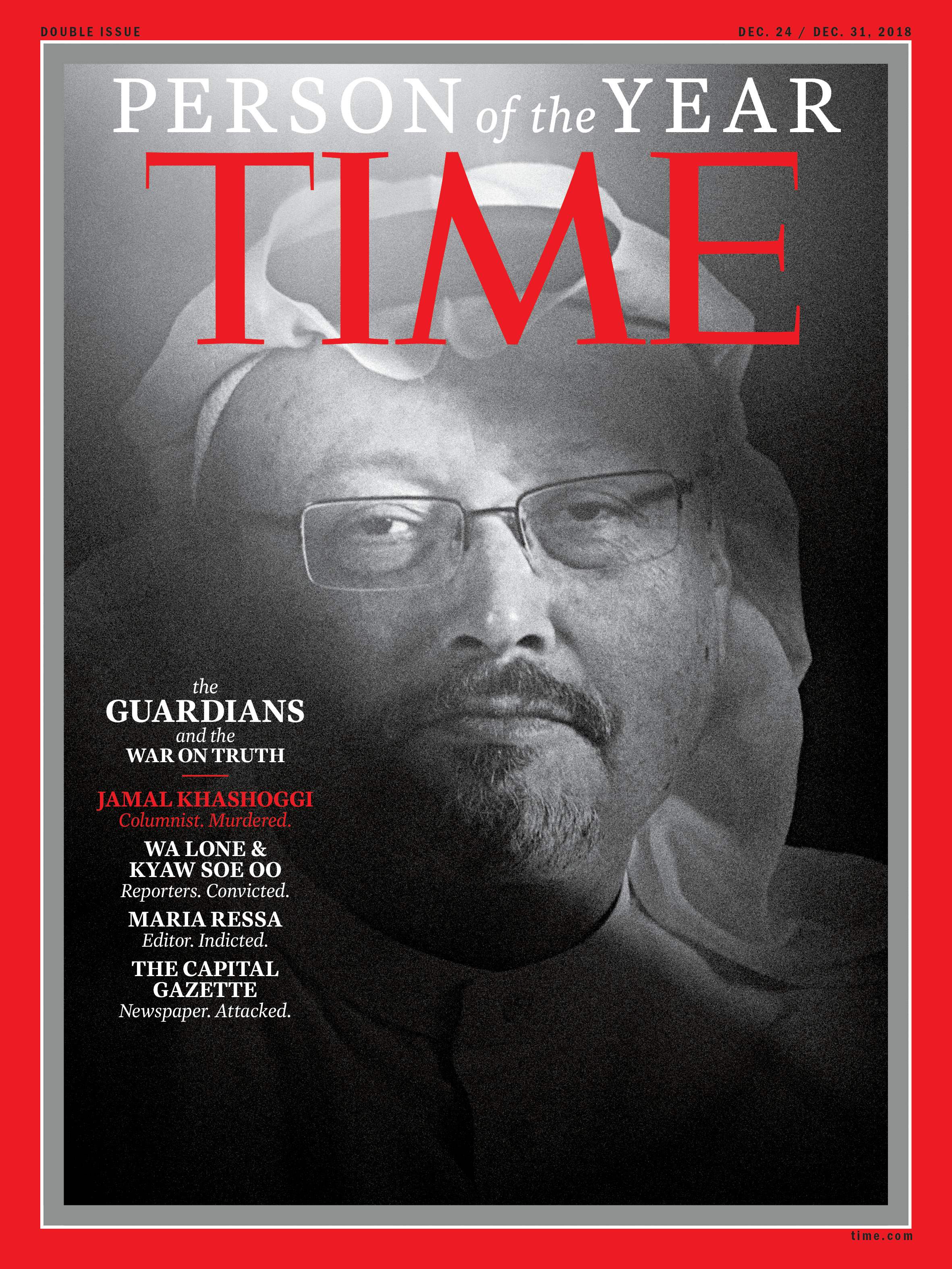
On December 11, 2018, Time magazine collectively named journalists they called "Guardians of the Truth" as their "Persons of the Year." They put Khashoggi on the cover as their stand-in. This made him, technically, the 1st person already dead to receive their Man/Person of the Year designation since the distinction was established in 1927. Time also cited journalists in the U.S., Mexico, Venezuela, Russia, Turkey, Sudan, Bangladesh, Myanmar (formerly Burma), Vietnam and the Philippines.
(No, John F. Kennedy didn't receive it in 1963, although he got it while alive in 1961. The 1963 recipient was Martin Luther King Jr.)
In 2021, the former Saudi intelligence official Saad al-Jabri said in an interview with CBS that bin Salman is "a psychopath, killer... with infinite resources, who poses threat to his people, to the Americans and to the planet."
*
October 2, 2018 was a Tuesday. Football was in midweek. The NHL season started 2 days later; the NBA season, 15 days later. And only 1 baseball game was played. It was the National League Wild Card Game, at Wrigley Field in Chicago, and the Colorado Rockies beat the Chicago Cubs, 2-1. With 2 outs in the top of the 13th inning, the Rockies got consecutive singled from Trevor Story, Gerardo Parra and Tony Wolters to take the lead. The Rockies were subsequently swept by the Milwaukee Brewers in the NL Division Series.

Thursday, September 15, 2022

September 15, 1959: Khrushchev Comes to America

September 15, 1959: Soviet Premier Nikita Khrushchev arrives in the U.S., the 1st visit to America by a Russian or Soviet leader, ever. He brought his wife Nina and their adult children, including his lookalike son Sergei – who, in defiance of his father’s previous proclamation, "We will bury you," became an American citizen and a professor at Brown University in Providence, Rhode Island.

"Mr. K" visited New York, Los Angeles, San Francisco, a farm in Iowa, Pittsburgh and Washington, including meeting with President Dwight D. Eisenhower for a summit at Camp David (named for Ike's grandson). His New York visit included a meeting with Eleanor Roosevelt at Hyde Park.

On his visit to Los Angeles, he wanted to visit Disneyland, but it was canceled due to security concerns. He didn't like that. So he asked to see the filming of a real Hollywood movie. The one he watched was Can-Can, based on the play by Abe Burrows, music by Cole Porter, and starring Frank Sinatra and Shirley MacLaine. When he got back to Moscow, he called the film "depraved" and "pornographic."

San Francisco Examiner columnist Frank Conniff wrote of his hometown, syndicated throughout the country via the conservative Hearst media company, "This is the damndest city: They cheer Khrushchev and boo Willie Mays!"

Time magazine had named Khruschchev its Man of the Year for 1957. For 1959, it gave the award to Eisenhower.

*

September 15, 1959 was a Tuesday. These baseball games were played:

* The New York Yankees lost to the Chicago White Sox, 4-3 at Yankee Stadium. The South Siders scored 2 runs in the 8th and 1 in the 9th to come from behind, while the Yankees could only muster 1 run in the bottom of the 9th. Billy Pierce was the winning pitcher, while Whitey Ford blew a save in relief of Ralph Terry. Nellie Fox, soon to be named the American League's Most Valuable Player, went 3-for-4 with a walk. Mickey Mantle hit 2 home runs, but it wasn't enough.

One week later, the White Sox would clinch the American League Pennant. Only 2 AL Pennants between 1949 and 1964 were won by teams other than the Yankees: This one, and in 1954, by the Cleveland Indians. Both the '54 Indians and the '59 ChiSox had Al Lopez as their manager.

* The Boston Red Sox beat the Cleveland Indians, 1-0 at Fenway Park in Boston. Tom Brewer pitched a 6-hit shutout. Ted Williams singled as a pinch-hitter.

* The Baltimore Orioles beat the Detroit Tigers, 2-1 at Memorial Stadium in Baltimore. An error by Tiger catcher Lou Berberet on a grounder by his opposite number, Gus Triandos, let the winning run score in the bottom of the 11th inning. Brooks Robinson went 1-for-4. Al Kaline went 2-for-4 with a walk and an RBI.

* A doubleheader was split at Griffith Stadium in Washington. The Washington Senators won the opener, 1-0. Camilo Pascual pitched a 3-hit shutout. The Kansas City Athletics won the nightcap, 6-2. Over the 2 games, Roger Maris went 2-for-7 with a walk and an RBI for the A's. Harmon Killebrew went 1-for-7 with a walk for the Senators.

* The St. Louis Cardinals beat the Philadelphia Phillies, 6-4 at the 1st Busch Stadium (formerly the last Sportsman's Park) in St. Louis. Stan Musial did not play.

* The Los Angeles Dodgers beat the Milwaukee Braves, 8-7 at the Los Angeles Memorial Coliseum. The Braves scored a run in the top of the 10th inning, but in the bottom half, the Dodgers tied it, and then Don McMahon walked Joe Pignatano with the bases loaded to give the former Brooklyn team the win.

Duke Snider left the game with an injury after going 0-for-1, but his replacement in center field, Ron Fairly, went 2-for-4 with a walk and an RBI. Hank Aaron went 4-for-6 with 3 RBIs, but this did not include any of his 755 home runs.

* The San Francisco Giants beat the Cincinnati Reds, 13-6 at Seals Stadium in San Francisco. Khrushchev did not attend. Willie Mays, who was not booed, went 2-for-3 with 2 walks and an RBI. Willie McCovey, about to be named the National League Rookie of the Year, went 3-for-5 with a home run and 2 RBIs. Frank Robinson went 0-for-1 before leaving the game with an injury.

* And the game between the Chicago Cubs and the Pittsburgh Pirates at Wrigley Field in Chicago was postponed -- not due to rain, but due to cold weather. It was made up as part of a doubleheader the next day. The Pirates won the 1st game, 3-2. The Cubs won the 2nd game, 4-2. They scored a run in the 8th and 2 in the 9th, on a home run by Sammy Taylor, to come from behind.

Over the 2 games, Ernie Banks, soon to be named the NL's Most Valuable Player, went 4-for-8 with 2 RBIs, and Roberto Clemente went 5-for-8 with an RBI.

Tuesday, August 16, 2022

August 16, 1954: "Sports Illustrated" Debuts

August 16, 1954: Sports Illustrated debuts, produced by Time, Inc. The 1st cover of the weekly magazine shows a scene from a baseball game at Milwaukee County Stadium: Eddie Matthews of the host Milwaukee Braves is swinging his bat, in front of New York Giants catcher Wes Westrum. Behind Westrum is umpire Augie Donatelli.

It wasn't the 1st magazine with the name. In 1936, Stuart Scheffel created Sports Illustrated as a monthly magazine, with golf, tennis and skiing as its main focus. It failed after 2 years, and Scheffel sold the rights to the name to Dell Publications. (Aside from the name, that company has no connection to electronics company Dell Technologies.) 

In 1949, Dell released a monthly magazine with the name, and that lasted just 6 issues, despite expanding its coverage to boxing and the major team sports. But it couldn't compete against Sport, the monthly that was the biggest sports magazine since its founding in 1946.

At the time, there were 2 problems with producing a sports magazine. It would cost too much to do so more regularly than monthly. This led to the 2nd problem: Timeliness. For example: Suppose you were running a publishing house in the Summer of 1951, and you wanted to launch a sports magazine. You decide that your 1st issue will be a preview of that year's World Series. You see the New York Yankees and the Brooklyn Dodgers leading their respective Leagues. So you conclude that the Series will be between those 2 teams.

And your premiere issue comes out at the end of September. By that point, the Dodgers have blown their big lead, to the New York Giants. On October 3, "The Giants win the Pennant!" And you look like a fool. No one wants to buy your magazine. And you're out of business before you can publish an issue previewing the 1951 NFL Championship Game and the New Year's Day 1952 college football bowl games.

For this reason, the biggest sports-themed magazines of the era were the baseball preview issues published by Baseball Digest and Street & Smith. They would make predictions for the season to come, but it was a lot easier to overcome ridicule for making a bad prediction for October in March than it would be in September.

By this time, the post-World War II economic boom was in full swing, so more people were in a position to buy magazines. And to buy the television sets on which to watch sporting events. And to buy tickets to watch the events live. The market for a weekly sports magazine, which could keep up with events as they were happening, was there -- for a publishing house that could afford to produce it.

Henry Robinson Luce could afford it: He ran Time, Inc., and had already succeeded with the newsmagazine Time (a weekly founded in 1923), the photo-based newsmagazine Life (a weekly founded in 1936), and the business-themed magazine Fortune (a monthly founded in 1929). And in 1953, he thought the time was right to try a weekly that would be, essentially, Time, but focused on sports. When the owners of Sport weren't willing to sell their magazine, or the rights to their magazine's name, at any price, Luce bought the rights to the name Sports Illustrated.

But Luce's background worked against the magazine: A graduate of Yale University, his friends were mainly the very rich, like himself. Their pastimes included golf, tennis, sailing, hunting, fishing, and the card game of contract bridge. Now, I am of the firm belief that golf is not a sport. Tennis is. Competitive sailing, I suppose, qualifies. But fishing is not a sport. Nor is hunting: As has been pointed out many times, including by Rick Reilly in SI in the 1980s, it's not a "sport" if "the other team" doesn't even know there's a competition.

Bridge? That's not a sport. It's a game -- one I have never played, and I don't know the rules -- and not athletic in the slightest. And yet, Luce published articles about the game in Sports Illustrated. Twice, he put Charles Goren, both the leading bridge player and the leading writer about the game in his generation, on the SI cover, and frequently printed Goren's articles. I have frequently lamented ESPN's televising of competitive poker, because it's a card game and not a sport. Well, Luce publishing Goren's bridge articles was the 1950s' equivalent.

(For those of you who do enjoy playing bridge: I'm not saying it's a bad game, or that it's not worth your time. And I'm certainly not casting aspersions on Goren. I'm saying that the game shouldn't be discussed in a magazine about sports, except maybe as an aside in an article about a real athlete. For example: If Heavyweight Champion Rocky Marciano enjoyed playing bridge -- and I don't know if he enjoyed any card games -- that might be worth mentioning in an SI article about him, along with his preferences in food, music and TV shows.)

Just as Time had been producing a Man of the Year issue since 1927, SI issued an end-of-the-year Sportsman of the Year issue. The 1st honoree was Roger Bannister, the British medical student who, a few weeks before the 1st issue, had become the 1st person to run a mile race in less than 4 minutes; then, a few weeks later, having his record beaten by the Australian runner John Landy, beat Landy in a much-publicized race at the British Empire Games in Vancouver.

Now known as "Sportsperson of the Year," the title has occasionally been awarded to multiple individuals, and sometimes even to entire teams. It's gone to performers in the various sports this many times: Baseball 18, football 17, basketball 17, track and field 8, golf 7, tennis 5, hockey 4, boxing 3; 2 each in soccer, cycling and speed skating; and 1 each in auto racing, horse racing (to a jockey, not a horse), gymnastics and swimming.

The 1st black recipient was decathlete Rafer Johnson in 1958, while Kip Keino, awarded in 1987 for his charitable efforts even though his Olympic running achievements were in 1968 and 1972, was the 1st African native to receive the award. The 1st Hispanic recipient was golfer Lee Trevino in 1971, while Sammy Sosa receiving a co-award with Mark McGwire in 1998 made him the 1st Latin American native to get it.

The 1st female recipient was Billie Jean King in 1972, sharing it (the first time it was split) with UCLA basketball coach John Wooden. The 1st female sole recipient was also a tennis player, Chris Evert in 1976. Billie Jean was still in the closet at the time, so the 1st openly gay recipient was Megan Rapinoe in 2019. Tiger Woods, whose mother was from Thailand, was the 1st recipient of Asian descent, in 1996. South Korean native Byun-Hyun Kim, as part of the collective award to the 2004 Boston Red Sox, was the 1st recipient from an Asian country.

It's been awarded to 5 Canadians (hockey players Bobby Orr, Wayne Gretzky and Bob Bourne; football player Laurent Duvernay-Tardif, and basketball player Chris Boucher as part of the collective award to the 2018 Golden State Warriors), an Englishman (Bannister), a Scotsman (auto racer Jackie Stewart), a Swede (boxer Ingemar Johansson), a Kenyan (Keino), a Norwegian (speed skater Johan Olav Koss), a Dominican (baseball players Sosa, and 2004 Red Sox David Ortiz, Manny Ramírez, Pedro Martínez, Sandy Martínez, Anastacio Martínez and Pedro Astacio -- none of those Martínezes is related to any of the others), a Puerto Rican (César Crespo with the 2004 Red Sox), a Colombian (Orlando Cabrera with the 2004 Red Sox), a Panamanian (Ramiro Mendoza with the 2004 Red Sox), a Korean (Kim), a Venezuelan (baseball player José Altuve), a Georgian (Zaza Pachulia of the 2018 Warriors) and a Japanese (tennis player Naomi Osaka).

Until Woods in 2000, no one had received the award more than once. Basketball player LeBron James has gotten it 3 times, while Woods and football player Tom Brady have gotten it twice. Of course, Brady, Sosa, Altuve, and, collectively, the 2004 Red Sox have since been exposed as blatant and unrepentant cheaters.

Sometimes, the award is controversial, and more of a "lifetime achievement award" than an award for that specific year. Such examples include baseball player Stan Musial in 1957, basketball coaches John Wooden in 1972 and Dean Smith in 1997, golfer Jack Nicklaus in 1978, football coaches Joe Paterno in 1986 and Don Shula in 1993, tennis player Arthur Ashe in 1992, and football player Brett Favre in 2007. While Ashe was dying of AIDS after a lifetime of activism, each of these honorees could legitimately have been said to have had better years than the ones in which they were honored (although Wooden did win a National Championship in the year in question, and Paterno was about to finish off such a season).

In 1960, André Laguerre became managing editor of SI. The magazine had never turned a profit, but Luce could afford to not care about that. Laguerre made it turn a profit by 1964, with the maxim, "It doesn't matter what you write about. All that matters is how well you write."

It was under Laugerre that SI began to resemble the magazine we know today. He phased out the rich man's "sportsman" articles, and focused on the sports that middle-class Americans were interested in: Boxing, horse racing, and the major team sports. The magazine became known for its season preview issues and its Olympic coverage.

And, starting in 1964, for Laugerre's creation, the Sports Illustrated Swimsuit Issue. It usually comes out in February, possibly a reference to Paul Gallico, who, when asked in 1937 why he gave up sportswriting, said, "February." In other words, when it was too cold in most of the country for outdoor sports like baseball, football, track and field, golf, tennis and horse racing. Indoor sports like basketball and hockey had yet to become big business; while Americans couldn't have cared less about soccer, played around the world in the Winter, no matter how cold it got.

Aside from the Swimsuit Issue, if there's one thing people know about the magazine, it's "The Dreaded SI Cover Jinx." It began almost immediately: Matthews soon suffered a broken hand, although he only missed 7 games. But on January 30, 1955, skier Jill Kinmont suffered a crash that left her paralyzed. The SI issue with her on the cover, already in stores and mailed to subscribers, was dated the very next day. 

On February 13, 1961, 16-year-old Laurence Owen was on the cover, for a preview of the World Figure Skating Championships. Two days later, along with the entire U.S. team, she was killed in a plane crash on the way to the event. Other cover subjects included skiers and auto racers who ended up killed in competitions; and race horse breeder Prince Aly Khan, and golfer Tony Lema, all by 1966.

The most memorable non-fatal example came in the issue dated November 18, 1957. It featured the University of Oklahoma football team, riding a 47-game winning streak, still a college football record. The cover headline was, "Why Oklahoma is Unbeatable." The 2-time defending National Champions were upset by Notre Dame on November 16.

For the 1987 Baseball Preview Issue, SI put Cleveland Indians sluggers Joe Carter and Cory Snyder on the cover, under the headline "INDIAN UPRISING," adding, "Believe it! Cleveland is the best team in the American League." This soon turned out to be, spectacularly, not the case, and manager Pat Corrales answered a question about the Jinx, saying, "Sports Illustrated isn't getting my hitters out. Sports Illustrated isn't hitting my pitchers." He was soon fired.

But the jinx doesn't affect most honorees. For many years, boxer Muhammad Ali held the record for most appearances on the cover, and he is generally regarded as what he called himself: "The Greatest of All Time!" He has now appeared 40 times. But Michael Jordan, usually (if inaccurately) called the greatest basketball player ever, now holds the record, with 50 SI covers. Among active athletes, LeBron leads with 25. Most appearances by team? The Los Angeles Lakers have had 67, just ahead of the New York Yankees with 65.

*

August 16, 1954, like all dates on SI covers, was a Monday. There was only one score on this historic day: The Philadelphia Phillies beat the Brooklyn Dodgers, 9-6 at Ebbets Field. Even this game wasn't supposed to be played on this day: It was the rescheduling of a rainout on May 25.

For the Phils: Catcher Forrest "Smoky" Burgess went 4-for-5 with an RBI, and shortstop Bobby Morgan, a Dodger until that year, went 3-for-5 with 2 RBIs. Hall of Fame center fielder Richie Ashburn went 0-for-3, but did draw 2 walks. Robin Roberts went the distance, moving to 19-10 on a season that would see him finish 23-15.

For Dem Bums: Bob Darnell started, Clem Labine ended up as the losing pitcher, and both Elwin "Preacher" Roe and Don Newcombe came out of the bullpen. Pee Wee Reese and Gil Hodges hit home runs, Duke Snider went 2-for-4 with 2 RBIs, and Jackie Robinson went 0-for-3 with a walk.

Also on this day, film director James Cameron was born.

Tuesday, June 28, 2022

June 28, 1940: Wendell Willkie Is Nominated for President

June 28, 1940: Wendell Willkie is nominated for President at the Republican National Convention, at the Philadelphia Civic Center. It was the 1st political convention broadcast on television -- the Democratic National Convention would follow, 4 weeks later -- but that's not what was historic about this Convention. Hardly anybody had television sets to watch it on, anyway.

Lewis Wendell Willkie was born on February 18, 1892 in Elwood, Indiana, 46 miles northeast of Indianapolis. The U.S. Army reversed his name to "Wendell Lewis" when he enlisted in World War I, and, since his family had always called him "Wendell," anyway, he never corrected the mistake, and later made that his legal name. He served, but did not see combat.

He dropped out of law school to enlist, and returned. He was hired by the law firm that represented Firestone Tire and Rubber Company in Akron, Ohio, but when he met company founder Harvey Firestone -- a friend of President Warren G. Harding, a Republican -- he was told he would never amount to anything because he was a Democrat.

In 1924, he was a Delegate to the Democratic Convention, the one that went to 103 ballots before Congressman John W. Davis was nominated. Despite being a Midwestern Protestant, Willkie had supported Governor Al Smith, because of Smith's opposition to the Ku Klux Klan, which had essentially taken over the Republican Party in Indiana. In 1925, Willkie got Klan members expelled from the Akron school board.

Willkie built a reputation as a great trial lawyer, representing public utilities. In 1932, he was a Democratic Delegate again, supporting Governor Franklin D. Roosevelt, who was elected President. But in 1935, with FDR at the height of his New Deal, Willkie broke with him to represent Commonwealth & Southern Corporation against the Tennessee Valley Authority. In 1936, Willkie voted for FDR's Republican opponent, Governor Alf Landon. In 1939, he switched parties, becoming a Republican, becoming perhaps the 1st ex-Democrat to say, "I did not leave my party, my party left me."

In 1940, the Republicans figured, after 8 years of the New Deal, the American people would want to go back to conservative leadership. They didn't expect FDR to run for a 3rd term. But with Adolf Hitler taking over most of Europe, and threatening Britain, FDR knew he was the only American politician experienced enough to handle the Nazi leader.

The elections of 1932, 1934 and 1936 had brought many Republican figures down to defeat. But the economic downturn of 1938 knocked a few potential Democratic successors to FDR out of contention. Neither party really had a wealth of contenders. The leading Republican contenders were Senators Robert Taft of Ohio (son of President William Howard Taft) and Arthur Vandenberg of Michigan; and the District Attorney of Manhattan, Thomas E. Dewey.

Dewey was just 38 years old, and, though nationally famous due to his prosecution of organized crime figures, would have been a poor choice as nominee against the veteran FDR. But Taft was in only his 2nd year in the U.S. Senate. More importantly, Taft and Vandenberg were isolationists: Had they been elected, they would have done everything they could to keep America from going to war with Hitler. Therefore, millions of Americans, in both parties -- none more so than FDR -- wanted the Republicans to nominate an internationalist.

After the Nazi invasion of Poland started The War, Willkie gave speeches, including on radio, about the threat to America and the need to aid its allies. He transformed his image: Before, he was mocked, including by Republicans, as "the barefoot boy of Wall Street." As Chicago Sun-Times columnist Steve Neal, who wrote books about both him and FDR (and also Harry Truman and Dwight D. Eisenhower), put it, his wartime speeches "transformed Willkie from a big-business critic of the New Deal into a champion of freedom. And it gave his candidacy new purpose."

Senator James E. Watson, of Willkie's home State of Indiana, was appalled that his candidacy was being taken so seriously. It wasn't because Willkie was the least-qualified Presidential nominee in GOP history. It was because he had so recently been a Democrat: "I may welcome the town whore into my church, but I wouldn't want him to lead the church choir." And Alice Roosevelt Longworth, daughter of President Theodore Roosevelt and widow of House Speaker Nicholas Longworth, owner of the sharpest tongue in Washington society, said that the Willkie campaign came "from the grass roots of ten thousand country clubs."

But Willkie had one key ally: Henry Luce, publisher of Time, Life and Fortune magazines. (Sports Illustrated came later, in 1954.) Luce was one of the biggest names in American conservatism, and he was an internationalist. Born in China as the son of Christian missionaries, he opposed the Nazis in large part because their Axis included the Empire of Japan, which was devastating China. He made sure the stands at the Civic Center were packed with people chanting, "We want Willkie!" This gave the "dark horse" the appearance of having more support than he actually did -- leading to more people switching their support to him, a self-fulfilling prophecy.

The brothers Gardner and John Cowles, publishers of Look magazine, and owners of the largest newspaper chain in the Midwest, sought to break the Taft/Vandenberg hold on the region. They figured Willkie could be the man to do it, and asked him to make a speech in St. Paul, the capital of Minnesota. For half an hour, Willkie read a very dry speech. At its end, he threw it to the ground, and said, "Some damn fool told me I had to read this speech. Now, let me tell you what I think." He did, and the audience perked up, and they loved it. The brothers published the speech, and it gained Willkie some support.

Furthermore, Hitler's victory in France, 2 weeks before the Convention, left only Britain between the Nazis and America. When the Delegates gathered in Philadelphia, they joked that Dewey was "the first American casualty of World War II."

Before a candidate could be nominated, a platform had to be approved. It split the difference between what the interventionists and the isolationists wanted: "We favor the extension of aid to all people fighting for liberty or whose liberty is threatened, as long as such aid is not in violation of international law or inconsistent with the requirements of our national defense."

Years later, someone discovered that the text was lifted, almost verbatim, from an ad that had appeared in several newspapers, including The New York Times, over the names of isolationist Congressmen, written and aid for by Nazi agents. But, even at the time, the nationally syndicated journalist H.L. Mencken, no stranger to epic put-downs, especially of the Republican Party, wrote that this was "so written that it will fit both the triumph of democracy and the collapse of democracy, and approve both the sending of arms to England and sending only flowers."

On the 1st ballot, Dewey led with 360 Delegates, to 189 for Taft, 105 for Willkie, 76 for Vandenberg, 74 for Governor Arthur James of Pennsylvania, and 196 scattered among other candidates. James' name was placed in nomination because, in the old days, before Primaries became the way nominees were selected, the Governor of the host city's State, should he be of the same party, was usually given the courtesy of being nominated as a "favorite son." Dewey led, but he was nowhere near a majority of the Delegates, so more ballots would be needed.

On the 2nd ballot, it was Dewey 338, Taft 203, Willkie 171, Vandenberg 73, James 66. On the 3rd ballot, it was Dewey 315, Willkie moving up to 2nd with 259, Taft gaining so that he also had 259, Vandenberg 72, James 59.

Willkie took the lead on the 4th ballot, with 306, to Taft 254, Dewey 250, Vandenberg 61, James 56. On the 5th ballot, Dewey's support collapsed, leaving only 2 contenders: Willkie with 429 Delegates, and Taft with 377. On the 6th ballot, Willkie clinched a majority, with 655 to Taft's 318. Charles McNary of Oregon, the Senate Minority Leader, was nominated for Vice President.
Charles McNary

FDR was relieved. Not because he thought Willkie, whom he'd met a few times, would be easy to beat. Nor because he thought, should Willkie beat him, he would be a good President. It was because FDR knew that, no matter what, whoever was President from 1941 onward would oppose Hitler, and that was Issue Number One, to the point where, whatever people thought Issue Number Two should be, it was far behind in consideration.

Indeed, over the next 4 months, Willkie gave several speeches supporting an internationalist outlook. He did, however, rip FDR's policies more strongly than Landon had in 1936, proving that Republican voters will vote for any Republican, as long as he sufficiently rips the Democratic nominee.

The election was closer than FDR would have liked: He won 55 percent of the popular vote, to Willkie's 45. The Electoral Vote gave the appearance of a landslide, as FDR won 36 States, beating Willkie 449 to 82.

After the election, Willkie made 2 foreign trips as Roosevelt's informal envoy. After the Japanese attack on Pearl Harbor brought America into The War, Willkie, as nominal leader of the Republican Party, gave the President his full support.

The War was serious enough that Vandenberg dropped his former isolationist policies, and became one of the leading advocates for building up the armed forces, to the point where one of the early bases of the U.S. Air Force, outside Santa Barbara, California, would be named for him. Taft supported the war effort in full, although, after The War, he opposed the formation of NATO. To his credit, Taft was opposed to the internment of Japanese Americans. To America's detriment, he was the only major American politician, of either party, who was.

Willkie had not entered the Republican Primaries in 1940. In 1944, he did enter the Primaries, but conservatives, angry at his being chummy with FDR, turned on him, and nominated Dewey, who had been elected Governor of New York in 1942.

Willkie died of a heart attack on October 8, 1944, before the election. His former running mate, McNary, had died earlier in the year. So, while the Republicans engaged in a whispering campaign that FDR was sick, or even dying, which turned out to be true, both of the Republicans' 1940 nominees failed to live to see the end of the term for which they had run.

After Willkie, the Republican Party took great care to nominate more qualified candidates for President: From 1944 to 2012, not counting the renomination of incumbent Presidents, they nominated 3 current or former Vice Presidents (Richard Nixon twice and George H.W. Bush), 5 current or former Governors (Dewey twice, Ronald Reagan of California, George W. Bush of Texas and Mitt Romney of Massachusetts), 3 Senators (Barry Goldwater and John McCain of Arizona, and Bob Dole of Kansas), and a 5-star General (Dwight D. Eisenhower).

They weren't always more qualified than their respective Democratic opponents, but, at least, they were qualified. Willkie may have been smart, but by no measure was he remotely qualified to be President. An advisor to the President, certainly: He proved that after the election. But the President himself, no. A nominee for the office must be qualified, or you risk having a disastrous Presidency.

In 2016, the Republican Party nominated Donald Trump, who had never previously run for elective office, and had never served in appointive office at any level of government. He and his supporters thought that was a plus. As it turned out, it was a huge minus.

*

June 28, 1940 was a Friday. Muhammad Yunus, the Bangladeshi financier who won the Nobel Peace Prize for his "microcredit" initiative, was born on this day.

These baseball games were played:

* The New York Yankees beat the Philadelphia Athletics, 4-1 at Yankee Stadium. Marius Russo went the distance for the win, Charlie Keller hit a home run, and Joe DiMaggio went 1-for-3.

* The Brooklyn Dodgers were leading the Boston Bees -- as the Braves had been known since 1936, but they would switch the name back the next season -- 2-1 at Ebbets Field, when the game was called due to rain after 8 innings.

* The Washington Senators beat the Boston Red Sox, 4-3 at Fenway Park in Boston. Charlie Gelbert doubled home the winning run in the top of the 10th inning. Jimmie Foxx went 2-for-4 with a walk and an RBI. Ted Williams went 0-for-4 with a walk.

* The St. Louis Cardinals beat the Pittsburgh Pirates, 8-2 at Forbes Field in Pittsburgh. Neither of the Waner brothers, Paul or Lloyd, played in this game.

* The Chicago Cubs beat the Cincinnati Reds, 3-2 at Crosley Field in Cincinnati.

* The Detroit Tigers and the St. Louis Browns were rained out at Sportsman's Park in St. Louis. The game was made up as part of a doubleheader 2 days later, on a Sunday. The Browns won the opener, 7-6. George McQuinn singled home the winning run in the bottom of the 11th inning. The Tigers led, 7-1 after 7 innings, when the game was called due to darkness. Over the 2 games, Hank Greenberg went 3-for-7 with a home run, 2 walks and 4 RBIs.

* And the New York Giants, the Chicago White Sox, the Cleveland Indians, and the Philadelphia Phillies were not scheduled.

Friday, April 8, 2022

April 8, 1966: Time Magazine's "Is God Dead?" Cover

April 8, 1966: Time magazine prints its most famous cover, asking a big question: "Is God Dead?"

Why did the question come up? The question was already steeped in German philosophy in the 19th Century. In 1797, German writer Jean Paul wrote Siebenkäs (Sevencheese), in which a character says, "'The Dead Christ Proclaims That There Is No God." Philipp Mainländer and George Hegel had also written on the subject. In 1862, French writer Victor Hugo had his character Gerard de Nerval say, "God is dead, perhaps" in Les Misérables.

In his 1882 book The Gay Science (sometimes translated as "The Joyful Science," it has nothing to do with homosexuality), Friedrich Nietzsche came right out and said it: "Gott ist tot." He said, "The belief in the Christian God has become unbelievable," adding that everything that was "built upon this faith, propped up by it, grown into it," including "the whole of European morality," is bound to "collapse." He repeated the line "God is dead" in his next and most-known book, Thus Spoke Zarathustra.

The World Wars of the 20th Century, in which both Germany as aggressor and the nations defending themselves used God as justification, would likely have convinced him that he was right, at least about the collapse part.

What's more, Nietzsche believed it was a good thing: He often wrote of an "overman" who was "beyond good and evil," superseding established concepts of what was moral and what was not. And that was part of the problem: After his death in 1900, this belief in an Ãœbermensch was twisted into the official beliefs of the aggressors of the World Wars, Kaiser Wilhelm II and Chancellor Adolf Hitler.

It was an American of German descent, Otto Fuerbringer, who, as editor of Time, released that cover, the magazine's first without a photograph in its 43 years of publishing to that point. But the issue did not attempt to answer the question. In more recent terms, the cover was "clickbait."

The article accompanying the magazine cover, titled "Toward a Hidden God" and written by the magazine's religion editor, John T. Elson, mentioned the so-called "God Is Dead" movement only briefly in its introduction. In a footnote, it identified the leaders of the movement, and explained how those theologians had been trying to construct a theology without God.
Otto Fuerbringer

The article pointed out that, while this movement had roots in the philosophy of Nietzsche, it also drew on a broader range of thinkers, who had expressed concerns about the role of God in an increasingly secularized world. The immediate reality did not indicate a death of God, or a death of religion, and the article pointed out that the recent Second Vatican Council had done much to revitalize Christianity, and the Roman Catholic Church in particular.

The article cited a poll in which 97 percent of Americans declared a belief in God, but only 27 percent called themselves "deeply religious."

Time received around 3,500 letters to the editor, still the largest number of responses to any one story in the history of the magazine. In its issue of December 26, 1969, Time ran a follow-up cover story asking, "Is God Coming Back to Life"?

A month before the controversial cover, John Lennon of The Beatles gave an interview in which he said, "Christianity will go. It will vanish and shrink. I needn't argue about that; I'm right and I'll be proved right. We're more popular than Jesus now." When it was published in the American magazine Datebook on July 29, evangelical Americans lost their minds, and convinced radio stations to ban the Beatles, and even held record burnings, as if it was Nazi Germany. Lennon had to apologize.

On November 29, 1993, Time did a cover story on psychology, discussing how people were moving away from the teachings of Sigmund Freud. Freud had died in 1939, and was famously atheist: He wouldn't have said God was dead, he would have said God never existed in the first place. But the 1993 cover showed a painting of Freud, with his head coming apart like pieces of a puzzle, asking, "Is Freud Dead?"

And on April 3, 2017, with Donald Trump having become President, despite so many of his statements having been proven to be lies, Time printed this cover.
Trump was defeated in 2020, so the answer was, "No, but it sure was sick for a while." (UPDATE: Trump was returned to the Presidency in 2024, indicating that truth remains seriously ill.)

Otto Fuerbringer died in 2008; John T. Elson, the following year.

*

April 8, 1966 was a Friday -- indeed, it was Good Friday, the traditional date of the Crucifixion of Jesus, with Easter to follow on Sunday. Actresses Cynthia Nixon and Robin Wright were born on this day.

The baseball season started 3 days later. Football was out of season. The NBA Playoffs were in the Divisional Finals, but both were between games. The Boston Celtics beat the Philadelphia 76ers in 5 games, while the Los Angeles Lakers needed 7 games to beat the St. Louis Hawks. The Celtics then beat the Lakers in the Finals.

And the Stanley Cup Playoffs were underway, but both Semifinal series were between games. The Montreal Canadiens would sweep the Toronto Maple Leafs in 4 straight, while the Detroit Red Wings would need 6 games to finish off the Chicago Black Hawks, and then the Canadiens would beat the Wings for the Cup. So there were no scores on this historic day.

Wednesday, April 6, 2022

April 6, 1930: Mohandas Gandhi Completes His Salt March

April 6, 1930: Mohandas K. Gandhi completes the Salt March, his 1st major act against British imperialism in India. The "Mahatma" (meaning "Great Soul") was already 60 years old.

He had already long stood for oppressed peoples as a lawyer in India and South Africa, including acts of civil disobedience. But the march was the action that got the world's attention.

It began on March 12, in Sabarmati Ashram, and lasted 239 miles to Dandi, on the west coast of India, in Gandhi's native state of Gujarat. The Raj, the British government in India, refused to let the natives produce their own salt, forcing them to pay the Raj a salt tax. Gandhi started marching with 78 people. When it ended, there were thousands of people with him. He was arrested on May 4, and held until the following February. Recognizing the parallel with the Boston Tea Party of 1773, Time magazine named Gandhi its Man of the Year for 1930.

It would take until 1947 for India to achieve independence.

*

April 6, 1930 was a Sunday. There were no scores on this historic day: Baseball was in Spring Training, football was out of season, the NBA hadn't been founded yet, and the hockey season had ended 3 days earlier, with the Montreal Canadiens beating the Boston Bruins for the Stanley Cup.

Thursday, March 3, 2022

March 3, 1923: Time Magazine Debuts

March 3, 1923: Time magazine debuts, with a cover featuring Joseph G. Cannon, a Republican from Illinois, who had been Speaker of the U.S. House of Representatives from 1903 to 1911.

Founded by a pair of Yale University classmates, Henry R. Luce and Briton Hadden, it quickly became America's leading news magazine.

Hadden fell victim to a strep infection, and, with antibiotics not yet possible, died on February 27, 1929, a few days after his 31st birthday. Before he died, he signed a will, which left all of his stock in Time Inc. to his mother, and forbade his family from selling those shares for 49 years.

That didn't stop Luce: Within a year, he had formed a syndicate that gained hold of Hadden's stock. He took Hadden's name off the magazine's masthead. He took control of Hadden's personal papers, and claimed credit for Hadden's ideas, including the introduction of Time's annual Man of the Year, first awarded in 1927, to pilot Charles Lindbergh.

In 1936, Luce founded Life magazine, which became a picture magazine, to appeal to people who weren't interested in the in-depth articles that Time was publishing. He built Time-Life, Inc. into a publishing empire that would eventually include, among other magazines, Fortune and Sports Illustrated.

And he used this empire to push conservative Republican causes, including opposing President Franklin D. Roosevelt's liberal "New Deal," and also Nationalist China, as Luce had been born in China to Christian missionaries, and was deeply anti-Communist. Fortunately, he hated the Nazis in equal measure.

Luce died in 1967. Afterward, the company restored Hadden's name to the masthead, and restored his historical reputation as well.

*

March 3, 1923 was a Saturday. Baseball and football were out of season. The NBA hadn't been founded yet. There were 2 games played in the National Hockey League that day. The Montreal Canadiens beat the Ottawa Senators, 1-0 at the Mount Royal Arena in Montreal. And the Toronto St. Patricks beat the Hamilton Tigers, 4-3 at the Mutual Street Arena. The St. Pats would become the Maple Leafs in 1927.

December 31, 1999 & January 1, 2000: The Millennium

December 31, 1999:  The Millennium arrives. The people of planet Earth survived. At a terrible cost. But we hadn't destroyed ourselves. ...