Showing posts with label university of houston. Show all posts

Tuesday, October 4, 2022

October 4, 1968: Old Iron Pants

George Wallace (left) and Curtis LeMay

October 4, 1968: Former (and future) Governor George Wallace of Alabama, running for President on a 3rd-party ticket, selects his Vice Presidential nominee: Former Air Force General Curtis LeMay. This would prove to be a big mistake.

Born in 1906 in Columbus, Ohio, LeMay graduated from Ohio State University, and joined the U.S. Army Air Corps. Rising through the ranks, he was known for relentlessly training the men under his command, believing that they would only perform their duties properly in combat if they were second nature to them. The men called him "Old Iron Pants" and, for his smoking, "The Big Cigar." He didn't mind either nickname.

He determined that a difference in weather meant that the kind of bombing that was done to Nazi Germany wasn't working on Imperial Japan, and changed the tactics. He led Operation Meetinghouse, the B-29 firebombing of Tokyo, describing it as follows: "The U.S. had finally stopped swatting at flies and gone after the manure pile." (That was for his official report. I suspect that, privately, he used a word other than "manure.")

Upon hearing his announcement as Wallace's running mate, Robert McNamara, who had recently resigned as Secretary of Defense to become Chairman of the World Bank, released a statement, saying of LeMay, "He was the finest combat commander of any service I came across in war. But he was extraordinarily belligerent, many thought brutal."

The U.S. Air Force was separated from the Army in 1947. LeMay became a full 4-star General in 1951, during the Korean War, and retired in 1965, early in the Vietnam War. Early in 1968, conservatives in California wanted him to challenge Senator Thomas Kuchel in the Republican Primary, but he declined. Kuchel was subsequently beaten in the Primary by Max Rafferty, the State's Superintendent of Schools, who then lost the general election to Democrat Alan Cranston, formerly the State's Controller.

Initially, LeMay supported Nixon in the 1968 election. Wallace had served under LeMay in 1947, and asked him to be his running mate. Twice, LeMay turned him down. Wallace's history as a segregationist didn't faze LeMay: He simply wanted Nixon to win, and thought Wallace would pull votes from him.

Wallace also asked FBI Director J. Edgar Hoover, who shared his beliefs about Communists and civil rights. Hoover turned him down. He also asked former Governor John Connally of Texas, a conservative Democrat who would later switch to the Republican Party. Connally also turned him down. At this point, instead of realizing that he, himself, might be the problem, Wallace asked LeMay a 3rd time, and he accepted.

At a press conference in Pittsburgh on October 4, Wallace announced LeMay as his running mate. LeMay spoke for 7 minutes, and undid all the work Wallace had put in to build himself up over the last 4 years. He said, "We seem to have a phobia about nuclear weapons." He added:

I think there are many times when it would be most efficient to use nuclear weapons. However, the public opinion in this country and throughout the world throw up their hands in horror when you mention nuclear weapons, just because of the propaganda that's been fed to them. I don't believe the world would end if we exploded a nuclear weapon.

He also said, of the North Vietnamese, that American firepower could "bomb them back to the Stone Age." This was just 4 years after Senator Barry Goldwater of Arizona was nominated for President by the Republicans, and scared the voters by saying that the tactical use of nuclear weapons in Vietnam should be considered. And he was accused of racism, for voting against the Civil Rights Act of 1964. Voters thought him too extreme, and he got just 37 percent of the vote, the lowest total for a Republican nominee between 1936 and 1992.

Now, LeMay was making Wallace look like the "mad bomber" that Goldwater really wasn't, when Wallace was already the racist that Goldwater really wasn't. Just as Goldwater tried to qualify his remarks with, "I don't think we would ever use them," LeMay tried to backtrack a few days later, saying, "I never said we should bomb them back to the Stone Age. I said we had the capability to do it." It didn't help.

Many people who were supporting the populist, racist stances of Wallace were realizing that this ticket simply wasn't acceptable. The Democratic nominee, Vice President Hubert Humphrey, started calling Wallace and LeMay "the Bombsy Twins." (As opposed to literary figures the Bobbsey Twins.) Nixon said nothing: He knew, contrary to what LeMay suspected, that, as long as Wallace was in the race, he would take more votes from Humphrey than from Nixon.

On October 24, Wallace headlined the 1st political rally at the new Madison Square Garden in New York, which had replaced "The Old Garden" the preceding February 11. The Garden, hosting George Wallace? Anything for a buck, I suppose. There were protesters, but they should have ignored Wallace, to let his campaign die of silence, and then have gone after Richard Nixon. It might, almost literally, have made all the difference in the world.

On November 5, Nixon won 301 Electoral Votes, with 43.4 percent of the popular vote. Humphrey won 191 Electoral Votes, with 42.7 percent of the vote. Wallace won 5 States -- Alabama, Arkansas, Georgia, Louisiana and Mississippi, plus 1 Electoral Vote in South Carolina -- for 46 Electoral Votes, with 13.5 percent of the vote.

Wallace did not win the following States, but almost certainly threw them from Humphrey to Nixon: Alaska, California, Delaware, Florida, Illinois, Kentucky, Missouri, New Jersey, North Carolina, Ohio, South Carolina, Tennessee and Wisconsin. That's 197 Electoral Votes. If Humphrey had gotten even 40 percent of those, 79, he would have won, 270-222-46. 
LeMay probably didn't cost Wallace a single State. But did he, more than Wallace himself, throw any States from Humphrey to Nixon? Who knows.

LeMay never ran for office again, and died in 1990.

*

October 4, 1968 was a Friday. Baseball was between Games 2 and 3 of the World Series, which the Detroit Tigers would win in 7 games. And it was too early for the NBA, ABA and NHL seasons. But there was one score on this historic day, in college football: The University of Houston, then ranked Number 12 in the country, beat the University of Cincinnati, 71-33 at the Astrodome in Houston. Yes, that's in football, not basketball.

Monday, April 4, 2022

April 4, 1983: The N.C. State Miracle

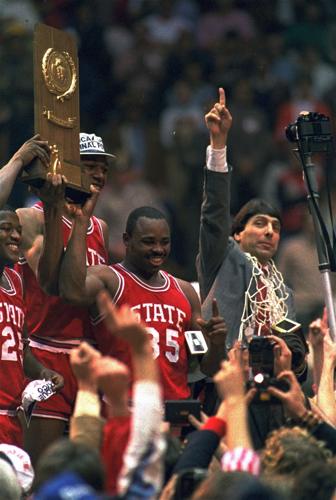
April 4, 1983: The NCAA Basketball Tournament Final is held at the University Arena, a.k.a. "The Pit," on the campus of the University of New Mexico in Albuquerque. It caps one of the great underdog stories in the Tournament's history.
Coached by Long Island native and former Rutgers player Jim Valvano, North Carolina State University was not expected to have a great season in 1982-83. They finished the regular season 17-10. They had beaten teams then ranked Number 20, West Virginia in a holiday tournament at the Meadowlands; Number 19 Georgia Tech at home, the Reynolds Coliseum in Raleigh; and Number 3 North Carolina at home. But they had also lost away to Number 14 Louisville, Number 15 Missouri away; Number 2 Virginia at home; Number 3 North Carolina away; Wake Forest in Greensboro; Number 6 Memphis State at home; Maryland away; Notre Dame at home; Number 3 Virginia away; and Maryland at home.

But the Wolfpack won the Atlantic Coast Conference Tournament at The Omni in Atlanta. They beat Wake Forest, then Number 5 North Carolina in overtime, and then Number 2 Virginia in the Final. They went into the NCAA Tournament, and beat Pepperdine in double overtime, 69-67. They upset Number 6 Nevada-Las Vegas (UNLV), 71-70. They beat Utah, 75-56, and played Virginia one more time, beating the Number 4 Cavaliers, 63-62.

The Final Four was held at the University of New Mexico's University Arena in Albuquerque. The court is actually below ground level, giving the place the nickname "The Pit." N.C. State beat Number 18 Georgia, 67-60. That set up a Final with the University of Houston. They won their Semifinal, 94-81 over the University of Louisville.

Coached by Guy Lewis, who had taken UH to the Final Four (not that the name was in use yet) in 1967 and 1968, they featured center Akeem "the Dream" Olajuwon (who would later start calling himself "Hakeem") and guard Clyde "the Glide" Drexler. Their high-flying, slam-dunking style led Houston Post sportswriter Thomas Bonk to think of college fraternities, and he nicknamed them "Phi Slama Jama."

The Cougars went into the Final 31-2 and ranked Number 1, having lost only away to Syracuse and to then-Number 1 Virginia in a tournament in Tokyo.

N.C. State went in 25-10. The starting lineup was guards Sidney Lowe and Dereck Whittenburg, forwards Lorenzo Charles and Thurl Bailey, and center Cozell McQueen. Their close games got them nicknamed the "Cardiac Pack." But Houston were favored by 7 1/2 points, and their experience of having gotten to the Final Four the season before made them look like they should win.

Uncharacteristically, Drexler was called for 4 fouls in the 1st half, with a 5th foul meaning dismissal from the game. N.C. State led at halftime, 33-25. Whatever Lewis told his Cougars in the locker room, it worked, as they went on a 17-2 run to take the lead. But with the arena's odd combination of being nearly a mile above sea level and having its court underground, Olajuwon left the game multiple times to receive oxygen. That forced the Cougars to slow the pace of the game in order to protect their lead.

Tied 52-52 with 44 seconds remaining, and with no shot clock in college basketball (it would be adopted for the 1985-86 season), the Wolfpack held the ball for a final shot attempt. Houston's Benny Anders narrowly missed stealing the ball as the clock ticked down. Whittenburg got the deflected ball about 30 feet from the basket, and launched a shot. It didn't quite go in, but Charles got it as it started to go down, and dunked it just before the clock ran out.

Final score: North Carolina State 54, Houston 52. It was N.C. State's 2nd National Championship, after coach Norm Sloan led them to the 1974 title.

It was one of the most stunning upsets in the history of college basketball. Valvano ran onto the court, looking as if he wasn't sure where he was going. He later said he was "looking for somebody to hug." It was reminiscent of another team in red and white, English soccer team Sunderland A.F.C., whose manager Bob Stokoe ran around the touchline to celebrate their big upset win over Leeds United in the 1973 FA Cup Final.

Thurl Bailey went on to play 11 seasons in the NBA, with the Utah Jazz and the Minnesota Timberwolves, before playing in Greece and Italy, and returning for 1 more season with the Jazz. Sidney Lowe played 4 seasons, for the Indiana Pacers, the Detroit Pistons and the Atlanta Hawks, and was an original Charlotte Hornet in 1988-89 and an original Minnesota Timberwolf in 1989-90. He then went into coaching, including as head coach of the Timberwolves, and 5 seasons at N.C. State, including 2 20-win seasons, although he was unable to get them into the NCAA Tournament.

Lorenzo Charles played the 1985-86 season with the Hawks, before playing in Italy, Spain, Turkey, Sweden and Uruguay. Cozell McQueen played 3 games for the Pistons in 1987, and also played in France, Italy and Spain. Dereck Whittenburg went right into coaching, including the head jobs at New York City schools Wagner (getting them into the 2003 NCAA Tournament) and Fordham, and 3 stints as an assistant at his Alma Mater, before returning to N.C. State as an assistant athletic director. Sophomore guard Terry Gannon went on to become a renowned sportscaster. And freshman guard Ernie Meyers became a broadcaster for N.C. State.

Valvano had previously coached Iona College into the NCAA Tournament in 1979 and 1980. He went on to get N.C. State back into the Elite Eight in 1985 and 1986. In 1990, an NCAA investigation cleared him of wrongdoing, but some of his players had broken rules, and it reflected badly on him. He was forced to resign, and titled his memoir Valvano: They Gave Me a Lifetime Contract, and Then They Declared Me Dead.

Nevertheless, Dave Didion, the NCAA investigator handling Valvano's case, wrote a personal letter to Valvano, saying, among other things, "If I had a son, I would feel comfortable with you as his coach and encourage him to learn from you."

Valvano was hired as a college basketball analyst by ESPN, but developed cancer, and died in 1993. The V Foundation for Cancer Research was founded in his name, and he was posthumously elected to the Basketball Hall of Fame. Lorenzo Charles died in 2011. As of April 4, 2022, the rest of the '83 Wolfpack are still alive.

Over the 1981-82, 1982-83 and 1983-84 seasons, the University of Houston went 88-16, including 71-12 in the regular season. The Cougars won the Southwest Conference title in 1983 and 1984. They made the NCAA Tournament Final Four all 3 seasons, and the Final in the last 2. With their "Phi Slamma Jamma" style, they did something even the Houston teams of Elvin Hayes in 1967 and '68 couldn't do: They made basketball cool to the football-crazy State of Texas.

But they couldn't take the final step. In 1982, they lost the Semifinal to North Carolina. In 1983, they lost this epic final to N.C. State. And in 1984, they lost the Final to Georgetown. It would take another 37 years before they reached the Final Four again. In between, the Houston Rockets made 3 NBA Finals, winning 2; the Dallas Mavericks made 2, winning 1; the San Antonio Spurs made 6, winning 5; and the University of Texas, Texas Tech and Baylor University each made a Final Four, with Tech reaching the 2019 Final and Baylor beating Houston in the 2021 Semifinal before beating Gonzaga to become the 1st Texas-based team to win a National Championship since Texas-El Paso (UTEP, then known as Texas Western) did so in 1966.

UPDATE: Houston reached the Final in 2025, losing to Florida. 

*

April 4, 1983 was a Monday. Ben Gordon, who helped the University of Connecticut win the 2004 National Championship, was born that day. So was actress Amanda Righetti.

As NCAA Tournament Finals tended to be in that era, it was also Opening Day for Major League Baseball, and there were 4 games that day:

* The Kansas City Royals beat the Baltimore Orioles, 7-2 at Memorial Stadium in Baltimore. Larry Gura outpitched Dennis Martinez. George Brett went 2-for-4 with a home run, a walk, and 2 RBIs. Willie Aikens and Jerry Martin also hit home runs for the Royals. For the O's, Eddie Murray and Cal Ripken Jr. each went 1-for-3 with a walk and an RBI. Despite this defeat, the Orioles went on to win the World Series.

* The Cincinnati Reds beat the Atlanta Braves, 5-4 at Riverfront Stadium in Cincinnati. Dave Concepción singled Eddie Milner home with the winning run in the bottom of the 8th, off Steve Bedrosian, who had relieved Phil Niekro. This made Mario Soto the winning pitcher. Johnny Bench, in what turned out to be his last season as a player, went 2-for-4 with an RBI. Ron Oester and Gary Redus hit home runs for the Reds, Chris Chambliss for the Braves.

* The Texas Rangers beat the Chicago White Sox, 5-3 at Arlington Stadium in the Dallas suburb of Arlington, Texas. Mike Richardt and Larry Parrish hit home runs. Mike Smithson started for the Rangers, but John Butcher was the winning pitcher, in relief, defeating LaMarr Hoyt. Despite this, Hoyt went on to win the American League Cy Young Award, and the White Sox won the AL Western Division title, before losing the AL Championship Series to the Orioles, who then beat the Philadelphia Phillies in the World Series.

* And the Cleveland Indians beat the Oakland Athletics, 8-5 at the Oakland Coliseum. Rick Sutcliffe outpitched Rick Langford. Andre Thornton hit a home run for the Tribe, while Toby Harrah went 4-for-6, but with no RBIs. Kelvin Moore homered for the A's. Rickey Henderson went 1-for-4 with a walk and a stolen base.

The NHL was between the end of its regular season and the start of the Stanley Cup Playoffs. There was 1 game in the NBA that night: The Seattle SuperSonics beat the Los Angeles Lakers, 121-111 at the Seattle Center Coliseum. David Thompson, the hero of N.C. State's 1974 National Championship, led all scorers with 31 points.

And there was 1 game in the USFL, the United States Football League: The Denver Gold beat the Michigan Panthers, 29-21 at the Silverdome in the Detroit suburb of Pontiac, Michigan.

Saturday, April 2, 2022

April 2, 1984: The Redemption of Georgetown

Fred Brown (left) hugged by John Thompson

April 2, 1984: Georgetown beat the University of Houston, 84-75 at the Kingdome in Seattle, and win the NCAA basketball tournament. The Hoyas become the 1st team in the Chesapeake region to win the National Championship. John Thompson becomes the 1st black head coach to win it.

As soon as the clock runs out, instead of hugging his best player, Patrick Ewing, he hugs Fred Brown, whose mistake helped cost Georgetown the title game 2 years earlier.
 
For the 3rd straight year, Houston's "Phi Slama Jama" of Hakeem "the Dream" Olajuwon and Clyde "the Glide" Drexler made the Final Four, but didn't win it. Over those 3 years, the Cougars went 88-16, including 71-12 in the regular season.

It must have been especially frustrating for head coach Guy Lewis, who had coached Houston to the Final Four in 1967 and 1968, with Elvin Hayes as his star. Now, he was 0-for-5 in Final Fours. He coached the Cougars from 1956 to 1986, and died in 2015. UH did not return to the Final Four until 2021.

(UPDATE: In 2025, they got back to the NCAA Final, but lost to Florida, making them 0-for-7 in Final Fours and 0-4 in Finals. No other team has been to 4 NCAA Tournament Finals without winning any.)

Georgetown would return to the title game in 1985, but lost to Villanova in one of the greatest games and greatest upsets in basketball history. Over Ewing's 4 years, the Hoyas went 121-23, including 69-6 in their last 2 years, which included a 29-game winning streak from February 25, 1984 to January 23, 1985. It was one of the best 4-year stretches in college basketball history, including 3 title games, but only 1 title.

In 1994, Olajuwon would lead the Houston Rockets to the NBA title, beating Ewing's New York Knicks. The following year, Drexler, after a Hall of Fame career with the Portland Trail Blazers, joined Olajuwon on the Rockets, and they won another title. Ewing never won one.

*

April 2, 1984 was a Monday. This was the Opening Day of the Major League Baseball season, and 3 games were played:

* The New York Mets lost to the Cincinnati Reds, 8-1 at Riverfront Stadium in Cincinnati. Mario Soto outpitched Mike Torrez.

* The Chicago White Sox beat the Baltimore Orioles, 5-2 at Memorial Stadium in Baltimore. Since Baltimore was then the closest MLB city to Washington, D.C., President Ronald Reagan attended, and revived the Presidential tradition of throwing out the ceremonial first ball. Previously, Presidents did so from "the Presidential box" in Washington. Reagan wore an Orioles jacket over a bulletproof vest, and threw the first ball from the mound, which had never been done by a President before, but has been done by them since.

Cal Ripken Jr. hit a home run. Eddie Murray went 1-for-4 with the Orioles' other RBI.

* The California Angels beat the Boston Red Sox, 2-1 at Anaheim Stadium (now Angel Stadium of Anaheim). Rod Carew went 2-for-4. Reggie Jackson did not play.

One game was played in the United States Football League (USFL): The Birmingham Stallions beat the New Orleans Breakers, 31-17 at Legion Field in Birmingham.

The NHL was between its regular season and the Stanley Cup Playoffs. There were 2 games played in the NBA. The New York Knicks beat the Chicago Bulls, 115-113 at Madison Square Garden. Quintin Dailey scored 44 in defeat for the Bulls. And the Utah Jazz beat the Houston Rockets, 111-100 at the Salt Palace in Salt Lake City, Utah. Adrian Dantley scored 37 for the Jazz.

Thursday, January 20, 2022

January 20, 1968: College Basketball's "Game of the Century"

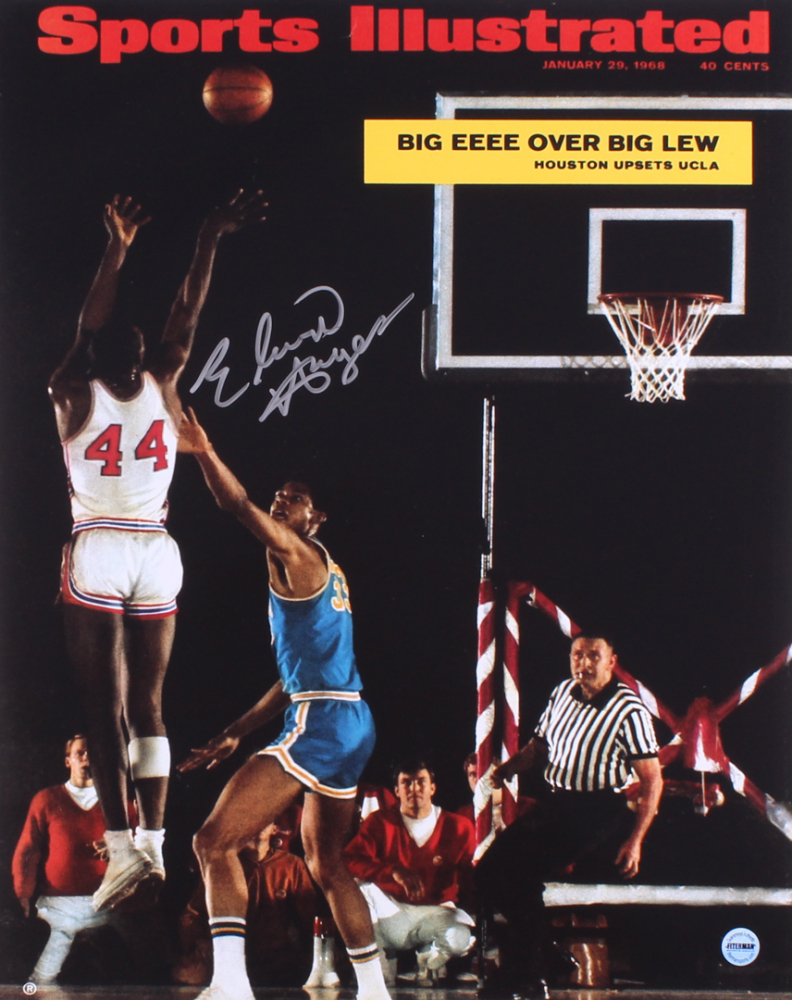
Elvin Hayes signed this SI cover,
even though his back was to the camera.

January 20, 1968: College football had experienced a few games with the "Game of the Century" label, including in both the 1966 and 1967 seasons. Now, it was college basketball's turn.

The University of California at Los Angeles -- UCLA -- had won the National Championship in 1964 and 1965. Then, Lew Alcindor -- who would later convert to Islam and change his name to Kareem Abdul-Jabbar, and I'll refer to him as "Kareem" hereafter -- arrived on campus from New York City. Until 1972, the NCAA prohibited freshmen from competing in varsity sports. But in his 1st appearance of any kind for UCLA, Kareem led the freshman team to victory over the varsity.

Head coach John Wooden knew he could bide his time until Kareem was eligible. Sure enough, in 1966-67, with sophomore Kareem leading the way, the Bruins went 30-0 and won the National Championship. Going into January 20, 1968, they had won 47 straight games, the 2nd-longest streak in college basketball history, behind the 60 straight of the University of San Francisco, 1955-57, mostly with Bill Russell.

The team the Bruins beat in the NCAA Final was the University of Houston. Coach Guy Lewis had his own big man, Elvin Hayes, known as the Big E. With Hayes and Don Chaney, Lewis had bravely integrated not just his own team, but basketball in the Southwest Conference.

Ted Nance was UH's sports information director. He talked to his counterpart at UCLA, J.D. Morgan, about putting together a nationally televised showcase game, a prime-time matchup with UCLA, using the "Game of the Century" label that had been applied to the 1966 football game between Michigan State and Notre Dame. Morgan talked Wooden into it. The label was cited in UH's football programs. And when UCLA's football team played USC in a "Game of the Century," it helped promote the basketball version -- even though UCLA lost the football version.

The problem was selling the game to a network willing to televise it. The Big Three -- NBC, CBS and ABC -- all passed on it. Basketball was far behind baseball and football in popularity. At this point, it probably wasn't even as popular as boxing and horse racing. The fact that it was "a black sport," with racial strife around the country, didn't help its image, although there had never been a racist incident on the court in either the NBA or in the college game.

Enter Eddie Einhorn. Later to be a co-owner of the Chicago White Sox, he founded TVS, a network that specialized in televising college basketball games, and syndicating them to "independent" stations (stations not affiliated with any network -- for example, in New York at the time, Channels 5, 9 and 11). 

Morgan offered Einhorn the use of UCLA's announcer, Dick Enberg, who also called games for the NFL's Los Angeles Rams. Einhorn paid $27,000 for the rights to the game, and signed up 120 stations, some of them affiliated with networks, pre-empting the regularly scheduled national programming. In New York, the game was broadcast on WPIX-Channel 11.

"Einhorn was a visionary," Enberg said, decades later, after becoming NBC's lead announcer for the NFL and college basketball, and adding baseball's California Angels and San Diego Padres to his grand record. "He was so far ahead of anyone in television at the time. He saw how truly big college basketball could be, and had a major hand in making all that happen. The networks were way, way behind Eddie Einhorn."

Instead of UH's 5,000-seat Delmar Fieldhouse, the game would be moved into the Astrodome. A compromise was reached when UH agreed to have the floor from the Los Angeles Memorial Sports Arena shipped in as the game's playing surface, although the center-court decal was customized, with the words "ASTRO DOME."

It was all set up. All that was necessary now was for the teams to remain undefeated, and to keep their preseason Number 1 (UCLA) and Number 2 (Houston) rankings intact. They got what they wanted: The Bruins won their 1st 13 games of the 1967-68 season, and the Cougars won their 1st 14.

A crowd of 52,693, the largest ever to see a basketball game in America at that point, saw a game that lived up to the hype. UCLA had a notable disadvantage: Kareem had sustained an eye injury, and was not at his best. This injury would recur, and lead to the familiar image of him wearing goggles on the court during his professional career.
Another check against Kareem, and therefore against UCLA: Because he had made so many dunk shots in 1966-67, the NCAA banned it. The fact that Hayes had also done a lot of dunks seemed to have escaped the press, who called it "The Lew Alcindor Rule." The rule was retracted in 1976, leading to the University of Louisville's 1980 "Doctors of Dunk" and UH's early 1980s "Phi Slamma Jamma" team. But that didn't help either the Bruins or the Cougars on this night.
$5.00 in 1968 would be roughly $40 in 2022.
Not a bad price for a "Game of the Century."

Tipoff was 8:00 PM Central Time -- 9:00 Eastern, and 6:00 Pacific (in other words, on the UCLA campus). At the half, Houston led, 46-43. Lewis did not have Hayes set to cover Kareem, but he did block 3 of Kareem's shots, and the fans at the Astrodome chanted, "Big E! Big E! Big E!"

Lucius Allen, later to be Kareem's teammate on the 1971 NBA Champion Milwaukee Bucks, sank 2 free throws with 2 minutes left, tying the game 69-69. Hayes had 4 fouls, but played as if this was his night, the game that would show the world what he could do. He took a shot, and was fouled by Jim Nielsen. He sank his free throws to put the Cougars up 71-69. They were his 38th and 39th points of the game, to lead all players on both sides. Kareem scored only 8.

With time running out, Allen put up a shot that couldn't go in. On UCLA's next possession, he looked for forward Lynn Shackelford, the team's best shooter. He found Shackelford, in the corner, unguarded. But All-American guard Mike Warren -- later to use the name Michael Warren as he played a policeman on Hill Street Blues -- thought the pass was for him, and he deflected it out of bounds.

With 10 seconds left, Hayes took an inbounds pass, and Kareem and Allen converged on him, hoping to force a turnover. He tried dribbling out the clock, but the 2 big Bruins wouldn't give up. Finally, with 3 seconds left, he managed to get off a pass to George Reynolds, and that was the ballgame. Houston was Number 1.

Earlier in the day, there was a news report about a U.S. Marine action in Vietnam. Most people at the game had already heard about it. So when Enberg interviewed Wooden after the game, he told Enberg, "Compared to what is happening worldwide, this is just another basketball game. We were defeated. We go on. But there are much more important things happening in our world to be concerned about."

"That was typical Wooden," Enberg said.

Also typical Wooden was picking his team up, and properly preparing them for the rest of the season. They didn't lose again. What would now be called the Final Four was held, interestingly enough, at the L.A. Sports Arena, on the exact same floor. UCLA played Houston in the Semifinal, and, with Kareem's eye injury cleared up, it was no contest: UCLA 101, Houston 69. The Bruins went on to beat North Carolina, coached by 37-year-old Dean Smith, in the Final, 78-55.

UCLA won the National Championship again in 1969, losing just 1 regular-season game, away to crosstown USC -- again, on the Sports Arena floor -- after the Pacific-Eight Conference title had already been decided. UCLA went 88-2 with Kareem playing, won the National Championship all 3 seasons, and Kareem was named the NCAA Tournament's Most Outstanding Player all 3 times.

College basketball got a huge boost from the "Game of the Century." It got another boost in 1974, when UCLA, having also won the National Championship in 1970, 1971, 1972 and 1973, set a new record with an 88-game winning streak, then lost to Notre Dame, and then to North Carolina State in the NCAA Semifinal. UCLA won one more title in 1975, and then Wooden retired, having won 10 titles.

Another boost to college basketball came in 1979, with a Final matchup between Earvin "Magic" Johnson of Michigan State, soon to be Kareem's teammate on the Los Angeles Lakers, and Larry Bird of Indiana State. Michigan State's win remains the most-watched college basketball game ever, and, while the term had been used before, the words "March Madness" became familiar.

Let Enberg have the final word: “Just for historical reference, I did what amounted to be the very first national telecast of the NCAA Finals and that was in 1961, when Cincinnati played Ohio State in Kansas City. That national telecast went to two cities; Cincinnati and Columbus, Ohio. That was it. We’re talking 1961 and this UCLA-Houston game is only seven years later, so I say that only to confirm the baby was delivered in the Astrodome on that night when Houston played UCLA.”

*

January 20, 1968 was a Saturday. Baseball and football were out of season. Almost unnoticed that day were 5 games played in the NBA:

* The Baltimore Bullets beat the Boston Celtics, 118-115 at the Baltimore Civic Center (now the CFG Bank Arena). The Bullets got 33 points from Gus Johnson, and 32 from Earl "the Pearl" Monroe. In defeat, Sam Jones scored 38, and John Havlicek 29.

* The Cincinnati Royals beat the Detroit Pistons, 128-120 at the Cincinnati Gardens. Oscar Robertson scored 32.

* The Philadelphia 76ers beat the Chicago Bulls, 135-111 at the Chicago Stadium. Bob Boozer led all scorers with 27, but, for the Sixers, Hal Greer had 26, Chet "the Jet" Walker had 24, and Wilt Chamberlain had 18 and 21 rebounds. That is not a misprint, children: Twenty-one rebounds in one game.

* The St. Louis Hawks beat the Seattle SuperSonics, 120-115 at the Kiel Auditorium in St. Louis. Lenny Wilkens scored 39 for the Hawks.

* And the Los Angeles Lakers beat the San Francisco Warriors, 151-122 at The Forum outside Los Angeles in Inglewood, California. Fred Hetzel scored 36 for the Warriors, but the Lakers got 30 from Elgin Baylor, 25 from Jerry West, and 20 from Darrall Imhoff.

And there was one game in the newly-founded American Basketball Association: The New Jersey Americans beat the Indiana Pacers, 106-96 at the Teaneck Armory. The Americans moved to Long Island the next season, and became the New York Nets.

There were 5 games played in the NHL:

* The New York Rangers beat the Oakland Seals, 3-0 at the Oakland Coliseum Arena.

* The Montreal Canadiens beat the Chicago Black Hawks, 3-1 at the Montreal Forum.

* The Boston Bruins beat the Philadelphia Flyers, 4-2 at the Boston Garden.

* The Toronto Maple Leafs beat the Minnesota North Stars, 5-1 at Maple Leaf Gardens in Toronto.

* The Pittsburgh Penguins beat the Detroit Red Wings, 8-5 at the Civic Arena in Pittsburgh.

* And the St. Louis Blues and the Los Angeles Kings were not scheduled.

Also, a North London Derby was held. Tottenham Hotspur hosted and beat Arsenal, 1-0.

December 31, 1999 & January 1, 2000: The Millennium

December 31, 1999:  The Millennium arrives. The people of planet Earth survived. At a terrible cost. But we hadn't destroyed ourselves. ...