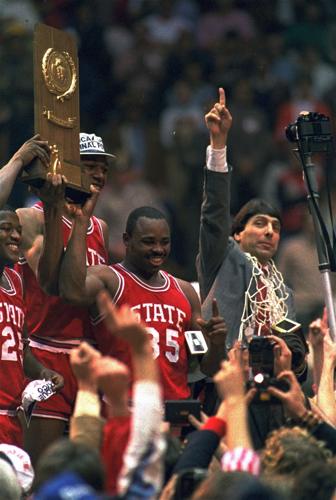
April 4, 1983: The NCAA Basketball Tournament Final is held at the University Arena, a.k.a. "The Pit," on the campus of the University of New Mexico in Albuquerque. It caps one of the great underdog stories in the Tournament's history.

Coached by Long Island native and former Rutgers player Jim Valvano, North Carolina State University was not expected to have a great season in 1982-83. They finished the regular season 17-10. They had beaten teams then ranked Number 20, West Virginia in a holiday tournament at the Meadowlands; Number 19 Georgia Tech at home, the Reynolds Coliseum in Raleigh; and Number 3 North Carolina at home. But they had also lost away to Number 14 Louisville, Number 15 Missouri away; Number 2 Virginia at home; Number 3 North Carolina away; Wake Forest in Greensboro; Number 6 Memphis State at home; Maryland away; Notre Dame at home; Number 3 Virginia away; and Maryland at home.
But the Wolfpack won the Atlantic Coast Conference Tournament at The Omni in Atlanta. They beat Wake Forest, then Number 5 North Carolina in overtime, and then Number 2 Virginia in the Final. They went into the NCAA Tournament, and beat Pepperdine in double overtime, 69-67. They upset Number 6 Nevada-Las Vegas (UNLV), 71-70. They beat Utah, 75-56, and played Virginia one more time, beating the Number 4 Cavaliers, 63-62.
The Final Four was held at the University of New Mexico's University Arena in Albuquerque. The court is actually below ground level, giving the place the nickname "The Pit." N.C. State beat Number 18 Georgia, 67-60. That set up a Final with the University of Houston. They won their Semifinal, 94-81 over the University of Louisville.
Coached by Guy Lewis, who had taken UH to the Final Four (not that the name was in use yet) in 1967 and 1968, they featured center Akeem "the Dream" Olajuwon (who would later start calling himself "Hakeem") and guard Clyde "the Glide" Drexler. Their high-flying, slam-dunking style led Houston Post sportswriter Thomas Bonk to think of college fraternities, and he nicknamed them "Phi Slama Jama."
The Cougars went into the Final 31-2 and ranked Number 1, having lost only away to Syracuse and to then-Number 1 Virginia in a tournament in Tokyo.
N.C. State went in 25-10. The starting lineup was guards Sidney Lowe and Dereck Whittenburg, forwards Lorenzo Charles and Thurl Bailey, and center Cozell McQueen. Their close games got them nicknamed the "Cardiac Pack." But Houston were favored by 7 1/2 points, and their experience of having gotten to the Final Four the season before made them look like they should win.
Uncharacteristically, Drexler was called for 4 fouls in the 1st half, with a 5th foul meaning dismissal from the game. N.C. State led at halftime, 33-25. Whatever Lewis told his Cougars in the locker room, it worked, as they went on a 17-2 run to take the lead. But with the arena's odd combination of being nearly a mile above sea level and having its court underground, Olajuwon left the game multiple times to receive oxygen. That forced the Cougars to slow the pace of the game in order to protect their lead.
Tied 52-52 with 44 seconds remaining, and with no shot clock in college basketball (it would be adopted for the 1985-86 season), the Wolfpack held the ball for a final shot attempt. Houston's Benny Anders narrowly missed stealing the ball as the clock ticked down. Whittenburg got the deflected ball about 30 feet from the basket, and launched a shot. It didn't quite go in, but Charles got it as it started to go down, and dunked it just before the clock ran out.
Final score: North Carolina State 54, Houston 52. It was N.C. State's 2nd National Championship, after coach Norm Sloan led them to the 1974 title.
It was one of the most stunning upsets in the history of college basketball. Valvano ran onto the court, looking as if he wasn't sure where he was going. He later said he was "looking for somebody to hug." It was reminiscent of another team in red and white, English soccer team Sunderland A.F.C., whose manager Bob Stokoe ran around the touchline to celebrate their big upset win over Leeds United in the 1973 FA Cup Final.
Thurl Bailey went on to play 11 seasons in the NBA, with the Utah Jazz and the Minnesota Timberwolves, before playing in Greece and Italy, and returning for 1 more season with the Jazz. Sidney Lowe played 4 seasons, for the Indiana Pacers, the Detroit Pistons and the Atlanta Hawks, and was an original Charlotte Hornet in 1988-89 and an original Minnesota Timberwolf in 1989-90. He then went into coaching, including as head coach of the Timberwolves, and 5 seasons at N.C. State, including 2 20-win seasons, although he was unable to get them into the NCAA Tournament.
Lorenzo Charles played the 1985-86 season with the Hawks, before playing in Italy, Spain, Turkey, Sweden and Uruguay. Cozell McQueen played 3 games for the Pistons in 1987, and also played in France, Italy and Spain. Dereck Whittenburg went right into coaching, including the head jobs at New York City schools Wagner (getting them into the 2003 NCAA Tournament) and Fordham, and 3 stints as an assistant at his Alma Mater, before returning to N.C. State as an assistant athletic director. Sophomore guard Terry Gannon went on to become a renowned sportscaster. And freshman guard Ernie Meyers became a broadcaster for N.C. State.
Valvano had previously coached Iona College into the NCAA Tournament in 1979 and 1980. He went on to get N.C. State back into the Elite Eight in 1985 and 1986. In 1990, an NCAA investigation cleared him of wrongdoing, but some of his players had broken rules, and it reflected badly on him. He was forced to resign, and titled his memoir Valvano: They Gave Me a Lifetime Contract, and Then They Declared Me Dead.
Nevertheless, Dave Didion, the NCAA investigator handling Valvano's case, wrote a personal letter to Valvano, saying, among other things, "If I had a son, I would feel comfortable with you as his coach and encourage him to learn from you."
Valvano was hired as a college basketball analyst by ESPN, but developed cancer, and died in 1993. The V Foundation for Cancer Research was founded in his name, and he was posthumously elected to the Basketball Hall of Fame. Lorenzo Charles died in 2011. As of April 4, 2022, the rest of the '83 Wolfpack are still alive.
Over the 1981-82, 1982-83 and 1983-84 seasons, the University of Houston went 88-16, including 71-12 in the regular season. The Cougars won the Southwest Conference title in 1983 and 1984. They made the NCAA Tournament Final Four all 3 seasons, and the Final in the last 2. With their "Phi Slamma Jamma" style, they did something even the Houston teams of Elvin Hayes in 1967 and '68 couldn't do: They made basketball cool to the football-crazy State of Texas.
But they couldn't take the final step. In 1982, they lost the Semifinal to North Carolina. In 1983, they lost this epic final to N.C. State. And in 1984, they lost the Final to Georgetown. It would take another 37 years before they reached the Final Four again. In between, the Houston Rockets made 3 NBA Finals, winning 2; the Dallas Mavericks made 2, winning 1; the San Antonio Spurs made 6, winning 5; and the University of Texas, Texas Tech and Baylor University each made a Final Four, with Tech reaching the 2019 Final and Baylor beating Houston in the 2021 Semifinal before beating Gonzaga to become the 1st Texas-based team to win a National Championship since Texas-El Paso (UTEP, then known as Texas Western) did so in 1966.
UPDATE: Houston reached the Final in 2025, losing to Florida.
*
April 4, 1983 was a Monday. Ben Gordon, who helped the University of Connecticut win the 2004 National Championship, was born that day. So was actress Amanda Righetti.
As NCAA Tournament Finals tended to be in that era, it was also Opening Day for Major League Baseball, and there were 4 games that day:
* The Kansas City Royals beat the Baltimore Orioles, 7-2 at Memorial Stadium in Baltimore. Larry Gura outpitched Dennis Martinez. George Brett went 2-for-4 with a home run, a walk, and 2 RBIs. Willie Aikens and Jerry Martin also hit home runs for the Royals. For the O's, Eddie Murray and Cal Ripken Jr. each went 1-for-3 with a walk and an RBI. Despite this defeat, the Orioles went on to win the World Series.
* The Cincinnati Reds beat the Atlanta Braves, 5-4 at Riverfront Stadium in Cincinnati. Dave Concepción singled Eddie Milner home with the winning run in the bottom of the 8th, off Steve Bedrosian, who had relieved Phil Niekro. This made Mario Soto the winning pitcher. Johnny Bench, in what turned out to be his last season as a player, went 2-for-4 with an RBI. Ron Oester and Gary Redus hit home runs for the Reds, Chris Chambliss for the Braves.
* The Texas Rangers beat the Chicago White Sox, 5-3 at Arlington Stadium in the Dallas suburb of Arlington, Texas. Mike Richardt and Larry Parrish hit home runs. Mike Smithson started for the Rangers, but John Butcher was the winning pitcher, in relief, defeating LaMarr Hoyt. Despite this, Hoyt went on to win the American League Cy Young Award, and the White Sox won the AL Western Division title, before losing the AL Championship Series to the Orioles, who then beat the Philadelphia Phillies in the World Series.
* And the Cleveland Indians beat the Oakland Athletics, 8-5 at the Oakland Coliseum. Rick Sutcliffe outpitched Rick Langford. Andre Thornton hit a home run for the Tribe, while Toby Harrah went 4-for-6, but with no RBIs. Kelvin Moore homered for the A's. Rickey Henderson went 1-for-4 with a walk and a stolen base.
The NHL was between the end of its regular season and the start of the Stanley Cup Playoffs. There was 1 game in the NBA that night: The Seattle SuperSonics beat the Los Angeles Lakers, 121-111 at the Seattle Center Coliseum. David Thompson, the hero of N.C. State's 1974 National Championship, led all scorers with 31 points.
And there was 1 game in the USFL, the United States Football League: The Denver Gold beat the Michigan Panthers, 29-21 at the Silverdome in the Detroit suburb of Pontiac, Michigan.


No comments:
Post a Comment