Showing posts with label university of chicago. Show all posts

Sunday, December 25, 2022

December 25, 1894: The 1st Intersectional College Football Game

Walter Camp

December 25, 1894: In a manner of speaking, the 1st holiday-season college bowl game is played on this day. Certainly, it was the 1st college football game, ever, between teams from 2 different parts of the country. And it was the 2 men most responsible for the development of American football who set it up and opposed each other in it.

Walter Camp had been one of the 1st great college football players, at Yale University in the late 1870s. In 1888, he became Yale's head coach, and one of his players on that great team was Amos Alonzo Stagg. Between them, they invented pretty much every feature that turned American football from a game resembling soccer and rugby to the game that became so popular in the 20th Century.
Amos Alonzo Stagg

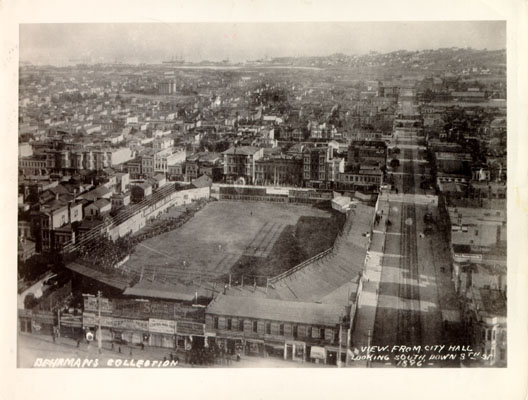
Both men went West to start college football programs, Stagg at the University of Chicago, Camp at the newly-founded Stanford University in the San Francisco Bay Area. They played at the Haight Street Grounds in San Francisco. Chicago beat Stanford 24-4.
The Haight Street Grounds stood from 1887 to 1895. It was actually not at Haight Street, but at the southeastern corner of Stanyan and Waller Streets, in the Haight-Ashbury district that would become the seat of the Hippie movement in the 1960s, at the southeastern corner of Golden Gate Park, about a block from where Kezar Stadium would later be built.

*

December 25, 1894 was a Tuesday. Baseball was out of season, hockey was all-amateur, basketball was a recent invention, and this was before college football was playing bowl games, let alone on Christmas Day.

But in England, soccer, or "football" as they call it, had a tradition: To keep traveling to a minimum, and thus families together, 2 nearby teams would play at one's home ground on Christmas Day, and at the other's on the next day, December 26, Boxing Day. This tradition began to die out in the 1950s, but Boxing Day games are still played.

On December 25, 1894, the London-based team which I would eventually support, then known as Woolwich Arsenal, played, but not against a nearby team: They hosted Burslem Port Vale, at the Manor Ground in Plumstead, Kent, later to be a part of Southeast London, and won, 7-0. Patrick O'Brien scored 3 goals -- not yet known as a "hat trick" in either ice hockey or association football.

Thursday, December 15, 2022

December 16, 1893: Antonín Dvořák's "New World Symphony"

December 16, 1893: Antonín Dvořák's Symphony No. 9 "From the New World" receives its première at Carnegie Hall in New York.

Antonín Leopold Dvořák was born on September 8, 1941 in Nelahozeves, in Bohemia, in what was then the Austrian Empire, now in Czechia or "the Czech Republic." A talented violinist as a boy, by 1873 he was regarded as one of the best in the world.

He began submitting the scores of symphonies and other works to German and Austrian competitions. In 1874, he won the Austrian State Competition, with Johannes Brahms on the jury of the Austrian State Competition. In 1877, Brahms recommended Dvořák to his publisher, Simrock, who commissioned what became the Slavonic Dances, Opus 46. This led to commissions that spread his fame to Britain and America in the 1880s, and Russia in 1890.

In 1892, he was appointed the director of the National Conservatory of Music of America in New York. While there, he wrote his 2 most successful orchestral works: His Symphony No. 9, titled From the New Worldwhich spread his reputation worldwide; and his Cello Concerto, one of the most highly regarded ever written.

But he was a patriot, for a country that was then subsumed by another, and wrote many pieces extolling what was then called "Czechoslovakia." Homesickness led him to return to Prague, the Czech capital, in 1895. He died on May 1, 1904, at the age of 62.

*

December 16, 1893 was a Saturday. There was 1 score on this historic day, a football game between schools 21 miles apart: The University of Chicago beat Northwestern University, 22-14, in a then-rare indoor football game, at Tattersall's Pavilion, at 17th and Dearborn Streets on the southern edge of downtown Chicago.

Saturday, December 10, 2022

December 10, 1935: The 1st Heisman Trophy Is Awarded

Jay Berwanger

December 10, 1935: The Heisman Trophy is awarded for the 1st time, to Jay Berwanger.

John Jacob Berwanger was born on March 19, 1914 in Dubuque, Iowa. Like every other football star of the era, he played both offense and defense, in the backfield in his case. Like baseball legend Honus Wagner, he was of German descent, but nicknamed "The Flying Dutchman."

In a 1934 game for the University of Chicago against Michigan, he collided with their center, and left him a permanent scar near his eye. That Michigan center was Gerald Ford, who later became the President of the United States. Both men ended up in the College Football Hall of Fame. In his senior year, 1935, he rushed for 577 yards, passed for 405, returned kickoffs for 359, scored 6 touchdowns, and kicked 5 points-after-touchdown. 

And yet, both seasons, the Chicago Maroons went only 4-4. This was part of a decline of a once-great program: In 1939, they went 2-6, closing on November 25 with a 46-0 home loss to Illinois. On December 22, the University of Chicago dropped its football program. It reinstated its program in 1969, on an NCAA Division III level, where they remain. The Big Ten Conference dropped to a Big Nine, until 1953, when they admitted Michigan State.

As a pre-television football star at a school that no longer plays at the top level, Berwanger probably would have been forgotten, if not for a vote made by the Downtown Athletic Club in New York. They decided to recognize "the most valuable college football player east of the Mississippi." The following year, the Club's athletic director, coaching legend John Heisman, died, and the award was renamed for him: The Heisman Memorial Trophy. It was also expanded to allow for the best player in the entire country.

The trophy, designed by sculptor Frank Eliscu, is modeled after Ed Smith, a leading player in 1934 for New York University (NYU). The two men were classmates at Manhattan's George Washington High School, and so, commissioned by the Downtown Athletic Club for a commissioned sculpture of a football player, he asked Smith to pose in his uniform.

Smith did not realize until 1982, when Sports Illustrated decided to have the model tracked down, that the sculpture for which he had posed had become the Heisman Trophy. The DAC presented Smith with a Heisman Trophy of his own in 1985, on its 50th Anniversary.

The trophy is made out of cast bronze, 13.5 inches tall, 14 inches long, 16 inches wide, and weighs 45 pounds. From its inception in 1935, the statue was cast by Dieges & Clust in New York, and later Providence, Rhode Island, until 1980, when Dieges and Clust was sold to Herff Jones. Since 2005, the trophy has been made by MTM Recognition in Del City, Oklahoma.
The 1st vote went to Berwanger, receiving 43 percent of the votes. For as long as the Trophy is awarded, he will be remembered as its 1st winner. It was awarded at the Downtown Athletic Club in Lower Manhattan from 1936 to 2000. The DAC's facilities were ruined as a result of the 9/11 attacks, and so the Yale Club took over hosting duties in 2001.

The DAC went out of business, and the Heisman Trust was created to award the Trophy and to do the other things that the DAC had done. The Marriott Marquis Hotel in Times Square hosted in 2002, '03 and '04. From 2005 to 2019, the ceremony was held across the street at the PlayStation Theater in Times Square. The COVID-19 epidemic prevented a full ceremony for 2020, and so the award was presented at the ESPN Studios in Bristol, Connecticut.  Since 2021, it has been held at Jazz at Lincoln Center.

As the player of the year, Berwanger was an easy choice to be the 1st pick in the 1st-ever NFL Draft, the following February. He was chosen by the team with the previous season's worst record: The Philadelphia Eagles.

But the Eagles also made the 1st-ever puzzling Draft Day move: Team owners Bert Bell (later to be the Commissioner of the NFL) and Lud Wray had heard that Berwanger was going to demand $1,000 per game (NFL contracts were per game back then, not per season), and they didn't think they could afford that, so they traded Berwanger's rights to the Chicago Bears, in exchange for tackle Art Buss. Buss played 2 seasons for the Eagles, having already played 2 for the Bears, and this is the most interesting thing about him.

But at least the Eagles got something for Berwanger's rights. The Bears got nothing. At first, Berwanger chose not to sign for the Bears, or any team for that matter, because he wanted to maintain his amateur status, so that he could compete in the decathlon at the 1936 Olympics in Berlin. Certainly, a worthy goal, and one that Bears owner, general manager and head coach George Halas could respect. The Olympics would be in early August, and the Bears' 1st game wouldn't be until September 20. Halas could afford to bide his time.

But Berwanger didn't make the Olympic team, and the Gold Medal in the decathlon went to another American, Glenn Morris, who had also played football, at Colorado A&M University (which became Colorado State in 1958). So Berwanger went to Halas, and asked for $15,000 for the season -- which worked out to $1,250 a game, more than the Eagles thought he would demand.

Halas was known for his cheapness, but was willing to go as high as $13,500. Berwanger declined, and got a job with a Chicago-based rubber company, and also coached at the University of Chicago until it dropped its football program in 1940. He never played a down of professional football, and told an interviewer that he regretted not having accepted Halas' offer.
Ed Smith was chosen in the 3rd round of that 1st draft, by the Washington Redskins. He played for them in 1936, and for the Green Bay Packers in 1937. He later worked for the Otis Elevator Company, and lived until 1998. Trophy sculptor Frank Eliscu lived until 1996. Berwanger died after a lengthy battle with lung cancer, at his home in the Chicago suburb of Oak Brook, Illinois, on June 26, 2002, at the age of 88. 

*

December 10, 1935 was a Tuesday. Football was in midweek. The NFL Championship Game was played the following Saturday: The Detroit Lions beat the New York Giants, 26-7 at the University of Detroit Stadium.

Baseball was out of season. The NBA hadn't been founded yet. There were 2 games played in the NHL. The New York Americans beat the Toronto Maple Leafs, 4-2 at the old Madison Square Garden. And the Boston Bruins beat the Montreal Maroons, 2-0 at the Boston Garden.

Wednesday, November 30, 2022

November 30, 1905: Chicago vs. Michigan, College Football's 1st "Game of the Century"

Walter Eckersall

November 30, 1905: The Championship of college football's Western Conference -- forerunner of the Big Ten -- is decided at Marshall Field in Chicago, named for the department store mogul who funded its construction. It becomes the 1st of many college football games referred to as "The Game of the Century."

The University of Chicago, coached by Amos Alonzo Stagg, came into the game at 10-0. They had allowed only 5 points all season, in a 16-5 win over Indiana. They had scored 44 points against Illinois, 42 each against Iowa and Beloit College, 33 against Lawrence University, and 32 against Northwestern.

They were led by Walter Eckersall, and, while quarterback was a very different position at the time, with the forward pass not legalized until the next season, he was widely regarded as the best player in the country. Stagg, later to be known as "The Grand Old Man of Football," called Eckersall "a selfless performer, marked by complete dedication to victory."

Future Notre Dame star end and coach Knute Rockne grew up in Chicago, and saw Eckersall play in both high school and college. He said of Eckersall, "The first time I learned a football was not only something to kick, but something to think with, was when I saw a great football player in action."

Stagg had recruited Eckersall out of Hyde Park High School, on the city's South Side, not far from the UC campus. Fielding Yost had also tried to recruit him, for the University of Michigan. There, Yost had such a high-powered offense that they were known as "The Point-a-Minute Team." They came in at 12-0: 65-0 over Ohio Wesleyan, 44-0 over Kalamazoo College, 36-0 over Case University, 23-0 over Ohio Northern, 18-0 over Vanderbilt, 31-0 over Nebraska, 70-0 over Albion, 48-0 over Drake, 33-0 over Illinois, 40-0 over Ohio State, 12-0 over Wisconsin, and 75-0 over Oberlin.

Granted, this 495-0 performance wasn't exactly against a modern Football Bowl Subdivision "Power 5 Conference" schedule. And only one of those games, the win over Illinois, was played away from Regents Field in Ann Arbor, Michigan. It should be noted that Wisconsin came closer than anybody to beating each team, having come within 4-0 of Chicago.

Since the start of the 1902 season, the Chicago Maroons were 46-4-3. But the Michigan Wolverines were 54-0-1 in their last 55 games. Their last loss? November 29, 1900, 15-6 -- against Chicago at Marshall Field. The showdown was set for Thanksgiving Day, and a crowd of 27,000, believed to be the largest in college football history to that point, filed into Marshall Field. (At the time, Thanksgiving Day was the last Thursday in November. It became the 4th Thursday in November in 1941.)

At first, the game was a punting duel between Eckersall and Michigan's John Garrels. It was scoreless early in the 3rd quarter, when a Garrels punt and a penalty pinned Chicago inside its own 10-yard line. On third down, as Eckersall attempted to punt, he encountered a fearsome rush, but evaded the Michigan tacklers, and was able to scramble to the 22-yard line and a 1st down.

After 3 more 1st downs, the drive stalled and Chicago were forced to punt again. Eckersall's booming punt carried into the end zone, where it was caught by Michigan's William Dennison "Denny" Clark, who attempted to run the ball out. He advanced the ball forward to the 1-yard line, but was hit hard by Art Badenoch, and then was brought back inside his own end zone by Mark Catlin.

Under the rules of the time, forward progress was not credited, and a ball carrier could be carried backwards or forwards until he was down. Therefore, Chicago were credited with a safety: 2 points. And that would produce the final score: Chicago 2, Michigan 0. Michigan's streak was over, and Chicago were awarded the Western Conference and National Championships.

Football observers like to say, "Defense wins championships." This is hardly ever true: You can't win if you don't score, and you can't score if you don't have the ball; and, if you have the ball, by definition, you are on offense. This time, defense really did win a Conference and a National Championship. The only other major football championship ever decided on a safety was the 1929 Rose Bowl, the Roy Riegels Game. (I have an entry for that event.)

Clark received the blame for the Michigan loss, and tried to live with it, but couldn't. In 1932, he shot and killed himself. He was 48 years old. In a suicide note to his wife, he reportedly expressed the hope that his "final play" would be of some benefit in atoning for his error at Marshall Field.
Denny Clark

Chicago would see its 14-game winning streak end on November 10, 1906, defeated by Minnesota. Since there was, as yet, no real professional football to speak of, Eckersall became a college football referee, considered the finest of his era. He also became a writer on the game for the Chicago Tribune. At the end of each season, as a counterweight to the Eastern-heavy "All-American" team selected by former Yale coach Walter Camp, Eckersall named an "All-Western" team, and it was considered prestigious in its day.

But "Eckie" was a heavy drinker, and died of cirrhosis of the liver on March 24, 1930. He was only 43 years old, and, to protect his public image, the Tribune reported the cause of death as a heart attack.

In 1949, the Chicago Public Schools constructed a sporting facility on the South Side, at 2423 East 82nd Street, named "Walter Eckersall Stadium." Eckersall, Stagg and Yost would all be charter inductees into the College Football Hall of Fame in 1951.

*

November 30, 1905 was a Thursday. Among the other notable college football games played that Thanksgiving Day: Alabama beat Tennessee, 29-0; Auburn beat Georgia, 20-0; Georgia Tech beat Clemson, 17-0; Holy Cross beat Fordham, 28-5; Indiana beat Ohio State, 11-0; Iowa beat St. Louis University, 31-0; Iowa State beat cross-State rival Drake, 17-12; Kansas beat arch-rival Missouri, 24-0 in Kansas City; Nebraska beat Illinois, 24-6; North Carolina beat Virginia, 17-0 in Norfolk, Virginia; Penn State beat the University of Pittsburgh, 6-0; the University of Pennsylvania beat Cornell, 6-5; and Utah beat Colorado State, 24-0.

Rutgers, Princeton, Harvard and Yale all completed their seasons the preceding Saturday. Army and Navy had the week off, to prepare for each other: They tied, 6-6, at Princeton's University Field.

Sunday, November 13, 2022

November 14, 1908: Cornell vs. Chicago In the Snow

Stagg's Maroons. Note the shape of the ball.

November 14, 1908: American football has had several "snow bowls" in its history. This may have been the first.

Alone among the schools that would later be included in "the Ivy League," Cornell University is nowhere near what would come to be called "the Northeast Corridor." Dartmouth College, in Hanover, New Hampshire, isn't quite on it. But the rest are. From north to south: Harvard University in Cambridge, Massachusetts, across the Charles River from Boston; Brown University in Providence, Rhode Island; Yale University in New Haven, Connecticut; Columbia University in New York City; Princeton University in Princeton, New Jersey; and the University of Pennsylvania in Philadelphia.

In contrast, Cornell is not only, by far, the newest of the Ivies, having been founded by Ezra Cornell in 1865, but it is the furthest away: In Ithaca, New York, 223 miles northwest of Midtown Manhattan, and just 51 miles southwest of Syracuse University, which, like its Keystone State counterpart, Pennsylvania State University in State College, is a convenient marker separating "the Northeast" as a region of the United States from "the Midwest."

Nevertheless, because of its inclusion with the Ivy League, Cornell is generally considered a "Northeastern" school, and so its contest on this date with the University of Chicago was considered an "intersectional" matchup.

UC's location on the South Side of the Midwest's biggest city belies the fact that, if there was a Midwestern equivalent to the Ivy League, it would be one of the schools in it, as would the school just north of the city in Evanston, Illinois, which, reflecting the early history of America, is named Northwestern University. Both UC and NU started out in the league that would become known as the Big Ten Conference. UC dropped its football program in 1940, and despite looking so bad, so many times, over the ensuing years, that it seems like they'd dropped football, Northwestern remains in the Big Ten.

Chicago came into the game 4-0, having beaten Purdue, Indiana, Illinois and Minnesota, and only Illinois had gotten close. Cornell had not been as dominant in their wins, but they still came in at 6-0, having beaten Hamilton, Oberlin, Colgate, the University of Vermont, Penn State and Amherst.

The game was played at Marshall Field in Chicago. The stadium was named for the department store of the same name, which was named by its owner, of the same name, a major UC donor. But both teams were coached by the men for whom their next home field would be named: UC by Amos Alonzo Stagg, who, along with his fellow Yalie, Walter Camp, had done so much to create American football through standardization of the rules; and Cornell by Henry Schoellkopf.

Speaking of those rules: It was a different time. The forward pass had been legalized only 2 years before, but there were still restrictions on it, and it was rarely used. It would not be a factor in this game, even if the weather had been good. The field was 110 yards long, kickoffs were done at midfield, it was 3 downs to gain 10 yards, a touchdown was worth 5 points, and a field goal was worth 4 points.

In 1912, these would all be changed: The field would become 100 yards, a team would kick off from its own 40-yard line, it would be 4 downs to gain 10 yards, a touchdown would be worth 6 points, and a field goal would be worth 3. Men who could kick the ball a long way would still be important, but not nearly as important, moving American football even further from its English ancestors, soccer and rugby.

As for that weather: It snowed throughout the game, making running difficult, kicking and punting harder, and passing would have seemed to be all but impossible. It probably didn't help however many fans came out -- no attendance figure appears to have been recorded -- that both teams traditionally wore red: Cornell's teams have always been called the Big Red, while Chicago's were the Maroons.

Cornell scored in the middle of the first half, on a touchdown pass from Gardner to Mowe. The extra point was good, and their 6-0 lead held until the final minute of play. In the Chicago Daily Tribune, I.E. Sanborn wrote, "In a hard fought, exciting but poorly played game Chicago and Cornell broke-even on Marshall field yesterday, the final score being 6 to 6, leaving the question of supremacy between east and west suspended in the snow laden air."

Hard to believe that both UC and Cornell have good journalism schools.

Sanborn called the tying play a "triangular pass," "Steffen to Page to Schommer." Walter Steffen, later a city Alderman and Judge, was the captain and quarterback; Harlan Page, later UC's basketball and baseball coach, was an end; and John Schommer, who has been called basketball's first superstar, was a halfback.

So the "triangular pass" was probably a forward pass from Steffen to Page, and then a lateral from Page to Schommer. What would later be called a "hook and ladder," which, as Don Shula, who pulled it off a few times, pointed out is a corruption of its original name, "hook and lateral."

The following week, Chicago won a close one over Wisconsin, to finish 5-0-1, to win the league title. Cornell beat Trinity College of Connecticut. However, in what had already become their traditional Thanksgiving Day rivalry game, they went to Philadelphia to play Penn, and lost. They finished 7-1-1. Had there been an Ivy League at the time, Penn would have won the title.

*

November 14, 1908 was a Saturday. These other notable college football games were played:

* Harvard beat Dartmouth, 6-0 at Harvard Stadium in Boston.

* Brown beat Vermont, 12-0 at Andrews Field in Providence, Rhode Island.

* Syracuse beat Tufts, 28-0 at Archbold Stadium in Syracuse, New York.

* Army played Washington & Jefferson to a tie, 6-6 on The Plain in West Point, New York.

* Navy beat Penn State, 5-0 at Worden Field in Annapolis, Maryland.

* North Carolina beat South Carolina, 22-0 at Campus Athletic Field in Chapel Hill, North Carolina.

* The Carlisle Indian School -- with Jim Thorpe as a freshman -- beat the University of Pittsburgh, 6-0 at Exposition Park in Pittsburgh.

* Georgia and Alabama played to a tie, 6-6 at the Birmingham Fairgrounds in Birmingham, Alabama.

* Tennessee beat Clemson, 6-5 at Waite Field in Knoxville, Tennessee.

* In an intersectional matchup, Ohio State beat Vanderbilt, 17-6 at Dudley Field in Nashville.

* In yet another intersectional matchup, this one a battle of unbeatens like Cornell vs. Chicago, Penn beat Michigan, 29-0 at Ferry Field in Ann Arbor, Michigan. 

* Illinois beat Purdue, 15-6 at Stuart Field in West Lafayette, Indiana.

* Missouri beat Washington University of St. Louis, 40-0 at Rollins Field in Columbia, Missouri.

* Kansas beat Nebraska, 20-5 at Nebraska Field in Lincoln.

* In what would have been a battle of unbeatens had Princeton not lost to Dartmouth at the Polo Grounds the week before, Yale beat Princeton, 11-6 at University Field in Princeton, New Jersey.

* In contrast, New Jersey's other major team played a much less significant game, but won it: Rutgers beat Muhlenberg, 15-5 at Neilson Field in New Brunswick.

Thursday, March 24, 2022

March 25, 1908: College Basketball's 1st Great Team

March 25, 1908: Perhaps the 1st great college basketball team wins perhaps the 1st great college basketball game. John Schommer hits an 80-foot shot with seconds remaining, and the University of Chicago closes its season with a 16-15 victory over the University of Pennsylvania, in Philadelphia.

The season before, on March 23, 1907, Chicago beat the Central YMCA, 22-19 at the Bartlett Gymnasium on the UC campus. This was the early days of basketball, which was founded at a YMCA in Springfield, Massachusetts, only a little over 15 years before. Such a matchup would never be scheduled today.

Nevertheless, the Chicago Maroons completed their season, with a record of 15-2. Their only 2 losses had been on March 6, away to the University of Wisconsin; and on March 16, home to the University of Minnesota.

This was their 1st season under head coach Joseph Raycroft. John Schommer and Albert Houghton were named All-Americans. At the time, freshmen were allowed to play on the varsity, which would later be banned, except for wartime conditions and other unusual circumstances (such as disasters), until 1972.

In 1907-08, with Schommer leading the way as a junior, the Maroons went 23-2, losing on January 21, away to the aforementioned Central YMCA; and on January 31, again away to Wisconsin. Known as "Mr. Everything," Schommer also lettered in baseball, football and track.
John Schommer

In 1908-09, they went 12-0, completing a 3-year run of 50-4. Schommer became the 1st-ever 4-time basketball All-American, with Pat Page also making the team. In each of those 3 seasons, Chicago won the title in the Western Conference, the league that would become known as the Big Ten; and were, decades later, retroactively recognized as National Champions by the Helms Foundation.

Schommer succeeded Raycroft as head coach, but only coached in the 1911-12 season. But there was no professional league in which he could play, so he refereed Big 10 basketball games until 1940. In 1959, he became 1 of the 1st 4 players elected to the Basketball Hall of Fame. He died in 1960. Raycroft later led Princeton University's Department of Health and Physical Education. He died on September 30, 1955, the same day as James Dean.

In 1939, Robert Maynard Hutchins, president of the University of Chicago dropped varsity sports, believing it to have become overemphasized. Michigan State eventually took Chicago's place in the Big 10. A sports program was revived at UC in 1973, at the NCAA Division III level.

*

March 25, 1908 was a Wednesday. Baseball was in Spring Training. Football was out of season. Professional basketball barely existed. And the Stanley Cup Finals was won earlier in the month by the Montreal Wanderers, the team known as "The Little Men of Iron" winning their 3rd Cup, in a run of 5 out of 6.

December 31, 1999 & January 1, 2000: The Millennium

December 31, 1999:  The Millennium arrives. The people of planet Earth survived. At a terrible cost. But we hadn't destroyed ourselves. ...