Showing posts with label private detective. Show all posts

Wednesday, November 23, 2022

November 24, 1887: Sherlock Holmes Debuts

Jeremy Brett as Holmes, in the PBS
anthology series Mystery!, sometime in the 1980s

November 24, 1887: The British magazine Beeton's Christmas Annual is published. It sells out before Christmas, largely on the strength of a novel whose text it contains: A Study in Scarlet, by Dr. Arthur Conan Doyle. The story introduces the character of consulting detective Sherlock Holmes, and his assistant, Dr. John H. Watson.

Watson was based on Conan Doyle himself. (He used "Conan Doyle" as a compound surname, but Britain's list of knighthoods, and most libraries, list him alphabetically under D for "Doyle.") Born on May 22, 1859 in Edinburgh, Scotland, as Arthur Ignatius Conan Doyle, his mother was Irish Catholic, and his father's parents were as well, but he left the Church as a young man and became an agnostic.

He attended the University of Edinburgh Medical School, and studied botany at the Royal Botanical Garden there. He would have Holmes frequently rely on his knowledge of botany, particularly in how some plants are poisonous.

One of his professors was Dr. Joseph Bell (1837-1911), and it was on him that Conan Doyle based Holmes, writing to him in 1892, "It is most certainly to you that I owe Sherlock Holmes... Round the centre of deduction and inference and observation which I have heard you inculcate I have tried to build up a man."

Another University of Edinburgh graduate (though not of its medical school) who turned to writing, Robert Louis Stevenson, used Holmes-like deduction to figure it out, writing to Conan Doyle, "My compliments on your very ingenious and very interesting adventures of Sherlock Holmes... Can this be my old friend Joe Bell?"

In September 1879, Conan Doyle was published for the first time, both with an academic article and a short story. And -- relevant to the 2020s -- he was a staunch supporter of early vaccination and a denouncer of anti-vaccinators.

In 1885, he married Louisa Hawkins, and they had a daughter named Mary Louise and a son named Arthur Kingsley. Known as "Kingsley," he was wounded in World War I, and died of pneumonia just 14 days before the Armistice. Louisa died of tuberculosis in 1906. The following year, he married Jean Leckie, and they had a son named Denis, a son named Malcolm, and a daughter named Jean.

He earned his medical doctorate, but was unsuccessful in the practice of medicine. In 1886, he wrote A Study in Scarlet, and it was accepted for publication by Ward Lock & Co., although they waited an entire year to print it in their Beeton's Christmas Annual. It got excellent reviews, and Ward Lock commissioned a sequel, which became The Sign of the Four.

In 1890, having fulfilled this commitment, and not liking the way he was being exploited, Conan Doyle stuck to writing short Holmes stories for The Strand magazine, and it through these stories that Holmes is best remembered.
Conan Doyle took the name and profession, but nothing else, from Dr. James Watson, once a colleague in Portsmouth, Hampshire, England. Dr. John H. Watson narrated most of Holmes' stories. There was a Chief Inspector William Sherlock whose name was frequently  in the London newspapers, and Conan Doyle was find of the poetry of American writer Oliver Wendell Holmes.

It has been suggested that there was then a popular cricket player named Sherlock who inspired the detective's name, but this idea is usually dismissed. Nevertheless, Conan Doyle was a keen sportsman, and loved cricket, playing 10 first-class matches for the Marylebone Cricket Club at Lords. He played for an Authors XI alongside James M. Barrie (creator of Peter Pan), P.G. Wodehouse (Jeeves and Wooster) and A.A. Milne (Winnie the Pooh). As a bowler (equivalent in baseball to the pitcher), he had one first-class wicket (major league strikeout): W.G. Grace, a fellow physician, who was then regarded as the greatest batsman the sport had ever known.

He previously played as a goalkeeper for Portsmouth Association Football Club, while practicing medicine in the city. (That team went out of business in 1896, and the current Portsmouth Football Club -- "Play up, Pompey!" -- was formed 2 years later.) In 1901, he was 1 of 3 judges for the world's 1st major bodybuilding competition.  In 1908, he was a judge for the Olympic Games held in London, and was one of the judges who assisted Dorando Pietri after he fell on the final lap of the marathon, leading to Pietri's disqualification.

He had been an amateur boxer and, while on a lecture tour of America in 1910, was invited by boxing promoter Tex Rickard to referee the Heavyweight Championship fight between Jack Johnson and Jim Jeffries. He declined, citing the distance and his schedule. (Rickard ended up refereeing the fight himself, which Johnson won by a 15th round knockout.) That same year, he was elected captain of the Crowborough Beacon Golf Club in Sussex. He entered the English Amateur billiards championship in 1913. And some time that he spent in Switzerland, before creating Holmes, led to a love of skiing.

But his time spent in Switzerland also inspired the "death" of Holmes. He wanted to write about other things. Inspired by the  "scientific novels" of Jules Verne -- H.G. Wells had not yet tried the genre, and Hugo Gernsback had not yet coined the phrase "science fiction" -- he created the scientist Professor Challenger, including The Lost World, one of the 1st pieces of fiction to incorporate dinosaurs. He created Brigadier Gerard, an officer in Napoleon's Grand Armée. He created Sir Nigel Loring, a knight in the Hundred Years War.

His scientific and historical fiction got him the best reviews of his career. But the general public wanted more and more of Holmes. Conan Doyle couldn't take it anymore: In 1893, he published The Final Problem. He created a villainous equal for Holmes, Professor James Moriarty. Though Moriarty appeared in only this story, Holmes told Watson that they had been in a battle of wits for years.

They made their way to the Reichenbach Falls, a real place in the Bernese Oberland of Switzerland. There, according to the story, on May 4, 1891, 10 years after Holmes and Watson first met, Holmes and Moriarty fight, and tumble over a protective fence to their deaths. From such a height, neither could have possibly survived.

Holmes fans were furious! How dare the man who created their hero kill him! Conan Doyle got death threats in the mail. He was attacked on the street, by men with umbrellas and women with purses. It was the first "toxic fandom" in the history of popular culture.

It also produced some of the earliest "fanfiction," as people began writing their own Holmes stories, not considering copyright laws. As you might guess, this included some pornographic stories, some involving Holmes and Irene Adler, and some even involving a homosexual relationship between Holmes and Watson, thus inventing what came to be known -- after similar "Kirk/Spock" stories by whacked-out female Star Trek fans -- in the 1970s as "slash fiction."

Irene Adler, like Moriarty, canonically appeared only once, in A Scandal in Bohemia, but to Holmes would always be "the woman," though Watson specifically said that Holmes held only respect for her: "It was not that he felt any emotion akin to love for Irene Adler." Later film adaptations of Holmes would romantically link them, however. And author William S. Baring-Gould, a Holmes expert, suggested that Rex Stout's fictional private detective, Nero Wolfe, was the illegitimate son of Sherlock and Irene, the result of an affair after meeting again sometime after the incident at the Reichenbach Falls.

Bowing to pressure, in 1901, Conan Doyle published a full-length novel, The Hound of the Baskervilles, obviously taking place before Holmes' death. This only increased the demand for more Holmes stories. In 1903, Conan Doyle gave in, writing The Empty House, and explaining how Holmes survived the Reichenbach Falls. Fandom had its 1st victory over the "cancellation" of a popular series. It would not happen again until the aforementioned Star Trek, 65 years later.

Though associated with the Victorian era, and (within his fictional world) known all over Europe for his detective work, the character of Holmes was never knighted by Queen Victoria. Nor was he knighted by her son, King Edward VII; nor by his son, King George V. But in 1902, King Edward did knight Conan Doyle -- not for his Holmes stories, but for his recent writings supporting the country, its government, and its Army in the Boer War.

In 1917, Conan Doyle published His Last Bow, which depicts Holmes and Watson, by then in their 60s, aiding the British government against the German Empire in the Summer of 1914, on the eve of World War I. As late as 1927, he was publishing Holmes stories, taking place between The Empty House and His Last Bow, and having Watson assure readers that Holmes, who had taken to beekeeping, "is long retired from his profession of detective but is still alive and well, albeit suffering from a touch of rheumatism."

Conan Doyle died on July 7, 1930, at 71, from a heart attack, at Windlesham Manor, his house in Crowborough, Sussex, about 40 miles south of London. He was buried in Minstead Churchyard in New Forest, Hampshire. His wife Jean died in 1940. None of his 5 children had children of their own, so, with his daughter Jean's death in 1997, the bloodline of Arthur Conan Doyle died out.

Baring-Gould, who placed Holmes' birth in 1854, considered the date of the creator's death to also be that of the creation. But Holmes lives on. His best known portrayal remains that of Basil Rathbone, in 14 films between 1939 and 1946. Some were set in Holmes' original period, but some were set in the present, and featured Holmes and Watson riding in automobiles and fighting Nazis, with Holmes wearing a fedora hat instead of a deerstalker cap. Nigel Bruce's portrayal rendered Watson as something of a bumbler, unworthy of standing alongside Holmes, for a generation of fans.

From 1970 to 2012, PBS' Sesame Street featured a Muppet named Sherlock Hemlock, voiced by Jerry Nelson, better known as the voice of The Count. Jeremy Brett played Holmes in 41 episodes of a Granada TV series from 1984 to 1994, which were broadcast in America as part of PBS' anthology series Mystery! Dr. Watson was played by David Burke in the 1st season, and Edward Hardwicke thereafter.

In 1987, the CBS movie The Return of Sherlock Holmes told the story of Jane Watson (Margaret Colin), the Doctor's great-granddaughter, a private detective living in present-day Boston, inheriting her family's English property, which included a cryogenic chamber in which Holmes (Michael Pennington) had frozen himself after being infected with plague. After getting him cured, he sees that modern London is no place for him, so she takes him home, his first experience on an airplane. Together, they solve a murder as he adjusts to the late 20th Century.

I was working at a movie theater in 1988 when Without a Clue was shown there. Ben Kingsley played Watson, and his creation, Holmes, had proven so popular that he hires an actor, Reginald Kincaid, played by Michael Caine, to play Holmes for the public. Together, they -- actually, just Watson, as Kincaid is called by Watson "You idiot!" to his face and, correctly, "a gambler, a womanizer, and a drunkard!" to others -- solve crimes, but Holmes gets the public credit. When Watson is kidnapped by Moriarty, Kincaid must take the lead for the first time, and be a real Holmes for the first time. With help from Mrs. Hudson, the landlady at 221b Baker Street, and a kid from the Baker Street Irregulars, he defeats Moriarty and closes the case.

More recently, 2 Holmes films have been made with Robert Downey Jr.; the TV series Sherlock, starring Benedict Cumberbatch as a present-day Holmes, also shown on PBS' Mystery!; and the CBS series Elementary, with Jonny Lee Miller as a present-day Holmes moving from London to New York, where he meets Dr. Joan Watson, a divorcée born Joan Yun (Lucy Liu). Despite Watson now being a woman, the series never made them a romantic couple.

That show's title brings up an important point. Arthur Conan Doyle never, not even once, had Sherlock Holmes say to his partner the words, "Elementary, my dear Watson." Rathbone used it, making it forever identified with the character, but Conan Doyle didn't. He did have Holmes use the word "elementary" a few times, and call his partner "my dear Watson" a few times (other times, "my dear fellow"), but never paired them up.

In the Marvel Cinematic Universe, Cumberbatch played Dr. Strange, while Downey played Iron Man. I think the Marvel writers missed an opportunity: Neither actor had the chance in any Marvel film to say to the other, "No shit, Sherlock!"

As for the world's most famous address: During Conan Doyle's lifetime, addresses on London's Baker Street did not go as high as 221, but the street was later extended. In 1932, the Abbey National Building Society moved into a complex at 219 to 229 Baker Street. Abbey National employed a full-time secretary to answer mail that came to 221b, addressed to Holmes. Abbey House closed in 2005. Since then, the Sherlock Holmes Museum, at 237 to 241 Baker Street, NW1 6XE, has had legal ownership of the building at 221b.

In a 2012 episode of the YouTube series Epic Rap Battles of Historyrapper-comedian Zach Sherwin played Sherlock Holmes, and Saturday Night Live castmember Kyle Mooney played Dr. John Watson, against "Nice" Peter Shukoff as the Christian Bale version of Batman, with "Epic" Lloyd Ahlquist, incongruously, as the Burt Ward version of Robin.

*

November 24, 1887 was a Thursday. Erich von Manstein was born on this day. He became a Field Marshal of the Wehrmacht, Nazi Germany's army, and was convicted of war crimes. He served 4 years in prison, and, under NATO supervision, led the rebuilding of West Germany's armed forces.

In America, it was Thanksgiving Day. So, while baseball season was over, hockey hadn't yet come over the Canadian border, basketball hadn't yet been invented, and football hadn't yet gone professional, there was college football played that day:

* Yale beat Harvard in "The Game," 17-8 at the original Polo Grounds, at 111th Street and 5th Avenue in Manhattan. Effectively, this was the National Championship Game, as both teams came in undefeated. Harvard had outscored its opponents 652-0; Yale, 509-4. Led by quarterback Harry Beecher, who became the 1st football player to appear on what would later come to be called baseball cards, Yale won the game.

* That game at the Polo Grounds was the 2nd game of a doubleheader. In the 1st game, Wesleyan University beat the University of Pennsylvania, 10-4. Yale, Harvard and Penn, as Ivy League schools, now compete in the NCAA's Football Championship Subdivision (FCS, formerly Division I-AA); while Wesleyan, in Middletown, Connecticut, competes in NCAA Division III.

* The U.S. Naval Academy beat Johns Hopkins, 8-0 on the Academy grounds in Annapolis, Maryland. Hopkins, the Baltimore university famous for its medical school, now competes in Division III.

* The University of Richmond beat Randolph-Macon College, 14-13 in Richmond, Virginia. Richmond now compete in the FCS. Randolph-Macon, in Ashland, Virginia, compete in Division III.

* And the University of Michigan beat the Chicago Harvard School, 26-0 on a mudpatch of a field at the Wanderer Cricket Ground, at 37th Street and Indiana Avenue on the South Side of Chicago.

Michigan had intended to play Northwestern University on the day, but Northwestern backed out after the Michigan team had already arrived in Chicago. It was suggested to them that the CHS team was better than Northwestern, anyway, so the game was set up. It rained, and instead of being "the great equalizer," the rain held CHS back, and allowed Michigan to dominate.

The Chicago Harvard School was basically a private high school, intended to prepare its students for schools like Harvard and the University of Chicago, and did not play a major college in football again. It closed in 1962.

Monday, October 24, 2022

October 24, 1934: Nero Wolfe Debuts

Edwin Arnold as Wolfe

October 24, 1934: Rex Stout publishes Fer-de-Lance, his first novel featuring the detective Nero Wolfe. Wolfe was a bit unusual, in that he sent his leg man, Archie Goodwin, out to do the leg work, while he sat back and built his deductions around Goodwin’s findings.

Rex Todhunter Stout was born on December 1, 1886 in Noblesville, Indiana, and grew up in Topeka, Kansas. He served in the U.S. Navy, including as a yeoman on the Presidential yacht under Theodore Roosevelt. By 1910, he had stories published in magazines, but it took until 1929 for him to publish his first novel, How Like a GodFrom 1934 until his death on October 27, 1975), Stout published 33 novels and 39 novellas or short stories about Wolfe.
Rex Stout

Wolfe lives in a brownstone on West 35th Street in Manhattan, although no brownstones ever existed on that street in real life; and the address frequently changed in the stories, ranging from 506, which would put it between 10th and 11th Avenues; to several in the 900s, peaking at 938, which would put it into the Hudson River, past the furthest-extending piers.

In the 1957 novella Fourth of July Picnic, speaking from the living room in his brownstone, Wolfe describes himself as follows:

I was born in Montenegro and spent my early boyhood there. At the age of sixteen I decided to move around, and in fourteen years I became acquainted with most of Europe, a little of Africa, and much of Asia, in a variety of roles and activities. Coming to this country in nineteen-thirty, not penniless, I bought this house and entered into practice as a private detective. I am a naturalized American citizen.

According to a 1949 memo, Stout gave Wolfe's height as 5-foot-11, and his weight as a too-much 272. But Archie Goodwin, the narrator of the stories and the man who does Wolfe's "leg work," frequently describes Wolfe as weighing "a seventh of a ton," equivalent to about 286 pounds. This was intended to indicate unusual obesity at the time of the first book. In a 1947 short story, Archie makes it worse: "He weighs between 310 and 390, and he limits his physical movements to what he regards as the irreducible essentials."

That 1949 Stout memo lists Wolfe's age as 56, which would mean he was born in 1893, but the characters do not age. "Those stories have ignored time for thirty-nine years," Stout told his authorized biographer, John McAleer. "Any reader who can't or won't do the same should skip them. I didn't age the characters because I didn't want to. That would have made it cumbersome and would seem to have centered attention on the characters rather than the stories."

In a 1956 article for The Baker Street Journal, a magazine dedicated to Sherlock Holmes, the greatest detective in fiction, science fiction writer J.D. Clark ran with the 1893 birthday, and suggested that, during his "hiatus" after his faked death at the Reichenbach Falls in Switzerland in 1891, Holmes reunited with the woman he described in A Scandal in Bohemia as "the woman," Irene Adler, and Wolfe's birth was the result.

In his fictional biography of Holmes, published in 1962, the writer William S. Baring-Gould ran with this, and many Holmes fans now accept it in their "head canon." Stout, still alive at this point, never confirmed the theory, starting only in the 1st novel that Wolfe's mother was still alive (this being 1934), living in Budapest, Hungary, and that Wolfe sent her a check every month. Stout did, however, place a painting of Holmes above Goodwin's desk in the brownstone.

Another popular theory is that Wolfe's mother is the Queen of "a Balkan principality," which could be Montenegro; and his father is Arsène Lupin, the French gentleman thief created in 1905 by writer Maurice Leblanc. It has been noted that the name Lupin comes from the root word "loup," the French word for "wolf."

Wolfe is described as being loath to leave his home for business, or for anything that would keep him from reading his books, tending his orchids, or eating the gourmet meals prepared by his chef, Fritz Brenner. In the 1947 story Before I Die, Wolfe says, "I rarely leave my house. I do like it here. I would be an idiot to leave this chair, made to fit me."

He is very demanding: His first line in his first story is, "Where's the beer?" His tastes are expensive: Gourmet food, and a rooftop greenhouse with rare orchids. And he does not suffer fools gladly: If he believes he is being disrespected by a guest in his brownstone, he has Goodwin physically remove him, in what usually results in a humiliation. (Goodwin, a native of Ohio but the exact city varies in the stories, describes himself as just under 6 feet and 180 pounds, and is very capable of such physicality.)

Goodwin also lives in the brownstone, and serves as Wolfe's bodyguard as well as his investigator. As he put it in a 1937 story:

I know pretty well what my field is. Aside from my primary function as the thorn in the seat of Wolfe's chair to keep him from going to sleep and waking up only for meals, I'm chiefly cut out for two things: to jump and grab something before the other guy can get his paws on it, and to collect pieces of the puzzle for Wolfe to work on.

Goodwin is a ladies' man. Wolfe is not: He is wary of them, and tends to keep them at arms' length, and trusts Goodwin's judgment on which women connected to cases -- whether Wolfe meets them are not -- are of good character, something Wolfe feels free to decide for himself among men.

Wolfe has been played by Edwin Arnold and Walter Connolly in 1930s films, Sydney Greenstreet in a 1951 NBC radio series, Robert Eckles in a 1957 ABC movie, Thayer David in a 1979 ABC movie, William Conrad in a 1981 NBC series, and Maury Chaykin in a 2000s series on the cable network A&E. An ad in TV Guide said of Conrad's version, "He likes his orchids rare, his steaks medium, and his murders well-done!" Each new version was set in the present day, until the A&E series, which went back to the character's 1930s roots.

Goodwin was played by Lionel Stander in the 1930s films, Wally Maher in the 1951 NBC radio series, future M*A*S*H co-creator Gene Reynolds in the 1957 ABC movie, Tom Mason in the 1979 ABC movie, future Matt Houston star Lee Horsley in the 1981 NBC series, and Timothy Hutton in the 2000s A&E series.

*

October 24, 1934 was a Wednesday. Baseball season had ended 15 days earlier, when the St. Louis Cardinals beat the Detroit Tigers in Game 7 of the World Series. Football was in midweek. The NBA hadn't been founded yet. And the NHL season started 15 days later. So there were no scores on this historic day.

October 24, 1920: Agatha Christie Introduces Hercule Poirot

David Suchet in the role

October 24, 1920: The Mysterious Affair at Styles, by Agatha Christie, is published. It introduces the character of Hercule Poirot, who might be the most famous private detective in literature behind Sherlock Holmes -- unless, of course, one were to count Batman.

The story begins on July 16, 1916, during World War I, at a time when thousands of refugees from Belgium had fled to England. Poirot would be one of them. According to the man who becomes his best friend, British Army Captain Arthur Hastings:

He was hardly more than five feet four inches but carried himself with great dignity. His head was exactly the shape of an egg, and he always perched it a little on one side. His moustache was very stiff and military. Even if everything on his face was covered, the tips of moustache and the pink-tipped nose would be visible. The neatness of his attire was almost incredible; I believe a speck of dust would have caused him more pain than a bullet wound. Yet this quaint dandified little man who, I was sorry to see, now limped badly, had been in his time one of the most celebrated members of the Belgian police.

Both David Suchet, who played Poirot in 13 TV-movies for ITV (broadcast on PBS in America) from 1989 to 2013, and Kenneth Branagh, who has played him film versions of Murder On the Orient Express and Death on the Nile, have understood the obsessive-compulsive nature of the character, and played this trait up.

By 1930, Christie had told an interviewer that she found Poirot "insufferable." By 1960, she felt that he was a "detestable, bombastic, tiresome, ego-centric little creep." Despite this, Poirot remained an exceedingly popular character with the general public. Christie later stated that she refused to kill him off, claiming that it was her duty to produce what the public liked. Finally, in 1975, she killed him off in Curtain: Poirot's Last Case. She died herself the following year.

The 1st actor to play Poirot was Charles Laughton, on the London stage in 1928, in Alibi, adapted from The Murder of Roger Ackroyd. This play would become the 1st film based on the character, in 1931, played by Austin Trevor. Trevor said he was cast because he could do a French accent; nevertheless, his Poirot didn't have the character's best-known feature, the mustache.

Murder On the Orient Express, the best-known Poirot story, was first filmed in 1974, with Albert Finney. It was filmed again in 2001, with Alfred Molina; 2017, with Branagh. Peter Ustinov played him 6 times between 1978 and 1988. In 1976, Neil Simon's sendup of mystery novels Murder By Death features James Coco as "Milo Perrier," along with Elsa Lanchester as "Miss Marbles," a takeoff on Christie's other great detective, Miss Marple.

"Orient" doesn't necessarily mean "East Asian." It merely means "Eastern," and the Orient Express, which ran from 1883 to 2009, is now in private hands, but still runs from Paris to Istanbul and back.

*

October 24, 1920 was a Sunday. Baseball season was over. The NBA hadn't been founded yet. The NHL season had yet to begun. But it was the 1st season of the American Professional Football Association, which became the NFL in 1922, and these games were played:

* The Rochester Jeffersons beat the Syracuse Stars, 21-7 at the Bay Street Ball Grounds in Rochester, New York.

* The Buffalo All-Americans beat the Toledo Maroons, 38-0 at Olympic Park in Buffalo.

* The Akron Pros beat the Cleveland Tigers, 7-0 at League Park in Akron, Ohio.

* The Dayton Triangles and the Canton Bulldogs played to a tie, 20-20 at Triangle Park in Dayton, Ohio.

* The Detroit Heralds beat the Columbus Panhandles, 6-0 at Navin Field in Detroit. That ballpark was renamed Briggs Stadium in 1938 and Tiger Stadium in 1961.

* The Decatur Staleys beat the Chicago Tigers, 10-0 at Cubs Park in Chicago. That ballpark was renamed Wrigley Field in 1926.

* The Rock Island Independents beat the Chicago Cardinals, 7-0 at Douglas Park in Rock Island, Illinois.

Of all these teams, only 2 are still in existence: The Decatur Staleys became the Chicago Staleys in 1921, and the Chicago Bears in 1922; while the Chicago Cardinals became the St. Louis Cardinals in 1960, the Phoenix Cardinals in 1988, and the Arizona Cardinals in 1994.

Thursday, October 13, 2022

October 13, 1930: Agatha Christie Introduces Miss Marple

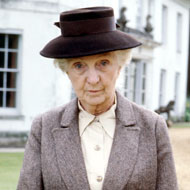
Joan Hickson in the role

October 13, 1930: The Murder at the Vicarage by Agatha Christie is published. It introduces the character of Jane Marple. This early version of "Miss Marple," as she is perennially known, is a gleeful gossip, and not an especially nice woman. The citizens of the fictional town of St. Mary Mead, said to be 25 miles from London, like her, but are often tired by her nosy nature and how she seems to expect the worst of everyone. In later books, along with a great private detective, she becomes a kinder and more modern person.

She did not appear in a film until 1961, when Margaret Rutherford played her in Murder, She Said. This, and Angela Lansbury's portrayal in the 1980 version of The Mirror Crack'd, inspired the title of Lansbury’s later TV series, Murder, She Wrote.

In 1976, Neil Simon spoofed her as Jane, a.k.a. Miss Marbles, played by Elsa Lanchester, in the film Murder By Death, with James Coco playing Milo Perrier, a sendup of Christie's other great detective, Hercule Poirot. Joan Hickson played her in 12 films for the BBC from 1984 to 1992, which aired on PBS as part of its Mystery! anthology series. ITV began airing movies with the character in 2004, with Geraldine McEwan playing the role until 2009, and Julia McKenzie from then until 2013.

*

October 13, 1930 was a Monday. The World Series ended 5 days earlier, with the Philadelphia Athletics beating the St. Louis Cardinals. Football was in midweek. The NBA hadn't been founded yet. And the NHL season was a week away. So there were no scores on this historic day.

Monday, October 3, 2022

October 3, 1941: "The Maltese Falcon" Premieres

October 3, 1941: The Maltese Falcon premieres, starring Humphrey Bogart as San Francisco private investigator Sam Spade. It was the 3rd film version of Dashiell Hammett's mystery novel, following the 1931 film of the same title (with Ricardo Cortez as Spade) and the 1936 film Satan Met a Lady (Warren William).

It is also the 1st film directed by John Huston, and the 1st time Bogart worked with Sydney Greenstreet and Peter Lorre, who would co-star with him in other films, especially the next year's Casablanca. Mary Astor plays Brigid O'Shaughnessy, a.k.a. Ruth Wonderly, who manipulates Sam, until he utters the line, "I won't play the sap for you!"

Brigid and Greenstreet's Kasper Gutman are both after the Maltese Falcon, a jewel-encrusted bird that was intended as a tribute from the Knights Templar of Malta to King Charles V of Spain, who was the Holy Roman Emperor from 1519 to 1566. But it was stolen by pirates and covered with black tar. The artifact's fate remains a mystery, as the only one shown in the film turns out to be a fake, not worth dying for, or killing for -- even if Spade tells San Francisco Police Lieutenant Dundy, played by Barton MacLane, that the real thing is "the stuff that dreams are made of."

Hammett died in 1941, Greenstreet in 1954, Bogart in 1957, Lorre in 1964, MacLane in 1969, and Huston and Astor with a month of each other in 1987. The last surviving actor from the film was Elisha Cook Jr., who played Wilmer Cook, who worked for Gutman. He lived until 1995.

As it is arguably the most popular "film noir" of all time, there have been many parodies, including a 1969 episode of the British spy series The Avengers, a 2001 episode of Charmed, and a 2012 episode of Castle, "the Blue Butterfly."

In 1988, Star Trek: The Next Generation showed Captain Jean-Luc Picard, played by Patrick Stewart, being a fan of hard-boiled detective novels of the mid-20th Century, in particular stories about a character created for the show, San Francisco private eye Dixon Hill. A Holodeck simulation goes wrong, and he and 3 other crewmembers are stuck with 1941 technology and no safety protocols, a problem which comes into play when one of them gets shot. Laurence Tierney, who had appeared in some film noirs as a young man, played Cyrus Redblock, a tribute to Sydney Greenstreet. The title of the episode was a combination of 2 of Raymond Chandler's Philip Marlowe novels: "The Big Goodbye."

*

October 3, 1941 was a Friday. On this day, Ernest Evans (no middle name) is born in Spring Gully, South Carolina, and grows up in Philadelphia. Because he did a great impression of rock and roll pioneer Fats Domino, and was fat himself, his friends nicknamed him Chubby Checker. Ironically, his real voice is so distinctive, and his biggest hit song so iconic, that his own voice became one of the most imitated in music history.

This was an off-day in the World Series between the Brooklyn Dodgers, Bogart's favorite team, and the New York Yankees. The Yankees would win the Series in 5 games. The NBA hadn't been founded yet. The NHL season didn't start until November 1. And the NFL played no games. But there were 8 college football games played that night:

* Manhattan College beat George Washington University, 23-0 at the Polo Grounds. Manhattan dropped their football team after the 1942 season, due to the manpower drain of World War II. GWU dropped theirs after 1966, since not having an on-campus stadium meant either building one or renting another stadium, neither of which was deemed cost-effective. Neither has ever resumed play.

* The University of Miami beat Elon University, 38-0 at Burdine Stadium in Miami. In 1959, that stadium would be renamed the Orange Bowl. Elon, of Elon, North Carolina, dropped to NCAA Division II in 1975, but rose to Division I FCS (formerly known as Division I-AA) in 1999.

* The University of Detroit beat crosstown Wayne State University, 54-0 at Titan Stadium on the UD campus. UD was founded as an all-male school by the Society of Jesus (the Jesuits) in 1877. They dropped their football program after the 1964 season. Also in 1941, the Sisters of Mercy founded Mercy College of Detroit, for women. In 1990, the schools merged, to become the coeducational University of Detroit Mercy. Wayne State have played in NCAA Division II since 1975.

* Creighton University beat Saint Louis University, 18-8 at Creighton Stadium in Omaha, Nebraska. After the 1942 season, like Manhattan due to World War II, Creighton dropped its football program. SLU dropped theirs in 1949. Neither has ever resumed.

* Texas Tech beat Oklahoma A&M, 16-6 at Taft Stadium in Oklahoma City. A&M became Oklahoma State in 1958.

* Brigham Young University played Colorado State College of Education at Greeley, beating them 26-0 at what was known as "Y Stadium" on the BYU campus, in Provo, Utah. CSC became the University of Northern Colorado in 1970, but everybody outside of Colorado thinks of the Chapel Hill Tar Heels when they hear "UNC."

* Oregon beat Idaho, 21-7 at Hayward Field in Eugene, Oregon.

* And Gonzaga University beat Albertson College, 14-0 at a stadium known as the Lettuce Bowl (I am not making that up) in Nampa, Idaho. Gonzaga, based in Spokane, Washington, dropped their football program after the 1941 season, due to World War II, and have never resumed it. Albertson renamed itself the College of Idaho in 2007. They suspended their football program in 1977, and resumed play in the NAIA in 2014.

Sunday, September 25, 2022

September 26, 1903: Arthur Conan Doyle Invents "Fan Service"

September 26, 1903: Dr. Sir Arthur Conan Doyle caves in to public pressure, and invents "fan service," by bringing back his most famous fictional character: Sherlock Holmes.

The 1st Holmes story, A Study in Scarlet, had been published on November 24, 1887 in the British magazine Beeton's Christmas Annual. It sold out before Christmas, and the public couldn't get enough of the stories of the consulting detective Holmes and his assistant, Dr. John H. Watson.

Conan Doyle was a highly intelligent man with many interests, and he wanted to write about other things. Inspired by the  "scientific novels" of Jules Verne -- H.G. Wells had not yet tried the genre, and Hugo Gernsback had not yet coined the phrase "science fiction" -- he created the scientist Professor Challenger, including The Lost World, one of the 1st pieces of fiction to incorporate dinosaurs. He created Brigadier Gerard, an officer in Napoleon's Grand Armée. He created Sir Nigel Loring, a knight in the Hundred Years War.

His scientific and historical fiction got him the best reviews of his career. But the general public wanted more and more of Holmes. Conan Doyle couldn't take it anymore: In 1893, he published The Final Problem. He created a villainous equal for Holmes, Professor James Moriarty, a man so brilliant and evil that Holmes called him "The Napoleon of Crime." Though Moriarty appeared in only this story, Holmes told Watson that they had been in a battle of wits for years.

They made their way to the Reichenbach Falls, a real place in the Bernese Oberland of Switzerland. There, according to the story, on May 4, 1891, 10 years after Holmes and Watson first met, Holmes and Moriarty fight, and tumble over a protective fence to their deaths. From such a height, neither could have possibly survived.

Holmes fans were furious! How dare the man who created their hero kill him! Conan Doyle got death threats in the mail. He was attacked on the street, by men with umbrellas and women with purses. It was the first "toxic fandom" in the history of popular culture.

It also produced some of the earliest "fanfiction," as people began writing their own Holmes stories, not considering copyright laws. As you might guess, this included some pornographic stories, some involving Holmes and Irene Adler, from "A Scandal in Bohemia," the only woman ever to defeat Holmes, whom he called "the woman," so she must have meant something to him.

Some of these fan-written stories even involved a homosexual relationship between Holmes and Watson, thus inventing what came to be known -- after similar "Kirk/Spock" stories by whacked-out female Star Trek fans -- in the 1970s as "slash fiction." And you thought the English Victorians were uptight about sex. (Heterosexual porn stories involving famous fictional characters created by others came to be called "hetslash.")

Bowing to pressure, in 1901, Conan Doyle published a full-length novel, The Hound of the Baskervilles, obviously taking place before Holmes' death. If he thought it would satisfy the demand for more Holmes material, he was wrong: It backfired, only increasing the demand.

So, in 1903, Conan Doyle gave in, writing The Empty House, and explaining how Holmes survived the Reichenbach Falls. It was published in America on September 26, in the magazine Colliers; and in Britain in Holmes' previous usual forum, The Strand magazine, the following month. Fandom had its 1st victory over the "cancellation" of a popular series. It would not happen again until the original Star Trek series, 65 years later.

The story explains that what came to be known to Holmes fans as "The Great Hiatus," from May 4, 1891 to March 30, 1894, began when Holmes managed to grab onto an outcropping of a cliff at the Reichenbach Falls, but knew that one of Moriarty's men, Colonel Sebastian Moran, had discovered that he'd survived. By fooling Moran into thinking that he'd killed Holmes, Holmes exposes Moran as the perpetrator of a recent murder, and puts the highest-ranking remaining member of Moriarty's organization away, striking a blow from which it never recovers.

Conan Doyle continued to publish Holmes stories until 1917, with "His Last Bow," showing Holmes and Watson as old men, helping out the British government at the dawn of what came to be called World War I. Conan Doyle died on July 7, 1930, and Holmes fans accepted as "canon" that Holmes died at the same time.

But the Holmes movies starring Basil Rathbone, starting in 1939, would move from the Victorian era to the present day. And 2 TV shows, one on the BBC, another on CBS, moved Holmes into the 21st Century. People still can't get enough of the man at 221B Baker Street.

UPDATE: In 2025, CBS began airing Watson, set in the present day, but unconnected to their previous series Elementary, which ran from 2012, with Jonny Lee Miller as Holmes and Lucy Liu as an Asian-American female Watson. This new Watson, a black American played by singer Morris Chestnut, has lost his friend Holmes, and moves to Pittsburgh to establish a new medical practice.

*

September 26, 1903 was a Saturday. Woolwich Arsenal of South-East London, which would became Arsenal Football Club and move to North London, beat Bristol City, 4-0 at St. John's Lane in Bristol, Gloucestershire, in England's West Country.

And these baseball games were played:

* A doubleheader was split at Hilltop Park in Washington Heights, Manhattan The New York Highlanders, the team that would become the Yankees, nears the end of its 1st season. They lose the opener to the Detroit Tigers, 13-8. Future Hall-of-Famer Sam Crawford goes 4-for-6 with 4 RBIs. The Highlanders leading the Detroit Tigers, 5-1 after 6 innings of the nightcap, when rain comes and the game is called. Jimmy Williams, their 2nd baseman, went 2-for-3 with 3 RBIs.

* The New York Giants beat the Pittsburgh Pirates, 4-1 at Exposition Park in Pittsburgh. "Iron Man" Joe McGinnity advanced to 31-20. That's for one season. He outpitched William "Brickyard" Kennedy, who fell to 9-6. Honus Wager of the Pirates, at this point the best player in baseball, did not play in this game.

* The Brooklyn Superbas beat the Cincinnati Reds, 10-7 at the Palace of the Fans in Cincinnati. What became Crosley Field was built on the site in 1912. The Superbas became the Dodgers in 1911.

* A doubleheader is split at the Huntington Avenue Grounds in Boston. The St. Louis Browns beat the Boston Americans, the team that will become the Red Sox, to win the 1st game, 6-2. Cy Young (28-9) is outpitched by Ed Siever (13-14, and definitely not to be confused Cy Young or a Cy Young Award winner like, say, Tom Seaver). The Americans are leading the 2nd game, 8-2 after 8 innings, when the rain that hit the Northeast hits them, and they go no further.

* The Philadelphia Athletics beat the Cleveland Naps, 4-2 at Columbia Park in Philadelphia. Napoleon "Nap" Lajoie had briefly starred for the A's, but, because he'd previously played in the city for the Phillies, an injunction meant that he couldn't play in the City of Philadelphia unless it was for the Phillies. Since he could only play away games -- and there was no health risk as there would be over a century later, as with Kyrie Irving and the Brooklyn Nets -- the A's let him go to the Cleveland Bronchos. In 1903, they made the 2nd baseman their manager, and even changed their name to the Cleveland Naps, which held until he left them after the 1914 season. They then became the Indians, and the Guardians in 2022.

* The Chicago White Sox beat the Washington Senators, 7-4 at Boundary Park in Washington.

* The Boston Beaneaters beat the Chicago Cubs, 4-3 at West Side Park in Chicago, in a game limited to 8 innings by rain. The Beaneaters became the Braves in 1912.

* And the Philadelphia Phillies beat the St. Louis Cardinals, 7-2 at Robison Field in St. Louis. (Not "Robinson.")

Wednesday, June 1, 2022

June 1, 1927: The Hardy Boys/Nancy Drew Franchise Begins

June 1, 1927: The Tower Treasure is published, beginning the Hardy Boys/Nancy Drew franchise of mystery novels for children, teenagers, and "young adults."

Edward Stratemayer founded the Stratemeyer Syndicate, which published children's books, including several series, all of them published under pen names, which, essentially, were "franchise" as much as the characters themselves. Among them were the Bobbsey Twins, two sets of fraternal brother/sister twins, perpetually 12 and 6 years old, respectively; in 72 books under the name "Laura Lee Hope" from 1904 to 1979; and Tom Swift, a boy inventor, in 33 books under the name "Victor Appleton" from 1910 to 1941. Among the writers were Stratemayer himself, and his daughter, known after her marriage as Harriet Adams.

The Tom Swift books frequently had plays on words, such as, "'I lost my crutches,' said Tom lamely," and "'I'll take the prisoner downstairs', said Tom condescendingly." Such puns became known as "Tom Swifties," and, eventually, led to singer Taylor Swift's fans being called "Swifties." (So, as you can see, it all comes together, said Mike connectively.)

Eventually, unlike the other characters, the original Tom was allowed to reach full adulthood, was renamed "Tom Swift Sr.," and the adventures followed his son, Tom Swift Jr.

But it was the Hardy Boys, published under the name "Franklin W. Dixon," who caught the most imagination of the public. Older brother Frank starts out as 16 years old, and younger brother Joe as 15, but are later raised to 18 and 17. They live in Bayport, on Barmet Bay (the State is never specified), with their father, Detective Fenton Hardy; their mother, Laura; and their Aunt Gertrude.

In the older stories, starting in 1927 with The Tower Treasure, the Boys' mysteries are often linked to their father's confidential cases. He sometimes requests their assistance, while at other times they stumble upon relevant villains and incidents. The Hardy Boys are sometimes assisted in solving mysteries by their friends, and, less frequently, by their girlfriends.

Writing about them in 1971, Arthur Prager said:

Never were so many assorted felonies committed in a simple American small town. Murder, drug peddling, race-horse kidnapping, diamond smuggling, bank robbing, kidnapping, dynamiting, burglaries, medical malpractice, big-time auto theft, even (in the 1940s) the hijacking of strategic materials and espionage, all were conducted with Bayport as a nucleus.

In other words, people who later said that the small town of Cabot Cove, Maine, home of mystery writer Jessica Fletcher on the TV show Murder, She Wrote had an inordinate number of murders, well, the Hardy Boys stories were something of an inspiration.

Or maybe Jessica was inspired by Nancy Drew, created by Stratemeyer as a feminine counterpart to the Hardy Boys, who could appeal to girls. Her 1st story, The Secret of the Old Clock, was published on April 28, 1930, under the pen name "Carolyn Keene." At the time of the book's premiere, Nancy is 16, giving her a birth year of 1914. Which means, if she were real, she probably would have died early in the 21st Century. That's a lot longer than Stratemeyer lived: He died on May 10, 1930, just 12 days after the 1st Nancy Drew book was published, of pneumonia, at the age of 67.

The Stratemeyer Syndicate was taken over by Edward's daughters, Harriet Adams and Edna Squier. From 1959 to 1973, they extensively revised the Hardy Boys and Nancy Drew books, to remove social and ethnic stereotypes, modernize content, and shorten them for easier reading.

Edna lived on until 1974, Harriet until 1982. I was a kid at the time, and had read some of the Hardy Boys and Nancy Drew books, and was told that the authors were actually "little old ladies." That urban legend had some truth to it: Edna lived to be 79, and Harriet to 90.

Former First Ladies Hillary Clinton and Laura Bush, and Supreme Court Justices Sandra Day O'Connor and Sonia Sotomayor, cited Nancy as an influence on their lives. Without her influence, it's hard to imagine the later creations of such characters as Harriet the Spy by Louise Fitzhugh, Kinsey Millhone by Sue Grafton, and Stephanie Plum by Janet Evanovich.

Both the Hardy Boys and Nancy Drew were introduced in films in the 1930s, and have been occasionally used in film and on television ever since. And the Stratemeyer Syndicate survives, with the most recent Nancy Drew novel published in 2003, and the most recent Hardy Boys novel in 2005.

But it would take until the novel Super Sleuths! in 1981 for Nancy to team up with the Hardy Boys in a published story. Surely, there is fanfiction where either Frank or Joe marries Nancy -- or even where they fight over her.

*

June 1, 1927 was a Wednesday. This was also the day that the Peace Bridge opened between Buffalo, New York and Fort Erie, Ontario. I have a separate entry for that event.

These baseball games were played that day:

* The New York Yankees beat the Philadelphia Athletics, 2-1 at Shibe Park in Philadelphia. Myles Thomas outpitched Rube Walberg. Joe Dugan singled Ben Paschal home with the winning run in the top of the 9th inning. Mark Koenig, probably the least powerful of this legendary Yankee team that became known as "Murderers' Row," hit the game's only home run.

Babe Ruth went 0-for-4. Lou Gehrig went 2-for-3 with a walk. For the A's, Ty Cobb went 0-for-4, Eddie Collins went 1-for-4, Mickey Cochrane went 2-for-4, Al Simmons went 1-for-4, and Jimmie Foxx did not play.

* The Brooklyn Dodgers beat the Boston Braves, 6-2 at Braves Field in Boston.

* The Boston Red Sox beat the Washington Senators, 6-1 at Griffith Stadium in Washington.

* The Philadelphia Phillies beat the Pittsburgh Pirates, 7-4 at Forbes Field in Pittsburgh.

* The Cleveland Indians beat the Detroit Tigers, 14-1 at Navin Field (later Briggs Stadium and Tiger Stadium) in Detroit.

* The Cincinnati Reds and the St. Louis Cardinals were rained out at Sportsman's Park in St. Louis. The game was made up as part of a doubleheader on June 25. The Cards won the opener, 2-1. The Reds won the nightcap, 10-7. Grover Cleveland Alexander, 40 years old and still in the wake of his World Series heroics the year before, allowed 4 runs over the last 2 innings. Over the 2 games, Frankie Frisch went 5-for-8 with 2 RBIs.

* And the New York Giants, the Chicago Cubs, the Chicago White Sox and the St. Louis were not scheduled.

Wednesday, May 25, 2022

May 25, 1934: "The Thin Man" Premieres

William Powell as Nick, Myrna Loy as Nora,
and Skippy as Asta

May 25, 1934: The Thin Man premieres, directed by W.S. Van Dyke, and based on the novel by Dashiell Hammett, published earlier in the year.

Hammett had created the characters of Nick and Nora Charles, a married couple who solve murder mysteries while exchanging sharp and smart repartee. The tremendous popularity of the characters made them a media archetype, as the bantering, romantically involved detective duo has become a well-used trope in literature, stage, screen, and television ever since. Without Nick and Nora, there would be no McMillan & Wife, no Hart to Hart, no Scarecrow & Mrs. King, and, while the title characters were not cops but assisted their love interests who were, no Castle and no The Mentalist. The characters may even have influenced the banter between James Bond and the "Bond Girls."

Nick is a former private detective, whose surname Charles hides his Greek ancestry. He retired from his work when he married Nora, a wealthy heiress from the Nob Hill section of San Francisco. Hammett reportedly modeled Nora on his longtime mistress, playwright Lillian Hellman, and the characters' boozy, flippant dialogue on their relationship. (The novel also mentions that Nick was once a Pinkerton detective, as was Hammett.)

William Powell, who had starred in 4 films as Philo Vance, a private detective created by writer S.S. Van Dine (not to be confused with W.S. Van Dyke), was cast as Nick. Myrna Loy played Nora, having previously been typecast as exotic, foreign women. She had appeared in The Jazz Singer, the 1st "talkie," in 1927, but a sexy voice made her ideal for the transition out of the silent era.

The titular "Thin Man" is Clyde Wynant, an old friend of Nick's, and the Charleses end up having to solve his murder. There would be 6 Nick & Nora movies, among the 14 films that Powell and Loy would appear in together. Despite the original Thin Man being dead halfway through the 1st movie, all 6 had "The Thin Man" in the title, thus leading to the misperception that Nick was "the Thin Man." (Powell was rather slender.)

After the Thin Man was released on December 25, 1936. Another Thin Man followed on November 17, 1939. Shadow of the Thin Man was next, on November 21, 1941. To this point, all of the Thin Man movies had been directed by W.S. Van Dyke. However, he developed cancer and, as a Christian Scientist, refused treatment. He died in 1943. Richard Thorpe directed The Thin Man Goes Home, premiering on January 25, 1945. And Edward Buzzell directed Song of the Thin Man, premiering on August 28, 1947.

My grandmother was approaching her 10th birthday when the 1st film came out. She was a big fan of the films, and especially of Myrna Loy. She was also a big fan of crossword puzzles, and she taught me that it was common for them to have "ASTA," the Charles' dog, as an answer, because it was a short name.

Of course, by the time she taught me that, the Thin Man movies were in the distant past. Hammett died in 1961, Powell in 1984, and Loy in 1993. Asta was played by a Wire Fox Terrier named Skippy, who died in 1951, at the age of 20.

From 1957 to 1959, NBC aired The Thin Man, starring Peter Lawford as Nick and Phyllis Kirk as Nora. The action was moved to the present day and to New York. In 1975, for ABC, Craig Stevens and Jo Ann Pflug starred in the TV-movie Nick and Nora. In 1976, the Charleses were among the legendary fictional detectives spoofed in the film Murder by Death, with David Niven and Maggie Smith playing Dick and Dora Charleston.

In 1991, a Broadway musical titled Nick & Nora was staged, starring Barry Bostwick and Joanna Gleason. It tanked, running only 9 performances. In 2011, a film version was announced, with Johnny Depp, but it was canceled before Nora was ever cast.

*

May 25, 1934 was a Friday. The entire American League was in action that day, while the entire National League was not:

* The New York Yankees lost to the Chicago White Sox, 7-5 at Comiskey Park in Chicago. Sammy Byrd, who took over as a defensive replacement for Babe Ruth so many times that he was nicknamed "Babe Ruth's Legs," hit a home run. Ruth himself did not play, while Lou Gehrig went 0-for-4, although he did draw a walk.

* The Cleveland Indians beat the Boston Red Sox, 18-3 at League Park in Cleveland. For the Tribe, Earl Averill went 5-for-6 with a home run and 5 RBIs, Bill Knickerbocker went 4-for-6 with 4 RBIs, Joe Vosmik went 4-for-6 with 3 RBIs, and pitcher Monte Pearson went the distance, and also went 3-for-5 with an RBI.

* The Philadelphia Athletics beat the Detroit Tigers, 9-7 at Navin Field in Detroit. (That ballpark was later renamed Briggs Stadium and Tiger Stadium.) Jimmie Foxx went 1-for-5 with an RBI. Hank Greenberg went 2-for-4 with a walk and an RBI.

* And the Washington Senators beat the St. Louis Browns, 9-3 at Sportsman's Park in St. Louis. Shortstop and manager Joe Cronin hit a home run for the Senators, as did John Stone and Buddy Myer.

Thursday, March 31, 2022

March 31, 1939: Basil Rathbone's Sherlock Holmes Films Begin

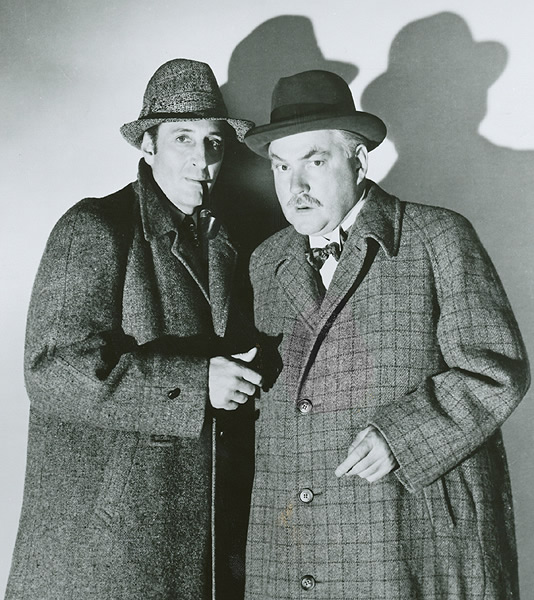
Basil Rathbone (left) and Nigel Bruce

March 31, 1939: The Hound of the Baskervilles premieres, the 1st of 14 films starring Basil Rathbone, coming off his villainous turn as Sir Guy of Gisbourne for the 1938 film The Adventures of Robin Hood, as "consulting detective" Sherlock Holmes, and Nigel Bruce as his partner in crime-solving, Dr. John H. Watson. The Rathbone/Bruce series has defined the characters of Holmes and Watson ever since.

Both characters were created by the man for whom Watson was a stand-in, Dr. Sir Arthur Conan Doyle, who had died in 1930, and thus had only seen stage plays and silent films based on the characters.

Based on Conan Doyle's 1902 novel, Holmes is called on by Sir Henry Baskerville, heir to a family's country estate, to find out about a large, vicious dog that has allegedly killed much of the family. Holmes discovers that the dog belongs to another heir, who wants the family fortune for himself.

This was followed later in 1939 by The Adventures of Sherlock Holmes, pitting the hero against his arch-enemy, Professor James Moriarty, "the Napoleon of Crime," played by George Zucco. Ida Lupino guest-starred.

The subsequent films are moved from the stories' native late Victorian era to the present day. Sherlock Holmes and the Voice of Terror was released in 1942, and was based on the story "His Last Bow," in which an aging Holmes solved a case for the British government on the eve of World War I. In this version, Holmes leaves behind his famed deerstalker cap for a fedora, and stops a Nazi agent from sabotaging Britain at a low point in World War II.

"The Adventure of the Dancing Men," from 1903, was adapted into Sherlock Holmes and the Secret Weapon, released at Christmas 1942, as Moriarty (now played by Lionel Atwill) is now working with the Nazis. Sherlock Holmes in Washington is an original story, and closes with Holmes and Watson riding down Pennsylvania Avenue toward the U.S. Capitol Building in an open convertible, a jarring thought to anyone used to his usual Victorian London setting.

"The Adventure of the Musgrave Ritual" became the 1943 film Sherlock Holmes Faces Death. The 1944 film The Spider Woman is a combination of "The Sign of the Four," "The Adventure of the Dying Detective" and "The Final Problem." The Scarlet Claw, released for Summer 1944, was an original story. "The Adventure of the Six Napoleons" became the 1944 film The Pearl of Death. "The Five Orange Pips" became the 1945 film The House of Fear. The Woman In Green, released for Summer 1945, was an original story, with Henry Daniell as Moriarty.

Pursuit to Algiers, released late in 1945, was an original story. "The Adventure of the Empty House" and "The Adventure of the Blue Carbuncle" were adapted for the 1946 film Terror By Night. The last film, Dressed to Kill, released on June 7, 1946, was an original story.

Despite many subsequent attempts, including the 21st Century films with Robert Downey Jr., and the present-day TV updates Sherlock with Benedict Cumberbatch and Elementary with Jonny Lee Miller, Basil Rathbone is still the defining Holmes for many fans of the character. Bruce died in 1953, Rathbone in 1967.

*

March 31, 1939 was a Friday. Baseball was in Spring Training. Football was out of season. The NBA hadn't been founded yet. And the Stanley Cup Playoffs were between rounds. So there were no scores on this historic day.

There was one noteworthy event connected with sports on this day, although no one would know it for many years: Karl-Heinz Schnellinger was born. The left back starred for German soccer team FC Köln and Italy's AC Milan, and was a member of the West Germany team that reached the 1966 World Cup Final, losing to England.

Sunday, February 6, 2022

February 6, 1939: Raymond Chandler Publishes "The Big Sleep"

February 6, 1939: Raymond Chandler publishes The Big Sleep, introducing his character, Los Angeles private detective Philip Marlowe.

Raymond Thornton Chandler was born on July 23, 1888 in Chicago, his father's hometown, and grew up in Plattsmouth, Nebraska. After his father left the family, his mother, from Waterford, Ireland, took him to Waterford, London, Paris and Munich, where his language skills grew. By 1907, he had passed the British civil service exam, taken a job at the Admiralty, and published his 1st poem. He later served in the British Army in World War I, and caught the Spanish Flu, surviving it.

He went back to America, and began both a writing career and an affair with a much older married woman, Pearl "Cissy" Pascal. It was only after her divorce and his disapproving mother's death that he was able to marry Cissy. In 1931, he lost his job as an oil company executive, due to his drinking and fooling around with his female employees.

He began writing, in particular copying the pulp-style writing of Erle Stanley Gardner, who was about to move on, and create the character of lawyer Perry Mason. Chandler worked on short stories, selling them to detective magazines, before creating Marlowe, clearly a copy of Dashiell Hammett's Sam Spade, a private eye further north in San Francisco.

In The Big Sleep, Marlowe is hired by an elderly General, to stop a man from blackmailing his free-spirited daughter. He finds out that the General's other daughter is also in trouble. The story comes to involve murder, gambling, a pornography ring, and a secret homosexual affair. Good luck turning that into a movie, with the Hays Code at the peak of its power.

Marlowe proved so popular that there would eventually be 7 novels. The Big Sleep was followed by Farwell, My Lovely in 1940, The High Window in 1942, The Lady in the Lake in 1943, The Little Sister in 1949, The Long Goodbye in 1953, and Playback in 1958. And with Hammett not writing another book after The Thin Man in 1934, Chandler surpassed him as the premier author of what became known as "hard-boiled detective novels."

In 1944, Chandler and film director Billy Wilder co-wrote the screenplay for Wilder's film Double Indemnity. In 1951, he worked with Alfred Hitchcock on the script for Strangers On a Train. But after Cissy's death in 1954, following a long illness, he fell into a deep depression, and drank himself to death in 1959. He had no children. After his death, the Chandler estate authorized later writers to write Marlowe novels.

In 1944, the 1st film featuring Marlowe was released: Farewell, My Lovely was adapted as Murder, My Sweet, with Dick Powell. In 1946, The Big Sleep was filmed, with Humphrey Bogart, and his wife, Lauren Bacall, as the blackmailed Vivian Rutledge. The porn angle was played down, as the photos of older daughter Carmen Sternwood (Martha Vickers) were used only for blackmail; and the gay angle was dropped entirely.

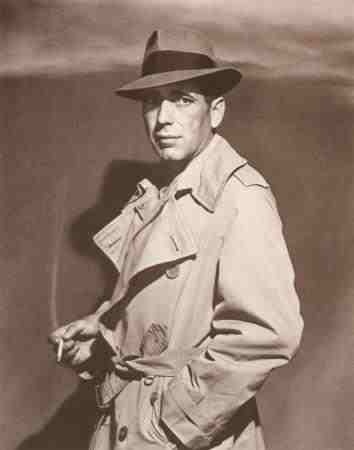
By playing Marlowe, and before that Hammett's Sam Spade in the 1941 film version of The Maltese Falcon, Bogart became the stereotype of the hard-boiled private detective, spreading the fame of Spade and Marlowe -- and, by extension, that of Hammett and Chandler.
Bogart as Marlowe

In 1947, Robert Montgomery starred in Lady in the Lake, and George Montgomery starred in The Brasher Doubloon, an adaptation of The High Window. The Montgomerys were not related, but Robert was the father of actress Elizabeth Montgomery, and George married singer-actress Dinah Shore.

Eventually, Marlowe was brought up to the present day. In 1969, The Little Sister was adapted as Marlowe, starring James Garner, and this became the basis for Garner's later L.A.-based private eye TV series The Rockford Files. In 1973, Elliott Gould starred in The Long Goodbye, with baseball pitcher turned writer Jim Bouton playing a "playboy killer."

Film noir veteran Robert Mitchum, who, in spite of his age, seemed born to play Marlowe, went back to the source era to play him in Farewell, My Lovely in 1975, set in 1941. He starred in a present-day version of The Big Sleep in 1978. In 2022, Liam Neeson starred in the period piece Marlowe, an adaptation of The Black-Eyed Blonde, an authorized sequel to The Big Sleep, which John Banville wrote under the name Benjamin Black.

In 1988, Star Trek: The Next Generation showed Captain Jean-Luc Picard, played by Patrick Stewart, being a fan of hard-boiled detective novels of the mid-20th Century, in particular stories about a character created for the show, San Francisco private eye Dixon Hill. A Holodeck simulation goes wrong, and he and 3 other crewmembers are stuck with 1941 technology and no safety protocols, a problem which comes into play when one of them gets shot. Laurence Tierney, who had appeared in some film noirs as a young man, played Cyrus Redblock, a tribute to Sydney Greenstreet and his Maltese Falcon character Kasper Gutman. The title of the episode was a combination of 2 Marlowe novels: "The Big Goodbye."

*

February 6, 1939 was a Monday. Baseball and football were out of season. The NBA hadn't been founded yet. And the NHL had no games scheduled. So there were no scores on this historic day. 

December 31, 1999 & January 1, 2000: The Millennium

December 31, 1999:  The Millennium arrives. The people of planet Earth survived. At a terrible cost. But we hadn't destroyed ourselves. ...