Showing posts with label ebbets field. Show all posts

Tuesday, November 29, 2022

November 29, 1931: The Packers' 1st "Threepeat"

Johnny "Blood" McNally

November 29, 1931: The Championship of the National Football League is clinched... at Ebbets Field. The Green Bay Packers beat the football team named the Brooklyn Dodgers, 7-0, to advance to 12-1 on the season.

Coached by Earl "Curly" Lambeau, the Packers' star player was John Victor McNally Jr., from New Richmond, Wisconsin, across the State, close to Minneapolis rather than to Green Bay or Milwaukee. He starred at St. John's University in Minnesota, and then at Lambeau's Alma Mater, Notre Dame.

In 1922, while at St. John's, he and a teammate, Ralph Hanson, were passing a Minneapolis movie theater, showing the movie Blood and Sand, starring Rudolph Valentino as a Spanish bullfighter. McNally turned to the teammate, and, knowing that they could secretly make money playing professional or semipro ball on Sundays, the day after playing for Notre Dame, if they used fake names, and said, "I'll be Blood, and you be Sand." Hanson, as Ralph Sand, never played in the NFL, but John McNally was "Johnny Blood" from then on.

He played in the NFL for the Milwaukee Badgers, the Duluth Eskimos and the Pottsville Maroons, before joining the Packers in 1929, eventually helping them win 4 NFL Championships. In this 1931 season, the two-way halfback scored 2 touchdowns rushing, a then-record 10 receiving, and another on an interception return. He later served as a player-coach with the football version of the Pittsburgh Pirates, before they changed their name to the Steelers; and returned to St. John's to coach. (St. John's is now an NCAA Division III school, and has no connection besides name to the one in New York City.)

The Packers benefited from having their 1st 7 games all at home, probably because most NFL teams then used the biggest stadium in their city, which tended to be not a college football stadium, including one of the many "Memorial Stadiums" built to honor the dead of World War I in the preceding decade, but a baseball park, and most of those parks were occupied in September.
City Stadium

The Packers beat the football version of the Cleveland Indians, 26-0; the Dodgers, 32-6; the team that would become their arch-rivals, the Bears, 7-0; the football version of the New York Giants, 27-7; the Chicago Cardinals, 26-7; the Frankford Yellow Jackets, 15-0; and the Providence Steam Roller (no "S" on the end), 48-20.

The Packers went to Wrigley Field to play the Bears again, and won, 6-2. They hosted the Staten Island Stapletons, and won, 26-0. They were finally beaten by Ernie Nevers and the Cardinals, 21-13 at Wrigley, where they played their home games that season, rather than at Comiskey Park, the usual home of the Cardinals and baseball's Chicago White Sox.

The Packers rebounded, beating the Giants, 14-10 at the Polo Grounds; beating the Steam Roller, 38-7 at the Providence Cycledrome on Thanksgiving; and clinching against the Dodgers at Ebbets Field. The following week, they lost to the Bears, 7-6 at Wrigley Field. But it didn't matter, because the Portsmouth Spartans finished at 11-3, and could not catch the Packers.

The Packers thus won their 3rd straight NFL Championship. It had never happened before. Through the 2021 season, it has happened only once since: The Packers again, in 1965, 1966 and 1967, including Super Bowls I and II.

This remains the last time the NFL Championship has been decided without some form of postseason play.

Lambeau and McNally were both charter inductees into the Pro Football Hall of Fame in 1963. Lambeau died in 1965, and Green Bay's new City Stadium was renamed Lambeau Field in his memory. McNally was one of a few 1920s players interviewed by NFL Films for their 1976 documentary Old Leather, and lived until 1985.

UPDATE: The Green Bay Packers have the largest team Hall of Fame of any team in the "Big Four" North American sports: The NFL, MLB, the NBA and the NHL. From the team's founding era, 1919 to 1928, but not on the 1929, '30 or '31 title teams, they have inducted tackle Howard "Cub" Buck, back Charlie Mathys, and team executive Andrew Turnbull.

From the 1929-30-31 title teams, they have inducted co-founder, owner, general manager, head coach and back Earl "Curly" Lambeau; co-founder George Whitney Calhoun; executives Frank Jonet, Gerald F. Clifford, Fred Leicht, Emil Fischer and Lee Joannes; backs Johnny "Blood" McNally, Verne Lewellen, Arnie Herber, Hank Bruder and Joseph "Red" Dunn; ends Lavern "Lavvie" Dilweg and Milt Gantenbein; tackle Cal Hubbard; guards Mike Michalske and Howard "Whitey" Woodin; centers Francis "Jug" Earp, Bernard "Boob" Darling and Nate Barragar; trainer Carl "Bud" Jorgensen and team doctor W. Webber Kelly; and the team's 1st broadcaster, Russ Winnie.

Lambeau, Buck, Dilweg, Dunn, Goldenberg, Lewellen, McNally and Michalske have also been inducted into the Wisconsin Athletic Hall of Fame.

*

November 29, 1931 was a Sunday. Only 2 other games were played that day. The Giants and the Steam Roller played to a 0-0 tie at the Polo Grounds. This turned out to be the last game the Steam Roller ever played. They had won the NFL Championship in 1928, but the Great Depression did them in.

And the Spartans beat the Bears, 3-0 at Universal Stadium in Portsmouth, Ohio. It still stands, as Spartan Memorial Stadium.

The day before, the Cardinals beat the Indians, 21-0 at Wrigley Field. And, 2 days before that, on Thanksgiving Day, these games were played:

* The Giants lost to the Stapletons, 9-6 at Thompson Stadium on Staten Island.

* The Bears beat the Cardinals, 18-7 at Wrigley Field.

* And, as I said, the Packers beat the Steam Roller, 38-7 at the Cycledrome.

Baseball was out of season. The NBA hadn't been founded yet. There were 2 games played in the NHL. The New York Rangers beat the Chicago Black Hawks, 5-0 at the Chicago Stadium. And the Detroit Falcons beat the Montreal Canadiens, 3-2 at the Olympia Stadium in Detroit. Ebenezer "Ebbie" Goodfellow scored the winning goal, 3:33 into overtime. The next season, the Falcons became the Detroit Red Wings.

Monday, November 7, 2022

November 7, 1944: President Franklin Roosevelt Is Elected to a 4th Term

November 7, 1944: For the 1st time in 80 years, America holds a Presidential election in the middle of a war. President Franklin D. Roosevelt is elected to an unprecedented 4th term, defeating Thomas E. Dewey, who held FDR's former post of Governor of New York.

With World War II raging, and America and its Allies widely viewed as winning it, but not yet having won it, FDR won 432 Electoral Votes to Dewey's 99. The popular vote was 25.6 million for FDR, 22.0 million for Dewey. That looks close, but it worked out to 53.4 percent for FDR, and 45.9 for Dewey.

Dewey won 12 States: Maine, Vermont (the only 2 States that FDR never won), Ohio, Indiana, Wisconsin, Iowa, North Dakota, South Dakota, Nebraska, Kansas, Colorado and Wyoming. FDR won the other 36 States, including New York, where both men lived; and Michigan, where Dewey was born and raised.

How close was it? Take out "the Solid South," still not willing to vote for a Republican because it was "The Party of Lincoln," even if he was as conservative as they were, and the Electoral Vote would have been 276-99 for FDR. Not enough to cost him the election. Nor the popular vote: FDR still would have won, 21.1 million to 19.9 million.

But if Dewey had won every State in which he got at least 47 percent of the vote, including New York, Pennsylvania and Illinois, which were then the 3 States with the largest population, he would have won the Electoral Vote, 275-256. (48 percent wouldn't have done it, because he would still have lost New York, and the election, 303-238.)

The consensus, in both candidates' camps, was that the key to FDR winning was to have him be seen as winning The War, but not having already won it, meaning he was needed to "finish the job." As in 1940, the consensus was that, if he were running solely on domestic policy, he would have lost, because a lot of people were tired of the New Deal and its regulations, but trusted the experienced old hand to win The War.

The last time America had a Presidential election in the middle of a war was in 1864, when Abraham Lincoln was by no means a shoo-in for re-election, but military success gave him the win. The Democrats brought back Lincoln's slogan: "Don't change horses in mid-stream." But, with Senator Harry Truman of Missouri replacing Henry Wallace as the nominee for Vice President, the Republicans joked that the Democrats had changed the back half of the horse. The Republicans had nominated Governor John Bricker of Ohio, their 2nd-place finisher in delegates, for Vice President, and this gave them a rhyming slogan: "Win the war quicker with Dewey and Bricker."

FDR was not well, struggling with heart disease and high blood pressure, brought on by the pressure of fighting, essentially, 2 major wars at once: Against Nazi Germany in Europe, and against the Japanese Empire in the Pacific. And he was also trying to set up the postwar country, with his G.I. Bill of Rights and other postwar economic measures; and the postwar world, with the United Nations.

His smoking and drinking didn't help. He was 62 years old, and looked at least 72. The Republicans began a "whispering campaign," saying that the Democratic titan was too old and tired to handle the Presidency, and possibly dying.

To counter this, FDR held a parade down Broadway in Lower Manhattan. In the rain. Not good for his health. I wonder if anyone warned him about William Henry Harrison, who was inaugurated as President on March 4, 1841, and then proceeded, without a hat, overcoat or gloves, in freezing rain, to give the longest Inaugural Address ever, 1 hour and 45 minutes. He died 1 month later.

FDR's parade was attended by millions, cheering and chanting, "We want Roosevelt!" Prior to the parade, he held a rally at Ebbets Field in Brooklyn. "I've got a confession to make," he told the crowd. "I come from the State of New York, and I've practiced law in New York City. But I have never been in Ebbets Field before." He was not booed.

He did say, "I've rooted for the Dodgers" -- even though he had, on numerous occasions, been to Yankee Stadium to cheer on the Yankees, to the Polo Grounds to cheer on the Giants, and saw them both at the Polo Grounds in Game 2 of the 1936 World Series. "And I hope to come back someday and watch 'em play." That got a huge roar.

FDR would be unable to go back. He had not been to a major league game since before Pearl Harbor, thinking it inappropriate for the President to do so. (There was Presidential precedent: Woodrow Wilson loved baseball, and threw out the first ball at every Opening Day of his first term, but not in 1917 and '18 due to World War I, not in '19 due to his trip to the postwar peace conference, and not in '20 due to his health.) FDR died at the dawn of the next season, of a stroke brought on by working himself to death to save civilization from fascism.

In 2016, there was no "whispering campaign": The Republicans came right out and said that the year's Democratic nominee, also (officially) from the State of New York, Hillary Clinton, was "dying" and "doesn't have the stamina to be President." She did 3 90-minute debates, and kicked Donald Trump's ass in each of them.

In 2020, when it became clear that Trump was becoming more and more unhealthy and unhinged, they said it was Joe Biden who had "dementia." He did 2 debates that, because of Trump's interruptions, lasted more than 90 minutes, and mopped the floor with him both times.

As of November 7, 2022, both Hillary Clinton, age 78, and Joe Biden, a few days away from turning 80, are still alive, and appear to be in good health. So, you tell me.

UPDATE: After a disastrous debate with Trump, Biden, 81, accepted the appeals of major Democratic officials, and dropped out of the race, and endorsed Vice President Kamala Harris, who turned 60 late in the campaign. Trump, 78, now looked like a very old man indeed. He did emerge as the official winner of the election, but acted ever more like a grumpy old man as his 2nd term went on.

*

November 7, 1944 was a Tuesday. Midweek, so no football. The baseball season was over. The NHL season had started, but had no games scheduled for this day. And the NBA hadn't yet been founded. So there were no scores on this historic day.

Wednesday, October 26, 2022

October 27, 1904: The New York Subway Opens

October 27, 1904: The 1st Subway line opens in New York. It runs from City Hall to Grand Central Station (roughly today's 4, 5 and 6 Trains), then turns onto 42nd Street (today's S, or Times Square-Grand Central Shuttle), then up Broadway to 207th Street (today's 1 Train) before making one final curve into the Bronx to Bailey Street (this part is part of today's A Train). The fare is 5 cents -- $1.52 in today's money.
The Polo Grounds of the time, and its 1911 successor, were served by the 155th Street station that opened on this day. It was supposedly on this line in 1908 that Jack Norworth, a songwriter, saw a sign saying, "Baseball To-Day, Polo Grounds," inspiring him to write the lyrics to "Take Me Out to the Ballgame."
It would be 1918 before "34th St.-Penn Station" opened to service the 1910-built Pennsylvania Station, and thus to the successor station and the "new" Madison Square Garden built on the site. The 34th Street station on the 8th Avenue side of Penn Station opened in 1932, as did the 42nd Street station that serves the Port Authority Bus Terminal that opened in 1950, and the 50th Street station that served the old Garden from 1932 until its closing in 1968.
The current 4 Train station at 161st Street and River Avenue opened in 1917, and began serving Yankee Stadium at its opening in 1923. The D Train station there opened in 1933, probably to coincide with the opening of the nearby Bronx County Courthouse. The Prospect Park station now used by the Q Train became part of the City Subway in 1920, and was used to get to games at Ebbets Field.
The station now served by the 7 Train opened in 1939 for the 1939-40 New York World's Fair, well predating the 1964-65 World’s Fair and the opening of Shea Stadium and the National Tennis Center. It was named "Willets Point Blvd." from 1939 to 1964 and "Willets Point-Shea Stadium" from 1964 to 2008, and has been renamed "Mets-Willets Point," as the MTA did not want to use the name "Citi Field" due to CitiGroup's role in the 2008 financial crisis.
*
October 27, 1904 was a Thursday. Poet Dylan Thomas was born in Swansea, Wales. He would die in New York in 1953.

There were no scores on this historic day: The baseball season was over, professional football was in its infancy, it was a Thursday so there were no college football games, and there was no professional basketball or professional hockey.

Saturday, October 22, 2022

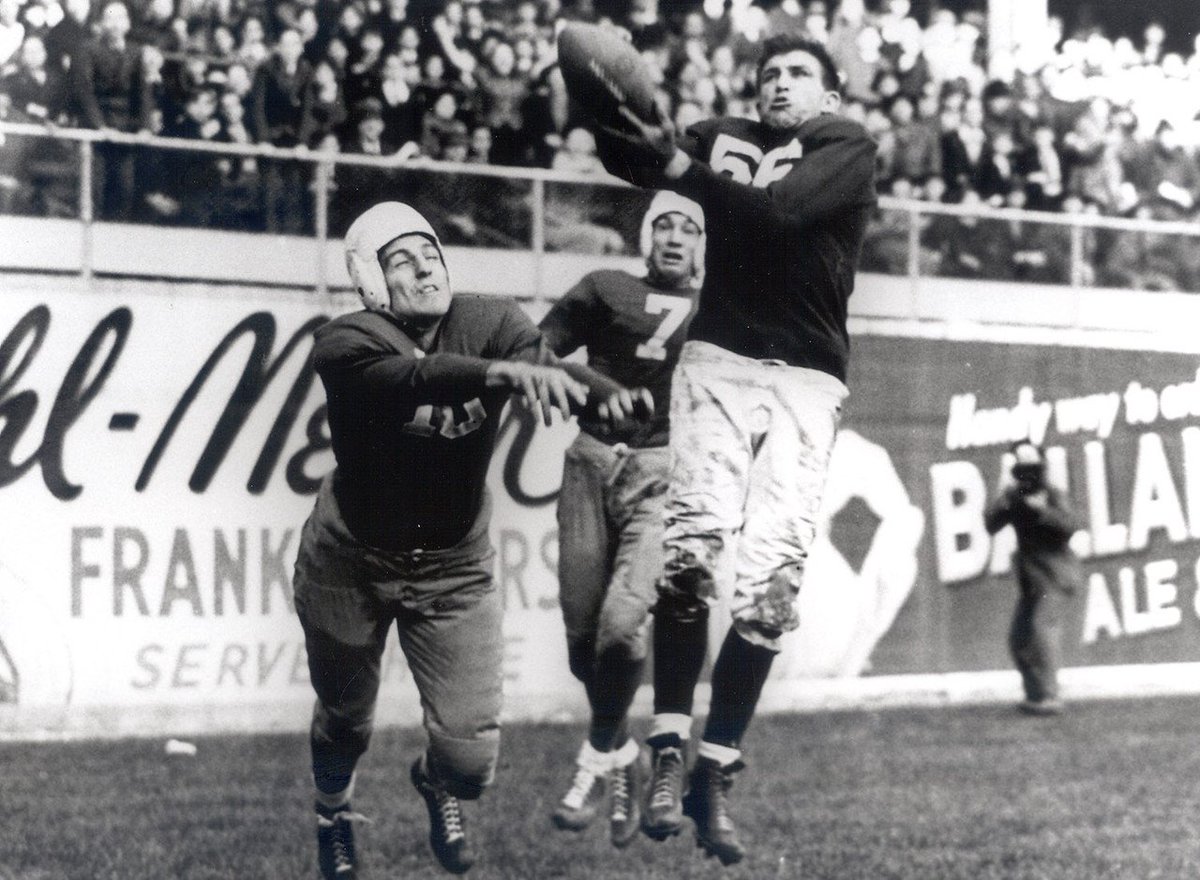
October 22, 1939: The 1st NFL Game On Television

The only known photograph of the game.
Number 7 is Ace Parker. Number 56 is Bill Hewitt.
Both men are in the Pro Football Hall of Fame.
No, Hewitt hasn't lost his helmet: He didn't wear one
until the NFL passed a rule requiring it in 1940.

October 22, 1939: For the 1st time, a professional football game is televised, on experimental New York station W2XBS, the forerunner of WNBC-Channel 4. The Brooklyn Dodgers -- yes, there was an NFL team with that name -- play the Philadelphia Eagles at Ebbets Field in Brooklyn. The Dodgers win, 23-14, before only 13,057 fans.

There's no record of how many people paid to watch it in person, but there were apparently less than 300 TV sets capable of receiving the signal. No footage of the game survives, not even on newsreel.

The Dodgers struck first, on a 1-yard run by Clarence "Pug" Manders, who was in the middle of a run of 3 straight Pro Bowls. In the 2nd quarter, Fran Murray scored on a 1-yard run of his own for the Eagles. It remained 7-7 at the half, but the Dodgers took over: Ralph Kercheval kicked field goals of 44, 38 and 45 yards, and future Hall-of-Famer Clarence "Ace" Parker threw a 47-yard touchdown pass to Perry Schwartz. The Eagles added a 22-yard touchdown pass from Davey O'Brien, winner of the 1938 Heisman Trophy with Texas Christian, to Hall-of-Famer Bill Hewitt, but that would be as close as the Eagles got.

Football and television is an epic love story, but it was far from love at first sight. It would really take another 19 years, and the 1958 NFL Championship Game -- Baltimore Colts 23, New York Giants 17, in overtime at Yankee Stadium -- for it to become more than a flirtation. If there is an event that can be called "the wedding," it's probably Super Bowl III, 10 years after that, on January 12, 1969.

But the couple is inseparable, partly because of the shared TV revenue which allows Green Bay, Wisconsin, with a metropolitan area of 300,000 people, to compete on the same level as New York City, with a metro area of nearly 24 million people. It's also why the Big Ten Conference wanted to add Rutgers and the University of Maryland: Between the markets of New York, Philadelphia, Baltimore and Washington, they added about 40 million.

The NFL's TV revenue is so big (How big is it?), it's been said that the NFL can shut the doors of all 16 stadiums hosting games in a given weekend, with a total official attendance of zero, and still make a profit.

*

October 22, 1939 was a Sunday. George Cohen, the right back on the England team that won the 1966 World Cup, was born on this day.

The baseball season was over, the NHL season hadn't begun yet, and the NBA hadn't yet been founded. But there were 4 other NFL games founded:

* The New York Giants beat the Chicago Bears, 16-13 at the Polo Grounds.

* The Washington Redskins beat the Pittsburgh Pirates, 21-14 at Forbes Field in Pittsburgh. The Pirates, like the Giants named for their city's oldest baseball team, became the Pittsburgh Steelers the next season.

* The Cleveland Rams beat the Chicago Cardinals, 24-0 at Comiskey Park in Chicago. The Rams moved to Los Angeles in 1946, St. Louis in 1995, and back to Los Angeles in 2016. The Cardinals moved to St. Louis in 1960, and Arizona in 1988.

* And the Green Bay Packers beat the Detroit Lions, 26-7 at City Stadium in Green Bay. 

Wednesday, October 5, 2022

October 5, 1941: The Mickey Owen Game

October 5, 1941: Game 4 of the World Series at Ebbets Field in Brooklyn. It made the home fans shudder. I read an interview once, with a Brooklyn Dodger fan, whose name I've forgotten, citing a far more important, and more traumatic, event that happened just 63 days (9 weeks) later: "I was there. I remember that like I remember Pearl Harbor."

The Dodgers had opened the season with a lot of hope. They hadn't won a National League Pennant since 1920, and hadn't been in a Pennant race since 1924. But they had been rebuilt, under the auspices of team president Larry MacPhail. He had renovated Ebbets Field, hired Walter "Red" Barber as radio broadcaster, traded for shortstop Leo Durocher, made Durocher the manager, and made other key transactions, including trading for Durocher's replacement as shortstop, Harold "Pee Wee" Reese.

After going 62-91 in the last pre-MacPhail season, 1937, the Dodgers improved to 69-80 in 1938. In 1939, they improved to 84-69, 3rd place, but still 12 1/2 games behind the Pennant-winning Cincinnati Reds. In 1940, they were 88-65, 2nd place, but still 12 games behind the Pennant-winning Reds.

Still, hopes were high for 1941. From April 18 to 30, the Dodgers went 13-1. They ended the month in 1st place by 1 game. From May 6 to 14, they rattled off a 7-game winning streak. From May 23 through June 1, they won 9 straight. They were tied for 1st with the St. Louis Cardinals, with the next-closest team, the Giants, being 8 games behind. From June 19 to July 11, they won 15 out of 19 decisions (plus a game that was called due to rain while tied) through July 11.

They went 9-1 from July 31 through August 11. But the Cards stayed hot, too, so, by that date, the teams were tied for 1st. As late as September 3, the teams were tied for 1st. The Dodgers got hot one more time, going 13-6 from September 6 to 24. This run included a 10-inning win at home to the Giants on the 7th, an 11-inning win away to the Cards on the 11th, and 4 runs in the top of the 17th to beat the defending World Champion Reds.

On September 25, the Dodgers clinched the Pennant when Whitlow Wyatt pitched a shutout for his 22nd win of the season, and was backed by a home run by Pete Reiser. The Dodgers won, 6-0.

The Dodgers and their fans were feeling particularly potent. They were convinced that they would beat the New York Yankees in the World Series and take over New York.

*

October 1, 1941, a Wednesday: Game 1 of the World Series was played at Yankee Stadium. Durocher surprised everyone by choosing Curt Davis as his starting pitcher. He later admitted he messed up the Dodgers' rotation for the Series, one of the few times Leo the Lip admitteda mistake, rather than blaming someone else.

In hindsight, while the rotation was all out of whack, Davis pitched fairly well. But a home run by Joe Gordon and the pitching of Charles "Red" Ruffing gave the Yankees a 3-2 win.

October 2, 1941, a Thursday: Game 2 at Yankee Stadium. The Yankees took a 2-0 lead in the 3rd, but the Dodgers tied the game in the 5th, and Dolph Camilli's single in the 6th won it, 3-2.

October 3, 1941, a Friday: The Maltese Falcon premieres, starring Humphrey Bogart as San Francisco private investigator Sam Spade. If "Bogie" wasn't already a legend, he certainly became one with this film. It was the 3rd film version of Dashiell Hammett's mystery novel, following the 1931 film of the same title (with Ricardo Cortez as Spade) and the 1936 film Satan Met a Lady (Warren William). 

Ernest Evans was born. He would become known as Chubby Checker, the man who popularized (though did not create, nor write the song about) the dance craze The Twist.

Given the proximity of the teams, a travel day wasn't necessary for the World Series, but it got one, anyway.

October 4, 1941, a Saturday: This was the birthdate of journalist Roy Blount Jr., horror novelist Anne Rice, and Elizabeth Eckford of the Little Rock Nine, and Anne Rice.
Ebbets Field

Game 3 of the World Series is played at Ebbets Field. The game is scoreless in the 7th inning, with Fred Fitzsimmons throwing goose eggs for the Brooklyn team, and Marius Russo doing so for the Bronx outfit. Russo comes to bat, and launches a line drive off Fat Freddie's kneecap. The ball caroms to shortstop Reese, who throws Russo out to the end inning.

On the official World Series highlight film, it's not clear how bad the injury is. Fitzsimmons is shown limping off the field under his own power -- probably a good thing, since he would have been pretty hard to carry off with all that weight. But the film is misleading: It turns out that the kneecap is broken.

Once an All-Star for the Giants, Fitzsimmons seemed to specialize in beating the Dodgers. But in 1937, a slow start led the Giants to trade him to the Dodgers, a big mistake. He was welcomed by the Flatbush Faithful, and they wouldn't have won the Pennant without him. Durocher said, "I wish we had 9 guys like Fitz. We'd never lose."

But now, he was permanently injured. At age 41, he would pitch just 1 game in 1942, and 9 more in 1943, before accepting his injury and retiring to the coaching ranks. He also ran a popular bowling alley in Brooklyn for many years.

Durocher was forced to bring Hugh Casey in to pitch the top of the 8th. The 1st relief pitcher to be called "The Fireman," because he "put out fires," he got the 1st out, but allowed 4 straight singles, scoring 2 runs. Russo allowed a double to Fred "Dixie" Walker and a single to Reese, but hung on to for a complete-game 2-1 win. The Yankees now led, 2 games to 1.

October 5, 1941, a Sunday. This was also the day of the Berdychiv Massacre, when Nazi Germany's Gestapo killed 38,000 Jews in Ukraine. I have a separate entry for that event.

Arnold Malcolm Owen -- sometimes incorrectly listed as "Mickey Owens," but there was never an S on the end -- was a 4-time National League All-Star as catcher for the Dodgers, was elected a County Sheriff, and ran the Mickey Owen Baseball School. For the last 64 years of his life, he was decent enough to field questions about the one part of his life that everyone seems to remember.
In Game 4 of the World Series at Ebbets Field, Charlie Keller of the Yankees singled home a run off Kirby Higbe of the Dodgers in the 1st inning. In the top of the 4th, Johnny Sturm singled home 2 runs to make it 3-0 Yankees.

But in the bottom of the 4th, the Dodgers closed to within 3-2 when Jimmy Wasdell doubled home 2 men that Atley Donald had walked. In the 5th, Reiser hit a home run to give the Dodgers a 4-3 lead.

Reiser was the NL's batting champion that season. The Cardinals had been scouting him since he was 12 years old. He was so talented that Durocher, later to manage the Giants and thus manager Willie Mays, said that Reiser might have been better. But he ended up crashing into outfield walls to make catches, much like Lenny Dykstra in the 1980s and '90s. And when Reiser did it, those walls were not padded. Injuries caught up with him, and he was never able to live up to his Hall of Fame-level talent.

The 4-3 Dodger lead held up until the top of the 9th. Casey got the 1st 2 outs. Tommy Henrich came to the plate as the Yankees' last hope. Casey got 2 strikes on him. Then he threw…

Casey told the press it was a curveball. Owen also said it was a curve, which was what he had signaled for. Henrich called it "the sharpest-breaking curveball that Hugh Casey ever threw." But many observers, including DiMaggio, and the Yankees' rookie shortstop, Phil Rizzuto, said that they thought it was a spitball.

Henrich swung and missed. Strike 3. Ballgame over. Dodgers win, and the World Series is tied at 2 games apiece.

Except… Owen didn't catch the 3rd strike! The ball tailed away from him, as spitballs have been known to do, and he couldn't hold onto it. It rolled all the way to the screen. Henrich saw this, and ran to 1st, and Owen didn't even have time to get off a throw.

He later recalled: "It wasn't a strike. It was a low inside curve that I should have had. But I guess the ball struck my glove, and by the time I got hold of it, I couldn't have thrown anybody out at first. It was an error."

It is the most famous passed ball in baseball history, but if it was a spitball, which was and remains an illegal pitch anyway, then it should, instead, have been credited as a wild pitch, and be the most famous one of those, and Casey, rather than Owen, should be faulted.


No matter. Casey only needed to get 1 more out. Even if Henrich represented the tying run and the next batter represented the winning run. Just 1 more out.

The batter was DiMaggio. Uh-oh, you don't give the Yankee Clipper a written invitation to keep a game alive. Especially not in 1941, when he had become the most celebrated athlete in America, ahead of Ted Williams; ahead of football stars Sammy Baugh, Sid Luckman and Don Hutson; ahead of even the Heavyweight Champion of the World, Joe Louis.

DiMaggio singled to left. Now the tying run was on 2nd, the potential winning run on 1st. But there were still 2 outs. If Casey could get the next batter, the game would still end, however precariously, with a Dodger victory.

The batter was Keller. At this point in his career, before a back injury curtailed it, he looked like he was headed to the Hall of Fame. And he did nothing to dispel that in this at-bat: He rocketed a Casey delivery off the right-field wall, and Henrich and DiMaggio scored.

Keller would later say, "When I got to 2nd base, you could have heard a pin drop in Ebbets Field." The noisiest, most raucous ballpark of his time had been stunned into silence.

The Yankees scored 2 more runs in the inning, and won 7-4. They now led 3 games to 1.

*

As I said, October 5, 1941 was a Sunday. There were NFL "Scores On This Historic Day":

* The football version of the New York Giants beat the Pittsburgh Steelers, 37-10 at Forbes Field in Pittsburgh.

* The football version of the Brooklyn Dodgers lost to the Washington Redskins, 3-0 at Griffith Stadium in Washington.

* The Chicago Bears beat the Cleveland Rams, 48-21 at Cleveland Municipal Stadium. (The Rams moved to Los Angeles in 1946.)

* The Green Bay Packers beat the Chicago Cardinals, 14-13 at the Dairy Bowl in the Milwaukee suburb of West Allis, Wisconsin. The Dairy Bowl was a football stadium built in the infield of a speedway, now known as the Milwaukee Mile, at the Wisconsin State Fair Park.

* And the Philadelphia Eagles and the Detroit Lions had the week off.

October 6, 1941, a Monday. Were the Dodgers rattled by their 9th inning collapse of the day before? Maybe. In the top of the 2nd, Wyatt walked Keller, gave up a single to Bill Dickey that got Keller to 3rd, uncorked a wild pitch that scored Keller and got Dickey to 3rd, and gave up a single to Joe Gordon that scored Dickey.

Dem Bums did have their chances to bounce back. In the bottom of the 3rd, Wyatt helped his own cause with a double down the left-field line off his opposite number, Ernie "Tiny" Bonham. After getting Walker to fly out, Bonham gave up a hit to Lew Riggs, and Reiser hit a sacrifice fly to get Wyatt home. The next batter was Dolph Camilli, who would be named the NL's Most Valuable Player. But Bonham struck him out to end the threat. It was still 2-1 Yankees.

Henrich, who would be nicknamed "Old Reliable" by Yankee broadcaster Mel Allen, hit a home run in the top of the 5th, and that would be all the scoring in the ballgame. Bonham went the distance for the Bronx Bombers, getting the last out when Wasdell flied out to DiMaggio in center field. Yankees 3, Dodgers 1. The Yankees had won their 9th World Series, already more than any other team. It was the 1st time, though, that they had faced the Dodgers in a World Series. There would be more.

The Brooklyn Eagle newspaper printed a big headline, reading, "WAIT TILL NEXT YEAR." The next year, the Dodgers won 104 games, but the Cardinals won 106. The Dodgers would lose the World Series to the Yankees again in 1947, 1949, 1952 and 1953, before finally winning it in 1955. The Eagle had closed earlier that year, so it was up to the New York Daily News to print the obvious headline on October 5, 1955, the day after the great triumph: "THIS IS NEXT YEAR!"

Despite America's entry into World War II, Owen never went into the service. I wonder if some Dodger fans said, "Mickey Owen is such a bum, even the Army don't want him!"

The Dodgers didn't win the Pennant again until 1947, the rookie year of Jackie Robinson. It was a last gasp for the holdovers from 1941, including Dixie Walker, who led the Southerner faction of the team that had initially opposed Robinson's signing. After the clincher, he said that Robinson had more to do with the team winning than anyone, "with the exception of Bruce Edwards." Edwards had succeeded Owen as the Dodgers' starting catcher. He wasn't a great player, but he was reliable, never committing the kind of passed ball that Owen did.

Edwards was succeeded the next year by Negro League star Roy Campanella, who became a Hall-of-Famer and a 3-time Most Valuable Player. And yet, I wonder if a lot of the accolades that would later come his way were due to what became known as "Mickey Owen's Muff." That Campy might have been cheered not just for what he was, a fantastic player and a good guy, but for what he wasn't: Owen.

It's not fair to Owen. He was widely respected prior to the '41 Series, and most Dodger fans didn't go on to hate him. Certainly, he escaped the scorn that was heaped on Ralph Branca after 1951. And neither one of them got the kind of treatment that Bill Buckner got from Boston fans after 1986.

Which is a good thing. Nobody deserves that. Well, maybe not nobody… But certainly not Buckner, nor Branca, nor Owen.

If Owen had hung onto the ball, and the Dodgers had won, tying the Series, what kind of difference would it have made? Probably not much: The Yankees won Game 5 anyway, and would've needed to win Game 6 or Game 7 at Yankee Stadium. They still would have won. Pretty much the only things that would have changed would have been the reputations of Owen and Casey, for the better.

Owen died on July 13, 2005, in his home town of Mount Vernon, Missouri. He was 89. It's a little ironic that he and Branca both came from towns named Mount Vernon, in Branca's case the one in Westchester County, New York.

Henrich died on December 1, 2009, as the last survivor of this game. He was also the last surviving person who had been a teammate of Lou Gehrig. Herman Franks, who later helped steal a Pennant from the Dodgers as a 1951 New York Giant, had died earlier in 2009 as the last surviving '41 Dodger.

Today, the Sandlot Baseball Camp, formerly the Mickey Owen Baseball School, is still open on State Highway 96 in Miller, Missouri, in the southwestern part of the State, in the Ozark Mountains, about halfway between Joplin and Springfield -- 238 miles southwest of St. Louis, 171 miles southeast of Kansas City, 64 miles northwest of Branson (the "Redneck Vegas"), and 80 miles northeast of Mickey Mantle's hometown of Commerce, Oklahoma.

Monday, October 3, 2022

October 3, 1947: The Cookie Game

October 3, 1947: The New York Yankees' Floyd "Bill" Bevens takes a no-hitter into the bottom of the 9th inning against the Brooklyn Dodgers in Game 4 of the World Series. He gets to within 1 out of the 1st World Series (and thus the 1st postseason) no-hitter ever. But 10 walks put him in danger, including putting the tying and winning runs on base -- Al Gionfriddo and Eddie Miksis, respectively.

Dodger manager Burt Shotton send Harry "Cookie" Lavagetto up to pinch-hit for Eddie Stanky. Lavagetto hits a double-off the right-field wall at Ebbets Field, which the Yankees' Tommy Henrich can't catch, and the Dodgers win, 3-2.

Red Barber, calling the game for the Dodgers' radio station, WMGM, AM 1050, watched the hit, and the play, and the pounding on the back Lavagetto got from his teammates, and said this, concluding with one of his Southern expressions:

Gionfriddo walks off second, Miksis off first. They're both ready to go on anything. Two men out, last of the ninth. The pitch, swung on, there's a drive hit out toward the right field corner. Henrich is going back. He can't get it! It's off the wall for a base hit! Here comes the tying run, and here comes the winning run! Friends, they're killin' Lavagetto, his own teammates, they're beatin' him to pieces, and it's taking a police escort to get Lavagetto away from the Dodgers! Well, I'll be a suck-egg mule!

Hugh Casey, the Dodgers' closer throughout the 1940s, and the losing pitcher in The Mickey Owen Game in 1941, is the winning pitcher this time.

Instead of the Yankees being up 3 games to 1, the Series is now tied. This becomes known as The Cookie Game.

Two days later, Al Gionfriddo will rob Joe DiMaggio with an amazing catch to preserve the Dodgers’ lead in Game 6, but the Yankees win the Series in Game 7. By a weird twist of fate, neither Bevens, nor Lavagetto, nor Gionfriddo will ever play again.

Floyd Clifford Bevens (1916-1991) was called "Bill" because, in a minor-league game, he caught a popup after it bounced off the bill of his cap. He said, "I'm lucky it didn't bounce off my nose!"
Harry Arthur Lavagetto (1912-1990) was called "Cookie" because he was signed by Victor Devincenzi, the owner of the Pacific Coast League's Oakland Oaks, whose nickname was Cookie. The Oaks played from 1903 to 1955, winning Pennants in 1912, 1926, 1948 (managed by Casey Stengel, and with Hall of Fame catcher Ernie Lombardi, and 2nd baseman and future manager Billy Martin) and 1954.

A 3rd baseman, Cookie was a fan favorite in Brooklyn, especially in the Pennant season of 1941. A Dodger fan and commercial artist known as Fierce Jack Pierce would buy tickets for 2 seats, one for himself, and one for a helium tank. With the tank, he would blow up balloons with "COOKIE" written on them every time Lavagetto came to the plate, chanting, "Coooo-kie! Coooo-kie!" He was probably not the inspiration for the Sesame Street character Cookie Monster.

*

October 3, 1947 was a Friday. Elsewhere in Brooklyn, Fred DeLuca, who went on to found the Subway fast-food franchise, was born.

It was too soon for the NBA and the NHL. And the NFL played no games. But there was a game in the All-America Football Conference, which challenged the NFL from 1946 to 1949. The Brooklyn Dodgers beat the Chicago Rockets 35-31 at Soldier Field in Chicago.

Mickey Colmer scored 3 touchdowns for the football version of "Dem Bums," who were coached by former Washington Redskin Hall-of-Fame running back Cliff Battles. The Rockets were coached by Jim Crowley, one of "The Four Horsemen of Notre Dame" in 1924. But their best player, receiver Elroy Hirsch, had suffered a fractured skull earlier in the season, and was out for the season. This gave "Crazy Legs" another nickname, "The Highest-Paid Waterboy In Football." He would later become a Hall-of-Famer for the Los Angeles Rams.

October 3, 1946: The 1st Pennant Playoff

Murry Dickson

October 3, 1946: For the 1st time, one of baseball's two major leagues saw its regular season end with two teams in a tie for 1st place. The Brooklyn Dodgers and the St. Louis Cardinals each won 96 games and lost 58. There had to be a Playoff for the National League Pennant, a best-2-out-of-3 games series.

There was no such suspense in the American League: The Boston Red Sox went 104-50, and won the American League Pennant, finishing 12 games ahead of the 2nd-place team, the Detroit Tigers.

Game 1 of the Playoff was played at Sportsman's Park in St. Louis. Howie Schultz hit a home run for the Dodgers, but Terry Moore and a rookie catcher named Joe Garagiola each got 3 hits. Stan Musial, whom Dodger fans had nicknamed "Stan the Man," went 1-for-4, his hit a triple.

Ralph Branca, the 20-year-old pitcher with only a fastball that manager Leo Durocher had chosen as the Dodgers' starter, didn't get out of the 3rd inning. It was his 1st major late-season failure. It would not be his last. On the other side, Howie Pollet went the distance for his 21st win of the season. (In such Playoffs, all statistics count with regular-season stats.) The Cardinals won, 4-2.

Game 2 was played 2 days later, at Ebbets Field in Brooklyn. Murry Dickson started for the Cards, Joe Hatten for the Dodgers. The Dodgers took a 1-0 lead in the 1st inning, but Dickson helped his own cause with a triple, and it was 2-1 St. Louis in the 2nd. The Cards added 2 runs in the 5th, 1 in the 7th, and 1 in the 8th, to lead 8-1.

The Dodgers gave it a shot in the bottom of the 9th, preventing Dickson from finishing the job. The Cards' lead was reduced to 8-4, and the bases were loaded, bringing the tying run to the plate. Cards manager Eddie Dyer brought Harry Brecheen in, and he stopped the bleeding. The Cardinals had won the Pennant, and Game 3 was not necessary. The Cards went on to beat the Red Sox in the World Series.

From 1941 to 1949, Cardinals vs. Dodgers was the best rivalry in the NL. The Dodgers edged the Cards for the Pennant in 1941, the Cards edged the Dodgers in 1942, the Cards won in 1943 and 1944, the Chicago Cubs got past both in 1945, they had this Playoff in 1946, the Dodgers edged the Cards in 1947, the Boston Braves got past both in 1948, and the Dodgers needed to win on the final day to eliminate the Cards in 1949.

By that point, the Dodgers had become the team that desegregated baseball. The Cardinals didn't desegregate until 1954. By 1964, they had enough of a mix of black and white to win their 1st Pennant since 1946. By which point, the Dodgers had been in Los Angeles for 8 years, and had lost 2 more Pennant Playoffs, 1 in Brooklyn, 1 in Los Angeles.

*

October 3, 1946 was a Thursday. Football was in midweek. The NHL season didn't begin until October 16. And the NBA season, the league's 1st, began on November 1. So there were no other scores on this historic day.

Saturday, October 1, 2022

October 1, 1950: The Dick Sisler Game & Connie Mack's Farewell

October 1, 1950: Dick Sisler hits a home run off Don Newcombe in the top of the 10th inning at Ebbets Field, and the Phillies beat the Brooklyn Dodgers 4-1, to clinch the National League Pennant. It is the only Pennant the Phils would win in a 65-year stretch from 1915 to 1980.

This was the 2nd of 3 straight seasons in which the National League race came down to the last day of the regular season with the Dodgers involved. The year before, they had to win to clinch and eliminate the St. Louis Cardinals, and they did. The year after, they had to win to force a Playoff with their arch-rivals, the New York Giants, and they did -- for all the good that ended up doing them.

The Phillies were the youngest team, by average player, ever to win the National League Pennant. Before the season started, Harry Grayson, the sports editor of the Newspaper Enterprise Association, gave them the nickname "The Whiz Kids," a takeoff on a radio show titled Quiz Kids.

Managed by Eddie Sawyer, only 40 years old but experienced with them, as he had managed some of them in the minor leagues, the Phillies had been strong all season long, led by center fielder sparkplug Richie Ashburn, slugging left fielder Del Ennis, ace starting pitcher Robin Roberts, and Jim Konstanty, who became the 1st relief pitcher ever to be named either League's Most Valuable Player.

But they had lost 3 starting pitchers down the stretch: Curt Simmons went into the Army when his National Guard unit was called up on September 10, rookie Bubba Church sustained an awful eye injury on September 15, and rookie Bob Miller suffered a shoulder injury the next day. Simmons had won 17 games, Church 8, and Miller 11; but none would win another game that season. If not for Roberts winning 20, and Konstanty winning 16 and saving 22 more, the Phils would have been hopeless.

Richard Alan Sisler was born on November 2, 1920 in St. Louis. His father was George Sisler of the St. Louis Browns, one of the best all-around players of his generation: A .340 lifetime hitter whose 1920 total of 257 hits stood as a major league record for 84 years, a 4-time American League leader in stolen bases, and, according to contemporary observers, the best-fieldling 1st baseman of his time.

His brother Dave Sisler would be a major league pitcher, and his brother George Sisler Jr. became a longtie baseball executive. Oddly, George Sr. was a scout for the Dodgers at the time, and was in the ballpark when Dick hit the home run. A reporter asked George how he felt, and he said, "I felt awful and terrific at the same time."

A 1st baseman and left fielder, Dick debuted with the Cardinals in 1946, contributing to a World Series-winning team a a rookie. He was traded to the Phillies in 1948. That 1950 season was his only selection to the All-Star Game. He was traded to the Cincinnati Reds in 1952, and back to the Cardinals later that year, last playing in the majors with them in 1953. He finished his career with a .276 batting average, and just 55 home runs, but 1 of them won a Pennant.

Dick went into coaching, and won another Pennant in 1961, on the staff of Fred Hutchinson of the Cincinnati Reds. When Hutchison left the team late in the 1964 season due to cancer, Dick stepped in as interim manager. Ironically, his Reds were a big reason why his former team, the Phillies, did not win the Pennant that season. But it was his other former team, the Cardinals, who did.

When Hutch died, Dick was named the official manager, and won 89 games in 1965, but was fired after the season, anyway. The Cardinals brought him onto the coaching staff of his former teammate Red Schoendienst, and, together, they won the 1967 World Series, and lost the 1968 World Series. He later coached for the San Diego Padres and, in 1979 and '80, under Joe Torre on the Mets.
He spent most of the 1980s working in the Cardinal farm system, helping to build a team that won 3 Pennants and the 1982 World Series. He died on November 20, 1998, at the age of 78.

The Dick Sisler Game was is also the last major league game as a manager for Burt Shotton, who'd managed the Dodgers to Pennants in 1947 and 1949, and eased the path of Jackie Robinson as he and general manager ranch Rickey reintegrated baseball.
An outfielder, Shotton had played in the major leagues from 1909 to 1923, including 1915 to 1917 with the St. Louis Browns, where he was a teammate of George Sisler -- hence, George's scouting for the Dodgers. Shotton had previously managed the Phillies from 1928 to 1933, and the Reds in 1934, and had also coached for the Cardinals and the Cleveland Indians.

He left the Indians after the 1945 season. When Rickey needed a manager for 1947 after Leo Durocher's yearlong suspension, he asked for Shatoon, who told Rickey, "I romised my wife I would never put on another uniform." So Rickey talked him into managing in a suit, like Connie Mack.

Speaking of whom...

Also on this day, the Philadelphia Athletics complete a massively disappointing 102-loss season by beating the Washington Senators, 5-3 at Shibe Park. It is the last game for A's manager Connie Mack: Approaching his 88th birthday, his sons Earle, Roy and Connie Jr., agreeing on little else, agree to gang up on him and force him to finally retire as manager -- something he, as also the owner, did not want to do.

Before the A's move to Kansas City, the Phillies, new owners of the ballpark, will rename it Connie Mack Stadium, and will erect a statue of him outside.

Having first played in what we would now call Major League Baseball in 1886, the 1st term of Grover Cleveland, and made it to 1950, the 2nd term of Harry Truman, Connie Mack was involved in 4,490 regular-season games, far and away a major league record. (Vin Scully was on hand for 10,766 games over 67 seasons, but that was as a broadcaster.)
Shotton and Mack were the last managers to wear street clothes during a game. Although no rule specifically mandates that a manager must wear a uniform, there is now a rule that states that, aside from medical and security personnel, no one is allowed on the field of play during a game unless they are wearing some form of baseball uniform.

At 87, Mack remains the oldest manager in MLB history. The oldest who was not also the team's owner is Jack McKeon, who was just short of 81 when he served as interim manager of the Florida Marlins in 2011, having previously led them to win the 2003 World Series. Otherwise, the oldest regular manager was Casey Stengel, who had to retire as manager of the New York Mets after an injury at his 75th birthday party.

Pitcher Bobby Shantz is the last living man to have been managed by Connie Mack, 72 years after Mack's last game. Dodger pinch-hitter Tommy "Buckshot" Brown was the last living player from the Dick Sisler Game. For the Phillies, the last survivor, backup infielder Ralph "Putsy" Caballero, died in 2017. Curt Simmons, who did not appear in the game, was the last living 1950 Phillies Whiz Kid.

In 1978, the Phillies established the Philadelphia Baseball Wall of Fame. They elected one Phillie and one Athletic every year until 2003, and have elected a single Phillie every year after that. From the 1950 Whiz Kids, they have elected Robin Roberts, Richie Ashburn, Del Ennis, Granny Hamner, Curt Simmons, Willie "Puddin' Head" Jones.

Mack was the 1st A's figure elected. Also elected from the 1950 A's were Wally Moses, Elmer Valo, Bobby Shantz, Eddie Joost, Ferris Fain, Sam Chapman and Gus Zernial. But it says something about the fall of the A's that, for most of the 1930s and '40s, the only player elected to the Wall was "Indian" Bob Johnson.

Mack, Shantz and Johnson have also been elected to the Philadelphia Sports Hall of Fame. Of the 1950 Whiz Kids, so have Roberts, Ashburn, Ennis, Hamner, Simmons, Jones, and broadcaster Byrum Saam -- but, oddly, not manager Eddie Sawyer.

UPDATE: Simmons died on December 13, 2022, Brown on January 15, 2025. Shantz turned 100 on September 26, 2025.

*

October 1, 1950 was a Sunday. Actor Randy Quaid was born.

These other MLB games were played:

* The Yankees lost to the Boston Red Sox, 7-3 at Fenway Park in Boston. The game is meaningless, as the Yankees had long since clinched the Pennant. Ted Williams went 4-for-5 with 3 RBIs. Joe DiMaggio was held out, to save his injured heel for the World Series.

* The New York Giants beat the Boston Braves, 5-1 at the Polo Grounds.

* A doubleheader was split at Comiskey Park in Chicago. The Chicago White Sox won the opener, 4-3. The St. Louis Browns won the nightcap, 10-6 at Comiskey Park in Chicago. The nightcap was the last game for Luke Appling, the Hall of Fame shortstop for the Chiago White Sox. Appling goes 1-for-4, but, batting .234 at age 43, it was time. "Old Aches and Pains" retires with a lifetime batting average of .310, and 2,749 hits.
* A doubleheader was split at Crosley Field in Cincinnati. The Cincinnati Reds won the 1st game, 3-2. The Pittsburgh Pirates won the 2nd game, 3-1.

* The Cleveland Indians beat the Detroit Tigers, 7-5 at Briggs Stadium in Detroit. The ballpark was renamed Tiger Stadium in 1961.

* And the Chicago Cubs beat the St. Louis Cardinals, 3-2 in 11 innings, at Sportsman's Park in St. Louis. Stan Musial hit a home run.

Since this was a Sunday, there were also NFL games:

* The New York Giants beat the Cleveland Browns, 6-0 at Cleveland Municipal Stadium.

* The Pittsburgh Steelers beat the Washington Redskins, 26-7 at Griffith Stadium in Washington.

* The Green Bay Packers beat the Chicago Bears, 31-21 at Green Bay City Stadium.

* The next day, the Chicago Cardinals beat the Baltimore Colts, 55-13 at Comiskey Park.

* The Los Angeles Rams beat the San Francisco 49ers, 35-14 at Kezar Stadium in San Francisco. Since the 49ers had come in from the All-America Football Conference, this was the 1st game ever between them and the Rams, which became one of the NFL's best rivalries.

* Two days earlier, on the Friday, the football team named the New York Yanks (not "Yankees") lost to the Detroit Lions, 44-21 at Yankee Stadium.

* And, with some irony, given what else was going on in sports in their city, the Philadelphia Eagles had the week off.

Sunday, September 25, 2022

September 25, 1941: The Brooklyn Dodgers' Wild Ride

September 25, 1941: The Dodgers can clinch their 1st Pennant in 21 years today, if they beat the Boston Braves at Braves Field in Boston. If not, there are 2 games left, both at home to the woeful Philadelphia Phillies.

They had opened the season on April 15, with a lot of hope. They hadn't won a National League Pennant since 1920, and hadn't been in a Pennant race since 1924. But they had been rebuilt, under the auspices of team president Larry MacPhail. He had renovated Ebbets Field, hired Walter "Red" Barber as radio broadcaster, traded for shortstop Leo Durocher, made Durocher the manager, and made other key transactions, including trading for Durocher's replacement as shortstop, Harold "Pee Wee" Reese.

After going 62-91 in the last pre-MacPhail season, 1937, the Dodgers improved to 69-80 in 1938. In 1939, they improved to 84-69, 3rd place, but still 12 1/2 games behind the Pennant-winning Cincinnati Reds. In 1940, they were 88-65, 2nd place, but still 12 games behind the Pennant-winning Reds.

Still, hopes were high for 1941. But their opening series, at home to their arch-rivals, the New York Giants, was a flop: They were swept 3 straight, 6-4, 3-1 and 7-5. It wasn't that surprising: The Giants still had some of the players that had won Pennants in 1933 (also winning the World Series that year), 1936 and 1937. Then the Dodgers went up to Boston and turned it around, sweeping a 3-game series from the Braves.

The same teams started a new series on April 20. It was the Giants' home opener at the Polo Grounds, with a full house of 56,314 on hand. Remembering that Joe Medwick, the former St. Louis Cardinal slugger had been beaned shortly after MacPhail had traded for him, the Dodgers came to bat with metal inserts inside their caps. This was the 1st step toward baseball teams wearing batting helmets. The Dodgers won the game, 10-9, and ended up taking 2 out of 3 in the series.

From April 18 to 30, the Dodgers went 13-1. They ended the month in 1st place by 1 game. From May 6 to 14, they rattled off a 7-game winning streak. Then, through May 22, they lost 6 straight. Then, through June 1, they won 9 straight. They were tied for 1st with the Cardinals, with the next-closest team, the Giants, being 8 games behind.

But after June 1, they went downhill again. From June 2 to 18, they went 6-8. Then they got going again, winning 15 out of 19 decisions (plus a game that was called due to rain while tied) through July 11. They were 3 1/2 games ahead of the Cardinals. After losing 2, they won another 4, to go 4 games up.

This streaky team then took another downturn, going 2-10, including going 0-4 against the Cards, plus a game that was called due to darkness after 12 innings, as the Cards' Sportsman's Park didn't yet have lights. At the close of business on July 30, the Dodgers trailed the Cards by 3 games. They were playing like "Dem Bums" of old.

But they closed July by taking the finale of their series in St. Louis, 9-5. That started another hot streak, going 9-1 through August 11. But the Cards stayed hot, too, so, by that date, the teams were tied for 1st. The Dodgers won 5 straight: A doubleheader in Boston on August 17, a single game at home to the Pittsburgh Pirates on August 18, and a doubleheader against the Pirates on August 19. But no matter what the Dodgers did, they couldn't shake the Cards: As late as September 3, the teams were tied for 1st.

The Dodgers got hot one more time, going 13-6 from September 6 to 24. This run included a 10-inning win at home to the Giants on the 7th, an 11-inning win away to the Cards on the 11th, and 4 runs in the top of the 17th to beat the defending World Champion Reds.

On September 25, they played the Boston Braves at Braves Field. They need not have worried. Their ace, Whitlow Wyatt, pitched a shutout for his 22nd win of the season, and was backed by a home run by Pete Reiser. The Dodgers won, 6-0.

Listening on the radio back at Ebbets Field, MacPhail called the New York Central Railroad office at Grand Central Terminal. He wanted the Dodgers' train back from Boston's Back Bay Station stopped at 125th Street, the last stop before Grand Central, so he can get on, and then get off with them to enjoy the party on arrival.

On the train, already a party every bit as chaotic as the plane flight that the New York Mets would have back from Houston 45 years later, Durocher is told this, and he tells the conductor to forget the order, and plow right on through to Grand Central. Why should their fans wait any longer to celebrate, just because MacPhail's massive ego wanted some validation? And so, the train barreled right on through 125th Street, leaving MacPhail fuming on the platform.

The next day, MacPhail called Durocher into his office, and fired him on the spot. Durocher appealed to the team's various owners, including the young lawyer operating the Brooklyn Trust bank's 1/4 share of the team, Walter O'Malley. MacPhail was overruled.

It was a difficult time for the world. World War II was on, and Nazi Germany was still pounding Great Britain with bombs, but the Royal Air Force rendered them unable to make a crossing of the English Channel for a land invasion. Every country in Western Europe had been either conquered by the Nazis or, as in the case with the already-fascist-ruled nations of Italy, Spain and Portugal, and the neutral nations of Switzerland and Sweden, taken into their diplomatic orbit. And they had invaded the Soviet Union, and were besieging Leningrad, and were knocking on the door of Moscow itself. The Red Army was digging in.

And in the Pacific region, the Empire of Japan was truly a rising Sun, having effectively taken over Korea, Japan, and the Dutch East Indies (the eventual Indonesia). They were threatening British and French interests in Southeast Asia, and even Australia. As would soon be seen, even American possessions in the Pacific Ocean were not safe.

But baseball had been America's distraction from the threat of being dragging into this horrible war. The Dodgers had that great Pennant race. The Yankees ran away with the American League Pennant, due largely to the 56-game hitting streak that Joe DiMaggio had from May 15 to July 16. And Ted Williams of the Boston Red Sox had batted .406, clinching the .400 batting average on the season's last day, September 28.

The Dodgers and their fans were feeling particularly potent at this moment. They were convinced that they would beat the New York Yankees in the World Series, and take over New York.

It didn't happen. How was a stunning story. The Dodgers would have a near-miss for the Pennant in 1942, fall short during World War II, had another near-miss in 1946, and won the Pennant in 1947. That year and 1948 were transition seasons, and in 1949, they began a run of success with a new group of players, some of whom had debuted in 1947, including Jackie Robinson and Duke Snider. Included in that was, finally, a World Series win.

Then came something much worse for their fans than losing a World Series: They lost their team.

*

September 25, 1941 was a Thursday. There were 3 other bas* eball games were played that day:

* The New York Giants beat the Philadelphia Phillies, 3-2 at Shibe Park in Philadelphia. Mel Ott went 0-for-3 with a walk. Bob Carpenter went the distance to win the game for the Giants. Two years later, a different Bob Carpenter would buy the Phillies, and restore them to glory.

* The Pittsburgh Pirates beat the St. Louis Cardinals, 3-1 at Forbes Field in Pittsburgh. Rookie Stan Musial, who'd made his major league debut just 8 days earlier, went 2-for-4.

* And the Cincinnati Reds beat the Chicago Cubs, 6-0 at Crosley Field in Cincinnati.

December 31, 1999 & January 1, 2000: The Millennium

December 31, 1999:  The Millennium arrives. The people of planet Earth survived. At a terrible cost. But we hadn't destroyed ourselves. ...