Showing posts with label new york giants. Show all posts

Saturday, December 31, 2022

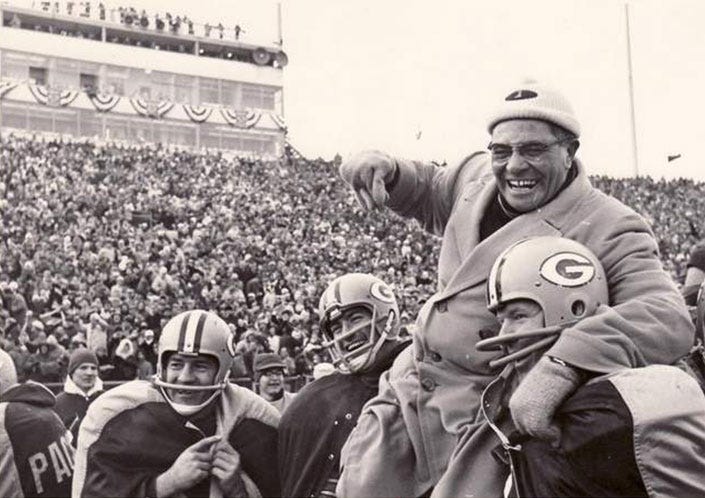
December 31, 1961: Those Who Stayed Were Champions

December 31, 1961: The NFL Championship Game is played at the 2nd City Stadium in Green Bay, Wisconsin. In 1965, it will be renamed Lambeau Field.

In spite of the previous success of the Green Bay Packers, this is the 1st time the game is played in Green Bay. The previous City Stadium had never hosted it. The Packers had finished 1st in the NFL in 1929, 1930 and 1931; and 2nd behind a team that would have been in the Eastern Division in 1927. But there was no NFL Championship Game for them to host, or for which to be the visiting team, until 1933.

Once that was established, the way the old system worked out, the Championship Game was hosted by the Eastern Division winners in even-numbered years, and the Western Division winners in odd-numbered years. The Packers won the West in 1936, 1938, 1944 and 1960, and played the Championship Game on the road. Their only previous time hosting was in 1939, and with a seating capacity of just 25,000, City Stadium was considered too small, so they moved it to Wisconsin State Fair Park in the Milwaukee suburb of West Allis. They won, beating the New York Giants, 27-0.

In 1956, the NFL gave the Packers an ultimatum: Build a bigger stadium, or move. They built what became Lambeau Field in 1957, and seating capacity was 32,500. By 1961, it was 38,669. (By the time of the 1967 title game, the Ice Bowl, it was 50,861. It reached 56,263 in 1970, 60,890 in 1990, 72,515 in 2003, and 81,441 by 2013.) Now, all they had to do was qualify for the title game, by winning the Western Division.

The 1961 season was also the one in which the teams involved adopted their familiar helmet logos: The Packers, football-shaped "G" monogram, for Green Bay (they've never used a "GB," although Lombardi had practice caps made with such a logo); the Giants, the lower-case "ny," for "New York."

The Giants won the NFL Championship in 1956, with head coach Jim Lee Howell. What we would now call his offensive coordinator was Vince Lombardi, and his defensive coordinator was Tom Landry. Lombardi left to become the head coach of the Packers in 1959. Landry left to become the head coach of the expansion Dallas Cowboys in 1960. It would take them a few years to get their act together.

Meanwhile, the Giants again reached the Championship Game in 1958 and 1959, losing to the Baltimore Colts both times. In 1961, Allie Sherman replaced Howell as Giants head coach, and Y.A. Tittle replaced Charley Conerly as quarterback. But running back Frank Gifford came out of retirement, and Sam Huff still led the best defense in the NFL.

The Giants lost their opener, home to the St. Louis Cardinals, then won 5 straight -- the 1st 4 on the road, as the New York Yankees kept using Yankee Stadium all the way to the World Series -- then lost at home to the Dallas Cowboys, won 4 straight, lost to the Packers in Green Bay, beat the defending Champion Philadelphia Eagles away, and finished with a home tie with the Cleveland Browns. At 10-3-1, they won the Eastern Division.

Back to Lombardi: When he arrived, the Packers were coming off a 1-10-1 season. He told his players, "We may not win, but we won't be losing with the same people." With that in mind, he cut the man then regarded as the team's best player, end Billy Howton, because he didn't think Howton was serious enough.

But he kept the actual best player, Paul Hornung: While Hornung was the life of the party off the field, he was completely dedicated on it. And that summed up what Lombardi meant when he gave the Packers their slogan: "Those who stay will be champions."

Sure enough, in just 1 season, having gotten rid of the unserious, and having promoted the dedicated, he took the Packers to to 7-5. In 1960, they went 8-4, and won the Western Division, but lost the NFL Championship Game to the Philadelphia Eagles. It would be the only postseason game Lombardi ever lost.

In 1961, they lost their opener to the Detroit Lions in Milwaukee, then won 6 straight, lost to away to the Baltimore Colts, won their next 4, lost away to the San Francisco 49ers, and closed with a win away to the Los Angeles Rams, finishing 11-3.

With Bart Starr quarterbacking an offense with Hornung and Jim Taylor running, Boyd Dowler receiving, and one of the great offensive lines of all time, including Hall-of-Famers Jim Ringo at center, Jerry Kramer at guard and Forrest Gregg at tackle -- Lombardi called Gregg "the finest player I ever coached," and he later coached the Cincinnati Bengals into their 1st Super Bowl -- the Pack dropped 49 points on the Browns, 45 on the Colts, and 35 on the Rams.

The defense was fearsome, with end Willie Davis, tackle Henry Jordan, linebacker Ray Nitschke, cornerback Herb Adderley, and safeties Willie Wood, and former Giant Emlen Tunnell all going to the Hall of Fame. They shut out the Chicago Bears, held the Colts and the Minnesota Vikings to just 7 points each, held the Lions to 9 in their rematch, and held the 49ers in their earlier win and the Vikings in their other game to 10.

This was the 1st title game played in Green Bay, which would become famous for its cold weather, especially after the 1967 NFL Championship Game, which became known as the Ice Bowl. Green Bay wasn't the furthest-north city in the NFL anymore -- the expansion Vikings now were -- but they were further north than 2 of the Canadian Football League's 9 teams, the Toronto Argonauts and the Hamilton Tiger-Cats.

For the 3rd time, the Giants faced a frozen field for an NFL Championship Game. For the 3rd time, they decided to try sneakers rather than cleats, to get better traction. (This would eventually be outlawed.) In 1934 and 1956, both times against the Bears, it worked. This time, it didn't.

The game kicked off at 1:00 PM Central Time (2:00 Eastern). The 1st quarter ended with the game scoreless, and that would be the highlight of the day for the Giants. It was all Packers: Hornung scored on a 6-yard run, Starr threw a 13-yard pass to Dowler, Starr threw a 14-yard pass to Ron Kramer, and Hornung kicked a 17-yard field goal -- all in the 2nd quarter. Green Bay led, 24-0.

In the 3rd quarter, Hornung kicked a 22-yard field goal, and Starr threw a 13-yard touchdown pass to Kramer. Hornung added a 19-yard field goal. Meanwhile, the Packer defense completely shut Big Blue down. Packers 37, Giants 0. It was only the 5th shutout in an NFL Championship Game -- and, after 4 more NFL Championship Games and 56 Super Bowls, it remains the last. (The 1939 game was also a Packer shutout of the Giants, 27-0.

The Packers beat the Giants again in the 1962 NFL Championship Game, 16-7 at Yankee Stadium. The Giants made one more Championship Game in 1963, losing to the Chicago Bears, then collapsed, not reaching the Playoffs again until 1981.

The Packers fell short in 1963 and 1964, then became the only team ever to win 3 straight NFL Championship Games: 1965, 1966 and 1967. This included the 1st 2 Super Bowls, before Lombardi retired. After coaching the Washington Redskins to a big improvement in 1969, Lombardi developed colon cancer, and died the next year.

Nevertheless, he was right about his Packers: In 7 seasons, 5 times, those who stayed were champions.

UPDATE: The Packers have the largest team Hall of Fame in North American sports. Through the 2025 NFL season, the inductees from the Lombardi Era, 1959 to 1968, are:

* Offense: Quarterbacks Bart Starr and Zeke Bratkowski; running backs Paul Hornung, Jim Taylor, Elijah Pitts, Donny Anderson and Travis Williams; wide receivers Gary Knafelc, Ron Kramer, Max McGee and Boyd Dowler; tight ends Marv Fleming and Carroll Dale; centeres Jim Ringo and Ken Bowman; guards Jerry Kramer, Fred "Fuzzy" Thurston and Gale Gillingham; tackles Forrest Gregg, and Bob Skoronski; and kicker-punter Don Chandler.

* Defense: Ends Willie Davis, Dave Hanner and Lionel Aldridge; tackles Henry Jordan and Ron Kostelnik; linebackers Ray Nitschke, Bill Forester, Dan Currie, Dave Robinson and Lee Roy Caffey; cornerbacks Herb Adderley and Jesse Whittenton; and safeties Willie Wood and Bob Jeter.

* Management: Head coach and general manager Vince Lombardi, assistant coaches Red Cochran and Phil Bengtson; scout Jack Vainisi; longtime executives Fred Leicht, Frederick Trowbridge, Jerry Atkinson, Dominic Olejniczak and Tom Miller; trainer Bud Jorgensen and team physician E.S. Brusky; team historian Lee Remmel; team photographer Vernon Biever; band director Wilner Burke; video director Al Treml; broadcaster Ray Scott; journalist Art Daley; the Hall of Fame's founder, William Brault; and longtime Packer fan Al Schneider.

Lombardi, Starr, Hornung, Taylor, Kramer, Thurston, Davis and Nitschke have also been inducted into the Wisconsin Athletic Hall of Fame.

After Lombardi left, it would be a long time before there was another title. Elected to the Packers Hall of Fame from the 1970s: Linebacker Fred Carr, cornerbacks Ken Ellis and Willie Buchanon, running back John Brockington, and placekicker Chester Marcol.

Elected from the 1980s: Quarterbacks Lynn Dickey and Don Majkowski; running back Gerry Ellis; receivers James Lofton and Sterling Sharpe; tight end Paul Coffman; center Larry McCarren; tackle Greg Koch; defensive end Ezra Johnson; linebackers Mike Douglass, John Anderson, Tim Harris and Johnny Holland; cornerback Mark Lee; safeties Johnny Gray and Mark Murphy (not to be confused with the Mark Murphy who was Packer team president from 2007 to 2025); placekicker Jan Stenerud; and executive Robert Parins.

*

December 31, 1961 was a Sunday. The AFL Championship had been played a week earlier, with the Houston Oilers beating the San Diego Chargers, 10-3 at Balboa Stadium in San Diego. There had been 2 college bowl games the day before the NFL Championship Game, and the 4 major bowls were played the next day, New Year's Day. This included the Sugar Bowl, at Tulane Stadium in New Orleans, in which Number 1-ranked Alabama clinched the National Championship, beating Arkansas, 10-3.

Baseball was out of season. The NBA scheduled no games for the day. The NHL scheduled 2. The New York Rangers lost to the Boston Bruins, 7-4 at the old Madison Square Garden. And the Detroit Red Wings beat the Toronto Maple Leafs, 4-2 at the Olympia Stadium in Detroit. The Montreal Canadiens and the Chicago Black Hawks were not scheduled.

Friday, December 30, 2022

December 30, 1962: The Birth of NFL Films

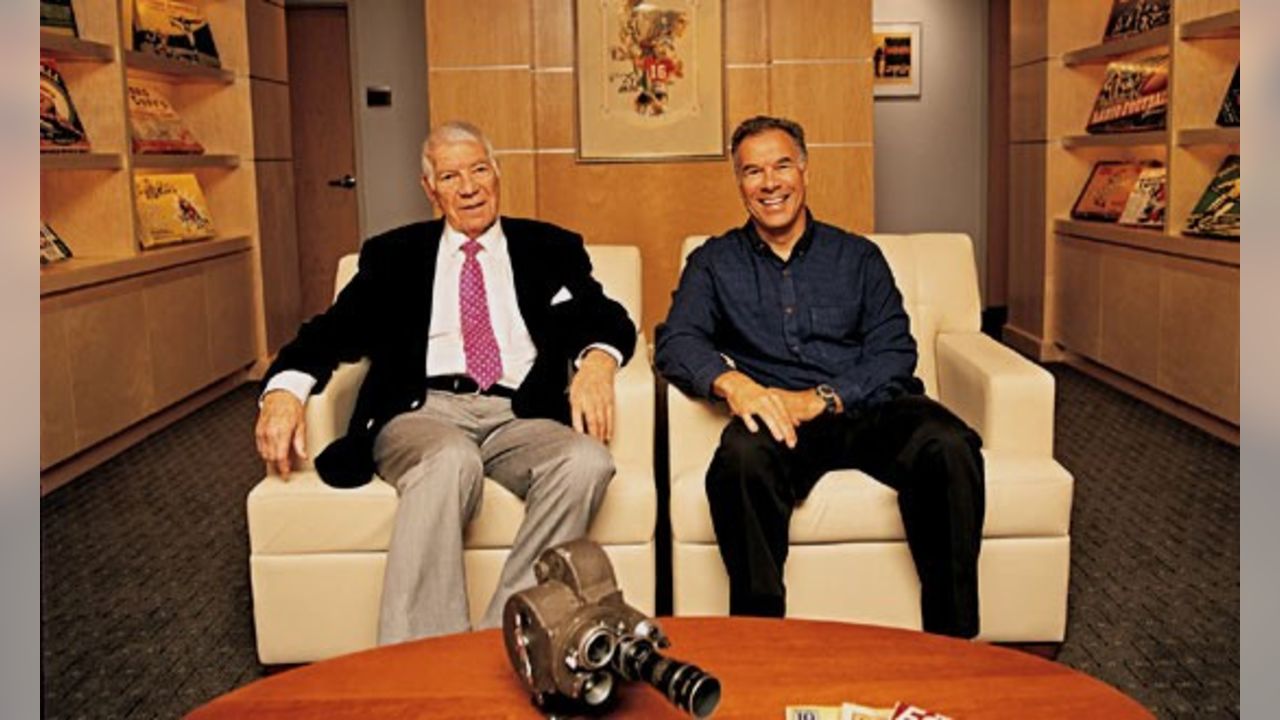
Ed Sabol (left), Steve Sabol,
and the camera that started it all.

December 30, 1962: The Green Bay Packers beat the New York Giants, 16-7 at Yankee Stadium in The Bronx. Aside from being bitterly cold, with New York dealing with the kind of weather that Green Bay was used to, the game itself was not especially remarkable.

But it was filmed by a crew from Blair Motion Pictures of Philadelphia. This was the birth of NFL Films. That company would be nearly as responsible for the League's growth in popularity as Commissioner Pete Rozelle and the various television network executives.

A son of Romanian Jewish immigrants, growing up in Blairstown, Warren County, New Jersey, Ed Sabol served in World War II, then sold topcoats. But he got a home movie camera as a wedding present. He used it to record his son Steve's high school football games. Then he formed a small film company, named for his daughter, Blair. In 1962, he won the rights to film the NFL Championship Game, by bidding $5,000. And even that was double the winning bid of the season before.

Rozelle was impressed by the resulting film, and in 1965, the NFL team owners bought Blair Motion Pictures, renaming it NFL Films. Each of the League's 14 team owners gave Ed $20,000, and the right to shoot all NFL games, and produce an annual highlight film for each team.

In 1967, NFL Films released a half-hour documentary, The Call It Pro Football, including footage of the game that was retroactively renamed Super Bowl I. It began with the narrator, Philadelphia newscaster John Facenda, saying, "It starts with a whistle, and ends with a gun. Sixty minutes of close-in action from kickoff to touchdown. This is pro football: The sport of our time." It was one of the earliest successes for the company.

In 1970, ABC began broadcasting Monday Night Football, and, during halftime, showed NFL Films' footage of the previous day's games. In 1971, the company began producing This Is the NFL, a Saturday show that showed highlights of the previous week's games, on CBS, featuring the network's lead announcing team, former New York Giants tackle and kicker Pat Summerall, and former Philadelphia Eagles cornerback Tom Brookshier. That program did such a great job of raising the NFL's profile, it inspired Major League Baseball to start Major League Baseball Productions, and start the series This Week In Baseball in 1977.

Three things stood out in NFL Films' broadcasts: The marching-band music, the use of slow motion to capture things like the spinning of a passed football in flight, and the narration of Facenda. Let the record show, however, that he never described the field in Green Bay as "the frozen tundra of Lambeau Field." That was later ESPN announcer Chris Berman, imitating him.

ESPN eventually began doing historical programs, featuring footage from NFL Films' vault at their massive headquarters in Mount Laurel, Burlington County, New Jersey, a suburb of Philadelphia; and interviews with surviving figures from those films, conducted by Steve Sabol.

These included Old Leather, from 1976, about stars of the 1920s, with Red Grange, Fritz Pollard, and Johnny "Blood" McNally among those alive and well enough to sit for interviews; and Their Deeds and Dogged Faith, from 1977, about some of the toughest figures in NFL history, including Chicago Bears (and NFL) founder George Halas.

Facenda died in 1984, his last film being the highlights of Super Bowl XVIII. Another Philadelphia broadcast legend, Phillies announcer Harry Kalas, took over until his death in 2009. They have used various announcers since.

Ed Sabol was elected to the Pro Football Hall of Fame as a "Contributor" in 2011. It seemed to be just in time: He was 95 years old and in a wheelchair; and Steve was dealing with brain cancer. Steve died the next year, at age 69. Ed lived until 2015, age 98. Steve was posthumously elected to the Hall in 2020.

*

December 30, 1962 was a Sunday. There were no other football games that day: The NCAA had college football bowl games scheduled for the day before and the day after, but not this day; and the AFL Championship Game was the week before, with the Dallas Texans (soon to be the Kansas City Chiefs) beating the Houston Oilers in double overtime.

There were 2 games played in the NBA. The Los Angeles Lakers beat the Detroit Pistons, 135-130 at Cobo Hall (now Huntington Place) in Detroit. Elgin Baylor scored 38 points. And the St. Louis Hawks beat the Chicago Zephyrs, 107-100 at the Chicago Coliseum. The failing Zephyrs moved the next season, becoming the Baltimore Bullets. They moved to Washington in 1973, and became the Washington Wizards in 1997.

There were 2 games played in the NHL. The New York Rangers and the Montreal Canadiens played to a 4-4 tie at the old Madison Square Garden. And the Chicago Black Hawks beat the Boston Bruins, 4-2 at the Chicago Stadium. The Toronto Maple Leafs and the Detroit Red Wings were not scheduled. 

December 30, 1956: "De-FENSE!"

Sam Huff

December 30, 1956: The NFL Championship Game is played at Yankee Stadium. This was the 1st season in which the football version of the New York Giants played their home games there, after 31 seasons across the Harlem River, at the Polo Grounds, home of the baseball Giants.

The Giants selected linebacker Sam Huff of West Virginia in the 3rd round of the 1956 NFL Draft. He did not get along with head coach Jim Lee Howell, and quit. But before he could get on a plane to go home, the team's offensive coordinator caught him at the airport, and talked him into going back. That coach's name was Vince Lombardi.

The defensive coordinator was Tom Landry, who had been perhaps the 1st player in the two-platoon era to became a great defensive back without also playing on offense. He devised the 4-3 defense, with 2 tackles, 2 ends, and 3 linebackers, and dropped Huff to the position of middle linebacker, which did not previously exist. (Up to then, most teams used a 5-2 defense.)

Huff recalled, "Before, I always had my head down, looking right into the center's helmet. Now, I was standing up, and I could see everything, and I mean everything. I always had outstanding peripheral vision. It's one of the reasons I was so perfectly suited for the position."

The Giants had a good offense, with quarterback Charley Conerly; running backs Frank Gifford, Mel Triplett and Alex Webster; end Kyle Rote; and offensive tackle Roosevelt Brown. But, for the 1st time in NFL history, it was a defense that caught everybody's attention. Before the various Fearsome Foursomes (at least 3 teams had lines nicknamed that), before the No-Name Defense in Miami, before the Steel Curtain in Pittsburgh, before the Doomsday Defense in Dallas, before the Jets' New York Sack Exchange, and before the 46 Defense in Chicago, there was the Big Blue Wrecking Crew.

The tackles were Dick Modzelewski and Rosey Grier. The ends were Jim Katcavage and Andy Robustelli. The linebackers were Sam Huff, flanked by Bill Svoboda and Harland Svare. The cornerbacks were Ed Hughes and Dick Nolan. The safeties were Emlen Tunnell and Jimmy Patton. They were so good, a new chant rang around the rafters of the pre-renovation original Yankee Stadium: "De-FENSE! De-FENSE! De-FENSE!"

Huff said, "Landry built the 4-3 defense around me. It revolutionized defense, and opened the door for all the variations of zones and man-to-man coverage, which are used in conjunction with it today."

Gifford, the 1st in a long line of great tailbacks at the University of Southern California, was the glamour boy on offense, but Huff became that on defense. And on December 30, 1956, with the field at Yankee Stadium frozen solid, the Giants played the NFL Championship Game against the Chicago Bears. They were a far cry from the "Monsters of the Midway" who had dominated the NFL in the 1940s.

Three weeks earlier, on December 9, the Bears were playing the Chicago Cardinals at Wrigley Field, in a game that would be depicted in an episode of the ABC sitcom Happy Days. Ed Brown, playing quarterback for the Bears, threw an interception. Richie Cunningham, played by Ron Howard, said he wanted the other quarterback put in. His friend Ralph Malph, played by Donny Most, said of that quarterback, "He's washed up. He's old. He's 30. He's got no future." Richie said, "George Blanda has 2 or 3 good years left."

The Bears won the game, 10-3. And, while Brown got the Bears into the Championship Game, Blanda kept on playing and playing and playing, until the 1975 AFC Championship Game, played 16 days before that episode of Happy Days aired.

Record-wise, the Bears were better, 9-2-1, compared to the Giants' 8-3-1. But the game was no contest. Especially since, echoing their 1934 Championship Game win over the Bears, the Giants wore sneakers instead of shoes with cleats, getting better traction on the frozen field. This would finally be outlawed -- too late for the Bears.

Tunnell returned Blanda's opening kickoff 53 yards. Just 3 plays later, Triplett ran 17 yards for a touchdown. On the Bears' 1t play from scrimmage, Brown fumbled a handoff, and the Giants recovered. On their next drive, Brown was intercepted by Jim Patton. Both times, Ben Agajanian kicked a field goal, and the Giants ended the 1st quarter up 13-0.

In the 2nd quarter, Alex Webster scored on a 3-yard touchdown run. Rick Casares ran the ball in from 9 yards to put the Bears on the scoreboard. They would not get on it again. Before the half was out, Webster would score another touchdown, and Henry Moore would block a punt in the end zone, making it 34-7 New York.

As Huff and the dee-fense continued to shut the Bears down (if not quite shutting them out), the Giants carried out the kind of ball-control offense that Bill Parcells would use for them 30 years later. In the 3rd quarter, Conerly threw a 9-yard touchdown pass to Rote, although Agajanian missed the extra point. In the 4th quarter, Conerly threw a 14-yard pass to Gifford. Final score: Giants 47, Bears 7. It wasn't a "miracle on ice," it was a massacre on ice.

This began a run of 8 seasons in which the Giants would win their Division 6 times, but they wouldn't win the NFL Championship Game again. In 1958, the Giants hosted the Baltimore Colts, and lost in overtime, in what has become known as "The Greatest Game Ever Played." In 1959, they had a rematch at Memorial Stadium in Baltimore, and the Colts won again.

By that point, Lombardi was gone, having been named the head coach of the Green Bay Packers. In 1960, Landry was named the 1st head coach of the expansion Dallas Cowboys. That season, the Giants lost the Division title to the Philadelphia Eagles, after a fumble-forcing tackle by Chuck Bednarik knocked Gifford out for the rest of the season.

Gifford sat out the 1961 season, while Allie Sherman was named the Giants' new head coach, and Y.A. Tittle replaced Conerly as quarterback. They won the Division again, but lost the Championship Game to Lombardi's Packers on a snow-strewn Lambeau Field on New Year's Eve. In 1962, with Gifford returning, it was Giants vs. Packers again, this time at Yankee Stadium, again with the field frozen, and the Packers won. In 1963, on yet another frozen field, the Giants went out against the Bears at Wrigley Field, and lost a tough battle.

All the while, Huff became more and more famous. He was named to 5 Pro Bowls. Time magazine had placed college football players on its cover before, but Huff became the 1st NFL player on it, for its issue dated November 30, 1959.

In the 1960 preseason, the CBS news program The Twentieth Century approached Huff, offering to put a microphone on his uniform for practices and an exhibition game, to show TV viewers what a football game really sounded like. Hosted by Walter Cronkite, it was titled "The Violent World of Sam Huff," and it aired, perhaps appropriately, on October 30, Mischief Night.

How successful was the program? The next day, a CBS executive wrote a letter, put it in an envelope, and wrote nothing on the envelope except "Number 70." No actual name, no return address, nothing except "Number 70." Three days later, the letter was delivered to Huff's locker at Yankee Stadium.

The U.S. Postal Service employees knew exactly what, and who, it meant. Even before Lawrence Taylor was born, Huff might have been a better linebacker.

The team seemed to get old all at once in 1964. Huff was traded to the Washington Redskins, Tunnell was already gone, and 1964 would be the last season for Tittle, Gifford and Robustelli. Roosevelt Brown lasted 1 more season. The Yankees, too, seemed to get old overnight between the Autumn of 1964 and the Spring of 1965. Yankee Stadium became a very different place through its closing for renovations in 1973.

In October 1976, the Yankees would be back in the World Series, in a renovated Yankee Stadium; while the new Giants Stadium opened in the New Jersey Meadowlands. It took until 1981 for the Giants to make the Playoffs again, and the 1986 season before they won another title.

*

December 30, 1956 was a Sunday. Actresses Sheryl Lee Ralph and Patricia Kalember were born.

At the time, the NCAA did not permit college football games, even bowl games, to be played on Sundays. Baseball was out of season. There were 4 games played in the NBA:

* The New York Knicks beat the Rochester Royals, 96-88 at the old Madison Square Garden. Kenny Sears scored 33 points for the Knicks. This would be the last season in Rochester, as the Royals moved to Cincinnati for 1957-58.

* The Boston Celtics beat the Syracuse Nationals, 105-92 at the Boston Garden.

* The Fort Wayne Pistons beat the Philadelphia Warriors, 104-99 at the Allen County War Memorial Coliseum in Fort Wayne, Indiana. In spite of the defeat, the Warriors' Paul Arizin scored 35 points. This would be the last season in Fort Wayne, as the Pistons moved to Detroit for 1957-58.

* And the St. Louis Hawks beat the Minneapolis Lakers, 100-93 at the Kiel Auditorium in St. Louis. Bob Pettit scored 41 points and had 18 rebounds for the Hawks.

And there were 2 games in the NHL. The Boston Bruins beat the Detroit Red Wings, 4-2 at the Olympia Stadium in Detroit. And the Chicago Black Hawks beat the Toronto Maple Leafs, 2-0 at the Chicago Stadium. The New York Rangers and the Montreal Canadiens were not scheduled.

Thursday, December 29, 2022

December 29, 1963: Two Old Men and a Football

George Halas and John Johnson

December 29, 1963: The NFL Championship Game is played at a frigid Wrigley Field in Chicago. As with the 1st official title game, 30 years earlier, the opposing teams were the Chicago Bears and the New York Giants.

Coached, run, and owned by the man who founded the NFL, George Halas, the Bears had a relatively ordinary offense, led by quarterback Bill Wade and running backs Willie Galimore and Ronnie Bull. But they had Mike Ditka, who practically invented the position of tight end. Only once all season did they score more than 27 points, although that was in a 52-14 clobbering of the Los Angeles Rams in Los Angeles.

It was on defense where they were truly dominant. End Doug Atkins, tackle Stan Jones and middle linebacker Bill George -- described after his death by Sports Illustrated columnist Rick Reilly as "the meanest Bear ever," and that's saying something -- would be elected to the Pro Football Hall of Fame. End Ed O'Bradovich, linebackers Joe Fortunato and Larry Morris, cornerback J.C. Caroline and safety Richie Petitbon were also All-Pros. Not once all season did the Bears allow more than 21 points in a game, and only twice more than 17.

They also had an unexpected advantage: Two key players from other teams in the Western Division, running back Paul Hornung of the Green Bay Packers and defensive tackle Alex Karras of the Detroit Lions, had been suspended for the season due to gambling (on sports other than football, which is why they only got one year).

As a result, it was neither the two-time defending NFL Champion Packers or the Lions, who had dealt the Packers their only loss the season before, who put any blemishes on the Bears' record. The Bears jumped out to a 5-0 start before losing 20-14 away to the San Francisco 49ers. They got up to 9-1, then faced back-to-back 17-17 ties, away to the Pittsburgh Steelers and at home to the Minnesota Vikings, before closing by avenging their loss to the 49ers and completing their sweep of the Lions.

The Bears were the NFL's founding team. But its flagship team, as is usually the case in sports, was in New York. The Giants had half of the "Million Dollar Backfield" of the 1950s San Francisco 49ers: Quarterback Yelberton Abraham (Y.A.) Tittle and running back Hugh McElhenny. The other two, Joe "the Jet" Perry and John Henry Johnson, never appeared in an NFL Championship Game, and this was one last chance for Y.A. and Hugh. All 4 would be elected to the Pro Football Hall of Fame.
Y.A. Tittle

They also still had the NFL's biggest glamour boy of the 1950s, Frank Gifford, hanging on. And they still had some members of the defense, including Hall-of-Famers Andy Robustelli at defensive end and Sam Huff at middle linebacker, who allowed them to reach the Championship Game 6 times in 8 years. But they had only won in 1956, beating the Bears. They had lost to the Baltimore Colts in 1958 and '59, and, with Allie Sherman taking over from Jim Lee Howell as coach, to the Packers in '61 and '62.

Tittle was 37 years old, bald, and what little hair he had left was already gray, so he looked even older. Halas was 68, at the time the oldest head coach in NFL history. It was looking like the last chance for either of them, which it did turn out to be.

Wrigley Field is known to baseball fans for, among other things, its lack of lights until 1988, and the Chicago Cubs' continuation of scheduling as many day games as they can, so fans can sit in the bleachers and soak up the Summer sun. But this was between Christmas and New Year's, and the temperature was in the single digits, Fahrenheit. The field was frozen.

It would have been frozen at the much larger Soldier Field, but NFL Commissioner Pete Rozelle asked Halas to move the game there, so the lights could be used. Halas refused. So, in order to avoid the game ending in darkness, the starting time was moved up to 12:05 PM, Central Time (1:05 Eastern).

With extra bleachers running north-to-south from left field to the right-field foul line, seating capacity was 45,801. Despite the cold, every seat was filled. Chicago fans may be divided between the Cubs and the White Sox when it comes to baseball, but the NFL's Chicago Cardinals had moved, and locals had given up on them before that. No team is more popular in Chicago than the Bears -- not the Cubs, not the White Sox, not the Bulls even in their Michael Jordan years, not the Blackhawks, not even Notre Dame. It was true then, and it is true now.

With the kind of drive that would have pleased later coach Bill Parcells, the Giants methodically moved down the field on the game's opening drive, eating the clock, taking up the 1st half of the 1st quarter, until Tittle threw a 14-yard touchdown pass to Gifford. Just before the end of the quarter, Wade tied things with a 2-yard run.

Don Chandler, later to be the kicker and punter for the Packer teams that won the 1st 2 Super Bowls, kicked a field goal in the 2nd quarter, putting the Giants up, 10-7. But on their next drive, Morris hit Tittle and reinjured a knee that had been hurt earlier in the year. Sherman took Tittle out and replaced him with Glynn Griffing, but showed so little confidence him him that he ordered a punt on a 3rd down.

Much like New York Yankees star Mickey Mantle, with whom he shared a home stadium, Tittle tried to play through his pain. He got shots of cortisone and Novocaine, and threw off his back foot, normally unwise for a quarterback, but with his collected know-how, he thought he could lead the Giants to victory.

But late in the 3rd quarter, Tittle tried a screen pass, and O'Bradovich intercepted it, setting up a Bears drive that ended with a quarterback sneak by Wade. The Bears led, 14-10. Tittle gamely trudged through the 4th quarter, trying to get one more touchdown. But with 10 seconds left, in range of the end zone, Tittle threw, and was intercepted in the end zone by Petitbon.

It was the Bears' 5th interception of the day. With the country watching on CBS, seeing him limp off the field, Tittle had won the hearts of millions of fans, but the Bears had won the NFL Championship. It was their 1st since the last of the Sid Luckman titles in 1946.

Halas was ecstatic, but the players knew better than to lift the aging "Papa Bear" onto their shoulders and carry him off the field in triumph. So the defensive players picked up Halas' defensive coordinator, and carried him, and gave him the game ball in the locker room. He had been nearly as responsible for this title as Halas. His name was George Allen, and he would later coach the Rams into the Playoffs, and the Washington Redskins to the 1972 NFC Championship, and be elected to the Hall of Fame.

It was the 8th and last Championship for Halas as owner, his 6th as head coach, each a record that has never been matched. (Bill Belichick has coached 6 title winners, but he cheated.)

It also made Chicago the 1st city to win both the NFL Championship and the NCAA Basketball Tournament in the same calendar year. Loyola University had won the title in March. It's only happened once since, in 2018, with the Super Bowl by then played in February: Philadelphia did it with the Eagles and Villanova.

The following year would be a bad one for both teams, starting eras of mediocrity. During the Summer, Willie Galimore and fellow Bear running back Bo Farrington were killed in a car crash outside the team's Indiana training camp. This led them to draft Gale Sayers in 1965. They also drafted Dick Butkus, to shore up their aging defense. In spite of having 2 of the top 5 players in the game in the late 1960s, the Bears didn't reach the Playoffs again until 1977, by which point both Sayers and Butkus were retired.

And, just as the Yankees got old in a hurry in the 1964-65 off-season, so, too, did the Giants suddenly look very old in Autumn 1964. Huff had been traded to Washington, and 1964 would be the last season for both Tittle and Gifford. Hall of Fame offensive tackle Roosevelt Brown only lasted one year after that. The Giants didn't make the Playoffs again until 1981.

Halas' reasons for not moving the Bears to Soldier Field have been debated. Finally, the AFL-NFL merger of 1970 forced his hand: NFL stadiums now had to have both lights and a seating capacity of over 50,000, and Wrigley Field then had neither. In 1971, Halas moved the Bears to Soldier Field. Given his love of football, and his love of making money, he must have been very happy being able to play Monday Night Football, and the Bears did so 14 times, 7 at Soldier Field, before his death in 1983.

The Giants and the Bears have met to decide the NFL Championship 6 times, more than any other pairing. The Bears won in 1933, 1941, 1946 and 1963; the Giants, in 1934 and 1956. With the realignment of the NFL, they cannot face each other in the Super Bowl. But they have faced each other in the NFC Playoffs again in the seasons of 1985, when the Bears won; and 1990, when the Giants won. On each of those occasions, the winner did go on to win the title.

The Bears are the founding franchise of the NFL. Yet they’ve won only one title since, Super Bowl XX in the 1985-86 season. That’s just 2 titles in the last 77 years.

But consider this: The Bears won 8 World Championships in their 50 seasons playing at Wrigley Field. It took the Cubs 101 seasons playing there to win one.

In 2019, in connection with their 100th Season (not their 100th Anniversary, which was the next year), the Bears did fan balloting for their 100 Greatest Players. From this 1963 title team, they chose quarterback Billy Wade, running backs Willie Galimore, Rick Casares, receiver Johnny Morris, tight end Mike Ditka, center Mike Pyle, guard Stan Jones, tackles Herm Lee and Bob Wetoska; defensive ends Doug Atkins and Ed O'Bradovich, linebackers Joe Fortunato and Larry Morris (no relation to Johnny; cornerbacks J.C. Caroline, Roosevelt Taylor and Bennie McRae; safety Richie Petibon, and punter Bobby Joe Green.

From the period between the 1963 and 1985 titles, they chose running back Gale Sayers, linebackers Dick Butkus and Doug Buffone, receiver Dick Gordon, defensive tackles Jim Osborne and Wally Chambers, cornerback Allan Ellis and safety Doug Plank.

*

December 29, 1963 was a Sunday. Sean Payton, who would coach the New Orleans Saints to their 1st World Championship, was born.

Baseball was out of season. There were 2 games played in the NBA. The New York Knicks lost to the Cincinnati Royals, 105-99 at the Cincinnati Gardens. And the Los Angeles Lakers beat the Detroit Pistons, 140-128 at Cobo Hall (now Huntington Place) in Detroit. Jerry West scored 39 points.

And the NHL's entire "Original Six" were in action:

* The New York Rangers lost to the Montreal Canadiens, 6-2 at the old Madison Square Garden.

* The Detroit Red Wings beat the Boston Bruins, 2-1 at the Olympia Stadium in Detroit.

* And the Chicago Black Hawks beat the Toronto Maple Leafs, 2-0 at the Chicago Stadium.

Wednesday, December 28, 2022

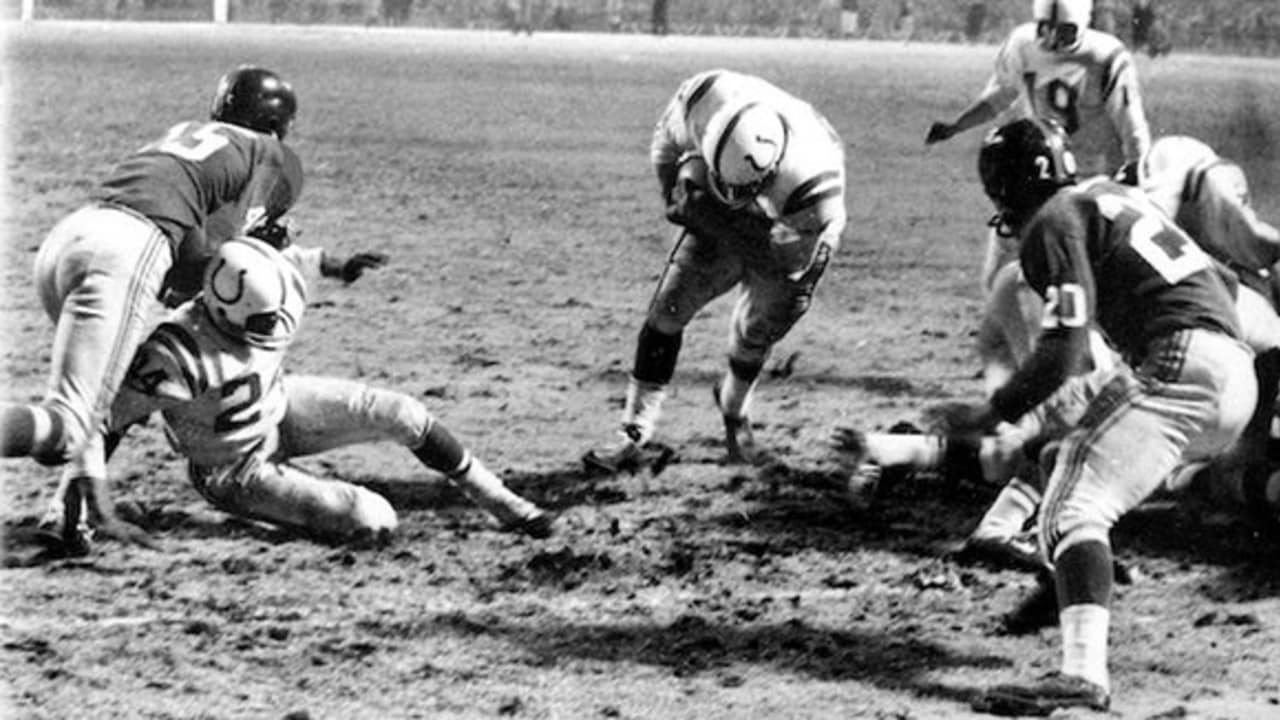
December 28, 1958: Pro Football's "Greatest Game"

Alan Ameche scores the winning touchdown.
Lenny Moore (24) provides the key block on Emlen Tunnell.
Johnny Unitas (19) watches.

December 28, 1958: The NFL Championship Game is held at Yankee Stadium. The New York Giants, Champions of the NFL Eastern Division, play the Baltimore Colts, Champions of the Western Division. It is the 1st Championship Game for the Colts, the 10th for the Giants, who had previously won it in 1934, 1938 and 1956. (Why Baltimore, a Northeastern city, was placed in the League's Western Division, I don't know.)

The Giants had Charlie Conerly as their quarterback, and the biggest football star of the time, Frank Gifford, at running back. They were the 1st team to really make defense a priority, led by future Hall-of-Famers Sam Huff, Andy Robustelli and Emlen Tunnell. Two years earlier, they had destroyed the Chicago Bears in the Championship Game, 47-7.
The pre-renovation original Yankee Stadium, set up for football


But the Colts were on the rise. Their quarterback was Johnny Unitas. He had Raymond Berry to throw to, Lenny Moore in his backfield, and Jim Parker to block for him. All 4 would make the Hall of Fame. His defense was led by Hall-of-Famers Gino Marchetti and Art Donovan.

The 1st half was a bit sloppy, and didn't live up to the legend. Pat Summerall, future broadcasting legend, began the scoring with a field goal in the 1st quarter, putting the Giants up 3-0. In the 2nd quarter, Alan Ameche, who won the Heisman Trophy at the University of Wisconsin in 1954, scored a touchdown to put the Colts ahead. Unitas threw a touchdown pass to Berry, giving the Colts a 14-13 lead at the half.

In the 3rd quarter, Mel Triplett snuck the ball over the goal line to put the Giants back in it. Early in the 4th quarter, Conerly threw a touchdown pass to Gifford, giving the Giants a 17-14 lead. As the clock wound down, Unitas drove the Colts, but couldn't get them over. So Steve Myhra was sent in to kick a field goal as time expired. With the clock reading 0:00, the scoreboard read 17-17.

No NFL Championship Game had ever ended in a tie. Overtime was needed, for the 1st time in NFL history. (The League didn't institute overtime for the regular season until 1974.) The Giants won the toss, but couldn't score. Unitas led an inspiring drive, toward what would have been left field in The Stadium's baseball setup, which finally ended with Ameche scoring from the 1-yard line -- appropriately where Monument Park would later be in The Stadium's post-renovation period (1976-2008).

Bob Wolff, who had been in the same Stadium 2 years earlier to call Don Larsen's perfect game for the New York Yankees against the Brooklyn Dodgers in the 1956 World Series, was at the microphone for NBC again, and had the call: "Unitas gives to Ameche... The Colts are the World Champions! Ameche scores!" He later said he was glad he didn't "bury the lead" by saying, "Ameche scores!" first.

This game had the largest TV audience in NFL history to that point, 45 million people. The fact that it was in New York, and involved a New York team, helped it loom large in the public consciousness. This was the game that launched the NFL on a path to becoming, at least in perception, more popular than Major League Baseball.

It made legends of the Colts, and Unitas in particular. He would go on to be recognized as the greatest quarterback of all time. It's been 62 years, and some people still think he is. And the Colts, playing in a city that didn't have a big college football team -- Morgan State University is a historically black school, the U.S. Naval Academy is a national school, and the University of Maryland is closer to Washington -- became known as the team of America's working class, an "America's Team" in a way that felt artificial when the Dallas Cowboys later called themselves that.
Johnny Unitas

It also became known as "The Greatest Game Ever Played." It has been noted that it would never have been called that had the Colts beaten, say, the Philadelphia Eagles. But it was the New York team that they beat, in New York City. And so, every so often, polls are taken that show this game as the "greatest." The most recent was in 2019, for the NFL's 100th Anniversary. In 1981, John Thorn left his comfort zone, baseball, and published Pro Football's 10 Greatest Games. He included this game as one of them.

The teams had a rematch in the 1959 NFL Championship Game. In those days, home field was rotated between the Eastern and Western Champions, and the Colts hosted it at Memorial Stadium, beating the Giants again.

It remains the longest game in New York Giants history.

*

December 28, 1958, as you may have guessed, was a Sunday. There were no more NFL games to be played. It was the off-season for baseball.

There was only 1 NBA game played that day: The Cincinnati Royals beat the Minneapolis Lakers, 120-116 at the Cincinnati Gardens. Jack Twyman of the Royals scored 32 to lead all players in this game. Bob "Slick" Leonard, later to coach the Indiana Pacers to 3 ABA Championships, led the Lakers with 20 points.

The Lakers moved to Los Angeles in 1960. The Royals moved to Kansas City, becoming the Kings, in 1972, and to Sacramento in 1985.

All of the NHL's "Original Six" were in action that day:

* The New York Rangers beat the Montreal Canadiens, 5-3 at the old Madison Square Garden. This was an anomaly, as the Canadiens were in the middle of a run of 5 straight Stanley Cups, and the Rangers were in a down period.

* The Detroit Red Wings, beat the Boston Bruins, 5-3 at the Olympia Stadium in Detroit.

* And the Chicago Black Hawks beat the Toronto Maple Leafs, 4-3 at the Chicago Stadium. ("Black Hawks" was written as 2 words until 1986, when the team's original charter document was found, and it was discovered that "Blackhawks" was written as one word, and it has officially been so ever since.) 

Friday, December 23, 2022

December 23, 1995: Snowballs at the Meadowlands

December 23, 1995: The New York Giants close their season in ignominious fashion -- and the result is far from the worst of it.

They were playing the San Diego Chargers, at Giants Stadium in the Meadowlands. It's important to note that the Giants have no rivalry with the Chargers. This was only the 7th time the 1925-established NFL mainstays and the 1960-established original AFL team had played each other in the regular season. The Giants had won at Yankee Stadium in 1971, at Shea Stadium in 1975, at Giants Stadium in 1986, and at Jack Murphy Stadium in San Diego in 1989. The Chargers had won at The Murph in 1980 and at Giants Stadium in 1983.

None of those games had been particularly contentious. Indeed, even this game had no incidents between the Giant players and the Charger players.

For the Giants, it was a bad season, by any measure. They started out 0-3, closed to within 3-5, fell to 3-9, got up to 5-9, and went into this game 5-10. The Chargers had started 4-7, but had won 4 straight, and had a chance to make the Playoffs if they beat the Giants and other games went their way.

There had been significant snowfall the day before, and only 50,243 fans, out of a possible 78,000+, showed up. While the seats at Giants Stadium had been cleared of snow, there was still a lot of it lying around, waiting for angry -- or, at least mischievous -- fans to turn them into snowballs. At least in the 1st half, they only threw them at each other, because they were pleased with the product on the field: The Giants went into the locker room up 17-3.

This score was understandable: There was snow all around, and the temperature was 34 degrees, 24 with the wind chill. The New York-based team was used to this kind of weather. The San Diego-based team was not.

But a funny thing happened on the way to the Giants giving their fans a Merry Christmas: They ended up giving their fans a big lump of coal instead. The Chargers scored a touchdown, but it was still 17-10 Giants after 3 quarters.

By this point, the snowballs were flying from the stands, then onto the field. Bob Sheppard, who had been the Yankees' public address announcer since 1951 and the Giants' since 1956, put his best "Voice of God" to work on the crowd, telling them that the game could be forfeited if the barrage continued.

On the 1st play of the 4th quarter, referee Ron Blum called time-out. He went over to the Charger sideline to call up to the booth, and ask for a repeat of the threat. A fan threw a snowball in his direction. Except it wasn't a snowball: It was an iceball, much harder. And it didn't hit Blum: It hit Sid Brooks, the Chargers' equipment manager, right in the face, knocking him out.

The game should have been forfeited right there. Maybe it would have been, if Charger head coach Bobby Ross had spoken up at that moment. But he didn't, and it wasn't.

The Chargers completed their drive with a touchdown, and the game was tied. On their next drive, Junior Seau hit Giant quarterback Dave Brown, whose throw had been intended for the end zone. Instead, Shaun Gayle -- now with the Chargers, he had been an All-American sprinter in college and a member of the Chicago Bears' 1985-86 "Super Bowl Shuffle" team -- intercepted it, and returned it 99 yards for a touchdown. Well before he reached the end zone, fans sitting there began throwing snowballs at him. Many got as far as him, but none hit him.

The Giants fumbled on their next possession, and John Carney kicked a field goal for the final score: Chargers 27, Giants 17. It was one thing for the Giants to humiliate their fans, which had happened before. It was another thing for the fans to humiliate each other, and the players.

Giants management announced that any snowball-thrower who could be identified would be banned from the Meadowlands Sports Complex for life, even if that meant revoking his season ticket. Six such spectators were identified, including one who ended up on the back page of the New York Daily News. Giants management also bought a full-page ad in the next day's San Diego Union-Tribune -- the Sunday edition -- apologizing to the people of San Diego for the incident.

By a quirk in the NFL schedule, the New York Jets were scheduled to play at Giants Stadium the very next day. The New Jersey Sports and Exposition Authority, operator of the stadium, went into overdrive to get all the snow removed from the stadium before kickoff. Given that the Jets were going in 3-12 under the already-much-maligned head coach Rich Kotite, a 2nd angry fanbase was possible. But the snow was cleared, there were no incidents, and the Jets lost to the New Orleans Saints, 12-0.

The Chargers did end up making the Playoffs. Since then, they've played the Giants 6 times. The Giants won in San Diego in 1998. The Chargers won in San Diego in 2005 and 2013, at the Meadowlands in 2009 and 2017, and, following their move back to Los Angeles, at SoFi Stadium in Inglewood, California 11 days ago.

None of those games had any incidents, either. Only the one on Christmas weekend 1995.

*

December 23, 1995 was a Saturday. There were 2 other NFL games played that day, instead of the next day, Sunday, Christmas Eve:

* The Detroit Lions beat the Tampa Bay Buccaneers, 37-10 at Tampa Stadium. No danger of snowballs in Florida.

* And the Indianapolis Colts beat the New England Patriots, 10-7 at the RCA Dome in Indianapolis. No danger of snowballs in a dome.

There were 12 games played in the NBA:

* The New York Knicks beat the expansion Toronto Raptors, 103-91 at Madison Square Garden.

* The New Jersey Nets beat the Philadelphia 76ers, 98-85 at The Spectrum in Philadelphia.

* The Charlotte Hornets beat the Miami Heat, 87-75 at the Charlotte Coliseum.

* The Cleveland Cavaliers beat the Indiana Pacers, 97-97 at the Gund Arena (now the Rocket Arena) in Cleveland.

* The Orlando Magic beat the Detroit Pistons, 94-79 at The Palace in the Detroit suburb of Auburn Hills, Michigan.

* The Chicago Bulls beat the Utah Jazz, 100-86 at the United Center in Chicago.

* The Milwaukee Bucks beat the Atlanta Hawks, 115-111 at the Bradley Center in Milwaukee.

* The Minnesota Timberwolves beat the Dallas Mavericks, 111-98 at the Target Center in Minneapolis.

* The San Antonio Spurs beat the Houston Rockets, 110-95 at the Alamodome in San Antonio.

* The Los Angeles Clippers beat the Denver Nuggets, 107-92 at the McNichols Arena in Denver.

* The Los Angeles Lakers beat the Portland Trail Blazers, 102-99 at the Rose Garden (now the Moda Center) in Portland.

* And the Seattle SuperSonics beat the Washington Bullets, 118-100 at the KeyArena in Seattle.

There were 11 games played in the NHL:

* The New Jersey Devils lost to the Florida Panthers, 2-1 at the Miami Arena.

* The New York Islanders beat the Washington Capitals, 3-1 at the Nassau Coliseum.

* The Montreal Canadiens beat the Pittsburgh Penguins, 1-0 in one of the last games played at the Montreal Forum.

* The Boston Bruins beat the Tampa Bay Lightning, 7-5 at the Fleet Center (now the TD Garden).

* The Philadelphia Flyers played the Hartford Whalers to a tie, 3-3 at the Hartford Civic Center (now the PeoplesBank Arena).

* The Buffalo Sabres beat the Ottawa Senators, 4-2 at the Ottawa Civic Centre (now the TD Place Arena).

* The Toronto Maple Leafs beat the Edmonton Oilers, 6-1 at Maple Leaf Gardens in Toronto.

* The Chicago Blackhawks beat the Dallas Stars, 2-0 at the Reunion Arena in Dallas.

* The Winnipeg Jets beat the St. Louis Blues, 2-1 at the Winnipeg Arena.

* The Colorado Avalanche played the Los Angeles Kings to a tie, 2-2 at The Forum outside Los Angeles in Inglewood, California.

* And the Detroit Red Wings beat the Vancouver Canucks, 1-0 at General Motors Place in Vancouver (now the Rogers Arena).

Also, Arsenal went to Anfield, and lost to Liverpool, 3-1. 

Wednesday, December 21, 2022

December 21, 1941: The Last NFL Player Without a Helmet

According to Pro-Football-Reference.com,
the only number Dick Plasman wore
during a game for the Bears was 14.

December 21, 1941: The NFL Championship Game is played at Wrigley Field in Chicago. The Chicago Bears make it back-to-back titles, beating the New York Giants, 37-9.

It wasn't as demonstrative as the year before, when the Bears beat the Washington Redskins, 73-0 in Washington, earning them the nickname "The Monsters of the Midway." But it was decisive. The Giants actually led 6-3 at the end of the 1st quarter, and forged a 9-9 tie in the 3rd. But quarterback Sid Luckman ran the T formation as well as ever, leading 3 long drives that ended with short touchdown runs, 2 by Norm Standlee, 1 by George McAfee. The Bears also got 2 field goals from Bob Snyder, and a 42-yard fumble return by Ken Kavanaugh.

This game was notable for other reasons. It had been 2 weeks since the Japanese attacked Pearl Harbor, so it would be the last NFL game played before the manpower drain of World War II began to take effect. Two players in this game would be killed in The War, both in early 1945: Chicago back Young Bussey, with the Navy in the Philippines; and New York end Jack Lummus, with the Marines on Iwo Jima.

On the Bears' last touchdown, Ray "Scooter" McLean chose to dropkick the extra point. There wouldn't be another attempt at a dropkick in an NFL game for 64 years, until Doug Flutie of the New England Patriots did it at the end of the 2005 season. A member of 4 title teams with the Bears, McLean would go on to be the Green Bay Packer head coach replaced by Vince Lombardi in 1959.

"There'll be no need of breaking up the Bears for the good of pro football," Bears end Dick Plasman said. "The war's done it already." This prediction turned out not to be completely true: The Bears did manage to reach the Championship Game again in 1942, but lost it to the Redskins; then, with a makeshift roster, including bringing running back Bronko Nagurski out of retirement after 6 years, beat the Redskins in the 1943 title game. After 2 years missing the title game, they got back to it in 1946, and beat the Giants. The Giants got into the 1944 title game, losing to the Packers.

Plasman did not wear a helmet in the 1941 title game, or in any game he'd played before that. By his own admission, he didn't even like hats. He thus became the last man to appear in an NFL game without a helmet. The NFL mandated helmets starting in 1943, with no "grandfather clause." When Plasman, on leave with the U.S. Army Air Forces, was allowed to return to the Bears in 1944, and when he played for the Chicago Cardinals after The War in 1946 and 1947 (his last game was their NFL Championship win), he wore a helmet.

Paul Zimmerman, the Sports Illustrated pro football expert known as Dr. Z, said of Plasman, "Ferocious on his blocks, a great pass rusher and a receiver, too. The guy was terrific, a force out there. He was worthy of the Hall of Fame."

In 1974, sportswriter Ira Berkow asked Plasman if he would wear any headgear if given an opportunity to return to the field. He said, "Yes, earmuffs." He had sustained frostbite in his ears during The War. He died in 1981.

*

December 21, 1941 was a Sunday. Baseball was out of season. The NBA hadn't been founded yet. There were 3 games in the NHL:

* The New York Rangers beat the Montreal Canadiens, 4-3 at the old Madison Square Garden. Bryan Hextall scored the winning goal, 6:07 into overtime.

* The Boston Bruins and the Detroit Red Wings played to a tie, 2-2 at the Olympia Stadium in Detroit.

* The Toronto Maple Leafs beat the Chicago Black Hawks, 3-0 at the Chicago Stadium.

* And the New York Americans were not scheduled. They had been renamed the Brooklyn Americans, even though they were still playing at Madison Square Garden. World War II put their plans for an arena in Brooklyn on hold, and they never played again.

Monday, December 19, 2022

December 20, 1926: The Hornsby-Frisch Trade

Rogers Hornsby

December 20, 1926: The New York Giants trade their 2nd baseman and Captain, Frankie Frisch, and Jimmy Ring to the St. Louis Cardinals for Rogers Hornsby.
Frisch had led the Giants to 4 straight National League Pennants from 1921 to 1924, including winning the 1921 and 1922 World Series. But on August 20, Giant manager John McGraw berated him in front of his teammates for missing a sign that cost the team a run in a game -- with retroactive irony, against the Cardinals. So he quit the team.
Frankie Frisch, the Fordham Flash
Giants management refused to step in and straighten things out between the manager and his best player. And since McGraw was also a part-owner of the Giants, and had the backing of main owner Charles Stoneham, he was not going to be the one to go. And Ring was a mediocre pitcher nearing the end of the line.
John McGraw
In exchange, the Giants got Hornsby, also a 2nd baseman, and the best hitter in the National League. From 1920 to 1925, Hornsby had won 6 straight NL batting titles, batting .370, .397, .401, .384, .424 (which remains the highest batting average since 1901, and the highest in the NL since 1887) and .403. In 1922 and 1925, he also led the NHL in home runs (with 42 and 39, respectively) and RBIs (152 and 143), becoming the 1st player to win the Triple Crown twice (an achievement since matched only by Ted Williams).
How good a hitter was he? Legend tells of the greatest umpire of that era, Bill Klem, calling a pitch that Hornsby took a ball; and, when the catcher objected, Klem told him, "Young man, when the pitcher throws a strike, Mr. Hornsby will show you." In other words, by hitting it.
Hornsby had also managed the Cardinals in 1925 and '26, and even owned some stock in them. Since he had to divest himself of that stock in order for the trade to go through, and majority owner Sam Breadon was offering less than Hornsby wanted, the trade was held up for a while. But it did go through.
At first, this blockbuster deal looked great for the Giants. The trade was great -- for the Cardinals. Hornsby's attitude was considerably worse than Frisch's, and McGraw had enough of him that 1st season, trading him afterward. The Giants didn't win another Pennant until 1933, after McGraw retired.
McGraw could be one ornery cuss, but Hornsby was nearly impossible to deal with. As would a later slugger, Dick Allen, he put up All-Star-worthy numbers 4 years in a row, for 4 different teams: He batted .317 with 11 home runs and 93 RBIs for the 1926 Cardinals; .361, 26 and 125 for the 1927 Giants; a League-leading .387, 21 and 94 for the 1928 Boston Braves; and .380, 39 and 149 for the 1929 Chicago Cubs.
He did help the Cubs win Pennants in 1929 and 1932, but was in decline by the latter year. The Cardinals took him back in 1933, but quickly traded him to their Sportsman's Park landlords, the woeful St. Louis Browns, and he served as a player-manager until 1937, when he retired as a player. He was elected to the Baseball Hall of Fame in 1942.
His .358 lifetime batting average ranks 2nd all-time behind Ty Cobb, and tops all National League hitters and all righthanded hitters. His 301 home runs included 298 in NL play, which topped all NL players at the time of his retirement in 1937. He fell short of 3,000 hits, though, at 2,930. 
Like later basketball star Bill Russell, he found it considerably harder to be a manager/head coach without himself as a contributing player. He was also a racist, and a compulsive gambler. Had the extent of his betting on horse racing been known at the time, he might have gotten banned from baseball.
But because he had lost so much money gambling, he had to stay employed in baseball, which wasn't easy. He was a player-manager for the Chattanooga Lookouts of the Southern Association in 1938, and the Baltimore Orioles of the International League in 1939. He went back to Texas, and got into the Texas League Playoffs managing the Oklahoma City Indians in 1940 and the Fort Worth Cats in 1942. Then the TL decided to suspend play for the duration of World War II.
He served as a Spring Training instructor for the Chicago White Sox and the Cleveland Indians. In 1949, he broadcast Cubs games on TV. In 1950, he went back to the Texas League, and led the Beaumont Roughnecks to the Pennant. In 1951, he won the Pacific Coast League Pennant with the Seattle Rainiers.
That got the majors' attention again. In 1952, Bill Veeck hired him to manage the Browns. It lasted 2 months, and when Veeck fired him, the Browns players gave him an engraved trophy to thank him. A few weeks later, the Cincinnati Reds hired him, but, frustrated, he resigned with 8 games left in the season. He coached for the Cubs.
In 1962, when no one else would hire him, his former Giant teammate Casey Stengel hired him as 3rd base coach for the expansion New York Mets. Rogers Hornsby coached that season, and was expecting to be brought back for the next season, when he died on January 5, 1963, in Chicago, of a heart attack. He was 66 years old.
Helped tremendously by a change of scenery, teammates and bosses, Frisch helped the Cardinals win Pennants in 1928, '30, '31 and, as player-manager of a team that became known as the Gashouse Gang, '34. So he was a member 8 Pennant winners, and 4 World Series winners.
He was elected to the Hall of Fame in 1947, and became a broadcaster, first for the Giants, then for CBS and its Game of the Week. He became known for moaning about walks: "Oh, those bases on balls!"
As a member of the Hall of Fame's Committee on Veterans, he was known for lobbying for the election of his former Giant and Cardinal teammates, which many later fans have suggested were undeserving. The term "The Frisch Five" was coined, although there is not consensus on who the 5 players are. From the Giants, they have included George "High Pockets" Kelly, Ross Youngs, Dave Bancroft, Travis Jackson and Freddie Lindstrom. From the Cardinals, they have included Jim Bottomley, Chick Hafey, Jesse Haines and Burleigh Grimes.
Frankie Frisch died on March 12, 1973, at the age of 75, at a hospital in Wilmington, Delaware, from injuries sustained in a car crash in nearby Elkton, Maryland.

In 1949, Ogden Nash, my grandmother's favorite poet, even though he was a Giant fan and she was a Brooklyn Dodger fan, wrote "Line-Up for Yesterday" for Sport magazine, an alphabetical list of star players. For the letter F, he wrote: 

F is for Fordham
And Frankie and Frisch;
I wish he were back
With the Giants, I wish.

And for H:

H is for Hornsby;
When pitching to Rog,
The pitcher would pitch,
Then the pitcher would dodge.

*
December 20, 1926 was a Monday. Baseball and football were out of season. The NBA hadn't yet been founded. One game was played in the NHL, and what would eventually be called "the old Madison Square Garden," but was then new: The New York Americans beat the Toronto Maple Leafs, 2-0.

Saturday, December 17, 2022

December 17, 1944: The Malmédy Massacre

December 17, 1944: The Malmédy Massacre is carried out, in Malmédy, Wallonia, the French-speaking part of Belgium, during the Battle of the Bulge in World War II.

With the Allies having liberated France, and marching toward Germany itself from the West, and the Soviet Union's Red Army marching from the East, the Nazis needed a win, somewhere. On December 15, they attacked in the Ardennes Forest, which stretches over France, Belgium, Luxembourg, and even part of Germany.

They pushed forward, and formed a "bulge" in the American line, leading to the conflict being known as "The Battle of the Bulge." By the 22nd, they had the U.S. Army's 101st Airborne Division, then stationed in Bastogne, Belgium, virtually surrounded.

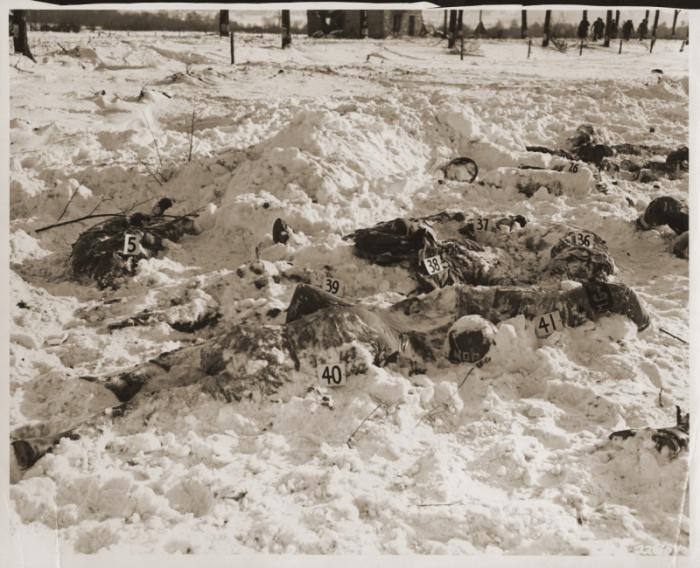
What is generally called "The Malmédy Massacre" was actually 2 separate incidents. At 4:30 AM local time on December 17, troops of the 1st SS Panzer Division captured dozens of American soldiers at a small fuel depot in Büllingen, in Belgium, but a German-speaking town, just 4 miles from the German border. The SS executed all of the American soldiers.

Later that day, between 12:00 Noon and 1:00 PM, Kampfgruppe Peiper approached the Baugnez crossroads, 2 miles southeast of the city of Malmédy. A U.S. Army convoy of 30 vehicles, from B Battery of the 285th Field Artillery Observation Battalion, was negotiating the crossroads, and then turning right, towards Ligneuville and St. Vith, in order to join the U.S. 7th Armored Division.

The Germans saw the U.S. convoy first, and the spearhead unit of Kampfgruppe Peiper fired upon and destroyed the first and last vehicles, which immobilized the convoy, and halted the American advance. As their immobilized convoy was outnumbered and outgunned, those soldiers of the 285th surrendered to the SS.

At the Baugnez crossroads, the SS infantry assembled the just-surrendered U.S. prisoners-of-war in a farmer's field, and added them to another group of U.S. POWs, soldiers who had been captured earlier that day. The POWs who survived the massacre at Malmédy said that a group of approximately 120 U.S. POWs stood in the farmer's field, when the SS fired machine guns at them. Panicked by the machine gun fire, some POWs ran and fled the field, but the SS soldiers shot and killed most of the grouped POWs where they stood; and some G.I.s had dropped to the ground and pretended to be dead.

Nonetheless, after the initial machine-gunning of the group of POWs, the SS soldiers walked amongst the POW corpses, searching for wounded survivors to kill with a coup de grâce gunshot to the head. Moreover, some of the POWs who fled the farmer's field had run to and hidden in a café at the Baugnez crossroads. The SS then set the café afire, and killed every U.S. POW who escaped the burning building.

At about 2:30 PM, 43 U.S. POWs who survived the massacre emerged from hiding from the SS, and then sought help and medical aid in nearby Malmédy, which was held by the U.S. Army. They were encountered by a patrol from the 291st Combat Engineer Battalion, and told them of what had happened. 

On December 26, reinforcements arrived, and the tide of the battle was turned. It was the beginning of the end of the Third Reich. Because it took until then for U.S. troops to push the Nazis back, and also because of the heavy snow, many of the bodies were not found for over a month.

In 1949, a U.S. Senate investigation concluded that, in the 36-day Battle of the Bulge, the soldiers of Kampfgruppe Peiper murdered between 538 and 749 U.S. POWs. Other investigations put the figure of the dead as being between 300 and 375 U.S. soldiers and 111 civilians executed.

The German commander, Joachim Peiper, was second-in-command to Heinrich Himmler in the SS. On July 16, 1946, he was convicted of war crimes, and sentenced to death. But the sentence was never carried out, and he was paroled after serving 10 years. In 1972, he moved to France. He was assassinated by an anti-Nazi group calling themselves The Avengers, on Bastille Day, July 14, 1976. He was 61.

On May 30, 2006, hosting The O'Reilly Factor on Fox News, Bill O'Reilly said, "In Malmédy, as you know, U.S. forces captured SS forces who had their hands in the air, and they were unarmed, and they shot them down."

O'Reilly lost his job -- not shortly after this, and not for this, but 11 years later, for his sexual assaults of women. Furthermore, Fox News scrubbed the reference to the Malmédy Massacre from the transcript of the show on their website.

*

December 17, 1944 was a Sunday. The NFL Championship Game was played at the Polo Grounds in Upper Manhattan. The Green Bay Packers, coached by team co-founder Earl "Curly" Lambeau, and led by quarterback Irv Comp and pro football's 1st great receiver, Don Hutson, visited the New York Giants, coached by Steve Owen, and led by former Packer quarterback Arnie Herber.

Four weeks earlier, also at the Polo Grounds, the Giants had beaten the Packers, 24-0. Not this time: The Packers won, 14-7, and won their 6th NFL Championship, all in a span of 16 years. They wouldn't get back to the title game for 16 years, upon the rebuilding led by Vince Lombardi.

The Giants thus fell to to 2-5 in NFL Championship Games, and would be 3-11 before their win in Super Bowl XXI in 1987.

Baseball was out of season. The NBA hadn't been founded yet. There were 2 games played in the NHL. The New York Rangers lost to the Montreal Canadiens, 4-1 at the old Madison Square Garden. And the Chicago Black Hawks beat the Detroit Red Wings, 2-1 at the Chicago Stadium. The Boston Bruins and the Toronto Maple Leafs were not scheduled.

December 31, 1999 & January 1, 2000: The Millennium

December 31, 1999:  The Millennium arrives. The people of planet Earth survived. At a terrible cost. But we hadn't destroyed ourselves. ...