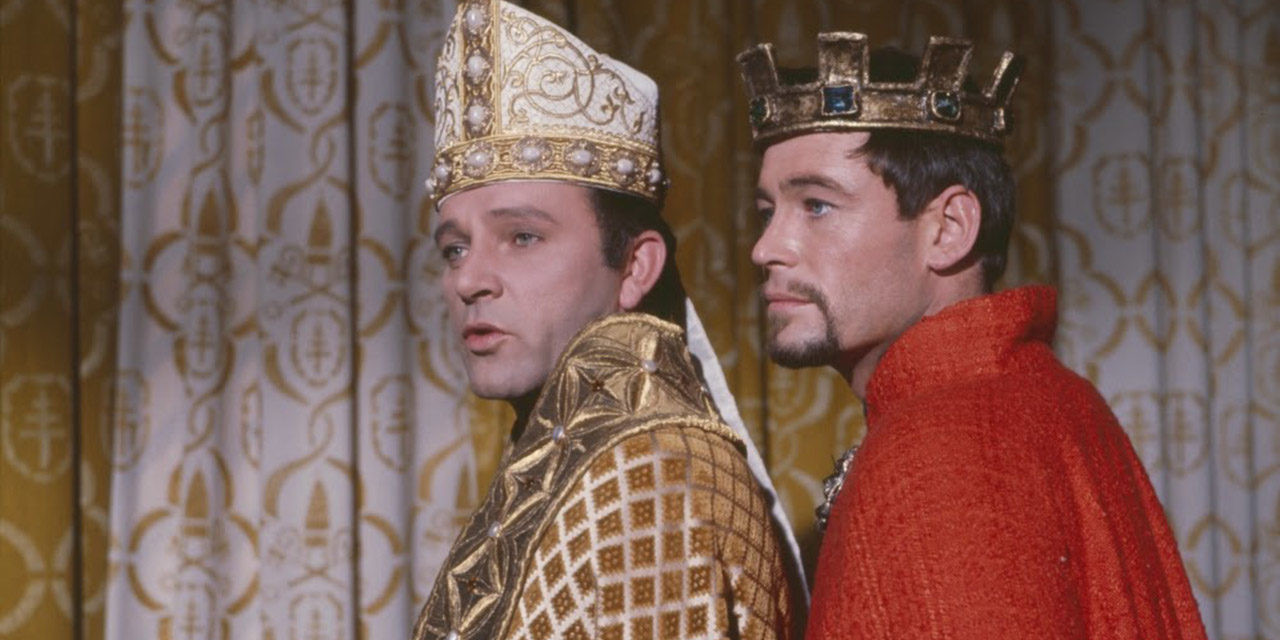
Hepburn and O'Toole, near the end
October 30, 1968: The film The Lion In Winter premieres. James Goldman wrote the screenplay, based on his 1966 play. Directed by Anthony Harvey, it tells of the "Christmas court" held in 1183 by King Henry II of England (played by Peter O'Toole, who had played a younger version in A Man for All Seasons) in Chinon, Touraine, part of his holdings in France, as part of the Angevin Empire.
Henry has endlessly cheated on his wife, Eleanor of Aquitaine (Katharine Hepburn), whom he has kept imprisoned for years, while scheming to gain her lands and her fortune, as, through her marriage to King Louis VIII of France, she was the richest woman in Europe.
Here's where it gets complicated. Eleanor was Louis' 1st wife, and the marriage was annulled. His 2nd wife was Constance of Castile, a Spanish Princess. Their daughter, Margaret, married "Henry the Young King," son of Henry and Eleanor, who had died of dysentery earlier in 1183, without an heir (and thus does not appear in the film).
They also had a daughter named Alys, Countess of the Vexin (Jane Merrow, and the character's name is spelled "Alais" in the script), who was raised by Eleanor, and was engaged to the 2nd son of Henry and Eleanor, Richard, Duke of Aquitaine (a young Anthony Hopkins). But, as the film begins, Henry and Alys are having an affair, which produced a daughter. And Henry wants to divorce Eleanor to marry Alys, so he needs annulment from the Roman Catholic Church. Unlike his descendant, Henry VIII, 3 and a half centuries later, it never occurred to Henry, in real life or in "reel life," to break away from the Church and found his own.
Because Constance had died giving birth to Alys, Louis needed a 3rd wife, who was Adela of Champagne. This marriage produced Louis' successor as King of the rump state of France, Philip II (played in the film by a young, pre-James Bond, Timothy Dalton).
To make matters worse, Henry was so determined to expand his holdings to include all of France, but also 50 years old, which was considered old at the time, that he had driven his sons -- Henry, Richard, Geoffrey, Duke of Brittany (John Castle) and John (Nigel Terry) to oppose him -- and each other. In the film, he says, "I'm the oldest man I know. I've got 10 years on the Pope!" and "I've snapped and plotted all my life. There's no other way to be a king, alive, and 50, all at once." (In fact, Lucius III, the Pope at the time, was 83 years old.)
At this point, Henry wants youngest son John to inherit the throne, unless he can produce a son with Alys. He says, "John will rule the country, while I run it. That is to say, he gets to spend the taxes that I raise."
Eleanor wants the crown to go to her favorite son, Richard. But John is weak-willed, and is manipulated by Geoffrey, who resents being passed over by both parents, and thinks that being "the power behind the throne" is the only way he can become king. He tells Henry, "You don't think of me much," to which Henry says, "Much? I don't think of you at all." Geoffrey tells John, "If you're a Prince, then there's hope for every ape in Africa." Geoffrey enlists Philip's help in sowing discord between Richard and John, and thus between both of them and each of their parents.
Henry is smart enough to see through this, and has all 3 sons imprisoned. He prepares to make a pilgrimage to Rome, to "suck up to" the Pope, so that he'll grant the annulment of his marriage to Eleanor, thus allowing him to marry Alys. (Henry was 50, Eleanor was 61, and Alys was 23. The sons? Richard was 26, Geoffrey was 25, and John was 17. Philip was 18.) At this point, even Alys has become a nasty plotter, reminding Henry that if he lets any of them live, they'll have whoever he proclaims to be his heir killed.
Waiting in the dungeon -- to be executed, they think -- they hear someone approaching. Richard says, "He's here. He'll get no satisfaction out of me. He isn't going to see me beg." Geoffrey says, "My, you chivalric fool. As if the way one fell down mattered." Richard: "When the fall is all there is, it matters."
But the man coming is a guard that Eleanor has bribed to release them, and to give them knives for defense. The sons threaten their father with knives, but cannot bring themselves to kill him. Likewise, Henry cannot bring himself to condemn his sons to death for treachery. Weeping, he lets the three escape. Resigned that he has been checked by Eleanor in his plans for divorce and a new heir, he falls pitifully into her arms. The two lament how their initial passion has devolved into its present adversarial state. For a moment, they remember that they once loved each other deeply.
In the morning, Eleanor leaves on her barge to return to her imprisonment, waving and shouting farewells while Henry bellows cheerful nonsenses, each acknowledging their perverse emotional bond, while anticipating the resumption of their struggle next year.
The film was nominated for 7 Academy Awards, including Best Picture, Harvey for Best Director, and O'Toole for Best Actor. In a rare tie vote, Hepburn and Barbra Streisand, for Funny Girl, won Best Actress. Goldman won Best Adapted Screenplay, and John Barry, who had composed the James Bond theme, won for Best Score.
How historically accurate is the film? It's mixed. Henry held a Christmas court at Caen in 1182, but not one anywhere in 1183. The conflicts between the brothers, and with their parents, were real enough. But the suggestion that Richard was homosexual is still debated, while the accusation that he had molested Philip as a boy is almost certainly not true.
So who "won" this "game of thrones"? Not Geoffrey: In 1186, he was trampled to death in a jousting tournament. He was 27. In 1189, Richard led another revolt, and Henry surrendered, proclaiming him as his heir, dying later in the year, at 56. The eldest remaining son thus became King Richard I, known to history as Richard the Lionheart.
But Richard only spent 6 months of his reign in England, concerned more with his holdings in France. Indeed, he rarely spoke English, he broke his engagement to Alys, married the Spanish Princess Berengaria of Navarre, and had only one known child, an illegitimate son named Philip of Cognac.
Richard went off to Jerusalem to fight the Third Crusade, becoming known as Coeur de Lion -- Richard the Lionheart, still symbolic of medieval chivalry. But, despite some early victories in "The Holy Land," he lost a brutal war to the Kurdish Sultan Salah ad-Din Yusuf ibn Ayyub (known to history as Saladin), retreated, and was captured on his way back by Holy Roman Emperor Henry VI, held at Trifels Castle in what's now southern Germany. Eleanor was forced to pay 100,000 pounds of silver, over twice the annual income of the whole of England, to free him. It gave birth to the term "a king's ransom."
Meanwhile, John was ruling England in Richard's place, and the taxes were ridiculous. The people, knowing that the legitimate King was far away, rebelled. This gave rise to the legend of Robin Hood, who was most likely a composite of several figures, including some from this era, some from later. Richard returned in 1194, restored some order, made sure John was held in check by allies, and then returned to France. In 1199, he was mistakenly shot with an arrow by a 10-year-old boy. As he died from gangrene, at age 41, after 10 years not exactly on the English throne, he told his men to spare the boy's life. They didn't.
John was now legitimately King, as Henry wanted in 1183. But his previous activity had left him unpopular. And Eleanor died in 1204, around 80 years old, leaving him without his best possible advisor. The wealthy barons ganged up on him, causing him to lose his lands to his half-brother Philip II of France, leading to the name that has stuck to him ever since: John Lackland.
The barons forced him to sign the Magna Carta in 1215, making him the first King, anywhere in the world, to hand over even a portion of his authority. He refused to respect it, though, and the civil war started again. In mid-campaign, he died of dysentery in 1216, 49 years old.
The Angevin Empire collapsed, so, in the end, Philip "won." He lived on until 1223, age 57. While Henry II and Richard I are regarded as among England's most successful monarchs, John is considered one of the worst. His son, 9 years old, became King Henry III, and reigned until his death in 1272, but his attempts to regain the former Angevin lands in France was a disaster. His son, Edward I, turned his attentions from south to north, and became "The Hammer of the Scots."
After playing John, Terry got another chance to play a King of England, and a much better one, though also with a disastrous end: He played King Arthur in the 1981 film Excalibur.
James Goldman died in 1998, Katharine Hepburn in 2003, Peter O'Toole in 2013, Nigel Terry in 2015, Anthony Harvey in 2017. As of October 30, 2022, Anthony Hopkins, John Castle, Timothy Dalton and Jane Merrow are still alive.
When I first saw this film, I noticed that Hepburn sounded different. I'd only known her as an older woman, and from Martin Short's impersonation of her on Saturday Night Live. It took me a few days to realize who I knew she sounded like: Kate Mulgrew, star of Star Trek: Voyager. In 2002, Mulgrew began playing Hepburn in Matthew Lombardo's one-woman Broadway play, Tea at Five. On the morning of June 29, 2003, she woke up playing someone who was still alive. When she took the stage that night, she was playing someone who had died.
In a 2002 episode of The West Wing, the White Hose Director of Communications, Toby Ziegler (Richard Schiff), calls it the favorite movie of President Josiah Bartlet (Martin Sheen). Bartlet was a stickler for historical accuracy, but series creator and episode writer Aaron Sorkin had him misquote Henry: "By God, I'm 50, alive, and the King, all at the same time!" And he had both Bartlet and Ziegler misquote the brothers' lines: "When the fall's all that's left, it matters a great deal."
To confuse things further, The Lion In Winter was revived on Broadway in 1999. Eleanor was played by Stockard Channing, who played Dr. Abigail Bartlet, wife of President Bartlet. Henry was played by a black actor, Laurence Fishburne. In 2003, it was filmed again, with another Star Trek actor, Patrick Stewart, as Henry, and Glenn Close as Eleanor.
In a 2021 episode of Epic Rap Battles of History, "Nice" Peter Shukoff played Richard the Lionheart, against "Epic" Lloyd Ahlquist against Ragnar Lodbrok, the main character of the TV show Vikings, who lived about 300 years earlier -- and may have spent more time in England than Richard did.
*
October 30, 1968 was a Wednesday. Baseball was out of season. Football was in midweek. There were 5 games in the NBA:
* The New York Knicks lost to the Cincinnati Royals, 118-114 at the Cincinnati Gardens. Oscar Robertson scored 34 points for the Royals.
* The Detroit Pistons beat the Boston Celtics, 119-117 at the Boston Garden.
* The Baltimore Bullets beat the San Francisco Warriors, 112-110 at the Baltimore Civic Center (now the CFG Bank Arena).
* The San Diego Rockets beat the Atlanta Hawks, 127-116 at the San Diego Sports Arena (now the Pechanga Arena).
* And the Phoenix Suns beat the Seattle SuperSonics, 115-108 at the Seattle Center Coliseum.
There were 2 games in the American Basketball Association. The Kentucky Colonels beat the Denver Rockets, 123-100 at the Louisville Convention Center. Darel Carrier led all scorers on the night with 36 points. And the New Orleans Buccaneers beat the Los Angeles Stars, 112-109 at the Los Angeles Memorial Sports Arena.
And there were 5 games in the NHL:
* The New York Rangers beat the Pittsburgh Penguins, 7-3 at the new Madison Square Garden.
* The Montreal Canadiens beat the Toronto Maple Leafs, 5-0 at Maple Leaf Gardens in Toronto.
* The Boston Bruins beat the Minnesota North Stars, 4-2 at the Metropolitan Sports Center in the Minneapolis suburb of Bloomington, Minnesota.
* The St. Louis Blues beat the Philadelphia Flyers, 4-1 at the St. Louis Arena.
* The Chicago Black Hawks beat the Los Angeles Kings, 4-2 at The Forum outside Los Angeles in Inglewood, California.
* And the Detroit Red Wings and the Oakland Seals were not scheduled.