Showing posts with label new orleans. Show all posts

Sunday, December 25, 2022

December 25, 1895: The Legend of Stagger Lee

Lloyd Price

December 25, 1895: The legend of "Stagger Lee" is born. Lee Shelton, a black pimp known as "Stack" or "Stacker" Lee, ran an, um, entertainment venue called the Four Hundred Club in St. Louis. He and William Lyons, also involved in the St. Louis underworld, were drinking in the Bill Curtis Saloon. They began to argue, and Lyons took Shelton's Stetson hat off his head. For this offense, Shelton shot Lyons, killing him.

Shelton was convicted, served 12 years for murder, was imprisoned again for robbery, and died in prison in 1912.

As early as 1897, during Shelton's trial, the 1st song about the murder was performed. It spread throughout American music, black and white alike, and, depending on the singer's accent, the perpetrator (and thus the title) could be "Stack-o-Lee," "Stag-o-Lee," "Stacker Lee," "Stagger Lee," and so on. The legendary New Orleans pianist Mac "Dr. John" Rebennack claimed that there were so many versions, he could sing the song for half an hour and never repeat a verse.

Eventually, "Stagger Lee" became the best-known version. But the song, as most people know it now, gets the details wrong: In most versions, "Stagger Lee" and "Billy" are shooting dice in an alley late at night, and Billy, having already won Stagger Lee's Stetson hat, tries to cheat him. So Stagger Lee goes home, gets his gun, goes to the bar, and, despite Billy pleading for his life -- "I got three little children and a very... sickly wife!" -- shoots him. (I wonder if one of the versions that Dr. John knew went, "I got three little children and a very... ugly wife!")

Fred Waring & His Pennsylvanians became the 1st white act to record it, in 1923. Lloyd Price hit Number 1 with it in 1959, but there was a problem: It was on ABC-Paramount Records, and ABC not only owned the label, but aired American Bandstand. That show couldn't have the Number 1 song in the country played for teenagers, on live national daytime television, with the words, "Stagger Lee shot Billy, oh, he shot that poor boy so bad, 'til the bullet came through Billy and it broke the bartender's glass!" (How did that couplet get past 1950s censors in the first place?)

So they had Price record a cleaned-up version, in which Billy stole Stagger Lee's girlfriend, but he feels bad about it, and gives her back, and the guys make up, and are both alive at the end. The way to tell the difference is at the beginning: In the original version, Price sings, in his New Orleans accent, "The night was Claire," while in the cleaned-up version, he sings it straight, "The night was clear." In both versions, "the Moon was yellow, and the leaves came tumbling down" -- making the opening a haiku (five syllables, then seven, then five), and also suggesting that the song takes place in  Autumn, several weeks before Christmas.

*

December 25, 1895 was a Wednesday. Baseball was out of season, hockey was all-amateur, basketball was a recent invention, and this was before college football was playing bowl games, let alone on Christmas Day.

But in England, soccer, or "football" as they call it, had a tradition: To keep traveling to a minimum, and thus families together, 2 nearby teams would play at one's home ground on Christmas Day, and at the other's on the next day, December 26, Boxing Day. This tradition began to die out in the 1950s, but Boxing Day games are still played.

On December 25, 1895, the London-based team which I would eventually support, then known as Woolwich Arsenal, played, but not against a nearby team: They hosted Burslem Port Vale, at the Manor Ground in Plumstead, Kent, later to be a part of Southeast London, and won, 2-1.

Friday, November 25, 2022

November 25, 1980: Leonard-Duran II: "No Más"

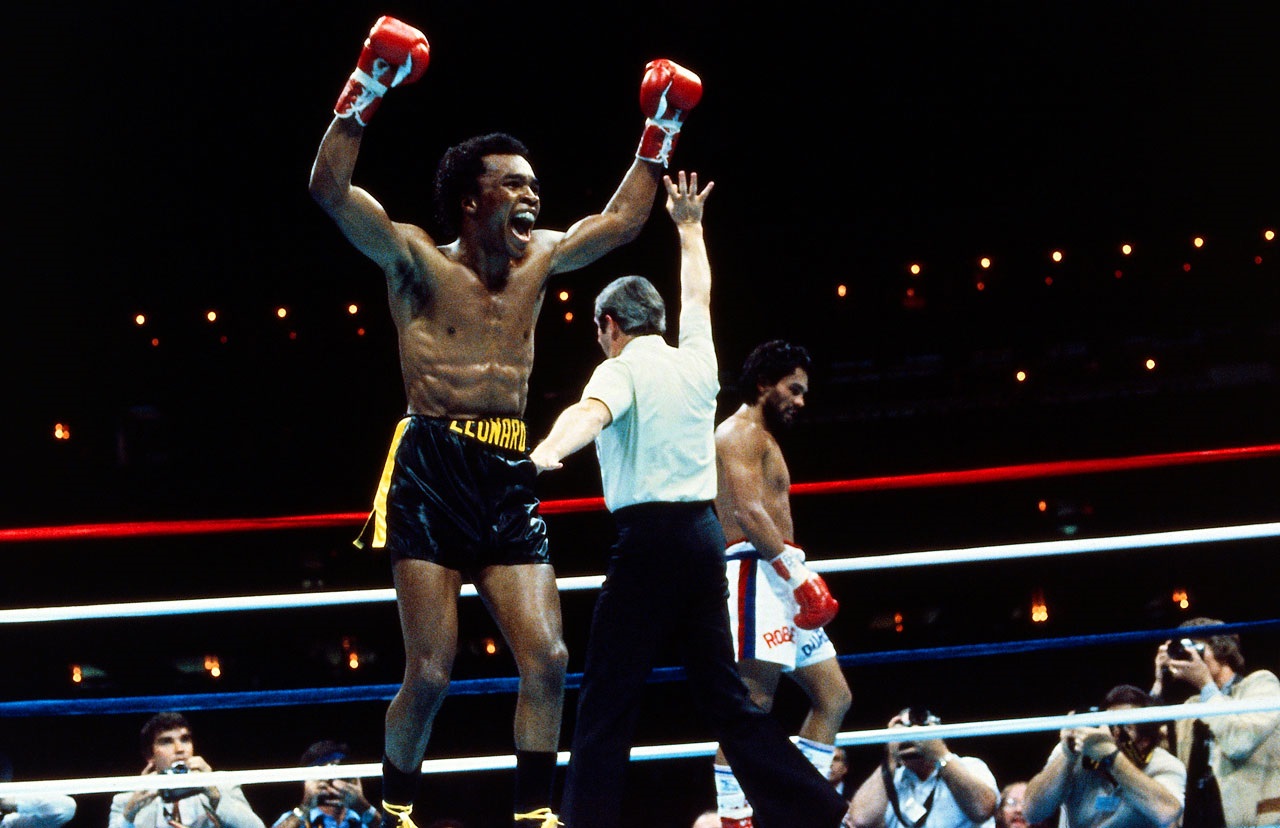
November 25, 1980: The Welterweight Championship of the World is contested at the Superdome in New Orleans. It is a rematch between 2 of the greatest fighters, pound-for-pound, of their generation.

Roberto Durán, 29, might have been the greatest Lightweight Champion ever, holding that title from 1972 to 1979. The man known as "Hands of Stone" was a hero in Latin America, in particular treated nearly as a god in his native Panama.

Sugar Ray Leonard, 24, won a Gold Medal for America at the 1976 Olympics at the Montreal Forum. In 1979, he won the Welterweight title by defeating Wilfred Benitez.

Durán was ready to move up in weight class, and take Leonard on. On June 20, 1980, back in Montreal, this time at the much larger Olympic Stadium, in front of 60,000 people, Leonard came in with a career record of 27-0, Durán at 71-1. Durán won a unanimous decision, but it was close: The cards had him leading 148-147, 146-144 and 145-144.

"I did the best I could", Leonard said. "I think I pretty much fought from the heart." Asked if Leonard was the best he ever fought, Durán thought for a moment and then answered, "Si, si." Durán said. "He does have a heart. That's why he's living."

Since the fight was so close, a rematch was in order. A crowd of 70,000 people crammed into the Superdome in New Orleans. This time, Leonard fought better, and was taunting Durán. At the end of the 8th round, Durán, trailing on all cards, and having lost his respect for Leonard, turned to the referee, also a Latin American, Octavio Meyran of Mexico, and said to him in Spanish, "I don't want to fight with this clown," and he went back to his corner and quit.

Broadcasting the fight for ABC, Howard Cosell said -- erroneously, as it turned out -- that what Durán had told the ref was, "No más" -- "No more." Leonard was declared the winner by technical knockout, and regained the title.

To make matters worse, the official excuse for Durán quitting was "stomach cramps." If he had them before the fight, it should have been postponed.

The man known as Hands of Stone was viewed to have feet of clay. Back in Panama, both his house and his mother's house were vandalized. Graffiti appeared in Panama City calling him a coward, a traitor, and even "maricón" -- roughly, the Caribbean Spanish word for the anti-gay slur "faggot.

("Maricón" was the word that Benny "the Kid" Paret had used at Emile Griffith during the weigh-in for their 1962 Welterweight Championship and trilogy-decider fight, that led Griffith to pound away at him so hard during the fight that Paret died.)

In 1983, Durán fought Super Welterweight Champion Davey Moore in front of a mostly-Latino crowd at Madison Square Garden, hoping to see the return of a former hero to heroic status. It was no contest: Durán crushed Moore, whose cornermen threw in the towel -- appropriately enough, in the 8th round, the same round that did Durán in 3 years earlier. Durán regained not only a title (if not the same one), but also his strong, masculine image, his pride, his reputation, and his fans.

On December 7, 1989, with both men well past their prime, but with Leonard holding the WBC version of the Super Middleweight Championship, they fought for a 3rd time, at The Mirage hotel and casino outside Las Vegas. Leonard won a unanimous decision.

It was the last fight that Leonard ever won. He lost to Terry Norris and Héctor "Macho" Camacho, finishing 36-3-1. Durán must have needed the money, because he kept on fighting until 2001, and his last fight was also a loss to Camacho. His final record was 103-16, having lost nearly half his fights after his win over Leonard.

There were 4 truly great welterweight and middleweight fighters in the 1980s: Leonard, Durán, Thomas Hearns and Marvelous Marvin Hagler. Durán followed up his win over Moore by losing back-to-back fights to Hagler (a 15-round decision) and Hearns (an awful 2nd-round knockout.) Leonard won a very tough decision over Hearns, and won a controversial decision over Hagler. Hagler knocked Hearns out in the 3rd round, surviving a furious fusillade, in one of the greatest short fights ever.
Left to right: Durán, Leonard, Hagler.
I found a photo of Leonard, Durán and Hearns together,
but not one of all 4 of them together.

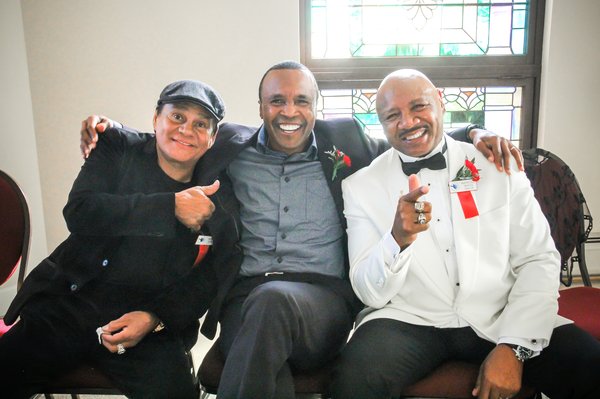
Despite the various controversies between them, the 4 of them became friends after their careers, as boxers tend to do. There usually is a healthy respect between worthy opponents. Hagler died of a heart attack in 2021, at the age of 66. As of November 25, 2022, the other 3 are still alive.

UPDATE: In 2026, Ronald Hearns, also a boxer, places his father Thomas under conservatorship, as he has begun to show signs of boxing-related dementia. Hagler is not suspected of having had it. Nor is Leonard or Durán.

*

November 25, 1980 was a Tuesday. Baseball was out of season, but later baseball star Nick Swisher was born. Football was in midweek. There were 3 games played in the NBA:

* The Atlanta Hawks beat the Portland Trail Blazers, 112-108 at The Omni in Atlanta. John Drew led all scorers on the night with 34 points.

* The Philadelphia 76ers beat the expansion Dallas Mavericks, 108-92 at the Reunion Arena in Dallas. Julius "Dr. J" Erving had 31 points.

* And the San Diego Clippers beat the Denver Nuggets, 108-94 at the San Diego Sports Arena (now the Pechanga Arena).

There were 4 games played in the NHL:

* The New York Islanders played the Winnipeg Jets to a tie, 4-4 at the Nassau Coliseum.

* The Calgary Flames beat the Montreal Canadiens, 5-4 at the Montreal Forum.

* The St. Louis Blues beat the Buffalo Sabres, 5-3 at the Checkerdome (as the St. Louis Arena was then known).

* And the Colorado Rockies beat the Edmonton Oilers, 4-3 at the McNichols Arena in Denver.

Wednesday, November 23, 2022

November 23, 1974: The 1st Bayou Classic

November 23, 1974: The 1st Bayou Classic is held, at Tulane Stadium in New Orleans. Grambling State University defeats Southern University, 21-0.

Northern Louisiana and Southern Louisiana is a cultural intrastate rivalry, and this extends even to what have come to be called Historically Black Colleges and Universities (HBCUs). These were often placed in the same cities as major white schools. Southern University is in Baton Rouge, the capital city of Louisiana, which is also where Louisiana State University (LSU) is. Grambling State University (or just "Grambling") is in the town of the same name, not far from Ruston, home of Louisiana Tech.

Grambling and Southern -- and I am listing them that way only due to alphabetical order -- began playing each other in football in 1932. Arnett "Ace" Mumford coached SU from 1936 to 1961 (except for 1943, during World War II), while Eddie Robinson coached GSU from 1941 to 1997 (except for 1943 and 1944). Each man's school named its respective stadium after him.

As early as 1948, the game was being called a "classic." But it was an unfortunate event that led it to becoming the extravaganza it's become: In 1972, there was political unrest on Southern's campus, and 2 students, Denver Smith and Leonard Brown, were shot and killed, presumably by white sheriff's deputies. I say, "presumably" because, officially, the murders have never been solved. Governor Edwin Edwards ordered the campus closed, and, since SU were hosting the game that season, they had to forfeit.

For the 1973 season, the game was moved to presumably neutral territory, although the site, what's now named Independence Stadium, in Shreveport, was considerably closer to Grambling, which was due to host that season, anyway. A crowd of 40,000 sold the place out.

When the schools realized just how many people wanted the game back, they decided to make a bigger deal out of it. So they moved the 1974 game to New Orleans, on the Saturday after Thanksgiving. And that's how it's been done ever since, first at Tulane Stadium and then, from the 2nd one onward, at the Superdome.

The only exceptions have been in 2005, when the damage from Hurricane Katrina forced the game to be moved to what's now named NRG Stadium in Houston -- which, appropriately enough, is known as the Bayou City; and in 2020, when, due to COVID restrictions, it was again played at Independence Stadium in Shreveport.

The Bayou Classic is, beyond any question, the biggest game of the year in the NCAA's Football Championship Subdivision, formerly known as Division I-AA, bigger even than its Playoffs. The winner almost always clinches -- or has already clinched -- the West Division of the Southwestern Athletic Conference (SWAC).

The game has been called "Black America's Family Reunion." Black-themed college fraternities, whether they have houses on either school's campus or not, have reunions in New Orleans that weekend. There's concerts, a black business showcase, a college recruitment fair (not just for the schools playing), and a charity golf tournament.

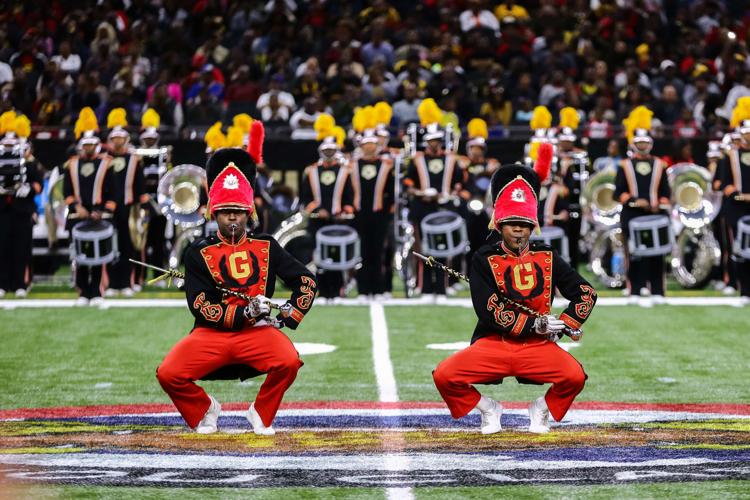
And, of course, there's the Battle of the Bands, at halftime, between Grambling's "World Famed" Tiger Marching Band, which famously performed at Super Bowl I, and Southern's Marching Band from Jaguarland, a.k.a. "the Human Jukebox."
Each band's high-stepping, horn-swinging moves are accompanied by dancing girls in glittering outfits. It has been suggested that the Battle of the Bands is more important to the schools' bragging rights than the football game.
The Battle of the Bands was the main reason NBC began televising the game in 1991. Aside from Notre Dame home games and some bowl games, it's the Peacock Network's only college football broadcast, usually at 1:30 PM Central Time (2:30 Eastern).

*

November 23, 1974 was a Saturday. These other notable college football games, including some major rivalries, were played that day:

* Rivalry: Number 1 Oklahoma beat Number 6 Nebraska, 28-14 at Memorial Stadium in Lincoln, Nebraska. Oklahoma were on probation, so, while they were eligible to be ranked Number 1, and eligible to be awarded the National Championship, they were ineligible for a bowl game.

* Number 2 Alabama were idle, preparing for their rivalry with Number 7 Auburn the next week. 'Bama won, 17-13 at Legion Field in Birmingham. 

* Rivalry: Number 4 Ohio State beat Number 3 Michigan, 12-10 at Ohio Stadium in Columbus. This clinched the Big Ten Conference title for Ohio State.

* Number 5 Notre Dame beat Air Force, 38-0 at Notre Dame Stadium in South Bend, Indiana. Army and Navy had the week off, preparing for their game against each other, the following week at John F. Kennedy Stadium in Philadelphia. Navy won, 19-0.

Since Big Eight Conference Champion Oklahoma were ineligible for a bowl game, the Orange Bowl offered its bids to Notre Dame and to Southeastern Conference Champion Alabama. Notre Dame won. The Sugar Bowl offered its Southeastern Conference bid to the University of Florida, which lost to Nebraska.

* Rivalry: Number 8 University of Southern California (USC) beat the University of California at Los Angeles (UCLA), 34-9 at the Los Angeles Memorial Coliseum. USC won the Pacific-Eight Conference title, and beat Ohio State in the Rose Bowl.

* Number 10 Penn State were idle. They were preparing for their rivalry game next week, with the University of Pittsburgh. Penn State won, 31-10 at Three Rivers Stadium in Pittsburgh.

* Rivalry: Number 11 Maryland beat Virginia, 10-0 at Scott Stadium in Charlottesville, Virginia.

* One ranked team was upset, and it was by their arch-rivals: Number 19 California lost to Stanford, 22-20 at California Memorial Stadium in Berkeley.

* Baylor beat Southern Methodist University (SMU), 31-14 at the Cotton Bowl in Dallas. When Texas A&M beat Texas, that threw the Southwest Conference title to Baylor, and they went back to the Cotton Bowl, to play the game of the same name. Penn State beat them.

* Rivalry: Harvard beat Yale, 21-16 at Harvard Stadium in Boston.

* In New Jersey, Rutgers beat Colgate, 62-21 at Rutgers Stadium in Piscataway; and Princeton beat Cornell, 41-20 at Palmer Stadium in Princeton.

* Rivalry: Temple beat Villanova, 17-7 at Veterans Stadium in Philadelphia.

* Rivalry: William & Mary beat Richmond, 54-12 at City Stadium in Richmond, Virginia.

* Rivalry: North Carolina beat Duke, 14-13 at Kenan Stadium in Chapel Hill, North Carolina.

* Rivalry: Clemson beat South Carolina, 39-21 at Memorial Stadium in Clemson, South Carolina.

* Rivalry: Tennessee beat Kentucky, 24-7 at Neyland Stadium in Knoxville, Tennessee.

* Rivalry: Mississippi State beat Mississippi (Ole Miss) at Mississippi Veterans Memorial Stadium in Jackson.

* Rivalry: Louisiana State (LSU) beat Tulane, 34-22 at Tiger Stadium in Baton Rouge, Louisiana.

* Rivalry: Purdue beat Indiana, 38-17 at Ross-Ade Stadium in West Lafayette, Indiana.

* Rivalry: Illinois beat Northwestern, 28-14 at Memorial Stadium in Champaign, Illinois.

* Rivalry: Wisconsin beat Minnesota, 49-14 at Camp Randall Stadium in Madison, Wisconsin.

* Rivalry: Missouri beat Kansas, 27-3 at Faurot Field in Columbia, Missouri.

* Rivalry: Brigham Young beat Utah, 48-20 at what's now LaVell Edwards Stadium in Provo, Utah.

* Rivalry: Oregon State beat Oregon, 35-16 at what's now named Reser Stadium in Corvallis, Oregon.

* Rivalry: Washington beat Washington State, 24-17 at Martin Stadium in Pullman, Washington.

There were 7 games played in the NBA:

* The New York Knicks lost to the Milwaukee Bucks, 90-72 at Madison Square Garden.

* The Philadelphia 76ers beat their arch-rivals, the Boston Celtics, 98-96 at The Spectrum in Philadelphia. Don Nelson scored 35 points in defeat.

* The Kansas City-Omaha Kings beat the Atlanta Hawks, 103-100 at The Omni in Atlanta.

* The Buffalo Braves beat the Phoenix Suns, 117-104 at the Buffalo Memorial Auditorium. Bob McAdoo scored 33 points for the Braves.

* The Cleveland Cavaliers beat the New Orleans Jazz, 121-100 at The Coliseum in the Cleveland suburb of Richfield, Ohio.

* The Golden State Warriors beat the Detroit Pistons, 110-98 at Cobo Hall (now Huntington Place) in Detroit. Rick Barry scored 45 points for the Warriors.

* And the Seattle SuperSonics beat their arch-rivals, the Portland Trail Blazers, 117-110 at the Portland Memorial Coliseum. Fred Brown scored 40 points for the Sonics.

There were 4 games in the American Basketball Association:

* The New York Nets lost to the Indiana Pacers, 104-95 at the Market Square Arena in Indianapolis.

* The Denver Nuggets beat the Virginia Squires, 122-110 at the Hampton Coliseum outside Norfolk in Hampton, Virginia.

* The San Antonio Spurs beat the Spirits of St. Louis, 127-114 at the HemisFair Arena in San Antonio.

* And the Utah Stars beat the Kentucky Colonels, 111-110 in overtime at the Salt Palace in Salt Lake City.

There were 7 games played in the NHL:

* The New York Rangers lost to the Boston Bruins, 5-2 at Madison Square Garden.

* The New York Islanders and the Vancouver Canucks played to a tie, 3-3 at the Nassau Coliseum.

* The Philadelphia Flyers beat the Toronto Maple Leafs, 6-3 at Maple Leaf Gardens in Toronto.

* The Pittsburgh Penguins and the Los Angeles Kings played to a tie, 0-0 at the Civic Arena in Pittsburgh.

* The Chicago Black Hawks beat the Kansas City Scouts, 6-0 at the Chicago Stadium.

* The Minnesota North Stars beat the California Golden Seals, 3-1 at the Metropolitan Sports Center in the Minneapolis suburb of Bloomington, Minnesota.

* The St. Louis Blues beat the Detroit Red Wings, 4-2 at the St. Louis Arena.

* And the Montreal Canadiens, the Buffalo Sabres, the Atlanta Flames and the Washington Capitals were not scheduled.

And there were 4 games in the World Hockey Association:

* The Toronto Toros beat the Quebec Nordiques, 9-2 at the Colisée de Québec in Quebec City.

* The New England Whalers beat the Chicago Cougars, 3-2 at the Big E Coliseum in West Springfield, Massachusetts.

* The San Diego Mariners beat the Minnesota Fighting Saints, 5-3 at the St. Paul Civic Center in St. Paul, Minnesota.

* And the Houston Aeros beat the Vancouver Blazers, 4-2 at the Pacific Coliseum in Vancouver.

And in English soccer, the North London soccer team I would one day root for, Arsenal F.C., lost to Coventry City, 3-0 at Highfield Road in Coventry, West Midlands.

Monday, November 14, 2022

November 14, 1960: The Ruby Bridges Story

November 14, 1960: New Orleans, Louisiana is hailed as one of the great American cities. Not for its black residents in 1960, it wasn't.

In 1960 New Orleans, Ruby Bridges was 6 years old. And she wanted to go to school. She required police protection to do so, because she was going to a previously all-white school, and there were threats of violence.

That day, two schools were desegregated in the city. Three girls went to McDonough No. 19 Elementary, and Ruby Bridges attended William Frantz Elementary. All four were escorted by U.S. Marshals. White parents boycotted the schools, refusing to allow their children to attend the same school as Black children.

Bridges and "The McDonough Three" had to pass a test to prove they were "worthy" to attend the white schools. God only knows -- Ruby, as I said, was 6, and probably didn't remember, and the white men who made the test are almost certainly all dead now -- what "worthy" meant. We're not talking about wielding the power of Thor in a hammer here. We're talking about being allowed to attend a school the law previously said that you couldn't.

As Ruby entered the school with her armed escort, a crowd of ignorant buffoons used the kind of language that they would be appalled to hear their own children hearing. They threw rocks and rotten fruit at her. One of the Marshals escorting Ruby that day, Charles Burks, later said, "She showed a lot of courage. She never cried. She didn't whimper. She just marched along, like a little soldier."

Only one teacher at the school, Barbara Henry, agreed to teach Ruby. Ruby went to her classroom and the only other person in the room was Mrs. Henry. Ruby would remain the only student in the class for over a year.

Her father hadn't wanted Ruby to attend the school, but her mother saw it as an important "step forward" for all Black children in their community. Eventually, the white boycott of the school subsided, but the Bridges family still experienced horrors from the community. Every morning as she walked to school, a woman called out threats to Ruby, saying she was going to poison the girl. Another woman held up a Black doll in a little coffin. Her father was fired from his job. Ad their local grocery store refused to let them shop there any longer.

In New Orleans. A city that celebrates its outlaw, even piratical, past. A city which once had a higher percentage of its black people free, rather than enslaved, of any major city in the South.

In 1964, Norman Rockwell painted The Problem We All Live With, depicting what Ruby was up against. At the age of six years old. It appeared on the cover of the January 14, 1964 issue of Look magazine.
Ruby Bridges later became a civil rights activist, married a man named Malcolm Hall, and had 4 sons. At her suggestion, President Barack Obama had Norman Rockwell's painting of her hung outside the Oval Office for several months in 2011. While looking at the painting with Bridges, the President told her, "If it hadn't been for you, I might not be here."
Ruby Bridges Hall in 2020

As of November 14, 2022, Ruby Bridges Hall is still alive, and living in New Orleans. She is 68 years old. That's not that old. This garbage didn't happen all that long ago. Or, to put that into additional perspective: Ruby Bridges is 3 months younger than Jerry Seinfeld, 14 days younger than Elvis Costello, 1 day younger than Corbin Bernsen (a.k.a. Arnie Becker of L.A. Law), 22 days older than Barry Williams (a.k.a. Greg Brady of The Brady Bunch), 31 days older than Scott Bakula (who starred on NCIS: New Orleans), and 32 days older than David Lee Roth.


*

November 14, 1960 was a Monday. Baseball was out of season. Football was in midweek: Monday Night Football was still 10 years away. And neither the NBA nor the NHL had any games scheduled. So there were no scores on this historic day.

Sunday, October 23, 2022

October 23, 1926: Tulane Stadium Opens

October 23, 1926: Tulane Stadium opens in New Orleans. Hosts Tulane University lose to Auburn, 2-0. Auburn scored a safety, one of the rare instances of the expression "Defense wins games" actually being true.
The Tulane Green Wave would continue to play in the 80,000-seat rounded horseshoe until the 1974 season. They had already won the Southern Conference title in 1925, and would win it again in 1929, 1930 and 1931. They would win the Southeastern Conference title in 1934, 1939 and 1949, before downgrading their program after the 1965 season.
From 1935 to 1975, usually on New Year's Day, the stadium would also host the Sugar Bowl, which became the stadium's nickname as well, usually with the Southeastern Conference Champions, often going for the National Championship. They were won in the Sugar Bowls of 1939, by Texas Christian University (TCU); 1940, by Texas A&M; 1952, by Maryland; 1953, by Georgia Tech; 1958, by Louisiana State (LSU), Tulane's arch-rivals; 1960, 1961 and 1963, by Mississippi (Ole Miss); 1961, by Alabama; and 1973, by Notre Dame.
The NFL's New Orleans Saints played there from their 1967 inception through 1974. Tom Dempsey set an NFL record there by kicking a last-play 63-yard field goal to give the Saints a win over the Detroit Lions in 1970.
It also hosted Super Bowl IV in 1970: Kansas City Chiefs 32, Minnesota Vikings 14; Super Bowl VI in 1972: Dallas Cowboys 24, Miami Dolphins 3; and Super Bowl IX in 1975: Pittsburgh Steelers 16, Vikings 6. In each case, it was the 1st World Championship won by each team.
Tulane Stadium was replaced by the Louisiana Superdome in 1975, and demolished in 1979. Yulman Stadium, Tulane's 30,000-seat stadium starting in 2014, was built on the site.
*
October 23, 1926 was a Saturday. These other notable college football games were played:
* Alabama beat Sewanee, 2-0 at Rickwood Field in Birmingham.
* Stanford beat Oregon, 29-12 at Hayward Field in Eugene, Oregon. Alabama and Stanford would play each other to a 7-7 tie in the Rose Bowl on January 1, 1927, and share the National Championship.
* Army beat Boston University, 41-0 at Michie Stadium in West Point, New York; and Navy beat Colgate, 13-7 at Thompson Stadium in Annapolis, Maryland.
* Among New York City teams, Columbia beat Duke, 24-0 at Baker Field; and Fordham lost to Washington & Jefferson, 28-13 at the Polo Grounds. Both stadiums were in Upper Manhattan. And New York University (NYU) beat Rutgers, 30-0 at Yankee Stadium in The Bronx. The other major New Jersey team, Princeton, beat Lehigh, 7-6 at Palmer Stadium in Princeton.
* Notre Dame beat Northwestern 6-0 at Dyche Stadium outside Chicago in Evanston, Illinois. Dyche Stadium had just opened 3 weeks earlier. In 1997, it was renamed Ryan Field.
* In rivalry games, Carnegie Tech (now Carnegie-Mellon) beat their neighbors, the University of Pittsburgh, 14-0 at Pitt Stadium; Virginia Tech beat Virginia, 6-0 at Miles Stadium in Blacksburg, Virginia; and Washington State beat Washington, 9-6 at Husky Stadium in Seattle.

Monday, August 29, 2022

August 29, 2005: Hurricane Katrina

August 29, 2005: Hurricane Katrina hits New Orleans, Louisiana, resulting in a broken levee that flooded the city, which was already below sea level. By nightfall, 80 percent of the Crescent City, and parts of neighboring areas, were flooded. Over 1,800 people were killed, and thousands were left homeless.

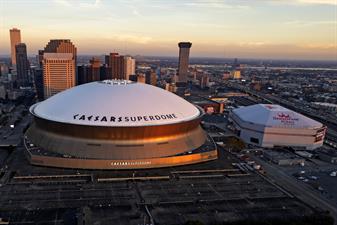
The Louisiana Superdome, home of the NFL's New Orleans Saints, was used as a shelter, topping out at 26,000 people. But because of the nature of the emergency, getting relief supplies into the city was incredibly difficult.

Although there had been devastating fires in Chicago and Boston in the 19th Century, and Baltimore and San Francisco in the early 20th Century, an earthquake in San Francisco in 1989 and Miami clobbered by Hurricane Andrew in 1992, Katrina was the first natural disaster that made Americans think that a great American city might actually be lost, ruined to the point where there would be no choice but to abandon it.

President George W. Bush was at his ranch outside Crawford, Texas, on vacation. He should have immediately flown back to Washington and coordinated the federal government's response. Instead, he stayed at his ranch for 5 days, doing nothing -- except for 1 trip to San Diego for a Republican Party fundraiser.

As a result, most of the goodwill he'd generated with his response to the 9/11 attacks and the early part of the Iraq War was gone. One political magazine showed a cover with a cartoon of Bush being poked with a fork, with the headline, "HE'S DONE," and a caption that he might have still been in office, "but the 9/11 Presidency is over."

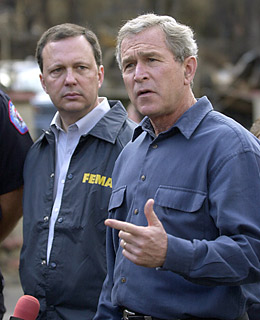
That was the day that Michael D. Brown resigned as Administrator of the Federal Emergency Management Agency (FEMA), which is in charge of responding to natural disasters. Bush was caught on camera telling him, "Heck of a job, Brownie." It wasn't sarcastic: Bush really believed that Brown was doing a good job.
"Brownie" and "Dubya"

At his best, Bush was a genial idiot. At his worst, he was a nasty right-winger. He was never competent enough to be President, and he appointed people he liked to posts for which they were not qualified and ill-suited, and Brown was one of them.

As late as 1950, New Orleans' population was 660,000, putting it in America's top 20 cities. White flight led to a drop to about 484,000 people within the city limits in the 2000 Census. After Hurricane Katrina, it dropped to 230,000, losing over half its people in one fell swoop. According to a recent estimate, it's back up to about 391,000, making it larger than such NFL cities as Tampa, St. Louis, Pittsburgh, Cincinnati and Buffalo (and, of course, Green Bay).

But the metropolitan area has just 1.27 million people, making it the smallest metro area in the NFL, ahead of only Buffalo (if Green Bay is included with Milwaukee and Niagara Falls is included with Buffalo). And the poverty issue, so pervasive before the hurricane, is worse. And crime is definitely an issue.

In 1940, the city was 70 percent white. As late as 1970, it was 51 percent white. By 1990, it was 62 percent black, and the proportions are roughly the same today: 61 percent black, 31 percent white, 5 percent Hispanic and 3 percent Asian. The further east you go, the greater the black percentage; the further west, the more white.

Both the dome and the arena were nearly ruined by Hurricane Katrina. Whatever had gone wrong on the inside of the Superdome, more noticeable was the outside, as the hurricane's winds had stripped the top of the dome, making it look like it had been sandblasted.

The Saints played their entire 2005 season on the road while the dome was refurbished. Next door, the Smoothie King Center, home of the NBA's New Orleans Hornets (since rebranded as the Pelicans), needed work, so the Hornets played most of the 2005-06 season in Oklahoma City, thus opening the door to a team for that city: In 2008, the Seattle SuperSonics became the Oklahoma City Thunder.

A relief concert was held at Madison Square Garden, "The Big Apple to the Big Easy," featuring performers from New Orleans, and others whose work was inspired by them. In 2012, the favor was returned after Hurricane Sandy became the 2nd-most-damaging storm in American history, behind Katrina.

The Superdome reopened for the 2006 season, and the Saints provided a lift to the devastated city. On February 7, 2010, the Saints won Super Bowl XLIV, beating the Indianapolis Colts 31-17 at Sun Life Stadium (now Hard Rock Stadium) in the Miami suburbs, for their 1st NFL Championship. It had been a little over 4 years since the hurricane, and it resulted in the biggest party in the history of America's greatest party city.
The Superdome was restored. But the city still needs help. Having lost so many former residents, whose houses could not be rebuilt, hurt its tax base. It's the same with businesses that never came back. In New Orleans, "back" is a relative term.

*

August 29, 2005 was a Monday. This was also the day the TV series Prison Break premiered on Fox.

The NFL season was soon to begin, with the NBA and NHL seasons to follow. But baseball and its Playoff races were heating up, and 10 games were played in Major League Baseball: 

* The New York Yankees beat the Seattle Mariners, 7-4 at Safeco Field in Seattle. (Now named T-Mobile Park.) The Bronx Bombers got 2 home runs from Jason Giambi, and 1 each by Alex Rodriguez and Matt Lawton. (A 2-time All-Star with Minnesota, with 138 career home runs, he was only a Yankee for 21 games.) Mike Mussina left the game after allowing 4 runs in 3 innings. Aaron Small got the win in relief.

* The Boston Red Sox beat the Tampa Bay Devil Rays, 10-6 at Fenway Park in Boston.

* The Oakland Athletics beat the Baltimore Orioles, 10-5 at Camden Yards in Baltimore. The A's beat the O's with 5 runs in the top of the 12th inning, including home runs by Nick Swisher (future Yankee) and Mark Ellis.

* The St. Louis Cardinals beat the Florida Marlins, 6-1 at what was then named Dolphins Stadium in the suburb of Miami Gardens, Florida. (It's now Hard Rock Stadium.)

* The Cleveland Indians beat the Detroit Tigers, 10-8 at Progressive Field in Cleveland.

* The Los Angeles Dodgers beat the Chicago Cubs, 9-6 at Wrigley Field in Chicago.

* The Minnesota Twins beat the Kansas City Royals, 3-1 at Kauffman Stadium in Kansas City. Cliche Alert: Walks can kill you, and the Royals' Shawn Camp walked 2 batters in the top of the 10th before allowing a 2-run double to Nick Punto.

* The Texas Rangers beat the Chicago White Sox, 7-5 at Ameriquest Field in the Dallas suburb of Arlington, Texas. (It's now named Choctaw Stadium.)

* The Arizona Diamondbacks beat the San Diego Padres, 7-5 at Qualcomm Stadium in San Diego.

* The Colorado Rockies beat the San Francisco Giants, 2-1 at SBC Park in San Francisco. (It's now named Oracle Park.)

* And the New York Mets, the Atlanta Braves, the Cincinnati Reds, the Houston Astros, the Los Angeles Angels, the Milwaukee Brewers, the Philadelphia Phillies, the Pittsburgh Pirates, the Toronto Blue Jays and the Washington Nationals were not scheduled. 

Thursday, August 18, 2022

August 18, 1988: George Bush Promises: "Read My Lips: No New Taxes"

August 18, 1988: The Republican Convention is held at the Superdome in New Orleans. President Ronald Reagan, limited to 2 terms by the 22nd Amendment to the Constitution, could not run again. Vice President George H.W. Bush is nominated for President, and Senator Dan Quayle of Indiana, at 41 the 1st "Baby Boomer" to appear on a major party's national ticket, is nominated for Vice President.

The conservative movement, which had nominated and elected Ronald Reagan as President in 1980 and 1984, had never fully trusted Bush. Among their criticisms of him at the time: He wasn't tough enough -- the words "The Wimp Factor" were sometimes used -- and he wasn't as dedicated to conservative principles as the outgoing President.

So Reagan speechwriter Peggy Noonan wrote him the best speech of his career, including the promise that essentially won him the election. Comparing himself to the Democratic nominee, Governor Michael Dukakis of Massachusetts, who had raised taxes so much Republicans called the State "Taxachusetts," Bush said:

I'm the one who will not raise taxes. My opponent now says he'll raise them as a last resort, or a third resort. But when a politician talks like that, you know that's one resort he'll be checking into.

My opponent won't rule out raising taxes. But I will. And the Congress will push me to raise taxes, and I'll say, "No." And they'll push, and I'll say, "No." And they'll push again, and I'll say to them, "Read my lips: no new taxes."

It was definitive. And it was tough-sounding. And it made those Delegates cheer.

It was also monumentally stupid, because the federal budget had a pretty big deficit, thanks to "Reganomics." Richard Darman, an economic adviser to Bush who had been Assistant Secretary of the Treasury under Reagan, called the pledge "stupid and dangerous."

Certainly, the pledge was better-remembered than Bush's call for more civility: "I want a kinder and gentler nation." After all, that went out the window when he ran an incredibly dirty campaign against Dukakis.

It was also better remembered than another high-sounding phrase Bush used, which Noonan borrowed from a science-fiction story written by Arthur C. Clarke back in 1946: "A thousand points of light":

We're a nation of community, of thousands and tens of thousands of ethnic, religious, social, business, labor union, neighborhood, regional and other organizations, all of them varied, voluntary and unique.
This is America: The Knights of Columbus, the Grange, Hadassah, the Disabled American Veterans, the Order of Ahepa, the Business and Professional Women of America, the union hall, the Bible study group, LULAC {League of United Latin American Citizens}, Holy Name. A brilliant diversity spreads like stars, like a thousand points of light in a broad and peaceful sky.
Bush won the election easily, and, among the Reagan holdovers he appointed, one was Darman, as Director of the Office of Management and Budget.

Two years later, the Reagan economic policies continued, and the federal budget deficit got seemingly out of control. He realized he had to do the right thing: He compromised with the Democratic leaders of Congress, and raised taxes. The next day's headline in the arch-conservative New York Post:


You'll notice there's a subheadline: "DONALD DOES IT." I don't remember what this refers to. I do know that, many years later, Donald Trump mocked the "thousand points of light" line: At a rally in Montana on July 5, 2018, he said, "Thousand points of light, I never quite got that one. What the hell is that? Has anyone ever figured that one out? And it was put out by a Republican, wasn't it? I know one thing, 'Make America Great Again,' we understand. 'Putting America first,' we understand."

In the 1992 election, with 12 years of Reagan-Bush in the books and the nation in deep trouble, Bush ran a campaign for re-election, not on the economy, which was deep into recession, but on "character" and "trust." The nation decided Bill Clinton was worthier on those scores, in large part because Bush had failed on the economy and, in the process, broke his promise.

Eight years after that, the 41st President's son became the 43rd, running on a promise of, "This is not just, 'No new taxes,' This is, 'Tax cuts, so help me, God.'" Five years after that, Hurricane Katrina flooded New Orleans, and the very building where the father had accepted the nomination, the Superdome, became the most obvious domestic failure of the son. Until the Crash of 2008, when the Bush Tax Cuts made it obvious that conservatism doesn't work.

*

August 18, 1988 was a Thursday. These Major League Baseball games were played:

* The New York Yankees lost to the California Angels, 7-1 at Yankee Stadium. Chuck Finley, who usually pitched well against the Yankees, outpitched 45-year-old Tommy John, who had also pitched for the Angels. Mark McLemore and Brian Downing hit home runs for the Halos, while the only Yankee run came on a solo home run by Dave Winfield. He went 2-for-4. Don Mattingly went 0-for-4. Rickey Henderson went 1-for-4.

* The New York Mets lost to the San Francisco Giants, 4-1 at Candlestick Park in San Francisco. Mike Krukow held the Mets to 5 hits, 2 by Keith Hernandez, while Bob Ojeda only lasted 4 innings. Matt Williams hit a home run.

* The Seattle Mariners beat the Boston Red Sox, 6-1 at Fenway Park in Boston. Mark Langston outpitched Mike Boddicker. Jay Buhner, newly acquired in a trade from the Yankees, hit a home run for the M's.

* The Baltimore Orioles beat the Oakland Athletics, 10-1 at Memorial Stadium in Baltimore. Eddie Murray went 0-for-1 with 3 walks. Cal Ripken went 3-for-4 with a walk and 2 RBIs.

* The Cleveland Indians beat the Milwaukee Brewers, 4-3 at Cleveland Municipal Stadium. Robin Yount went 2-for-4. Paul Molitor went 1-for-4.

* The Cincinnati Reds beat the Chicago Cubs, 9-1 at Riverfront Stadium in Cincinnati.

* The Detroit Tigers beat the Chicago White Sox, 6-4 at Tiger Stadium in Detroit.

* The Texas Rangers beat the Minnesota Twins, 4-2 at the Metrodome in Minneapolis.

* The St. Louis Cardinals beat the Houston Astros, 2-1 at Busch Memorial Stadium.

* The San Diego Padres beat the Montreal Expos, 5-4 at Jack Murphy Stadium in San Diego. The Expos tied the game in the top of the 9th, on a home run by Andrés Galarraga. But in the bottom of the 9th, Carmelo Martínez singled Stan Jefferson home with the winning run. Tony Gwynn went 1-for-3 with 2 walks.

* The Los Angeles Dodgers beat the Philadelphia Phillies, 2-1 at Dodger Stadium in Los Angeles. Mike Schmidt did not play.

* And the Kansas City Royals, the Toronto Blue Jays, the Atlanta Braves and the Pittsburgh Pirates were not scheduled.

Wednesday, August 3, 2022

August 3, 1975: The Superdome Opens

August 3, 1975: The Louisiana Superdome opens in downtown New Orleans. Trumpeter Al Hirt and clarinetist Pete Fountain, both based in that city known as the birthplace of jazz, perform at the opening concert.

The "Big Mushroom" was designed to take the place of Tulane Stadium, on the campus of Tulane University, as the home of the school's football team, and of the NFL's New Orleans Saints, and of 2 of college football's most popular games, the Sugar Bowl and the historically black schools' Bayou Classic. On the very day of the Superdome's dedication, Tulane Stadium was condemned. It was demolished in 1979.

Between August 28 and September 14, 1975, the Superdome continued to celebrate its grand opening, with appearances by Bob Hope, Telly Savalas, Dorothy Lamour, Karen Valentine, and Raquel Welch. The Allman Brothers, The Marshall Tucker Band, Wet Willie, The Charlie Daniels Band, The O'Jays, The Isley Brothers, The Temptations, Donald Byrd and the Blackbyrds, and the Ringling Brothers and Barnum & Bailey Circus also performed. On October 3, Johnny Cash led a concert that included his wife June Carter, Waylon Jennings and his wife Jessi Colter, and Merle Haggard.

The 1st football game in the Superdome was on August 6, an exhibition game in which the Saints lost to the Houston Oilers, 13-7. Their 1st regular-season game in the building was on September 28, a 21-0 loss to the Cincinnati Bengals. Tulane's dome debut was better, a 14-3 win over the University of Mississippi.
On November 29, the Bayou Classic was played there for the 1st time. The Grambling State University Tigers defeated the Southern University Jaguars, 33-20. And on December 31, New Year's Eve, the Sugar Bowl was first held there. Alabama beat Penn State, 13-6. 'Bama coach Paul "Bear" Bryant was not wearing his famous houndstooth hat. When asked why, he said, "My mama told me never to wear a hat indoors." He had never coached a game under a dome before.

With the closing (but not, as of this writing, the demolition) of the Astrodome in Houston, the Superdome is the oldest actively used domed stadium in the United States. It has hosted the Super Bowl more times than any other venue:

1. 1978, Super Bowl XII: Dallas Cowboys 27, Denver Broncos 10.
2. 1981, Super Bowl XV: Oakland Raiders 27, Philadelphia Eagles 10.
3. 1986, Super Bowl XX: Chicago Bears 46, New England Patriots 10.
4. 1990, Super Bowl XXIV: San Francisco 49ers 55, Denver Broncos 10.
5. 1997, Super Bowl XXXI: Green Bay Packers 35, New England Patriots 21.
6. 2002, Super Bowl XXXVI: New England Patriots 20, St. Louis Rams 17.
7. 2013, Super Bowl XLVII: Baltimore Ravens 34, San Francisco 49ers 31.

It is scheduled to host for an 8th time, Super Bowl LIX, to conclude the 2024 NFL season. (UPDATE: The Philadelphia Eagles beat the Kansas City Chiefs, 40-22.)

It has hosted 6 NCAA Final Fours:

1. 1982, North Carolina over Georgetown.
2. 1987, Indiana over Syracuse.
3. 1993, North Carolina over Michigan.
4. 2003, Syracuse over Kansas.
5. 2012, Kentucky over Kansas.
6. 2022, Kansas over North Carolina.
The NBA's New Orleans Jazz played there from 1975 until their 1979 move to Salt Lake City, as the Utah Jazz. Muhammad Ali regained the Heavyweight Championship of the World from Leon Spinks there in 1978, and Sugar Ray Leonard regained the Welterweight Championship from Roberto Duran there in 1980.

It also hosted some preseason baseball games: Minnesota vs. Houston in 1976; the New York Yankees vs. Baltimore in 1980; the Yankees vs. the New York Mets, Philadelphia and Pittsburgh in 1981; the Yankees vs. Montreal and Texas in 1982; the Yankees vs. Montreal and Toronto in 1983; Philadelphia vs. St. Louis in 1984; San Francisco vs. Oakland in 1989; Los Angeles vs. Oakland in 1991; the Mets vs. Oakland in 1993; the Yankees vs. Boston in 1994; and the Chicago Cubs vs. Minnesota in 1999.
Baseball doesn't look right in the Superdome, does it?

The Class AAA New Orleans Pelicans played their home games there in 1977. New Orleans tried to get the Oakland Athletics to move there in 1979, and the Pittsburgh Pirates for 1982, but were unsuccessful.

It has also hosted a Mass by Pope John Paul II in 1987, and the 1988 Republican National Convention, which nominated George H.W. Bush for President.

In 2005, Hurricane Katrina nearly ruined New Orleans, including causing serious damage to the Superdome. It was used as a shelter for those who had lost their homes, with disastrous results. The Saints split their home games that season between Tiger Stadium on the Louisiana State campus in Baton Rouge and the Alamodome in San Antonio; Tulane used 5 different smaller college stadiums in Louisiana; the Bayou Classic was moved to what's now named NRG Stadium in Houston; and the Sugar Bowl to the Georgia Dome in Atlanta. The Superdome reopened the following September 25.

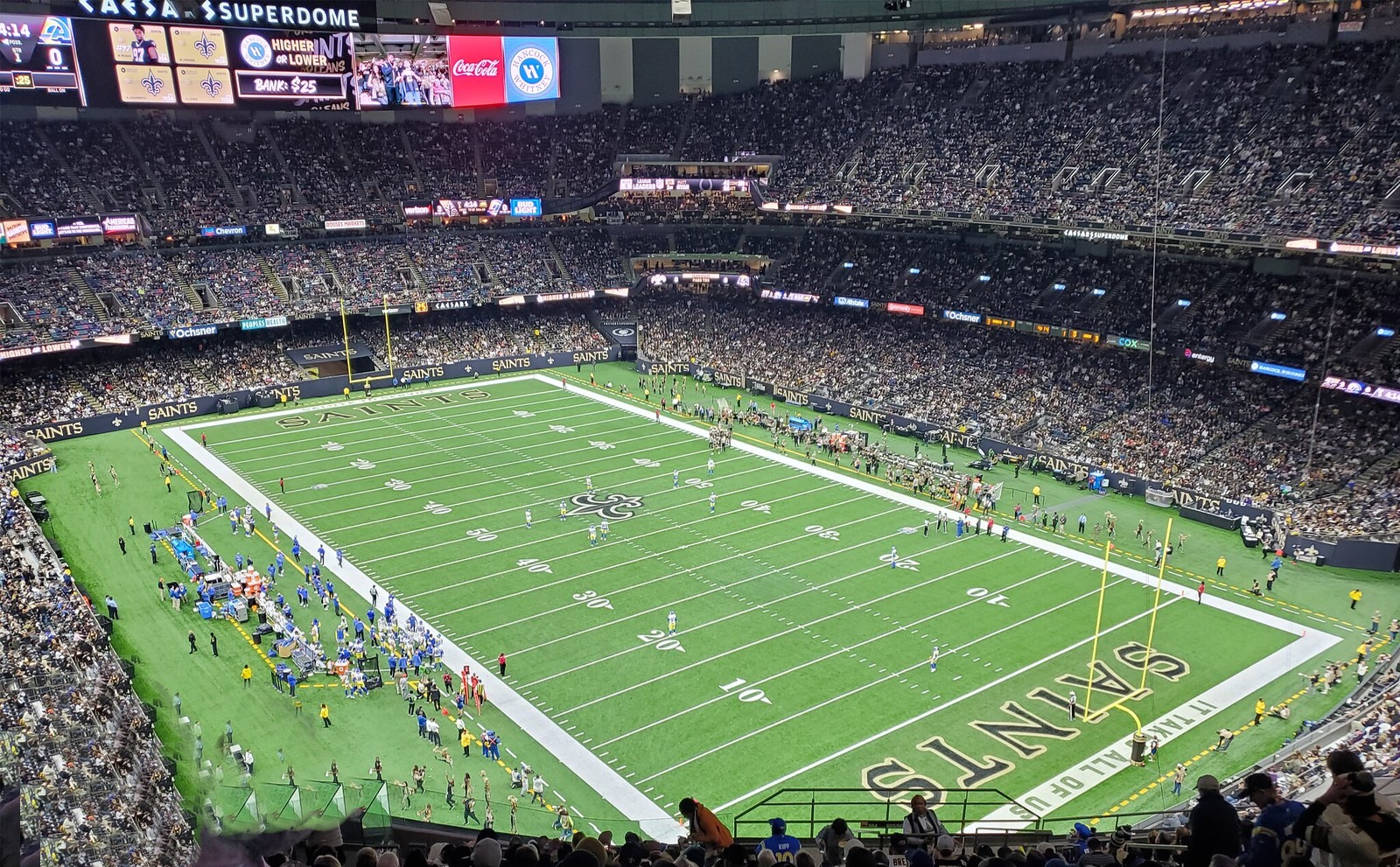
Current seating capacity is 73,208. The post-Katrina renovation of 2005-06 was designed solely to make it usable again. Another renovation was undertaken in 2011, to do some modernization -- which also ended the building's baseball capability. There has been talk of a new domed stadium to replace it, but no plans are underway.

Naming rights were sold in 2011, making it the Mercedes-Benz Superdome. The 2017 move of the Saints' arch-rivals, the Atlanta Falcons, to the new Mercedes-Benz Stadium confused matters, and Mercedes-Benz allowed their naming rights on the Superdome to lapse. In 2021, it became the Caesars Superdome, with the rights bought by the Caesars casino company.

The New Orleans Arena opened next-door in 1999. Since 2014, it has been named the Smoothie King Center. Since 2002, it has been home to the NBA team known as the New Orleans Hornets until 2013, and the New Orleans Pelicans ever since.

*

August 3, 1975 was a Sunday. These baseball games were played that day:

* The New York Yankees split a doubleheader with the Cleveland Indians at Shea Stadium, where they groundshared with the Mets while Yankee Stadium was being renovated. The Yankees won the opener, 12-1. George "Doc" Medich went the distance as the winning pitcher. Bobby Bonds, in perhaps his best game in his lone season as a Yankee, went 3-for-5 with 2 RBIs.

The Indians won the nightcap, 3-2. Larry Gura went 7 strong innings, but Dick Tidrow blew the game in the 8th inning. Rico Carty, who always seemed to hit the Yankees well, went 4-for-4 with a home run and 2 RBIs. Frank Robinson, in his 1st season as Major League Baseball's 1st black manager, was not yet retired as a player, but did not put himself into either game.

* The New York Mets were swept by the Pittsburgh Pirates, 5-4 and 4-3 at Three Rivers Stadium in Pittsburgh. The 1st game went 15 innings, when ex-Met Duffy Dyer hit a home run off Bob Apodaca, who pitched 4 innings in relief of Tom Seaver. Willie Stargell went 1-for-5 with 2 walks in the 1st game, and did not play in the 2nd game.

* The Philadelphia Phillies beat the Montreal Expos, 5-4 at the Olympic Stadium in Montreal. Tommy Hutton singled Mike Schmidt home with the winning run in the top of the 10th inning. Schmidt went 3-for-5 with a home run. Tug McGraw was the winning pitcher, in relief of Steve Carlton.

* The Boston Red Sox beat the Detroit Tigers, 6-4 at Fenway Park in Boston. Carl Yastrzemski went 0-for-4 with a walk, but Denny Doyle, Rick Burleson and Cecil Cooper hit home runs.

* The Milwaukee Brewers beat the Baltimore Orioles, 4-1 at Memorial Stadium in Baltimore. Hank Aaron went 1-for-4 with an RBI. Robin Yount went 1-for-3 with an RBI. Brooks Robinson went 0-for-3.

* A doubleheader between arch-rivals was split at Wrigley Field in Chicago. The Chicago Cubs won the 1st game, 6-3. The St. Louis Cardinals won the 2nd game, 7-4.

* The Minnesota Twins swept a doubleheader from the Chicago White Sox, 7-4 and 12-9 at Metropolitan Stadium in the Minneapolis suburb of Bloomington, Minnesota. Over the 2 games, Rod Carew went 3-for-7 with 2 walks and 3 RBIs.

* The Kansas City Royals beat the Oakland Athletics, 5-0 at Royals Stadium (now Kauffman Stadium) in Kansas City. Paul Splittorff allowed only 1 hit, a single by Claudell Washington in the 1st inning. George Brett went 2-for-4 with 3 RBIs. Reggie Jackson went 0-for-3.

* The California Angels beat the Texas Rangers, 6-4 at Arlington Stadium in the Dallas suburb of Arlington, Texas. Nolan Ryan started for the Angels, but pitched only 5 innings. The Angels' bullpen blew the lead, but they scored 2 runs in the top of the 9th to win it.

* The Atlanta Braves beat the San Diego Padres, 5-1 at San Diego Stadium (later renamed Jack Murphy Stadium and Qualcomm Stadium).

* The Cincinnati Reds beat the Los Angeles Dodgers, 3-1 at Dodger Stadium in Los Angeles. Pete Rose went 0-for-4. Johnny Bench did not play.

* And a doubleheader was split at Candlestick Park in San Francisco. The San Francisco Giants won the 1st game, 5-4. The Houston Astros won the 2nd game, 10-9.

Wednesday, June 22, 2022

June 22, 2020: The Protesting of the Andrew Jackson Statue

Many times, people have protested against the actions and/or plans of the man who was then the President of the United States. It usually doesn't happen to a President who has been long dead.

But, nearly 200 years after he was in office, Andrew Jackson remains a polarizing figure.

NOTE: My cutoff date for this project is 1869, the year of the completion of the Transcontinental Railroad, the 1st openly professional baseball team, and the 1st American football game. I had managed to work in references to most pre-1869 Presidents. This was the only way I could think of to do it for either Jackson or his successor, Van Buren.

June 22, 2020: A crowd unsuccessfully attempts to topple the equestrian statue of Andrew Jackson, in Lafayette Square, a block north of the White House in Washington, D.C. This was a part of the "Black Lives Matter" protests in the nation's capital over the preceding weeks. Both African-American and Native American activists wanted the statue removed, because of Jackson's actions toward their ancestors.

Former U.S. Senator Ben Nighthorse Campbell of Colorado, a Native American who had switched from the Democratic Party to the Republican Party during his tenure, defended the monument, advocating for it to remain, but also called for the addition of plaques to explain the complicated history of its subject.

The statue, sculpted by Clark Mills, was dedicated on January 8, 1853, what would have been Jackson's 86th birthday, and was the 1st equestrian (man on horseback) statue in America. Copies of it were dedicated in Jackson Square in New Orleans in 1856, at the Tennessee State Capitol in Nashville in 1880, and at Jacksonville Landing in Jacksonville, Florida in 1987. There are also statues of him at the State Capitol in Raleigh, North Carolina; and in front of the Jackson County Courthouse in Kansas City, Missouri.

Alone among America's 1st 46 Presidents, the birthplace of Jackson is undetermined. It is generally agreed that he was born in the Waxhaws, a rural region straddling what is now the State Line between North Carolina and South Carolina. He had family on both sides of that line, and both States claim him as one of their own. Based on the available evidence, South Carolina appears to be more likely, but we can't be sure.

Just as Barack Obama's enemies would lie and say he was born in Kenya, when it was conclusively proven that he was born in Honolulu, Hawaii, Jackson's enemies said that he wasn't born on American soil at all. Their story was that he wasn't born on any soil, but on a ship traveling from Ireland to America.

It is generally accepted that he was born on March 15, 1767, somewhere in the Waxhaws, and he definitely grew up on the South Carolina side. His father died before he was born, leaving his mother and his brothers desperately poor. He had absolutely no formal education, but was taught to read and write, and he never stopped educating himself: Although he was a rough-hewn country boy, he learned Greek and Latin as well as any lawyer in Boston, Philadelphia, Virginia -- or, given where he was, Charleston, South Carolina.

The War of the American Revolution was hard on the Carolinas. In 1781, he and his older brother Robert were captured by British soldiers. An officer demanded to have his boots polished. Both brothers refused, and the officer struck each with a blow to the head. Both brothers were taken to a prisoner-of-war camp, and contracted smallpox. Both were released because of this, but Robert died.

With this experience, their mother, Elizabeth, nursed American prisoners of war on a prison ship in Charleston, and she contracted cholera, and died. At 14, Andrew Jackson was an orphan with Scots-Irish heritage that was already predisposed to distrusting the British. Now, never having had a father, and having lost both his mother and his brother to the British, he hated them intensely, and had equal hatred for aristocracy and political privilege, which they seemed to symbolize.

He studied law in North Carolina. A friend, John McNairy, recommended they go west, to Tennessee, and practice law there. Both became among the State's founding fathers, and Jackson later appointed McNairy to be a federal Judge. In 1796, just after Congress granted Tennessee Statehood, he was elected one of the State's 1st Congressmen; in 1797, to the U.S. Senate; in 1798, as Justice of the State Superior Court; and in 1801, Colonel of the State Militia.

Four governmental posts in five years? At the time, leaving one office before one's term was up to take on a different office was rather common. The country was young, the Constitutional setup was even younger, and, at this point in the Congress' history, seniority was practically meaningless. Politicians went to the office where they seemed to be needed. This was especially true in newly-admitted States. It would be some time, even in the South, before Congressmen and Senators stayed put for decades.

Jackson married Rachel Donelson, but it turned out that her divorce from her previous marriage wasn't yet final. This scandal, hardly the fault of either of them, would follow them for the rest of their lives. His many public defenses of his wife led to some duels. Most ended peacefully, with each man firing his pistol into the air, and agreeing that the threshold of "honor" had been met. Jackson had done this in 1788, with a North Carolina lawyer and militia officer named Waightstill Avery; and in 1803 with John Sevier, the 1st Governor of Tennessee (the two men were alternately allies and rivals).

But an argument with lawyer Charles Dickinson over a horse race led to Dickinson slandering Rachel, and the duel was on. Since dueling was illegal in most States, but extradition from one State to another was usually difficult, it was agreed to meet across the State Line, in Adairville, Kentucky on May 30, 1806.

Dickinson was known as the best shooter in Tennessee, and he got a shot off before Jackson could, hitting him in the chest. It was deflected by a button on his coat and his breastbone, and lodged close to his heart. It remained in his body for the rest of his life. According to the dueling code, Dickinson was still required to face a shot from Jackson. That shot went right to the heart, and Dickinson was dead. He was just 25 years old. Jackson's reputation took as much of a hit as he did, but both did live on.

When the War of 1812 broke out, he was commissioned a Colonel in the U.S. Army, and later a Brigadier General and a Major General. (This would be the highest rank awarded in the U.S. Army until the Civil War.) He fought the British, and their Native American allies in the concurrent Creek War, winning the Battle of Horseshoe Bend on March 27, 1814, making the State of Alabama possible.

On January 8, 1815, his victory against long odds in the Battle of New Orleans made him a national hero. Seeing that Jackson was every bit as tough as they were -- by this point, he was 48, a year younger than George Washington was at Yorktown, 2 years younger than Napoleon, and carrying a 2nd bullet, in his left shoulder -- his troops gave him the nickname "Old Hickory," and he liked it.
He was a mass of contradictions. If you were loyal to him, he stood by you all the way; but at the slightest hint of disloyalty, you were out of his life. He was a slaveholder, but all reports, including from his surviving slaves, said that he treated them well.

He was not formally educated, but was self-educated and brilliant. He hadn't trained at the U.S. Military Academy at West Point -- of course, he couldn't have, as it wasn't founded until 1801 -- but he was the greatest General the U.S. Army had until the Civil War, when Ulysses S. Grant and William T. Sherman became candidates for that title. He was fabulously wealthy by the standards of his time, but, as a politician, supported the country's poor and opposed what then passed for big business, including big banks. And he was a lawyer, devoted to upholding the law, and yet a killer.

He commanded U.S. troops in the First Seminole War, leading to the annexation of Florida. In 1822, he was returned to the Senate by his adopted home State. In 1824, he ran for President. He finished 1st in both the popular vote and the Electoral Vote -- but didn't get a majority of the Electoral Vote. The House of Representatives had to choose the 6th President of the United States, and it chose John Quincy Adams. Jackson believed the election had been stolen from him through what became known as "The Corrupt Bargain": Henry Clay of Kentucky, then the Speaker of the House, who finished 3rd, swung his votes to Adams, and Adams appointed Clay Secretary of State.

Unlike Donald Trump nearly 200 years later, Jackson was smart about it. Instead of merely whining, or trying an insurrection -- and, as a military commander, he could have done it, but knew that it would be wrong -- he organized his supporters, turning the Democratic-Republican Party of Thomas Jefferson into a new Democratic Party. As Adams' Administration failed, Jackson ran again in 1828, and, this time in a two-horse race, he won easily. This was despite a very dirty campaign, in which both he and his wife were libeled. Rachel died between the election and the Inauguration, and he swore revenge against his enemies, thinking them responsible.

His 1st term was dominated by "The Petticoat Affair." Led by Floride Calhoun, wife of Vice President John C. Calhoun, the wives of Jackson's Cabinet members socially ostracized Secretary of War John Eaton and his wife, Peggy Eaton. Their private history, to put it politely, resembled that of Andrew and Rachel Jackson.

Thinking of Rachel, Jackson took the Eatons' side. Hoping to quell the controversy, Secretary Eaton resigned in 1831, and Jackson ended up firing and replacing every other member of his Cabinet -- except for his Secretary of State, who was a widower, and had stood up for the Eatons. His name was Martin Van Buren. In 1832, running for re-election, Jackson dumped Calhoun from the ticket, and got Van Buren nominated for Vice President. They overwhelmingly beat Clay in the election. Jackson later appointed Eaton to be Military Governor of Florida and U.S. Minister to Spain.

One unintended consequence of all this: Jackson's 2nd Attorney General, and later his 4th Secretary of the Treasury, was Roger Taney. In 1836, Jackson appointed him Chief Justice of the U.S. Supreme Court. In 1857, in Dred Scott v. Sandford, Taney ruled that black people were not American citizens, even if born free. Taney died before the abolition of slavery.

But the Taney appointment might not be Jackson's worst decision. In 1830, he signed the Indian Removal Act, which displaced tens of thousands of Native Americans from their ancestral homelands east of the Mississippi, and resulted in thousands of deaths. It was a horrible thing to do, and Native Americans have hated him ever since. Some won't take a $20 bill, because his picture is on it. They'll take two tens, but not a twenty.

It's worth mentioning, though, that, at the time, while the Indian Removal Act was opposed by such Congressional figures as Clay and Jackson's Tennessee rival, David Crockett (despite his status as a folk hero thanks to a 1950s TV show, he was never called "Davy" in his lifetime), nobody came up with a better idea. And Jackson's justification was that, had the Natives stayed, they would have been wiped out by white men, anyway. That doesn't absolve Jackson, but it does put his choice in perspective.

Jackson faced a challenge to the integrity of the federal union when South Carolina threatened to nullify a high protective tariff set by the federal government. Jackson threatened the use of military force to enforce the tariff, but the crisis was defused when the tariff was amended.

In 1832, he vetoed a bill by Congress to reauthorize the Second Bank of the United States, correctly arguing that it was a corrupt institution. In 1835, Jackson became the only President to pay off the national debt, and the 1st to survive an assassination attempt. When he left office after 2 terms on March 4, 1837, he was still immensely popular, but also widely hated. And he still was both when he died on June 8, 1845.
Photograph taken in 1845, not long before he died.
"Looks like a monkey," he said, being used to flattering paintings.

Four different men who held the Presidency have called Jackson their favorite President: Franklin Roosevelt, Harry Truman, Lyndon Johnson and Donald Trump. Trump put a portrait of Jackson in the Oval Office. It was suggested that he did so because Jackson was a fellow racist.

What would Jackson have thought of Trump? A big businessman? A dealer with big banks? A draft dodger? A man who treated his wives badly? A crook? A traitor? When he left office, Jackson was asked if he had any regrets. He said, "I regret I was unable to shoot Henry Clay or to hang John C. Calhoun." The distinction being that he considered Clay a common criminal, worthy of being shot; and Calhoun a traitor, where the traditional penalty is hanging.

Many locations in America have been named for Jackson, including the capital of Mississippi; Jacksonville, the largest city (but not the seat of the largest metropolitan area) in Florida; a city in Tennessee, whose name became the title of a hit song by country music legends June Carter & Johnny Cash; the town in Ocean County, New Jersey, where Six Flags Great Adventure, one of the country's leading theme parks, is located, including a frontier theme that Jackson himself might have appreciated; and Jackson Heights, a neighborhood in Queens, New York City. Counties in 21 States have been named for him, including in Missouri, which also has a Hickory County, named for his nickname.

New York City has a high school and an elementary school named for Jackson. Oddly, neither is in Jackson Heights: The high school is in Cambria Heights, and the public school is in Flushing. There are also Andrew Jackson High Schools in Miami and, as you might expect, in Jacksonville, Florida; and in his home State of South Carolina, in Kershaw, in the Waxhaws from whence he came.

Speaking of which: Jackson was the 1st President born in South Carolina, and remains the last one with a connection to it; and the 1st President to represent Tennessee. Van Buren was the 1st President from New York.

The USS President Jackson was an attack transport that served the U.S. Navy from 1941 to 1955. The USS Andrew Jackson was a submarine, in service from 1963 to 1989. A Jackson Highway ran from Chicago to New Orleans, although it has mostly been phased out.

Among the actors who have played Jackson: Lionel Barrymore twice, in The Gorgeous Hussy in 1936, with Joan Crawford as Peggy Eaton, and Lone Star in 1952; Hugh Sothern in The Buccaneer, a film about the Battle of New Orleans and the pirate Jean Lafitte, in 1938; Brian Donlevy in The Remarkable Andrew in 1942; Charlton Heston twice, in The President's Lady in 1953, with Susan Hayward as Mrs. Eaton, and in a 1958 remake of The Buccaneer; Basil Ruysdael in Davy Crockett, King of the Wild Frontier in 1955; Wesley Addy in The Adams Chronicles in 1976; and Kris Kristofferson in Texas Rising in 2015.

In 2008, Michael Friedman created the musical Bloody Bloody Andrew Jackson, a comedic look at the man and the myth. It reached Broadway in 2010, starring Benjamin Walker, who would double down in 2012, taking the title role in the film Abraham Lincoln: Vampire Hunter.

Jackson's portrait has appeared on the $20 bill since 1928. Since 2016, there has been a plan to replace him on the bill with abolitionist Harriet Tubman. As of June 22, 2022, it hasn't happened yet.

Jackson's 2nd Vice President and successor, Martin Van Buren, was a masterful politician before reaching the Presidency, but not very good in it. He served in the New York State Senate, as his State's Attorney General, as a U.S. Senator, briefly as Governor, and as Jackson's Secretary of State and then Vice President. In 1836, he beat William Henry Harrison for President.
But the Panic of 1837 hit early in his Presidency, and he never recovered. A Second Seminole War didn't help, and his refusal, as an abolitionist, to allow the admission of Texas as a slave State cost him a great deal of support. In 1840, Harrison won a rematch.

Counties are named for Martin Van Buren in Michigan, Iowa, Arkansas and Tennessee. Towns are named for him in 14 States, including, strangely, 12 in Indiana. New York City has a Martin Van Buren High School in Queens Village. Only one U.S. Navy ship has been named for him, a schooner launched during his Administration, and in service from 1839 to 1847.
Statue, Kinderhook, New York

He was played by Charles Trowbridge in The Gorgeous Hussy in 1936, Francis Sayles in Man of Conquest in 1939, and Nigel Hawthorne in Amistad in 1997.

The last surviving member of Jackson’s Cabinet, and also the last of Van Buren's Cabinet, was Amos Kendall, who served as Postmaster General from 1835 to 1840. He lived until 1869.

*

June 22, 2020 was a Monday. COVID restrictions were in effect, so there were no sporting events on this historic day.

December 31, 1999 & January 1, 2000: The Millennium

December 31, 1999:  The Millennium arrives. The people of planet Earth survived. At a terrible cost. But we hadn't destroyed ourselves. ...