Showing posts with label lefty grove. Show all posts

Monday, December 12, 2022

December 12, 1933: The 2nd Athletics Fire Sale

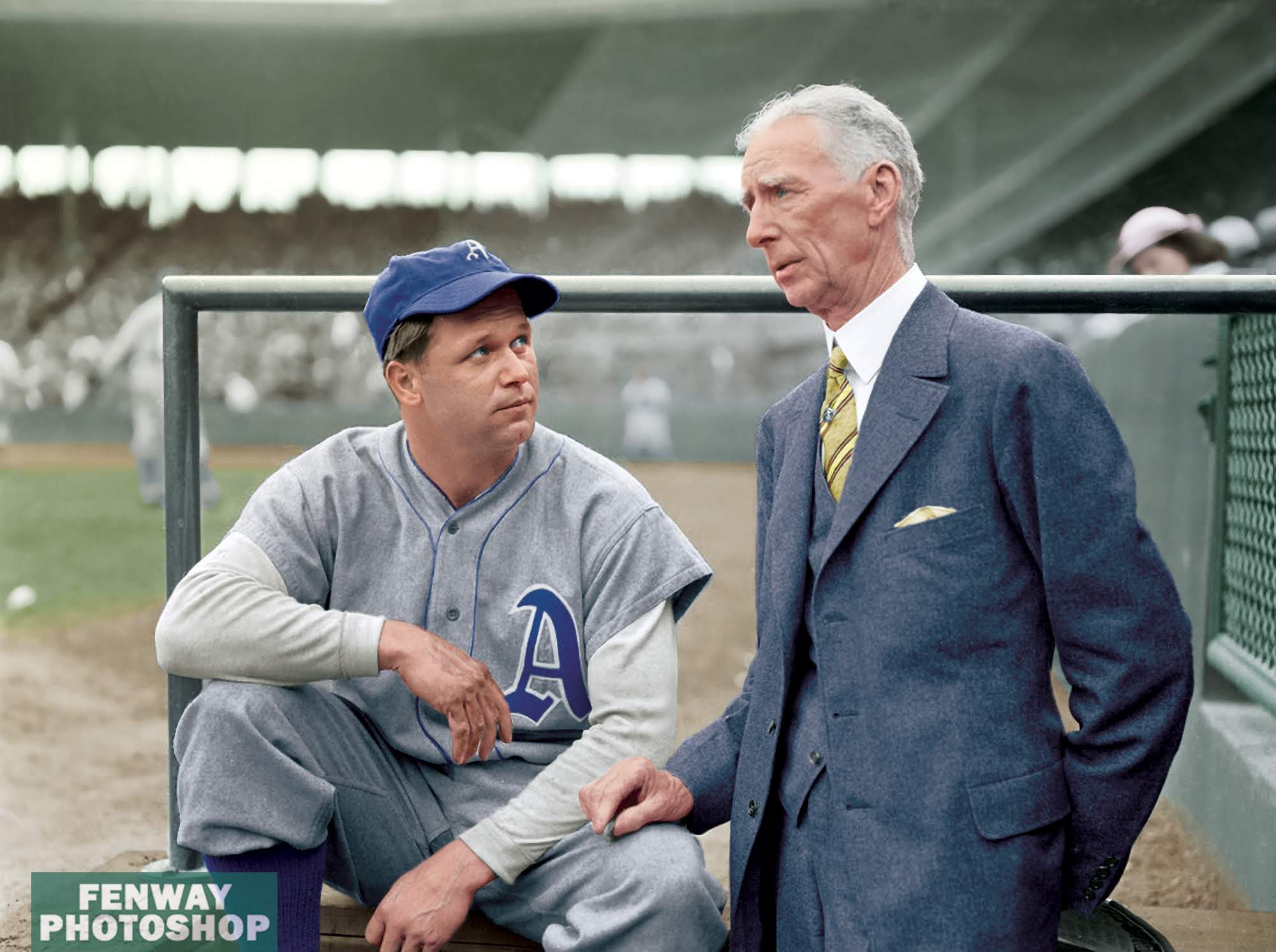
Jimmie Foxx (left) and Connie Mack

September 28, 1932: Connie Mack begins the breakup his of his Philadelphia Athletics. The 1st time he'd done so, in 1914-15, it was because he couldn't keep up with the salaries being offered by the Federal League teams. This time, it was personal.

In 1925, the A's went 88-64, and were only 8 1/2 games behind the 1st-place Washington Senators. But the rise of the "Murderers' Row" Yankees delayed Philadelphia's return to greatness. In 1929, they began a run of 3 seasons in which they won 313 games, and game within a Game 7 loss in 1931 of winning 3 straight World Series.

But Mack lost all of his non-baseball holdings in the stock market Crash of 1929. He couldn't fund the A's with any other income. So, after the 1932 season, despite a strong 94-60 record (but 13 games behind the Pennant-winning Yankees), he began to sell of his 2nd generation of stars.

On September 28, 1932, he sent left fielder Al Simmons, 3rd baseman Jimmy Dykes, and center fielder Mule Haas are all sold to the Chicago White Sox, for $100,000. Simmons would be elected to the Baseball Hall of Fame, and Dykes and Haas would have been perennial All-Stars had the All-Star Game been founded before 1933.

But the big day was December 12, 1933, when Mack made 3 separate moves:

* Pitchers Lefty Grove and Rube Walberg, and 2nd baseman Max Bishop, are traded to the Boston Red Sox for Bob Kline and Rabbit Warstler and $125,000. Along with Carl Hubbell, Grove was 1 of the 2 best lefthanded pitchers in the game, and would go to the Hall of Fame. Walberg was the 3rd starter on the A's, behind Grove and George Earnshaw, but would have been the ace on many teams.

Key to this deal was the fact that Tom Yawkey had recently turned 30 and come into his inheritance, and had bought the Red Sox, and could afford to spend whatever he wanted to build a championship team. He did try, but the Yankees' dynasty that was restarted in 1936 thwarted his early efforts.

Grove's 199 wins during the 1930s made him the winningest pitcher of the decade.

* Catcher Mickey Cochrane was traded to the Detroit Tigers for Johnny Pasek and $100,000. The Tigers subsequently named Cochrane player-manager, and won the next 2 American League Pennants.

* Finally, before the ink was dry on the previous 2 trades, Mack traded Pasek and Earnshaw to the White Sox for Charlie Berry and $100,000. So, in 1 day, Mack sold off his 3 best pitchers.

The A's went from 94-60 in 1932 to 79-72 in 1933, to 68-82 in 1934, to 58-91 in 1935. On December 10, 1935: 1st baseman Jimmie Foxx and pitcher Johnny Marcum were traded to the Red Sox for Gordon Rhodes, George Savino and $150,000. Foxx was the best righthanded slugger in the game, and would go to the Hall of Fame. Marcum was the Mackmen's best pitcher following the '33 fire sale, and Mack dumped him, anyway.

The A's never recovered, and the Mack family ended up selling the A's in 1954, to a buyer who moved them to Kansas City. They failed there as well, and Charlie Finley bought them in 1960, moving them to Oakland in 1968. After 5 straight AL Western Division titles, 1971-75, including 3 straight World Series wins, 1972-74, he broke them up, and the team crashed. New owner Walter Haas rebuilt them in the early 1980s, but the pitching collapsed, preventing a new dynasty. The A's rebuilt again, and won 3 straight Pennants, 1988-90, but after another Division title in 1992, were broken up again.

The pattern held: By 2000, the "Moneyball" regime built a team that reached the Playoffs 5 times in 7 years, but won no Pennants. They sold off, rebuilt, and made 3 straight Playoffs, 2012-14. They couldn't afford to keep it going, sold off, rebuilt, and made 3 straight Playoffs, 2018-20. They couldn't afford to keep it going, and sold off. In 2022, the A's lost 102 games, their most since the Finley fire sale bottomed out at 108 in 1979.

Rumors of the A's moving again have been renewed, since they haven't been able to get a deal to replace the Oakland Coliseum. If they do move, how long will it be before they win again? And, if so, how long before they have a 9th fire sale?

One thing is for sure: The A's are not moving back to Philadelphia, where the Phillies, having won the 2022 NL Pennant, are overwhelmingly popular. The city can certainly support one winning team, but not two teams. But, wherever they go, or if they stay, at some point, the A's will go back to their Philadelphia roots, and break it all down and start all over again.

In 1949, Ogden Nash, my grandmother's favorite poet, wrote "Line-Up for Yesterday" for Sport magazine, an alphabetical list of star players. For the letter Q, Nash had to cheat a little, and wrote:

Q is for Don Quixote
Cornelius Mack;
Neither Yankees nor years
Can halt his attack.

He also had to cheat a little for the letter X:

X is the first

of two x's in Foxx
Who was right behind Ruth
with his powerful soxx.

*

December 12, 1933 was a Tuesday. Baseball was out of season. The NBA hadn't been founded yet. The NFL was going to play its 1st official Championship Game the following Sunday, and the Chicago Bears won it, 23-21 over the New York Giants.

There were 4 games played in the NHL that night:

* The Toronto Maple Leafs beat the Boston Bruins, 4-1 at the Boston Garden. This was the game in which Eddie Shore hit Ace Bailey over the head with his stick, ending his career. I have a separate entry for that event.

* The New York Americans beat the New York Rangers, 3-0 at the old Madison Square Garden, which was still fairly new at the time. The company that ran the Garden owned the Rangers, and the Amerks were tenants, so any win the tenants had over the landlords was considered big.

* The Detroit Red Wings beat the Chicago Black Hawks, 4-1 at the Olympia Stadium in Detroit.

* And the Montreal Canadiens and the Ottawa Senators played to a 1-1 tie at the Ottawa Auditorium.

Wednesday, April 20, 2022

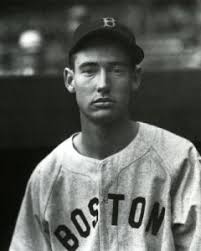
April 20, 1939: Ted Williams' 1st Major League Game

April 20, 1939: It is Opening Day at Yankee Stadium, and the New York Yankees are hosting the Boston Red Sox.

A pair of Hall-of-Fame pitchers start against each other: Charles Herbert "Red" Ruffing for the Yankees, and Robert Moses "Lefty" Grove for the Red Sox, formerly the ace of the Philadelphia Athletics. Between them, these 2 men appeared on 10 of the 14 American League Pennant-winners from 1929 to 1942. Grove won 300 games, Ruffing 273 -- 231 of them with the Yankees, still the most of any Yankee righthanded pitcher.

In fact, this game was loaded with Hall-of-Famers. The Yankees had center fielder Joe DiMaggio, catcher Bill Dickey, and 2nd baseman Joe Gordon. while another pitcher, who did not get into the game, was Vernon "Lefty" Gomez.

The Red Sox had 1st baseman Jimmie Foxx, who would eventually reach 534 career home runs, making him, at the time, 2nd on the all-time list behind Babe Ruth. They also had 2nd baseman Bobby Doerr, and their shortstop, also their manager at the time, Joe Cronin.

But the game would be more notable for 2 other future members of the Hall of Fame. And while one was fading, another debuted.

Lou Gehrig had a difficult Spring Training, and opened the season by going 0-for-4. He was noticeably slower with swinging the bat and playing 1st base. He would end up playing only 8 games that season, going 4-for-33, a batting average of .143. On May 2, he told manager Joe McCarthy that he wanted to be taken out of the lineup, ending his consecutive games played streak at 2,130. Until the 1990s, nobody even thought that record was approachable.

Gehrig soon went to the Mayo Clinic, and found out he had amyotrophic lateral sclerosis, a nerve-and-muscle disease that now bears his name. He died 2 years later.

But in this April 20, 1939 game, a 20-year-old left fielder from San Diego made his major league debut: Theodore Samuel Williams. He played right field, not the left field by which he would be remembered, and wore Number 9, which he would wear throughout his career. He struck out against Ruffing in the 2nd inning. But in the 4th, he hit a double to right-center field. He struck out again in the 6th, and popped up to 2nd in the 9th.

Dickey led off the bottom of the 2nd with a home run off Grove. With 1 out in the 5th, Rolfe reached 1st on an error by Foxx, and was driven in on a triple by Jake Powell. In spite of Williams' debut, the Yankees win, 2-0, and go on to win the World Series.

From 1938 to 1949, the Red Sox would finish 2nd to the Yankees 6 times, and would finish 3rd an additional 3 times in the 1950s. But only twice did they finish ahead of the Yankees in any season from 1919 to 1965: In 1946 and 1948.

There was no Rookie of the Year award in 1939. If there had been, Ted would have won it easily, batting .327, hitting 31 home runs, and leading the American League with 344 total bases and 145 runs batted in -- the 1st rookie ever to lead the AL in RBIs.

He soon developed nicknames. He seemed really young, so they called him "The Kid." He was thin, but could hit, so they called him "The Splendid Splinter." He hit hard, so they called him "The Thumper." And, at some point in his career, he became so much the symbol of baseball in New England, that he was known as "Teddy Ballgame."

Sometimes, he would call himself "Ol' TSW" for his initials. Sometimes, he called himself "Ted Fucking Williams." Or "Teddy Ballgame of the MFL." Asked to explain, he said, "That's the Major Fucking Leagues."

*

April 20, 1939 was a Thursday. This was also the day on which Billie Holiday recorded the anti-lynching song "Strange Fruit." I have a separate entry for that event.

Football was out of season. The NBA hadn't been founded yet. The NHL season ended 4 days earlier, when the Boston Bruins won the Stanley Cup, defeating the Toronto Maple Leafs in 5 games.

There were 4 other games played in baseball that day:

* The Brooklyn Dodgers beat their arch-rivals, the New York Giants, 5-3 at Ebbets Field. Mel Ott hit a home run in defeat for the Giants.

* The Boston Bees beat the Philadelphia Phillies, 2-0 at National League Park in Boston. Lou Fette pitched a 3-hit shutout. This was the 4th of 5 seasons in which the Boston team of the NL used "Bees" instead of "Braves," and had Braves Field renamed. In 1941, they switched back.

* The Philadelphia Athletics beat the Washington Senators, 2-0 at Shibe Park in Philadelphia. George Caster pitched a 4-hit shutout.

* And the Detroit Tigers beat the Chicago White Sox, 8-7 at Briggs Stadium in Detroit. (It was renamed Tiger Stadium in 1961.) Dixie Walker and Hank Greenberg hit home runs for the Tigers, Greenberg's being what would now be called a walkoff in the bottom of the 14th.

Saturday, April 16, 2022

April 16, 1940: Bob Feller's Opening Day No-Hitter

April 16, 1940: It is the Opening Day of a new baseball season. At Comiskey Park in Chicago, the Cleveland Indians beat the Chicago White Sox 1-0. Bob Feller pitches a no-hitter.

It's not close to a perfect game: He walked 5 batters, and a batter reached base on an error. Rollie Hemsley's triple in the 4th inning brought home the game's only run. It was the 1st of 27 games that Feller would win that season, a career high.

This was the 1st of 3 no-hitters that Feller went on to pitch, on top of 12 one-hitters. He would later say that his 2nd no-hitter, against the New York Yankees on April 30, 1946, was the highlight of his baseball career. He said, "The no-hitter on opening day in Chicago is the one that gets all the attention. But my no-hitter at Yankee Stadium was against a much better team than the White Sox. There was no comparison. I had to pitch to Tommy Henrich, Charlie Keller and Joe DiMaggio in the 9th inning to get the Yankees out." His 3rd no-hitter came against the Detroit Tigers on July 1, 1951.

This game remains the only no-hitter ever pitched in a team's opening game of the season, although the expansion of the MLB schedule means that no-hitters have been pitched earlier in the calendar year. Through the 2022 season, the record was set by Hideo Nomo, then with the Boston Red Sox, against the Baltimore Orioles, on April 4, 2001.

And yet, Feller was almost topped on that Opening Day. The Boston Red Sox beat the Washington Senators, 1-0 at Griffith Stadium in Washington. President Franklin D. Roosevelt threw out the ceremonial first ball, making him 8-for-8 on Opening Days, setting a record that has not been seriously approached. He would make it an absolutely unbreakable (due to the later 22nd Amendment) 9-for-9 the next year, but decided not to do it while World War II was in progress.

Lefty Grove outpitched Dutch Leonard, allowing only 2 baserunners, and taking a perfect game into the 8th inning. But he started that inning by giving up a fly ball to Gerald "Gee" Walker, and Boston's left fielder dropped it, before throwing him out at 2nd base. Then Grove gave up singles to Cecil Travis and Jimmy Bloodworth, before stranding them.

That left fielder went 2-for-4 that day. His name was Ted Williams. Jimmie Foxx went 1-for-2 with 2 walks. But the only run of the game came in the top of the 2nd, when Grove himself singled Bobby Doerr home.

*

April 16, 1940 was a Tuesday. Queen Margarethe II of Denmark was born.

These other baseball games were played that day:

* The New York Yankees lost to the Philadelphia Athletics, 2-1 at Shibe Park. Cliché Alert: Walks can kill you. Charles "Red" Ruffing got the 1st out in the bottom of the 10th inning, but walked Frankie Hayes, gave up a double to Al Rubeling, walked Dee Miles, and gave up a game-losing sacrifice fly to the opposing pitcher, Alfred "Chubby" Dean, who also went the distance. (He was no relation to Dizzy Dean, and, being listed at 5-foot-11 and 181 pounds, he wasn't all that chubby.)

As so often happened early in his career, Joe DiMaggio was injured in Spring Training, and did not play on Opening Day. This was also the Yankees' 1st season opener without Lou Gehrig in the lineup since 1925.

* The New York Giants lost to the Philadelphia Phillies, 3-1 at the Polo Grounds. Kirby Higbe, who would help pitch the Dodgers to the Pennant the next year, outpitched Hall-of-Famer Carl Hubbell. Gus Suhr drove in the Phils' runs with a home run. Mel Ott went 0-for-2 with 2 walks.

* The Brooklyn Dodgers beat the Boston Bees, 5-0 at National League Park in Boston. Whitlow Wyatt pitched a 5-hit shutout. Dolph Camilli went 2-for-4 with 3 RBIs. This would be the 5th and final year of the Boston's team's rebrand (as we would say today), after a disastrous 1935 season. In 1941, they went back to calling themselves the Boston Braves, and their stadium Braves Field.

* The Cincinnati Reds beat the Chicago Cubs, 2-1 at Crosley Field in Cincinnati. Paul Derringer outpitched Bill Lee (no relation to the later Red Sox pitcher of the same name). Frank McCormick and Ival Goodman hit home runs for the Reds, Augie Galan for the Cubs. Ernie Lombardi went 1-for-4.

* The St. Louis Browns beat the Detroit Tigers, 5-1 at Briggs Stadium (later Tiger Stadium). George Coffman outpitched Bobo Newsom. Hank Greenberg went 0-for-4, but drove in the Tigers' only run with a groundout.

* And the Pittsburgh Pirates beat the St. Louis Cardinals, 6-4 at Sportsman's Park in St. Louis. Virgil Davis hit a home run for the Bucs, and Joseph "Arky" Vaughan went 3-for-5 with 2 RBIs. Paul Waner struck out as a pinch-hitter, and his brother Lloyd did not play.

Football was out of season. The NBA hadn't been founded yet. The NHL season had ended 3 days earlier, when the New York Rangers beat the Toronto Maple Leafs to win the Stanley Cup.

December 31, 1999 & January 1, 2000: The Millennium

December 31, 1999:  The Millennium arrives. The people of planet Earth survived. At a terrible cost. But we hadn't destroyed ourselves. ...